Bank of Shanghai: The Financial Engine of China's Commercial Capital
I. Introduction & The Financial Core of China's Economic Engine
Walk east along Yincheng Middle Road in Pudong on a weekday morning and a procession of glass towers displays the logos of the institutions that finance China: the People's Bank of China's Shanghai head office, the futures exchange, the clearing house, and a dozen foreign banks with their Asia-Pacific nameplates. Standing within that skyline is the headquarters of 上海银行 Bank of Shanghai Co., Ltd., an institution little known outside China that, by the end of June 2026, carried RMB 3.42 trillion of assets on its balance sheet — roughly USD 480 billion, larger than all but a handful of European banks.1
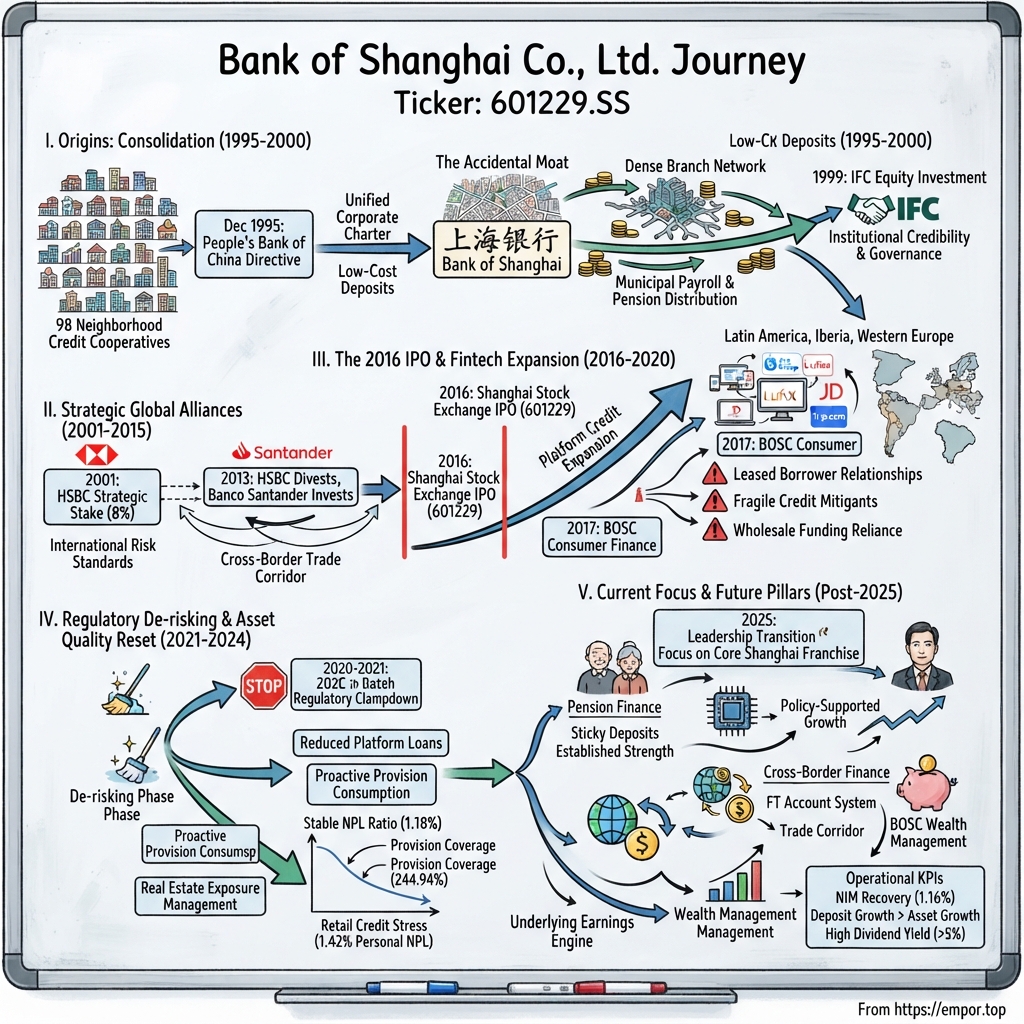
Yet this institution did not begin as a unified bank. It originated as 98 separate neighborhood credit cooperatives scattered across Shanghai's districts, each with its own loan book, management, and in many cases, silent solvency challenges. In December 1995, under the direction of the 中国人民银行 People's Bank of China, those 98 entities were consolidated into a single corporate charter and instructed to operate as a modern commercial bank. Thirty-one years later, that amalgamation ranks among the largest publicly listed banks in Asia.
That evolution mirrors the trajectory of modern Chinese financial reform: state-directed consolidation, an early experiment with foreign equity capital, an initial public offering delayed by a full decade, a fintech expansion that generated rapid growth followed by regulatory tightening, and a sustained period of margin compression as China's banking sector adjusts to lower interest rates.
The core thesis worth testing. Chinese 城商行 city commercial banks occupy a distinct structural position. They are neither national state-owned giants nor community banks in the Western sense. Functionally, they operate as treasury arms for municipal economies — integrated into local government finance, state-owned enterprise (国有企业 SOE) cash management, and municipal payroll and pension distribution. When that municipality is Shanghai — China's wealthiest city, primary financial center, and anchor of the 长三角 Yangtze River Delta industrial corridor — that position carries substantial structural value.
However, structural value does not automatically guarantee long-term durability. The bull thesis posits that Bank of Shanghai's position in municipal treasury management and Shanghai's pension disbursement system generates low-cost, sticky deposits that cushion the bank against yield compression better than its peers. The bear thesis contends that sector-wide headwinds — regulatory pressure to lower loan rates to support economic growth and increased competition from large state-owned lenders expanding into local markets — continue to squeeze earnings, noting that the bank's net interest margin has compressed to 1.16%.2
Both perspectives capture elements of the bank's financial reality. Evaluating the business requires testing both arguments against Bank of Shanghai's thirty-year operational record rather than relying solely on official targets.
The structure of the story. The analysis begins with the 1995 consolidation and the institutional position it established. It then examines the foreign-capital era — marked by investments from the International Finance Corporation, HSBC, and Banco Santander — to assess what those strategic partnerships produced in operational terms. It covers the 2016 listing and subsequent platform-lending expansion, which together explain the subsequent multi-year de-risking phase. Finally, it reviews current segment economics, the 2025 leadership transition that returned 顾建忠 Gu Jianzhong back to the bank, and the key metrics that measure operational performance quarter by quarter.
Management anchors its long-term strategy on four core pillars: 养老金融 pension finance, 科技金融 technology finance, 跨境金融 cross-border finance, and wealth management through its subsidiary 上银理财 BOSC Wealth Management.1 Pension finance represents an established structural strength built over three decades. The remaining three represent newer strategic initiatives whose long-term profitability remains to be demonstrated. Distinguishing core franchise strengths from developing initiatives forms the primary task of this analysis.
That examination begins in 1995, with an administrative directive that few at the time recognized as the founding moment of a financial powerhouse.
 Subscribe on LinkedIn
II. Origins: The Great Consolidation of Shanghai's Urban Credit Unions (1995 – 2000)
Understanding why 98 credit cooperatives were merged requires examining their origins. In the 1980s, as China's economic reforms created space for private and collective enterprise, the formal banking system — four large state-owned banks organized around specific industrial sectors — largely ignored small borrowers like neighborhood shops or local machine workshops. 城市信用社 Urban credit cooperatives filled that gap: small, locally chartered deposit-takers, often sponsored by a district government or neighborhood committee, that gathered savings from residents and extended credit to nearby small businesses.
While these cooperatives met an immediate need, their operational foundations were weak. Credit assessment often depended on personal connections rather than financial analysis. Capital buffers were thin, and related-party lending to sponsoring entities was widespread. By the early 1990s, as inflation accelerated and speculative property and trading activity expanded across coastal cities, a significant portion of urban credit cooperatives across China became functionally insolvent, holding uncollectible loans against deposits from unsuspecting retail savers.
The People's Bank of China, which then acted as both regulator and central bank, chose consolidation rather than liquidation. The strategy sought to prevent widespread small bank failures that could undermine public confidence in the financial system. By pooling assets and liabilities into single, capitalized, and professionally supervised municipal institutions, regulators aimed to use operational scale and time to resolve non-performing loans. Shenzhen executed the first such consolidation in 1995, and Shanghai followed months later.
December 1995: one charter, 98 balance sheets. 上海城市合作银行 Shanghai City Cooperative Bank was established that month, absorbing 98 urban credit cooperatives across the municipality along with the Shanghai Union of City Credit Cooperatives, the umbrella body that had loosely coordinated them.1 The structural transformation was swift. Overnight, dozens of independent institutions became branch offices, while their leaders either stepped into branch management roles or retired. Loan portfolios of inconsistent quality were combined into a single ledger, leaving the new entity with both valuable commercial ties and legacy credit risks.
The newly established bank did not receive a clean balance sheet, but an inherited workout portfolio. Its initial years focused on balance-sheet triage: identifying recoverable loans, establishing standardized underwriting procedures, and implementing foundational commercial banking infrastructure, including a unified accounting system and central treasury operations. The institution renamed itself 上海银行 Bank of Shanghai Co., Ltd. in 1998, dropping "cooperative" from its title to signal its intent to function as a commercial lender rather than a restructuring vehicle.1 While the renaming was symbolic, the underlying operational overhaul was substantive.
The accidental moat. The consolidation unexpectedly generated the bank's most durable competitive advantage. Because the 98 credit cooperatives were deeply embedded throughout Shanghai's urban districts, the merged entity inherited a dense physical branch network that national banks had not established for retail banking. Furthermore, Shanghai's district governments, municipal infrastructure vehicles, and local state-owned enterprises required an accessible and responsive financial partner, making the new institution the natural primary repository for their operating accounts.
This operational relationship established a low-cost funding engine. Bank profitability depends primarily on the net interest margin between funding costs and asset yields. The lowest-cost funding source in commercial banking is neither retail savings nor wholesale borrowing, but transactional operating deposits required for daily payroll, vendor payments, and receivables collection. These balances carry negligible interest costs, show little sensitivity to prevailing rates, and remain sticky because switching providers requires restructuring an organization's entire payment infrastructure.
Bank of Shanghai secured a substantial portion of these transactional balances in its first decade, primarily through the municipal retirement system. As Shanghai established its social insurance disbursement framework in the late 1990s, the bank acquired a commanding share of the accounts used to distribute pension payments to retirees. Each account provides low-cost, recurring deposit balances that automatically renew each month, establishing long-term customer relationships. Subsequent analysis will evaluate the volume of municipal pension flows the bank handles and assess the durability of this core low-cost deposit franchise.
The first foreign shareholder. In 1999, Bank of Shanghai became one of the earliest Chinese commercial lenders to admit foreign equity capital. The International Finance Corporation (国际金融公司 IFC), the private-sector lending arm of the World Bank Group, acquired an equity stake in the institution.1
Although the financial size of the IFC investment was modest, its strategic impact was significant. At a time when Chinese commercial banks were widely viewed by international investors as opaque and undercapitalized, securing equity investment from a World Bank affiliate provided institutional credibility. The partnership also introduced external oversight of the bank's credit portfolio and established formal corporate governance standards.
The analytical takeaway from this initial phase is clear. Bank of Shanghai's primary competitive asset was not created through organic strategic execution, but inherited through a government-directed merger and subsequently maintained. While this legacy structural positioning creates high barriers to entry — as competitors cannot easily duplicate decades of municipal payment relationships — it also highlights a key analytical distinction: the bank has demonstrated greater capability in preserving an inherited franchise than in building new competitive advantages from scratch.
The IFC investment marked the initial phase of foreign partnership. The bank subsequently undertook a broader effort to integrate international banking practices into its operations.
III. Strategic Global Alliances: The HSBC & Banco Santander Era (2001 – 2015)
In 2001, with China's accession to the World Trade Organization months away, major international banks evaluated how to gain exposure to the country's banking growth despite restrictions on foreign bank ownership and the high cost of building nationwide branch networks. Most settled on strategic minority stakes: purchasing 5% to 20% equity in a domestic lender, seconding executives, signing technical cooperation agreements, and awaiting market expansion.
HSBC, possessing extensive history in Chinese commercial banking, acquired an 8% equity stake in Bank of Shanghai in 2001.1 The investment marked one of the earliest foreign stake purchases in China's banking sector and represented an unusual endorsement for a city commercial lender rather than a national state-owned bank.
What did HSBC actually deliver? Conventional narratives emphasize that HSBC introduced international risk management, corporate governance standards, and credit assessment frameworks to a domestic city bank. That argument holds partial merit: following 2001, Bank of Shanghai established formal credit-approval workflows, board committee structures, and risk-reporting protocols that had not previously existed in structured forms.
Yet strategic equity partnerships across Chinese banking generally produced less operational change than announced. Foreign strategic investors typically held minority board representation, possessed no executive authority over corporate strategy, and faced significant cultural and regulatory divides between head offices in London or Madrid and local credit committees. This limitation became evident from 2009 onward, as foreign financial institutions systematically trimmed or fully divested their holdings in Chinese banks.
HSBC's exit aligned with that industry-wide re-evaluation. Under Chief Executive Stuart Gulliver, HSBC systematically liquidated non-core minority holdings during the early 2010s to improve capital efficiency, placing its Bank of Shanghai stake up for sale.
December 2013: Santander steps in. On December 10, 2013, HSBC agreed to sell its 8% holding in Bank of Shanghai to Banco Santander as part of its broader program to exit minority investments and boost capital returns.3 Santander's total financial commitment — comprising the stake purchase and an accompanying strategic cooperation agreement — was valued at approximately EUR 470 million, establishing the Spanish lender as Bank of Shanghai's second-largest shareholder and primary international partner.4 The transaction closed in the first half of 2014.
Santander's rationale differed from HSBC's earlier strategy. Where HSBC sought a broad option on Chinese economic growth in 2001, Santander pursued trade corridor integration in 2013. The Spanish bank's footprint across Latin America, Iberia, and Western Europe aligned with the expansion routes of Shanghai-based exporters and multinational corporations. The strategic cooperation agreement targeted wholesale banking, trade finance across Europe and Latin America, and cross-border cash management for Shanghai corporate clients expanding overseas.4
While structurally tailored to cross-border commerce, the relationship's overall financial impact has remained modest. Although management highlights cross-border finance as one of Bank of Shanghai's four strategic pillars, the bank has not disclosed specific revenue figures tied to the Santander partnership, nor has it separately quantified the relationship's contribution to net earnings. Santander has nevertheless retained its equity stake through the 2016 public listing, fintech platform shifts, and subsequent real estate downturns, demonstrating long-term shareholder commitment. Nonetheless, the cross-border pillar represents an operational capability rather than a proven earnings driver.
Building a footprint beyond the Bund. During this period, Bank of Shanghai also pursued regional geographic expansion. Operating as a city commercial lender posed inherent geographic constraints, as Chinese regulators approved branch networks outside a bank's home municipality only on a selective basis.
Throughout the 2000s and 2010s, Bank of Shanghai expanded into China's primary economic hubs — entering the Yangtze River Delta first through branch openings in Ningbo, Nanjing, and Hangzhou, and later extending into the 京津冀 Beijing-Tianjin-Hebei region and the 珠三角 Pearl River Delta via Shenzhen.1 The bank also founded 上银国际 BOSC International in Hong Kong, creating an offshore platform for investment banking, asset management, and cross-border financial structuring outside the mainland regulatory perimeter.[^5]
This geographic footprint allowed the bank to capture deposit and lending business from the regional subsidiaries of its Shanghai corporate clients. However, out-of-region expansion introduced structural margin pressure. Beyond its home market, Bank of Shanghai lacked municipal treasury accounts, pension disbursement infrastructure, and deep local institutional ties. In outside markets, it competed primarily on price against established national lenders like 工商银行 ICBC and incumbent local city commercial banks. Consequently, regional asset expansion increased overall loan volume at the expense of franchise quality, as out-of-region assets carried higher funding costs and narrower risk-adjusted spreads than core Shanghai operations.
That trade-off between growth and franchise quality remained a defining tension for the institution heading into its public listing.
IV. The 2016 IPO & The Fintech Credit Expansion (2016 – 2020)
Bank of Shanghai had sought a public listing since roughly 2000, but sixteen years passed before it reached the domestic equity market. The delay stemmed from market-wide policy rather than institution-specific performance: Chinese regulators repeatedly paused bank initial public offerings on domestic exchanges, cautious about flooding the A-share market with large, low-multiple financial issuers and concerned about what mandatory disclosures might reveal regarding asset quality across the sector. Consequently, an entire cohort of city commercial banks queued for years.
The regulatory window opened in 2016. On October 11 of that year, Bank of Shanghai received final clearance and priced its offering of roughly 600 million new shares at RMB 17.77 per share. The transaction raised approximately RMB 10.67 billion — making it the largest A-share IPO of 2016.5 The shares began trading on the 上海证券交易所 Shanghai Stock Exchange under the ticker 601229.6
The primary objective of the capital raise was straightforward: core equity expansion. Under Basel III-derived capital rules, a bank's capacity to expand its loan book is bounded by its core tier-1 equity relative to risk-weighted assets. Expanding assets at 20% annually requires a corresponding increase in capital, a pace that retained earnings alone rarely sustain. The public offering provided Bank of Shanghai several years of equity runway to expand its balance sheet.
What the bank did with the runway. The deployment of that capital represents a critical pivot in the bank's modern operational history, serving as a key test of management's underwriting discipline.
The years immediately following the listing coincided with the peak of China's internet finance expansion. 蚂蚁集团 Ant Group's consumer credit platforms — 花呗 Huabei and 借呗 Jiebei — were scaling rapidly, though Ant sought to avoid holding the underlying loans on its own balance sheet. Its model relied on origination and distribution: utilizing proprietary data and consumer applications to acquire and assess borrowers, then placing the loans onto commercial bank balance sheets in exchange for origination fees. Lufax, JD, and numerous smaller platforms operated variations of the same model.
For a mid-sized regional lender, the arrangement offered immediate financial appeal. Consumer loans originated through internet platforms generated yields far above traditional lending to Shanghai state-owned enterprises. Origination volume was virtually unconstrained, and because third-party platforms handled credit assessment, Bank of Shanghai did not need to construct a nationwide retail underwriting infrastructure. Furthermore, because platforms frequently structured these agreements with credit enhancements — including third-party guarantees, insurance wrappers, or first-loss loss-sharing arrangements — internal risk assessments often categorized these portfolios as high-yield, low-risk assets.
Bank of Shanghai expanded its participation rapidly, scaling co-lending and loan-facilitation partnerships across major digital platforms. In 2017, it deepened its commitment to consumer credit by founding 尚诚消费金融 BOSC Consumer Finance, a licensed consumer finance company established in partnership with 携程集团 Trip.com.1 The strategic rationale for the Trip.com partnership rested on transaction flows: travel bookings provided a direct consumer credit use case, while Trip.com's user demographics aligned with the urban, employed consumer profile target for retail credit.
The economics of the boom, and what they concealed. The bank's reported financial metrics during this period showed rapid top-line growth. Net interest income expanded as the asset mix shifted toward higher-yielding consumer credit. Total assets crossed RMB 2 trillion, and return on equity remained resilient even as wider banking sector margins began to contract.
However, three structural vulnerabilities developed beneath these reported results.
First, the bank was leasing borrower relationships rather than building a proprietary retail franchise. In platform co-lending structures, customer engagement remains with the digital application, leaving the lending bank operating strictly as a balance-sheet provider. If a platform redirected loan volume or if regulatory shifts altered partnership rules, the bank retained no underlying customer deposit, cross-selling channel, credit data, or brand equity.
Second, credit risk mitigants proved fragile. Platform guarantees and third-party insurance wrappers offered nominal protection, but the effectiveness of such credit enhancements depended on guarantor solvency during systemic stress events when default rates spiked across portfolios. Regulators subsequently highlighted this structural vulnerability across joint-lending operations.
Third, and most critical for balance-sheet stability, rapid asset expansion outpaced core deposit growth. Because core retail and corporate deposits expand in step with local economic activity and relationship banking, the bank funded the shortfall through wholesale interbank markets, issuing negotiable certificates of deposit and securing interbank borrowings. While wholesale funding remains inexpensive during periods of monetary easing, costs rise and liquidity contracts during market stress. This reliance shifted a lender whose core structural advantage was low-cost, sticky municipal deposits toward funding high-risk national consumer credit through market-based liabilities.
This expansion provides an important empirical reference point for evaluating current management assertions regarding capital discipline. While present corporate narrative emphasizes underwriting prudence, localized risk management, and conservative balance-sheet control, the platform-lending phase demonstrates that when presented with rapid growth opportunities backed by third-party underwriting, the institution expanded aggressively, spending much of the subsequent decade de-risking those portfolios. Consequently, institutional claims of inherent risk conservatism must be evaluated against operational performance during future credit cycles rather than management statements during sector downturns.
The operational turn arrived through two simultaneous pressures: tightening regulatory oversight of platform finance and emerging asset quality challenges across real estate exposures.
V. Regulatory De-risking, Real Estate Realities, & Asset Quality Reset (2021 – 2024)
The tone of Chinese financial policy changed sharply in late 2020. The suspension of Ant Group's initial public offering days before pricing served as the visible signal; the substantive follow-through was a regulatory sweep that dismantled the economics of platform co-lending. Rules issued throughout 2020 and 2021 capped the share of a bank's loan book sourced through internet partnerships, mandated minimum funding retention on joint loans, restricted lending beyond a bank's licensed geographic perimeter, and imposed a decisive constraint on city commercial banks: regional lenders were required to serve their home markets rather than using digital platforms as a synthetic national branch network.
For Bank of Shanghai, this shift was not a routine compliance adjustment — it effectively removed the institution's primary growth engine. Since then, the bank has spent the intervening years transitioning away from third-party platform loans in line with directives from the 国家金融监督管理总局 National Financial Regulatory Administration (NFRA), the successor regulatory body established in 2023.[^8]
Then the property cycle turned. The second shock was larger and unfolded more gradually. China's property developers, having expanded through perpetual pre-sale financing and high land-bank leverage, ran directly into the policy constraints of the "three red lines" before encountering a broader contraction in buyer demand. 恒大 Evergrande became the primary emblem of this stress, followed by 融创 Sunac and a long tail of regional developers. Lenders across China discovered that their developer loans, construction credit lines, and residential mortgage books were all tied to the same macro factor.
Bank of Shanghai's real estate exposure was concentrated in eastern China, particularly within the Yangtze River Delta. That geographic concentration acted as both a cushion and a structural risk. It offered a cushion because Shanghai property values proved more resilient than those in third- and fourth-tier cities, where defaults were most severe. Conversely, it posed a structural risk because the bank's corporate portfolio carried heavy exposure to real estate, and because property collateral backed a far broader range of commercial loans than standard sector classifications suggest — a Shanghai manufacturer borrowing against its land-use rights remains a real estate credit exposure in economic substance.
The clean-up, and how to read it. Headline asset-quality metrics through this period appeared remarkably stable. The non-performing loan ratio (不良贷款率) held at 1.18% through the end of 2025, unchanged year on year.2 Meanwhile, provision coverage (拨备覆盖率) stood at 244.94% at the end of 2025, down 24.87 percentage points from the prior year.2
A stable non-performing loan ratio during a prolonged property downturn does not indicate an absence of credit stress. Rather, it shows that the bank recognized, charged off, and disposed of impaired assets at roughly the same pace new defaults emerged. Chinese commercial banks utilize several mechanisms to manage these metrics, including writing off fully provisioned non-performing loans, selling bad-debt packages to asset management corporations, and extending or restructuring distressed credit lines. While standard practice across the sector, these actions mean the headline NPL ratio reflects the pace of resolution as much as the underlying rate of deterioration.
The more revealing metric is provision coverage, where the trajectory highlights the financial trade-offs made during the reset. Coverage falling by nearly 25 percentage points in a single year indicates that the bank drew down credit reserves faster than it replenished them. In practical terms, a meaningful portion of reported profit stability was achieved by consuming capital buffers built during prior expansion years. Chinese financial commentary on the FY2025 results emphasized this dynamic directly, framing the performance as a case of top-line revenue growth struggling to yield bottom-line profit gains due to heavy provision consumption and shifting asset mix dynamics.7
That approach represents a standard balance-sheet management choice, as provision buffers are specifically designed to absorb stress during credit downcycles. Furthermore, a 245% coverage ratio remains well above regulatory minimums and comfortable by international standards. However, it represents a finite resource. The current buffer can absorb another downturn of similar intensity, but not multiple cycles. Consequently, the quality of future earnings will depend heavily on whether credit costs normalize downward, as the bank holds significantly less reserve cushion to smooth earnings than it possessed in 2021.
Retail credit is where the stress moved. The legacy of the platform-lending era did not resolve cleanly. By mid-2026, the personal loan non-performing ratio rose to 1.42%, up 8 basis points from the end of 2025 — showing continued deterioration even as the broader loan portfolio held steady.1 However, forward-looking asset-quality metrics pointed toward potential stabilization: special-mention loans (关注类贷款), the category tracking early-stage stress prior to default, dropped 34 basis points to 1.77% of total loans, while the overdue loan ratio declined 15 basis points to 1.5%.1 Total loan loss provisions stood at RMB 43.09 billion.1
Evaluating these metrics requires weighing two contrasting dynamics. Consumer credit quality continues to deteriorate, reflecting both residual platform-era exposures and broader pressure on household income expectations in China. At the same time, leading risk indicators — the loan balances that typically convert into defaults over subsequent quarters — are improving faster than lagging metrics are worsening. That divergence is characteristic of a retail portfolio in the late stages of balance-sheet resolution rather than the onset of a new credit cycle. Confirming that stabilization, however, will require special-mention and overdue loan ratios to maintain their downward trajectory over several additional quarters while the personal NPL ratio flattens.
The bank emerged from this de-risking period with scaled-back strategic ambitions and a tighter operational focus on its home market in Shanghai. What remained was a core fundamental question: what drives this institution's underlying earnings engine?
VI. Business Segment Breakdown & Financial Engine Room
Stripping away strategic messaging reveals three distinct operating units under a single holding company. Bank of Shanghai's corporate banking segment supplies the majority of its asset volume, retail banking generates low-cost liabilities alongside fee income, and financial markets operations manage residual liquidity and interest rate exposure.
Corporate banking: the volume engine. The 公司金融 corporate banking segment remains the largest contributor to both revenue and profit, serving as the most visible reflection of the bank's local identity. Its client base forms the institutional core of Shanghai's economy, encompassing municipal state-owned enterprises, technology and manufacturing firms in Zhangjiang Science City, municipal infrastructure and green transition projects, and corporate supply chains across the Yangtze River Delta.
Two specialized capabilities distinguish this business from standard commercial lending. The first is its access to the Free Trade Zone 自贸区FT账户 FT account system — a regulatory framework allowing qualifying Shanghai entities to operate accounts partially outside mainland capital controls, which streamlines cross-border settlement and financing. Bank of Shanghai built its cross-border banking proposition around this framework, capturing a localized structural advantage tied directly to Shanghai's free trade zone status.
The second is technology lending, which management has prioritized in recent years. In the first half of 2026, technology finance loan disbursements expanded 60.96% year on year to RMB 149.34 billion, pushing the outstanding technology loan balance up 16.11% to RMB 219.31 billion.1 Green finance loans rose 10.6% to RMB 127.12 billion, while inclusive finance (普惠金融) reached RMB 155.87 billion.1
These growth figures require careful analytical context. The divergence between a 60.96% surge in loan disbursements and a 16.11% increase in outstanding balances indicates that much of the new credit consists of short-term loans that turn over rapidly, inflating gross disbursement metrics relative to net balance-sheet expansion. Furthermore, "technology finance" operates as a policy-encouraged regulatory classification where individual institutions retain discretion over categorization boundaries. While Bank of Shanghai is directing substantial credit into tech-sector borrowers, evaluating whether this expansion generates attractive risk-adjusted returns will require observing how these loan vintages perform through a complete credit cycle, as commercial lending to early-stage technology enterprises carries inherently higher risk than traditional municipal corporate credit.
Retail banking and the pension franchise. The 零售金融 retail banking segment generates less revenue than corporate banking but carries strategic importance as the foundation of the institution's low-cost deposit franchise.
The 养老金融 pension finance franchise represents the bank's most defensible competitive asset. Bank of Shanghai serves as the primary provider of municipal pension disbursement services in Shanghai, processing a substantial share of retiree payments across the city and offering specialized services tailored to older clients, including adapted branch layouts, simplified digital interfaces, and targeted wealth products.[^10]
The economic value of this franchise lies in its funding characteristics. Shanghai possesses one of China's oldest demographic profiles, featuring a large retiree population with significant accumulated savings. Pension disbursement accounts provide monthly deposit inflows that are withdrawn gradually, carry high customer retention, and incur minimal interest expense. In an environment of falling asset yields driven by monetary easing, low-cost demand deposits provide a vital hedge, allowing a lender to lower funding costs in step with declining loan yields.
This funding advantage is reflected directly in recent balance-sheet trends. By the end of June 2026, total deposits reached RMB 1.86 trillion, representing a 7.43% increase that outpaced loan growth of 6.1% and overall asset expansion of 3.33%.1 Expanding deposits faster than total assets demonstrates a strengthening self-funding profile, reversing the wholesale interbank reliance that characterized the earlier platform-lending period.
Additional evidence appears in margin performance. In the first half of 2026, net interest income increased 7.37% year on year to RMB 17.67 billion, exceeding loan growth and signaling margin expansion rather than simple volume expansion.1 Net interest margin began recovering in quarterly results from its full-year 2025 trough of 1.16%.2 Domestic equity analysts through 2026 characterized the bank's operational trajectory as stable with a recovering net interest margin.8 In the context of broader sector margin pressure, this stabilization suggests that liability repricing — as legacy higher-yield time deposits mature and roll over into lower prevailing rates — is currently outpacing asset yield compression.
Two analytical caveats temper this margin outlook. First, liability repricing provides a temporary adjustment: once legacy deposit portfolios fully reprice to current rates, the margin relief subsides. Second, deposit repricing benefits the broader banking sector as old deposits mature across all lenders. The crucial institution-specific question is whether Bank of Shanghai's high proportion of sticky, low-cost pension deposits will enable it to sustain lower funding costs longer than regional peers.
Wealth management and fees. 上银理财 BOSC Wealth Management, the bank's wholly owned subsidiary, serves as the primary platform for converting retail deposit relationships into fee and commission income (手续费及佣金收入).1 The strategic rationale reflects an industry-wide push to expand non-interest revenue streams that do not consume core regulatory capital or absorb credit risk.
However, execution results across the sector remain constrained. Chinese wealth management underwent structural adjustments following 2018 regulatory mandates that eliminated implicit guarantees and required mark-to-market valuations, while market volatility in 2022 highlighted retail investor sensitivity to principal fluctuations. Fee income growth across Chinese commercial lenders has remained subdued, further dampened by regulatory caps on fund and insurance distribution commissions. Consequently, non-interest income from wealth management represents a potential long-term complement to interest spreads rather than an established earnings engine, requiring investors to evaluate net fee revenue rather than headline assets under management.
Financial markets. The 金融市场 treasury and financial markets segment manages interbank operations, bond underwriting and investment portfolios, interest rate derivatives, and overall liquidity positioning. During periods of declining domestic bond yields, mark-to-market valuation gains and portfolio trading profits across government securities have provided a temporary boost to reported earnings across Chinese banking.
Analytical rigor requires discounting trading-driven income relative to core lending spreads. Portfolio gains reflect macro interest-rate cycles rather than recurring customer franchise value, creating revenue volatility that can reverse if bond yields rise. A clear assessment of underlying earning capacity depends on evaluating operating performance exclusive of net investment gains.
Taken together, the segment breakdown reveals an institution whose primary competitive advantage resides predominantly on the liability side of its balance sheet. While low-cost funding offers significant protection during a rate-cutting cycle, it presents a more focused operational core than the bank's broader multi-pillar strategic framework suggests. Evaluating how leadership navigates this structural profile forms the next dimension of the analysis.
VII. Current Management, Capital Allocation, & Governance
In April 2025, the leadership of Bank of Shanghai changed hands in a transition that signaled how Shanghai's state shareholders evaluated the institution's strategic performance over the preceding decade.
顾建忠 Gu Jianzhong, born in November 1974, was named Party Secretary of Bank of Shanghai at a cadre meeting on April 22, 2025, succeeding 金煜 Jin Yu as the institution's leader, with the chairmanship to follow upon regulatory approval.9 His qualification as chairman received regulatory clearance in August 2025, and he was re-elected to the position at the board's eleventh meeting of the year on December 10, 2025, during the first board turnover since his appointment.10
Two details highlight the strategic intent behind the appointment. First, Gu was a returning insider, having spent much of his early career at Bank of Shanghai before departing; his return was widely framed in Chinese financial media as a veteran returning to his former institution after more than a decade away.11 Second, he previously served as President of 上海农商银行 Shanghai Rural Commercial Bank from January 2019 until his departure in 2025, leading the city's other major locally controlled lender for six years.9
That background carries clear operational implications. Shanghai Rural Commercial Bank operates as a deposit-rich, locally focused, conservatively managed lender — effectively reflecting the business model that Bank of Shanghai's core municipal and pension franchise implies, but from which its platform-lending expansion diverged. Appointing its former president to lead Bank of Shanghai signals a clear directive from municipal shareholders: refocus on the core local franchise.
Gu's stated priorities have aligned with that directive. He has emphasized a refocused local identity under the formulation "本地的上海银行" (Shanghai's own Bank of Shanghai), while driving branch productivity and modernizing the bank's talent base.11 Meanwhile, 施红敏 Shi Hongmin continues as President and Chief Financial Officer, overseeing cross-border integration, net interest margin defense, and credit-cost discipline.
Assessing the leadership transition. Evaluating this management team requires caution, as pricing in a full operational turnaround based on limited evidence remains premature.
Early operating data has aligned with management's stated strategy. Deposits have grown faster than total assets, net interest margin contraction has stabilized, leading asset-quality indicators have improved, and loan originations have shifted toward policy-supported sectors. However, domestic financial commentary has raised concerns, noting that the bank has lost market share within its home municipality despite disavowing volume-driven growth, framing Gu's early tenure as one in which the Shanghai core has faced competitive erosion.12 That critique is significant: because the bank's structural moat rests on its Shanghai franchise, market share loss in its home market represents a vulnerability that cannot be readily offset through expansion elsewhere.
Testing management's execution requires tracking specific financial metrics over time. Gu's strategy deliberately sacrifices rapid balance-sheet expansion in favor of an improved asset mix — a trade-off that creates value only if underlying profitability improves. In the twelve months through June 2026, total assets grew 3.33%, while net profit attributable to shareholders rose 0.51% to RMB 13.30 billion on revenue up 5.48% to RMB 28.84 billion.13 Top-line revenue expanding significantly faster than net profit illustrates the current state of the turnaround: revenue recovery is underway, but bottom-line gains remain constrained as provision charges absorb the difference. If that divergence persists into 2027 and 2028, the strategy will reflect operational re-alignment rather than improved capital returns.
Ownership structure and governance. Bank of Shanghai's shareholder register reflects state capitalism paired with a long-standing foreign equity partner. The controlling ownership block is held by state-owned entities led by 上海国际集团 Shanghai International Group, the municipality's primary financial holding vehicle.6 Banco Santander remains the leading foreign strategic shareholder, retaining its roughly 8% equity position for over a decade through platform credit shifts, real estate market adjustments, and multiple leadership transitions.
This governance structure presents distinct trade-offs. State control ensures structural alignment with Shanghai's municipal development priorities, which underpins the bank's core deposit franchise. Conversely, municipal oversight means that when policy directives require commercial lenders to extend low-cost credit to targeted sectors, participate in local government financing vehicle restructurings, or absorb broader policy-driven costs, a municipally controlled bank retains less operational independence than a purely commercial entity. For minority shareholders, investment returns depend on a business whose strategic decisions do not focus exclusively on return-on-equity optimization.
Capital allocation and dividend policy. Management's capital allocation track record offers concrete evidence of financial conservatism. For FY2025, the bank distributed RMB 5.20 per 10 shares, representing a total cash dividend payout of RMB 7.389 billion and a payout ratio above 30%, translating to a 5.32% dividend yield at a share price of RMB 9.77.2 Furthermore, the bank introduced interim distributions, proposing RMB 3.00 per 10 shares for the first half of 2026 — totaling RMB 4.263 billion, or 32.05% of consolidated net profit for the period.1
The adoption of interim dividends carries broader significance than the payout amount alone. It aligns with capital market directives across listed Chinese companies encouraging frequent shareholder distributions, while enhancing cash-flow timing for income-oriented investors. More fundamentally, distributing roughly one-third of net earnings while expanding the balance sheet demonstrates that internal capital generation exceeds capital consumption — a direct operational result of pursuing moderate 3% asset growth rather than aggressive expansion.
Capital adequacy and core tier-1 capital ratios (核心一级资本充足率) have remained well above regulatory requirements under China's Basel III framework. The institution has sustained growth without issuing new equity since its 2016 public offering, relying instead on retained earnings and non-dilutive capital instruments, including perpetual bonds and tier-2 capital debt.6 This record demonstrates consistent capital discipline over a decade, though it primarily reflects slower balance-sheet growth and would face renewed testing should the bank seek to resume rapid asset expansion.
Which raises the question of whether it could, and against whom.
VIII. Helmer's 7 Powers & Porter's 5 Forces Analysis
Evaluating Bank of Shanghai's strategic position through established corporate strategy frameworks provides a structured framework for answering that question. Applied to the institution, the analysis reveals a lopsided profile: one genuinely strong structural power, several moderate capabilities, and an operational environment that presents significant structural headwinds.
Hamilton Helmer's 7 Powers
Switching costs — strong, and the only power that clearly holds. High switching costs represent Bank of Shanghai's most formidable competitive advantage. A Shanghai retiree whose pension has been deposited into the same account for fifteen years rarely switches banks; the barrier is not financial, but administrative and behavioral, presenting a substantial obstacle for an older customer base. Similarly, a municipal district government whose payroll processing, tax receipts, fiscal accounts, and infrastructure funding flow through a single lender faces a complex system migration to transfer operations. These institutional relationships have endured a complete real estate downcycle, sweeping regulatory shifts, and leadership transitions — empirical evidence that confirms a durable structural switching cost rather than an assumed customer preference.
However, this advantage carries a critical boundary: switching costs protect account relationships rather than interest margins. A pension customer who maintains a transactional account may still allocate investable savings to a competitor's higher-yielding wealth products, transfer capital to a brokerage, or move funds into 支付宝 Alipay money market vehicles, leaving only core transactional balances with the bank. Consequently, Bank of Shanghai's defense guards against account attrition rather than balance migration, as Chinese retail depositors actively seek higher yields. The accurate framing of this advantage is not an unassailable deposit moat, but a sticky claim on low-cost transactional balances, with investable capital subject to ongoing market competition.
Scale economies — moderate. Branch density across Shanghai lowers customer-acquisition and operational costs within the municipality relative to national lenders that manage Shanghai as one of dozens of regional markets. Spreading fixed compliance, technology, and risk infrastructure expenses across RMB 3.42 trillion in assets provides greater efficiency than smaller rural institutions possess. However, Bank of Shanghai remains an order of magnitude smaller than national giants like ICBC or CCB, which command vast technology budgets and structural funding advantages. In the critical metric of national funding costs, major state-owned banks consistently pay less for capital than city commercial lenders. Bank of Shanghai's localized deposit network narrows that funding cost gap within Shanghai, but provides no structural advantage outside its home market.
Process power — moderate and unproven. Management asserts that decades of commercial lending to Shanghai's small and medium-sized enterprises — particularly specialized 专精特新 SMEs — have established proprietary credit-underwriting capabilities that competitors cannot easily duplicate. Local market intelligence regarding supply-chain networks, industrial park operations, and borrower track records is difficult for out-of-region lenders to replicate.
However, recent balance-sheet history challenges this thesis. An institution possessing superior proprietary underwriting would not outsource credit evaluation to third-party digital platforms at scale — a strategy Bank of Shanghai pursued aggressively following its 2016 public listing. Furthermore, the bank's recent technology lending expansion is too recent to provide seasoned credit performance data. Consequently, process power remains a plausible capability in traditional municipal SME lending, but one contradicted by the post-IPO platform-lending period and unproven in current technology portfolios.
Counter-positioning, network economies, cornered resource, branding — largely absent. Bank of Shanghai possesses no business model that larger incumbents cannot duplicate, lacks network effects (as deposit utility does not scale with user volume), holds no exclusive structural input, and maintains a brand that confers regional trust without pricing power. The sole candidate for a cornered resource — the municipal pension disbursement mandate — operates as a regulatory and institutional relationship endowment rather than an unassailable proprietary asset, and remains subject to municipal administrative review.
Counter-power vulnerability. The bank's most pressing competitive pressure stems from state policy directives rather than commercial rivals. Central government mandates have directed large state-owned lenders to expand 普惠金融 inclusive finance credit to small businesses at reduced interest rates. When national banks extend policy-backed credit to Shanghai enterprises at compressed yields, Bank of Shanghai must match those rates or yield market share. This policy-driven competition operates independently of local relationship depth, putting direct pressure on net interest margins.
Porter's Five Forces
Rivalry: high. Bank of Shanghai operates in an intensely competitive environment across two fronts. Above the institution, the 国有四大行 Big Four state-owned banks leverage lower funding costs, extensive technology infrastructure, and policy mandates to capture local market share. Alongside it, regional peers including 宁波银行 Bank of Ningbo, 江苏银行 Bank of Jiangsu, and 南京银行 Bank of Nanjing compete within the Yangtze River Delta. Notably, Bank of Ningbo has achieved higher loan and earnings growth over the past decade under identical regulatory conditions, demonstrating that Bank of Shanghai's post-2020 operational deceleration reflects firm-specific execution alongside broader macroeconomic trends.
Bargaining power of borrowers: high and rising. High-quality corporate borrowers in Shanghai — including municipal state-owned enterprises, established technology manufacturers, and multinational subsidiaries — maintain extensive banking options. These clients negotiate competitive pricing, securing credit at narrow spreads above the benchmark 贷款市场报价利率 Loan Prime Rate. With multiple institutions vying for prime corporate balance sheets, borrowing entities retain significant pricing leverage.
Bargaining power of depositors: rising. Chinese retail depositors have increasingly diversified beyond traditional bank accounts into money market funds, wealth management products, insurance savings instruments, and digital brokerage accounts. While recent regulatory caps on deposit rates have lowered funding costs across the banking sector and helped stabilize net interest margins, this margin relief represents a broader policy intervention rather than an institution-specific competitive achievement.
Threat of substitutes: moderate. Financial disintermediation poses an ongoing structural challenge as China's corporate bond market expands. Highly rated state-owned enterprises increasingly issue debt directly in capital markets at yields below bank loan rates, bypassing traditional commercial lending. While Bank of Shanghai earns fee income by participating in debt underwriting, bond issuance yields lower revenue per client relationship than balance-sheet lending. Furthermore, as prime corporate borrowers transition to direct debt issuance, the average credit risk of remaining bank loan portfolios increases over time.
Threat of new entrants: low. Regulatory barriers to entry in Chinese commercial banking remain high, as central authorities tightly restrict new banking charters. Furthermore, regulatory tightening since 2020 has constrained internet finance platforms, neutralizing the primary non-traditional threat to incumbent lenders.
The overall competitive landscape presents challenging structural economics, in which Bank of Shanghai relies primarily on its localized deposit franchise to offset intense margin pressure. Evaluating whether this structural positioning supports an investment allocation depends on share valuation and the execution of management's strategic turnaround.
IX. Activist Stress Test & Bear vs. Bull Investment Spine
Two investors reading the same financial disclosure can draw starkly different conclusions. One sees a bank trading far below the accounting value of its equity while yielding more than 5% and generating steady capital. The other sees a state-directed lender in a margin-compressed industry tied to a cooling economy. Both are analyzing the exact same balance sheet.
The bear case, argued properly
Margin compression is structural, not cyclical. A net interest margin of 1.16% is thin by global standards — operating at that level would put a U.S. regional bank in distress. Chinese commercial lenders absorb low margins because their operating costs and credit provisions run lower, but that buffer has limits. The People's Bank of China has cut policy benchmark rates to support economic growth, mortgage portfolios have been repriced lower by regulatory mandate, and the Loan Prime Rate has steadily dropped. Recent margin stabilization relies heavily on deposit repricing — a temporary, self-limiting tailwind. Once legacy higher-yield deposits fully roll over into current lower rates, that relief stops while loan yield compression persists. Skeptics can credibly argue that net interest margins will experience another downward leg toward 1.10% or below once deposit repricing runs its course.
The largest banks are structurally advantaged in a policy-driven market. When central authorities use the banking sector as a policy tool, institutions with the lowest funding costs absorb policy mandates most effectively. Directives encouraging China's four large state-owned lenders to expand inclusive finance mean the marginal loan pricing for small and medium-sized enterprises — Bank of Shanghai's core commercial target — is increasingly set by national giants that can afford significantly narrower spreads.
Local government financing exposure is the unquantified risk. The 地方政府融资平台 LGFV local government financing vehicle sector represents the most opaque credit risk across Chinese commercial banking. National policy measures have relied on debt swaps and maturity extensions, replacing high-coupon LGFV obligations with longer-dated, lower-yielding municipal debt. While this restructuring provides fiscal relief for local municipalities, lenders holding the paper exchange higher-yielding assets for lower-yielding ones over longer horizons. This shift manifests not as an explicit credit loss, but as a long-term yield drag that remains hidden within headline non-performing loan metrics. Because Bank of Shanghai does not disclose its precise LGFV exposures in a breakdown that permits external analysis, that opacity forms a central element of the pessimistic thesis.
Credit costs are being absorbed by a depleting buffer. A drop in provision coverage of nearly 25 percentage points in a single year, occurring alongside virtually flat net profit growth, indicates that reported earnings were supported by drawing down credit reserves rather than expanding core operations.2 Critical investors will question what normalized earnings power will look like when credit costs normalize and coverage must be rebuilt rather than consumed.
Growth has stalled while regional peers expand. Annual asset growth of 3.33% barely outpaces nominal economic expansion. If the trade-off for slower balance-sheet expansion is not demonstrably higher profitability — and net profit rising just 0.51% against revenue growth of 5.48% offers little evidence of it — the strategic pivot has imposed growth constraints without yielding financial gains.13
The governance trade-off under state ownership. State control means the bank must align with Shanghai's broader municipal development priorities, which may conflict with minority shareholder returns. Whether supporting municipal balance-sheet restructurings, maintaining policy-directed credit exposures, or lending at mandated target rates, strategic choices often prioritize civic policy goals over return-on-equity optimization. Outside investors possess no mechanism to influence these decisions and little analytical disclosure to quantify their financial impact.
The bull case, argued properly
The funding franchise delivers structural low-cost liquidity. The argument that pension distribution accounts and municipal government relationships generate low-cost funding is supported by empirical balance-sheet trends. Deposits expanding 7.43% against overall asset growth of 3.33%, combined with net interest income rising 7.37% against loan growth of 6.1%, demonstrate an institution whose funding costs are declining faster than its asset yields.1 This funding dynamic represents the precise scenario in which a low-cost deposit base protects profitability during a monetary easing cycle. In an industry where net interest margins across commercial lenders have steadily compressed, margin stabilization represents a meaningful relative advantage.
Shanghai offers China's premier regional economic base. High household wealth per capita, dense clusters of advanced manufacturing and technology firms, the pilot free trade zone framework, multinational corporate headquarters, and deep capital markets provide an advantageous operating environment for a regional bank. Double-digit expansion across technology, green, and inclusive lending portfolios demonstrates solid borrowing demand within these policy-supported sectors, whatever an investor concludes regarding their ultimate risk-adjusted returns.1
Asset-quality indicators signal late-stage balance-sheet resolution. Decreasing special-mention and overdue loan ratios alongside a stable headline non-performing loan rate of 1.18% indicate a loan portfolio clearing legacy credit issues rather than accumulating new default risks.1 If these leading risk metrics continue to improve, credit provision charges should gradually normalize, closing the gap between top-line revenue growth and bottom-line profit expansion and validating management's de-risking approach.
Current valuation reflects substantial market pessimism. Bank of Shanghai shares have traded at a steep discount to net asset value, well below 0.6 times book value, while maintaining a dividend payout ratio above 30% and offering a yield exceeding 5%.214 A price-to-book multiple below 0.6 reflects investor skepticism that stated book value fully captures underlying asset risks or that return on equity will exceed the cost of capital. Optimistic investors view this deep valuation discount as providing a margin of safety against macro headwinds, with reliable cash dividends generating steady income while balance-sheet stabilization plays out.
Weighing the two
Evaluating the investment case yields three distinct conclusions.
On the deposit franchise: The core thesis holds, though with qualifications. Financial metrics confirm a genuine funding advantage derived from Shanghai's municipal pension disbursement system and corporate transactional accounts. However, this does not constitute an unassailable deposit moat, as retail investable wealth remains exposed to market competition and recent margin relief reflects sector-wide deposit repricing tailwinds. The key performance indicator to monitor is whether net interest margins remain stable once the deposit repricing cycle runs its course around 2027 or 2028, and whether deposit costs stay consistently below city commercial bank peer averages.
On management and strategic execution: The strategic realignment toward core municipal banking is logically coherent but unproven, and the historical platform-lending expansion warrants analytical caution. Early balance-sheet metrics align with leadership's refocused priorities, but bottom-line profit growth has yet to confirm a complete operational turnaround. The primary evidence disproving the strategy would be a multi-year continuation of top-line revenue outstripping net profit or persistent market share erosion in its core Shanghai market — a vulnerability already highlighted by domestic financial analysts.12
On technology finance as a growth driver: Management's strategic emphasis on technology lending remains unproven and warrants critical examination. A 60.96% surge in loan disbursements reflects gross origination volume rather than net interest earnings, and commercial lending to tech enterprises carries inherently higher risk than traditional municipal infrastructure finance. Evaluating the performance of this portfolio will require tracking credit loss ratios in 2028 and 2029 rather than gross loan origination figures in 2026.
Ultimately, evaluating Bank of Shanghai's investment case comes down to tracking a small set of empirical metrics over the next credit cycle.
X. 1–3 Essential KPIs to Watch
For investors evaluating Bank of Shanghai's disclosures, three key performance indicators serve as the primary test of its strategic thesis. Each metric maps directly to one of the core analytical verdicts.
1. Net interest margin (净息差 NIM). Net interest margin provides the single clearest measure of whether the bank's core deposit franchise translates into structural profitability, capturing the spread between funding costs and asset yields. The bank exited 2025 with a net interest margin of 1.16% before beginning a modest recovery.2 Evaluating this metric requires tracking two underlying dynamics: first, the margin trajectory after the temporary tailwind from high-cost legacy deposit repricing expires, as sustained expansion beyond that point would indicate genuine funding power rather than sector-wide rate relief; second, deposit costs specifically, where lower funding costs relative to regional peers would confirm the durability of the low-cost municipal deposit franchise.
2. NPL ratio and provision coverage together (不良贷款率与拨备覆盖率). Credit quality disclosures across Chinese commercial banks require evaluating the non-performing loan ratio and provision coverage in tandem. A stable headline non-performing loan ratio achieved by drawing down credit reserves represents a temporary profit-smoothing mechanism rather than true balance-sheet stability. Provision coverage declined by nearly 25 percentage points during 2025.2 A constructive trajectory would feature provision coverage stabilizing or rebuilding alongside a flat headline non-performing loan ratio and a turnaround in the personal loan non-performing ratio, which reached 1.42% in mid-2026.1 Conversely, further declines in provision coverage to support short-term reported earnings would signal lingering asset-quality stress.
3. Retail AUM and Shanghai pension account share (零售AUM与养老金账户市占率). This metric serves as a forward-looking indicator of whether the core consumer franchise is expanding or eroding. Retail assets under management reveal whether the bank captures clients' investable wealth or merely processes their transactional balances — defining the practical boundary of its switching-cost advantage. Pension account share measures how effectively the institution defends its municipal endowment against local competitors. Because Bank of Shanghai does not publish standardized pension market share data, the operational test lies in comparing retail asset growth against retail deposit growth: assets under management expanding faster than deposits indicates that clients are consolidating broader wealth management relationships with the bank, whereas deposit growth outpacing assets under management suggests the bank is maintaining payment plumbing while ceding investment balances.
Financial metrics record past performance. Assessing how management executes against these indicators while navigating market competition forms the remaining test of the institution's trajectory.
XI. Earnings Calls & Transcript Guidance for Downstream Writer
Chinese bank results briefings follow a predictable rhythm, making transcript analysis far more instructive than standard press releases.
Prepared remarks strictly adhere to official policy language. Executives open by demonstrating alignment with national development priorities, walk through progress across the primary strategic focus areas — technology, green, inclusive, pension, and digital finance — and highlight growth metrics for expanding categories. While the disclosed figures are accurate, the selective framing reflects management's preferred narrative.
The analyst Q&A session provides more substantive insight, where three recurring lines of inquiry emerge:
Real estate and LGFV exposure. Sell-side analysts pressed management at successive annual results briefings, including the 2023 and 2024 cycles, regarding the composition of the property book, the migration of restructured loans, and the pace of non-performing asset disposal.15[^19] The critical signal is whether executives disclose specific balances and trajectories or retreat to broad assertions that risks remain "overall controllable." On local government financing vehicle debt specifically, the central issue is the yield drag caused by debt swaps rather than immediate credit defaults. Management commentary has generally acknowledged this asset substitution while characterizing the yield pressure as manageable, though without quantifying its exact earnings impact.
Margin trajectory and repricing mechanics. The most instructive exchanges focus on repricing velocity across both sides of the balance sheet: how rapidly corporate loans reprice within twelve months, how much of the time deposit portfolio matures over the same period, and whether net interest margins will stabilize or contract further. Management guidance on net interest margin stabilization through 2025 and into 2026 proved directionally correct, representing a point in its favor on guidance discipline.8 However, that narrow credibility win over a short horizon should not be extrapolated into general long-term reliability.
Strategy under the new chairman. Briefings from mid-2025 onward warrant close inspection, as they represent the initial articulation of Gu Jianzhong's mandate in his own words. The critical test lies in narrative consistency: whether the refocused "Shanghai's own Bank of Shanghai" (本地的上海银行) identity persists through quarters of slower loan growth, or if strategic messaging reverts toward balance-sheet expansion. Chinese banks rarely announce explicit strategy reversals, choosing instead to adjust operational emphasis over time. Consequently, tracking which phrases appear and which quietly disappear across four consecutive briefings is more informative than any single statement.[^20]
The most revealing analytical signal is the divergence between prepared remarks and analyst questions. When management opens with a 61% growth rate in technology lending while analysts concentrate their questions on corporate loan repricing speeds and retail asset quality, the market clearly signals which metrics drive performance. Through 2026, that divergence has remained wide.
XII. Outro & Key Takeaways
The institution operating today bears little resemblance to the entity created under the December 1995 consolidation order. Ninety-eight neighborhood credit cooperatives with uncertain solvency have evolved into a RMB 3.4 trillion commercial bank with a global strategic partner in Banco Santander, an offshore investment banking arm in Hong Kong, a dedicated wealth management subsidiary, and a technology lending book larger than those of many European mid-cap lenders. That scale represents a significant institutional transformation, yet evaluating the bank as an investment requires looking past balance-sheet expansion.
The fundamental investment case for Bank of Shanghai is narrower than its three-decade growth history suggests. Its durable competitive advantage rests essentially on a single asset: a commanding share of transactional and pension deposits across China's wealthiest municipality, inherited from a state-directed consolidation and defended over 30 years. That funding edge remains functional, enabling net interest margins to stabilize while broader sector margins continue to compress. Yet that advantage is bounded: it protects low-cost operating accounts rather than investable wealth, applies strictly within Shanghai, and reflects temporary margin relief from a sector-wide deposit repricing cycle that will eventually run its course.
The remaining elements of management's strategic narrative remain unproven or early in execution. Technology finance is expanding rapidly but has not yet been seasoned through a full credit downcycle. Cross-border banking benefits from Santander's international network but yields undisclosed financial contributions. Wealth management offers sound strategic logic within a retail market constrained by regulatory fee caps and investment volatility. Meanwhile, balance-sheet de-risking is advancing — as forward-looking risk metrics improve ahead of lagging defaults — but that stabilization has depended in part on consuming provision buffers built during prior years.
A valuation well below 0.6 times book value, paired with a dividend yield exceeding 5% and a cash payout ratio above 30%, reflects market skepticism regarding reported asset quality and long-term return on equity.2 The core investment question is not whether Bank of Shanghai is a premier institution, but whether its steep valuation discount offers an adequate margin of safety against structural headwinds — and whether new leadership can translate a strategy of disciplined asset growth into improved profitability rather than simple top-line deceleration. First-half 2026 results, showing revenue growth of 5.48% against net profit expansion of just 0.51%, highlight a business mid-turnaround whose ultimate earnings trajectory remains unsettled.13
These balance-sheet dynamics illustrate why city commercial lenders warrant close observation even by investors without direct holdings. A municipal lender functions as a high-resolution instrument for assessing a regional economy: loan demand reflects corporate investment confidence, retail credit performance tracks household financial stability, deposit mix reveals saver behavior, and interest margins measure how national policy impacts financial intermediaries. Evaluating Bank of Shanghai's disclosures offers a clear view into Shanghai — and, by extension, the ongoing structural adjustment of China's broader economy.
References
-
Bank of Shanghai 2026 Interim Results: Steady Performance, RMB 4.263 Billion Interim Dividend Proposed — Sina Finance, 2026-09-02 ↩↩↩↩↩↩↩↩↩↩↩↩↩↩↩↩↩↩↩↩↩
-
Full-Year Dividends of Nearly RMB 7.4 Billion, Yield Above 5%: Bank of Shanghai Earned Over RMB 24.1 Billion in 2025, Margin Still Under Pressure — TF Caijing, 2026 ↩↩↩↩↩↩↩↩↩↩
-
HSBC Sells 8% Stake in Bank of Shanghai to Spain's Santander — Bloomberg, 2013-12-10 ↩
-
Santander Buys 8% of Bank of Shanghai for EUR 470 Million — Embassy of Spain in Beijing / Ministry of Foreign Affairs, 2013-12-16 ↩↩
-
A-Share IPO Fundraising Approached RMB 150 Billion in 2016, With Banks Leading — Jiemian News, 2017 ↩
-
Shanghai Stock Exchange Listed Company Information (601229) — Shanghai Stock Exchange ↩↩↩
-
Bank of Shanghai Financial Review: Provision Consumption and Asset Mix Shift Behind "Rising Revenue, Flat Profit" — Sina Finance, 2026-04-24 ↩
-
Bank of Shanghai: Steady Operations, Recovering Interest Margin — CNFOL Finance Research Commentary ↩↩
-
Bank of Shanghai Changes Leadership: Gu Jianzhong Named Party Secretary, Jin Yu Resigns as Chairman — The Paper, 2025-04-22 ↩↩
-
Gu Jianzhong Re-elected Chairman of Bank of Shanghai; Shareholder Director Seat Left Vacant — NetEase Finance, 2025-12 ↩
-
Bank of Shanghai Falls Behind as Veteran Gu Jianzhong Returns — Sina Finance, 2025-04-24 ↩↩
-
RMB 3 Trillion Bank of Shanghai Stops Chasing Scale; Gu Jianzhong Has Not Held the Home Market — RC Caijing ↩↩
-
Bank of Shanghai Posts H1 Revenue and Profit Growth; Technology Loan Disbursements Surge Over 60% — BigGo Finance, 2026 ↩↩↩
-
Bank of Shanghai (SHA:601229) Dividend History, Dates & Yield — Stock Analysis ↩
-
Bank of Shanghai 2023 Annual Report Disclosure Filing — Eastmoney Information, 2024-04-26 ↩
 LinkedIn
 WhatsApp
 Reddit
 Hacker News
 Email
Email Kindle
 RSS Feed
 Spotify
 Apple Podcasts
 Amazon Music
 Audible
 YouTube