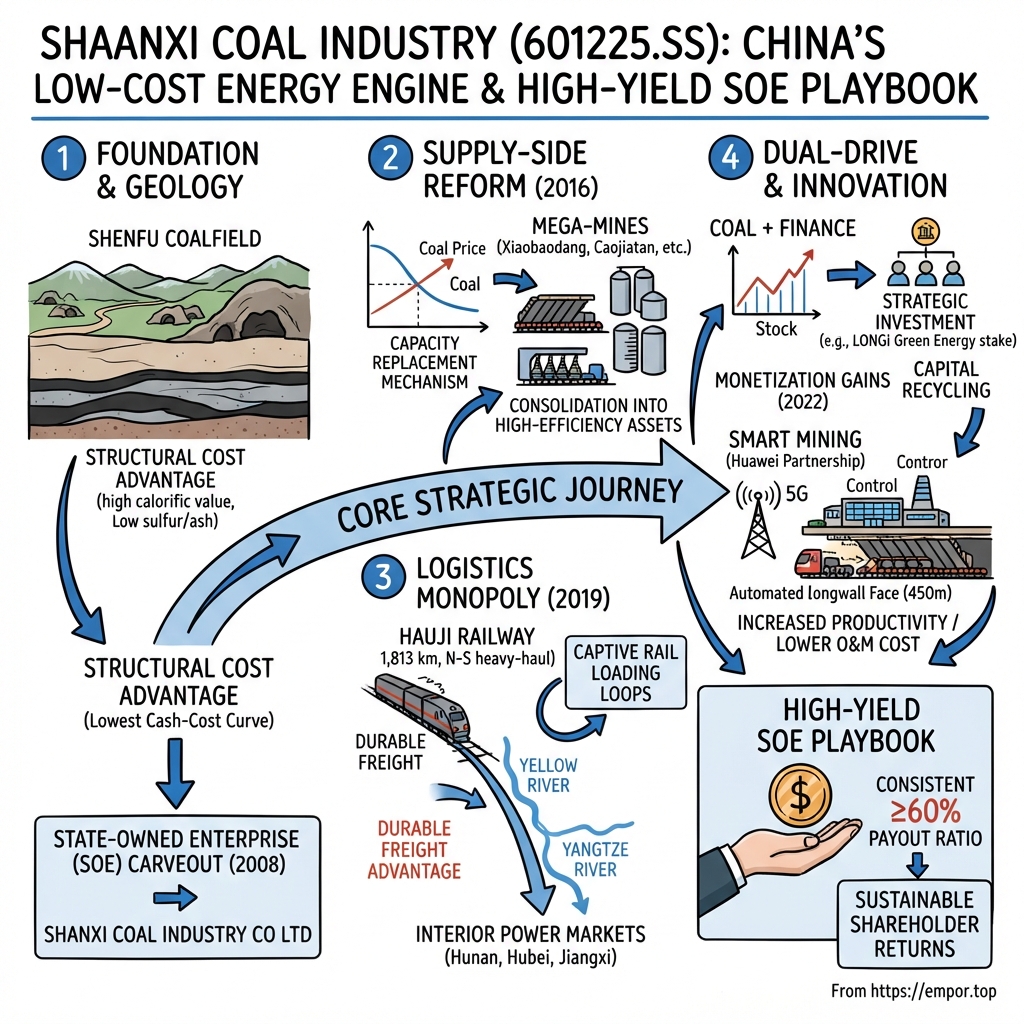
Shaanxi Coal Industry: China's Low-Cost Energy Engine and the High-Yield SOE Playbook
I. Introduction & Episode Roadmap
Drive north out of Xi'an, past the Qinling foothills and the Wei River plain, and the landscape flattens into something that looks like nothing much at all. Loess plateau. Wind-scoured gullies. Villages of cave dwellings cut into the yellow earth. For most of the twentieth century, northern Shaanxi — 陕北 Shaanbei — was shorthand in Chinese for poverty and revolutionary hardship. Mao Zedong hid here. The land gave up millet and dust.
Then the drills went down, revealing that the dust sat atop one of the richest thermal coal deposits on the planet.
This is the story of how that geological accident became 陕西煤业 Shaanxi Coal Industry Company Limited — a state-owned enterprise that mines more than 170 million metric tons of coal a year, generates revenue of roughly ¥180 billion (around $25 billion), and trades on the Shanghai Stock Exchange under the ticker 601225 as one of the highest-yielding large-cap stocks in the A-share market.[^1][^4]
Yet coal is only half the narrative. Between 2016 and 2022, Shaanxi Coal executed a strategy rarely seen among commodity producers, state-owned or otherwise. Rather than consuming its commodity upcycle windfall on empire-building acquisitions or unproven diversification, the company executed three decisive moves: it consolidated production into a handful of low-cost mega-mines, acquired a strategic equity stake in neighboring solar manufacturer 隆基绿能 LONGi Green Energy, and distributed substantial dividend payouts to shareholders.
The LONGi transaction stands out as a defining case study. An inland Chinese coal miner, using trust structures managed by a private asset manager, built a major position in the world's largest monocrystalline solar wafer producer. Near the peak of the green-tech bull market, management reclassified the holding on its balance sheet, crystallizing billions of renminbi in reported gains. That maneuver generated contrasting interpretations: astute capital allocation to supporters, aggressive accounting to critics. Analysis suggests it represented a mix of strategic foresight and financial engineering, though the company's ultimate foundation remains its low unit costs.
The company in one paragraph. Shaanxi Coal Industry is the listed upstream mining vehicle of 陕煤集团 Shaanxi Coal and Chemical Industry Group, which is controlled by 陕西省国资委 the Shaanxi Provincial SASAC.[^10] It ranks as China's third-largest listed coal producer by output, behind 中国神华 China Shenhua Energy and 中煤能源 China Coal Energy. Assets are concentrated in the 神府煤田 Shenfu Coalfield around Yulin and Shenmu in northern Shaanxi, where thermal coal deposits feature high calorific value, low sulfur content, low ash content, and near-horizontal seams close to the surface. That geological positioning serves as the company's primary economic engine.
Evaluating the core thesis. Four main claims underpin the investment thesis, requiring critical examination:
- Cost position. Shaanxi Coal sits near the bottom of China's coal cash-cost curve due to structural geological advantages rather than transient cyclical factors.
- Logistics. Co-investment in the 1,813-kilometer 浩吉铁路 Haoji Railway established a durable freight advantage into interior power markets.[^7]
- Capital allocation. Management converted commodity windfalls into tangible shareholder returns, with the LONGi gains reflecting deliberate positioning rather than pure luck.
- Terminal value. A thermal coal producer can remain a viable long-duration asset even as China targets carbon neutrality by 2060.
The fourth claim carries the highest long-term significance, and this analysis evaluates it continuously rather than relegating it to a final risk section.
Episode roadmap. The story begins with the region's geology and the corporate architecture established under the provincial SASAC. It examines the 2016 供给侧结构性改革 supply-side structural reform that reshaped the industry's cost curve, followed by the company's railway logistics strategy. The analysis then explores the "coal plus finance" 双轮驱动 dual-drive strategy, the monetization of the LONGi position, and the 华为 Huawei technology partnership that introduced 450-meter automated longwall faces to reduce underground staffing. Finally, it evaluates segment economics, current management under Chairman 赵福堂 Zhao Futang, key questions raised by market analysts, a competitive comparison against Shenhua and China Coal, and a structured bull/bear framework linked to verifiable operational metrics.
A key framing note. Analyzing a Chinese SOE requires balancing two operational realities. Shaanxi Coal operates as a commercial entity generating measurable economic returns. Simultaneously, it functions as an instrument of state energy policy. When central planners require coal supplies at capped prices to secure grid stability, the mandate of 保供 ("guarantee supply") takes priority over market pricing. Investors who view the business solely as an unconstrained commercial producer or strictly as a non-economic public utility risk misjudging its structure. The core analysis lies in navigating the tension between these two mandates.
 Subscribe on LinkedIn
II. The Geological Foundation & Founding Context
In 1983, a geological survey team working the terrain around 神木 Shenmu and 府谷 Fugu counties confirmed what earlier exploratory drilling had suggested: beneath the loess and the shifting sands of the Mu Us desert margin lay a thermal coal basin of extraordinary quality and scale. The 神府煤田 Shenfu Coalfield — later recognized as part of the broader Shenfu-Dongsheng basin straddling the Shaanxi–Inner Mongolia border — turned out to be one of the largest contiguous high-grade thermal coal deposits in the world.
Why this particular coal is different
Thermal coal is not a uniform commodity in the way copper cathode is. Two tons of coal can differ by a factor of two in heat output, by an order of magnitude in sulfur content, and by wide margins in residual ash. The economics of any coal mine depend less on total tonnage in the ground than on three primary variables: the value of the coal per ton, the cash cost to extract it, and the freight cost to transport it.
Shenfu coal scores favorably on all three counts due to specific geological mechanics:
Calorific value. Shenfu thermal coal typically rates above 5,500 kilocalories per kilogram, with premium grades reaching higher levels. Calorific value reflects the fuel's energy density — the measure of heat released per ton burned. A power plant burning 6,000 kcal coal requires significantly fewer tons and incurs lower freight expenses per unit of electricity generated than one burning 4,500 kcal coal. Because transportation often represents a third or more of delivered fuel costs in interior China, high energy density acts as a structural freight discount embedded directly in the deposit.
Sulfur and ash. Shenfu coal features characteristically low sulfur content — generally below 0.5% — alongside low ash levels. Under strict environmental emissions standards, low-sulfur coal reduces the operating load and expense of flue-gas desulfurization systems at power plants. This provides a structural buyer preference that endures across all phases of the coal price cycle.
Seam geometry. Deposit geometry serves as the primary driver of the company's cost advantage. Shenfu seams are thick — featuring multi-meter continuous coal bands — while lying relatively flat and close to the surface. This contrasts sharply with the deep, faulted, steeply dipping, and gas-prone seams that characterize legacy basins in Shanxi, Henan, Guizhou, and eastern China.
Longwall extraction relies on a rotating cutting drum moving along a continuous face of coal while hydraulic roof supports shield the work area and advance as the coal retreats. The process functions like a high-capacity mechanical planer slicing through a solid block. The technology operates at peak efficiency when the deposit remains uniform. Faults, seam dips, or thinning rock force equipment to stop, realign, or abandon working panels. Mines with thick, flat, undisturbed geology can run longwall equipment near-continuously, whereas complex deposits require frequent, capital-intensive equipment relocations between short panels.
Shenfu represents near-ideal longwall geology. That structural deposit advantage forms an economic moat that capital expenditure elsewhere in China cannot easily replicate.
From fragmented chaos to state pillar
Geological deposits alone generate a regional boom rather than an organized industry. Through the 1990s and early 2000s, the Shenfu region was mined by a fragmented array of township enterprises, private operators, and small state mines — many of which operated with poor recovery rates, inadequate safety standards, and high accident rates.
The provincial government responded through structural consolidation. In 2004, 陕西煤业化工集团 Shaanxi Coal and Chemical Industry Group was established under the Shaanxi Provincial SASAC, consolidating the province's state-owned mining and coal chemical assets into a single vertically integrated enterprise.[^10] The consolidation reflected standard state-owned enterprise reform logic of that era: operating scale enabled safety investment, safety compliance secured mining licenses, and expanded licensing enabled further scale.
Yet the parent group remained a mixed asset portfolio: world-class upstream mining rights were grouped alongside capital-intensive, highly cyclical coal chemical facilities and high-cost legacy mines in southern Shaanxi.
The 2008 carve-out: asset selection as strategy
The decisive corporate restructuring occurred on December 23, 2008, when 陕西煤业股份有限公司 Shaanxi Coal Industry Company Limited was incorporated as a joint-stock entity holding the parent group's premier upstream mining assets.[^1] This was a selective carve-out: the highest-grade, lowest-cost mining concessions in northern Shaanxi were transferred into the listed vehicle, while chemical operations and high-cost legacy mines largely remained with the parent company.
For investors, this style of carve-out presents a double-edged dynamic. The primary advantage is clear: the listed entity emerges as a cleaner, higher-margin business than its parent. The tradeoff is the persistent governance risk inherent to state-owned enterprises with a dominant parent company. A parent entity retains assets that it can later inject into the listed subsidiary at prices negotiated between a controlling shareholder and a board it effectively controls. The 2008 carve-out established a high-margin upstream vehicle while introducing a recurring related-party governance question — a dynamic that resurfaced with the later Binchang Mining asset injection.
The 2014 IPO: listing into the teeth of a bear market
Shaanxi Coal completed its initial public offering on the Shanghai Stock Exchange on January 28, 2014, under ticker 601225.1 Market timing appeared unfavorable. Domestic coal prices had declined sharply since 2012 as post-stimulus infrastructure spending slowed and market overcapacity expanded. Capital raised in the offering was scaled back substantially from initial targets set during peak market conditions.
In hindsight, framing this offering as a masterclass in counter-cyclical timing overstates management's control over market conditions. A more grounded assessment suggests the public listing was driven by provincial and parent-level demands for capital and SOE reform credentials, forcing the company to accept a low valuation amid weak market appetite.
Ultimately, the capital allocation proved more critical than the IPO valuation. Proceeds from the offering, combined with subsequent internal cash flow, financed extensive mechanization and the construction pipeline for next-generation mines in northern Shaanxi. As a result, the company expanded its low-cost production capacity during the market trough. Whether by strategic foresight or the long lead times of mine development, Shaanxi Coal positioned its physical asset base to capitalize immediately when Beijing reshaped industry rules in 2016.
This structural positioning set the stage for the single most consequential policy intervention in modern Chinese heavy industry.
III. Inflection Point 1: Supply-Side Reform & Reshaping the Cost Curve (2016–2019)
By the winter of 2015, China's coal industry faced severe financial distress. Thermal coal benchmark prices at 秦皇岛港 Qinhuangdao Port had fallen to levels where a majority of domestic mines operated at a loss, with contemporary industry estimates indicating that upwards of 80% of Chinese coal producers were cash-negative. The sector carried heavy bank debt, employed millions of workers, and generated output far in excess of economic demand.
While conventional market dynamics would have driven bankruptcies and multi-year capacity rationalization, China pursued a coordinated administrative solution.
What supply-side reform actually did
In early 2016, the State Council formalized 供给侧结构性改革 supply-side structural reform for the coal sector, setting explicit targets to eliminate hundreds of millions of tons of annual production capacity over a multi-year period.5 The framework relied on administrative mechanisms rather than pure market forces: annual operational day limits, mandatory closures of small-scale mines, stricter safety and environmental licensing thresholds, and a capacity replacement system.
The 产能置换 capacity replacement mechanism proved to be the central driver of structural value creation across the sector. Under the rules, producers that permanently retired inefficient capacity earned tradeable quota credits required to license new production facilities. Closing a small, hazardous, high-cost mine was not merely an asset write-off; it served as regulatory currency to secure development permits for large-scale, efficient operations.
The system operated effectively as a market for production rights, where the retired assets were defined by economic inefficiency rather than environmental emissions.
Shaanxi Coal's asymmetric trade
While most Chinese coal producers treated supply-side reform as a survival challenge, Shaanxi Coal executed a portfolio arbitrage.
The company possessed a sharp internal quality contrast across its asset base: high-grade, undeveloped concessions in northern Shaanxi alongside capital-intensive legacy mines in central and southern regions, where coal seams were thinner, deeper, and geologically complex. The reform framework enabled management to systematically retire high-cost southern capacity and transfer the acquired quotas to its northern developments.
Executing this strategy at scale required owning undeveloped, tier-one geology prior to the policy shift. Producers in Shanxi retiring high-cost mines could only redeploy quota into local Shanxi formations. In contrast, Shaanxi Coal retired a 600,000-ton mine in southern Shaanxi and applied those credits toward a northern operation capable of producing thirty times that volume at a fraction of the unit cost.
This shift demonstrates that the resulting cost advantage stemmed primarily from portfolio optimization enabled by regulatory policy and geological assets, rather than pure operational efficiencies. Because geology cannot be replicated, and because the company has already consolidated its asset base into high-performing mines, future cost reductions depend on technological automation, a transition explored later in this analysis.
The mega-mines
This policy arbitrage yielded a concentrated group of high-capacity mining operations.
小保当煤矿 Xiaobaodang and 曹家滩煤矿 Caojiatan serve as flagship assets — ultra-large pithead operations in the Yulin mining district engineered around high-capacity longwall extraction, each designed for annual output in the range of fifteen million to more than twenty million tons.[^1] To contextualize that scale, a single mine of this tier generates annual coal volume comparable to the peak historical output of major European mining regions.
红柳林煤矿 Hongliulin and 张家峁煤矿 Zhangjiamao represent the mature foundation — tier-one operations with low unit costs that provided stable cash flow and operational templates during the construction of the newer mega-mines.
Designing these facilities as pithead operations directly on the coalfield minimizes intermediate logistics. Coal moves directly from the longwall cutting face to rail loading infrastructure at the mine mouth, eliminating secondary truck haulage, repeated stockpile transfers, and material handling losses that accumulate costs across conventional supply chains.
The cost curve shift
The portfolio consolidation established a persistent downward step in Shaanxi Coal's unit extraction costs. Pithead cash extraction costs across the core northern Shaanxi mines have been discussed by management and sell-side analysts in the range of roughly ¥150 to ¥200 per ton in recent years — placing the assets near the bottom of a national cost curve where a meaningful share of Chinese production sits well above that level.2
Evaluating this cost advantage requires two critical qualifications.
First, reported cost per ton in Chinese mining disclosures is not standardized. Full cost (完全成本) — which incorporates depreciation, resource taxes, safety production funds, land subsidence compensation, and regulatory levies — exceeds cash extraction cost by a substantial margin, and disclosure practices vary across listed peers. Comparative cost metrics should therefore be interpreted as directional indicators rather than precise accounting equivalents.
Second, absolute extraction costs have trended upward. Industry-wide increases in resource tax rates, mandatory safety spending, and environmental restoration obligations have raised the company's blended unit costs above late-2010s levels. The verifiable claim is not that Shaanxi Coal's cost structure is static, but that its relative cost advantage over high-cost domestic producers remains structural due to seam geometry and asset concentration.
The key performance indicator testing this thesis is full cost per ton evaluated against China Shenhua and China Coal across complete commodity cycles. A persistent narrowing of that margin gap would indicate structural erosion of the company's cost advantage.
Having established a low extraction cost at the mine mouth, the company faced the next operational challenge: transporting coal nearly two thousand kilometers south into interior consumption markets.
IV. Inflection Point 2: The Logistics Monopoly — Captive Rail & The Haoji Arterial
A single geographic reality dictates China's energy politics: coal reserves are concentrated in the north and northwest — across Shanxi, Shaanxi, and Inner Mongolia — while electricity demand resides in the east and south along the Yangtze and Pearl River deltas and the central industrial belt of 两湖一江 Hunan, Hubei, and Jiangxi.
Separating these supply and demand hubs are roughly two thousand kilometers of rugged terrain, major river systems, and historically congested freight corridors.
The old way: a twenty-day journey
For decades, coal moving from northern Shaanxi and western Inner Mongolia to southern power plants followed a circuitous route.
Producers first loaded trains at the mine mouth, hauling coal east along the heavily congested Daqin or Shenshuo–Shuohuang rail corridors to Bohai Rim ports such as 秦皇岛港 Qinhuangdao. At the port, crews unloaded the coal into stockyards before reloading it onto coastal bulk carriers. Vessels then sailed south around the Shandong peninsula and down the coast to the Yangtze River estuary, where the cargo was transferred once more onto river barges to head back inland toward power plants in Hubei, Hunan, and Jiangxi.
This journey typically required fifteen to twenty days. Each transfer point added handling expenses and material degradation. The route remained vulnerable to port congestion, coastal shipping rate spikes, seasonal typhoons, and winter sea ice. Most critically, it forced coal from landlocked western mines to travel to the coast simply to reach landlocked interior consumers.
For inland power plants, this multi-stage supply chain mandated large, costly buffer inventories. For upstream producers, high maritime and rail handling fees eroded the pricing advantage derived from low pithead extraction costs.
The bet: 浩吉铁路 Haoji Railway
To address this structural inefficiency, state planners authorized the construction of a dedicated north–south heavy-haul coal line: the 浩吉铁路 Haoji Railway. Spanning 1,813 kilometers from Haolebaoji in Inner Mongolia to Ji'an in Jiangxi, the line crossed the Yellow and Yangtze rivers to directly connect western mines with central power consumers. The railway opened for operation on September 28, 2019.[^7]
Shaanxi Coal participated as a strategic co-investor alongside the national railway operator and regional peers. Simultaneously, the company constructed captive 集运端 rail loading loops — dedicated collection hubs — that linked its northern Shaanxi pithead operations directly into the new trunk line.
This equity participation was driven by capacity positioning rather than pure financial returns on infrastructure capital. While public railway access is open to all shippers, co-investment provided corporate standing in capacity planning and enabled the construction of dedicated mine-mouth loading loops. In a national rail network where freight slots are administratively allocated and frequently constrained, guaranteed loading access effectively turned a shared public infrastructure corridor into a reliable corporate conduit.
What actually changed
The direct overland route reduced transit times from the historical fifteen-to-twenty-day seaborne circuit to roughly three days.[^7] This shift altered operating dynamics across the regional value chain. Shorter lead times lowered working capital requirements for both mines and utilities, reduced buffer inventory needs, eliminated exposure to volatile coastal shipping rates, and allowed supply adjustments on a weekly rather than monthly schedule.
The corridor also expanded Shaanxi Coal's addressable market. Power plants in Hubei, Hunan, and Jiangxi had previously relied on expensive multimodal transport, lower-grade domestic coal, or seaborne imports. Direct access to high-calorific Shenfu coal expanded their procurement choices while securing a captive regional buyer base where Shaanxi Coal holds a clear delivered-cost advantage over distant or imported suppliers.
The stress test
A rigorous analysis requires testing these advantages against operational friction, as initial infrastructure expectations often exceed early performance.
First, the Haoji Railway experienced a prolonged volume ramp relative to its design capacity. At launch, northern feeder lines remained unfinished, southern last-mile spurs into individual power plants required multi-year construction schedules, and central utilities maintained long-term commercial contracts along coastal shipping routes. Domestic media and industry reports documented cargo volumes tracking below original projections during the line's early years of operation.
Second, Shaanxi Coal does not hold exclusive rights to the corridor. The line serves multiple regional miners, and while captive loading loops provide slot priority, they do not confer a true logistics monopoly. The asset provides a structural cost and delivery edge into central China relative to legacy Shanxi producers, but that advantage is shared with a select group of northern Shaanxi and Inner Mongolian peers.
Third, the economic benefit remains subject to state-regulated rail tariffs rather than pure market pricing mechanisms. Freight rates are set by administrative policy, leaving margins vulnerable to regulatory adjustments.
Evaluating the logistics thesis yields a calibrated conclusion: the Haoji investment secured a durable delivered-cost advantage into interior consumption markets and reduced supply chain variance. However, it did not grant nationwide pricing power, and capacity utilization took longer to materialize than initial forecasts suggested. This dynamic — a genuine structural benefit operating within real operational and regulatory constraints — provides an essential lens for evaluating the company's financial capital allocation strategies.
V. Inflection Point 3: The "Coal + Finance" Playbook & The LONGi Solar Windfall
By 2017, Shaanxi Coal's cash flow had expanded significantly. Supply-side structural reforms had revived thermal coal prices from their 2015 trough, while its newly consolidated mega-mines were rapidly ramping production. With net cash accumulating on the balance sheet, management faced a dilemma common to commodity producers near cycle peaks: how to deploy surplus capital effectively.
Historically, state-owned heavy industrial firms and global mining companies have often misallocated windfall capital during upcycles — acquiring assets at peak valuations, expanding into unfamiliar adjacent sectors, or funding capital-intensive chemical projects. Shaanxi Coal pursued an unconventional alternative.
The dual-drive strategy
Management articulated a 双轮驱动 "dual-drive" strategy: operate the core coal business for cash generation while deploying surplus capital into financial investments focused on the energy transition — the structural trend posing a long-term threat to thermal coal demand.[^1]
From an investment perspective, this structure offered a strategic hedge against terminal value risk. If renewable energy and storage technologies gradually displace thermal coal in the power grid, holding equity stakes in leading clean-energy producers transforms a long-term commercial threat into a portfolio position. Whether management originally conceived the strategy as a formal structural hedge or rationalized it retrospectively, the portfolio logic provided an explicit rationale for non-core capital deployment.
The structure: trusts and an outside manager
The execution mechanism was unusual for a state-owned enterprise. Rather than establishing an in-house investment team, Shaanxi Coal deployed capital through trust vehicles — including products associated with 西部信托 Western Trust — with investment management delegated substantially to 朱雀投资 Zhuque Asset Management, a private asset manager known for fundamental research in Chinese equities.2
This arrangement served two operational functions. First, it provided the coal producer with specialized equity research and portfolio management capabilities without requiring the unconstrained compensation structures typical of private asset managers. Second, it established governance distance between the state-owned operating entity and day-to-day market decisions.
However, the structure introduced significant portfolio opacity. Public shareholders investing in a pure-play thermal coal miner implicitly absorbed exposure to growth equities through trust vehicles disclosed with reporting lags and limited granular detail. Equity analysts repeatedly highlighted this structure as a governance concern during market downturns.
The LONGi position
The central component of the investment portfolio was a major equity stake in 隆基绿能 LONGi Green Energy, a Xi'an-headquartered company that grew into the world's largest producer of monocrystalline silicon wafers and a leading global solar module manufacturer.[^9]
Monocrystalline wafers are thin silicon wafers that form the foundation of photovoltaic cells. LONGi had scaled monocrystalline technology over a decade, correctly anticipating that manufacturing efficiencies would lower its cost per watt below prevailing multicrystalline alternatives. Between 2019 and 2021, LONGi experienced rapid earnings growth as global solar adoption accelerated.
Shaanxi Coal also established a financial position in 赣锋锂业 Ganfeng Lithium, expanding its exposure to battery supply chains.2
The geographic proximity of these investments warrants attention. LONGi is based in Shaanxi Province, placing its operations within the provincial state ecosystem where regional authorities maintained detailed visibility into corporate performance. While local familiarity provided an informational advantage over public market investors, it also indicated that the allocation reflected regional economic connections alongside fundamental investment research.
The 2022 monetization
The financial impact of the solar strategy culminated in a significant accounting reclassification.
In 2022, Shaanxi Coal altered the accounting classification of its LONGi holding, transferring the stake from long-term equity investments to financial assets measured at fair value through profit or loss.2 Under equity-method accounting, unrealized gains remained on the balance sheet without affecting annual earnings. Reclassifying the holding to fair-value measurement required recognizing both mark-to-market fluctuations and cumulative unrealized appreciation directly on the income statement.
This accounting shift generated a substantial recognized investment gain, inflating reported earnings during a period of strong operational performance. Driven by both peak coal realizations and investment revaluations, Shaanxi Coal reported net profit attributable to shareholders of roughly ¥35 billion for FY2022.[^4]3
Management subsequently trimmed its holdings in these financial positions in the years that followed.
Weighing it honestly
Evaluating the dual-drive playbook requires balancing two contrasting interpretations of management's capital allocation.
The favorable interpretation emphasizes execution and market timing. Management accumulated a significant position in a high-growth industrial sector, maintained it during a major expansion cycle, and monetized the stake near the peak of valuation. LONGi's equity value subsequently experienced a steep decline as global solar manufacturing encountered severe overcapacity and falling module prices beginning in 2023. Exiting the position prior to that industry contraction preserved significant capital.
The skeptical interpretation focuses on accounting timing and earnings quality. Reclassifying the stake to fair-value measurement during a peak commodity year allowed management to record accumulated gains on the income statement, distorting the company's underlying recurring earnings. Reported FY2022 net profit of ¥35 billion overstated normalized operational earnings power, as reflected by the decline to approximately ¥21 billion in FY2023 once non-recurring gains receded.[^4]
A balanced assessment lies between these positions. While the transaction delivered positive realized returns, the opaque trust structure and accounting adjustments introduced artificial volatility into reported net income — creating friction for investors holding the stock primarily for its predictable cash flows and dividend yield. Management's subsequent decision to scale back financial investments and refocus on core mining operations suggests a recognition that public markets value operational cash-flow stability over opportunistic financial engineering.
Furthermore, a single successful equity investment in a local provincial champion, executed through an external asset manager, does not establish a repeatable capital allocation competency. Rather than demonstrating institutionalized investment skill, the evidence indicates that Shaanxi Coal avoided the destructive capital expenditure cycles that historically burdened mining peers while capitalizing on one well-timed local investment. The critical test for future cycles remains whether management continues returning excess cash flow through dividends or redeploys capital into secondary non-core ventures.
Ultimately, the company's durable economic edge remained grounded in operations two hundred meters underground.
VI. Inflection Point 4: 5G Smart Mining & Operational Productivity
Consider a traditional working coal face. Hundreds of meters underground, a shift crew of thirty or forty miners operates in darkness, noise, and coal dust, surrounded by heavy machinery operating in tight quarters. The shearer operator walks along the cutting machine, while roof support operators manually advance hydraulic chocks. Maintenance crews troubleshoot equipment on-site. The environment is hazardous, expensive, and increasingly difficult to staff as younger Chinese workers seek alternative employment and industrial wages rise.
By contrast, Shaanxi Coal has deployed a significantly more automated model. The working face extends 450 meters. The shearer follows a pre-programmed path with automated roof supports advancing behind it. The primary control station sits on the surface, where operators monitor video feeds and telemetry over a private 5G network. As a result, physical staffing at the cutting face during standard production shifts has dropped sharply.
The Huawei partnership and 矿鸿 MineOS
The enabling technology stack originated substantially from 华为 Huawei, which created a dedicated coal mining unit and, in September 2021, launched 矿鸿 MineHarmony — an industrial operating system derived from its HarmonyOS platform, designed specifically for mining equipment.[^9]
MineHarmony targets a persistent operational challenge: legacy interoperability. A modern mine relies on equipment from dozens of vendors — shearers, conveyors, roof supports, ventilation fans, pumps, and environmental sensors — each running proprietary communication protocols. Coordinating these systems historically required expensive, brittle, custom integrations. MineHarmony introduces a unified software layer that allows equipment from diverse manufacturers to communicate standardized data.
The system functions much like a mobile operating system. Prior to standardized mobile platforms, handset software operated in isolation, requiring custom applications for each device. An operating system consolidates disparate hardware into a single platform where applications can be developed once and deployed broadly. MineHarmony applies that same architectural consolidation underground.
The accompanying 5G deployment addresses a bandwidth bottleneck. Underground operations historically relied on fiber optic lines and narrowband wireless networks incapable of transmitting high-definition video and dense telemetry. Private 5G networks, paired with explosion-proof hardware, deliver the bandwidth and low latency required to stream real-time video to surface control centers, making remote intervention viable.
The 450-meter face
The centerpiece of this technical deployment is the ultra-long automated longwall face, with operational implementations at Caojiatan and Xiaobaodang running faces of 450 meters — roughly one and a half times standard industry length.[^1]
The economic rationale for extended face length centers on equipment utilization. In longwall mining, productive cutting time occurs while the shearer drum moves across the coal seam; non-productive time accumulates during end-of-face turnarounds, equipment relocations, and panel changeovers. Lengthening the face from 300 to 450 meters increases the coal extracted per pass by 50 percent while keeping fixed turnaround overhead largely static. Extended faces also reduce the total number of panels required to mine a deposit, minimizing panel changeovers — one of the most capital-intensive and disruptive procedures in underground mining.
However, operating a 450-meter face requires rare geological conditions: exceptional seam continuity, uniform thickness, minimal faulting, and a stable roof structure, alongside heavy-duty hydraulic supports engineered for extreme loads. Shenfu's deposit geometry accommodates these demands, whereas most Chinese coalfields do not. Technology in this context acts as a multiplier on underlying geological quality rather than an independent solution, preventing competitors with complex geology from replicating the efficiency gain simply by purchasing identical machinery.
Proof points and the appropriate skepticism
Shaanxi Coal and its technology partners have highlighted major reductions in underground shift personnel — reporting headcount cuts of 50 percent or more at automated faces — alongside high equipment availability and improved safety metrics.[^1][^9]
These metrics represent vendor- and operator-supplied figures from a commercial partnership, typically reflecting performance on flagship faces rather than portfolio-wide averages. Analytical rigor requires viewing them as directionally informative rather than baseline operational performance across all assets.
Independently verifiable financial disclosures provide more reliable evidence: the company maintained relatively stable unit extraction costs during a period of widespread industrial wage inflation in China, while sustaining coal segment gross margins at the upper end of its domestic peer group.[^4] These results support the presence of tangible automation benefits, though the impact remains closely intertwined with the company's favorable seam geometry and asset concentration.
The strategic conclusion
The strategic value of mining automation rests on operating leverage and margin defense during cyclical downturns. Labor represents a semi-fixed cost in underground mining, as skilled crews cannot be easily dismissed during brief price declines and re-recruited when demand recovers. By permanently reducing the labor required per ton of output, Shaanxi Coal lowers its cash break-even threshold.
This structural reduction directly impacts terminal asset valuation. For a commodity producer, performance during market troughs determines long-term survival and consolidation capability. A producer maintaining low fixed costs and a left-of-curve cash position can remain cash-generative when falling spot prices force marginal producers into operating losses, positioning the firm to capture market share in a recovery.
Validating this structural thesis will depend on performance during the next sustained coal price trough, specifically whether the company's coal segment preserves positive cash flow when spot realizations drop below the cost structures of higher-cost domestic miners.
This leads directly to how the business performs on financial disclosures.
VII. Segment Financial Breakdown & Current Management Playbook
Strip away the narrative, and Shaanxi Coal's income statement is straightforward: it extracts coal from the ground and sells it. Virtually everything else is rounding.
The shape of the business
Coal mining and sales — 煤炭采选与销售 — accounts for roughly 90% or more of consolidated revenue and an even larger share of operating profit.[^4] Consolidated revenue has hovered between ¥170 billion and ¥180 billion in recent years, backed by self-produced coal output exceeding 170 million tons alongside additional volume from purchased and traded coal.2[^4]
That trading volume distorts the underlying economics. A meaningful portion of reported revenue stems from purchasing third-party coal and reselling it — a low-margin activity that inflates top-line revenue without contributing proportionally to net earnings. Investors comparing headline revenue across Chinese coal producers without adjusting for trading mix risk misinterpreting both operating scale and underlying margin strength. The metrics that drive true profitability are self-produced tonnage and the cash margin earned on each ton.
On self-produced coal, gross margins remain near the top of the domestic industry — well above levels achieved by higher-cost peers. That margin gap represents the clearest quantitative validation of the company's structural cost advantage.[^4]
Railway transportation and logistics forms the second segment. Captive loading infrastructure and rail equity stakes generate modest fee income while securing crucial transport throughput. Though minor as a standalone profit center, logistics serves as a vital strategic enabler — a distinction obscured by standard segment disclosures.
Power generation and financial investments comprises the residual bucket, combining limited utility assets with financial equity holdings. Management has systematically scaled back the financial investment component.
The strategic implication of this revenue mix is clear: Shaanxi Coal operates as a near-pure-play bet on Chinese thermal coal prices and production volumes, cushioned by a low unit cost structure. Lacking a meaningful internal power generation hedge, any drop in benchmark coal prices flows directly to operating earnings — marking a fundamental structural contrast with integrated peers like China Shenhua.
Who runs it
Chairman 赵福堂 Zhao Futang leads the executive team, with 赵文革 Zhao Wenge serving as general manager.[^1] Like most senior Chinese SOE executives, both are career industry insiders whose performance incentives reflect a dual mandate: commercial profitability monitored by the state asset regulator, alongside policy execution to guarantee domestic energy security.
For public investors, this governance structure carries distinct trade-offs. Senior executives are appointed managers progressing through the provincial state system rather than owner-operators holding substantial equity. This alignment encourages long-term planning and conservative debt management, but it also means shareholder returns represent only one corporate objective among several. When commercial returns clash with state policy mandates — such as price-capped supply quotas during energy crunches — regulatory directives take priority.
Management messaging has focused consistently on three core themes: operational execution across core mega-mines, alignment with national energy security policy, and prioritizing return on invested capital over volume expansion.[^1] While narrative consistency is a positive indicator, evaluating management performance requires examining execution across two key areas.
Stress test one: the retreat from financial investments
Management's post-2023 reduction in financial trust holdings is frequently framed as a disciplined return to core operations. Alternatively, it can be viewed as a retreat under market pressure from a diversification strategy launched three years earlier. Both perspectives hold merit. What remains clear is that framing the initial entry and subsequent unwind as a seamless master plan ignores the reality of a major policy shift: the company established its "dual-drive" framework as a core strategic pillar, only to dismantle it when market conditions shifted.
The more plausible interpretation is that management adapted to market feedback, recognizing that equity investors applied a holding-company discount to volatile investment gains rather than rewarding non-core growth. Such responsiveness to market sentiment remains relatively rare among state-owned enterprises.
Stress test two: parent asset injections
Shaanxi Coal has periodically acquired mining assets from its parent entity, most notably incorporating 彬长矿业 Binchang Mining to add coal capacity to the listed vehicle.[^1]2
These transactions demand rigorous evaluation. The parent entity, 陕煤集团, retains a controlling stake of roughly two-thirds of the listed company.2 When a controlling shareholder transfers assets to a subsidiary it controls, independent price discovery is inherently constrained, leaving minority shareholders reliant on independent board members, third-party valuations, and regulatory oversight to ensure fair terms.
The central operational question is whether injected assets match the economic quality of the northern Shaanxi core. Binchang operates in a distinct mining district with different geological formations, yielding a coal quality profile and cost structure that differ from the Shenfu field. Asset injections of this nature expand total output volume while risking dilution of the company's primary asset: its position at the low end of the cost curve.
The critical metric for tracking this performance is blended full cost per ton following asset integration. If consolidated unit costs rise faster than industry-wide cost inflation, the acquisition diluted overall asset quality. Consequently, tonnage expansion from parent injections cannot be treated as organic value creation until cost stability is demonstrated over complete operating cycles.
Dividends: the actual investment case
Capital allocation ultimately centers on cash distribution, which forms the primary investment thesis for most A-share investors.
Shaanxi Coal has established a policy mandating a minimum dividend payout ratio of 60% of distributable net profit. In practice, distributions have met or exceeded that benchmark, delivering cash dividend yields frequently in the 6% to 8% range depending on prevailing stock prices and annual net income.2[^4] The company has also introduced mid-year distributions to accelerate cash returns.
Within an A-share market historically characterized by inconsistent dividend policies, and amid broader regulatory efforts encouraging SOEs to enhance shareholder returns, this distribution record has established 601225 as a cornerstone holding for domestic income funds and institutional capital.
However, a policy-driven payout commitment does not equal a structural moat, nor does a percentage-based dividend function as a fixed-income bond substitute. The 60% commitment represents a payout ratio, meaning absolute cash distributions track underlying commodity earnings. When net profit contracted from approximately ¥35 billion in FY2022 to roughly ¥21 billion in FY2023, absolute dividend payouts declined proportionally.[^4] Investors purchasing shares based on trailing yields calculated from peak commodity earnings experienced a sharp drop in realized cash returns.
Ultimately, Shaanxi Coal provides a substantial cash yield underwritten by strong operational cash flow and a net cash balance sheet. Yet because its payout framework exposes investors directly to commodity price cycles, the stock remains a high-yielding cyclical asset rather than a fixed-income alternative.
VIII. Primary Evidence: Earnings Call Analysis & Policy Mechanisms
Chinese A-share earnings communication differs noticeably from U.S. quarterly earnings calls. With less scripted guidance and extensive regulatory boilerplate, substantive exchanges often occur across investor-relations records, exchange-mandated Q&A filings, and annual results briefings rather than transcribed conference calls.1 Yet the pattern of inquiries from financial analysts has remained consistent over time.
Two primary themes dominate these disclosures.
Question one: the long-term contract mechanism
The most persistent line of inquiry concerns 长协机制 — China's long-term coal contract mechanism.
Under this framework, overseen by the 国家发展和改革委员会 National Development and Reform Commission (NDRC), coal producers commit substantial volumes to power generators through annual contracts with transaction prices restricted within an administratively determined band rather than floating at spot market rates.5 The mechanism aims to shield electric utilities — which operate under regulated power tariffs and cannot easily pass along fuel price increases — from extreme coal price spikes that could compromise grid stability.
The framework faced a major operational test in 2021, when production constraints, strong industrial demand, and import disruptions caused widespread power rationing across multiple provinces. Central authorities responded by directing major coal-producing regions — with Shaanxi at the forefront — to rapidly expand output while strictly enforcing contract price caps.[^8] In practice, state-owned producers were instructed to forgo spot-market windfalls to support broader economic stability.
Shaanxi Coal has consistently maintained long-term contract coverage between 70% and 80% of its total sales volume, leaving 20% to 30% exposed to spot market pricing.2
Equity analysts scrutinize this sales mix continuously because it dictates the profile of the company's earnings. High contract coverage establishes a structural floor during market downturns, preserving realized prices well above marginal cash costs when spot markets collapse. Conversely, it caps upside realization during commodity rallies, as the vast majority of output remains tied to regulated band prices.
This mechanism reveals a fundamental aspect of the business: Shaanxi Coal does not function as a high-beta vehicle for spot coal price speculation. Instead, it operates as a structurally floored and capped cash-generation business with modest spot-market exposure. While this profile offers earnings predictability for income-focused investors, it limits profit expansion during commodity spikes. The long-term contract system acts simultaneously as the company's primary downside buffer and the structural ceiling on upside earnings.
Management consistently presents high contract coverage as a strategic stability feature and an expression of alignment with national energy security priorities. Given that state policy dictates contract parameters, this posture reflects both operational reality and regulatory alignment.
Question two: earnings quality and the financial book
The second recurring theme involves mark-to-market earnings volatility originating from non-core financial investments.
Analyst concerns centered on earnings transparency and dividend stability. When significant swings in net profit stem from equity market repricing rather than core mining operations, reported earnings per share fail to reflect underlying operational performance. Furthermore, because dividend payouts are calculated as a fixed percentage of net profit, non-operational investment swings directly induce volatility into shareholder cash returns — an undesirable trait for an investor base seeking predictable yields.
In response, management began scaling back the financial investment portfolio after 2023, refocusing public communications on operational cash flows from core coal mining.2 This shift reduced earnings volatility and improved overall reporting transparency.
What the calls do not resolve
Despite routine disclosures, two critical operational areas remain insufficiently addressed in public reporting.
First, the company provides limited granular forward cost guidance. While management discusses cost management qualitatively and reports historical unit costs, disclosures do not allow external analysts to independently model unit cost breakdowns across individual components — such as labor, materials, energy, resource taxes, safety funds, and depreciation. Although this disclosure level is standard across Chinese mining SOEs, it requires investors to rely on historical reported figures rather than verifiable structural cost drivers.
Second, reporting lacks detailed reserve depletion schedules for flagship assets. Mega-mines such as Xiaobaodang and Caojiatan extract coal at high annual rates, which accelerates reserve consumption. Public disclosures provide limited detail regarding how long these flagship facilities can maintain peak output before requiring capital-intensive replacement capacity or secondary development. For an upstream mining company whose core economic thesis depends on specific low-cost concessions, reserve longevity and depletion timing represent essential valuation inputs that remain under-disclosed.
That disclosure gap becomes more prominent when evaluating Shaanxi Coal alongside its major industry peers.
IX. Competitive Landscape & Framework Analysis
China's listed coal sector does not function as a textbook competitive market. Prices are heavily influenced by state mechanisms, mine entry requires administrative licensing, and the largest producers are state-owned enterprises. Competition occurs primarily on unit extraction costs, logistics access, and the ability to convert regulatory policies into financial returns. With those structural caveats, comparing Shaanxi Coal against its primary industry peers is instructive.
中国神华 China Shenhua Energy: the integrated giant
China Shenhua Energy serves as the industry benchmark, but operates on a fundamentally different business model. In addition to coal extraction, Shenhua owns a large captive power generation fleet, a dedicated railway network—including the Shuohuang line and connections to the Daqin corridor—alongside captive port facilities and a bulk shipping fleet. It functions as a vertically integrated energy and logistics system anchored by upstream coal reserves.
This vertical integration creates a structural natural hedge. When coal prices decline, Shenhua's mining profitability contracts, but lower fuel input costs cushion margins in its power segment. When coal prices rise, upstream profits expand while power generation margins compress. Consequently, Shenhua's consolidated earnings are structurally less volatile than those of a pure-play upstream producer.
Shaanxi Coal lacks this integrated operational buffer due to its minimal power generation exposure. That structural difference highlights the core trade-off between the two producers: Shenhua delivers earnings stability through vertical integration, whereas Shaanxi Coal offers higher-margin, direct exposure to upstream mining economics with a lower pithead cash-cost position and less capital locked in midstream and downstream infrastructure.
Neither model is universally superior; the choice depends on investor priorities. However, this structure makes Shaanxi Coal a higher-beta asset, meaning any thesis framing it as a defensive holding without acknowledging the absence of a downstream power hedge remains incomplete.
中煤能源 China Coal Energy
China Coal Energy operates as the other major central SOE producer, managing a portfolio across multiple provinces with notable coking coal assets and substantial coal chemical operations. Its broader geographic dispersion results in higher blended transportation costs and a more heterogeneous asset quality profile than Shaanxi Coal's concentrated northern hub. Additionally, its coking coal exposure links a portion of earnings to steel production rather than electricity demand, subjecting the company to distinct industrial demand cycles.
兖矿能源 Yankuang Energy
Yankuang Energy represents the most financially aggressive major domestic producer, maintaining significant international mining operations in Australia alongside historically higher leverage than its state-owned peers. That overseas footprint introduces foreign exchange volatility, sovereign policy risks, and seaborne export market dynamics absent from purely domestic producers. Higher debt leverage further increases its equity sensitivity to commodity price swings in both directions.
Hamilton Helmer's 7 Powers
Applying Hamilton Helmer's 7 Powers framework to Shaanxi Coal requires distinguishing genuine competitive moats from standard operational advantages.
Cornered Resource — the strongest and most defensible claim. Helmer defines a cornered resource as preferential access to a coveted asset that independently enhances value. Mining concessions over thick, shallow, flat, high-calorific, and low-sulfur seams in the Shenfu field meet this criterion. The geological asset cannot be replicated, competitors cannot acquire the underlying rights, and the cost advantage persists independently of managerial changes. This resource base serves as the structural foundation of the investment case.
Scale Economies — present, with an important qualifier. Concentrating production into ultra-large mega-mines spreads fixed overhead across high tonnage and justifies automation investments that would be uneconomic across smaller operations. However, Shaanxi Coal is not China's largest total producer by volume; China Shenhua holds that position. The scale advantage operates at the individual mine level rather than the corporate level, which is where extraction unit economics are determined.
Process Power — plausible but the weakest of the three. While the company's underground automation stack is operational, it relies on external technology partners whose solutions remain commercially available to industry peers, while its effectiveness remains bounded by favorable geology. Process Power requires proprietary operational capabilities embedded within an organization that competitors cannot replicate even when understood. Shaanxi Coal's automation deployment represents a technology adoption advantage enabled by favorable geology rather than a proprietary, uncopyable process.
Counter-Positioning — not present. The business model does not involve an approach that incumbent peers refuse to adopt due to cannibalization risks. Peer producers would readily utilize Shenfu geology and 450-meter automated longwall faces if their asset bases allowed it.
Switching Costs, Network Economies, Branding — not present. Thermal coal remains a standard commodity sold primarily under annual contracts to power utilities, where procurement decisions depend on delivered cost and calorific specification. The product commands no meaningful brand premium, nor does the business benefit from network effects.
In total, Shaanxi Coal exhibits attributes of three powers, anchored primarily by a strong cornered resource. For a commodity producer, this represents a defensible operational moat, but it reinforces that the company functions as a cost-advantaged extractor in a mature end market rather than a compounding growth enterprise.
Porter's Five Forces
Threat of new entrants: very low. Mining rights are state-allocated, environmental approvals face stringent regulation, and national policy has restricted structural capacity expansion since the 2016 reforms. Consequently, greenfield competitive entry is negligible. However, strict licensing cuts both ways, as the same regulatory framework that shields incumbents also limits their ability to secure new concessions.
Bargaining power of suppliers: low. Equipment manufacturers, engineering firms, and material suppliers sell into a concentrated market dominated by major state-owned miners. While underground labor costs have risen due to recruiting challenges for subsurface work, ongoing mechanization and automation investments mitigate supplier power from labor.
Bargaining power of buyers: high when accounting for state regulatory mechanisms. While power utilities are numerous, the true counterparty dictating commercial terms is the state asset and energy regulator. The state establishes long-term contract price bands, mandates supply quotas during market tight spots, and regulates the electricity tariffs that determine what utilities can pay.5 A central authority simultaneously influences selling prices, delivery obligations, and customer purchasing power. Because key utility customers operate under protective state pricing frameworks, buyer power is concentrated through administrative policy rather than traditional market negotiation.
Threat of substitutes: low in the short to medium term, high over the long term. Thermal coal functions as China's 能源压舱石 — the ballast of the national grid — providing baseload reliability that renewable energy cannot yet fully replace at scale. In the near term, substitution risks remain modest, as demonstrated during the 2021 power supply crunch when authorities prioritized thermal generation to maintain grid stability. Over a longer horizon, rapid renewable capacity expansion, falling energy storage costs, and national 双碳目标 dual-carbon mandates commit China to peaking carbon emissions before 2030 and reaching carbon neutrality by 2060.5 While long-term thermal coal demand faces structural decline, the central analytical question concerns the timeline and trajectory of that transition rather than its ultimate direction.
Rivalry: moderate and administratively dampened. Producers compete on delivered cost within regional markets, but total industry capacity and output targets are managed through administrative policies. This regulatory oversight limits the destructive price wars typical of unconstrained commodity markets.
The composite structural picture reveals a protected asset base operating with a state-influenced buyer structure and a long-term demand runway bounded by energy transition goals. This combination sets up the strategic tension between near-term cash generation and terminal asset value.
X. The Investment-Story Spine: Bull vs. Bear & Risk Radar
Every investment case reduces to two fundamental questions: what drives the company's performance, and what risks could undermine it? For Shaanxi Coal, the answers are anchored in physical geology, state policy, and capital allocation.
Why win
The cost position is real and its source is not replicable. This cost advantage forms the foundation of the investment case. It does not depend on managerial skill, brand equity, or customer loyalty — factors that can erode over time — but on deposit geometry and seam quality. The historical record through the 2015 downturn and the 2023–2025 price normalization demonstrates that while earnings compressed, the core coal mining operations remained solidly cash-generative.[^4]
Delivered-cost access to the interior. The Haoji Railway corridor and captive rail loading infrastructure improve realized economics into central China while reducing supply chain volatility.
Balance sheet strength. The company has operated with a net cash position and low leverage relative to its peer group, providing resilience across commodity cycles. Historically, post-IPO operations have avoided the dilutive equity offerings that often characterize weaker cyclical producers.
Cash distribution. Management maintains a policy of distributing at least 60% of net profit in dividends, backed by free cash flow and aligned with state initiatives encouraging listed state-owned enterprises to enhance shareholder returns.2
Why not
No integration hedge. Unlike China Shenhua, Shaanxi Coal lacks a large captive power generation fleet to cushion falling coal prices. Without that downstream hedge, operating margins and dividend distributions remain directly exposed to coal market declines.
State policy as counterparty. Regulated contract price bands cap upside realizations during market rallies, while mandatory supply obligations prioritize national energy security over commercial pricing. As demonstrated during the 2021 supply crunch, state directives take priority over spot-market pricing when grid stability is at stake.[^8]
Terminal value risk. Shaanxi Coal's core asset is a depleting physical resource selling into an end market bound by long-term carbon neutrality mandates. The investment thesis relies not on long-term volume growth, but on the company generating substantial cash returns over its remaining operational window and distributing that capital rather than expanding capacity into a maturing market.
The primary risk to this thesis lies in capital redeployment — specifically whether cash flow is directed into dilutive parent asset acquisitions or non-core projects rather than returned to shareholders.
Earnings quality history. The 2022 accounting reclassification of the LONGi holding demonstrated that reported net income can temporarily diverge from core operational performance, highlighting the need for investors to distinguish between recurring mining cash flow and non-operational accounting gains.
Risk radar
Regulatory and price-cap risk. Adjustments by the National Development and Reform Commission to benchmark price bands or mandatory contract ratios directly alter the company's earnings floor and ceiling, representing the primary policy variable.
Macroeconomic demand. Thermal coal consumption tracks Chinese industrial electricity usage. A prolonged slowdown in heavy manufacturing, construction, or industrial production directly depresses power sector fuel demand.
Renewable energy displacement. The rate at which expanding solar, wind, hydro, nuclear, and energy storage capacity absorbs incremental electricity demand determines when absolute thermal coal generation begins to contract.
Resource depletion and replacement cost. Reserve consumption at flagship mega-mines requires capital-intensive long-term replacement, a variable constrained by limited granular depletion disclosures.
Governance and related-party transactions. Asset transfers from the controlling parent entity introduce potential valuation risks for minority shareholders, requiring continuous scrutiny of acquisition pricing.
Institutional capital trends. Broad institutional divestment from fossil fuel producers imposes a persistent valuation discount on thermal coal equities, regardless of underlying cash generation.
The three KPIs that actually matter
Evaluating Shaanxi Coal's ongoing execution depends on three key operational indicators:
1. Full cost per ton (吨煤完全成本) benchmarked against China Shenhua and China Coal. This metric quantifies the company's geological moat. The cost advantage remains valid only as long as a clear unit-cost gap persists against major peers, particularly following parent asset injections that could dilute asset quality.
2. Long-term contract fulfillment and realized price versus spot (长协履约率). Contract coverage ratios and price realizations establish the boundary conditions of the company's earnings profile. Revisions to coverage mandates or NDRC contract price bands serve as the clearest indicators of shifting policy impact.
3. Dividend payout ratio and absolute dividend per share (分红率与股息率). Evaluating payout commitments requires tracking both the percentage payout ratio and the realized cash dividend per share. While the percentage reflects managerial policy, absolute cash distributions fluctuate directly with underlying commodity earnings across the price cycle.
XI. Epilogue & Playbook Lessons
Stand on the surface at Caojiatan on a clear northern Shaanxi morning and the scene is almost anticlimactic. There is no open pit, no plume of smoke, and no visible drama — just a compact industrial campus, a rail loop, and a line of railcars filling beneath silos. Two hundred meters below, an automated longwall face stretching 450 meters — roughly four football fields laid end to end — cuts through a coal seam deposited three hundred million years ago, monitored by technicians from a surface control center.
That quiet operational footprint captures the essence of the business: an enterprise defined less by traditional mining operations than by the confluence of extraordinary geological luck, an administrative policy regime favoring asset consolidation, a captive rail link to interior consumption markets, and a capital allocation framework that distributed upcycle cash flow to shareholders rather than funding aggressive corporate expansion.
Three broader lessons generalize from Shaanxi Coal's playbook across capital-intensive industries.
First: state-led consolidation creates low-cost oligopolies, and the primary beneficiaries are incumbents holding premier assets. China's supply-side structural reform targeted national overcapacity rather than corporate profitability. Yet the capacity replacement mechanism functioned as an asset-upgrading subsidy for producers holding undeveloped tier-one geology. When administrative policy restructures a commodity sector, value accrues asymmetrically to participants whose existing asset portfolios align with new regulatory criteria. Identifying those structural beneficiaries before policy implementation determines investment outcomes.
Second: in mature commodity sectors, terminal value is best addressed through payout policy rather than reinvestment. Management teams operating at commodity cycle peaks frequently face pressure to deploy capital into acquisitions or corporate diversification. Shaanxi Coal's commitment to high dividend payout ratios, balance-sheet strength, and capital expenditure discipline preserved capital in a market bounded by long-term carbon targets. When an asset is depleting and its addressable market faces eventual contraction, distributing free cash flow reflects rational capital management rather than a lack of strategic ambition.
Third: technology acts as a multiplier on structural asset quality, not a substitute for it. Advanced underground automation and 5G network integration improved operational productivity and lowered cash break-even points across core assets. However, these technology deployments succeeded because uniform, high-grade geology permitted 450-meter longwall faces. An operator deploying identical machinery in a faulted, thin, or deep seam cannot achieve equivalent economic returns. Evaluating technology adoption in heavy industry requires identifying the underlying physical asset the technology multiplies.
What remains is the fundamental valuation question. A business deriving its value from a depleting physical resource selling into a market subject to long-term carbon neutrality mandates functions over time as a declining asset base. The core investment debate centers not on whether demand eventually contracts, but on the cumulative cash distributions generated prior to that transition, the consistency with which that capital reaches shareholders, and whether current market valuations adequately discount both factors. On capital distribution, the recent operational record exceeds historical sector norms; assessing the entry valuation remains the investor's core task.
References
-
Shanghai Stock Exchange Official Announcement & Filing Directory for 601225 — Shanghai Stock Exchange ↩↩
-
Shaanxi Coal Industry (601225.SS) Corporate Profile & Financial Disclosures — Eastmoney ↩↩↩↩↩↩↩↩↩↩↩
-
Shaanxi Coal Industry Co Ltd (601225.SS) Company Profile — Reuters ↩
-
Shaanxi Coal Industry Co Ltd (601225:CH) Financial Overview — Bloomberg ↩
-
China State-Owned Enterprise Reform Directives and Supply-Side Reform Policies — State Council of the People's Republic of China ↩↩↩↩
 LinkedIn
 WhatsApp
 Reddit
 Hacker News
 Email
Email Kindle
 RSS Feed
 Spotify
 Apple Podcasts
 Amazon Music
 Audible
 YouTube