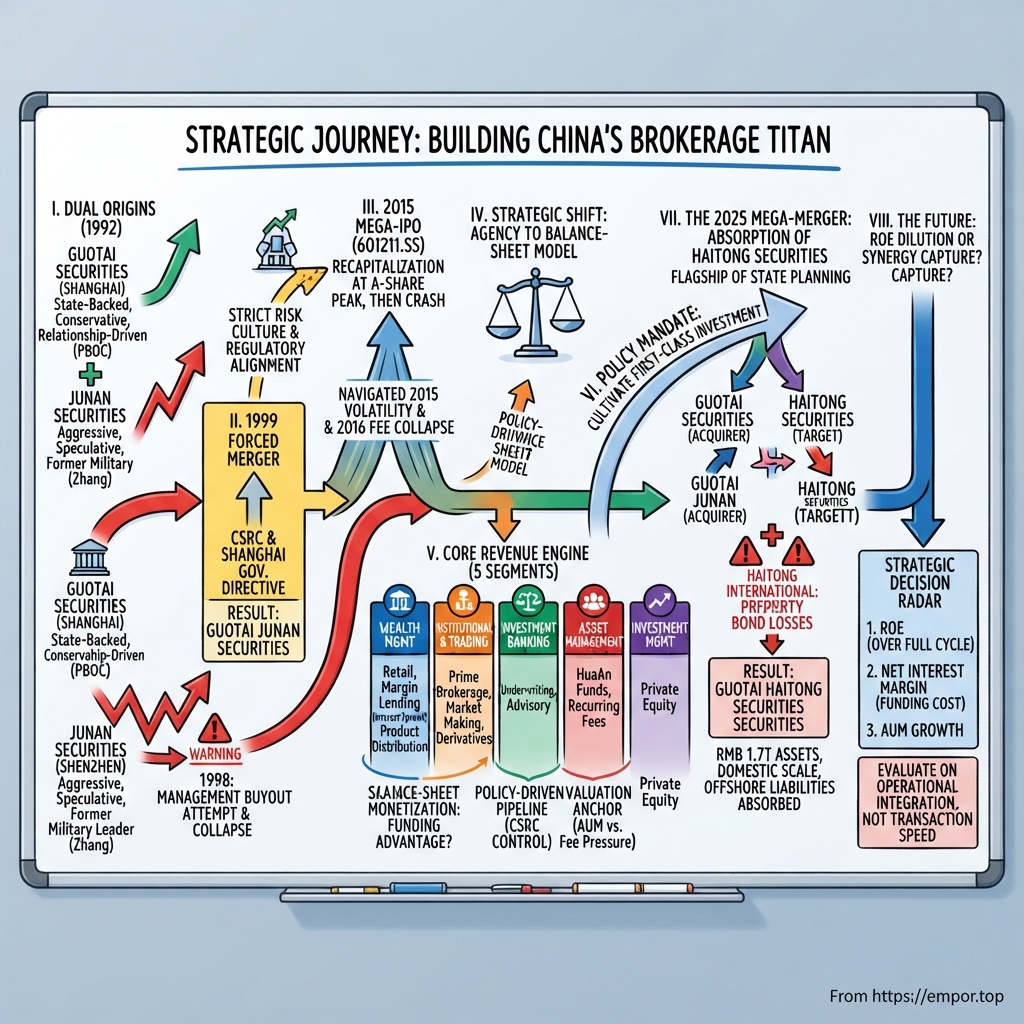
Guotai Junan Securities: Building China's Brokerage Titan
I. Introduction & Episode Roadmap
On a September morning in 2024, two press releases landed on the Shanghai Stock Exchange's disclosure portal within minutes of each other, before both stocks halted trading. 国泰君安证券 Guotai Junan Securities and 海通证券 Haitong Securities — two of China's oldest, largest, and most Shanghai-rooted brokerages — announced plans to merge.1 Neither firm was in visible financial distress at the time, nor had either been the subject of public takeover speculation. The announcement arrived fully formed, reflecting a decision shaped by high-level state planning.
What followed was the largest absorption merger in the history of China's securities industry: an all-stock transaction folding Haitong into Guotai Junan to create 国泰海通证券 Guotai Haitong Securities. With total assets around 1.7 trillion RMB — roughly $240 billion — the combined firm displaced 中信证券 CITIC Securities at the top of the domestic market by balance-sheet size.23
Beyond the transaction itself lies a broader strategic question.
Chinese regulators have signaled for years a desire to cultivate a core group of 打造一流投资银行 first-class investment banks — institutions equipped to underwrite domestic economic growth and compete directly with global peers like Goldman Sachs and Morgan Stanley.4 The Guotai Junan–Haitong merger serves as the flagship execution of that policy. The transaction was structured under the supervision of the 中国证券监督管理委员会 China Securities Regulatory Commission (CSRC) and executed by Guotai Junan, whose controlling shareholder is 上海国际集团 Shanghai International Group, an entity owned by 上海市国有资产监督管理委员会 Shanghai SASAC.5
For investors, the core question is whether state-engineered scale generates a genuine competitive advantage — through lower funding costs, expanded distribution, and a stronger institutional franchise — or merely creates a larger, slower firm burdened by legacy liabilities. Both outcomes remain plausible. Evaluating them requires examining what was combined, the costs incurred, and the underlying earnings engine of the merged entity once transaction momentum cools.
The analysis unfolds across six stages. First, the contrasting 1990s origins of Guotai Junan's founding entities — a conservative state enterprise in Shanghai and an aggressive Shenzhen brokerage led by a former military officer whose ambitious management buyout attempt ended in regulatory disgrace. Second, the 1999 forced merger that united them, shaping the firm's enduring risk culture. Third, the 2015 initial public offering, launched shortly before severe deleveraging hit China's A-share market. Fourth, the core operating business across five segments, evaluating individual economic drivers and a return profile that has lingered in the mid-single digits over the past decade. Fifth, the structure of the Haitong acquisition, including the integration of an offshore subsidiary severely impaired by defaults on Chinese property developer bonds. Sixth, a strategic assessment of Guotai Junan's competitive positioning, testing management assertions against market realities and identifying the core operational metrics that will determine long-term performance.
This analysis considers a business whose controlling shareholder is a municipal government, operating within an industry where profitability depends heavily on regulatory policies governing trading volumes, commission rates, and IPO approvals. Traditional analytical frameworks — economic moats, pricing power, and capital allocation discipline — remain essential, but they must be evaluated within an enterprise that does not operate solely to maximize shareholder returns. That state role is not a disqualifier; it is a structural variable that must be explicitly priced.
 Subscribe on LinkedIn
II. Dual Origins: Guotai, Junan, and the Wild West of 1990s Chinese Finance
Understanding why a Shanghai brokerage carries a compound name requires returning to the early 1990s, when China's capital markets lacked basic institutional structures.
In early 1992, 邓小平 Deng Xiaoping embarked on his Southern Tour, visiting Shenzhen and Zhuhai to affirm that market mechanisms were compatible with China's economic system. The tour restarted economic reforms that had stalled after 1989, triggering a rapid expansion of financial institutions. At the time, the Shanghai and Shenzhen stock exchanges were barely a year old, having opened in December 1990 with only a few dozen listed companies. China had no comprehensive securities law until 1998 and no unified national capital markets regulator until the establishment of the 中国证券监督管理委员会 China Securities Regulatory Commission (CSRC) in October 1992.
Hundreds of securities brokerages filled this regulatory vacuum, most carved out of commercial banks, trust companies, or municipal finance bureaus. Two distinct institutions emerged as key players.
国泰证券 Guotai Securities was founded in Shanghai in 1992 with backing from the state banking system. By temperament and sponsorship, Guotai represented the financial establishment: closely aligned with the People's Bank of China apparatus, focused on government bond distribution and policy-backed underwriting, and staffed by former state bureaucrats. For financial professionals seeking institutional stability, Guotai was the natural home.
In Shenzhen, 君安证券 Junan Securities pursued an entirely different strategy. Founded in the same year, Junan was driven by 张国庆 Zhang Guoqing, a former military officer who had served in the People's Bank of China's Shenzhen branch before building the brokerage. Zhang operated as a quintessential early-stage market operator: fiercely competitive, dismissive of bureaucratic caution, and committed to executive equity ownership.
Junan quickly established itself as one of China's most aggressive financial houses. The firm took large speculative positions in 国债期货 treasury bond futures — a volatile market that collapsed during the March 1995 "327 incident," when systemic risk led exchange authorities to cancel trades and suspend the market entirely. Junan also built an early corporate underwriting franchise, securing a major share of new-issue mandates across emerging B-share and Hong Kong H-share equity pipelines. Additionally, it operated extensive proprietary equity trading desks long before institutional asset management took root in China.
That aggressive risk culture ultimately proved fatal. In 1998, Junan's executives attempted an unauthorized management buyout. The scheme routed firm profits through affiliated shell companies in Shenzhen and Hong Kong to acquire equity stakes in Junan on behalf of top management. In a developed market with established statutory rules, such a transaction might be negotiated openly. In China during the late 1990s, where state entities held the underlying equity and no legal framework existed for executive buyouts, regulators classified the maneuver as a misappropriation of state assets.
Regulators uncovered the transactions, leading to Zhang's removal, investigation, and ultimate conviction and imprisonment. Deprived of leadership and burdened by proprietary trading losses from the 1997–1998 Asian financial crisis, Junan was no longer viable as an independent entity.
The regulatory resolution set a precedent for future state-led restructurings in China's financial sector. Rather than liquidating Junan or allowing market forces to resolve its failure, the CSRC and the Shanghai municipal government arranged a state-directed merger. In August 1999, Guotai Securities and Junan Securities merged to form 国泰君安证券 Guotai Junan Securities, with Shanghai state capital serving as the controlling anchor. The conservative Shanghai institution absorbed Junan's staff, underwriting relationships, and trading desks, alongside the operational lessons of its downfall.
This turbulent era forged the regulatory and operational standards that still shape Chinese finance. During the 1990s, brokerage branches functioned primarily as physical trading halls filled with retail investors submitting manual orders. Securities firms competed largely on physical footprint. Firewalls between proprietary trading, corporate underwriting, and client brokerage were minimal, while formal rules requiring the segregation of client funds were rarely enforced in practice. Between 1997 and 2005, an industry-wide regulatory restructuring eliminated dozens of brokerages, establishing the net capital framework that continues to limit broker leverage relative to equity.
That systemic cleanup provides crucial context for analyzing Chinese securities firms today. The domestic industry did not avoid crisis; rather, it experienced its formative consolidation early. The process established a regulatory posture that prioritizes risk containment over deregulation. Consequently, analytical models assuming a steady trajectory toward Western-style financial deregulation misinterpret the regulatory environment.
For Guotai Junan, Junan's downfall demonstrated that systemic failures stemmed not from market volatility, but from unconstrained leverage, weak governance, and concentrated executive control. The post-merger institution shaped its identity around the opposite principles: strict internal risk controls, close alignment with regulatory guidance, and a state-anchored shareholding structure designed to prevent centralized personal control.
This institutional design enhanced durability, allowing Guotai Junan to avoid the severe insolvencies that periodically affected peers. However, it also constrained profitability. By prioritizing risk aversion and regulatory compliance, the firm adopted an operational profile yielding returns on equity more comparable to regulated utilities than high-growth investment banks. The 1999 merger established a structural trade-off between balance-sheet stability and capital efficiency that continues to shape its financial performance.
Over the next fifteen years, Guotai Junan expanded its branch network, client base, and underwriting volume alongside domestic market growth. Operating as an unlisted entity funded by state shareholders and retained earnings, the firm faced mounting capital constraints that eventually necessitated access to public equity markets — setting the stage for an initial public offering with remarkable timing.
III. The 2015 Mega-IPO & Navigating A-Share Volatility
By the spring of 2015, the Shanghai Composite Index had been climbing for nearly a year, driven by unprecedented levels of margin financing. Market-wide margin balances reached trillions of RMB, augmented by a shadow system of grey-market leverage—including trust structures, peer-to-peer platforms, and 伞形信托 umbrella trusts—that regulators could track only imperfectly. Retail investors were opening accounts at a rate of millions per week, turning brokerage stocks into direct proxies for trading volume and making them among the top-performing equities globally.
Against this backdrop, Guotai Junan listed on the Shanghai Stock Exchange under ticker 601211 on June 26, 2015, raising approximately 30.05 billion RMB—around $4.8 billion—in what stood as one of the largest domestic Chinese IPOs ever completed at the time.6
That timing placed the firm in a distinct position. Guotai Junan converted a decade and a half of constrained, state-funded growth into the single largest equity capital raise in its history, priced at the peak of a highly leveraged bull market, with the proceeds clearing into its accounts during the final week of June 2015.
The Shanghai Composite peaked on June 12, 2015. By early July, the index had dropped by roughly a third. The unwinding was mechanical and severe: falling prices triggered forced liquidations, which drove prices lower and prompted further margin calls. Over a thousand listed companies suspended trading to protect their shares from intense sell-offs. In response, Chinese authorities launched a coordinated market stabilization effort. Major brokerages were directed to commit capital to exchange-traded fund purchases and refrain from net selling, supported by central bank liquidity injections and a temporary freeze on new IPO approvals.
Guotai Junan entered the crash with a freshly recapitalized balance sheet. The firm absorbed margin lending stress—as 融资融券 margin financing and securities lending balances deteriorated alongside evaporating client collateral—and participated in the mandated stabilization program without incurring capital losses that threatened its solvency. Whether this outcome reflected prescience or fortunate timing remains a subject of debate. The IPO timing was determined by the CSRC approval queue after years of waiting, rather than a tactical market call by management. However, management chose to raise the maximum capital available and retain it as liquidity rather than immediately deploying it into high-risk proprietary positions. While consistent with the firm's cautious risk culture established after the 1999 merger, this conservative deployment reflects capital preservation rather than active market-timing skill.
The more consequential legacy of 2015 lay not in the crash itself, but in the structural industry shift it accelerated.
Before 2015, Chinese retail brokerage operated as a lucrative business anchored by a regulated commission floor, with effective commission rates above ten basis points of turnover common in prior years. What followed was an abrupt fee collapse: internet-native competitors—most visibly 东方财富 East Money, which entered the sector as a financial data portal rather than a branch network—bid execution rates down toward cost. Industry-average net commission rates compressed to roughly two and a half basis points, stripping away approximately three-quarters of the industry's traditional transaction take rate.
This commission compression became the central structural reality of modern Chinese brokerage, driving Guotai Junan's strategic choices leading up to the Haitong transaction. When trade execution yields thin margins, brokerages face three primary strategic options: distribute third-party funds and wealth management products for advisory fees, extend margin financing to capture net interest spreads, or reorient from retail clients toward institutional services such as market-making, derivatives, prime brokerage, and fixed income.
Guotai Junan pursued all three strategies, leveraging its balance-sheet scale and conservative governance. The result was a decisive transition from an agency model—taking fees on client trades with minimal balance-sheet risk—to a balance-sheet model where earnings depend on capital deployment volume, funding costs, and risk management. This shift explains why building a 1.7 trillion RMB balance sheet became a strategic imperative: when an institution monetizes its balance sheet, scale becomes the primary product.
However, this transition also reframes the firm's risk profile. While an agency broker earns lower fees during market downturns, a balance-sheet intermediary experiences compressed fee income alongside potential capital losses on its risk assets.
IV. Segment Breakdown & Financial Engine Room
Chinese brokerages report financial results across five business lines, though standard reporting labels can mask the underlying operational mechanics. Examining these segments reveals what each business line sells, who pays for the service, and what conditions are necessary to generate sustained returns.
Wealth management — the biggest, and the most commoditized. Roughly 35 to 40 percent of net revenue flows from the segment designated as 经纪与财富管理 (Brokerage and Wealth Management). Beneath this single heading lie three distinct business models. The first is retail equity brokerage: executing trades for tens of millions of account holders at compressed market commission rates. The second is margin lending: financing leveraged client positions against securities collateral to earn an interest spread rather than a transaction fee — generating the bulk of retail profits. The third is financial product distribution: selling third-party mutual funds, insurance, and structured wealth products while collecting a share of recurring management fees.
The core economic driver for both trading execution and margin lending is identical: average daily trading volume across A-share markets. When retail investor activity surges, brokerages benefit twice over, as trading turnover drives commission volume while appetite for leverage inflates margin balances. Conversely, during market lulls, both revenue streams decline in tandem, exposing a lack of true revenue diversification. Product distribution represents the sole component with distinct economic characteristics, as mutual fund assets under management do not instantly vanish during low-turnover periods. Consequently, domestic brokerages universally highlight product distribution as a strategic priority.
Within this wealth franchise, operational scale serves a defensive function rather than providing offensive pricing power. An extensive branch network and massive client roster cannot support premium commission pricing when market rates are dictated by low-cost digital competitors. Instead, scale reduces unit processing costs and maintains a captive distribution network for financial products developed across the parent group. While economically valuable, this scale does not constitute a traditional moat based on pricing power.
Competitive pressures are most acute at the client acquisition stage. For domestic brokerages, the critical asset is not merely the existing account, but the digital interface where a prospective investor chooses to open one. Digital platforms such as 东方财富 East Money and 同花顺 Flush dominate this gateway because retail investors rely on their applications for market data, news, and stock screening prior to trading. Traditional brokerages have responded by developing proprietary applications and deploying branch personnel to serve higher-value clients — such as margin borrowers, high-net-worth individuals, and wealth product buyers — where personal advisory relationships remain influential and unit economics far exceed standard trading commissions. This strategy has insulated incumbent profits despite industry-wide commission compression, yet it surrenders the primary digital entry point, leaving traditional branch networks with a progressively aging client demographic.
Institutional and trading — the balance sheet at work. Generating roughly 30 to 35 percent of net revenue, the 机构与交易 (Institutional and Trading) division represents the primary destination for corporate capital. This segment encompasses market-making in fixed income, currencies, and commodities; proprietary equity positions; over-the-counter derivatives structured for institutional counterparties; and prime brokerage services — including financing, securities lending, execution, and reporting — supplied to China's expanding quantitative hedge fund industry.
In operational terms, the division functions as a hybrid between a collateralized lender and a market maker. Within prime brokerage and repurchase agreements, the firm extends credit against collateralized assets to capture an interest spread — a model dependent on low funding costs and rigorous collateral management. In market-making and derivatives, the firm intermediates between buyers and sellers, capturing bid-ask spreads while hedging residual exposures — a volume-driven model where profitability hinges on execution flow and effective tail-risk management during market gaps.
Both activities rely on access to cheap, reliable capital. A domestic brokerage funds its balance sheet through the interbank repurchase market, corporate bond issuances, and short-term credit facilities, with borrowing rates determined by asset size, credit ratings, and perceived state backing. This mechanics provides an empirical benchmark for evaluating the Haitong merger: if the combined institution achieves lower borrowing costs than its predecessors maintained independently, the advantage will manifest in expanded net interest margins. If borrowing costs remain unchanged, the core financial rationale for scale becomes difficult to substantiate.
The principal vulnerability in this segment stems from directional market risk. Proprietary trading income — 自营投资收益 — remains the most volatile line item on a Chinese brokerage income statement, frequently determining whether annual earnings are muted or depressed. Regulatory net capital requirements strictly cap balance-sheet leverage, preventing domestic firms from achieving the peak returns on equity seen at Western investment banks during bull markets, while similarly insulating them from comparable downside leverage spikes during downturns.
Investment banking — policy-driven, and currently throttled. Accounting for roughly 10 to 15 percent of net revenue, the 投资银行 (Investment Banking) segment comprises equity underwriting, corporate bond issuance, and financial advisory services, with a strong concentration in Shanghai-area state-owned enterprise restructurings where municipal shareholder ties are paramount.
In Chinese equity underwriting, market supply is administratively controlled. The CSRC dictates the cadence of initial public offering approvals and employs IPO 逆周期调节 (counter-cyclical adjustment of new issuance) as a stabilization mechanism — curtailing or halting public offerings during periods of secondary market weakness under the premise that fresh equity supply depresses trading values. Consequently, the primary determinant of underwriting revenue is an external regulatory policy decision. While an investment bank can gain market share within a constrained pipeline, it cannot independently expand market volume. Corporate bond underwriting provides more consistent fee streams, prompting major brokerages to focus capital on fixed-income issuance.
Asset management — the small segment that matters most for valuation. Generating approximately 10 percent of net revenue, 资产管理 (Asset Management) is the smallest operating line, yet commands significant valuation weight. The division includes the brokerage's internal asset management unit alongside a controlling stake in 华安基金 HuaAn Funds, an established domestic mutual fund manager with assets under management totaling hundreds of billions of RMB.
Despite contributing only a tenth of total revenue, asset management warrants close investor scrutiny due to the quality of its earnings. Mutual fund management fees generate recurring income, demand minimal balance-sheet capital, scale with asset accumulation rather than trading turnover, and remain resilient during market volume contractions. In an industry where earnings otherwise depend on interest spreads or trading transaction tolls, recurring fees on managed assets command higher valuation multiples in public markets.
However, domestic mutual fund fee structures face ongoing regulatory scrutiny. Financial authorities have systematically lowered baseline equity fund management fees as part of a policy initiative to reduce investment costs for retail households. To maintain fee revenue, asset growth must outpace rate compression. Framing the asset management division as an insulated high-margin business overlooks its exposure to the same regulatory fee-reduction policies that impacted retail brokerage commissions.
Investment management — the private book. The remaining 5 to 8 percent of net revenue derives from direct private equity investments, venture capital funds, and participation in state-guided industrial funds. This segment operates on extended investment horizons with lumpy earnings realizations contingent on capital exit markets — which have faced headwinds during periods of restricted public listings. Additionally, because unlisted holdings are recorded at estimated fair value rather than observable market prices, this line item relies heavily on internal valuation methodologies.
Taken together, the five operating segments present a consistent financial profile: reported return on equity has remained bounded in the mid-single digits, generally hovering between 6 and 9 percent throughout the decade following the firm's public listing. This performance reflects structural realities rather than execution missteps — specifically, strict regulatory leverage caps, a commoditized retail brokerage landscape, an administratively constrained investment banking pipeline, and a risk-averse corporate governance model operating atop an expanding equity base fueled by retained earnings and equity issuances.
This structural ceiling raises a central strategic question for the enterprise: if returns on equity are constrained by regulatory leverage caps and systemic fee compression, what concrete financial advantage does a dramatically larger balance sheet deliver?
V. The Mega-Merger: Absorbing Haitong Securities to Build a 1.7 Trillion RMB Powerhouse
The answer begins not in a corporate boardroom, but at the 中央金融工作会议 Central Financial Work Conference in Beijing in late October 2023 — a policy gathering held roughly every five years to set the direction of Chinese finance. Policy directives emphasized building financial institutions of genuine scale and quality, which the CSRC translated into an explicit agenda: cultivate first-class investment banks, encourage industry consolidation, and support market leaders expanding through mergers and acquisitions.47
For over a decade, market participants had described China's brokerage sector as inefficiently fragmented, with more than a hundred licensed firms competing for a compressing fee pool. By late 2023, consolidation shifted from a theoretical recommendation to a regulatory mandate.
The deal. On September 5, 2024, Guotai Junan and Haitong Securities announced plans to combine, with Guotai Junan absorbing Haitong through an all-share transaction.12 Haitong investors received newly issued Guotai Junan equity rather than cash, with the H-share exchange ratio set at 0.62 Guotai Junan H-shares for every Haitong H-share.8 Haitong's public listings — 600837.SS in Shanghai and 6837.HK in Hong Kong — were retired, its assets and liabilities transferred to the acquiring entity, and the combined firm renamed 国泰海通证券 Guotai Haitong Securities. Regulatory approvals were granted by late 2024, and full legal execution concluded in 2025.9
From a capital allocation perspective, the all-stock structure preserved balance-sheet liquidity, requiring zero cash outlay from the acquirer. However, issuing equity diluted existing Guotai Junan shareholders. Consequently, evaluating value creation turns on whether the per-share value of the acquired Haitong assets surpassed the equity value surrendered. Answering that requires separating Haitong's domestic operating engine from its offshore operations, as the two presented starkly different financial conditions.
The wreckage. Haitong's offshore subsidiary, 海通国际 Haitong International, had operated as an active Chinese underwriter and trader in Hong Kong, accumulating significant positions in high-yield US dollar bonds issued by domestic property developers. When China's real estate sector entered a wave of debt defaults starting in 2021 — led by developers like 恒大 Evergrande and 碧桂园 Country Garden — the market value of those holdings plummeted. Haitong International recorded heavy capital losses across 2022 and 2023, required major equity injections from its parent, and was taken private off the Hong Kong exchange in 2024 prior to the parent merger.
This offshore breakdown offers critical evidence when testing assertions regarding state-linked risk discipline. Haitong was an established, state-controlled broker operating under identical domestic regulatory oversight. Yet its international arm concentrated credit exposure in a single volatile sector through a Hong Kong entity and sustained substantial losses. While Guotai Junan avoided similar exposures, that outcome reflects firm-specific risk management choices rather than an inherent safeguard of state ownership. Ultimately, Guotai Junan knowingly absorbed those impaired offshore liabilities as part of the transaction.
The prize. In exchange, Guotai Junan acquired Haitong's healthy domestic franchise. Haitong maintained an extensive branch network concentrated in Shanghai and the broader Yangtze River Delta, a large institutional client base, an established investment banking pipeline, proprietary futures and asset management operations, and a major retail deposit base. These domestic operating assets were priced at a market discount resulting from the offshore distress.
Stripped of corporate rhetoric, the strategic trade was straightforward: Guotai Junan used its equity to acquire a complementary domestic franchise at a valuation depressed by offshore debt holdings, absorbing those international liabilities as an acquisition cost. The long-term return on this trade depends on two unresolved factors: the ultimate size of residual credit losses within the acquired offshore book, and management's capacity to extract durable cost savings from duplicate domestic operations.
The transaction also highlights structural limits within broader Chinese financial consolidation. Industry M&A had stalled for years due to governance friction among distinct state owners. Most large brokerages are held by different provincial or central state entities, requiring multiple government bodies to agree on valuation and governance rights. Guotai Junan and Haitong represented a manageable exception because both fell under the Shanghai municipal government's ownership framework. Consequently, while the merger demonstrates what state alignment can accomplish within a single municipality, it provides a limited template for complex cross-provincial consolidations.
The skeptical read on synergies. Realizing cost synergies in branch-based financial services is historically slow and politically constrained. Operating headquartered entities with overlapping branch networks across eastern China creates operational redundancy in real estate, technology platforms, back-office administration, and management headcount. However, eliminating duplicate roles inside a municipal state-owned enterprise faces strict employment stability expectations. Cost reductions are likely to proceed more gradually than standard private-sector integration playbooks project, making near-term margin expansion claims questionable until verified in cost-to-income metrics.
Management points to transaction speed as evidence of operational capability. The merger progressed from initial announcement to regulatory approval in under four months, completing key exchange mechanics within roughly six months of clearance.9 While swift execution demonstrates high-level state coordination and transaction management, deal closing speed is distinct from operational integration and does not guarantee successful post-merger synergy capture.
The 2026 cleanup. Further organizational restructuring occurred in August 2026, when the group announced a proposal to take private its listed Hong Kong subsidiary, 国泰君安国际 Guotai Junan International (1788.HK).10 Management cited the resolution of horizontal competition as the primary rationale, eliminating structural overlap between listed offshore entities to unify cross-border operations following the absorption of Haitong's international units.
Alternatively, the privatization reflects a pragmatic consolidation of an offshore corporate structure that had accumulated redundant legal entities without building distinct market advantages. Consolidating cross-border activities into a single platform streamlines governance and eliminates secondary listing costs.
Ultimately, these corporate reorganizations leave a fundamental question unanswered: whether the enlarged enterprise can generate higher risk-adjusted returns per unit of capital than its constituent parts achieved independently. Resolving that requires evaluating the firm's overarching competitive strategy.
VI. Strategic Frameworks: Hamilton Helmer's 7 Powers & Porter's 5 Forces
Strip away policy rhetoric and consider the central question an investor must answer: does this business possess a durable competitive advantage that yields returns above its cost of capital, or does it merely possess scale?
Hamilton Helmer's 7 Powers framework provides an analytical lens for distinguishing scale from structural advantage.
Scale economies — real, but narrower than claimed. The strongest argument for scale centers on funding costs. A securities firm's expense structure is driven less by payroll than by the cost of capital, and in China's interbank market, the largest and most visibly state-backed institutions borrow at lower rates than smaller peers. A 1.7 trillion RMB balance sheet, an implicit backstop from Shanghai's municipal government, and top-tier domestic credit ratings should yield a funding advantage that compounds across every spread-based line of business. Scale also matters in prime brokerage, where quantitative hedge funds concentrate business with counterparties capable of supporting large-scale financing and securities lending.
The weaker version involves branch and technology scale, where the industry's true cost leaders are internet platforms rather than massive balance sheets. Operational scale has failed to stop commission compression across any Chinese brokerage, including market leader CITIC Securities.
Cornered resource — the strongest power in the portfolio, with an asterisk. State control by Shanghai International Group under Shanghai SASAC represents a genuine, non-replicable asset. This relationship positions the firm for municipal bond underwriting, advisory roles in Shanghai SOE restructurings, and participation in Pudong's financial-center initiatives. No commercial rival can acquire this alignment, fulfilling the classic definition of a cornered resource.
The caveat is that state backing works in both directions. A controlling shareholder that is a municipal government will at times require the firm to undertake actions that do not maximize value for minority shareholders — such as participating in market stabilization programs, supporting policy priorities, moderating headcount reductions, or absorbing a distressed peer. The 2015 market stabilization program and the Haitong merger both illustrate this dynamic. While investors benefit from mandate flows and lower funding costs, they also inherit policy obligations. Pricing only the benefits is a common analytical error when evaluating Chinese state-linked financials.
Process power — plausible, and partially evidenced. The proposition is that over twenty-five years of risk-control architecture, installed following the Junan collapse, constitute an organizational capability competitors cannot easily copy. The supporting evidence is notable: the firm navigated the 2015 leverage unwind without capital impairment, and unlike Haitong, avoided concentrating its offshore book in Chinese property developer debt during 2019–2021 when doing so was lucrative and widespread.
The limit of this claim is that avoiding two specific crises over a decade is consistent both with superior risk processes and with a conservative risk appetite that depresses returns during normal periods — an orientation reflected in the firm's mid-single-digit return on equity. Furthermore, this capability describes the pre-merger enterprise. Whether that risk culture survives the absorption of a massive institution with different operating habits remains unproven, and would be challenged by any credit or trading losses emerging from legacy Haitong desks post-integration.
Counter-positioning — absent, and the firm knows it. This represents the firm's clearest structural weakness. East Money built a digital brokerage atop a free financial information portal, acquiring users at near-zero marginal cost and treating trade execution as a loss leader. A full-service incumbent burdened by thousands of branch personnel cannot match that cost structure without destroying its own core economics — the classic counter-positioning trap where an incumbent's rational response is to abstain from direct price competition. Guotai Junan has responded by competing on services digital platforms cannot offer: large-scale margin financing, institutional coverage, and proprietary product creation. While a logical strategy, it does not overcome the underlying counter-positioning disadvantage.
Switching costs, branding, network economies — weak. Retail clients face minimal friction when transferring accounts. Brand reputation provides marginal advantages at the institutional level but commands no price premium. Brokerage services lack meaningful network effects, as liquidity resides with the stock exchange rather than individual brokers.
Applying Michael Porter's Five Forces framework to the business yields a consistent strategic picture. Rivalry is severe: 中信证券 CITIC Securities, 华泰证券 Huatai Securities, 中国国际金融股份有限公司 CICC, and 中国银河证券 China Galaxy Securities all compete for identical institutional mandates and retail flows, all operate with state or quasi-state backing, and none maintains an obvious product differentiator. Buyer power is high on the retail side, where commission rates hover near marginal cost, and increasingly high on the institutional side, where large quantitative hedge funds split prime brokerage mandates across multiple counterparties to preserve negotiating leverage. Substitutes pose a genuine threat: 东方财富 East Money and 同花顺 Flush dominate the client acquisition channel, while the shift of household savings into passive index funds and ETFs undermines the advisory distribution model traditional brokerages seek to sell. New entrants face high barriers — CSRC licensing requirements are strict and capital thresholds remain substantial — making regulatory barriers the single force clearly favoring incumbents, which explains why competitive intensity stems from internal rivalry rather than outside disruption. Supplier power is moderate: stock exchanges and clearing infrastructure operate as monopolies, but their fees are administratively set rather than extractively priced.
This strategic synthesis challenges a simple bullish thesis. The firm holds one strong power in its state relationship, one moderate and partially proven power in its risk processes, and a real but bounded advantage in funding scale, while remaining structurally disadvantaged on the dimension that drove the industry's fee collapse. That combination does not rule out an attractive investment — an oversized, well-capitalized institution in a market that periodically generates high trading volumes can produce solid returns. However, those returns are more likely to stem from market cycles and entry valuations than from a compounding competitive advantage. Distinguishing between those two drivers represents the primary analytical task for investors evaluating the stock.
Which raises the question of who is making the decisions.
VII. Current Management, SOE Governance & Capital Allocation
Leadership at a Chinese state-owned brokerage is not selected through traditional Western corporate channels, and ignoring this distinction undermines analytical rigor. Executive appointments at a firm controlled by Shanghai SASAC are vetted by the municipal party apparatus and informed by supervisory authorities. Senior executives frequently rotate between regulatory bureaus, state financial institutions, and municipal government posts over their careers. This produces leaders who are politically fluent, regulatorily experienced, and focused on institutional stability rather than personal franchise-building.
Chairman 朱健 Zhu Jian exemplifies this career trajectory. He spent formative years within the CSRC's Shanghai bureau before holding senior executive roles across Shanghai's state financial apparatus, later assuming the leadership of Guotai Junan and subsequently the merged entity.5 For an institution whose defining strategic transaction required navigating a complex regulatory approval framework on an abbreviated timeline, leadership well-versed in supervisory procedures served as a central asset.
Yet that background also limits traditional executive assessment. A career built across regulatory oversight and state administrative roles provides little evidence of independent capital allocation, commercial restructuring decisions, or publicly tracked performance benchmarks. Consequently, the primary test of Zhu's leadership centers on the operational integration now underway.
President 李俊 Li Jun oversees operational execution, bringing a background focused on institutional services and technology integration — the domains where post-merger synergies are ultimately realized or lost. Consolidating trading platforms, risk management engines, client databases, and settlement systems represents the most technically demanding aspect of the transaction. Without a single, unified risk management system, an institution cannot effectively oversee a combined balance sheet, leaving it vulnerable to unmonitored exposures.
The ownership picture. 上海国际集团 Shanghai International Group remains the controlling shareholder of the combined enterprise, holding a stake in the low-to-mid 30 percent range, alongside additional equity blocks held by Shanghai municipal state entities.5 The remainder of the capital structure comprises a widely dispersed public float split between A-shares and H-shares.
This ownership structure creates two opposing forces. On one hand, municipal control imposes a structural check against unhedged risk-taking and aggressive executive buyout schemes — the governance vulnerabilities that led to Junan's collapse in 1998 and Haitong International's offshore property bond losses in 2021. On the other hand, the controlling shareholder's strategic priorities focus on developing Shanghai into an international financial hub, supporting regional employment, and advancing national policy initiatives, rather than maximizing minority shareholder returns.
Capital allocation, assessed on behavior rather than statements. The firm has maintained a cash dividend payout ratio between 30 and 40 percent of net earnings — a consistent payout for a capital-constrained broker operating under regulatory net capital rules that favor equity retention. Because distributions track underlying earnings, dividend payments fluctuate alongside broader market cycles rather than providing a stable yield.
A more instructive metric is how management deploys retained capital. Over the decade following its 2015 initial public offering, retained earnings have primarily expanded balance-sheet positions — funding margin loans, proprietary trading assets, and fixed-income market-making inventory. Under China's regulatory leverage caps, balance-sheet expansion represents the primary pathway for capital deployment, causing equity growth to outpace net income and keeping return on equity bound in the mid-single digits. Expanding book value per share while returns linger at modest levels reflects systematic capital retention rather than active capital allocation.
The Haitong absorption stands as the first major discretionary capital allocation decision in the firm's history as a public company, executed entirely through equity rather than cash. Acquiring impaired assets with equity creates shareholder value only if the acquirer's stock is fairly valued. Because Chinese securities shares have traded at depressed price-to-book multiples for years, issuing equity at a discount to purchase an asset trading at a discount represents a relative-value trade rather than an inherently value-accretive transaction.
Management's strategic messaging has remained consistent since the 2024 merger announcement: build a first-class investment bank, serve the real economy, strengthen Shanghai's financial status, and capture integration synergies. However, public disclosures have lacked quantified, time-bound targets for cost reductions, branch consolidations, headcount adjustments, or long-term return on equity targets. While Chinese state-owned enterprises rarely provide the detailed financial guidance typical of Western institutions, the absence of explicit benchmarks prevents investors from evaluating management's execution against declared commitments, requiring market participants to judge the merger solely through future financial results.
Where governance scrutiny is most acute. Institutional investors focus on three primary vulnerabilities. First, the valuation process establishing the exchange ratio: because controlling shareholders of both entities answered to the same municipal state asset supervisor, verifying arm's-length negotiation dynamics remains challenging. Second, the valuation of the acquired offshore book: fair-value estimates for illiquid, distressed property credit represent the single largest accounting judgment on the balance sheet, requiring close inspection of auditor disclosures and ongoing impairment charges. Third, related-party complexity: an enterprise operating mutual fund management, futures trading, private equity, an offshore subsidiary being taken private, and a municipal parent company contains numerous internal channels through which capital and revenue can shift beyond the direct view of public shareholders.
These considerations are not assertions of impropriety; rather, they define the specific operational and financial metrics that will determine whether state-engineered scale translates into long-term value creation.
VIII. Bull vs. Bear Case & Skeptical Investor Stress Test
Here is the argument in its strongest form, on both sides, with the disconfirming evidence attached to each claim rather than quarantined.
The bull case, claim by claim.
Claim one: post-merger scale creates durable cost and funding advantages. The mechanism is credible: consolidated technology spending, rationalized branch overlap across eastern China, and lower wholesale borrowing costs on a larger, more systemically important balance sheet. The test against history is less reassuring. Chinese brokerage consolidation has occurred before—including the 1999 creation of this firm—and the resulting entity did not generate a visible structural margin advantage over peers in the subsequent two decades, maintaining returns on equity in the same band as competitors. That history does not reject the claim, but it narrows it: scale should assist at the funding line specifically, placing the burden of proof on whether net interest margins and cost-to-income ratios improve relative to CITIC Securities and Huatai Securities over the next two to three years. Absent that improvement, scale provides size without advantage.
Claim two: Chinese household wealth is migrating from property into financial assets, and the firm's asset management franchise captures it. The underlying shift is real and documented: the multi-year contraction in Chinese residential real estate removed the default savings vehicle for a generation of households, redirecting capital into financial markets. The claim narrows for two reasons. First, much of that capital has flowed into bank deposits and government bonds rather than equities—products with entirely different fee economics. Second, equity allocations have shifted disproportionately into low-fee passive products alongside regulatory fee compression on active funds. Consequently, while the volume thesis holds, the margin thesis faces structural pressure. A refined version of the claim requires asset management assets under management to outpace fee compression—an empirical variable tracked through monthly fund disclosures rather than a structural certainty.
Claim three: policy tailwind, with regulators consolidating the industry around national champions. This is the best-evidenced bull point, because the policy is explicit and the merger is its demonstration case.4 It is also the claim most worth examining for what it implies about the recipient. Being designated a national champion entails explicit obligations to the state. The policy framework that delivers scale and mandate flows also imposes market stabilization duties, fee reductions to lower investor and issuer costs, and employment stability expectations during integration. Policy support and policy control represent two sides of the same instrument.
The bear case, claim by claim.
Claim one: ROE dilution. Absorbing a significantly expanded asset base with lower relative earning power depresses returns arithmetically. If additional credit impairments emerge from the legacy offshore book, those losses reduce the numerator directly. A combined return on equity persisting below pre-merger levels would indicate that the merger consumed equity capital without producing commensurate earnings, representing a net dilution for pre-transaction Guotai Junan shareholders.
Claim two: fee compression has not finished. Retail commissions remain near marginal cost, while underwriting fees, asset management fees, and advisory rates face ongoing regulatory pressure under policy initiatives to reduce financial intermediation costs. Every core revenue line operates under a supervisory framework willing to administer prices.
Claim three: earnings visibility is poor. A-share trading turnover fluctuates substantially between subdued and active periods, driving commission revenue and margin lending income in tandem, while proprietary trading revenue tracks broader market direction. Earnings can expand or contract sharply based on retail sentiment, arguing against evaluating the enterprise on any single year's financial results.
The stress test. Put a skeptical long/short investor in the room and the questions get sharper.
On the offshore book: what is the residual exposure to defaulted Chinese property credit carried over from Haitong International, at what carrying value, and under what recovery assumptions? This is where acquisition costs are frequently hidden, with discrepancies between carrying values and realized recoveries appearing gradually through incremental impairments.
On margin lending: the retail margin lending book is collateralized by A-share equities, meaning collateral values and borrower liquidity decline simultaneously during market downturns. While the 2015 deleveraging demonstrated that a well-capitalized balance sheet can absorb this stress, it also proved that collateral declines produce credit losses.
On integration: combining two Shanghai-headquartered competitors involves overlapping branch footprints, duplicated regional management, and workforce teams that historically competed for the same accounts. Cultural friction in financial services typically manifests as producer attrition, as senior bankers, institutional salespeople, and traders relocate with client relationships. Initial revenue dis-synergies represent a standard outcome in large brokerage acquisitions globally, with little reason to expect an exception here.
On disclosure and complexity: an institution of this scale, operating multiple subsidiaries under a municipal state parent, presents analytical opacity from an external perspective. That complexity constitutes an independent risk factor, partially explaining why Chinese brokerages trade at persistent valuation discounts relative to book value.
The weighted conclusion, stated plainly: the historical record supports the view that Guotai Haitong is a durable, well-capitalized institution occupying a central position in Shanghai's financial infrastructure. It rejects the stronger assertion that scale and state backing automatically yield superior returns on capital, as two and a half decades of post-1999 history demonstrate an enterprise earning peer-average returns despite holding similar structural advantages. The defensible thesis is narrower: Guotai Haitong is a high-quality, cyclically sensitive participant in Chinese capital markets whose long-term performance will depend primarily on market turnover and secondarily on whether post-merger integration yields measurable funding and operational cost reductions—the primary new variable subject to empirical tracking.
IX. Strategic Risk Radar & Key Investment KPIs
Not every macro risk matters equally. Three core risks dominate the outlook, each with a direct transmission mechanism into earnings.
Regulatory and policy risk is the dominant exposure, operating as the baseline condition rather than a tail risk. The CSRC dictates the pace of IPO approvals and has repeatedly slowed equity issuances to support secondary market valuations, directly curtailing investment banking revenue. Regulators have also systematically compressed brokerage commissions, mutual fund management fees, and underwriting spreads to lower financial intermediation costs across the economy. Furthermore, during periods of severe market instability, major state-linked brokerages can be directed to deploy balance-sheet capital into market stabilization programs. Investing in the combined enterprise represents an explicit bet on Chinese financial policy as much as on capital market activity.
Asset quality and proprietary trading risk represents the primary driver of severe downside earnings volatility. The firm relies heavily on balance-sheet capital deployed across proprietary equities, corporate bonds, derivative hedges, and collateralized margin loans. A sharp market downturn simultaneously depresses proprietary investment income and increases margin credit stress. Similarly, credit events in corporate debt impair the fixed-income portfolio, while acquired offshore exposures add a residual layer of risk whose ultimate cost remains uncertain. Haitong International's recent distress stands as a direct, internal demonstration of how concentrated credit exposures can generate substantial capital losses.
Integration execution risk represents the primary operational variable directly within management's control. Potential failure modes are well-defined: branch rationalization that stalls due to employment stability mandates, leaving a bloated cost structure; prolonged technology platform consolidation that leaves risk management systems fragmented; producer attrition among institutional teams; and delays or complications in the privatization of Guotai Junan International, which would perpetuate the offshore governance overlap the transaction was designed to resolve.10
Beyond these core risks, several secondary indicators warrant attention: the group's corporate credit ratings and debt issuance spreads, which provide the cleanest external test of whether funding-cost synergies are materializing; auditor disclosures regarding fair-value estimates for Level 3 illiquid assets; and senior talent departures from legacy Haitong institutional units, serving as a leading indicator of revenue dis-synergies.
Evaluating long-term performance requires focusing on three primary key performance indicators.
Return on equity for the combined entity. ROE functions as the master metric, aggregating the financial impact of the merger. Pre-merger Guotai Junan generated returns on equity consistently in the mid-single digits. If the combined firm achieves and sustains returns meaningfully above that baseline across a full market cycle, the scale thesis will be validated. If ROE returns to or below historical levels once transaction accounting normalizes, the merger will have delivered balance-sheet size without economic expansion. Establishing this trend requires multi-year observation, as single-year fluctuations reflect prevailing market sentiment rather than structural integration success.
Asset management AUM, with particular focus on HuaAn Funds. Managed assets provide the cleanest measure of recurring fee income insulated from trading turnover and direct balance-sheet risk. Investors should evaluate total AUM growth alongside disclosed fee revenue to verify that asset accumulation outpaces regulatory fee compression. Rising AUM paired with stagnant fee income would signal margin erosion rather than sustainable franchise growth.
Net interest margin on the financing book. The net interest spread between returns on margin lending and repurchase assets versus wholesale borrowing costs reveals whether scale delivers genuine funding advantages. This metric serves as the most direct test of the merger's core strategic rationale and remains largely unclouded by one-off acquisition accounting.
Tracked across multi-year periods against peers such as CITIC Securities and Huatai Securities — rather than against isolated historical baselines — these three metrics provide the empirical foundation for evaluating the combined entity. Secondary indicators like quarterly trading volatility, IPO league table rankings, and headline asset milestones offer little analytical signal by comparison.
X. Playbook: Business & Investing Lessons
Three durable lessons emerge from this story, generalizing well beyond a single Chinese brokerage.
State-led consolidation can manufacture scale, but it cannot manufacture returns. What Chinese authorities accomplished between 2023 and 2025 stands as a striking exercise in industrial policy: identifying a fragmented sector, treating that fragmentation as a strategic weakness, and forging the country's largest broker through an all-stock merger on a timeline impossible in markets where decisions require board negotiations and shareholder approval. State coordination is a formidable capability, and investors who dismiss state-directed consolidation as inherently value-destructive overlook the funding, licensing, and mandate advantages it provides. Yet scale is merely an input. Sustainable returns require either pricing power or a persistent cost advantage—neither of which administrative decree can supply. Investors must weigh both realities: the state can build an enterprise, but it cannot guarantee that enterprise will earn.
Risk guardrails are invisible until they become essential. Junan in 1998 was one of China's premier securities firms, its aggressive risk-taking indistinguishable from commercial brilliance until it proved fatal. Haitong International in 2020 was a leading Chinese investment bank in Hong Kong, its property bond franchise looking equally brilliant right up until developers defaulted. In both instances, the high returns that appeared to justify the risk preceded the losses that invalidated it by years. The lesson for investors is clear: an institution earning conspicuously higher returns than peers on identical regulatory terms is often taking risk that has not yet been priced—while a firm earning lower returns may be paying an insurance premium that appears expensive only until a crisis hits. Judging financial institutions on short-term returns without identifying their underlying drivers is a direct path to capital loss.
When trade execution commoditizes, monetize the balance sheet. The collapse of Chinese brokerage commissions from double-digit basis points to roughly two and a half offers a textbook study in commoditization. Trade execution—once the industry's core revenue engine—turned into a low-margin utility function within a decade. Incumbents survived by reorienting around services that cannot be provided for free: collateralized lending, OTC derivatives, prime brokerage financing, and fund manufacturing and distribution. When a visible product commoditizes, economic value migrates to capital-intensive, heavily regulated, or relationship-dependent activities. Firms that anticipate this shift position themselves deliberately, while those that hesitate have their positions dictated by the market.
XI. Epilogue & Outro
There is a clear symmetry to this story. In 1999, a conservative Shanghai brokerage absorbed an aggressive, overextended rival whose leadership had gambled and lost, leading state authorities to arrange a merger to prevent a major institutional failure. In 2025, that same Shanghai firm absorbed another large, overextended competitor whose offshore division had gambled on Chinese property credit and lost. While regulators framed this second transaction as a strategic ambition to build scale rather than a rescue, it contained elements of both.
国泰海通证券 Guotai Haitong Securities stands as the flagship of China's capital markets reform: the largest broker by assets in a market that has become, by most measures, the second most important equity market in the world.3 It possesses balance-sheet scale, operational licensing, municipal patronage, and an explicit regulatory mandate. What it lacks is empirical proof that these assets translate into superior returns on invested capital for shareholders.
The central strategic question for the coming decade is geographic. Domestically, the firm's competitive position is about as strong as regulatory conditions allow—backed by leading scale, privileged municipal access, and a peer group governed by identical constraints. Consequently, domestic growth depends on overall market expansion and the cyclical trading enthusiasm of Chinese retail investors, neither of which management controls. The alternative growth path is the one regulators envision when calling for first-class investment banks: establishing a competitive international franchise across Hong Kong, Southeast Asia, London, and New York.
The historical record on that global ambition remains discouraging. The most aggressive attempt by a Chinese brokerage to build an offshore investment bank occurred through Haitong International, which concluded with heavy credit losses and a mandatory delisting. Meanwhile, the group moved in 2026 to take private its own Hong Kong platform, 国泰君安国际 Guotai Junan International, to simplify an overlapping offshore structure. These episodes do not mean a Chinese securities firm can never establish a global presence. However, they demonstrate that this institutional lineage has tried and failed before, requiring investors to discount forward-looking claims of international expansion until offshore operations generate sustained, disclosed profits.
For now, the enterprise is best understood as a well-capitalized, state-controlled financial intermediary occupying a central node in China's domestic capital markets. Its earnings will fluctuate with domestic retail sentiment, its historical returns on equity remain modest, and its defining variable is whether state-engineered scale will yield concrete operating efficiencies or merely an expanded balance sheet. The financial disclosures that will answer that question arrive quarterly, and they merit close inspection.
References
-
China brokerages Guotai Junan, Haitong Securities plan merger — Reuters, 2024-09-05 ↩↩
-
China Brokerage Giants Guotai Junan, Haitong to Merge — Bloomberg, 2024-09-05 ↩↩
-
Guotai Junan-Haitong merger creates Chinese brokerage behemoth — S&P Global Market Intelligence, 2024-09-10 ↩↩
-
China Securities Regulatory Commission — regulatory policy announcements ↩↩↩
-
Shanghai Stock Exchange — Guotai Junan company filings (601211.SS) ↩
-
Financial sector reform and consolidation directives — Caixin Global, 2024-03-15 ↩
-
HKEXnews — Guotai Junan Securities regulatory disclosures (2611.HK) ↩
-
China brokerage mega-merger approved by regulators — Financial Times, 2024-12-28 ↩↩
-
Guotai Haitong proposes to privatize offshore unit Guotai Junan International — The Standard HK, 2026-08-15 ↩↩
 LinkedIn
 WhatsApp
 Reddit
 Hacker News
 Email
Email Kindle
 RSS Feed
 Spotify
 Apple Podcasts
 Amazon Music
 Audible
 YouTube