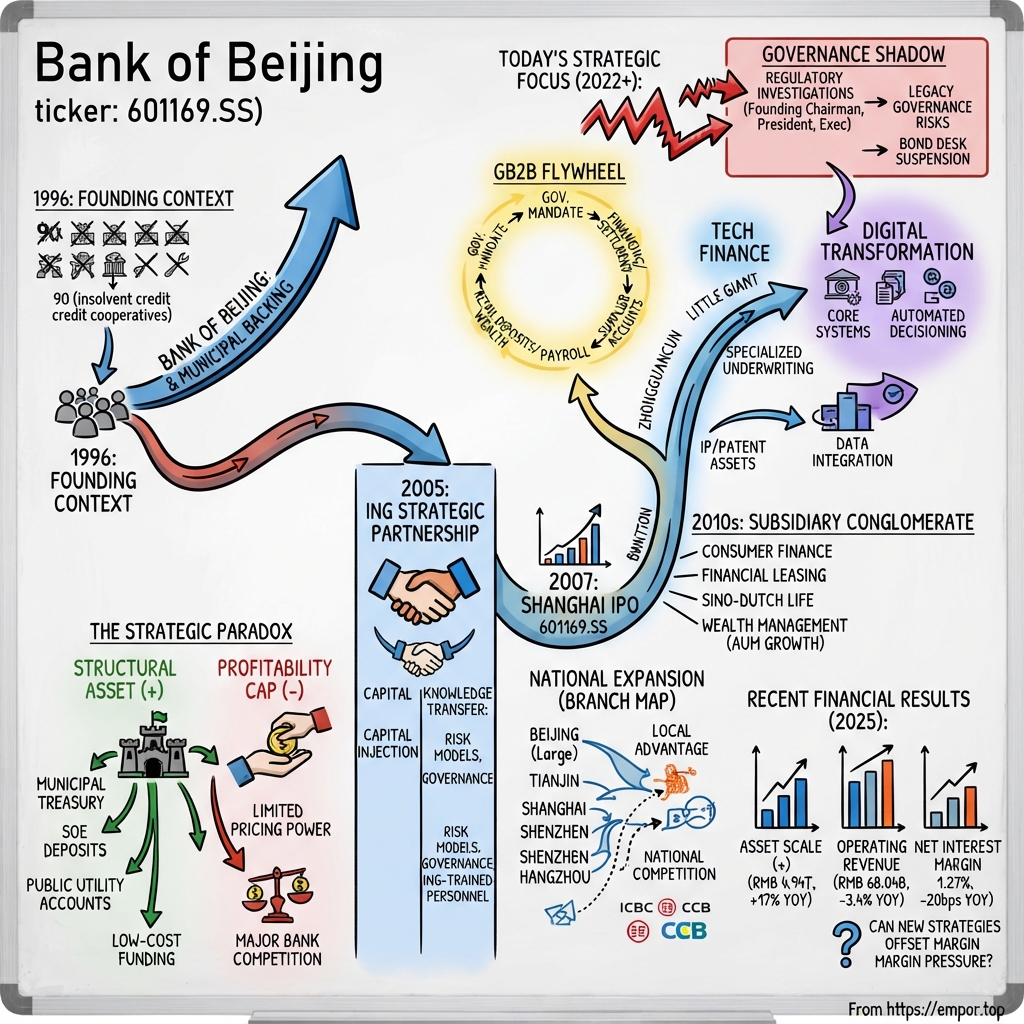
Bank of Beijing: Capital, Governance, and the Municipal Giant
I. Introduction & Episode Roadmap
On a winter morning in 1996, in a conference room in western Beijing, officials from 中国人民银行 People's Bank of China (PBOC) and the Beijing Municipal Government sat down to address a financial crisis with no easy solutions. Ninety 城市信用社 urban credit cooperatives scattered across the capital—neighborhood-level deposit-takers that had lent aggressively into the early-1990s property and trading boom—were insolvent. Depositors were ordinary Beijing residents, and municipal leaders faced the immediate threat of localized bank runs that risked escalating into a broader political issue in the nation's capital.
The officials chose consolidation over liquidation: fold the ninety cooperatives into a single institution, back it with the municipal government's credibility, and allow Beijing's economic expansion to absorb the accumulated losses over time. That institution became Bank of Beijing.
Thirty years later, 北京银行 Bank of Beijing is the largest 城商行 city commercial bank in China, holding roughly RMB 4.94 trillion—more than $680 billion—in total assets against annual operating revenue of about RMB 68.04 billion.[^1]1 By asset scale, it is larger than most European national champions. Recent financial results, however, show a business under pressure: net interest margin has compressed to roughly 1.27%, operating income has declined, and attributable net profit has fallen sharply year over year.[^1]2
That combination—enormous asset scale paired with shrinking lending margins—defines the strategic tension facing the bank today.
The strategic paradox
The bull case and the bear case for Bank of Beijing rest on the same foundation. The bank's franchise is built on privileged access to the fiscal and corporate ecosystem of China's capital: municipal treasury accounts, 地方国有企业 municipal SOE operating deposits, and the payroll accounts of public transit, utilities, and district administrations. That funding position is a rare structural asset—less a product of branch networks or technology than of deep government ties.
However, that same relationship caps profitability. A bank whose primary borrowers are government-linked entities has limited pricing power. Municipal infrastructure loans and SOE working capital are low-margin, highly competitive lines of business. Major state-owned lenders such as 中国工商银行 ICBC and 中国建设银行 CCB possess structurally lower funding costs and the balance-sheet capacity to undercut pricing at will. Privileged access to customers who possess immense bargaining power creates a moat with inherent vulnerabilities.
Compounding these structural limits is the bank's legacy: over RMB 10 billion in non-performing assets inherited at inception, significant exposure to defaulted property developers, and governance challenges that include regulatory investigations into founding chairman 阎冰竹 Yan Bingzhu and former president 阎晓燕 Yan Xiaoyan.[^4][^5]
The central question
Can a municipal champion—structurally advantaged in low-cost deposits but disadvantaged in loan pricing—pivot rapidly enough into 科创金融 tech finance and fee-earning wealth management to offset the compression of its core net interest margin, while unwinding legacy real estate and local-government credit risks under leadership that transitioned in February 2026 when 关文杰 Guan Wenjie succeeded 霍学文 Huo Xuewen as chairman?
Answering that question requires tracing the bank's evolution through the 1996 rescue, the landmark ING Group equity investment in 2005, the 2007 Shanghai initial public offering, the subsidiary expansion of the 2010s, the governance restructuring, the current "GB2B" corporate strategy, segment economics, and a formal evaluation of its competitive position using Hamilton Helmer's 7 Powers and Porter's Five Forces framework.
The analysis begins where the bank originated: with an inherited financial crisis.
 Subscribe on LinkedIn
II. Founding Context: Rescuing Beijing's Financial System (1996–2004)
The balance sheet handed to the bank's first management team reflected severe financial distress: 90 separate institutions, 90 distinct loan books, and accounting records kept to 90 different standards. Loans had frequently been extended to related parties of cooperative managers, backed by collateral that existed primarily on paper. Non-performing assets exceeded RMB 10 billion against a capital base that was, in economic terms, negative.
The consolidation was less a commercial merger than an operational triage.
The bailout that became a bank
北京城市合作银行 Beijing City Cooperative Bank was formed in 1996 as the vehicle for that consolidation, with the municipal government and PBOC as the architects.[^1] The underlying logic established a template for Chinese banking: fragmented small institutions fail loudly, whereas a single larger entity backed by a local government can absorb accumulated losses over time through city-led growth.
Capital injection alone did not secure the model; the essential mechanism was an implicit bargain. The Beijing Municipal Government placed its administrative authority and public account relationships behind the new bank, and in return, the institution absorbed the capital's legacy financial losses. Every long-term competitive advantage in the bank's funding model derived from that initial exchange.
Yan Bingzhu and the identity of salvation
阎冰竹 Yan Bingzhu served as founding chairman for two decades—an unusually long tenure that deeply shaped the bank's culture, political ties, and ultimate governance vulnerabilities. He was later placed under disciplinary investigation in 2024, long after retirement.[^4] Both sides of his record stem from the same foundation: the prolonged tenure, dense political connections, and centralized lending authority that enabled rapid early consolidation were the exact factors that heightened governance risks over time.
Yan framed the bank's origin not as a commercial startup but as a rescue operation. That internal framing persisted for years, fostering a corporate culture that prioritized policy-adjacent municipal lending over pure commercial profit maximization and made it difficult for management to reject requests from key city borrowers.
Why the capital's banking system was a political problem
The urgency of the 1996 rescue stemmed directly from Beijing's role as the national capital.
During the early 1990s, urban credit cooperatives proliferated across Chinese cities as semi-formal lenders to collectives and small enterprises excluded from state bank credit. Offering deposit rates above state banks, they funded speculative positions in local property and commodity trading. When central authorities imposed macroeconomic tightening in 1993 and 1994 to curb double-digit inflation, local asset bubbles collapsed, leaving cooperatives with illiquid, un-refinable loans.
While national policy mandated consolidating credit cooperatives into city commercial banks nationwide, Beijing's intervention carried distinct political urgency. Depositor runs in the capital would have been visible to central leadership and interpreted internationally as a failure of China's financial reforms. The resulting institution was therefore given something its peers in smaller cities were not—the full backing of the country's most resourceful municipal government and the attention of the central bank.[^1]
This founding dynamic established a permanent structural relationship. The alliance between the bank and the Beijing government was not a negotiable commercial partnership, but the foundational condition of the bank's existence. That history explains why the bank's low-cost deposit advantage has proved so durable, as well as why the institution has limited practical ability to refuse policy-directed lending when requested.
Shedding the name, shedding the stigma
Subsequent corporate rebrandings tracked the bank's expanding ambitions. The institution became 北京市商业银行 Commercial Bank of Beijing in 1998, dropping "cooperative" to distance itself from the stigma of failed neighborhood credit unions. In 2004, the institution became simply 北京银行 Bank of Beijing—a name with no geographic modesty in it, chosen precisely because national expansion was already the plan.[^1]
Building the cornered resource
Beneath the corporate rebrand, the bank systematically embedded itself in the capital's operational finances throughout the late 1990s and early 2000s. It secured fiscal deposit collection rights from the Beijing Municipal Bureau of Finance (北京市财政局), obtained exclusive payroll mandates across municipal state-owned enterprises, established settlement accounts for subway and utility networks, and captured treasury business across district administrations.
This institutional positioning forms the load-bearing wall of the bank's investment case. Public sector deposits are cheap, sticky, and resistant to competitor displacement via advertising or digital apps because they depend on government trust.
However, a funding advantage generates value only when a bank can deploy capital at healthy lending spreads. By the mid-2000s, Bank of Beijing possessed abundant low-cost liquidity paired with a weak underwriting franchise—a structural mismatch that required outside expertise.
That help arrived, unexpectedly, from Amsterdam.
III. The Strategic ING Partnership & Shanghai IPO (2005–2008)
In March 2005, ING Group announced it would acquire a 19.9% strategic stake in Bank of Beijing for roughly RMB 1.78 billion—about $215 million at the exchange rates of the day—alongside a parallel investment from the International Finance Corporation.[^3] For ING, a Dutch bancassurance group with a mandate to seek growth outside saturated European markets, it was a calculated bet on Chinese urbanization. For Bank of Beijing, it proved to be an institutional education.
What 19.9% actually bought
The 19.9% figure was not accidental. Chinese regulations of the era capped single foreign strategic holdings in domestic banks at that ceiling—large enough to command board representation and management attention, yet small enough to avoid triggering regulatory concerns over foreign control.
The entry valuation, at roughly 1.2 times book value, looks modest in retrospect when set against the multiples Chinese banks commanded two years later at the peak of the 2007 A-share bull market.[^3][^13] However, that retrospective view requires context. In 2005, financial analysts widely suspected that reported non-performing loan ratios across Chinese banks understated bad assets, and foreign investors priced in substantial operational uncertainty. ING was compensated for taking on that balance-sheet opacity, and while the investment paid off handsomely, calling it cheap at the time conflates hindsight with foresight.
The transfer that mattered more than the money
While the capital injection strengthened the balance sheet, the knowledge transfer proved far more transformative. ING seconded experienced personnel and established the infrastructure of a modern commercial bank: quantitative credit-risk scoring models, standardized retail banking workflows, tailored products for mass-affluent customers, and board-level risk oversight that created an independent channel for governance scrutiny.
For an institution created by consolidating ninety small credit cooperatives, this represented a step change in institutional capability. It stands as the clearest example of a capability the bank actively acquired rather than inherited through administrative decree—and one it has struggled to replicate independently since. In evaluating the bank's current risk management, a key question is how much of that ING-era credit discipline survived two decades of rapid balance-sheet expansion, a major real estate cycle, and subsequent governance disruptions. As later credit losses demonstrate, that discipline proved durable in some business lines, but vulnerable in others.
The counterfactual worth sitting with
Rather than treating the ING partnership as a simple success story, a more analytical approach considers what the institution would have become without it.
In 2004, Bank of Beijing possessed a politically secure deposit franchise, an underwriting portfolio of uncertain asset quality, and no internal mechanism to decline credit requests from influential municipal borrowers. The era produced numerous regional lenders that followed similar trajectories into severe balance-sheet distress. The ING partnership introduced an internal constituency for credit oversight whose authority derived from an outside institutional shareholder rather than from the executive suite.
That structure highlights a broader lesson in financial governance: the primary benefit was not foreign management expertise in the abstract, but the establishment of an independent check on centralized authority. For investors evaluating closely held financial institutions, such governance checks—where risk oversight does not depend on executive approval—are critical, because major credit losses in banking are typically governance failures before they become economic ones.
Subsequent regulatory investigations into the bank's founding-era leadership suggest that this independent oversight weakened over time or failed to reach key operational areas, such as procurement and related-party lending, where governance breakdowns eventually surfaced.[^4][^5]
September 2007: the Shanghai listing
On September 19, 2007, Bank of Beijing completed its initial public offering on the Shanghai Stock Exchange under ticker 601169, raising approximately RMB 15 billion.31 The market timing was exceptional, as the broader A-share index reached its historical peak just weeks later, though that reflected the prevailing public listing window for Chinese state financial institutions rather than executive foresight.
Beyond capital raised, the listing altered the bank's structural governance. It converted an opaque municipal lender into a publicly traded corporation subject to continuous Shanghai Stock Exchange disclosure mandates, regular sell-side research coverage, and real-time market pricing.3 For an institution with the governance history that later emerged, public market reporting became its most effective external mechanism for financial discipline.
Spending the capital: the branch map
The IPO proceeds funded a major expansion strategy shared by leading regional Chinese banks of the era: geographical expansion outside the home market. Bank of Beijing established branch networks in 天津 Tianjin, 上海 Shanghai, 西安 Xi'an, 深圳 Shenzhen, 杭州 Hangzhou, 长沙 Changsha, 南京 Nanjing, and 济南 Jinan.[^1]
This expansion introduced an enduring strategic tension. The bank's primary competitive advantage—its deep integration with Beijing's municipal government and state enterprise ecosystem—is geographically bound. Outside the capital, Bank of Beijing operated as a standard non-local lender, competing on loan pricing against established local institutions with strong municipal ties and major national state banks possessing lower funding costs. While cross-regional branch networks delivered asset growth and broader geographic credit exposure, they did not create a secondary competitive moat, yielding historically lower returns on capital outside Beijing than within its home market.
Differentiating pure balance-sheet expansion from the extension of a true competitive advantage became the central operational challenge for the bank over the following decade.
IV. Subsidiary Conglomerate Strategy & First-Mover Licensing (2010–2019)
If the 2000s were about capital and credibility, the 2010s were about licenses—and in Chinese finance, a license is a form of property.
First through the door
In 2010, Bank of Beijing secured one of China's first consumer finance pilot licenses and launched 北银消费金融 Beiyin Consumer Finance.[^1] Being first in a regulated pilot in China confers something more valuable than a head start: it signals regulatory trust, placing the institution in the room when rules for the broader market are written.
The consumer finance vehicle itself had a bumpier history than the "first mover" framing suggests. The underlying business model—unsecured lending to customers the parent bank would not lend to directly—carries inherently higher default risks. The Chinese consumer finance sector subsequently went through a painful asset-quality cycle in the mid-2010s that affected most early licensees. First-mover status in a pilot is a regulatory achievement, not proof that the business earns an attractive return on allocated capital; investors should evaluate the two claims separately.
Building the group
The subsidiary architecture expanded along three additional tracks. 中荷人寿 Sino-Dutch Life Insurance was structured as a 50/50 joint venture with ING, extending the Dutch relationship from balance-sheet investment into operating partnership.[^3] 北银金融租赁 Beiyin Financial Leasing gave the group an equipment and infrastructure leasing arm—useful for municipal projects where leasing structures offer greater capital efficiency than direct lending. Finally, 北银理财 Beiyin Wealth Management was established as the standalone wealth management subsidiary required by China's post-2018 asset management reforms, later scaling past RMB 300 billion in assets under management.[^1]
The wealth management subsidiary is the most crucial for the bank's forward trajectory for a simple structural reason: it generates asset-based fees rather than interest spreads on loans. In an environment where the central bank repeatedly cuts the loan prime rate, fee income is the only revenue line that does not automatically shrink.4 Whether Bank of Beijing can expand this business fast enough to offset margin pressures remains an open question that financial results have not yet answered affirmatively.
The children's bank and the Zhongguancun bet
Two customer-acquisition experiments illustrate management's strategic approach during this era.
The first was "children's banking" (儿童金融), built around a branded product family aimed at parents opening accounts for their kids.[^1] The underlying logic applies customer-lifetime-value principles packaged in family-friendly branding: capture household financial relationships early and monetize them over decades through deposits, mortgages, and eventual wealth management services. While this represents a genuinely differentiated retail acquisition tactic among Chinese regional banks, it is a marketing program rather than a structural advantage. Without disclosed conversion economics, outside investors cannot assess whether the initiative generates durable market share.
The second initiative was more strategically significant. 中关村 Zhongguancun—Beijing's technology district, housing the capital's dense concentration of research institutes, university spinouts, and venture-backed startups—lies directly within the bank's home market. Beginning in the 2010s, Bank of Beijing built dedicated lending capability for early-stage technology companies: firms with no collateral, negative cash flow, and intellectual property as their principal asset.
Underwriting such borrowers requires a framework fundamentally different from traditional Chinese corporate credit, which is built around collateral and guarantees. The bank evaluated creditworthiness using alternative indicators: venture capital backing, patent portfolios, government program qualifications, and incubator partnerships. Whether this underwriting framework reflects genuine credit discipline or simply remained untested through a full default cycle is a critical question for the current strategy, which positions tech finance as the primary growth engine.
What the license strategy actually bought
Stepping back from individual subsidiaries reveals a clear pattern: Bank of Beijing spent the 2010s converting regulatory goodwill into corporate optionality. Each license functioned as a call option on a business line the bank could potentially scale, acquired through committed capital and management focus.
Evaluating an option portfolio requires analyzing the exercise rate rather than the acquisition rate, and on that metric, the record is mixed at best. The wealth management subsidiary represents the clearest success by scale, having built a meaningful asset base in a business with structurally attractive economics.[^1] The insurance joint venture has operated steadily without becoming a defining contributor. The leasing arm serves the municipal franchise usefully, while the consumer finance vehicle—despite its first-mover advantage—failed to emerge as a market leader.
Converting one out of four options into a franchise-defining business is not an unusual hit rate for corporate diversification. However, it justifies applying a heavy discount to the bank's current portfolio of announced initiatives, and insisting on revenue and return disclosure before crediting any of them in a valuation. The key concern for investors is not that certain bets failed, but the absence of segment-level return disclosure that would let outsiders tell which bets are working.
Furthermore, managing a commercial bank, consumer lender, insurer, leasing company, and wealth manager simultaneously introduces operational friction across distinct risk cultures. The evidence from the subsequent credit cycle is that the core bank's own risk culture was not strong enough to be extended across a group.
Crossing RMB 2 trillion
During this decade of expansion, total assets passed RMB 2 trillion and Bank of Beijing became the largest city commercial bank in China by that measure.[^1] While asset growth was rapid, balance-sheet expansion in banking is straightforward to generate by relaxing credit standards or accepting narrower lending spreads. The true test of asset quality only becomes visible when the credit cycle turns.
It turned.
V. The Shadow of Governance & Macro Headwinds (2020–2023)
The bill for a decade of rapid balance-sheet growth arrived in the form of three simultaneous pressures: credit losses, margin compression, and a governance reckoning that reached all the way back to the founding generation.
The anti-corruption storm
In March 2024, Chinese authorities announced that 阎冰竹 Yan Bingzhu, the bank's founding chairman, was under investigation for suspected serious violations of discipline and law—the standard regulatory formulation for corruption probes.[^4] In September 2024, a former president of the bank, 阎晓燕 Yan Xiaoyan, was placed under investigation on similar grounds.[^5] In June 2026, authorities reportedly detained another executive.[^6]
For institutional investors, three analytical implications emerge from this pattern.
First, while the investigations focus on conduct from a prior management era, they remain relevant to the current franchise. The loan book originated during that period stays on the balance sheet, and credit decisions made under lax governance routinely manifest as loan losses years later.
Second, the frequency of enforcement actions carries more weight than any individual case. A probe into a single retired executive represents an isolated event; investigations involving a founding chairman, a former president, and an additional executive across a two-year window point to systemic control vulnerabilities rather than coincidence.[^4][^5][^6]
Third, disclosure regarding specific findings remains minimal. Chinese disciplinary probes seldom yield detailed public findings that allow analysts to quantify the precise financial impact. This opacity constitutes a distinct risk factor: internal corporate disclosures cannot offer complete reassurance, contributing to the historical valuation discount applied to the sector.
Reading a Chinese governance investigation as an analyst
Given the frequency of enforcement actions across China's financial sector, evaluating their structural implications requires a consistent analytical framework.
The formal phrasing—"suspected serious violations of discipline and law"—indicates the opening of a case without detailing the underlying allegations. Historically, banking probes in China have centered on credit extended for personal benefit, vendor procurement practices, and the allocation of high-demand assets such as wealth management quotas or pre-IPO shares.[^4][^5]
The analytical read-through requires evaluating both historical assets and future operations. Looking backward, enforcement actions raise the likelihood that certain legacy loans were extended on non-commercial terms, warranting conservative assumptions regarding recovery values. Looking forward, the impact hinges on whether control failures were structural or localized. An institution that responds by restructuring credit approval authorities, enhancing internal audit independence, and enforcing mandatory rotation for relationship managers differs fundamentally from one that merely replaces individuals while maintaining existing processes.
Bank of Beijing's public reporting does not provide sufficient detail to verify which structural remedies have been implemented—an information gap that itself represents a notable finding.6 This opacity underscores the significance of the June 2026 action: an investigation touching the current operating era, rather than the founding generation, serves as a key metric distinguishing legacy liabilities from ongoing operational risks.[^6]
Credit quality: the property complex and a bond desk suspension
Asset quality deteriorated alongside broader stress in China's real estate market. Exposure to defaulted property developers, including 恒大 Evergrande and 佳兆业 Kaisa, worked its way through the loan book. Separately, the bank's involvement with 康得新 Kangde Xin—one of the largest corporate bond defaults and accounting fraud cases in recent Chinese capital markets history—resulted in a six-month regulatory suspension of its bond underwriting desk.[^1][^9]
The bond underwriting suspension represents a distinct category of operational risk beyond direct credit losses. While loan write-offs reflect business risks inherent to commercial lending, a supervisory suspension indicates a failure of internal due diligence and compliance processes. The penalty temporarily removed a key fee-generating business line and created lingering reputational friction precisely as management sought to expand non-interest income.
The margin squeeze
Concurrently, the People's Bank of China repeatedly lowered the Loan Prime Rate to support broader economic activity.4 The mechanical impact of rate cuts on commercial bank profitability is direct and structural.
Commercial loans reprice downward quickly, as most corporate facilities in China reset annually against the benchmark rate. Retail and corporate deposits reprice downward far more slowly due to depositor stickiness and competitive pressure for liquidity. Consequently, falling benchmark rates reduce asset yields faster than funding costs, compressing net interest margin. For a lender reliant on spread income, a 20-basis-point margin compression on a RMB 4.9 trillion balance sheet reduces annual operating revenue by roughly RMB 10 billion—a decline driven by macroeconomic policy rather than operational missteps.[^1]2
Compounding this pressure, credit evaluations and workout costs for 地方政府融资平台 Local Government Financing Vehicles (LGFVs) rose significantly. Under national debt-resolution programs, commercial banks were encouraged to extend loan maturities and accept lower coupon rates on local government-linked exposures. For a municipal lender with substantial public-sector credit exposure, LGFV debt restructurings represent a persistent drag on interest earnings.
The funding cost gap
These margin dynamics highlight the need to rigorously evaluate the bank's deposit moat. Bank of Beijing maintains a funding cost advantage over regional commercial peers that lack comparable municipal government relationships. However, its funding costs remain higher than those of national state-owned lenders such as ICBC and CCB, which benefit from extensive nationwide branch networks, deep retail deposit bases, and direct clearing access.
Consequently, the bank's funding advantage is specific and bounded: it enjoys lower deposit costs relative to city commercial bank peers in Beijing, but operates at a structural funding disadvantage against national champions competing for the same municipal corporate and infrastructure mandates.
This structural dynamic framed the challenge inherited by executive leadership: with net interest margins constrained by monetary policy and competitive pressures, generating sustainable growth required diversifying beyond traditional balance-sheet lending.
VI. Modern Era: Transformation under Huo Xuewen & Guan Wenjie (2022–Today)
Certain executive appointments signal precisely what a company's owners prioritize. In 2022, Bank of Beijing's chairmanship went to 霍学文 Huo Xuewen, who arrived not from a commercial competitor but from the Beijing municipal financial regulatory apparatus.[^1] The appointment sent a clear message: municipal leaders viewed the bank's core challenges as issues of policy alignment and institutional discipline rather than commercial banking technique.
Huo's tenure continued until February 2026, when he retired and was succeeded by 关文杰 Guan Wenjie, a career banker rather than a regulator.[^1] That sequence is itself telling: a regulator was brought in to clean up institutional governance, and a career banker was subsequently appointed to manage commercial operations. Whether that initial remediation was successful remains an open question that future credit and governance metrics will test, and the June 2026 executive investigation provides an unsettling early data point.[^6]
The GB2B flywheel, explained plainly
The strategic centerpiece of Huo's tenure was labeled "GB2B"—stitching Government, Business, and Consumer relationships into a single transaction-banking loop.
Behind the jargon lies a straightforward commercial model. The municipal government awards an infrastructure project. Bank of Beijing provides financing and, crucially, serves as the settlement bank for payment flows. Those settlement funds flow to contractors and suppliers—the business layer—whose operating accounts and supply-chain financing the bank captures. As those companies pay employees, the bank secures retail payroll accounts, generating deposits, mortgage originations, and eventually wealth management sales.
Each layer is acquired at minimal marginal cost because the preceding layer provides the commercial relationship. When operating as intended, the model compounds deposits, fee income, and retail assets from a single government mandate.
Evaluating whether the strategy delivers results requires careful inspection of reported metrics. The underlying mechanism is valid: dominant transaction banking creates sticky, low-cost deposits, and regional leaders in corporate settlement consistently show lower funding costs. However, evidence that Bank of Beijing is successfully executing this flywheel remains mixed. Operating income fell in the most recent reported year, and net interest margin continued to narrow.[^1]2 A fully functioning flywheel would manifest first as funding cost resilience; current margin compression indicates that asset-yield declines are outstripping any deposit cost advantages.
Rather than a dynamic growth engine, GB2B functions primarily as a defensive mechanism. It helps slow the erosion of the bank's core deposit franchise, though public financial disclosures have yet to show it reversing the broader revenue trend.
Tech finance: the growth story, and what would falsify it
A more distinct strategic initiative centers on 科创金融 tech finance. Beijing contains a dense concentration of state-designated 专精特新 "Little Giant" enterprises—specialized, niche small and mid-sized companies producing critical components. National policy explicitly encourages credit allocation to these specialized firms.
For Bank of Beijing, this mandate aligns municipal relationships, geographic positioning, and national policy. The bank maintains a deep presence in Zhongguancun, government policy supports funding these enterprises, and small tech loans command wider interest spreads than traditional municipal infrastructure loans.
Yet those higher spreads carry proportional credit risk. Elevated interest yields on small-company loans compensate for default risks that may not be immediately visible. Tech sector lending in China has not yet weathered a severe economic downturn comparable to the real estate cycle. A clear test will determine the quality of this underwriting: if the tech finance portfolio expands rapidly while special-mention loan ratios and migration rates into non-performing status remain stable, the credit model is sound. Conversely, if rapid growth is followed by deteriorating migration metrics over two to three years, the bank will have sacrificed underwriting discipline for asset volume—mirroring its earlier real estate exposure.
Investors must also distinguish between policy milestones and commercial performance. Lead bank designations, pilot licenses, and government innovation fund partnerships represent regulatory access rather than guaranteed earnings. As demonstrated by the bank's early consumer finance license, regulatory first-mover status does not automatically yield market-leading financial returns.
Digital transformation: substance versus vocabulary
Huo's tenure emphasized digital transformation, a broad phrase in Chinese banking that spans core-systems modernization down to routine mobile application updates.
The relevant economic distinction is narrow. Consumer-facing digital tools have become baseline requirements across Chinese banking, preventing customer attrition rather than conferring a sustainable advantage, as technology platforms such as 蚂蚁集团 Ant Group and 腾讯 Tencent established the standard for user experience. The strategic value lies in back-office capability: automated credit decisioning that makes small-ticket tech underwriting profitable, and data integration that converts GB2B transaction flows into actionable credit metrics.
That internal capability dictates the success of the tech finance initiative. Extending a RMB 5 million loan to a twelve-person tech firm holding patents but lacking physical collateral cannot be executed profitably through traditional relationship-manager site visits, as underwriting overhead would consume the interest margin. Profitability requires substituting structured data—tax filings, supply-chain flows, patent registries, and government program records—for physical collateral.
Consequently, the core metric of the digital program is not app adoption, but whether the technology loan book can expand while maintaining acceptable cost-to-income and loss ratios. Because detailed breakdowns of these variables remain undisclosed, assessing tech finance execution remains a primary analytical open question.
The 2025 reality check
The most recently reported full-year results frame the situation without much ambiguity.[^1]2
Total assets expanded by roughly 17% year over year to approximately RMB 4.94 trillion. Operating income dropped about 3.4% to RMB 68.04 billion, while attributable net profit fell approximately 23.7% to RMB 20.09 billion. Net interest margin compressed by roughly 20 basis points to 1.27%, while the headline non-performing loan ratio edged down slightly to 1.29%.
Taken together, these results show balance-sheet growth outstripping revenue performance. Chasing asset volume during a period of falling benchmark rates adds lower-yielding assets to the balance sheet, providing short-term volume at the expense of long-term margin pressure.
The sharp drop in net profit relative to operating income reflects negative operating leverage alongside elevated credit provisioning or non-recurring charges. Meanwhile, an improving headline NPL ratio during a period of 17% asset expansion can be mathematically driven by denominator growth, as a two-basis-point drop on a rapidly expanding loan book offers little proof of underlying asset quality improvement. Evaluating true credit quality requires tracking special-mention loan migration and asset write-offs rather than relying on headline metrics.
VII. Business Segment Economics & Competitive Landscape
Understanding Bank of Beijing's profitability requires viewing the institution as three distinct businesses sharing a single balance sheet, brand, and regulatory license—each operating under different economics and competitive dynamics.
Corporate banking: the engine, and the constraint
Corporate banking generates roughly 55% of total revenue, encompassing municipal infrastructure financing, SOE working capital, supply-chain finance, and tech-ecosystem lending.[^1]
This segment is where the municipal franchise translates into earnings, but it is also where pricing power breaks down. A major Beijing state-owned enterprise seeking working capital can solicit quotes simultaneously from national state-owned lenders such as 中国工商银行 ICBC and 中国建设银行 CCB alongside rival city commercial banks. Because corporate credit facilities are largely commoditized, differentiation relies on execution speed and relationship depth. In a falling-interest-rate environment where lenders compete for scarce, high-quality corporate borrowers, this market structure exerts continuous downward pressure on lending margins.
Ultimately, corporate banking represents both Bank of Beijing's primary revenue engine and its central vulnerability: a high-volume, low-margin business where corporate borrowers command significant pricing power and municipal relationships provide a real, but non-exclusive, moat.
Retail: the strategic priority that is hardest to win
Personal banking accounts for roughly 30% of revenue, comprising residential mortgages, consumer loans through 北银消费金融 Beiyin Consumer Finance, credit cards, and wealth management distribution.[^1]
Retail banking is widely viewed across China's financial sector as a strategic priority due to sticky deposits and higher net interest spreads. However, the segment remains fiercely competitive. Mortgage expansion is constrained by a contracting property market, while consumer digital interaction is increasingly dominated by technology platforms such as 蚂蚁集团 Ant Group and 腾讯 Tencent.
Bank of Beijing's retail strength is strictly regional. Within the capital, municipal payroll accounts provide an acquisition channel that competitors cannot easily duplicate. Outside Beijing, however, the retail franchise operates without a structural moat. This asymmetry highlights the institution's growth ceiling: its competitive advantage is tied to a single, albeit economically dominant, metropolitan market.
Financial markets: the shock absorber
Treasury and financial market operations—encompassing bond trading, interbank operations, and institutional asset management—account for the remaining roughly 15% of revenue.[^1]
This business line warrants careful analytical scrutiny. In a declining-rate environment, Chinese commercial banks have recorded substantial paper gains on government bond portfolios as yields fell and bond prices rose. While these gains have bolstered reported earnings across the sector, they are inherently non-recurring: a debt portfolio can only be revalued upward once for any given rate cut, and the underlying assets yield less going forward. Consequently, evaluating non-interest income requires distinguishing temporary trading and investment gains from durable, fee-generating revenue.
A note on where the deposits actually come from
An important structural shift complicates the traditional municipal deposit narrative.
Over the past decade, Chinese fiscal deposit management has become increasingly centralized and standardized. Municipal treasury funds are subject to competitive allocation, performance benchmarks, and central treasury single-account rules that limit discretionary idle balances at commercial banks. Systemic policy has steadily shifted government fund allocation from relationship-based placements toward rules-based governance.
While this evolution does not eliminate Bank of Beijing's advantage—given its deep operational integration and the high switching costs of municipal payment systems—it subjects the franchise to gradual administrative erosion. Unlike market competition, administrative changes erode deposit margins quietly over time. Tracking the bank's blended funding costs against regional peers such as 上海银行 Bank of Shanghai over multi-year periods provides a clearer signal of relative franchise strength than top-line deposit volumes.
The peer war-game
A comparative analysis against key industry peers clarifies Bank of Beijing's positioning:
- Against
江苏银行 Bank of Jiangsu: Bank of Jiangsu has built a comparable asset base anchored in the Yangtze River Delta's dense private manufacturing sector. Unlike Beijing's state-dominated borrower base, Jiangsu's private corporate clients possess greater pricing tolerance, allowing the bank to capture higher lending spreads. - Against
宁波银行 Bank of Ningbo: Bank of Ningbo has consistently sustained higher net interest margins and lower credit costs through disciplined, specialized small- and medium-enterprise underwriting. Ningbo's performance demonstrates that margin compression across city commercial banks is not solely a macroeconomic inevitability, but also a function of customer mix and risk selection. - Against
上海银行 Bank of Shanghai: As a Tier-1 municipal peer, Bank of Shanghai shares a similar reliance on fiscal deposits, alongside comparable exposure to real estate downturns and LGFV restructurings. Because both institutions navigate similar macro headwinds, relative divergence in lending margins or credit costs serves as a diagnostic indicator of company-specific execution. - Against the Big Five state-owned banks: In the Beijing metropolitan market, ICBC and CCB compete directly for large municipal and SOE accounts using lower funding costs and larger single-borrower lending limits. Bank of Beijing competes on responsiveness, local decision-making authority, and relationship depth, but remains vulnerable whenever national state banks choose to price aggressively for major mandates.
In summary, Bank of Beijing occupies a defensible middle tier: too deeply integrated into municipal finance to be displaced, yet too geographically concentrated to expand its structural advantage. It operates as a mature, low-growth municipal franchise whose valuation should reflect structural margin constraints rather than speculative growth narratives.
VIII. Playbook: Business & Investing Lessons
Every long corporate history yields transferable lessons. Four key insights emerge from Bank of Beijing's trajectory, each accompanied by a qualification essential to evaluating the franchise.
Municipal alliance as a moat — with a ceiling. Deep integration with a local government produces sticky deposits that remain resilient even when competitors offer higher interest rates. That funding stability is a genuine competitive asset, explaining why leading city commercial banks prioritize municipal relationships. However, that alliance also makes the bank a price-taker on the asset side and leaves it exposed to policy-directed credit mandates, such as maturity extensions on local government financing vehicle loans. A government that secures a bank's funding also asserts a claim on its credit decisions.
Foreign partnership done right, and what "right" required. The ING partnership stands as a textbook example of a non-controlling strategic investment that delivered institutional capability: securing a sufficient equity stake to align incentives without triggering regulatory friction over foreign control, combined with direct operational knowledge transfer.[^3] The qualification is that institutional capability depreciates over time. Two decades later, the risk management systems installed by ING have weathered a full real estate cycle, major governance probes, and complete turnover among the personnel originally trained to operate them. Investors should view the ING legacy as a historical explanation for how the bank developed its underwriting framework rather than proof of ongoing credit discipline.
Scale does not protect profit. The clearer lesson from the bank's operational performance lies in its recent financial results: total assets expanded by roughly 17% year over year while attributable net profit dropped by about 24%.[^1] When lending margins compress faster than balance-sheet volume expands, adding assets consumes capital while generating diminishing returns. Bank executives facing revenue pressure frequently pursue asset growth because volume is the primary variable within their direct control. However, rapid balance-sheet expansion during a period of narrowing margins reflects margin dilution rather than commercial strength.
Governance cleanup precedes strategic pivot. Bank of Beijing attempted to execute a digital and tech-finance transformation while simultaneously absorbing disciplinary investigations involving its founding chairman and a former president.[^4][^5] Governance remediation and strategic repositioning compete for the same finite resources: executive focus and organizational credibility. Transformation initiatives launched alongside governance crises frequently fall short of goals, suggesting that strategic announcements should be evaluated against verified operating metrics rather than corporate commitments.
That perspective provides the appropriate framework for evaluating the bank's strategic posture.
IX. Strategic Analysis: Hamilton Helmer's 7 Powers & Porter's 5 Forces
Hamilton Helmer's 7 Powers
Helmer's framework asks a demanding question: what allows a business to sustain differential returns that competitors cannot arbitrage away? Three of the seven powers present plausible claims, though evaluating their actual strength requires strict criteria.
Cornered Resource — real, but bounded. The bank's direct relationship with the Beijing Municipal Government—and the fiscal treasury deposits, state-owned enterprise payroll mandates, and infrastructure financing access flowing from it—meets Helmer's definition: a competitor with unlimited capital cannot buy or replicate a political alliance. However, strict boundaries apply. This resource does not extend beyond Beijing, confers no asset-side pricing power, and carries policy obligations—such as local government financing vehicle support—that reduce its net economic value. Verdict: intact, but materially narrower than the promotional narrative, explaining low funding costs rather than superior profitability.
Scale Economies — locally valid, nationally weak. Within Beijing, dense branch coverage and high municipal transaction volume allow the bank to spread fixed operational costs across a large base. Yet that advantage fails on a broader canvas. Nationally, Bank of Beijing remains subscale compared to major state-owned lenders, while fixed technology investments increasingly favor scale players. Verdict: a local operational efficiency advantage rather than a durable national power.
Counter-Positioning — an unsupported claim. Proponents suggest that early specialization in tech enterprise finance and family-oriented retail banking represents a business model incumbents cannot copy without damaging existing operations. That premise fails to hold. Nothing prevents national players such as ICBC or regional peers like Bank of Ningbo from lending to specialized tech firms or marketing family accounts, and several have done so. Counter-positioning requires that an incumbent's rational response be inaction; here, the rational response is direct imitation. Verdict: not a power, but a perishable product head start.
The remaining four powers—network economies, switching costs, branding, and process power—do not apply in a meaningful way. Corporate borrowers maintain multi-bank relationships as standard policy. Retail switching costs across China have fallen sharply with mobile payments and account portability. Finally, banking brand strength in China acts primarily as a proxy for perceived sovereign backing, a domain dominated by the Big Five state-owned banks.
Porter's Five Forces
Rivalry: high and intensifying. Competition hits from all angles: national state banks with lower funding costs, regional city commercial banks expanding outside their home provinces, and digital platforms targeting retail customers. Falling benchmark interest rates have converted this rivalry into direct price competition for a shrinking pool of creditworthy borrowers, creating a severe headwind for margins.
Bargaining power of buyers: high. Large state-owned enterprises and municipal entities are sophisticated, multi-banked, and under administrative instruction to reduce financing costs. Bank of Beijing's largest corporate clients possess significant pricing leverage over the institution, explaining why net interest margins have compressed to roughly 1.27% and why a strong deposit base fails to yield asset-side pricing power.
Bargaining power of suppliers: moderate and bifurcated. Depositors represent the primary suppliers of capital. Municipal fiscal deposits remain stable and largely price-insensitive, whereas retail depositors actively shift funds into higher-yielding money market funds and wealth management products. The resulting blended funding cost sits between that of standard regional lenders and larger national state banks.
Threat of substitutes: moderate and rising. Highly creditworthy corporate borrowers increasingly bypass bank loans by issuing bonds directly, disintermediating lenders from prime corporate credit. On the funding side, wealth management products substitute for traditional bank deposits. Both trends favor fee-earning business models over spread-based lending, reinforcing the strategic urgency of scaling the wealth management subsidiary.
Threat of new entrants: low. Banking licenses are issued by the 国家金融监督管理总局 NFRA, and new commercial bank licenses in China remain exceptionally rare.[^9] This represents the sole force unambiguously in the bank's favor, keeping investor focus centered on credit quality and margin pressures rather than structural market disruption.
Synthesizing both frameworks reveals a genuine but geographically bounded resource advantage, strong regulatory barriers to entry, and intense pressure across the key drivers of operating profitability. That profile describes a mature, low-growth institution generating stable cash flows rather than a high-compounding growth story—the core baseline around which current bull and bear cases revolve.
X. Epilogue & Investment Thesis: Bull vs. Bear Case
The bull case, stated fairly
The affirmative investment case rests on three main pillars.
First, the deposit franchise has proven exceptionally durable. An institution embedded in the Beijing municipal fiscal apparatus is insulated from standard funding runs, a stability demonstrated during the macroeconomic stress of 2020 through 2023. In a banking market where sudden liquidity shocks pose an existential threat, such structural deposit stickiness provides real balance-sheet value.
Second, the equity yield provides significant income support. The stock has traded at a dividend yield between 6% and 7%, offering a cushion for yield-focused investors when paired with a resilient deposit base and an implicit sovereign backstop against disorderly failure.15 Indeed, much of the recent equity outperformance across Chinese banking has been driven by yield-seeking capital rotating into state-linked lenders as benchmark deposit rates and bond yields declined.4
Third, policy alignment creates operational tailwinds. Lending to specialized "Little Giant" (专精特新) tech firms and supporting industrial self-reliance directly advances national strategic goals, alongside the broader "common prosperity" (共同富裕) mandate to support the real economy. Institutions aligned with these initiatives frequently benefit from preferential program access, regulatory forbearance, and targeted central bank liquidity support.
Where the bull case has to survive contact with the record
However, each pillar must be tested against the institution's historical operating record rather than accepted on structural assumptions alone.
Regarding franchise durability: while low-cost deposits remained stable, the margins earned on them collapsed. That funding advantage did not prevent attributable net profit from dropping by roughly 24%.[^1] The defensible interpretation is that the municipal deposit base protects the institution from solvency failure, not that it protects shareholders from earnings contraction. Those are distinct outcomes, and only the former is supported by evidence.
Regarding dividend sustainability: payouts funded by shrinking profits face basic arithmetic limits. If net earnings experience another material decline while the absolute payout is maintained, the payout ratio will climb toward ceilings enforced by regulatory capital rules—especially as risk-weighted assets expand at a 17% annual pace, absorbing capital that might otherwise fund investor distributions. The dividend is not guaranteed; it is directly tied to the underlying earnings trajectory. The critical test will be whether management maintains the absolute dividend per share through the upcoming reporting cycle without resorting to fresh equity or capital-raising announcements.
Regarding policy alignment: the bank's own operational history offers a clear caution. Securing one of China's first consumer finance licenses in 2010 did not translate into a market-leading consumer lending franchise.[^1] Policy alignment reliably secures regulatory access and transaction volume, but it does not guarantee economic returns. When policy encourages credit allocation to higher-risk sectors, alignment can become a mechanism for accumulating loan losses. Consequently, policy alignment represents a growth opportunity with unproven return economics rather than a structural competitive moat.
The bear case
The skeptical argument centers on compressed lending margins that sit largely outside management's control. At roughly 1.27%, the bank's net interest margin has narrowed to a level where loan spreads barely cover operating overhead and credit provisions on new business.[^1] Because the customer base remains heavily weighted toward municipal entities and large state-owned enterprises that command significant pricing power, management cannot easily reprice assets upward without shifting toward riskier borrowers.
Furthermore, legacy credit risks remain unresolved. Restructurings across real estate developers and local government financing vehicles have relied primarily on extending loan tenors and cutting interest rates rather than crystallizing write-offs. While this approach prevents systemic defaults, it corrodes long-term bank profitability by locking low-yielding, concessionary loans onto the balance sheet for years.
Finally, the governance valuation discount remains fully justified. Three executive investigations over a two-year span—involving founding chairman Yan Bingzhu, former president Yan Xiaoyan, and a third executive detained in June 2026—paired with minimal public disclosure, give investors ample cause for caution regarding financial reporting and corporate strategy.[^4][^5][^6] Before public markets credit a strategic transformation, management must demonstrate that internal risk controls function effectively; the recent enforcement action suggests that remediation remains an ongoing process.
The activist stress test
A rigorous evaluation of management's strategy highlights four operational areas where institutional investors would demand greater transparency.
First, capital allocation logic requires scrutiny. Expanding risk-weighted assets by 17% during a fiscal year in which net profit dropped nearly 24% consumes equity capital to pursue loan volume when marginal returns on that volume are falling. Institutional analysts would question why management has not moderated asset growth to preserve capital and protect dividend distributions, and whether recent loan expansion reflects pure commercial demand or policy-directed targets—a distinction that current disclosures leave unaddressed.
Second, subsidiary conglomerate friction demands accountability. Operating consumer finance, equipment leasing, life insurance, and wealth management units absorbs capital and executive focus. Without segment-level disclosures showing return on allocated capital for each entity, outside investors cannot verify which subsidiaries generate returns above their cost of capital, leaving the group structure vulnerable to conglomerate opacity discounts.
Third, underlying credit reporting requires deeper detail. The divergence between a stabilizing headline non-performing loan ratio and a steep drop in net profit suggests that headline metrics obscure underlying asset stress. Analyzing true balance-sheet health requires detailed reporting on special-mention loan migration, loan extension terms, gross write-off volumes, and recovery rates on non-performing asset sales.
Fourth, governance remediation needs verifiable proof. Market participants require concrete evidence detailing how credit approval hierarchies, related-party transaction limits, and procurement oversight were restructured following regulatory investigations, moving beyond executive assertions to transparent reporting.
The calibrated conclusion
Synthesizing the evidence yields a nuanced assessment. The claim to a cornered resource remains valid, but it is strictly confined to deposit stability within Beijing and confers no asset-side pricing power. Management quality remains unproven: chairman Guan Wenjie assumed leadership in February 2026, leaving him with an abbreviated operational track record at the bank, while the compliance environment he inherited produced a fresh executive probe within months.[^1][^6] Furthermore, tech finance represents an unproven growth option that warrants caution given the bank's mixed history with pilot licenses, while its scale advantage remains locally bound in an era where technology investments require national scale.
Ultimately, these structural factors must be evaluated against market pricing and investment time horizons, determining whether current equity valuations adequately discount the bank's earnings constraints and credit risks.
The risks that are actually material
Rather than relying on generic sector disclosures, four specific operational exposures dictate the institution's risk profile.
Asset repricing and margin pressure, rather than deposit flight. The traditional risk of depositor flight is the threat Bank of Beijing is best equipped to resist. The primary operational drag is structural margin compression: a substantial loan portfolio repricing downward in a lower-interest-rate environment while deposit costs adjust downward at a slower pace, compounded by restructured local government and property loans locked in at reduced yields over extended tenors. This represents an ongoing, slow-motion drag on operating revenue rather than an acute liquidity crisis.4
Capital adequacy under rapid asset expansion. Expanding total assets by 17% in a single year while net profit contracts by nearly 24% places dual pressure on regulatory capital.[^1] If internal capital generation fails to match the pace of balance-sheet growth, the institution may be forced to issue preference shares, perpetual bonds, or convertible debt that rank senior to common equity. Any such capital issuance would signal structural pressure on both risk-weighted asset expansion and common dividend distributions.
Execution risk in tech finance underwriting. Transitioning from large-ticket municipal credit to high-volume, small-ticket tech enterprise lending introduces distinct underwriting risks. In small-business credit expansion, loan origination typically outpaces loss visibility by several years before default rates normalize, a sequence that previously impacted the bank's consumer finance subsidiary.
Regulatory oversight and compliance friction. The temporary suspension of the bank's bond underwriting desk demonstrated that regulatory authorities will curb operating licenses when compliance failures occur, while ongoing executive probes subject the institution to heightened supervisory oversight relative to regional peers.[^6][^9] Beyond direct financial penalties, heightened scrutiny restricts management's flexibility to aggressively expand high-margin fee businesses.
Conversely, frequently cited external factors such as geopolitical tension or supply-chain restructuring carry minimal direct impact for a domestically focused municipal lender, while digital platform disintermediation in payments has largely stabilized.
The three KPIs that matter
Evaluating Bank of Beijing's forward performance depends primarily on three verifiable key performance indicators.
1. Net interest margin stabilization. Net interest margin serves as the foundational driver of top-line revenue. The direction and trajectory of margin trends are critical: stabilization indicates that deposit cost adjustments have aligned with asset repricing, providing the necessary precondition for revenue recovery.
2. Special-mention loan migration rates. Headline non-performing loan ratios can be obscured by balance-sheet growth and debt write-offs. Tracking the rate at which special-mention loans migrate into non-performing status provides the most reliable leading indicator of underlying credit health across real estate, local government financing vehicles, and tech enterprise portfolios.
3. Net fee and commission income as a percentage of operating revenue. This metric indicates whether transaction banking and wealth management operations are generating sustainable non-interest income. Excluding non-recurring trading and investment gains, expanding fee revenue provides direct evidence that the bank is reducing its reliance on net interest spreads.
XI. Outro & Links
Thirty years after the consolidation of ninety distressed urban credit cooperatives, Bank of Beijing stands as China's largest city commercial bank—at a juncture where its absolute asset scale is less telling than its underlying economics.
The bank's trajectory highlights a broader strategic principle: privileged access to a borrower does not grant pricing power over that borrower. Bank of Beijing built a position at the core of the capital's municipal fiscal system, securing cheap, stable funding and an enduring administrative foothold. Yet that positioning failed to translate into pricing leverage, as its principal corporate borrowers—the municipal government and affiliated state enterprises—commanded superior bargaining power.
The investment thesis does not hinge on the bank's deposit moat, which is already fully reflected in its funding costs. Instead, it depends on execution in domains where the institution enjoys no structural advantage: underwriting small technology enterprises with sufficient credit discipline to capture spreads without incurring disproportionate loan losses, and expanding fee-based revenue rapidly enough to offset net interest margin compression. Neither capability has been conclusively demonstrated, leaving both to be tracked through upcoming quarterly disclosures.
For further research, primary sources include Bank of Beijing's investor relations disclosures and Shanghai Stock Exchange filings for audited financials and segment details, ING Group archives for the 2005 strategic transaction records, Caixin's reporting on executive governance investigations, and regulatory publications from the People's Bank of China and the National Financial Regulatory Administration for macroeconomic policy and supervisory context.
References
-
Bank of Beijing Company Announcements Archive — Eastmoney ↩↩↩↩
-
Shanghai Stock Exchange Company Disclosures: Bank of Beijing (601169) — SSE ↩↩
-
Monetary Policy and Benchmark Interest Rate Decisions — People's Bank of China ↩↩↩↩
-
Bank of Beijing Community Financial Analysis & Filings — Snowball Finance ↩
 LinkedIn
 WhatsApp
 Reddit
 Hacker News
 Email
Email Kindle
 RSS Feed
 Spotify
 Apple Podcasts
 Amazon Music
 Audible
 YouTube