Industrial Bank: The Interbank King, Green Finance Pioneer, and China's Financial Workhorse
I. Introduction & Episode Roadmap
There is a particular kind of institution that exists in every large economy but rarely receives broad public attention: the lender that is centrally important yet largely unseen. It lacks the consumer brand recognition of a state champion and the prestige of a global investment bank. Instead, it operates quietly at the core of the financial system, moving capital and growing into one of the largest balance sheets in the world.
兴业银行 Industrial Bank Co., Ltd. is that institution in China. Founded in 1988 in the port city of 福州 Fuzhou — in a coastal province traditionally associated with trade, shipping, and tea rather than high finance — it developed into one of China's twelve national 股份制商业银行 joint-stock commercial banks, positioning it below the state-owned Big Five but above regional institutions.1 Its shares have traded on the Shanghai Stock Exchange under the code 601166 since February 2007.2 Its total assets exceed RMB 10 trillion, roughly matching the economic size of a mid-sized European nation.[^2]
Yet the central interest of Industrial Bank lies not merely in its scale, but in its defining structural paradox.
The Dual Identity Paradox
For much of the 2010s, domestic financial markets referred to Industrial Bank as 同业之王 the King of Interbank. It acquired the moniker by building a strategy distinct from traditional commercial banking. Rather than funding loans primarily through branch-gathered retail deposits, Industrial Bank relied heavily on wholesale borrowing from other financial institutions. It directed those funds into higher-yielding structured assets — including trust beneficiary rights and asset management plans — which functioned economically as credit to property developers and local governments while sitting outside standard loan categories.
This model delivered rapid asset growth and high returns for several years until financial regulators intervened.
Concurrently, Industrial Bank developed an initiative that appeared philosophically opposed to its interbank arbitrage focus. In 2008, it became the first Chinese lender to adopt the 赤道原则 Equator Principles, an international framework for evaluating environmental and social risk in project finance.9 At the time, domestic peers often viewed the move as an unnecessary administrative handicap that slowed credit approvals.
However, when Beijing established its 双碳目标 dual carbon goals to peak emissions before 2030 and achieve carbon neutrality before 2060, Industrial Bank possessed more than a decade of underwriting experience in environmental sectors newly designated as national strategic priorities.
These dual identities — an aggressive interbank arbitrage operator alongside an early green-finance pioneer — define the bank's history. Analyzing how both models coexisted and evaluating which strategy built a durable competitive advantage forms the core of its evolution.
The Stakes
For investors, the questions are operational and structural. Industrial Bank has spent a decade unwinding its legacy wholesale business model following 127号文 Circular 127 in 2014, which capped interbank liabilities and restricted off-balance-sheet channels.8 Under chairman 吕家进 Lv Jiajin, appointed in 2021, the institution has focused on expanding green finance, wealth management, and investment banking while working down legacy exposures to property developers and 地方政府融资平台 local government financing vehicles.56
This transition carries significant strategic implications for a balance sheet of this magnitude. The bullish perspective holds that market valuations reflect a declining legacy model even as underlying operations pivot toward cleaner fee and advisory sources. The bearish view contends that the bank has exchanged one policy-dependent framework for another, leaving core profitability drivers — including net interest margins, credit costs, and fee income — exposed to structural economic pressures.
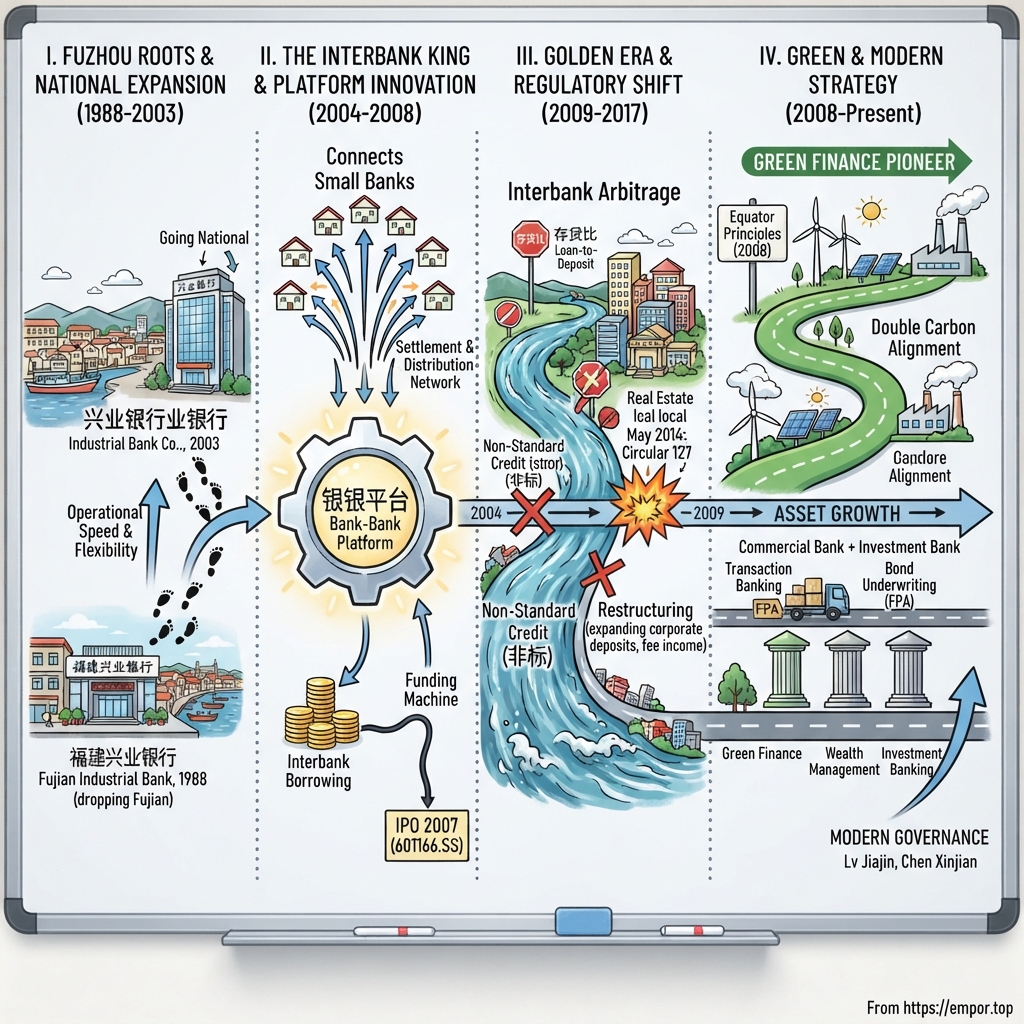
This analysis examines Industrial Bank's evolution across five phases: its origins in Fujian and the strategic constraints of a mid-tier commercial lender; the creation of the 银银平台 Bank-Bank Platform and the interbank borrowing model; the subsequent regulatory tightening; the pivot to green finance under its 商行+投行 Commercial Bank + Investment Bank strategy; and an evaluation of its financial engine, executive governance, and key risk factors.
 Subscribe on LinkedIn
II. Fuzhou Origins & Regional Roots (1988–2003)
In 1988, Fujian province occupied a unique economic position in China. Situated directly across the strait from Taiwan, the region had received limited central government heavy-industrial investment during the preceding Cold War decades due to security concerns. Consequently, as market reforms took hold, Fujian possessed relatively little state-owned industry. Instead, it was characterized by entrepreneurial activity, overseas family capital, and light manufacturing clusters producing textiles, footwear, and consumer electronics for export.
However, the province lacked dedicated commercial banking infrastructure to support this expanding private economy.
A Bank Built for a Gap
To address that deficit, the institution was established in August 1988 as 福建兴业银行 Fujian Industrial Bank, capitalized principally by Fujian provincial state assets.1 It belonged to an early cohort of commercial lenders formed as Beijing introduced competition into the banking sector, alongside peers such as Shenzhen-based 招商银行 China Merchants Bank.
The competitive landscape was heavily skewed toward incumbent state-owned institutions. The Big Five banks — 中国工商银行 ICBC, 中国建设银行 CCB, 中国农业银行 ABC, 中国银行 Bank of China, and 交通银行 Bank of Communications — operated tens of thousands of branches nationwide. Backed by sovereign guarantees, these state institutions captured the vast majority of retail deposits, as risk-averse households prioritized perceived safety over yields.
Lacking a national branch network or state backing, the Fuzhou-based provincial lender sought to differentiate itself through operational speed and flexibility.
The Strategic Logic of Not Competing Head-On
Recognizing that building a competing retail branch network carried prohibitive fixed costs, Industrial Bank avoided direct competition for consumer deposits.
Instead, it targeted segments where state lenders moved slowly: corporate credit for Fujian's private exporters and manufacturers, local infrastructure financing, and interbank treasury operations. Corporate clients could be secured through rapid underwriting decisions and tailored credit evaluations. While centralized credit committees at major state banks were often reluctant to evaluate private exporters — such as footwear manufacturers in 晋江 Jinjiang relying on European order books — Industrial Bank actively funded them.
Crucially, the bank began managing its treasury and balance sheet as an active profit center rather than a passive operational function. Deprived of low-cost retail deposit bases, it leaned heavily on wholesale interbank markets for funding, generating net interest spreads through liquidity management and liability positioning. Developed out of necessity, this treasury expertise ultimately powered the bank's rapid expansion during its most profitable era — while also creating its primary structural vulnerability.
Going National
By 2003, the lender had expanded beyond its regional base and officially changed its name to 兴业银行 Industrial Bank Co., Ltd., dropping the Fujian prefix.1 The rebranding reflected a broader strategic push to transform into a national entity. Expanding across China required substantial new capital, a future public equity listing, and a compelling value proposition for clients outside its home province.
That growth catalyst emerged from a business model innovation that peer institutions had not yet commercialized at scale.
III. The Invention of the "Interbank King" & The IPO (2004–2008)
In the early 2000s, Industrial Bank identified a structural problem in Chinese finance that shaped its growth strategy for the following decade.
China possessed an extraordinarily long tail of small financial institutions: thousands of 农信社 rural credit cooperatives, 城商行 city commercial banks, and later 村镇银行 village and township banks. Each served a single county or city, held local deposits, and faced high fixed operating costs.
A rural credit cooperative in inland China needed a modern core IT system, access to national payment and settlement networks, and competitive wealth management products to prevent local customers from defecting to major state banks. However, amortizing core technology costs across a customer base of a few hundred thousand people was economically unviable.
The Bank-Bank Platform
Industrial Bank's solution, developed from 2004 onward, was the 银银平台 Bank-Bank Platform: rather than competing with these small institutions, it became their infrastructure supplier.1
The offering operated as an early form of banking-as-a-service. Industrial Bank hosted core IT systems for smaller lenders, provided connectivity to clearing and settlement networks, managed correspondent services, and enabled small banks to distribute Industrial Bank-manufactured wealth management products to local depositors under revenue-sharing arrangements.
Instead of opening physical branches in every town, Industrial Bank built a distribution and settlement footprint across small-town China by supplying existing local lenders. The small banks retained their brand, local relationships, and customer ownership. In return, Industrial Bank gained manufacturing scale, float, settlement flow, and broad product distribution without the capital expenditure of a nationwide branch network.
By the platform's mature phase, roughly two thousand small financial institutions were connected in some form.1 This architecture created network effects inside a balance-sheet business: each additional institution increased the platform's value as a settlement hub and expanded product distribution, while the marginal cost of hosting another bank declined.
However, the direct financial contribution of the Bank-Bank Platform remained difficult to isolate. Industrial Bank reported platform scale metrics — such as connected institutions and transaction volumes — more consistently than standalone profitability. As a result, while the strategic network was real, its earnings were substantially bundled into interbank and fee-income lines rather than independently verifiable.
The Funding Machine
Operating alongside the platform was a wholesale funding strategy that earned Industrial Bank its nickname as the "King of Interbank."
Standard commercial banking relies on retail deposits to fund loans and generate net interest margins. Industrial Bank substituted retail deposit-gathering with 同业负债 interbank liabilities — borrowing from other financial institutions, including the small banks connected to its platform that held surplus local deposits but lacked efficient lending options.
This structure provided two major advantages. Wholesale interbank borrowing was often cheaper than the all-in operational cost of maintaining a branch network. It was also highly scalable: a lender could raise RMB 10 billion in the money market in an afternoon, whereas collecting an equivalent amount in household deposits required years of branch expansion.
This model drove remarkable operating efficiency. Industrial Bank's 成本收入比 cost-to-income ratio ran consistently below the mid-twenties in percentage terms during its peak years — an extraordinarily lean level for a major commercial bank, resulting directly from generating high asset volume without a proportionate branch network.[^2]
Yet this design embedded significant liquidity risk. Unlike retail deposits, which are sticky, insured, and generally insensitive to short-term bank performance, institutional interbank funding is highly sensitive to market conditions. A bank reliant on wholesale markets remains structurally exposed to external liquidity shocks and shifting interbank rates.
The 2007 Listing
Industrial Bank listed on the Shanghai Stock Exchange in February 2007, raising approximately RMB 15.99 billion.2 The timing coincided with a major bull market in Chinese equities, months before the Shanghai Composite Index peaked.
The capital expansion provided the equity buffer required to expand risk-weighted assets aggressively through the 2008 global financial crisis and the post-crisis credit stimulus.
At its listing, equity markets priced Industrial Bank on its lean cost structure, high efficiency, and strong returns on equity. However, initial valuations reflected immediate profitability without fully pricing the underlying funding risks — specifically whether its low cost-to-income ratio represented a permanent operational advantage or a temporary window created by an un-tightened regulatory perimeter.
IV. The Golden Era of Interbank Arbitrage, Shadow Banking, & Circular 127 (2009–2017)
In November 2008, amid collapsing export orders and global financial turmoil, Beijing launched a stimulus program of roughly four trillion yuan. Because central directives delegated most spending to municipalities, local officials raised funds primarily through the 地方政府融资平台 local government financing vehicle — special-purpose entities that borrowed against land holdings and projected tax revenues to construct roads, subways, and industrial parks.
The resulting appetite for credit was virtually unlimited, but regulatory limits constrained official lending capacity.
The Constraint That Created an Industry
During this era, Chinese commercial lenders operated under strict quantitative credit quotas and a capped 存贷比 loan-to-deposit ratio. Even when a bank possessed willing borrowers, ample capital, and abundant liquidity, administrative ceilings frequently prevented it from extending direct loans.
Where rigid regulatory limits intersect intense borrowing demand, financial engineering quickly emerges to bridge the gap.
Instead of lending directly to a real estate developer or local financing vehicle, a commercial bank would direct a trust company to extend the credit. The trust then issued 信托受益权 trust beneficiary rights — financial claims backed by the underlying loan cash flows. Intermediary financial institutions routed these rights back to the bank, which recorded the exposure on its balance sheet as an investment receivable or interbank asset rather than a standard loan.
While the underlying credit risk matched a conventional loan, the regulatory accounting differed entirely. The structured asset bypassed official credit quotas, incurred lower capital reserve requirements, and required minimal loan-loss provisioning.
Industrial Bank did not single-handedly invent structured credit routing, but it scaled the framework more aggressively than any competitor. By around 2013, interbank assets and non-standard credit investments — known domestically as 非标 non-standard assets — expanded to nearly 40 percent of the bank's total balance sheet, creating a concentration unmatched among China's major commercial lenders.[^2]
What the Returns Actually Meant
This balance sheet structure generated extraordinary financial results. During peak years, Industrial Bank achieved a return on equity in the low-to-mid 20 percent range, placing it at the top of China's banking sector and periodically ahead of 招商银行 China Merchants Bank, widely viewed as the premier joint-stock lender in the country.[^2]
Evaluating the sustainability of those peak returns requires unpacking three distinct performance drivers.
First, the institution possessed genuine treasury expertise. Industry consensus recognized Industrial Bank's money desk as one of the most capable in China, demonstrating sharp execution, effective market positioning, and nimble liquidity management.
Second, the bank benefited from regulatory leverage arbitrage. A substantial share of outsized profitability stemmed from housing credit risks in alternative asset wrappers that required less regulatory capital. Holding less equity against equivalent economic risk inflated return on equity through accounting definitions rather than superior operational performance.
Third, the model relied on unpriced tail risk. Non-standard exposures were heavily concentrated in real estate and municipal infrastructure during an expansionary period when defaults appeared remote. Consequently, reported returns reflected unprovisioned credit risk.
Differentiating these drivers is critical because only operational treasury skill survives regulatory shifts. Investors who extrapolated peak-era returns assumed an unchanged regulatory perimeter — an assumption that proved short-lived.
May 2014
In May 2014, the 中国人民银行 People's Bank of China, alongside banking, securities, and foreign exchange regulators, issued the directive that ended this arbitrage era: 127号文 Circular 127, formally titled the Notice on Regulating Interbank Business of Financial Institutions.8
The policy imposed strict structural limits. It capped a bank's net interbank borrowing at one-third of total liabilities, mandated that repo and resale agreements be backed by standardized liquid securities rather than trust rights, and required lenders to evaluate underlying assets to apply appropriate capital charges and provisions. Furthermore, it banned third-party financial institutions from providing the implicit credit guarantees that held complex intermediation chains together.
These measures directly targeted the interbank expansion model that Industrial Bank had championed.
Equity and credit analysts immediately projected sharp balance sheet contraction, eroding return metrics, and potential capital shortfalls as shadow credit exposures were reclassified onto primary balance sheets under full risk weightings.
The Restructuring
The subsequent transition proved neither as catastrophic as bears predicted nor as frictionless as bulls hoped.
Management executed a three-part strategic adjustment. First, it reclassified non-standard investments onto the formal loan book, absorbing higher capital requirements and credit-loss provisioning. Second, it expanded corporate deposit gathering to stabilize a funding structure previously reliant on wholesale markets. Third, it scaled capital-light, fee-generating operations, particularly corporate bond underwriting, to drive earnings without expanding balance sheet risk.
This balance sheet restructuring unfolded over nearly a decade. Return on equity, which had previously reached the low-to-mid 20 percent range, compressed toward the low-to-mid teens — aligning Industrial Bank's profitability profile with joint-stock commercial peers.[^2] Concurrently, operating efficiency margins narrowed as the lender invested in branch infrastructure, deposit gathering, and compliance systems.
The structural takeaway is clear: peak-era returns reflected a temporary regulatory window rather than an enduring competitive moat. Regulatory arbitrage relies on unadjusted policy boundaries, and shifts in oversight inevitably compress extraordinary margins regardless of execution capability.
Rather than attempting to construct alternative shadow structures — a course that increased vulnerabilities for several peer institutions — Industrial Bank complied with regulatory directives and overhauled its operational model. The central analytical question for its next strategic phase is whether its updated model offers greater long-term stability than the wholesale system it replaced.
V. The Green Banking Pioneer: Early Mover Advantage & Policy Alignment (2008–Present)
The strategic pivot toward green finance appears obvious in hindsight, which makes its 2008 origins worth examining.
That year, Industrial Bank announced it would adopt the Equator Principles — a voluntary international framework requiring lenders to evaluate environmental and social risks in large project finance transactions.9 It was the first Chinese financial institution to sign on.
Operationally, this decision ran counter to the prevailing incentives in China's credit market. In 2008, amid a nationwide stimulus boom, underwriting speed was the primary competitive advantage in project lending. By voluntarily inserting environmental and social due diligence into its approval process, Industrial Bank added operational friction that its peers avoided.
Domestic competitors largely viewed the move as corporate social responsibility theatre — an administrative handicap undertaken primarily for international publicity.
Why It Was Not Actually Charity
Industrial Bank has framed this strategy around 寓义于利, or "embedding righteousness within profit" — the proposition that environmental lending should operate as a commercial business line rather than a philanthropic cost center.9
Management claims warrant scrutiny, requiring an examination of the underlying operational mechanism.
That mechanism was specialized credit underwriting. Evaluating an industrial energy-efficiency retrofit, a wastewater treatment concession, or a waste-to-energy plant demands technical expertise absent from conventional corporate credit teams: understanding equipment performance, verifying operational cost savings, assessing offtake contract structures, and modeling cash flows under shifting subsidy regimes. These capabilities are built gradually through transaction volume.
By adopting the Equator framework early, Industrial Bank forced its credit organization to build specialized risk-assessment skills a decade before mainstream market demand emerged. The compliance requirement effectively functioned as a long-term training program.
The bank subsequently expanded a specialized product suite around these capabilities, offering energy-efficiency financing, loans collateralized on carbon emission rights, environmental infrastructure project finance, and green bond underwriting across its leasing (兴业金融租赁), trust (兴业信托), and securitization subsidiaries.9
The Policy Windfall
In September 2020, Beijing formally committed to its 双碳 dual carbon targets to peak carbon emissions before 2030 and achieve carbon neutrality before 2060. The framework rapidly propagated into industrial policy, provincial planning, and regulatory guidance on bank credit allocation.
Industrial Bank's cumulative green finance commitments have since expanded into the trillions of yuan across group credit, leasing, trust, and securitization operations.9 The institution has also earned the highest MSCI ESG rating among Chinese commercial banks, a status that commercially expands the pool of international institutional capital eligible to hold its securities.9
However, two analytical caveats must accompany those scale milestones.
First, expanding asset volume does not guarantee superior net interest margins. Green lending in China has become intensely competitive as financial regulators encouraged all commercial lenders into the sector. State-owned Big Five banks, operating with significantly lower funding costs, aggressively undercut pricing for large state-backed clean energy projects. Industrial Bank's financial disclosures emphasize aggregate green credit balances far more consistently than green interest spreads, and investors cannot assume spreads have remained stable during rapid balance sheet growth. Furthermore, as competitors hire experienced talent and adopt standardized evaluation methodologies, early underwriting advantages naturally erode.
Second, "green credit" remains a regulatory classification subject to policy revision rather than a fixed economic asset class. Shifting eligibility boundaries mean historical cross-period comparisons of green asset growth provide incomplete pictures of underlying economic performance.
The most defensible thesis for the bank's green franchise is narrower than corporate marketing claims but remains operationally relevant: Industrial Bank retains a credible relationship and underwriting capability in mid-sized environmental and clean-energy project finance, where credit evaluation requires specialized structuring and the Big Five's cost-of-funds advantage is less decisive. Its home market provided additional tailwinds, as Fujian developed into a major clean-technology hub anchored by battery manufacturer 宁德时代 CATL and its surrounding supply chain.
Ultimately, the key performance indicator for this strategy is not total green asset volume, but whether yields on green credit maintain a persistent premium over the bank's general corporate loan book. If pricing converges to commodity corporate lending levels, the green enterprise represents a high-volume origination engine with reputational benefits rather than a durable economic moat.
VI. Modern Strategy: "Commercial Bank + Investment Bank" & "Three Cards" (2018–Present)
By 2018, the strategic challenge facing Industrial Bank was no longer merely adapting to Circular 127. It was navigating a fundamental shift in the structure of Chinese finance.
China had long operated one of the world's most bank-intermediated financial systems, where corporate funding depended overwhelmingly on bank loans while household savings accumulated in deposits and real estate. However, central policy began shifting explicitly toward direct financing — encouraging deeper bond markets, expanded equity capital markets, and the transition of household wealth from real estate into financial assets.
For a traditional commercial lender, this structural shift posed existential risks if left unaddressed. As corporate borrowers increasingly turn to corporate bond markets rather than traditional bank credit, the high-margin corporate lending pool contracts. Concurrently, as households shift savings from low-cost deposits into asset management products, bank liability structures become more expensive and volatile.
The Thesis
Industrial Bank's strategic response was the 商行+投行 Commercial Bank + Investment Bank model: attempting to capture disintermediation rather than fight it.
Under this architecture, the commercial banking arm maintains primary corporate relationships by providing deposits, working capital, treasury management, and settlement services. When corporate funding needs shift toward capital markets, the investment banking division monetizes those existing relationships through bond underwriting, ABN/ABS asset-backed securitization, loan syndication, and merger-and-acquisition advisory services.
To track execution, management introduced FPA, or Financial Product Aggregate — a unifying metric covering the total volume of client financing arranged across both balance-sheet lending and off-balance-sheet capital market channels.[^2] By evaluating teams on FPA, management sought to make bankers indifferent between originating a loan or underwriting a bond, capturing fee revenue rather than forfeiting corporate transactions to investment banks or securities brokerages.
This fee-oriented model aims to alter balance-sheet efficiency. Generating fee income consumes minimal regulatory capital, allowing a bank operating under strict capital constraints to support returns on equity without expanding risk-weighted assets. In practice, Industrial Bank has consistently ranked among the top underwriters of non-financial corporate debt instruments in China's interbank market, validating its execution capacity in corporate bond issuance.[^2]
However, this volume has structural limitations. Debt underwriting in China is a highly fragmented, low-margin business contested by major commercial banks and brokerage firms. Underwriting volume leadership does not translate directly into high-margin profitability, particularly as banking regulators have pressured financial institutions to reduce corporate service fees. Consequently, market analysts view FPA growth primarily as a mechanism for corporate relationship retention rather than a driver of high-margin fee expansion.
The Three Cards
Management organized this broader push around what it termed 三张名片 the three business cards: green finance, wealth management, and investment banking.[^2]
While green finance established early positioning and investment banking captured corporate capital market activity, wealth management was targeted to address demographic shifts in household capital. Its subsidiary, 兴银理财 CIB Wealth Management, expanded its assets under management into the trillions of yuan, ranking among the largest bank-affiliated asset managers in China.[^2] This push aligns with broader macroeconomic reallocations: as China's prolonged real estate correction reduced the appeal of residential property, household capital increasingly flowed into bank-distributed wealth management products seeking stable yields.
The Platform, Rebuilt
Connecting these wealth ambitions to operational execution required repurposing the Bank-Bank Platform. Originally built as a settlement and IT infrastructure network for small lenders, the platform evolved into an asset-light distribution system. Through its "wealth cloud" services and the 钱大掌柜 Qian Da Zhanggui retail platform, Industrial Bank distributes both proprietary and third-party wealth management products through the branch networks of partner regional banks.1
This adaptation applies the bank's historic network strategy to fee-based product distribution. Lacking the extensive physical branch network of the Big Five state banks, Industrial Bank leverages its clearing relationships with thousands of regional institutions, gaining indirect access to local retail depositors nationwide.
However, this distribution model relies on rented rather than owned channels. Partner institutions retain direct ownership of client relationships and can readily swap product providers as competing money managers offer rival terms. Distribution through third-party intermediaries remains structurally weaker than distribution through a proprietary branch network, and the bank's public disclosures do not detail partner retention rates or distribution concentration.
Ultimately, the central strategic question facing Industrial Bank is whether fee growth from wealth management and capital market advisory can expand rapidly enough to offset ongoing net interest margin compression across its core lending book.
VII. Segment Deep-Dive, Economics & Financial Engine
At its foundation, commercial banking remains a spread business governed by credit loss rates. Three core metrics shape overall performance: net returns on assets above funding costs, operational efficiency, and the rate of unrecoverable loans.
Industrial Bank's group structure organizes around three primary business engines.
Corporate banking remains the anchor, contributing roughly half or slightly more of total operating income.[^2] This traditional core encompasses enterprise lending, transaction banking, trade finance, green project finance, and the corporate underwriting relationships that feed the investment banking fee pool. It is also where the bank's legacy problem loans reside.
Financial markets and interbank operations contribute roughly a fifth to a quarter of operating income, generating revenue from bond portfolio positioning, trading, interbank services, and platform operations.[^2] Descended from the interbank arbitrage era, this unit now operates within established regulatory boundaries. While Industrial Bank maintains sophisticated bond trading capabilities relative to domestic peers, this segment represents the group's most volatile earnings line, as falling interest rates can temporarily inflate results through unrepeatable mark-to-market gains.
Retail and wealth banking contributes another fifth to a quarter of operating income, serving as the bank's designated growth engine across mortgages, consumer credit, credit cards, wealth management fees, and private banking.[^2] Relative to peers, however, it represents the weakest of the three operating units — a central pillar of the bearish thesis on franchise quality. Industrial Bank's historical decision to forego aggressive retail deposit expansion leaves it with a structurally less favorable deposit mix and a smaller retail wealth customer base than retail-focused competitors like 招商银行 China Merchants Bank.
The Margin Problem
The dominant financial force shaping Chinese commercial banking in recent years has been persistent net interest margin compression — a structural shift driven primarily by macroeconomic policy rather than competitive dynamics.
The People's Bank of China has guided the benchmark LPR loan prime rate lower to reduce economy-wide borrowing costs and support a weak property market. As benchmark rates fall, floating-rate loans reprice downward at annual resets, while new credit is extended at lower yields.
Conversely, liability costs reprice slowly. Fixed-rate time deposits lock in yields until maturity, while risk-averse depositors — facing real estate weakness and volatile equity markets — have increasingly shifted funds into longer-term, higher-yielding deposit products. This asymmetry creates a structural scissor effect, pulling asset yields down faster than funding costs.
While margin compression affects the entire sector, Industrial Bank's funding structure alters its transmission. Because the bank maintains a higher reliance on wholesale and corporate funding, its overall cost of funds responds more rapidly to market interest rate movements than peers backed by retail deposits. This creates a double-edged dynamic: wholesale liability costs decline quickly when market rates drop, offering temporary relief, but rise rapidly during monetary tightening.
Management's response has centered on active treasury optimization, deposit cost discipline, and shifting the revenue mix toward fee income. In earnings communications across recent periods, executive guidance has consistently framed net interest margins as bottoming rather than recovering, pointing to deposit cost reduction as the primary operational lever rather than asset yield improvement.[^2] This consistent framing offers investors a realistic baseline rather than an unfulfilled recovery narrative.
Efficiency and Credit
Operational efficiency remains a relative strength. The bank's cost-to-income ratio continues to compare favorably against joint-stock peers such as 浦发银行 SPDB and 中信银行 CITIC Bank.[^2] This performance reflects both the enduring structural advantage of a branch-light network and disciplined cost controls, though the margin over competitors has narrowed as Industrial Bank invests in retail infrastructure and technology.
Regarding asset quality, the reported 不良贷款率 non-performing loan ratio has run in a band of roughly 1.07% to 1.15% in recent periods, with 拨备覆盖率 provision coverage in the range of roughly 230% to 250%.[^2]
Evaluating these credit metrics requires analytical scrutiny. Reported non-performing loan ratios in the Chinese banking sector reflect regulatory classification standards alongside underlying credit performance. Emerging credit stresses typically appear first in adjacent balance sheet categories — such as special mention loans, restructured facilities, or extended exposures — which receive less public attention. Meanwhile, provision coverage functions operationally as a buffer for earnings smoothing, allowing lenders to release loan-loss reserves to bolster reported profits during periods of weak pre-provision income.
Consequently, a stable non-performing loan ratio alone does not confirm underlying credit stability. Evaluating credit health requires monitoring special mention loan trends, provision coverage trajectories, and actual credit impairment charges recognized on the income statement. A bank maintaining a flat non-performing loan ratio while drawing down provision coverage is supporting current earnings through reserve releases — a finite resource over time. While Industrial Bank's practices align with broader peer group standards, reported credit indicators offer limited visibility, leaving the precise loss risk within legacy real estate and local government financing vehicle exposures unobservable from public disclosures alone.
VIII. Management, Governance, & Capital Deployment
When 吕家进 Lv Jiajin took the chairmanship of Industrial Bank in 2021, he inherited an institution mid-transformation and a domestic banking sector entering its most challenging environment in two decades.56
The Chairman
Lv's background is unusual for a joint-stock bank chairman: almost all of his career was spent inside the state-owned banking system rather than the entrepreneurial joint-stock tier. Before arriving at Industrial Bank, he held senior executive roles at 中国邮政储蓄银行 Postal Savings Bank of China, 交通银行 Bank of Communications, and 中国建设银行 China Construction Bank.56
That career path provides key context for his strategic priorities. An executive formed within major state lenders brings distinct operational instincts: a preference for balance sheet conservatism, close alignment with national policy directives, and an approach that treats regulatory relationships as core infrastructure rather than constraints to maneuver around. Postal Savings Bank, in particular, is China's most deposit-rich and retail-focused lender — an exact inversion of Industrial Bank's historical profile.
Appointing an executive with that background signaled a clear shift in direction. It marked the end of the bank's era of aggressive balance sheet engineering and the start of a transition toward a more conventional, retail-funded, and policy-aligned institution.
The operational record under Lv's tenure aligns with that direction. Strategic priorities have focused on reducing exposure to private real estate developers, restructuring local government financing vehicle positions, improving asset quality disclosures, and channeling credit toward advanced manufacturing, green sectors, and 新质生产力 new productive forces — Beijing's designated framework for high-tech industrial upgrading.[^2]
This balance sheet de-risking is visible in disclosed loan portfolio metrics, where real estate exposures have steadily declined as a share of total lending.[^2] What external analysis cannot verify, however, is the underlying credit quality of the remaining portfolio. A shrinking real estate loan share can reflect either effective credit workouts or delayed loss recognition on residual holdings. Determining the true picture requires granular recovery rates on resolved developer exposures, which the bank does not disclose.
Management credibility is also tested by strategy and guidance discipline. Unlike Western peers, Chinese commercial banks rarely provide explicit numerical guidance, making narrative consistency the primary benchmark for evaluation. On this metric, Industrial Bank has maintained steady messaging: executive leadership has consistently articulated its "three business cards" framework across annual reports and earnings presentations since its launch, avoiding the frequent strategic repositioning seen at several peer institutions.[^2]
The President
President 陈信健 Chen Xinjian provides an operational complement as a long-tenured internal executive focused on daily management, risk discipline, and digital transformation initiatives.[^2] Pairing an external chairman possessing state-system standing with an internal president holding institutional knowledge is an established governance structure among Chinese commercial lenders, intended to guide strategic shifts while maintaining operational stability.
Ownership
The 福建省财政厅 Fujian Provincial Department of Finance is Industrial Bank's largest shareholder, holding approximately 18.78%, alongside substantial stakes held by 中国烟草总公司 China National Tobacco Corporation state entities and other long-term institutional investors.[^2]
China Tobacco's significant equity position represents a common structure in domestic financial markets, where the highly cash-generative state monopoly frequently allocates capital into major financial institutions.
This ownership structure creates a dual governance dynamic for investors. Provincial state backing offers systemic support, implicit stability, and preferred access to regional infrastructure and policy-directed projects. Conversely, a state controlling shareholder operates with public policy priorities — including regional employment and local economic development — that can diverge from maximizing risk-adjusted returns for minority equity holders. When local authorities require financing for municipal projects, state-controlled lenders face structural pressure to extend credit, a dynamic that historically drove local government financing vehicle exposures across China's banking sector.
Capital and Dividends
Industrial Bank has maintained a dividend payout ratio of approximately 30% of net profits, generating dividend yields in the mid-to-high single digits due to low equity market valuations across the banking sector.[^2]
To support its balance sheet, the bank has repeatedly issued securities across the capital stack, including Tier 2 subordinated debt, perpetual bonds qualifying as Additional Tier 1 capital, and convertible bonds (兴业转债).[^2]
Convertible bond issuances represent a common capital management mechanism among Chinese commercial lenders. Designed as deferred equity issuance, a convertible raises debt with the expectation that rising share prices will trigger conversion into equity, bolstering Core Tier 1 capital. If the stock trades persistently below the conversion price — a common challenge while Chinese bank equities trade beneath book value — the instrument remains debt, requiring cash redemption at maturity without building permanent equity capital.
This capital structure creates an analytical tension. Maintaining a 30% dividend payout ratio while frequently issuing capital instruments means the institution recycles capital rather than self-funding its growth. In response, management can argue that dividends support key state shareholders with income mandates, while debt-like capital instruments avoid immediate equity dilution. However, this balance remains vulnerable: capital recycling is sustainable only as long as credit costs remain contained and balance sheet expansion stays moderate.
IX. Competitive Landscape & Strategic Frameworks
From a distance, Chinese banking can appear to be an industry where conventional competitive analysis scarcely applies. Licences are state-controlled, interest rates are guided by the central bank, and the largest institutions double as instruments of national policy. Yet competitive dynamics are intense; they simply operate along different axes than in Western financial markets.
Seven Powers, Tested
Network effects — the Bank-Bank Platform. This represents Industrial Bank's strongest claim to structural power, and the underlying mechanism is genuine: each additional connected institution enhances settlement utility and expands product distribution. However, this power is asymmetric. A regional bank relying on Industrial Bank's hosted core IT system faces substantial switching costs, whereas a partner merely distributing its wealth management products faces virtually none. Because Industrial Bank does not disclose the proportion of deeply integrated software clients versus loosely affiliated distribution partners, the true density of the network cannot be independently verified. Verdict: real but unquantifiable, and likely weaker than headline institution counts suggest.
Scale economies. Spreading software development costs across thousands of partner institutions generates legitimate operating leverage, as evidenced by the bank's historically lean cost-to-income ratio. But scale in Chinese banking is ultimately dictated by deposit gathering, where the Big Five state lenders command an absolute, structural funding cost advantage. Technology leverage narrows this gap but cannot eliminate it. Verdict: a genuine second-order advantage operating within a first-order funding disadvantage.
Counter-positioning. The bank's early move into green finance provides a textbook case of counter-positioning. Incumbent state banks initially declined to follow because rigorous environmental due diligence added operational friction to loan approvals. That hesitation granted Industrial Bank a decade of uncontested learning. Counter-positioning endures, however, only as long as incumbents lack the incentive to respond. Once Beijing elevated green lending to a strategic national priority, state lenders pivoted aggressively into the sector, eroding Industrial Bank's early mover advantage. Verdict: historically decisive, currently residual.
Switching costs. Corporate transaction banking — including cash pooling, payroll processing, and treasury management integration — creates durable client stickiness, particularly among the mid-sized private enterprises in Fujian and eastern China where Industrial Bank's commercial relationships are deepest. This unglamorous capability remains one of the bank's most resilient operational strengths. Verdict: real, modest, durable.
Notably absent from the bank's competitive profile are brand and cornered resource. Industrial Bank lacks meaningful consumer brand equity against state-owned giants, and its specialized analytical talent, while highly capable, remains readily hireable across the broader market.
Five Forces
New entrants: very low threat. Banking licences remain strictly regulated by the 国家金融监督管理总局 NFRA, and the fintech expansion of the late 2010s was firmly curtailed.10 Structural barriers to entry remain virtually insurmountable.
Buyer power: high. Premium corporate borrowers — including major state-owned enterprises and blue-chip private conglomerates — command strong pricing leverage. They can secure low-cost credit from Big Five lenders or bypass commercial banks entirely by issuing debt instruments in public capital markets. Mid-tier lenders consequently face a structural trade-off: accept compressed interest margins on high-quality corporate credits or assume elevated risk to capture yield on weaker borrowers. Much of the credit stress observed across China's joint-stock banking tier stems from institutions repeatedly choosing the latter path.
Supplier power: high. Institutional and retail depositors are price-sensitive and mobile. Regulators have repeatedly intervened to cap aggressive deposit pricing, reflecting the degree to which intense liability competition has threatened bank net interest margins.
Substitutes: moderate and rising. Direct capital market financing acts as a substitute for bank credit, while wealth management products compete with traditional deposits. Industrial Bank's strategy explicitly seeks to capture both shifts through its investment banking and wealth management divisions rather than resist them. While this mitigates franchise displacement, participating in lower-margin asset management substitute products remains inherently margin-dilutive relative to legacy credit spreads.
Rivalry: high. Competition among joint-stock commercial banks is aggressive and product differentiation is limited. 招商银行 China Merchants Bank remains the industry benchmark for retail funding and consumer franchise strength. 平安银行 Ping An Bank has targeted consumer credit, while 中信银行 CITIC Bank and 浦发银行 SPDB compete directly across Industrial Bank's corporate-heavy lending footprint.
Evaluating Industrial Bank through both analytical frameworks yields a clear conclusion: the institution possesses several genuine, second-order operational strengths operating within an industry structure that remains inherently challenging for mid-tier lenders. It is a well-managed institution navigating a tough competitive environment — a materially different thesis than a structurally insulated franchise, and a distinction central to evaluating its long-term financial performance.
X. Risk Radar & Skeptical Investor Stress Test
A bank's risks do not exist in isolation. They form an interconnected chain where stress in one area compounds vulnerability in another.
Property
Industrial Bank's exposure to private real estate developers is a legacy of an era when property lending offered the highest risk-adjusted yields in Chinese corporate finance. The high-profile defaults that followed—including 恒大 Evergrande and 碧桂园 Country Garden—affected balance sheets across the entire banking sector.
In response, management moved to reduce real estate as a proportion of total lending while increasing provision coverage against developer exposures.[^2] However, external investors face a significant analytical limitation regarding ultimate loss recovery. Evaluating the true quality of these workouts requires granular disclosures on realized recovery rates for resolved credits—information the bank does not disclose. While the strategic direction toward de-risking is clear, the absolute magnitude of remaining loss exposure remains unverifiable from public filings.
Local Government Debt
Exposure to local government financing vehicles represents an arguably more consequential structural risk, operating far more subtly than developer loans because it rarely culminates in outright default.
Beijing's strategy for managing municipal debt relies on large-scale debt swap programs, replacing high-cost, short-duration vehicle borrowings with longer-dated, lower-yielding government-backed bonds (特殊再融资债券). Systemically, this refinancing framework preserves stability by preventing a wave of municipal defaults.
For bank shareholders, however, the process operates as a gradual transfer of value. Rather than recognizing explicit credit write-downs, the lender accepts asset repricing: a facility originally yielding six percent is converted into a government-backed obligation yielding three percent over an extended maturity. While avoiding formal non-performing loan classification, net interest income experiences a permanent downward step-change, locking up balance sheet capital for years.
This structural repricing represents a significant earnings headwind across the banking sector because it bypasses income statement credit impairment charges entirely. Given Industrial Bank's historical underwriting of regional infrastructure initiatives, this yield compression directly affects core profitability. Crucially, the bank does not disclose the weighted average yield concession across its restructured local government portfolio, masking the precise long-term impact on net interest margins.
Margin and Regulation
Persistent margin compression compounds these asset risks by narrowing the earnings buffer available to absorb credit losses. While a lender operating with wide interest spreads can fund elevated provisions directly out of pre-provision operating profit, a bank facing compressed margins must increasingly draw down existing reserves when credit costs rise.
On the regulatory front, the implementation of comprehensive asset management rules (资管新规) at the turn of the decade eliminated implicit principal guarantees, requiring bank-distributed wealth management products to adopt mark-to-market valuation. Consequently, retail investment products experience market fluctuations, exposing asset managers to customer redemptions during market downturns. As demonstrated during the late-2022 fixed-income sell-off, this regulatory shift introduced quarterly volatility into fee income streams previously viewed as stable recurring revenues.
The Stress Test
A rigorous investor stress test must address a fundamental question: if real estate credit losses exceed current provisioning and local government debt restructuring reduces yields by two percentage points across affected exposures, can Industrial Bank maintain its dividend payout without eroding Core Tier 1 capital?
In the near term, the balance sheet arithmetic suggests it can, driven by three specific structural buffers.
First, provision coverage maintained above 230% provides a substantial reserve buffer—representing roughly two and a half years of provisioning against existing non-performing assets—that can be drawn down to absorb credit losses without directly impairing reported earnings. Second, fee-generating operations in investment banking and wealth management consume minimal regulatory capital, supporting organic capital generation even as overall balance sheet growth slows. Third, deliberate moderation in risk-weighted asset expansion reduces the baseline capital required to support new lending.
However, relying on these mechanisms carries clear long-term limitations. Consuming provision reserves to support net income and maintain dividends draws on a finite historical buffer rather than generating fresh organic equity. Furthermore, fee-based business lines face systemic pricing headwinds, while converting subordinate debt or convertible bonds into Core Tier 1 capital remains constrained as bank equities continue trading below book value.
Ultimately, Industrial Bank's dividend capacity remains defensible under moderate economic stress but vulnerable to prolonged downturns. The decisive variable is not legacy property exposure—which is largely recognized—but whether pre-provision operating profit can stabilize. If net interest margins find a firm floor and fee streams expand, internal capital generation can sustain current payouts. If margin compression persists, funding shareholder distributions through reserve drawdowns remains a time-bound strategy with a finite operational runway.
XI. Playbook: Business & Investing Lessons
Regulatory arbitrage is a catalyst, not a moat. This is the central lesson of Industrial Bank's evolution, with implications extending far beyond commercial banking. The outsized returns generated between 2009 and 2014 were substantial, but inherently temporary, stemming from regulatory gaps that oversight authorities were bound to close. Any enterprise whose core economics depend on asset reclassification rather than structural capability should be valued as an option with an uncertain expiration date, not an enduring annuity. The strategic corollary is that acknowledging regulatory boundaries early and overhauling operations is far superior to constructing new wrappers for legacy exposures, as several peer institutions attempted.
B2B ecosystems can substitute for B2C scale — imperfectly. The Bank-Bank Platform provided an innovative workaround for a lender lacking a national branch footprint: renting distribution from institutions that already held local retail relationships. Yet this framework carries clear structural limits. Rented distribution remains inherently contestable in a way owned networks are not, as third-party partners maintain direct customer ownership. It serves as an effective secondary distribution model, but cannot fully replicate a proprietary branch network.
Aligning with state policy is powerful and non-exclusive. Industrial Bank anticipated the trajectory of Chinese industrial policy years before green finance became explicit, earning an early mover advantage in environmental project underwriting. However, policy alignment generates a competitive edge only during the window between early adoption and universal mandate. Once green lending became a regulatory directive across the entire banking sector, technical capability ceased to be a unique differentiator and became baseline table stakes. The strategic lesson is clear: the economic value of anticipating policy decays the moment that policy becomes compulsory.
Agility has a ceiling in a regulated industry. Industrial Bank repeatedly out-maneuvered larger, slower state-owned institutions. Yet it consistently confronted a fundamental reality of commercial banking: state champions command the lowest funding costs, and cheap capital beats clever structuring over long horizons. Mid-tier lenders can compete effectively on execution speed, specialization, and corporate service, but they cannot overcome a structural cost-of-capital disadvantage. Any strategy reliant on out-structuring a fundamental funding gap carries a flaw at its foundation.
The central thread connecting these lessons is the distinction between an advantage derived from moving early and one built on structural differentiation. Industrial Bank has repeatedly demonstrated an ability to anticipate market shifts early. Whether those early moves have produced a structurally insulated franchise remains the defining open question for investors.
XII. Epilogue & Bull vs. Bear Investment Thesis
The Bull Case
Chinese bank equities, including Industrial Bank, have long traded at deep discounts to book value — a valuation pricing in substantial unrecognised credit losses. The optimistic case rests on the view that these severe downside risks will not materialize. If real estate credit losses are largely absorbed and local government debt is managed through gradual yield repricing rather than systemic default, the extreme losses anticipated by the market will fail to occur, allowing valuations to re-rate without requiring extraordinary operational outperformance.
Several strategic assets reinforce this thesis. The institution built its green finance operations a decade ahead of peers, positioning it in key sectors aligned with national policy priorities. Its asset-light interbank platform provides nationwide distribution without the capital burden of physical branch expansion, preserving a structural cost-efficiency advantage. Furthermore, a dividend payout ratio held near 30% generates a high single-digit yield at current valuations, supported by major state shareholders with a strong interest in preserving steady distributions.
The Bear Case
The pessimistic case contends that net interest margin compression is a structural policy choice rather than cyclical noise. By using the banking system to lower borrowing costs across the broader economy, central policy transfers earnings from lenders to borrowers, with no indication of reversal. Local government debt restructuring extends this transfer over years through reduced yields rather than explicit write-downs, permanently dampening interest income. Meanwhile, actual recovery rates on legacy property exposures remain unverifiable from public disclosures.
Operational challenges further constrain the franchise. Retail and wealth management — designated as core growth engines — lag behind leading joint-stock peers, while wealth offerings now face mark-to-market valuation volatility under revised asset management rules. Crucially, the unique arbitrage advantages that once powered Industrial Bank's exceptional returns have been curtailed by regulators or eroded by competition. What remains is a capable mid-tier commercial lender operating in a system where structural funding advantages belong to state-owned giants and policy priorities favor borrowers.
Reconciling Them
These two perspectives address different dimensions of the investment thesis. The bullish narrative focuses on valuation and the gap between priced market distress and actual credit losses. The bearish argument centers on the long-term earnings capacity of the business model. Both views can prove correct: a lender whose return profile permanently steps down from historical peaks can still deliver investment upside if market valuations reflect an even more severe credit outcome.
The core question for investors is not whether Industrial Bank is an exceptional institution — it remains a solid lender with genuine but secondary advantages. Rather, the decision hinges on whether market pricing reflects a normalized return on equity in the low-to-mid teens alongside modest balance sheet expansion, or whether current valuations assume a catastrophic impairment scenario that ultimately fails to materialize.
What to Actually Watch
Three specific operational indicators will determine which thesis prevails.
Net interest margin, quarter over quarter, relative to joint-stock peers. This sequential metric dictates whether pre-provision operating profit can stabilize. Core balance sheet dynamics — including dividend sustainability, capital generation, and provision buffer strength — depend directly on this margin. Tracking sequential direction against peer performance isolates institution-specific trends from broader industry pressures.
Special mention loan ratios evaluated alongside provision coverage. Headline non-performing loan figures reflect policy discretion and regulatory classification timing, making them incomplete indicators of asset quality. Deterioration emerges first in special mention loans. Analyzing this ratio alongside provision coverage trends clarifies whether reported profitability reflects underlying credit stability or earnings support through reserve drawdowns. A simultaneous rise in special mention loans and decline in provision coverage would challenge the asset quality thesis.
Fee and commission income growth, driven by wealth management and underwriting. Fee expansion provides the definitive test of whether the 商行+投行 Commercial Bank + Investment Bank strategy delivers true profit margins or merely transactional volume. If Financial Product Aggregate expands while net fee income stalls, the strategy generates operational activity without enhancing economic return — confining the investment thesis to a valuation discount rather than a franchise transformation.
Industrial Bank successfully overhauled its business model once before following the regulatory closure of its shadow interbank operations. Whether its current transition toward green credit, wealth management, and investment banking creates a more durable operational model remains an open question. The answer will be determined by these three financial lines rather than strategic disclosures.
References
-
Industrial Bank Official Portal — Industrial Bank Co., Ltd. ↩↩↩↩↩↩
-
Industrial Bank Corporate Profile & Filings — Shanghai Stock Exchange (601166) ↩↩
-
Industrial Bank Co Ltd 601166.SS Stock Quote & Company Overview — Reuters ↩
-
Industrial Bank Co Ltd 601166:CH Company Profile — Bloomberg ↩
-
Industrial Bank Appoints Lv Jiajin as Chairman — Yicai Global, 2021-07-27 ↩↩↩
-
China Industrial Bank Names Former PSBC Executive Lv Jiajin as Chairman — Caixin Global, 2021-05-28 ↩↩↩
-
China Financial Sector: Industrial Bank Co., Ltd. Company Overview — Morningstar ↩
-
Notice on Regulating Interbank Business of Financial Institutions (Circular 127) — People's Bank of China, 2014-05 ↩↩
-
Industrial Bank Sustainable Finance & Equator Principles Disclosures — CIB Sustainable Development Portal ↩↩↩↩↩↩
-
China Banking and Wealth Management Market Intelligence — National Financial Regulatory Administration (NFRA) ↩
 LinkedIn
 WhatsApp
 Reddit
 Hacker News
 Email
Email Kindle
 RSS Feed
 Spotify
 Apple Podcasts
 Amazon Music
 Audible
 YouTube