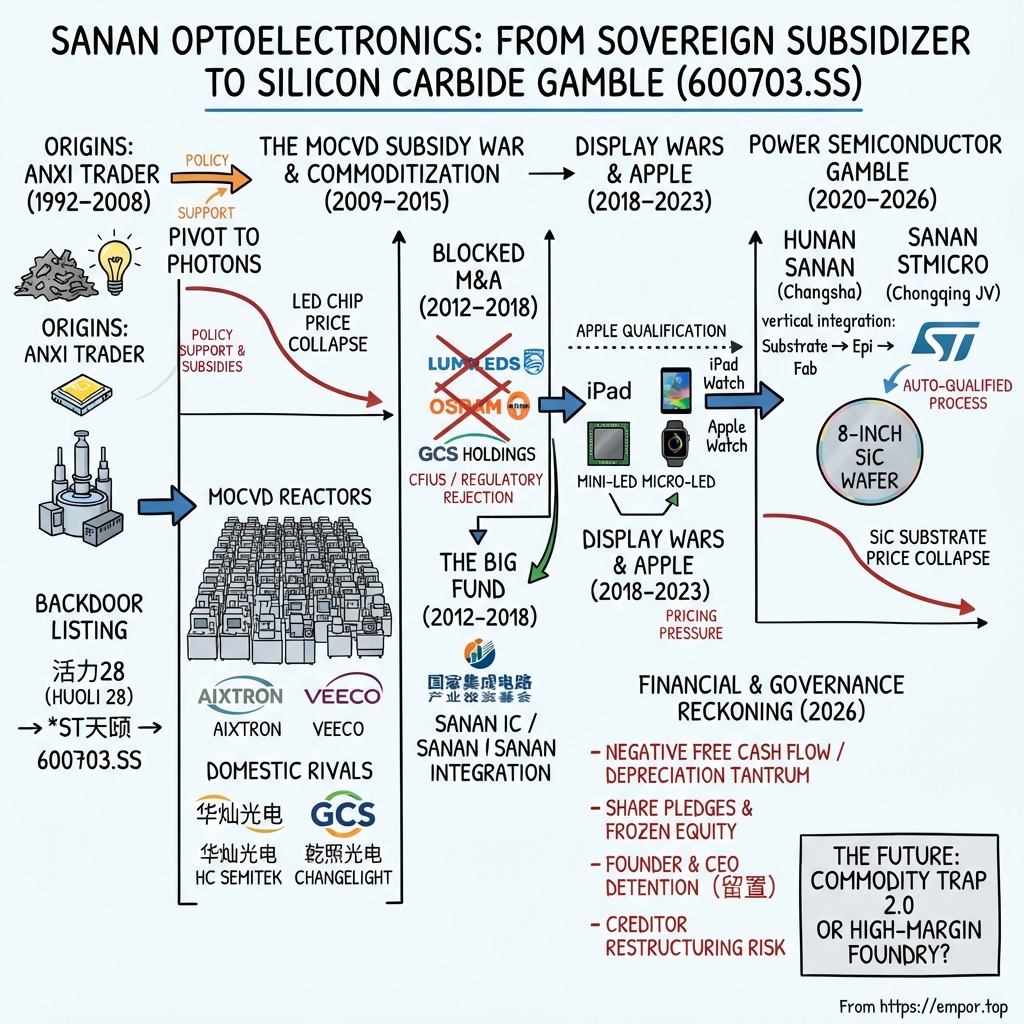
Sanan Optoelectronics: The Sovereign Subsidizer, the Photon Wars, and the Silicon Carbide Gamble
I. Prologue: The Sovereign Subsidizer and the Silicon Carbide Gamble
On June 7, 2023, an announcement departed from the prevailing geopolitical narrative.
It was the summer of expanding export controls. Washington had spent eighteen months tightening restrictions on Chinese semiconductor ambitions. The Netherlands and Japan aligned on lithography tool exports, while major Western corporate boards were evaluating de-risking strategies in China. Amid those tensions, 意法半导体 STMicroelectronics — the Franco-Italian chipmaker supplying power semiconductors to Tesla, Renault, and much of the European automotive sector — announced a $3.2 billion joint venture in Chongqing to build an 8-inch 碳化硅 SiC (silicon carbide) power device fab.[^1]
The partner was neither SMIC nor Hua Hong. It was 三安光电 Sanan Optoelectronics Co., Ltd., listed under ticker 600703.SS on the 上海证券交易所 Shanghai Stock Exchange. To most Western investors, Sanan was known primarily as the manufacturer that spent a decade commoditizing LED chips, undercutting the legacy business models of Cree, Philips, and Osram.
That dual identity defines Sanan. It is simultaneously one of China's most consequential compound-semiconductor manufacturers and a clear case study in what state-subsidized industrial scale does — and does not — deliver.
The paradox, stated plainly.
On one hand, Sanan operates as a dominant volume producer. It maintains what is estimated to be the world's largest fleet of 金属有机化合物化学气相沉积 MOCVD (metal-organic chemical vapor deposition) reactors — the equipment used to grow thin crystalline layers from which LED and laser chips are cut. Company and industry estimates have placed its share of global LED chip capacity above 30% for years. When Sanan expands capacity, industry prices decline — a dynamic demonstrated throughout the LED market between 2011 and 2020.
On the other hand, Sanan illustrates the structural limits of that approach. Cumulative government support — including equipment rebates, tax holidays, discounted industrial land, subsidized electricity, and low-cost policy loans — has totaled tens of billions of renminbi over fifteen years. That backing built massive physical capacity, but it did not secure enduring pricing power. That distinction forms the central investment question.
By 2025 and 2026, the financial consequences emerged. The company reported its first annual net loss since its 2008 public listing — losing approximately 353 million renminbi for fiscal year 2025. The loss was driven not by declining revenue, but by heavy depreciation charges stemming from multi-billion-dollar silicon carbide and gallium arsenide mega-fabs operating well below design capacity.1 Governance challenges followed: in the spring of 2026, founder and controlling shareholder 林秀成 Lin Xiucheng was placed under supervisory detention (留置 liuzhi), followed weeks later by vice chairman and CEO 林科闯 Lin Kechuang — the executive who structured the STMicroelectronics joint venture.2 Over the summer of 2026, creditors petitioned Xiamen courts for bankruptcy restructuring of the controlling shareholder entities; although the petition was withdrawn on September 2, 2026, roughly one-quarter of the listed company's equity remains tied up in share pledges and judicial freezes.3
The core tension of this story. Can a manufacturer built on low-cost capital, municipal subsidies, and high-volume commodity production transform itself into a high-margin, mission-critical compound-semiconductor foundry for global automotive manufacturers and AI datacenters? Or will the overcapacity dynamics that Sanan previously introduced to the global LED market recur in silicon carbide, driven by equally subsidized domestic competitors?
This narrative traces the arc: from scrap-iron trading in Fujian to a backdoor listing via a bankrupt detergent maker; through the MOCVD subsidy expansion that reshaped global LED economics; through a series of cross-border acquisitions blocked by Western regulators; into the Apple Mini-LED supply agreement; into the Chongqing and Changsha power-fab investments; and finally into the 2026 restructuring, evaluating the enterprise through Hamilton Helmer's 7 Powers and Porter's Five Forces to outline the conditions required for the bullish thesis to hold.
 Subscribe on LinkedIn
II. Origins: The Anxi Scrap Metal Trader and the "Backdoor" Lightbulb (1992–2008)
Anxi County sits inland from Xiamen in southern Fujian, a landscape of terraced tea hills and, historically, iron ore. It is famous for two exports: Tieguanyin oolong tea, and merchants. Anxi natives built trading networks across Southeast Asia for centuries, and the county carries a reputation within China for a particular kind of commercial aggression — fast, relationship-dense, willing to move before the paperwork catches up.
Lin Xiucheng, born in 1956, was formed by that environment and the specific economic window opened by Deng Xiaoping's reforms. His initial fortune came not from photons but from heavy industry: steel and scrap metal trading through Sanxi Iron & Steel (三溪钢铁) during the 1980s and 1990s, riding Fujian's local infrastructure boom. Steel trading in that era relied on freight logistics, credit relationships with municipal officials, and the nerve to hold inventory through price swings. It was decidedly not a business rooted in research and development.
That background shaped Sanan's trajectory. Almost everything the company later executed well — reading government incentive programs, structuring land deals, and rapidly expanding capacity before competitors could respond — reflected the skill set of a commodity trader with deep local government relationships. Conversely, the operational areas where Sanan later struggled — process maturity, chip yields, customer qualification, and proprietary IP — represent capabilities that commodity trading does not build.
The pivot from steel to photons.
Around 2000, Lin executed a pivot that proved prescient: aligning his capital with national industrial policy. China's 863 Program (国家863计划), the state high-technology development framework, had designated optoelectronics and semiconductor lighting as strategic priorities. Solid-state lighting offered a compelling policy rationale: replacing inefficient incandescent bulbs with LEDs would sharply curtail coal-fired power consumption. Where state priority led, municipal subsidies followed.
Lin founded Xiamen Sanan Electronics (厦门三安电子) and began building operations in gallium arsenide (砷化镓 GaAs) and gallium nitride (氮化镓 GaN) epitaxy — the process of growing precisely doped crystal layers on a substrate wafer.
The physics of compound semiconductors explains why this transition was challenging. Unlike a silicon chip, which acts primarily as a logic switch, a compound semiconductor is a physics device: its physical band structure determines whether it emits light, handles high frequencies, or withstands high voltages. Manufacturing requires loading substrate wafers into an MOCVD reactor — a specialized, high-precision chemical vapor deposition furnace — and flowing metal-organic gases at extreme temperatures to deposit atomic layers just nanometers thick. Deviating on layer thickness or doping concentration by even a few percent causes color variance, electrical leakage, or complete device failure. Because these fabrication recipes are closely guarded craft knowledge, acquiring equipment is far simpler than mastering process capability.
Sanan purchased MOCVD reactors and recruited Taiwanese engineers familiar with the requisite process recipes. Yet progress during this early phase was slow, and production yields remained low.
The 2008 backdoor listing.
By the mid-2000s, expanding optoelectronic manufacturing required capital beyond what Fujian bank loans could provide, while China's domestic IPO queue faced multi-year regulatory bottlenecks. Lin resolved the constraint through a reverse merger (借壳上市). The listing vehicle was 活力28 Huoli 28, a Hubei-based laundry detergent manufacturer that had fallen into financial distress and traded under the ticker *ST天颐 S*ST Tianyi (stock code 600703). In mid-2008, Sanan injected its optoelectronics assets into the shell, creating the first pure-play optoelectronic semiconductor stock on China's A-share market. The company retains that original stock code today.
Historical falsification: was this an R&D story?
Sanan's corporate materials have long suggested that its early growth stemmed from indigenous R&D and organic technical breakthroughs.4
The historical record indicates a different primary driver. During its formative years, Sanan relied heavily on imported epitaxy expertise, utilizing Taiwanese engineering talent and turnkey equipment from Western vendors such as Aixtron and Veeco to establish baseline process capabilities.5 Furthermore, the 2008 public listing represented financial engineering rather than technological achievement, requiring municipal backing, land deals, and debt restructurings to resolve the detergent shell's legacy liabilities.
Sanan's foundational advantage rested not on proprietary IP, but on capital-market access, speed of execution, and alignment with municipal governments. Recognizing that legacy is essential for evaluating its long-term strategy: a company built around mobilizing subsidized capital naturally relies on that same mechanism when entering new markets — a playbook Sanan subsequently deployed on a scale that reshaped global industry economics.
III. The Great MOCVD Subsidy War & The Commoditization of the Photon (2009–2015)
Around 2010, provincial development zone offices across China set the stage for a dramatic shift in chip manufacturing. Municipal party secretaries operated under a mandate from Beijing to attract strategic emerging industries, backed by fiscal resources from local land sales. Facing competing jurisdictions just down the highway, local officials offered generous terms to companies willing to deploy metal-organic chemical vapor deposition (MOCVD) reactors, promising tax revenues, local employment, and political credit in return.
The economics of the expansion were defined in those rooms. Municipalities across China — most notably Wuhu in Anhui (安徽芜湖), Tianjin (天津), and Xiamen (福建厦门) — offered direct cash rebates ranging from 8 million to 12 million RMB per imported MOCVD tool. Against an equipment purchase price of roughly 15 million to 20 million RMB, the rebate covered half to two-thirds of the initial capital cost, disbursed essentially upon installation.
That upfront cash fundamentally altered standard investment metrics. In conventional capital allocation, equipment is acquired based on projected production volumes and operating margins sufficient to recover capex and yield a return. With local governments financing up to 60% of the purchase price, hurdle rates collapsed. Manufacturers needed only to cover cash operating costs. Furthermore, under Chinese accounting standards, much of the subsidy was recognized as deferred income amortized over the asset's life, boosting reported net profits for years afterward.
Sanan capitalized on this framework more aggressively than its peers. The company signed multi-hundred-reactor expansion agreements with Wuhu, Xiamen, and other municipalities, bundling equipment rebates with free land, subsidized industrial electricity — a critical cost factor for continuously operating MOCVD furnaces — and low-interest policy loans. This expansion dramatically expanded supplier relationships: toolmaker Aixtron saw order volumes from Sanan large enough to materially impact its reported financials, while Veeco secured multi-tool supply agreements with Sanan throughout the 2010s.[^7]6
The deflationary hammer.
The resulting surge in capacity triggered a sustained price collapse across the sector. As Sanan expanded its fleet from dozens to hundreds of reactors, it surpassed global incumbents in total epitaxy capacity. Global LED chip prices entered a structural decline of 15% to 25% annually throughout the first half of the 2010s — a compounding curve that halved market prices every three to four years.
Global incumbents adjusted or retrenched in rapid succession. Taiwan's 晶元光电 Epistar, then the world's largest merchant LED chipmaker, saw its operating margins erode. Cree restructured its business and eventually exited traditional lighting chips to focus on silicon carbide — a strategic shift Sanan would replicate a decade later. Philips spun off Lumileds, Osram carved out its traditional lighting division, and Japan's 日亚化学 Nichia leveraged its extensive patent portfolio in blue LEDs and phosphors to retain high-margin niches while relinquishing volume markets.
While Western observers frequently characterized the expansion as market dumping, the underlying dynamic reflected a structural shift in capital discipline. State subsidies effectively replaced private equity discipline, removing the requirement to generate a return on invested capital that typically restrains industry overcapacity.
Historical falsification: did scale become a moat?
For a decade, sell-side analysts argued that Sanan's massive MOCVD fleet created a durable, scale-driven cost advantage capable of generating sustained economic rents.
A close examination of Sanan's financial performance undermines that thesis. Although Sanan achieved unit cost leadership — reflected in higher gross margins relative to Taiwanese peers across industry cycles — lower unit costs translated into sustained profitability only when supported by market pricing power. Because equipment subsidies were equally accessible to domestic competitors like 华灿光电 HC SemiTek and 乾照光电 Changelight, capacity multiplied across the domestic supply base. Downstream packagers and luminaire manufacturers, facing an increasingly fragmented supplier landscape, aggressively renegotiated contracts and absorbed pricing gains within quarters.
The company's financial disclosures highlighted this dependence on state support. Between 2011 and 2015, government grants recognized in profit accounted for an estimated 30% to over 50% of Sanan's reported annual net profit.7 Excluding those grants and properly amortizing equipment subsidies against the asset base reveals that the underlying return on invested capital in its core LED operation fell into single digits — well below the cost of capital for a capital-intensive, highly cyclical business.
Ultimately, the evidence refutes the scale-moat thesis. Rather than establishing a defensible economic moat, Sanan built cost parity on a capital treadmill, where continuous reinvestment was required merely to maintain market position. The primary indicators of this dynamic — LED chip gross margins excluding government grants, alongside capacity utilization rates — signaled these underlying pressures in real time.
Management recognized the limits of commodity LED manufacturing and sought to pivot into higher-value compound semiconductor markets overseas. However, international regulatory scrutiny soon reshaped those ambitions.
IV. Cross-Border M&A, Blocked Doors, and the Big Fund Pivot (2012–2018)
Between 2012 and 2018, Sanan attempted what would have been one of the most consequential corporate roll-ups in the history of the compound semiconductor industry. Ultimately, regulatory opposition thwarted the core strategy, reshaping the company's long-term risk profile.
The Taiwan wedge. In 2012, Sanan acquired a 19.9% strategic stake in 璨圆光电 Formosa Epitaxy, Taiwan's second-largest LED maker, for roughly 505 million renminbi. The stake was deliberately structured just below the 20% threshold that would have triggered stricter regulatory scrutiny in Taipei, where cross-strait investment in strategic technology faced intense political sensitivity. When Taiwan's Epistar absorbed Formosa Epitaxy in 2014, Sanan's holding converted into Epistar equity, making mainland China's largest LED manufacturer a major shareholder in its principal Taiwanese competitor. While the transaction served as an effective strategic wedge, it delivered minimal transfer of operational capability.
Luminus. In 2013, Sanan paid approximately $22 million for Luminus Devices, a Massachusetts high-brightness LED manufacturer spun out of MIT research.8 The modest purchase price reflected its limited strategic scope. Through Luminus, Sanan acquired a patent portfolio and cross-licensing position to defend against patent infringement claims in Western markets, alongside a direct sales channel to tier-one international illumination customers—useful assets, but not a transformative technological capability.
The Western pushback. When Sanan subsequently sought to acquire core Western manufacturing assets, foreign regulators blocked each transaction in sequence.
The defining setback occurred with Lumileds. Royal Philips had agreed to sell its LED components and automotive lighting division to a consortium led by GO Scale Capital, backed by Chinese investors including Sanan. The Committee on Foreign Investment in the United States (CFIUS) blocked the transaction on national security grounds, citing the dual-use defense applications of gallium nitride technology. Philips later sold Lumileds to Apollo Global Management. In 2016, CFIUS similarly rejected Sanan's planned $226 million acquisition of GCS Holdings, a California-based compound-semiconductor foundry. Sanan and GCS subsequently restructured the relationship into a Xiamen-based joint venture, which transferred significantly less operational technology. Meanwhile, Sanan's preliminary inquiry to acquire Germany's Osram Licht AG encountered strong political resistance in Berlin, halting discussions before advancing to a formal bid.
Three attempts at securing global scale ended in three regulatory vetoes.
The Big Fund pivot.
Faced with international barriers to overseas acquisitions, Chinese industrial policy shifted from acquiring foreign semiconductor assets to building domestic infrastructure. In 2015, the 国家集成电路产业投资基金 National Integrated Circuit Industry Investment Fund—commonly known as the Big Fund (大基金)—designated Sanan as a key champion, acquiring a high-single-digit equity stake and injecting billions of renminbi.9
That capital funded the creation of 三安集成 Sanan IC / Sanan Integration, marking a structural expansion in ambition. Sanan sought to transition from optoelectronics to advanced power and radio-frequency electronics: gallium arsenide (GaAs) chips for smartphone power amplifiers, gallium nitride (GaN) for power and RF applications, silicon carbide (SiC) for high-voltage power conversion, and surface acoustic wave (SAW) filters. The strategic objective was to evolve from a high-volume producer of commodity light-emitting diodes into a diversified compound-semiconductor foundry—a position domestic brokerages described as building the "TSMC of non-silicon."
Historical falsification: can Sanan acquire and integrate foreign technology?
Corporate narratives during this period suggested that Sanan had demonstrated an ability to acquire foreign technology platforms and rapidly close the gap with Western peers.
The empirical record contradicts that assertion. Foreign regulators blocked every transaction of major strategic scale—including Osram, Lumileds, and GCS. The only completed outright acquisition was Luminus, representing a financial investment far smaller than Sanan's subsequent capital expenditure programs, while the Epistar holding remained a passive financial position rather than an operational integration.
This pattern of regulatory rejections fundamentally altered Sanan's strategic risk profile. Blocked from acquiring mature international capabilities, Sanan was forced to build greenfield facilities in domestic industrial parks using its own balance sheet. This dynamic substituted cross-border M&A risk for operational construction risk: multi-billion-renminbi mega-fabs requiring years to ramp yields, burdened by fixed annual depreciation charges that accrue regardless of customer demand. The financial pressures facing Sanan by 2026 trace directly back to this forced strategic shift.
Before those power fabs came online, however, Sanan made one final attempt to escape commodity LED economics by moving upmarket within its existing optoelectronics business.
V. The Display Wars: Mini-LED, Micro-LED, and the Apple Mirage (2018–2023)
If a standard white LED chip costs pennies, the strategic alternative is to manufacture components that command premium pricing. That was the premise behind Mini-LED technology, which for several years stood as one of the most promising growth narratives across the Chinese optoelectronics sector.
The underlying mechanics were straightforward. Conventional liquid-crystal display (LCD) panels rely on a uniform backlight behind a liquid-crystal layer acting as a light shutter. Because liquid crystals leak light, dark areas of an image retain a subtle grey glow. Mini-LED addresses this limitation by reducing LED sizes to a fraction of a millimeter and arranging thousands of them into independently controlled dimming zones, extinguishing backlighting precisely where images require true black. This approach delivers contrast performance approaching organic light-emitting diode (OLED) displays while leveraging LCD's mature, high-luminance supply chain. Micro-LED advances the concept further: shrinking LEDs until each individual chip is a pixel, eliminating the liquid-crystal layer altogether. While Micro-LED offers exceptional image quality, it presents severe manufacturing challenges, requiring the precise transfer of millions of sub-millimeter chips onto a display backplane at near-perfect yields.
For Sanan, the commercial logic hinged on volume metrics. A Mini-LED backlight for a premium tablet requires thousands of chips, compared to a few dozen in a conventional backlight. Higher unit density, stringent performance tolerances, and a limited pool of qualified vendors offered an opportunity for expanded margins. Sanan directed substantial capital into specialized production lines and established strategic partnerships, including collaboration with Samsung Electronics on commercial Micro-LED display products.
The Apple qualification saga.
The primary target across the display supply chain was Apple. Apple introduced Mini-LED displays in its 12.9-inch iPad Pro and MacBook Pro models, relying initially on exclusive supply from Taiwan's Epistar, which later reorganized under 富采控股 Ennostar. From 2020 onward, market observers anticipated that Sanan would break Ennostar's single-source position.
In 2022, industry reporting confirmed that Apple had qualified Sanan as a Mini-LED supplier, diversifying away from its Taiwanese sole source.[^12] In Chinese equity markets, analysts and investors viewed the milestone as a definitive validation of Sanan's advanced packaging capabilities.
The subsequent commercial reality, however, demonstrated the limitations of supplier qualification.
First, the qualification path proved arduous. Sanan endured extended audit cycles, patent-clearance hurdles stemming from Nichia's and Cree's IP portfolios, and a production yield ramp that materialized years after initial market expectations. Second, qualifying a second vendor provided Apple with substantial pricing leverage. By introducing dual-sourcing, Apple established competitive tension that curtailed supplier pricing power—meaning Sanan's entry served primarily to compress component prices for both Ennostar and Sanan.
Third, the underlying technology roadmap shifted. In 2024, Apple introduced its M4 iPad Pro featuring a dual-layer tandem OLED panel, phasing out Mini-LED in its flagship tablet, with its laptop lineup anticipated to transition to OLED as well. As the high-margin tier retreated, Mini-LED technology migrated downmarket into mid-tier domestic televisions, where panel manufacturers competed aggressively on price—replicating the commodity dynamics that had previously impacted traditional lighting chips.
Historical falsification: does marquee qualification create a growth engine?
Promotional narratives maintained that securing qualification with Apple established Mini-LED and Micro-LED technology as a high-margin growth engine for Sanan.
Financial disclosures contradict that assessment. Qualification milestones failed to generate sustained revenue or cash flow at a scale material enough to alter Sanan's segment reporting. Apple retained pricing power throughout the relationship, and by the time Sanan achieved volume readiness, the customer was already transitioning its flagship product architecture to alternative display technologies.
The evidence points to a narrower takeaway: while technical qualification confirms manufacturing capability, qualification absent multi-year architectural lock-in does not establish an economic moat. Instead, it exposes the supplier to yield and price competition within a product lifecycle dictated by the buyer. This dynamic offers a vital template for evaluating Sanan's broader strategy, as a similar qualification cycle unfolds in power semiconductors with automotive customers and far larger capital commitments. For Sanan's display division, the key metric remains whether its product mix can shift toward automotive and large-format Mini-LED applications fast enough to offset wafer-level price erosion.
VI. The Power Mega-Fabs: Hunan Sanan & The $3.2B STMicro Joint Venture (2020–2025)
In a crystal growth furnace, time moves differently. Fabricating a silicon wafer requires pulling a rotating boule from a pool of molten silicon—a process measured in hours that yields a cylinder several meters long. Fabricating a silicon carbide wafer requires sublimating SiC powder at over 2,000°C and allowing it to recrystallize onto a seed, atom by atom, at a rate of just a few tenths of a millimeter per hour. A usable boule takes a week or more to grow and yields a block only a few centimeters tall. Slicing that crystal presents additional hurdles: SiC approaches the hardness of diamond, meaning the sawing process wastes a substantial portion of the grown material. Every step introduces potential yield loss, and any crystal defect propagates directly into downstream devices.
These physical constraints explain why silicon carbide substrate manufacturing remained a tight oligopoly for two decades, dominated by Wolfspeed, Coherent (formerly II-VI), Rohm, and a small group of peers. They also explain why the material commands strategic attention. Silicon carbide handles high voltages and extreme temperatures with significantly lower switching losses than conventional silicon. In electric vehicles utilizing 800-volt architectures, replacing silicon IGBTs with SiC MOSFETs in the traction inverter provides automakers with meaningful range gains for the same battery size while enabling faster charging. Automakers such as BYD, Geely, Porsche, and Tesla all adopted the technology, creating what long appeared to be a semiconductor market defined by structural scarcity.
Hunan Sanan.
Sanan responded with one of the most aggressive capital commitments in its history. Beginning in 2020, the company pledged 16 billion renminbi—over $2 billion—to establish a fully vertically integrated silicon carbide manufacturing complex in the Changsha High-Tech Zone. The facility encompassed substrate growth (衬底), epitaxy (外延), wafer fabrication (晶圆制造), and packaging (封装) under unified corporate ownership. No domestic competitor had attempted full vertical SiC integration at that scale. In North America, Wolfspeed pursued a structurally similar strategy across North Carolina and New York, later illustrating the financial risks inherent to that capital-intensive approach.
The strategic rationale was sound on paper: in a market constrained by expensive substrates, controlling internal substrate supply provides both cost efficiency and supply security. That logic, however, depended entirely on substrates remaining scarce.
The STMicro alliance.
Then came Chongqing. In June 2023, Sanan partnered with STMicroelectronics to form 安意法半导体 Sanan STMicroelectronics (Chongqing) Co., Ltd., a joint venture owned 51% by Sanan and 49% by STMicroelectronics. The JV was established to construct a dedicated 8-inch SiC power device fab representing a total investment of approximately $3.2 billion, funded through local support and equity contributions from both partners.[^1] In parallel, Sanan committed to build a wholly owned 8-inch SiC substrate plant adjacent to the facility to supply the joint venture.
Examining the ownership structure reveals the underlying operational trade-offs. STMicroelectronics provides its proprietary, automotive-qualified SiC device process—a manufacturing recipe developed over years and validated through major automotive supply contracts. The joint venture fab produces exclusively for STMicroelectronics. Sanan contributes majority equity, construction management, and local government coordination, while separately absorbing the capital expenditure and yield risks of substrate fabrication.
For STMicroelectronics, the arrangement secures localized manufacturing capacity within China to serve domestic automotive original equipment manufacturers under local-content pressures, financed partly by Chinese capital, without transferring core technology outside the joint venture perimeter. For Sanan, the partnership delivers a high-profile global anchor customer at a time when Western technology firms were scaling back Chinese operations. However, the commercial returns are bounded by contract-manufacturing economics. Sanan does not control the direct customer relationship or the underlying device IP; it owns the physical fab and bears the operational risk.
The Chongqing manufacturing line achieved initial completion (通线) in February 2025, with production ramping through 2026.10
Historical falsification: does vertical integration plus ST guarantee high-margin SiC dominance?
Three empirical factors undermine the thesis that vertical integration and the joint venture ensure market dominance:
First, the substrate price collapse. The underlying assumption of substrate scarcity dissolved. Expanding domestic capacity from 天岳先进 SICC, 天科合达 TankeBlue, Sanan, and other suppliers flooded the market for 6-inch conductive substrates. Wafer prices dropped by more than half between 2023 and 2025, falling from roughly $1,000 per wafer to below $450, triggering an industry-wide price war that accelerated global corporate restructurings.11 Wolfspeed's subsequent financial distress demonstrated that oversupply pressures affected global producers, not just domestic players. Vertical substrate integration was intended to secure a cost advantage; when substrate operating margins approach zero across the sector, owning substrate capacity leaves a manufacturer holding zero-margin assets paired with fixed depreciation liabilities.
Second, the depreciation tsunami. Fixed-asset additions across the Changsha and Chongqing sites generated billions of renminbi in annual non-cash depreciation charges, which began hitting the balance sheet as soon as facilities came online, regardless of utilization levels. This non-cash expense served as the primary mechanical driver behind Sanan's fiscal year 2025 net loss of approximately 353 million renminbi, as well as ongoing margin compression into the first half of 2026.1 Distinguishing between timing and structural issues is critical: a net loss driven by depreciation on assets ramping toward high utilization represents a temporary accounting drag; a loss driven by depreciation on assets operating in a market with collapsing prices reflects structural overcapacity. The ultimate outcome depends on line utilization and yield efficiency rather than gross revenue totals.
Third, captive supply constraints. Because the Chongqing fab's output is contractually dedicated to STMicroelectronics, Sanan's financial upside remains tied to foundry fee structures. Should silicon carbide power devices generate exceptional industry profits in future years, the majority of those economic rents will accrue to the partner controlling the proprietary process technology and customer relationships.
The evidence indicates that claims of guaranteed market dominance remain unproven and are challenged by prevailing market pricing. While Sanan has demonstrated the capability to build silicon carbide production capacity at global scale, it has yet to prove that these assets can generate an adequate return on invested capital. The trajectory mirrors the dynamics of the LED sector a decade earlier, where domestic capacity expansion outpaced market demand, forcing prices down. The key metrics that will determine long-term viability are production yield rates on 8-inch conductive substrates—which dictate whether cost reductions outpace price erosion—and capacity utilization at the Chongqing facility.
Meanwhile, a much smaller division within the company has quietly generated some of Sanan's highest operating margins.
VII. The Hidden Businesses: RF Foundry, Optical Comms, and AI Photonics
Every sprawling industrial conglomerate contains divisions that market analysts overlook until a strategic shift forces a re-evaluation. Sanan IC operates two candidate businesses for that shift, though they carry very different execution odds.
The RF front-end bet.
Inside every smartphone, a radio-frequency (RF) front-end module manages signal processing—power amplifiers pushing signals to cellular towers, alongside integrated switches and filters. Standard silicon struggles at high frequencies, whereas gallium arsenide (GaAs) excels because of its significantly higher electron mobility. Sanan IC constructed GaAs heterojunction bipolar transistor (HBT) and pseudomorphic high-electron-mobility transistor (pHEMT) foundry lines to target this market.
The global benchmark for pure-play GaAs foundry services is Taiwan's 稳懋半导体 WIN Semiconductors, alongside 宏捷科 AWSC. Sanan IC pitched Chinese fabless RF design houses—such as 唯捷创芯 Vanchip and 卓胜微 Maxscend—on sovereign supply security, positioning itself as a domestic foundry resilient against export-control disruptions.
The market response provides a clear case study in how process moats operate in practice. Chinese RF design houses shifted meaningful production volumes to Sanan for mid-tier smartphone components and Wi-Fi chips. However, for flagship 5G frequency bands—where linearity and noise tolerances leave no margin for error and a failing component risks a product launch—design houses continued to rely on WIN Semiconductors. The capability gap is not primarily a function of manufacturing equipment, but of process maturity accumulated through years of yield optimization and precise device modeling. Customers maintain multi-sourcing strategies specifically to avoid placing a flagship product cycle on an unproven fab.
Optical communications: the dark horse.
A more compelling segment within Sanan IC's portfolio is its laser diode operations. The company manufactures vertical-cavity surface-emitting lasers (VCSEL), distributed feedback lasers (DFB), and electro-absorption modulated lasers (EML)—the core optical sources deployed inside fiber-optic transceivers.
The strategic relevance of this division expanded rapidly with the rise of artificial intelligence infrastructure. An AI training cluster functions as tens of thousands of distributed accelerators requiring continuous, high-speed data exchange. Because traditional copper interconnects cannot sustain that bandwidth beyond short distances, rack-to-rack data transport relies on optical links requiring specialized lasers at 400G, 800G, and 1.6T speeds. Datacenters optimized for AI workloads require a substantially higher density of optical transceivers per unit of compute than traditional cloud facilities, and high-speed EML lasers remain technically complex components that Chinese manufacturers historically imported.
Company disclosures show that Sanan's optical chip unit commands the highest gross margins in its portfolio, exceeding 35%, yet the business still generates less than 6% of total revenue.12 That combination illustrates classic financial optionality: a segment currently too small to alter consolidated earnings, but backed by strong margins and a structural demand driver that could expand its impact over time.
Realizing that potential, however, requires accounting for the execution track record established during the Mini-LED display expansion. Sanan has historically converted technical qualifications into commercial volume slowly, and into sustained operating profit even more gradually. Qualification cycles for high-speed EML lasers with transceiver module manufacturers remain long, module makers face intense price pressure from hyperscale cloud providers, and domestic competitors are deploying capital against the same market opportunity. Consequently, treating the optical business as a near-term re-rating catalyst risks repeating the assumptions made during the Mini-LED cycle under a different technical label.
Historical falsification: the "TSMC of compound semiconductors."
The broader investment thesis—that Sanan IC can replicate TSMC's foundry dominance across RF, power, and optical semiconductors—fails on structural industry characteristics rather than execution metrics alone.
TSMC's contract manufacturing model succeeded because standard silicon CMOS design is decoupled from fabrication through standardized process design kits, EDA tools, and an established fabless ecosystem. Compound semiconductors lack that structural separation. Because device performance is tightly co-optimized with crystal structure and physical fabrication, the circuit design is intrinsically bound to the manufacturing process. For that reason, integrated device manufacturers such as Infineon, onsemi, Rohm, and BYD maintain internal fabrication lines, leaving a merchant foundry market that is structurally smaller than silicon analogies suggest. Sanan IC's capacity utilization has swung sharply with end-market cycles, and the division has yet to demonstrate sustained independent free cash flow generation.
Evaluating Sanan IC requires rejecting the broad foundry analogy in favor of a narrower, evidence-based assessment: the division can plausibly secure profitable market share in specific niches—such as optical components where its epitaxy heritage provides a technical foundation, and targeted contract manufacturing under alliances like the STMicroelectronics joint venture. That represents a viable niche business, but it does not mirror TSMC's scale or pricing power, and valuing the division as a broad semiconductor foundry represents a persistent misapplication of silicon metrics to compound semiconductor markets.
That reality leads directly to the balance sheet where the cumulative financial consequences of these capital allocations settle, and to the corporate structure controlling the enterprise.
VIII. Capital Allocation, Corporate Governance, and the 2026 Reckoning
In March 2026, Sanan's board issued a filing of the kind domestic market participants read with deep unease: the company's ultimate controller was unreachable, having been placed under supervisory detention (留置 liuzhi) by the National Supervisory Commission—a legal framework allowing authorities to hold individuals incommunicado during investigations without formal public charges or fixed timelines. Weeks later, in April 2026, a second disclosure followed: vice chairman and CEO Lin Kechuang had been taken into custody by Chongqing supervisory authorities.2
Understanding how the enterprise reached this crisis requires examining the financial architecture constructed over the preceding decade.
The shape of the business. Traditional LED chips and components continue to generate roughly 70% to 75% of total revenue, producing gross margins in the mid-to-high teens. While outperforming most domestic peers, those returns remain insufficient to fund the company's broader ambitions. Compound semiconductor integrated circuits contribute another 20% to 25% of revenue, delivering top-line growth while bearing the substantial startup costs of ramping new fabrication lines. Meanwhile, a legacy precious-metals recycling and trading unit—a remnant of the founder's commodity trading origins—has shrunk considerably following revenue-recognition restatements. The accounting episode highlighted how recognizing low-margin trading revenue on a gross basis inflated top-line figures without delivering meaningful underlying economics.
The capex problem. Cumulative capital expenditures over the past decade exceeded 50 billion renminbi, consistently outpacing operating cash flows. This imbalance resulted in chronic negative free cash flow, financed through a combination of secondary equity offerings, commercial bank debt, local government incentives, and Big Fund equity injections. That dynamic defines Sanan's core financial reality: for most of its public history, the company operated as a net consumer of capital, relying on state subsidies to achieve even modest return hurdles.
The parent-level problem. As early as 2019, financial media investigations drew attention to balance-sheet anomalies at the parent level. Controlling shareholder 三安集团 Sanan Group accumulated heavy short-term debt while pledging a substantial portion of its Sanan Optoelectronics equity—reported above 80% at peak levels—alongside large related-party prepayments.
Share pledging creates a direct contagion mechanism for public equity. When a controlling shareholder borrows against listed shares, a sustained decline in share price forces lenders to demand additional collateral or liquidate the position. Private borrowing undertaken for ventures outside the public entity translates into forced-selling risk for minority shareholders who had no role in authorizing the leverage. When the parent company simultaneously conducts related-party transactions with its listed subsidiary, the potential for value extraction increases significantly.
The retreat of sovereign support. Having completed its investment lifecycle, the Big Fund systematically reduced its equity stake between 2020 and 2024 as part of a broader rebalancing across domestic semiconductor holdings.9 While mechanically anticipated, the divestment removed an influential institutional shareholder whose backing had long signaled state underwriting—precisely as capital expenditure commitments reached their peak.
2026. The accumulated financial pressure culminated in mid-2026. From June through August 2026, creditors petitioned Xiamen courts for the judicial bankruptcy restructuring of controlling entities Sanan Electronics and Sanan Group. On September 2, 2026, the petitioning creditor unexpectedly withdrew the filing, triggering a brief rally in the listed stock.3 However, the withdrawal did not resolve the underlying leverage: roughly 26.3% of Sanan Optoelectronics' total equity remains bound by judicial freezes and share pledges. As a result, corporate control hinges on parent-level debt negotiations in which public minority shareholders lack representation.
Historical falsification: management quality.
Sell-side commentary has frequently characterized management as prudent stewards of a public-private partnership who safeguard minority shareholder value.
The empirical record refutes that assertion. Governance practices reveal aggressive parent-level leverage against pledged equity, recurring related-party transactions that attracted regulatory and auditor scrutiny, revenue-recognition restatements in legacy trading lines, and a decade of capital deployment that built global manufacturing capacity while failing to cover the company's cost of capital. Furthermore, the simultaneous detention of both the founder and the sitting CEO removes the primary executive architects who held the STMicroelectronics partnership, the Chongqing fabrication ramp, and municipal government relationships.
The evidence confirms that the stewardship thesis is unsupported by financial reality. The enterprise exhibits key governance vulnerabilities: structural parent-level debt imposed on public shareholders, operational complexity spanning commodity LEDs to precious-metals trading, capital allocation that has generated sub-cost-of-capital returns, and a temporary vacuum in executive leadership.
Evaluating the company's outlook requires monitoring two concrete developments: the formal resolution of the supervisory investigations—through release, indictment, or executive replacement—and court-confirmed completion of parent-group debt restructuring. Until those issues are resolved, operational gains in manufacturing facilities cannot be reliably reflected in the equity's fundamental valuation.
With the operational, technological, and governance landscape established, the analysis turns to the structural forces governing the enterprise's long-term competitive position.
IX. Strategic Analysis: 7 Powers and Porter's 5 Forces
Stripping away the narrative leaves the central question Hamilton Helmer's framework is designed to answer: does Sanan possess any structural condition that generates differential returns and resists arbitrage?
Scale economies. Real, but insufficient. In LEDs, Sanan achieved genuine unit-cost leadership, yet that scale delivered cost parity rather than economic rents because of subsidized entry by domestic followers and an absence of downstream buyer willingness to pay a premium for scale. In 8-inch silicon carbide substrates, a genuine scale-and-yield opportunity exists, as 8-inch crystal growth is technically demanding and limited to fewer competitors. However, scale economies generate returns only when capacity expansion remains disciplined—and domestic silicon carbide capacity growth has been aggressively unconstrained. Grade: moderate, and currently neutralized by industry price erosion.
Network effects. Absent. No mechanism exists by which an additional Sanan customer improves the product or platform for the next. As a pure hardware manufacturing business, Sanan has never possessed network power.
Counter-positioning. Absent. Counter-positioning requires a novel business model that incumbents cannot emulate without damaging their core operations. Sanan's playbook—deploying heavily subsidized capacity to undercut prices—was aggressively emulated by domestic competitors. While it severely disrupted legacy Western incumbents, as a strategic power it failed the persistence test once domestic peers like HC SemiTek and Changelight replicated the model.
Switching costs. Bifurcated, but providing Sanan's primary source of potential differentiation. In commodity LED chips, switching costs are negligible: products are qualified within weeks, and downstream buyers re-tender contracts regularly. Conversely, in automotive-grade silicon carbide and optical transceiver chips, switching costs are substantial. AEC-Q101 automotive qualification requires 18 to 24 months, and once a component is designed into a vehicle's traction inverter, it typically remains locked in for the platform's production lifecycle. The strategic implication is that structural stickiness resides exclusively in the segments currently incurring startup losses during their operational ramp. While this supports an argument for patient capital, it means the bullish thesis relies on businesses that have yet to demonstrate sustained pricing power post-qualification.
Branding. Weak to non-existent. Sanan functions as an invisible upstream component supplier. End consumers do not select products based on the internal LED manufacturer, barring historical exceptions like Nichia's reputation among specialized lighting specifiers.
Cornered resource. Historically, Sanan's cornered resource was political: privileged access to municipal subsidies, industrial land, and policy loans on terms superior to those available to foreign and most domestic competitors. That advantage has largely diluted as state incentives expanded broadly and the Big Fund reduced its direct involvement. Today, the closest equivalent to a cornered resource is its exclusive manufacturing arrangement with STMicroelectronics in China. While valuable, this relationship remains contractual rather than structural—representing a temporary power subject to renewal rather than a permanent competitive moat.
Process power. Sanan's most defensible operational capability. Fifteen years of continuous MOCVD epitaxy and high-volume wafer processing have built deep organizational expertise that cannot be acquired through capital equipment purchases alone. However, in China's competitive semiconductor labor market, process knowledge frequently transfers when engineering teams are poached by newly funded competitors—the precise mechanism by which domestic rivals accelerated their own process maturity. Process power that resides within key personnel rather than standardized institutional systems remains inherently leakier than the framework's ideal condition.
Porter's Five Forces, applied to Sanan's target markets:
Threat of new entrants — medium-high. In standard commercial markets, a $2 billion fabrication facility presents a formidable barrier to entry. In China, provincial governments have repeatedly subsidized matching facilities for emerging challengers in silicon carbide and gallium nitride, including SICC, TankeBlue, and Innoscience. When state policy underwrites market entry, high capital intensity ceases to function as a barrier and becomes a balance-sheet burden for early movers.
Bargaining power of buyers — extremely high. Apple, Samsung, global tier-one automotive suppliers, and domestic smartphone OEMs systematically maintain dual-sourcing strategies and mandate annual contractual price reductions. Sanan has historically lacked the pricing power to resist these concessions against major buyers.
Bargaining power of suppliers — medium-high. Vendors of MOCVD reactors and crystal-growth equipment hold tight intellectual property monopolies, while supply chains for specialty gases and chemical precursors remain highly concentrated. Cross-border export controls introduce a geopolitical risk factor that commercial agreements alone cannot mitigate.
Threat of substitutes — high and expanding. Three distinct substitution vectors challenge Sanan's portfolio: OLED technology displacing Mini-LED in premium display applications, GaN-on-silicon challenging silicon carbide in 650-volt power applications where volume concentrates, and legacy silicon IGBTs retaining a clear cost advantage in budget electric vehicles where range gains do not justify higher component costs.
Competitive rivalry — destructive. Structural overcapacity persists across legacy LED lines alongside a newly constructed supply overhang in 6-inch silicon carbide capacity nationwide. In an industry characterized by high fixed capex and commodity outputs, intense rivalry forces pricing toward marginal cost.
The composite picture reveals one genuine operational power in process expertise, one contractual advantage in the STMicroelectronics alliance, and meaningful switching costs restricted to unproven growth segments—set against five competitive forces operating overwhelmingly against profit margins. This challenging structural environment explains Sanan's long-term financial performance far more accurately than any single operational decision.
X. Playbook: Business & Investing Lessons
1. The subsidized scale trap. Subsidies are extraordinarily effective at building physical capacity and extraordinarily poor at building economic moats. The reason is straightforward: a moat acts as a barrier to entry, whereas a state incentive acts as a subsidy of entry. When local governments cover up to 60% of equipment costs for any domestic player, capital intensity—normally the most reliable barrier in heavy manufacturing—ceases to protect incumbents. Returns in such an industry trend toward the cost of capital and, because state backing lowers hurdle rates, frequently fall below it. The core analytical test is simple: examine profitability excluding government grants across a complete market cycle. If underlying earnings remain weak, the scale thesis reflects volume growth rather than structural profitability.
2. The capex treadmill in compound semiconductors. The sector continuously transitions across wafer generations—moving from 2-inch to 4-inch, 6-inch, and now 8-inch substrates—obsoleting significant portions of prior tooling with each shift. Unlike a fabless design house, a compound-semiconductor manufacturer cannot halt reinvestment without surrendering market share. The financial signature of this cycle is straightforward: non-cash depreciation accrues as a fixed expense as soon as fabs come online, whereas revenue depends on customer qualification schedules and market demand. When end-market demand stumbles, operating margins rapidly erode, as demonstrated in fiscal year 2025. When evaluating capital-intensive technology transitions, the primary question is not whether a company can construct a fab, but whether unit-cost reductions outpace output price declines.
3. The perils of parent-company financial engineering. A listed operating entity is never fully insulated from a leveraged parent company. High share-pledge ratios, related-party prepayments, and cross-guarantees create channels through which parent-level debt translates into forced-selling risk for minority shareholders. Investors evaluating founder- or family-controlled listed entities across any market must analyze the parent entity's balance sheet as an integral component of the investment thesis, viewing elevated pledge ratios as a primary risk indicator rather than a secondary footnote.
4. Certification is not commercialization. Sanan's Apple qualification provides a clear case study. Securing qualification with a marquee customer often serves as an invitation to compete on price and yield within the customer's broader vendor matrix. The economic value of a design win depends on three factors absent from corporate announcements: the duration of the architectural commitment, the number of co-qualified suppliers, and the buyer's ability to transition to alternative display technologies. On all three metrics, the Mini-LED qualification delivered limited pricing power. Investors must apply those same criteria to ongoing transitions, including high-speed optical lasers for AI datacenters and automotive silicon carbide power devices.
5. Geopolitics as a core business variable. Sanan's strategic trajectory was determined less by internal capital allocation than by regulatory decisions in Washington and Berlin. For enterprises operating at the intersection of strategic technology and international trade friction, foreign regulatory intervention is not a low-probability tail risk to be modeled separately; it is a primary constraint governing which strategic options remain viable.
XI. Bear vs. Bull Case & The 3 Critical KPIs
The bull case, stated at its strongest.
The Western bridge. At a time when Western semiconductor firms are unwinding Chinese exposure, Sanan holds a rare counterweight: a contractual, capitalized operating partnership with a top-five global power semiconductor manufacturer. That relationship provides Sanan with access to automotive-qualified process know-how it could neither develop independently nor acquire abroad given past regulatory hurdles. No domestic silicon carbide peer possesses a comparable alliance. Should China's 800-volt electric vehicle transition accelerate and STMicroelectronics require localized capacity, the Chongqing facility becomes a high-utilization asset backed by committed offtake.
SiC cost domination. The collapse in substrate pricing is a double-edged dynamic. While falling prices compress operating margins across the sector, they inflict the fastest damage on high-cost producers—predominantly Western integrated device manufacturers burdened by higher labor and capital expenditure structures, as evidenced by Wolfspeed's recent financial strains. If Sanan's 8-inch substrate yields mature ahead of domestic rivals, the company could emerge from industry consolidation as one of a small group of high-volume survivors, at which point rationalized capacity could restore pricing discipline.
The AI optical supercycle. Sanan IC's optical chip division delivers the portfolio's highest gross margins, supported by demand from artificial intelligence datacenter deployments that operate independently of broader domestic consumer cycles. Policy support for localized supply in high-speed laser components provides an additional tailwind for this high-margin niche.
Governance cleanup as catalyst. Paradoxically, the current corporate crisis could catalyze structural reform. If parent-level debt restructuring shifts equity control toward state-linked or institutional investors, the resolution could eliminate the share-pledge overhang and introduce capital-allocation discipline that the founder-led management structure failed to deliver. Chinese capital markets offer clear precedents for such forced operational professionalization.
The bear case, stated at its strongest.
Commodity trap 2.0. The core bear thesis contends that Sanan is replicating its LED playbook in silicon carbide, with identical structural consequences. The parallels are clear: state-subsidized capacity, numerous domestic entrants, standardized product specifications, dual-sourcing buyers, and a market price declining faster than manufacturing yields improve. In silicon carbide, however, the capital at risk is an order of magnitude larger, and current subsidy structures cannot offset the resulting depreciation burden.
Governance and legal paralysis. The detention of two top executives represents an active operational risk rather than a temporary headline concern. Automotive customers mandate rigorous management continuity audits, joint-venture operations require authorized signatories, and strategic decisions regarding the 8-inch facility ramp cannot be suspended without financial penalty. Furthermore, legal proceedings could ultimately impose liabilities directly on the listed entity.
Parent liquidity contagion. The September 2026 withdrawal of the bankruptcy restructuring petition provided short-term relief without resolving the underlying leverage. If debt negotiations stall, a judicial auction of pledged and frozen shares—representing over a quarter of total equity—would place control of a strategically significant semiconductor asset into contention, destabilizing key relationships with automotive and telecommunications customers that took years to qualify.
Legacy drag. Mini-LED and Micro-LED components have failed to generate sufficient revenue scale or margin expansion to offset structural price decay in traditional lighting chips. Without that offset, blended returns on equity hover near zero even before the full depreciation impact of new power fabs reaches the income statement.
Weighing it. A balanced assessment shows that the bull case remains largely contingent, whereas the bear case rests on observable facts. The alliance with STMicroelectronics is operational, yet its financial returns are contractually capped. The optical chip business generates strong margins, but accounts for less than 6% of total revenue. The silicon carbide manufacturing capacity is installed, but underlying substrate prices have dropped by half. Meanwhile, annual net losses, share pledges, frozen equity, and executive detentions remain active balance-sheet and governance realities. An investor underwriting the bull thesis is purchasing an option on operational execution under absent leadership within an oversupplied market—a speculative position that should not be confused with an investment in a durable, high-quality business.
The three KPIs that actually matter.
-
8-inch SiC conductive substrate yield and monthly wafer output at Chongqing and Changsha. This represents the decisive operational metric. Substrate yield dictates unit manufacturing costs, determining whether Sanan navigates industry oversupply as a market consolidator or a high-cost casualty. Given that Sanan discloses ramp milestones episodically, investors must evaluate the multi-quarter trajectory rather than individual announcements.
-
Blended gross margin and free cash flow conversion. The key indicator is whether operating cash flow exceeds capital expenditures as major facility construction peaks. After a decade of persistent negative free cash flow, sustained positive cash generation would provide the first empirical proof of a structural shift in Sanan's business model.
-
Resolution of controlling-shareholder debt and executive legal status. Definitive court approvals regarding parent group restructuring alongside clear legal resolutions for Lin Xiucheng and Lin Kechuang are required to remove governance risk. Until these issues settle, the public equity carries control uncertainty that overrides standard operational metrics.
XII. Epilogue: The Photons and the Electrons
One narrative frames Sanan's trajectory as a notable industrial achievement: a Fujian commodity trader aligning with national policy in 2000 to construct the world's largest compound-semiconductor manufacturing footprint, displacing established international incumbents and driving down global LED prices. From a volume perspective, it represents a massive expansion of domestic manufacturing capacity.
An alternative narrative views those same twenty-five years as a prolonged, state-subsidized misallocation of capital: tens of billions of renminbi deployed into production capacity that generated returns below the cost of funding, paired with heavy parent-level leverage and public minority shareholders bearing uncompensated governance risks.
Both interpretations rest on the same empirical record. The distinction depends on whether enterprise performance is evaluated by physical output or return on invested capital.
In late 2026, these competing realities converge. In Chongqing, an 8-inch fab is ramping toward producing automotive silicon carbide power devices for STMicroelectronics—Sanan's most technically demanding operational test to date. In Fujian, financial restructuring negotiations surround the controlling shareholder entities. Meanwhile, the founder and the chief executive who structured the enterprise's strategic expansion remain under supervisory detention.
Optoelectronics established Sanan's high-volume market presence without securing long-term pricing power. Whether power semiconductors yield a different financial trajectory remains an open question—one that will be determined by manufacturing yield rates and debt restructurings rather than corporate announcements.
References
-
Sanan Optoelectronics 2025 Annual Financial Results & Management Discussion — Shanghai Stock Exchange, 2026-04-28 ↩↩
-
Sanan Optoelectronics Announcement on Actual Controller and Executive Supervisory Measures (留置公告) — Shanghai Stock Exchange, 2026-04-10 ↩↩
-
Sanan Optoelectronics Announcement on Creditor Withdrawal of Bankruptcy Restructuring Application Against Controlling Shareholder — Shanghai Stock Exchange, 2026-09-02 ↩↩
-
Sanan Optoelectronics Official Corporate Portal — Sanan Optoelectronics Co., Ltd. ↩
-
Sanan Semiconductor Official Product & Capability Portal — Sanan Semiconductor ↩
-
Veeco Instruments and Sanan Optoelectronics Enter Multi-Tool Equipment Supply Agreement — Veeco Investor Relations, 2017-05-25 ↩
-
Sanan Optoelectronics (600703.SH) Company Regulatory Filings & Disclosures — Shanghai Stock Exchange ↩
-
Sanan Optoelectronics Announces Strategic Acquisition of Luminus Devices, Inc. — Business Wire, 2013-06-06 ↩
-
China's Big Fund cuts stakes in top domestic semiconductor players including Sanan — Caixin Global, 2021-09-02 ↩↩
-
Sanan STMicroelectronics 8-Inch SiC Wafer Project Powers Up in Chongqing — Power Electronics News, 2025-03-04 ↩
-
China SiC Substrate Price War Accelerates Global Industry Restructuring — TrendForce / LEDinside, 2024-07-18 ↩
-
Sanan Optoelectronics 2025 Semi-Annual Financial Report (600703) — Shanghai Stock Exchange, 2025-08-30 ↩
 LinkedIn
 WhatsApp
 Reddit
 Hacker News
 Email
Email Kindle
 RSS Feed
 Spotify
 Apple Podcasts
 Amazon Music
 Audible
 YouTube