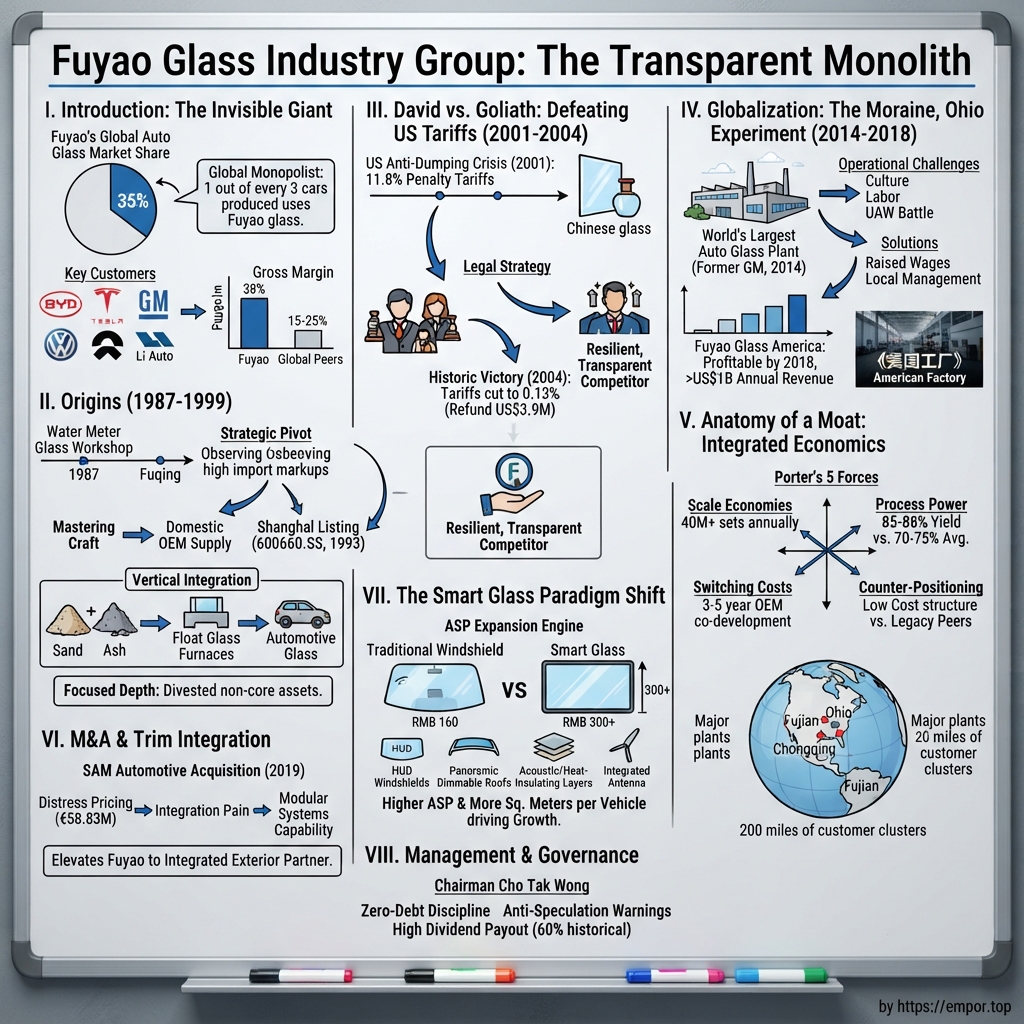
Fuyao Glass Industry Group: The Transparent Monolith
I. Introduction & Episode Roadmap
On July 30, 2025, a ribbon was cut on a patch of southwestern Ohio farmland-turned-industrial-park in Moraine, a few hundred metres from a building that had once been a General Motors assembly plant. The new facility cost roughly US$300 million, was designed to employ about 500 people, and was built to make glass for head-up displays, driver-assistance sensor windows and electric vehicles.1 It was the newest node in what its owner describes as more than US$1.5 billion of American investment supporting roughly 4,000 direct jobs.1
The owner was not Corning, not PPG, not Pilkington. It was 福耀玻璃工业集团股份有限公司 Fuyao Glass Industry Group Co., Ltd. — a company founded in 1987 in a small coastal county in Fujian province to make glass covers for water meters, listed on the 上海证券交易所 Shanghai Stock Exchange as 600660 and on the 香港交易所 Hong Kong Stock Exchange as 3606.
Nine months later, at the company's annual general meeting on April 25, 2026, its founder was asked what he would do if American tariffs made those plants uneconomic. 曹德旺 Cho Tak Wong (Cao Dewang), weeks short of his eightieth birthday, did not offer a diplomatic answer. "How much in duties you want to impose is your business," he said, adding that if the company encountered unreasonable treatment, "we'll simply shut down the [US] factories."2
Those two moments — a half-billion-dollar bet on American manufacturing, and a public threat to walk away from it — frame the analytical problem. Fuyao is simultaneously the most globally integrated Chinese industrial manufacturer of its generation and one of the most exposed to the unwinding of that integration.
The scale. In the year ended December 31, 2025, Fuyao reported revenue of RMB 45.79 billion, up 16.65%, and profit attributable to owners of RMB 9.31 billion, up 24.20% — earnings per share of RMB 3.57.3 Group gross margin reached 36.76% and return on equity 24.79%, both the highest in at least a decade.3 The company sold 169.18 million square metres of automotive glass during the year, of which 142.73 million went to vehicle assembly lines and 26.45 million into the replacement market.3 Independent tallies put its global share of automotive glass at roughly 34%, with operations across twelve countries.4
To understand why those margins are unusual, compare them with the nearest listed pure-ish comparable. 旭硝子 AGC Inc., the Japanese group formerly called Asahi Glass, reported FY2025 net sales of ¥2,058.8 billion and operating profit of ¥127.5 billion — an operating margin near 6% — with group net income of ¥69.2 billion and return on equity of 4.7%.5 AGC's automotive segment was the bright spot, with operating profit more than doubling to ¥29.3 billion.5 AGC is a well-run, technically formidable company. Fuyao earns roughly five times its return on equity.
The paradox worth explaining. Automotive glass is, on paper, a terrible business. It is heavy. It breaks. It is made from sand, soda ash and natural gas, none of which anyone controls. Its customers are automakers — the most ruthless procurement organisations in manufacturing, structurally committed to extracting annual price reductions from every supplier they have. Its finished product is a low-value-per-kilogram commodity that costs a fortune to ship across an ocean and arrives with a meaningful chance of being cracked. Every economic characteristic points toward a fragmented, low-return industry.
Instead it is an oligopoly, and one member of that oligopoly earns software-adjacent returns on equity. Explaining how — and, more importantly, testing whether that explanation survives contact with the company's own history — is the work of this piece.
The counter-evidence arrives early. Fuyao's record is not a smooth compounding curve. Earnings per share fell from RMB 1.64 in 2018 to RMB 1.16 in 2019 and RMB 1.04 in 2020 — a 37% decline in two years — while return on equity compressed from 20.39% to 12.03% over the same period, before the recovery that produced 2025's record.6 A moat that permits a near-halving of returns on equity across a two-year stretch is a real moat, but it is not the fortress the bull case sometimes describes.
The stumble is not confined to history. In the first half of 2026, Fuyao's revenue grew just 2.44% to RMB 21.97 billion, profit before tax fell 19.95%, and profit attributable to owners fell 17.37% to RMB 3.97 billion.7 The proximate cause was currency: an exchange loss of RMB 803 million against a RMB 602 million gain in the prior-year period, a RMB 1.4 billion swing. Strip it out and pre-tax profit rose 4.78%.7 The first quarter told the same story — revenue up 5.08%, net profit down 15.68%, an exchange loss of RMB 438.7 million, and operating cash flow down 82.22% to RMB 357 million.8
Themes this piece will test, not assume.
The founder's ethos. Fuyao is celebrated for zero-diversification discipline and conservative finance. The record is more textured: the company took a second listing in Hong Kong in 2015, placed HK$4.34 billion of new H shares in 2021, and closed 2025 with RMB 16.85 billion of interest-bearing debt and a 46.40% gearing ratio.39 Focus is real. Self-funding is a myth.
The trade precedent. The 2001–2004 anti-dumping fight remains the most consequential legal victory a Chinese manufacturer has won against the US government. It also, as the 2026 AGM made plain, bought nothing durable in the current trade environment.
The globalisation friction. Moraine made Fuyao famous through 《美国工厂》 American Factory, the documentary that won the Academy Award for Best Documentary Feature.10 The plant is profitable. It is also, on the company's own subsidiary disclosures, structurally less profitable than the Chinese base — a fact that complicates the "localisation is pure upside" narrative.
The smart-glass inflection. This is the live thesis. Fuyao's automotive glass volumes grew 8.54% in 2025; automotive glass revenue grew 17.30%.3 The gap between those two numbers — price and mix — is the entire investment case, and it is measurable from disclosed data even though the company declines to disclose the underlying ratio directly.
The story begins where all of this began: with a man selling glass covers for water meters, and noticing what a windshield cost.
 Subscribe on LinkedIn
II. Origins & Early Trajectory: Water Meters to Windshields (1987–1999)
The origin scene that Fuyao's own retelling returns to involves a broken windshield and a price. In the mid-1980s, replacement windshields for imported cars in China were sold at multiples that bore no relationship to what they cost to manufacture — a distortion produced by import licensing, foreign-exchange rationing and the simple absence of any domestic supplier capable of meeting optical and safety standards. Cho Tak Wong, then running a small township enterprise in 福清 Fuqing making glass for water meters, drew the obvious conclusion: a market that priced a piece of laminated glass like a luxury good was a market waiting to be attacked from below.
What makes the decision interesting is not the arbitrage — plenty of people saw it — but the choice of where to attack. Cho did not go after the original-equipment business first. Original equipment meant qualifying with state-owned automakers and their foreign joint-venture partners, a process measured in years. He went after the aftermarket, where the buyer is a repair shop, the qualification requirement is that the glass fits and does not shatter, and the pricing umbrella held by importers was enormous. Aftermarket cash flow funded the capability that OEM qualification would later require.
Fuyao was founded in 1987 and became one of China's earlier listed industrial companies when its A shares began trading in Shanghai in 1993 — a listing that predates most of the Chinese corporate names familiar to Western investors today.3 It has now been a public company for over three decades, which is itself analytically useful: there is a long record against which to test claims.
The move from aftermarket to original equipment during the 1990s was the harder transition, and it is the one that determined everything afterwards. Selling a replacement windshield requires that the part fit and survive. Selling into an assembly line requires passing a supplier audit, holding dimensional tolerance across tens of thousands of units, delivering on a schedule set by someone else, and carrying warranty liability for the life of a vehicle programme. Companies that make that jump acquire a customer base that is extraordinarily difficult to displace. Companies that fail to make it stay in the aftermarket forever, competing on price with everyone.
That distinction still shows up in Fuyao's numbers three decades later: of the automotive glass it sold in 2025, roughly 84% by area went to vehicle assembly and the remainder into replacement channels.3 Fuyao is fundamentally an original-equipment supplier that happens to retain a substantial aftermarket business — not, as its origin story might suggest, the reverse.
The decision that defined the economics. The choice that separated Fuyao from every other Chinese glass processor was to go upstream into float glass — the continuous ribbon process, invented by Pilkington in the 1950s, in which molten glass is floated across a bath of liquid tin to produce a perfectly flat sheet. A float furnace is an unforgiving asset. It runs continuously, typically for a decade or more, because shutting it down and restarting it is enormously expensive and damages the refractory lining. It consumes natural gas and electricity relentlessly. It is, in the language of finance, an operating-leverage machine: brutal when volumes fall, exceptional when they do not.
Most glass processors buy float glass and cut, bend, laminate and temper it. Fuyao decided to make its own. The rationale was partly cost and partly something more specific: automotive-grade float glass has to be optically consistent enough that a curved windshield does not distort what a driver sees. Buying that quality from third parties means depending on someone else's furnace discipline.
The evidence that the integration is real, rather than rhetorical, is visible in the 2025 accounts. Fuyao's float glass product line reported revenue of RMB 6.48 billion — but group intra-segment eliminations that year totalled RMB 8.01 billion.3 Since eliminations exceed the entire reported float line, the large majority of Fuyao's float output never leaves the group; it is consumed by Fuyao's own processing plants. The company does not publish a self-sufficiency percentage, so the widely quoted "over 80%" figure should be treated as an outside estimate rather than a disclosed fact. What the filings do support is the direction: this is a genuinely integrated manufacturer, not a processor with a token furnace.
There is a second, less-discussed fact in the same table. Float glass carried a 38.94% gross margin in 2025 against 30.86% for automotive glass.3 The upstream business is the more profitable one on a standalone basis. That inverts the usual assumption that vertical integration is a defensive cost play subsidised by a high-margin downstream. At Fuyao, the furnace is a profit centre in its own right — which also means that when float glass economics turn against the industry, Fuyao feels it directly rather than being insulated by its processing business.
The road not taken. The most repeated claim about Cho Tak Wong is that he refused to follow his peers into property and financial speculation during China's boom decades, keeping capital and management attention inside one industry. The broad shape of that claim holds: Fuyao today describes its strategy as "professionalism, focus, and dedication," and the 2026 business plan is a list of glass and trim projects with no adjacent-industry entries at all.3
But "never diversified" is too absolute, and the company's own disclosures show why. When Fuyao placed new H shares in 2021, roughly 10% of the net proceeds was earmarked for "expanding the photovoltaic glass market and general corporate uses."9 In 2019 it bought a German aluminium trim business. In 2025 it incorporated an Indonesian sales entity and a new US subsidiary in South Carolina.3 The accurate version of the discipline claim is narrower and more useful: Fuyao has stayed inside glass and glass-adjacent components, has never made a financial-speculation detour of consequence, and has extended sideways only into things that bolt onto a car window. That is genuine focus. It is not monastic abstinence, and investors should test each adjacency on its own returns rather than assuming discipline by reputation.
By the end of the 1990s Fuyao had the aftermarket, was winning domestic OEM programmes, and owned its own glass supply. It was also, by the logic of its own cost position, about to become a problem for somebody in Detroit.
III. The David vs. Goliath Moment: Slicing Through U.S. Anti-Dumping Tariffs (2001–2004)
In March 2001, the US Department of Commerce initiated an anti-dumping investigation into automotive replacement glass windshields from China, on petition from PPG Industries, Apogee Enterprises and Safelite Glass.11 The timing was not coincidental: China had spent the year negotiating its WTO accession, and American manufacturers were positioning for what came next.
The initial determination landed hard. Fuyao's windshields were assigned an average duty of 11.8%.[^12] For a product competing largely on price into a fragmented distribution channel, an 11.8% duty is not a nuisance — it is an eviction notice.
Why the standard playbook did not apply. The conventional Chinese response in that era was to absorb the duty, reroute through third countries, or retreat to the domestic market. Cho Tak Wong did none of those. He hired American trade counsel and committed to the one thing anti-dumping cases actually turn on: proving the cost structure.
This deserves a moment of explanation, because anti-dumping law is where accounting meets geopolitics. Because China was treated as a non-market economy, the Commerce Department did not accept Chinese input prices as evidence of what things actually cost. It constructed a "normal value" using surrogate prices from a third country and compared that against US selling prices. A Chinese firm's real defence, therefore, is not to argue that it is efficient — it is to fight over methodology: which surrogate country, which input factors, which conversion assumptions, which double-counted costs.
Fuyao fought that fight with unusual thoroughness, documenting factor-by-factor consumption in a way that could survive verification, and litigating adverse findings rather than accepting them. The case moved through administrative review and into the courts, where remands sent the methodology back to Commerce for reconsideration rather than settling the question in one stroke. That is the unglamorous shape of most trade litigation: not a courtroom verdict but a war of attrition over spreadsheets, conducted in a foreign language under a foreign legal system, funded out of the cash flow of a mid-sized Chinese manufacturer.
There is a personnel footnote to this that matters for a later chapter. The executive running Fuyao Glass America through the years of the dispute — from 2001 to 2009 — was the founder's eldest son, who is credited with steering the subsidiary through the anti-dumping lawsuit.4 The company's American legal education and its succession plan turn out to be the same story.
The outcome, announced in October 2004, was the number that made the case famous: a final rate of 0.13% — below the 0.5% de minimis threshold and therefore, in practical terms, zero — accompanied by a cash refund of approximately US$3.9 million in duties already paid.[^12]11
What it actually bought, and what it did not. The romantic reading is that Fuyao proved a Chinese company could beat the US government. The commercially accurate reading is narrower and more interesting.
First, it preserved the American replacement-glass channel at a moment when losing it would have capped Fuyao's scale for a decade. Aftermarket volume is what keeps float furnaces full between OEM programme launches.
Second — and this mattered more — it changed how global automakers underwrote Fuyao as a supplier. A Tier-1 automotive supplier is not selected on price. It is selected on whether it will still be shipping conforming parts in year six of a vehicle programme. A supplier that had absorbed years of legal cost, opened its books to a hostile foreign regulator and emerged with a de minimis finding had produced exactly the kind of evidence that procurement organisations use to justify sole-sourcing a windshield.
Third, and this is where the story must be tested rather than admired: the victory conferred no durable protection. Twenty-two years later, at the 2026 AGM, the founder's answer to tariff risk was not a legal strategy but a threat to exit. "I'm a private business owner," he said in remarks reported alongside those comments; if the terms make money impossible, he will not sell.2 The 2026 interim report opens its operating discussion by citing "trade protectionism and tariffs" as a defining feature of the environment, and separately notes that a 2026 change in export tax rebate policy removed rebate eligibility for certain exported goods, forcing recognition of receivable VAT as contract assets.7
The honest conclusion is that the 2004 case was a commercial rescue and a reputational asset, not a structural moat. It bought Fuyao time and credibility during the window when it needed both. The protection that actually matters today was purchased with concrete, not with lawyers — and that purchase happened in Ohio.
IV. Globalization & American Factory: The Moraine, Ohio Experiment (2014–2018)
The Moraine plant that General Motors closed in December 2008 was, for a while, one of the more potent symbols of American deindustrialisation: a 1980s-era assembly facility, thousands of jobs gone, a community that had built its tax base around it. In 2014 Fuyao bought the building and began converting it into an automotive glass plant. Trial runs began in October 2015 and the factory opened in October 2016, representing a US$450 million investment, employing 2,000 workers at opening, and sized to supply glass for four to five million vehicles a year — roughly a quarter of North American automotive production. Ohio's JobsOhio provided US$6.6 million in incentives, its largest award at the time.12
The logic was freight, not politics. A windshield is an awkward object: large, curved, heavy, fragile, and worth a few hundred renminbi. Shipping it from Fujian to the American Midwest consumes container volume disproportionate to the value carried, adds weeks of working capital, and introduces breakage. More decisively, automakers run their assembly plants on tight replenishment cycles; a supplier eight weeks away by sea cannot participate in that rhythm without holding expensive buffer inventory.
If Fuyao wanted meaningful North American OEM share — as opposed to aftermarket share, which tolerates long lead times — it had to make glass inside the American automotive cluster. The economics of automotive glass are, in this sense, radically local. Freight cost per unit of value is high enough that the industry naturally organises into regional production zones. This is the single most important structural fact about the industry, and it explains both why the sector consolidated into a handful of global players and why each of them must replicate capacity in every region it serves.
The collision. What followed was documented, in unusual intimacy, in 《美国工厂》 American Factory — a film produced by Higher Ground Productions and released on Netflix in 2019, which went on to win the Academy Award for Best Documentary Feature.10 The film's power came from its refusal to pick a villain. It showed Chinese managers genuinely baffled by American production rates, and American workers genuinely alarmed by Chinese safety practices and pay scales that were a fraction of what GM had paid.
What the documentary captured better than any filing is the specific nature of the mismatch. The plant was staffed in large part by people who had worked at the GM facility on the same site, at union wages, under work rules negotiated over decades. It was being run to productivity standards benchmarked against Chinese plants where shift structures, staffing ratios and the relationship between supervisor and worker are organised on entirely different assumptions. Neither side was behaving unreasonably by the standards of its own system. That is precisely why the collision was structural rather than personal — and why "cultural adaptation" is not a soft skill in this business but a hard input into unit cost.
The friction was not merely cultural. The United Auto Workers mounted an organising campaign, and workers had filed citing workplace safety concerns and inadequate wages and benefits; the plant had been fined by OSHA for safety violations.13 The National Labor Relations Board election was held over November 8–9, 2017. The UAW lost by roughly two to one — a tally reported as 868 to 444 — and afterwards said it was investigating election "irregularities" and might file objections with the NLRB.13
It is worth being precise about what that vote proves. It proves the UAW failed to organise a plant in a state and an era in which it repeatedly failed to organise plants, following a campaign in which the employer raised wages and improved conditions while state politicians on both sides intervened publicly.13 It does not prove that Fuyao solved the labour question. It proves that Fuyao won a specific election.
Did it work financially? Yes — and the detail matters more than the headline. Fuyao's 2025 annual report discloses Fuyao Glass America Inc. (consolidating Fuyao Glass Illinois Inc. and an asset-holding entity) as having total assets of RMB 8.74 billion, revenue of RMB 7.92 billion, operating profit of RMB 1.05 billion and net profit of RMB 884 million for the year.3 In the first half of 2026, the American subsidiary generated RMB 3.98 billion of revenue and RMB 467 million of net profit.7
So the American operation is roughly 17% of group revenue and solidly profitable. But its net margin — around 11% in both periods — sits roughly nine percentage points below the group's 20.35%.37 The regional disclosure in the 2025 annual report points the same way: revenue within China carried a 40.09% gross margin, and the overseas remainder, derived from the same table, a materially lower one.3
This is the analytical conclusion the celebratory version of the Ohio story usually skips. Localisation is not margin-accretive; it is access-accretive. Fuyao builds abroad because it cannot serve those customers otherwise, and it accepts a structurally lower return to do so. As the overseas share of the business grows — management stated in the 2026 interim report that overseas sales are around 50% of the total and rising annually — the group's blended margin faces a persistent mix headwind that only product upgrading can offset.7
The overhang nobody puts in the highlight reel. On July 26, 2024, Homeland Security Investigations, IRS Criminal Investigations, the FBI and local law enforcement executed federal search warrants at the Moraine plant and 27 other locations in the Dayton area, in an investigation into alleged financial crime, money laundering, labour exploitation and potential human smuggling.14 Fuyao filed a statement with the Shanghai Stock Exchange saying US officials had informed it that its subsidiary was not the target, and that an unnamed third-party labour contractor was; the company suspended two shifts and resumed production the same day.14 Homeland Security has not publicly confirmed the company's characterisation.14
For investors, the point is not to prejudge an investigation. It is that a manufacturing model built on contract labour inside a politically sensitive foreign jurisdiction carries a tail risk that does not appear in any margin analysis — and that Fuyao expanded that footprint anyway, adding the new Moraine facility in 2025 and incorporating Fuyao Glass South Carolina, Inc. in September of that year.13
Which raises the question the next section has to answer: if the American business is lower-margin and legally exposed, what exactly is generating a 24.79% return on equity?
V. The Anatomy of a Monopolistic Moat: Integrated Economics & Competitive Landscape
Picture the shortlist an automaker draws up when it needs windshields for a vehicle platform launching in three years. It is not long. Globally, automotive glass is supplied at scale by Fuyao, AGC, Saint-Gobain, 日本板硝子 Nippon Sheet Glass through its Pilkington brand, and — mostly in the replacement channel — 信义玻璃 Xinyi Glass. Between them they account for the overwhelming majority of world volume. There is no fringe of hungry entrants, because the entry ticket is a float furnace, a decade of process learning, and a homologation record no start-up possesses.
Within that oligopoly, Fuyao is the outlier on returns. The comparison with AGC drawn earlier is the cleanest available: a group operating margin near 6% and return on equity of 4.7% in FY2025, against Fuyao's 20.35% net margin and 24.79% return on equity.53 Saint-Gobain is a diversified building-materials group in which mobility glass is a minority of the whole, which makes segment-level comparison unreliable — but its group profitability sits in the same single-digit-net-margin neighbourhood as AGC's, not in Fuyao's.
What actually explains the gap — and what does not. The most commonly cited explanation is yield: the proportion of glass that survives bending, tempering and laminating without becoming scrap. In a business where the furnace burns gas whether or not the sheet survives, scrap rate is close to being the whole game, and the frequently quoted claim is that Fuyao runs in the mid-to-high 80s against an industry average in the low-to-mid 70s.
Investors should know that Fuyao does not disclose its yield rate. It appears in no annual report, no interim report and no results announcement. The figures in circulation are estimates. They may well be directionally right — a durable ten-point gross margin advantage over a peer group has to come from somewhere physical — but a claim that cannot be checked should not be load-bearing in an investment thesis.
What can be checked points to four mechanisms, in rough order of confidence.
Integration, already established. The furnace is inside the house and is itself the higher-margin line. Fuyao captures the float manufacturing spread that AGC's automotive segment must partly pay away or defend separately.
Scale economies with a specific mechanism. Fuyao sold 169.18 million square metres of automotive glass in 2025 while producing 174.57 million.3 Float furnaces, bending lines and coating equipment are enormous fixed-cost assets whose unit cost falls with utilisation. Running them fuller than a peer is worth more than any procurement negotiation.
Process power built over decades. Bending a windshield is not stamping metal. Glass is heated to the point of plasticity and allowed to sag or is pressed into a mould, and the temperature gradient across the sheet determines whether the result is optically acceptable. When a head-up display projects onto that surface, the tolerance for shape error collapses further. This is accumulated, tacit, hard-to-transfer know-how — the kind of advantage that compounds because the learning happens on the line rather than in a lab.
Cost position on labour and location. Domestic Chinese gross margin of 40.09% against a lower overseas figure is, in part, simply China's manufacturing cost base.3 This is a real advantage and also a fragile one: it erodes mechanically as the overseas mix grows.
Where the standard framework is applied honestly. In Hamilton Helmer's taxonomy, Fuyao's clearest powers are scale economies and process power. Switching costs are genuine but bounded: because a windshield is tooled to a specific vehicle platform and must be re-homologated if the supplier changes, an automaker rarely switches mid-cycle — but it re-tenders at every new platform, which for most models is every five to seven years. The moat is a series of expiring contracts, not a subscription. Counter-positioning is the weakest claim: legacy peers face higher structural costs, but nothing prevents them from competing for the next platform, and AGC's doubling of automotive operating profit in FY2025 shows they are not passive.5
Through Porter's lens, the picture is: rivalry moderate and concentrated; new entrants effectively barred by capital and homologation; substitutes weak (polycarbonate has never solved abrasion and regulatory acceptance for windshields); suppliers — sand, soda ash and natural gas — commoditised but volatile, and named by Fuyao itself as a principal risk;7 and buyers genuinely powerful, since automakers are consolidated, sophisticated and contractually committed to annual price reduction.
That last force is the one that matters most, and it is where the history must be brought to bear against the claim.
The falsification test. If Fuyao's moat were as absolute as the 2025 numbers suggest, its profitability should be relatively insensitive to industry conditions. It is not. Between 2018 and 2020, with the same integrated furnaces, the same co-located plants and the same management, the company's own reported return on equity fell from 20.39% to 12.03% and earnings per share dropped 37%.6 Automotive glass did not become a worse business in those years; volumes fell, currency moved, the German trim acquisition bled, and the fixed-cost leverage that produces exceptional returns in good years worked in reverse.
The correct conclusion is not that the moat is fake. It is that the moat is real but cyclical in its expression: it reliably delivers a superior position relative to peers, and unreliably delivers a superior absolute return. Fuyao's relative advantage over AGC persisted through 2020 and 2021; its absolute return on equity did not. An investor underwriting mid-20s returns on equity as a steady state is underwriting the top of a cycle, not the structure of an industry. The falsifying event to watch for is not a single weak year — it is whether a downturn now compresses Fuyao's margin spread against AGC and Saint-Gobain rather than merely its absolute level.
Which brings us to the acquisition that supplied the last downturn with much of its pain.
VI. M&A, Capital Deployment, & Exterior Trim Integration (2019–Present)
In November 2018, a German auto-parts maker called SAM Automotive — a specialist in anodised aluminium exterior trim, the bright strips that frame a car's side windows and roof line — went insolvent.15 Two months later, in January 2019, Fuyao's European subsidiary acquired its assets for €58.83 million.15[^17]
On price alone, this looked like an obvious win. Distressed assets, a foothold in the German premium supply base, and a capability adjacent to Fuyao's core: if you already supply the window, supplying the frame around it lets you sell a finished module rather than a component.
The strategic logic was sound. The execution was not.
What the deal actually cost. Fuyao's own 2020 annual results announcement discloses the outcome with unusual clarity. FYSAM Auto Decorative GmbH — the entity that acquired SAM's trim-strip assets for €58,827,566.19 — reported 2020 revenue of about RMB 1.03 billion, an operating loss of about RMB 289 million and a net loss of about RMB 280 million, and ended the year with negative net assets of roughly RMB 571 million.6 To keep it running, Fuyao resolved to inject an additional €65 million into Fuyao (Hong Kong) Co., Ltd. to replenish FYSAM's liquidity.6
Put plainly: an asset purchase costing under €59 million produced a subsidiary whose accumulated losses had wiped out its equity within two years, and which required a capital injection larger than the original price. The cheap purchase price was not the relevant number. The integration bill was — and it landed in exactly the years when group return on equity was falling toward 12%.
What went wrong, mechanically. Anodising aluminium is a wet chemical process with meaningful environmental compliance costs and a steep quality-yield curve. Fuyao was buying a business that had already failed under German cost structures, and the fix required both restructuring German operations and relocating labour-intensive processing to Chinese facilities — a transfer that takes longer than acquirers ever forecast, because the tacit process knowledge sits with the people you are trying not to keep.
Where it stands now — and a disclosure gap worth naming. Fuyao no longer discloses FYSAM's standalone results. The 2025 annual report's product table shows three lines: automotive glass at RMB 41.89 billion, float glass at RMB 6.48 billion, and "Others" at RMB 5.43 billion before eliminations.3 Aluminium trim sits inside "Others," which is not broken out and carries no disclosed gross margin.
That is a legitimate criticism to make of an otherwise detailed filer. An acquisition that produced two years of nine-figure losses has been absorbed into an unlabelled residual line. An investor cannot currently verify whether the aluminium business earns its cost of capital.
What the filings do show is that Fuyao keeps investing in it. In July 2025 the company incorporated Fuyao Aluminum Parts (Chongqing) Co., Ltd. with registered capital of RMB 85 million, and the 2026 business plan lists "Shanghai Aluminum Components, Chongqing Aluminum Components, Anhui Decorative Parts and Anhui Molds" among its priority construction projects.3 The 2026 interim report repeats the same list as work in progress.7
The reasonable interpretation is that management judges the capability strategically necessary — modular window-and-trim assemblies are what premium automakers increasingly want to buy — and is willing to fund it through a long payback. That may be correct. It is also the classic profile of a business kept for strategic reasons rather than returns, and the absence of segment disclosure means investors are asked to take it on trust.
Now the bigger claim: does Fuyao fund itself?
The frequently repeated proposition is that Fuyao funds virtually all of its capital expansion from operating cash flow. The record does not support it.
Fuyao took a second listing in Hong Kong in 2015, pricing at the very top of its indicative range after what bankers described as extremely strong institutional and retail demand.16 On May 10, 2021 it completed a placement of 101,126,000 new H shares at HK$42.90, raising gross proceeds of approximately HK$4.34 billion and net proceeds of approximately HK$4.31 billion — with about 60% allocated to working capital and capital structure, 15% to repaying interest-bearing debt, 15% to R&D and 10% to photovoltaic glass and general corporate purposes.9 That is an equity raise whose stated primary purpose was balance-sheet repair, executed in the immediate aftermath of the profit trough.6
Fuyao's 2015 Hong Kong listing is also the reason its share count stepped up materially in the middle of the last decade; the 2021 placement added a further 101 million shares to a base then around 2.5 billion. Neither raise was large enough to be described as serial dilution. Both are enough to retire the phrase "funds everything internally."
The debt picture is equally clear. During 2025 Fuyao drew RMB 14.18 billion of new bank borrowings and RMB 900 million of ultra-short-term commercial paper, repaying RMB 12.37 billion and RMB 400 million respectively, and finished the year with RMB 16.85 billion of interest-bearing debt and a gearing ratio of 46.40%, up from 43.58% a year earlier.3 In the first half of 2026, non-current borrowings more than doubled to RMB 7.76 billion, which the company attributed to business expansion and financing-structure optimisation.7
Capital intensity is the reason. Cash paid for property, plant, equipment and other long-term assets was RMB 6.16 billion in 2025 against operating cash flow of RMB 12.06 billion — roughly half of operating cash consumed by capex, before dividends.3 The largest items were RMB 1.80 billion across the Anhui automotive glass, accessory glass and float projects, RMB 1.13 billion for the Fujian ancillary glass project, RMB 983 million for the US automotive glass project, RMB 428 million for Suzhou and RMB 422 million for Tianjin.3
For 2026, management published something most companies do not: an explicit funding budget. Fuyao stated it expects total funding needs of RMB 49.86 billion, comprising RMB 39.00 billion of operating expenditure, RMB 7.73 billion of capital expenditure and RMB 3.13 billion of cash dividends, to be met through receivables and inventory turnover, optimised use of cash balances, bank borrowings or debenture issuance.3 Note that borrowings are named in the plan itself.
And yet the shareholder return is real. Fuyao paid RMB 13.57 billion in cumulative cash dividends across 2023–2025.3 For 2025 the total distribution of RMB 5.48 billion represented 58.85% of net profit attributable to shareholders, split between an interim RMB 0.90 and a final RMB 1.20 per share.3 For the first half of 2026, despite the profit decline, the board proposed RMB 1.00 per share — RMB 2.61 billion, or 65.73% of first-half net profit.7
Raising the interim payout ratio into a down half-year is a deliberate signal. It is also, mechanically, the reason the balance sheet leans on debt: Fuyao is simultaneously running a capex programme worth roughly 17% of revenue and distributing nearly 60% of earnings. Those two commitments cannot both be met from operating cash flow indefinitely, and the 2026 funding plan concedes as much.
The accurate characterisation, therefore: Fuyao is a disciplined operator and a generous distributor, but it is not self-funding, and it has twice gone to the equity market — once at listing, once in a difficult year. Investors who value the dividend record should understand that it is partly financed by leverage, and that gearing has been rising.
VII. The Smart Glass Paradigm Shift: Driving ASP & Economic Weight
Here is the single most important arithmetic in the Fuyao story, and it fits in two lines.
In 2025, Fuyao sold 8.54% more square metres of automotive glass than in 2024. Automotive glass revenue rose 17.30%.3
Volume explains roughly half the growth. The rest is price and mix — and that gap is the entire modern investment case.
Making it concrete. Dividing disclosed automotive glass revenue by disclosed sales volume gives an implied blended revenue per square metre of approximately RMB 248 in 2025, against approximately RMB 229 in 2024 — an increase of roughly 8%.3 This is a derived figure, not a company-reported one, and it blends OEM and replacement channels, which price differently. But it is computed entirely from disclosed data, it is reproducible each period, and it is the closest thing to a clean read on whether the mix-upgrade story is working.
What is actually being sold. The products driving that increase are worth understanding in plain terms, because "smart glass" is a marketing phrase covering several genuinely different technologies.
Head-up display windshields. Projecting an image onto a windshield creates a physics problem: laminated glass has two surfaces, so the driver sees two reflections slightly offset — a ghost image. The fix is to make the plastic interlayer between the two glass sheets very slightly wedge-shaped, so the two reflections converge into one. Manufacturing a wedge film to optical tolerance, and bending glass around it without distorting the geometry, is difficult in a way that ordinary windshields are not.
Dimmable panoramic roofs. Electrochromic and suspended-particle-device glass changes opacity when a voltage is applied — replacing the mechanical sunshade and the motor that drives it. In an electric vehicle, where every kilogram and every centimetre of headroom is contested, deleting a physical shade is worth real money.
Coated heatable and ultra-insulating glass. Thin metallic coatings reflect infrared radiation, reducing the heat load the air conditioner has to fight. In a combustion car this is a comfort feature. In an electric car, where climate control draws directly from the traction battery, it is a range feature — which is why automakers will pay for it.
Lightweight ultra-thin and flush-mounted laminated glass. Thinner glass saves weight; flush glazing improves aerodynamics and looks like a single continuous surface. Both are harder to manufacture without breakage.
The common thread is that each requires more process control than a plain tempered side window, which is precisely where an incumbent with decades of furnace and bending experience should win.
The disclosure problem investors should not ignore. Fuyao reports the change in high-value-added product penetration but never the level. The 2025 annual report says the proportion of such products "continued to grow, rising by 5.44 percentage points" year on year.3 The 2026 interim report says the proportion "rose by 8.03 percentage points year-on-year."7
Both are increases from an undisclosed base. There is no year in which Fuyao has published the absolute penetration rate. Widely circulated figures — a jump from roughly a quarter of the mix to more than half — are analyst reconstructions, not company disclosure.
This matters for two reasons. First, a percentage-point gain compounds differently from a low base than a high one; without the level, an investor cannot judge how much runway remains. Second, "high value-added" is a company-defined category with no external standard, and its composition can change. The derived revenue-per-square-metre calculation is the honest cross-check precisely because it is definition-independent: whatever management chooses to call high-value, the money either shows up in revenue per square metre or it does not.
The other half of the segment story. Automotive glass generated RMB 41.89 billion of the 2025 total, with float glass at RMB 6.48 billion and "Others" — trim, moulds, services — at RMB 5.43 billion before intra-group eliminations of RMB 8.01 billion.3 In the first half of 2026, automotive glass revenue rose 3.75% to RMB 20.27 billion with gross margin improving 1.49 points to 32.02%, while float glass rose 2.11% to RMB 3.16 billion with gross margin up 2.24 points to 40.93%; group gross margin reached 38.33%.7
Two observations follow. Gross margins expanded in a half-year when revenue grew barely 2% and Chinese vehicle production fell 4% — that is mix and cost control doing exactly what the thesis says they should.7 And research spending rose 17.01% to RMB 1.03 billion in the half, against RMB 1.91 billion for the whole of 2025, roughly 4.2% of revenue.73 Fuyao is spending more on R&D while volumes stagnate, which is the correct behaviour if the mix shift is real and the wrong behaviour if it is not.
The bound on the claim. Two things constrain how far this thesis can be pushed.
First, mix upgrading is a race against automaker cost-down demands, not a substitute for it. Every additional feature Fuyao adds to a windshield becomes, in the next platform negotiation, a baseline expectation subject to the same annual price-reduction pressure as everything else. The company names this directly: intensified competition "may result in a decrease in the selling prices" and competitors' new products or substitute materials could hurt margins.7
Second, the Chinese automotive market that has driven adoption is currently contracting in volume, with production and sales down 4% and 4.1% in the first half of 2026, and the company describes domestic end-user demand as "relatively weak."7 Fuyao's revenue growth of 2.44% outpaced that decline — genuine outperformance — but outperforming a shrinking market is a lower-quality result than growing into an expanding one, and it should not be described in the same terms.
The calibrated version of the smart-glass claim: it is working, it is measurable, and it is not permanent. The KPI that would confirm it is continued growth in implied revenue per square metre. The KPI that would falsify it is that figure flattening while volumes stagnate — the signature of a mix shift that has been competed away.
VIII. Management, Governance, & Investor Credibility
On October 16, 2025, after nearly four decades running the company he founded, Cho Tak Wong resigned as chairman of Fuyao Glass. The board elected his eldest son, 曹晖 Tso Fai (Cao Hui), as chairman and legal representative with immediate effect. The founder remained on the board as honorary chairman for life, continuing to advise on strategy.4
It was the most consequential governance event in the company's history, and it was executed with almost no drama — which is itself the point.
The founder. Cho Tak Wong is one of the more genuinely unusual figures in Chinese business: a man who built a global industrial company from a township enterprise, who talks about industry with the specificity of someone who has stood in front of a furnace, and who has been publicly, repeatedly sceptical of the financialisation that consumed many of his contemporaries. He is also, notably, an owner who gave much of his ownership away. The 河仁慈善基金会 Heren Charitable Foundation was established with 300 million Fuyao shares and held 169,512,888 shares — 6.50% of the company — at the end of 2025.3 He serves as its first chairman.3
His direct economic interest in the company is smaller than commonly reported. The 2025 annual report records Cho Tak Wong personally holding 314,828 shares.3 His control runs through Sanyi Development Limited, which held 390,578,816 shares or 14.97%, and Fujian Yaohua Industrial Village Development Co., Ltd., with 24,077,800 shares or 0.92%, both described as controlled by the same entity.3
Crucially, the annual report states explicitly that Heren Charitable Foundation is independent, that Cho Tak Wong and the entities controlled by him do not control it and are not its beneficiaries.3 So the accurate figure for founder-controlled equity is roughly 16%, not the 17–19% often quoted by adding the foundation's stake. That is a modest controlling position for a company of this size, held together by structure and reputation rather than by a supermajority.
The successor. Tso Fai, 55, joined Fuyao in November 1989 and holds an MBA from Baker College in the United States.3 The formative part of his résumé for this analysis is that he ran Fuyao Glass America — the entity that fought the anti-dumping case and later built Moraine.4 He is not a founder's son parachuted in from a family office; he is the executive who managed the company's hardest foreign assignment during its most legally hostile decade.
The rest of the bench, and the concentration problem. 叶舒 Ye Shu, 53, has been president since March 2017 and an executive director since October 2019, having joined in 2003 and worked through supply management.3 Chen Xiangming, 55, has been an executive director since 2003 and chief financial officer since August 2015, and doubles as joint company secretary.3 Zhang Haiyan, 44, joined the board as employee director in September 2025.3
Here is the governance fact investors should weigh: Ye Shu is Cho Tak Wong's son-in-law and Tso Fai's brother-in-law; the annual report also identifies a further director as the founder's brother-in-law and Tso Fai's uncle.3 The chairman, the president and at least one other director are related to the founder by blood or marriage.
The two non-executive directors, Wu Shinong and Zhu Dezhen, both serve on the council of the Heren Charitable Foundation — the entity holding 6.5% of the shares — with Wu Shinong also serving as its vice president.3 They are classified as non-executive rather than independent, which is technically correct, but it means that a meaningful share of the non-executive bench is connected to the founder's philanthropic vehicle.
Board refreshment did occur: Liu Xiaozhi and Cheng Yan joined as independent non-executive directors on September 16, 2025, and the board that signed the 2026 interim results comprises five executive, two non-executive and four independent non-executive directors.37 A four-of-eleven independent complement is not unusual for a Hong Kong-listed Chinese issuer. It is also not a structure that would readily challenge a controlling family.
There is also a connected-transaction thread worth knowing about, even though it is small. Fuyao Europe GmbH leases its production plant at Leingarten, Germany from Global Cosmos German Limited — a company of which Cho Tak Wong has been a director since December 2015 — under a lease running from January 1, 2018 to December 31, 2029, with rent escalating 2.5% annually. The 2025 transaction amount was €2.90 million against an approved cap of €3.45 million, and the independent non-executive directors confirmed it was on normal commercial terms in the ordinary course of business.3
The amount is immaterial to a company earning RMB 9.3 billion. The structure is not nothing: a wholly-owned foreign subsidiary renting its factory from an entity connected to the founder, on a twelve-year lease with built-in escalators. It is fully disclosed, capped and reviewed — which is the right way to handle it — but it belongs in an honest description of how this company is governed.
A second-layer diligence note. On August 6, 2024 Fuyao's board resolved to change auditors from PricewaterhouseCoopers Zhong Tian LLP to Ernst & Young Hua Ming LLP, and from PricewaterhouseCoopers to Ernst & Young for the overseas audit, citing "recent issues related to the Company's auditors, combined with market information" and the principle of prudence.3 This coincided with PwC's regulatory difficulties in China and affected many issuers; it does not appear to be Fuyao-specific. Ernst & Young issued standard unqualified audit reports on the 2025 financial statements and an unqualified report on internal control over financial reporting.3 Worth noting, not worth alarm.
How management explains itself when results disappoint. This is where credibility is actually tested, and Fuyao's record here is better than average.
Consider the 2026 currency problem. In the first-quarter report, the company stated the exact exchange loss — RMB 438.7002 million against a RMB 235.9389 million gain a year earlier — and disclosed that excluding it, total profit rose 9.63%.8 In the interim report, it repeated the exercise: an RMB 802.632 million loss against an RMB 601.551 million gain, with pre-tax profit up 4.78% excluding the effect.7 The same explanation appeared in the management discussion, in the line-item variance analysis, and again in the shareholder-returns action-plan assessment.7
That is what disclosure discipline looks like: the same number, the same framing, in three places, with the adjusted figure stated rather than implied. It is materially more useful than the common alternative of gesturing at "macro headwinds."
The company applied similar candour to less flattering items. The first-half decline in operating cash flow was attributed to settling bills payable outstanding from year-end and reduced use of commercial bills — a working-capital timing explanation that is specific enough to be checked.7 The increase in financing cash flow was decomposed into RMB 3,057 million of higher net financing and RMB 1,442 million of lower dividends paid due to distribution timing.7
Where the disclosure stops. Fuyao does not issue numeric revenue or profit guidance. What it publishes instead — the annual funding-needs budget — is unusual and, for a capital-intensive manufacturer, arguably more informative than an earnings forecast, because it is a testable statement about spending intentions.
But three things an investor would want are simply absent: the absolute high-value-added penetration rate, any yield or scrap disclosure, and standalone results for the aluminium trim business. Fuyao also does not hold the kind of open analyst question-and-answer call that Western investors expect; its live engagement runs through results briefings and the annual general meeting, which is where the founder's tariff remarks emerged.2
The credibility verdict, weighed. Management's narrative has been consistent across filings for years — focus, integration, mix upgrade, shareholder returns — and the operating record broadly matches it. The 2024 "Quality Improvement, Efficiency Enhancement, and Focus on Shareholder Returns" action plan, reaffirmed in April 2025, has been followed by rising payout ratios, which is more than can be said for many such plans.7
Against that: the aluminium acquisition underdelivered for years and then disappeared into an unlabelled line; the self-funding narrative is contradicted by two equity raises and rising gearing; and the governance structure concentrates authority in one family with limited independent counterweight. None of these is disqualifying. All of them mean the appropriate posture is verification rather than deference — particularly now, in the first full cycle under a new chairman whose independent capital-allocation record is, by definition, not yet written.
IX. Playbook: Business & Investing Lessons
Strip away the documentary, the courtroom and the succession, and Fuyao is a case study in a narrow question: what actually creates durable margin in a heavy, cyclical, commoditised manufacturing industry? Five lessons come out of the record — each stated with the counter-test that keeps it honest.
1. Vertical integration buys cost control, not immunity.
The float furnace is the single most consequential asset in this story. Owning it means Fuyao sets its own glass quality specification, absorbs its own furnace margin, and does not renegotiate raw material supply with a competitor every year.
But "pricing immunity" overstates it. Fuyao's own risk disclosure names the exposure precisely: automotive glass costs are driven by float glass, PVB interlayer, labour, electricity and manufacturing overhead, while float glass costs are driven by quartz sand, soda ash, natural gas, labour and electricity — with the company explicitly citing international commodity prices, natural gas supply and demand, soda ash capacity changes and rising labour costs as risks it must manage.7 Integration moves the exposure upstream; it does not eliminate it. A soda ash squeeze or a gas price spike hits Fuyao directly rather than arriving through a supplier's invoice.
The useful version of the lesson: integration converts a negotiation risk into an operating risk. That is a good trade for a company that runs furnaces well and a bad one for a company that does not.
2. Yield is the right idea; unverifiable yield is the wrong evidence.
The economic logic is unimpeachable. In a plant where the furnace burns gas continuously and the equipment depreciates regardless, every sheet that becomes scrap is pure margin destruction. A supplier operating ten points better on yield than a rival has an advantage no procurement negotiation can close.
The problem is evidential. As established earlier, Fuyao publishes no yield figure. An investor building a thesis on "88% versus 75%" is building on an estimate that neither the company nor its auditors have ever confirmed.
The disciplined substitute is to watch the outcome rather than the input: the gross margin spread against AGC and Saint-Gobain, tracked through a full cycle. If the process advantage is real, the spread persists when volumes fall. If it narrows in a downturn, the advantage was partly operating leverage wearing a process-power costume.
3. Focus compounds — but adjacency must still clear a return hurdle.
Fuyao has spent nearly four decades inside one industry, and the compounding is visible in the process knowledge that lets it bend a head-up display windshield to tolerance. There is no property arm, no financial products business, no unrelated conglomerate sprawl. In the Chinese corporate landscape of the past thirty years, that is genuinely uncommon.
But the aluminium trim story is a warning about what "adjacent" can cost. A business that looked like a natural extension of the window destroyed its own equity base within two years of acquisition and required a capital injection larger than its purchase price. Focus prevented Fuyao from buying a shopping mall. It did not prevent it from buying a distressed German metal-finishing operation whose returns remain undisclosed seven years later.
The lesson is not "don't do adjacencies." It is that proximity to the core business is not evidence of a good return, and that investors should demand segment disclosure before granting credit for optionality.
4. Globalising means paying for access, and accepting local rules you do not set.
The Moraine experience produced a genuinely transferable insight: a Chinese manufacturer can run a profitable plant in a high-cost Western economy, provided it hires local management, adapts its labour practices and accepts the regulatory and legal environment on that environment's terms — including OSHA enforcement, an NLRB election it might have lost, and federal investigations it does not control.
What the record also shows is the price of that access. The American operation earns roughly half the group's net margin. Overseas gross margin runs materially below domestic. Localisation is a toll paid to be in the room, not a profit engine.
And the toll may be rising. When a founder tells shareholders he will close plants rather than run them at a loss under tariffs, he is describing a real option — and real options have value precisely because circumstances might make exercising them rational.2
5. Mix upgrading is a genuine defence against volume cycles — with a shelf life.
The first half of 2026 is the cleanest demonstration available: Chinese vehicle production fell 4%, and Fuyao still grew revenue and expanded gross margin.7 That is mix doing exactly what the thesis promises, in the exact conditions where a pure volume business would have contracted.
The caveat is structural rather than cyclical. Content-per-vehicle upgrading is a one-way ratchet only until the content becomes standard, at which point it re-enters the annual price-reduction machine that governs every automotive component. Fuyao's ability to keep raising revenue per square metre depends on continuously introducing the next premium feature — which is why R&D spending rising 17% while volumes stall is the correct behaviour, and why a flattening of implied revenue per square metre would be the early warning.
The meta-lesson running through all five: Fuyao's advantages are real, mechanical and explicable, and every one of them is conditional. None is a permanent structural gift. Which is the right frame for the final question — what breaks this, and what would prove it unbroken?
X. Strategic Position, Risk Radar, & Bull vs. Bear View
Start with the position as it actually stands in September 2026. Fuyao is the volume leader in a five-player global industry, earns roughly three to five times the group-level profitability of its nearest listed peer, is compounding revenue per square metre through product upgrading, is running a capital expenditure programme worth roughly a sixth of revenue, is paying out close to two-thirds of first-half earnings, and is watching a currency line item swamp a perfectly respectable operating performance for a second consecutive quarter.
That is not a simple story, and it should not be told as one.
The three KPIs that matter.
Most metrics for this company are noise. Three are not.
First: implied automotive glass revenue per square metre. Divide disclosed automotive glass revenue by disclosed automotive glass sales volume. Both are published annually. This single derived number is the cleanest available test of whether the entire mix-upgrade thesis is working, and it is immune to management's discretion over what counts as "high value-added." If it keeps climbing while volumes are flat, the thesis holds. If it flattens, the premium features have been competed away and Fuyao is a volume business again.
Second: Fuyao Glass America's revenue and net margin. Disclosed annually in the subsidiary table and semi-annually in the overseas-assets note. This is the localisation trade in a single line: whether the American footprint scales toward group-level profitability, holds at its current gap, or deteriorates under tariffs and cost inflation. It is also the number that will move first if the founder's threat to close plants ever becomes an operational discussion.
Third: capital expenditure against operating cash flow, read alongside the gearing ratio. Fuyao publishes both, and it publishes a forward funding budget. This is the honest test of the capital discipline narrative: whether the expansion programme is being funded from the business or from the balance sheet, and how fast leverage is drifting while dividends stay near 60% of earnings.
The risk radar, mechanism by mechanism.
Tariffs and trade fragmentation. This is the dominant risk, and it is asymmetric in an unusual way. Fuyao's American plants are the hedge against tariffs on Chinese-made glass — but they are also American assets owned by a Chinese company in an environment where that ownership is itself politically contested. The 2026 interim report cites trade protectionism and tariffs as defining features of the environment and discloses that an export tax rebate policy change removed rebate eligibility for certain exported goods.7 The mitigation and the exposure are the same asset.
Energy and raw material costs. A float furnace is a continuous gas burner. Fuyao does not disclose an energy cost percentage, and the frequently quoted "35–40% of float production cost" is an industry estimate rather than company data. What is disclosed is that management treats natural gas and soda ash as principal risks and cites its European and American plants as a partial hedge, since local energy pricing differs from Chinese pricing.7
Currency. Overseas sales are around half of the total and rising annually, which management itself flags as an exchange-rate risk requiring active management through settlement-currency optimisation and financial instruments.7 The 2025 annual report noted the company did not use financial instruments for hedging during that year;3 by mid-2026 it held currency swap and other contracts valued as derivative financial assets.7 That shift is worth tracking: it suggests the FX losses of 2026 changed treasury behaviour.
Cyclicality and capital intensity together. This is the combination that produced the 2019–2021 trough. Fuyao is building Anhui, Fujian, Suzhou, Tianjin, US and aluminium capacity simultaneously. Fixed-cost absorption is spectacular when the new lines fill and punishing when they do not.
Legal and labour exposure in the United States. The 2024 federal search warrants remain the clearest example of a risk that lives entirely outside the operating model and cannot be managed by process excellence.
Customer concentration in a price-war market. Chinese automakers are in an intense domestic price war while exporting aggressively. Fuyao benefits from their export growth and suffers from their margin desperation. Both effects run through the same customer relationships.
The activist stress test.
A skeptical long-short investor would press on five things.
Disclosure asymmetry. The company reports the change in high-value-added penetration but not the level, discloses no yield data, and buries an acquisition that generated negative net assets into an unlabelled "Others" line. Each choice happens to obscure something an investor would want to verify.
The self-funding narrative versus the balance sheet. Gearing rose to 46.40% in 2025 while dividends absorbed nearly 59% of earnings, and non-current borrowings more than doubled in the first half of 2026.37 An activist would ask whether the payout is being sustained for signalling reasons at the cost of balance-sheet flexibility, in a business whose own history includes a two-year profit decline of 37%.
Governance concentration. Chairman, president and at least one further director related by blood or marriage; two non-executive directors connected to the founder's foundation; a connected-party factory lease running to 2029; and a founder who remains honorary chairman for life with a board seat.3 Nothing here breaches Hong Kong or Shanghai listing rules. All of it reduces the probability that a bad capital allocation decision gets challenged internally.
Succession execution risk. Tso Fai has run the hardest overseas assignment in the company's history, which is meaningful evidence. He has not yet been tested as the person who decides where the next RMB 8 billion of capital goes. The first full cycle under the new chairman is the test.
Whether the record margin year is the cycle peak. Group gross margin, net margin and return on equity all hit multi-year highs in 2025 — and then the first two quarters of 2026 produced declining profit. The bull attributes it entirely to currency. The bear notes that revenue growth also decelerated from 16.65% to 2.44%.
Porter's five forces, applied to where the pressure actually is. The forces analysis was set out earlier; what has changed by 2026 is the weighting. Rivalry has become more dangerous not because there are more competitors but because AGC's automotive profitability is recovering sharply, which reduces the probability that peers retreat from capacity during the next downturn — the mechanism by which Fuyao historically gained share. Buyer power has intensified because Chinese automakers are fighting a domestic price war. Supplier power and entry barriers are essentially unchanged. Substitution remains negligible.
The 7 Powers scorecard, honestly graded. Scale economies: strong and demonstrable. Process power: strong in inference, weak in disclosure. Switching costs: real within a platform, absent between platforms. Cornered resource: none — Fuyao owns quartz sand mineral resources and process patents but nothing an OEM cannot source elsewhere. Counter-positioning: weak, and weakening as peers recover. Branding: irrelevant in a business-to-business component sold on specification. Network economies: absent entirely. That is four powers in play, two of them contested — a strong hand, not an unbeatable one.
The bull case. Fuyao is the low-cost, high-yield, vertically integrated leader in a consolidated industry with no credible new entrant, at exactly the moment when the glass content of a vehicle is expanding in both area and function. The mix shift is not a forecast — it showed up as roughly 8% growth in implied revenue per square metre in 2025 and as gross margin expansion in a half-year when the Chinese market contracted. Local manufacturing in the United States and Europe means tariffs on Chinese exports hurt competitors more than Fuyao. The company generated RMB 12.06 billion of operating cash flow in 2025 while distributing RMB 5.48 billion, and it has raised its interim payout ratio into a weak half-year.37 If the currency swings reverse — and currency swings do reverse — the reported earnings line snaps back without any operational improvement at all.
The bear case. The 2025 result was a cycle peak dressed as a structural achievement. Revenue growth has decelerated to near zero in a contracting Chinese market; the overseas mix that management is proudly growing carries structurally lower margins; capital expenditure is running at roughly a sixth of revenue into a global auto market that is not growing in units; gearing is rising while the payout ratio climbs; the aluminium adjacency has never demonstrated an acceptable return and is no longer separately disclosed; the US footprint carries tariff, political and legal tail risk that the founder himself has publicly said might justify closing plants; and the process advantage on which the entire margin premium rests has never been disclosed in a form anyone outside the company can verify.
What the history actually says, weighed. The moat claim survives — but in a narrowed form. Fuyao's relative position against its listed peers has been durable across cycles; its absolute returns have not. The capital allocation claim is partially rejected: the company is a disciplined operator and a poor-to-unproven acquirer, and it is not self-funding. The management credibility claim survives on disclosure behaviour and is unproven on the new chairman's allocation record. The mix-upgrade claim is intact and currently working, but is a race rather than a ratchet.
The events that would confirm the revised case are specific: implied revenue per square metre continuing to rise through a full down-cycle, and the gross margin spread against AGC holding when volumes fall. The events that would falsify it are equally specific: that spread compressing, the American subsidiary's margin deteriorating under tariff pressure, or capital expenditure continuing at current levels while operating cash flow stalls and gearing climbs past the level at which the dividend becomes a financing decision rather than a distribution.
For a company whose entire product is transparency, that is a reasonable amount left to see through.
References
-
Fuyao Glass America Launches State-of-the-Art Manufacturing Facility — China General Chamber of Commerce USA, 2025-07-30 ↩↩↩
-
Billionaire behind 'American Factory' firm warns of US exit amid trade friction with China — South China Morning Post, 2026-04 ↩↩↩↩
-
Fuyao Glass Industry Group Co., Ltd. Annual Report 2025 — Fuyao Group, 2026-03 ↩↩↩↩↩↩↩↩↩↩↩↩↩↩↩↩↩↩↩↩↩↩↩↩↩↩↩↩↩↩↩↩↩↩↩↩↩↩↩↩↩↩↩↩↩↩↩↩↩↩
-
World's Largest Auto Glass Maker Fuyao Group Sees Founder Cao Dewang Step Down as Chairman — TechNode, 2025-10-16 ↩↩↩↩
-
AGC FY2025 presentation slides: Automotive drives profit growth despite flat sales — Investing.com, 2026 ↩↩↩↩
-
2020 Annual Results Announcement — Fuyao Glass Industry Group Co., Ltd. / HKEX News, 2021-03-29 ↩↩↩↩↩
-
Announcement of Interim Results for the Six Months Ended June 30, 2026 — Fuyao Group, 2026-08-18 ↩↩↩↩↩↩↩↩↩↩↩↩↩↩↩↩↩↩↩↩↩↩↩↩↩↩↩↩↩↩
-
Completion of Placing of New H Shares Under General Mandate — Fuyao Glass Industry Group Co., Ltd. / HKEX News, 2021-05-10 ↩↩↩
-
Certain Automotive Replacement Glass Windshields From the People's Republic of China: Final Results of Antidumping Duty Administrative Review — U.S. Federal Register, 2004-10-18 ↩↩
-
Fuyao Glass America Inc.'s $450M Moraine factory opens — Bricker Graydon, DevelopOhio ↩
-
Fuyao Glass America Workers Vote Overwhelmingly Against Unionization — WYSO, 2017-11-10 ↩↩↩
-
Fuyao Glass Claims Third-Party Target in Ohio Facility Raid — USGlass Magazine, 2024 ↩↩↩
-
Fuyao Glass Completes Acquisition of Assets of German SAM Automotive Group — MarkLines Automotive Industry Portal, 2019-01-17 ↩↩
 LinkedIn
 WhatsApp
 Reddit
 Hacker News
 Email
Email Kindle
 RSS Feed
 Spotify
 Apple Podcasts
 Amazon Music
 Audible
 YouTube