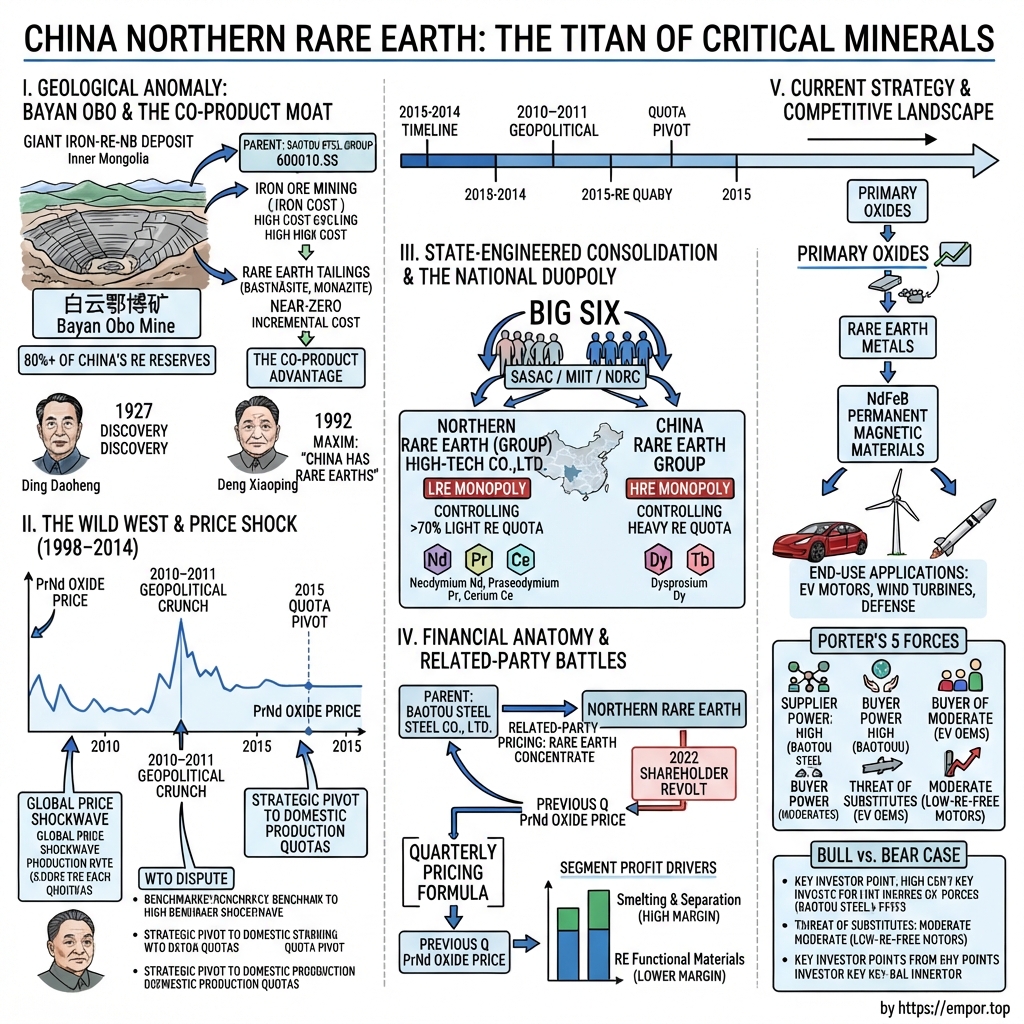
China Northern Rare Earth: The Titan of Critical Minerals
I. Introduction & Episode Roadmap
There is a photograph that circulates in Chinese industrial circles showing a tailings pond outside Baotou, Inner Mongolia — a grey-black lake of processed rock, several kilometres across, ringed by earthen dams. To an untrained eye it looks like waste. It is, in a narrow sense, exactly that: the leftovers from six decades of digging iron ore out of a mountain called Bayan Obo. But that tailings impoundment holds roughly 200 million tonnes of material at an average rare earth grade of about 7%, containing an estimated 13.8 million tonnes of rare earth oxides — which would make the garbage pile the second-largest rare earth deposit on Earth in its own right.1
That is the single most important fact about 中国北方稀土(集团)高科技股份有限公司 China Northern Rare Earth (Group) High-Tech Co.,Ltd. (600111.SS), and everything else in this story is downstream of it.
Rare earths are seventeen elements that sit, awkwardly, at the bottom of the periodic table — the fifteen lanthanides plus scandium and yttrium. They are not actually rare in a geological sense. What is rare is finding them concentrated enough to extract economically, and rarer still is the industrial capability to separate them from one another, because chemically they are near-identical siblings. Separating neodymium from praseodymium is less like mining and more like running thousands of stages of liquid-liquid extraction to tease apart molecules that barely know they are different. The output matters enormously: neodymium-iron-boron magnets are the strongest permanent magnets ever commercialised, and they are what let an electric vehicle traction motor deliver the torque of a much larger machine, what lets an offshore wind turbine generate power without a gearbox, and what lets a phone vibrate, a hard drive spin, and a guided munition steer.
The scale of the position
Northern Rare Earth is the largest rare earth enterprise group in the world by revenue and market value, and in 2024 it received close to 70% of China's national rare earth total-volume control quota — the state-issued permission slip without which no legal tonne of rare earth ore is mined or separated in the country.2 Since 2024, those quotas have been issued to exactly two entities: Northern Rare Earth and 中国稀土集团 China Rare Earth Group Co., Ltd.3 In an industry where China has held the overwhelming majority of global mine supply and an even more lopsided share of separation and refining capacity, a company with 70% of the Chinese light rare earth quota is, functionally, a large minority of world supply for the elements that make magnets.4
The dual-monopoly architecture
Beijing did not stumble into this. It engineered it. The Chinese rare earth landscape was deliberately cleaved in two: a light rare earth champion in the north, built on Bayan Obo's bastnäsite and monazite, and a heavy rare earth champion in the south, built on the ion-adsorption clays of Jiangxi, Guangdong and Fujian that hold dysprosium and terbium. Northern Rare Earth got the north. China Rare Earth Group, assembled by the central 国务院国有资产监督管理委员会 SASAC in December 2021, got the south.5
Here is the wrinkle that makes this a genuinely interesting equity rather than a policy diagram: Northern Rare Earth does not own the mine. It has never owned the mine. It buys its entire raw material feed from a sister company, at a price set by a formula that has been fought over in public, voted down twice by minority shareholders, and rewritten under pressure. The most valuable asset in the story sits one level up the ownership chain, and the listed vehicle's economics depend on how much of the resource rent that upper level chooses to leave behind.
Episode roadmap
What follows traces how a 1927 field expedition led to the world's largest rare earth deposit being mined as an iron mine for sixty years; how the co-product economics of that arrangement quietly destroyed Western competition in the 1990s and 2000s; how the 2010–2011 price shock and the WTO cases that followed forced China to swap export quotas for domestic production quotas — a trade that turned out to be far more powerful; how the "Big Six" consolidation became the Big Two; where the profits actually live inside this company and why the answer changes every quarter; the extraordinary 2022 shareholder revolt in which retail investors in a Chinese state-owned enterprise twice defeated their own controlling group; and finally, what a sceptical investor should watch from here, in a world where the United States government has started underwriting a competitor with a guaranteed price floor.
The through-line is a question. Is Northern Rare Earth a cornered-resource business with structural pricing power, or is it a highly cyclical toll processor sitting between a monopoly supplier upstream and a state that has opinions about prices downstream? The evidence points in both directions, and the last four years of financial history are unusually good at testing it.
 Subscribe on LinkedIn
II. The Geological Anomaly: Bayan Obo & The Co-Product Moat (1927–1997)
In July 1927, a young geologist named 丁道衡 Ding Daoheng, travelling with the Sino-Swedish Scientific Expedition across the grasslands of Suiyuan, walked up a low, dark hill that local Mongolian herders called Bayan Obo — "rich sacred mountain." He was looking for iron. He found it: a large, obvious iron ore body outcropping at surface. He wrote it up, collected samples, and carried them back east.[^6]
He had, without knowing it, just found the most important rare earth deposit in human history. It took another eight years for anyone to realise it. In 1935, the geologist 何作霖 He Zuolin, examining Ding's samples in Beiping, identified two unfamiliar rare earth minerals in the ore and named them baiyunite and boboite after the mountain itself.[^6] Nobody in 1935 China had any use for a lanthanide. The find went into the literature and stayed there.
An iron mine that happened to be a rare earth mine
What makes Bayan Obo geologically freakish is that it is not a rare earth deposit that also contains iron. It is a giant, polymetallic iron-rare-earth-niobium orebody in which all three occur together, in enormous quantity, in the same rock. Chinese estimates place around 38 million tonnes of rare earth oxide in the deposit, on the order of 80%-plus of China's national rare earth reserves, alongside roughly 1.4 billion tonnes of iron ore.1 It is also, awkwardly, radioactive — the ore carries thorium, which is why rare earth processing at Baotou has always been an environmental as well as a chemical problem.
There is a reason this matters beyond geology. Every rare earth deposit on Earth forces its owner into the same trade: you must handle radioactive material, and you must find a home for the elements nobody wants. Bayan Obo carries thorium in its ore, which means the residues from separation are mildly radioactive and must be impounded rather than disposed of. It also carries an element distribution weighted heavily toward lanthanum and cerium — the two cheapest, most abundant, least useful light rare earths — relative to the neodymium and praseodymium that actually pay the bills. Every tonne of PrNd oxide produced at Baotou drags several tonnes of lanthanum and cerium into the world alongside it. Managing that imbalance, which the industry calls the "balance problem," has shaped Northern Rare Earth's strategy for thirty years and explains why the company invests so heavily in polishing powders, catalysts and cerium-bearing alloys: those are not glamorous growth markets, they are demand-creation exercises for by-products that would otherwise pile up in warehouses.
For most of the twentieth century, China mined it for the iron. 包头钢铁(集团)有限责任公司 Baotou Iron and Steel (Group) Co., Ltd. — Baogang Group — was built in the 1950s as one of the People's Republic's flagship steel projects, and Bayan Obo was its ore supply. The rare earths went out with the tailings.
This is the origin of the structural advantage that defines the business to this day, and it is worth stating precisely, because it is frequently stated imprecisely. Baogang Group holds the exclusive mining right to Bayan Obo. Its listed subsidiary 内蒙古包钢钢联股份有限公司 Inner Mongolia Baotou Steel Union Co., Ltd. (包钢股份, 600010.SS) mines the ore, produces iron concentrate for steelmaking, and then puts the tailings through a further beneficiation circuit to produce rare earth concentrate — which it sells to Northern Rare Earth.[^7]
The economic consequence is enormous. In a conventional standalone rare earth mine, the entire cost of drilling, blasting, hauling, crushing, grinding and waste-rock stripping must be recovered from rare earth revenue alone. At Bayan Obo, the iron ore business absorbs the primary mining cost, and rare earth concentrate is produced from material that has already been dug up, hauled and ground. The incremental cost of getting to a rare earth concentrate is a fraction of a greenfield operation's. This is why Mountain Pass in California and Mount Weld in Western Australia have spent forty years struggling to match Chinese costs. It is not primarily labour arbitrage, and it is not only lax environmental enforcement, though both mattered. It is that one competitor's ore came out of the ground on somebody else's cost sheet.
From experimental plant to listed company
Sixty years of learning to do something hard
The industrial build-out began in 1961, when construction started on the Baotou Steel "8861" Rare Earth Experimental Plant — the direct ancestor of the company. By 1970 it had assembled the four basic process stages that still define the industry: beneficiation, pre-treatment, extraction and separation.[^6] It was, in the language of the era, a strategic materials project, not a business — funded because the state wanted the capability, not because anyone had modelled a return.
That distinction is worth dwelling on, because it explains a capability gap that Western policymakers have spent fifteen years failing to close with money. Separation is not a process you buy; it is a process you learn. Picture a very long relay race in which each runner is asked to sort a crowd of near-identical twins by an almost imperceptible difference in height. One stage barely improves the sorting. Run several hundred stages in series, each passing its slightly-better-sorted output to the next, and you eventually get pure single elements at one end. Every stage has to be tuned — solvent chemistry, acidity, flow rates, temperature — and the tuning changes with the feedstock. Baotou spent three decades running that experiment on Bayan Obo ore specifically, at state expense, with no requirement to earn a return. By the time the business was commercialised, the accumulated process knowledge was itself an asset that could not be replicated by capital alone.
Whether that knowledge advantage still holds is a fair question. Lynas has been separating Mount Weld ore for over a decade and its engineers are not amateurs. But the fact that Lynas's more recent heavy rare earth expansion in Malaysia has run over budget is a data point in the direction of "still hard."6
The commercial conversion came in 1997. Baogang Group, together with the Hong Kong-registered 嘉鑫有限公司 Jiaxin Ltd and Baotou Steel's conglomerate arm, incorporated Inner Mongolia Baotou Steel Rare-Earth (Group) Hi-Tech Co., Ltd. in September 1997, and its public shares began trading on the Shanghai Stock Exchange under the code 600111 later that month.7 Jiaxin is still on the register nearly three decades later, holding about 2.8% and ranking as the second-largest shareholder after Baogang Group's 38.03%.8
That 38% is a number worth holding onto. Baogang Group controls the company — the Inner Mongolia Autonomous Region government is the ultimate controlling party — but it controls it with well under half the shares.8 Roughly three-fifths of the equity sits with index funds, insurers, and a very large population of Chinese retail investors. In 2022, that arithmetic produced a governance event almost nobody expected.
The famous line that gave this industry its geopolitical framing came in 1992, when 邓小平 Deng Xiaoping, touring the south, remarked that "the Middle East has oil; China has rare earths." It has been quoted so often it has become wallpaper. But it is worth noticing what it actually was: a statement of ambition, made at a moment when China's rare earth industry was a chaotic, low-margin, environmentally catastrophic scrum of hundreds of producers undercutting each other. Turning that aspiration into an actual chokepoint took another quarter-century of policy, and the first phase of it looked less like statecraft than like a price war China was winning against itself.
III. The Wild West, Global Price Shock, & Quota Pivot (1998–2014)
If you had asked a Western mining executive in 2002 why they had exited rare earths, you would not have heard a story about Chinese industrial policy. You would have heard a story about a price that would not stop falling.
Through the late 1990s and 2000s, Chinese rare earth oxide flooded world markets. Part of it was legitimate capacity at Baotou and in the southern clay provinces. A large part of it was not: an entire shadow industry of illegal mining and smelting — 黑稀土 , "black rare earth" — operated outside quota, outside tax, and emphatically outside environmental regulation, leaching hillsides with ammonium sulphate and dumping the residue into watersheds. The externalised cost never appeared in the price. It appeared in the groundwater.
The scale of that shadow industry was not marginal. At its worst, industry estimates of illegal Chinese output ran to a substantial fraction of official production — supply that existed nowhere in any statistic, paid no resource tax, and set the marginal price for the entire world. This is the part of the story that gets lost when the narrative is compressed to "China used state power to corner the market." For roughly fifteen years, China did not corner anything. It ran an uncontrolled price war against itself, exported its strategic resource at a discount, and poisoned a considerable amount of its own territory doing it. The state's later interventions were, in substantial part, a response to a domestic policy failure.
The result was a one-way ratchet. Western separation plants, which had to price in remediation, closed. Mountain Pass, which had been the world's dominant supplier through the 1960s to 1980s, suspended separation and eventually mining. By the late 2000s, an overwhelming share of the world's rare earth separation capacity sat in China, and the rest of the world had lost not just the plants but the process engineers who knew how to run them.4 That last part is the piece that Western policymakers consistently underestimated: solvent extraction for rare earths is a craft discipline as much as a capital project, and craft disciplines die when the last plant closes.
2010–2011: the shock
Then, in 2010, the mechanism became visible. Amid a territorial dispute with Japan in the East China Sea, Chinese rare earth shipments to Japanese buyers were disrupted, and China tightened export quotas sharply. The market's reaction was violent. Neodymium oxide, which had traded at modest levels for years, spiked to around $234 per kilogram in 2011 — a multiple of its prior price — and the entire complex went with it.9
For automotive, wind, electronics and defence supply chains, this was the first time most engineers had ever thought seriously about where a magnet came from. The immediate corporate response was what the industry calls "thrifting": redesigning magnets to use less dysprosium, substituting where possible, in some cases redesigning motors entirely to reduce or eliminate rare earth content. The engineering here is genuinely clever. Dysprosium is added to NdFeB magnets to stop them losing magnetism when they get hot, which is exactly what happens inside a hard-working traction motor. But dysprosium is expensive and geographically concentrated, so magnet makers learned to place it only at the grain boundaries where it does the most good — a technique called grain boundary diffusion — cutting dysprosium content by more than half for the same thermal performance. Nobody unlearns that once prices fall. That engineering response is a permanent feature of the demand curve now, and it matters for any long-term bull case: every price spike teaches customers to need less.
The second response was capital. Molycorp raised money and restarted Mountain Pass. Lynas Rare Earths built Mount Weld and a processing plant in Malaysia. Dozens of juniors listed on the promise of the next Bayan Obo.
The third response was legal. In March 2012, the United States requested WTO consultations with China over its rare earth export duties, quotas and trading restrictions; the European Union and Japan brought parallel complaints. The panel report circulated on 26 March 2014, and the Appellate Body report on 7 August 2014, with adoption on 29 August 2014. China lost comprehensively: the panel found the export quotas were designed for industrial policy rather than conservation and could not be justified under GATT Article XX, and China removed the challenged duties, quotas and trading restrictions by May 2015.10
The pivot that mattered
Here is where the story turns, and where a lot of Western commentary misread what had happened. China lost the WTO case and complied. It abolished export quotas. And then it replaced them with something considerably more effective: binding domestic production quotas — the 稀土总量控制指标 total-volume control targets — covering mining and smelting/separation, administered by 工业和信息化部 MIIT together with the 国家发展和改革委员会 NDRC.
The elegance of this is hard to overstate. An export quota restricts what leaves the country and is a textbook trade barrier. A production quota restricts what exists at all, applies equally to domestic and foreign buyers, and is therefore very difficult to challenge as discriminatory. It also does something an export quota cannot: it hands the state direct control over the supply-demand balance, and therefore over price, and it makes the quota allocation itself the scarce asset. If you hold quota, you have a business. If you do not, you have a chemistry set.
Meanwhile the 2011 boom collapsed on schedule. Prices gave back most of their gains as demand destruction, thrifting and restarted supply arrived together. Molycorp — carrying heavy debt from a capital-intensive Mountain Pass rebuild and having never turned a profit after 2011 — filed for Chapter 11 in June 2015.1112
That episode is the single most important historical data point for anyone underwriting Western rare earth independence today, and Section VII returns to it, because the 2025–2026 version of the same bet has one structural feature Molycorp never had: a government price floor.
For Northern Rare Earth, the 2011 spike and the bust that followed produced the same shape at the P&L level, and the trough was brutal. In fiscal 2016 the company earned net profit of just RMB 91 million on revenue of RMB 5.11 billion — a business, at that point, barely distinguishable from a marginal chemicals processor. The consolidation that followed was not a strategic choice by management. It was administered from Beijing.
IV. The "Big Six" Consolidation & The National Duopoly (2014–2021)
Chinese officials described what happened next as a "secret war." The enemy was not foreign. It was the several hundred domestic miners, separators and traders whose illegal and semi-legal output had been undercutting the official industry, wrecking the environment, and — most galling from Beijing's perspective — giving away China's strategic leverage for nothing.
The instrument was consolidation. Between roughly 2014 and 2016, the industry was compressed into six state-backed groups: China Minmetals, Aluminum Corporation of China, Baotou Iron and Steel Group, Xiamen Tungsten, Ganzhou Rare Earth Group, and Guangdong Rare Earth Industry Group.13 Everything else was to be acquired, absorbed, or shut. The "Big Six" 六大稀土集团 were not merely a corporate structure; they were an enforcement mechanism. Quota was issued only to the six. Traceability obligations were imposed on the six. Environmental capex requirements — which small operators could never fund — were set at a level the six could meet and nobody else could.
The mechanics of enforcement deserve more attention than they usually get, because they explain why this consolidation succeeded where earlier attempts had failed. Previous crackdowns had tried to police mining sites — an impossible task across thousands of square kilometres of hill country. The Big Six framework instead policed the market. If a smelter could only sell to a licensed buyer, and a licensed buyer could only accept quota-tagged material, then illegal ore had nowhere to go regardless of how easily it came out of the ground. Combine that with invoicing, tax and, later, traceability obligations, and the illegal economy did not need to be found. It needed to be made unsellable.
Northern China's light rare earth consolidation was completed around 2015.13 Inner Mongolia's provincial government had already designated Baotou Steel Rare Earth as the sole state-controlled enterprise for mining and processing in the north. In 2015 the company renamed itself China Northern Rare Earth (Group) High-Tech Co., Ltd. — dropping "Baotou Steel" from the name and claiming a national mandate in the title.
December 2021: six becomes two
The final act came on 23 December 2021, when SASAC announced the establishment of China Rare Earth Group, headquartered in Ganzhou, Jiangxi.5 It combined the rare earth assets of Chinalco, China Minmetals and Ganzhou Rare Earth, with SASAC holding 31.21% directly and the three contributors 20.33% each, alongside small stakes for two state research institutes.14 The new entity controlled the large majority of Chinese heavy rare earth production.
From that moment, China's rare earth industry has been a duopoly with a very clean division of labour:
- Northern Rare Earth holds the light rare earths — neodymium
钕, praseodymium镨, cerium铈, lanthanum镧— sourced from Bayan Obo. These are the volume elements and the magnet workhorses. - China Rare Earth Group holds the heavies — dysprosium
镝, terbium铽— from southern ion-adsorption clays. These are the elements added in small percentages to NdFeB magnets to stop them demagnetising at high temperature, which is why they matter so much for EV traction motors and defence hardware.
The obvious question is why Northern Rare Earth was not simply folded into the central SASAC entity to create one national champion. The answer is a mix of politics and plumbing. Northern Rare Earth's raw material is inseparable from Baogang Group's iron ore operation, which is one of Inner Mongolia's largest employers and a pillar of the regional economy and fiscal base; you cannot transfer the rare earth business to Beijing without either splitting the orebody's economics or transferring a steel complex with it. Northern Rare Earth remains under Inner Mongolia's control, and it is the only one of the two with a large, liquid, publicly traded equity.
For investors, the practical significance of the duopoly is that it removed the price-undercutting dynamic that destroyed industry margins for two decades. From 2021 onward, Chinese rare earth prices have been set within a supply framework that the state controls almost completely on the supply side. Northern Rare Earth's fiscal 2021 net profit of RMB 5.13 billion — a fifty-six-fold increase on 2016 — is what that regime change looked like on an income statement.
But it is worth being precise about what the duopoly did and did not deliver, because the subsequent record is unambiguous. It did not deliver stability. Net profit peaked at RMB 5.98 billion in fiscal 2022, then fell to RMB 2.37 billion in 2023 and RMB 1.00 billion in 2024 — a decline of roughly 83% from peak to trough in two years, under a fully consolidated duopoly with quota control already in place. Consolidation removed the competitive supply response. It did not remove the cycle. Any thesis that treats the duopoly as a guarantor of earnings durability has to explain those two years, and the honest explanation is that the state controls volume, not demand, and the company sells a commodity whose price still swings violently.
That volatility is not evenly distributed within the business, which brings us to where the money actually is.
V. Financial Anatomy & Segment Economics: Where the Profits Live
Read Northern Rare Earth's fiscal 2025 annual report and you notice something missing. Under a heading explaining non-disclosure, the company states that in accordance with national security-control requirements for the rare earth industry, certain content constitutes state secrets or commercial secrets, and that the report therefore omits production volumes, sales volumes and inventory quantities of its principal products, which have been "desensitised."8
For a business whose entire investment case rests on physical volumes, this is a material disclosure gap, and it arrived alongside Beijing's decision to stop publishing national quota numbers altogether from 2025.3 An investor in this company in 2026 cannot verify the two most fundamental operating variables — how much quota it received and how much it produced — from public filings. That is not a criticism of the company, which is complying with policy. It is a statement about the analytical terrain.
What the company does disclose
Fiscal 2025 revenue was RMB 42.56 billion, up 29.11%, with net profit attributable to shareholders of RMB 2.25 billion, up 124.17%.15 The segment split was:
- Rare earth principal products — the smelting and separation engine, producing single and mixed rare earth chlorides, salts and oxides, plus rare earth metals — RMB 32.64 billion of revenue, up 37.03%, at a 13.97% gross margin, an improvement of 2.36 percentage points.16
- Rare earth application products and others — motors, hydrogen storage devices, downstream equipment — RMB 4.50 billion, roughly flat, at a 4.62% gross margin, down 9.41 percentage points.16
Sit with that second line for a moment, because it is the most important number in the report and it cuts directly against the standard narrative. The consensus story on Northern Rare Earth is that it is climbing the value chain from bulk oxide into high-margin functional materials and applications. In the year the company reported record production and a doubling of profit, the downstream applications segment did not grow and its gross margin collapsed by nearly two-thirds. In 2025, the money was made upstream, in separation, on price.
This does not mean the downstream strategy is failing — it means it has not yet been proven at the margin level. There is genuinely encouraging evidence on the volume side: the magnetic materials subsidiary, Inner Mongolia Northern Rare Earth Magnetic Materials, generated approximately RMB 9.5 billion of revenue in the first half of 2026, up about 107% year-on-year and a third consecutive year of growth.17 The company reports about 100,000 tonnes per year of magnetic material alloy capacity, with a further 50,000-tonne high-performance NdFeB strip-casting alloy project under construction.18 Magnet alloy is a genuine, scaled, growing business. Finished downstream applications — the motors and devices at the end of the chain — are not yet earning a premium. The distinction matters, and management's framing tends to blur it.
The single most important line item: concentrate
Northern Rare Earth does not mine. In fiscal 2025 it purchased rare earth concentrate from Baotou Steel Union for RMB 9.42 billion including tax, representing 100% of that transaction category.8 One supplier. One hundred per cent. A related party under common control.
The pricing mechanism, adopted by the board and shareholders in March 2023 and effective from 1 April 2023, works like this: in the first ten days of each quarter's first month, management calculates the concentrate price using an agreed formula benchmarked to the prior quarter's rare earth oxide prices, signs a new supply contract or supplementary agreement, and announces it.19 The price is quoted per tonne on a dry basis at REO=50%, with a linear adjustment for grade.
The 2026 sequence tells you everything about how this works in practice:
- Q1 2026: RMB 26,834 per tonne ex-tax, up 2.4% quarter-on-quarter.20
- Q2 2026: RMB 38,804 per tonne — a 44.6% jump in a single quarter.21
- Q3 2026: RMB 38,565 per tonne, with the grade adjustment set at RMB 771.30 per tonne per 1% REO.19
What happened in between was that PrNd oxide prices surged. Praseodymium-neodymium oxide averaged RMB 719,500 per tonne as at 31 March 2026, up 18.22% from the start of the year, and by late February had touched a first-half high around RMB 890,000 per tonne, a cumulative move of up to 46.7% from the year's opening level, before pulling back toward RMB 700,000 in March and April.2217
The formula's one-quarter lag is therefore the company's most important short-term earnings driver, and it is symmetric in an uncomfortable way. When oxide prices rise, Northern Rare Earth enjoys one quarter of expanding spread before the concentrate cost catches up — which is precisely what produced the first-half 2026 result. When oxide prices fall, it pays yesterday's high input cost against today's lower selling price, and the spread inverts. The mechanism does not create value; it times it. Over a full cycle, the formula is designed to transfer the resource rent upstream to the party that owns the orebody.
The 2022 revolt
Which is exactly what minority shareholders realised in 2022, and what makes that year one of the more remarkable episodes in Chinese corporate governance.
Rare earth prices were booming. Baotou Steel Union, which had been selling concentrate under a periodically renegotiated arrangement, proposed in January 2022 to raise the price to RMB 26,887.20 per tonne, and then in June proposed a further increase to RMB 39,189 per tonne effective 1 July — a rise of roughly 46% that would have transferred a very large share of the cycle's profits from the listed processor to the listed miner.23
Because this was a related-party transaction, Baogang Group and its affiliates had to abstain. The vote therefore belonged entirely to the minority. On 15 July 2022, at an extraordinary general meeting, the proposal was defeated: 2.51 billion shares in favour (45.46%) against 3.01 billion opposed (54.53%), with 84.84% of minority shares voting no.23 Chinese financial media described it as a landmark — retail and institutional minorities in a state-controlled enterprise overturning a proposal backed by their own controlling group.
Baotou Steel Union came back in October with a reduced proposal of RMB 37,230 per tonne. In November 2022, Northern Rare Earth's shareholders rejected it again.24
The resolution, in March 2023, was the formula described above: a mechanical, pre-agreed, publicly announced quarterly adjustment linked to market oxide prices, replacing discretionary negotiation. That is a genuine governance improvement and it deserves credit. It converted an annual political fight into a transparent, forecastable input cost.
But it is important not to over-read it. The formula did not reduce the transfer; it regularised it. The Q1-to-Q2 2026 jump of nearly 45% happened automatically, with no vote, no negotiation and no minority veto. Minority shareholders won the right to know what they would be charged. They did not win the right to a smaller share of the rent. And the company's auditor has continued to flag the fairness and completeness of related-party transaction disclosure as a key audit matter in the fiscal 2025 report, alongside revenue recognition — the latter specifically because revenue is a key performance indicator for the company, creating a risk that management could manipulate it to hit targets.8 Those are routine formulations in Chinese audit reports, but they are not decorative: they identify exactly the two places where an investor's trust is being asked for.
What kind of business is this, really?
Strip away the strategic language and a useful way to think about Northern Rare Earth is as a spread business wearing a resource company's clothes. It buys a single input from a single related supplier at a formula price, converts it using processing assets whose cost base is well understood and slowly declining, and sells the output into a market whose price is set by a combination of state quota policy and global magnet demand. Its earnings are the spread between two numbers it does not control, multiplied by a volume set by a ministry.
That framing is not dismissive; spread businesses can be excellent. But it does clarify what an investor is buying. This is not a company whose value compounds through reinvestment at high incremental returns on the way management describes. It is a company whose value is a claim on a policy-protected spread, plus an option on the downstream migration succeeding. The first part is real, verifiable and cyclical. The second part is currently unproven.
Quality of earnings
One more thing an investor should look at before leaving the financial anatomy. Fiscal 2025 net income of RMB 2.25 billion was accompanied by operating cash flow of roughly RMB 1.1 billion and negative free cash flow, with capital expenditure running above depreciation as the green smelting upgrade and magnet capacity projects consumed cash. Inventory stood at RMB 17.07 billion — over 35% of total assets — and receivables rose 14.39% to RMB 3.91 billion.16 In the first quarter of 2026, despite net profit more than doubling, operating cash flow was negative RMB 272 million.25
There are benign explanations: a business that buys concentrate on a quarterly formula and holds large working inventories of oxides will build working capital hard when prices rise. That is a real and mechanical effect. But the pattern — profit up sharply, cash flow negative, inventory over a third of the balance sheet — is exactly the pattern a sceptical investor is trained to interrogate, and it means reported earnings in an upcycle should be understood as partly a mark on inventory rather than cash in hand. The balance sheet itself is conservative: total debt of RMB 5.86 billion against RMB 30.86 billion of total equity and RMB 5.15 billion of cash and short-term investments leaves net debt near RMB 1.3 billion, roughly a quarter of a year's EBITDA. Leverage is not the risk here. Working capital and price are.
VI. Current Strategy, Management & Capital Allocation (2022–2026)
On 27 May 2026, Northern Rare Earth's management sat down for an online investor interaction session, the format that substitutes in the A-share market for a conventional earnings call. An investor asked, in effect, whether the second-quarter price pullback would break the profit run. The answer was that short-term, stage-wise corrections in rare earth product prices "constitute normal market fluctuation," and that downstream demand from new energy vehicles and robotics remained robust. Asked to discuss pricing, management declined to guide, noting that transaction prices are formed by agreement between buyer and seller.26
That is a fair snapshot of how this management team communicates: policy-fluent, operationally specific where it can be, and conspicuously unwilling to forecast the variable that determines its earnings. Given that the state has a strong interest in rare earth price stability and that the company describes its own role as helping to "stabilise confidence, stabilise expectations and stabilise market operation," the reticence is understandable.8 It is also a constraint an equity investor should price: this is not a company that will pre-announce pricing power.
The people
刘培勋 Liu Peixun serves as Party Secretary and Chairman. Born in May 1968, he began working in July 1991, holds an MBA and the rank of senior engineer, and concurrently serves as a member of Baogang Group's Party Standing Committee and deputy general manager, having taken the Northern Rare Earth Party Secretary role from May 2024.27 瞿业栋 Qu Yedong serves as deputy Party Secretary and general manager.27
The dual-hatting is the salient governance fact. The chairman of the listed company is simultaneously a senior executive of the controlling shareholder — the same group whose subsidiary is the sole supplier on the other side of a RMB 9.4 billion annual related-party contract. This is entirely normal in Chinese state-owned enterprises, and it is also precisely the structure that made the 2022 minority revolt necessary. It is worth being clear-eyed: management's incentives are set through contractual performance targets tied to state metrics — supply chain security, the "one profit, five ratios" SOE assessment framework, green and intelligent manufacturing upgrades, quota compliance — rather than to share price or to maximising the listed entity's share of the value chain against its parent.8
To management's credit, the operating record under that incentive system is not weak. The company reported a 5.1% year-on-year reduction in per-tonne rare earth processing cost in 2024, further reductions in the blended cost of interest-bearing debt, and — for the first time in recent years — annual sales of lanthanum-cerium products exceeding production in 2025, meaningfully drawing down the inventory overhang in the industry's least-wanted elements.28 Lanthanum and cerium are the co-product problem of light rare earth mining: you get them whether you want them or not, in far greater quantity than demand supports. Actually clearing that inventory is a genuine, non-trivial commercial achievement, and it is the kind of operational detail that distinguishes real execution from strategy-deck language.
Capital allocation, tested
Here the record requires a harder look, because a claim frequently attached to this company — a high dividend payout backed by conservative leverage — does not survive contact with the filings.
The conservative leverage is real. The high payout is not. For fiscal 2023, the company distributed RMB 253 million in cash dividends against RMB 2.37 billion of attributable profit — a payout of roughly 11%.2 For fiscal 2025, the proposed distribution is RMB 0.13 per share, approximately RMB 470 million against RMB 2.25 billion of profit, or about 21%.8 Cumulative cash dividends over 2021–2023 totalled RMB 2.476 billion against roughly RMB 13.5 billion of combined attributable profit in those years. Since its 1997 listing, cumulative distributions via dividends and buyback cancellations have amounted to RMB 5.419 billion.2
The company's own framing is that its cash dividend scale ranks first among listed rare earth companies.2 That is likely true and it is also the wrong metric — it is a function of being the largest company in the sector, not of shareholder generosity. On payout ratio, this is a retention-heavy business reinvesting the great majority of cyclical profits into capacity. Whether that is good or bad depends entirely on the returns those projects earn, and the honest answer is that it cannot yet be told from outside: return on equity was 30.2% in fiscal 2022, 4.5% in fiscal 2024, and 9.1% in fiscal 2025, a range so wide that it tells you about the rare earth price and almost nothing about project-level returns on the RMB 1.3 billion of annual capex.
The controlling shareholder has, at least, put its own money in. In March 2025 Baogang Group implemented a share purchase plan, committing RMB 1 billion to increase its stake.28 That is a meaningful signal of alignment at a moment when the stock was well below its subsequent highs.
Downstream integration, and what it has actually delivered
The strategic direction is unambiguous: move from selling oxide to selling magnets, motors and devices. The fiscal 2025 report describes the first phase of the rare earth green smelting upgrade project in operation with phase two under construction, completed projects at subsidiaries including Gansu Rare Earth, Huaxing Rare Earth, Northern Zhongxin Antai, Northern Magnetic Materials, Northern Zhaobao and a secondary-resources recycling unit, and joint ventures with partners including Ningbo Zhaobao and Fujian Jinlong Rare Earth.82 The company also reports building China's first intelligent demonstration line for rare earth disc motors and developing miniature milliwatt-class axial-flux permanent magnet motors, and has laid out sintered and hot-pressed NdFeB ring magnets aimed at humanoid robot joints.826
The humanoid robot angle deserves a moment of scepticism, because it is currently the most-cited demand driver in every Chinese rare earth investor presentation. Ring magnets for robot joints are a real product with real design wins. They are also, today, a rounding error against a magnet market driven by EV traction motors and wind generators. The relevant historical test is how well this company has converted technical firsts into revenue before — and the record is mixed. The hydrogen storage business is instructive: after years of development, the concrete 2026 milestone was the deployment of a first batch of 1,000 hydrogen-powered two-wheelers in Baotou with 170,000 cumulative kilometres of safe operation.17 That is a credible pilot. It is not a business. Certification, demonstration lines and first-of-type awards are not commercialisation, and an investor should discount speculative application revenue accordingly until it shows up in a segment margin.
The rest of the operating record
A few other items from the 2025 disclosures are worth logging, because they cut in different directions and an honest assessment needs both.
On the positive side of the ledger: the company was named in the first batch of MIIT "excellence-grade" smart factories; environmental protection facilities operated at a 100% synchronised operating rate with zero industrial wastewater discharge maintained at its Inner Mongolia subsidiaries; its domestic ESG rating was raised to AAA by leading Chinese agencies; and the stock was added to the CSI A50 index and returned to the SSE 50 index, both of which mechanically broaden the institutional buyer base.8 The company also published a rare earth smelting safety standard, filling a gap in industry safety norms, and reported no major or above safety production accidents during the year.8
On the more sceptical side: much of the 2025 report's strategic narrative is written in the register of Chinese state-enterprise policy language — "new quality productive forces," "five unifications" production organisation, "133N" compensation reform, over seventy reform achievements — and it is genuinely difficult for an outside investor to distinguish substantive operational change from compliance reporting. The company states R&D investment intensity reached over 5%, which sits well above the R&D expense recognised in its income statement and presumably reflects a broader definition including capitalised and group-level spend; the reconciliation is not disclosed.82 Where a claim cannot be tied to a number an investor can check, the appropriate response is neither to accept nor reject it, but to leave it out of the model.
The regulatory moat, codified
The final leg of the strategy is not corporate at all. On 26 April 2024 the State Council adopted the 稀土管理条例 Regulations on the Administration of Rare Earths, effective 1 October 2024 — the first regulation covering the entire rare earth industry chain in China, spanning mining, smelting and separation, metal smelting, comprehensive utilisation, circulation and import-export.29 The regulations declare rare earth resources to be state property, mandate protective mining, and require the establishment of a national product traceability information system into which mining, separation and export enterprises must truthfully record product flows.30
Layered on top came export control. In April 2025 China's Ministry of Commerce imposed licensing requirements on seven medium and heavy rare earth items — samarium, gadolinium, terbium, dysprosium, lutetium, scandium and yttrium — together with their metals, oxides, alloys, compounds and downstream products, capturing all SmCo magnets and any NdFeB magnet containing terbium or dysprosium.31 On 9 October 2025 the regime was expanded dramatically to cover mining and processing equipment and technologies; that October expansion was subsequently suspended for one year to 10 November 2026, but the April 2025 licensing regime was never suspended and remains in force.32
For Northern Rare Earth specifically, the direct effect is limited — its products are light rare earths, and neodymium and praseodymium were not on the April 2025 list. The indirect effect is large. Export controls on the heavies that make magnets work at temperature, plus traceability obligations that make non-quota material commercially unusable, plus quota allocation to two companies, together create a legally enforced structure in which Northern Rare Earth's licence to operate is also a prohibition on anyone else building competing light rare earth separation capacity in China. The company's own annual report describes rare earth prices as increasingly supported by a "strategic security premium" in addition to supply-demand fundamentals.8
That is a real moat. It is also a state-granted one, which means it is revocable, and it is priced by a state with interests broader than one Inner Mongolian issuer's margin. That tension frames how the position holds up against the competition.
VII. Competitive Landscape & Porter's 5 Forces / 7 Powers Analysis
On 10 July 2025, MP Materials announced something that had never happened in the modern history of Western critical minerals: the United States Department of Defense agreed to a ten-year price floor of $110 per kilogram on MP's NdPr products, committed to purchase 7,000 tonnes per year of rare earth magnets for a decade, and invested $400 million for convertible preferred equity and warrants representing roughly 15% of the company on an as-converted basis.33
Read that against the Molycorp bankruptcy of 2015 and you have the central strategic question of this decade. Molycorp died because it was a high-cost producer competing against Chinese marginal cost with no protection. MP Materials, on the same orebody, now competes against Chinese marginal cost with a sovereign guaranteed price. The economics that killed Western rare earths in 2015 have been suspended by fiat.
Peer benchmarking
Domestic. China Rare Earth Group is the other half of the duopoly and is complementary rather than directly competitive — it holds the heavies. 金力永磁 JL MAG Rare-Earth and 宁波韵升 Ningbo Yunsheng are downstream magnet specialists; they are customers and, increasingly, competitors as Northern Rare Earth pushes into magnet alloy and finished magnets. This is a genuine tension in the vertical integration strategy that the company does not discuss: every tonne of magnet Northern Rare Earth makes itself is a tonne it does not sell as alloy to a customer who also buys its oxide.
Western. Lynas Rare Earths is the only scaled non-Chinese separator, and it has been expanding into heavies — first samarium oxide batches produced in Malaysia ahead of an April 2026 target, though the company has acknowledged the heavy rare earth expansion has run over budget.6 Lynas produced 1,857 tonnes of NdPr in the June 2026 quarter, down 11% year-on-year, on quarterly revenue of A$289 million, its strongest in four years.6 MP Materials posted record NdPr production of 917 tonnes in Q1 2026, up 63%, with revenue of $90.6 million plus $42.3 million of price-protection income, and expects first magnet sales from its Independence facility in Texas in the second half of 2026.34
Put those numbers next to Northern Rare Earth's — RMB 42.6 billion of annual revenue, a magnetic materials subsidiary alone running at roughly RMB 19 billion annualised — and the scale gap is roughly an order of magnitude. Western supply is being built. It is not close to substituting.
But the direction of travel is what matters for a long-duration thesis, and three things have changed structurally versus the 2011–2015 cycle. First, the demand-side buyer is now a government with a security mandate rather than a price-sensitive OEM. Second, the price floor mechanism removes the specific failure mode that killed Molycorp. Third, China's own export controls have converted "cheaper from China" into "possibly unavailable from China," which changes procurement behaviour permanently — CSIS and other analysts have documented the diversification response that followed the 2025 restrictions.35 Northern Rare Earth's competitive position outside China is likely to erode over the next decade, not because Western producers will beat it on cost, but because a growing share of Western demand will be legally or contractually walled off from it.
Hamilton Helmer's 7 Powers, applied honestly
Cornered Resource — strong, but the corner belongs to someone else. Access to Bayan Obo's light rare earth co-product stream is genuinely unique and genuinely low-cost. But the listed company does not own the mining right; Baogang Group does, and Baotou Steel Union captures the resource rent through the concentrate formula. What Northern Rare Earth actually owns is privileged access to that concentrate — valuable, but a contractual position, not a title deed. The 2022 vote and the 2026 price series show exactly how much of the rent flows upstream when prices rise.
Scale Economies — real and verified. Separation costs fall with throughput because solvent extraction cascades have high fixed cost and near-continuous operation. The 5.1% reduction in per-tonne processing cost in 2024 is direct evidence of the mechanism working, and no non-Chinese peer operates within an order of magnitude of the scale.2
Process Power — real, and under-appreciated. Decades of accumulated separation chemistry, tailings management and thorium handling at Baotou, backed by what the company describes as the world's largest comprehensive rare earth research institute, two national-level innovation platforms and seventeen provincial research platforms.8 Lynas's over-budget heavy rare earth expansion is a useful proxy for how hard this is when you are learning it fresh.6
Counter-Positioning / Regulatory Power — the strongest and the most fragile. Quota allocation to two entities, criminal-enforceable traceability, and the prohibition on new non-state separation capacity constitute a moat no commercial competitor can attack. But this is not a power the company built or owns. It is a policy, and its beneficiary can be changed by the same authority that created it. It is also the reason the company cannot behave like a monopolist on price: an SOE whose annual report emphasises supply chain security and market stabilisation is not going to maximise short-run margin against domestic magnet makers.
Branding, network economies and switching costs are essentially absent here, and pretending otherwise would be inventing moats. Rare earth oxide is a specification-grade chemical.
War-gaming the next five years
Play it forward. Suppose Western magnet capacity scales roughly as announced: MP's Independence facility ramps through 2027, the DoD offtake absorbs 7,000 tonnes of magnets a year, Lynas adds heavy separation, and European and Japanese programmes add increments. That is a few tens of thousands of tonnes of magnet capacity against a global market measured in hundreds of thousands. Northern Rare Earth loses very little volume.
Now change one variable: assume Western defence, automotive and wind procurement rules increasingly require non-Chinese content. Volume is no longer the binding question — the addressable market is. In that world Northern Rare Earth remains dominant in a market that has been administratively partitioned, and its growth becomes a function of Chinese and Global South demand rather than global demand. Its cost advantage stops being a competitive weapon in the walled-off segment, because price is not the criterion there.
Now change a second variable: assume the price floor works so well that Western NdPr capacity overshoots demand outside China. The subsidised producers cannot lose money — they have a floor — so they do not exit. Marginal supply lands back in the unprotected part of the market. That is the scenario in which the co-product cost advantage matters most, and Northern Rare Earth wins the price war it did not want.
The point of the exercise is that the range of outcomes is unusually wide and that most of the variance comes from policy in two capitals rather than from anything the company does. An investor should size the position accordingly and should be suspicious of any model whose output is insensitive to that.
Porter's Five Forces
Supplier power — extreme, and the defining risk. One supplier, 100% of feedstock, common control, a formula with automatic quarterly repricing, and a documented history of the supplier attempting a 46% price increase during a price boom.823 This is the single most concentrated supplier relationship you will find in a company of this size.
Buyer power — moderate and rising. Chinese magnet makers are large, sophisticated and increasingly vertically integrated themselves. Their customers — 比亚迪 BYD, Tesla and the rest of the EV complex — have spent three years in a price war and push cost down the chain relentlessly. Management's disclosure that magnetic materials achieve over 95% supply coverage within Baotou reads as a strength; it can equally be read as regional concentration.25
Threat of substitutes — moderate, structural, and permanent. Ferrite magnets and induction motors can replace NdFeB in some applications at a cost in power density and efficiency. Tesla publicly signalled intent to reduce rare earth use in future drive units. Thrifting reduces the grams of magnet per motor every design cycle. And Northern Rare Earth is itself building a recycling business, which is a tacit acknowledgement that secondary supply will grow. None of these kills demand; all of them cap the price at which demand destruction accelerates. The 2011 spike is the proof: high prices are self-limiting because customers engineer around them.
Threat of new entrants — near zero domestically, rising internationally. Inside China, the Regulations on the Administration of Rare Earths make new entry illegal. Outside China, entry is being subsidised into existence.
Rivalry — low today. A two-firm duopoly with complementary product sets and state-allocated volumes produces very little rivalry, which is precisely the point of the design.
VIII. Investor Playbook: Bull vs. Bear Case & 3 Critical KPIs
By September 2026 the stock had already told investors that the market understood the cycle. Shares changed hands around RMB 38.94, against a 52-week range of RMB 36.69 to RMB 63.57 — roughly 39% below the high, at a market capitalisation near RMB 141 billion, even as first-half net profit was running up more than 112%.36 The market was not pricing the earnings it had just received. It was pricing what happens after PrNd oxide stops going up.
The bull case
The demand story is the most credible part of it, and it is not speculative. Permanent magnet demand from new energy vehicle traction motors continues to compound. China's plan calls for cumulative offshore wind grid-connected capacity to exceed 100 GW during the coming five-year period — roughly double the level at the end of the 14th Five-Year Plan — and offshore turbines have moved decisively toward permanent magnet direct-drive and semi-direct-drive designs precisely because eliminating the gearbox eliminates the thing that breaks in the middle of the ocean.8 Industrial motors, robotics and low-altitude aircraft add further volume. China's 15th Five-Year Plan explicitly calls for continuing to strengthen competitive advantage in rare earths and rare metals.8
On the supply side, the structural argument is that a quota regime plus traceability plus export licensing plus a two-firm allocation is about as tight as a commodity market can be made, and that the "strategic security premium" the company describes is a genuine new component of price formation rather than a cyclical artefact.
On cost, the co-product economics remain the real thing. No standalone mine can match a business whose feedstock is the by-product of an iron ore operation.
And on mix, the magnet alloy business is scaling fast and visibly — a doubling of revenue at the magnetic materials subsidiary in a half-year is not a rounding error.17
The bear case, and where it bites hardest
Transfer pricing is not a tail risk; it is the operating model. The concentrate formula guarantees that when oxide prices rise, the input cost follows within one quarter. Northern Rare Earth captures the change in price for roughly ninety days and then hands most of the level upstream. Any model that extrapolates first-half 2026 margins into a steady state is implicitly assuming PrNd prices keep rising indefinitely.
The cycle has already falsified the durability claim once, recently, under the current structure. From the fiscal 2022 peak of RMB 5.98 billion, attributable profit fell to RMB 1.00 billion by fiscal 2024. That happened after the duopoly was formed, after quota control was fully in place, and after the concentrate formula was adopted. The consolidated regime has been tested by a downcycle and it did not prevent an 83% peak-to-trough earnings decline. The correct conclusion is not that the moat is fake — it is that the moat governs volume and entry, not price, and this remains an earnings stream that can lose four-fifths of its value in two years.
The downstream margin claim is unproven. As set out above, the application products segment's gross margin fell to 4.62% in 2025. Until that line inflects, "moving up the value chain" is a volume story, not a margin story, and should be underwritten as such.
Disclosure has gone backwards. Production, sales and inventory volumes were withheld from the fiscal 2025 annual report under security-desensitisation rules, and national quota figures have not been published since 2025.83 An investor is being asked to underwrite a volume-driven business without volume data. This is a genuine reduction in analysability that should widen, not narrow, the range of outcomes a prudent investor allows for.
Cash conversion is weak in exactly the year it should be strong. Negative free cash flow in fiscal 2025 and negative operating cash flow in Q1 2026 against sharply higher reported profit, with inventory above a third of total assets, means a meaningful part of the reported upcycle sits in working capital rather than the bank.1625
Governance concentration. The chairman sits on the controlling shareholder's executive team; RMB 3.30 billion of group deposits sat with the related-party Baogang Finance Company at the end of 2025, representing 72.95% of deposits; and the auditor identified related-party transaction fairness and completeness as a key audit matter.8 None of these is an allegation of wrongdoing. All of them are the exact items a short-side analyst would put on the first slide.
Reshoring caps the addressable market, slowly but permanently. The MP Materials price floor and the parallel European and Japanese diversification programmes will not take share on cost. They will take share by policy. The relevant question is not whether Western producers become competitive; it is what share of global demand is legally required to buy non-Chinese material by 2030.
Myth versus reality
Four consensus statements about this company are worth checking against the record.
"It controls the world's largest rare earth mine." It does not own the mine, has never owned the mine, and buys 100% of its feedstock from a related party under a formula it does not set unilaterally. What it controls is the largest separation complex fed by that mine.
"It has a high dividend payout backed by state bank liquidity." Leverage is genuinely conservative, but payout has run between roughly 11% and 21% of attributable profit in recent years, and cumulative distributions since the 1997 listing total RMB 5.4 billion against a current market capitalisation near RMB 141 billion.236 This is a reinvestment story, not an income story.
"Consolidation ended the cycle." Attributable profit fell about 83% from the fiscal 2022 peak to the fiscal 2024 trough, entirely within the consolidated duopoly era.
"It is moving up the value chain into high-margin materials." Magnet alloy volumes are growing very fast and that is real. But the disclosed applications segment gross margin fell to 4.62% in 2025 while the upstream separation margin expanded, which is the opposite of what a successful margin migration looks like at this stage.16 The claim should be treated as a live experiment with encouraging volume data and no margin proof yet, and the applications margin line is where it will be settled.
An activist's stress test
If a concentrated long-short investor took a position here, the pitch would write itself. Force a payout policy: with net debt near a quarter of EBITDA and a payout ratio near 20%, the company is retaining cyclical cash for capex whose returns are unmeasurable from outside. Demand a segment-level return-on-capital disclosure for the new materials and applications businesses, so that "moving up the value chain" can be tested rather than asserted. Push for an independent review of the concentrate formula's calibration — the mechanism is transparent, but the parameters were set in 2023 under duress and have never been publicly re-derived. Question why group cash sits predominantly at the controlling shareholder's finance company. And note that the same shareholder base that voted the price increase down twice in 2022 retains the ability to do it again on any renegotiation, which is a live and underappreciated source of optionality for minorities.
The counter-argument, which is fair, is that most of these levers are unavailable in a company whose management is evaluated on national supply security rather than on returns on capital. That is itself the answer: this is an equity where alignment runs to the state first, the controlling shareholder second, and the minority third, and it should be underwritten with that ordering in mind.
The three KPIs that matter
1. Northern Rare Earth's absolute quota allocation for light rare earth mining and smelting/separation. This is the volume that determines everything, and it is the hardest number to get since MIIT stopped publishing. Investors should track whatever the company or its regulators disclose, and treat any change in the two-way allocation split between Northern Rare Earth and China Rare Earth Group as a first-order event. A rising national quota with a stable ~70% share is the bull case operating; a rising national quota with a falling share is the moat being reallocated.
2. The ratio of the PrNd oxide spot price to the announced quarterly concentrate price. This spread is the gross margin. It is fully observable — the concentrate price is announced publicly in the first ten days of each quarter, and oxide prices are quoted daily — which makes it the single most trackable earnings driver in the company. Widening spread means the lag is working in the company's favour; compression means yesterday's cost is meeting today's price.
3. Magnetic materials revenue growth alongside the applications segment gross margin. Volume without margin is not value migration. The bull thesis on downstream integration is confirmed only when the applications segment's gross margin rises toward and past the separation business's, and it is falsified if magnet volumes keep doubling while blended downstream margins stay in the mid-single digits.
One more thing worth watching, not as a KPI but as a signal: 章建平 Zhang Jianping, one of China's best-known individual investors, appeared as the fourth-largest shareholder at the end of Q1 2026 with 72.25 million shares — a 2% stake worth approximately RMB 3.45 billion at quarter-end prices — a new position taken during the quarter.37 Concentrated ownership by a single non-index holder of that size is not a thesis. It is a reminder that the free float here is unusually influential for a Chinese state-owned enterprise, and that the 2022 precedent means minorities in this particular company have demonstrated they will use it.
IX. Epilogue & Key Takeaways
Return to the tailings pond. It is the most honest image of this company because it captures both halves of the truth simultaneously.
The waste pile is a monument to the fact that China did not find its rare earth dominance; it built it, slowly, over sixty years, largely by accident at first and then very deliberately. The deposit was discovered in 1927 by a geologist looking for iron and mined as iron for six decades. The chemistry that separates the elements was developed in state laboratories in Baotou through the 1960s and 1970s with no commercial market in sight. The cost advantage that destroyed Western competition came from an industrial structure — iron and rare earths from one hole in the ground — that no planner designed. And the regulatory architecture that turned a low-cost position into a chokepoint was assembled only after China had already lost a WTO case, watched its own illegal miners give the resource away, and concluded that controlling production was more powerful than controlling exports.
That sequence is the lesson for investors and strategists both, and it generalises. Owning a resource is not a competitive advantage. Owning the capacity to refine it, at scale, with accumulated process knowledge and permitted environmental infrastructure, is. The West has never lacked rare earth deposits — the USGS has documented substantial reserves in the United States, Australia, Brazil and Vietnam for decades. What it lacked, and is now paying enormous sums to rebuild, is the boring middle of the supply chain: the solvent extraction cascades, the tailings dams, the engineers who know why a circuit is drifting. Molycorp had a world-class orebody and went bankrupt anyway. That is not a story about geology.
The second lesson is more uncomfortable and is specific to this security rather than to the industry. A cornered resource creates rent. It does not tell you who collects it. Northern Rare Earth sits in the middle of a value chain where the mineral right belongs to its controlling shareholder, the pricing formula transfers most of the resource rent to a sister company on a ninety-day lag, and the quota that constitutes its licence to exist is granted annually by a ministry with its own objectives. The company is the largest and lowest-cost operator in the most strategically consequential commodity of the energy transition, and it earned a 9.1% return on equity in 2025.
Both of those statements are true. Reconciling them is the entire investment question, and it will be answered not by the rare earth price — which will do what commodity prices do — but by whether the downstream margin ever arrives, whether the quota share holds, and whether the minority shareholders who won in 2022 continue to matter.
References
-
Diagnosing Bayan Obo: the world's largest rare earth mine was dug as an iron mine for over 60 years — The Paper (澎湃新闻) ↩↩
-
2024 "Quality Improvement, Efficiency Enhancement and Emphasis on Returns" Action Plan Implementation and 2025 Action Plan — China Northern Rare Earth, 2025-04-19 ↩↩↩↩↩↩↩↩↩
-
China discreetly sets rare earth quotas for 2025 — Mining Technology ↩↩↩
-
China's Rare Earth Elements: What Businesses Need to Know — China Briefing ↩↩
-
State-Owned Enterprise Seen Changing Rare Earth Market — SASAC, 2021-12-24 ↩↩
-
Lynas to build new heavy rare earth separation facility in Malaysia — Mining Technology ↩↩↩↩
-
Company development history — China Northern Rare Earth (Group) High-Tech Co., Ltd. ↩
-
China Northern Rare Earth (Group) High-Tech Co., Ltd. 2025 Annual Report — Shanghai Stock Exchange filing, 2026-04-17 ↩↩↩↩↩↩↩↩↩↩↩↩↩↩↩↩↩↩↩↩↩
-
What Happened to the Rare-Earths Crisis? — MIT Technology Review, 2015-02-25 ↩
-
DS431: China — Measures Related to the Exportation of Rare Earths, Tungsten and Molybdenum — World Trade Organization ↩
-
Cautionary Rare Earths Tale Found in Molycorp's Rise and Fall — IndustryWeek ↩
-
China's Rare Earth Metals Consolidation and Market Power — Foreign Policy Research Institute, 2022-03 ↩↩
-
Minmetals unit confirms China rare earths merger, creating new giant — Mining.com ↩
-
China Northern Rare Earth: Major Product Production Hit Record Highs; Net Profit in 2025 Up 124.17% YoY — Shanghai Metals Market ↩
-
Net profit more than doubled last year; Northern Rare Earth targets 2026 revenue growth of at least 3.38% — East Money, 2026-04-17 ↩↩↩↩↩
-
China Northern Rare Earth 2026 Interim Results Pre-Increase Announcement (No. 2026-034) — Shanghai Stock Exchange filing, 2026-07-15 ↩↩↩↩
-
Northern Rare Earth currently has 100,000 tonnes/year of magnetic material alloy capacity — Sina Finance, 2025-06-12 ↩
-
Announcement on the Q3 2026 rare earth concentrate transaction price — China Northern Rare Earth via Sina Finance, 2026-07-10 ↩↩
-
Northern Rare Earth and Baotou Steel Union raise Q1 rare earth concentrate transaction price — East Money, 2026-01-09 ↩
-
Northern Rare Earth: Q2 2026 rare earth concentrate transaction price adjusted to RMB 38,804/tonne ex-tax — Jiemian News ↩
-
China Northern Rare Earth Achieves "Dual Growth" in Revenue and Profit in Q1 — Xinhua via Shanghai Stock Exchange, 2026-05-08 ↩
-
Northern Rare Earth related-party transaction price rise of 46% draws controversy; minority shareholders deliver landmark rejection of controlling shareholder proposal — Sina Finance, 2022-07-15 ↩↩↩
-
Baotou Steel Union's pressure fails: Northern Rare Earth shareholders again reject concentrate price adjustment — NetEase, 2022-11 ↩
-
Reading Northern Rare Earth's Q1 2026 report: attributable net profit up 113.12%, operating cash flow swings from positive to negative — Sina Finance, 2026-04-29 ↩↩↩
-
Northern Rare Earth investor relations activity record, 27 May 2026 — 10jqka ↩↩
-
Northern Rare Earth Party Committee theoretical study session — Sohu, 2026 ↩↩
-
Baogang Group invests RMB 1 billion to increase its stake in Northern Rare Earth — Xinhua Inner Mongolia, 2025-04-06 ↩
-
Regulations on the Management of Rare Earths — International Energy Agency policy database ↩
-
China issues rare earth regulations to further protect domestic supply — Mining Weekly, 2024-07-01 ↩
-
Export controls on certain medium and heavy rare earth items — International Energy Agency policy database ↩
-
China Intensifies Export Controls over Rare Earths and Related Technologies — Freshfields ↩
-
MP Materials Announces Transformational Public-Private Partnership with the Department of Defense — MP Materials, 2025-07-10 ↩
-
MP Materials Reports First Quarter 2026 Results — MP Materials ↩
-
Rare Earth Export Restrictions One Year Later — Center for Strategic and International Studies ↩
-
China Northern Rare Earth Financials & Market Data — TradingView ↩↩
-
Zhang Jianping newly becomes Northern Rare Earth's fourth-largest shareholder — China Fund News ↩
 LinkedIn
 WhatsApp
 Reddit
 Hacker News
 Email
Email Kindle
 RSS Feed
 Spotify
 Apple Podcasts
 Amazon Music
 Audible
 YouTube