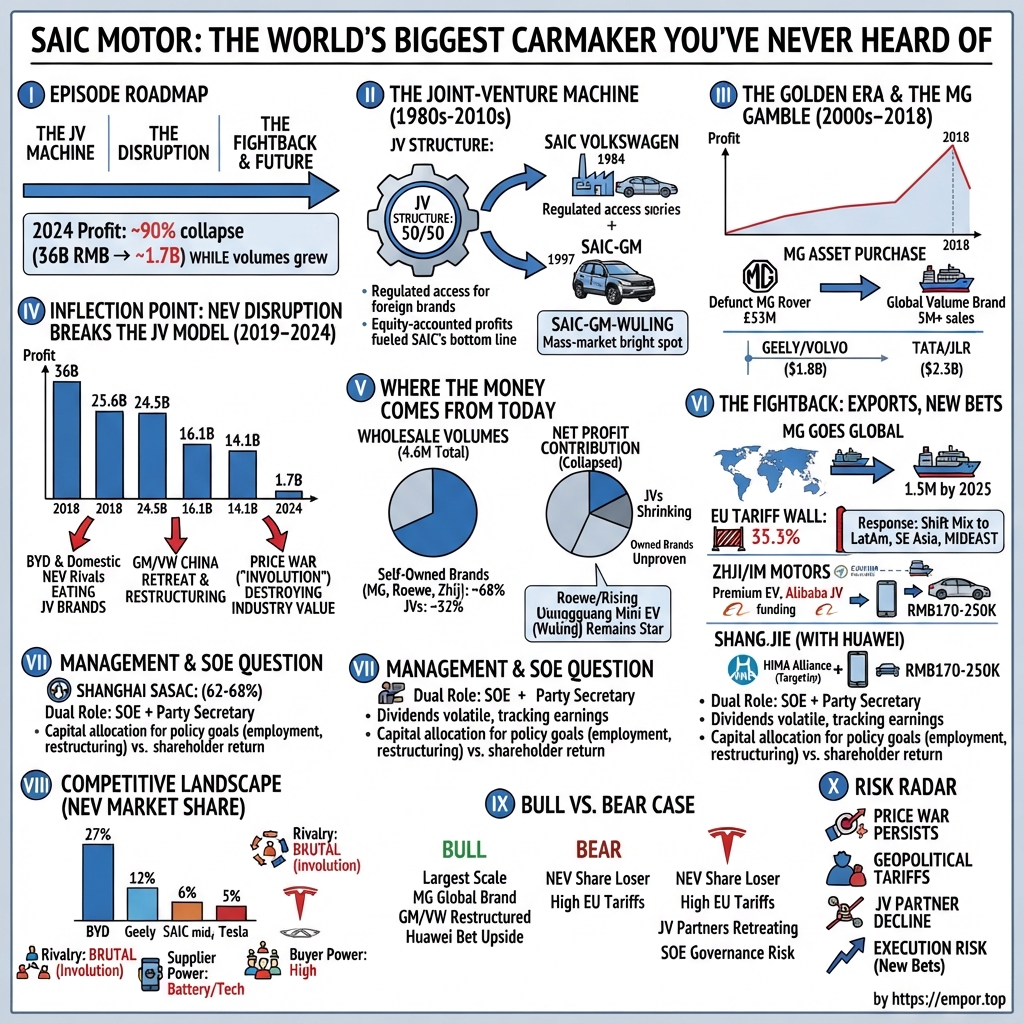
SAIC Motor: The World's Biggest Carmaker You've Never Heard Of
I. Introduction & Episode Roadmap
Walk into a car dealership in Bangkok, Santiago, Birmingham or Sydney and you will find a badge that looks unmistakably British: an octagon, the letters M and G, a heritage stretching back to 1924 and a marketing story about open-top roadsters on English country lanes. What you will not find on the showroom wall is the name of the company that actually owns it — a state-controlled industrial group headquartered a few kilometres from the Bund in Shanghai, majority-owned by the municipal government, and for eighteen consecutive years the largest automaker in the largest car market on earth.1
That company is 上汽集团 SAIC Motor Corporation Limited. In 2018, at the top of its arc, it sold 7.05 million vehicles and booked revenue of RMB 902.19 billion — more than USD 130 billion — with net profit attributable to shareholders of just over RMB 36 billion.2 It out-sold 比亚迪 BYD, out-sold Volkswagen's other Chinese ventures, out-sold Toyota in China by a wide margin. Almost nobody outside China and the automotive trade press can name it.
Then came the number that makes this story worth telling. In calendar 2024, SAIC's net profit attributable to shareholders fell to RMB 1.666 billion — a decline of 88.19% in a single year — on revenue of RMB 627.59 billion.3 Strip out non-recurring items and the picture was worse still: on an adjusted basis, the group posted a loss of roughly RMB 5.4 billion. This is not a company that stopped selling cars. Its wholesale volumes in that year were still measured in millions, and by 2025 they were growing again. It is a company that kept selling cars and very nearly stopped making money doing it.
How does that happen? The short answer is that SAIC's profits were never really about selling cars. For three decades the company's income statement was driven by two joint ventures with foreign partners — one with Volkswagen, one with General Motors — whose earnings arrived as equity-accounted investment income rather than consolidated revenue. When Chinese consumers abandoned foreign-branded internal-combustion cars for domestic electric ones, that engine did not slow. It seized.
This is the story of how a regulatory moat that looked permanent for thirty years evaporated in about five; of a distressed-asset acquisition made for the price of a mid-sized office building that turned into China's most successful global car brand; of a state-owned giant that once publicly refused to let 华为 Huawei near its cars and then, four years later, handed Huawei the keys; and of the open question at the centre of the investment case — whether SAIC is a genuine turnaround, a structurally impaired incumbent being kept upright by its owner, or something uncomfortably in between.
We will move through the joint-venture machine that built the company, the golden era and the MG gamble, the inflection that broke the model, where the money actually comes from today, the fightback built on exports and Huawei, the governance question that hangs over every capital allocation decision, the competitive structure of an industry Beijing itself now describes as pathological, and finally the specific evidence that would confirm or falsify the bull case. Start where SAIC started: with a foreign partner, a government licence, and a factory in Shanghai.
 Subscribe on LinkedIn
II. The Joint-Venture Machine: How SAIC Became China's Largest Automaker
On 1 September 1985, a Volkswagen Santana rolled off an assembly line in Shanghai's Anting district. It was a hand-finished car in a country that had almost no private car ownership, built by workers who had spent the previous decade assembling trucks and tractors, using a body shell that Volkswagen had already been phasing out in Europe. It was also, in retrospect, one of the most consequential industrial events of China's reform era.4
The joint venture behind it — SAIC Volkswagen, 上汽大众 — had been formalised in 1984 between Shanghai Automotive Industry Corporation and Volkswagen AG, making VW the first German automaker into China and one of the very first foreign automakers of any nationality.4 The Santana went on to motorise urban China: taxi fleets, government cars, the first generation of private buyers. For a generation of Chinese drivers, "car" and "Santana" were close to synonymous.
The company that signed that agreement was not a carmaker in any modern sense. Its lineage ran back to a Shanghai workshop that produced its first prototype sedan on 28 September 1958 — the Fenghuang, or Phoenix, a hand-beaten body inspired by a mid-1950s Plymouth over a Soviet-derived engine. Twenty-two were built before the programme ended in 1961. Renamed the Shanghai SH760 in 1964, the car went into steady production for mid-ranking officials and stayed there until 1991, assembled at a rate that would today qualify as a rounding error.5
That history matters for one reason, and it shapes everything after. When Volkswagen arrived, SAIC's predecessor had roughly three decades of experience building a handful of cars a day largely by hand, and essentially none in mass production, modern quality systems or supplier management. The joint venture was not a partnership between equals. It was a technology transfer wearing the costume of a partnership, and both sides understood that. Everything SAIC learned about building cars at scale, it learned inside a structure where the foreign partner supplied the product and the Chinese partner supplied the access.
Understand why that structure existed, because everything that follows depends on it. Chinese industrial policy of the era required foreign automakers to manufacture through local joint ventures in which the Chinese partner held at least half. A foreign company could not simply build a plant and sell cars; it needed a domestic partner with the licence, the land, the labour relations and the political relationships. SAIC's core asset for more than thirty years was therefore not engineering excellence. It was being the government-sanctioned gateway through which the world's largest automakers reached the world's largest market.
SAIC ran that playbook twice more. In June 1997 it formed Shanghai General Motors — later 上汽通用 SAIC-GM — bringing Buick, Chevrolet and eventually Cadillac into China. At its 2017 peak, that single joint venture delivered more than two million vehicles a year to Chinese customers, a volume larger than Ford's entire European business.6 Then in November 2002 came a stranger and, as it turned out, more durable creature: 上汽通用五菱 SAIC-GM-Wuling, a three-way venture in Liuzhou, Guangxi, owned 50.1% by SAIC, 44% by GM China and 5.9% by Guangxi Automobile Group — the first Chinese-foreign joint venture created under the mixed-ownership reform of state enterprises.7 Wuling did not build luxury sedans. It built micro-vans for farmers and small merchants, at prices that seemed impossible.
Now the accounting quirk that governs this entire story. Under Chinese and international accounting standards, a 50%-owned joint venture over which a company has joint rather than exclusive control is not consolidated. Its revenue does not appear in the parent's revenue line. Instead, the parent's share of the venture's profit appears far down the income statement as investment income from associates and joint ventures. The practical consequence is severe: for most of SAIC's modern history, the majority of its bottom-line net income arrived as a single equity-accounted line item, generated by pricing, product and capital decisions taken in Wolfsburg and Detroit as much as in Shanghai.
That is a comfortable arrangement while the foreign partners are winning. It is a catastrophic one when they are not, because the Chinese partner controls neither the product cycle nor the cost base that generates its own earnings. And it has a second, subtler effect that took two decades to become visible. If the majority of your profit arrives without you having to design a car, engineer a powertrain or build a brand, the organisational incentive to do those hard things is permanently weakened. SAIC's own engineers were competent. But the company's economics did not depend on them.
Even in 2025 — after the collapse, after the pivot to self-owned brands, after everything described in the sections that follow — SAIC's share of profit from associates and joint ventures was RMB 13.43 billion, against total net profit attributable to shareholders of RMB 10.11 billion.8 Read that carefully. The joint ventures still contributed more than the entire group earned. The consolidated business SAIC actually controls, taken on its own, was not yet profitable at the attributable line. Any account of SAIC that describes the JV era as finished is running ahead of the arithmetic.
Hold Wuling to one side for now — it is the one leg of the JV network that adapted to electrification on its own terms, and it deserves its own treatment later. First, the two decades in which the machine worked exactly as designed, and the single opportunistic purchase that would eventually matter more than any of it.
III. The Golden Era and the MG Gamble (2000s–2018)
Longbridge, Birmingham, April 2005. MG Rover Group — the last independent volume carmaker in Britain, the residue of what had once been British Leyland — collapsed into administration, throwing more than 6,000 people out of work and setting off a political crisis in the middle of a UK general election campaign. PricewaterhouseCoopers took charge of the carcass and began looking for buyers. The favourite was SAIC, which had already paid £67 million for the intellectual property behind the Rover 75, the Rover 25 and the K-Series engine while MG Rover was still trading.
On 22 July 2005, PwC announced that the assets of MG Rover and its engine subsidiary Powertrain had been sold — not to SAIC, but to 南京汽车 Nanjing Automobile Corporation, for £53 million.9 Roughly a hundred million US dollars for a century-old British marque, its tooling, and its factory equipment. The unions who had backed SAIC's rival bid were blindsided.
What happened next is a very Chinese resolution. Two state-owned enterprises — one belonging to Shanghai, one to Jiangsu province — now owned competing halves of the same dead British carmaker. Rather than let them fight, the Communist Party arranged a solution in December 2007. It was described as a merger; in substance SAIC absorbed Nanjing Automobile whole, with Nanjing's shareholders receiving roughly 10% of SAIC Motor's shares.10 SAIC now owned MG outright.
Set the price against what SAIC's peers were paying for foreign brands at almost exactly the same moment. Tata Motors bought Jaguar Land Rover from Ford in 2008 for about USD 2.3 billion. 吉利 Geely bought Volvo Cars from Ford in 2010 for about USD 1.8 billion. Both were purchases of genuine premium brand equity with functioning engineering organisations and global dealer networks. MG, by contrast, came with a defunct factory, obsolete platforms and a badge that most of the world associated with unreliable 1970s sports cars. SAIC paid a small fraction of what its rivals paid, and it paid for a shell.
There was a second act to the British inheritance that gets less attention and tells you as much about how SAIC operates. The intellectual property SAIC had bought before the collapse — the Rover 75 and Rover 25 platforms and the K-Series engine — gave it the bones of a passenger car programme, but not the name. BMW had retained the rights to the Rover marque. So SAIC invented one: 荣威 Roewe, a coinage engineered to sound Germanic-British to Chinese ears while meaning something closer to "glory and power" in Mandarin. A few years later the group added Maxus, the light commercial vehicle brand inherited from Britain's LDV, which became SAIC's van and pickup business.10
Read those three brands together and a pattern appears. SAIC did not build brands. It bought the wreckage of other people's brands, cheaply, and then spent years grafting its own engineering onto them. That is a legitimate strategy and it produced two durable franchises. It is also, unavoidably, the behaviour of a company that had never had to create demand for a product of its own — because for thirty years the joint ventures did that job.
For the better part of a decade, MG looked like a bargain of the sort that flatters no one. MG limped. The cars were mediocre. The brand was neither properly British nor credibly Chinese. But SAIC kept feeding it — platforms, capital, patience — and somewhere around the mid-2010s the compounding started. By the mid-2020s MG had cumulative global sales past five million units and top-ten positions in more than twenty countries, with roughly ten models spanning sedans and SUVs.11 It became the vehicle — literally — for SAIC's entire export strategy.
It is worth being precise about what this proves and what it does not. It does prove that cheap, patient brand acquisition can beat expensive brand acquisition on a long enough horizon, and that SAIC was capable of sustained execution when the objective was clear and the competitive clock was slow. It does not prove that SAIC is a good capital allocator in general. MG took roughly two decades to become a genuine global asset, and it was acquired almost by accident, through a merger the company did not initiate. The newer bets we will come to — a premium EV sub-brand launched and then quietly cancelled, another premium EV brand still losing tens of thousands of yuan per car, a Huawei partnership announced and productionised inside nineteen months — are being made on a far shorter clock, with far larger cheques, in a market that punishes a wrong product cycle within twelve months rather than five years. The MG precedent is genuine evidence of patience. It is weak evidence of speed.
Through all of this, the core machine kept grinding out cash. SAIC's revenue climbed from the hundreds of billions of renminbi through the 2000s to RMB 870.6 billion in 2017 and RMB 902.19 billion in 2018, with net profit of RMB 34.41 billion and RMB 36.01 billion in those two years respectively.2 Volumes hit 7.05 million in 2018, up 1.8% in a year when the total Chinese market actually shrank 2.76%. The dividend followed: SAIC paid RMB 1.83 per share on 2017 earnings and RMB 1.26 on 2018 earnings, yields in the mid-single digits that made it a staple income holding for domestic institutions.12
That was the high-water mark, and nobody at the time described it as one. The 2018 annual results, published in the spring of 2019, showed profit growth decelerating to 4.65% from 7.5% the prior year — a rounding-error slowdown that read like normal cyclicality.2 It was not cyclicality. Something structural had begun, and it had a name.
The machine that produced all of this was, at that moment, running at maximum efficiency and maximum fragility at the same time — and nobody inside it had any reason to say so.
IV. The Inflection Point: NEV Disruption Breaks the JV Model (2019–2024)
The clearest way to see what happened to SAIC is to lay the profit line end to end and refuse to look away. RMB 36.0 billion in 2018. RMB 25.6 billion in 2019. RMB 20.4 billion in 2020. A brief rebound to RMB 24.5 billion in 2021. Then RMB 16.1 billion in 2022, RMB 14.1 billion in 2023, and RMB 1.67 billion in 2024.23 Over six years, roughly 95% of the earnings power disappeared. Revenue fell too — from RMB 902 billion to RMB 628 billion — but nothing like as fast. This was a margin collapse, not a demand collapse, and margin collapses are almost always structural.
Root cause one: the joint-venture brands were eaten alive. SAIC-GM is the cleanest case. From more than two million vehicles delivered in 2017, the venture's volumes fell year after year until they reached roughly 435,000 in 2024, a 23% decline in that year alone despite growing demand for its electrified models.13 That is not a bad year. That is the near-total destruction of a business that had been one of the two or three most profitable automotive operations in the world.
SAIC Volkswagen held up better in absolute terms but travelled the same road. The mechanism was the same in both cases and it was not complicated: Chinese consumers stopped buying foreign-branded petrol cars. Domestic manufacturers — BYD above all, but also a long tail of new entrants — offered electric and plug-in hybrid vehicles with better software, better cabin technology, lower running costs and, increasingly, lower sticker prices. The foreign joint ventures had spent thirty years optimising for a market that no longer existed, and their product decisions were made on global development cycles that took four years when the Chinese market was resetting every eighteen months.
It is worth dwelling on the mechanism, because it is easy to mistake this for a branding problem. It was a clock-speed problem. A global automaker defines a vehicle, freezes its specification, and ships it three to four years later into markets on several continents; that cadence is what makes global platforms economic. Chinese domestic manufacturers were refreshing infotainment, driver assistance and battery chemistry on something closer to an eighteen-month cycle, and Chinese buyers — younger, more digitally native, and shopping for a cabin experience as much as a car — noticed immediately. A joint venture cannot fix this unilaterally, because the product is defined by the foreign parent's engineering organisation.
That is why the extensions signed later with both partners emphasise China-specific architectures and locally led development. It is also why those extensions should be read as an attempt to fix the clock-speed problem rather than as evidence it has been fixed.
Root cause two: GM's accounting reckoning arrived all at once. GM's Chinese joint ventures, historically a reliable source of equity income, swung to a loss of USD 347 million over the first nine months of 2024 against a profit of USD 353 million in the same period of 2023. On 4 December 2024, GM told investors it would take more than USD 5 billion in non-cash charges and write-downs on its China operations: between USD 2.6 billion and USD 2.9 billion to write down the carrying value of the joint ventures themselves, plus roughly USD 2.7 billion of restructuring charges covering plant closures and portfolio cuts.14
Because SAIC equity-accounts the same ventures, the same reckoning landed on its own income statement. SAIC disclosed that asset impairments at SAIC-GM and its subsidiaries reduced net profit attributable to shareholders by approximately RMB 7.87 billion in 2024.3 Management flagged the scale of the miss to the market in late January 2025, well ahead of the full results, warning that profit would fall by up to 90%.15 That early warning is a real credibility data point and we will return to it — pre-announcing a catastrophic number is a choice, and not every company makes it.
There is a second number in that year's accounts that deserves as much attention and gets far less. SAIC's 2024 profit was helped by RMB 5.178 billion of gains booked on transactions involving its Indian subsidiary, where the company had been progressively selling down its stake in MG Motor India to the local JSW Group after Indian restrictions on Chinese investment made expansion untenable.316 Without that one-off, the reported RMB 1.67 billion becomes something close to a break-even or negative result — which is precisely why the adjusted, non-recurring-items-excluded figure for 2024 was a loss of roughly RMB 5.4 billion. The headline decline of 88% understated the operational damage.
Root cause three: the industry itself turned pathological. Chinese officialdom has a word for what happened next — 内卷 involution, competition so intense it destroys value for every participant rather than allocating it to the best one. Rhodium Group's work on the sector quantifies the mechanism. Central government purchase support was projected at around RMB 342 billion in 2025 — roughly RMB 150 billion of scrappage and trade-in subsidies plus about RMB 192 billion of NEV purchase-tax exemptions — equivalent to something like 3% of central fiscal revenues and 7% of passenger car retail sales.17 Because those subsidies were fixed-amount rather than proportional, they pushed buyers toward ever cheaper cars, dragging the entire industry down-market.
The result was volume growth without value growth. In the first half of 2025, Chinese passenger vehicle retail volumes rose about 11% to 11 million units while the value of those retail sales rose 0.8% — implying average transaction prices fell roughly 10% year on year. Sector operating margins compressed from 5.1% to 4.2% over the same comparison.17 Rhodium's most uncomfortable finding is that the shakeout everyone expected did not happen: concentration actually fell, as subsidised cheap models let marginal players stay alive.
A company whose cost structure was built around high-volume internal-combustion assembly, with two foreign partners carrying legacy plants, legacy dealer networks and legacy engineering overheads, was about as badly positioned for that environment as it is possible to be. Vertically integrated NEV-native rivals — BYD making its own batteries and semiconductors, 宁德时代 CATL supplying cells at scale — had cost positions SAIC could not reach and product cycles it could not match.
So the moat did not shrink. It changed category. The thing that had made SAIC valuable — privileged, regulated access to the Chinese market on behalf of foreign brands — stopped being scarce the moment Chinese consumers no longer wanted what those foreign brands were selling. The new sources of advantage were battery and software vertical integration, and brand equity in electric vehicles specifically. SAIC had approximately none of either. What it did have, it turns out, was a rather different business hiding inside the wreckage.
V. Where the Money Actually Comes From Today
Open SAIC's 2025 annual report and go straight past the headline. Yes, revenue reached RMB 656.24 billion, up 4.57%, and net profit attributable to shareholders rebounded to RMB 10.106 billion, up 506.45%.8 Those are the numbers the press releases lead with, and they are real. The interesting part is one layer down, in the segment margins.
The automobile manufacturing segment generated RMB 646.15 billion of revenue at a 10.09% gross margin. Split by product, complete vehicles produced RMB 410.2 billion of revenue at a 4.30% gross margin, while auto parts produced RMB 203.0 billion at 19.15%. The finance segment — auto lending, insurance, leasing — turned RMB 10.09 billion of revenue at an 88.47% margin.8 Weighted average return on equity for the whole group was 3.43%.
Sit with that for a moment. The actual business of designing, building and selling complete automobiles — the thing SAIC is famous for, the thing that requires most of its 18.1 billion renminbi of annual R&D spending and virtually all of its factories — earned a gross margin of four percent. Before any selling expense, any administrative cost, any depreciation on the plants. Components and financial services are doing a disproportionate share of the group's economic work. That is not unique to SAIC in this market, but it is the single most important fact about its current earnings quality, and it explains why the 2025 "recovery" produced a net margin of roughly 1.5% on revenue.
The mix shift is the story. In 2025, SAIC sold 4.507 million vehicles, up 12.3%. Self-owned brands — 荣威 Roewe, MG, SAIC Maxus, 智己 IM Motors, and Wuling's own marques — accounted for 2.928 million units, or 65% of group volume, up nearly six percentage points in a year. NEV sales reached 1.643 million units, up 33.1%, a record for the group. Overseas sales came in at 1.071 million units.18 By the first half of 2026 the self-owned share had reached 71.8%, up 8.3 percentage points year on year, on volumes of 1.469 million units.19
That transition is genuine and it is the correct strategic direction. It is also, at present, a shift toward lower-margin business, which is why volume growth and profit growth have decoupled. And the growth in owned brands is masking a continuing collapse underneath: in June 2026 alone, SAIC Volkswagen's volumes fell 35.4% and SAIC-GM's fell 18.2% year on year.20 The group is not growing so much as replacing.
On NEVs, the honest framing is mid-pack. SAIC's NEV growth rates comfortably exceed the market. Its share of that market does not. On CPCA data for full-year 2025, BYD held 27.2% of China's NEV retail market — down a startling 6.9 points from 34.1% the prior year but still dominant — with Geely at 12.2%, 长安 Changan at 6.2%, SAIC-GM-Wuling at 6.0%, Tesla at 4.9%, Huawei's HIMA alliance at 4.6%, and 奇瑞 Chery and Leapmotor tied at 4.1%.21 The largest automaker in China by total group volume is a mid-single-digit player in the segment that will determine which automakers still exist in a decade. Growing faster than the market from a small base is necessary; it is not yet evidence of a winning position.
The Rising Auto retreat. In 2021, SAIC spun its Roewe R electric line into a standalone premium brand, 飞凡 Rising Auto, targeting the segment above RMB 200,000 and intended to shed Roewe's downmarket association with ride-hailing fleets. It never found its market. In late October 2024, after three years of independent operation, Rising Auto was folded back into Roewe as a premium product line.22 SAIC had, by then, been running two separate premium NEV brands — Rising and IM Motors — against each other in overlapping price bands, while its self-owned mainstream brands fought for the same engineering resources.
Note how differently the company handled this from the 2024 profit warning. The write-down got a formal pre-announcement to the market. The cancellation of an entire brand — three years of investment, a dealer network, a marketing identity — was handled as a marketing-system integration announced at an auto show. Both are defensible individually. Together they suggest a management team that discloses quantifiable bad news well and narrative bad news poorly.
The bright spot almost nobody models. In July 2020, SAIC-GM-Wuling launched the 宏光MINI EV Hongguang Mini EV: a four-seat, sub-three-metre battery electric car with no fast charging, modest range and a price starting below RMB 30,000. Western analysts largely dismissed it as a quadricycle. It became the best-selling micro-EV in the world. The 1.7 millionth unit rolled off the line in August 2025; the family sold 435,598 units in 2025 alone and had topped 1.9 million cumulative units by year end, leading China's A00-class NEV sales chart for 65 consecutive months.23 In March 2026 Wuling launched the fifth generation in six years, starting at RMB 42,800 after trade-in subsidies.24
Two things make this genuinely material rather than a curiosity. First, scale: Wuling delivered NEV sales above one million units for the first time in 2025 within total volumes of 1.635 million.18 Second, and more interesting analytically, this is a joint venture brand winning in NEVs on its own terms — the exact thing the JV model was supposed to be incapable of. Wuling succeeded because it was never really a foreign-brand vehicle. It was a Chinese product organisation in Liuzhou with a foreign shareholder, designing for a customer that Detroit and Wolfsburg never studied. The lesson SAIC could have drawn a decade earlier is that the JV structure was not the problem; the imported product definition was.
The obvious question is why SAIC did not simply run the Wuling playbook everywhere. The honest answer is that it is not transferable upward. Wuling wins by being the cheapest credible product in a segment where the competition is an electric scooter or a second-hand hatchback, and its economics depend on a cost base built in Liuzhou over decades for a customer who will not pay for software. None of that helps in the RMB 200,000 segment, where the buyer is comparing driver-assistance systems and cabin computing. Wuling proves SAIC's group can win when the product definition is Chinese and the price point is the bottom of the market. It says nothing about whether the group can win at the top.
The non-vehicle segments — components, mobility services, finance — matter to the P&L out of proportion to their revenue, as the margin table shows, and they stabilise earnings through the cycle. But they do not move the investment case. Auto parts margins follow vehicle volumes with a lag; auto finance profitability depends on the credit quality of buyers of the same cars. They are ballast, not propulsion. The propulsion, such as it is, has to come from somewhere else — and management's answer has three parts.
VI. The Fightback: Exports, Huawei, and New Bets (2023–2026)
In June 2025, a ship called the Anji Ansheng left a Chinese port on its maiden voyage to Europe carrying around 4,000 MG cars. At the time it was the largest pure car and truck carrier ever built. It was owned not by a shipping line but by SAIC's own logistics arm, 安吉物流 Anji Logistics. When people talk about Chinese automakers "flooding" export markets, this is the physical infrastructure that makes it possible — and it is the least discussed part of SAIC's story.
MG goes global
SAIC is China's largest automotive exporter, and MG is the reason. In 2025 the brand registered 307,282 vehicles in Europe, up 26% year on year, making it the best-selling Chinese automotive brand in the region — a position it has now held for eleven consecutive years.1925 Cumulative overseas deliveries across the group passed six million units. The company's "Glocal 3.0" strategy, unveiled at the Shanghai auto show on 23 April 2025, committed to seventeen new overseas models, a next generation of hybrid powertrains aimed at mainstream segments, knock-down assembly plants in Southeast Asia, and a European engineering centre.26
In the first half of 2026, overseas sales reached 735,000 units, up 48.7% year on year, with June alone up 61.2%.19 On any reasonable annualisation that is the fastest-growing meaningful profit pool SAIC has.
Now the falsification test, because this is the growth vector on which the bull case leans hardest. SAIC has set public overseas targets before and missed them. It targeted 1.35 million overseas vehicles for 2024 and delivered 1.082 million.2728 It then set 1.5 million for 2025 and reported 1.071 million, up 3.1%.18 Two consecutive years of targets missed by roughly 20–30%, with the second year's result essentially flat. The 2026 acceleration is real and large, but it is an acceleration off a base that had stalled for two years, and it comes with a specific credibility caveat: this management team's history of hitting its own export numbers is poor. The honest reading is that the export franchise is genuine — the volumes, the brand position and the shipping assets all check out — while management's forecasting of it has not been reliable. Watch reported overseas deliveries, not the target.
The tariff wall
On 30 October 2024, after a thirteen-month anti-subsidy investigation, the European Union imposed definitive countervailing duties on battery electric vehicles imported from China, on top of the existing 10% import duty. Of the three sampled exporters, BYD received 17%, the Geely group 18.8% — and SAIC received 35.3%, the highest of any major Chinese automaker, a differential the Commission attributed in part to the degree of cooperation with its investigation.29 SAIC, in other words, took the worst outcome in the industry precisely in the market that represents the largest single piece of its export business.
The response has come on three fronts. First, mix: shifting European exports toward hybrids and plug-in hybrids, which fall outside the BEV-specific duty — hence the hybrid powertrain emphasis in Glocal 3.0. Second, geography: leaning harder into Southeast Asia, Latin America, Australia and New Zealand, and the Middle East, each of which SAIC now describes as a 50,000-unit-plus region alongside Europe's 300,000-plus.18 Third, localisation: on 2 June 2026 MG confirmed Spain as the site of its first European vehicle plant, with an initial investment of roughly EUR 200 million and planned annual capacity of 120,000 vehicles, production due in 2028, subject to final Spanish central government foreign-investment clearance.30 An MG Europe executive framed the economics simply — local manufacturing becomes viable at roughly 300,000 units of annual European sales, a threshold the brand crossed in 2025.
There is a wider pattern here that cuts both ways for SAIC. Rhodium Group's work on the European market found that the duties dented Chinese shipments only temporarily: volumes recovered to pre-duty levels as manufacturers pivoted toward plug-in hybrids and combustion vehicles, which the battery-electric-specific measure did not touch. Chinese exports to Europe rose 29% year on year to 922,000 units, and Chinese-made vehicles reached 6.4% of EU sales across 2025 and 12.1% in the United Kingdom, with December EU penetration hitting 9.3%.31 The tariff changed the powertrain mix far more than it changed the volume.
That is good news for SAIC's near-term export arithmetic and a slower-burning problem sitting underneath it. A brand that routes around an EV tariff by selling more hybrids and petrol cars in Europe is buying volume today against tightening European fleet emissions rules tomorrow, and Rhodium flags MG specifically as exposed on exactly that count given the scale of its combustion-engine sales in the bloc.31 The hybrid pivot is a tactical answer to a tariff. It is not a strategic answer to Europe.
The tariff picture also became less binary in 2026. On 12 January 2026, the European Commission published guidance on a minimum-price undertaking mechanism, under which Chinese manufacturers could be exempted from the duties in exchange for commitments not to sell below a defined price floor, with EU investment or export caps also viewed favourably.32 That materially changes the risk profile — but note what a price floor actually does. It removes the tariff by removing SAIC's ability to compete on price in Europe, which is the competitive weapon MG has used to get there. Escaping a 35.3% duty by agreeing not to undercut European incumbents is a real improvement over paying it, and it is not the same thing as free access.
The logistics moat
Anji Logistics finished 2025 with 41 vessels in its fleet after taking delivery of eight new pure car and truck carriers during the year, the last of them the 9,500-CEU Anji Fortune on 22 December.3334 The company has said its annual ocean-going finished-vehicle transport capacity will reach 600,000 units in 2026, with routes covering Western Europe, the Mediterranean, Mexico, the west coast of South America, Southeast Asia, Australia, New Zealand and the Middle East. It also opened a dedicated ro-ro terminal at Nanjing in May 2025 with 418 metres of berth and storage for more than 20,000 vehicles.
This is the most concrete durable advantage in the entire SAIC story, and it deserves to be judged as such rather than as a press-release detail. Car carriers are capital-intensive, slow to build, and were in acute global shortage during the 2022–2024 export surge, when charter rates for PCTCs rose several-fold and shipping capacity — not manufacturing capacity — was the binding constraint on Chinese vehicle exports. Owning the ships converts a shared industry bottleneck into a private one. The caveat is that moats built on physical capacity erode as capacity is added industry-wide, and a great deal of new PCTC tonnage has been ordered globally since 2022. Anji's advantage is real, it is measurable in vessels and berths, and it is more likely to be a five-year advantage than a twenty-year one.
Real optionality, sized correctly: IM Motors
智己 IM Motors — Zhiji Automobile Technology — was founded on 25 December 2020 as SAIC's premium smart-EV venture, with SAIC holding 54% alongside 阿里巴巴 Alibaba and 张江高科 Zhangjiang Hi-Tech. It raised RMB 9.4 billion in a Series B round in December 2024.35
Judge it on outcomes. In 2025, IM delivered 81,000 vehicles and posted a net loss of RMB 3.598 billion — approximately RMB 44,000 of loss per vehicle delivered.36 In the first half of 2026 deliveries reached 40,087 units, up 58%, with monthly volumes above 10,000 for two consecutive months after the LS8 launched in April.36 Growing, still deeply loss-making.
Then, in early July 2026, several authorised IM dealerships in Kunming, Zhuhai and Shanghai abruptly shut. The proximate cause was a dealer group that had diverted customer prepayments to cover operating costs and collapsed when private lending disputes caught up with it; financial institutions seized vehicle certificates of conformity as collateral, blocking registrations and deliveries. IM pledged to advance funds to redeem the certificates and complete legitimate customer deliveries, though the remedy excluded roughly 60 dealership employees owed three months of back wages.36 The company's response was reasonably fast. The episode nonetheless exposed how thin the channel's financial buffer had become in a brand losing RMB 44,000 a car.
IM Motors is genuine optionality — a real product line, real growth, real technology. It is not a driver of group earnings and should not be modelled as one. The confirming evidence would be per-unit loss narrowing materially as volume scales; the falsifying evidence would be a second consecutive year of losses above RMB 3 billion at higher volume.
Real optionality: the Momenta robotaxi bet
SAIC Mobility raised more than RMB 1 billion in a Series B in August 2022 to scale robotaxi operations, with autonomous-driving developer Momenta among the participants.37 The partnership's distinguishing idea is that its robotaxis are built on mass-production hardware — the sensor and compute architecture already fitted to the IM LS6 — rather than expensively retrofitted prototypes.38 The two companies opened a Level 4 route linking the Shanghai International Resort to Pudong International Airport in August 2025, and SAIC Mobility has since started a purpose-built robotaxi programme targeting a 2027 debut.39 Momenta itself moved toward a Hong Kong listing, receiving regulatory clearance in June 2026.40
This is strategic to SAIC's long-term position — if urban mobility shifts toward fleets, an automaker that owns neither the fleet nor the autonomy stack is a contract manufacturer. But it is a sub-point in the investment case today, and there is an awkward detail in it: Momenta, which SAIC backed early, sells its technology to Mercedes-Benz and Toyota as well. SAIC's autonomy position is a shareholding in a supplier that arms its competitors, not a proprietary capability.
The big bet: Shangjie, and the soul that SAIC gave up
On 1 July 2021, at SAIC's annual shareholder meeting, then-chairman 陈虹 Chen Hong was asked whether the company would let a third party such as Huawei supply a complete autonomous-driving solution. His answer became one of the most quoted lines in the Chinese auto industry: it would be "like a company providing us with a complete solution so that it becomes the soul and SAIC becomes the body. Such a result is unacceptable to SAIC, and we want to take the soul into our own hands."41
In February 2025, SAIC signed a deal with Huawei.4243 The venture, 尚界 Shangjie, became the fifth brand in Huawei's 鸿蒙智行 HIMA alliance, alongside 赛力斯 Seres' 问界 AITO, Chery's 智界 Luxeed, BAIC's 享界 Stelato and JAC's 尊界 Maextro. The first model, the H5 SUV, launched on 23 September 2025 priced from RMB 159,800 to RMB 199,800 — nineteen months from signature to showroom, and notably below HIMA's usual RMB 250,000-plus positioning.44
The Chinese business press was blunt about what changed in those four years. As one detailed account of the deal put it, after years of fighting over the ownership of the "soul," SAIC concluded that the priority was no longer the soul but saving the body.22 The same account catalogued the internal failures that forced the decision: SAIC's in-house software unit lacked mass-production experience, its intelligent-driving centre lost direction after the Rising Auto cancellation, and its self-owned premium brands had not delivered.
Why Huawei rather than building? Because there is a proven template. Seres was close to delisting risk before its deep Huawei partnership; AITO sold more than 380,000 units in a year and Seres' market value rose toward RMB 200 billion — at one point exceeding SAIC's own.22 Equally instructive is the counter-example: BAIC's ARCFOX used Huawei's lighter-touch technology-licensing model and delivered only 73,600 units in 2024. The depth of Huawei's involvement — product definition, software, retail channel — appears to be what determines the outcome.
Early results were strong. Shangjie reached 20,000 H5 deliveries within 78 days of launch, and cumulative deliveries topped 30,000 by late January 2026.4546 Two further models were planned for 2026, and an upgraded H5 launched on 18 June 2026 with a pre-sale range of RMB 169,800 to RMB 209,800. The supply chain was given a procurement plan sized for 400,000 annual units.
Now the disconfirming evidence, which belongs right here rather than in a risk appendix. First, the HIMA alliance itself has stopped growing: Huawei's HIMA brands delivered 42,101 vehicles in August 2026, down 5.52% year on year and the third consecutive month of decline.47 Whatever advantage the Huawei brand halo conferred in 2024 is measurably weakening in 2026. Second, Shangjie is positioned below RMB 200,000 while HIMA has itself said that models below RMB 300,000 basically incur losses — meaning the brand's unit economics are unproven at exactly the price point it has chosen.22 Third, Huawei's engineering resources are finite and its incentives sit with the four established brands.
Fourth, and most fundamental: a partnership fixes a capability gap by renting the capability. It does not create process power, and it hands the most differentiated part of the product — the software and the intelligent cockpit — to a supplier that provides the same thing to Chery, BAIC, JAC and Seres.
The calibrated conclusion: the Huawei tie-up is the most credible thing SAIC has done in the smart-EV segment, and the early volume data support it. But the claim that it restores SAIC's competitive position should be narrowed to something smaller — it gives SAIC a competitive product in one price band, on rented technology, inside an alliance whose aggregate momentum is currently negative. The KPI that settles it is Shangjie's monthly run-rate against the stated 20,000-per-month ambition, and whether the second and third models extend the franchise or cannibalise the first.
VII. Current Management and the State-Owned Enterprise Question
On 10 July 2024, SAIC announced that 陈虹 Chen Hong — forty years at the company, president since 2004, chairman since 2014, the executive who had presided over eighteen consecutive years at the top of the Chinese sales table and, latterly, over the collapse described above — was stepping down on reaching the retirement age of 63.1 王晓秋 Wang Xiaoqiu, then 60 and president since 2019, was elected chairman effective the following day. 贾健旭 Jia Jianxu, 46, was promoted to president.
The biographies matter less than what they signal. Wang is a lifer: roughly 35 years at SAIC, an engineering background, having run both the passenger vehicle unit and the SAIC-GM joint venture before becoming group president.1 Jia came up through SAIC Volkswagen and the components supplier Yanfeng. Neither is an outsider, neither has run a company outside the SAIC system, and neither was brought in to break with the past. The reshuffle was a scheduled retirement executed on time, not an intervention.
What has Wang's team actually done since taking over? The visible record is a sequence of consolidations rather than a strategy launch: the reabsorption of a failed premium brand, a reorganisation of the passenger-vehicle and software units, a renewed export push under a new label, and the reversal of the company's most publicly stated technology principle in favour of a partnership with Huawei. Taken together, that is the behaviour of a management team triaging rather than expanding — which was almost certainly correct given what it inherited, and which also means there is not yet a completed strategic cycle to judge them on.
The internal picture that forced those choices was unflattering. By the time the Huawei deal was signed, SAIC's in-house software organisation was short of mass-production experience, its intelligent-driving unit had lost direction following the cancellation of the Rising Auto programme, and the company's most credible autonomy capability sat inside an external supplier it had merely invested in.22 A leadership team that concludes it cannot build the critical capability in time and buys access to someone else's is making a defensible call. It is also confirming that the previous decade of in-house investment did not produce a competitive result.
Who they answer to. Shanghai Automotive Industry Corporation (Group) — the unlisted parent, ultimately controlled by the Shanghai municipal State-owned Assets Supervision and Administration Commission, 上海市国资委 — holds approximately 67.66% of SAIC Motor.48 There is no founder, no dual-class structure, no meaningful insider ownership, and no plausible activist. The chairman of a Chinese central or municipal state-owned enterprise also typically holds the Party Secretary role, meaning the same individual is accountable to the Party organisation and to minority shareholders simultaneously. When those two constituencies want the same thing, the structure is efficient. When they do not, minority shareholders have one-third of the votes and no other lever.
The capital allocation record, read honestly. SAIC's dividend history is the clearest window into how the board actually behaves. Per share, on the year's earnings: RMB 1.83 for 2017, RMB 1.26 for 2018, RMB 0.88 for 2019, RMB 0.62 for 2020, RMB 0.682 for 2021, RMB 0.337 for 2022, RMB 0.370 for 2023, RMB 0.088 for 2024, and RMB 0.266 for 2025.128
There are two legitimate readings and both are worth stating. The positive one: the board let the dividend fall roughly 95% from peak to trough rather than borrowing or selling assets to defend a payout it could not fund. Entrenched management at a state enterprise could easily have done otherwise, and many have. Dividends tracking earnings is what capital discipline looks like when earnings collapse.
The less flattering one: this is not the safe SOE income stock that its 2015–2019 record — five straight years of 5–6% yields — implied. An investor who bought SAIC in 2019 for the dividend experienced a 93% cut over five years. The payout is now a genuinely volatile, earnings-linked variable, and the 2025 recovery to RMB 0.266 restored roughly a seventh of the 2017 level. Both readings are true. The second is the one that changes portfolio behaviour.
The credibility test. Take management's own communications over three episodes and compare them.
On the 2024 collapse, disclosure was good. The company pre-warned the market in late January 2025 that profit would fall by as much as 90%, specifying the writedown as the driver, months before full results.15 That is the behaviour of a management team that would rather absorb the share price reaction early than be accused of concealment.
On the Rising Auto retreat, disclosure was poor. A brand created in 2021 with real capital behind it was reabsorbed into Roewe in October 2024, communicated as a marketing-system integration announced around an auto show rather than as the strategic reversal it plainly was.22 No public accounting of what was spent, what was learned, or what changed in the multi-brand strategy as a result.
On the current recovery, disclosure is selectively framed. SAIC's H1 2026 release led with core net profit attributable to shareholders — excluding foreign-exchange and impairment effects — up 72% year on year to RMB 7.87 billion.49 The reported net profit attributable to shareholders in the same period was RMB 5.15 billion, against RMB 6.02 billion in H1 2025.4950 In other words, on the statutory measure, first-half profit declined about 14% year on year, while the company's headline emphasised a 72% increase on a self-defined adjusted metric. Both numbers are disclosed. The choice of which one leads is a communications decision, and it is a different choice than the one made in January 2025 when the news was bad.
Nor was volume growing: H1 2026 group sales of 2.045 million units were down 0.35% year on year, even as the release described SAIC's growth rate as outpacing the overall market.20 The mix improvement is genuine and the cash generation was excellent — operating cash flow rose 158% to RMB 54.3 billion and gross margin improved three points to 12.6%.49 But the framing consistently presents the strongest available cut of the data.
The structural tension nobody can arbitrage away. A 67.66% state owner has objectives beyond return on capital: employment stability in Shanghai and Liuzhou, the pace at which loss-making joint ventures are restructured, national self-sufficiency in automotive semiconductors and software, and the industrial-policy imperative behind partnering with a sanctioned national champion like Huawei. None of these is illegitimate. Several may even coincide with shareholder value. But an investor should price the possibility that they will not — that a plant stays open longer than economics justify, or that capital goes into a technology programme for strategic rather than commercial reasons.
There is no activist mechanism to test this. There is no realistic proxy contest, no hostile stake, no board seat available to a dissenting minority. The closest thing to a stress test SAIC receives is the price war itself — and Beijing has spent two years trying to stop that too.
VIII. Competitive Landscape & Industry Structure
Picture the Chinese NEV market in 2025 as a battlefield map. One army holds more than a quarter of the field and is retreating. A second is advancing at a run. Half a dozen others are dug into positions of five percent or less, and the map itself keeps shrinking in value because everybody is giving product away.
The full-year 2025 retail shares tell it precisely: BYD 27.2%, down from 34.1% a year earlier — a loss of nearly seven points of share for the incumbent leader. Geely 12.2%, having grown 81.3%. Changan 6.2%. SAIC-GM-Wuling 6.0%. Tesla 4.9%, down and pushed from third place to fifth. HIMA 4.6%. Chery and Leapmotor 4.1% each. Seres 3.3%. 小米 Xiaomi Auto 3.2%, having grown 200.9% from a standing start.21 By August 2026, monthly deliveries showed BYD at 440,293, Chery Group at 280,128, Geely at 270,194 — and SAIC at 357,007, of which 190,000 were NEVs.51
The uncomfortable fact for SAIC is right there. It is the largest group in China by total volume and a mid-pack competitor in the segment that will define the industry's future value. Meanwhile the fastest-growing NEV players are companies that did not exist in this business a decade ago, or in Xiaomi's case five years ago.
The named competitors, and what each proves.
BYD is the structural benchmark. It makes its own batteries, its own power semiconductors, much of its own electronics, and it sells across every price band from the sub-RMB 70,000 Seagull upward. That vertical integration is a cost position SAIC cannot replicate without a decade and enormous capital. Note, though, what happened to BYD in 2025: nearly seven points of share lost, and a year-on-year decline in Chinese retail sales.21 Vertical integration confers cost advantage; it has not conferred immunity. The Chinese market punishes everyone.
Geely is the instructive contrast in capital allocation style. Family-controlled by 李书福 Li Shufu, it has been aggressively acquisitive for fifteen years — Volvo, Proton, Lotus, a stake in Mercedes-Benz's parent — and it grew NEV volumes 81.3% in 2025 to take second place. Geely takes concentrated, founder-driven risks quickly. SAIC takes state-mediated decisions slowly. Over the MG horizon, slow worked. Over the 2020–2026 horizon, fast worked considerably better.
Chery is the direct competitor for the thing SAIC most needs. Also state-linked, also export-obsessed, Chery has been fighting MG for share in exactly the markets — Middle East, Latin America, Southeast Asia, increasingly Europe — that SAIC's growth story depends on. Chery is also a HIMA partner, which means SAIC's export rival and its alliance stablemate are the same company.
The Huawei-aligned brands are the competitive set Shangjie must survive inside. AITO, Luxeed, Stelato and Maextro were established before Shangjie and occupy higher price bands. When HIMA's total deliveries fall for three straight months, as they did into August 2026, the newest and cheapest brand in the alliance is not obviously the one that gets protected.47
Myth versus reality
Myth: SAIC is essentially a holding company for two foreign joint ventures. That was true for most of its history and is no longer a fair description of its volumes — but it remains uncomfortably close to true of its profits, because the equity-accounted line still outruns the group's attributable earnings. The more accurate description today is a components-and-finance business with a very large, very low-margin vehicle operation attached, and two shrinking equity stakes that still carry the bottom line.
Myth: Chinese automakers are conquering Europe with subsidised electric cars. In 2025 they largely conquered it with hybrids and petrol cars, because that is what the tariff structure rewarded.31 The European story is a story about trade policy shaping product mix, not about EV superiority winning on merit.
Myth: the price war will consolidate the industry, and the survivors will earn excellent returns. Through 2025 it did the opposite — subsidy design kept marginal players alive and fragmented the market further.17 Consolidation is the thesis; the data has not yet cooperated.
Myth: state ownership means SAIC cannot fail. It means SAIC is unlikely to run out of money. It does not mean SAIC keeps its position: roughly a third of its annual unit volume disappeared between 2018 and 2025 with the ownership structure entirely unchanged throughout. A balance sheet backstop protects solvency, not relevance.
Porter's five forces, applied to the actual situation. Rivalry is the dominant force and it is price-based, subsidised, and — per Rhodium's data — has been increasing fragmentation rather than driving consolidation.17 Supplier power has inverted: the value in an electric vehicle sits in the battery pack, the power electronics and the software stack, which means CATL, BYD's captive cell operation and Huawei now hold pricing leverage over assemblers like SAIC that the old Tier-1 supplier base never had. Buyer power is high and rising, because EV specifications have commoditised quickly — range, charging speed and screen size are legible to consumers and comparable across brands, which is exactly the condition under which price becomes the deciding variable. New entrants keep arriving from adjacent industries with distribution and brand already built: Xiaomi is the proof that a consumer-electronics company can reach a 3.2% NEV share in its second year.
Substitutes include the mobility services SAIC is itself chasing through the Momenta partnership — a hedge, of sorts, against its own product being disintermediated.
Seven Powers, applied honestly. SAIC's historical power was a form of counter-positioning enforced by regulation: it held the licence that foreign automakers required, and no domestic competitor could take it because the JVs were contractually and politically locked. Layered on top were classic scale economies in assembly and purchasing. That combination produced two decades of category leadership, and it curdled almost completely once the growth in the market moved to a technology where the JV bottleneck conferred no advantage at all.
What remains? Scale economies are real and evidenced — 4.5 million units of annual volume, the largest export logistics fleet operated by any automaker in China, and a components business earning nearly 20% gross margins off group volume.833 A cornered resource of sorts exists in state backing, which in a shakeout is a survival advantage rather than a growth advantage: if weaker private competitors exhaust their funding first, SAIC's balance sheet and its owner outlast them. That is worth something real, and it is worth being clear that it is a defensive asset.
What is absent is more telling. There is no process power — no demonstrated ability to design, build and iterate smart electric vehicles faster or better than rivals; the Rising Auto cancellation and the Huawei partnership are both admissions on that point. There is no brand power in premium smart EVs, which is why IM Motors loses RMB 44,000 a car. There is no switching cost or network economy to speak of; SAIC does not own a software ecosystem, and the one attached to its most promising new brand belongs to Huawei. There is no cornered resource in batteries or chips.
That is the war-game picture: an incumbent with genuine scale and distribution assets, real state protection, and no durable advantage in the product category that determines the next decade. Which sets up the argument.
IX. Bull Case vs. Bear Case
The bull case
Start with what is not in dispute. SAIC still sells more vehicles than any other Chinese automotive group — 4.507 million in 2025 and the only Chinese group above two million in the first half of 2026 — and that scale funds a components business and a finance business that generate genuinely high margins.188 Scale in a consolidating industry is not nothing.
The export franchise is the strongest single element. MG is a real global brand asset acquired for roughly a hundred million dollars, with five million cumulative units, top-ten positions in more than twenty countries, and eleven consecutive years as the leading Chinese brand in Europe.1119 Behind it sits distribution infrastructure competitors cannot quickly copy: 41 vessels and 600,000 units of annual ocean capacity in 2026.33 First-half 2026 overseas volumes grew 48.7%, and a Spanish plant would, if approved and built, put manufacturing inside the tariff wall by 2028.1930
The joint ventures have been restructured rather than abandoned. GM absorbed the write-downs and the plant closures, resetting the cost base, and both partners committed to long extensions — GM to 2047, signed 5 August 2026, with a commitment to launch at least 30 new NEVs across Buick and Cadillac by 2030 and to use SAIC-GM as an export hub for the Middle East, South America, Mexico, Africa and Asia; Volkswagen to 2040, signed on SAIC Volkswagen's fortieth anniversary in November 2024, with eighteen new models including eight electric vehicles by 2030.5253 Those extensions are evidence that both foreign partners concluded China-based development and manufacturing remain worth having.
The Huawei partnership provides a proven external template rather than a hope. AITO's transformation of Seres is the case study, and Shangjie's first 20,000 deliveries in 78 days suggest the template travels.2245
And the arithmetic of a depressed base cuts both ways. A group net margin around 1.5% on RMB 656 billion of revenue means a very small improvement in vehicle gross margin — currently 4.30% — produces a large percentage change in earnings.8 The H1 2026 gross margin improvement of three points to 12.6% and the 158% increase in operating cash flow are early evidence that the cost reset is doing something.49 Finally, state backing is a survival advantage during a shakeout, not merely a governance drag.
The bear case
The bear case starts by noting that SAIC has lost share in the segment that matters, every year, for years. It is at roughly 6% of China's NEV retail market while running the country's largest manufacturing base.21 Growth rates above the market from a mid-single-digit base are not the same as a winning position, and neither Shangjie nor IM Motors has yet demonstrated that it changes the trajectory at scale. Shangjie is a rented capability inside an alliance whose deliveries have been declining year on year for three consecutive months; IM Motors lost RMB 3.598 billion in 2025 and had a dealer channel failure in July 2026.4736
The export engine — the growth story — carries the highest EU duty imposed on any major Chinese automaker at 35.3%, and the escape route on offer is a minimum price undertaking that removes SAIC's principal weapon in that market.2932 Management has missed its own overseas targets in each of the last two disclosed years.2718
The joint ventures buy time, not performance. SAIC-GM's first-half 2026 sales fell 7.45% to 265,927 units, and July 2026 volumes were down 17.7%, even as profitability improved on a smaller cost base.52 SAIC Volkswagen's June 2026 volumes fell 35.4%.20 Twenty-year contracts with partners whose China volumes are in multi-year decline are optionality, not earnings. And the equity-accounted contribution from those ventures still exceeded total group net profit in 2025 — which means the "pivot to self-owned brands" has not yet produced a self-sufficient consolidated business.8
Governance compounds all of it. With a 67.66% state owner, capital allocation is not purely shareholder-driven, there is no activist channel, and the understated handling of the Rising Auto reversal is a live signal about how the next misstep will be communicated.4822 Meanwhile group earnings have been declining at roughly a 27% annual rate over five years while the broader auto industry grew, and revenue has contracted around 4% a year.54
Thin structural margins leave almost no room for error. A 1.5% net margin means one bad product cycle, one tariff escalation, or one more year of involution absorbs the entire recovery.
The activist stress test
There is no activist investor who can act on SAIC. It is still worth asking what one would attack, because the questions are the same ones a long-only owner should be putting to the company.
Start with portfolio complexity. SAIC runs two large foreign joint ventures, a third with a separate provincial partner, at least four self-owned vehicle brands, a components group, a logistics and shipping business, a mobility and robotaxi venture, an auto-finance and insurance arm, and a fifth brand operated inside another company's software alliance. An activist would argue that a group earning a low-single-digit net margin has no business running that many separate strategic bets simultaneously, and would push for disposals — most obviously of the non-core stakes — with proceeds returned to shareholders. The counter-argument is that the components and finance businesses are precisely what has been carrying group profitability while the vehicle business earns almost nothing.
Then segment disclosure. The gap between a 4.30% gross margin on complete vehicles and a 19.15% margin on components invites an obvious question: how much of the parts business's profitability comes from selling to the group's own vehicle operations and its joint ventures, and on what terms.8 Transfer pricing between a listed subsidiary, its unlisted state parent and half-owned ventures is exactly the area where a sceptical investor would want more granularity than Chinese disclosure standards typically require. This is not an allegation of anything; it is an unanswered question that a concentrated holder would press.
Third, the finance segment. An 88.47% gross margin on auto lending and insurance is attractive until demand weakens, at which point the credit quality of loans written to buyers of the group's own cars during a price war becomes the relevant variable.8 Captive finance arms are a margin cushion in good years and a lagging indicator of trouble in bad ones.
Fourth, accountability. A brand was created, funded for three years and cancelled without a public post-mortem; overseas targets were missed by roughly a fifth and then a quarter in consecutive years without an explanation the market could audit; and the current recovery is being presented through a company-defined profit measure. In a Western listed company, any one of those would generate a shareholder letter. Here they generate nothing, which is precisely the governance discount at issue.
The why-win / why-not spine
Put plainly: SAIC's answer to "why does this company win from here" currently rests on three unproven bets — Shangjie, IM Motors and the Momenta robotaxi programme — plus one proven but tariff-exposed franchise, MG exports. The demonstrated evidence supports a narrower claim than the bull case makes. It supports: SAIC is a scale exporter with genuine logistics infrastructure and a restructured JV cost base, currently converting volume into modest but improving cash generation. It does not yet support: SAIC is a competitive force in premium smart EVs. Those are different companies with different multiples, and the second one has not been demonstrated.
The history narrows rather than rejects the bull case. MG proves SAIC can build a global brand from a cheap asset with two decades of patience. Wuling proves it can win at the bottom of the market. Nothing in the record — Rising Auto, IM Motors' losses, the decision to rent Huawei's software rather than build — demonstrates it can win in the premium intelligent-EV segment, which is where the industry's future profit pool is presumed to sit. The claim to hold is the narrow one, and the events that would broaden it are specific and observable.
X. Risk Radar
Price-war and margin risk. Beijing's anti-involution campaign is real and repeated. The State Administration for Market Regulation held press conferences in January 2026 and published ten typical cases of "involutionary" competition; MIIT summoned automakers to Beijing and instructed them to stop price wars and shorten supplier payment terms, and a CAAM survey found average payment terms had fallen to about 54 days, roughly ten days shorter than a year earlier and broadly consistent with the industry's 60-day commitment.55 That is enforcement with measurable effect. But the campaign has required repeated intervention across 2025 and 2026 precisely because it has not settled the problem, and the subsidy structure that drives buyers down-market remains in place.17 Margin recovery for SAIC is a policy-dependent variable, not a management-controlled one.
Geopolitical and tariff risk. The EU duty is the acute exposure, and the minimum-price alternative is a constraint as much as a relief. Beyond Europe, SAIC's India experience is the cautionary precedent: a market where the company built a real business and then had to sell down control because of investment restrictions arising from a border dispute it had nothing to do with.16 As Chinese-linked manufacturing capacity shifts into Southeast Asia and Latin America, the probability of further trade actions in those markets rises with SAIC's dependence on them. The US market is effectively closed to Chinese connected vehicles, which is why SAIC-GM's export plan explicitly excludes it.52
Joint-venture structural risk. The 2047 and 2040 extensions are genuine commitments and they remove a cliff-edge risk that existed as recently as 2024. They do not fix volumes. Both partners are shrinking in China, and the GM venture has narrowed to Buick and Cadillac with Chevrolet facing exit from the Chinese market. A structurally smaller JV can be a profitable JV — GM's stated goal was profitability at smaller scale without incremental capital — but the equity income that once carried SAIC's entire earnings base is unlikely to return to its former size.14
Execution risk from simultaneous pivots. Shangjie, IM Motors, the Roewe consolidation, the Spanish plant, the Glocal 3.0 overseas model programme and the robotaxi build are all live at once, in a company that has just cut its dividend by 95% and back. Resource dilution is the specific mechanism to watch, and the Rising Auto episode is direct evidence that SAIC has previously spread itself across too many overlapping brands and had to retreat.
Technology and data-governance risk. A modern car is a networked computer that continuously records location, cabin audio and video, and driver behaviour. That turns vehicle software into a regulated category rather than a product feature. The United States has effectively closed its market to Chinese connected vehicles, which is why SAIC-GM's export plan under the extended joint venture names the Middle East, South America, Mexico, Africa and Asia and omits the United States entirely.52 Any other government can apply the same reasoning at any time. For a company whose growth depends on exports and whose most advanced vehicle software is supplied by Huawei — a firm already subject to Western restrictions — this is a structural limit on which markets the growth story is allowed to reach, not a compliance detail.
Governance and capital-allocation risk. Covered in full above; the mechanism is that a 67.66% owner with policy objectives can direct capital toward employment, restructuring pace, or national technology goals ahead of returns, with no minority recourse.48
Accounting and disclosure judgments worth watching. Two specifically. First, the treatment of JV carrying values: the RMB 7.87 billion impairment through SAIC-GM in 2024 demonstrates that these are estimates subject to revision, and further impairment is possible if partner volumes keep declining.3 Second, the growing prominence of company-defined "core" profit measures that exclude FX and impairment — useful for understanding trend, but a metric the company controls the definition of, currently pointing in a materially more favourable direction than the statutory number.49
XI. Durable Business & Investing Lessons
Regulatory-access moats can look permanent and then evaporate. SAIC held a genuine, government-created advantage for more than three decades: foreign automakers could not reach Chinese consumers except through a domestic partner, and SAIC was the best partner available. That advantage did not erode gradually through competition. It became irrelevant almost overnight because the technology transition moved demand to a product category where the licence conferred no benefit at all. Investors who model regulatory moats should ask not "can a competitor take this licence" but "what technology change makes the licence worthless."
Cheap and patient can beat expensive and prestigious — at a cost measured in decades. MG cost roughly a fiftieth of what Tata paid for Jaguar Land Rover and a thirty-fifth of what Geely paid for Volvo, and it has arguably delivered more strategic value to its owner than either. But the payoff took nearly twenty years of sustained investment, and it required SAIC to be willing to lose money on a bad brand for a very long time. The lesson is not "buy distressed brands." It is that brand-building horizons are far longer than investment committee horizons, and only a certain kind of owner — in this case a state-backed one with no pressure to mark the asset — can hold through the trough.
State ownership is a double-edged instrument in a shakeout. When rivals run out of cash, an owner with a municipal balance sheet behind it is a genuine survival advantage. But it also removes the signal investors normally rely on: management is not disciplined by the threat of takeover, activist pressure, or funding scarcity. Capital discipline has to be inferred from behaviour instead — which is why the dividend record, and the willingness to cut it, is more informative about SAIC's board than any strategy presentation.
Renting capability is legitimate strategy — and its credibility is only as good as the partner's track record with others. SAIC's decision to reverse Chen Hong's "soul" doctrine and hand product definition and software to Huawei is not weakness; trying to out-build a vertically integrated leader from a standing start would more likely have destroyed capital. But the value of the decision is entirely dependent on external evidence: AITO worked, ARCFOX did not, and the difference was the depth of the partner's involvement. When a company outsources its differentiation, the diligence question moves from the company to the supplier — and to whether the supplier's other customers are being served better.
Finally, watch the gap between statutory and adjusted numbers. SAIC's disclosure has been better than average when the news was catastrophic and more selectively framed when the news was mixed. That asymmetry is itself information, and it is available to anyone willing to read the reported line beneath the headline.
XII. Epilogue: What to Watch
Three metrics carry most of the signal. Everything else is commentary.
One: the self-owned brand share of total wholesale volume, and NEV volume within it. This ran at 65% for full-year 2025 and 71.8% in the first half of 2026.1819 It is the single clearest measure of whether the JV-to-owned-brand pivot is working, because it captures both halves of the transition at once — how fast the legacy business is shrinking and whether the replacement business is growing faster. The number to watch is not the level but whether the absolute self-owned volume keeps rising while total group volume is flat, which is what happened in the first half of 2026. If self-owned volume growth stalls while JV volumes keep falling, group volume goes with it.
Two: SAIC-GM and SAIC-Volkswagen quarterly profitability, and the equity income line that flows from them. SAIC's share of profit from associates and joint ventures was RMB 13.43 billion in 2025 against group net profit of RMB 10.11 billion.8 Until that gap closes — until the consolidated business earns its own way — the JV line remains the largest single determinant of reported earnings, and it is the line most exposed to further impairment. Watch whether the post-restructuring profitability at SAIC-GM holds as its volumes continue to decline.
Three: Shangjie and IM Motors delivery volumes and unit economics. These are the tell for whether the "new bets" phase is working. For Shangjie, the reference points are the 20,000-per-month ambition and the 400,000-unit annual procurement plan against actual monthly deliveries.45 For IM Motors, it is whether the RMB 44,000 per-vehicle loss narrows materially as volume scales past the H1 2026 run rate.36
What would falsify each of these? For the mix KPI, a quarter in which self-owned volumes stop growing in absolute terms while joint-venture volumes keep declining — that combination turns a mix story back into a shrinkage story. For the joint-venture line, a fresh impairment, or equity income falling while group net profit fails to replace it. For the new bets, Shangjie settling into a monthly run rate far below its stated ambition, or IM Motors reporting a third consecutive year of losses above RMB 3 billion at higher volume.
Near-term catalysts. Further Shangjie model launches through late 2026 and into 2027, and whether the upgraded H5 sustains its run rate. Any movement on the EU minimum-price undertaking mechanism, and whether SAIC signs one — plus Spanish central government clearance for the MG plant.3230 Trade actions in Southeast Asia, Latin America or the Middle East, which would hit the fastest-growing part of the export book. And the full-year 2026 results, which will show whether the partial profit recovery to RMB 10.1 billion in 2025 was the start of a trend or a rebound off an impairment-depressed base.8
XIII. Outro
SAIC once proved, almost by accident and for the price of a rounding error, that it could out-globalise every rival in Chinese autos. It bought a dead British badge for £53 million and spent twenty patient years turning it into the best-selling Chinese car brand in Europe. That was a genuine achievement, and it happened while the company's actual profits were being generated by two foreign partners in ventures it did not control.
Those partners are diminished now, the licence that made them necessary is worth little, and the company is being asked to do the hard thing it never previously had to do: build a competitive product, in the segment that matters, against opponents who have been doing nothing else for a decade. Its answer is to lean on the export franchise it already has, and to rent the capability it lacks from Huawei.
The entire investment case now rests on whether SAIC can repeat the MG trick — faster, at far greater expense, with rented technology, and with essentially no margin for error.
References
-
Chinese Auto Giant SAIC Reshuffles Top Team as Chairman Retires — Yicai Global, 2024-07-10 ↩↩↩
-
SAIC Motor sees 4.65% year-on-year growth in 2018 net profit — Gasgoo ↩↩↩↩
-
SAIC Motor's 2024 Profit Drops 88%, Operating Income Slips 15% — MarketScreener, 2025 ↩↩↩↩↩
-
Volkswagen's success story in China — China Daily / Invest in China ↩↩
-
The Big Read – SAIC (1/6): Birth of a giant — CarNewsChina, 2022-01-30 ↩
-
SAIC Motor: Annual Report 2025 — MarketScreener ↩↩↩↩↩↩↩↩↩↩↩↩
-
Uncertainty continues following sale of MG Rover to Nanjing Automobile Corporation — Eurofound, 2005 ↩
-
The Big Read – SAIC (3/6): Becoming British, independent brands built on MG Rover and Maxus — CarNewsChina, 2022-02-13 ↩↩
-
MG: China's Century-Old Automotive Brand and Its International Success — GHL Auto ↩↩
-
SAIC Motor Corp Stock Dividend History & 600104 Dividend Yield — Investing.com ↩↩
-
Sales at SAIC-GM skid 23% in 2024 despite strong demand for electrified models — Automotive News ↩
-
GM expects more than $5 billion impact from China restructuring, including plant closures — CNBC, 2024-12-04 ↩↩
-
SAIC Motor sees up to 90% drop in 2024 profits — Investing.com, 2025-01 ↩↩
-
India's JSW Group to acquire 35% stake in SAIC-owned MG Motor India — S&P Global Mobility ↩↩
-
China's Subsidies Are Fueling "Involutionary" Competition in the Auto Sector — Rhodium Group ↩↩↩↩↩
-
SAIC Motor's 2025 sales surpass 4.5 million, driven by self-owned brands and NEVs — Gasgoo, 2026-01 ↩↩↩↩↩↩↩
-
SAIC Motor tops H1 sales with 2 million units — SAIC Motor, 2026-07 ↩↩↩↩↩↩
-
SAIC Motor tops first-half sales in China with VW reliance declining — Gasgoo, 2026-07 ↩↩↩
-
Automakers' share in China NEV market in 2025: BYD leads with 27.2% — CnEVPost, 2026-01-12 ↩↩↩↩
-
SAIC can't wait, and Shangjie can't afford to lose — 36Kr ↩↩↩↩↩↩↩↩
-
1.7 millionth Wuling Hongguang Mini EV rolled off production line in China — CarNewsChina, 2025-08-11 ↩
-
Wuling launches fifth-gen Hongguang Mini EV to defend market share — CnEVPost, 2026-03-27 ↩
-
SAIC MG to Build First European Factory in Spain, Production Due in 2028 — ChinaEVHome, 2026-06-02 ↩
-
SAIC Motor Revs Up "Glocal 3.0" Strategy — SAIC Motor, 2025-04-23 ↩
-
SAIC aims to sell 1.35 million vehicles overseas in 2024 — CnEVPost, 2024-01-17 ↩↩
-
SAIC Motor reports 2024 sales record, driven by reform and innovation — MarketScreener ↩
-
Definitive Duties Adopted by the EU on Chinese Battery Electric Vehicles to Counteract Subsidies to Apply by October 30 — Cleary Foreign Investment and International Trade Watch, 2024-10 ↩↩
-
SAIC MG to Build First European Factory in Spain — ChinaEVHome, 2026-06-02 ↩↩↩
-
Don't Stop Me Now: Chinese Cars Are Having a Good Time in Europe — Rhodium Group ↩↩↩
-
Good-bye tariffs: EU publishes guidance on minimum price mechanism with China — electrive.com, 2026-01-12 ↩↩↩
-
Anji Logistics boosts ocean carrier capacity for 2026 — Automotive Logistics ↩↩↩
-
SAIC logistics unit Anji reaches 41 car carriers, 8 added this year — CnEVPost, 2025-12-23 ↩
-
IM Motors steers clear of EV shockwaves with funding deal — Bamboo Works ↩
-
IM Motors Dealer "Runaway" Crisis: Official Pledge to Cover Deliveries, Full-Year Loss Nears 3.6 Billion Yuan — BigGo Finance, 2026-07 ↩↩↩↩↩
-
SAIC Mobility Raises RMB 1 billion in Series B to Scale Robotaxis with Momenta — Momenta ↩
-
SAIC Mobility, Momenta to co-launch mass-production-based Robotaxi fleet in Shanghai — Gasgoo ↩
-
SAIC Mobility starts purpose-built Robotaxi project, targets 2027 debut — Gasgoo, 2026 ↩
-
Self-driving firm Momenta moves closer to Hong Kong IPO with regulatory go-ahead — CnEVPost, 2026-06-18 ↩
-
SAIC chairman rules out using Huawei's self-driving technology — CnEVPost, 2021-07-01 ↩
-
SAIC Motor joins Huawei in new China EV venture to halt multi-year slide in sales — South China Morning Post ↩
-
SAIC announces deal with Huawei to jointly make NEVs — CnEVPost, 2025-02-21 ↩
-
Huawei-SAIC joint brand Shangjie launches 1st model H5, starting at $22,470 — CnEVPost, 2025-09-23 ↩
-
Huawei-backed Shangjie hits 20,000 deliveries, to launch at least 2 new models in 2026 — CnEVPost, 2025-12-09 ↩↩↩
-
SAIC Shangjie H5's Cumulative Deliveries Top 30,000 Units — Gasgoo, 2026-01 ↩
-
Huawei HIMA August deliveries fall 5.52%, marking third straight YoY decline — CnEVPost, 2026-09-01 ↩↩↩
-
SAIC Motor Corporation Limited: Shareholders, Shareholding Structure — MarketScreener ↩↩↩
-
SAIC Motor posts over 70% YoY surge in core H1 2026 net profit — Gasgoo, 2026-08 ↩↩↩↩↩
-
SAIC Motor reports stable YoY growth in H1 2025 revenue — Gasgoo, 2025-08 ↩
-
Roundup: August 2026 deliveries by major Chinese automakers — CnEVPost, 2026-09-01 ↩
-
SAIC and GM extend Chinese joint venture to 2047 — electrive.com, 2026-08-06 ↩↩↩↩
-
SAIC Motor Corporation Limited — Past Performance, Simply Wall St ↩
-
China Antitrust Monthly Bulletin – January 2026 — Lexology ↩
 LinkedIn
 WhatsApp
 Reddit
 Hacker News
 Email
Email Kindle
 RSS Feed
 Spotify
 Apple Podcasts
 Amazon Music
 Audible
 YouTube