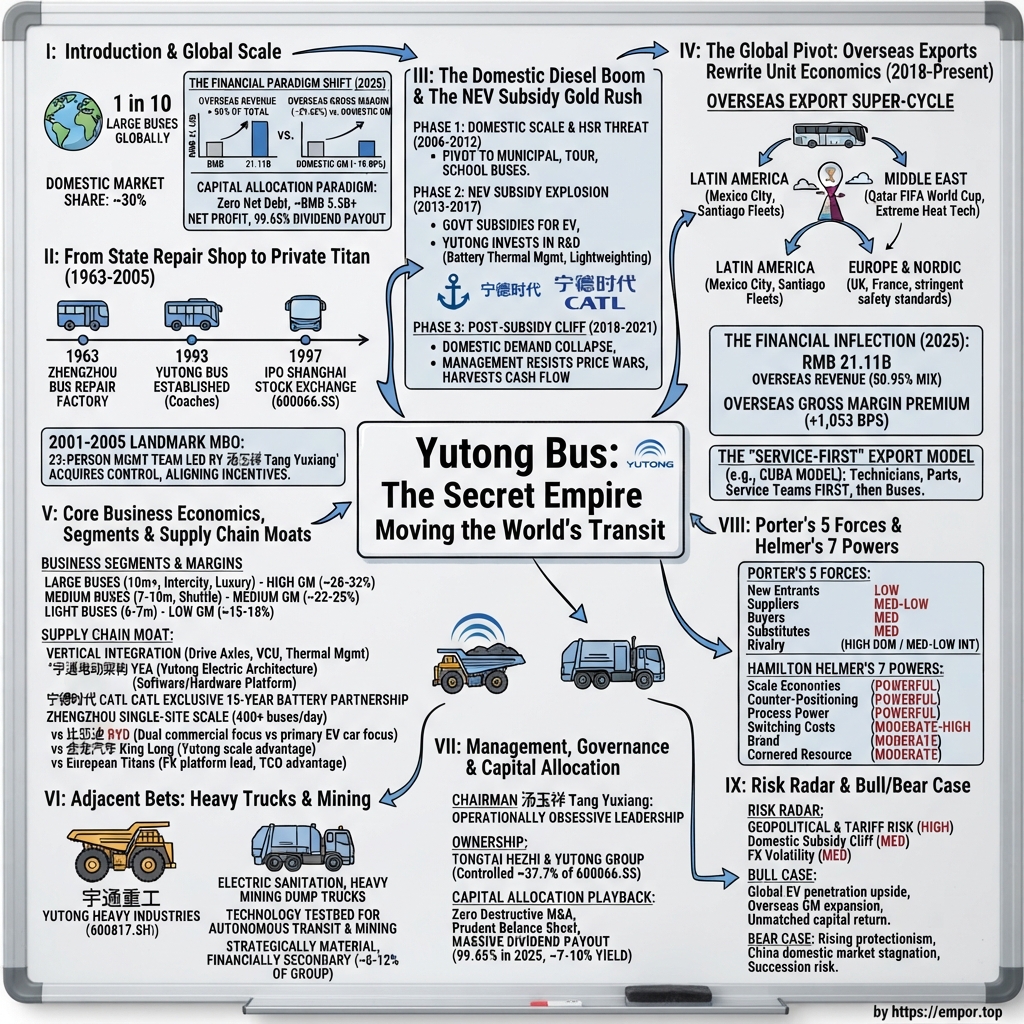
Yutong Bus: The Secret Empire Moving the World's Transit
I. Introduction & Episode Roadmap
On a November evening in 2022, a fleet of buses pulled away from Lusail Stadium outside Doha carrying tens of thousands of football fans into the desert night. They made almost no sound. There was no diesel clatter, no exhaust shimmer under the floodlights — just the low whine of electric motors and the hiss of air suspension. Most of the people on board had no idea what they were riding in. The badge on the front said Yutong, a name that meant nothing to a fan from Buenos Aires or Manchester, and everything to a bus fleet manager in Almaty, Santiago, or Copenhagen.
That is the essential fact about 郑州宇通客车股份有限公司 Yutong Bus Co., Ltd.: it is one of the largest manufacturers of a product almost everyone uses and almost no one thinks about. Listed on the 上海证券交易所 Shanghai Stock Exchange under ticker 600066, it sold 49,518 buses in 2025 — 40,907 of them large or medium units — against a domestic Chinese market for 6-metre-plus buses of 137,212 vehicles and an overseas large-and-medium market that Yutong's own management sized at roughly 260,000 units a year.1234 Do that arithmetic and the popular claim that Yutong builds something like one in every ten big buses on earth is roughly right, though it hides the more interesting number underneath: outside China, Yutong's share of the addressable market was about 5.4% in 2024 by management's own estimate.3 Dominant at home. A challenger, not a champion, everywhere else.
That tension — domestic incumbent, global insurgent — is the whole story.
The financial paradigm shift. In 2025 Yutong crossed a line it had been approaching for a decade. Overseas revenue reached RMB 21.11 billion, up 38.87%, and accounted for 50.95% of total revenue — the first year in the company's 63-year history that foreign customers mattered more than Chinese ones.12 More striking than the mix was the margin gap: gross margin on exports ran at roughly 29.6% against roughly 19.1% domestically, a spread of more than ten percentage points.2 A company that spent thirty years as a cyclical Chinese industrial suddenly looked like a global capital-goods exporter with real pricing power.
The capital allocation paradox. Yutong ended 2025 carrying RMB 132 million of total debt against RMB 9.49 billion of cash and short-term investments, and then handed nearly all of its RMB 5.55 billion net profit back to shareholders as cash.1 A commercial-vehicle manufacturer with no leverage and a dividend policy that looks like a mature utility's is an unusual animal anywhere, and a rare one in China's automotive sector.
And the crack in the story. Here is what makes 2026 the right moment to examine this business rather than celebrate it. Through the first eight months of 2026, Yutong's unit sales fell 7.05% year on year to 26,771 buses. Medium buses dropped 15.57%. August alone was down 12.07%.5 First-quarter revenue fell 7.9% and net profit fell 12.7%.6 The half-year report showed revenue up 3.65% but reported net profit down 3.52%.78 The stock, which rose 134.49% in 2024, traded around RMB 27.91 in early September 2026 against a fifty-two-week high of RMB 38.50.3[^9] The export engine is still running hard.
The domestic engine is coughing. Whether the first can carry the second is the live question, and management does not yet have a settled answer.
Myth versus reality, up front. Three claims circulate about this company, and they are worth separating before the narrative starts. The first is that Yutong is a global bus champion. It is a Chinese champion with a fast-growing but still minority position abroad — roughly 5% of the non-China large-and-medium market by management's own estimate, against 31% at home.34 The second is that Yutong's export margin advantage is structural. It is currently real and currently widening, but it derives from having reached markets that competitors ignored, and those competitors have now arrived.
The third is that a near-100% dividend payout signals exceptional cash generation. In 2025 it signalled something more specific: a distribution roughly twice that year's free cash flow, topped up from the balance sheet. Each of these gets tested against the company's own record in the sections that follow.
What this episode covers. Five threads run through the rest of this story. First, the privatization and management buyout under 汤玉祥 Tang Yuxiang that turned a provincial state factory into an owner-operated company — and the governance oddities that came with it. Second, the arc from diesel scale to the 新能源客车 new energy bus subsidy boom and the brutal hangover that followed, which is the single most useful piece of disconfirming evidence anyone can apply to today's bull case.
Third, the export super-cycle and the service model that made it possible. Fourth, the supply chain, the battery partnership with 宁德时代 CATL, and what is and is not defensible about Yutong's technology position. Fifth, the frameworks — Porter, Helmer, the bear case, and the two or three numbers that actually tell you whether this is working.
Start where the company started: a repair shed in Henan.
 Subscribe on LinkedIn
II. From State Repair Shop to Private Titan: The 1963–2005 Transformation
In March 1963, the Henan provincial transport bureau converted a light machinery works in Zhengzhou into a vehicle repair depot. Its assignment was unglamorous: fix the province's buses and manufacture spare parts. By December of that year the shop had built something of its own — the JT660, the first long-distance coach ever produced in Henan.9 It was a rudimentary vehicle by any standard, a body bolted onto a truck frame, but it established the pattern that would define the enterprise for sixty years. Yutong has always built the whole bus.
For two decades the factory did what planned-economy enterprises did: it filled quotas. Renamed the Zhengzhou Bus Repair Factory in 1968, then designated one of fourteen national backbone enterprises for large bus production in 1985 and renamed simply the Zhengzhou Bus Factory, it produced low volumes of standard vehicles for local transit authorities who had no choice of supplier and no basis for complaint.9 There was no marketing, no service network, no pricing. There was an allocation.
The first genuinely commercial decision came in 1991, and it came from watching people rather than reading plans. China's 民工潮 migrant worker wave was in full flood — tens of millions of rural workers travelling enormous distances to the coastal factory belt, spending two and three days on the road. Zhengzhou introduced China's first double-deck sleeper coach, a bus with berths instead of seats.9 It was a product designed around a social phenomenon, and it sold. That instinct — build for the customer's operating economics, not for the specification sheet — is the through-line of everything Yutong has done well since.
1993 and 1997: the two structural moves. In 1993 the factory underwent shareholding reform and became Zhengzhou Yutong Bus Co., Ltd., narrowing its focus to medium and large passenger coaches.9 Four years later it listed on the Shanghai Stock Exchange, the first bus manufacturer in China to do so.9 The IPO capital funded batch manufacturing lines and a standardised body-on-frame chassis programme, and — more importantly — gave the company a reason and a mechanism to sell outside Henan. A listed company reports consolidated numbers to strangers. That is a discipline a provincial factory does not otherwise have.
It is easy to under-read the significance of the focus decision embedded in that restructuring. China in the early 1990s had well over a hundred entities calling themselves bus manufacturers, most of them provincial workshops assembling bodies onto bought-in truck chassis for a captive local buyer. The obvious strategy was to widen: add trucks, add special vehicles, add anything the province needed. Yutong went the other way and committed to one product family — medium and large passenger buses — at a moment when narrowing looked like leaving money on the table.
Sixty years later the company still sells essentially one thing. That single-category discipline is the reason a Zhengzhou factory can outspend the world on bus-specific engineering while being a modest company by automotive standards.
The competitive landscape it entered was not empty. The Xiamen-based King Long group, backed by Fujian's provincial apparatus and technology licensed from foreign partners, was widely regarded as the more sophisticated operator through the 1990s and early 2000s. Yutong's advantage was neither technology nor capital. It was that it was building buses for a country whose transport needs were changing faster than any specification sheet could keep up with — the sleeper coach for migrant workers, then the tourist coach as domestic leisure travel emerged, then the school bus after a series of national safety scandals, then the electric transit bus. The company's pattern is to be the fastest translator of a Chinese social change into a vehicle.
The buyout. What happened between 2001 and 2004 is one of the more consequential and more contested episodes in Chinese corporate history, and it deserves to be described accurately rather than romantically.
汤玉祥 Tang Yuxiang had joined the factory in 1981 and worked his way up through the technical ranks to general manager. In March 2001 he and twenty-two other individuals capitalised a vehicle called Shanghai Yutong Chuangye Investment with RMB 120.54 million. On 21 June 2001, Yutong Bus announced that the Zhengzhou state asset bureau had agreed to transfer the equity of its controlling shareholder, Zhengzhou Yutong Group, to Shanghai Yutong (89.8%) and Henan Jianye Investment (10.2%).10 The capital structure behind Shanghai Yutong was unusual: the individual shareholders effectively represented 838 employees, who contributed RMB 80.54 million; Tang himself subscribed for RMB 30 million, of which reporting at the time indicated only RMB 2 million was his own cash, with RMB 8 million borrowed and RMB 20 million backed by institutional investors.10
Then it stalled. In July 2003 the Ministry of Finance and 国务院国资委 SASAC issued guidance prohibiting the transfer of state equity in large state enterprises and listed companies to management. Yutong's transaction was caught mid-flight.10 The deal was ultimately restructured and completed in 2004 through a Yutong Group holding company, with Tang and a small group of partners securing control.10
To understand why this was contentious requires context that is easy to lose from outside China. The management buyout wave of 1999–2003 was, for a period, the primary mechanism by which control of state industrial assets passed into private hands. Some of those transactions created durable companies. Many were straightforward transfers of value from the public to a small group, executed at book value or below, financed by pledging the target's own assets, and followed by asset disposals. By 2003 the political tolerance had run out, and the rules that caught Yutong mid-transaction were written to stop the pattern.
Yutong's deal was not obviously in the abusive category — the employee participation was broad, the operating company was not levered up, and the acquirers stayed to run the business for the next two decades. But it was executed in that environment, under those norms, and no investor should describe it as a clean transaction simply because the outcome was good.
How to read this. The generous reading, which the company's later record partly supports, is that Yutong's MBO avoided the two pathologies that discredited the broader wave of Chinese management buyouts: it did not load the operating company with acquisition debt, and it did not obviously strip the asset. Yutong's balance sheet has carried essentially no interest-bearing leverage in the two decades since, which is not what you observe when a buyout is financed out of the target's borrowing capacity.
The less generous reading is that a management team acquired control of a state asset in a period when the valuation of such assets was, by the state's own subsequent admission, poorly policed — which is precisely why the 2003 rules were written. It is worth being honest that the pricing and process were never fully transparent, and that the arrangement remained structurally ambiguous for nearly twenty years afterwards. Yutong Bus reported no single actual controller until February 2023, when an internal equity transfer inside the holding vehicle 通泰合智 Tongtai Hezhi pushed Tang's stake there to 52% and triggered a mandatory general tender offer for both listed entities in the group.11 That is a governance question we return to later, not a founding myth.
What the buyout unambiguously did was align the decision-makers with the owners for the following twenty years. Whatever else you conclude about Yutong, its capital allocation since 2005 has behaved like the capital allocation of people who own the equity. That mattered enormously in the decade that followed, when the Chinese government started handing out money.
III. The Domestic Diesel Boom & The NEV Subsidy Gold Rush (2006–2017)
For a Chinese coach manufacturer, the mid-2000s were as good as it gets. Rising incomes, a tourism industry taking off, intercity travel still overwhelmingly road-based, and a state building highways faster than anyone in history. Yutong's revenue climbed from RMB 4.95 billion in 2006 to RMB 19.76 billion in 2012 — quadrupling in six years — with net profit rising from RMB 221 million to RMB 1.55 billion over the same period.[^9] Domestically it pulled clear of 金龙汽车 King Long Automotive and its three semi-independent subsidiaries — 厦门金龙 Xiamen King Long, 厦门金旅 Xiamen Golden Dragon, and 苏州金龙 Higer Bus — as well as 福田汽车 Foton Motor, 中通客车 Zhongtong Bus, and 安凯客车 Ankai Bus.
What separated Yutong from that field was not a single decision but a compounding one. Foton had a truck business to feed and treated buses as an adjacent line. King Long's three semi-independent subsidiaries competed with each other for the same domestic tenders, a structure that split engineering effort and made group-level pricing discipline nearly impossible. Zhongtong and Ankai were provincial champions with provincial scale. Yutong had one product, one factory campus, and one profit-and-loss statement, and it reinvested into the same category every year.
Then the trains arrived.
The high-speed rail shock. China's 高铁 high-speed rail network went from essentially nothing in 2008 to the world's largest within a decade, and it did something to the intercity coach market that no competitor could have done. A four-hour bus journey between provincial capitals became a ninety-minute train ride at a comparable price. Long-distance road passenger volumes went into structural decline and never recovered; by 2026, Chinese commentary on the sector was describing the intercity coach as a vehicle that had been "forced into retirement by high-speed rail" and obliged to find an entirely different way to live.12
This is a genuinely important episode for anyone assessing Yutong's moat, because it is a clean historical test of a claim the company still makes today: that buses are a weakly cyclical necessity with no substitute. HSR proved that a substitute can appear, be state-financed, arrive at scale, and permanently remove a profit pool. Yutong's response was to redeploy rather than defend — shifting capacity toward municipal transit, tour coaches, and school buses, categories where rail cannot go. It worked. But it worked because a second policy wave arrived at exactly the right moment.
2013–2017: the subsidy gold rush. Beijing decided that the fastest way to clean urban air and seed a domestic battery industry was to electrify public fleets, and it paid for the privilege. Central and local subsidies on pure-electric and plug-in hybrid buses were, at their peak, large enough that a municipal operator could acquire an electric bus for a fraction of its sticker price.
Demand did what demand does when someone else is paying: it exploded. Yutong's revenue went from RMB 22.20 billion in 2013 to RMB 35.85 billion in 2016, and net profit from RMB 2.26 billion to RMB 4.04 billion — an operating margin structure that, at its 2016 peak, produced a 27.6% gross margin on a bus.[^9]
It is worth explaining how the subsidy actually worked, because the mechanism determines the aftermath. The central government and the municipality each paid a portion of the vehicle price directly to the manufacturer, not the operator, on delivery of a qualifying vehicle — qualification being defined by battery capacity, range and passenger capacity thresholds. Two consequences followed immediately. First, the manufacturer became the party with the incentive to maximise qualifying deliveries, which is why the fraud that followed took the form it did.
Second, and more consequentially for Yutong, the manufacturer became a creditor of the state. Buses were built, delivered, and recognised as revenue; the subsidy cash arrived months or years later, after audit. Yutong's receivables ballooned accordingly, and in 2017 the company generated negative RMB 1.75 billion of operating cash flow on RMB 33.22 billion of revenue and RMB 3.13 billion of accounting profit.[^9] A business can be enormously profitable on paper and cash-consumptive in reality when its largest customer is a subsidy programme.
Subsidy arbitrage versus engineering. The gold rush also produced one of the uglier chapters in modern Chinese industrial policy. A nationwide investigation launched in January 2016 by MIIT, the Ministry of Finance, the Ministry of Science and Technology and the NDRC found manufacturers claiming subsidies for vehicles that were never built, or fitting batteries smaller than declared. Roughly 4,500 subsidised electric vehicles from seven companies were found to have less powerful batteries than claimed; five companies were fined amounts related to more than RMB 1 billion of subsidies, and MIIT delisted the offending models.13 Among those penalised was Higer Bus — part of the King Long group, Yutong's closest domestic peer.13
Yutong was not among the companies sanctioned in that investigation, and its R&D spending through the period is consistent with a company building rather than gaming: it has run annual R&D above RMB 1.5 billion every year since 2018, reaching RMB 1.79 billion in 2024 and RMB 1.81 billion in 2025.31 It is fair to say Yutong emerged from the fraud scandal with its reputation intact while a direct competitor did not. It is not fair to conclude from that alone that Yutong's electric buses were technically superior — the absence of a sanction is not a proof of engineering quality, and the more durable evidence for that came later, in export markets that had no subsidies to game.
The anchor customer relationship. Yutong's commercial relationship with 宁德时代 CATL dates to 2012, before CATL was CATL, and became one of the more consequential supplier relationships in Chinese manufacturing.14 For a battery company scaling from nothing, a bus manufacturer is an ideal first customer: high energy content per vehicle, predictable duty cycles, institutional buyers who care about warranty rather than styling. For Yutong, an early lock on the eventual global cell leader was worth more than any single product decision it made in the decade.
Phase 3: the cliff. Then the subsidies tapered, and finally ended. What followed is the most important passage in this company's financial history, and any bull case built today has to survive it.
Chinese 6-metre-plus bus industry sales peaked around 217,000 units in 2016 and fell to roughly 97,000 by 2021 — less than half the peak, and the lowest level in a decade.4 Yutong's own numbers tracked the collapse: revenue fell from RMB 35.85 billion in 2016 to RMB 21.71 billion in 2020, and net profit fell from RMB 4.04 billion to RMB 516 million — an 87% decline in earnings over four years.[^9] In 2021 net profit was RMB 614 million; in 2022, RMB 759 million. Operating cash flow in 2017 was actually negative RMB 1.75 billion as subsidy receivables ballooned.[^9]
Read that sequence carefully, because it is the answer to a question that will be asked in the last section of this story: can a policy-driven demand wave that lifted Yutong's margins and volumes for five years reverse completely? It already did once. The company did not go bankrupt — it had no debt, and it kept paying dividends throughout — but shareholders who bought the 2015 narrative waited seven years to see the earnings return.
There is a further detail in that collapse worth extracting, because it separates a cyclical business from a structurally impaired one. The 2016 peak was not merely a volume peak; it was a margin peak created by subsidy economics. When the subsidy went away, the customer — a municipal transit authority whose own finances were deteriorating — could not pay the difference. Prices fell to meet the customer's actual willingness to pay, which is the level that domestic gross margin has hovered near ever since.
The domestic bus market did not simply shrink. It repriced permanently to a lower margin structure, and that structure is the roughly 19% gross margin the company still earns at home a decade later.2 Anyone modelling a domestic recovery should model volume recovery, not margin recovery. Yutong's own numbers say the margin is not coming back.
Management's response to the cliff is what set up the next chapter. It did not chase domestic volume at any price, and it did not diversify into passenger cars, which several Chinese commercial-vehicle makers attempted and regretted. It harvested a shrinking domestic market and spent the proceeds on getting out of China.
IV. The Global Pivot: How Overseas Exports Rewrote Yutong's Unit Economics (2018–Present)
The global pivot did not begin in 2018. It began in 2005, on a dock in Havana, with twelve luxury coaches.
The Cuba model. Cuba was, on paper, an absurd first serious export market: a small island, a currency nobody wanted, an economy under embargo, and a transport fleet held together with improvisation. Yutong sent twelve tourist coaches in 2005, becoming the first Chinese bus manufacturer to sell into Latin America.[^16] Within months a further order of roughly a thousand units followed, and in May 2007 the Cuban government signed an agreement to purchase 5,348 buses for approximately USD 370 million — at the time the largest vehicle export deal in China's history.15
What made Cuba a template rather than a one-off was what Yutong did after the sale. It stationed technicians on the island. It built parts warehouses. It trained Cuban mechanics. In a market where a broken-down bus could not simply be replaced, uptime was the product, and Yutong sold uptime rather than steel.15 The insight generalises: the buyer of a city bus is not a consumer choosing a car, it is an operator running a depot, and that operator's economics are dominated by availability, not by purchase price.
European OEMs sold expensive chassis to be finished by third-party bodybuilders, with parts arriving from a warehouse a continent away. Yutong sold a complete vehicle plus a service organisation.
By the end of 2025, that organisation had grown to more than 400 authorised overseas service outlets with an average service radius of 120 kilometres, more than 40 self-built overseas spare-parts warehouses in countries including Qatar, Mexico, France, Kazakhstan and Norway, and a commercial presence of over 60 subsidiaries, representative offices and dealer partners across six regions.13 Cumulative exports passed 130,000 buses, sold into more than 60 countries.216
It is worth pausing on what that network actually costs to maintain, because it is the least glamorous line in the business and the most important. A spare-parts warehouse in Kazakhstan is working capital sitting idle until something breaks. A resident service engineer in Chile is a fixed cost in a market that might order fifty buses one year and none the next. European incumbents did not fail to build these networks because they were stupid; they declined to build them because the return is invisible until you win a renewal tender and your competitor does not.
Qatar: the proof-of-concept the world actually saw. In 2019, Qatar's state transport operator Mowasalat ordered 1,002 buses from Yutong, 741 of them electric — at the time the largest electric bus order ever placed anywhere.17 By the 2022 World Cup, more than 1,500 Yutong buses were operating in Qatar, 888 of them electric, shuttling officials, media and fans.18 Yutong stationed a 126-person service team in-country and trained 3,000 drivers on operation and maintenance.18
The engineering problem was not trivial and is worth explaining plainly. A lithium battery is a chemical system that degrades faster when hot; a Gulf summer runs above 50°C, which means the pack must be actively cooled while the cabin air-conditioning — itself the single largest auxiliary load on a desert bus — is running flat out. Yutong's answer was liquid-cooled packs and high-capacity dual air-conditioning, sized so that the cooling load does not eat the range.
Getting this right in a stadium-shuttle duty cycle, in public, at a global sporting event, was a marketing asset no amount of advertising could buy — and, crucially, it was a demonstration in a market with no Chinese subsidies attached.
Latin America: from tourist coaches to municipal backbone. Mexico City took 300 Yutong electric trolleybuses between 2019 and 2022, added 18-metre articulated electric BRT vehicles to Metrobús Line 3 from 2021, and in 2024 unveiled a 27-metre bi-articulated electric bus carrying up to 270 passengers.19 Santiago de Chile presented a fleet of 214 Yutong electric buses in a single deployment serving thirteen routes and more than 280,000 weekly passengers.20 Independent tracking by the ICCT put Yutong at roughly 890 zero-emission buses in operation across Latin America as of 2024, concentrated in Mexico and Chile, alongside 比亚迪 BYD and Foton.21
Central Asia and the KD model. The least discussed and possibly most instructive export region is the former Soviet space. By June 2025, Yutong had passed 10,000 cumulative vehicles sold across the five Central Asian republics, of which more than 1,000 were new-energy units, and had secured a further 1,000-unit order from Kazakhstan to be produced at the QazTehna plant it co-built with a local partner.22 That last clause is the important one.
In more than a dozen countries — Kazakhstan, Pakistan, Ethiopia, Malaysia, Mexico, Nigeria among them — Yutong does not export finished buses. It exports knocked-down kits that a local partner assembles in a local plant using local labour, with Yutong supplying technology, standards, management systems and brand.322
The economics of that trade-off deserve to be stated plainly rather than celebrated. KD assembly solves three problems at once: import tariffs on finished vehicles, local content requirements in public procurement, and the political preference of a government that wants jobs as well as buses. It also transfers a portion of the value chain — and therefore a portion of the margin — to someone else, and it hands a partner a working knowledge of how to build a Yutong.
Management frames this as an upgrade from "product export" to "technology export and brand licensing."3 An investor should read it as a defensive necessity that protects volume at the cost of margin per unit, and should expect the export gross margin to drift down as the KD share of overseas volume rises. That is not a criticism of the strategy. It is the arithmetic of the strategy.
Europe: the hardest market, entered slowly. Europe was different because the barrier was regulatory rather than commercial. EU whole-vehicle type approval, crash and fire standards, and operator procurement rules make entry expensive and slow — which is exactly why it is a moat once you are through it. Yutong's European position advanced from selling into permissive markets to winning in demanding ones: at Busworld Europe in October 2025, its 15-metre U15 city bus took the Grand Award Bus, ahead of the Daimler eCitaro and the Ebusco 3.0, and the company collected seven awards in total.23 Chinese manufacturers collectively went from about 13% of Europe's electric bus market in 2017 to roughly a quarter by 2023.24
The organisational machinery behind the exports. It is worth naming how Yutong actually runs this, because the structure is unusual and it is the part competitors will find hardest to copy quickly.
Management describes an internationalisation model built around what it calls "national companies" as the management centre, pushing a "three-directs" strategy into overseas markets — direct sales, direct service and direct parts supply, rather than handing the customer relationship to an importer.3 The commercial network mixes direct sales and distribution across more than 60 subsidiaries, offices and dealer partners spanning Europe, the Americas, Asia-Pacific, the CIS, the Middle East and Africa.3
The trade-off is deliberate and expensive. A distributor model is capital-light and fast; a direct model costs more upfront, ties up working capital in overseas parts inventory, and requires managing people in dozens of jurisdictions.
What it buys is the customer relationship, the service data, and pricing power in the renewal tender — which is precisely where the export gross margin comes from. Yutong's overseas selling costs are not disclosed separately by region, so the return on that investment has to be inferred from the margin rather than measured directly.
The Nordic markets were the technical test in the opposite direction from Qatar. Cold destroys electric range in a way that is easy to underestimate: lithium chemistry slows in the cold, so usable capacity falls, and simultaneously the cabin needs heating, which on a diesel bus is free waste heat from the engine and on an electric bus is a direct draw on the same battery. A bus that manages 300 kilometres in Copenhagen in May may manage far less in Tromsø in February. The engineering answer is a heat pump rather than resistive heating, aggressive thermal insulation, and battery pre-conditioning while the vehicle is still on the depot charger — which is why Yutong's second-generation electric platform put heat pumps and thermal management at the centre of the specification.3 The company's flagship 15-metre U15 is quoted at up to 850 kilometres of range under the SORT2 duty cycle with capacity for 90 passengers.23 Manufacturer range figures are marketing numbers everywhere in the industry and should be treated as such; the meaningful evidence is that Nordic operators have bought at scale and re-ordered.
The financial inflection. The numbers are the point. In 2024, revenue rose 37.63% to RMB 37.22 billion and net profit rose 126.53% to RMB 4.12 billion, on 46,918 buses sold, of which 14,000 were exported — up 37.73%.3 In 2025, revenue rose a further 11.31% to RMB 41.43 billion and net profit rose 34.94% to RMB 5.55 billion, on 49,518 buses of which 17,149 were exported, up 22.49%.12 Overall gross margin reached 24.14% and net margin 13.58%.2
What actually changed was not volume — 2025 unit sales grew only 5.54% — but mix. Profit grew three times faster than revenue because a rising share of each bus sold went to a customer paying an export price at an export margin. That is the correct way to read this business: Yutong is no longer primarily a volume story, it is a mix story.
And that is exactly where the falsification bites. A mix shift produces a step-change in margin, not a permanent growth rate. Once exports are 51% of revenue, the incremental benefit of each further point of export mix shrinks, and the domestic half of the business still has to not shrink.
It has been shrinking, and the warning arrived earlier than most coverage acknowledged. In May 2025 — in the middle of the celebrated growth run — Yutong's monthly volume fell 12.35% year on year to 3,053 units, and cumulative sales growth for the year flipped from positive to negative.25 Contemporaneous domestic commentary noted that Yutong's new-energy transit sales had declined 4.22% over the first four months of that year while the domestic market was growing, raising the question of whether the company was ceding domestic transit share while its attention was on exports.25 The full-year 2025 numbers papered over that: domestic 6-metre-plus volumes ended up 1.2% and share held above 31%.4 But the trajectory did not reverse. First-half 2025 revenue was RMB 16.13 billion with net profit of RMB 1.94 billion; first-half 2026 revenue was RMB 16.72 billion with net profit of RMB 1.87 billion.2627 Revenue up, profit down, volumes down — that is a company running harder to stand still.
Management's own guidance for 2026, given on the FY2025 results call, was roughly 34,000 domestic units with slight growth and about 19,000 export units, up around 11% — a decelerating export number after two years of 22–38% growth.28 Through August, total volumes were tracking 7.05% below the prior year, which makes the domestic component of that guidance look optimistic.5 The export super-cycle is real. Management is not guiding to it continuing at the same rate, and investors should not assume it either.
V. Core Business Economics, Segments & Supply Chain Moats
Walk into the Zhengzhou plant and the thing that surprises an auto-industry visitor is how little it looks like a car factory. There is no single model rushing down a line at ninety seconds a station. There are buses in wildly different states of dress on the same line — a right-hand-drive coach for Southeast Asia, a low-floor electric city bus destined for the Nordics, a desert-spec unit with a second air-conditioning condenser. Yutong's Zhengzhou complex has a design capacity of 65,000 vehicles a year, and it is essentially the company's only production site.3
That single fact — one campus, 65,000 units, everything customised — is the operational core of the business, and it explains more about Yutong's economics than any strategy statement.
Why flexible batch manufacturing is the whole game. A car plant is optimised for repetition: the same vehicle, thousands of times, with variation confined to paint and trim. A bus plant cannot work that way, because there is no such thing as a standard bus. A Chilean transit authority specifies different door configurations, a Norwegian one different heating and wheelchair provisions, a Saudi tour operator different seat pitch and luggage capacity, and each of them orders in tens or low hundreds rather than tens of thousands.
The default industry response, and the European response for decades, was to build a chassis and let a specialist bodybuilder finish it — which pushes the customisation problem downstream to someone with no scale.
Yutong's answer was to absorb the customisation into the main line. Modular body sections, a standard electric chassis architecture underneath, and a production sequencing system that lets a ten-unit Nordic order and a fifty-unit desert order flow down the same line without a changeover stop. This is a genuinely hard operational capability and it is the reason a single Zhengzhou campus can serve six continents at 65,000 units of design capacity while running above 24% gross margin.32 It is also almost impossible to verify from outside a factory gate.
The circumstantial evidence is the profitability spread against domestic peers building similar vehicles from a similar supply chain, which has persisted through boom and bust and is discussed below.
How the segments earn. Large buses of ten metres and above are the profit engine: intercity coaches, double-deckers, high-capacity urban transit and export tour vehicles. Yutong sold 24,943 of them in 2025, up 1.08%.2 Medium buses of roughly seven to ten metres — suburban transit, corporate shuttles, school buses — accounted for 15,964 units, up 1.92%.2 Light buses of six to seven metres, the most competitive and lowest-margin category, grew fastest at 8,611 units, up 30.89%.2 Yutong does not publish gross margin by vehicle length; it publishes it by geography, which tells you which cut management thinks matters.
The interesting detail in the 2026 half-year numbers is that this mix inverted. Large bus volumes fell 9.73%, medium fell 15.27%, and light rose 21.38%.8 Growth migrating from the high-margin end to the low-margin end is not, by itself, a crisis — but it is the opposite of the premiumisation story, and it explains why revenue grew 3.65% while reported net profit fell 3.52%.78
The battery, explained simply. The single largest cost in an electric bus is the battery pack, and the single largest hidden cost for the operator is replacing it. A municipal transit authority buying a bus expects fifteen years of service life. A conventional battery pack does not last fifteen years under transit duty, which means the operator budgets for a mid-life replacement that can cost a meaningful fraction of the original vehicle price. That replacement is the thing that makes total-cost-of-ownership maths for electric buses fragile.
In March 2024, Yutong and CATL jointly launched a long-life pack warranted for fifteen years or 1.5 million kilometres, roughly double conventional pack life, using modified electrode and interface chemistry.14 Whether the physics delivers over fifteen years is, definitionally, unproven — nobody has run one of these packs for fifteen years. What matters commercially is narrower and more testable: the warranty transfers the risk from the operator's budget to the manufacturer's balance sheet.
In a tender scored on total cost of ownership, a fifteen-year warranty is worth a great deal even before anyone knows whether the cells survive. Yutong put "Battery-for-Life" at the centre of its Busworld Europe 2025 stand for exactly this reason.23
Investors should watch the warranty provision line in the annual report over the coming years. If the packs perform, this is a genuine differentiator. If they do not, the cost lands on Yutong, not the customer, and it lands with a five-to-ten-year lag.
Vertical integration and the software layer. Yutong develops its electric drive axles, vehicle control units, thermal management and chassis software in-house, and its second-generation electric chassis architecture was targeted to reach over 90% penetration in newly sold products.3 R&D ran at RMB 1.81 billion in 2025, 4.36% of revenue, against a portfolio of 2,743 valid patents including 971 invention patents.2 For context, that R&D ratio is high for a bus manufacturer and low for a car manufacturer — appropriate, since Yutong's engineering problem is integration and durability rather than novel propulsion chemistry.
The autonomous programme is worth sizing honestly. Yutong reported that its autonomous buses had operated safely for six years across 24 Chinese cities, accumulating more than 17 million kilometres by the end of 2024.3 That is a substantial real-world dataset. It is also, so far, a technology demonstration rather than a revenue line — the company does not disclose autonomous vehicle revenue separately, and there is no evidence in the disclosures that it is material. Treat it as optionality, not as an earnings driver.
The light bus push, and what it signals. The fastest-growing category in Yutong's 2025 and 2026 numbers is also its least profitable, and management has been explicit that it is a deliberate investment: light bus product development and upgrade was named first among the four destinations for the 2024 R&D budget.3 The strategic logic is that last-mile feeder transit, custom commuting and rural passenger-and-freight integration are the segments Chinese policy is actively promoting, and they need a smaller vehicle than Yutong historically built.
The investor's reading should be balanced. Entering a more competitive, lower-margin segment to defend relevance in a shrinking domestic market is a rational defensive move — but it is a defensive move, and it dilutes group gross margin at the same time as management tells the market that premiumisation is the strategy. Both things are true. Watch whether light bus growth continues to come with domestic share gains or merely with volume.
Who actually buys these buses, and what they optimise for. The customer for a city bus is not a person; it is a depot. Its economics are dominated by three lines: the capital cost amortised over a fifteen-year life, the energy or fuel cost per kilometre, and the availability rate — the percentage of the fleet that can be put into service on a given morning. A bus that is 5% cheaper but 3% less available is a worse bus, because an unavailable vehicle means a missed service, a regulatory penalty, and a spare vehicle held in reserve at full capital cost.
This is why Yutong's service network is not a marketing asset but a product feature, and why an operator in a market with no local Chinese parts depot will rationally pay more for a European bus.
It is also why the domestic Chinese business is structurally lower-margin than exports, and the reason has little to do with Yutong. Chinese municipal transit operators are typically loss-making entities dependent on local government subsidy for both capital and operating budgets. When municipal finances tighten — as they have across much of China since 2022 — fleet renewal slips and price becomes the dominant tender criterion.
Yutong's own disclosed risk language names this directly: customer operating results below expectation constraining demand growth, and sustained tight balance in local fiscal revenue and expenditure potentially slowing vehicle renewal.3 An overseas buyer in Qatar, Chile or Norway is a fundamentally better-capitalised customer. The export margin premium is, in significant part, a customer-quality premium rather than a product premium.
The competitive set, measured rather than asserted. In 2025 Yutong sold 42,558 buses of six metres and above in China for a 31.02% domestic share.4 King Long's group generated RMB 24.55 billion of revenue and RMB 468 million of net profit — a net margin under 2% against Yutong's 13.58%.292 Zhongtong generated RMB 7.33 billion of revenue and RMB 360 million of profit.30 BYD, despite its scale in passenger EVs, sold 4,873 six-metre-plus buses in China in 2025, down 9.76% — buses are a secondary line for a company whose attention is elsewhere.31
The profitability gap between Yutong and its Chinese peers is the strongest single piece of evidence for a real cost or brand advantage, and it has persisted through both the boom and the bust. But note what happened in 2025: King Long's profit rose 196.9% and Zhongtong's rose 44.18%, both driven substantially by exports.29304 Ankai grew exports 152.84% to 5,034 units and still swung into a loss, which tells you those export volumes were bought with price.4 Chinese bus exports as a category grew to 41.01% of domestic 3.5-metre-plus sales in 2025, and the industry consensus, in the blunt phrase of one Chinese trade report, became "go overseas or get eliminated."4
That is the uncomfortable implication of the peer data, and it deserves to be stated rather than buried.
Yutong got to the export markets first and built the service network. Everyone else is now following, and they are following with price. Whether Yutong's 29.6% export gross margin survives the arrival of four competitors willing to bid below it is the central unanswered question in this business, and it is not answered by anything in the 2025 results.
VI. Adjacent Bets: Heavy Trucks, Mining & Yutong Heavy Industries
Every Chinese industrial group of a certain size eventually acquires a second listed vehicle, and Yutong is no exception. 宇通重工 Yutong Heavy Industries trades separately on the Shanghai exchange under 600817, sitting alongside Yutong Bus inside the group structure that Tang Yuxiang controls.11 It builds electric sanitation vehicles, electric mining haul trucks, and construction equipment.
Sizing it properly. In 2025, Yutong Heavy Industries generated revenue of RMB 3.49 billion, down 8.2%, and net profit of RMB 309 million, up 36.25%.32 Set against Yutong Bus's RMB 41.43 billion of revenue and RMB 5.55 billion of profit, that is a business roughly one-twelfth the size on revenue and one-eighteenth on earnings.1 It is a separate listed company; a Yutong Bus shareholder does not own it. The only reason it belongs in this story at all is technology reuse and what it reveals about group priorities.
Where the reuse is real. The mining truck business is the interesting one. Electric heavy haulage in a closed-loop mine is a genuinely good application for the technology stack Yutong built for buses: fixed routes, predictable duty cycles, a depot for charging, an operator who counts total cost per tonne rather than sticker price, and no range anxiety because the route never changes. Yutong Heavy's mining equipment segment generated RMB 641 million of revenue in 2025 with volumes up 74.9%, and its vehicles were operating or in trial across more than 100 mine sites in 29 Chinese provinces.32 Powertrain, battery management software and CATL cell supply all carry across from the bus business.
Where to be sceptical. Two things deserve flagging. First, the segment grew volumes 74.9% while total company revenue fell 8.2% — meaning the sanitation business, which is sold largely to local governments, contracted. Municipal fiscal stress is the common factor across both Yutong entities, and it is not a diversification if the same customer funds both. Second, autonomous mining haulage and L4 airport shuttles are frequently cited as the group's next optionality, and the historical base rate for converting such pilots into revenue at Yutong is instructive: six years and 17 million kilometres of autonomous bus operation have not yet produced a disclosed revenue line.3 Technical milestones at this company have been real. Their conversion into profit has been slow.
The autonomy question, sized honestly. Autonomous driving is the adjacency that generates the most excitement and the least disclosed revenue. The application logic is sound: a closed-loop mine haul road and an airport apron are among the easiest environments in the world for a self-driving vehicle, because they are private, mapped, speed-limited, and free of the unpredictable pedestrians and cyclists that make urban autonomy hard. A bus route is the next rung up — fixed, repeated hundreds of times a day, with a professional operator in the loop. If autonomous commercial vehicles arrive anywhere first, they arrive here.
But the discipline an investor should apply is the one the outline of this business already suggests: certification is not commercialisation. Yutong has genuine technical achievement to point to, and it has been pointing to it for six years without disclosing what it earns.3 The reasonable base case is that autonomy shows up first as a feature that helps win tenders — driver-assistance packages, depot automation, platooning — rather than as a product line that gets its own revenue disclosure. Treat any valuation attributed to it as speculative until the company itself decides the number is large enough to report.
A note on group structure. Two listed companies under one controlling shareholder, sharing technology, suppliers and a brand, is a structure that always deserves a second look for related-party flows. Yutong Bus discloses its related-party transactions in the annual report in the standard format, and there is no indication in the disclosures of transfers that would materially distort either entity's results. That is an observation bounded to what is disclosed, not a clean bill of health — the point for an investor is simply to keep reading the related-party note each year rather than assuming it stays immaterial.
The conclusion for a Yutong Bus investor is narrow. The heavy industries business is a useful proving ground for electric drivetrains in harsher duty cycles than a city bus imposes, and it keeps the group's engineering organisation fed with problems. It is not, on any reasonable reading of the numbers, a driver of the investment case for 600066. More than 95% of Yutong Bus's revenue comes from buses and bus components, and that is where the analysis belongs.2
It also raises the sharper question that the adjacency exists to serve: who decides how this group's capital gets spent, and what has their record been?
VII. Management, Governance & Capital Allocation: The Tang Yuxiang Playbook
Tang Yuxiang does not do interviews, does not appear at industry conferences as a keynote personality, and has never been the subject of the kind of founder mythology that attaches to China's consumer-technology executives. He joined the Zhengzhou factory in 1981, became general manager, and has chaired Yutong Bus since 2001.11 Forty-five years at one enterprise, in one city, building one product category.
That longevity is the asset and the risk in the same sentence.
The control structure. Tang exercises control through 通泰合智 Tongtai Hezhi, which sits above 宇通集团 Yutong Group, which in turn holds Yutong Bus. The structure became explicit on 6 February 2023, when an internal transfer inside Tongtai Hezhi lifted Tang's direct stake there to 52% and made him, for the first time on paper, the actual controller of the listed company.11 Because Chinese takeover rules treat a change in ultimate control as a triggering event, this obliged a general tender offer. Tang, Yutong Group and its subsidiary Mengshi collectively held roughly 924 million shares, or 41.72%, and the offer covered the remaining 58.28% at RMB 7.89 per share, with a parallel offer for Yutong Heavy Industries at RMB 9.17.11
Three things about that episode are worth an investor's attention. It was procedurally correct — the offer was made, and the announcement explicitly flagged the risk that if public float fell below 10% the listing itself would be at risk.11 The offer price was low relative to where the shares subsequently traded, and shareholders overwhelmingly did not tender, which is why the company remains listed and liquid.
The third point is the one that matters for how an investor reads the company's history. For roughly twenty years before 2023, Yutong Bus disclosed no single actual controller while being run by essentially the same people. That is a disclosure gap, not a scandal, but "owner-operator alignment since 2004" is a characterisation the filings only formally support from 2023.
The capital allocation record. This is where the evidence is genuinely strong, and it is strong because it spans a full cycle rather than a good year.
Yutong has not made a transformational acquisition. It has not bought a foreign brand, entered passenger cars, or built a property arm — all of which Chinese industrials of comparable size and cash generation did during the 2015–2021 period, and several of which produced write-downs. Capital expenditure has stayed remarkably contained: RMB 729 million in 2025 against RMB 5.55 billion of profit, and management guided at the 2024 shareholder meeting to RMB 146 million of committed spend on projects in progress plus RMB 743 million of new project commitments for 2025.13 Overseas expansion has been executed through KD assembly partnerships in more than a dozen countries — Kazakhstan, Pakistan, Ethiopia, Malaysia, Mexico, Nigeria — where the local partner supplies the plant and labour while Yutong supplies technology, standards and brand.322 The company's first controlled overseas new-energy commercial vehicle KD plant began construction in Qatar at the end of 2024.22
That is a deliberately capital-light internationalisation. It is also, as the bear case will note, a lower-margin one when it displaces direct exports.
The more interesting test of capital allocation quality is not what Yutong bought but what it did with the cash it did not spend. Between 2016 and 2023 the company generated cumulative operating cash flow well in excess of its capital needs while earnings were collapsing, and it neither hoarded the money indefinitely nor deployed it into an unrelated growth story. It funded the export build-out and returned the rest. Whether that was disciplined or merely unimaginative is a matter of interpretation; what the annual income statements for 2016 through 2025 do show is a company whose earnings collapse came from operating margin compression rather than from impairments of past investments.[^9]
The dividend, tested rather than admired. Yutong's dividend record is the headline attraction for many holders, and it deserves scrutiny rather than applause. By management's own accounting at the 2024 annual shareholder meeting, the company had declared 27 cash dividends in its 28 years as a listed company, distributing RMB 26.02 billion against RMB 33.42 billion of cumulative net profit — a cumulative payout ratio of 77.88%.3 For 2025, the board proposed RMB 20 per 10 shares, taking total distributions including the interim to RMB 5.535 billion, or 99.65% of net profit.[^35]1
Here is the part that does not appear in the celebratory coverage. Yutong's 2025 operating cash flow was RMB 3.20 billion — down from RMB 7.21 billion in 2024 — because working capital consumed RMB 2.36 billion as receivables and other items built.[^9] After RMB 729 million of capex, free cash flow was approximately RMB 2.47 billion.[^9] The declared distribution of RMB 5.535 billion is more than double that. The gap was funded from the balance sheet, and it shows: cash and equivalents fell from RMB 8.67 billion to RMB 6.37 billion over the year.1
That is not a solvency issue — Yutong ended 2025 with net cash of roughly RMB 6.2 billion and essentially no debt.1 It is a sustainability question, and the honest framing is that a 99.65% payout was funded partly from a stock of accumulated cash rather than entirely from the year's cash generation. The pattern has precedent: Yutong's payout ratio exceeded 100% in each of five consecutive years from 2019, reaching 214.53% in 2020 when profits had collapsed and the dividend had not.33 Management has been willing to pay through a downturn out of the balance sheet, which is shareholder-friendly and finite.
The 2026 half-year brought partial reassurance: operating cash flow rebounded 247% to RMB 5.95 billion, suggesting the 2025 working capital drag was a timing effect rather than a structural deterioration.8 One good half does not settle it. The relevant test is whether full-year 2026 operating cash flow covers the distribution.
What the shareholder register and the share price say. Yutong is not a widely-held retail lottery ticket. The 2024 annual report recorded 53,665 registered shareholders as of 28 February 2025 — a modest number for a company of this size, and consistent with a register dominated by the controlling group and institutional income funds.3 The investors who turned up to the annual shareholder meeting were the large domestic asset managers: China Southern, China AMC, China Life Asset Management, Taikang, ICBC Credit Suisse, E Fund, Hua An, Yinhua, Fullgoal.3 This is the shareholder base a near-100% payout attracts, and it has a behavioural implication: a dividend cut would be read not as prudence but as a breach of the implicit contract, which raises the cost of ever cutting.
The share price has behaved accordingly. Yutong rose 134.49% during 2024 on a rights-adjusted basis, and management explicitly flagged that performance in its market-value-management disclosure — a formal internal policy the company adopted in response to Chinese regulators' 2024 push for listed companies to manage the gap between market and intrinsic value.3 By early September 2026 the shares traded around RMB 27.91, giving a market capitalisation near RMB 61.8 billion against a fifty-two-week range of RMB 25.81 to RMB 38.50.[^9] On the declared RMB 2.00 per share distribution, that is a trailing yield in the high single digits. The de-rating through 2026 has tracked the volume decline rather than the earnings, which tells you the market is pricing the sustainability question rather than the reported result.
Succession, unaddressed. Tang Yuxiang has run this company for a quarter of a century and worked in it for forty-five years. No succession plan has been publicly disclosed. Senior executives appear in the filings and handle investor communications, but the company has not communicated a transition framework, and the control structure means the question is one of ownership as well as management.
For a business whose principal competitive advantages are process capability and long-horizon capital discipline — both of which are cultural rather than contractual — this is a material unquantified risk, and the honest position is that outsiders have no basis on which to assess it.
Guidance discipline. On the FY2025 results call in March 2026, management guided to roughly 34,000 domestic units and 19,000 exports for a total near 53,000, with new-energy exports around 5,000. It attributed falling average selling prices to sales mix rather than price competition, stated that it had observed no price cuts either domestically or internationally, and said it intended to maintain a high payout while retaining appropriate buffers.28 Asked about lithium cost inflation, management said the impact was "extremely limited" because customised bus production allows cost pass-through, and framed higher oil prices as a net positive for new-energy demand.28
Some of that has aged well and some has not. The mix explanation for lower ASPs is consistent with what the segment data show. But the claim of no price competition sits awkwardly against Ankai tripling exports into a loss, and against Yutong's own year-to-date volume decline through August.45 It is also worth recording how management handles questions it does not want to answer. In the April 2025 shareholder meeting record, asked directly why new-energy export market share had fallen in the first quarter and what the improvement plan was, the answer in full was that volumes are affected by industry demand rhythm and delivery schedules, and that "the company's production and operations are normal, business development is positive."3 That is a non-answer to a specific question, and it appears more than once in the record. Yutong's disclosure is procedurally complete and substantively thin. Investors relying on management commentary to detect a turn will detect it late.
VIII. Porter's 5 Forces & Hamilton Helmer's 7 Powers Analysis
Frameworks are only useful if they are scored against evidence rather than narrative, so each judgement below carries the observation that supports it and the observation that would overturn it.
Porter's Five Forces
Threat of new entrants: low. The barriers are real and specific. EU whole-vehicle type approval takes years and money. A credible bid for a municipal fleet requires a local service organisation before the first vehicle is delivered — Yutong's 400-plus outlets and 40-plus parts warehouses represent a decade of sunk investment.13 Flexible batch manufacturing at 65,000-unit scale is a process capability, not a purchase.3 What weakens this force is that the entrants are not new: they are established Chinese peers with the same supply chain, and they are already inside the gate. Golden Dragon grew exports 64.9% in 2025.4
Bargaining power of suppliers: medium-low. CATL is the world's largest cell maker and could in principle extract rent. In practice, Yutong's volume, its fourteen-year relationship, and the joint development of the long-life pack give it terms that smaller bus makers cannot match.14 Steel, aluminium and motors are commoditised. The residual risk is that CATL's incentives are set by the passenger-car market, where a single customer dwarfs the entire global bus industry.
Bargaining power of buyers: medium, and arguably understated. This is where the standard framing is too kind to Yutong. Its customers are overwhelmingly governments and state-owned operators — municipal transit authorities in China, state transport companies in Qatar, Chile and Kazakhstan. Such buyers run open tenders, have political incentives toward local content, and can defer purchases for years when budgets tighten.
Yutong's own risk disclosure names local fiscal strain and slower fleet renewal as a live constraint.3 Switching costs — retraining mechanics, replacing diagnostic tools and parts inventory — are real but they bind at the depot level, not the tender level, and a determined procurement officer can absorb them.
Threat of substitutes: medium, with a proven precedent. High-speed rail already removed the intercity coach profit pool once.12 Urban transit has no direct rail substitute at comparable cost, and tour and commuter segments are structurally safe. But the historical record here is a warning, not a reassurance.
Competitive rivalry: high domestically, and rising in exports. The domestic top five held 78.13% share in 2024, down 1.75 points, with rivalry now spilling into the export markets that carry Yutong's margin.34 The comfortable framing that exports are a low-rivalry haven was true in 2022. It is becoming less true each year.
Hamilton Helmer's Seven Powers
Scale economies — powerful, with a caveat. Fixed costs for electric powertrain development, crash and fire certification, and vehicle software are spread across the largest annual large-and-medium bus volume in the world. The RMB 1.81 billion R&D bill is 4.36% of Yutong's revenue; the identical bill at Zhongtong's RMB 7.33 billion revenue would be 25%.230 That is a durable structural advantage. The caveat is that scale in buses is small in absolute terms — CATL's cell scale, not Yutong's vehicle scale, drives the largest cost line.
Counter-positioning — powerful, and the most underrated of the seven. European incumbents cannot match Chinese electric bus pricing without stranding diesel powertrain assets, dealer networks and supplier relationships built over decades. This is the classic counter-positioning trap: the incumbent understands the threat perfectly and still cannot respond, because responding destroys its own profit pool faster than the threat does. The evidence that it is biting is that a Yutong bus beat the Daimler eCitaro for Busworld's top European award on European soil.23
Process power — powerful. Building ten Nordic-specification buses and fifty desert-specification buses on the same line without stopping it is a manufacturing capability accumulated over decades, and it is the reason Yutong can serve fragmented export markets economically where a mass-production mentality would fail. It is also the hardest power to verify from outside, and the honest position is that the persistent profitability gap versus King Long and Zhongtong is circumstantial evidence for it, not proof.
Switching costs — moderate, not high. Depots standardise on telematics, diagnostics and parts. Retraining is a real cost. But bus fleets are procured in batches on multi-year tenders, and every tender is a fresh decision. Ruter's response to its 2025 security findings — stricter cybersecurity requirements in upcoming tenders — is precisely the mechanism by which a specification change resets switching costs to zero.34
Cornered resource — weak to moderate, and probably overstated in bull cases. The CATL relationship is preferential, not exclusive; CATL sells to everyone. The long-life warranty is a commercial commitment, not a patent thicket. The 971 invention patents matter at the margin.2 Yutong has better access than its peers. It does not have a resource nobody else can obtain.
Network economies — weak. There is no meaningful network effect between bus passengers. Some second-order benefit exists in the service network's density, but that is scale, not network.
Brand — moderate, and geographically uneven. In Kazakhstan, Qatar and Chile, Yutong is a known and trusted supplier. In Western Europe it is a credible newcomer whose brand now carries a security question attached to it, which is a different kind of brand equity.
One structural observation ties the two frameworks together. Yutong's strongest Porter position and its strongest Helmer power point at the same place — export markets against European incumbents — and its weakest of each point at the same place too, the domestic Chinese market where rivalry is high, buyers are fiscally constrained, and no power beyond scale is doing much work. The company is therefore not one business with a moat. It is two businesses, one of which has a temporary and contested advantage and one of which has almost none, currently in a ratio of roughly half and half by revenue.
The composite read: Yutong's genuine powers are scale economies, counter-positioning and process power — all cost- and execution-based. Its weakest claimed powers are the ones bull cases lean on hardest: cornered resources and switching costs. A company whose advantages are cost-based can be attacked by another low-cost producer, and it is being attacked by four of them.
IX. Skeptical Stress Test, Risk Radar & Bull vs. Bear Case
Put an activist short-seller in front of the 2025 annual report and three questions come immediately.
"Is 2024–2025 export growth a post-COVID replacement spike?" Partly, and the company's own data says so. The 2025 Chinese domestic recovery to 137,212 units was explicitly attributed by industry analysis to a replacement peak for new-energy buses purchased around 2015–2016 — that is, the echo of the subsidy boom coming due on a ten-year cycle.4 Overseas, the 2022–2024 surge coincided with the global travel restart and Belt and Road-linked transit projects. The strongest counter-evidence for the sceptic is that Yutong's export growth continued into 2026 even as domestic volumes fell: exports of 7-metre-plus buses rose 18.45% in the first half of 2026 to 6,642 units, taking a 22.08% share of Chinese industry exports.8 The honest verdict: exports are not purely a spike, but the growth rate is normalising, and management guides to about 11% export growth in 2026 versus 22.49% in 2025 and 37.73% in 2024.2823
"What if Europe imposes tariffs?" This is the risk most commonly asserted and most commonly misunderstood. The EU's 2024 anti-subsidy duties on Chinese battery electric vehicles — 7% to 35% for five years — apply to vehicles designed to carry nine or fewer passengers. Buses fall outside the product scope and were not investigated.3536 European bus manufacturers formally urged the Commission in 2024 to open a separate investigation into Chinese electric buses; as of this writing no such duty exists.24 The exposure is therefore real but latent, and the mechanism to watch is not tariffs but procurement rules: local content requirements, the EU's foreign subsidies instrument, and national security screening. A EUR 10 million green transition subsidy awarded to a Yutong deployment in Salzburg became a political controversy for precisely that reason.24
"Can the payout survive a downturn or a capex ramp?" The 2020 precedent says the board will pay through a downturn out of the balance sheet, at a 214.53% payout ratio if necessary.33 The 2025 accounts show a distribution roughly twice free cash flow.[^9]1 Net cash of RMB 6.2 billion supports that for a while, not indefinitely, and overseas KD plant construction — starting with the Qatar facility — puts upward pressure on capex.122 The realistic answer is that the dividend is sustainable at the current absolute level and not at 99.65% of a growing profit base.
The risk radar, only where it bites.
Cybersecurity and political risk — this is the sleeper, and it is high. In November 2025, Norwegian operator Ruter tested two Yutong electric buses in an isolated environment and found that diagnostic and over-the-air update channels could in principle allow the manufacturer to reach vehicle control systems remotely.3734 Yutong denied that remote control was possible, stating there is no physical link between the telematics unit and steering, propulsion or braking, that EU vehicle data is stored at an AWS facility in Frankfurt, and that over-the-air updates require operator approval and are limited to comfort and diagnostic functions.37 Denmark's civil protection authority opened its own investigation; Movia, the country's largest transit authority, operates 469 Chinese-built electric buses of which 262 are Yutong.34 No incident has been reported. That is not the point. The point is that Ruter announced it would write stricter cybersecurity requirements into future tenders.34 A specification change is how a European market closes to a Chinese supplier without a single tariff being levied, and it is the single most plausible mechanism for breaking Yutong's European growth.
Domestic policy dependence — medium. Yutong's own risk language names the 以旧换新 trade-in subsidy programme as a demand driver and local fiscal strain as a constraint on fleet renewal.3 A profit pool that depends on a renewal subsidy is, by construction, a policy asset.
Currency — medium. Exporting into emerging markets means carrying emerging-market currency and payment risk. Yutong does not disclose a detailed hedging book.
Input costs — low to medium. Management's stated position is that lithium price moves are largely passed through in customised production.28 That claim has not been tested by a sharp lithium spike since it was made.
Accounting judgments worth reading each year — three of them. First, warranty provisions. A fifteen-year, 1.5-million-kilometre battery commitment is an accounting estimate as much as an engineering claim, and the provision the company books against it embeds an assumption about failure rates over a period longer than the technology has existed.14 Second, contract liabilities. Yutong carried roughly RMB 2.1 billion of contract liabilities — customer prepayments for undelivered vehicles — at the 2026 half year, which is a useful forward demand signal and a reminder that reported revenue and cash collection move on different clocks.8 Third, receivables.
The 2017 experience showed how quickly a policy-driven revenue base converts into a receivable that does not convert into cash, and the RMB 2.36 billion working capital outflow in 2025 is a smaller version of the same dynamic.[^9] None of these is a red flag today. All three are the lines where a deterioration would appear first.
Myth versus reality, revisited. Three consensus claims deserve a verdict now that the evidence is on the table. Claim one: Yutong is the global bus champion. Reality: it is the Chinese champion and a fast-growing overseas challenger with roughly 5% of the addressable non-China market by management's own figure — a strong position from which to grow, not an established dominance.3 Claim two: exports have permanently re-rated the business. Reality: the re-rating happened and was earned, but "permanent" is the wrong word when management guides export growth down to roughly 11% and four domestic rivals are entering the same markets on price.284 The defensible version is that the export margin premium is real and currently intact, and its persistence is the thing to monitor rather than assume.
Claim three: the near-100% payout demonstrates cash strength. Reality: it demonstrates a board unwilling to disappoint an income-oriented register, funded in 2025 partly from accumulated cash rather than the year's free cash flow.[^9]1 That is a defensible choice by a debt-free company. It is not the same thing as the cash generation the headline ratio implies.
The bull case, stated at its strongest. Bus electrification outside China is still early, and Yutong is the low-cost producer with a fifteen-year battery warranty, a global service network competitors would need a decade to replicate, and a product that just beat Daimler on Daimler's home continent. Export margins near 30% against domestic margins near 19% mean every point of mix shift adds disproportionate profit.223 The balance sheet carries no debt, capex requirements are modest, and the company returns essentially all of its earnings in cash — a rare combination on any exchange.
The bear case, stated at its strongest. This company has already run one policy-driven boom that reversed almost completely, taking earnings down 87% from 2016 to 2020.[^9] Domestic volumes are falling again right now — down 7.05% year to date through August 2026, with medium buses down 15.57%.5 The export margin premium is the entire investment case, and it is being attacked by Chinese competitors buying share with price, one of whom has already traded a 152.84% export volume increase for a loss.4 The European growth vector carries a security overhang that resolves through procurement specifications rather than trade law, where Yutong has no recourse. And the man who has run the company for a quarter-century has no publicly disclosed succession plan.
The calibrated conclusion. The historical record does not reject the export thesis — the margin premium is real, has widened rather than narrowed, and has persisted for three consecutive years across markets with no Chinese subsidies. But it narrows the thesis considerably. What the record supports is that Yutong executed a genuine and defensible mix shift from a low-margin domestic market to a higher-margin export market.
What it does not support is that the resulting margin structure is permanent, because the mechanism that produced it — being early to markets competitors ignored — is not one that survives competitors arriving. Management's own 2026 guidance, calling for export growth to roughly halve, is the closest thing to an admission of that available in the filings.28
X. Essential Investor KPIs & Lessons for Founders
If you follow this company for the next several years, most of what is published about it will be noise. Three things are not.
One: export gross margin, not export revenue. Everyone tracks the export mix, and the mix will keep rising almost mechanically as long as domestic volumes fall. The number that carries the thesis is the gross margin Yutong earns on those exports and the spread it holds over domestic margin. In 2025 that was roughly 29.6% overseas against 19.1% domestically, and the overseas figure had improved by about 1.2 points year on year.2 If export volumes keep growing while export gross margin compresses, that is competitors buying share and the moat is cost-based and eroding.
If both hold, the counter-positioning against European incumbents is doing real work. This one metric distinguishes the bull case from the bear case more cleanly than any other.
Two: domestic large-and-medium bus market share. Yutong held 32.47% of the domestic large-and-medium segment in 2025 and 37.1% of 7-metre-plus sales in the first half of 2026.28 The point of watching this is not growth — the domestic market is not a growth market. The point is that share is the evidence for pricing discipline. If share holds while domestic volumes fall, management is doing what it says it does: declining unprofitable volume. If share falls alongside volumes, the company is losing business rather than declining it, and the "we don't chase share" narrative becomes an explanation rather than a strategy.
Three: operating cash flow against the declared dividend. Not the payout ratio, which is calculated against accounting profit and told you nothing useful about 2025. The comparison that matters is full-year operating cash flow less capital expenditure against the total declared distribution. In 2025 that comparison was RMB 2.47 billion of free cash flow against a RMB 5.535 billion distribution, funded from cash on hand.[^9]1 The first-half 2026 rebound in operating cash flow to RMB 5.95 billion suggests the shortfall was a working capital timing effect.8 Two consecutive years of distributions exceeding free cash flow would suggest something else.
The lessons this business teaches.
Alignment beats structure. The 2001–2004 buyout was messy, contested, and completed under rules that changed mid-transaction. What it achieved was putting the operating decisions in the hands of people whose wealth depended on twenty-year outcomes. The observable consequence is the absence of things: no debt-funded empire building, no unrelated diversification, no vanity brand acquisition through a period when Chinese industrials were doing all three. Alignment is visible mostly in what a company declines to do.
Exporting hardware is a service problem wearing a manufacturing costume. The Cuba experience is the most transferable idea in this story. Yutong did not win overseas by building a better bus than Mercedes — it won by being the supplier whose vehicles were running when the customer needed them running, in places where nobody else had put a mechanic or a parts shelf. The service network took twenty years and a great deal of unglamorous capital, and it is the asset that a competitor with a cheaper bus cannot replicate quickly.
Counter-positioning is the incumbent's problem, not the challenger's achievement. Daimler, Volvo and Scania are not badly run. They are trapped: every euro of electric bus share they take at Chinese prices destroys a diesel franchise that still funds them. That trap is what Yutong is monetising in Europe. It is worth naming precisely, because it is temporary — it lasts exactly as long as the incumbents' diesel profit pool does, and not one day longer.
Disclosure quality is a competitive variable, not a compliance chore. Yutong files what the rules require and little more, and its answers to hard investor questions are frequently procedural rather than substantive. That has a cost the company probably does not price: it means the market cannot distinguish a deliberate decision to walk away from unprofitable volume from an involuntary loss of it until the annual data arrives. Companies that explain their misses build the credibility to be believed during the next one.
Know which market you are harvesting. The most consequential decision Yutong made after the subsidy cliff was to stop fighting for domestic volume and spend the cash flow on getting out of China. It cost the company several years of flat headline growth and a de-rated share price, and it produced the 2024–2025 inflection. The current test is symmetrical: with domestic volumes falling again in 2026 and export growth guided to decelerate, the company is once more in a period where the honest answer is that the next leg is not yet visible in the numbers.
What management does with the cash flow during that period — hold the dividend, build overseas plants, or something else entirely — is the decision worth watching, because the last time Yutong faced this choice, the answer defined the following decade.
References
-
宇通客车股份有限公司2025年年度报告 — 巨潮资讯网 (cninfo), 2026-03-31 ↩↩↩↩↩↩↩↩↩↩↩↩↩↩↩↩
-
宇通客车2025年盈利55.54亿创新高 海外销售收入211亿增三成首超国内 — 新浪财经, 2026-04-01 ↩↩↩↩↩↩↩↩↩↩↩↩↩↩↩↩↩↩↩↩
-
宇通客车股份有限公司投资者关系活动记录表(2025年4月) — 上海证券交易所 (sseinfo), 2025-05 ↩↩↩↩↩↩↩↩↩↩↩↩↩↩↩↩↩↩↩↩↩↩↩↩↩↩↩↩↩↩↩↩↩↩
-
客车市场的2025年:暴涨与亏损并存,不出海就出局 — 经济观察网, 2026-02-06 ↩↩↩↩↩↩↩↩↩↩↩↩↩↩
-
China Pulls Plug on Electric Vehicle Fraud — Caixin Global, 2017-02-06 ↩↩
-
Yutong Creates its New Development Mode in Overseas Market — chinabuses.org ↩↩
-
About Yutong — Yutong Bus Co., Ltd. official international site ↩
-
Yutong completed delivery of 741 e-buses in Qatar, ready for 2022 FIFA World Cup — Sustainable Bus ↩
-
Chinese-made Yutong e-buses grace World Cup — China Daily, 2022-11-21 ↩↩
-
130 Yutong trolleybuses on their way to Mexico City — Sustainable Bus ↩
-
Yutong delivered further 214 e-buses in Santiago de Chile — Sustainable Bus ↩
-
Latin America e-bus market monitor (2024) — International Council on Clean Transportation, 2025-05 ↩
-
Yutong Launches EV Long-Life Tech at Busworld Europe 2025, Secures Seven Major Awards — PR Newswire, 2025-10-03 ↩↩↩↩↩
-
EU companies adopt BYD, Yutong buses despite China security fears — KrASIA ↩↩↩
-
宇通客车上半年营收161.29亿元同比降1.26%,归母净利润19.36亿元同比增15.64% — 新浪财经, 2025-08-25 ↩
-
China electric buses: Denmark, Norway investigate security loophole — NBC News, 2025-11 ↩↩↩↩
-
Are Chinese electric buses exempt from European EV tariffs? — Charged EVs ↩
-
Electric Buses Dodge Tariffs in the EU, IDTechEx Discusses What's Next — IDTechEx ↩
-
Yutong rejects remote control claims over electric buses in Norway — electrive.com, 2025-11-06 ↩↩
 LinkedIn
 WhatsApp
 Reddit
 Hacker News
 Email
Email Kindle
 RSS Feed
 Spotify
 Apple Podcasts
 Amazon Music
 Audible
 YouTube