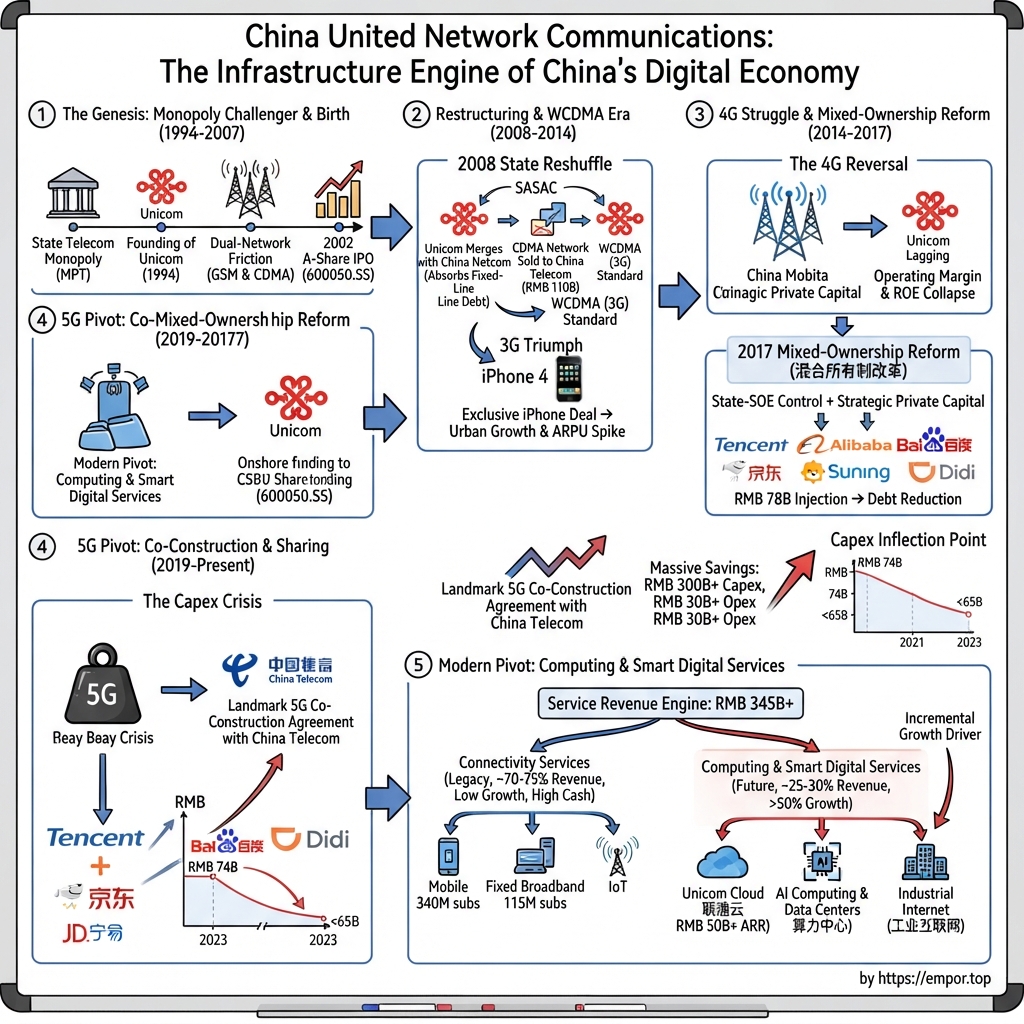
China United Network Communications: The Infrastructure Engine of China's Digital Economy
I. Introduction & Episode Roadmap
On 18 August 2026, China Unicom's management walked into a Hong Kong results briefing carrying a set of slides headed with three words: Healthy. Vibrant. Robust.1 The numbers underneath told a more complicated story. Net profit for the first half had fallen 34.6% to RMB 9.5 billion. Profit before tax was down 36.4%. And for the first time in years, the board declared no interim dividend at all — against RMB 0.2841 per share paid at the same point in 2025.23
This is a company that spent the previous three years being repackaged by the sell-side as one of Asia's cleanest capital-return stories: the 5G build was over, capital expenditure was falling every year, free cash flow was compounding, and the payout ratio was marching upward. In March 2026 that story looked intact — free cash flow of RMB 36.0 billion, up 28.5%, and a dividend payout ratio lifted to 61.3%.4 Five months later, the interim cheque didn't arrive.
Most of the damage was mechanical rather than moral. Beijing raised the value-added tax rate applied to mobile data services from 6% to 9%, and Unicom absorbed the difference; employee benefit expenses also landed earlier in the calendar than usual.3 Management's framing was that "the full-year contraction in profit is expected to narrow significantly."5 That may well prove right. But the episode is a useful cold shower, because it exposes the thing that is easy to forget about China Unicom: it is a listed company whose revenue, pricing, tax treatment, competitive intensity, network architecture, and chief executive are all set, to a meaningful degree, outside the building.
Two companies called China Unicom, and why the difference matters
The ticker in question, 600050.SS, is 中国联合网络通信股份有限公司 China United Network Communications Limited — the Shanghai-listed A-share company. It is not the same thing as 中国联合网络通信(香港)股份有限公司 China Unicom (Hong Kong) Limited (0762.HK), which is the entity that publishes the operating results everyone quotes. And neither is the parent, 中国联合网络通信集团有限公司 China United Network Communications Group, the central state-owned enterprise sitting above both.
The chain runs: Unicom Group controls the A-share company; the A-share company and Unicom Group jointly own China Unicom (BVI) Limited; and BVI, together with a second vehicle held directly by the Group, owns the Hong Kong listed company.6 That "second vehicle" is the detail that matters. Because a large slice of the Hong Kong entity's economics is held by the parent directly rather than through Shanghai, the A-share company's own attributable profit is far smaller than the headline figures. In 2025, the Hong Kong entity reported net profit of RMB 20.8 billion.4 The A-share company reported RMB 9.13 billion.7 Same revenue base — RMB 392.2 billion of operating revenue flows through both — but the Shanghai shareholder's claim on the profit is roughly 44% of the Hong Kong shareholder's.
That is not a scandal; it is disclosed structure. But it means an investor in 600050.SS is buying a leveraged-down claim on an operating business they must analyse through a different listed vehicle's filings, alongside a controlling shareholder that owns economics both above and beside them. Any article about this ticker that quotes only the Hong Kong numbers is quietly overstating what the A-share owns.
The arc
Six turns of the wheel got Unicom here, and each one is a lesson in what happens when industrial policy is your largest shareholder, your regulator, and your co-investor simultaneously.
It began in 1994 as the state's deliberate answer to a telecom monopoly. It survived a 2008 restructuring that handed it a fixed-line business it did not want and took away a mobile network it had just finished building. It won the 3G lottery and rode Apple to a genuine premium-subscriber franchise, then lost the 4G cycle so comprehensively that 2016 profit fell 94%. It was chosen in 2017 as the flagship of 混合所有制改革 mixed-ownership reform, taking RMB 78 billion from China's internet giants. It then did something no Western telecom pair has managed at scale — built and shared a single national 5G radio network with a direct competitor. And it is now spending its declining capital budget on artificial-intelligence computing capacity, in a market its own chairman has publicly described as showing signs of "involutionary" overbuilding.8
That last sentence is the whole investment question, and we will spend most of this episode testing it.
Myth versus reality
Four claims about this company circulate widely enough to be treated as settled. None of them survives contact with the filings intact.
The myth that owning 600050.SS gives you the profits you read about. The RMB 20.8 billion figure quoted in almost every write-up belongs to the Hong Kong entity. The Shanghai company's own attributable profit, as shown above, is a little under half that. The revenue is shared; the earnings are not.
The myth that Unicom Cloud is a RMB 50 billion-plus growth engine. It was, on the definition used three years ago. The disclosed growth rate has fallen every year since, the scope of what counts as "Unicom Cloud" has been widened at least once, and the segment aggregate around it has been re-cut three times in three reporting periods. The business is large. It is no longer growing quickly, and the reporting changes have consistently flattered rather than clarified.
The myth that falling capital expenditure equals a dividend story. Total capital spending has indeed declined for four consecutive years. But the money did not leave the company — it moved, from radio networks whose economics are understood to computing capacity whose economics are not. A shrinking budget can carry a rising risk profile.
The myth that mixed-ownership reform changed who runs the company. Tencent, Alibaba and Baidu bought in and took board representation. Nine years later, the chairman arrived by administrative appointment from a competitor. Both facts are true; only one of them determines strategy.
Each of these gets tested against the record in the sections that follow. To understand why a company with 1.3 billion connections earns a single-digit return on equity, though, the place to start is the reason it was allowed to exist at all.
 Subscribe on LinkedIn
II. The Genesis: Telecom Monopoly Breakup & The Birth of Unicom (1994–2007)
Picture China in 1993. A telephone line was not a utility; it was a status asset. Installation fees ran into thousands of yuan, waiting lists stretched for months, and the whole apparatus — network, regulation, tariffs, equipment procurement — sat inside one ministry, the 邮电部 Ministry of Posts and Telecommunications. The MPT was simultaneously the operator, the rule-maker, and the referee of its own performance. Demand for basic connectivity in a country industrialising at double-digit speed was effectively infinite, and supply was rationed by an organisation with no commercial reason to hurry.
The State Council's answer, approved in 1994, was not privatisation. It was the invention of a rival from inside the state itself. China Unicom was founded with backing from the Ministry of Electronics Industry, the Ministry of Railways, and the Ministry of Electric Power — three ministries that happened to own something valuable: rights-of-way, power corridors, and railway conduits along which fibre could be laid. Unicom was, in its origin, less a company than an institutional lever. Its purpose was to force the MPT to behave as though it had competition.
The financing hack, and the day Beijing shut it down
There was one problem: Unicom needed capital on a scale no ministry could supply, and foreign investment in Chinese telecom operations was prohibited outright. So Unicom's early managers built one of the more inventive workarounds in emerging-market corporate history — the structure that came to be known as 中中外 "Chinese-Chinese-Foreign". A foreign partner would form a joint venture with a Chinese entity; that joint venture would then contract with Unicom to supply financing and equipment in exchange for a share of network revenue. Sprint, France Télécom, Siemens and others participated. Legally, no foreigner operated a telecom network. Economically, they held revenue streams from one.
It worked until the government decided it should not. In 1999, ahead of China's WTO accession negotiations, Beijing ordered the structures unwound, and the foreign partners were bought out. The episode is worth remembering because it established a pattern that recurs throughout this story: Unicom's most creative commercial structures have survived exactly as long as they served state policy, and no longer. That is not a criticism of the company's judgement. It is a description of the operating environment, and it is the single most important input into any assessment of the durability of Unicom's advantages today.
Two networks, one balance sheet
The first great restructuring came at the turn of the millennium, when mobile operations were carved out of China Telecom to create 中国移动 China Mobile in 1999–2000. Unicom emerged from that period as something genuinely awkward: a dual-standard mobile operator. It ran a GSM network competing head-on with China Mobile's, and from 2001 it built an entirely separate CDMA network on a different technology.
The strategic logic was defensible — CDMA offered better spectral efficiency and a differentiated position. The capital logic was brutal. Unicom was financing two national mobile networks simultaneously against a competitor financing one, with a fraction of the competitor's cash generation. Every yuan of capital was split. The predictable result was that neither network achieved the coverage depth of China Mobile's GSM footprint, and coverage is the one attribute in mobile that customers can feel without being told about it. Unicom spent the decade structurally underinvested in the thing that actually drives churn.
This is the first entry in a ledger we will keep throughout: Unicom's returns have repeatedly been damaged less by bad execution than by being handed a capital allocation problem with no good answer.
Listing the holding company
600050.SS arrived on the Shanghai Stock Exchange in 2002, and it is important to understand what was listed. This was not an operating company being taken public. It was an onshore funding vehicle created to hold equity in the offshore Hong Kong operating entity and to raise renminbi capital from domestic investors at a moment when the offshore markets were unenthusiastic about a sub-scale dual-standard carrier.
That original purpose — an onshore capital-raising and control vehicle rather than a direct operating claim — has never really changed. It explains the profit-attribution gap we noted earlier, and it explains why the A-share and H-share have traded on persistently different multiples for two decades. It also set the stage for the A-share company's single most consequential moment, which arrived fifteen years later, and which we will come to.
By 2007, Unicom was profitable but strategically cornered: number three in mobile, no fixed-line business, two incompatible networks, and a 3G licensing decision pending that everyone in Beijing knew would reset the industry. What arrived in 2008 reset it harder than anyone expected.
III. The Great Telecom Restructuring of 2008 & The WCDMA Golden Era (2008–2014)
On 24 May 2008, the State Council and 国务院国有资产监督管理委员会 SASAC announced the plan that would collapse six operators into three. It was announced on a Saturday, which in Chinese policy practice signals a decision that is final and not open to lobbying.
The architecture was symmetrical to the point of being schematic. Each surviving operator would be a full-service carrier with a mobile network and a fixed-line network, and each would receive a different 3G standard. China Mobile absorbed China Railcom and was given TD-SCDMA, the homegrown standard that China wanted commercialised. China Telecom was given CDMA2000 — and, to get there, bought China Unicom's CDMA business outright. China Unicom merged with the northern fixed-line giant 中国网通 China Netcom and received WCDMA, the mature European standard with the deepest global device ecosystem.
What Unicom sold, and what it bought
China Telecom paid RMB 110 billion (about USD 15.85 billion) for the CDMA business, split between roughly RMB 66.2 billion for the network assets and RMB 43.8 billion for the business and its employees, transferring 41.9 million subscribers.9 Simultaneously, Unicom absorbed China Netcom in a share swap under which each Netcom share converted into 1.508 Unicom shares.9
Judged purely on price, neither leg was obviously a mistake. Judged on what Unicom was left holding, the trade was poor.
Consider what left the building. The CDMA network was young, recently built, technically capable, and — critically — a mobile asset in the year the world was pivoting decisively to mobile data. Consider what came in. China Netcom's northern footprint was copper and fibre serving fixed-line telephony, an enormous installed base of PSTN switching gear, and a very large workforce. Fixed voice was already in structural decline; every year of that decline arrived on Unicom's income statement as depreciation on assets whose revenue was evaporating, plus a labour cost base that could not be reduced at anything like the speed of the revenue loss.
The right way to characterise the 2008 restructuring is not that Unicom overpaid in cash — it received cash. It is that Unicom traded a growing asset for a shrinking one and accepted a permanent margin handicap in exchange. The Netcom merger did bring one durable asset: a national fixed-line and backbone infrastructure that, twenty years later, underpins the enterprise leased-line and data-centre interconnection businesses. But that payoff took a decade and a half to arrive, and it arrived only because a technology nobody was modelling in 2008 — hyperscale computing — eventually made backbone fibre valuable again. Crediting 2008 management with foresight there would be generous to the point of fiction.
The WCDMA windfall, and what it proved
Then came the good years, and they were very good.
WCDMA was not a Chinese standard; it was the world's standard. That meant every handset manufacturer on earth already built for it, while China Mobile's TD-SCDMA required bespoke devices with worse battery life and a thinner ecosystem. Unicom had, by regulatory accident, the only Chinese network that a global premium smartphone would simply work on.
Apple noticed. On 28 August 2009, China Unicom signed a three-year agreement to bring the iPhone to China, reportedly committing to purchase five million units for USD 1.46 billion.10 At the time Unicom had over 140 million subscribers against China Mobile's near-500 million.10 It was a distant number two buying a franchise it could not build organically.
The effect over 2009–2013 was the closest thing to a genuine competitive advantage Unicom has ever held in the consumer market. Affluent urban smartphone buyers — the highest-ARPU cohort in the country — selected their carrier based on which network their preferred device ran properly on, and for several years the answer was Unicom. Mobile ARPU rose, the subscriber mix skewed premium, and Unicom captured share in exactly the segment where share is most valuable.
Here is the analytical point, and it is uncomfortable. That advantage was not built. It was allocated. Unicom's premium franchise rested on a standards decision made by regulators and on Apple's independent commercial judgement, and Unicom controlled neither. When the regulator made the next standards decision, the franchise evaporated on almost the same timetable it had appeared. Any argument today that Unicom possesses a "cornered resource" in spectrum or licensing has to reckon with the fact that the last time Unicom held a genuinely cornered spectrum position, it lasted approximately four years and ended by administrative decision.
Which is precisely what happened next.
IV. The 4G Price War Trap & The Landmark 2017 Mixed-Ownership Reform
In March 2017, China Unicom's management had to stand up and explain a number that is difficult to say out loud: full-year 2016 net profit had fallen 94%.11 The company had earned, on a business with well over RMB 270 billion of revenue, something in the neighbourhood of RMB 600 million. Adjusted for the size of the asset base, Unicom had spent a year running one of the world's largest telecommunications networks essentially for free.
How does a national carrier with hundreds of millions of customers get there? Three forces arrived at once.
The 4G reversal
The first was a licensing sequence that inverted the 3G outcome. China issued TD-LTE licences early, and China Mobile — sitting on the largest cash pile in the industry — did what a cash-rich incumbent does when handed a head start: it built. By the time Unicom's FDD-LTE network had full regulatory clearance and scale, China Mobile had constructed a 4G footprint Unicom could not match, and it had done so in a technology generation where the device-ecosystem disadvantage that crippled TD-SCDMA no longer applied. Unicom finished 2016 with 60.2 million 4G subscribers.11 China Mobile's 4G base was an order of magnitude larger.
The strategic asymmetry is worth stating plainly, because it recurs: in a capital-intensive industry where coverage is the product, the operator with the largest cash flow wins any generational build-out that is run as a race. Unicom has lost that race every time it has been run on those terms. This is the single most important piece of historical evidence bearing on the current AI-computing build, and we will return to it.
提速降费 — when your regulator sets your prices
The second force was policy. Beginning in 2015, the State Council pushed a sustained campaign of 提速降费 "speed up and reduce fees": faster networks, cheaper data, and the abolition of domestic roaming charges. For consumers it was a genuine welfare gain. For the operators it was the systematic removal of retail pricing power.
Chairman 王晓初 Wang Xiaochu quantified one piece of it with unusual candour, telling investors that scrapping domestic roaming fees alone would cost Unicom roughly RMB 1.58 billion of revenue every quarter.11 "The removal of roaming fees has the biggest impact on us," he said.11 He was right that it hit Unicom hardest — a challenger with a weaker home-market footprint depends more on customers who roam.
The third force was simply the compounding of the first two: falling ARPU against a cost base loaded with the depreciation of a 4G network built late and the legacy fixed-line burden inherited in 2008.
The flagship reform
By 2017, Unicom's leverage was becoming a genuine constraint, and Beijing needed a demonstration project. State-owned enterprise reform had been official policy for years without a marquee case. Unicom was chosen as the flagship pilot of mixed-ownership reform, and the structure was executed through the Shanghai vehicle.
The A-share company issued roughly nine billion new shares and Unicom Group sold a further 1.90 billion existing shares, together representing about 35.2% of the enlarged share capital, at RMB 6.83 per share, for total consideration of approximately RMB 78 billion.[^12][^13] Roughly 10.9 billion shares in total moved to strategic investors.6 The buyers were the roll-call of Chinese internet power: 腾讯 Tencent and 百度 Baidu took stakes of about 5.33% and 3.39% respectively, an entity linked to Alibaba's founder took about 2%, alongside 京东 JD.com, 苏宁 Suning, 滴滴 Didi, China Life and state investment funds.[^12][^13] Unicom Group's direct holding in the A-share company fell from 62.7% to 36.7% — from absolute to relative control.12
Was it good capital allocation? Two answers, ten years apart.
On the narrow financial question, yes. The proceeds were used to retire interest-bearing debt and to fund the beginning of the digital build. A company that had just earned almost nothing was recapitalised without a rights issue on punitive terms and without a state bailout. Judged as balance-sheet repair, the reform worked, and it deserves credit for that.
On the broader claim — that mixed ownership transformed governance and unlocked commercial dynamism through private-sector partnership — the record is far weaker, and nine years is long enough to judge it.
Start with returns. In 2025, with the balance sheet long since repaired and the reform capital fully deployed, the Hong Kong entity's return on equity was 5.7%.4 That is not a company whose cost of capital has been beaten; it is a company earning something close to a regulated-utility return with none of a regulated utility's tariff protection. The A-share entity's attributable profit grew from RMB 8.17 billion in 2023 to RMB 9.03 billion in 2024 to RMB 9.13 billion in 2025 — a 1.07% increase in the most recent year.7
Then consider control. The reform's stated purpose was to end single-shareholder dominance. Yet in November 2025, the chairman of China Unicom was replaced by administrative appointment, and the successor came from outside the company entirely.13 Tencent and Alibaba did not choose him. The strategic joint ventures announced in 2017 across cloud, content and big data produced no separately disclosed business line of material scale that survives in today's reporting.
The honest conclusion is narrower than the 2017 headlines: mixed-ownership reform was an effective, well-priced recapitalisation dressed as a governance revolution. It fixed the thing that was broken. It did not change who decides. Investors evaluating today's strategy on the assumption that private-sector shareholders exert real strategic influence should note that in the one moment where that influence would have been visible — the choice of chief executive — it was not.
V. The 5G Pivot: Co-Construction, Sharing, & Capital Discipline (2019–Present)
By mid-2019 the arithmetic of 5G had become genuinely frightening for the two smaller Chinese carriers, and it is worth explaining why in plain terms.
Radio waves behave like light: the higher the frequency, the more bandwidth you can carry, and the less well the signal travels through walls, trees and rain. 4G in China ran largely at frequencies that propagate well, so a given tower covered a wide area. The mid-band spectrum allocated for 5G — around 2.1GHz and 3.5GHz — carries far more data but does not reach as far. To deliver 5G coverage equivalent to 4G, an operator needs materially more base stations for the same geography. More sites means more civil works, more power, more backhaul fibre, more rent, and more maintenance, forever.
For China Mobile, with a subscriber base and cash flow roughly triple Unicom's, that was expensive. For China Unicom and China Telecom, each building a duplicate national grid alongside it, it was a return-on-capital catastrophe waiting to be reported.
The deal nobody expected
In September 2019, China Unicom and China Telecom announced they would jointly construct and share a single 5G radio access network across China.14
It is hard to overstate how unusual this was. Passive infrastructure sharing — towers, sites, power — is common worldwide. Sharing the active radio network, the antennas and base station equipment that actually determine what a customer experiences, between two nationwide competitors is nearly unprecedented at this scale. The two carriers kept separate core networks, separate billing, separate spectrum identities and entirely separate retail operations. What they merged was the single most capital-hungry layer of the stack.
By September 2023, the two operators had reported cumulative savings exceeding RMB 300 billion in capital expenditure and operating costs from the shared build.[^17] Unicom continued to book incremental operating savings from the arrangement afterward, disclosing RMB 1.35 billion of annualised opex savings from ultra-lean network initiatives in 2025 alone.4 Management now describes the result as the world's first and largest co-built, co-shared 5G standalone network, and cites it as a foundation of the government's "Six Networks" infrastructure programme.5
This is, in my assessment, the most genuinely impressive strategic act in modern Unicom history — and it should be credited carefully rather than uncritically. Three qualifications matter.
First, it was almost certainly not achievable without state coordination. Two commercial rivals do not merge their radio networks because a business development team had a good idea; SASAC's ability to align both parties was the enabling condition. That makes it a real advantage, but a granted one, of the same species as the WCDMA licence.
Second, the saving is shared. China Telecom captured the identical benefit. Co-sharing improved both carriers' economics against China Mobile, but it did nothing for Unicom's position against China Telecom — which remains larger and more profitable.
Third, the saving is now historical. It is in the base. The capital intensity of the next build — AI computing — is not being shared in the same way.
The tower precedent
There is an earlier version of the same idea worth noting briefly, because it establishes the pattern. In 2015, the three carriers transferred their tower assets, estimated at around USD 36 billion, into 中国铁塔 China Tower, which listed in Hong Kong in August 2018 raising USD 6.9 billion at a valuation of roughly USD 27.6 billion; Unicom retained about 28.1%.15
Economically, this converted a large block of owned, depreciating passive infrastructure into a leased operating expense. It reduced capital intensity and it eliminated the most obviously wasteful duplication in the industry. It also, unavoidably, converted a fixed cost the carriers controlled into a payment to a third party that must itself earn a return. Tower-cos are a good deal at the moment of transfer and a slowly compounding cost afterward. That is not an argument against the transaction; it is a reminder that "asset-light" restructurings move economics around rather than creating them.
The inflection, and its limits
The capital expenditure trajectory since the 5G peak has been, on the face of it, exactly what capital-cycle investors look for. Unicom spent RMB 74.2 billion in 2022, equal to 23% of service revenue; RMB 73.9 billion in 2023 at 22%; RMB 61.4 billion in 2024 at 18%; and RMB 54.2 billion in 2025 at 16%. Guidance for 2026 is approximately RMB 50 billion.4 Free cash flow reached RMB 36.0 billion in 2025, up 28.5%.4
Falling capital intensity plus rising free cash flow is the textbook definition of a post-build telecom, and for two years it was the entire bull case.
But look at where the remaining money goes. Management guided that computing power would exceed 35% of the 2026 capital budget, "on the basis of total capex control."8 In the first half of 2026, capital expenditure was RMB 24.1 billion, of which 37% went to computing power — with the absolute computing power investment up more than 80% year on year.1
Read that carefully. The headline capital budget is falling. Within it, one line item is growing at over 80%. Arithmetically, that means the connectivity network — the business that generates roughly three-quarters of revenue and essentially all of the cash — is being funded with a sharply shrinking allocation in order to finance an AI build whose returns are unproven. Unicom's capex line has not become disciplined so much as reallocated. Whether that reallocation is prescient or destructive is the central open question of this investment case, and it is the question we take up next.
VI. Segment Breakdown & Economics: Connectivity vs. Computing & Smart Digital Services
If you want to understand where China Unicom actually makes money, the useful exercise is to ignore the strategy slides for a moment and follow the revenue.
The business splits into two halves with almost opposite characteristics. On one side sits connectivity: mobile subscriptions, fixed broadband into homes, leased lines to enterprises, and the vast and growing category of machine connections. It grows barely at all, and it throws off cash reliably. On the other sits everything the company groups under computing and digital intelligence: cloud, data centres, system integration, data services, AI applications and cybersecurity. It grows faster, it consumes capital, and — as we will see — its disclosed growth rate has been falling for four straight years while the definition of the segment has changed twice.
Segment one: the cash engine that policy keeps re-pricing
Unicom ended 2025 with more than 480 million mobile and broadband subscribers, a net addition of 20.93 million; total connections of all types reached 1.25 billion, of which IoT terminal connections were 720 million after adding 98.33 million in the year.4 By the first half of 2026, total connectivity scale passed 1.3 billion.1 The physical estate behind that: 4.8 million 4G and 5G base stations, an industry-leading 87% of broadband ports on 10G-PON, 5G-Advanced deployed across more than 330 cities, and population coverage above 99%.12
Two things about how Unicom now reports this business deserve attention.
First, the company stopped disclosing standalone mobile ARPU some years ago and now guides investors to an "integrated package ARPU" — the blended revenue from households that take mobile, broadband, television and devices together. That figure has held above RMB 100, with integrated penetration above 78%.14 Bundled ARPU is a legitimate and arguably more useful metric for a business selling household relationships. It is also, unavoidably, a metric that cannot be compared to the mobile-only ARPU the company used to publish, and it rises mechanically as more services are attached to the same customer. When a company replaces a metric that was falling with a metric that is rising, an analyst should note it rather than simply adopt it.
Second, the value of these connections is not set by Unicom. In 2026 the 工业和信息化部 Ministry of Industry and Information Technology ran a nationwide programme requiring simpler, more transparent tariffs, forcing carriers to cut the number of packages on sale and standardise disclosure. Management described implementing this as company policy, saying it had "comprehensively reduced the number of packages on sale" so that "value returning to a healthy track."5 The industry frames this as 反内卷 — an end to self-destructive involutionary competition — and there is a real argument that regulated tariff discipline raises industry returns by preventing a price war none of the three can win.
But the same regulatory hand that suppresses price competition also raised the value-added tax on mobile data from 6% to 9% in 2026, which Unicom absorbed rather than passed through, and which was the largest single driver of the 34.6% first-half profit decline.3 The correct reading is not "regulation helps" or "regulation hurts." It is that the connectivity business is a quasi-utility whose selling prices, competitive intensity, coverage obligations and tax rate are all policy variables, and its cash flows should be valued with that volatility in mind.
There is one genuine bright spot inside connectivity. 5G private network revenue — dedicated on-premise networks for factories, mines, ports and grids — reached RMB 12.3 billion in 2025, growing 51%.4 Unicom reports serving more than 10,000 5G factories and 14 million industrial devices connected to its Gewu platform.1 This is real, differentiated, and sticky in a way consumer data never is: once a mine's automation runs on your radio network, switching is a capital project, not a phone call. It is also still small relative to the whole.
Segment two: the growth engine, and what happened to it
Now the part of the story that requires the most care, because it is where the consensus narrative and the disclosed evidence diverge most sharply.
The bull case says Unicom is transforming into a computing and AI infrastructure company, with the new segment now approaching a quarter of service revenue and driving the majority of incremental growth. The headline numbers appear to support it. In the first half of 2026, computing power revenue was RMB 41.9 billion, up 13%, equal to 23.6% of service revenue, with IDC revenue up 11% and computing service revenue up 9%.12 In 2025, AI revenue grew 147%, data centre revenue reached RMB 28.1 billion up 8.5%, and the company reported 45 EFLOPS of intelligent computing capacity across more than 1.10 million standard cabinets.4
Now trace 联通云 Unicom Cloud — the flagship product, and for years the loudest number in every Unicom presentation.
In 2023, the company reported Unicom Cloud revenue of RMB 51 billion, up 41.6% year on year, following a period of triple-digit growth as the state-owned enterprise migration wave began.16 In 2024, the company disclosed Unicom Cloud revenue of RMB 68.6 billion, up 17.1% — and simultaneously noted that "the scope of Unicom Cloud revenue has been optimised" to include cloud IDC, cloud resources, cloud platform, cloud service, cloud integration, cloud interconnection and cloud security.17 In 2025, Unicom Cloud revenue grew 5.2%.4 The 2025 presentation reported the growth rate without the absolute figure.
So the sequence, as disclosed, runs from triple-digit growth, to roughly 40%, to 17.1% on a broadened definition, to 5.2%. Over the same period the top-line framing changed twice: in 2024 the company reported a "Computing and Digital Smart Applications" segment of RMB 82.49 billion, up 9.6%, representing about 24% of service revenue;17 in 2025 it reported instead a "computing power business revenue ratio" of 15.4% on a narrower definition of computing services plus data centre revenue;4 and in the first half of 2026 it reported "computing power revenue" at 23.6% of service revenue on a definition that added digital smart applications and cloud-AI services back in.1
Three different aggregates in three consecutive reporting periods, none of them reconciled to the others in the investor materials, at exactly the point where the underlying growth rate was decelerating sharply. I do not think this is fabrication — each definition is disclosed in a footnote, and telecom segment definitions genuinely do drift as products converge. But it is a serious comparability problem, and the effect of the changes has consistently been to present the growth story in its most favourable available framing.
The evidence-based conclusion is this. The claim that computing and digital services are a large and growing share of Unicom's revenue survives the scrutiny — roughly a quarter of service revenue is real, and the connectivity-to-computing mix shift is genuine. The claim that they constitute a high-growth engine capable of offsetting connectivity stagnation does not survive in its strong form. A cloud franchise decelerating to mid-single-digit growth, inside a segment growing 13%, inside a service revenue line that actually declined 0.2% in the first half of 2026, is not an engine.1 It is a mix shift running at roughly the speed of the decline it is meant to offset.
What would change that assessment? Two observable things: computing power revenue growth re-accelerating on a stable definition, and cabinet utilisation continuing to climb as capacity is added. On the second, the current evidence is encouraging — utilisation reached above 74% in the first half of 2026 on more than 1.15 million cabinets, up from 72% on 1.10 million a year earlier.14 Capacity is being absorbed as it is built. That is the single most reassuring operating datapoint in the computing story, and it is the one to watch.
VII. Current Management, SASAC Governance, & Capital Allocation Record
On 28 October 2025, 陈忠岳 Chen Zhongyue, chairman of China Unicom, was appointed to lead China Mobile Group — the company he had spent years competing against.13 Three weeks later, on 19 November, 董昕 Dong Xin was named chairman and Party secretary of China Unicom.13 Dong is 59, holds a master's degree in financial and accounting management and a doctorate in business administration, and had spent nearly his entire career at China Mobile: general manager of its finance department, chairman and general manager of its Hainan, Henan and Beijing subsidiaries, then vice president, chief accountant, and ultimately director and president of China Mobile Communications Group and chief executive of China Mobile Limited — where he oversaw the Shanghai A-share listing that raised RMB 56 billion.1318 He then spent nearly two years outside the industry as deputy director general of the National Radio and Television Administration before returning.13 He formally took the China Unicom chair in January 2026.18
简勤 Jian Qin, 60, executive director and president since April 2024, has an economics doctorate and a near-identical pedigree: chairman and general manager of multiple China Mobile provincial subsidiaries, then vice president of China Mobile Communications Group.18 He ran the company day-to-day during the interregnum between Chen's departure and Dong's arrival.13
So: China Unicom's chairman and its president are both career China Mobile executives, and China Unicom's previous chairman now runs China Mobile.
What the rotation actually means for investors
The standard bull-case reading of executive rotation among the three carriers is that it prevents destructive price wars and aligns the industry around national infrastructure goals rather than share-grabbing. There is real evidence for this. Since roughly 2019, the three operators have shared radio networks, pooled towers, and — under MIIT direction in 2026 — simplified tariffs in concert. Industry-level capital returns have improved. An executive who expects to run a competitor in five years has limited incentive to burn that competitor's economics today.
But the same mechanism has a cost that bulls rarely price. If the chief executive of a listed company is appointed by the state, from a competitor, without reference to the shareholders, then the alignment being optimised is industry-and-policy alignment, not shareholder-return alignment. Those overlap most of the time and diverge exactly when it matters — when a national infrastructure priority requires investment that a purely commercial operator would decline. The 2026 AI computing build is precisely such a moment. When Dong Xin says the company will "undertake the arduous and demanding tasks first to lay a solid foundation for reaping rewards in the future," he is describing a national-champion mandate, not a hurdle-rate discipline.8
There is also a specific consequence of the constant rotation: strategic continuity is asserted rather than demonstrated. Unicom's stated keynote — "Preserve and Innovate, Steady and Far-reaching" — and its four arenas of connectivity, computing power, service and security were articulated under one chairman and are being executed by another. Investors cannot assess this management team against its own multi-year promises, because this management team has not been in place for multiple years. That is a genuine limitation on any credibility assessment, and it should be stated rather than papered over.
The capital allocation record, assessed honestly
Start with what has clearly gone right. Dividends per share have risen every year: RMB 0.274 for 2022, RMB 0.3366 for 2023, RMB 0.4043 for 2024, and RMB 0.417 for 2025, with the payout ratio reaching 61.3%.4 The A-share dividend for 2025 was RMB 0.1635 per share, up 3.5%.7 Capital intensity fell from 23% of service revenue to 16% across the same window.4 Net debt has been held at conservative levels, and the balance-sheet fragility of the 2016–17 period has not recurred.
That is a real, verifiable improvement in shareholder-return discipline sustained over four consecutive years. It should not be dismissed.
Now the counterweights, which belong in the same paragraph rather than a distant risk section.
Compare the payout to the obvious peer. China Mobile paid out 75% of 2025 earnings and told shareholders it expects the 2026 ratio to be "stable-to-rising."19 Unicom paid 61.3%.4 Unicom is the smaller, lower-return, higher-uncertainty operator, and it retains a larger share of its earnings. Management's own explanation is explicit: "We retain a portion of the funds to continuously support the future development of China Unicom, aiming to achieve capital appreciation through effective investment."8 That is an honest statement of preference — reinvestment over distribution — and investors should take it at face value rather than assuming the payout ratio marches to management's aspirational long-term target regardless of what the compute build demands.
Then there is the interim dividend. Unicom paid RMB 0.2481 per share at the 2024 half and RMB 0.2841 at the 2025 half.178 At the 2026 half, it paid nothing.3 Management attributes the profit decline to VAT and expense timing and expects the full-year contraction to narrow.5 Perhaps the final dividend absorbs the gap. But a company that has spent three years teaching investors to view it as a rising-distribution story chose, in the first period of genuine profit stress, to preserve cash rather than maintain the interim payment. That tells you the ranking of priorities under pressure, and it is worth more than any stated payout target.
Finally, the returns question. The 2017 reform capital, the co-sharing savings, the cloud build and the falling capital intensity have coexisted with a return on equity of 5.7% and A-share attributable profit growth of 1.07%.47 Nine years of restructuring, one flagship state reform, an unprecedented network-sharing agreement, and the return on shareholders' capital sits below where most investors would put a fair cost of equity. Any assessment of this management's capital allocation has to hold those facts together: the distribution discipline has improved markedly; the return on invested capital has not.
Which brings us to the framework question — does Unicom possess durable competitive advantage at all, or is it a policy instrument that happens to be listed?
VIII. Strategic Analysis: Helmer's 7 Powers & Porter's 5 Forces
Frameworks are only useful if you are willing to score them honestly, including the low scores. Applied to a state-controlled national carrier, most of the standard "powers" turn out to be granted rather than earned — and granted powers behave very differently from earned ones when conditions change.
Hamilton Helmer's 7 Powers, applied with the counterevidence attached
Scale economies — real, but shared and second-rank. The co-built 5G network genuinely halves the marginal cost of radio densification for both Unicom and China Telecom, and both carriers hold enormous procurement leverage over 华为 Huawei and 中兴 ZTE. But scale economies are relative. China Mobile earned RMB 137.1 billion in 2025 against Unicom's RMB 20.8 billion at the Hong Kong entity, and spent RMB 150.9 billion of capital against Unicom's RMB 54.2 billion.194 Unicom's scale advantage exists against a hypothetical unshared version of itself, not against the market leader. Score: present, but it does not close the gap that matters.
Cornered resource — the most overstated claim in the bull case. Spectrum licences, rights-of-way and state security clearances for government cloud work are genuinely restricted, and no new entrant can assemble them. But the historical test is decisive: Unicom's last genuinely cornered spectrum position — WCDMA — produced roughly four good years and was neutralised by the next licensing round. Regulators grant these resources and regulators re-allocate them. A resource that can be re-priced by administrative decision, and whose retail output price is set by the same authority, is not a moat in Helmer's sense; it is a licence with attached obligations. Score: overstated.
Counter-positioning — narrow, and narrowing. The argument is that Unicom serves government and state-enterprise customers who face regulatory friction with 阿里云 Alibaba Cloud and 腾讯云 Tencent Cloud, and that hyperscalers cannot easily counter without abandoning their own model. There is substance here — Unicom reports the largest cloud-native implementation among central SOEs with 1,300 systems cloudified, more than 180 provincial and municipal government clouds, and roughly 400,000 enterprise cloud customers.4 But counter-positioning requires the incumbent to be unable to respond, and China's hyperscalers have built compliant sovereign-cloud offerings. The evidence that this position generates pricing power is weak: cloud revenue growth of 5.2% is not what a defensible niche produces. Score: real but not proven to be economically valuable.
Process power — modest. Unicom's genuine operational asset is presence: engineers, service contracts and physical plant in thousands of counties and municipalities, plus more than 100,000 partner merchants across offline channels.1 Rebuilding that would take a competitor a decade. But China Mobile and China Telecom already have it. A capability that all three incumbents possess is a barrier to entry, not a source of relative advantage. Score: industry-level, not company-level.
Switching costs — the most credible power, and the smallest. Enterprise 5G private networks, dedicated leased lines, and integrated government cloud deployments create genuine multi-year lock-in — a smart mine or automated port cannot re-tender its network annually. The 51% growth in 5G private network revenue is consistent with a business where installed customers expand rather than churn.4 But at RMB 12.3 billion, this is roughly 3.5% of service revenue.4 Score: genuine, durable, and far too small to carry the valuation.
Branding and network economies are not meaningfully present. Consumer telecom brands in China are largely undifferentiated, and telecom networks have interconnection obligations that prevent classic network effects from accruing to any one operator.
The honest composite: Unicom has one small genuine moat (enterprise switching costs), one shared structural cost advantage (co-sharing), and a set of regulatory privileges that are better understood as a licence-and-obligation bundle than as a defensible franchise.
Porter's Five Forces
Threat of new entrants — very low, and this is real. Capital requirements, spectrum scarcity and a saturated subscriber market make commercial entry essentially impossible. The only new licensed entrant of the past decade was the state broadcaster 中国广电 China Broadnet, itself an instrument of policy rather than a market participant. This force genuinely protects industry structure.
Bargaining power of buyers — higher than the bulls allow, in a specific way. Consumer buyers individually have none; data is commoditised and they take the tariffs offered. But the aggregate consumer is represented by MIIT, which functions as a monopsony buyer setting price levels across the industry. And on the enterprise side, the dominant customers are governments and state-owned enterprises — buyers with structural leverage, multi-vendor procurement policies, and budget cycles subject to fiscal pressure. Selling to the state is not the same as having pricing power over the state.
Bargaining power of suppliers — low. Huawei, ZTE and domestic server and optical vendors compete hard for operator tenders at national scale. The material exception is at the top of the AI stack, where advanced accelerators are constrained by export controls — a supplier-power problem Unicom cannot solve by negotiating harder.
Threat of substitutes — low for connectivity, meaningful for computing. Nothing substitutes for nationwide terrestrial fibre and mobile radio; satellite and Wi-Fi are complements, and Unicom has itself obtained a satellite mobile communications operating permit.4 But the computing half of the business faces direct substitution from hyperscale cloud providers and from enterprises building their own capacity.
Competitive rivalry — historically destructive, currently suppressed. The 2014–2017 period demonstrated what unmanaged rivalry does to these three balance sheets. Co-construction agreements, tower pooling, executive rotation and MIIT tariff discipline have replaced it with coordination. The critical investor question is whether that coordination is structural or discretionary. Every mechanism producing today's rational competition is a policy choice that could be reversed, and the same authority that suppressed price competition raised the VAT rate on mobile data by three percentage points in the same year.
The synthesis: Unicom's industry structure is far more attractive than its company-specific competitive position. It sits third in a well-regulated oligopoly with high entry barriers and coordinated capital discipline — which is genuinely valuable — but it possesses little that distinguishes it from the two operators above it, and it earns accordingly.
IX. Bull vs. Bear Stress Test, Material Risks, & Key KPIs
The most useful way to stress-test China Unicom is to take the bull case in its strongest form, then hand it to the company's own history and see what survives.
The bull case, stated fairly
The argument runs in four parts. First, the capital cycle has turned: the 5G build is finished, capital intensity has fallen for four consecutive years, and free cash flow is compounding. Second, industry competition has been structurally rationalised through network sharing, executive rotation and regulator-enforced tariff discipline, so the price wars that destroyed returns in the 2010s cannot easily recur. Third, the revenue mix is shifting toward computing and AI infrastructure, which carries a different — and higher — valuation framework than commoditised gigabytes. Fourth, cash returns are rising: four straight years of dividend growth to a 61.3% payout, with management pointing toward more.
Each of those claims is anchored in verifiable evidence. The question is whether Unicom's own record supports them at the strength the bull case requires.
Test one: does capital discipline survive a technology transition?
This is the claim with the longest and least flattering track record. Unicom has faced four generational build decisions in its history. On the dual GSM/CDMA build in the 2000s, it split capital across two networks and achieved coverage depth on neither. On 3G, it received a favourable standard and monetised it well for roughly four years. On 4G, it was outbuilt by a better-capitalised rival and posted a 94% profit collapse in the aftermath. On 5G, it did genuinely well — but only by refusing to run the race, sharing the network with China Telecom rather than competing on build.
The base rate is therefore one clear success out of four, and the success came from avoiding a capital race rather than winning one.
Now apply that to AI computing. Unicom is increasing computing capital expenditure more than 80% year on year, lifting it to 37% of a shrinking total budget.1 It is not sharing this build with China Telecom the way it shared 5G. It is competing against China Mobile, whose computing services revenue reached RMB 89.8 billion in 2025 against Unicom's far smaller base, and which deployed RMB 150.9 billion of total capital that year.19 It is also competing against China Telecom, which raised cloud and data-centre investment 22% to RMB 45.5 billion, making it that company's single largest capital item at 38% of the total.20
In other words, all three carriers are simultaneously building AI capacity into the same domestic demand pool, without a sharing agreement, in the pattern that has previously produced Unicom's worst outcomes.
The most striking piece of evidence here is not from a bear. It is from the chairman. Discussing the computing build, Dong Xin told investors that computing power "is also accompanied by risks and challenges. Its future returns are subject to high uncertainty, particularly against the current backdrop of some 'involutionary' construction within the industry."8 That is management explicitly naming overbuilding risk in the business it is directing the majority of incremental capital toward.
Verdict: the bull case's capital-discipline claim survives only in a narrowed form. Unicom has demonstrated discipline in total capital expenditure and in shared infrastructure. It has not demonstrated discipline, or a winning record, in a contested generational build — and it is now in one. The falsifying event to watch is straightforward: capital expenditure exceeding the guided RMB 50 billion, or the computing mix rising further while computing revenue growth does not.
Test two: is the computing pivot converting into economics?
The mix shift is real, as established. What has not been demonstrated is that it earns better returns than what it replaces.
Unicom does not disclose segment-level margins for its computing business, so we must infer. The inferences are not encouraging. In the first half of 2026, network and operation expenses rose 4.9%, and management attributed the increase specifically to "increased energy consumption costs and business settlement fees resulting from the expansion of computing power services."5 Data centres are electricity businesses with servers attached; scaling them scales power costs and third-party settlement in near-lockstep with revenue. Meanwhile the company's overall gross margin at the A-share level fell 1.38 percentage points year on year in the first quarter of 2026.21
There is also a definitional caution that belongs here rather than in a footnote. A meaningful portion of what is counted as computing revenue is system integration and cloud integration — reselling and assembling third-party hardware and software. That revenue is real, and it builds customer relationships, but it converts to gross profit at a fraction of the rate that connectivity does. A revenue line that grows while margins compress is a mix shift toward lower-quality revenue, not a re-rating event, and the burden of proof sits with management to show otherwise through disclosure it has not yet provided.
Verdict: the claim that computing changes Unicom's valuation framework is currently unproven, and the available margin evidence points the other way. What would confirm it: disclosed gross margin or contribution for the computing segment on a stable definition, sustained cabinet utilisation above current levels as capacity scales, and computing revenue growth re-accelerating above the mid-teens.
Test three: are the cash returns durable?
The dividend record through 2025 is genuinely good, and the payout expansion was delivered rather than merely promised — which distinguishes Unicom from many SOEs. But the 2026 interim decision is the first real stress test of that commitment, and the company chose cash preservation.
The activist question writes itself. A sceptical investor would ask: why does a company with conservative leverage, RMB 36 billion of free cash flow, a declining core-network build, and a return on equity of 5.7% retain nearly 40% of its earnings to fund investments its own chairman describes as having highly uncertain returns — when the market leader distributes 75%? The company's answer is that retained capital will compound through effective investment.8 The historical record on that proposition, as we have seen, is thin.
Verdict: the cash-return claim is intact but narrower than advertised. Distributions have grown reliably; they are subordinate to the computing build when the two conflict, and the 2026 interim demonstrated the ranking.
Where the bull case genuinely holds
Two elements survive intact and deserve to be stated as clearly as the criticisms.
The industry structure is real and improving. Three players, insurmountable entry barriers, an active regulator suppressing price competition, shared infrastructure, and rotating executives with no incentive to destroy each other. Whatever one thinks of Unicom specifically, this is a far better industry to own a piece of than it was in 2016.
And the operating cash generation is genuinely strengthening for identifiable, non-cosmetic reasons. Net operating cash inflow reached RMB 32.9 billion in the first half of 2026, up 13.6% and a recent high, even as net profit fell by a third.1 Management attributed this to sustained receivables discipline — customer-level ledgers, front-loaded credit control on government and enterprise accounts, and escalation on overdue projects — and reported that the growth rate and absolute increment of receivables both slowed.5 Cash flow rising while profit falls, driven by working capital rather than accruals, is a genuinely healthy signal, and it is the strongest single datapoint in the company's favour in the current period.
Material risk radar
Computing capital returns. The dominant risk, discussed above. If domestic AI infrastructure is overbuilt, Unicom will own depreciating assets with falling utilisation and will have starved its cash-generating network to fund them.
Policy and tax. The 2026 VAT increase from 6% to 9% on mobile data demonstrated that Unicom's after-tax economics can be reset by administrative action without warning or offset.3 The same authority mandates coverage obligations, tariff structures and package simplification. This risk is not hypothetical; it materialised in the most recent reporting period.
Cloud margin compression. Hyperscale price competition in China has been persistent, and Unicom's cloud growth has already decelerated to mid-single digits while carrying integration-heavy revenue.
Geopolitical and supply chain. Export controls constrain access to advanced AI accelerators, directly limiting the capability of the intelligent computing capacity Unicom is building. Separately, the FCC revoked the operating authority of China Unicom's Americas unit in January 2022, closing a market and signalling how quickly international operations can be curtailed.22 International revenue reached RMB 13.6 billion in 2025 and RMB 7.7 billion in the first half of 2026, growing 13.8%.41 It is a genuine growth vector and a genuine geopolitical exposure simultaneously.
Disclosure comparability. Three segment definitions in three periods, discontinued mobile ARPU reporting, and no computing margin disclosure. None of this is improper, but collectively it raises the cost of diligence and reduces an outside investor's ability to verify the growth narrative independently.
Structural, for A-share holders specifically. The 600050.SS claim on group economics is materially smaller than the Hong Kong entity's headline profit implies, and the controlling shareholder holds economics both above and alongside the A-share company.
The three KPIs that matter
One: computing power revenue growth and cabinet utilisation, read together, on a consistent definition. Neither number is sufficient alone. Revenue growth without utilisation could be low-margin integration pass-through; utilisation without revenue growth could be capacity leased cheaply. Together they answer the only question that matters about the compute build — is the capacity being absorbed at an economic price. Watch for whether the company reports these on a definition consistent with the prior period.
Two: capital expenditure against the RMB 50 billion guidance, and the computing share within it. Management has given a specific, falsifiable number and a specific mix. This is the cleanest available test of whether stated capital discipline survives contact with an AI arms race, and it is the metric on which this management has the least track record.
Three: dividend per share and the payout ratio through the profit trough. The 2025 payout of 61.3% was achieved in a good year. The question is what happens to distributions in a year when profit contracts and the compute budget grows. Whether the full-year 2026 dividend per share holds its four-year growth streak after the interim was skipped will tell investors more about the true capital allocation hierarchy than any stated target.
X. Earnings Call & Transcript Analysis Guide for Downstream Writer
Unicom's investor communications have a distinctive texture that is worth understanding before reading them, because the format itself shapes what can be learned.
The Hong Kong entity publishes a chairman's presentation transcript alongside results, and separately a written Q&A transcript. Neither is a live, unscripted analyst call in the Western sense — the Q&A documents read as curated, with questions phrased in a manner that permits comprehensive prepared answers. That is a limitation on what can be inferred. But the documents remain genuinely useful, for two reasons: the topics chosen for inclusion reveal what management judges it must address, and the language is specific enough to be tracked across periods.
The documents to read, and what to read them for
The 2025 annual results presentation transcript, delivered in March 2026, is the single most revealing Unicom document currently available.8 Read it for three things: the explicit RMB 50 billion capital expenditure guidance with a stated computing mix above 35%; the dividend framing, where management justifies retaining a portion of earnings; and the passage on computing returns, where the chairman volunteers that future returns carry high uncertainty amid industry over-construction. Management flagging its own principal risk unprompted is unusual and analytically valuable.
The 2026 interim Q&A transcript should be read against it.5 Note what dominates: institutional reform, the causes of the profit decline, operating cash flow improvement, product innovation, subscriber value management, "Token operations," and the government's "Six Networks" programme. Note what is absent: any direct treatment of cloud or computing margins, and any discussion of dividend policy following the skipped interim payment. In curated Q&A, omission is the most informative signal available, and both omissions concern the two questions an independent analyst would most want answered.
The three questions to press
Cloud and computing profitability. Revenue growth is disclosed; contribution margin is not. Given that management itself attributed rising network and operation expenses to energy and settlement costs from computing expansion,5 the question of whether computing revenue converts to profit at rates comparable to connectivity is unanswered and material.
Dividend versus AI capital. With the interim payment skipped and computing capital growing over 80%, the trade-off between distribution and reinvestment has moved from theoretical to live.
Revenue quality under tariff regulation. Management reports that new-subscriber unit data tariffs and broadband activation rates improved significantly and that new-subscriber value exceeds the existing-base average, citing the "Unicom Magic Cube" product, which reached over 1.5 million subscribers in roughly three months.51 That is an encouraging early datapoint on differentiated pricing — but 1.5 million against a base above 480 million is a pilot, not a turn, and the right question is whether the value premium persists past promotional periods.
Narrative consistency across time
The comparison worth making spans eight years. In 2017–18, Unicom's investor narrative was about subscriber volume, market share recovery and the transformative potential of internet-company partnerships. By 2024–25, it had shifted entirely to free cash flow, dividend payout ratio, capital intensity and enterprise digital revenue. In 2026, a third register appeared: "value-driven operations," "customer lifetime value" replacing "monthly ARPU" as the internal performance metric, and Token operations as a new growth vector.5
Some of that evolution is legitimate adaptation. But note the pattern in the metric changes specifically. Mobile ARPU was retired as a disclosure when it was under pressure. Segment definitions were revised as cloud growth decelerated. Performance appraisal is now shifting from monthly ARPU to customer lifetime value — a metric that is longer-dated, internally computed, and not externally verifiable. Each individual change is defensible. The consistent direction of the changes is toward measures that are harder for outsiders to check, and an analyst should weight management's narrative accordingly.
XI. Playbook & Investing Lessons
Co-opetition can rescue return on capital where competition cannot. The 5G sharing agreement is the most important thing Unicom has done in twenty years, and its lesson generalises: in industries where the product is coverage and the cost is duplication, the highest-return strategic move may be to stop competing on infrastructure entirely while continuing to compete on everything else. The caution is equally general — the saving accrues to both parties, so it improves the industry's economics without necessarily improving any participant's relative position.
Recapitalisation dressed as governance reform should be valued as recapitalisation. The 2017 mixed-ownership reform delivered exactly what a balance sheet repair delivers: reduced leverage, restored capacity to invest, and a crisis avoided. It did not deliver what its framing promised — changed control, private-sector strategic influence, or a step-change in returns. When a transaction is marketed on its narrative and delivers on its arithmetic, credit the arithmetic and discount the narrative.
A capital intensity inflection is only a cash flow inflection if the freed capital stays freed. The textbook telecom trade — buy when the generational build ends and capital expenditure collapses into dividends — assumes there is no next build waiting. Unicom's headline capital budget fell for four consecutive years while a new build was assembled inside it. Investors should track capital expenditure composition, not just the total, because the total can fall while the risk profile of what remains rises sharply.
When management names its own biggest risk, believe it. Dong Xin's remark about uncertain computing returns amid involutionary construction is the most important sentence in Unicom's recent disclosure, and it cuts against the narrative the rest of the presentation supports. Executives rarely understate risks they volunteer.
In state-linked infrastructure, distinguish granted advantages from earned ones. Spectrum allocations, licensing decisions, network-sharing permission and tariff regimes have all been decisive for Unicom's economics, and all were decided elsewhere. Granted advantages are valuable — they are also revocable, and they arrive bundled with obligations. Valuing them as though they were earned moats is the most common error made about companies of this type.
Metric changes are information. Retired disclosures, redefined segments and shifts toward internally-computed measures tend to cluster around periods when the previous metric was deteriorating. That is not proof of intent, but it is a reliable prompt to reconstruct the old series before accepting the new framing. The discipline is simple and unglamorous: when a company changes how it counts something, rebuild the old series before adopting the new one, and ask what the old series would have shown.
Selling to the state is not the same as pricing to the state. Unicom's most defensible commercial position — government clouds, provincial digital administration, state-enterprise migration — is also its most concentrated. A customer base of governments and state-owned enterprises offers scale, long contracts and genuine switching costs, and it simultaneously offers a buyer with budget authority, multi-vendor procurement policy, and the ability to change the specification. The 5.2% cloud growth rate is the tell: if privileged access to state buyers conferred pricing power, it would appear in the growth rate, and it has not. Concentrated public-sector demand should be underwritten as a durable revenue base, not as a moat.
Read the holding structure before the income statement. The gap between what the Hong Kong entity earns and what the Shanghai vehicle owns is disclosed, unremarkable, and routinely ignored — including by the research that frames this ticker. Wherever a listed company sits inside a chain of parent-controlled vehicles, the first analytical task is establishing what the shares in front of you actually have a claim on. That is not a China-specific lesson, but China's dual-listed state enterprises make it an expensive one to skip.
References
-
China Unicom (Hong Kong) Limited 2026 Interim Results Presentation — China Unicom, 2026-08-18 ↩↩↩↩↩↩↩↩↩↩↩↩↩↩↩
-
China Unicom (Hong Kong) Limited 2026 Interim Results Press Release — irasia / China Unicom, 2026-08-18 ↩↩↩
-
China Unicom's H1 2026 profit falls 34.6pc as VAT rate rises, declares no interim dividend — The Standard, 2026-08-18 ↩↩↩↩↩
-
China Unicom (Hong Kong) Limited 2025 Annual Results Presentation — China Unicom, 2026-03-19 ↩↩↩↩↩↩↩↩↩↩↩↩↩↩↩↩↩↩↩↩↩↩↩
-
China Unicom (Hong Kong) Limited 2026 Interim Results Q&A Transcript — China Unicom, 2026-08-18 ↩↩↩↩↩↩↩↩↩↩
-
China Unicom (Hong Kong) Limited — Shareholding Structure — China Unicom ↩↩
-
中国联通 (600050) 盈利预测与财务数据 — 同花顺金融服务网 Straight Flush Finance ↩↩↩↩
-
China Unicom (Hong Kong) Limited 2025 Annual Results Announcement Presentation Transcript — China Unicom, 2026-03-19 ↩↩↩↩↩↩↩↩
-
China Makes First Moves Toward Telco Integration — Forbes, 2008-06-02 ↩↩
-
China Unicom says removal of domestic roaming fees will trim 1.6b yuan in quarterly revenue; posts 94pc slump in 2016 net profit — South China Morning Post, 2017-03-16 ↩↩↩↩
-
China Unicom Releases Pilot Program for Mixed Ownership Reform — SASAC, 2017-08-20 ↩
-
China Unicom Taps Veteran Executive as Chairman to Navigate Telecom Transition — Caixin Global, 2025-11-20 ↩↩↩↩↩↩
-
China Unicom, China Telecom partner on 5G network — Reuters, 2019-09-09 ↩
-
China Tower raises $6.9 billion in Hong Kong IPO — RCR Wireless News, 2018-08-03 ↩
-
China Unicom (Hong Kong) Limited Annual Report 2023 — China Unicom, 2024 ↩
-
China Unicom (Hong Kong) Limited Annual Report 2024 — Performance Highlights — China Unicom, 2025 ↩↩↩
-
China Unicom (Hong Kong) Limited — Directors and Senior Management — China Unicom ↩↩↩
-
China Mobile Limited Announces 2025 Annual Results — HKEXnews, 2026-03-26 ↩↩↩
-
China Telecom boosts profit, cuts capex — Light Reading, 2026 ↩
-
中国联通(600050.SH):2026年一季报净利润为21.37亿元、同比下降17.99% — 腾讯新闻 Tencent News, 2026-04-22 ↩
-
FCC revokes operating authority of China Unicom Americas unit — Reuters, 2022-01-27 ↩
 LinkedIn
 WhatsApp
 Reddit
 Hacker News
 Email
Email Kindle
 RSS Feed
 Spotify
 Apple Podcasts
 Amazon Music
 Audible
 YouTube