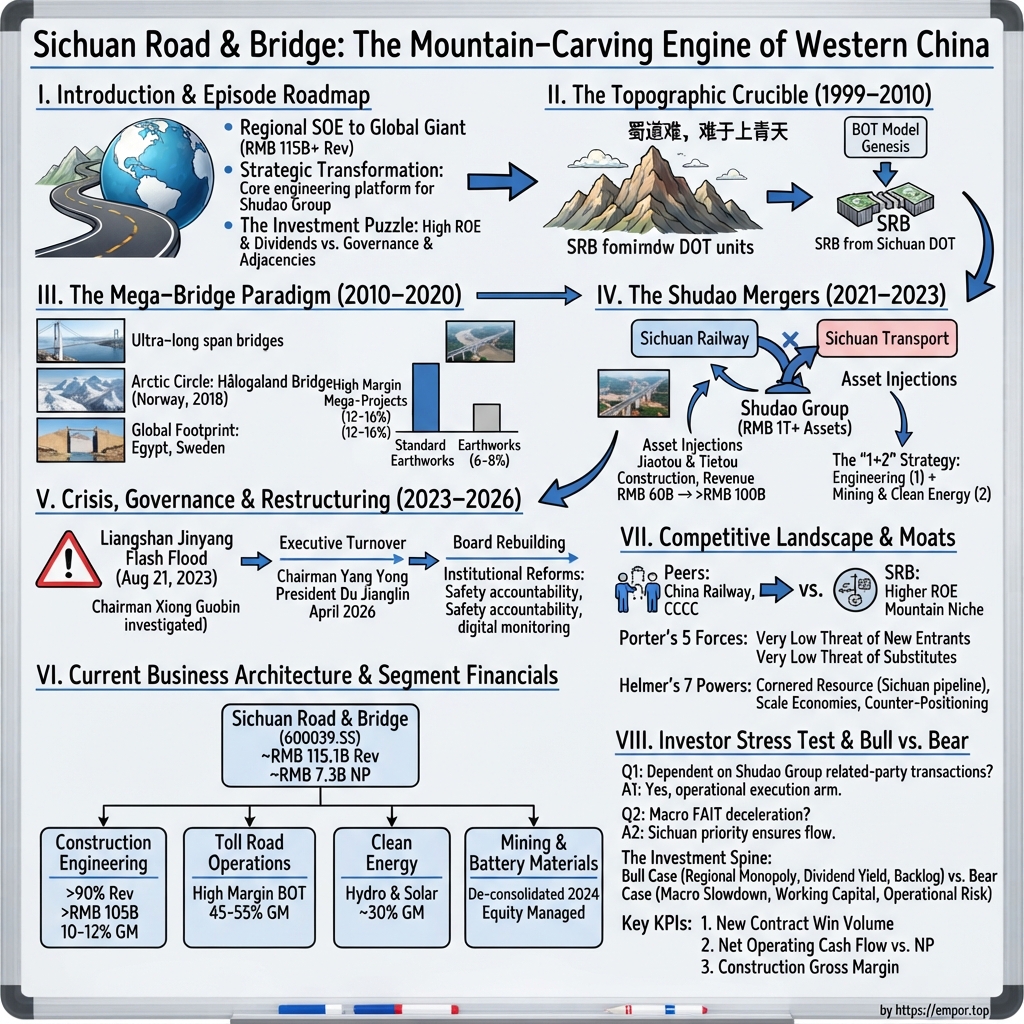
Sichuan Road & Bridge: The Mountain-Carving Engine of Western China
I. Introduction & Episode Roadmap
Stand on the deck of the Luding Dadu River Bridge, roughly 250 metres above a river that Chinese schoolchildren learn about as the site of one of the Long March's defining crossings, and the engineering problem announces itself before any spreadsheet does. The gorge walls fall away almost vertically. The wind funnels through at speeds that make conventional cable erection dangerous. On the far side, the road climbs toward the Tibetan Plateau.
The bridge that spans it — 1,411 metres long, with a 1,100-metre main span, nicknamed the "first bridge of the Sichuan–Tibet route" — required the first domestic use of a cable crane system to erect a kilometre-class steel truss girder in a high-altitude gorge under complex wind conditions. It collected the Gustav Lindenthal Medal, one of the bridge world's most prestigious awards, in 2019.1
The company that built it is 四川路桥建设集团股份有限公司 Sichuan Road & Bridge Constructors Group Co., Ltd., ticker 600039 on the 上海证券交易所 Shanghai Stock Exchange. In 2025 it reported revenue of ¥115.11 billion — roughly $16 billion — and net profit attributable to shareholders of ¥7.30 billion.2 It is one of China's most consistently profitable listed heavy-civil contractors, and it distributes more of its earnings to shareholders than almost any peer in the sector.
That is the version of the story the company tells, and it is not false. But it is incomplete in a way that matters enormously to anyone deciding what this business actually is.
The number that reframes everything. In 2024, Sichuan Road & Bridge earned a gross margin of 17.4% on work performed inside Sichuan Province, and 4.3% on work performed outside it.3 Same engineering department. Same equipment fleet. Same tier-one qualifications. Same award-winning bridge designers. A four-fold difference in gross profitability, determined entirely by which side of a provincial boundary the concrete was poured on.
That single comparison is the analytical spine of this piece. If the company's advantage were technical — proprietary methods for building in seismic, high-altitude, landslide-prone terrain — it would travel. Engineering skill is portable; that is the whole point of engineering. What does not travel is an administrative relationship with a provincial state balance sheet.
Sichuan Road & Bridge's controlling shareholder is 蜀道投资集团有限责任公司 Shudao Investment Group Co., Ltd., a provincial conglomerate with roughly ¥1.5 trillion in assets that ranked 445th on the 2026 Fortune Global 500, up nine places from the prior year.4 Shudao and its four concert parties together control 79.67% of the listed company's shares.5 The parent commissions the roads. The subsidiary builds them. The margin on that work is, in an important sense, a policy variable.
So the honest framing is not "regional SOE with a technical moat." It is: the designated construction arm of a provincial infrastructure balance sheet, which happens to be very good at bridges. Both halves matter. The technical capability is real, and it is why the province uses this vehicle rather than importing a central state-owned contractor. But the profit pool is administratively allocated, and the terms of that allocation are set by the party on the other side of the table — who also happens to own four-fifths of the equity.
This distinction produces a specific set of questions that a promotional read of the company would never ask. If the moat is a relationship rather than a capability, what happens when the province's fiscal appetite changes? If revenue is booked against provincial and platform clients whose payment cycles are lengthening, is reported profit converting into cash? And when the parent moves assets into and out of the listed vehicle — mining out in 2024, bridge components and a railway builder in during 2025 and 2026 — who is that trade priced for?
The evidence on all three is mixed, and it has been deteriorating on at least one dimension. Gross margin has fallen in each of the last three reported years, from 18.14% in 2023 to 15.68% in 2024 to 14.36% in 2025. Net margin has followed it down from 7.86% to 6.48%, and return on equity has compressed from 20.72% to 14.54%.6 Meanwhile accounts receivable grew 48.99% in 2025 against revenue growth of 7.34%, pushing the ratio of receivables to revenue from 18.06% two years earlier to 35.04%.6
Those are not the financial signatures of a business with unassailable pricing power. They are the signatures of a contractor whose largest customer is under fiscal strain.
And yet the same company raised its dividend commitment to a minimum of 60% of net profit for 2025 through 2027, executed against it precisely in 2025, and grew new contract awards 47% in a year when the national construction industry's aggregate new contract value fell 5.51%.2 The most recent reported half-year — the six months to 30 June 2026 — showed revenue of roughly ¥46.9 billion, up 7.62% year on year, with return on equity of 5.70% for the period.7 Both things are true simultaneously: growth at the top line, erosion underneath it. Reconciling them is the work.
The story runs in five movements. First, the terrain that made this company necessary, and the corporate scaffolding that emerged from the provincial transport bureaucracy. Second, the decade in which the firm converted geography into genuine technical distinction — and the much smaller commercial payoff that distinction generated abroad. Third, the 2021 provincial mega-merger that created Shudao and turned Sichuan Road & Bridge into the listed platform for a trillion-yuan construction pipeline. Fourth, the August 2023 disaster in 凉山州金阳县 Jinyang County, Liangshan Prefecture that destroyed the company's board and sent its chairman into criminal detention. And fifth, the current architecture, the competitive position, the capital allocation record, and an explicit test of what would have to be true for the bull case to hold — and what would break it.
Start where the company started: with a landscape that refused to be crossed.
 Subscribe on LinkedIn
II. The Topographic Crucible: Engineering China's Mountain Gateway (1999–2010)
There is a line from the Tang poet Li Bai that every Sichuanese schoolchild can recite: 蜀道难,难于上青天 — "The road to Shu is harder than climbing to heaven." It was written roughly thirteen centuries ago about the mountain passes into the Sichuan Basin, and it survived into the twenty-first century as something closer to an engineering specification than a poem. The provincial parent company that now controls Sichuan Road & Bridge is literally named after that line: 蜀道 Shudao, the road to Shu.
Geography as a cost structure. Sichuan is a fertile basin ringed on three sides by mountains and opening on the west onto the eastern fringe of the Qinghai–Tibet Plateau — the Hengduan range, where rivers have cut gorges more than a kilometre deep and where terrain climbs from 500 metres to 4,000 metres in under 200 kilometres of map distance. It sits on an active seismic belt. Rainfall in the western prefectures concentrates into violent summer bursts that trigger debris flows and flash floods.
For a highway builder, this translates into a single dominant operational fact: in the mountains, you barely build road. You build structure. Expressways through this terrain routinely carry bridge-and-tunnel ratios above 80% — meaning four-fifths of the alignment is either suspended in air or bored through rock.
The contrast with the rest of the industry is worth making concrete. A flatland contractor in Henan or Jiangsu moves earth, compacts subgrade, and lays asphalt. The dominant inputs are labour, fuel and bitumen, and the dominant risk is competitive tender pricing. A contractor in western Sichuan casts pier shafts into gorge walls, spins main cables across canyons, and drives tunnel headings through fractured, water-bearing rock at altitude. The dominant inputs are specialised equipment, engineering hours and time; the dominant risk is that a method fails.
These are different businesses with different cost structures, different risk profiles, and — critically — different competitive sets. Roughly nine out of ten contractors in China can do the first. Very few can do the second at scale.
The 2008 Wenchuan earthquake, which killed roughly 70,000 people and severed large sections of the provincial road network, hard-coded a further requirement into everything built afterward: seismic design became a first-order constraint rather than a code compliance box. Rebuilding the western corridors meant designing structures expected to survive ground motion that would destroy conventional construction, in places where a failed bridge means an entire prefecture is cut off. That is an unusually demanding brief, and firms that survive it accumulate genuinely scarce know-how.
The corporate origin is more bureaucratic than romantic. The listed entity was established in 1999 under Sichuan Provincial Government document [1999] No. 341, with the provincial highway and bridge construction group as its principal promoter, and it listed on the Shanghai Stock Exchange in March 2003 — the first company from Sichuan's transport system to reach the A-share market.8
It was not a founder's company. It had no charismatic entrepreneur, no garage, no pivot. It was a set of provincial engineering bureaus given a share register and a stock code, and for its first decade it behaved accordingly: a general contractor bidding for provincial highway and bridge packages, with revenue that tracked the provincial capital budget almost mechanically.
What gave that arrangement scale was national policy. The 西部大开发 Great Western Development Strategy, launched in 2000, was Beijing's answer to a widening coastal–interior income gap: pour fixed-asset investment into the western provinces, build the transport spine first, and let industry follow. For a contractor headquartered in Chengdu with tier-one highway qualifications, this was close to a two-decade guaranteed order book. Expressway kilometres in Sichuan went from a few hundred to thousands, and every one of them required more structure per kilometre than the national average.
The genuinely consequential strategic shift of this era was financial, not technical. Traditional general contracting — 施工总承包 — is a thin-margin, competitive-tender business. You bid, you build, you get paid, you move on. Somewhere in this period the company began participating in project equity: taking positions in build-operate-transfer expressway concessions, and later in what the company now calls 投建一体 invest-build integration, where the contractor is simultaneously an equity investor in the road it is constructing.
This is worth pausing on, because it is the mechanism that explains both the company's superior margins and its current cash flow problem, and most descriptions of Chinese contractors gloss over it.
Think of it as the difference between a builder who is hired to construct a house and a builder who takes a stake in the house. In the first case, the builder's economics are set by competitive tender and settle within a year or two. In the second, the builder captures the construction margin and a share of the asset's long-run cash flows — but is also funding a large portion of the project himself, and will not see that capital back for a decade or more.
The construction margin in the second case can be set generously, because the party negotiating it is partly the same party who owns the asset. That is not a scandal; it is how integrated infrastructure development works everywhere. But it does mean that the reported gross margin on an invest-build project is not a market-tested price. It is a negotiated allocation between two related parties, and its level tells you about the relationship, not about competitive strength.
The trade, in one sentence: margin today against capital locked up for years. For a contractor whose partner and eventual asset owner is the provincial government, this arrangement has a real advantage — the counterparty is not going to disappear. It also has an obvious hazard. The receivable and the concession asset both sit on your balance sheet, and their value depends on the fiscal health of a single provincial system. In good years, invest-build looks like margin expansion. In tight years, it looks like an involuntary loan to your controlling shareholder. Both interpretations describe the same contract.
By roughly 2010, then, the shape of the modern company was set: a provincially owned contractor with unusual competence in mountain structures, a policy tailwind of national scale, and a business model that had begun to trade cash conversion for reported profitability. The next decade would test how far the competence could travel.
III. The Mega-Bridge Paradigm & Global Engineering Feats (2010–2020)
On 9 December 2018, at a latitude of 68 degrees north — well inside the Arctic Circle, where December daylight is a few hours of blue dusk — traffic began crossing the Hålogaland Bridge over the Rombak Fjord near Narvik, Norway.
At 1,533 metres it was Norway's second-largest suspension bridge and the longest-span suspension bridge inside the Arctic Circle, and it cut roughly 18 kilometres from the E6 highway between Narvik and Bjerkvik. The main contractor was Sichuan Road & Bridge, which had begun on-site construction in April 2016 against a total project cost of about NOK 2.2 billion.[^9]9
It is hard to overstate the symbolic weight this project carries in the company's own telling. Chinese state media covered it as "the Norwegian sea-crossing bridge made in Sichuan."[^9] The engineering constraints were genuinely severe: European structural codes with different partial safety factors from Chinese practice, Arctic winter working windows, Norwegian labour and environmental regulation, and a client — the Norwegian Public Roads Administration — with no political reason whatsoever to be forgiving.
What the project proved, and what it did not. It proved that a provincial Chinese contractor could satisfy a demanding European public client on a technically difficult structure, on a fixed scope, at a Northern European jobsite. That is a real credential, and it is one most Chinese regional builders do not have.
What it did not prove is that this capability generates meaningful profit. Here the record is unambiguous and unflattering to the "global engineering platform" framing. In 2020, Sichuan Road & Bridge ranked 210th on the ENR Top 250 International Contractors list, with international operating revenue of $149.3 million.10 Against group revenue that year of ¥64.6 billion, overseas work was on the order of 1–2% of the business.
The company maintains offices in Norway, Germany, Tanzania, Eritrea, the United Arab Emirates and Cambodia, and has run projects in Kuwait, Bangladesh, Egypt, Turkey and Senegal.10 Its largest current overseas civil project, the Dhaka Bypass Expressway in Bangladesh — 48.079 kilometres of mainline, roughly $412 million of total investment, that country's first fully enclosed expressway — is a genuinely significant piece of infrastructure for Bangladesh.[^12] It is also, at that size, a rounding error against a ¥115 billion revenue base.
This is the first place where the standard narrative needs a correction, and the correction generalises. A marquee project is not a business line. The Hålogaland Bridge is best understood as a certification event: proof of technical capability, useful marketing collateral for domestic tenders, but not evidence of an export franchise. In the eight years since it opened, the company has not converted that credential into a materially larger international book.
That conversion record matters beyond Norway. It is the relevant base rate for judging management's newer optionality claims — mining, clean energy, overseas growth. A company that turned its most celebrated technical achievement into roughly one percent of revenue over eight years has not demonstrated a repeatable path from capability to earnings.
The domestic technical story is more commercially substantive. Through the 2010s, the company's subsidiary Sichuan Provincial Highway & Bridge Construction Group accumulated the special-grade general contracting qualification for highway engineering and grade-A highway design credentials — the tier-one licences without which a firm cannot bid the largest domestic packages at all.8
These qualifications deserve a plain-language explanation, because they are the actual legal barrier to entry. China's construction licensing system grades contractors by demonstrated project history, engineer headcount, equipment and financial capacity. The special grade is the top tier, and it cannot be purchased, borrowed or acquired quickly — it must be earned through a documented record of completed projects at scale. A new entrant with unlimited capital still cannot bid a provincial mega-package until it has built the smaller ones first. The licence is, in effect, a time barrier, and time is the one input capital cannot compress.
More importantly, the company built a portfolio of structures that solved specific mountain problems. On the Luding crossing, the cable-crane erection of a kilometre-class steel truss girder in a high-wind gorge, buckling-restrained steel bracing used as a suspension bridge's central clamp, and a corrugated-steel-web composite tower crossbeam were all domestic firsts.1 On the Sichuan–Yunnan Jinsha River bridge, the company pioneered integrated lifting of prefabricated rebar cages for tall mountain pylons and arch ribs.1
Why this work earns more, explained simply. High-structure mountain work carries a margin premium over flatland earthworks for three reinforcing reasons.
Fewer contractors can bid it credibly, so the tender field is thinner. The work is equipment- and method-intensive rather than labour-intensive, so a firm with the right cable cranes, gantries and precast yards already amortised has a genuine cost advantage over a newcomer who must buy them. And clients pricing a project where failure means a bridge in a river are less willing to award purely on price.
That premium is measurable. In 2025, Sichuan Road & Bridge's overall gross margin was 14.36%.6 中国铁建 China Railway Construction Corporation, one of the two largest railway and highway contractors on earth, reported a group gross margin of 9.72% for the same year, and 8.3% in its core engineering contracting segment, on revenue of ¥1,029.78 billion; its net profit fell 17.34% to ¥18.36 billion.11 A regional builder earning several percentage points more gross margin than a national champion is not a rounding difference — it is a structurally different position.
But test the technical explanation against the company's own spending. If the margin premium rests on continuously refreshed engineering capability, research spending should hold up. It has not. Research and development expense fell 32.48% in 2024, from ¥3.996 billion to ¥2.698 billion — 2.52% of revenue, supported by 3,940 R&D personnel, or 21.33% of the workforce.12 It then fell a further 30.73% in 2025, which the company attributed to changes in investment in intelligent systems, new technologies and new processes.13
Cutting research spending roughly in half over two years while margins compressed is a legitimate short-term cost response — and management has been explicit that expense control is a priority. It is also difficult to reconcile with a thesis that the company's edge is technological and self-renewing. If the edge were primarily R&D-derived, halving R&D would be an alarming act of self-harm. That the company did it, and that margins compressed anyway, points toward a different explanation for where the margin actually comes from.
Recall the in-province versus out-of-province split: 17.4% against 4.3% in 2024.3 Out-of-province, where Sichuan Road & Bridge competes against exactly the central state-owned enterprises whose margins it beats at home, its gross margin is roughly half theirs. The premium is not a portable engineering rent. It is what the company earns when it is building for its own parent, on projects the parent has structured, inside the province the parent controls.
The technical capability is what qualifies the company for that position and makes it hard to replace. It is not, by itself, what generates the profit. That distinction became far more consequential in 2021, when the province reorganised the entire structure above it.
IV. The Shudao Mergers & M&A Ramp: Becoming the Provincial Titan (2021–2023)
In May 2021, the Sichuan provincial government did something provincial governments across China were doing in that period, but did it at unusual scale: it merged its railway investment group and its transportation investment group into a single entity, 蜀道投资集团有限责任公司 Shudao Investment Group.14
The new group consolidated the province's transport capital — expressways, railways, ports, and the construction organisations that built them — under one balance sheet. By 2023 that balance sheet exceeded ¥1.34 trillion in assets, generating ¥266 billion of revenue and ¥11.5 billion of total profit. It has since grown toward ¥1.5 trillion, spanning 604 wholly-owned and controlled enterprises at all levels, five listed companies and nine domestically rated AAA credit entities.45
For Sichuan Road & Bridge, the merger created an immediate problem with a name: 同业竞争, horizontal competition. Under Chinese listing rules, a controlling shareholder is not supposed to own businesses that compete with the listed company it controls. The merged Shudao owned several construction organisations that did precisely what 600039 did. Something had to be resolved, and the resolution direction was never really in doubt: the listed company would absorb them.
The 2021–2022 injection. Starting in September 2021, the company launched a share-and-cash acquisition of Sichuan Transportation Construction Group, Sichuan Gaolu Construction Engineering, and a 96.67% interest in a provincial expressway greening and environmental subsidiary — all controlled by Shudao.15
The structure was revealing. A 51% stake in the construction group held by the provincial expressway development company and a 39% stake held by the Tibetan-area expressway company were paid for in newly issued shares; a 5% stake held by a port and shipping developer was settled in cash. Against a valuation date of 30 September 2021, the combined appraised equity value of the injected businesses was ¥7.794 billion.16
Paying the two largest state sellers in paper rather than cash matters. It meant the listed company did not deplete its balance sheet to acquire the assets, and it meant the parent's ownership rose rather than fell. Minority shareholders were diluted; the controlling bloc was reinforced. Weighted average shares outstanding went from roughly 4.77 billion in 2021 to about 8.62 billion in 2022 — the equity base nearly doubled.
The mechanical effect was dramatic, and it is where the "growth" narrative of this era largely comes from. Group revenue had been ¥52.7 billion in 2019 and ¥64.6 billion in 2020. It reached ¥102.6 billion in 2021 and ¥135.2 billion in 2022 — the highest figure the company has ever reported. Net profit went from ¥1.70 billion in 2019 to ¥11.21 billion in 2022, a more than six-fold increase in three years. Return on equity peaked at 26.8% in 2022.
An investor looking at that sequence in isolation would conclude they were watching a compounding machine. They were mostly watching consolidation accounting plus a peak in the Sichuan expressway construction cycle.
The subsequent three years make that unmistakable. Revenue fell to ¥115.0 billion in 2023, then ¥107.2 billion in 2024, before recovering to ¥115.1 billion in 2025 — still 15% below the 2022 peak. Net profit fell to ¥9.00 billion, then ¥7.21 billion, and recovered only marginally to ¥7.30 billion.
The core construction segment tells the story most cleanly: revenue declined 8.93% in 2023 and 10.53% in 2024, from a 2022 peak of ¥114.1 billion down to ¥92.95 billion, with construction gross margin compressing from 18.5% to 15.56% over the same window.17
So the honest characterisation of the Shudao merger era is this. The asset injections were a genuine and probably sensible tidying of a fragmented provincial construction estate; they eliminated internal bidding against the parent; and they permanently enlarged the revenue base. They did not create a durable growth trajectory, and the peak-year metrics they produced — including the ">15% ROE" that appears in most bullish descriptions of this company — have not been sustained. By 2025, return on equity as the company reports it had fallen to 14.54%.6
Meanwhile, the parent kept reorganising. Shudao's internal restructuring has continued at pace, with more than ¥10 billion of consolidations across finance, mining, clean energy and the provincial highway network in an eighteen-month stretch.18 Two of those transactions ran directly through the listed company, and they ran in opposite directions.
In November 2025, Sichuan Road & Bridge agreed to buy the bridge functional components asset group of 新筑股份 Xinzhu Road & Bridge Machinery — dampers, expansion joints, structural bearings — for an appraised ¥628.43 million.19 Xinzhu had itself become a Shudao subsidiary six months earlier, when share transfers completed in May 2025 left the group holding 24.5% and control.
The target business, Chengdu Xinzhu Transportation Technology, was founded in January 2013 with registered capital of ¥400 million and generated ¥469 million of revenue and ¥30.57 million of net profit in 2024. In January 2026 the parties reset the valuation date from May 2025 to December 2025 and cut the price to ¥560.73 million.20
The strategic logic here is defensible on its face. Bridge bearings and dampers are exactly the components a bridge specialist consumes; owning them captures upstream margin and secures supply. The price reduction on revaluation is also, modestly, a point in favour of process discipline — the number moved when the underlying assets were remeasured.
Then in April 2026 came a transaction that drew considerably more scrutiny. The company agreed to pay ¥682 million in cash for the remaining 49% of Sichuan Railway Construction, held by Shudao's railway investment arm, taking its ownership to 100%.21
Sichuan Railway Construction, founded in 1993, holds first-class qualifications in railway, highway and municipal works, and reported total assets of ¥43.25 billion and net assets of ¥12.21 billion as of mid-2025.18 The purchase was struck against a total equity valuation of ¥13.93 billion — a 13.20% premium to book, driven mainly by appreciation of investment property and fixed assets.
The criticism was sharp and specific. The target had earned ¥50.94 million of net profit in 2024 but swung to a loss of ¥30.32 million in the first half of 2025. The deal carried no performance guarantee clauses — no 业绩对赌 protecting minority shareholders if the acquired business underperformed. And the timing coincided with the listed company's own operating weakness.17
Commentators asked the obvious question: is a controlled subsidiary paying a premium for a loss-making related-party asset, without downside protection, at a moment when its own core business is under pressure, an act of industrial logic or a transfer of value upward?
There is no way to resolve that question from the outside with certainty. What can be said is that the absence of a performance undertaking is a real disclosure gap; that a 13.2% premium to book for a business currently losing money requires the acquirer to believe in a cyclical recovery that has not yet appeared in the numbers; and that this is precisely the kind of transaction a minority shareholder in a 79.67%-controlled company has almost no mechanism to contest.
The pattern in these deals — assets moving between parent and listed subsidiary at negotiated valuations, in both directions, with the listed vehicle's minority holders as price-takers — is the central governance feature of this company. It became impossible to ignore after August 2023.
V. Crisis, Governance Shock & Management Restructuring (2023–2026)
Shortly after midnight on 21 August 2023, heavy rain upstream in the mountains above Jinyang County, in Sichuan's Liangshan Yi Autonomous Prefecture, sent a flash flood down a tributary gorge.
In its path stood the workers' dormitory of a rebar processing plant serving the JN1 section of the G4216 Jinyang-to-Ningnan Expressway — a Sichuan Road & Bridge project. The flood destroyed it. Six people were killed, 46 went missing, and 21 were injured.22
What followed was not treated as a natural disaster. It was treated as a crime.
On 5 February 2024, the Sichuan Provincial Department of Emergency Management published its investigation and assessment report. Provincial discipline and supervision organs held 127 party members and supervised persons accountable for suspected violations of discipline and law and dereliction of duty. Public security organs opened criminal cases against twelve enterprise personnel and applied criminal compulsory measures.22
Former chairman 熊国斌 Xiong Guobin was placed under discipline investigation and detention. Former vice chairman and general manager 陈良春 Chen Liangchun was investigated on suspicion of the crime of falsely reporting a safety accident — 谎报安全事故罪 — and his case proceeded to court.23
That charge is the crux, and it deserves to be stated plainly rather than folded into the softer language of "regulatory investigations into safety violations and delayed reporting."
Chinese law distinguishes between an accident and the concealment of one. A flash flood in a mountain gorge during the August rainy season is a hazard that every contractor in western Sichuan faces, and competent siting, monitoring and evacuation protocols exist to manage it. The allegation of false reporting is categorically different: it concerns what the organisation did in the hours after the water came.
The contagion was immediate. Within days of the disaster, at least five executives across Sichuan's transport construction sector had been placed under investigation; on a single day, three more were taken.24 This was not one company's failure — it was a sweep through a provincial system.
The investment implication is not "this company has weather risk." Every mountain contractor has weather risk. The implication is that in August 2023, at the moment of maximum pressure, the reporting chain of a company whose entire business model depends on the credibility of its disclosures did not function as designed.
A firm that has 79.67% of its equity held by a single controlling bloc, whose largest customer is its own parent, and whose backlog figures cannot be independently verified by outside investors, is a company where reporting integrity is not a soft governance metric. It is the foundation of the whole analytical exercise. Every number in the sections that follow is self-reported.
Rebuilding took nearly three years and two full leadership transitions. 孙立成 Sun Licheng became general manager in September 2023, was elected vice chairman in October, and subsequently took the chairmanship — an interim stabilisation.25
On 30 April 2026, Sun resigned as chairman and director "due to work adjustment." The same day, the fourth meeting of the ninth board elected 羊勇 Yang Yong — previously vice chairman and general manager — as chairman and party secretary, and appointed 杜江林 Du Jianglin as general manager.26
Yang Yong's résumé reads like a map of the province's hardest roads. Born in August 1972, a party member with a master's degree and the rank of professor-level senior engineer, he spent his entire career in highway investment, construction and enterprise management: deputy chief engineer at the provincial transport department's highway and waterway quality supervision station; deputy chief engineer and deputy general manager at the Dujiangyan–Wenchuan highway company; party deputy secretary, director and general manager at the Wenchuan–Barkam expressway company; party secretary and chairman at the Jiuzhaigou–Maqu expressway company; then party committee member and deputy general manager at Shudao's expressway group before moving into the listed company.27 Du Jianglin came from the party secretary and chairman role at one of the group's own bridge construction subsidiaries.26
Read that biography as an investor rather than as a press release. Every posting sits inside the Sichuan provincial transport system. Dujiangyan–Wenchuan, Wenchuan–Barkam and Jiuzhaigou–Maqu are the earthquake-zone and Tibetan-plateau corridors — the technically hardest roads the province has built, and the ones where a project manager learns what mountain construction actually costs.
This is deep, specific operational competence in exactly the domain that matters. It is also, without exception, career progression within a single state system. There is no external capital-markets experience, no exposure to a competitive commercial environment, and no obvious constituency for minority shareholders in the appointment process, which flows from the provincial 国资委 SASAC and the parent rather than from the float.
Which leads to the incentive question. Management equity ownership is minimal. There is no meaningful alignment through personal stock exposure. Governance therefore depends on institutional mechanisms: SASAC performance evaluation, internal discipline inspection, external audit, and — the one shareholders can actually observe and hold management to — the dividend policy.
That last mechanism is genuinely load-bearing here, and the company has strengthened it, as the capital allocation section takes up in detail.
On the operational side, the company has instituted disaster-prevention protocols, site safety accountability and digital risk monitoring across mountain projects. Its 2026 action plan for "improving quality, raising efficiency and emphasising returns" placed risk control near the centre: building out identification, assessment, early-warning and disposal mechanisms, and explicitly naming regulated conduct by the "key minority" — senior officers — as the core lever of governance and compliance management.28
Those measures are appropriate, and in fairness no comparable incident has been disclosed in the company's filings in the roughly three years since. But three years is a short window against a hazard that recurs on a monsoon cycle, and the absence of a second disclosed incident is not the same as proof that the reporting culture has changed. What would constitute evidence is a near-miss disclosed voluntarily and promptly. Investors should watch for that, not for the absence of headlines.
The disaster also marks the boundary of a financial regime. The peak-earnings year was 2022. The disaster was 2023. Every metric that matters — margin, cash conversion, receivable days, return on equity — has moved in the wrong direction since. Disentangling how much of that is the construction cycle, how much is provincial fiscal stress, and how much is organisational disruption is the central diagnostic problem of the current business.
VI. Current Business Architecture & Segment Financials
Strip away the diversification language and the 2025 income statement is remarkably simple. Of ¥115.11 billion in revenue, engineering construction contributed ¥105.17 billion — 91% of the total, and up 13.15% on the prior year, a genuine recovery from two consecutive years of decline.2 Everything else is a rounding adjustment on that number.
Segment one: construction, and the anatomy of a backlog. In 2025 the company won 616 new projects worth approximately ¥203.46 billion, up 47.15% year on year — against a national backdrop in which total new contract value across Chinese construction enterprises fell 5.51%.2 Of those awards, 292 infrastructure projects accounted for ¥184.00 billion and 94 real estate projects for ¥19.02 billion. Backlog at year end stood at ¥335.00 billion, roughly 2.9 times annual revenue — nominally about three years of work in hand.
That growth is real, and it is the strongest single data point in the bull case. But three qualifications matter, and each one is specific.
The first is composition. In 2024, of ¥138.3 billion of new awards, 450 contracts worth ¥116.6 billion were inside Sichuan and 74 contracts worth ¥21.7 billion were outside it.3 Roughly 84% of new work by value was in-province — which is to say, roughly 84% of new work was in the 17.4%-margin bucket rather than the 4.3% one.
This is the mix arithmetic that determines whether backlog converts into earnings, and it matters far more than the headline award number. Growth in the out-of-province share would show up as revenue growth and margin dilution simultaneously. An investor cheering a rising order book without checking where the orders are located may be cheering the wrong thing.
The second is that the backlog figure does not reconcile. At the company's 25 May 2026 results briefing, an investor walked through the arithmetic in public: 2024 year-end backlog of ¥291.3 billion, plus 2025 new construction contracts of ¥180.7 billion, less 2025 construction revenue of ¥105.1 billion, should produce closing backlog of ¥366.9 billion. The company reported ¥335.0 billion — a shortfall of ¥31.9 billion, roughly 10% of the stated backlog.29
Chief financial officer 郭仁荣 Guo Renrong responded that "the company's project performance and contract execution proceed normally" and that "operating and financial data reflect certain differences in statistical methodologies," directing investors to future periodic reports. He did not specify whether the gap arose from contract modifications, design changes, cancellations or unfinalised signings.
That is not a satisfactory answer, and it should be weighed as such. There may be an entirely mundane explanation — scope reductions, contracts signed but later rescoped, differences between bid value and executed contract value. But a ¥31.9 billion unexplained difference in the single metric most investors use to forecast this company's revenue, met with a procedural non-answer at a public briefing, is a disclosure quality event. It bears directly on the reporting-integrity question raised by the 2023 disaster.
The third qualification is the most immediate. In the first quarter of 2026, new orders were ¥13.04 billion — down 62.40% year on year.30 One quarter is not a trend, and Chinese contract awards are lumpy and politically timed; a single large expressway package can swing a quarter by tens of billions. But a 62% decline immediately following a 47% increase is a reminder of how little forward visibility a single year's award number actually provides.
Segment two: toll roads. Toll operations generated ¥2.759 billion of revenue in 2025, having declined 3.96% to ¥2.884 billion in 2024.23 These concessions carry structurally higher margins than construction — a mature toll road is a fixed-cost asset collecting cash — and they provide recurring income that partly offsets the working capital intensity of the contracting business.
But size bounds the argument. At roughly 2.4% of revenue, toll operations cannot rescue group margins no matter how profitable they are. Any thesis that leans on "mix shift toward high-margin annuity income" runs into arithmetic before it runs into strategy. The segment is also shrinking rather than growing, and segment-level gross margins are not broken out in the annual report summary.
Segment three: clean energy. In 2024 the clean energy business generated ¥610 million of revenue, up 33.26%, having added 430 megawatts of solar capacity including distributed installations along 16 expressways, with larger projects under development at Yanyuan, Mao'ergai and Huidong in the western prefectures.3
The concept — "zero-carbon expressways," using highway rights-of-way as solar real estate — is genuinely elegant. Rights-of-way are already owned, already secured, already close to grid connections, and a highway embankment has no competing use. It is one of the few asset classes where an infrastructure contractor has a structural advantage over a dedicated renewables developer.
The scale is not elegant. At ¥610 million against ¥107 billion of group revenue, this was roughly half a percent of the business. And at the end of 2024, the company moved clean energy — along with mining — from consolidated operation to equity participation.3 Whatever this becomes, it will not be built primarily on the listed company's balance sheet.
Segment four: mining and strategic minerals, and the round trip. This is the most instructive capital allocation episode in the company's recent history, and it deserves to be told as a sequence rather than as a footnote.
In January 2023, holding roughly ¥12 billion of cash, the company announced that a subsidiary would acquire 50% of Colluli Mining Share Company for approximately $170 million, taking an equal joint venture position alongside Eritrea's state mining company in a Danakil Basin potash deposit — 1.113 billion tonnes of ore reserves, mineable from just 16 metres of depth, pitched as potentially the world's lowest-cost sulphate-of-potash project. Total project funding was estimated at $950 million, 70% project-financed, with the company's total contribution around $400 million.31 Because neither partner controlled the JV, earnings would not consolidate.
Management framed the move as part of a 1+2 strategy: engineering as the cash-generating "1", with mining and clean energy as the growth "2". At the time, that framing carried the implicit promise that the "2" would eventually matter to earnings.
The operating build-out was real. By 2024, the Asmara copper polymetallic project in Eritrea, designed for roughly 4 million tonnes of ore per year, had begun direct ore sales from its first mining area — about 70,000 tonnes for the year — and the Mabian lithium iron phosphate plant, rated at 50,000 tonnes per year, entered production in April and produced and sold over 21,000 tonnes. Mining and new materials revenue nearly doubled, up 98.13% to ¥3.343 billion.3
Then, in December 2024, the company reversed course.
Its wholly-owned subsidiary sold 20% of the mining group to Shudao for ¥651.26 million; Shudao injected a 40% equity interest in the mining operating company plus cash totalling ¥3.256 billion; and the subsidiary then sold a further 20% of the mining operating company for ¥357.16 million. Registered capital of the mining group doubled from ¥3 billion to ¥6 billion, leaving Shudao with 60% and Sichuan Road & Bridge with 40%. Shudao became the controlling shareholder, and the listed company ceased consolidating the mining businesses.3233
Management's stated rationale — concentrating resources on the core engineering business while retaining a strategic position in minerals — is coherent, and the effect on the listed company is defensible. It removed a capital-hungry, commodity-price-sensitive, geopolitically exposed division from a balance sheet already straining under receivables. If potash and copper prices fall, minority shareholders now feel 40% of it rather than 100%. Eritrea is not a jurisdiction most infrastructure investors want concentrated exposure to.
But the symmetry cuts the other way too. The listed company funded the exploration, development and ramp-up phase — the expensive, risky part — and then transferred majority control to the parent just as the assets began producing. If Colluli becomes what management said it could be, 60% of that outcome now accrues to Shudao.
Framed as risk reduction, this is prudent. Framed as sequencing, the listed vehicle carried development risk and the parent took control of the harvest. Both framings fit the facts, and the transaction was priced by the same party on both sides of it. What the episode also demonstrates is that the "1+2" strategy, announced with considerable fanfare in 2023, was substantially abandoned within two years — a strategy shift that deserves more explanation than it has received.
A fifth line worth noting: trading. Materials trading generated ¥6.706 billion of revenue in 2024, up 28.42%, and ¥6.280 billion in 2025.32 Trading revenue at this scale is largely a pass-through with minimal margin; it inflates the top line without contributing proportionally to profit. Investors comparing revenue growth across contractors should be aware that a meaningful slice of this company's reported revenue is low-value throughput rather than construction work.
The balance sheet is where all of this comes due. Total assets reached ¥267.67 billion at the end of 2025, up 11.64%.2 Total interest-bearing debt stood at ¥75.62 billion, with cash covering roughly 53% of it and the cash ratio at 0.18 — below the 0.25 level conventionally treated as comfortable. Interest expense consumed 31.27% of net profit. The top five customers accounted for 65.15% of revenue.6
Days of sales outstanding — the average time between booking revenue and collecting cash — stretched from roughly 210 days in 2022 to 427 days in 2025 on reported receivables. Contract assets, which capture work completed but not yet settled, ran around ¥80 billion.14 That combination, in plain terms, means the company is carrying more than a year of sales as claims on customers, plus a further block of work whose settlement price has not been finally agreed.
Set against that, 2025 delivered the single most encouraging data point of the recent record: operating cash flow of ¥7.76 billion, up roughly 125%, and for the first time in years comfortably in excess of reported net profit. Free cash flow turned positive at ¥6.62 billion after two consecutive negative years. In the first quarter of 2026 the cash collection ratio reached 157.46%, up 17.32 percentage points.30
Collections are improving. Whether that reflects a durable change in provincial payment behaviour or one good year of catch-up on a very large stock of arrears is the question the next four quarters will answer.
VII. Competitive Landscape, Porter's 5 Forces & Helmer's 7 Powers
Picture the bid room for a mountain expressway package in western Sichuan. Who is actually in it?
Not many people, and that is the whole point. The central state-owned giants — 中国中铁 China Railway Group, 中国铁建 China Railway Construction Corporation, 中国交建 China Communications Construction Company — can bid, and sometimes do. They have larger balance sheets, deeper international books and comparable technical depth. What they generally do not have is a parent who owns the project, a Chengdu-based equipment fleet already amortised on gorge geometry, and thirty years of relationships inside the provincial transport bureaucracy.
The competitive result shows up in the margin gap already noted, with the difference concentrated entirely in the in-province book. It also shows up in the profit trend. Where CRCC's net profit fell 17.34% in 2025 and 中国交建 CCCC reported a fourth quarter in which net profit collapsed 84.47%, contributing to a full-year decline of roughly 37%, Sichuan Road & Bridge grew revenue 7.34% and held net profit roughly flat.112
In a sector-wide downturn, the regional specialist outperformed the national champions. That is meaningful evidence that its position is not merely cyclical — a company riding the same cycle as everyone else does not decouple from it in the down year.
Against regional peers such as 山东高速 Shandong Hi-Speed, the comparison is less about technical credentials and more about the same structural question posed in a different province: how healthy is the sponsoring provincial balance sheet, and how much of the listed vehicle's book comes from it? Every provincial construction champion in China is running a version of the same trade. What differentiates them is not engineering; it is the fiscal capacity and payment discipline of the province behind them. That is an unusual thing to have to underwrite when buying an equity, and it is not a variable most infrastructure investors are equipped to forecast.
Porter's five forces, applied honestly.
Threat of new entrants: very low, and durably so. Special-grade highway general contracting qualifications take years to accumulate and cannot be bought. Mountain-specific equipment fleets and precast staging yards require capital that only sustained volume justifies. And the customer relationship is, in the most literal sense, an ownership relationship. There is no realistic path for a new firm to displace this company inside Sichuan.
Bargaining power of suppliers: low to moderate. Steel, cement and asphalt are commodities with deep markets and multiple sources, and large EPC contracts commonly incorporate price-adjustment mechanisms. Input cost inflation is a manageable risk here, not an existential one. The more meaningful supply-side exposure is skilled labour and experienced project managers in remote high-altitude sites — a constraint that does not show up in commodity indices.
Bargaining power of buyers: this is the force that actually matters, and it is high — not low. The standard framing treats a captive parent as protective. That is only half right.
When one buyer controls 79.67% of your equity, sets your contract terms, determines your project pipeline, and represents most of a customer base in which the top five names are 65.15% of revenue, that buyer has near-total bargaining power. It has simply chosen, so far, to exercise it benignly — awarding work at in-province margins that support a 60% dividend the parent itself collects most of.
The evidence that this power is real rather than theoretical is visible in the numbers. Receivables grew 48.99% in 2025 against 7.34% revenue growth; the receivables-to-revenue ratio climbed from 18.06% to 25.24% to 35.04% across three years; receivables turnover fell from 6.18 times to 3.42 times.6
Those are the fingerprints of a customer extending its own payment terms unilaterally. A contractor with genuine buyer-side leverage does not accept a doubling of its collection cycle. The company's own explanation at the 2026 briefing was that infrastructure clients are government institutions and government investment platforms with long fund approval times, and that the build-first-settle-later industry convention produces large completed-but-unsettled balances — an accurate description of the mechanism, and an implicit acknowledgment that the counterparty sets the pace.29
Threat of substitutes: very low. Mountain logistics has no alternative to roads, bridges and tunnels. Rail substitutes for some freight, but it requires the same contractors and the same terrain solutions.
Rivalry: moderate, and rising at the margin. Inside Sichuan, rivalry is muted by ownership. Outside it, the 4.3% out-of-province gross margin is what rivalry looks like when the protection is removed. As central SOEs face their own revenue pressure, their willingness to bid aggressively into provincial markets is likely to increase rather than decrease.
Helmer's seven powers, and which ones actually apply.
Cornered resource — the primary power, correctly identified but frequently mis-specified. The cornered resource is not high-altitude bridge intellectual property. Technical know-how of this kind diffuses; competitors observe completed structures, hire experienced engineers, and buy the same equipment. The halving of the company's own R&D budget over two years, with no visible loss of qualification, is itself evidence that the technology is not the binding constraint.
The genuinely cornered resource is preferential access to the pipeline of a ¥1.5 trillion provincial transport group that owns four-fifths of the company. That is close to un-replicable by any competitor. It is also, by construction, entirely dependent on a single relationship and a single provincial fiscal position — and it is a resource whose terms the owner can adjust, as the receivable data suggests it already has.
Scale economies — real but bounded. Equipment clusters, tunnelling machinery and precast yards optimised for gorge geography confer a genuine unit-cost advantage over a newcomer, and this is part of why the province uses this vehicle rather than tendering openly. But it is scale within a geography, not scale in the sense that generates a global cost curve. The 4.3% out-of-province margin is the empirical measure of exactly how far this scale advantage travels.
Counter-positioning — the weakest of the three claims, and it should be discounted. Counter-positioning in Helmer's framework requires a business model that incumbents cannot copy without damaging their existing business. Nothing prevents CRCC or CCCC from bidding mountain work in Sichuan; they simply lose more often, for reasons of relationship and local cost base rather than structural incapacity. That is a competitive advantage, but it is not counter-positioning, and labelling it as such overstates its durability.
The remaining powers — network economies, switching costs, branding, process power — do not meaningfully apply to a heavy civil contractor selling to a single institutional buyer.
The synthesis matters for how an investor should think about this company. Its moat is one power deep and one customer wide. It is genuinely strong while the relationship holds and the province keeps building. It offers essentially no protection against the one risk that actually threatens the business: a durable slowdown in Sichuan's transport capital expenditure, or a continued deterioration in the terms on which that expenditure is paid for.
VIII. Management Credibility, Capital Allocation & Investor Stress Test
On 25 May 2026, Yang Yong and Guo Renrong sat down for the company's combined 2025 annual and first-quarter 2026 results briefing on the Shanghai Stock Exchange roadshow platform.29 It is worth reading that session closely, because it is one of the few moments each year when this management team faces unscripted questions.
The tone of the answers divides cleanly into two categories.
Where management was concrete, it was genuinely concrete. Yang laid out the dividend arithmetic precisely: a final distribution of ¥0.46 per share, or ¥3.995 billion, plus interim distributions of ¥278 million, for a total of ¥4.273 billion. Including the share buyback, total returns to shareholders reached ¥4.379 billion — 60.01% of 2025 net profit.229
The 0.01% is not an accident. It is a policy floor met to the basis point, which tells you something about how this organisation treats a public commitment.
He described the buyback in operational detail: 11.4 million shares repurchased, 0.13% of capital, at a cost of roughly ¥106 million, available for equity incentives or convertible bond conversion, with unused shares subject to cancellation after 36 months.229 And he set out the cost programme concretely — rigid production targets with accountability, strict administrative expense control, higher equipment utilisation, advanced process adoption including diesel-to-electric equipment pilots, and treasury system construction.
On the demand outlook, he cited Sichuan's provincial transport plan: roughly 20,000 kilometres of expressway targeted by 2035, with about 11,000 kilometres open by the end of 2025 and, in management's framing, approximately 10,700 kilometres still to be built. For 2026 specifically, the province targets ¥140 billion of highway investment, completing 600 kilometres and starting construction on 600 more.29
Provincial data supports activity at that order of magnitude: Sichuan completed ¥125.64 billion of road and waterway investment in the first half of 2026.34 That is a genuine, externally verifiable demand signal, and it is the strongest support for the argument that the pipeline is not about to disappear.
Where management was evasive, the evasion is itself informative. The ¥31.9 billion backlog discrepancy drew the "differences in statistical methodologies" response and a referral to future filings. That is a non-answer to a quantified, arithmetically explicit question about the company's single most forecast-relevant disclosure. Compare that with the precision of the dividend answer in the same session, and the difference in candour by topic becomes hard to miss.
The dividend record is the strongest evidence for management credibility, and it should be given its full weight. The payout ratio has been raised three times in six years and delivered against each time.
Before 2020 it ran around 15%. For 2020–2022 the commitment was a minimum of 30%, with actual payouts of 39.46%, 40.46% and 50.52% — over-delivery in every year. For 2023 the floor moved to 50%; 2024's distribution came in at ¥3.606 billion, or 50.02% of net profit. The 2025–2027 plan set the floor at 60%, and 2025 delivered 60.01%.3532 The most recent yield ran near 6.9%, against a market average of 2.54%.35
That is a genuine, verifiable pattern of promise-then-delivery, sustained through a period in which earnings fell by more than a third from their peak. Many Chinese SOEs announce payout policies; delivering on an escalating one while profits decline is a materially harder test, and this management passed it three times. It is the single most credible thing about this team.
But the funding source deserves scrutiny, because "returning capital" and "generating capital" are not the same act.
In 2024, operating cash flow was ¥3.43 billion while dividends declared were ¥3.61 billion — the operating business did not quite cover the distribution. In the same year, capital expenditure of ¥7.56 billion produced free cash flow of negative ¥4.13 billion, and the company raised ¥10.54 billion of net new debt. In 2023, operating cash flow was negative ¥2.12 billion and free cash flow negative ¥9.86 billion, against ¥10.41 billion of net debt issuance.12 In 2021, operating cash flow was also negative.
Across that stretch, the dividend was not funded from operating surplus. It was funded from the balance sheet, against a net debt to EBITDA ratio that stood near 3.8 times at the end of 2025.
That is not necessarily imprudent for a state-backed entity with roughly ¥182 billion of bank credit lines available and ¥4.7 billion of direct financing completed in 2025.2 Access to funding at this scale, at state-enterprise pricing, is itself a competitive asset that a private contractor could not replicate. But it is a materially different proposition from a self-funding dividend, and 2025's ¥7.76 billion of operating cash flow is the first year in several where the distribution was covered from operations. One year is a data point, not a pattern.
The activist stress test. Suppose a sceptical fund took a position and wrote a letter. What would it say?
On related-party dependence: it would note that management, when asked about receivable risk, emphasises that its clients are provincial and state entities backed by group financing rather than distressed lower-tier municipal platforms. The letter would reply that this is precisely the point — the company is not an independent contractor with a diversified customer base but the execution arm of a single provincial capital programme, and it should be valued as such, with a discount for the absence of any arm's-length pricing test on the majority of its revenue.
On asset shuffling: it would place the December 2024 mining transfer next to the April 2026 railway purchase and ask why value flowed out of the listed vehicle when a business was ramping and into it when a business was loss-making — both at valuations negotiated with the same counterparty, and in the latter case without a performance guarantee.1732
On strategy consistency: it would note that the "1+2" framework was presented in 2023 as a multi-year diversification, and that by the end of 2024 both of the "2" had been moved off the consolidated balance sheet. Whatever the merits, that is a reversal of a publicly stated strategy inside two years, and the company's explanation — resource concentration — arrived after the fact rather than as an anticipated milestone.
On disclosure: it would put the ¥31.9 billion backlog gap and the 2023 false-reporting prosecution on the same page and argue that the company has not yet earned the presumption of disclosure reliability that its valuation implicitly assumes.
On the equity overhang: it would note that in September 2025 Shudao announced a plan to sell up to 2% of the company via block trades between 13 October and 31 December 2025, described as introducing "value investors who recognise the company's intrinsic value."36 Reasonable on its face. Also a controlling shareholder selling into its own stock at a moment when it controls the order flow that sets the earnings — a conflict that no amount of framing removes.
On accounting judgment: it would point to roughly ¥80 billion of contract assets and ask how much of that balance represents work whose settlement price remains genuinely unagreed, and what the impairment sensitivity looks like if provincial settlement discipline tightens further.14 It would also flag the 2025 divergence in which taxes and surcharges fell 46.56% while revenue rose 7.34%, and construction in progress rose 39.51% — neither necessarily improper, both worth explaining.6 And it would ask whether cutting R&D by roughly half over two years is a temporary cost measure or a permanent reduction in the capability the company markets as its differentiator.
On the counter-argument: the fund would have to concede that collections improved sharply in 2025, that the dividend floor has been honoured to the basis point across three escalating commitments, that new awards outgrew a shrinking national market by more than fifty percentage points, and that the company out-earned every central SOE peer in a bad year for the sector. This is not a broken business. It is a business whose economics are inseparable from a counterparty its shareholders cannot influence.
IX. The Investment Spine: Bull vs. Bear Case & 3 Key KPIs
Reduce everything above to a single question and it becomes tractable: is Sichuan Road & Bridge a company with a moat, or a company with a landlord?
The bull case, stated at its strongest.
First, the pipeline is administratively secured and quantitatively large. A backlog of ¥335.0 billion against ¥115.1 billion of revenue is roughly three years of visibility. Sichuan's expressway build-out has, on management's account, thousands of kilometres still to run toward a 2035 network target, with ¥140 billion of provincial highway investment budgeted for 2026 alone.229 In an industry where the national new-contract pool shrank 5.51% in 2025, this company's awards grew 47.15%.2 Whatever one thinks of the relationship's fairness, it is delivering volume.
Second, the margin position is empirically superior and survived a stress test. Fourteen-plus percent gross margin against sub-ten-percent at CRCC, roughly flat net profit in a year when the two largest central SOE peers posted double-digit and thirty-plus-percent profit declines.112 That relative performance in a downturn is the best available evidence that the position is structural rather than cyclical.
Third, the capital return commitment is codified, escalating and delivered. Three payout increases in six years, each met or exceeded, culminating in a 60% floor for 2025–2027 delivered at 60.01%, with a yield near 6.9% against a 2.54% market average.352 For an investor whose primary requirement is distributed cash rather than growth, this is a genuine and comparatively rare form of discipline among Chinese SOE contractors.
The bear case, stated at its strongest.
First, the earnings peak is three years behind. Revenue peaked at ¥135.2 billion in 2022 and net profit at ¥11.21 billion; 2025 delivered ¥115.1 billion and ¥7.30 billion. Return on equity fell from 26.8% to roughly 14%, and gross margin has declined in each of the last three years. The frequently repeated ">15% ROE" characterisation of this company describes a period that has already ended.
Second, and most seriously, the business is converting revenue into receivables rather than cash. Days of sales outstanding roughly doubled between 2022 and 2025. The receivables-to-revenue ratio nearly doubled in two years. First-quarter 2026 receivables were up 75.94% year on year.30 Roughly ¥80 billion of contract assets sit alongside ¥75.6 billion of interest-bearing debt, with interest expense consuming nearly a third of net profit.614
The mechanism is straightforward: invest-build integration books margin today and collects cash years later, and when the counterparty's own fiscal position tightens, "years later" extends. The company is, in effect, financing its controlling shareholder's road programme with borrowed money — and paying out 60% of the accounting profit on that arrangement in cash dividends.
Third, the order book is volatile and the disclosure is imperfect. A 47% award increase followed immediately by a 62.40% first-quarter decline, and an unreconciled ¥31.9 billion backlog gap that management declined to explain, together mean the single metric that drives forward estimates cannot be relied on with confidence.2930
Fourth, operational and governance risk is not hypothetical here. Six dead, 46 missing, 127 people held to account, twelve criminal cases, a former chairman detained, a former general manager prosecuted for falsely reporting a safety accident.2223 The remediation appears serious. The base rate is not zero.
Weighing it, and what survives.
The moat claim, tested against the company's own record, does not survive in the form it is usually stated. "World-class mountain engineering technology creating a defensible margin premium" is falsified by the company's own segment disclosure: the same engineering earns 17.4% at home and 4.3% away, and eight years after the Hålogaland Bridge the international book remains around one percent of revenue.310 The R&D halving without qualification loss points the same direction.
The narrower claim does survive: preferential access to a provincial pipeline, protected by technical qualifications that make the company genuinely hard to replace in that role, generates margins meaningfully above national peers. That is a real advantage. It is a relationship advantage, and it should be underwritten as one.
The management quality claim survives in one dimension and fails in another. On capital returns, the record of promise-then-delivery is verifiable across three escalating commitments and should be credited. On disclosure and related-party transaction discipline, the record includes a criminal false-reporting prosecution, an unexplained backlog discrepancy, a two-year strategic reversal explained after the fact, and a premium-priced purchase of a loss-making affiliate without performance protection. Both are true of the same team.
The capital allocation claim — that management "restrains speculative capex" — needs qualifying rather than accepting. The mining build-out was speculative capex, undertaken at scale, and it was transferred to the parent at majority control just as production began. Describing the outcome as discipline is generous; describing it as a completed round trip whose upside now accrues 60% to the controlling shareholder is more precise. What can fairly be said is that the listed vehicle is now simpler and less capital-hungry than it was in 2023.
The dividend claim survives with one condition. It is real, codified and honoured. Whether it is self-funding depends on whether 2025's ¥7.76 billion of operating cash flow was a turn or a catch-up. In 2023 and 2024 it was not self-funding.
Three KPIs, and only three.
One: new contract awards and the backlog roll-forward — including the reconciliation. Not just the headline number, but whether reported closing backlog ties to opening backlog plus awards less revenue. The ¥31.9 billion gap makes this a disclosure test as much as a demand test. A clean reconciliation in the next annual report would materially strengthen the case; a repeat, or another methodological deflection, would materially weaken it.
Two: operating cash flow relative to net profit, read together with receivables and contract assets as a percentage of revenue. This is the single most important number for this company. If cash conversion stays above one and the receivables ratio stabilises or falls from 35%, the invest-build model is functioning as designed and the dividend is genuinely earned. If 2025 proves to have been a one-year catch-up and the ratio resumes climbing, the company is booking margin it will not collect, and the 60% payout becomes a debt-funded distribution.
Three: gross margin on construction, split between in-province and out-of-province. This is where the moat is measured directly. The in-province figure tests whether the parent is still awarding work on terms that generate a premium. The out-of-province figure tests whether anything about this business is competitive on open ground. Convergence of the first toward the second would mean the moat is being repriced by its owner — the most consequential thing that could happen to this equity, and something no headline revenue number would reveal.
X. Epilogue & Playbook Lessons
Go back to the bridge deck above the Dadu River. The structure is genuinely remarkable. It solved problems no one had solved before, in a place that punishes error, and it won an award named after the engineer who built the Hell Gate Bridge. Nothing in the analysis above diminishes that.
But the bridge is not the business. The bridge is the qualification that makes the business possible.
Three lessons carry beyond this company.
First: extreme physical constraints can build real capability, but capability and profit are different assets. Sichuan's terrain forced this company to become genuinely excellent at something difficult, and that excellence is why the province entrusts it with the work. The profit, however, is generated by a relationship, and the proof is in the company's own books — the same engineers, the same methods, four times the gross margin on one side of a provincial line.
When evaluating any specialist, the useful test is not whether the capability is impressive but whether it earns a premium where the sponsoring relationship is absent. Here, tested over eight years and across two continents, it largely has not. The corollary applies far beyond infrastructure: a marquee technical achievement is evidence of what a company can do, never of what it gets paid to do.
Second: parent-subsidiary alignment is a two-way valve, and minority shareholders only control the direction of traffic when it flows their way. Shudao's restructuring genuinely eliminated internal competition and enlarged the listed company's revenue base. It also moved a maturing mining business out at majority control and a loss-making railway builder in at a premium to book, both priced by the same counterparty, in one case without performance protection.
An investor who owns this equity is not buying a company so much as buying a defined slice of a provincial balance sheet's construction earnings — and the terms of that slice are reset periodically by someone else. That is not automatically a bad trade. Slices of provincial balance sheets can be very profitable, and this one has paid out reliably. But it should be priced as what it is, and the escalating dividend policy is best read as the mechanism through which the controlling shareholder compensates minorities for holding a position they cannot otherwise influence.
Third: governance resilience is tested by what an organisation does in the hours after something goes wrong. The 2023 disaster produced not just casualties but a criminal charge for falsely reporting them. The subsequent protocols, the two leadership transitions, and the absence of a further disclosed incident in the three years since are meaningful. They are not yet proof.
In a company where nearly every material fact an outside investor relies on — backlog, contract assets, related-party pricing, segment margins — is self-reported and cannot be independently verified, the credibility of the reporting function is not a governance nicety. It is the entire basis on which the numbers can be used at all. The ¥31.9 billion question at the May 2026 briefing was, in that sense, the most important exchange of the year, and it went unanswered.
What Sichuan Road & Bridge is, then, is a genuinely capable engineering organisation occupying a genuinely privileged position, with genuinely superior margins and a genuinely honoured dividend commitment — attached to a single customer that is also its owner, at a moment when that customer is paying more slowly than it used to.
The bull and bear cases are not competing readings of the same facts. They are the same fact, seen from either end of the relationship. Which one dominates over the next several years will be settled not by the next bridge, however remarkable, but by how quickly the money comes back down the mountain.
References
-
Sichuan bridges span the province's rivers and chasms — Sichuan Daily / Sichuan Online (四川新闻), 2026-06 ↩↩↩
-
Sichuan Road & Bridge Construction Group Co., Ltd. 2025 Annual Report Summary — Shanghai Securities News (上海证券报), 2026-04-25 ↩↩↩↩↩↩↩↩↩↩↩↩↩↩↩↩
-
Sichuan Road & Bridge Construction Group Co., Ltd. 2024 Annual Report Summary — Shanghai Securities News (上海证券报), 2025-04-23 ↩↩↩↩↩↩↩↩↩↩
-
2026 Fortune Global 500 list released: three Sichuan enterprises included — People's Daily Sichuan Channel (人民网四川频道), 2026-07-29 ↩↩
-
Eagle Eye Alert: Sichuan Road & Bridge receivables growing faster than revenue — Sina Finance (新浪财经), 2026-04-24 ↩↩↩↩↩↩↩↩
-
Sichuan Road & Bridge (600039) company data and latest results — 10jqka Financial Services (同花顺金融服务网) ↩
-
Sichuan Road & Bridge Construction Group Co., Ltd. 2025 Public Offering of Corporate Bonds to Professional Investors (Tranche 1) Prospectus — Shanghai Stock Exchange, 2025-04-15 ↩↩
-
Norway's second-largest bridge, built by a Chinese enterprise, aids development in northern Norway — Xinhua News Agency (新华网), 2023-12-09 ↩
-
Deeply integrating into the Belt and Road: Sichuan Road & Bridge Construction Group's overseas high-quality development — China Association for Public Companies (中国上市公司协会), 2022-09-28 ↩↩↩
-
China Railway Construction Corporation (601186.SH) reports 2025 results: net profit attributable to shareholders of 18.363 billion yuan, down 17.34% — Sina Finance (新浪财经), 2026-03-30 ↩↩↩
-
Reading Sichuan Road & Bridge's 2024 annual report: revenue and net profit both decline, multiple expense lines shift — Sina Finance (新浪财经), 2025-04-22 ↩↩
-
Reading Sichuan Road & Bridge's Q1 2025 results: R&D expense halved, net operating cash flow still negative — Sina Finance (新浪财经), 2025-04-29 ↩
-
Revisiting the sustainability of Sichuan Road & Bridge's high dividend — 10jqka (同花顺财经), 2025-06-22 ↩↩↩↩
-
To resolve horizontal competition, Sichuan Road & Bridge plans to acquire assets under Shudao Group — Sina Finance (新浪财经), 2021-09-29 ↩
-
Sichuan Road & Bridge announcement on the listing and circulation of restricted shares from the issuance of shares and payment of cash to purchase assets and raise supporting funds — Shanghai Securities News (上海证券报), 2025-11-22 ↩
-
Sichuan Road & Bridge's 682 million yuan acquisition draws controversy: core business under pressure, yet paying a premium for a loss-making asset — Sina Finance (新浪财经), 2026-04-12 ↩↩↩
-
Shudao Group's internal restructuring accelerates: Sichuan Road & Bridge takes Sichuan Railway Construction for 682 million yuan — Tencent News (腾讯新闻), 2026-04-01 ↩↩
-
Same Shudao family: Sichuan Road & Bridge to take over Xinzhu Shares assets for 628 million yuan — Sina Finance (新浪财经), 2025-11-07 ↩
-
Sichuan Road & Bridge announcement on progress of the acquisition of Chengdu Xinzhu Road & Bridge Machinery's bridge functional components asset group and related-party transaction — Sina Finance (新浪财经), 2026-05-12 ↩
-
Sichuan Road & Bridge announcement on acquiring the 49% stake in Sichuan Railway Construction held by Shudao Railway Investment Group and related-party transaction — Shanghai Securities News (上海证券报), 2026-04-01 ↩
-
Full text: Investigation and assessment report on the "8·21" flash flood disaster in Jinyang County, Liangshan Prefecture, Sichuan — Beijing Daily (北京日报), 2024-02 ↩↩↩
-
Sichuan Road & Bridge: Liangshan Jinyang flash flood investigation report released, former chairman Xiong Guobin and others placed under criminal compulsory measures — Jiemian News (界面新闻) ↩↩
-
After the Sichuan Jinyang flood, at least five transport-construction executives have been investigated — The Paper (澎湃新闻), 2023-09-05 ↩
-
Sichuan Road & Bridge adjusts its helmsman — China Securities Journal (中国证券报), 2026-04-30 ↩
-
Sichuan Road & Bridge: vice chairman Yang Yong promoted to chairman, Du Jianglin succeeds Yang Yong as general manager — Sina Finance (新浪财经), 2026-04-30 ↩↩
-
Sichuan Road & Bridge: Yang Yong appointed chairman, Du Jianglin appointed general manager — Sohu (搜狐), 2026-05-01 ↩
-
Sichuan Road & Bridge announcement on the 2026 "improving quality, raising efficiency and emphasising returns" action plan (Announcement No. 2026-025) — CNINFO (巨潮资讯网), 2026-04-24 ↩
-
A 31.9 billion yuan order gap draws market questions: the 60.01% dividend line, 10,700 km of expressway still to build — highlights from Sichuan Road & Bridge's results briefing — Sina Finance (新浪财经), 2026-05-25 ↩↩↩↩↩↩↩↩
-
Sichuan Road & Bridge (600039) Q1 2026 results analysis: net profit down 15.72%, receivables rise — Sohu (搜狐), 2026-05-01 ↩↩↩↩
-
Holding 12 billion yuan in cash and advancing the "1+2" business layout, Sichuan Road & Bridge moves on an East African potash mine — 21st Century Business Herald (21经济网), 2023-01-05 ↩
-
Sichuan Road & Bridge announcement on the controlling shareholder acquiring shares in and increasing capital of subsidiary Mining Group, and Mining Group acquiring equity in subsidiary Road & Bridge Mining — Shanghai Stock Exchange filing, 2024-12-05 ↩↩
-
Sichuan Road & Bridge announcement on the controlling shareholder's change to its horizontal-competition undertaking — Sina Finance (新浪财经), 2024-12-05 ↩
-
In the first half of 2026, Sichuan completed 125.64 billion yuan of road and waterway construction investment — CRI Online (国际在线), 2026-07-22 ↩
-
Benchmarking first-tier "dividend assets": Sichuan Road & Bridge raises its payout ratio to 60% — 21st Century Business Herald (21经济网), 2025-02-25 ↩↩↩
-
Sichuan Road & Bridge: controlling shareholder Shudao Group plans to reduce its stake by no more than 2% via block trades — Tencent News (腾讯新闻), 2025-09-10 ↩
 LinkedIn
 WhatsApp
 Reddit
 Hacker News
 Email
Email Kindle
 RSS Feed
 Spotify
 Apple Podcasts
 Amazon Music
 Audible
 YouTube