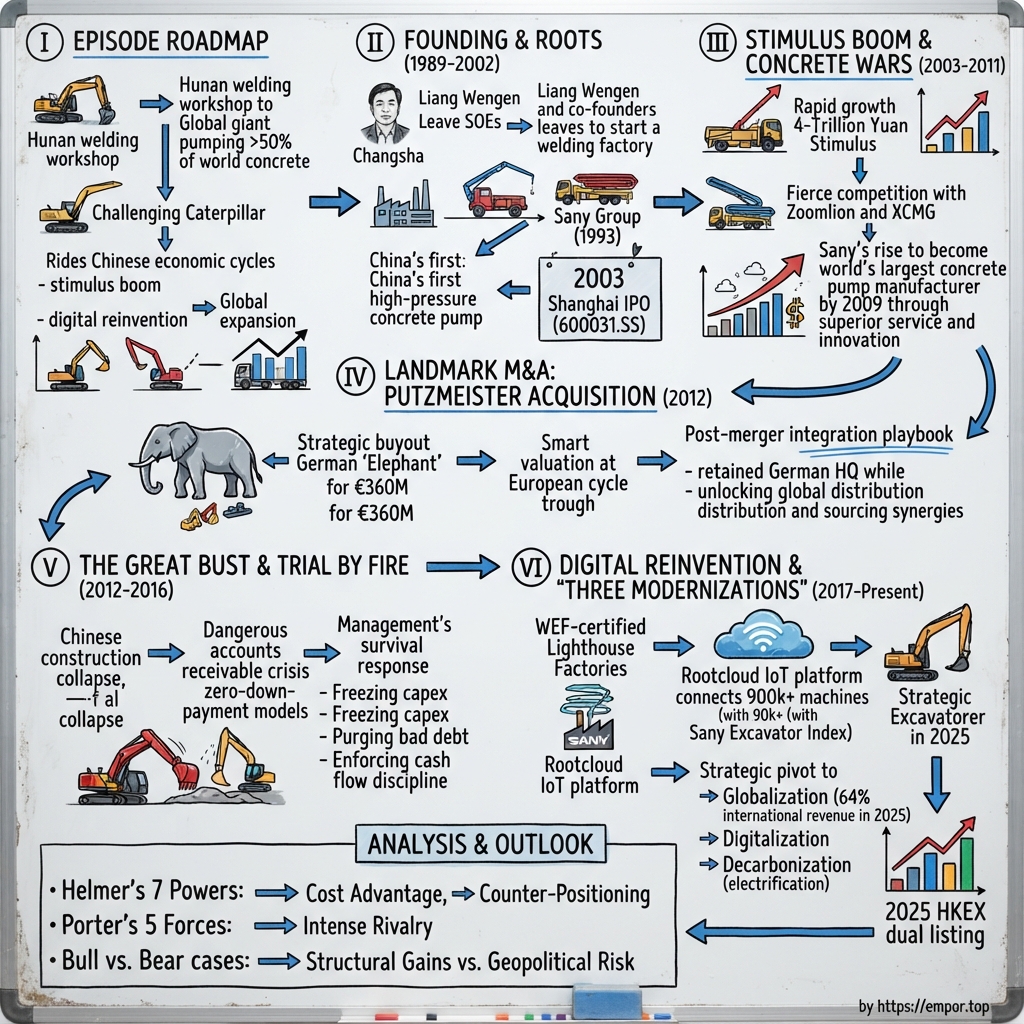
Sany Heavy Industry: Building the World's Concrete and Earth-Moving Machine
I. Introduction & Episode Roadmap
In June 1989, four engineers pooled 60,000 yuan borrowed from relatives and friends and opened a welding-materials workshop in Maotang, a village in the county-level city of 涟源 Lianyuan, deep in rural 湖南 Hunan province. The lead founder was 梁稳根 Liang Wengen, joined by 唐修国 Tang Xiuguo, 毛中吾 Mao Zhongwu, and 袁金华 Yuan Jinhua.1 They were not building machines. They were making the consumable rods that other people used to weld metal together.
Thirty-seven years later, that workshop's corporate descendant — 三一重工 Sany Heavy Industry Co., Ltd, ticker 600031 on the 上海证券交易所 Shanghai Stock Exchange — reported 2025 revenue of RMB 89.7 billion, net profit attributable to shareholders of RMB 8.41 billion, and sold 114,115 machines into more than 150 countries.2 Nearly two-thirds of that revenue came from outside China. The four original founders, plus three colleagues who joined later, still control the company through 三一集团 Sany Group.
That is the story arc. It is genuinely remarkable. It is also, for an investor arriving in 2026, only about half of what matters.
The hook, and what it obscures. Sany's marketing materials and much of the financial press describe it as the company that "pumps the world's concrete." Sany's own 2025 annual report claims its concrete machinery has been the world's number-one brand for fifteen consecutive years, and that its excavators have led China in unit sales for fifteen straight years.2 Those are the company's own claims, and they are plausible on export-volume data. But the widely repeated figure that Sany pumps "over 50% of the world's concrete" is not something Sany discloses, and it is not verifiable from any filing. What is verifiable is more instructive: in 2025, concrete machinery generated RMB 15.74 billion of Sany's revenue at a 20.15% gross margin — the lowest-margin core product line in the portfolio, and the only major one whose margin went backwards.2 The business that made Sany famous is no longer the business that makes Sany money.
The core thesis, stated honestly. Sany is the clearest live experiment in whether a Chinese capital-goods manufacturer can convert a domestic scale position into durable global share against Caterpillar and コマツ Komatsu. The company rode China's 四万亿计划 4-Trillion Yuan Stimulus to a 2011 peak of RMB 50.8 billion in revenue and RMB 8.65 billion in net profit — then watched revenue fall 54% and net profit collapse by more than 97% to RMB 203 million by 2016. That is not a downturn. That is a near-death experience, and it is the single most important fact in Sany's file, because everything management now claims about credit discipline, cash-flow priority, and cost structure is a claim made by people who once got it catastrophically wrong.
The recovery has been real. Revenue in 2025 exceeded the 2011 peak by 77%, with roughly 43% fewer employees. International revenue reached RMB 55.86 billion, or 64% of main-business revenue, at a 31.6% gross margin versus 20.7% at home.2 Operating cash flow hit a record RMB 19.98 billion. In October 2025, Sany completed a Hong Kong listing that raised HK$12.36 billion.3
But the most recent data complicates the story. In the first half of 2026, revenue grew 19.7% and headline net profit grew 9.1% — while profit excluding non-recurring items fell. In the first quarter, that core-profit measure dropped 16.2% year over year even as revenue grew 14.2%, with operating cash flow down 19.8%.4 A company that is growing revenue at scale while its underlying operating profit shrinks is telling you something about price, mix, currency, or credit costs. Working out which is the analytical task of this piece.
What this episode covers. The rural founding and the specific engineering breakthrough that made Sany a machine company rather than a consumables company. The stimulus decade and the extraordinarily ugly "Concrete Wars" against 中联重科 Zoomlion and 徐工机械 XCMG — a rivalry that ended with a jailed journalist, espionage accusations, and Sany moving its headquarters out of its own hometown. The 2012 purchase of German concrete-pump icon Putzmeister, and what fourteen years of ownership actually produced. The 2012–2016 collapse, in the detail the numbers permit. The digitalization campaign, including the industrial-internet venture that withdrew its own IPO. The globalization push that now defines the business. And finally, a structured test of the bull case against the company's own record — because Sany's history contains unusually good evidence for and against nearly every claim management makes today.
 Subscribe on LinkedIn
II. Founding & Early Roots: From Lianyuan to Changsha (1989–2002)
The founding myth of Sany is not a garage. It is a village workshop making welding rods, and the interesting part is not the poverty — it is how quickly the founders concluded that welding rods were a dead end.
Liang Wengen and his co-founders had left secure engineering jobs at state-owned enterprises during the early reform era, a genuinely risky move in a China where the 铁饭碗 "iron rice bowl" of state employment was still the default definition of a successful life. The Lianyuan Special Welding Materials Factory they opened in 1989 was profitable almost immediately — but it was a commodity business with no technical barrier and no path to scale.
The pivot that defined everything. In November 1994, the company split from the Lianyuan factory and restructured as a limited liability company focused on construction machinery manufacturing, relocating its centre of gravity to 长沙 Changsha, Hunan's provincial capital.1 The name 三一 — "three ones" — came from an aspirational slogan about first-class enterprise, first-class talent, first-class contribution. The strategic insight underneath was less poetic and more valuable: China was about to pour an unprecedented volume of concrete, and every machine that moved that concrete was imported.
In the early 1990s, China's concrete-pump market belonged to foreign brands — Putzmeister and Schwing from Germany, 極東開発工業 Kyokuto Kaihatsu from Japan. Chinese contractors paid import prices for equipment designed for European job sites, and waited for spare parts to arrive by sea.
How a concrete pump actually works, and why it was hard. A concrete pump is conceptually simple and mechanically brutal. Wet concrete — essentially liquid rock, abrasive and heavy — is pushed through a steel pipe by two hydraulic pistons alternating in a cycle. The critical component is the valve that switches the flow between the two cylinders on every stroke, several times per minute, for years, while a slurry of sand and gravel grinds past it. Get the valve wrong and the machine jams, leaks, or wears out. It is the part of the machine that fails.
In December 1994, Sany rolled out its first construction-machinery product in Changsha: the HBT60A trailer pump, described in company accounts as China's first domestically developed open-circuit concrete trailer pump.5 It did not work well. The flow-control valve assembly was unreliable, and the non-standard component designs that governed it were controlled by foreign manufacturers — Sany could neither build the assembly itself nor secure a stable supply.
The fix was the founding act of Sany as an engineering company. A technical team led by 易小刚 Yi Xiaogang abandoned the industry-standard approach and rebuilt the flow-control valve using off-the-shelf standard components — a design decision that traded elegance for supply-chain independence. After months of iteration, they succeeded, and Sany obtained its first patent. In October 1995, the redesigned 60A pump launched and became the company's first genuinely successful machine.5 By 1999, Sany had developed China's first 37-metre boom pump truck with self-owned intellectual property.5
That episode is worth sitting with, because it establishes a pattern Sany has repeated for three decades: when a foreign supplier controls a bottleneck component, Sany's answer is to redesign around it rather than negotiate for it. Yi Xiaogang, the engineer who led that valve project, is today one of Sany's executive presidents and a member of the controlling shareholder group.1 Very few large companies still have the person who solved the founding technical problem sitting in the executive suite thirty years later.
Going public. In December 2000, the company converted from a limited liability company into a joint stock company and took the name Sany Heavy Industry. Two months earlier, Liang Wengen and the other initial shareholders had consolidated their equity into Sany Group, which became the controlling parent.1
In July 2003, Sany listed on the Shanghai Stock Exchange, offering 60 million A shares — 25% of the enlarged share capital. Post-listing, Sany Group owned roughly 72.4% and public shareholders 27.6%.1 The IPO was small by any modern standard, and the capital raised was modest. Its real significance was structural: it converted a Hunan family-and-founders enterprise into a listed vehicle with access to public equity, public debt, and — critically — an acquisition currency.
The 2005 share reform. A footnote from this era matters more than it appears. In June 2005, Sany conducted a share reform converting 180 million non-tradable shares into ordinary A shares, compensating existing public shareholders with 3.5 shares and RMB 8 in cash for every 10 A shares held.1 Sany was among the first Chinese listed companies to complete this reform, which unlocked the state-era distinction between tradable and non-tradable stock across the entire A-share market.
The detail matters because it is the earliest data point on how this management team treats minority shareholders when it has leverage. Sany did not have to move first. Moving first meant negotiating a compensation package with public holders at a moment when the company could have waited for a more favourable regulatory framework. Whether that reflects genuine shareholder orientation or simply a desire for tradable stock as an acquisition currency is not determinable from the record — but the outcome was a clean, early conversion, and Sany's directors later confirmed no material non-compliance with Shanghai Stock Exchange rules or Chinese securities regulations through to the 2025 Hong Kong listing.1
The founders as a bloc. One governance feature deserves flagging early, because it colours every later decision. Liang Wengen, Tang Xiuguo, 向文波 Xiang Wenbo, Mao Zhongwu, Yuan Jinhua, Yi Xiaogang, and 周福贵 Zhou Fugui are all shareholders and directors of Sany Group, and all are formally designated as parties acting in concert, contractually bound to vote together and, failing consensus, to vote as Sany Group decides.1 As of the Hong Kong listing, this group held approximately 33.73% of issued shares, with Liang Wengen personally holding 56.74% of Sany Group.1
That is a control structure with real advantages — it permitted the long-horizon, deeply unpopular decisions that saved the company after 2012 — and real costs. A third of the register can outvote the other two-thirds on most practical matters because the other two-thirds are dispersed. Minority holders in Sany are, in governance terms, passengers.
For its first fourteen years as a listed company, that hardly mattered, because the stock went up and the market went vertical.
III. The Stimulus Boom & The "Concrete Wars" (2003–2011)
Between 2008 and 2011, Sany's revenue grew from RMB 13.7 billion to RMB 50.8 billion — nearly a fourfold increase in three years — and net profit rose from RMB 1.23 billion to RMB 8.65 billion, a sevenfold gain. That is the arithmetic of the greatest infrastructure boom in modern economic history, and Sany was standing exactly where it landed.
The macro setup was extraordinary. China was urbanising at a pace with no historical precedent, building a high-speed rail network from nothing, and pouring concrete for residential towers in cities most Western investors could not name. Then, in response to the 2008 global financial crisis, Beijing announced the 4-trillion-yuan stimulus programme, and demand for construction machinery went from strong to hallucinatory.
Winning the domestic market. Sany's competitive playbook in this era was not primarily technological. It was commercial, and it was aggressive on three fronts.
The first was service. Sany built a reputation on response time — engineers dispatched to breakdowns fast, because in a boom a stopped machine costs a contractor far more than the machine's price premium. In a market where foreign brands offered better engineering but slower parts, speed was a genuine differentiator.
The second was product iteration. Sany pushed new models into the market continuously rather than on Western multi-year development cycles, accepting more field failures in exchange for faster learning.
The third — and this is the one that nearly destroyed the company — was financing. Sany, like its Chinese peers, sold machines on extraordinarily loose terms: minimal down payments, extended instalment plans, and generous dealer credit. For a contractor with a signed project and rising asset prices, a near-zero-money-down excavator was free money. For Sany, every such sale booked revenue immediately and parked the credit risk on the balance sheet as a receivable.
This worked beautifully as long as the machines kept working and the projects kept coming. It functioned, in effect, as a subprime lending business bolted onto a manufacturer — and, as with subprime, the losses arrive with a multi-year lag.
The Concrete Wars. The domestic fight was extraordinarily personal, because Sany's fiercest competitor sat in the same city. Zoomlion, a state-linked enterprise, was also headquartered in Changsha. XCMG, the state-owned giant, operated from 徐州 Xuzhou in Jiangsu.
Competition between Zoomlion and Sany before roughly 2006 was largely confined to concrete machinery; afterwards it expanded across the full product range — mining trucks, cranes, bulldozers.[^6] The rivalry escalated from price competition into something closer to information warfare. Sany executives complained publicly that they were the targets of a dirty-tricks campaign involving accusations of tax evasion, bribery of officials, and theft of R&D.[^6]
It got worse. In November 2012, Zoomlion accused Sany of stealing trade secrets and data; Sany denied the allegations. Shortly afterwards, Sany announced it was moving its headquarters from Changsha to Beijing, with the relocation to be completed within two months — a decision reported as reflecting Liang Wengen's exhaustion with a stream of negative and, in the company's characterisation, untrue press coverage.6
The saga's most notorious chapter came in 2013, when a journalist who had reported on Zoomlion was detained, an episode that generated national headlines and reputational damage across the sector.7
What the Concrete Wars actually reveal. It would be easy to file this as colourful history. It is more useful as evidence about industry structure. Two things stand out.
First, this was a market where three well-capitalised domestic players fought over the same customers with essentially interchangeable machines. That is the definition of a low-differentiation industry, and it explains why Chinese construction-machinery margins have historically been thin and cyclical. Sany's current international gross margin of 31.6% looks impressive precisely because the domestic margin of 20.7% shows what this industry does to pricing when rivals are equally matched.2
Second, the intensity of the fight tells you that management believed domestic share was the prize worth almost any cost. That belief was correct for the boom and disastrous for what followed, because share bought with credit is not share — it is a loan portfolio you have not underwritten.
The dealer channel, and why it was the real weapon. One structural feature of the Chinese boom deserves explanation, because it is unfamiliar to investors who know Western equipment markets. Caterpillar sells through independent dealers who are separately capitalised businesses — they buy machines, carry the inventory, extend the customer credit, and absorb the loss when a customer defaults. The dealer is a shock absorber between the manufacturer and the end market.
Chinese manufacturers in the 2000s did not have that. They sold through agents and increasingly through direct channels, and they retained the credit risk themselves. What looked like a distribution choice was in fact a balance-sheet choice, and it had a seductive property during a boom: because Sany kept the credit, Sany also kept the margin the dealer would otherwise have taken, and could move faster than a manufacturer negotiating with independent partners. Sany could decide on a Monday to offer easier terms and see the volume on Friday.
The cost of that speed only appears in a downturn. When Chinese demand broke, Sany discovered it had no shock absorber — the losses came straight to the parent. Caterpillar's dealers, by contrast, took a large share of the 2009 and 2015 mining downturns on their own books. This single structural difference explains more about the divergent 2012–2016 experiences of Chinese and Western equipment makers than any argument about product quality, and it is the reason the dealer network Sany is now building overseas is a genuinely strategic asset rather than a marketing line item.
The milestone that mattered. By the end of this period, Sany's concrete machinery had become, by the company's account, the world's leading brand — a position its 2025 annual report describes as having been held for fifteen consecutive years, implying the crown was taken around 2011.2 That claim is company-sourced and should be treated as such, but the direction of travel is not in dispute: a Hunan workshop had displaced German incumbents at the top of a category those incumbents had invented.
Which raised an obvious question in Changsha and Beijing: if you have already beaten the Germans on volume, why not simply buy them?
IV. Landmark M&A: Acquiring the German "Elephant" Putzmeister (2012)
Karl Schlecht founded Putzmeister in 1958 and built it into the most respected name in concrete pumping — the company whose machines were flown to Fukushima in 2011 to pour water onto stricken reactors, whose "Elephant" boom pumps were the reference standard on every serious job site in Europe.8 By 2011 the company employed about 3,000 people and generated roughly €570 million in revenue, well below its pre-crisis peak, as European construction remained frozen.9
Schlecht had placed 99% of Putzmeister Holding's shares into the Karl Schlecht Stiftung, a charitable foundation, with the remaining 1% in a family foundation.10 He needed a buyer who could fund the company through a European trough without dismembering it.
The transaction. On 31 January 2012, Sany announced with CITIC Industrial Fund a joint investment of €360 million to acquire 100% of Putzmeister; the agreement had been signed on 20 January.10 Sany took 90% for €324 million; CITIC PE Advisors (Hong Kong) took the remaining 10%.10 Chinese regulatory clearances followed through the spring, and the share transfer completed on 16 April 2012.10 Including Putzmeister's debt, the total enterprise value was approximately €500 million.9
Did Sany overpay? On disclosed figures, the equity price implied roughly 0.6 times trailing revenue, and the enterprise value roughly 0.9 times. The EBITDA multiple was not disclosed, and it should not be estimated from the outside. For comparison, Caterpillar had agreed in November 2010 to acquire mining-equipment maker Bucyrus International for $92 per share, about $7.6 billion in equity and roughly $8.6 billion including net debt, against Bucyrus revenue of roughly $3.75 billion — well over two times sales.11 Sany bought a global category leader at a fraction of the multiple a Western incumbent paid for a comparable asset a year earlier.
The reason is not that Sany negotiated brilliantly. It is that Sany was buying a European industrial asset in the depths of the European sovereign debt crisis, from a foundation seller who prioritised continuity over price, while Caterpillar had been buying a mining asset at the top of a commodity supercycle. Timing did most of the work. The honest conclusion is that Sany bought well because it had cash when European assets were cheap — a repeatable advantage only if the company still has cash the next time assets are cheap, which is a balance-sheet question rather than a dealmaking one.
The integration. Sany's post-merger approach was deliberately light-touch: the Aichtal headquarters, German management, and workforce were retained rather than restructured. The commercial logic ran in two directions. Putzmeister kept the premium Western positioning and the customer relationships that came with it, while its distribution and service footprint gave Sany's own machines a credible route into European and North American markets that a Chinese brand could not have opened alone. Running in the other direction, Sany's Chinese manufacturing base could supply lower-cost components into Putzmeister's supply chain.
Why a German foundation sold to a Chinese buyer at all. The counterfactual is instructive. In 2012, a European or American strategic buyer could have bid for Putzmeister. None did at a price the foundation accepted, for a reason that reveals something about the industry: Putzmeister's growth market was China, and a Western owner would have been buying a European cost base to compete in a market where Chinese manufacturers had already won on price and service response. Sany was the only buyer for whom Putzmeister was worth more inside the acquirer than standalone, because only Sany could relieve Putzmeister of the need to compete in China at all.
The deal also carried a political dimension that Chinese outbound acquirers of that era usually failed to manage. German industrial acquisitions by Chinese buyers were, and remain, politically sensitive; the "Mittelstand sold to Beijing" framing was available to any critic who wanted it. Sany's decision to preserve Aichtal, the management, and the workforce was partly commercial logic and partly a deliberate defusing of that reaction. It worked — the deal completed without the regulatory friction that would sink comparable transactions a decade later, when European and American screening regimes hardened considerably. An investor should note that this specific window has closed: the 2012 playbook of buying a Western brand to gain distribution is far less available to Chinese acquirers in 2026 than it was then, which is precisely why Sany's current international strategy depends on building networks organically rather than buying them.
What fourteen years of ownership produced. Sany's own tenth-anniversary account described Putzmeister's sales growing from about €500 million in 2011 to more than €800 million by 2021 while retaining its leading position in global concrete machinery.12 Putzmeister Holding GmbH remains a major subsidiary in Sany's group structure as of the 2025 Hong Kong listing.1
That is a respectable outcome — roughly 60% revenue growth over a decade, with the brand intact and no publicly reported goodwill impairment. It is not a transformational one. Consider what it did not do: Sany's concrete machinery segment generated RMB 15.74 billion in 2025 at a 20.15% gross margin, the weakest of the core lines, and the only major segment whose gross margin declined year over year.2 Fourteen years after acquiring the world's premium concrete-pump brand, Sany's concrete business is its lowest-margin significant business. Meanwhile excavators — a category Sany entered organically, without a marquee acquisition — generated more than twice the revenue at a 34.24% gross margin.2
The honest reading is that Putzmeister was a good deal that bought exactly what it was priced to buy: a brand, a European service network, and legitimacy. It did not confer pricing power on Sany's concrete business, and the segment's margin trajectory suggests the category itself is structurally commoditising faster than brand can defend it. Investors extrapolating from "Sany owns Putzmeister" to "Sany has a moat in concrete machinery" should look at that 20% gross margin and reconsider.
There is a second lesson, and it is the more important one for reading the rest of this story. The Putzmeister deal closed in April 2012. Within months, Sany's domestic market began an unwinding so severe that the acquisition would look, in hindsight, like the last decision made by a company that thought the boom was permanent.
V. The Great Bust & Trial by Fire (2012–2016)
The numbers tell the story with a bluntness that no narrative improves upon.
Sany's revenue peaked in 2011 at RMB 50.8 billion. By 2016, it was RMB 23.3 billion — a decline of 54%. Net profit peaked in 2011 at RMB 8.65 billion. In 2015, Sany earned RMB 4.96 million — not billion, million — a figure so close to zero that the company reported earnings per share of RMB 0.0007. In 2016, net profit recovered to RMB 203 million, still 97.6% below the peak. For two consecutive years, one of China's largest industrial companies was, in economic terms, break-even.
This was not a Sany-specific failure. The entire Chinese construction-machinery industry went through the same wringer as post-stimulus demand evaporated and the enormous fleet sold during the boom sat idle. But Sany's specific vulnerability was the credit it had extended to win that boom.
Anatomy of the receivables trap. Here is the mechanism, in plain terms. During the boom, Sany sold machines to contractors with minimal down payments. The revenue and the profit were booked at delivery. The customer's obligation to pay sat on Sany's balance sheet as an account receivable, or as a longer-dated receivable if the instalment plan ran for years.
When construction demand collapsed, those contractors could not generate the cash flow to service their instalments. Sany's choices were all bad: repossess machines into a market where used equipment was worthless, restructure the debt and extend the exposure, or write it off.
The balance sheet shows the squeeze precisely. In 2014, Sany carried RMB 21.07 billion of accounts receivable against revenue of RMB 30.36 billion — receivables equal to about 69% of a full year's sales. In 2015 it was worse: RMB 21.59 billion of receivables against RMB 23.47 billion of revenue, a ratio of roughly 92%. The company was, functionally, a finance company with a factory attached, and its loan book was deteriorating.
Cash flow tells the same story from another angle. Operating cash flow, which had been RMB 5.68 billion in 2012, fell to RMB 1.23 billion in 2014 and RMB 2.14 billion in 2015. Free cash flow was negative in 2014. Total debt peaked at roughly RMB 27 billion in 2015 against shareholders' equity of RMB 22.7 billion — a company with more debt than book equity, earning nothing.
How management responded. Capital spending was cut to the bone. Purchases of property, plant and equipment fell from RMB 7.14 billion in 2011 to RMB 705 million in 2016 — a 90% reduction. Dividends were slashed; common dividends paid dropped from RMB 2.69 billion in 2012 to RMB 76 million in 2016. In 2017, Sany paid down RMB 12.16 billion of net debt in a single year, an extraordinary deleveraging that consumed essentially the entire cash flow of a recovering business.
Simultaneously, the company tightened credit standards, requiring meaningful down payments and applying real credit assessment to buyers — reforms that mechanically depressed near-term sales in exchange for collectability.
The workforce shrank dramatically. Sany employed roughly 50,000 people in 2011, when Liang Wengen briefly became the richest person in mainland China with a net worth of about $8 billion against company revenues of $5.2 billion.13 By the end of 2025, total headcount was 28,469 — 3,022 at the parent and 25,447 at subsidiaries.2 Sany's own account attributes a reduction of about 20,000 between 2012 and 2021 to automation rather than purely to the downturn, but the direction is unambiguous either way: the company that emerged from the bust employed roughly 43% fewer people than the one that entered it.
The decision that is hardest to make. It is worth pausing on what this period demanded of a management team, because the analytical significance is easy to state and the human difficulty is easy to forget. Every incentive in a downturn pushes toward maintaining volume. Factories have fixed costs that need absorbing. Sales teams are compensated on units. Dealers demand support. Competitors are still offering easy credit, so tightening terms means watching a rival take your customer in real time.
Sany's leadership chose, over several years, to lose share deliberately in order to collect cash. The evidence that this was a real choice rather than a forced outcome is the timing: capital spending was cut before the profit collapse bottomed, and the heaviest debt repayment came in 2017, when profits were recovering and the temptation to re-lever for growth would have been strongest. A management team that had simply run out of money would have deleveraged in 2015 because it had no choice. Doing it in 2017, with RMB 2.23 billion of net income and a recovering market, was volitional.
That is the strongest single piece of evidence in Sany's file for management quality, and it should be weighted accordingly — it is recent enough to bear on the current regime, it involved the same executives who run the company today, and it had a large and measurable economic consequence.
What the crisis proved, and what it did not. The bull case for Sany today rests substantially on the proposition that this management team learned credit discipline the hard way and will not repeat the mistake. That claim deserves a rigorous test rather than sympathy.
The evidence for it is real. Receivables as a share of revenue in 2025 stood at roughly 28% of sales on a net basis — a fraction of the 92% peak. Operating cash flow of RMB 19.98 billion in 2025 exceeded net profit of RMB 8.41 billion by more than two times, a genuine cash-conversion result rather than a slogan.2 The 2025 payout — an interim dividend of RMB 0.31 per share paid in October 2025 and a final of RMB 0.18 per share approved at the June 2026 annual meeting — represented roughly half of net profit, a level a company nervous about its balance sheet would not sustain.214
But the evidence against a complete rehabilitation sits in the same annual report, and it belongs here rather than in a distant risk section. Sany's auditor, Ernst & Young Hua Ming, designated the impairment of receivables, long-term receivables, and loans and advances as a Key Audit Matter for 2025 — the formal signal that an account requires significant management judgement and carries elevated misstatement risk. The disclosed amounts are substantial: gross accounts receivable of RMB 30.36 billion against a bad-debt allowance of RMB 4.82 billion; gross long-term receivables of RMB 22.99 billion with an allowance of RMB 805 million; and loans and advances of RMB 1.76 billion. Together, the carrying value of these three items equalled 28.52% of total consolidated assets.2
Read that again. More than a quarter of Sany's balance sheet is customer credit, and the allowance against ordinary trade receivables alone is roughly 16% of the gross balance — a provisioning rate that would be alarming in most industries and tells you Sany still books a meaningful share of sales to customers it expects may not pay in full. Credit impairment losses rose to RMB 1.18 billion in 2025 from RMB 897 million in 2024.2
So the calibrated conclusion is not that Sany learned its lesson, nor that it did not. It is narrower: Sany has reduced the scale of its credit exposure relative to revenue by roughly two-thirds and now generates cash convincingly through the cycle, but it has not exited the vendor-financing model — it has right-sized it. The business still runs on selling machines to customers who borrow to buy them, with Sany carrying much of that credit. That model works when end demand is growing. The KPI that would falsify the "discipline is permanent" claim is straightforward and stated later in this piece: receivables growing faster than revenue for several consecutive periods, combined with rising credit impairment charges.
Which brings us to how Sany tried to escape the trap entirely — by attacking its cost structure instead of its sales terms.
VI. Digital Reinvention: "Lighthouse Factories" & Industrial IoT (2017–2021)
The strategic problem Sany faced coming out of the bust was arithmetic. Chinese labour costs were rising every year. Domestic demand was cyclical and, after 2021, structurally impaired by the property downturn. If Sany's only advantage was cheap Chinese labour, that advantage had an expiry date.
The response was a manufacturing overhaul that management framed internally with a Chinese phrase that translates roughly as "transform or capsize" — a deliberately stark framing for an organisation that had just watched its profits fall to nothing.
What a "Lighthouse Factory" actually is. The World Economic Forum's Global Lighthouse Network, developed with McKinsey, designates manufacturing sites judged to be at the frontier of digital production. The certification is a recognition, not a revenue line — a point worth holding onto, because certification is not commercialisation.
The substance in Sany's case is more interesting than the badge. In 2021, Sany's Beijing piling-machinery plant became the first construction-machinery factory anywhere to receive the designation; in 2022, the Changsha No. 18 plant became the second.115
The Changsha No. 18 numbers, as reported by Hunan's provincial government and Sany, are specific: production capacity up 123%, staff efficiency up 98%, unit manufacturing cost down 29%, overall automation rate 76%, with the plant capable of producing 263 distinct product configurations. Sany reported investing RMB 500 million and achieving breakthroughs on 55 core technologies from the project's 2020 start. Per-capita production value at the factory reached RMB 14.71 million in 2021.[^17]
Translating that into plain English. Traditional heavy-machinery assembly is human-intensive: welders join structural steel by hand, cranes move components between stations, and changing from one product model to another requires physically reconfiguring the line over hours or days. Sany's approach substituted machine vision and robotic welding for hand welding, automated guided vehicles for manned material handling, and software-driven changeovers for physical reconfiguration.
The strategic payoff is not primarily lower labour cost. It is flexibility. A line that can switch between 263 configurations without downtime lets Sany build low volumes of many variants profitably — which matters enormously when you are selling into 150 countries with different regulations, operating conditions, and customer preferences, and when demand in any one market can halve in a year. A rigid high-volume line is a bet that demand stays steady. A flexible line is insurance against exactly the shock that nearly killed Sany in 2012.
By the end of 2025, Sany reported 37 factories internally designated as "lighthouse factories" reaching full production, alongside 37 manufacturing bases globally, while noting that only the two Chinese plants carry the external WEF certification.2 Investors should keep that distinction clear: the internal count is a company standard, not an independent one.
Does the automation claim survive testing? The strongest available evidence is the productivity ratio. In 2011, roughly 50,000 employees generated RMB 50.8 billion of revenue — about RMB 1.0 million per employee. In 2025, 28,469 employees generated RMB 89.7 billion — about RMB 3.2 million per employee.2 Revenue per head roughly tripled over fourteen years. Some of that reflects price and mix rather than pure productivity, and some reflects outsourcing. But a threefold move is too large to be an accounting artefact.
The weaker part of the claim is the leap from unit-cost advantage to competitive moat. Sany's consolidated main-business gross margin in 2025 was 27.70%.2 Caterpillar's 2025 gross margin, on full-year revenue of $67.6 billion, was approximately 32%, and its net margin around 13% against Sany's 9.5%.162 Sany is not, on a consolidated basis, out-earning the Western incumbent per dollar of sales. Its cost position shows up as price competitiveness in the market rather than as superior margin on the income statement — which is exactly what you would expect from a challenger buying share, and it means the automation advantage is currently being passed to customers rather than retained by shareholders.
The industrial internet, and a cautionary tale. The digitalization story has a second strand: 树根互联 Rootcloud, an industrial internet-of-things platform founded in June 2016 out of the Sany ecosystem. Rootcloud connects industrial machines to a cloud platform that streams telemetry — engine status, hydraulic pressure, location, operating hours — enabling predictive maintenance, remote diagnostics, and fleet analytics. By the time of its IPO filing, Rootcloud reported connecting over 1.2 million high-value industrial devices across more than 5,000 equipment types.17
The most celebrated output of this data is the 三一挖掘机指数 Sany Excavator Index, which aggregates daily operating hours across the connected fleet into a real-time proxy for Chinese construction activity. Because it measures machines actually digging rather than statistics compiled with a lag, it leads official fixed-asset investment and GDP data. Since 2016 the index has been reported monthly to China's State Council as a macroeconomic reference.18
That is a genuinely impressive asset. It is also, so far, a poor business. Rootcloud filed for a STAR Market listing in June 2022 and received its first round of regulatory questions that September. On 22 August 2023, the Shanghai Stock Exchange terminated the review after Rootcloud withdrew its application.1719 The reason was financial: revenue of RMB 151 million in 2019, RMB 279 million in 2020, and RMB 517 million in 2021, with losses throughout — cumulative R&D spending of RMB 534 million over three years amounted to 56.3% of cumulative revenue.17 The exchange specifically questioned whether persistent losses and negative operating cash flow threatened the company's ability to continue as a going concern, and scrutinised related-party sales, independence, and competition with its own ecosystem.19
This matters for how investors should price Sany's digital narrative. Rootcloud is not a consolidated subsidiary of Sany Heavy Industry — it sits in the broader Sany orbit — so its losses do not flow through 600031's income statement. But it is the clearest available test of whether the industrial-IoT capability can be monetised as a standalone product, and the answer, after seven years and a withdrawn IOP, is: not yet, and not without the parent group as its principal customer. The telemetry data demonstrably improves Sany's own aftermarket service and produces a macro index that policymakers read. It has not been shown to be a saleable software business. Any bull case that assigns value to Sany as a "software company" or an "industrial platform" is asserting something the market has already declined to fund.
What the telemetry does earn. It would be wrong to conclude the connected fleet is worthless because the software venture failed to list. The data has three demonstrable internal uses, and Sany's 2025 annual report describes an aftermarket service system built directly on it, integrating customer service, dispatch, and technical support.2
The first use is service economics. If a machine reports a hydraulic pressure anomaly before the pump fails, Sany can dispatch a technician with the right part rather than sending someone to diagnose and then sending someone else to fix. In a business where the competitive differentiator is downtime, that is a real cost and revenue advantage.
The second is credit management, and it may be the most underappreciated. A manufacturer that can see whether a financed machine is actually working — and where it is — has better information about a borrower's ability to repay than any credit bureau, and a practical route to recovery if it does not. Given that customer credit is more than a quarter of Sany's balance sheet, the ability to monitor collateral remotely is not a technology story; it is a risk-management story.
The third is product development. Fleet-wide data on how machines are actually used in Indonesia versus Peru versus Poland is the input to designing region-specific variants — precisely the capability Sany needs to justify launching 60 international products in a single year.2
None of these show up as a separate revenue line, and none can be valued directly. The correct treatment is to regard the telemetry capability as a cost-and-risk advantage embedded in Sany's existing margins, not as an unmonetised asset awaiting a re-rating.
The far more consequential transformation was happening not in the factories or the cloud, but on ships leaving Chinese ports.
VII. Current Strategy & Business Model: The "Three Modernizations"
On 20 January 2022, Sany announced that Liang Wengen had resigned as chairman. The board elected Xiang Wenbo chairman and 俞宏福 Yu Hongfu vice chairman, with Yu also appointed president.20 Liang's stated reason, given at an executive meeting, was that day-to-day administration had left him unable to concentrate on strategic direction — specifically digital transformation, the industrialisation of electric powertrain components, and component manufacturing.21
Xiang Wenbo was not an outside hire. Born in 1962, he joined Sany in 1991, became vice chairman in 2004, and president at the end of 2007.21 He was the executive most publicly associated with Sany's combative posture during the Concrete Wars era and its early internationalisation. He is now the company's legal representative and signs the statement attesting to the truthfulness of the financial reports.2
The succession was, in substance, less a transition than a formalisation. Liang remains a non-executive director, holds 56.74% of Sany Group, and remains part of the acting-in-concert bloc.1 Investors evaluating whether Sany has real board independence should be clear-eyed: control did not move.
The Three Modernizations. Sany organises its strategy around three pillars: 全球化 globalization, 数智化 digitalization and intelligence, and 低碳化 decarbonization. On the H1 2026 investor call, management reiterated that these are long-term top-level strategies that remain unchanged, and characterised the current process-reengineering and IPD (Integrated Product Development) management reforms as operational support for them rather than a change of direction.22 The narrative has, to management's credit, been consistent across the 2025 annual report, the annual results briefing, and the H1 2026 call.
The international engine. Globalization is explicitly the first strategy. The 2025 numbers show why. International main-business revenue reached RMB 55.86 billion, up 15.1%, at 64% of main-business revenue.2 By region: Asia-Pacific RMB 23.89 billion (+16.2%), Europe RMB 12.5 billion (+1.5%), the Americas RMB 11.16 billion (+8.5%), and Africa RMB 8.31 billion (+55.3%).2
Two observations. First, Africa's growth is spectacular and mining-driven; Sany's own framing on the H1 2026 call was that African demand rests on mineral development and infrastructure expansion, with substantial room to displace foreign brands in earthmoving and mining equipment.22 Second — and this deserves equal prominence — Europe grew 1.5% in 2025. That is essentially flat, in a period when the rest of the international book grew in the mid-teens. Europe is Sany's second-largest international region and its most demanding, and it stalled.
The infrastructure behind the international push is substantial and verifiable: more than 400 overseas subsidiaries, joint ventures, and dealers; 1,900 marketing and service outlets; over 3,000 overseas service engineers; 8 overseas regions and 32 country-level units; a unified customer interface, MySANY, live in 129 countries; and 21 R&D centres globally.2 Sany reported launching 60 products for international markets in 2025.2
Segment economics, and where the money actually is. The 2025 breakdown, with margins, reframes the business:
Excavating machinery generated RMB 34.54 billion at a 34.24% gross margin, up 2.42 percentage points — the largest and most profitable core segment, and the one that improved most.2 Concrete machinery generated RMB 15.74 billion at 20.15%, down 0.36 points. Hoisting machinery generated RMB 15.56 billion at 28.96%, up 1.73 points. Piling machinery, the smallest core line at RMB 2.82 billion, carried a 32.88% margin. Road machinery generated RMB 3.76 billion at 28.67%. A residual "other" category of RMB 14.85 billion carried a 17.91% margin, down 1.48 points.2
The pattern is clear: Sany is now an excavator company with a concrete-machinery heritage. Excavators plus cranes contribute more than half of main-business revenue at margins well above the corporate average, while the legacy concrete franchise and the low-margin "other" bucket dilute the mix. The company sold 114,115 machines in 2025 against production of 117,554, with finished-goods inventory of 26,439 units up 14.95% — inventory building slightly faster than sales, which bears watching but is not alarming at this scale.2
The segment nobody discusses. One line in the disclosure deserves more scrutiny than it usually receives. The "other" category generated RMB 14.85 billion in 2025 — larger than concrete machinery, larger than cranes — at a 17.91% gross margin that fell 1.48 points, the weakest margin and the sharpest decline in the portfolio.2 Sany separately disclosed trading business revenue of RMB 2.91 billion within the total.2 Roughly a sixth of Sany's revenue therefore sits in a bucket that is not broken out by product, earns roughly half the margin of excavators, and is deteriorating.
This is not evidence of anything improper — every diversified manufacturer has a residual category, and Sany's includes mining equipment, components, and trading activity. But it is a disclosure gap in a company that otherwise reports segments clearly, and it means that when consolidated margin moves, part of the explanation sits in a line investors cannot decompose. An activist would ask for that bucket to be unbundled, and the request would be reasonable.
Electrification. Decarbonization is the newest pillar and the one with the most aggressive growth rate. In 2025, new-energy product sales reached RMB 8.64 billion, up 115% year over year, with electric mixer trucks and electric dump trucks described as experiencing explosive growth.2 Sany has pursued battery-electric, hybrid, and hydrogen fuel-cell routes simultaneously, developing its own integrated electric drive axle, and has brought battery-electric excavators to Europe — its SY215E carries a 422 kWh battery pack from 宁德时代 CATL.23
The commercial logic is genuine. Diesel fuel is a large share of a contractor's operating cost; electricity is cheaper per unit of work in most markets; and urban European tenders increasingly carry emissions requirements that favour battery machines. On the H1 2026 call, management said it was concentrating electrification R&D on medium and large excavators — the highest-energy-consumption machines, where the fuel-cost saving is largest — and building out mobile charging and rapid battery-swap capability for mine and infrastructure sites.22
But hold the "first-mover advantage" framing to the standard the rest of this piece applies. RMB 8.64 billion is 9.6% of revenue. Growth of 115% off that base is impressive and also easy. Sany does not disclose electrification gross margins separately, so whether these are profitable sales or share-buying sales is not disclosed. And a battery-electric excavator's economics depend on a diesel-electric price spread and a duty cycle that vary enormously by market. The claim that Sany's electrification lead is a durable competitive weapon against Western incumbents is currently supported by growth rates and product launches — which is to say, by leading indicators, not by demonstrated pricing power or segment profitability.
The Hong Kong listing. On 28 October 2025, Sany listed H shares on the Main Board of the Hong Kong Stock Exchange, 22 years after its Shanghai debut. The company issued approximately 632 million H shares including the overallotment at HK$21.30, raising HK$12.36 billion — around $1.59 billion, and among the largest Hong Kong listings of the year.3 Twenty-one cornerstone investors subscribed roughly $759 million in aggregate, including 淡马锡 Temasek, BlackRock, 高瓴 Hillhouse, UBS Asset Management, and Oaktree Capital.3 Shares rose on debut.24 The stated use of proceeds skewed heavily toward the international build-out: roughly 45% to expanding the global sales and service network, 25% to R&D, and 20% to overseas manufacturing bases.24
A governance detail worth flagging. Sany's prospectus disclosed that this was its third attempt at an offshore listing. A previous H-share application was approved by the CSRC in August 2011 and cleared the Hong Kong listing committee hearing in September 2011, then was terminated on market conditions. In March 2022 Sany announced a plan to list global depositary receipts on the SIX Swiss Exchange, later switched the venue to the Frankfurt Stock Exchange, filed in March 2023, and terminated the application in April 2024.1
Three attempts across fourteen years, two abandoned. Management's explanations — market conditions and a reassessment of capital needs — are plausible and were disclosed. But the pattern is a fact about execution against stated intentions, and it is the kind of thing that should temper any assumption that announced strategic initiatives at Sany convert reliably into completed ones.
Where the credibility question sharpens. Two items from the most recent disclosures deserve to sit directly beside management's framing rather than in a footnote.
The first is R&D. Sany's 2025 annual report states that R&D is "the first driving force" of development and that the company invests more than 5% of sales in R&D annually. Total 2025 R&D investment was RMB 5.17 billion — RMB 5.03 billion expensed and RMB 136 million capitalised, at 5.79% of revenue, with a capitalisation ratio of just 2.63%.2 The low capitalisation rate is genuinely conservative accounting and deserves credit; many peers flatter earnings by capitalising far more.
But the absolute R&D expense has now fallen three years running: RMB 6.92 billion in 2022, RMB 5.86 billion in 2023, RMB 5.38 billion in 2024, RMB 5.03 billion in 2025 — while revenue rose 14.4% in 2025. R&D headcount fell from 8,057 in 2023 to 5,867 in 2024 to 5,720 in 2025, a 29% reduction in two years.252 R&D intensity has compressed from roughly 8.6% of revenue in 2022 to 5.8% today.
Xiang Wenbo's explanation, given at the 2025 annual results briefing, was that the decline reflects proactive optimisation of the R&D management system and efficiency gains, with the IPD reform strengthening shared technology platforms and resource reuse so that output improves without larger spending.25 That explanation is coherent and may be entirely correct — platform consolidation genuinely does reduce duplicated engineering. It is also exactly what a company cutting R&D for margin reasons would say. The way to tell the difference is not rhetoric but outcomes over the next three to five years: new-product win rates in international markets, and whether excavator and electrification margins hold. Investors should log the explanation and check it against results, rather than accept or dismiss it now.
The second item is the receivables machinery. On 30 August 2026, Sany announced a plan to establish an asset-backed securities programme on the Shanghai Stock Exchange with a shelf size of up to RMB 10 billion, issuable in tranches over two years with terms of up to five years, backed by accounts receivable generated by Sany and its subsidiaries.26 Two structural features matter. Sany itself acts as liquidity shortfall payment undertaker, obliged to make up any deficiency in the special-purpose vehicle's ability to pay senior investors — meaning the credit risk is not cleanly transferred off Sany's economics. And the controlling shareholder, Sany Group, will subscribe for the entire subordinated tranche, up to RMB 1 billion, making the transaction a related-party transaction requiring shareholder approval.26
This is not necessarily improper — receivables securitisation is a standard financing tool, the managers are CITIC Securities and CICC, and the arrangement was disclosed and put to independent directors and shareholders. But it deserves to be read next to management's reassurance, given at the H1 2026 investor meeting, that receivables growth simply tracked revenue growth, that turnover improved, that most new receivables are within one year and not yet due, that overdue rates remain low, and that provisioning is adequate and risk controllable.22 A company whose receivables risk is genuinely benign does not typically need its parent to absorb the first-loss tranche. The most defensible reading is that Sany's credit book is far healthier than in 2015 but still large enough that the company is actively engineering ways to fund and distribute it — and that the controlling shareholder, not outside investors, is the party willing to hold the riskiest slice.
VIII. Playbook: Business & Strategic Lessons
Strip away the narrative and Sany becomes a useful case study in what kinds of advantage actually persist in heavy capital goods — and what kinds evaporate.
Applying Hamilton Helmer's 7 Powers, honestly.
Scale economies and cost position is the power Sany most plausibly holds. The mechanism is real and multi-layered: high fixed-cost automated plants amortised over 114,000 machines a year; proximity to the densest components ecosystem on earth for steel, hydraulics, castings, and increasingly batteries and power electronics; and engineering labour at a fraction of Western cost. But the evidence for a durable cost moat is weaker than the mechanism suggests, and the discipline is to say so. Sany's consolidated gross margin of 27.70% sits below Caterpillar's roughly 32%, and its net margin of 9.5% below Caterpillar's roughly 13%.216 If Sany's structural cost position were converting into retained economics, you would expect the opposite. What the data actually supports is a price advantage that Sany is currently spending on share gain. That may be the correct strategy for a challenger. It is not the same thing as a moat, and it will only become one if margins converge upward as share matures — a testable proposition.
Counter-positioning through electrification is the most-cited claim and the least proven. The theory is that Western incumbents cannot aggressively push battery machines without cannibalising diesel engine and parts revenue. The theory has a hole: Caterpillar and Komatsu also sell electric machines, and the aftermarket parts business for an electric excavator's undercarriage, hydraulics, and structures — the parts that actually wear on a job site — is largely unchanged. The cannibalisation risk is smaller than the framing implies. At 9.6% of revenue with undisclosed segment margins, this is an option, not a power.
Cornered resource in the form of Chinese engineering talent is real in cost terms but is not cornered: XCMG, Zoomlion, 柳工 LiuGong, and every other Chinese OEM hire from the same pool. The genuinely scarce resource in Sany's case is arguably the founding cohort itself — an executive team that has run the same business through a full boom-bust-recovery cycle together for three decades. That is unusual, and it is also an ageing asset with no disclosed succession plan beyond the 2022 reshuffle.
Switching costs and branding are where the analysis gets uncomfortable for the bull case. In heavy equipment, switching costs come from parts availability, service response, operator familiarity, and residual values. Caterpillar's independent dealer network — capitalised, multi-generational, locally owned businesses with deep balance sheets — is the industry's benchmark for exactly this, and Sany's 400-plus dealer relationships and 1,900 service points, while substantial, are newer and thinner.2 Residual value is the quiet killer: a contractor comparing a Sany machine to a Caterpillar machine is comparing not just purchase price but expected resale value in five years, and the incumbent brands still win that comparison in developed markets. Sany's Europe revenue growing 1.5% in 2025 is consistent with that.2
Network economies and process power are largely absent, with the partial exception of the telemetry fleet, whose commercial value has not been independently validated.
Porter's Five Forces, applied to the industry Sany actually operates in.
Rivalry is the dominant force and it is intense. In 2025, XCMG generated revenue of RMB 100.8 billion, up 8.4%, with net profit of RMB 6.57 billion and overseas revenue of RMB 48.6 billion reaching 48.2% of sales for the first time.27 Zoomlion generated RMB 52.1 billion of revenue, up 14.6%, with net profit of RMB 4.86 billion, up 38.0%, and overseas revenue of RMB 30.5 billion at 51.4% of the total.28 Sany out-earned both on profit and led on overseas mix, but the strategic point is that all three Chinese majors are executing the same internationalisation playbook simultaneously, exporting Chinese competitive intensity to third markets. The Concrete Wars did not end; they went global.
Threat of new entrants is genuinely low. Building an excavator business requires factories, hydraulics competence, dealer networks, and financing capability — a decade of investment before the first profitable sale. This is the one force clearly in the incumbents' favour, and it protects Caterpillar and Sany alike.
Buyer power is moderate and rises sharply in downturns. Contractors are price-sensitive, well-informed, and can defer replacement for years. Sany's historical answer — easier credit — is precisely the lever that created the 2012–2016 crisis, which is why the credit KPI matters so much.
Supplier power is low to moderate and improving for Sany, given vertical integration into hydraulics, chassis, and now electric drive components. The notable exception is batteries, where the electrification strategy makes Sany dependent on cell suppliers such as CATL — a dependency shared by every equipment maker going electric.
Substitutes are close to nonexistent. There is no alternative technology for moving earth or placing concrete at scale. This is a structurally durable end-market, which is a genuine positive and one reason heavy equipment has produced good long-term compounders.
The capital allocation record, tested. Post-2016, Sany's capital spending shifted from land and greenfield footprint toward automation and overseas capacity. Capex ran at RMB 10.3 billion in 2021 — the peak year — then RMB 5.67 billion in 2022, RMB 4.53 billion in 2023, RMB 2.94 billion in 2024, and RMB 2.77 billion in 2025, while revenue grew.2 Falling capex against rising revenue is the signature of a company harvesting prior investment rather than buying growth, and it is the direct cause of 2025 free cash flow of roughly RMB 17.2 billion against net profit of RMB 8.41 billion.
The balance sheet transformed accordingly. At the end of 2025, Sany held cash and short-term investments of RMB 54.19 billion against total debt of RMB 21.40 billion — a net cash position of roughly RMB 17.1 billion, versus net debt of RMB 20.1 billion a decade earlier.2 That swing of nearly RMB 37 billion is the single most important structural change in the company since the bust, because it means the next downturn will be survived from a position of strength rather than from RMB 27 billion of debt and zero earnings.
The record is not spotless, and the discipline is to name the blemishes rather than characterise the whole as exemplary. Two abandoned offshore listings consumed years of management attention and advisory fees. The Rootcloud venture, while not consolidated, absorbed substantial ecosystem R&D over seven years and failed to reach public markets. And the 2012 Putzmeister acquisition, though well-timed, sits in the segment with the weakest margins today. The fair characterisation is that Sany's capital allocation since 2016 has been conservative and cash-generative in its core operations, while its adjacent and financial-markets initiatives have a mixed completion record. That is a meaningfully different statement from "disciplined capital allocator," and the distinction matters.
The lesson Sany's playbook teaches most clearly, though, has nothing to do with frameworks. It is that in cyclical capital goods, the balance sheet is the strategy. Sany's superior automation, better products, and international network would all have been irrelevant if the company had not first spent five brutal years paying down debt and rebuilding cash. Everything the company can do today is downstream of that.
IX. Bull vs. Bear Case & Investor Stress Test
The bull case, and the strongest version of each argument.
Share gain in a structurally growing addressable market. The core argument is that Sany is executing the playbook Toyota and Hyundai ran in autos: enter at the value end, build service credibility, move upmarket, and take share for decades. The supporting evidence is the international revenue trajectory — from below 20% of sales in 2019, past 50% for the first time in 2023, to 64% in 2025 — and the fact that international gross margin exceeded domestic for the first time in 2022 and has widened since.1229 On the H1 2026 call, management argued the runway remains long because Sany's market share in most overseas products and regions is still low.22 That framing is self-serving but factually defensible: Caterpillar, the global leader, holds only a mid-teens share of worldwide construction-equipment sales, in a fragmented industry.
Mix-driven margin improvement. As international sales grew from roughly half to nearly two-thirds of the book, consolidated main-business gross margin rose 1.07 points to 27.70% in 2025 and a further 0.36 points to 27.93% in the first half of 2026.222 Because international business earns roughly eleven points more gross margin than domestic, continued mix shift mechanically lifts the consolidated figure.
But the juxtaposition rule requires the counterweight in the same breath. Management has not guided this mix shift as permanent, and it is not: the domestic market can recover, which would reduce the international share while increasing total profit. More importantly, mix-driven margin gain is not the same as pricing power. The H1 2026 evidence is that gross margin rose 0.36 points and the combined selling, administrative and R&D expense ratio fell 0.83 points — and yet profit excluding non-recurring items still declined.2230 Gross margin improving while core profit falls means the pressure is below the gross line: currency, credit impairment, or financing costs. In the first quarter of 2026, finance costs swung to a RMB 798 million charge from a RMB 370 million credit, driven substantially by reduced interest income, while operating cash flow fell 19.8% and accounts receivable rose 5.2% to RMB 26.87 billion.4 The margin story and the profit story are currently pointing in different directions, and investors should weight the profit story.
Electrification and automation as durable advantages. Addressed above; both are supported by leading indicators rather than by demonstrated economics.
The bear case, and the mechanisms that would actually break the thesis.
Trade barriers are no longer hypothetical — they are already levied. This is the single most concrete risk in the file. Following a Trade Remedies Authority investigation, the United Kingdom imposed definitive anti-dumping duties on certain tracked excavators from China with operating weights from 11 to 80 tonnes, effective from 14 May 2025 and scheduled to remain in place until May 2030. Sany's rate was set at 32.82%. LiuGong received 20.09%, XCMG and 山河智能 Sunward 24.32%, and the Caterpillar group — whose China-built machines were also captured — 18.81%, with all other exporters at 40.08%.31 The TRA subsequently reconsidered aspects of the decision after challenges from LiuGong and Caterpillar and concluded the measures should stand; a further appeal has argued that battery-electric excavators are technologically distinct and should fall outside the scope.32
Three things follow. First, a 32.82% duty is not a nuisance; it is prohibitive on a price-competitive product, and Sany's rate is materially worse than its Chinese peers', which is a competitive disadvantage within the Chinese cohort as well as against Western brands. Second, this is precisely the kind of measure that other jurisdictions copy. Third — and this is the tell — Europe grew 1.5% in 2025 while every other region grew high-single to high-double digits.2 The tariff risk is not a future scenario being modelled; it is showing up in the regional revenue table now.
Management's answer, given directly on the H1 2026 call when asked about the US market, was that the core challenge is tariff-policy uncertainty and that the response has two parts: optimising the global supply chain to increase overseas manufacturing capability, and deepening local dealer networks. On overseas capacity specifically, management described existing bases in Indonesia, Brazil, and Europe, and said the medium-to-long-term plan involves knock-down assembly and local plant construction explicitly to respond to regional trade barriers.22 For Europe, management referenced localised capacity in Eastern Europe operated under a "dual-brand compliant operation model" — Sany and Putzmeister — to raise penetration in core countries.22
That is a concrete plan rather than a deflection, and it is the correct one. It is also expensive, slow, and margin-dilutive in the interim, and it converts the "Chinese cost advantage" thesis into something more complicated: if the answer to tariffs is manufacturing locally at local costs, then the structural cost gap versus incumbents narrows in exactly the markets where it was supposed to win share.
Prolonged domestic stagnation. Domestic revenue of RMB 31.41 billion in 2025 grew 15.0% with gross margin falling 0.43 points — growth bought with price.2 Sany's own 2025 outlook anticipated further improvement supported by infrastructure investment, ultra-long-term special treasury bonds, and local debt-resolution funds.2 If that policy support underdelivers, a third of the business faces both volume and price pressure.
The dealer and residual-value gap. Discussed above; the mechanism that would confirm it is Sany continuing to underperform in developed markets while outperforming in emerging ones.
Emerging-market credit concentration. Africa grew 55.3% in 2025 and 47.7% in the first half of 2026.230 Growth of that speed in frontier markets, sold on credit, in local currencies, to mining and infrastructure customers, is exactly the profile that generated the 2012–2016 receivables crisis in a different geography. Sany's H1 2026 answer on currency was that it manages exposure through repricing clauses in contracts and selective order acceptance rather than pure financial hedging.22 That is a real mechanism, but it is a commercial one — it works when Sany has pricing leverage and fails when it does not.
The activist's questions. A skeptical investor would press on four points. Why does more than a quarter of the balance sheet consist of customer credit, and why does the controlling shareholder need to absorb the subordinated tranche of the receivables securitisation? Why has R&D expense fallen for three consecutive years and R&D headcount by 29% in two, during a period management describes as a technology-driven transformation? Why did two prior offshore listing attempts fail, and what does that say about the reliability of announced initiatives? And what governance protection exists for minority shareholders when a formally contracted acting-in-concert bloc holds roughly a third of the register and the founder controls the parent outright?
None of these is disqualifying. All of them are answerable, and management has answered some of them on the record. But the answers are assertions to be verified against future results, not settled facts.
Myth versus reality, in three lines. The myth that Sany is a low-cost commodity manufacturer is wrong — excavator gross margins above 34% and international margins above 31% are not commodity economics.2 The myth that Sany has already won internationally is premature — Europe grew 1.5% last year and the UK levies a 32.82% duty on its machines.231 And the myth that the 2012–2016 lesson is fully learned is unproven — the receivables book is smaller relative to sales but is still the largest single item on the balance sheet, and it is now being securitised with parent support.226
What a downturn would look like from here, and why it would look different. The most useful stress test is not a list of risks but a scenario: assume global infrastructure and mining capital spending rolls over in the next two years, as it periodically does. What happens to Sany?
The 2012 version of Sany entered such a scenario with revenue two-thirds dependent on one country, receivables approaching a full year of sales, net debt of roughly RMB 8 billion rising toward RMB 20 billion, and a cost base sized for a boom. The outcome was five years of near-zero profit.
The 2026 version enters with revenue spread across four regions and more than 150 countries, receivables at a fraction of the prior ratio, a net cash position of roughly RMB 17 billion, capital spending already at maintenance levels, and a manufacturing base that can flex across hundreds of configurations.2 That is a materially more resilient starting position, and it is the strongest argument in the bull case that does not depend on forecasting demand.
The residual vulnerability is specific rather than general: it is that the international book — the part that is growing fastest and earning the best margins — is also the part with the least seasoned credit history. Sany has been selling aggressively into Africa, the Middle East, and Latin America for only a few years. Receivables from those customers have not yet been through a commodity-price downturn under Sany's ownership. Emerging-market credit looks pristine right up until the moment it does not, and the 2012–2016 episode is the company's own demonstration of exactly how fast a receivables book can turn.
The three KPIs that matter most.
First, international gross margin alongside international revenue growth — read together, never separately. Sany's entire equity story is that overseas sales are both the growth engine and the higher-margin business. If international revenue keeps compounding while its gross margin holds above 30%, the thesis is working. If revenue growth is sustained only by margin giveback — the pattern already visible in the domestic book, where 15% growth came with margin compression — then Sany is buying share rather than earning it, and the mix-shift argument for consolidated margin expansion collapses.
Second, net profit excluding non-recurring items, tracked against revenue growth. Headline net profit at Sany has recently been flattered by items outside core operations, while the underlying measure has fallen — down 16.24% in the first quarter of 2026 on 14.22% revenue growth.4 This single comparison strips out disposal gains, government grants, and fair-value swings and answers the only question that matters: is the machine business itself becoming more profitable as it grows? Sustained divergence between the two lines is the clearest early warning available.
Third, the receivables complex relative to revenue, together with credit impairment charges. This means gross accounts receivable plus long-term receivables, not the net figure, because the allowance is management's estimate rather than an observation. In 2025 that combined gross exposure sat above RMB 53 billion with impairment charges of RMB 1.18 billion and rising.2 If that exposure grows faster than revenue for consecutive periods while impairment charges climb, Sany is repeating the 2011 mistake in a new geography — and given that the company has now built an ABS programme with parent-funded first loss to help carry it, the warning signal would be arriving with the financing plumbing already in place to obscure it.
Sany's history offers an unusually complete data set on which to judge these questions, because the company has already been tested to the point of near-failure once and rebuilt itself from that position. The rebuild is real and visible in the cash flows. What remains genuinely open is whether the discipline that produced it survives the temptation of a global market where growth is available on credit — which is exactly the temptation that produced the last crisis.
References
-
History, Development and Corporate Structure — SANY Heavy Industry Co., Ltd. Hong Kong Listing Document, HKEXnews, 2025 ↩↩↩↩↩↩↩↩↩↩↩↩↩↩
-
SANY Heavy Industry Co., Ltd. 2025 Annual Report (三一重工股份有限公司2025年年度报告) — CNINFO, 2026-03-31 ↩↩↩↩↩↩↩↩↩↩↩↩↩↩↩↩↩↩↩↩↩↩↩↩↩↩↩↩↩↩↩↩↩↩↩↩↩↩↩↩↩↩↩↩↩↩↩↩
-
Linklaters advises on SANY Heavy Industry's US$1.72bn HKEX IPO — Linklaters, 2025-10 ↩↩↩
-
Sany Heavy Industry Q1 2026 review: core net profit down 16.24%, operating cash flow down 19.76% (三一重工2026年一季报解读) — Sina Finance, 2026-04-30 ↩↩↩
-
SANY: thirty years fought out, leading in the no-man's land (三一重工:“打”出来的三十年) — D1CM China Construction Machinery Net, 2024-06-12 ↩↩↩
-
Billionaire Disappears, Leaving Company in Debt; Sany Moving Headquarters Amidst Espionage Rumors — Caixin Global, 2012-11-29 ↩
-
Reporter's Arrest Hammers Zoomlion; Sany Can't Escape Fallout — Forbes, 2013-10-25 ↩
-
In Deep Remembrance of Karl Schlecht, Founder of Putzmeister — SANY Global ↩
-
Sany Heavy Industry Completes Putzmeister Acquisition: A Global Market Leader Is Born — MarketScreener, 2012 ↩↩↩↩
-
Caterpillar to Acquire Bucyrus International — Caterpillar Inc. Form 8-K Exhibit 99.1, U.S. Securities and Exchange Commission, 2010-11-15 ↩
-
Better together: SANY and Putzmeister 10 years hand in hand — SANY Global, 2022 ↩
-
Sany Heavy Industry: 2025 differentiated dividend plan, RMB 1.647 billion cash distribution (三一重工:2025年度差异化分红方案) — Jrj.com, 2026-07-09 ↩
-
World Economic Forum Adds Second SANY Factory to Global Lighthouse Network — PR Newswire, 2022-10-11 ↩
-
Caterpillar Reports Fourth-Quarter and Full-Year 2025 Results — PR Newswire, 2026-01-29 ↩↩
-
IPO watch: Rootcloud withdraws IPO application, loss-making predicament unresolved (树根互联撤回IPO申请) — 21st Century Business Herald, 2023-08-22 ↩↩↩
-
Sany's "Excavator Index" Points to Robust Q1 2026 Rebound for China's Economy — Rental Equipment Register, 2026 ↩
-
IPO radar: Rootcloud withdraws application, Sany's heir apparent loses STAR Market dream (树根互联撤回申请) — Jiemian News, 2023-08-25 ↩↩
-
Liang Wengen resigns as chairman of Sany Heavy Industry (梁稳根辞任三一重工董事长) — Jiemian News, 2022-01-20 ↩
-
After founder Liang Wengen steps back: how will Sany Heavy Industry cross the industry downcycle? (创始人梁稳根退居二线之后) — 21st Century Business Herald, 2022-01-20 ↩↩
-
SANY Heavy Industry Co., Ltd. Investor Relations Activity Record, H1 2026 results briefing held 2026-08-31 (三一重工股份有限公司投资者关系活动记录表) — Eastmoney announcement archive, 2026-09-04 ↩↩↩↩↩↩↩↩↩↩
-
SANY electric excavator arrives in Europe with 422 kWh battery — Electrek, 2025-03-29 ↩
-
Shares of China's Sany Heavy climb on Hong Kong trading debut after $1.6 billion IPO — CNBC, 2025-10-28 ↩↩
-
Sany Heavy Industry 2025 net profit up 41.2%, overseas contributes over 60% — why has R&D investment fallen for consecutive years? (为何研发投入连续下降?) — 10jqka Finance, 2026-04-22 ↩↩
-
SANY Heavy Industry Co., Ltd. Announcement No. 2026-036 on the Establishment and Application to Issue Asset-Backed Securities (ABS) and Related-Party Transaction — Eastmoney announcement archive, 2026-08-30 ↩↩↩
-
XCMG Machinery 2025 overseas revenue share reaches 48.2% (徐工机械2025年海外营收占比达48.2%) — Sina Finance, 2026-05-22 ↩
-
Zoomlion 2025 annual report review: steady operating growth, strong overseas performance (中联重科2025年报点评) — Jinguxun, 2026 ↩
-
In 2022, SANY Heavy Industry's overseas revenue increased 47.2% to RMB 36.57 billion, with overseas gross margin exceeding domestic for the first time — SANY Global, 2023 ↩
-
SANY Heavy Industry H1 2026 Revenue Rises 19.49% YoY to USD 7.89 Billion, with Overseas Revenue Accounting for 61.33% — PR Newswire, 2026 ↩↩
-
Trade remedies notice 2025/10: definitive anti-dumping duty on certain excavators originating from China — GOV.UK, 2025-05-14 ↩↩
-
UK upholds excavator anti-dumping decision after LiuGong and Cat complain — Construction Briefing, 2025 ↩
 LinkedIn
 WhatsApp
 Reddit
 Hacker News
 Email
Email Kindle
 RSS Feed
 Spotify
 Apple Podcasts
 Amazon Music
 Audible
 YouTube