Furukawa Electric: The Century-Long Metals Giant Powering the AI and Fusion Frontier
I. Introduction & Episode Roadmap
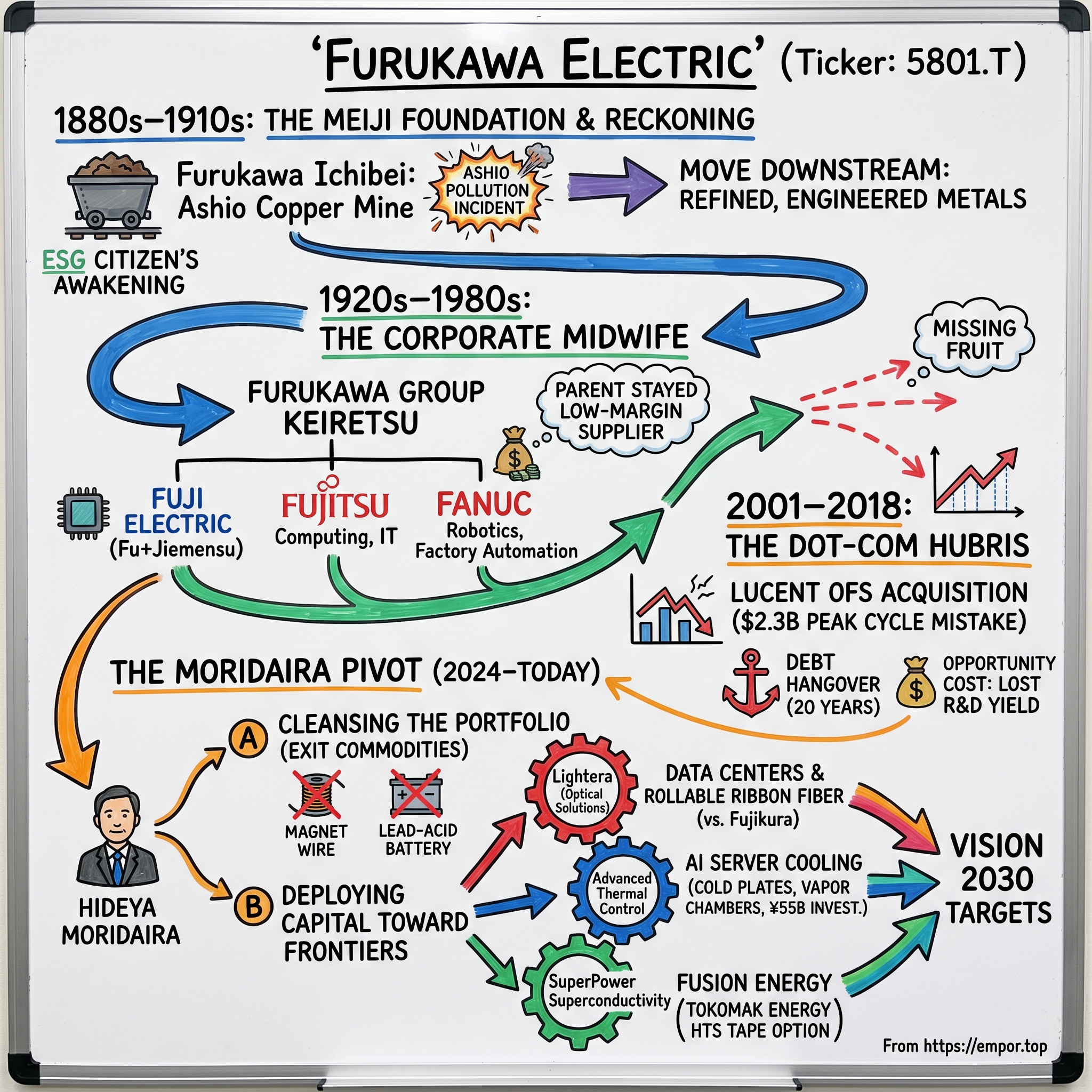
Walk into a hyperscale data center being built somewhere outside Phoenix or Osaka in 2026, and you will find, threaded through the raised floors and humming racks, a strange kind of archaeology. The hair-thin glass fibers carrying petabits of AI training traffic, the copper cold plates pressed against 1,000-watt GPUs to keep them from melting, the superconducting tape being wound into magnets for an experimental fusion reactor a continent away — a surprising share of that invisible plumbing traces back to a single Japanese company that started life 140 years ago drawing copper wire out of ore dug from a poisoned mountain.
That company is 古河電気工業株式会社 Furukawa Electric Co., Ltd., listed on the 東京証券取引所 Tokyo Stock Exchange under the ticker 5801.T. It is a roughly ¥1.3 trillion-revenue industrial heavyweight that the market has, for most of its modern life, treated with a shrug — a slow-moving, cyclical, heavy-metals commodity player forever hostage to the price of copper on the London Metal Exchange.1 The paradox at the heart of this story is that the same firm the market filed under "boring legacy metals" quietly became one of the more important physical enablers of the three most exciting compute stories of the decade: AI infrastructure, grid electrification, and nuclear fusion.
To understand why that paradox exists, you have to understand the lineage. Furukawa Electric is not just old; it is genealogically central to Japanese industry. It is the corporate midwife to some of the most celebrated names in Japanese technology. The 富士電機株式会社 Fuji Electric Co., Ltd. was born as a joint venture between Furukawa and Germany's Siemens. Out of Fuji Electric came 富士通株式会社 Fujitsu Ltd. Out of Fujitsu came ファナック株式会社 Fanuc Corporation, the global king of factory robots. A century of Japanese tech, in other words, has Furukawa DNA in it — and yet the parent itself never captured the software, robotics, or consumer-electronics windfalls its offspring did. It stayed downstream, supplying the wire, cable, and metal that the rest of the economy was built on.
If there is a "holy trinity" of future value the bulls point to, it is these three: optical solutions, where high-density rollable ribbon fiber and precision micro-connectors feed the world's hyperscale data centers; advanced thermal control, where cold plates, vapor chambers, and thermosyphons keep next-generation AI servers from cooking themselves; and fusion-grade superconductivity, where a small New York subsidiary supplies the exotic tape that the leading commercial fusion projects need to build their magnets. Each of these sits at a genuine physical frontier of the compute era. The discipline of this article is to take each in turn and ask not how large the opportunity could be — the answer is always "enormous," which is exactly why it is a useless question — but how defensible Furukawa's position within it actually is.
This article traces the full arc: from Meiji-era copper and Japan's first great industrial pollution disaster, through a beautifully structured cross-border alliance that spawned billion-dollar champions, into a catastrophically mistimed dot-com acquisition whose debt hangover starved the company for two decades, and on to a late, painful, and still-unproven attempt to reinvent itself. The modern pivot is the live drama. Under a CEO named Hideya Moridaira, Furukawa has been deconsolidating its lead-acid battery business, exiting a global magnet-wire joint venture, winding down commodity copper tube, and redeploying capital toward three high-margin frontiers: optical solutions for data centers under a new brand called Lightera, advanced thermal control to cool AI servers, and second-generation high-temperature superconducting tape for commercial fusion.
The neutral question this article keeps returning to is not whether that story sounds exciting — it does — but whether the evidence supports it. Is Furukawa genuinely becoming an indispensable, high-return technology enabler, or is it a cyclical metals company wearing an AI costume for the length of one hype cycle? Management says it will win. Our job is to ask what would have to be true, and what could prove them wrong.
It helps to name the consensus narrative up front and hold it at arm's length. The bullish story circulating about Furukawa in 2026 goes roughly like this: an unloved old-economy Japanese industrial has quietly become an AI-and-fusion play, its profits are inflecting sharply, its management is finally allocating capital like owners, and the market simply hasn't caught up. Much of that is true — the profit inflection is real, the divestitures are real, the frontier products exist. But the reality is more textured than the pitch. A meaningful chunk of the two-year earnings surge came from cyclical recovery and one-time portfolio gains rather than proven competitive wins; the crown-jewel optical business is still a fast-follower playing catch-up to a rival that got there first; and the largest single segment by revenue remains a low-margin automotive-harness business that no amount of AI storytelling can glamorize. The task, then, is to separate what Furukawa has actually demonstrated from what it has merely announced — because the two are not yet the same, and the gap between them is precisely the risk and the opportunity.
 Subscribe on LinkedIn
II. The Meiji Industrial Foundation: Furukawa Ichibei, Copper, and the Ashio Reckoning (1877–1910s)
Picture Japan in the 1870s: a country that had, barely a decade earlier, ended two and a half centuries of self-imposed isolation and was now sprinting to industrialize before the Western powers could turn it into a colony. In that scramble, one metal mattered more than almost any other. Copper was the oil of the age — the medium of the telegraph, the electrical grid, the dynamo, and the modern machine. Whoever controlled copper controlled a chokepoint of the coming electrical century.
Into that opening stepped 古河市兵衛 Furukawa Ichibei, born in Kyoto in 1832, a self-made merchant who had risen through the ranks of a wealthy trading house before it collapsed. In 1877, Ichibei took over the operation of the run-down 足尾銅山 Ashio Copper Mine, a nearly exhausted deposit in the mountains north of Tokyo that most had written off.1 What followed was one of the great operational turnarounds of the Meiji era. Ichibei poured capital and imported Western technology into Ashio, and in 1890 the mine adopted hydroelectric power — among the earliest full-scale industrial applications of hydro in Japan — to run its pumps, hoists, and electric haulage.2 Ashio became the country's largest copper mine, at its peak supplying a commanding share of national output.
But Ichibei understood something more sophisticated than mining. Raw copper is a commodity; drawn copper wire, refined and shaped, is a manufactured product with margin. So he integrated forward. In 1884 he established copper smelting works at Honjo in Tokyo to fix the uneven quality of his crude copper, and this smelter — later combined with cable-manufacturing operations pioneered by an associate named Yamada in Yokohama — is the direct ancestral seed of Furukawa Electric.1 The logic here is worth pausing on, because it recurs across the entire 140-year story: Furukawa's founders instinctively climbed from digging a raw material toward the higher-value engineered form of it. Ore to smelted copper, smelted copper to drawn wire, drawn wire to insulated cable. That upward reach is the company's oldest strategic reflex.
And then came the reckoning. The same relentless scaling that made Ashio a triumph made it a catastrophe for everyone downstream — literally. Toxic runoff laden with copper, arsenic, and sulfur compounds, along with sulfur-dioxide smoke and sediment from deforested, flood-prone hillsides, poured into the Watarase River basin. Farmland was poisoned, fisheries collapsed, and entire villages saw their livelihoods destroyed. The 足尾銅山鉱毒事件 Ashio Copper Mine pollution incident became Japan's first major industrial environmental disaster — the Meiji equivalent of a modern ESG crisis, decades before anyone used the acronym.2
The farmers found a champion in 田中正造 Tanaka Shozo, a member of the Diet who staged furious parliamentary protests and, in 1901, made a desperate direct appeal to the Meiji Emperor himself — an almost unthinkable breach of protocol that turned Ashio into a national scandal.2 Tanaka resigned his seat to make that appeal; he was briefly detained, and the episode became a foundational moment in the history of Japanese environmental politics. The government's eventual response was as revealing as the crisis: rather than shut Ashio, the state ordered the forced destruction of an entire village, Yanaka, to build a flood-retention basin that would absorb the contaminated water — sacrificing a community to keep the copper flowing. It is a stark early illustration of how, in the industrializing Meiji state, strategic industrial output could override the interests of the people living downstream of it.
For a sophisticated investor, the lesson buried in this dark chapter is not merely moral. The pollution crisis and the political firestorm it triggered forced Furukawa to build structural firewalls, invest in mitigation, and — crucially — accelerate its diversification away from the reputational and regulatory risk of raw extraction toward refined, engineered manufacturing. The environmental disaster, in a grim irony, helped push the company toward the wire-and-cable business that would define it. The seed of the modern corporation was planted in contaminated soil, and the move downstream was, in part, a flight from the liabilities of the mine.
III. The Corporate Midwife: How Furukawa Sowed the Seeds of Japanese Tech (1920s–1980s)
By 1920, the various Furukawa smelting, refining, and cable operations were formally consolidated into Furukawa Electric Co., Ltd., capitalized at ¥20 million — a single integrated entity spanning copper metallurgy and electrical wire.1 But incorporation is the least interesting thing that happened in this era. The remarkable part is what Furukawa spun out.
In 1923, seeking to build heavy electrical machinery and generators domestically rather than importing them, Furukawa Electric partnered with Germany's Siemens to create a joint venture on August 29 of that year.3 The naming of that JV is one of the small masterpieces of corporate branding. They called it 富士電機株式会社 Fuji Electric. The "Fu" (富) came from the first character of Furukawa; the "Ji" (士) came from the Japanese rendering of Siemens — pronounced "Jiimensu" — and, read together, the characters evoked 富士山, Mount Fuji, Japan's sacred peak.3 It was a name that simultaneously flattered both partners and wrapped the whole enterprise in national symbolism. It is hard to imagine a more elegant piece of cross-border diplomacy compressed into two kanji.
Fuji Electric, in turn, became a genealogical fountainhead. As the JV pushed deeper into heavy machinery, its telephone and telecommunications-equipment division looked increasingly out of place, and in 1935 it was spun off as a separate company — Fuji Tsushinki Seizo, later shortened to Fujitsu, an acronym stitched from Fuji, Jiimensu (Siemens), and tsushinki, the word for telecommunications equipment.4 Fujitsu would go on to become one of Japan's great computing and IT giants. Then the lineage forked again. In 1972, Fujitsu's numerical-control division — the group building the "brains" that tell machine tools how to move — was made independent under the engineer 稲葉清右衛門 Seiuemon Inaba, becoming Fanuc, whose name stands for Fuji Automatic Numerical Control.4 Fanuc grew into the undisputed global leader in factory automation and industrial robotics.
Sit with that family tree for a moment. Furukawa → Fuji Electric → Fujitsu → Fanuc. A copper-wire drawer birthed a power-equipment maker, which birthed a computer company, which birthed a robotics champion. Add the 1917 tire and rubber joint venture with America's B.F. Goodrich that became 横浜ゴム Yokohama Rubber, and you have a keiretsu — the 古河グループ Furukawa Group — whose offspring collectively touch power, computing, robotics, and mobility across the entire modern Japanese economy.
The keiretsu structure that bound these companies together is itself worth understanding, because it shaped Furukawa's economics for a century. In the classic Japanese model, group companies held one another's shares, banked with the same main bank, and traded preferentially with one another — a web of cross-shareholdings and long-term relationships that prized stability and mutual support over the ruthless capital efficiency of the Anglo-American model. For a supplier like Furukawa, this was comfortable: it guaranteed captive customers and patient shareholders. But it also entrenched exactly the habits that would later suppress the stock — capital tied up in strategic stakes that earned almost nothing, a reluctance to exit underperforming businesses because doing so might disrupt group relationships, and a management culture optimized for continuity rather than returns. When the Tokyo Stock Exchange finally began, decades later, to pressure companies to unwind cross-shareholdings and earn their cost of capital, it was in effect asking firms like Furukawa to dismantle the very operating system they had run on since the 1920s. That is the deep context for the governance reforms discussed later; they are not tinkering, but a repudiation of a century-old model.
Here is the strategically uncomfortable observation, and the one that matters for an investor trying to value the parent today. Furukawa Electric consistently sat at the base of the value chain — supplying the non-ferrous metals, power cables, and communications wiring that fueled Japan's post-war economic miracle — while letting its offshoots capture the software, robotics, and electronics revolutions with far richer economics. The parent was the soil; the children were the fruit. For decades, that was a comfortable, cash-generative place to be. The problem, as the next chapter shows, is that a company conditioned to be the reliable low-margin supplier can badly misjudge what it takes to compete at the frontier when the frontier suddenly becomes where all the money is.
IV. The Dot-Com Hubris: The $2.3B Lucent OFS Acquisition & Its 20-Year Hangover (2001–2018)
At the turn of the millennium, the telecommunications industry had convinced itself of a beautiful lie: that global bandwidth demand was effectively infinite, and that the world would need to lay fiber optic cable faster than anyone could manufacture it. Carrier capital budgets exploded. Fiber preform — the glass rod from which optical fiber is drawn — became, briefly, one of the most valuable engineered materials on earth. Everybody wanted more capacity, and everybody wanted it now.
It was into the very top of that mania that Furukawa Electric made the defining financial mistake of its modern history. In mid-2001, a cash-strapped Lucent Technologies, reeling from the collapse of the telecom bubble, put its crown-jewel Optical Fiber Solutions (OFS) division up for sale. Furukawa — desperate to leap from a strong regional player to a global-scale fiber powerhouse — agreed to buy the bulk of it. Lucent announced in July 2001 that it would sell OFS to Furukawa and, for a smaller cable-related slice, Corning, for an aggregate of roughly $2.75 billion; Furukawa's portion was about $2.3 billion, of which some $2.5 billion of gross consideration flowed for the major businesses, partly offset by securities and other adjustments.56 The deal closed on November 16, 2001, with Furukawa taking an 81.6% controlling stake in the combined cable operation and CommScope holding 18.4%.6 The renamed OFS Fitel became Furukawa's beachhead in North America.
The timing could hardly have been worse. Consider what a more disciplined bidder saw that Furukawa apparently did not. Corning pulled back. Japan's own Sumitomo Electric declined to chase the asset aggressively. These were sophisticated operators reading the same tea leaves — a monstrous capacity glut was forming just as carrier spending fell off a cliff. Furukawa paid a top-of-cycle multiple for a business whose end market was about to implode.
Implode it did. In the two years after the deal closed, optical fiber prices collapsed — by figures widely cited at the time of more than 90% from their bubble peak. OFS was suddenly a business with far too much capacity, chronic operating losses, and a heavy overhang of pension and other legacy liabilities inherited from its Lucent parentage. Industry coverage through the 2000s repeatedly flagged OFS as a drag on Furukawa's consolidated results.7 What had been sold internally as a bold stroke of global ambition became a two-decade weight around the company's neck.
It is worth dwelling on the psychology of the mistake, because it is not the psychology of stupidity — it is the psychology of ambition under pressure, which is far more common and far harder to guard against. Furukawa in 2001 was not a naive buyer. It was a competent, century-old manufacturer that genuinely understood glass and fiber. What it misjudged was the cycle. It reasoned, as almost everyone did, that a business selling into "infinite" bandwidth demand could absorb any purchase price. The failure was one of imagination about downside: no one in the deal room appears to have seriously modeled what happened if demand did not merely slow but reversed, and if a dozen competitors' idle capacity all came online into that reversal at once. The result was the textbook definition of negative operating leverage — high fixed costs meeting falling volumes and falling prices simultaneously, so that losses compounded rather than merely appeared. For an analyst studying any acquisitive company, the OFS episode is a permanent reminder to ask not "what is this worth if the thesis is right?" but "what does the balance sheet look like if the thesis is wrong for a decade?"
There is also a governance dimension that a skeptical investor should note. A deal of this magnitude, financed partly with assumed debt at the top of a cycle, imposed a cost of capital discipline on Furukawa for years afterward not because management chose prudence, but because the balance sheet forced it. Prudence extracted by necessity is not the same as prudence exercised by choice — and the distinction matters when judging, two decades later, whether Furukawa's current capital discipline reflects genuine institutional learning or merely the memory of pain. The most charitable and probably most accurate read is that OFS scarred the organization deeply enough that the lesson stuck.
The most damaging consequence was not the write-downs themselves — those are one-time pain — but the opportunity cost. For the better part of twenty years, the debt service and legacy obligations from OFS pushed Furukawa into a defensive, cash-conserving crouch. Capital that might have funded next-generation product development, new fiber architectures, or a serious thermal-management business was instead consumed keeping the balance sheet intact and the acquired operations breathing. When you wonder, later in this story, why a company with Furukawa's engineering pedigree was caught flat-footed by the data-center fiber revolution, the answer starts here. A peak-cycle acquisition doesn't just cost you the purchase price. It can cost you the next paradigm, because it steals the years and the R&D dollars you needed to see it coming. That is the deferred bill that came due in the late 2010s.
V. Missing the AI Gold Rush: The SpiderWeb Ribbon Battle against Fujikura (2018–2024)
In the late 2010s, a specific, unglamorous, physical problem became one of the most valuable bottlenecks in technology. The world's hyperscalers — Microsoft, Meta, Amazon, Google — were discovering that the constraint on connecting their exploding data-center empires was not glass, and not even money. It was space: the finite cross-sectional area inside the underground conduits and ducts running beneath cities. If you wanted to push tens of thousands of fibers between buildings, you had to physically fit them into pipes that were already there and already crowded. Density became king.
The company that cracked this most decisively was not Furukawa. It was its domestic rival, 株式会社フジクラ Fujikura Ltd. Fujikura had pioneered and commercialized a family of technologies — SpiderWeb Ribbon and Wrapping Tube Cable — built around a clever idea: instead of bonding optical fibers into rigid flat ribbons, bond them only intermittently. That "intermittently bonded" ribbon can be rolled and folded into a dense, flexible cylindrical bundle, letting an operator cram thousands of fibers — configurations reaching into the many thousands per cable — into a duct that previously held a fraction of that. To visualize it: a traditional flat ribbon is like a rigid comb, wasteful of space; the rollable ribbon is like a bundle of loose spaghetti that can be scrunched into a much smaller pipe, yet each strand can still be mass-spliced quickly. For hyperscalers whose deployment speed was gated by how fast technicians could splice fiber, that combination of density and fast splicing was gold.
Fujikura converted that lead into dominant share and premium margins with North American hyperscalers, and its stock re-rated dramatically as the market realized it had accidentally been holding an AI-infrastructure supplier. Furukawa, meanwhile, was still substantially tooled around legacy loose-tube fiber manufacturing, and its communications business missed the first, most profitable wave of the data-center buildout. Being the fast-follower here was expensive.
The financial nadir arrived in the fiscal year ended March 31, 2024. On a consolidated basis Furukawa still eked out a modest operating profit of about ¥11.2 billion, but that headline masked real distress underneath: net income attributable to owners collapsed to roughly ¥6.5 billion, less than half the prior year's level, even as revenue held above ¥1.05 trillion.89 Within that, the communications and optical segment was a disaster zone — hit by a brutal inventory correction across the U.S. telecom channel, by falling prices for legacy fiber, and by badly underutilized plants. The company's own results materials and contemporaneous coverage framed the optical business as the primary source of the pain, with the segment swinging to a deep operating loss even as other divisions held up.810
To make the competitive gap concrete: the reason Fujikura's rollable-ribbon architecture mattered so much to hyperscalers is that it attacked their single hardest constraint at exactly the moment that constraint became binding. When a hyperscaler builds a new data-center campus, the fiber count between buildings runs not into the hundreds but into the many thousands, because every server needs to talk to every other server at full bandwidth. Cramming that many fibers through pre-existing urban ducts, and then splicing them fast enough that construction crews are not the bottleneck, is a genuinely hard physical problem. Fujikura's intermittently bonded ribbon solved both halves at once — extreme density and mass fusion splicing — and it did so with years of head start and a manufacturing base already tuned for it. That is why the market rewarded Fujikura with a re-rating that Furukawa could only watch. A latecomer selling a similar product two years later does not command the same premium, because by then the customer has qualified the incumbent, tooled its installation crews around the incumbent's product, and has little reason to switch.
The most revealing artifact of this period is not the number but the tone of the earnings calls. Analysts pressed management repeatedly on why Furukawa was losing the data-center fiber race to Fujikura, and early answers leaned heavily on macro headwinds — the inventory cycle, carrier spending, currency. That framing is worth flagging as an analytical fact in its own right: when management explains a competitive loss primarily through external conditions rather than product gaps, it is often a sign the organization has not yet fully accepted the problem. A useful discipline for any investor listening to a struggling company is to separate the cyclical explanation from the structural one, and to weight management's willingness to name the structural problem as a leading indicator of whether they will actually fix it. In Furukawa's case, the shift — from blaming the inventory cycle to admitting the global fiber footprint itself was mis-architected — took the better part of two years, and it is that admission, not any single quarter's loss, that marks the real turning point. Eventually it did. The realization that hardened, and that would define the next chapter, was that the entire global fiber operation was not merely cyclically depressed — it was structurally broken, spread across three continents in uncoordinated units, and in need of demolition and rebuilding rather than patience. That admission set up the most consequential management pivot in Furukawa's recent history.
VI. The Moridaira Pivot: Cleansing the Portfolio & Unveiling Lightera (2024–Today)
Every turnaround needs a person willing to say the uncomfortable thing out loud, and at Furukawa that person is 森平英也 Hideya Moridaira, the Representative Director, President and CEO. Moridaira is not a parachuted-in outsider with a chainsaw; he is a career insider, which makes his willingness to cut sentimental businesses more interesting, not less. His central diagnosis was blunt: Furukawa's historical attachment to its legacy portfolio — the metals, the batteries, the low-margin wire — was actively destroying capital efficiency, and the market's persistent discount was the price of that sentimentality.
So he began cleansing the portfolio, and the pattern of divestitures is the clearest evidence of intent. First to go was magnet wire — the insulated copper wire wound into motors and transformers, a genuinely commodity business with structurally thin returns. On April 30, 2024, Superior Essex completed the acquisition of Furukawa's stake in their global magnet-wire joint venture, Essex Furukawa, and Furukawa exited the business entirely.[^11] Next came the lead-acid battery operation. Through a transaction structured with Advantage Partners and Tokyo Century, an entity launched a tender offer for 古河電池株式会社 The Furukawa Battery Co., Ltd. at ¥1,400 per share; the offer ran through the summer of 2025 and completed in September, after which Furukawa Electric transferred all of its roughly 18.8 million shares via a share buyback, fully exiting the capital-intensive, lower-growth automotive-battery business.1112 Alongside these, Moridaira systematically wound down commodity copper-tube operations, redirecting metal capital toward high-performance alloys and high-voltage systems.
The logic connecting these moves is a single financial idea: return on invested capital. Each divested business consumed capital while earning returns near or below Furukawa's cost of capital. Amputating them mechanically raises the group's blended ROIC even before a single new product ships — a point worth remembering when assessing how much of the improving return profile is genuine growth versus arithmetic from shedding low-return assets. Both are real; they are not the same thing.
It is worth pausing on what makes these divestitures credible rather than cosmetic, because Japanese industrials have a long and frustrating history of announcing "portfolio reform" and then doing nothing. The tell is that Furukawa gave up businesses that were, in a narrow accounting sense, still contributing revenue and even some profit. Magnet wire and lead-acid batteries were not dying units being dumped for scrap; they were stable, cash-generative, low-return operations that a sentimentally managed conglomerate would have happily kept forever precisely because they were not visibly broken. Killing a business that still makes money is far harder, culturally and politically, than killing one that is bleeding — and it is exactly the discipline that ROIC-based management demands and that most Japanese conglomerates have historically flinched from. That Furukawa followed through is the strongest single piece of evidence that Moridaira's capital-allocation talk has behavior behind it. The skeptical counterpoint, which an activist investor would press, is that the company still carries a large, low-margin automotive-harness business it has chosen to restructure rather than exit — so the amputation has been selective, and the hardest cut has not yet been made.
With the balance sheet lightened, Moridaira rebuilt the crown-jewel-in-waiting. On April 1, 2025, Furukawa integrated three previously separate optical operations — the Fiber Cable Division in Japan and Asia, OFS in North America and Europe, and Furukawa Electric LatAm (FEL) in Latin America — under a single global brand and holding structure called Lightera, housed in Lightera Holding G.K. (established October 2, 2024, wholly owned by Furukawa).13 The new entity, launched publicly at the OFC conference in San Francisco, is run by Foad Shaikhzadeh as Chairman and CEO and Holly Hulse as President and COO, and is organized into four regional divisions plus a specialty-photonics arm.13 The strategic point of Lightera is to stop running three uncoordinated fiber businesses that competed with each other and duplicated cost, and instead present hyperscalers with one global supplier and one product roadmap.
Under that unified structure, Furukawa finally scaled its own answer to Fujikura: a rollable ribbon fiber marketed as AccuRBN, and — critically — aggressive expansion of MT ferrule production. The MT ferrule deserves a moment of explanation, because it is the kind of unglamorous component that quietly controls a supply chain. When you join multiple optical fibers in a single connector, the fibers must be aligned to sub-micron precision — a fraction of the width of a human hair — or the light leaks and the link fails. The MT ferrule is the small, precision-molded block, studded with microscopic holes and guide pins, that holds those fibers in exactly the right position. In an AI data center wired with millions of optical connections, these ferrules are consumed in enormous volume, and the ability to mold them at scale, to tolerance, is a genuine manufacturing bottleneck. Whoever can produce them reliably captures value out of all proportion to the part's size — which is precisely why Furukawa is pouring capacity into them. It is a bet that the picks-and-shovels of AI networking are as attractive a place to stand as the fiber itself. Whether Furukawa's catch-up in rollable ribbon and ferrules translates into reclaimed share and margin — rather than merely me-too parity at lower prices — is the single most important open question in the entire investment case, and the following segment deep dive is where that question gets tested against the actual numbers.
VII. Follow the Money: A Segment Deep Dive into the 6 New Market-Based Business Lines
Reorganizations are the sort of thing that makes an audience's eyes glaze over — new boxes on an org chart, renamed divisions, a fresh set of acronyms. But the way a company draws its internal boundaries reveals what it is optimizing for, and in Furukawa's case the redraw was a deliberate act of exposure. Starting in the fiscal year that began April 2026, Moridaira did something that sounds bureaucratic but is actually a governance statement: he abolished the old product-centric divisions and reorganized the entire company into six market-based segments — Optical Solutions, Digital Infrastructure Components, Energy Infrastructure, Automotive Systems, Metal Solutions, and Service and Developments.14 The reason this matters is accountability. Product-centric structures let a struggling business hide inside a big division; market-based segments force each unit to stand naked in front of the end market it serves, which makes both success and failure harder to obscure. For an investor, cleaner segment lines are a precondition for trusting the ROIC story.
The macro backdrop for judging these segments is a company that has, at the consolidated level, genuinely inflected. Revenue rose from about ¥1.06 trillion in the year ended March 2024 to ¥1.20 trillion in the year ended March 2025 and ¥1,307.6 billion in the year ended March 2026, while operating profit surged from roughly ¥11 billion to ¥47 billion to ¥63.9 billion, and net income attributable to owners leapt to ¥72.5 billion — more than doubling year over year.8919 That is a real recovery. The question each segment answers is whether it is durable.
1. Optical Solutions — the turnaround engine. This is Lightera plus the FITEL fusion-splicer products — the machines that weld two fibers together with an electric arc, a business worth noting because it is a classic razor-and-blades adjacency: every new fiber deployment consumes splicing, and the installed base of splicers pulls through consumables and service. Having come off a segment that was hemorrhaging money in the year ended March 2024, the mandate here is a mix shift: from low-margin telecom-carrier cable volume toward high-density data-center solutions where density and speed command a premium. The proof point to watch is not revenue growth alone — carrier fiber can grow at bad margins — but whether the segment's operating margin climbs as data-center content rises. Management is betting heavily on capacity, having signaled optical-fiber capacity investment plans running into the hundreds of billions of yen. Here the neutral investor has to hold two facts simultaneously: the demand backdrop is genuinely strong, because AI is driving a structural increase in fiber intensity per data center, and yet strong end-market demand does not by itself confer pricing power when a well-entrenched competitor already owns the premium tier. Whether Lightera earns data-center margins or merely data-center volumes is the crux, and it is not yet settled by the numbers.
2. Digital Infrastructure Components — the high-margin hero. This is the segment that most justifies the "AI enabler" label, and it houses two distinct plays. The first is electrodeposited copper foil, including UL-certified 100%-recycled foil used in high-frequency PCBs and lithium-ion batteries. The second, and more exciting, is advanced thermal control: heat pipes, planar and 3D vapor chambers, liquid-cooling cold plates, and immersion systems for AI servers.
The physics here is unforgiving and it is Furukawa's friend, so it is worth explaining in plain terms. Every watt of electricity a chip consumes becomes a watt of heat that has to go somewhere. A decade ago, a high-end server processor might dissipate 150 watts, which a fan and a metal heat sink could handle by blowing air across it. A modern AI accelerator can dissipate a thousand watts or more, and a full rack of them can pull hundreds of kilowatts — a heat density closer to a stovetop burner than to a laptop. Air simply cannot carry heat away fast enough at that density; you would need gale-force airflow and the fans would consume absurd amounts of power. The only practical answer is to bring liquid directly to the chip. A cold plate is a metal block with liquid channels machined through it, pressed flush against the processor; coolant flows through, absorbs the heat, and carries it to a heat exchanger. A vapor chamber is subtler still — a sealed, flattened chamber where a working fluid evaporates at the hot spot and condenses at the cool edge, spreading heat far faster than solid metal could. These are precisely the kinds of components where decades of Furukawa's heat-pipe and metallurgical know-how translate into a genuine engineering edge, which is Helmer's "process power" in physical form.
Furukawa is spending to own that transition. In March 2026 it announced an investment of at least ¥55 billion (about $345 million) to expand cooling-module production across the Philippines, Thailand, and China — including a new water-cooling module factory in Thailand and expanded capacity in the Philippines, with mass production targeted from January 2027 and air-cooling heat-sink output ramping from mid-2026.15 The strategic wager embedded in that number is aggressive: Furukawa is committing capital to capacity ahead of confirmed, contracted demand, betting that the AI cooling market will be large enough and that its products good enough to fill those plants. This is the segment where Furukawa could plausibly build durable pricing power — the switching costs on a qualified thermal design are meaningful, because a server OEM that has validated a cold-plate supplier through its thermal and reliability testing is reluctant to re-qualify a competitor mid-platform. But that advantage only accrues if Furukawa actually wins the initial designs, and it is contesting them against Vertiv, Delta, and a field of Taiwanese thermal specialists who are expanding just as hard. The design-win scoreboard, not the capacity announcement, is what will tell you whether this bet is compounding.
3. Energy Infrastructure — the grid-modernization play. The core here is high-voltage underground and subsea power transmission cable, and the catalyst is the global electrification and renewables buildout: offshore wind farms need to be connected to shore, and countries increasingly want cross-border grid interconnectors. Furukawa's strategic move was to dissolve its legacy power-cable joint venture, 株式会社ビスキャス Viscas Corporation, in 2016, reclaiming the overseas commercial rights it had signed away so it could chase the high-voltage subsea boom on its own account. That decision is worth understanding as strategic chess: a joint venture is a way to share risk, but it is also a way to surrender autonomy and upside. By dissolving Viscas and pulling the commercial rights back in-house, Furukawa traded the safety of shared risk for the freedom to bid independently on exactly the projects — offshore wind export cables, national interconnectors — that were about to become scarce and lucrative. Subsea high-voltage cable is one of the genuinely attractive niches in Furukawa's portfolio: long-cycle, capital-intensive, reliability-critical, and supply-constrained, with order books that stretch years into the future and customers who value a proven, qualified supplier far above the cheapest bid. The caveat is that Furukawa competes here against formidable, deeply entrenched players — Prysmian, Nexans, and its domestic rival Sumitomo Electric among them — who have larger installed bases and their own dedicated cable-laying vessels, so this is an attractive pond in which Furukawa is not the biggest fish.
4. Automotive Systems. This is wire harnesses — the nervous system of a car, the bundled wiring that connects everything — plus EV electronic components. It is also, candidly, the portfolio's structural problem child: labor-intensive, low-margin, and exposed to the production whims of a handful of giant automakers. The strategy is retreat-and-reposition: exit low-margin geographies, restructure factories in China and North America, and pivot toward lightweight aluminum harnesses and the high-voltage harnesses that EVs specifically require. The honest read is that this is a defensive, margin-repair story, not a growth story.
5. Metal Solutions houses high-performance copper strip and copper alloys — the deliberately narrowed, higher-value remainder of the old metals business after the commodity copper tube was wound down. 6. Service and Developments is the catch-all: real estate leasing, hydroelectric power (a direct, poetic descendant of that 1890 Ashio hydro plant), and R&D for next-generation deep tech, including the fusion optionality explored next. Together these two are smaller, but Service and Developments is where the most asymmetric long-dated bet on the whole company quietly sits.
VIII. Option Value: SuperPower's Superconducting HTS Tape and the Fusion Energy Frontier
In 2011 and 2012, Furukawa Electric made an acquisition so quiet that most of its own shareholders would have struggled to explain it: it bought SuperPower Inc., a small company based in Schenectady, New York. At the time it looked like a speculative flyer on superconducting cables for smart grids — the kind of science-project asset that industrial conglomerates accumulate and then forget. For over a decade, that is roughly what it was.
Then the world's need for extreme magnetic fields caught up with it. SuperPower is one of a very small number of firms on earth capable of manufacturing commercial-scale second-generation high-temperature superconducting (2G HTS) tape. Here is the layman's version of why that matters. A superconductor carries electricity with zero resistance, which means you can push enormous currents through it to create enormously powerful magnets without the wire melting. "High-temperature" is relative — it still needs deep cooling — but 2G HTS tape can operate in conditions and field strengths that ordinary copper magnets cannot survive. It is, in effect, the material that makes certain impossible magnets possible.
The application that turned this from curiosity into strategic asset is nuclear fusion. A commercial fusion reactor works by confining a plasma heated to roughly 100 million degrees — many times hotter than the core of the Sun — inside a magnetic bottle, because no physical material can touch it. The strength of that magnetic bottle largely determines whether the reactor can produce more energy than it consumes. Conventional copper electromagnets cannot generate fields strong enough at a practical scale; HTS magnets can. And building them requires not meters but thousands of kilometers of high-quality HTS tape. In a fusion gold rush, HTS tape is the pickaxe — and there are very few pickaxe makers.
To grasp just how much tape a fusion program needs, consider the geometry. A tokamak confines its plasma inside a doughnut-shaped magnetic cage, and building that cage means winding kilometers of superconducting tape into large, precisely shaped coils, then stacking and cooling them. A single commercial-scale magnet system can require thousands of kilometers of tape, and every meter must meet exacting standards, because a defect that quenches the superconductor mid-operation can destroy the magnet. That combination — vast quantities, extreme quality, and a manufacturing process that took decades to perfect — is what turns a modest business like SuperPower into a potential chokepoint. In a world where dozens of fusion startups are racing toward the same milestone, the binding constraint may not be physics or funding but the number of firms that can actually make the tape at scale.
That scarcity is why the United Kingdom's Tokamak Energy went to Furukawa. Beginning with an agreement in January 2023 and deepening thereafter, Furukawa Electric and SuperPower agreed to supply Tokamak Energy with HTS tape — on the order of several hundred kilometers — for its ST80-HTS device, billed as the world's first high-field spherical tokamak to use HTS magnets at scale, with the first batches produced at SuperPower's New York facility and delivered to the UK.1617 Tokamak Energy's stated ambition is a pilot plant capable of delivering net electrical power into the grid in the early 2030s.16 The two companies have also discussed scaling HTS manufacturing to serve future pilot-plant requirements.17
For an investor, the correct framing of the fusion story is neither dismissal nor euphoria — it is option value. This is a small, cash-consuming business today whose payoff, if commercial fusion demonstrates net energy in the 2030s, could be enormous and supply-constrained, and whose payoff, if fusion slips another twenty years as it has done repeatedly for seventy, is negligible for a long time. HTS also has nearer-term uses in maglev transport and high-field magnets that provide some floor. The honest verdict: SuperPower is a genuine cornered resource with a fat, uncertain, long-dated tail — worth owning for free inside a ¥1.3 trillion industrial, but not something a rational analyst should underwrite into a base case today.
IX. The Acquired Playbook: Core Business & Investing Lessons
Step back from the granular business lines, and Furukawa Electric offers a set of durable investing lessons that generalize far beyond one Japanese industrial.
The first and most expensive is the sunk-cost trap of peak-cycle M&A. The 2001 OFS acquisition is a near-perfect specimen: a company, anxious about being subscale, buys global scale at the absolute top of a hype cycle, pays a top-of-market multiple, and then spends two decades paying it off in the currency of foregone innovation. The subtle lesson is that the true cost of overpaying is rarely the write-down you take in year two; it is the R&D you can't fund in years five through fifteen, which is exactly when the next paradigm arrives. Furukawa's late arrival to data-center fiber is the direct, traceable downstream cost of a check written in 2001.
The second is the fast-follower's dilemma. When a competitor achieves a genuine structural leap — Fujikura's rollable ribbon — the incumbent's instinct is to protect its existing tooling, org charts, and sunk investment. Furukawa's eventual willingness to blow up three continental fiber businesses and rebuild them as a single unit is the counter-move: you cannot catch a leader while defending the very structures that made you slow. Structural adaptation is painful precisely because it admits the old structure was wrong.
The third is selective amputation as a route out of the conglomerate discount. A sprawling industrial trades at a discount because the market cannot tell the good businesses from the value-destroying ones, and assumes the worst. The cure is not corporate rhetoric about "synergy" but visible, credible divestment — giving up magnet wire, exiting lead-acid batteries, winding down copper tube — which both mechanically improves returns and, more importantly, signals that management will kill sacred cows. That signal is what re-rates a stock, and it is only credible after the knife has actually fallen, not when it is merely promised.
The fourth is the beauty and the limit of the alliance-and-spinout model. The Fuji Electric lineage shows how a well-structured cross-border joint venture can compound into independent, multi-billion-dollar champions across generations. But it also shows the shadow side for the parent: Furukawa birthed Fujitsu and Fanuc and captured almost none of their equity upside, because it stayed the low-margin supplier at the base of the chain. Spawning champions is a wonderful thing to have done for Japan; it is a frustrating thing to have done for your own shareholders. The entire modern pivot can be read as Furukawa finally trying, at long last, to be the fruit rather than only the soil.
There is a fifth lesson, quieter than the others but perhaps the most important for judging Furukawa from here: the difference between owning an option and owning a business. SuperPower's HTS tape, the fusion partnership, even the early thermal bets — these are options, cheap tickets on outcomes that may or may not arrive, and their value lies precisely in their asymmetry. A great capital allocator collects such options when they are cheap and ignored, holds them patiently, and resists the temptation either to over-fund them before the payoff is visible or to abandon them the moment they look foolish. Furukawa acquired SuperPower for a pittance in the early 2010s and simply held it through a decade of irrelevance until the world changed around it. Whether that reflects deliberate strategy or accidental packrattery is debatable, but the outcome — a genuine cornered resource sitting inside the company at near-zero embedded cost — is exactly what optionality is supposed to look like. The discipline an investor should demand is that management continues to treat these as options: funded modestly, valued honestly, and never allowed to become the story that justifies the stock before the cash flows are real.
X. The Analyst Stress Test: Porter's 5 Forces, Hamilton Helmer's 7 Powers, and Corporate Governance Reform
Put Furukawa through the standard analytical machinery and a nuanced picture emerges — strong in a few defensible niches, ordinary or weak in the bulk of the business.
Start with Porter's Five Forces. The threat of new entrants is low in the businesses that matter most: subsea high-voltage cable and HTS tape demand enormous capital, decades of accumulated metallurgical and process know-how, and grueling qualification cycles that no startup can shortcut. Buyer power is the uncomfortable one. In optical, the customers are a handful of consolidated hyperscalers who are ruthless on price and can dual-source; they will pay a premium for density and thermal efficiency, but they will not overpay for parity products, which caps Furukawa's optical margins unless it genuinely leads on technology. In power cable, buyer power is more moderate because reliability trumps price. Supplier power is moderate and cyclical: copper and aluminum are commodities priced on the LME, so Furukawa is perpetually exposed to metal-price swings it cannot fully control. Substitutes are a low-to-moderate threat — fiber remains the ultimate data medium, and in cooling, Furukawa actually benefits from substitution as liquid cooling displaces air. Rivalry is intense and unrelenting, against Sumitomo Electric, Fujikura, and South Korea's LS Cable, among others.
Now Hamilton Helmer's 7 Powers, which asks where Furukawa has genuine, persistent advantage. The strongest case is cornered resource: SuperPower's 2G HTS production process and patent estate are a real, scarce capability few can replicate. Switching costs are high in high-voltage subsea cable, where a utility that has qualified a supplier faces catastrophic reputational and regulatory exposure if a subsea connector fails, making it deeply reluctant to switch — a genuine, if narrow, moat. Process power is a credible claim in specialized thermal engineering, where micro-vapor-chamber and cold-plate manufacturing embed hard-won tacit know-how. Scale economies are moderate at best, in fiber preform and copper drawing, and are precisely where Fujikura and others contest Furukawa most directly. Notably absent from the list are the powers that produce the fattest, most durable returns — network economies and branding power — which Furukawa essentially lacks. The sober conclusion: this is a company with a few real, defensible niches embedded in a much larger body of competitive, cyclical, commoditized activity. The bull case depends on the niches growing faster than the commodity core drags.
Finally, corporate governance reform, which is arguably the most important recent change and the one most driven by external pressure. The Tokyo Stock Exchange's campaign to push companies trading below book value (a price-to-book ratio under 1x) to fix their capital efficiency has landed squarely on Furukawa. For decades Furukawa was a poster child for the problem the TSE set out to fix: a company whose assets were carried on the books at more than the market was willing to pay for the whole enterprise, which is the market's blunt way of saying it expected management to keep earning less than the cost of the capital entrusted to it. The company's response has been to embrace ROIC-based portfolio management, holding business units to earning a positive spread over their cost of capital, and to unwind the legacy cross-shareholdings — the web of strategic equity stakes in other companies that Japanese firms historically hoarded and that tie up capital while earning little. Each strategic stake sold converts a lazy, low-yielding asset into cash that can be redeployed into the growth capex the company actually needs, and it removes a piece of the old keiretsu operating system that the market has learned to discount. The pace and completeness of that unwinding is one of the cleaner tests of whether management means what it says, because cross-shareholdings are politically awkward to sell — they often represent relationships with customers and partners — and a company that unwinds them quickly is signaling that it now prioritizes its own shareholders over the comfort of the group. On shareholder returns, Furukawa has adopted a dividend-on-equity policy targeting 3.5% of shareholders' equity, deliberately chosen over a volatile payout-ratio approach so that dividends stay stable even through the cyclical commodity downturns that used to whipsaw them.18 The Vision 2030 plan wraps these threads together: roughly ¥650 billion of total investment over the 2026–2030 period, an operating-profit target of ¥250 billion and a margin above 10% by fiscal 2030, and a stated return target reaching for the mid-teens — versus the ¥63.9 billion of operating profit actually earned in the year ended March 2026.18 Those are ambitious numbers, and the gap between the ¥63.9 billion base and the ¥250 billion target is the entire debate compressed into two figures.
XI. The Risk Radar: Material Threats to the Narrative
The most mechanically direct risk is raw-material price volatility. Because so much of Furukawa's cost base is copper and aluminum priced on the LME, a sharp spike that the company cannot fully pass through to automotive or grid customers compresses margins immediately and visibly. This is not a tail risk; it is the weather Furukawa lives in, and it is the single biggest reason the market has historically valued the company like a commodity play rather than a technology one. Any thesis that Furukawa has "become a tech company" has to survive contact with the fact that metal prices still move its P&L.
The second is execution risk in the thermal build-out. Committing at least ¥55 billion to cooling-module capacity across Southeast Asia is a bet that Furukawa can secure long-term design wins from AI server OEMs and hyperscalers. But this is a contested arena. If entrenched thermal specialists such as Vertiv or Delta Electronics lock up the key GPU-server platforms first, Furukawa risks building expensive plants into overcapacity and a price war — turning its most promising margin story into a capital sinkhole. The capacity is being committed ahead of the confirmed demand, which is how you win a land grab and also how you get stranded.
The third is the wire-harness drag. The automotive harness business is labor-intensive and structurally low-margin, and it is hostage to the production decisions of a few giant customers. If EV volumes in China and Europe disappoint or automakers squeeze pricing further, the segment's slow margin recovery can stall or reverse, acting as a persistent weight on consolidated results no matter how well the glamorous segments perform.
The fourth is geopolitical and supply-chain risk. Lightera's whole value proposition — one seamless global supplier — depends on frictionless movement between manufacturing sites in Japan, the United States, and Latin America. Rising tariffs, trade barriers, or export controls could raise the cost of that integration or force duplicative, subscale local production, eroding the very synergy the reorganization was built to capture. For a company deliberately globalizing its most important growth business, a deglobalizing world is a specific and material threat.
XII. Bull vs. Bear Case
The bull case — the hyperscale-and-fusion triple play. In the optimistic scenario, Lightera's AccuRBN rollable ribbon and its scaled MT-ferrule production claw back meaningful high-density fiber share in North America, converting a business that was losing money in the year ended March 2024 into a structurally profitable one riding the AI data-center buildout. Simultaneously, Digital Infrastructure Components turns into the crown jewel: Furukawa's cold plates and vapor chambers capture dominant share in direct-to-chip cooling for next-generation GPU platforms, and the physics of ever-hotter chips gives the segment durable pricing power and a long runway. Behind those two, SuperPower's HTS tape becomes an increasingly valuable cornered resource as commercial fusion reaches pilot demonstration in the early 2030s. And underpinning all of it, ROIC-led capital discipline keeps shedding low-return legacy assets, driving returns toward the mid-teens and finally pushing the price-to-book ratio durably above 1x. In this world, the market re-rates Furukawa from cyclical metals multiple to technology-enabler multiple, and the ¥250 billion operating-profit target for 2030 looks achievable rather than aspirational.
The bear case — the legacy drag reasserts. In the pessimistic scenario, Fujikura simply keeps its lead. Its head start in high-density fiber, its incumbent hyperscaler relationships, and its manufacturing scale leave Lightera fighting for the lower-margin telecom-carrier scraps, with parity products and no pricing power. The automotive harness business remains a labor-cost sinkhole, perpetually dragging consolidated margins. The bet on Southeast Asian cooling capacity collides with equally aggressive expansion from Vertiv, Delta, and others, and the resulting overcapacity triggers a price war that guts the returns on those shiny new plants. Copper price volatility and a higher-for-longer cost of capital squeeze the cash flows needed to fund the ¥650 billion capital plan, forcing hard trade-offs. In this world, the improvement of the last two years turns out to have been a cyclical up-move plus one-time gains from divestitures, not a structural re-rating, and Furukawa settles back into being what the market always thought it was: a well-run but capital-intensive commodity industrial with a couple of interesting call options attached.
A word on management credibility, since it sits underneath both cases. The fairest way to judge a management team is by behavior over time rather than by the polish of any single presentation, and on that standard Furukawa's current leadership scores reasonably well but not unambiguously. On the positive side of the ledger: they have set concrete, quantified targets rather than hiding behind vague ambition; they have followed portfolio-reform rhetoric with actual, hard divestitures of profitable-but-low-return businesses; and they have been willing, eventually, to name the structural problem in optical rather than blaming the cycle indefinitely. On the cautionary side: the early-cycle tendency to attribute the optical collapse to macro headwinds showed an organization slow to accept a competitive defeat; the ¥250 billion operating-profit target for 2030 is nearly four times the ¥63.9 billion just earned, which is the kind of gap that invites skepticism until interim milestones validate it; and the capacity-ahead-of-demand posture in thermal, while defensible as a land grab, is exactly the sort of aggressive capital deployment that a company preaching discipline must be watched on. The single most important thing to monitor is consistency: whether the story management tells on each successive earnings call stays stable and compounds, or whether the strategy quietly shifts and the targets quietly move. A durable turnaround narrates the same plan repeatedly and hits its markers; a fragile one keeps reinventing its explanation.
The honest synthesis is that both cases are live, and the evidence to date is genuinely mixed. The consolidated recovery is real — operating profit up roughly six-fold in two years is not noise. But a material portion of that came from cyclical normalization and portfolio pruning rather than proven, durable competitive wins in the growth segments. The bull case requires Furukawa to demonstrate, not merely claim, that it leads in cooling and can hold its own in high-density fiber. Until the segment-level margins in Optical Solutions and Digital Infrastructure Components show sustained expansion through a full cycle, the re-rating remains a hypothesis.
That is why the disciplined way to follow Furukawa Electric from here is to ignore the noise and watch a very small number of things. First, the operating margin of the Digital Infrastructure Components and Optical Solutions segments — the direct test of whether the AI-enabler thesis is producing pricing power or just revenue. Second, consolidated ROIC versus cost of capital and the trajectory of the price-to-book ratio — the scoreboard for whether the governance-and-capital-discipline story is actually working. Third, the pace of design wins and capacity utilization in the thermal business — the leading indicator that tells you, well before the margins do, whether the ¥55 billion cooling bet is compounding or stranding. Everything else — the fusion optionality, the copper cycle, the harness restructuring — is context around those three dials.
XIII. Epilogue & Outro
There is a long, strange symmetry to this story. A company that began in the 1880s by drawing copper wire from a mountain so aggressively mined that it poisoned a river has spent 140 years climbing, again and again, from the raw and commoditized toward the engineered and scarce. It birthed some of Japan's greatest technology companies and captured almost none of their upside. It made a single catastrophic acquisition at the top of a bubble and spent two decades paying for it in foregone innovation. It watched a domestic rival capture the AI-fiber wave it should have caught itself.
And now, under Hideya Moridaira, it is attempting the hardest thing an old industrial can attempt: to change what it is, not just what it makes. The divestitures are real, the reorganization is real, the two-year jump in profitability is real, and the frontier bets — cooling the AI servers, wiring the renewable grid, and weaving the superconducting magnets that may one day confine a fusion plasma — are genuinely at the leading edge of the physical economy. What is not yet real, what remains to be proven across a full cycle, is that any of this has bought Furukawa durable competitive advantage rather than a well-timed cyclical recovery dressed in the language of transformation.
The company that was written off as a legacy metals dinosaur is making a credible, capital-backed case that it is becoming an indispensable backbone of the next industrial era. Whether it succeeds is, refreshingly, not a matter of faith. It is a matter of watching three dials over the next several years, and letting the evidence — not the narrative — deliver the verdict.
References
-
Hydroelectric Power and the Ashio Copper Mine — Environment & Society Portal ↩↩↩
-
Lucent Technologies sells optical fiber business for $2.75 billion — Lightwave Online, 2001 ↩
-
Lucent Technologies Inc. Form 10-Q — U.S. Securities and Exchange Commission, 2001 ↩↩
-
Furukawa Electric Group FY2023 Financial Results and Presentation Materials (year ended March 31, 2024) — Furukawa Electric Co., Ltd., 2024-05-13 ↩↩↩
-
Annual Securities Report for the 203rd Fiscal Year — Furukawa Electric Co., Ltd., 2025-08-20 ↩↩
-
Furukawa Electric Reports Strong Turnaround in Earnings — Nasdaq ↩
-
Furukawa Electric Finalizes Exit From Furukawa Battery — Furukawa Electric Co., Ltd., 2025-12-24 ↩
-
Joint Investment in Sustainable Battery Holdings with Advantage Partners and Furukawa Electric — Tokyo Century Corporation, 2024-07-23 ↩
-
The operational structure of the Furukawa Electric optical fiber cable business has been integrated under a new brand, Lightera, launching April 1, 2025 — Furukawa Electric Co., Ltd., 2025-03-06 ↩↩
-
Notice concerning company split associated with reorganization (market-based business segments) — Furukawa Electric Co., Ltd., 2026-03-19 ↩
-
Furukawa Electric to Invest at Least 55 Billion Yen to Expand Data Center Cooling Production in the Philippines, Thailand and China — Furukawa Electric Co., Ltd., 2026-03-30 ↩
-
Tokamak Energy and Furukawa Electric Group strengthen relationship to progress commercial fusion energy — Tokamak Energy, 2023-01-11 ↩↩
-
Furukawa to supply specialist tape to Tokamak Energy — Nuclear Engineering International ↩↩
-
Furukawa Electric Publishes 204th Shareholder Newsletter / Vision 2030 targets — Furukawa Electric Co., Ltd. (via BigGo Finance), 2026-06-26 ↩↩
-
Financial Summary and Forecasts (FY ended March 31, 2026 results) — Furukawa Electric Co., Ltd. ↩
 LinkedIn
 WhatsApp
 Reddit
 Hacker News
 Email
Email Kindle
 RSS Feed
 Spotify
 Apple Podcasts
 Amazon Music
 Audible
 YouTube