Vanguard International Semiconductor: TSMC's Specialty Foundry Workhorse and the Bet on 12-Inch
I. Introduction & Episode Roadmap
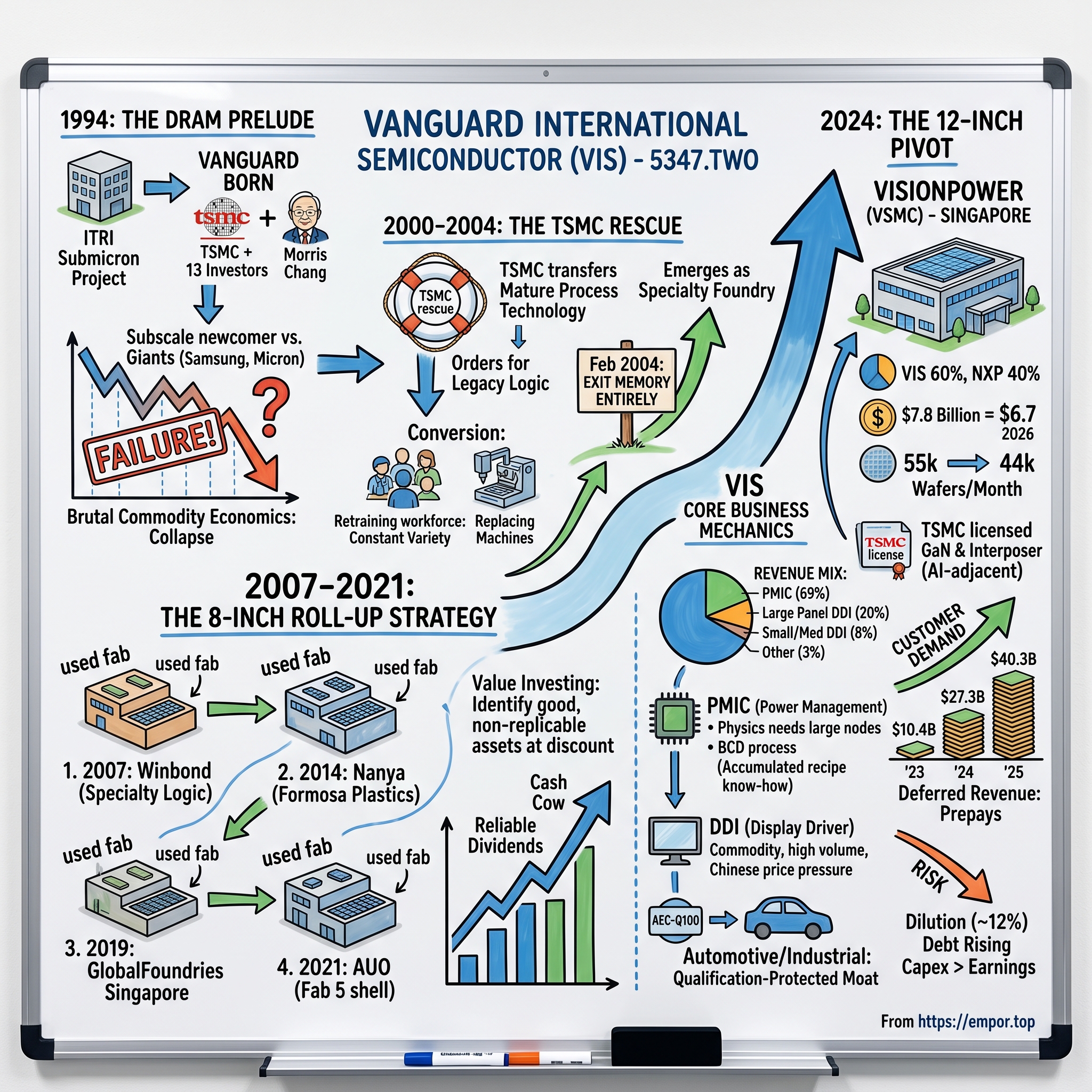
In December 1994, a group of Taiwanese officials and executives gathered to launch what was supposed to be the island's answer to the Japanese and Korean memory giants. Taiwan had semiconductors, but it did not have DRAM — the commodity memory chips that were, at the time, the single largest product category in the industry. So the government's 工業技術研究院 Industrial Technology Research Institute (ITRI) took the fruits of its Submicron Project, wrapped it in a corporate shell, and handed the keys to the most credible operator in the country. 台灣積體電路製造公司 TSMC led a consortium of thirteen private investors, and 世界先進積體電路股份有限公司 Vanguard International Semiconductor Corporation was capitalized at roughly NT$14 billion.1 It was a national champion by design, with the founder of TSMC, 張忠謀 Morris Chang, presiding over its birth.
The national champion failed. Within six years the DRAM business had nearly destroyed the company, and by February 2004 Vanguard had exited memory entirely.1 What emerged from the wreckage was something nobody had planned: a foundry that made money not by pushing the frontier of Moore's Law but by running old equipment extraordinarily well. For two decades, VIS — trading as 5347.TWO on Taiwan's Taipei Exchange — bought fully depreciated 8-inch (200mm) wafer fabs from companies that no longer wanted them, filled them with power-management and display-driver chips, and converted the resulting cash into one of the more reliable dividends in Taiwanese technology.
That model is now being deliberately abandoned — or at least, deliberately supplemented. In June 2024, VIS and NXP Semiconductors announced a joint venture to build a 300mm fab in Singapore, initially budgeted at US$7.8 billion, with VIS holding 60% and NXP 40%.2[^3] It is the largest capital commitment in the company's history by an order of magnitude, and it is the single fact that determines what VIS becomes. Everything else — the dividend, the margin profile, the balance sheet, the relationship with TSMC — is downstream of whether that fab works.
There is a second, quieter fact that reframes the whole story. VIS spent twenty years as a company defined by what its parent gave it. In June 2024, TSMC stopped taking board seats at VIS.[^4] In May 2026, TSMC announced it would sell up to 152 million VIS shares — about 8.1% of fully diluted capital, roughly US$850 million at prevailing prices — cutting its stake from approximately 27.1% to about 19%.34 TSMC was explicit that the commercial relationship continues: it still outsources silicon interposer production to VIS and still licenses gallium nitride process technology to it.35 But the equity umbilical cord is being cut in stages, and an investor is entitled to ask what VIS is worth once the halo dims.
The scale of the commitment is best understood by comparison to the company making it. VIS generated NT$48.59 billion of revenue in 2025 — roughly US$1.5 billion.6 Its 60% share of a multi-billion-dollar fab therefore represents a capital commitment on the order of a year and a half of total revenue, made by a company whose entire competitive history consists of refusing to build things. That is not a marginal expansion. It is a change of species.
The recent operating record is a genuine puzzle rather than a clean trend. In 2022, at the top of the post-pandemic chip cycle, VIS earned a gross margin above 46% and net income of more than NT$15 billion.[^8] Two years later, in 2024, revenue had recovered to NT$44 billion but gross margin had collapsed to roughly 27% and net income was under half the 2022 peak.[^8] That is the signature of a business with high operating leverage and very little pricing power at the bottom of a cycle. In 2025, revenue rose 10.3% to NT$48.59 billion and net income attributable to shareholders rose 12.2% to NT$7.91 billion — the second-highest revenue in company history, but with margins still nowhere near the 2022 high.6 Then, in the first half of 2026, something changed: AI data-center power demand arrived at the 8-inch node, and a company that had spent two years defending prices started raising them.7
There is one more framing worth setting up front, because it governs how every number in this story should be read. VIS is not a technology company in the sense that most investors use the phrase. It does not sell a product that gets better every year, and it does not compound by inventing things. It sells manufacturing capacity — hours of machine time in buildings full of expensive equipment — to customers who design the chips themselves. When capacity is scarce, VIS earns extraordinary returns. When capacity is abundant, it earns mediocre ones. Everything strategic the company does is ultimately an attempt to alter that equation: to make its capacity less substitutable, its customers stickier, and its cost base lower than the next foundry's. Judged by that standard, the last twenty years were a success and the next four are an open question.
This story traces that arc. It starts with the DRAM disaster and the TSMC rescue, moves through the roll-up strategy that made VIS a quietly excellent capital allocator, dissects the actual business — what a power-management chip is, why it does not need a 3nm transistor, and why that matters — and then confronts the Singapore bet directly: its scope changes, its funding, and the dilution that management's supporters tend to leave out. It examines who runs the company and how their words in 2024 line up against the facts of 2026. And it ends where an investor should end, with the two or three numbers that will actually tell you whether this is working.
 Subscribe on LinkedIn
II. The DRAM Prelude & TSMC Rescue: 1994–2004
To understand why Vanguard exists, you have to understand what Taiwan feared in 1994. The island had built a world-class contract manufacturing base, but the highest-volume, highest-revenue chip in the world was DRAM, and DRAM was made by 삼성전자 Samsung Electronics, by Japanese conglomerates, and by Micron. Taiwan's planners saw a strategic hole. ITRI's Submicron Project had produced domestic DRAM process know-how; the obvious move was to commercialize it. TSMC won the mandate, gathered a consortium, and Vanguard was born with a purpose-built mission and a Hsinchu Science Park fab.1
The Trap Nobody Escaped
DRAM is the most brutal business in semiconductors, and it is brutal for a reason that is structural rather than cyclical: the product is a commodity. A DRAM bit from one supplier is functionally identical to a DRAM bit from another. When the product is identical, the only variables are cost per bit and volume — which means the winner is whoever can build the biggest, most advanced fab and depreciate it fastest. That is a game of balance-sheet size, and Vanguard, capitalized at the equivalent of a few hundred million US dollars, was playing against companies whose parent conglomerates could absorb years of losses as a matter of national industrial policy.
The mechanics were merciless. Each DRAM generation required a new fab and a new process; a supplier who fell one node behind produced chips at a structurally higher cost per bit and simply could not sell them profitably. Meanwhile, the industry added capacity in unison during upcycles and then discovered, simultaneously, that demand had not kept pace. Prices did not decline gently; they collapsed. Vanguard entered this arena as a subscale newcomer, and by the late 1990s the price of DRAM was falling faster than the company could reduce its costs.1 The losses accumulated. The national champion was, in commercial terms, a mistake — not because the engineering was bad, but because the strategic premise was wrong. Taiwan did not need another DRAM maker; it needed to play a game it could win.
The Rescue That Was Really a Redesign
There is a detail from this period that is easy to skip and worth pausing on. In March 1998, Vanguard listed on Taiwan's over-the-counter market as a technology stock.1 It went public, in other words, as a DRAM company, in the window between the Asian financial crisis and the collapse of memory pricing that followed. Public shareholders bought into the national-champion story and then watched the company's founding business model fail in front of them. Whatever else can be said about VIS's subsequent conservatism — the reluctance to build, the preference for used equipment, the fondness for dividends — it was learned in public, at shareholders' expense, by people who were still in the building.
By the turn of the millennium, the choice facing Vanguard's board was not whether to fix DRAM but whether the company had any reason to exist. Its fab was real, its engineers were competent, and its process technology was serviceable. What it lacked was a market where those assets were worth anything. The decision that followed was less a rescue than a repurposing.
In 2000, Vanguard announced it would leave DRAM and become a foundry.1 This is easy to write and was extraordinarily hard to do. A memory company and a foundry are different organisms. A memory company makes one product and sells it to distributors and OEMs; the entire organization is optimized around cost per bit on a single process. A foundry makes hundreds of different products for hundreds of different customers, each with its own process recipe, its own design rules, its own qualification requirements. It needs a design-support organization, a process-integration team that can port customer designs, and a sales function that sells capacity and reliability rather than parts.
Vanguard did not build all of that from scratch. It borrowed it. TSMC transferred mature process technology and, critically, redirected demand — the orders for older, lower-margin, high-mix products that TSMC no longer wanted to run in fabs it would rather fill with leading-edge logic. The conversion took four years, and DRAM production ended completely in February 2004.1
The physical conversion was its own kind of engineering story. A DRAM fab and a specialty foundry use much of the same equipment, but they use it in profoundly different rhythms. Memory manufacturing is a monoculture: one product, one recipe, enormous lots moving through the line in lockstep, with the whole operation tuned to squeeze the last fraction of a percent of yield from a single flow. A foundry line is a bazaar: dozens of recipes running concurrently, lots of wildly different sizes, constant reconfiguration, and a scheduling problem that has more in common with air-traffic control than with mass production. Retraining a workforce that had spent six years optimizing one thing to instead handle constant variety is a slower process than replacing machines, and it is the part of a business-model pivot that spreadsheets consistently underestimate.
What that arrangement created is worth naming precisely, because it is the mechanism that explains most of the next twenty years. VIS became a designated overflow and legacy vessel for the world's most important foundry. When TSMC wanted to retire a node or free a fab, VIS was where the business went. This gave VIS three things that a normal small foundry cannot buy: proven process technology without full R&D cost, a customer list pre-qualified by someone else's reputation, and a structural pipeline of work that arrived without a sales effort.
It also created the central dependency of the investment case. An advantage you were given is not the same as an advantage you built. For two decades that distinction did not matter much, because TSMC's incentives and VIS's incentives were aligned and TSMC owned more than a quarter of the company. The distinction matters now, in 2026, precisely because TSMC has been reducing both its board presence and its equity — which is why the terms of the ongoing commercial relationship deserve far more investor attention than the ownership percentage.
The transition also left a cultural residue that shows up in the numbers to this day. A company that nearly died from capital intensity does not forget. For fifteen years after the DRAM exit, VIS practiced a form of capital allocation that was almost the opposite of what it had been founded to do: instead of building fabs, it bought them second-hand.
III. The 8-Inch Specialty Roll-Up Strategy: 2007–2021
Sometime in the late 2000s, the equipment industry quietly stopped making new 200mm wafer tools. Applied Materials, Lam, Tokyo Electron and the rest had moved their development budgets to 300mm, where the volume and the margins were. The consequence was strange and enormously consequential: an entire class of manufacturing capacity became, in effect, non-replicable. You could no longer order a new 8-inch fab. If you wanted 8-inch capacity, you had to buy someone else's — or scavenge tools from the secondary market, where prices are set by scarcity rather than by list.
VIS read this correctly and turned it into a repeatable playbook. The logic is closer to real-estate value investing than to technology investing: identify a productive asset that cannot be reproduced at any reasonable cost, buy it from a motivated seller at a discount to what it would take to build, and run it better than the seller did.
Four Deals, One Idea
The first move came in 2007, when VIS agreed to acquire two 200mm production lines from 華邦電子 Winbond Electronics, with the purchase finalized in January 2008.1 The transaction roughly transformed the company's scale and pushed it decisively into power-management and power-discrete products. The disclosed consideration for that transaction is not reliably documented in accessible English-language sources; what is documented is the strategic effect — VIS acquired a second and third production line from a seller that had decided memory and specialty logic were not both worth funding.
The second move, in 2014, is the one most often misdescribed. VIS did not buy an NXP facility that year. It bought a Taoyuan 8-inch fab from 南亞科技 Nanya Technology — the memory arm of the Formosa Plastics group — acquiring the operation through a subsidiary structure and paying a modest sum for the fab building and site itself. The facility, in Luzhu District, Taoyuan, became VIS Fab 3, and it added roughly 400,000 wafers of annual capacity.18 The seller's motivation is the interesting part: Nanya was concentrating on 12-inch DRAM, which meant an 8-inch fab was a stranded asset on its balance sheet and a strategic asset on VIS's.
The third and largest deal came in 2019, and it is the cleanest illustration of the thesis. On January 31, 2019, GlobalFoundries agreed to sell Fab 3E in Tampines, Singapore to VIS for US$236 million, including buildings, facilities, equipment and the intellectual property associated with GF's MEMS business, with ownership transferring on December 31, 2019.[^12] The fab ran roughly 35,000 200mm wafer starts per month.[^12] GlobalFoundries was in the middle of a strategic retreat — it had abandoned 7nm development in 2018 and was selling non-core assets to fund its pivot to differentiated specialty technologies. VIS bought a running, staffed, qualified fab with a customer base attached, in a jurisdiction outside Taiwan, for a fraction of what a greenfield equivalent would have cost.9
The fourth was smaller but revealing. In April 2021, VIS agreed to pay NT$905 million for 友達光電 AUO's L3B plant in the Hsinchu Science Park — a display fab building and its facility systems, not a working semiconductor line.[^14] The deal closed on January 1, 2022, and the shell became Fab 5, with room for roughly 40,000 8-inch wafers per month once tooled.10 VIS was buying the hardest, slowest, most permit-intensive part of a fab — the building, the cleanroom, the utilities — and then equipping it with tools sourced opportunistically.
The Mechanics Behind the Bargains
The reason these deals were available is worth spelling out, because it is the part that generalizes. In each case, the seller was not selling a bad asset; it was selling a good asset that no longer fit. Winbond was allocating scarce capital between memory and specialty logic and could not fund both. Nanya was pouring everything into 12-inch DRAM, which made a functioning 8-inch line a distraction with a maintenance bill attached. GlobalFoundries had made a public strategic decision to abandon the leading edge and needed cash to fund its repositioning into differentiated technologies. AUO was retrenching from a display building it no longer needed. None of them were forced sellers in a fire-sale sense. All of them had a strategic reason to accept a price well below what a buyer with a use for the asset would rationally pay.
The transaction structures varied in a way that reveals real deliberation. In Singapore, VIS bought a complete going concern — buildings, tools, intellectual property and the associated business — which is the expensive version but delivers revenue on day one.[^12] In Taoyuan, it acquired the operation through a subsidiary structure, paying a comparatively small amount for the fab and site.1 In Hsinchu, it bought only the shell: the building and facility systems for NT$905 million, taking on the job of equipping the cleanroom itself.[^14] That last structure is the most instructive, because it isolates what is genuinely scarce. Permits, land in a science park, cleanroom construction, and utility infrastructure take years; used 8-inch tools can be assembled patiently from a global secondary market. VIS separated the two and paid up only for the part it could not wait for.
There is a discipline embedded in that sequencing that an investor should credit. VIS did not buy capacity on a schedule. It bought when specific sellers had specific reasons to sell, which is why the deals are spread irregularly across fourteen years rather than executed as an announced expansion program. That is the behavior of a buyer who is willing to do nothing — historically the rarest quality in industrial capital allocation, and the one most directly at odds with what the company is doing in Singapore today.
Did It Work?
The honest answer is: mostly yes, with an important asterisk. The strategic logic was sound and the discipline was real. VIS bought when sellers were distressed or refocusing, paid well below replacement cost, and — because the acquired equipment was typically old and heavily depreciated — carried very low depreciation charges against the resulting revenue. That is the arithmetic behind the company's peak-cycle economics: in 2022, VIS converted NT$51.7 billion of revenue into NT$15.3 billion of net income, a net margin near 30% for a contract manufacturer.[^8]
The asterisk is that this strategy was inseparable from the cycle. The same operating leverage that produced 46% gross margins in 2022 produced roughly 27% gross margins in 2023 and 2024 on revenue that had partially recovered.[^8] A fully depreciated fab has low costs, but it still has fixed costs — labor, utilities, maintenance, and materials — and when utilization falls, those costs do not. The 8-inch roll-up was a superb way to buy cheap capacity. It was never a way to escape cyclicality, and investors who extrapolated 2022 as a normal year learned that expensively.
There is also a subtler limitation, and it is the one that forced the strategic change. A roll-up of non-replicable assets has a natural end point: you eventually run out of assets to roll up, and the underlying market for what those assets produce begins to migrate elsewhere. By the early 2020s, VIS operated five 8-inch fabs across Taiwan and Singapore with average monthly capacity around 286,000 wafers.11 It had, more or less, consolidated what was available. And its most important customers were starting to ask for something it could not make.
IV. Core Business Mechanics, Segments, & Industry Structure
Open the back of a laptop, a car dashboard module, or an AI server tray, and you will find a leading-edge processor surrounded by dozens of unglamorous chips whose job is to take electricity at one voltage and deliver it at another, cleanly, without overheating, and without letting a spike destroy anything downstream. Those are power management ICs, and they are the majority of what VIS makes.
What VIS Actually Sells
The sales mix is dominated by one product family. Power management ICs account for roughly 69% of revenue; large-panel display driver ICs about 20%; small and medium panel drivers about 8%; everything else roughly 3%.12 Read that mix carefully, because it corrects a common framing: VIS is not a balanced portfolio of specialty products. It is a power-management foundry with a display-driver side business.
Here is why a power chip does not need — and actively does not want — a cutting-edge transistor. The purpose of advanced logic nodes is density: cram more switches into less area so a processor can do more computation per watt. A power chip has the opposite job. It has to handle high voltages and dissipate heat without breaking down. Shrinking a transistor makes its insulating layers thinner, and thinner insulation is exactly what you do not want when 40 volts is passing through. Physics, not economics, keeps these chips on older, larger geometries. This is the single most important structural fact about VIS's market: its products are not on a Moore's Law treadmill, so a competitor cannot leapfrog it by buying a newer machine.
The technology that makes it work is called BCD — Bipolar-CMOS-DMOS — and the simplest way to understand it is as three different kinds of transistor built on one piece of silicon. Bipolar devices handle precise analog signals. CMOS handles the digital logic and control. DMOS handles the high-voltage, high-current switching. Getting all three to coexist on one wafer without any of them degrading the others is a process-integration problem, and it is solved not by a clever design but by years of iterative tuning: adjusting implant recipes, controlling defect density, learning which combinations of steps produce a stable yield. That accumulated recipe knowledge is genuinely difficult to copy, because much of it is not written down anywhere — it lives in process engineers and in the specific, quirky behavior of specific tools in specific fabs.
Display driver ICs are the other half of the story and behave very differently. A driver IC converts the digital image signal into the precise voltages that light each pixel. It also needs high-voltage capability, which is why it lives in the same fabs — but the end market is televisions, monitors, and phones, where volumes are enormous, product cycles are short, and customers are a handful of large, sophisticated buyers such as 聯詠 Novatek. That is a recipe for chronic price pressure, and it has been the segment most exposed to Chinese competition.
Who Buys This, and Why They Stay
The customer base splits into two populations that behave almost nothing alike, and conflating them is the most common analytical error made about this company.
The first population is analog and power chip designers selling into automotive, industrial and, increasingly, data-center power. These customers care about reliability over decades, about supply continuity, and about not having to touch a qualified part. A power chip in a car's braking module must work at minus forty degrees and at a hundred and twenty-five, after a decade of vibration, without a single failure across millions of units. Getting there requires the chip designer and the foundry to co-tune the process — and once they have, the relationship acquires inertia that has little to do with contracts. These customers are slow to arrive and slow to leave.
The second population buys display drivers for televisions, monitors and phones. Here the buyers are a small number of large, technically sophisticated design houses with in-house capability to port a design between foundries. Panel prices fall relentlessly; driver-IC prices follow; and the foundry absorbs a meaningful share of that pressure. The 28% of VIS's revenue that comes from large and small-panel display drivers sits squarely in this population.12
The AI development of 2026 belongs firmly to the first camp, and it arrived somewhere unexpected. An AI server rack takes electricity from the wall and steps it down repeatedly before it reaches a processor — a chain of conversions that requires a great many power chips, most of them boringly analog and none of them requiring an advanced node. VIS disclosed that its 0.25-micron process node, driven by server power management demand, rose two percentage points to 15% of revenue in the first quarter of 2026.7 A quarter-micron process is technology from the late 1990s. It is now, in part, an AI product. That is a useful corrective to the assumption that AI capital spending flows only to leading-edge foundries.
The Economics of an Old Fab
The financial signature of a mature 8-inch foundry is straightforward once you see it. Most of the equipment is written down or fully depreciated. So the cost of producing one more wafer is dominated by materials, chemicals, utilities, and labor, while the fixed cost base sits there regardless. Gross margin therefore becomes almost a direct readout of two variables: how full the fab is, and what price the wafers fetch.
The 2026 disclosures make this mechanical relationship visible. In the first quarter of 2026, VIS reported revenue of NT$12.53 billion, essentially flat sequentially, with gross margin of 29.3% and earnings per share of NT$1.18.7 Wafer shipments were 642,000 8-inch equivalents, up 3% sequentially, while blended average selling price fell 4%, and capacity utilization ran at roughly 80%.7 For the second quarter, management guided shipments up 11–13%, ASP up 2–4%, gross margin of 31–33%, and utilization of 85–90%.7 A five-point move in utilization and a low-single-digit move in price were expected to move gross margin by several points. That is operating leverage in its purest form, and it cuts both ways.
Who VIS Is Fighting
The mature-node competitive set is crowded and unusually political. 聯華電子 UMC and 力積電 PSMC compete from Taiwan. 華虹半導體 Hua Hong Semiconductor and 中芯國際 SMIC compete from China with access to state-directed capital. DB HiTek operates from Korea, Tower Semiconductor from Israel, and GlobalFoundries retains a specialty position. Texas Instruments competes in a different way — as an integrated device manufacturer that has been aggressively building its own 300mm analog capacity, effectively removing demand from the merchant foundry market rather than competing for it.
For most of 2023 through 2025, the direction of pressure was clear: Chinese capacity expansion and a demand hangover produced a price war. UMC was reported in October 2025 to be pushing supplier prices down by 15% for 2026 — the behavior of a company expecting to have to fight on price.13 Then the picture inverted with unusual speed. By 2026, AI server and edge-AI power demand had tightened 8-inch supply industry-wide; TrendForce projected average 8-inch utilization among the top ten foundries approaching 90% in 2026, up from roughly 80% in 2025, with PMIC and power discrete lines expected to stay above 80% into the first half of 2027.14 Foundries began reallocating capacity away from display drivers and image sensors toward PMIC, BCD, and power discretes precisely because the margins were better.14 By March 2026, UMC, VIS and PSMC were reported to be seeking mature-node price increases of up to 10%.15 By May, SMIC and Hua Hong were raising prices too.16
The investor conclusion here should be held carefully. The 2026 upturn is real and it is visible in VIS's own guidance. But it is a demand-driven cyclical tightening layered on top of an industry that still has a structural oversupply problem in China, where SMIC and Hua Hong continue to expand 28nm-to-90nm capacity at a pace that can outrun end demand.17 Tight utilization in 2026 does not repeal that. It defers it.
There is one more structural feature of this market that deserves emphasis, because it is the reason the 2026 tightening arrived faster than most forecasts allowed. Nobody has added net 8-inch capacity in years, and the largest players have been subtracting it. When demand for a supply base that can only shrink turns up sharply, the resulting squeeze is more violent than in a market where capacity can respond. That asymmetry works spectacularly in VIS's favor during a demand upturn — and it offers no protection at all against the thing that actually threatens the business, which is 12-inch capacity substituting for 8-inch work entirely.
Which is exactly the argument for not staying on 8-inch forever.
V. The $7.8 Billion Pivot: The VSMC Singapore 12-Inch Bet & GaN Optionality
On June 5, 2024, VIS and NXP announced something that broke the twenty-year pattern. Rather than buying a used fab, they would build a new one: a 300mm facility in Singapore, held through a joint venture named VisionPower Semiconductor Manufacturing Company, with VIS taking 60% and NXP 40%, and a total investment estimate of approximately US$7.8 billion.218 The plan called for 55,000 300mm wafers per month at full capacity, producing 130nm-to-40nm mixed-signal, power management and analog products for automotive, industrial, consumer and mobile markets.[^3]18 Ground was broken in Tampines in December 2024.1920
Why the Playbook Had to Change
The reason for the change is customer migration, and it is unsentimental. A power management chip built on a 0.18-micron 8-inch process and the same chip built on a 40nm or 55nm 12-inch process do the same job — but the 12-inch version fits more function into less silicon, integrates more digital control alongside the analog, and, because a 300mm wafer has more than twice the usable area of a 200mm wafer, delivers a lower cost per finished die at volume. As NXP, Infineon, TI and their peers designed their next-generation parts, they specified 12-inch BCD. A foundry that could not offer it would keep the legacy business and lose the new designs — and in a market where a design win lasts a decade, losing the new designs is how a specialty foundry dies slowly.
So VIS faced the choice that every disciplined capital allocator eventually faces: the strategy that made you successful has an expiry date, and the alternative requires taking exactly the kind of risk you have spent two decades avoiding. Building greenfield 300mm capacity is expensive, slow, and unforgiving. It is also, in this case, unavoidable.
Why Singapore, and What NXP Wanted
The choice of location was not primarily about cost. Singapore is not a cheap place to build or to staff a fab. It was chosen because of what it is not: it is not Taiwan, and it is not China. For a European or American automotive chip company explaining its supply chain to customers and regulators after the 2021 shortages, that distinction has become a purchasing criterion rather than a talking point. Singapore also brought a functioning semiconductor ecosystem, a government that actively courts fab investment, and — in NXP's case — decades of institutional familiarity with manufacturing on the island.
NXP's motives deserve explicit attention, because a joint venture is only as good as the reason each partner showed up. NXP is a fabless-leaning integrated device manufacturer that has spent a decade reducing its owned manufacturing while needing guaranteed access to specialty capacity it can qualify and control. Taking 40% of a fab operated by someone else, funding it alongside a partner, and locking in supply is a way to get the security of captive capacity without carrying the whole asset. For VIS, NXP brings something equally valuable: an anchor customer whose demand justifies the first phase and whose engineering teams help define the process. Each partner is solving a different problem with the same building, which is generally the healthiest basis for a joint venture — and also the reason the relationship should be monitored, since the partners' problems can diverge.
What Changed Between Announcement and Execution
Here is where an independent reading matters, because the project as it exists in 2026 is not the project announced in 2024. By the first-quarter 2026 earnings call in May, the total investment had been reduced to US$6.7 billion and planned monthly capacity cut from 55,000 to 44,000 wafers.721 Chairman 方略 Leuh Fang attributed the capacity reduction to the added complexity of a new product line: the Singapore fab would also produce silicon interposers at 30nm and 40nm, using technology licensed from TSMC.2122
That is a genuinely significant change, and it deserves to be read as more than a cost saving. A silicon interposer is not a chip in the conventional sense — it is a passive slab of silicon threaded with copper-filled vertical channels, which sits underneath an AI processor and its stacks of high-bandwidth memory and lets them talk to each other at enormous bandwidth. It is the substrate at the heart of TSMC's CoWoS advanced packaging, the bottleneck technology of the AI buildout. TSMC agreeing to outsource interposer production to VIS, and confirming that arrangement even while selling down its stake, positions VIS inside the AI supply chain in a way that nothing in its 8-inch business ever could.322
But it also means the Singapore fab is now doing two hard things at once — ramping automotive-grade analog for NXP and learning a packaging-adjacent process for TSMC — which is a plausible reason capacity guidance fell by a fifth before a single production wafer was made. Management framed the change as a mix upgrade. It is equally consistent with a project that got more complicated than planned. Both readings are legitimate; the evidence that will separate them is the yield and ramp data from 2027, which does not yet exist.
The Demand Side: Prepaid, Not Promised
The most concrete de-risking evidence is on the balance sheet rather than in the press releases. VIS's non-current deferred revenue rose from about NT$10.4 billion at the end of 2023 to roughly NT$27.3 billion at the end of 2024 and approximately NT$40.3 billion at the end of 2025.[^8] That line is customer prepayment for future capacity — cash received now against wafers to be delivered later. Chairman Fang has stated that the first phase's 44,000 wafers per month are sold out and supported by customers' long-term agreements.21
This is meaningfully stronger evidence than a management forecast, because customers voted with cash. It is not, however, a guarantee. Long-term agreements in semiconductors have been renegotiated before when end demand disappoints, and prepayments create their own obligation: VIS has taken money for wafers it must eventually produce at a specified quality. The commitment de-risks the demand question and sharpens the execution question.
Timeline and the Second Fab Question
As of the most recent disclosures, more than 200 tools had been moved into the Singapore facility, with samples anticipated around mid-2026 and volume production targeted for the first quarter of 2027.723 Capital expenditure for 2026 was budgeted at NT$60–70 billion, roughly 85% of it directed to Singapore.21 And with first-phase capacity already committed, VIS was reported in May 2026 to be evaluating a second 12-inch fab.22 That is a striking thing for a company to be considering before the first one has produced a commercial wafer — evidence of genuine demand, and simultaneously the kind of momentum that has ended badly for capital-intensive manufacturers before.
The GaN Option
Alongside all of this sits a smaller, longer-dated bet. On January 28, 2026, VIS announced a licensing agreement with TSMC covering 650V high-voltage and 80V low-voltage gallium nitride process technology, with development starting in early 2026 and mass production targeted for the first half of 2028.5 The context is that TSMC decided to exit GaN foundry services and licensed the technology to VIS and to GlobalFoundries rather than simply shutting it down.
Gallium nitride matters because silicon has a physical ceiling. In a power converter, energy is lost every time a transistor switches; GaN switches faster and loses less, which means smaller, cooler, more efficient power supplies — the kind an AI data center rack or an EV fast-charger needs. Combined with its existing GaN-on-QST platform, the license would make VIS one of the few foundries able to offer GaN on two different substrate types.5
The honest investor framing is that this contributes essentially nothing today. Mass production is targeted for 2028; the revenue contribution in 2026 is immaterial. It is an option, not a business — worth understanding, not worth paying for yet.
VI. Management, Governance, & Capital Allocation Track Record
The man running VIS spent his formative years inside the two institutions that define the company's present. 方略 Leuh Fang trained as a materials scientist at the University of Washington, served as a director at TSMC, and — in the detail that reads almost too neatly — was a vice president at SSMC, the Singapore joint-venture fab that TSMC and NXP's predecessor operated together.24 The chairman leading a Singapore joint venture with NXP had already run a Singapore joint venture with NXP. He joined VIS in 2009 and became chairman in 2015.
Alongside him, 尉濟時 John Wei serves as president, having been VIS's chief operating officer, a senior director at TSMC, and before that an engineer at Intel, with a doctorate in electrical engineering from the University of Pennsylvania.24 Amanda Huang serves as chief financial officer.24 The pattern is unmistakable: this is a TSMC operating culture transplanted into a smaller, older-equipment company. That has produced a management team fluent in yield management and customer qualification — genuine strengths — and a team that has never before built a greenfield fab of this scale on its own account.
It is worth being precise about what this background does and does not predict. A TSMC-trained fab operator is unusually well equipped to run an existing line at high yield, to qualify customers, and to squeeze cost out of a mature process — which is exactly the skill set the roll-up strategy required, and the results across five fabs suggest it was applied competently. It is a different skill from the one Singapore demands: constructing a greenfield facility, ramping a process transferred from outside, hiring and training a workforce in a foreign labor market, and doing all of it against a schedule with billions committed. Fang's SSMC tenure is genuine mitigating evidence — he has operated a large fab in Singapore before — but operating an established fab and standing one up are not the same job, and VIS as an institution has not done the latter at this scale.
On alignment, the picture is ordinary rather than remarkable. VIS discloses director and officer shareholdings through Taiwan's regulatory filing system, and management's direct economic stake is modest in the way typical of professionally managed Taiwanese technology companies — meaningful in absolute terms, not the kind of founder-scale ownership that aligns management with shareholders automatically. In practice, alignment here rests on compensation design and reputation rather than on a large personal position. Investors who prize insider ownership as a governance mechanism should note that it is not a significant feature of this story either way.
The Governance Unwinding
The most consequential governance event happened quietly. Ahead of the June 14, 2024 annual meeting, at which shareholders elected nine directors including five independents, TSMC did not seek board seats. Leuh Fang and 曾繁城 F.C. Tseng, who had previously sat as TSMC's institutional representatives, stood and were elected as individuals instead. From June 2024, TSMC no longer held board representation at VIS, and the company characterized the change as strengthening governance while leaving the business relationship unchanged.[^4]
Two years later came the equity step: the May 2026 announcement of the block sale reducing TSMC to roughly 19%, with TSMC stating it had no plan to sell further shares in the foreseeable future and that outsourcing and licensing arrangements were unaffected.34 Notably, TSMC pitched the sale as a matter of focusing resources on its core business — the same period in which it was pouring capital into advanced nodes and packaging for AI.
A skeptic reads this sequence as a controlled exit and asks the obvious question: if the specialty foundry relationship is so valuable, why is the parent monetizing it? A more supportive reading notes that TSMC pointedly retained the operational ties that matter and that a 19% holder is still by far the largest shareholder. The strongest evidence for the second reading is behavioral rather than rhetorical: in the same window, TSMC has been retiring its own 8-inch capacity and transferring that business to VIS. Reporting in 2026 described TSMC's roughly five million wafers of annual 8-inch output, with about 80% expected to shift to VIS in stages through order transfers, equipment transfers and technical cooperation.11 A company genuinely walking away does not hand over its book.
Reading Management by Behavior, Not Slides
What can be said with confidence about this team is that its operating claims have generally been testable and have generally held. Guidance has been given in the specific form that invites verification — shipment growth ranges, ASP direction, gross margin bands, and an explicit exchange-rate assumption — rather than in vague qualitative language.723 When the second quarter of 2026 was guided to a sharp sequential improvement, the components were disclosed separately, which means an investor can later determine which part was right and which was not. That is a meaningful disclosure choice; a management team hiding behind a single blended number does not offer that.
What can be said with equal confidence is that the strategic communications have moved. The Singapore project as described in June 2024 and the Singapore project as described in May 2026 differ in budget, capacity and product scope.[^3]21 Each individual change was explained, and none was concealed. But an investor evaluating credibility should note that the revisions have so far all been disclosed alongside good news — a capacity cut announced together with a sold-out order book, a scope change announced together with an AI-adjacent product line. That is normal corporate practice. It is also precisely the pattern that makes the first revision announced without an offsetting positive the most informative event to watch for.
The Dilution That Gets Left Out
VIS has a deserved reputation for capital discipline. It has paid substantial dividends for over a decade — NT$7.38 billion in each of 2022 and 2023, NT$8.40 billion in 2025 — and management has indicated an intention to maintain an annual dividend of NT$4.50 per share through 2029.[^8]7 For 2025, with earnings per share of NT$4.30, that payout exceeded reported earnings.6
But the claim sometimes made on VIS's behalf — that it funded its expansion from internal cash flow without diluting shareholders — is not accurate for the Singapore project, and the correction matters. In 2024, VIS raised approximately NT$17.6 billion through a cash capital increase of 200 million new shares priced at NT$88, explicitly to fund its investment in VSMC.[^30] TSMC participated, subscribing about NT$3.74 billion to lift its holding to roughly 27.55%.[^31] The share count reflects it: weighted average shares outstanding rose from roughly 1.64 billion in 2023 to about 1.84 billion in 2025.[^8] That is real dilution of roughly 12%, and any per-share analysis that ignores it is wrong.
The cash flow statement tells the rest. In 2025, VIS generated NT$25.5 billion of operating cash flow and spent NT$63.3 billion on capital expenditure, producing free cash flow of negative NT$37.8 billion.[^8] Cash and short-term investments fell from NT$63.9 billion to NT$41.7 billion; total debt rose to NT$31.9 billion, leaving the company at roughly net cash of NT$7.1 billion — still a conservative position, but a dramatically different one from the fortress balance sheet of two years earlier.[^8] Meanwhile, minority interest on the balance sheet climbed from NT$4.6 billion to NT$19.7 billion, reflecting NXP's funding of its 40% of VSMC.[^8]
The fair assessment is this: VIS has been a disciplined allocator historically, and it structured the Singapore project intelligently — a partner funding 40%, customers prepaying a large share, and equity raised at a reasonable price before the market fully understood the project. But it is now a company running negative free cash flow, paying a dividend that exceeds earnings, and carrying rising debt into the most execution-sensitive period of its history. Those facts coexist. Investors should hold both.
VII. Competitive Moats & Frameworks: Helmer's 7 Powers & Porter's 5 Forces
Strip away the narrative and ask the question an activist would ask: what actually stops a competitor from taking this business? For VIS, the answer is not one thing. It is a stack of moderately strong mechanisms, none individually decisive, whose durability varies enormously by end market.
Seven Powers, Selectively Held
Switching costs are the real moat, and they are concentrated. An automotive power chip must be qualified to AEC-Q100 standards, a process measured in years, not months. But the deeper lock-in is at the process level: an analog part's behavior is inseparable from the specific fab and process recipe that made it. Move production to a different foundry and the electrical characteristics shift subtly, which means requalification of the chip, then of the module, then of the vehicle system. For an automotive or industrial customer, changing foundry is a multi-year program with warranty and liability exposure attached. That is a genuine, evidence-backed moat — and it is confined to the automotive and industrial portion of the business. It does not protect display drivers for televisions, where the qualification burden is trivial and the buyer's only question is price. The share of revenue that sits behind the high-switching-cost wall is therefore the number that matters, not the total.
Process power is real but narrower than claimed. Decades of BCD yield tuning and defect-density work are not replicated by purchasing equipment; the knowledge is embedded in people and in specific tool sets. The evidence that this has value is that customers pay VIS to run parts they could theoretically move. The evidence for its limits is 2023 and 2024, when gross margins fell to roughly 27% because process expertise does not protect price when capacity is abundant.[^8]
The cornered resource is the TSMC relationship, and it is changing shape. VIS has had privileged access to process technology it did not develop: mature-node transfers historically, TSMC-licensed 130nm-to-40nm technology for Singapore, licensed GaN, and outsourced interposer work.[^3]35 This is a structural R&D cost advantage. But calling it a "cornered resource" in Helmer's sense requires it to be exclusive and durable, and TSMC has licensed its GaN technology to GlobalFoundries as well. The relationship is better understood as a preferential commercial partnership than as an owned asset — valuable, renewable, and not permanent.
Scale economies exist within 8-inch and are unproven at 12-inch. With five 8-inch fabs and roughly 286,000 wafers per month of capacity, VIS has purchasing power and the ability to load-balance across sites.11 At 12-inch, it will begin as a subscale newcomer competing against foundries with far larger 300mm footprints.
Counter-positioning, branding, and network effects are not meaningfully present, and it would be dishonest to manufacture them.
Five Forces, Honestly Scored
Buyer power: high, and asymmetric by segment. The customer base is concentrated among large analog and driver-IC companies with the technical capacity to dual-source. In display drivers, buyers have repeatedly demonstrated that they will move volume for price. In automotive analog, buyer power is muted by qualification friction — but even there, buyers plan multi-year and use the threat of the next design's placement as leverage.
Threat of new entrants: high in aggregate, but not in the classic form. Nobody is going to build a new 8-inch fab. The entry threat comes from state-backed Chinese capacity at 28nm-to-90nm on 12-inch, which substitutes for 8-inch work in consumer-grade PMIC and display drivers, and from foundries like Nexchip absorbing spillover orders.1417 Subsidized entrants do not need to earn a return, which is precisely what makes them dangerous to pricing.
Substitutes: low at the physics level, real at the packaging level. Nothing replaces a high-voltage analog chip with a digital logic chip. But the migration to 12-inch is itself a substitution of manufacturing platform, and it is the substitution that VIS is spending US$6.7 billion to avoid losing.
Supplier power: moderate and rising. For 8-inch, the binding constraint is a secondary equipment and spare-parts market with no new supply — which cuts both ways, protecting incumbents while making expansion expensive. For 12-inch, VIS buys from the same handful of equipment vendors as everyone else, with less volume leverage than its larger rivals. TSMC's willingness to transfer equipment has been a real mitigant.11
Rivalry: intense and cyclically variable. The 2023–25 price war and the 2026 price recovery happened in the same competitive structure with the same participants. That volatility is the honest characterization of this industry: rivalry does not disappear in an upcycle, it postpones.
War-Gaming the Field
Put the main rivals on a board and the strategic logic sharpens. UMC is the closest structural analogue — a Taiwanese mature-node foundry with far greater scale, a substantial 12-inch base, and the same exposure to Chinese pricing. Its behavior has been the industry's most reliable barometer: pushing supplier costs down 15% when it expected to fight on price in 2026, then pursuing increases when demand tightened.1315 UMC's advantage over VIS is 12-inch scale it already possesses; VIS's advantage over UMC is a more concentrated specialty mix in power management, where the current demand is.
PSMC competes from a position of its own memory-and-foundry hybrid history and has posted strong recent demand signals. Hua Hong and SMIC are the genuinely different competitors, because their cost of capital is not set by shareholders. Both have run 8-inch utilization at or near full and have raised prices in 2026 — which tells you that even subsidized capacity responds to a genuine shortage.16 The risk is not that Chinese foundries behave irrationally forever; it is that they add capacity on a policy timetable rather than a demand timetable, so the next oversupply is a matter of when.
Texas Instruments is the competitor most often underweighted in this analysis. It is not bidding against VIS for foundry contracts; it is building its own 300mm analog capacity and internalizing production that might otherwise reach the merchant market. Every wafer TI makes for itself is a wafer of merchant demand that never appears. That structural withdrawal of demand is a slower and quieter threat than Chinese price competition, and it targets exactly the 12-inch analog market VSMC is being built to serve.
Finally, there is the competitor that does not appear on any list: the customer who decides to stop outsourcing. Every analog company weighing whether to build its own capacity is a potential source of demand and a potential source of its withdrawal, and the decision is usually made not on cost but on whether the company believes capacity will be scarce in a decade. The 2021 shortage pushed that calculus toward insourcing across the industry. A prolonged period of comfortable supply would push it back.
The synthesis is that VIS holds a defensible position in automotive and industrial power, a structurally weak one in commodity display drivers, and an unproven one in 12-inch. An investor is really underwriting a mix shift — from the weak business toward the strong one — executed through a fab that has not yet run.
VIII. Skeptical Investor Stress Test & Risk Radar
The useful thing about earnings calls is not what management says in prepared remarks. It is what analysts keep asking about, quarter after quarter, and whether the answers stay consistent when the facts change.
What the Calls Reveal
Across the cycle from the VSMC announcement in June 2024 through the first-quarter 2026 call in May 2026, three questions recurred, and management's handling of them is a fair test of credibility.
The first was depreciation. A new 12-inch fab arrives with an enormous fixed-cost block before it produces meaningful revenue, and consolidated gross margin will be diluted during the ramp. Management has not denied this. The 2026 capital budget of NT$60–70 billion with 85% directed to Singapore is itself the disclosure — a company spending at that rate against a NT$48.6 billion revenue base in 2025 is telling investors, in the only language that cannot be spun, that depreciation is coming.621 What management has not provided, at least in publicly accessible materials, is a quantified estimate of the margin drag by year. That is a legitimate disclosure gap, and it is the single most useful thing the company could add to its investor communications.
The second was pricing. Through 2025, the question was defensive: could VIS hold 8-inch prices against Chinese competition and against UMC's reported plan to push prices down 15%?13 By the first quarter of 2026, ASP was still falling — down 4% sequentially — even as shipments grew.7 Then the story turned. Management guided second-quarter ASP up 2–4% and confirmed it was conducting price adjustments with customers, noting that fine-line-width 8-inch capacity was fully loaded with unmet demand remaining.723 Chairman Fang, discussing potential increases, pointed to rising utility, labor and capital costs as the justification while stressing continued communication with customers.25 The narrative did not lurch; it tracked the facts, in the right direction, with appropriate hedging. That is a point in management's favor.
The third was the Singapore project's scope. Here management changed the plan materially — cutting investment from US$7.8 billion to US$6.7 billion and capacity from 55,000 to 44,000 wafers per month — and explained it as a consequence of adding interposer production.721 The explanation is specific and technically coherent, and it came with a verifiable claim attached: that the reduced capacity was fully sold out under long-term agreements.21 That is the right way to disclose a downsizing. Whether the explanation is complete will only be knowable when yields are reported.
On the current trajectory, the tone from the top has been consistently bullish. Fang described 2026 in January as coming down to "one word: AI," calling the investment wave irreversible, and by mid-year was describing 8-inch mature capacity as in short supply with order visibility of roughly three to five months and AI-related revenue having roughly tripled from a low single-digit share to a double-digit share of revenue.2526 Order visibility of three to five months is a genuinely useful disclosure — it is short enough to be honest and long enough to be meaningful.
The Activist's Case
A skeptical investor building the short side would not attack the business quality. They would attack the shape of the commitment.
Start with the payout. VIS is paying roughly NT$4.50 per share while earning NT$4.30, running deeply negative free cash flow, drawing down cash, and adding debt — all while funding the largest capital project in its history.[^8]67 Maintaining a dividend through a construction cycle is a signal of confidence. It is also, arithmetically, borrowing to pay shareholders. If the ramp slips, that policy becomes the first thing management has to defend.
Next, the disclosure gap on ramp economics. Investors are being asked to underwrite a multi-year margin trough without a company-provided framework for its depth or duration.
Third, concentration risk that runs in two directions. NXP is simultaneously a 40% joint-venture partner, a major anchor customer, and a counterparty on long-term agreements. That alignment is a strength while the relationship is healthy and a single point of failure if NXP's own automotive end markets weaken.
Fourth, the geographic irony. VSMC is partly justified as geopolitical de-risking for customers who want capacity outside Taiwan and outside China — and the evidence that customers value this is that they prepaid for it.2122 But VIS's existing five 8-inch fabs remain concentrated in Taiwan and Singapore, with the majority of current earnings power in Hsinchu and Taoyuan. The de-risking benefits customers first and shareholders second.
Second-Layer Diligence
A few items sit below the headline analysis and are worth holding in view rather than elaborating at length.
The accounting judgment that matters most at VIS is not aggressive; it is simply large. Deferred revenue of roughly NT$40 billion in non-current liabilities represents cash collected against future obligations, and the timing of its recognition into revenue will shape reported results during the ramp years.[^8] Investors should read future income statements with that in mind rather than treating revenue growth as purely volume-driven.
Related-party complexity has increased rather than decreased. NXP is a shareholder of the joint venture, a customer, and a counterparty on long-term agreements simultaneously; TSMC is a large shareholder, a technology licensor, an equipment seller, a customer for interposers, and the source of transferred 8-inch business.311 None of this is improper, and Taiwan's disclosure regime requires the material transactions to be filed. But the arm's-length pricing of arrangements between a company and its largest shareholder is a legitimate area for scrutiny, and it becomes more so, not less, as TSMC's equity stake shrinks and its commercial claims remain.
The consolidation of VSMC also changes what the financial statements mean. Minority interest of nearly NT$20 billion now sits on the balance sheet, and consolidated figures include a fab that is spending heavily and earning nothing.[^8] Consolidated gross margin during 2027 and 2028 will therefore blend a mature, profitable 8-inch business with a ramping 12-inch one, and investors who want to understand the underlying 8-inch economics will need to look past the blended number.
Finally, the capacity picture cuts against a simple bear reading. Because TSMC and Samsung have been retiring 8-inch lines since late 2025, VIS's legacy fleet is becoming scarcer even as it ages — an unusual situation in which an obsolescing asset gains bargaining power before it loses relevance.14
The Risk Radar
Chinese overcapacity remains the structural risk, temporarily masked. Continued 28nm-to-90nm expansion in China threatens exactly the commodity end of VIS's mix.17 The 2026 tightening is a demand phenomenon, not a supply correction.
Execution risk is now the dominant variable. A greenfield 300mm ramp in a jurisdiction with tight labor markets, on a schedule targeting first-quarter 2027 volume production, is where value will be created or destroyed.7
AI concentration is a new risk, not just a new opportunity. AI-related revenue moved from low single digits to double digits of the mix in roughly a year.26 Fast-growing exposure to a single demand theme is welcome on the way up and unforgiving if data-center power-chip orders normalize.
Natural-disaster exposure is not theoretical. Earthquake-related losses depressed gross margin in late 2025, and their dissipation was one of the identified reasons margin recovered in the first quarter of 2026.7 Fabs in Taiwan carry seismic risk as an operating cost.
Customer concentration in display drivers cuts the other way too. The segment most exposed to price competition is also the one where a handful of large buyers can move meaningful volume in a single decision. A share shift at one large driver-IC customer would show up in VIS's utilization before it showed up in any industry data.
Currency matters more than it looks. Management's second-quarter margin guidance was explicitly framed at an assumed rate of NT$31.3 to the US dollar.23 Revenue is largely dollar-denominated and much of the cost base is not.
IX. The Investment Spine: Bull vs. Bear Case & Key KPIs
Strip the story to its load-bearing beam and the question is simple: is VIS a cyclical commodity manufacturer that got lucky on a capacity shortage, or a specialty foundry executing a genuine platform transition? The evidence supports parts of both.
Why This Wins From Here
The strongest bull argument is not the AI narrative. It is the transfer of TSMC's 8-inch book. If reporting is borne out and roughly 80% of TSMC's approximately five million annual 8-inch wafers migrates to VIS in stages, that is a structural volume increase arriving without a sales cost, into fabs that are largely depreciated, in a market where 8-inch capacity is shrinking industry-wide as TSMC and Samsung retire lines.1114 It is the roll-up strategy continuing by other means — VIS acquiring capacity and demand from a seller with a strategic reason to leave, exactly as it did from Winbond, Nanya, GlobalFoundries and AUO.
The second argument is the demand evidence behind Singapore. Prepayments of the scale visible in deferred revenue, a joint-venture partner funding 40%, and first-phase capacity contracted before production constitute unusually hard evidence for a project this early.[^8]21 Most greenfield fabs are built on forecasts. This one was built substantially on cash.
The third is the mix shift. As power management moves from roughly 69% of revenue toward a larger share, and as automotive, industrial and AI-server power grow relative to consumer display drivers, VIS is migrating from the part of its portfolio with no pricing power toward the part with qualification-protected stickiness.1214
What Would Break It
The bear case begins with a specific number: gross margin in the low-to-mid 30s at 85–90% utilization in an upcycle.7 That is what VIS earns at near-full capacity in a favorable pricing environment, against 46% in 2022.[^8] It suggests the price recovery has not restored the pricing power of the last cycle, and it sets a modest ceiling for what the depreciation of a new fab will be layered on top of.
Then add the timing. VSMC depreciation begins around volume production in 2027, precisely when the 2026 capacity shortage may have been resolved by everyone else's capacity additions. A margin trough from new depreciation coinciding with a cyclical downturn in pricing is the scenario that does real damage — and it is not a tail risk, it is the base case if the cycle behaves as it usually does.
Third, 8-inch obsolescence could arrive faster than the transition. VIS is betting that its 8-inch fleet stays productive long enough to fund the 12-inch build. If customers migrate designs faster than expected, VIS ends up carrying idle 8-inch fixed costs and ramping 12-inch depreciation at the same time.
Fourth, the dilution and payout arithmetic. Shareholders have already absorbed roughly 12% dilution, and the dividend is being paid out of a shrinking cash pile during the heaviest capex years in company history.[^8][^30]
The Peer Test
The cleanest way to test whether VIS's edge is real is to ask what it does that its closest comparables cannot.
Against UMC and PSMC, the differentiator is mix rather than technology. All three are Taiwanese mature-node foundries facing the same Chinese competition and the same customers. VIS is the most concentrated in power management, which in the current demand environment is the right place to be concentrated — and in a consumer-led downturn would be a less comfortable place to be. Concentration is not a moat; it is a bet on which end market holds up.
Against Hua Hong and SMIC, the differentiator is jurisdiction, and here the evidence is unusually direct. Customers prepaid billions of New Taiwan dollars for capacity that does not exist yet, in Singapore, when Chinese 12-inch capacity was available sooner and almost certainly cheaper.[^8]21 That is customers paying a premium for geography. It is the single strongest piece of evidence in the entire bull case, because it is revealed preference rather than survey data — and it is also the piece most vulnerable to a change in the political weather, since the premium exists only as long as buyers believe the risk it insures against is real.
Against Texas Instruments, the differentiator is capital structure. TI can build 300mm analog capacity and carry the depreciation because its gross margins as an integrated device maker are structurally higher than any foundry's. VIS cannot outspend it. What VIS can offer is what TI cannot: neutral capacity to the dozens of analog companies that compete with TI and would rather not depend on it.
Myth vs. Reality
Myth: VIS is a low-risk dividend compounder with a fortress balance sheet. Reality: it was one. In 2025 it ran NT$37.8 billion of negative free cash flow, issued equity in 2024, and let net cash fall to roughly NT$7.1 billion.[^8][^30] The risk profile has changed materially and the dividend signal has not caught up.
Myth: TSMC's stake sale means the relationship is ending. Reality: the equity link is loosening while the commercial link deepens — interposer outsourcing, GaN licensing, process licensing for Singapore, and the transfer of TSMC's 8-inch business all point the other way.3511 The right worry is not abandonment; it is that a commercial relationship without ownership is renegotiated on commercial terms.
Myth: the Singapore fab is a US$7.8 billion project. Reality: it is now a US$6.7 billion project at 44,000 wafers per month, and the change came with a technical rationale that is plausible but not yet validated by production data.721
The Two Numbers That Matter
Everything above compresses into a small number of observable metrics. Investors tracking VIS should watch these:
1. Blended capacity utilization, read together with ASP direction. Neither number means much alone. Utilization rising while ASP falls means VIS is buying volume with price — the 2025 pattern. Utilization and ASP rising together means genuine pricing power — the pattern management guided to for the second quarter of 2026.7 This pair is the most direct read on whether the specialty positioning is holding against Chinese capacity.
2. VSMC ramp milestones and their effect on consolidated gross margin. Tool move-in, sample delivery, volume production timing, and the yield trajectory through 2027. The specific thing to watch is whether the margin dilution from Singapore's depreciation lands within the range implied by management's capex disclosures, or whether it runs deeper and longer.
3. The automotive, industrial and AI share of revenue. This measures the mix shift from commoditized consumer display drivers toward qualification-protected power management. It is the cleanest available proxy for whether the moat is widening or narrowing.
X. Playbook & Key Strategic Lessons
Somewhere in a Hsinchu cleanroom, a lithography tool built in the 1990s is still exposing wafers. It has been maintained by three owners across two decades, its spare parts scavenged from machines that were scrapped in other countries, its recipes tuned by engineers who were in primary school when it was installed. It is not a romantic object. But it has probably generated a better return on invested capital than most of the equipment purchased in the same industry since, and understanding why is the whole lesson of this company.
Lesson one: when the equipment stops being made, the asset becomes the strategy. VIS's core insight was not about semiconductors. It was that a productive asset which cannot be reproduced at any price is worth more than its book value implies, and that motivated sellers — Winbond restructuring, Nanya moving to 12-inch DRAM, GlobalFoundries retreating from the leading edge, AUO exiting a building — will part with such assets at a discount to their strategic worth. Buying operational legacy capacity at a fraction of replacement cost produced fifteen years of returns that greenfield capex could not have matched.
Lesson two: every playbook has an expiry date, and the discipline is in recognizing it early. The uncomfortable truth about scrap-value M&A is that it works until the underlying platform migrates. VIS could have harvested 8-inch for another decade, paid out the cash, and slowly become irrelevant as its customers designed their next-generation parts on 12-inch. Choosing instead to commit multiples of its annual profit to a greenfield fab is the opposite of the behavior that made the company successful — which is precisely why it is the interesting decision. Whether it was the right one is not yet knowable. What is knowable is that management identified the platform shift before its revenue base broke, which is earlier than most incumbents manage.
There is a corollary that deserves its own line. The reason VIS could make this decision at all is that the previous strategy had already been paid for. Two decades of buying cheap assets and distributing cash built a balance sheet, a customer list, and a reputation strong enough to attract a partner willing to fund 40% of a fab and customers willing to prepay for its output. A company that had spent those years chasing growth with borrowed money would not have had the standing to make the bet when it mattered. Conservatism is often described as the opposite of ambition. In capital-intensive manufacturing, it is more accurately the thing that pays for it.
Lesson three: ecosystem anchoring is powerful and it is rented, not owned. VIS built two decades of advantage on technology transfers, order flow, and reputational cover from TSMC. That partnership was real and it was cheap. But it was never a possession. As TSMC reduced its board presence and then its shareholding, the arrangement was revealed for what it always was: a commercial relationship that persists because it serves both parties, and that would end the moment it stopped doing so. The lesson generalizes. Building alongside a giant is one of the highest-return strategies available to a smaller company — provided it never mistakes the giant's convenience for its own moat.
XI. Epilogue & What to Watch
In Tampines, Singapore, more than two hundred tools sit inside a building that did not exist two years ago, waiting to produce their first commercial wafers in the first quarter of 2027.7 Roughly eighteen months separate a company with a thirty-year history of running other people's used equipment from the first serious test of whether it can run its own new equipment at scale. The tools cost billions. The knowledge required to make them yield cannot be purchased.
The symmetry with 1994 is hard to miss. Thirty-two years ago, a consortium put capital into a purpose-built facility to make a product the market was about to oversupply, and the shareholders paid for the lesson. The difference this time is instructive rather than reassuring: the customers have already paid, the partner is funding nearly half, and the product is a specialty part with qualification friction rather than a commodity. Those are real structural improvements. They are not the same thing as a guarantee, because the variable that destroyed the original Vanguard — an industry adding capacity faster than end demand grows — has not been repealed by any of them.
Three things will define the next two years. The first is the Singapore ramp: samples, yields, volume production, and the depth of the resulting margin trough. The second is the durability of the 8-inch upcycle — specifically whether AI-driven power demand and TSMC's staged withdrawal from 200mm keep utilization elevated long enough to fund the transition, or whether Chinese capacity reasserts itself. The third is what the TSMC relationship looks like at 19% ownership and zero board seats: whether the interposer work, the GaN license, and the transferred 8-inch book prove that commercial logic outlasts equity ties, or whether each renewal becomes a negotiation VIS enters from a weaker position.
It is also worth watching what VIS does with the second-fab question. Committing to another 12-inch project before the first has demonstrated yield would be the clearest possible signal that management has shifted from opportunistic allocator to growth-oriented builder — a shift that would not be wrong on its face, but that would require investors to underwrite the company on entirely different terms than the ones that have applied since 2004. Declining to commit until the first fab performs would be evidence that the old discipline survived the transition. Either way, the decision will say more about this management team than any guidance range.
There is a version of this story where a company born as a failed state-directed memory venture reinvents itself twice — first into a specialty foundry, then into a credible 300mm player with a foothold in the AI packaging chain — and the Singapore fab looks, in retrospect, like the moment it stopped being a satellite. There is another version where the depreciation lands on a downcycle, the dividend gets cut, and a well-run 8-inch business turns out to have been the whole company. The evidence to distinguish them starts arriving in 2027, and it will arrive in the plainest possible form: utilization, price, and yield.
References
-
Vanguard International Semiconductor and NXP to Establish Joint Venture VSMC for 300mm Wafer Fab in Singapore — NXP Semiconductors, 2024-06-05 ↩↩
-
TSMC to Sell 8.1% of Vanguard International Semiconductor — TSMC, 2026-05-15 ↩↩↩↩↩↩↩
-
TSMC to sell part of VIS stake, maintain strategic ties — Focus Taiwan, 2026-05-15 ↩↩
-
世界先進與台積電簽署 GaN 技術授權!今年初啟動開發作業、2028 上半年量產 — TechNews 科技新報, 2026-01-28 ↩↩↩↩↩
-
VIS Quarterly Sales Report – The Fourth Quarter 2025 — Vanguard International Semiconductor via MarketScreener ↩↩↩↩↩
-
VIS FY2026 Q1 Earnings Call: AI Server Demand Drives Revenue Contribution to Double Digits in 2026, Q2 Gross Margin Outlook at 31-33% — BigGo Finance, 2026-05-05 ↩↩↩↩↩↩↩↩↩↩↩↩↩↩↩↩↩↩↩
-
世界先進晶圓五廠完成交割,未來可容納每月 4 萬片八吋晶圓產能 — TechNews 科技新報, 2022-01-01 ↩
-
Taiwan's UMC Reportedly to Slash Supplier Prices 15% in 2026—Mature Node Shake-Up Ahead — TrendForce, 2025-10-02 ↩↩↩
-
Capacity Cuts and Surging Demand for AI Power ICs Set Stage for Mature-Node Foundry Price Increases — TrendForce, 2026-05-07 ↩↩↩↩↩↩
-
UMC, VIS, PSMC Reportedly Eye Mature-Node Price Hikes Up to 10% From Apr. — TrendForce, 2026-03-16 ↩↩
-
SMIC, Hua Hong Reportedly Lift Prices Amid AI-Driven Capacity Shifts — TrendForce, 2026-05-22 ↩↩
-
Mature-Node Prices May Rebound in 2026, but Inventory Overhang and China Competition Weigh — TrendForce, 2026-04-03 ↩↩↩
-
VIS to build $7.8bn Singapore wafer fab with NXP Semiconductors — Taipei Times, 2024-06-06 ↩↩
-
VSMC Celebrates Breaking Ground on 300mm Fab in Singapore — NXP Semiconductors Investor Relations, 2024-12 ↩
-
VSMC celebrates breaking ground on 300mm fab in Singapore — Singapore Economic Development Board ↩
-
Vanguard adjusting new fab plans — Taipei Times, 2026-05-06 ↩↩↩↩↩↩↩↩↩↩↩↩
-
TSMC Affiliate VIS Reportedly Weighs Second 12-Inch Fab Amid Tight Capacity, Silicon Interposer Push — TrendForce, 2026-05-06 ↩↩↩↩
-
Management Team — Vanguard International Semiconductor Corporation ↩↩↩
 LinkedIn
 WhatsApp
 Reddit
 Hacker News
 Email
Email Kindle
 RSS Feed
 Spotify
 Apple Podcasts
 Amazon Music
 Audible
 YouTube