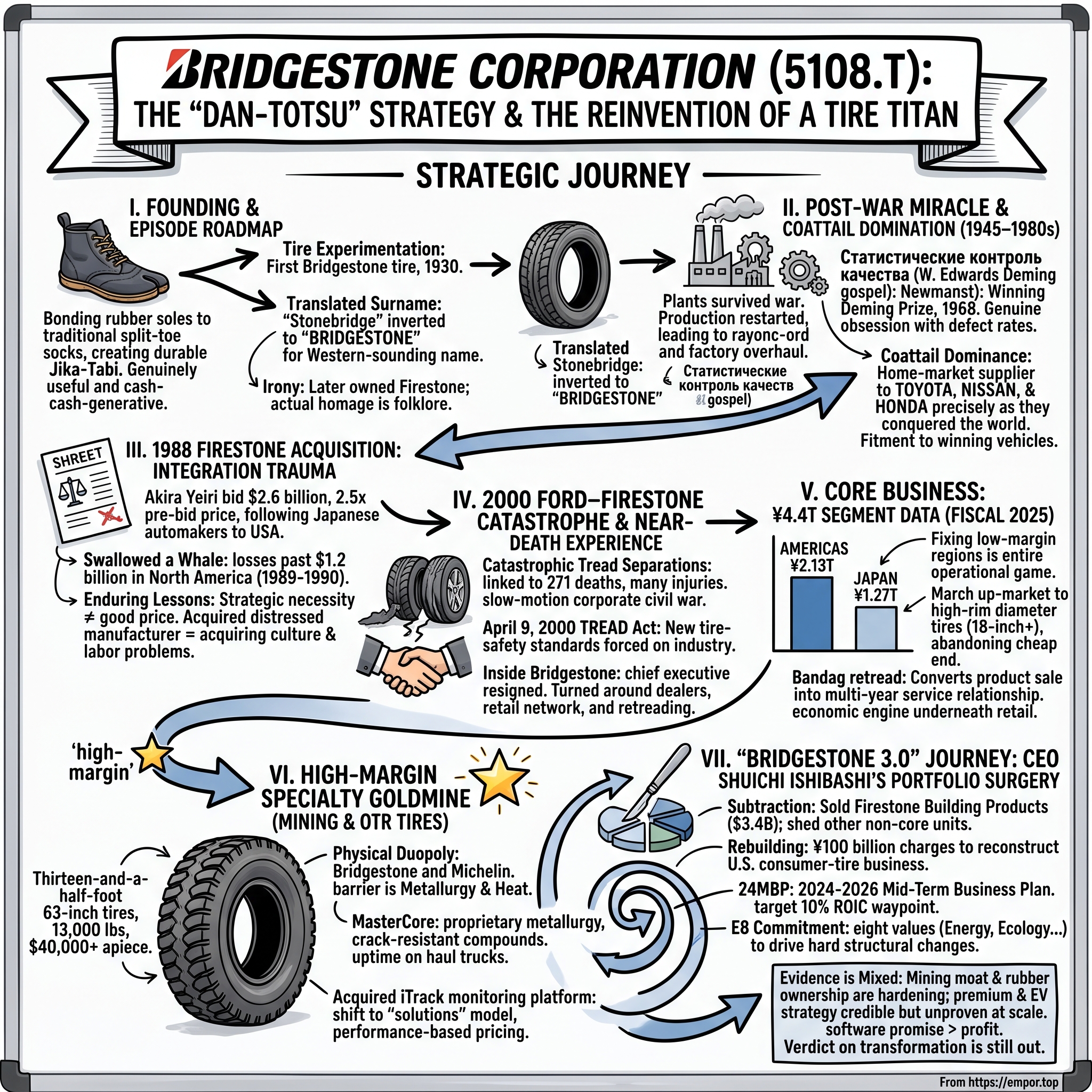
Bridgestone Corporation: The "Dan-Totsu" Strategy and the Reinvention of a Tire Titan
I. Introduction & Episode Roadmap
Picture the modern Bridgestone in a single frame. In the fiscal year ended December 2025, the company turned over roughly ¥4.43 trillion in revenue — a figure essentially flat against the prior year, which itself had been ¥4.43 trillion.12 At a share price near ¥3,700 in mid-2026, the market valued the whole enterprise at around ¥4.7 trillion, or well north of $30 billion.3 It is the number-one or number-two tire maker on the planet depending on the month and the metric, locked in a permanent, almost gentlemanly duopoly for supremacy with France's Michelin, with America's Goodyear a distant, debt-laden third.
That scale is the payoff of a ninety-five-year wager. The central puzzle of Bridgestone is not how a tire company got big — tires are a commodity, and commodities get big by building factories. The puzzle is how a company built on the lowest-margin, most cyclical, most capital-punishing product in the automotive supply chain has spent the last decade trying to escape its own gravity: to stop being a rubber-extruding volume manufacturer and become something that looks more like a premium-brand plus an industrial-software business. Management calls this ambition "Bridgestone 3.0." Whether the reality matches the slideware is the question this piece keeps returning to.
The through-line is dan-totsu. Bridgestone's entire strategy — past and present — is an attempt to find the corners of the tire world where being merely competitive is not enough and being dominant is worth a fortune: the gargantuan mining tires that only two companies on earth can physically build; the natural-rubber plantations it owns outright; the fleet-software subscriptions it hopes will glue commercial customers to its ecosystem. Where Bridgestone is dan-totsu, it earns like a monopolist. Where it is not — mid-tier passenger tires, low-cost European agricultural tires — it bleeds like everyone else.
The journey runs through several acts. The pre-war audacity of a founder who translated his own surname into English and bet a fortune on a car market that barely existed. The 1988 bidding war for Firestone, a deal that nearly broke the company's balance sheet. The 2000 Ford–Firestone recall catastrophe, one of the deadliest product-safety crises in American automotive history and a near-death experience for the brand. The discovery, over time, that the real money was never in the tires people notice but in the ones they never see — the ones under mining trucks the size of houses. And finally the portfolio surgery of the current global CEO, 石橋秀一 Shuichi Ishibashi, a lifer trying to drag a hundred-year-old manufacturer into a higher-margin future.
It helps to understand, up front, why the tire business is such a punishing place to try to compound capital. A tire is a rubber, steel, and fabric composite that must survive tens of thousands of miles of heat, load, and abrasion without ever failing catastrophically — and yet, to the person buying it, it is largely a grudge purchase, invisible until something goes wrong. The raw materials — natural rubber, synthetic rubber derived from oil, carbon black, steel cord — are globally traded commodities whose prices swing with weather and crude, and they can swallow well over half of every sales dollar. The factories are enormous, capital-hungry, and hard to flex; a plant running below capacity bleeds fixed costs. Demand tracks vehicle miles driven and new-car builds, both cyclical. And the customer, whether a giant automaker specifying original equipment or a price-shopping motorist in the replacement aisle, has plenty of alternatives. Put those forces together and you get an industry that, in its commodity middle, earns something close to its cost of capital across a full cycle and not much more. Everything Bridgestone has done that created lasting value has been an attempt to climb out of that middle — and everything that has destroyed value has come from being dragged back into it.
We will keep score honestly. Management makes a lot of promises about margins, returns, and "solutions." Some it has kept. Several it has missed. Let's begin where the surname came from.
 Subscribe on LinkedIn
II. Founding Context: From Tabis to Rubber (1931–1945)
In 1906, a seventeen-year-old named 石橋正二郎 Shojiro Ishibashi took over his family's small clothing shop in 久留米市 Kurume, a castle town in Fukuoka on the southern island of Kyushu.4 Born in 1889, he was not an obvious candidate to build a global industrial empire; he was a provincial merchant's son inheriting a business that stitched tabi — the traditional split-toe cotton socks worn with sandals.6 But Ishibashi had two instincts that would define everything: an obsession with standardization, and an eye for where Japan was going rather than where it had been.
He did the unglamorous things first. He narrowed the sprawling clothing business down to tabi alone, introduced fixed pricing in an era of haggling, and industrialized production.4 Then came the insight that turned a sock shop into a manufacturer. Japan's laborers — farmers, rickshaw pullers, construction workers — wore cloth tabi that shredded within weeks on rough ground. Ishibashi bonded a vulcanized rubber sole to the sock and created the jika-tabi (地下足袋), the rubber-soled work shoe that could survive a rice paddy or a building site.4 It was a genuinely useful invention, and it threw off cash. Crucially, it also taught Ishibashi rubber — the chemistry, the vulcanizing, the supply chains — years before he ever thought about tires.
By the late 1920s he was watching automobiles trickle onto Japanese roads and reaching an audacious conclusion: this backward, car-less country would one day need tires, and they would be imported from Akron, Ohio, unless somebody built them at home. So he did. The first Bridgestone-made tire rolled off a line in Kurume on April 9, 1930, and on March 1, 1931, he spun the tire operation out as an independent company, Bridgestone Tire Co., Ltd.7
The name is the founding myth, and it deserves a fact-check. "Ishibashi" is written 石橋 — ishi (stone) and hashi/bashi (bridge). Ishibashi wanted a Western-sounding name that foreign customers would accept, so he translated his surname, disliked the clunky "Stonebridge," and simply inverted it to "Bridgestone."5 A romantic legend, repeated in countless profiles, holds that he was consciously echoing Harvey Firestone, the American tire magnate. It is a lovely story, and there is no evidence for it in Bridgestone's own account, which credits only the surname and notes the "BS" logo doubled as "Best Service."5 The irony that Bridgestone would one day own Firestone is real; the homage is folklore. This is a useful early lesson in reading this company: the corporate mythology and the documented record do not always align, and the difference matters.
Consider the sheer nerve of the decision from Ishibashi's own vantage point in 1930. He was a merchant from a provincial castle town, not an industrialist. Tire-making was among the most technically demanding manufacturing on earth, dominated by American and European giants with decades of accumulated know-how, patents, and scale. Japan's roads carried a rounding-error number of automobiles. Every rational advisor would have told him to expand the profitable, proven rubber-shoe business he already understood. Instead he took the cash the jika-tabi threw off and poured it into an unproven product for a market that did not yet exist, on the conviction that it would exist. That is the pattern of the true founder-capitalist: using a boring, cash-generative present business to fund an audacious bet on the future — the same move, in spirit, that the modern company claims to be making when it recycles mining and divestiture cash into software and premium tires. The difference is that Ishibashi was betting his own fortune and name; today's version is executed by professional managers spending other people's capital, which is precisely why the accountability questions later in this story matter.
Building an advanced tire plant for a country with almost no passenger cars was the kind of bet that looks like genius or lunacy depending on the year. For a while it looked like lunacy — until war changed the accounting. As Japan militarized in the 1930s, tires became strategic materiel, and protective tariffs kept out foreign competition. Bridgestone's output was progressively conscripted into military demand.8
Then the bill came due. Allied bombing destroyed the Tokyo headquarters, and Japan's 1945 defeat wiped out Bridgestone's overseas assets entirely.8 (Contrary to a common retelling, the Kurume and Yokohama plants survived the war largely intact — a distinction that turned out to be decisive.)8 Ishibashi emerged from 1945 with his home factories standing, his balance sheet gutted, and a country in ruins that was about to become the most important automotive laboratory on earth. What he did next is where the modern company was really forged.
III. The Post-War Miracle & Coattail Domination (1945–1980s)
The genius of Bridgestone's post-war rise was that it barely had to invent anything. It just had to ride.
With its plants intact, Bridgestone restarted production almost immediately after 1945 and threw itself into the frantic modernization of Japanese industry. In 1951 it became the first company in Japan to sell rayon-cord tires and launched a multi-year overhaul of its production facilities.9 The technology gap with Akron and Clermont-Ferrand was real, and Bridgestone closed it the way post-war Japan closed most gaps — by licensing, copying, partnering, and then relentlessly refining. (A frequently cited technical-assistance tie-up with Goodyear belongs to this catch-up era, though Bridgestone's own published history emphasizes the rayon-cord milestone and factory modernization rather than any single foreign alliance.)9
The refining is where Bridgestone became Bridgestone. In the 1960s the company embraced the statistical quality-control gospel of W. Edwards Deming — the American statistician whose ideas Japanese manufacturers absorbed more fervently than his own countrymen ever did. Bridgestone ran a formal "Deming Plan," drilled statistical process control into its factories, and in 1968 won the Deming Prize, the most coveted quality award in Japanese industry.10 This was not a plaque for the lobby. In a business where a single flawed tire can kill someone at highway speed — a lesson the company would relearn agonizingly in 2000 — a genuine, institutionalized obsession with defect rates is a competitive weapon. Quality became Bridgestone's cultural identity, the thing it told itself it was best at.
And then there was the coattail. The single most important fact about Bridgestone's growth from 1955 to 1985 is that it happened to be the home-market tire supplier to トヨタ Toyota, 日産 Nissan, and ホンダ Honda precisely as those three conquered the world. Every Corolla and Civic that displaced a Detroit sedan in an American driveway carried Bridgestone rubber as original equipment. Bridgestone didn't have to win global consumers on its own brand; it was fitted to the vehicles that were winning them. That is about as good a distribution engine as a manufacturer can ask for, and it made Bridgestone dominant at home and increasingly visible abroad without a single overseas factory.
Which was also, eventually, the problem — but we'll get there. On the human side, control passed from the founder to his son Kanichiro Ishibashi, who became president in the early-1960s management restructuring as Shojiro moved up to chairman.10 Shojiro himself, one of the richest men in post-war Japan, poured his fortune into art and civic institutions, founding the Ishibashi Foundation and endowing museums in Tokyo and his native Kurume.6 That foundation was not a vanity footnote. It became the mechanism by which the founding family would retain a steady, patient anchor stake in the company long after professional managers took the wheel — a stewardship structure that still shapes capital allocation today.
There is a subtler point worth pausing on, because it recurs in the modern story. Being the OEM supplier to a rising automaker is a wonderful growth engine, but it is a low-margin one. Automakers are among the most sophisticated, ruthless procurement organizations on earth; they buy tires by the millions, they qualify multiple suppliers to keep them honest, and they squeeze price with a discipline that leaves a tire maker earning thin margins on the original-equipment fitment itself. The money is made later — in the replacement market, when the OE tires wear out and the driver, more often than not, replaces them with the same brand that came on the car. Bridgestone's OEM dominance was thus really an investment in future replacement demand and brand familiarity, subsidized at thin margins today for fatter margins tomorrow. That distinction — cheap OE fitment as a loss-leader for lucrative replacement sales — is the economic engine underneath tire retailing, and it explains why owning the replacement channel, the dealer, and eventually the software relationship would become so strategically central decades later.
By the 1980s Bridgestone was the undisputed king of Japan and a rising force in Asia. But its customers were about to force its hand. Toyota and Honda were building factories inside the United States, and they expected their tire supplier to follow them across the Pacific. Bridgestone had no meaningful American manufacturing. To keep the coattail it had ridden for thirty years, it would have to make the biggest, riskiest acquisition in its history.
IV. The 1988 Firestone Acquisition: Bidding War & Integration Trauma
In February 1988, Bridgestone's president Akira Yeiri made what he thought was a sensible, contained move: a bid of roughly $1.2 billion for a controlling stake in the tire operations of the Firestone Tire & Rubber Company.11 It was a logical deal. Japanese automakers were opening "transplant" assembly plants across the American Midwest to sidestep the voluntary export restraints capping Japanese car imports, and Bridgestone needed U.S. factories to supply them. Firestone — an American icon founded in 1900, but by the 1980s a wheezing, over-unionized, under-invested shadow of itself, still haunted by the deadly "Firestone 500" recall of 1978 — was the obvious target.
Then the auction turned into a war. In March 1988, Italy's Pirelli, allied with Michelin, tabled a competing offer of around $1.8 billion for all of Firestone, with a plan to carve the company up between them.11 For Bridgestone this was existential. Losing Firestone to its two great rivals would have handed Michelin and Pirelli an enormous American manufacturing and distribution footprint while leaving Bridgestone stranded on the wrong side of the ocean, watching its Japanese customers' U.S. plants get supplied by the competition.
Yeiri did not flinch. On March 18, 1988, Bridgestone blew past the Europeans with a knockout, all-cash bid for the entire company: $2.6 billion, or $80 per share — a deal that swept up all of Firestone's roughly 54,000 employees along with its factories.1112[^13] To grasp how aggressive that was, Firestone had traded under $30 a share only weeks earlier.11 Bridgestone paid a premium of roughly 2.5 times the pre-bid price to make sure nobody could counter. Yeiri later described the moment with a phrase that became legend inside the company: Bridgestone, he said, had "swallowed a whale."11
The whale nearly killed the shark. What Bridgestone's consensus-driven, harmony-seeking Japanese management found inside Firestone was a culture, a cost base, and a workforce it was catastrophically unprepared for. Firestone's headcount was nearly double Bridgestone's, and — in the blunt assessment later reported — far less compliant.11 Its aging American plants ran at perhaps 50–60% of the efficiency of Bridgestone's Japanese factories, and the capital required to modernize them dwarfed the acquirers' assumptions.11 To make matters worse, General Motors dropped Firestone as a supplier shortly after the deal, vaporizing something like a fifth of its original-equipment business overnight.11
The financial hangover was brutal and prolonged. Bridgestone's North American operations lost more than a million dollars a day through fiscal 1989–1990, and cumulative losses on the integration ran past $1.2 billion over roughly four and a half years.11 The elegant strategic logic — follow your customers, secure your distribution — was correct. The execution was a decade-long ordeal of labor strikes, culture clash, and cash bleeding out of Tokyo to plug an American hole. Bridgestone had bought the footprint it needed and dramatically overpaid for the privilege of learning how hard American manufacturing turnarounds are.
What should a long-term investor take from the Firestone saga beyond the drama? Two enduring lessons, both of which recur in Bridgestone's later chapters. The first is that strategic necessity is not the same as a good price. Bridgestone genuinely needed an American footprint, and that necessity is exactly what let the auction run away from it — a buyer who cannot walk away has no negotiating leverage, and the Europeans knew it. The second is that acquiring a distressed manufacturer means acquiring its culture, its labor relations, and its deferred capital spending, none of which appear cleanly on the acquisition-day balance sheet. Bridgestone paid for factories and got, bundled in, a decade of strikes, an efficiency gap it hadn't modeled, and a modernization bill it had underwritten far too optimistically. The playbook Bridgestone runs today — buy carefully, integrate patiently, and prefer bolt-on technology and distribution assets over transformational megadeals — is in large part a scar left by 1988.
For a company whose self-image was built on Deming-grade quality, the cruelest irony was still coming. The very plants Bridgestone had strained to acquire and starved of capital during the loss years would, a decade later, produce the tires at the center of a scandal that put the word "Firestone" on the front page of every American newspaper — for all the wrong reasons.
V. The 2000 Ford-Firestone Catastrophe & Near-Death Experience
By the late 1990s the Firestone acquisition finally looked like it might pay off. The plants were running, the losses had turned, and the Firestone brand was again bolted onto one of the best-selling vehicles in America: the Ford Explorer, the SUV that defined a decade of suburban driving. It was fitted, from the factory, with Firestone ATX, ATX II, and Wilderness AT tires. And it was those tires, on those vehicles, that produced one of the deadliest product crises in automotive history.
Drivers began experiencing catastrophic tread separations — the outer tread peeling away from the tire carcass, usually at highway speed, usually in summer heat, disproportionately on tall, tippy Explorers that then rolled over. Federal regulators opened an investigation. On August 9, 2000, Bridgestone/Firestone announced a recall: of roughly 14.4 million tires that met the recall criteria, about 6.5 million were still on the road.13 By the time the U.S. National Highway Traffic Safety Administration tallied it in September 2001, the failures were linked to 271 deaths and more than 500 injuries in the United States alone.13
What followed was a slow-motion corporate civil war conducted on live television. Congress hauled executives from both companies before its committees in September 2000.13 Ford's leadership blamed Firestone's tire construction; Firestone blamed Ford's vehicle design and the low tire-inflation pressure Ford recommended. Two founding-family dynasties — the Fords and, by then, the Japanese owners of Firestone — publicly tore apart a partnership that stretched back roughly a century. On May 21, 2001, Bridgestone/Firestone formally ended its supply relationship with Ford, an almost unheard-of move: the tire maker fired the customer.13 The scandal also produced lasting regulation, the 2000 TREAD Act, which forced new tire-safety and defect-reporting standards on the whole industry.13
Inside Bridgestone, the crisis triggered a reckoning. The financial hit ran to something on the order of $1.67 billion in direct costs, and the reputational damage was worse.11 Internal voices in Tokyo argued for the unthinkable — killing the Firestone brand outright. The chief executive, Yoichiro Kaizaki, who had run the company through the disaster, resigned in January 2001.13 The American CEO, Masatoshi Ono, had already stepped down the previous October.13
The turnaround fell to an American, John Lampe, who took the helm of the U.S. business amid the wreckage.13 His playbook is instructive because it reveals what Bridgestone actually is underneath the brand. Rather than defend the Ford relationship, Lampe walked away from it and rebuilt around Firestone's independent dealer and distribution network — the small tire shops and fleet accounts that had sold Firestones for generations. Backed by a parent company willing to absorb the write-downs and pour in capital, he restructured the manufacturing base, retired the compromised plants and product lines, and reimposed a draconian quality regime — a return, in effect, to the Deming culture the company had let slip inside its American acquisition.
There is a governance and disclosure dimension here that a skeptical investor should not skip past, because it foreshadows a recurring pattern. Through the earliest phase of the crisis, both Ford and Firestone spent precious months pointing fingers rather than getting tires off the road, and the regulatory record suggests the failure signals — warranty-claim spikes, overseas incidents, insurance data — had been accumulating well before the public recall. In a company that told the world its defining competence was quality control, the slow institutional reaction was the most damning part of the episode, more than any single manufacturing defect. It is a reminder that a strong engineering culture at headquarters does not automatically propagate to an acquired plant six thousand miles away with a different language, union, and set of incentives. The distance between Bridgestone's stated culture and its operational reality on the ground is a theme worth holding onto as we evaluate today's "solutions" and "quality-first" rhetoric.
Firestone survived. But the episode permanently reframed how Bridgestone thought about its business. A tire is not a consumer good like a soft drink; it is a safety-critical component whose failure creates body counts, congressional hearings, and existential liability. The lesson management drew — that quality and control of the product are not cost centers but the entire franchise — would push the company, over the next twenty years, toward the parts of the market where engineering barriers were highest and commodity competition was thinnest. To understand that pivot, you first have to see how the ¥4.4 trillion machine is actually built.
VI. Sizing the Core Business: Slicing the ¥4.4T Segment Data
Strip away the history and the mythology, and Bridgestone today is four regional businesses stapled to a handful of product lines, and the interesting thing — the thing that drives the entire investment debate — is how wildly their profitability differs.
Start with geography. In fiscal 2025, the Americas were by far the largest slice of the empire, generating about ¥2.13 trillion of revenue — roughly half the company — but at an adjusted operating profit (AOP) margin of only 9.5%.1 This is the paradox of Bridgestone: its biggest business is not its best business. The Americas throw off enormous absolute profit precisely because they are enormous, anchored by a manufacturing base and by the largest company-owned auto-service retail network in the world — nearly 2,200 stores trading as Firestone Complete Auto Care, Tires Plus, and Wheel Works.34 But the margins are middling, squeezed by consumer-tire competition and, lately, by tariffs.
Japan is the mirror image. On roughly ¥1.27 trillion of revenue in 2025 — a bit over a quarter of the group — Japan earned an AOP margin of 15.7%, comfortably the highest of the major regions.1 This is the profit anchor: a mature, premium home market where Bridgestone's brand strength, OEM relationships, and manufacturing scale let it price for value rather than fight for volume. Roughly a quarter of the revenue produces a disproportionate share of the quality profit.
Then there is EMEA — Europe, the Middle East, and Africa — historically the problem child. It turned over about ¥853 billion in 2025, but its AOP margin was a thin 5.0%, and that was a dramatic improvement: in 2024 the same region managed just 3.6%.12 For years EMEA has been dragged down by low-margin regional structures and a chronically loss-making agricultural-tire business. The fourth leg, Asia-Pacific, India, and China, is the smaller, higher-growth footprint — around ¥518 billion of revenue at an 11.5% margin in 2025.1 The pattern is stark: two regions (Japan, APAC) earn respectable double-digit margins; two (Americas, EMEA) earn far less on far more revenue. Fixing the big, low-margin regions is the entire operational game.
Now overlay the products, because the margin story repeats at the product level. Passenger and light-truck tires are high-volume and brutally competitive, with relentless pricing pressure from tier-two and low-cost Chinese entrants. Bridgestone's answer has been to march deliberately up-market — abandoning the cheap end and concentrating on premium, high-rim-diameter tires (18 inches and up in the U.S. and Europe), where brand and technology still command a price.19 Truck and bus tires are a steadier business-to-business franchise, and here Bridgestone owns a genuinely clever asset: the Bandag retread network, which lets fleet operators re-tread a worn casing several times rather than buy new, slashing their cost per mile and binding them to Bridgestone's service ecosystem.
One more feature of the retread business deserves emphasis, because it is a quiet structural advantage that most investors overlook. A truck-tire casing is the expensive, durable skeleton of the tire; the tread is the wearing surface. Bandag's process shaves off the worn tread and bonds fresh rubber onto a sound casing, letting a single casing live several lives. For a fleet running hundreds of thousands of miles a year, this cuts the cost per mile dramatically — but it also, crucially, keeps the fleet inside Bridgestone's ecosystem, because a Bridgestone casing is worth more when retread on a Bridgestone process at a Bridgestone-affiliated shop. It converts a one-time product sale into a multi-year service relationship, which is exactly the kind of economics a commodity manufacturer dreams about. That logic — sell the durable asset once, monetize the relationship for years — is the same idea Bridgestone is trying to import into mining and into fleet software, and it is the connective tissue of the entire modern strategy.
And then there are the specialties — off-the-road mining, agriculture, construction, and aviation tires. This segment is small in revenue but oversized in profit, historically running adjusted operating margins above 20% even as consumer tires scrape along in single digits; in the first half of 2025, Bridgestone reaffirmed that its specialty business "maintained a high profit structure with over 20% margins."16 That single fact — a fifth of every specialty sales dollar dropping to operating profit, more than double the consumer rate — is the beating heart of the bull case, and it is where the story gets genuinely interesting.
VII. The High-Margin Specialty Goldmine: Mining & OTR Tires
Stand next to one and it stops being a tire and becomes a piece of civil engineering. The largest off-the-road tires Bridgestone builds are so-called 63-inch tires — roughly thirteen and a half feet in diameter, taller than a giraffe, weighing on the order of 13,000 pounds each, and priced at a minimum of $40,000 apiece.15 They are fitted to ultra-class haul trucks like the Caterpillar 797, a machine that itself weighs nearly 700 tons and carries a 380-ton payload of ore out of an open-pit copper or iron mine.15 Six of those tires are the only thing between that moving mountain and the ground.
Here is the part that makes an investor sit up: essentially only two companies on earth can build these things at scale — Bridgestone, in Japan, and Michelin, in France.15 Not Goodyear at any real volume, not the Chinese entrants who are flooding the passenger market, not anyone. The barrier is not a patent you can license around; it is metallurgy and heat. A 400-ton truck grinding around a mine pit for weeks generates staggering internal heat inside the rubber, and a tire that can't shed that heat will literally delaminate, shred, or in extreme cases catch fire. Designing rubber compounds, steel-cord architecture, and tread patterns that survive those loads at speed, for thousands of hours, is a problem two firms have spent half a century and untold R&D solving — and no one else has cracked. This is dan-totsu in its purest form: a market where being pretty good is worthless and being one of two is a license to print money.
Bridgestone's flagship weapon here is a technology line it calls MasterCore, launched in 2020 initially in the 63-inch size. Its pitch is that proprietary steel-cord metallurgy — including a "Metal Surface Coating Technology" for stronger rubber-to-steel adhesion and anti-rust cord for durability — plus new crack-resistant compounds let mine operators run their trucks faster and carry heavier loads without the heat-buildup failures that plague lesser tires.17 In a mine, that is not a spec-sheet nicety. Uptime on a haul truck is worth thousands of dollars an hour, and a tire that lets you run one more load per shift pays for itself many times over. That is why mines will pay $40,000 a corner and consider it cheap.
The strategically important move, though, is what Bridgestone is trying to build around the tire. In 2020 it acquired the iTrack business from the UK's Transense Technologies — a monitoring platform that reads tire temperature and pressure in real time, tracks vehicle location, and throws alerts when a tire is running hot or a truck is speeding.18 The logic is to shift the relationship from selling a physical object to selling an outcome: keep the mine's tires alive and its trucks moving, monitored digitally, and get paid for performance rather than for rubber. Management frames this as the "solutions" future of the mining business.
A note of analytical caution is warranted here, because this is exactly the kind of place where narrative outruns disclosure. Bridgestone's own iTrack announcement describes a monitoring and management platform; it does not spell out a "tire-as-a-service" or "per-ton-kilometer" pricing model with the company bearing failure risk.18 That outcome-based model is the stated direction of travel, and it is a genuinely powerful idea for defending a duopoly against future low-cost entrants — but an investor should treat the degree to which mining revenue has actually converted to recurring, risk-bearing service contracts as unproven until the company quantifies it. The moat in mining tires is real and physical today. The digital layer on top is a promising thesis, not yet a demonstrated earnings stream.
It is worth dwelling on why this segment is so structurally attractive, because the reasons are instructive for the rest of the business. Mining customers — the big copper, gold, and iron-ore operators buying earthmovers from Caterpillar and 小松 Komatsu — are the opposite of price-shopping motorists. Their decision variable is not the sticker price of the tire but the cost of downtime: an idle haul truck can burn thousands of dollars an hour in lost production, and a tire failure in a remote pit can strand a machine for days waiting on a replacement that must be shipped by specialized transport. In that world, a tire that is 10% more expensive but delivers more predictable life and lets the truck run a little faster is not a premium product; it is a bargain. This is the ideal customer for a manufacturer: one who buys on total cost of ownership and uptime, is locked into a two-supplier market, and treats the product as mission-critical rather than discretionary. Everything Bridgestone earns above its cost of capital, it earns from customers who think this way — and the strategic project of the last decade has been to find or manufacture more of them.
That distinction — proven physical moat versus aspirational digital one — is the exact tension running through the company's entire modern reinvention, which is where the current CEO comes in.
VIII. The "Bridgestone 3.0" Journey: CEO Shuichi Ishibashi's Portfolio Surgery
When Shuichi Ishibashi became Bridgestone's global CEO in March 2020, the timing looked almost cruel: a new leader inheriting the top job just as a pandemic shut down the world's auto plants.22 He shares a surname with the founder — a coincidence, not a bloodline — but he is very much a company man, having joined Bridgestone in 1977 and spent his career deep in the American tire, retail, and diversified-products business before building out the group's global "solutions" model in the 2010s.22 He succeeded Masaaki Tsuya, and he arrived with a diagnosis: Bridgestone had become a sprawling, regionally siloed manufacturer whose margins were drifting the wrong way and whose portfolio was cluttered with businesses that had no right to a tire company's capital.
What kind of leader is he? Not a charismatic outsider brought in to blow the place up, but the archetype of the Japanese industrial lifer — a man who has worked one company for over four decades and knows where every body is buried. That cuts both ways for investors. On the positive side, he understands the operational plumbing intimately, particularly the American business where he spent formative years, and he is unlikely to be fooled by his own divisions' optimistic reporting. On the cautious side, an insider running a transformation must dismantle structures and cut businesses that he himself helped build, and history is full of company men who flinched at exactly that moment. The test of Ishibashi is therefore behavioral: does he actually shrink the empire where the returns don't justify the capital, or does he protect legacy operations out of institutional loyalty? So far the record shows genuine willingness to cut — but also targets repeatedly set and not yet hit, which is the tension the numbers section will confront head-on.
His response has been, above all, subtraction. The signature move came fast. In January 2021 Bridgestone agreed to sell Firestone Building Products — its commercial-roofing business, a perfectly good company but utterly unrelated to mobility — to Switzerland's LafargeHolcim for $3.4 billion; the deal closed that April.14 It was a clean, well-timed divestiture at a full price, and it handed Ishibashi a war chest to recycle into the core. Around the same era, Bridgestone shed other non-core diversified operations: it transferred its anti-vibration rubber business (auto components, not tires) to China's Anhui Zhongding, announced in December 2021 and completed in 2022, alongside the reshaping of its broader chemical and industrial-products arm.25 (A frequent misconception dates these chemical exits to 2024; they were largely a 2021–2022 program. The heavy 2024 charges were a different matter.)
Because the 2024 restructuring was about the core itself, not the periphery. Under the mid-term plan, Bridgestone booked roughly ¥100 billion tied to the "rebuilding" of its U.S. consumer-tire business — pulling forward plant restructuring and writing off production equipment as it exited low-margin capacity.2 This is the less glamorous, more revealing kind of surgery: not selling a shiny non-core asset, but admitting that parts of the crown-jewel American tire operation were structurally uncompetitive and had to be shrunk. It is the ongoing, expensive unwinding of decades of chasing volume.
On alignment, the picture is nuanced. Ishibashi personally holds 45,800 shares — a real stake for an executive, but modest against a ¥4.7 trillion company, and not the kind of founder-scale ownership that makes a CEO think like an owner by itself.23 The deeper alignment runs through the Ishibashi Foundation, the founder's philanthropic vehicle, which as of March 2026 held 76,693,430 shares — about 12.0% of the company, its second-largest shareholder after the custodial Master Trust Bank of Japan.24 (Some older summaries cite an 11.2% figure; the share count is the same, and the current, primary-sourced percentage is 12.0%.) That patient, family-linked anchor gives management cover to pursue a long-dated transformation without a quarter-to-quarter activist breathing down its neck — a genuine advantage for a multi-year restructuring, though also, a skeptic would note, a governance structure that insulates management from precisely that accountability.
All of it hangs on the framework Ishibashi calls the "24MBP" — the 2024–2026 Mid-Term Business Plan — which sets a base-case target of 10% return on invested capital by 2026, pushes the company from a regional structure toward a global "module" organization, and wraps the whole thing in a set of eight branded values called the "Bridgestone E8 Commitment."1921 Two of those pieces deserve translation from corporate language into plain English. The "global module structure" is an attempt to fix the exact disease that produced the Firestone integration disaster: regional fiefdoms that each ran their own factories, product lines, and P&L with little coordination, duplicating cost and blunting global scale. Reorganizing around global functional modules is meant to let Bridgestone develop a tire once and build it anywhere, and to stop the Americas, Europe, and Asia from each solving the same problem three times. The "E8 Commitment" — eight values each starting with the letter E, from Energy and Ecology to Emotion and Empowerment — is, more cynically, the kind of values-branding exercise that Japanese conglomerates favor and outside investors tend to skim past; its practical importance is mainly as the cultural banner under which the harder structural changes are being marched.
Whether the numbers arrive is the subject of the last third of this story. But first, the framework beneath the framework: why, mechanically, might Bridgestone earn superior returns at all?
IX. The Playbook: Porter's 5 Forces & Hamilton Helmer's 7 Powers
Strip a company down to its power sources and you learn what its margins are actually made of. Run Bridgestone through Hamilton Helmer's "7 Powers," and it turns out to have not one durable advantage but a portfolio of them — of very different quality.
Scale economies. Tires are a scale game, and Bridgestone's answer to the cost side is a program called BCMA — Bridgestone Commonality Modularity Architecture. The idea, in plain terms, is to build tires the way modern carmakers build cars: from shared modules. Instead of designing every tire from scratch, Bridgestone standardizes internal components into common modules that can be recombined across products and factories, cutting development and tooling cost while still allowing customization at the tread.19 Paired with the ENLITEN materials platform, the goal is fewer distinct parts, cheaper molds, and more flexible global production runs. This is real and defensible — but it is table stakes, not differentiation. Michelin does the same thing under its own names. Scale economics keep Bridgestone in the duopoly; they do not, by themselves, win it.
Cornered resource. Here is where it gets genuinely distinctive: Bridgestone owns its rubber. It controls Firestone Liberia, described as the largest contiguous natural-rubber operation in the world — some 118,990 acres worked by roughly 4,000 people, and in March 2024 the first natural-rubber farm on earth to earn ISCC PLUS sustainability certification.26 Add plantations in Indonesia and Thailand, and Bridgestone's four owned rubber companies supply roughly 20% of the natural rubber it procures globally.27 Why does this matter now more than ever? Because the European Union's Deforestation Regulation (EUDR) will require importers to prove their rubber wasn't grown on recently cleared forest — a documentation nightmare for anyone buying anonymous rubber through a chain of Southeast Asian middlemen. Bridgestone, owning the plantation and the paperwork, has a structural compliance edge.
A caution, again, on the marketing gloss: the "100% traceability" claim needs qualifying. Bridgestone's own disclosures put overall farm-level traceability at around 62%, with district-level traceability at 76% in 2025 and a 100% target only by 2027; the fully-traced 100% figure applies to a specific smallholder program of about 5,000 farmers.27 The owned estates are inherently traceable because Bridgestone owns them; the broader supply chain is a work in progress. The cornered resource is real; the "fully compliant today" framing is ahead of the facts.
Switching costs. This is the software bet. In 2019 Bridgestone paid €910 million for TomTom's fleet-telematics business, renamed it Webfleet Solutions, and inherited an installed base of some 860,000 connected vehicles.28 The theory is workflow lock-in: once a trucking fleet runs its vehicle diagnostics, routing, and driver management through Webfleet's hardware and subscription software, and bundles in tire retreading and maintenance under a "Bridgestone Fleetcare" contract, switching tire suppliers means ripping out an entire operating system.29 It is a sound thesis — telematics genuinely creates stickiness commodity rubber never could. Whether it scales to a level that meaningfully offsets manufacturing cyclicality is unproven, and it is the single element bears most doubt.
Brand and OEM network. The last power is the front-of-mind one, and its live battleground is electric vehicles. EVs are heavier than combustion cars and deliver instant torque, which chews through tires faster and demands lower rolling resistance to protect range. Bridgestone's ENLITEN platform — introduced in 2019 with a claimed ~20% reduction in rolling resistance and ~10% weight reduction versus a standard premium tire — is its pitch to win sole-supplier status on premium EV platforms; its Turanza EV line launched in 2023 targeting fitment on vehicles like Tesla's Model 3/Y and the Ford Mustang Mach-E.3031 It is worth unpacking why EVs are genuinely harder on tires, because the engineering is the whole selling point. A battery pack is heavy, so an electric car can weigh a fifth or more above a comparable petrol model, and all that extra mass presses down on the same four contact patches. Electric motors deliver maximum torque instantly, so every hard acceleration scrubs rubber off the tread the way a spinning wheel does. And because there is no engine noise to mask it, tire roar becomes the loudest thing in the cabin, so EV makers demand quieter tires too. A tire that wears out fast, drains range through rolling resistance, and hums on the highway is a serious problem for a carmaker. Solving all three at once — durability, low resistance, and quiet — is a real materials-science challenge, and it is exactly the kind of problem where an incumbent with deep R&D can, in principle, out-engineer a low-cost rival. Whether Bridgestone's answer is meaningfully better than Michelin's or Continental's is the open competitive question; the platform is credible, but "sole-supplier status on premium EVs" is an ambition management asserts more often than it quantifies.
Winning original-equipment fitment on a marquee EV is worth more than the OE margin itself, because drivers tend to replace with the brand their car came with — the same coattail dynamic that carried Bridgestone out of Japan sixty years ago, re-run for the electric age.
Note what a full Porter's-five-forces read adds to the 7 Powers view. The threat of substitutes is low — nothing replaces a tire, and even a fully autonomous, electric future still rolls on rubber. Supplier power is a genuine swing factor: natural rubber, synthetic rubber, and steel are volatile inputs, which is precisely why owning plantations matters. Buyer power is the crux and it is split down the middle — automakers and price-shopping motorists wield enormous leverage over commodity tires, while mine operators and, to a lesser extent, premium-EV buyers have far less. And the threat of new entrants is bifurcated: near-zero in giant mining tires, where physics and capital form a wall, but high and rising in commodity passenger tires, where Chinese manufacturers have shown they can build world-scale capacity in a decade. Rivalry, meanwhile, is a stable duopoly at the top with Michelin and a brutal free-for-all at the bottom. Read together, the frameworks tell one consistent story: Bridgestone possesses real, durable power in a few defensible niches and almost none in the large commodity middle. The investment question is simply whether the defensible niches can grow fast enough to outrun the erosion in the middle — and that is a question about execution and time, not about whether the moats exist.
X. The Risk Radar: Tariffs, Chinese EV Onslaught & Execution
Every bull case has a shadow, and Bridgestone's has three distinct ones — a price war, a tariff wall, and a stubborn regional wound.
The price war is arriving from China. Manufacturers like 赛轮 Sailun and 玲珑 Linglong have spent a decade building world-scale, low-cost capacity and pushing it into Europe and Latin America, eroding exactly the volume-driven passenger segments where Bridgestone is weakest. Western regulators have responded with anti-dumping and countervailing duties — U.S. cases have slapped double-digit and occasionally triple-digit margins on imported tires from China and its manufacturing satellites, with Linglong's Thai operation, for instance, drawing a 21.09% anti-dumping rate in the 2021 determinations, and earlier China-origin cases producing China-wide rates near 88%.3233 Those duties are a partial shield. They are not a moat, because the Chinese producers keep moving factories and moving up-market, and each year they get closer to the 18-inch-plus premium tiers Bridgestone has retreated into. If the Chinese entrants crack the premium passenger category the way they cracked the budget end, Bridgestone's "march up-market" strategy loses the high ground it retreated to.
The tariff wall is more immediate and, ironically, cuts the other way — it taxes Bridgestone too. Because Bridgestone imports a meaningful share of the tires it sells in the United States, the same protectionist wave raising duties on Chinese rubber also lands on Bridgestone's own cross-border flows. Management disclosed a direct U.S. tariff impact of roughly ¥25 billion in fiscal 2025, rising to about ¥55 billion in fiscal 2026 as the measures take full-year effect.1 The company insists it can largely offset this through cost reduction, supply-chain optimization, and its restructuring savings, and in 2025 it broadly did.1 But a ¥55 billion annual headwind against a business earning roughly ¥490 billion of adjusted operating profit is not trivial, and "we'll offset it with productivity" is a promise that gets harder to keep the longer tariffs persist and the more they escalate.
The regional wound is Europe. The EMEA segment's structurally low margins — 5.0% in 2025, and worse before — are the clearest evidence that Bridgestone's premium strategy is not yet uniformly working.1 The drag comes from a high manufacturing cost base and a loss-making agricultural-tire business the company has spent years trying to fix. Compared with Japan's ~15–16% margins, Europe reveals what Bridgestone looks like when it lacks pricing power and scale advantage: an ordinary, sub-scale tire maker in a competitive market.
There is a fourth risk that sits underneath all three and rarely makes the highlight reel: the sheer cyclicality and input-cost exposure of the underlying business. Tire demand rises and falls with vehicle production and miles driven, both of which move with the economic cycle, and roughly half the cost of a tire is commodities whose prices Bridgestone does not control. In a bad year, volumes fall while a plant's fixed costs do not, and if rubber and oil spike at the same time, the margin compression can be severe and fast. This is the deep reason the "solutions" pivot matters beyond the buzzword: recurring service revenue — retreading contracts, fleet-software subscriptions, mining monitoring — is inherently less cyclical and less commodity-linked than selling rubber by the tonne. The strategic bet is not merely to earn higher margins but to earn steadier ones. Whether that mix shift has progressed far enough to actually dampen a downturn is untested; the next real recession will be the audit.
A useful myth-versus-reality check belongs here. The consensus narrative casts Bridgestone as a serene, structurally advantaged premium franchise gliding above the commodity fray. The reality is more contingent: it is a company with a genuinely elite crown jewel (mining), a solid premium home market (Japan), and two very large regions — the Americas and Europe — that are, respectively, only adequately and poorly profitable, and exposed to exactly the tariff and low-cost-competition forces the bull case would prefer to wave away. The advantage is real but concentrated, not diffuse. Anyone underwriting the stock on a blanket "wide moat" assumption is over-generalizing from the best 20% of the business to the whole.
Management's counter to all three is a single doctrine it calls "Growth with Quality" — a deliberate willingness to shrink revenue by walking away from low-margin commodity business, retiring capacity, and concentrating on premium high-rim tires and high-return specialties.19 It is a coherent strategy, and it is the right one. But it is also, by construction, a strategy of managed retreat, and it carries an execution risk that is easy to underrate: a manufacturer with enormous fixed costs that voluntarily gives up volume must hit its margin and mix targets precisely, or it ends up with under-utilized plants and lower sales — the worst of both. Which brings the story to the scoreboard.
XI. Valuation & The Bull vs. Bear Case
So does the machine work? The honest answer in mid-2026 is: better than it did, not yet as well as promised.
Begin with the promises, because management credibility is best judged against its own targets. The 2030 long-term aspiration, set out in 2022, calls for revenue above ¥5 trillion, adjusted operating profit above ¥800 billion, an AOP margin above 15%, and a 12% return on invested capital, with the 24MBP setting a 10% ROIC waypoint for 2026.1920 Now the actuals: in 2025 Bridgestone earned an AOP margin of about 11.1% and a return on invested capital it reports at 8.3%.1 Those are respectable numbers — 2025's profit even rose to ¥327 billion, flattered by a large one-time tax reversal — but they sit meaningfully below the 2026 waypoint, let alone the 2030 goal.1 The gap between an 8.3% ROIC today and a 10% target next year is not trivial, and it is fair to say management is behind its own schedule on the metric it has told investors to hold it to. Guidance for 2026 — revenue of ¥4.5 trillion and AOP of ¥515 billion — implies progress, not a leap.1
On capital allocation the record is more clearly favorable, and it is where the family-steward structure shows its virtue. Bridgestone has leaned hard into shareholder returns: a ¥300 billion buyback in 2025 followed by an authorization of up to ¥150 billion in 2026, within a three-year 2024–2026 repurchase program totaling ¥450 billion, alongside a rising dividend and a stated floor around ¥250 per share (pre-split) with a roughly 50% payout target.1 For a Japanese industrial — a category long criticized for hoarding cash — this is disciplined, owner-friendly behavior, funded in part by the Firestone Building Products sale. A skeptic's fair challenge is whether returning capital is easier than earning it: buybacks flatter per-share metrics while the underlying ROIC still lags target.
Set against Michelin and Goodyear, the competitive shape is clear. Michelin is the true peer — comparable scale, the co-monopolist in giant OTR tires, arguably a shade ahead on premium branding and financial consistency, and further along in explicitly reframing itself as a high-tech materials-and-services company rather than a tire maker. Goodyear is the cautionary tale: more leveraged, lower-margin, and in recent years pushed by an activist investor into board changes and a formal portfolio review, it is the version of Bridgestone that never escaped commodity gravity and is now being forced to restructure from a position of weakness rather than strength. Bridgestone sits between them, and the strategic point is that its restructuring is being conducted from relative health — it has the balance sheet and the mining cash flow to fund a transition on its own terms. That is an advantage Goodyear no longer has.
What would a skeptical activist actually challenge here? Probably three things. First, the pace: an insider-led transformation that keeps missing its own ROIC waypoints invites the argument that the company is under-earning its assets and could be pushed harder and faster. Second, the ownership structure: the founder-linked foundation's large, patient stake, combined with the broader web of Japanese cross-shareholdings and custodial holders, insulates the board from exactly the pressure that is forcing change at Goodyear — good for stability, less good for urgency. Third, the portfolio logic: a bear could argue Bridgestone still spans too many low-return regional tire businesses and unproven digital ventures, and that a more radical separation — spinning the crown-jewel specialty business away from the commodity consumer operations — would surface value the current conglomerate structure buries. Management's answer is that the businesses share technology, rubber, and manufacturing, and are worth more together. That is a defensible position, but it is the same argument every diversified industrial makes right up until the day it breaks itself up.
The bull case rests on the durable stuff. The mining and OTR franchise is a physical two-player oligopoly earning 20%-plus margins that no new entrant can realistically assault, and MasterCore plus digital monitoring deepen the customer relationship. The owned natural-rubber base becomes more valuable as EUDR and traceability rules tighten. And if ENLITEN wins the premium EV OE wave, Bridgestone re-runs its coattail-distribution playbook for the next vehicle generation, while the 2021–2024 portfolio surgery leaves a cleaner, higher-return company behind.
The bear case is that the good businesses are too small to move a ¥4.4 trillion needle dominated by cyclical, contested consumer tires. Tariffs impose a permanent ¥50-billion-plus annual tax on North American profits; Chinese manufacturers keep climbing into the premium tiers that were supposed to be Bridgestone's refuge; Europe stays stuck in low single-digit margins; and Webfleet never scales enough to change the earnings mix. In that world Bridgestone is a well-run but fundamentally cyclical manufacturer whose 15% margin aspiration remains a slide, not a P&L.
If an investor tracks only a few things, track these three. First, adjusted operating profit margin by segment — specifically whether the Americas and EMEA close the gap on Japan, because that convergence is the entire "Growth with Quality" thesis in one number. Second, specialty (OTR/mining) margin and its share of group profit — the health of the crown jewel and the best evidence of durable pricing power. Third, ROIC against the 10%/12% targets — the single figure management chose as its own report card, and the cleanest test of whether the reinvention is real or rhetorical.
Notice what is deliberately not on that list: headline revenue growth. For a company explicitly pursuing "value over volume," rising revenue can actually be a warning sign that it is drifting back into low-margin commodity business, while flat or even falling revenue at rising margins is exactly what a successful transition should look like. This is the rare large industrial where a shrinking top line, in the right mix, is a feature rather than a bug — which is precisely why margin and return metrics, not sales, are the honest scoreboard. An investor who anchors on revenue growth will misread this company in both directions.
XII. Epilogue & Outro
There is a straight line, improbably, from a rubber-soled sock to a thirteen-foot mining tire. Shojiro Ishibashi built his first fortune by bonding rubber to something people already wore, solving a durability problem for laborers who couldn't afford to keep replacing their footwear. A century later his company's most profitable product bonds rubber to steel to survive under a 400-ton truck, solving a durability problem for miners who can't afford downtime. The chemistry got harder; the instinct never changed. Find the place where your product's reliability is worth the most, and own it so completely that competition becomes irrelevant.
The recurring lesson of Bridgestone's history is that it turns catastrophes into structural change. War destroyed its headquarters and taught it to master quality at home. The Firestone acquisition nearly broke its balance sheet and forced it to become a global manufacturer. The 2000 recall nearly killed the brand and re-taught it that in a safety-critical business, control of the product is the franchise. Each crisis pushed the company toward the high-barrier corners of its industry and away from the commodity middle.
The open question — the one the next five years will answer — is whether "Bridgestone 3.0" is another genuine transformation or merely a well-narrated version of the same cyclical tire company. The evidence is mixed and should be held that way. The mining moat is real and rare. The rubber ownership is a genuine, hardening advantage. The premium and EV strategy is credible but unproven at scale, and the software layer is more promise than profit. Meanwhile the core consumer business remains cyclical, tariff-taxed, and under Chinese pressure, and management sits behind its own return targets.
For a long-term investor, that is the whole game with a capital-intensive industrial: not the volume it ships, but whether it can keep concentrating its capital in the few places where it is genuinely dan-totsu — and earn its way there before the commodity tide catches up. Bridgestone has spent ninety-five years proving it knows where those places are. The verdict on whether it can finally earn like it fully occupies them is still, honestly, out.
References
-
Financial Results for Fiscal 2025 (presentation) — Bridgestone Corporation, 2026-02-16 ↩↩↩↩↩↩↩↩↩↩↩↩
-
Consolidated Financial Statements for the Fiscal Year Ended December 31, 2024 — Bridgestone Corporation, 2025-02-17 ↩↩↩
-
Bridgestone Corporation Stock Profile (5108.T) — Reuters Markets ↩
-
1906-1930 | History | Corporate — Bridgestone Corporation ↩↩↩
-
Origin of Bridgestone's Name — Bridgestone Blog, 2019-08-28 ↩↩
-
1941-1950 | History | Corporate — Bridgestone Corporation ↩↩↩
-
1951-1960 | History | Corporate — Bridgestone Corporation ↩↩
-
1961-1970 | History | Corporate — Bridgestone Corporation ↩↩
-
Bridgestone Tire Comes Full Circle 25 Years After Buying Firestone in 1988 — WardsAuto, 2013-02-11 ↩↩↩↩↩↩↩↩↩↩
-
Bridgestone Completes Sale of Firestone Building Products to LafargeHolcim — PR Newswire / Bridgestone Americas, 2021-04-01 ↩
-
Gigantic Wheels Turning Titan Tire Factory Into a Hub of New Activity — Tire Review, 2008-05-27 ↩↩↩
-
Bridgestone Reports First Half Profit Increase — Modern Tire Dealer, 2025-08-08 ↩
-
New Bridgestone MasterCore Tire Line Provides Mine Sites With Customized Tire Performance — Bridgestone Corporation, 2020-08-07 ↩
-
Bridgestone Acquires iTrack Solutions Business from Transense Technologies — Bridgestone Corporation, 2020-06-25 ↩↩
-
24 Mid Term Business Plan (2024–2026) — Bridgestone Corporation, 2024-03-01 ↩↩↩↩↩
-
2030 Long Term Strategic Aspiration (Integrated Report 2023, pp. 26–31) — Bridgestone Corporation, 2023 ↩
-
Top Management Change — Bridgestone Corporation, 2019-12-13 ↩↩
-
Annual Securities Report, 106th Fiscal Period (FY2024) — Bridgestone Corporation, 2025-03-25 ↩
-
Corporate Governance Report (updated 2026-03-31) — Bridgestone Corporation ↩
-
Bridgestone Transfers its Anti-Vibration Rubber Business to Anhui Zhongding — Bridgestone Corporation, 2021-12-10 ↩
-
Firestone Liberia Earns Historic Certification: The World's First ISCC PLUS Certified Natural Rubber Farm — PR Newswire, 2024-03-12 ↩
-
Procurement | Social | Sustainability — Bridgestone Corporation ↩↩
-
Bridgestone to Acquire TomTom's Digital Fleet Solutions Business — Bridgestone Corporation, 2019-01-22 ↩
-
Tyres & telematics: Webfleet and Bridgestone join forces to deliver a full mobility solution — Webfleet, 2021-07-30 ↩
-
Bridgestone Introduces ENLITEN, a New Lightweight Tyre Technology — CSRwire, 2019-06-29 ↩
-
Bridgestone Turanza EV Grand Touring Tire for Electric Vehicles Makes World Debut at Electrify Expo — PR Newswire, 2023-05-19 ↩
-
Final Determinations in Antidumping and Countervailing Duty Investigations of Passenger Vehicle and Light Truck Tires from South Korea, Taiwan, Thailand, and Vietnam — U.S. International Trade Administration, 2021-05-21 ↩
-
U.S. Commerce Department Declares Anti-Dumping Duties On Tires — AftermarketNews, 2015-01-23 ↩
-
Bridgestone Retail Operations (BSRO) Business Unit — Bridgestone Americas ↩
 LinkedIn
 WhatsApp
 Reddit
 Hacker News
 Email
Email Kindle
 RSS Feed
 Spotify
 Apple Podcasts
 Amazon Music
 Audible
 YouTube