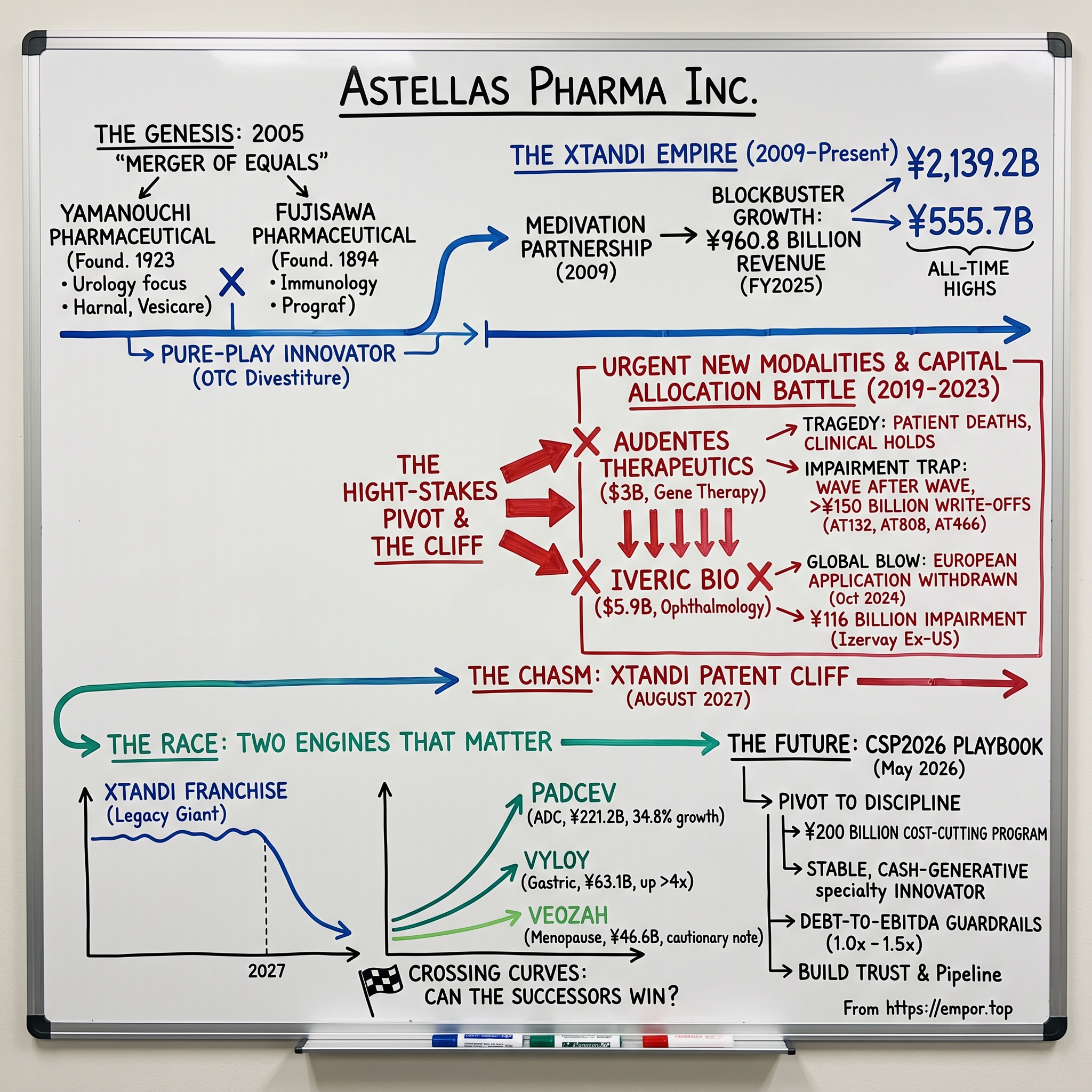
Astellas Pharma Inc.: The High-Stakes Pivot of a Japanese Giant
I. Introduction & Episode Roadmap
On the morning of April 27, 2026, Astellas Pharma Inc. (アステラス製薬株式会社 Astellas Seiyaku Kabushiki-gaisha; JPX: 4503.T) did something it had not done for three straight years: it reported numbers that looked unambiguously good. Revenue for fiscal 2025 — the year ended March 31, 2026 — came in at ¥2,139.2 billion, up nearly 12%. Core operating profit jumped more than 40% to ¥555.7 billion. President and CEO Naoki Okamura told investors these were "all-time highs since the founding of Astellas."12 For a company whose stock had spent much of the prior two years being punished for a serial habit of multi-billion-yen write-downs, it was a moment to exhale.
And yet the exhale is exactly where the tension of this story lives. Because underneath those record numbers sits a countdown clock. The single product that made Astellas a global name — the prostate-cancer blockbuster Xtandi (enzalutamide) — generated ¥960.8 billion in fiscal 2025, roughly 45% of the entire company's revenue.1 Its core U.S. patent protection runs out in August 2027, with European exclusivity, extended by a supplementary protection certificate, lapsing in mid-2028.11 When that happens, cheap generics will flood in and one of the most lucrative franchises in the history of Japanese pharma will begin a fast, structural decline. Astellas has, in effect, been handed an eviction notice on nearly half its business, with the date printed on it.
This is a company that has known about that date for a decade. The whole drama of the modern Astellas story is what management did with the warning. Flush with Xtandi cash, it went shopping — aggressively, expensively, and at the top of the market — for the drug franchises that would replace it. It paid $3 billion for a gene-therapy platform in 2020 and $5.9 billion for an eye-disease company in 2023. Both deals became case studies in what happens when a cash-rich incumbent, frightened of its own patent cliff, pays peak valuations for unproven science. The gene-therapy bet produced patient deaths in clinical trials and a cascade of impairments; the eye drug got rejected in Europe and triggered a ¥116 billion write-off.678 For two fiscal years, Astellas reported the surreal spectacle of a business whose core profits were rising on strong drug sales while its reported profits were being obliterated by the write-downs of yesterday's acquisitions.
So the question a serious investor has to sit with is not "is Xtandi a great drug" — it plainly was and is. It is this: can a mid-cap pharmaceutical company survive the loss of its one giant product, and can it do so given a management team whose recent track record of deploying capital has been, to put it charitably, mixed? In May 2026, Okamura's answer arrived in the form of Corporate Strategic Plan 2026 — a pivot from spending to discipline, headlined by a ¥200 billion cost-cutting program and a promise to stop the bleeding.3 Whether that promise is credible is the real subject of this piece.
It helps to hold two engines in mind, because Astellas today runs on exactly two that matter. The first is Xtandi, the legacy giant in decline-by-appointment. The second is Padcev (enfortumab vedotin), an antibody-drug conjugate for bladder cancer that pulled in ¥221.2 billion in fiscal 2025 and grew almost 35% year on year — the closest thing Astellas has to a genuine successor.1 The entire investment case can be reduced to a race between these two curves: how fast the Xtandi line falls after August 2027 versus how fast the Padcev line, joined by a handful of smaller drugs, can climb. Everything else in this story — the acquisitions, the write-offs, the leadership changes, the new strategic plan — is ultimately about whether the second curve can be made to win the race.
The narrative runs in stages. The Genesis — how two century-old Japanese drug houses merged in 2005 to build a global-scale innovator. The Xtandi Empire — how a mid-sized player from Tokyo co-owned one of the world's best-selling cancer drugs. The Modal Pivot — the fateful decision to chase gene therapy and ophthalmology. The Capital Allocation Battle — a financial autopsy of the Audentes and Iveric acquisitions. The Modern Pillars — the drugs that must now carry the company. And the CSP2026 playbook — management's attempt to rebuild trust. Empor is in the business of telling these stories straight, so the posture throughout is neutral: management's claim that it can grow through the cliff is a hypothesis to be tested against evidence, not a slogan to repeat. Let's begin where Astellas itself began — with a shotgun marriage of equals.
 Subscribe on LinkedIn
II. The Genesis: Yamanouchi, Fujisawa, and the 2005 "Merger of Equals"
To understand Astellas, you first have to understand that it is a fusion of two very different corporate personalities — one an obsessive chemist, the other a patient fermenter — stitched together at a moment of genuine fear.
The older of the two ancestors was 藤沢薬品工業 Fujisawa Pharmaceutical (Fujisawa Yakuhin Kōgyō), founded in Osaka in 1894. Fujisawa's genius was biological. It was a master of fermentation — the industrial art of coaxing microorganisms to manufacture complex molecules — and that expertise produced its crown jewel: Prograf (tacrolimus), an immunosuppressant discovered from a soil bacterium found on a Japanese mountainside. Prograf became the global gold standard for stopping the body from rejecting a transplanted organ. If you received a new liver, kidney, or heart anywhere in the developed world from the 1990s onward, there is a strong chance a Fujisawa molecule kept it alive. It gave Fujisawa a durable, defensible franchise in transplantation and immunology.
The younger ancestor, 山之内製薬 Yamanouchi Pharmaceutical (Yamanouchi Seiyaku), was founded in 1923 and was, by temperament, a chemist's company. Its dominance lay in urology, built on precise small-molecule synthesis. Yamanouchi owned Harnal (tamsulosin), a treatment for the urinary misery of an enlarged prostate that became a worldwide standard, and Vesicare (solifenacin) for overactive bladder. Where Fujisawa grew its drugs in vats, Yamanouchi engineered them atom by atom. The two firms overlapped just enough to understand each other and differed just enough to be complementary.[^5]
Why merge? The answer is the anxiety that has haunted Japanese pharma for thirty years: scale. By the early 2000s the global drug industry was consolidating into a handful of mega-caps — Pfizer, GlaxoSmithKline, Novartis — with the balance sheets to run enormous global clinical trials and the sales armies to sell into every major market. Japan's domestic drug firms, protected by a rich but insular home market, were sub-scale by comparison and increasingly vulnerable as that home market's pricing generosity began to erode. A mid-sized Japanese company could discover a fine molecule and then watch a Western giant out-develop and out-market it globally. Yamanouchi and Fujisawa concluded, separately, that the only way to compete on the world stage was to stop being two national champions and become one international one.
The integration was announced in 2004 and completed on April 1, 2005, creating Astellas Pharma Inc. — the name a coinage meant to evoke "stars" and "aspire," deliberately neutral so that neither legacy identity dominated.[^5] It was structured and sold as a "merger of equals," pooling Yamanouchi's urology and Fujisawa's immunology and transplantation into a single portfolio with real global reach. Mergers of equals are notoriously prone to cultural paralysis — two head offices, two ways of doing everything, endless committees — and the phrase often masks a slow-motion power struggle. Astellas navigated it better than most, in part because management moved fast to define what the new company would not be.
That defining move came quickly. In a business as sprawling as pharma, focus is a strategic weapon, and the new leadership decided Astellas would be a pure-play innovator — a developer of patented, high-margin prescription drugs — and nothing else. So it shed the low-margin distractions. The most telling divestiture was the 2006 sale of the combined over-the-counter business, housed in a unit called Zepharma, to 第一三共 Daiichi Sankyo for ¥23.5 billion.[^6] OTC medicines — the cough syrups and stomach remedies sold off pharmacy shelves — are a fine business, but a commoditized, marketing-driven, low-margin one that shares almost none of the DNA of cutting-edge drug discovery. By selling it, Astellas signaled that it would live or die on the strength of its research pipeline and the patents that protect it.
It is worth dwelling on why this focus mattered, because it set the terms of everything that followed. In the Japanese pharmaceutical industry of the 2000s, sprawl was the norm: domestic firms often carried OTC lines, diagnostics, generics, and even food or chemical divisions, cushioning themselves against the volatility of any single drug. That diversification produced stability but also mediocrity — capital spread thin across low-return businesses, and management attention diluted. Astellas chose the opposite. By concentrating exclusively on innovative prescription drugs, it maximized both the potential reward and the potential fragility of its model. High margins in the good years; a cliff-edge in the bad ones. It was a deliberately American, deliberately un-Japanese bet on innovation over ballast.
That was a high-conviction, high-risk identity to choose. A pure-play innovator has no cushion: when a patented blockbuster expires, there is no steady OTC or generics arm to absorb the blow. It is a business model that only works if you can keep discovering — or buying — the next blockbuster before the last one dies. Which is precisely the tightrope Astellas has walked ever since, and precisely why a single in-licensing deal struck in 2009 came to matter more than anything the merger itself produced.
III. The Golden Goose: The Medivation Partnership & The XTANDI Empire
In 2009, a small, aggressive San Francisco biotech called Medivation had a molecule and a problem. The molecule was MDV3100 — later named enzalutamide — an experimental compound that blocked the androgen-receptor signaling that fuels prostate cancer. The problem was that Medivation was a minnow, with no capacity to run the vast global trials or build the worldwide sales force that a prostate-cancer drug would demand. It needed a partner with deep pockets and global reach but without an existing prostate franchise that would create a conflict. Astellas, hunting for exactly this kind of late-stage asset, fit perfectly.
The deal they struck was a model of aligned incentives. Astellas agreed to shoulder 50% of U.S. development and commercialization costs and 100% of the costs outside the United States, and in exchange the two companies would split U.S. profits and Astellas would keep the rest of the world. It was a bet on a molecule that had not yet proven itself — but the clinical logic was compelling, and it soon proved better than anyone dared hope.
Here is why Xtandi, as enzalutamide was branded, changed the game. The dominant new prostate drug of that era was Johnson & Johnson's Zytiga (abiraterone), which worked by choking off the body's testosterone production. But abiraterone's mechanism forced a side effect: it suppressed the adrenal glands, so patients had to take a steroid (prednisone) alongside it, every day, to avoid dangerous hormone imbalances. Steroids bring their own baggage — fluid retention, bone loss, blood-sugar problems, infection risk — especially in elderly men. Xtandi worked differently. Rather than shutting off the fuel supply, it blocked the receptor the fuel plugs into, and it did so without requiring a steroid chaperone. For a frail 75-year-old with metastatic castration-resistant prostate cancer, "one pill, no steroid" was a materially better life. Oncologists noticed, and prescriptions followed.
There was a further clinical advantage that compounded over time. Xtandi did not stay confined to the last stages of the disease. Through a relentless program of follow-on trials, its approved use crept steadily earlier in the treatment journey — from late-stage metastatic disease into earlier metastatic settings and then into non-metastatic castration-resistant disease, where patients take the drug for years before their cancer has even spread. Each expansion widened the eligible patient pool and lengthened the average duration a patient stays on the drug, and in a business where revenue equals patients multiplied by time-on-therapy, that is how a good drug becomes a giant one. This "label expansion" playbook — squeezing every approvable indication out of a single molecule — is the quiet engine behind most pharmaceutical blockbusters, and Astellas and its partner ran it about as well as it can be run.
The commercial ascent turned Xtandi into a genuine juggernaut, and it attracted a giant. In 2016, Pfizer acquired Medivation outright for roughly $14 billion — around $81.50 a share — primarily to capture Medivation's half of the Xtandi economics.4 Overnight, Astellas's development partner became one of the largest pharmaceutical companies on earth. That could have been destabilizing — a scrappy biotech partner is very different from a mega-cap with its own priorities — but instead the alliance matured into a smoothly functioning commercial machine, with Pfizer's global sales reach amplifying the franchise. Xtandi kept climbing, reaching ¥960.8 billion in sales booked by Astellas alone in fiscal 2025, and even in that final pre-cliff year it was still growing, up 5.3%.1
There is a subtlety in the economics worth making explicit, because it shapes how much the cliff will actually hurt. Because Astellas bears 100% of costs outside the United States and shares U.S. profits, the ¥960.8 billion it books is a mix of high-margin ex-U.S. sales and a profit share on the U.S. side. When generics arrive, they will not erase that revenue uniformly or overnight; European genericization tends to be fast and brutal on price, while the U.S. can erode more unevenly, and switching-cost inertia among oncologists slows the bleed at the margin. But make no mistake about the direction. A drug that loses patent protection typically sees the vast majority of its revenue evaporate within a couple of years as pharmacies substitute copies costing a fraction of the branded price. There is no version of the post-2027 world in which Xtandi remains a ¥900-billion product.
Now weigh what that number actually means for the company, because this is where the analysis gets uncomfortable. For well over a decade, Xtandi did not merely contribute to Astellas — it was Astellas in a financial sense, throwing off the cash that funded the entire global research infrastructure, every trial, every acquisition, every dividend. A single drug underwriting an entire multinational is a wonderful thing right up until the moment it isn't. At roughly 45% of total revenue, Xtandi represents a concentration risk that would make any credit analyst wince.1 And the concentration is worsened by the competitive backdrop: Bayer's Nubeqa (darolutamide) has been aggressively winning share in the same prostate-cancer space, chipping at Xtandi's growth even before generics arrive. When the patent protection lapses beginning in August 2027, the decline will not be gentle.11
That is the structural fact that has driven every major decision Astellas has made in the last seven years. Management looked at a mountain of Xtandi cash and a cliff on the calendar and concluded, reasonably, that it had to buy its way to a new future before the old one expired. The instinct was sound. The execution is where the story turns dark. Because the hunt for the next modality led Astellas, first, straight into the most treacherous frontier in all of medicine.
IV. The Impairment Trap: Audentes and the Gene Therapy Tragedy
Gene therapy is the most seductive idea in modern medicine: instead of managing a genetic disease with lifelong drugs, you fix the broken gene itself, once, and cure the patient. For a company staring at a patent cliff, it also promised something strategically irresistible — a whole new "modality," a platform that could generate many drugs rather than a single molecule, with patent runways stretching decades into the future. In the late 2010s, as Astellas reorganized its research around ambitious "Primary Focus" areas including "Genetic Regulation," gene therapy looked like the modality that would replace Xtandi.
So in December 2019, Astellas announced it would buy Audentes Therapeutics for $3.0 billion in cash — $60.00 a share, a staggering 110% premium to where the stock had been trading the day before.[^10] Audentes brought a platform based on adeno-associated virus, or AAV — a re-engineered, harmless virus used as a microscopic delivery truck to carry a corrected gene into a patient's cells. Its lead program, AT132, targeted X-linked myotubular myopathy (XLMTM), a devastating genetic disease that leaves baby boys unable to breathe or move their muscles, usually killing them in early childhood. The promise was almost unbearably hopeful: a single infusion that could give these children a life.
To understand why this bet was so dangerous, it helps to picture the mechanics. An AAV gene therapy is dosed by the sheer number of viral particles infused — figures like 3×10¹⁴ vector genomes per kilogram of body weight, which is an almost unimaginable quantity of engineered virus flooding into a small child's bloodstream. To reach muscle cells throughout the entire body, you have to use a lot of trucks, and every one of those trucks passes through the liver, the organ that filters the blood. The liver bears the brunt of the immune reaction and the toxic load. In principle, dose high enough to cure the muscle; in practice, dose high enough to poison the liver. That is the knife-edge on which whole-body AAV therapy sits, and in 2019 nobody — not Audentes, not Astellas, not the field — had reliably figured out where the safe line was.
Then came the nightmare. Beginning in 2020, boys in the ASPIRO trial who had received the high dose began developing liver dysfunction within weeks of infusion, and several died — with causes including liver failure and gastrointestinal bleeding.6 The U.S. Food and Drug Administration placed the trial on clinical hold; the hold was later lifted; and then, after an additional death in a lower-dose cohort, a fourth child in total, it was reimposed.615 Investigators later noted that many of the affected patients had evidence of pre-existing liver disease, a subtlety that made the risk even harder to manage. This is the brutal, under-appreciated reality of high-dose systemic AAV gene therapy: the very thing that makes it powerful — flooding the body with viral vectors — is the thing that can kill the patient. Astellas had bought a platform whose central technical challenge was not yet solved, and had paid a triple-digit premium for the privilege.
What followed on the financial statements was a slow-motion demolition of the $3 billion purchase price, booked in wave after wave of impairment charges — the accounting acknowledgment that an asset is worth far less than you paid. The pattern is worth walking through slowly, because it is the heart of the credibility problem. An initial ¥58.8 billion was written off against AT132 as timelines slipped and the safety picture darkened. As the program was ultimately halted, a further ¥16.4 billion came off in fiscal 2025 — the accounting finally catching up to the reality that AT132 was effectively dead.1 But the damage was not confined to the lead asset. In fiscal 2023, Astellas took roughly ¥40 billion in impairments on AT808, a Friedreich's ataxia program from the same platform, part of a broader ¥70 billion bucket of one-time charges that quarter that also swept in an unrelated kidney drug.9 In fiscal 2024, another roughly ¥52 billion was written down on AT466, a myotonic dystrophy program.8
It is worth pausing on what an impairment actually is, because it is the recurring villain of this story. When a company buys another for far more than the book value of its tangible assets, the excess is parked on the balance sheet as intangible assets and goodwill — an accounting IOU that says, in effect, "we paid this much because we believe the science will be worth it." Each year the company must test whether that belief still holds. When a drug program fails or shrinks, the auditors force a write-down: the intangible is slashed, and the difference flows straight through the income statement as a loss. Impairments are, quite literally, the accounting system admitting that management overpaid. They do not cost cash today — the cash left years ago, at the moment of acquisition — but they are the delayed confession of a capital-allocation mistake.
Add it up and Astellas impaired well over ¥150 billion — on the order of a billion dollars or more — against a $3 billion acquisition, with the lead asset terminated and the platform's dream of curing many diseases reduced to a handful of dead programs. The lesson is not that gene therapy is worthless; the field is real and advancing, and other companies have since navigated the AAV dosing problem more carefully. The lesson is about the price and the timing. Astellas paid a peak-of-hype premium for an early-stage platform whose fundamental toxicology risk was unresolved, and it underwrote the deal as though the science were further along than it was. This is the recurring sin of a cash-rich incumbent frightened of its own future: it mistakes activity for strategy, and it pays for optionality as if it were certainty. The truly damning part is that, having absorbed this lesson at the cost of a billion dollars, Astellas turned around and did something structurally similar in a different therapeutic area — this time for nearly twice the money.
V. The Iveric Bio Gambits and the European Withdrawal
By 2023 the pressure had only intensified. The Xtandi cliff was four years closer, the Audentes bet was visibly failing, and management needed a large, late-stage, near-commercial asset to reassure the market that it had a post-Xtandi future. It found one in an eye disease — and it paid up.
In May 2023, Astellas agreed to acquire Iveric Bio for $5.9 billion in cash — $40.00 a share, a 64% premium to Iveric's undisturbed price. It was the largest acquisition in Astellas's history.[^12] The prize was a drug called Izervay (avacincaptad pegol), a treatment for geographic atrophy, or GA — an advanced, irreversible form of age-related macular degeneration in which patches of the retina slowly die, blinding elderly patients from the center of their vision outward. GA had, until recently, been an untreatable condition afflicting millions, so a drug that could slow it addressed a huge and desperate market. Izervay worked by inhibiting complement protein C5, a component of the immune cascade implicated in the retinal cell death, and it was delivered by injection directly into the eye.
Why would geographic atrophy command a nearly $6 billion price tag? Because the math of the opportunity looked enormous. GA affects millions of elderly people in the developed world, the eye is a chronic, repeat-injection market where patients return every one or two months for years, and until 2023 there was nothing to offer them. A drug that could credibly slow the march toward blindness, injected indefinitely into a huge and aging population, looked like an annuity. That is the logic that made Astellas willing to pay a 64% premium — and it was not a crazy logic, only an expensive one that assumed the drug would win globally.
The commercial catch was that Astellas was not first. Apellis Pharmaceuticals had already launched Syfovre (pegcetacoplan), a complement C3 inhibitor for the same disease, and had the first-mover advantage — the head start with retina specialists, the early share of a brand-new market. In a repeat-injection market, the first drug to establish itself in a physician's routine is genuinely hard to dislodge, which makes Apellis's timing lead a real, not cosmetic, edge. Izervay launched in the United States in late 2023 into a genuine two-horse race, and the competitive dynamic between the two drugs — measured in monthly injection volumes and new-patient starts — became the thing to watch. On U.S. soil, Izervay performed: it reached ¥77.6 billion in sales in fiscal 2025, up 33% year on year, a legitimately strong launch that proved the drug could compete.1
But the acquisition had been underwritten on a global opportunity, and the rest of the world did not cooperate. In September 2024, Europe's regulators signaled they were not convinced. The European Medicines Agency's committee took the view that slowing the growth of the atrophic lesion — the thing Izervay could demonstrably do — had not been shown to translate into a benefit patients could actually feel in their vision. Rather than receive an outright rejection, Astellas voluntarily withdrew its European marketing application in October 2024.7 For a drug whose business case depended on being a global product, losing Europe was not a rounding error; it was a hole punched straight through the underwriting model.
The financial consequence landed in fiscal 2024 as a roughly ¥116 billion impairment on the ex-U.S. value of the Izervay asset — the accounting recognition that a big chunk of what Astellas had paid $5.9 billion for was now, in practical terms, gone.8 Note the pattern repeating itself: pay a large premium for a late-stage asset, underwrite it on the most optimistic geographic and clinical assumptions, and then take a nine-figure write-down when reality delivers less. It is a subtler failure than Audentes — Izervay is a real, revenue-generating, competitive drug, not a terminated program — but it is the same disease. Astellas's return on the invested capital in these deals has been badly impaired by a consistent tendency to pay for the blue-sky case.
Two enormous acquisitions, two waves of write-offs, and a market that had stopped trusting management's word on what its own strategy was worth. And yet — this is the genuine complexity of the Astellas story — the underlying drug portfolio was, at the same time, getting stronger. Because while the deal-making was blowing holes in the income statement, one co-developed asset was quietly becoming the best thing the company owned.
VI. Modern Pillars & The Strategic Brands
If Xtandi is the past and gene therapy was a false future, the present of Astellas rests on a small set of "Strategic Brands" that must, collectively, do the near-impossible: replace a ¥960 billion product. Chief among them is a drug that showcases everything the company can do right when it partners well and executes.
That drug is Padcev (enfortumab vedotin), and to appreciate it you need to understand what an antibody-drug conjugate, or ADC, actually is. Think of it as a guided missile for cancer. Chemotherapy is a carpet bomb — it poisons every fast-dividing cell in the body, healthy or malignant, which is why it makes patients so sick. An ADC instead bolts a potent cell-killing toxin onto an antibody that seeks out a specific protein found on the surface of the tumor. The antibody is the guidance system; the toxin is the warhead; the tumor is the target. Padcev's antibody homes in on Nectin-4, a protein abundant on bladder-cancer cells, and delivers a payload called MMAE (monomethyl auristatin E) directly into them, largely sparing healthy tissue. Astellas co-developed it with Seagen, the ADC specialist since absorbed by Pfizer.
Padcev's defining moment came on December 15, 2023, when the FDA approved it in combination with Merck's Keytruda (pembrolizumab) — an immunotherapy that releases the brakes on the patient's own immune system — as a first-line treatment for advanced bladder cancer.[^8] The pairing was clever biology: the ADC physically destroys tumor cells and, in doing so, spills their contents in a way that can make the tumor more visible to the immune system, which the immunotherapy is then primed to attack. Two mechanisms, working in concert, aimed at the same cancer. The clinical data behind that approval, from the EV-302 trial, were the kind that change medical practice overnight. The Padcev-plus-Keytruda combination roughly doubled overall survival compared with the decades-old platinum chemotherapy standard: median survival of about 31.5 months versus 16.1 months, cutting the risk of death by roughly half.513 To grasp the significance, understand that first-line bladder-cancer treatment had barely changed in nearly forty years — platinum chemotherapy was the ceiling, and it was a low one. Doubling median survival in a lethal cancer is the sort of result oncologists wait a career to see, and it made the combination the new standard of care in first-line advanced bladder cancer almost immediately. When a therapy becomes standard of care, adoption is not a marketing battle; it is written into the treatment guidelines, and physicians who deviate must justify why.
The economics followed the science. Padcev reached ¥221.2 billion in fiscal 2025 sales, up 34.8% year on year, making it Astellas's undisputed growth engine.1 And crucially for the investment case, Padcev has what Xtandi is losing: a long, defensible patent runway and the durability that comes from being a complex biologic rather than a small molecule that generics can copy the day protection lapses. If any single asset can carry Astellas across the Xtandi chasm, it is this one — which is why its year-on-year growth rate is arguably the most important number in the whole company.
Not every "strategic brand" tells so happy a story. Consider Veozah (fezolinetant), a first-in-class non-hormonal pill for the hot flashes of menopause, acquired when Astellas bought the Belgian biotech Ogeda for up to €800 million back in 2017.10 The science is elegant — it targets a specific neural pathway in the brain that regulates body temperature, offering relief to the many women who cannot or will not take hormone therapy. It was widely tipped as a multi-billion-dollar blockbuster. Reality has been more sobering: Veozah pulled in just ¥46.6 billion in fiscal 2025.1 The shortfall is a lesson in the gap between clinical merit and commercial reality. Launching a novel drug into the enormous, marketing-driven consumer world of menopause required heavy direct-to-consumer advertising and sales spending, while insurers were slow to grant favorable coverage — so the drug carried huge launch costs against disappointing uptake, dragging on margins precisely when the company could least afford it. Veozah is the bull case's cautionary footnote: a good drug is not automatically a good business.
Then there is the genuinely promising newcomer, Vyloy (zolbetuximab), a first-in-class antibody targeting a protein called Claudin 18.2 on gastric-cancer cells. The elegance of Vyloy is that Claudin 18.2 is a target that barely existed as a therapeutic concept a decade ago; Astellas identified it, validated it in trials, and got there first, which is a very different — and far cheaper — way to build a franchise than overpaying for someone else's platform. Vyloy is early but exploding: sales rocketed to ¥63.1 billion in its first full commercial year, up more than fourfold, and it enjoys something rare in oncology — a validated, essentially uncontested lead in a new molecular target for stomach cancer, a common and deadly disease especially in the Asian markets Astellas knows best.1 It represents real, clinically de-risked optionality of exactly the kind Astellas failed to buy elsewhere, generated instead by its own laboratories. Rounding out the set is Xospata (gilteritinib), a leukemia drug that added ¥71.8 billion in fiscal 2025 — steady, if unspectacular.1
The through-line of this portfolio is instructive. Astellas's best modern assets — Padcev, Vyloy, Xospata — were largely home-grown or co-developed with focused partners, built on the company's real strengths in oncology biology. Its worst capital mistakes — Audentes, and to a lesser extent Iveric — were large, premium-priced acquisitions of platforms outside its core competence. That contrast is the single most important pattern for an investor to notice, because it suggests the company creates value when it develops and destroys it when it shops. Together, these strategic brands form the portfolio management is betting can outgrow the Xtandi decline. Whether that bet pays off is now inseparable from a second question: can the people running Astellas be trusted to execute it?
VII. The Leadership Profile & Capital Allocation Stress-Test
Every one of the controversial deals in this story — Audentes, Iveric, Ogeda — was negotiated by executives who built their careers in corporate strategy and business development, and the man now sitting atop the company is very much of that lineage. Naoki Okamura (岡村直樹 Okamura Naoki) became President and CEO on April 1, 2023, having risen through strategy and business-development roles and served as chief financial officer and chief strategy officer before taking the top job.12 He is, in other words, a dealmaker and a numbers executive who inherited a company shaped by dealmaking — including deals he had a hand in. Alongside him, Atsushi Kitamura (喜多村敦 Kitamura Atsushi) serves as chief financial officer, the executive now charged with imposing the financial discipline the previous years so conspicuously lacked.2
There is an irony in Okamura's position that sharpens the analysis. A CEO who came up through finance, strategy, and business development — the very functions that source, model, and justify acquisitions — is now the executive who must clean up the acquisitions that went wrong. He is, in a real sense, marking his own homework. That can cut two ways. A dealmaker turned steward may have the clearest possible view of why the deals disappointed and the credibility to say "no more." Or he may be temperamentally the last person to admit that the entire acquisition-led strategy he helped build was flawed. Which of these Okamura turns out to be is one of the genuine open questions in the story, and it will be answered by behavior, not by the tone of a strategy presentation.
The most serious charge against this management team is not that it made bets that failed — every drug company does — but that it repeatedly told investors one thing and then delivered another. Across fiscal 2023 and fiscal 2024, Astellas issued a series of severe downward revisions to its full-year operating-profit guidance, each time driven by a fresh impairment that had not been flagged.9 For an institutional investor, guidance is a promise about the reliability of management's own understanding of the business. When a company slashes its forecast three times because of write-downs on deals it championed, the market learns to discount not just the numbers but the credibility behind them.
Compounding the frustration was the widening gulf between two ways Astellas reports profit. "Core" operating profit — which strips out one-time items like impairments and amortization of acquired intangibles — kept rising on the strength of Xtandi, Padcev, and Vyloy, telling a story of a healthy, growing drug business. "Full" operating profit — which includes those one-time charges — kept collapsing, telling a story of serial capital destruction. The scale of the divergence in fiscal 2025 makes the point vivid: core operating profit was ¥555.7 billion, while full-basis operating profit was ¥382.6 billion — a gap of well over ¥170 billion between the business as management prefers to present it and the business as its own audited accounts record it.1 Both numbers were true, and that was exactly the problem. A management team that consistently asks investors to anchor on the flattering "core" figure while the "full" figure absorbs billions in write-offs is, in effect, asking to be judged on the operations while excused for the capital allocation. Sophisticated investors are entitled to refuse that bargain, because over a full cycle, capital allocation is the job. Core-versus-full is a legitimate accounting distinction used across the industry — but it becomes a credibility problem precisely when the "one-time" items stop being one-time and start arriving every single year.
An activist would push harder still, on alignment. Astellas ties executive pay heavily to medium-term, stock-linked performance schemes measured over rolling multi-year periods — the right structure on paper. But the directors' own direct shareholdings in the company are strikingly small, a governance feature that foreign and activist investors in Japan have long criticized, because a leadership team that owns very little stock personally bears little personal cost when acquisitions destroy value. The precise figures are disclosed in Astellas's governance filings, but the qualitative point is what matters: the people who approved billions in impaired deals had modest skin in the game.
This is the backdrop against which Corporate Strategic Plan 2026 must be read. Announced on May 26, 2026, CSP2026 is explicitly a pivot — away from the acquisition-hungry, invest-at-any-cost posture of the prior era and toward operational discipline and cash generation.3 Its headline commitment is a cumulative ¥200 billion cost-optimization program spread across the plan's five years, phased in gradually — on the order of ¥40 billion in the first year, building from there — aimed at lifting the core operating margin toward 30% by fiscal 2027.3[^4] On the fiscal 2025 earnings call, management pointed to an internal effort it branded "sustainable margin transformation" as the mechanism already delivering the sharp jump in core profitability, an attempt to show the cost discipline was operational rather than aspirational.2 Just as important for a company burned by its own dealmaking, CSP2026 sets a hard capital-allocation guardrail: a target gross-debt-to-EBITDA ratio of roughly 1.0x to 1.5x, breachable only for a genuinely transformative, value-enhancing acquisition — a self-imposed handcuff that reads as a direct response to the Audentes and Iveric criticism.[^4] The plan also commits to steady dividend increases and stakes out an ambition to build a deep late-stage pipeline, with more than ten pivotal studies targeted by the end of the decade.[^4] In a Fierce Pharma interview around the launch, Okamura framed the effort as "not simply saving the cost" but changing "the way we do our business" — an acknowledgment, at least rhetorically, that the old model is broken.14
The plan is coherent, and the cost discipline is welcome. But it should be assessed as what it is: a promise, from a team whose promises have recently underperformed, to behave differently going forward. The evidence that would validate it is not a slide deck but two or three years of guidance met, deals not done, and impairments not taken. Which raises the deeper structural question — does Astellas actually possess durable competitive advantages, or is it simply a patent-protected cash flow racing to reinvest before the clock runs out?
VIII. Playbook: Strategic Analysis & The 7 Powers
Strip away the drama of the acquisitions and ask the fundamental question a long-term investor must answer: what, if anything, protects Astellas's profits from competition over time? Hamilton Helmer's "7 Powers" framework is a useful scalpel here, and applied honestly it reveals a company whose moats are real but almost entirely time-limited — which is a very particular, and precarious, kind of advantage.
The clearest power Astellas holds is the Cornered Resource: its patents. The intellectual property around Xtandi, Padcev's Nectin-4 targeting, and Vyloy's Claudin 18.2 franchise are genuinely defensible — a competitor cannot simply copy them. But a drug patent is a cornered resource with an expiration date stamped on it, and the entire Xtandi cliff is what happens when that clock hits zero. This is the defining feature of the pharmaceutical business model: the moat is legally guaranteed and then legally dissolved, on schedule. The durability of Astellas's advantage therefore depends entirely on which patents dominate its revenue — and today too much of it still rides on the one that expires first.
The second power is Switching Costs, and here the advantage is subtler and more durable. Oncologists are deeply conservative about changing a treatment that is working. Once a patient is stable on an established regimen like Xtandi or Padcev, and once a whole clinical protocol and a physician's habits are built around it, there is real inertia against switching — even to a generic. This is why blockbuster drugs often decline more slowly than the cliff math suggests, and it offers Astellas a partial cushion. But switching costs slow generic erosion; they do not stop it, especially when payers and health systems actively steer patients toward cheaper equivalents.
Scale Economies cut both ways for Astellas. It is large enough to run massive global Phase 3 trials — the multi-thousand-patient studies costing tens of billions of yen that are the true barrier to entry in modern drug development — and that is a genuine advantage over smaller biotechs, which cannot afford to fail at that scale. But relative to Pfizer or Merck, its commercial reach is modest, which is precisely why its biggest drugs — Xtandi, Padcev, Vyloy's co-marketing — all involve partnerships with larger players who provide global selling muscle. Astellas is a first-rate developer that frequently rents distribution. That is a viable and even sensible model for a company its size, but it means permanently sharing the economics of its best assets, and it is not the same as owning an unassailable scale advantage of its own. The dependency also cuts strategically: when your growth engine is co-owned with Pfizer or Merck, those giants' priorities inevitably shape how hard the drug gets pushed in any given market.
Finally, Counter-Positioning, where management makes its most interesting claim. Astellas organizes its research not around traditional therapeutic-area silos but around cross-cutting "Primary Focus" platforms — immuno-oncology, targeted protein degradation, genetic regulation, and blindness and regeneration — arguing this lets it move faster and place more unconventional bets than lumbering, siloed mega-caps. It is a plausible thesis about organizational design. But the honest reading of the last five years is that this same appetite for unconventional modalities is exactly what led it into the Audentes catastrophe. Structural nimbleness is a virtue only if the bets pay off; otherwise it is just a faster way to destroy capital.
Run the same assets through Porter's Five Forces and the picture sharpens. The threat of substitutes is high and rising: Bayer's Nubeqa is taking prostate-cancer share now, and generic enzalutamide will swamp the market after 2027.11 The bargaining power of buyers is very high and getting worse — the U.S. Inflation Reduction Act empowers Medicare to negotiate prices on exactly the kind of high-revenue drugs Astellas sells, while European single-payer systems have always squeezed pharma pricing hard. In this industry, the buyers are governments and giant insurers, and they are increasingly determined to pay less. The net assessment is sober: Astellas owns real but decaying moats around individual products, operates in an industry with structurally worsening pricing power, and must continually replenish its patents just to stand still. That is the frame in which to weigh the bull and bear cases.
IX. The Bull vs. Bear Case
So, will Astellas make it across the chasm? The honest answer is that it is genuinely contested, and a serious investor should be able to argue both sides with conviction.
The bull case begins with Padcev and the possibility that it is being underestimated. If the Padcev-Keytruda combination continues to displace chemotherapy as the default first-line treatment for advanced bladder cancer — and expands into earlier disease settings where trials are ongoing — its sales trajectory could compound for years and offset a substantial share of the Xtandi decline all by itself. Layer on Vyloy establishing an uncontested monopoly as the premier Claudin 18.2 therapy in gastric cancer, and Astellas has two long-runway biologics growing fast just as the old blockbuster fades. The bull then adds the self-help story: if CSP2026's ¥200 billion cost program genuinely lands and management holds its capital-allocation discipline, core operating margins expand toward 30%, and the company converts a chaotic era of write-offs into a stable, cash-generative specialty innovator.3[^4] In this reading, fiscal 2025's record numbers were not a last hurrah but the first evidence that the portfolio can carry the load.
The bear case is equally coherent and starts with arithmetic. Xtandi's ¥960.8 billion is simply an enormous hole, and the brutal reality is that even a wildly successful Padcev and Vyloy may not grow fast enough, soon enough, to fill it before the cliff bites — leaving Astellas in structural revenue contraction for several years regardless of how good its newer drugs are.1 The bear then points to habit: this is a management team that has taken large impairments in three consecutive fiscal years, and there is no law of nature preventing a fourth — a safety setback in the surviving pipeline, a slower-than-hoped Izervay ramp against Apellis, or, most concretely, a future write-down of the Veozah asset if its heavy marketing spend never earns a commercial return. The deepest bear point is about trust itself: an investor is being asked to underwrite a discipline-and-harvest strategy from the very people who ran the invest-and-impair strategy, on the strength of a plan that is, as yet, unproven.
There is a consensus narrative worth fact-checking here, because it is half wrong. The lazy version of the Astellas story — the one that circulates on trading desks — is "it's just a patent-cliff stock, avoid it." The reality is more nuanced in both directions. On the one hand, the bears who dismiss Astellas as a melting ice cube understate the genuine quality and growth of Padcev and Vyloy, which are not consolation prizes but category-defining drugs with long runways. On the other, the bulls who point to fiscal 2025's record core profit as proof the turn is complete understate how much of that record still rests on the very asset that is about to expire. The truthful framing is that Astellas is neither a doomed melt nor a clean growth story; it is a genuinely contingent bet whose outcome depends on the timing of two crossing curves and the discipline of a management team on probation.
The activist stress-test sits on top of both cases. A skeptical long/short investor would challenge the persistent gap between core and full profits, the modest insider ownership, the string of guidance cuts, and a capital-allocation record that turned billions of Xtandi cash into impaired goodwill. Such an investor might also probe portfolio complexity — a company simultaneously running oncology, ophthalmology, women's health, and the smoldering remains of a gene-therapy unit is spread across a lot of scientific fronts for its size. The rebuttal is that CSP2026 explicitly addresses the capital-allocation critiques, with a leverage cap and a cost target that are, at minimum, the right things to promise. The debate, in the end, is not about whether the drugs are good — several plainly are — but about whether this management can be trusted to steward the cash they generate.
Which distills the whole company down to a short watch-list. First, Padcev's year-on-year growth rate — it needs to keep running above roughly 30% to prove it can be the primary post-Xtandi engine; a deceleration there is the single most important warning sign. Second, Izervay's U.S. competitive position versus Apellis's Syfovre, best tracked through the monthly pace of new-patient starts, since that head-to-head determines whether the $5.9 billion bet earns any return at all. Third, the convergence of full-basis and core operating profit — the simplest possible test of whether the impairment era is truly over. If the gap between what Astellas earns on paper and what it earns in reality finally closes and stays closed, management will have earned back its credibility. If it doesn't, no amount of drug-portfolio strength will convince the market that the capital is in safe hands.
X. Epilogue & Outro
Strip Astellas down to its essence and it becomes a near-perfect parable of the modern mid-cap pharmaceutical predicament. Here is a company handed one of the great drugs of its generation — a molecule so lucrative it funded an entire global enterprise for over a decade. And here is the iron law that came attached: that gift expires on a fixed date, and the cash it throws off in the meantime must be redeployed, flawlessly, into whatever comes next. There is no option to simply keep the good thing. The patent clock guarantees that a pharmaceutical company is always, in effect, running to replace itself.
What Astellas got wrong is instructive precisely because it was so understandable. Frightened by the Xtandi cliff, flush with the cash to do something about it, management confused urgency with strategy and paid peak-market prices for early-stage science whose risks it underestimated — a $3 billion gene-therapy platform that produced patient deaths and a billion dollars of write-offs, a $5.9 billion eye-drug bet that lost an entire continent. The deeper lesson for any investor watching a cash-rich incumbent stare down a patent cliff is that the redeployment of blockbuster cash is where fortunes are made and destroyed, and that paying for optionality as if it were certainty is a game of biotech roulette that the house usually wins.
And yet the story is not a tragedy, because the operating business underneath the deal-making got genuinely stronger. In Padcev, Astellas co-owns a category-defining cancer drug with a long runway; in Vyloy, an uncontested lead in a new gastric-cancer target; in CSP2026, at least a credible blueprint for the discipline the prior era lacked. The raw material for a durable, profitable specialty innovator is there. What is not yet there is the evidence that this management can execute the harvest as well as it once executed the spending spree.
So the open question, as of mid-2026, is the one that will define the next decade: will Astellas emerge from the Xtandi cliff as a lean, disciplined, high-margin innovator that turned its best drugs and a hard-won lesson into a second act — or will a company unable to fill the hole, and unable to fully restore investor trust, find itself pushed toward a defensive merger, swallowed into one of the very mega-caps it merged in 2005 to compete against? The drugs will keep working or they won't; the write-offs will stop or they won't. On those two questions rests everything, and both will be answered not in a strategy presentation but in the plain results of the years just ahead.
References
-
Financial Results for Fiscal Year 2025 [IFRS] (Consolidated), Ended March 31, 2026 — Astellas Pharma Inc., 2026-04-27 ↩↩↩↩↩↩↩↩↩↩↩↩↩
-
FY2025 Financial Results Earnings Call Script — Astellas Pharma Inc., 2026-04-27 ↩↩↩
-
Astellas Announces Five-Year Corporate Strategic Plan (CSP2026) — Astellas Pharma Inc., 2026-05-26 ↩↩↩↩
-
Pfizer to Acquire Medivation for $14 Billion — Pfizer / SEC Form 8-K Exhibit, 2016-08-22 ↩
-
Padcev and Keytruda Double Bladder Cancer Survival — National Cancer Institute, 2023 ↩
-
Another Death Blights Astellas' $3B Audentes Buy as FDA Slaps Clinical Hold on the Test — Fierce Biotech ↩↩↩
-
Astellas Provides Update on Marketing Authorization Application for Avacincaptad Pegol in the European Union — Astellas Pharma Inc., 2024-10-28 ↩↩
-
Notice Regarding Impairment Losses and Revision of Financial Forecasts (Izervay, AT466) — Astellas Pharma Inc., 2025-01-24 ↩↩↩
-
Notice Regarding Impairment Loss for Intangible Assets and Revision of Financial Forecasts for FY2023 — Astellas Pharma Inc., 2024-04-12 ↩↩
-
Astellas to Acquire Ogeda SA — Astellas Pharma Inc. / PR Newswire, 2017-04-04 ↩
-
Xtandi (Enzalutamide) Patent Expiration Analysis — Pharsight / GreyB ↩↩↩
-
Keytruda Plus Padcev Reduced Risk of Death by More Than Half Versus Chemotherapy in Advanced Urothelial Cancer — Merck, 2023 ↩
-
"Not Simply Saving Cost": Inside Astellas CEO's 5-Year Strategy to Counter Xtandi Patent Cliff — Fierce Pharma, 2026 ↩
-
Fourth Boy Dies in Trial of Astellas Gene Therapy Candidate — Genetic Engineering & Biotechnology News ↩
 LinkedIn
 WhatsApp
 Reddit
 Hacker News
 Email
Email Kindle
 RSS Feed
 Spotify
 Apple Podcasts
 Amazon Music
 Audible
 YouTube