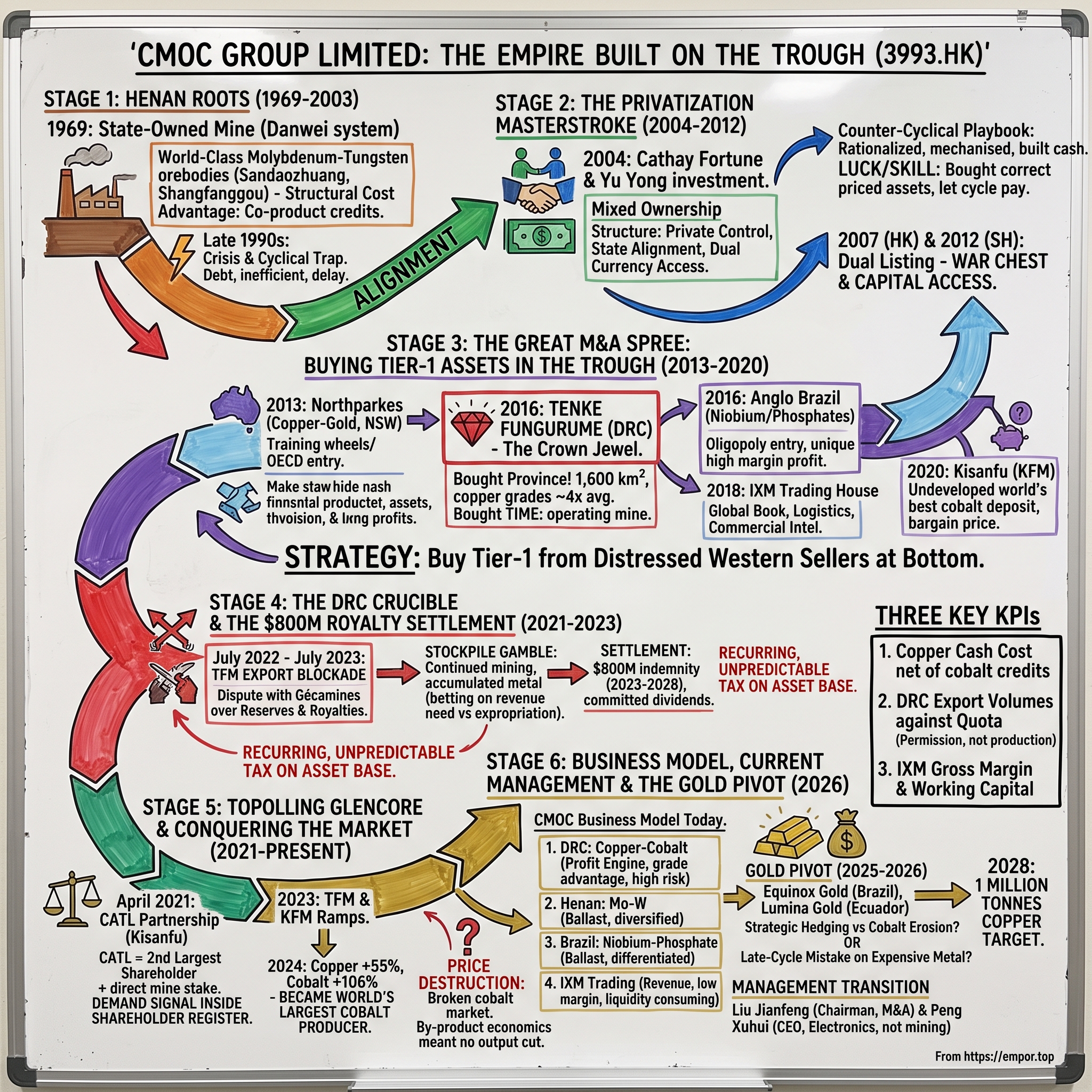
CMOC Group: The Empire Built on the Trough
I. Introduction & The Unlikely Mining Goliath
In May 2016, Freeport-McMoRan was a company selling the furniture. Copper had crashed, the balance sheet carried roughly $20 billion of debt after a disastrous oil and gas detour, and the ratings agencies were circling. So Freeport did what distressed sellers do: it sold the best thing it owned. Tenke Fungurume, in the copper belt of the Democratic Republic of Congo — one of the highest-grade large copper-cobalt deposits on the planet — went for $2.65 billion in cash.8
The buyer's name meant almost nothing to the Western mining establishment. 洛阳栾川钼业集团股份有限公司 CMOC Group Limited — literally, the Luoyang Luanchuan Molybdenum Group — was a mid-cap processor of a niche steel-alloying metal, headquartered in a county town in Henan province, best known to Chinese retail investors as a volatile molybdenum play. Analysts in London and New York spent that week working out how to pronounce it.
Ten years on, the arithmetic of who got the better end of that trade is no longer in dispute. In 2025 CMOC produced 741,100 tonnes of copper and 117,500 tonnes of cobalt, generated operating revenue of RMB 206.7 billion, and earned RMB 20.34 billion of net profit attributable to shareholders — up 50.3% year on year and a record for the fifth consecutive year.2 It had already passed Glencore to become the largest cobalt producer in the world, a title Glencore had held for a generation.3 The first quarter of 2026 was bigger still: revenue of RMB 66.4 billion, net profit of RMB 7.76 billion, nearly double the prior year, and operating cash flow up more than sevenfold.1 The shares, listed in Hong Kong as 3993.HK since 2007 and in Shanghai as 603993.SH since 2012, now carry a market value in the tens of billions of dollars — an order of magnitude beyond what the molybdenum business alone could ever have supported.524
The thesis worth testing. The story CMOC tells about itself, and that the sell-side has largely adopted, is a capital-allocation story: buy Tier-1 assets from distressed Western sellers at the bottom of the commodity cycle, build them out with Chinese engineering speed and cost, and let the cycle do the rest. It is a genuinely impressive record, and the numbers above are real. But three questions sit underneath it, and this piece is organised around them.
First: how much of the outcome is skill, and how much is the copper price? Buying at a trough works spectacularly when the trough ends. CMOC's earnings have compounded during the single strongest copper and cobalt tape in fifteen years. A cyclical business earning record profits at the top of a cycle is not, by itself, evidence of a moat.
Second: what is the actual cost of the jurisdiction? More than three-quarters of the group's mining profit comes out of two licences in Lualaba province in the DRC.4 That concentration has already produced a ten-month export blockade, an $800 million settlement with a state partner, and — since 2025 — a national export quota system that caps how much cobalt CMOC is permitted to ship regardless of how much it digs up.1316
Third: is the recent diversification into gold discipline or drift? A management team that spent a decade preaching focus spent 2025 and early 2026 committing roughly $1.4 billion to gold assets in Ecuador and Brazil.1920
That may be prudent hedging of a cobalt franchise under structural threat from cheaper battery chemistries. It may also be the classic late-cycle mining mistake: spending windfall cash on the metal that is already expensive. The distinction will not be settled by strategy language; it will be settled by what those assets produce, at what cost, in 2028.
The scale today, in plain terms. CMOC is now four businesses stacked on one another. Two industrial-scale copper-cobalt operations in the DRC generate the overwhelming majority of the profit. A niobium and phosphate business in Brazil and a molybdenum-tungsten business in Henan provide diversified, high-margin, low-drama cash flow.7 And IXM, a Geneva-based physical metals merchant bought in 2018, moves millions of tonnes of metal a year, dominating the revenue line while contributing a modest share of profit.11 Ownership is unusual and worth flagging early: Cathay Fortune, the private vehicle of founder-investor 于泳 Yu Yong, and 宁德时代 CATL, the world's largest battery manufacturer, each hold roughly a quarter of the shares, with a Luoyang municipal state entity retaining a legacy stake.24
Myth versus reality, up front. Three consensus statements about this company deserve immediate correction, because they distort almost every discussion of it.
Myth: CMOC is a cobalt company. Reality: cobalt is a by-product it cannot avoid producing. In 2025, copper sales of 730,200 tonnes drove a 31.6% increase in copper revenue, and copper was the overwhelming source of mining segment turnover.2 Cobalt is the tail that wags the headlines, not the earnings.
Myth: CMOC is a Chinese state-owned enterprise executing Beijing's resource strategy. Reality: control has sat with a private investment holding company since 2004, with the local state entity as a minority partner.5 The distinction matters commercially — this is a board that can move in weeks — and it matters politically, because CMOC is frequently regulated abroad as though the first description were true.
Myth: the revenue figure means CMOC is one of the world's largest miners. Reality: the great majority of that revenue is low-margin physical trading turnover booked through IXM.2 On mined output, CMOC is a large but not dominant copper producer, ranked well behind the majors.
To understand how a county-level state mine in Henan came to control the cobalt supply of the electric-vehicle industry, you have to start with the rock.
 Subscribe on LinkedIn
II. Henan Roots & The State-Owned Mine (1969–2003)
Luanchuan county sits in the Funiu mountains of western Henan, three hours by road from Luoyang, one of the ancient capitals of China. It is poor, steep, and — beneath the terraced hillsides — extraordinarily well endowed. In May 1969, at the height of the Third Front industrial mobilisation, the metallurgical authorities put a small experimental molybdenum concentrator into the hills above the county town.5 It processed a few dozen tonnes of ore a day. It was named for the date of its founding, in the manner of that era, and it existed because the state needed molybdenum for alloy steel and armour plate, not because anyone had run a return calculation.
The geology was the point, and it still is. Two deposits define the Luanchuan endowment. 三道庄 Sandaozhuang is a molybdenum-tungsten orebody that CMOC still owns outright, carrying molybdenum reserves of roughly 234 kilotonnes at 0.088% and tungsten reserves of about 103 kilotonnes at 0.172%.7 上房沟 Shangfanggou, held through a joint venture, is larger in contained molybdenum — around 598 kilotonnes at 0.139% — with an iron by-product.7 Those grades sound thin to a layman. In molybdenum they are not: this is one of the largest molybdenum districts on earth.
Critically, the tungsten and iron by-products mean the operation can survive prices that would idle a single-metal mine. That structural feature — a co-product credit that flatters the cost of the primary metal — recurs at every stage of this company's history, and it is worth holding onto, because it is the same mechanism that later made the DRC copper business so difficult for competitors to match.
What molybdenum actually does, and why that matters here. Molybdenum is not a metal anyone buys directly. It is an additive: put a small percentage into steel and the steel keeps its strength at high temperature and resists corrosion, which is why it lives inside power-plant boilers, oil-country tubing, pipelines, and the tooling that makes everything else. Tungsten does something adjacent — it is the hardest practical metal for cutting and drilling, the business end of machine tools and mining bits.
Both are therefore pure derivatives of heavy industry. When a country is building power stations, refineries and machine tools, demand is insatiable; when it stops, demand vanishes overnight, and there is no consumer market to cushion the fall. A mine in Luanchuan in 1995 was, in effect, a highly leveraged position on the capital expenditure budget of Chinese industry, taken by an institution with no ability to size, hedge or exit the position.
The problem was never the rock. By the late 1990s the enterprise had been reorganised twice, employed far more people than the ore required, ran equipment that predated the reform era, and had no meaningful access to capital. Molybdenum is one of the most violently cyclical minor metals in existence — a market measured in low hundreds of thousands of tonnes a year, where a single new mine or a single steel downturn swings the price by multiples. A state-owned single-asset producer with fixed headcount and floating revenue is, in effect, a leveraged bet on steel demand with no ability to hedge. When the Asian financial crisis knocked the bottom out of the molybdenum price, the mine's economics simply stopped working.
There is a human dimension to this that the financial framing misses. A county-level state mine in 1990s China was not simply an employer. It was the housing, the clinic, the school, the pension and the social order of the settlement built around it — the 单位 danwei system in its most literal form. Restructuring such an enterprise meant unwinding a community's entire support structure, which is why so many local governments across China chose subsidy and delay instead.
The Luanchuan mine's problem was that delay had a deadline. Ore does not improve with age, equipment degrades, and every year of underinvestment made the eventual capital requirement larger. The county was sitting on one of the world's great molybdenum endowments and steadily losing the ability to exploit it.
This is the part of the story where the standard Chinese SOE narrative would normally end: a subsidy, a bank rollover, a slow decline. What happened instead was a decision by Luoyang municipal officials that has to be read in the context of its moment. The late 1990s and early 2000s were the years of 抓大放小 grasp the large, release the small — the policy under which Beijing retained control of strategic giants and pushed local governments to restructure, merge, or partially privatise the thousands of smaller state enterprises they were carrying. Luanchuan's molybdenum mine was, by central standards, small. By Luanchuan's standards it was everything.
The structural insight. Local officials concluded something that many of their peers did not: the constraint was not the ore, the workforce, or the technology. It was governance and capital.
A world-class deposit sitting inside an institution with no incentive to maximise its value is a stranded asset. Commercialising it required someone with money, an appetite for a cyclical commodity, and — crucially — the freedom to fire, hire, invest and restructure without clearing every decision through a municipal bureau.
That combination is rarer than it sounds, and it is worth noting how contingent the outcome was. Hundreds of comparable Chinese resource enterprises went through the same policy window in the same years. The overwhelming majority were merged into provincial conglomerates, propped up, or quietly wound down. Almost none produced a globally significant company.
The difference at Luanchuan was not the reform framework, which was national. It was that the specific investor who arrived had both a long time horizon and the appetite to eventually take the company somewhere no Chinese molybdenum producer had ever gone.
Finding that investor took until 2004. The person they found had made his money in a business with nothing whatsoever to do with mining.
III. The Privatization Masterstroke & Cathay Fortune (2004–2012)
鸿商产业控股集团 Cathay Fortune Corporation is not a mining house. It is an investment holding company built by Yu Yong, a Chinese entrepreneur who assembled capital across insurance, pharmaceuticals and industrial assets and who has since become one of the more consequential private allocators in Chinese heavy industry. In January 2004, Cathay Fortune took a strategic investment in the Luanchuan molybdenum enterprise, becoming its private anchor shareholder alongside the Luoyang state holding vehicle that retained the legacy public interest.5
The structure that emerged is the thing to focus on, because it explains everything that followed. This was 混合所有制 mixed ownership before the term became a Beijing slogan: a private controlling shareholder with real operational authority, a municipal state entity as a stabilising minority partner, and — after listing — a public float to keep both honest. The state kept a seat at the table and the political cover that comes with it. The private shareholder got control of the board and the mandate to run the business like a business.
What Yu Yong actually changed. The playbook was unglamorous and it was execution, not vision. Headcount was rationalised against what the orebody required rather than what the county needed. Mining and processing were mechanised. Recovery rates — the percentage of contained metal that actually makes it out of the plant, the single most underrated variable in mining economics — were pushed higher. Debt was restructured. Most importantly, the enterprise began to be managed against the cycle rather than by it: build cash in the good years, do not commit to fixed costs that only work at peak prices.
The timing was extraordinary, and honesty requires acknowledging the luck. From 2004 through 2007 the molybdenum price went vertical on Chinese steel demand. A restructured, low-cost, high-grade molybdenum producer walked into the best molybdenum market in modern history. Skill created the option; the cycle paid for it.
The character of the allocator. Yu Yong has never behaved like a mining executive, and that is the point. He does not appear at industry conferences to talk about orebodies; Cathay Fortune's public footprint is that of a financial holding company that happens to own mines, and its interests have ranged across insurance, pharmaceuticals and, later, positions in the battery and electric-vehicle complex — including a stake in CATL itself, which makes the eventual partnership between the two companies less surprising than it first appears.24
The operating philosophy visible in the record is that of a private-equity owner rather than an operator: buy assets when the sellers are constrained, install cost discipline, use listed vehicles as permanent capital, and treat every asset as saleable at the right number. The Northparkes exit described later in this story is the clearest expression of it. So is the willingness to hold a control position for two decades in a business that has been through three complete commodity cycles — the opposite of the private-equity time horizon, and the reason the model has produced compounding rather than churn.
The 2008 stress test. The model's first real examination came almost immediately after the Hong Kong listing. The global financial crisis destroyed industrial metals demand within months, and molybdenum — the most industrial of all metals — fell further than most. A newly listed, newly restructured company with a single commodity exposure went straight into the worst demand shock in seventy years.
What it did not do is instructive: it did not gear up to buy at what looked like a bottom in 2009, and it did not commit to expansion at the 2010–2011 prices that followed. That patience looks obvious in retrospect. At the time, every peer was being told by its bankers that Chinese demand had permanently re-rated the entire complex.
Capital markets, twice. The company listed on the Main Board of the Hong Kong Stock Exchange in April 2007 — a deliberate choice to raise foreign currency and submit to an international disclosure regime, rather than list at home where the valuation would likely have been higher.5 That decision looks strategic in hindsight: an offshore listed vehicle with hard currency and international auditors is a very different animal when you later want to buy assets from Freeport-McMoRan or Anglo American. A secondary listing on the Shanghai Stock Exchange followed in October 2012, giving the company a domestic currency of exchange and a mainland shareholder base.5
The dual listing is not a footnote. It is the operating system of the company's subsequent M&A. Hong Kong provides US-dollar equity and access to international syndicated debt; Shanghai provides renminbi equity — a RMB 18 billion private placement in July 2017 being the largest single example — and access to Chinese policy banks.5 Very few mining companies anywhere can tap both pools. The ones that can have a structural cost-of-capital advantage in exactly the moments when Western peers cannot raise money at all.
Building the war chest. Between the two listings, the company did something that reads as unremarkable and was, in fact, the whole game: it stayed boring. It generated cash from a domestic molybdenum-tungsten operation with a low cost position, kept leverage modest, and did not chase acquisitions during the 2010–2011 commodity euphoria when every mining executive on earth was overpaying for growth. Rio Tinto bought Alcan at the top. Freeport bought oil and gas at the top. Glencore merged with Xstrata at the top. The Chinese molybdenum company from Henan sat on its hands.
Then commodity prices collapsed, and the phone started ringing.
What this means for an investor. The 2004–2012 chapter is where the company's real competitive asset was created, and it was not a mine. It was an ownership structure — private control, state alignment, dual-currency capital access — that permitted counter-cyclical behaviour. Most listed miners cannot buy at the bottom because their shareholders, their credit ratings and their boards are most frightened precisely when assets are cheapest. CMOC was built so that it could. That advantage is real, but it is also fragile: it depends on the continued alignment of three shareholders whose interests do not automatically coincide, a tension that surfaces later in this story.
IV. The Great M&A Spree: Buying Tier-1 Assets in the Trough (2013–2020)
Between 2013 and 2020 CMOC executed one of the more aggressive acquisition programmes in modern mining, and it did so almost entirely inside the worst commodity bear market since the 1990s. The pattern is consistent enough to be called a method: identify a Tier-1 asset owned by a Western major with a balance-sheet problem, pay cash, close fast, and accept jurisdictional risk that peers will not.
2013: the training wheels. The first international deal was the Northparkes copper-gold mine in New South Wales, acquired from Rio Tinto in November 2013 — an 80% interest, with Sumitomo Metal Mining and Sumitomo Corporation retaining 20%.510 Northparkes was a modest, highly automated block-cave operation with a long reserve life. Strategically, it mattered less as an asset than as an apprenticeship: it gave a Henan molybdenum company an operating mine in an OECD jurisdiction, an English-speaking technical team, and a track record that made the next seller take its calls.
The exit tells you something about how the company thinks. In December 2023 CMOC sold the same 80% interest to Evolution Mining for up to $475 million — $400 million upfront plus contingent consideration — explaining that it was exiting "in pursuit of other strategic initiatives that are more aligned with its objectives."10 CMOC had already monetised part of the asset in July 2020 through a $550 million gold streaming prepayment, and its own corporate timeline books the total realisation from Northparkes at $756 million.5 Management also acknowledged publicly that geopolitics — the deteriorating environment for Chinese ownership of Australian resources — informed the decision. Read plainly: a sub-scale asset in a jurisdiction growing hostile to the owner was recycled into capital for assets where the owner has an advantage. That is portfolio discipline, and it is rarer in mining than it should be.
2016, deal one: Brazil. In April 2016 Anglo American — mid-way through a desperate disposal programme to survive its own leverage — agreed to sell its niobium and phosphates businesses in Goiás and São Paulo for $1.5 billion in cash.9 The package included the Boa Vista niobium mine, the Chapadão phosphate mine, chemical complexes at Catalão and Cubatão, and sales operations in the UK and Singapore. In 2015 those businesses had produced 6,300 tonnes of niobium and over 1.1 million tonnes of fertilizer, generating combined EBITDA of $146 million.9
Niobium deserves a plain-English explanation because it is the most obscure thing CMOC owns and among the most profitable. Add a few hundred grams of ferroniobium to a tonne of steel and the steel becomes dramatically stronger without becoming heavier — which is why it is in pipelines, car bodies, bridges and jet engines. The global market is tiny, effectively three producers, and dominated by Brazil's privately held CBMM. Buying the number-two position in a three-player oligopoly, at roughly ten times depressed EBITDA, for a metal with no substitute and inelastic demand, was a quietly excellent piece of business.
2016, deal two: the crown jewel. Two weeks later came Tenke Fungurume. Freeport sold its 70% interest in TF Holdings — an effective 56% of the mine — for $2.65 billion.8 Lundin Mining's indirect 24% followed, secured in April 2017 and fully consolidated by 2019, lifting CMOC to 80% of TFM with the DRC state miner Gécamines holding the remaining 20%.5
What CMOC bought was not a mine so much as a mineral province. The TFM licence covers roughly 1,600 square kilometres — larger than many countries' entire mining estates — and hosts copper resources of about 29.57 million tonnes of contained metal at 2.25% and cobalt resources of 3.29 million tonnes at 0.25%.4
For context: the global average grade of a new copper mine is now well under 0.6%. TFM's ore is roughly four times richer. Grade is the closest thing to a permanent competitive advantage in mining, because it determines how much rock you must move, crush and treat per unit of metal — and rock-moving is where mining costs live.
There was a second, less obvious asset in the package: a fully permitted, operating, expandable licence in a jurisdiction where obtaining one from scratch is close to impossible. In an industry where the average time from discovery to production now runs well over a decade, buying an operating mine is buying time, and time is the scarcest input in mining.
2018: buying the plumbing. In October 2018 CMOC completed the acquisition of IXM, the former metals arm of Louis Dreyfus Company, initially through a jointly-owned investment fund and then directly, paying $495 million to take full ownership in 2019 — a price that included IXM's 2018 post-tax profit of $30.95 million on top of the original $466 million.511 IXM's own earnings history at the time was volatile: $39.8 million in 2016, $92.3 million in 2017, $31.0 million in 2018.11
Buying a trading house is a strange move for a miner, and most miners have regretted it. The logic here was specific. A producer sitting on concentrate and hydroxide in landlocked central Africa has one structural weakness: it must sell into whatever price and logistics environment exists on the day the truck reaches the port. A merchant with a global book, hedging capability and freight relationships converts that from a price-taking problem into a managed one, and it provides something no annual report captures — daily visibility into who is buying what, where, at what price. Whether that intelligence is worth what it costs is a question the segment economics section returns to.
2019: the nickel option. Less noticed, and worth flagging because it shows the direction of management's thinking well before the battery-metals thesis became consensus, CMOC took a 30% interest in the PT Huayue Nickel Cobalt project in Indonesia in November 2019.5 Nickel is the other metal that high-energy-density battery cathodes consume in bulk. Buying an option on Indonesian laterite nickel processing in 2019 — a year before the electric-vehicle capital cycle went vertical — indicates that the DRC acquisitions were not an isolated cobalt bet but part of a deliberate attempt to sit upstream of battery chemistry generally.
How it was all paid for. The financing architecture deserves a paragraph of its own, because the deals were only possible because of it. The Brazilian and Congolese acquisitions of 2016 were funded substantially with syndicated bank debt arranged through Chinese policy and commercial lenders, then progressively refinanced with equity: the RMB 18 billion Shanghai placement of July 2017 was the single largest such repair to the balance sheet.5
The pattern — borrow to move fast, then de-lever with equity once the asset is proven — is common in Chinese outbound M&A and unusual in Western mining, where boards typically insist on pre-funding. It works when the assets perform and when equity markets stay open. It is also precisely the structure that turns a jurisdictional shock into a solvency question, which is what made the events of 2022 more dangerous than the headline numbers suggested.
2020: the last cheap cobalt. In December 2020, Freeport sold again — this time Kisanfu, an undeveloped copper-cobalt deposit near Kolwezi, for $550 million.12 CMOC's own disclosure put the resource at 365 million tonnes of ore containing more than 6.2 million tonnes of copper and 3.1 million tonnes of cobalt metal.14 Today's stated reserve grades at KFM are 1.79% copper and 0.87% cobalt.4 That cobalt grade is the number that matters: it is several times the DRC average and roughly three times TFM's. Kisanfu was, on grade and scale together, the best undeveloped cobalt deposit on earth, and it sold for less than the price of a mid-sized office tower because in December 2020 nobody wanted to fund African cobalt.
Did CMOC overpay? Judged against the moment, no — the entry multiples on depressed earnings were mid-single-digit, and the replacement cost of these orebodies is not calculable at any price because they cannot be replaced.
Judged more sceptically, the honest verdict is narrower: CMOC bought correctly-priced assets that carried risks the sellers were unwilling to hold. Freeport did not sell Tenke because it was stupid; it sold because it needed cash and because a US-listed company faced political, ESG and financing constraints in the DRC that a Chinese buyer did not. Ivanhoe Mines took the alternative route with Kamoa-Kakula — build rather than buy — and created comparable value. The distinguishing CMOC skill was not valuation genius. It was willingness to underwrite sovereign and reputational risk, backed by a capital structure that allowed it, and by a state relationship that Western sellers could not access.
That willingness came with a bill. It arrived in Kinshasa in 2021.
V. The DRC Crucible & The $800M Royalty Settlement (2021–2023)
By mid-2022 the road out of Fungurume was quiet in a way that made no sense. Inside the fence, the mine was running at full tilt — pit trucks, crushers, tank houses, all of it. Outside, nothing moved. In July 2022, at the instance of Gécamines, exports of copper and cobalt from Tenke Fungurume were halted, and a court-appointed provisional administrator was installed over the operation.13 The dispute was about reserves and royalties: Gécamines alleged that CMOC had understated TFM's reserve base and thereby underpaid what it owed the state partner, with claims running to billions of dollars.13
Why this was existential and not merely expensive. The DRC's mining code entitles the state, via Gécamines, to a free-carried interest and a royalty stream. The value of that stream depends on declared reserves. A reserve figure is not a fact in the way a shipping manifest is a fact — it is a judgement about how much metal can be economically recovered under a set of assumptions about price, grade and recovery. Reasonable engineers can disagree by a wide margin. When a large expansion sharply raises the metal a mine is expected to produce, the state partner has an obvious argument that the original bargain was struck on stale numbers.
This is not a Congolese peculiarity; it is the fundamental instability of every long-life mining contract in a resource-dependent state. The contract is signed when the state is weak and the price is low, and it is enforced when the state is strong and the price is high.
The political weather. The dispute did not occur in a vacuum. Through 2021 and 2022, Kinshasa under President Félix Tshisekedi conducted a broad review of the mining contracts signed by the previous administration, in an environment where the concentration of Chinese ownership across the Congolese copper belt had become an explicit subject of Western policy analysis and of domestic Congolese politics alike.[^26] The Financial Times and others documented the scale of the shift in African battery-metal ownership during exactly this period.29
For an investor, the relevant lesson is not about any one government. It is that a mining asset in a resource-dependent state carries an embedded political option written against the owner, and that option becomes more valuable to the counterparty every time the metal price rises. Any model of CMOC that discounts DRC cash flows at a rate appropriate for an Australian mine is mispricing the asset by construction.
The stockpile gamble. CMOC's response was to keep mining. Rather than idle the operation, the company continued production through the blockade and accumulated finished metal on site — a decision that consumed working capital, filled storage, and staked a large sum on the belief that the dispute would end in a negotiated settlement rather than expropriation. It is worth being clear about what that decision actually was: a bet that the DRC wanted revenue more than it wanted a Chinese operator's assets, and that the political cost of seizing an operating mine from a partner of Beijing was higher than the DRC was willing to pay. That reading proved correct. It could have been catastrophically wrong, and no investor should treat it as a repeatable playbook.
The settlement. In July 2023 the parties agreed terms. CMOC agreed to pay Gécamines $800 million in transactional indemnity spread across 2023 to 2028, and committed to at least $1.2 billion in cumulative project dividends over the mine's life.13 Gécamines also secured entitlements around subcontracting value and offtake proportional to its 20% interest.13 Exports resumed after roughly ten months of blockade, and the stockpiled metal moved.
The accounting judgment worth flagging. Underneath the legal dispute sits an accounting and technical estimate that investors should treat as a permanent soft spot in any mining company's reporting. Reserve and resource statements are prepared under professional codes, but they rest on assumptions — long-run price decks, recovery rates, cut-off grades, capital costs — chosen by management and reviewed by experts management engages.
Those assumptions drive depreciation schedules, impairment tests, mine-life amortisation of acquisition premiums, and, in the DRC, the royalty base owed to a state partner. When a dispute turns on whether reserves were understated, it is worth remembering that the same estimates flow through the income statement. This is not an allegation of anything; it is a statement about where the judgment lies in a mining company's accounts, and it applies to Freeport and Glencore exactly as it applies to CMOC.
How to score it. Judged narrowly, CMOC paid roughly $2 billion in present and future value to retain an asset it had bought for $2.65 billion — a very large cheque. Judged in context, it retained 80% of one of the world's premier copper-cobalt districts, avoided arbitration that could have run for a decade, and converted an adversarial relationship into a revenue-sharing one. The settlement did not involve giving up equity, which is the outcome that actually destroys value in resource disputes.
The working-capital arithmetic nobody discusses. There is a second-order cost to the stockpiling strategy that rarely makes the headlines. Metal sitting in a yard has been fully paid for — the diesel, the reagents, the power, the wages, the royalties — and has returned nothing. It is capital employed at a zero yield, financed at the company's cost of debt, for as long as the blockade lasts.
A ten-month freeze on the output of a mine producing at TFM's scale therefore ties up a sum measured in the high hundreds of millions of dollars, before considering storage, security and the risk of value loss. The strategy worked because the settlement came and the metal shipped into a strong price. Had the dispute run two years instead of ten months, the same decision would have been read very differently — as a company financing a government's negotiating position with its own balance sheet.
The uncomfortable conclusion for investors is that this cost is not a one-off; it is a recurring, unpredictable tax on the asset base. The 2023 settlement resolved the reserve dispute. It did not resolve the underlying asymmetry, and within eighteen months the DRC state had found an entirely new lever — one that did not require any court at all.
Before that, though, CMOC had a market to conquer.
VI. The CATL Partnership & Toppling Glencore (2021–Present)
In April 2021, five months after buying Kisanfu, CMOC announced a partner. 宁德时代 CATL, through its recycling subsidiary 宁波邦普 Ningbo Brunp, acquired a 25% stake in KFM Holding — the vehicle holding 95% of the Kisanfu mine — for $137.5 million, with funding and offtake to follow ownership proportions.14 The two companies also agreed to explore nickel in Indonesia and lithium globally.14 曾毓群 Robin Zeng (Zeng Yuqun), CATL's founder, framed the rationale in terms of compliant, stable raw-material supply — the industrial polite phrasing for a battery maker that had watched cobalt prices triple and collapse twice in five years and wanted to stop being a price-taker.14
Why this is more than an offtake agreement. Then, in March 2023, CATL's investment arm went further and became CMOC's second-largest shareholder at group level.5 That is a structurally unusual arrangement: the world's largest battery manufacturer owns roughly a quarter of the world's largest cobalt miner, and separately owns a direct minority of its best cobalt mine. For CMOC it means the demand signal for its most volatile product sits inside the shareholder register. For CATL it means a hedge — when cobalt spikes, its input costs rise but its equity stake appreciates.
The obvious question is whether minority shareholders benefit or pay for that alignment. The honest answer is that it depends on transfer pricing that is not disclosed at the transaction level, and investors should treat related-party offtake between a controlling-adjacent shareholder and the operating company as a permanent item on the governance watchlist. There is no public evidence of value leakage. There is also no public disclosure that would definitively rule it out.
The ramp-up, and why it was genuinely remarkable. What CMOC and CATL did between 2021 and 2024 is the strongest evidence in this entire story for an operating capability rather than a financing one. TFM's mixed-ore expansion brought all three new production lines into operation by September 2023, and KFM — a greenfield mine in a landlocked country with limited power and road infrastructure — went from acquisition in December 2020 to full production inside roughly three years.5
The result showed up in the output figures with unusual violence. In 2024 copper production reached 650,161 tonnes, up 55% in a single year, and cobalt production reached 114,165 tonnes, up 106%.6 Doubling the output of a metal for which you already hold the largest global share, in twelve months, is not something the mining industry does. Group revenue rose 14.4% to RMB 213.0 billion, net profit rose 64% to RMB 13.5 billion, EBITDA rose 74.8%, operating cash flow more than doubled to RMB 32.4 billion, and the debt-to-assets ratio fell by nearly nine percentage points to 49.5%.6
What these mines actually do, in plain language. The DRC operations are not conventional copper mines in the sense most people picture. Ore is dug from open pits, crushed, and then leached — soaked in acid in large tanks so the copper and cobalt dissolve into solution. The metal is then pulled back out of that liquid and plated into sheets of cathode copper using electricity, a process the industry calls solvent extraction and electrowinning. Cobalt is recovered separately as hydroxide, a wet intermediate that is shipped to China for refining into battery chemicals.
Two consequences follow. First, this route produces finished or near-finished metal at the mine site rather than a low-value concentrate, which means less mass to truck 2,000 kilometres to a port — a decisive advantage in a landlocked country with poor roads. Second, it is power-hungry and acid-hungry, which is why CMOC has been building the Heshima hydropower project in the DRC alongside the mine expansions.15 Electricity supply, not orebody quality, is the binding physical constraint on how much this district can ultimately produce.
Process power, defined narrowly. The claim CMOC's supporters make is that Chinese engineering, procurement and construction delivers African capacity at a fraction of Western build cost per tonne and in half the time. The construction record supports the speed claim strongly; the cost claim is harder to verify from public filings, since CMOC does not publish comparable capital-intensity metrics against Western peers. What can be said with confidence is that a company that brought two major expansions online during a period when Western projects were routinely running years late and billions over budget has demonstrated something its competitors have not. Whether that is a transferable process capability or the product of a specific contractor ecosystem and a specific labour cost environment is genuinely unresolved.
Dethroning Glencore — and the price of winning. The consequence was that CMOC passed Glencore as the world's largest cobalt producer, taking a share of global mined supply that no single company had previously held.3 It also broke the market. Cobalt is a by-product: CMOC mines it because it comes up alongside copper, and copper economics justify the mining regardless.
That means CMOC's cobalt supply is close to price-insensitive on the way down — exactly the property that turns a supply surge into a price collapse. A normal producer cuts output when the price falls below cost. A by-product producer cannot, because the cost is already carried by the primary metal. Through 2024, cobalt hydroxide prices fell to nine-year lows, and the DRC — source of the overwhelming majority of world supply — watched its principal export revenue evaporate.17
So the state intervened. On February 22, 2025, ARECOMS, the DRC's strategic minerals regulator, suspended cobalt exports outright.17 CMOC kept mining through this blockade too: first-half 2025 cobalt output rose 13.05% to 61,073 tonnes even as shipments were frozen.15 In May 2025, speaking at an industry conference in Singapore, CMOC vice-president Kenny Ives — a 23-year Glencore veteran who had run its nickel business before joining IXM — publicly urged the DRC to lift the ban, warning that prolonged restriction would push automakers faster toward lithium-iron-phosphate chemistries that use no cobalt at all.17
That warning is the most analytically interesting statement any CMOC executive has made in recent years, because it is an argument against the company's own short-term interest in higher prices. It concedes the central bear case: cobalt is not scarce, it is administered, and every month of high administered prices funds the research that eliminates it.
The suspension gave way to a quota regime from October 16, 2025 — an annual export cap of 87,000 tonnes plus a 9,600-tonne strategic reserve controlled at ARECOMS's discretion, with the regulator reserving the right to adjust volumes quarterly.16 Prices responded exactly as designed, with cobalt hydroxide rising sharply from its February lows.18 CMOC's permitted export volume for 2026 is roughly 31,200 tonnes.18
Set that against production. CMOC produced 117,500 tonnes of cobalt in 2025 and guided to 100,000–120,000 tonnes for 2026.218 It is permitted to export a fraction of that. The company's stated logic — reaffirmed in January 2026 — is that cobalt is a by-product of a copper business it wants to grow regardless, so it will keep producing and keep stockpiling.18 That is defensible on unit economics. It also means a rising share of the balance sheet is metal sitting in a warehouse in Lualaba awaiting a government's permission to leave.
The first quarter of 2026 showed both halves of that trade in a single set of numbers. Copper production rose 10.15% to 187,880 tonnes while cobalt output was essentially flat at 30,508 tonnes, and the group also reported 43,027 ounces of gold, 3,184 tonnes of molybdenum, 1,660 tonnes of tungsten, 2,670 tonnes of niobium and 299,392 tonnes of phosphate fertilizer.1 Copper is growing, cobalt is capped, and a fourth metal has quietly appeared in the production table.
Which brings the story to what CMOC actually is, as a business, in 2026.
VII. Business Model, Segment Anatomy, & Current Management
Read CMOC's income statement without context and you will misidentify the company entirely. Revenue of RMB 206.7 billion in 2025 looks like one of the largest miners on earth by turnover.2 It is not. It is a mid-large miner with a very large trading business bolted on, and the two have almost nothing in common economically.
IXM: enormous revenue, thin margin, real function. IXM moved 4.71 million tonnes of physical metal in 2025, achieving an IFRS gross margin of 2.11% — described by the company as a recent high.2 In 2024, on 5.54 million tonnes of volume, it earned net profit of RMB 1.353 billion, up 48%.6 Both facts should be held together: IXM is roughly a tenth of group profit on the great majority of group revenue.
The clearest illustration of what this does to reported results came in the first half of 2025, when group revenue fell 7.83% while net profit rose 60.07%.15 Trading volumes and metal prices pushed the top line one way; mining margins pushed the bottom line the other. Any analysis of CMOC that leads with revenue growth is analysing the wrong number. The metric that matters for IXM is not its revenue but its margin stability and its working-capital consumption — a merchant business consumes cash to carry inventory and finance receivables, and in a rising price environment that consumption grows.
Is IXM worth owning? The strategic case is that it guarantees a channel for DRC production, provides hedging, and supplies commercial intelligence.
The sceptical case is that it adds a large, opaque, leverage-consuming balance sheet to a mining company, that trading businesses periodically produce large losses from positions no outsider can see, and that CMOC could have secured offtake through ordinary contracts. Both are legitimate. What is not in dispute is that the segment's economics are structurally poor on a return-on-revenue basis and that its disclosure is the thinnest in the group.
The DRC: where the money is. The copper-cobalt business is the profit engine, and its economics rest on the co-product mechanism described earlier. TFM now has annual copper capacity above 450,000 tonnes across five production lines; KFM exceeds 200,000 tonnes, with a Phase II expansion due in 2027 adding another 100,000 tonnes.4 Because the cobalt sold alongside the copper is credited against production costs, CMOC's effective cash cost per pound of copper sits well below what a pure copper miner at the same grade would report. CMOC does not publish a standardised C1 cash cost in its results releases — a genuine disclosure gap relative to Western peers, and one investors should note.
The 2025 cost line offers indirect evidence: full-year operating costs fell 11.56% to RMB 157.2 billion even as volumes grew, which the company attributed to refined operations and technological optimisation.2 Falling absolute costs against rising volumes is the signature of genuine operating leverage rather than price-driven earnings, and it is the strongest single data point in favour of the operational-competence thesis.
Brazil and Henan: the ballast. The Brazilian niobium and phosphate business produced 10,348 tonnes of niobium and 1.2135 million tonnes of phosphate fertilizer in 2025, both ahead of internal targets.2 The Henan molybdenum-tungsten business produced 13,906 tonnes of molybdenum and 7,114 tonnes of tungsten on revenue of RMB 8.8 billion.72 Neither will change the group's trajectory. Both matter more than their size suggests, because they generate hard-currency and domestic-currency cash flow in jurisdictions with no expropriation risk — and in the first half of 2026, sharply higher molybdenum and tungsten prices became a meaningful earnings contributor in their own right.21
The pivot to gold. The most significant strategic development since the DRC ramp-up is not in copper at all. In April 2025 CMOC agreed to acquire Lumina Gold — the former Odin Mining — for C$581 million, roughly $419 million, at a 41% premium, securing 100% of the Cangrejos project in Ecuador: proven and probable reserves of 659 million tonnes at 0.55 g/t gold, a 26-year mine life, in a large low-strip porphyry deposit.205 Then in December 2025 it agreed to buy Equinox Gold's entire Brazilian portfolio — the Aurizona, Fazenda, Santa Luz and RDM mines — for $1.015 billion, comprising $900 million upfront and up to $115 million contingent on first-year sales.19 Those assets carried 3.873 million ounces of reserves and produced 247,300 ounces in 2024, and the deal closed in January 2026.195 Chairman Liu Jianfeng framed it as conviction in gold and as delivering a strategy of "pillaring the portfolio on copper and gold."19
The strategy now has explicit targets: copper capacity of 800,000 to 1,000,000 tonnes by 2028, and roughly 20 tonnes of annual gold capacity in South America by 2029.2 Guidance for 2026 is 760,000–820,000 tonnes of copper with cobalt held at 100,000–120,000 tonnes.18
The honest read on the gold pivot. Two interpretations fit the evidence.
The charitable one: management sees cobalt's long-term demand as structurally threatened, sees gold as an uncorrelated store of value, is buying producing assets at a discount to what a gold-focused company would pay, and is diversifying jurisdiction away from a single African province.
The sceptical one: this is a company deploying windfall cash into a metal near record prices, at a 41% premium in one case and a full-priced portfolio in the other, in two new countries, in a commodity where it has no operating history. Notably, the trough-buying discipline that defined the 2013–2020 era is absent here: gold was not distressed in 2025. Investors should track whether the gold assets deliver against the stated production targets, because this is the first major capital allocation decision of the current leadership team, and it deviates from the playbook that built the company's reputation.
Governance: three shareholders, one board. Ownership remains split between Cathay Fortune, CATL and the Luoyang state entity, with each of the two largest holding roughly a quarter of the shares.24 Day-to-day operation belongs to a leadership team that turned over almost completely during 2025. Chairman Yuan Honglin, in the role since 2020, tendered his resignation in April 2025.5 刘建锋 Liu Jianfeng — born 1977, an economics and law graduate with an MBA and LL.M. from Boston College, an Australian CPA qualification, and a career spanning CNOOC, Roc Oil under Fosun, Geo-Jade Petroleum and the presidency of ENN Energy — became chairman.22 In October 2025, president Sun Ruiwen resigned, and 彭旭辉 Peng Xuhui — born 1981, a physicist by training with a doctorate in electronics and information, previously chairman of the Shenzhen-listed display manufacturer Tianma Microelectronics — was appointed chief executive, joining the board that December.23
That pairing is worth pausing on. CMOC's chairman is a cross-border M&A and finance professional from the oil and gas world. Its chief executive is a manufacturing operator from the electronics industry with no mining background at all. Neither is a career miner. Read generously, this is a deliberate bet that the company's next decade is about industrial process discipline and capital deployment rather than geology. Read sceptically, a company whose entire profit base sits in one of the most operationally and politically demanding mining jurisdictions on earth has just replaced its top two executives with people who have never run a mine. Both readings will be tested by whether the 2028 copper target and the 2027 KFM Phase II schedule are met.
Returns on capital, honestly framed. Return on equity is the number where cyclicality is most likely to fool an investor. CMOC reported ROE of 11.70% for the first half of 2025 and 9.06% for the first quarter of 2026 alone — the latter up 3.57 percentage points year on year.151 Annualised at the current run-rate, the business is earning returns on equity in the high teens or better, which for a miner is excellent.
The caveat is that those returns are being earned at a price environment near the top of the historical range, on an asset base that has been substantially expanded with retained earnings. The relevant test of capital allocation is not the ROE printed at the peak; it is whether the incremental capital deployed since 2023 — the KFM expansion, the Heshima power project, and now roughly $1.4 billion of gold — still clears its cost of capital at mid-cycle metal prices. Nothing in the public disclosure allows an outsider to run that test yet.
Capital returns and the balance sheet. For 2025 the company declared a final dividend of RMB 2.86 per ten shares — RMB 0.286 per share, approved on April 28, 2026 and paid on June 24, 2026.25 Against reported earnings and the share count, that is a payout in the region of 30% — respectable for a capital-hungry miner, unremarkable against Western majors returning most of their free cash flow. Total assets crossed RMB 200 billion for the first time in 2025, up 18%, while the debt-to-assets ratio has been trending down from the leveraged post-acquisition peaks.215 Financing has also become more creative: a $1.2 billion one-year zero-coupon convertible bond was issued during 2025.2 Zero-coupon converts are cheap money for an issuer whose equity has re-rated, and expensive dilution if it re-rates further — a shareholder-unfriendly trade in a strong tape, and a legitimate item for a sceptical investor to press management on.
VIII. Porter's 5 Forces & Hamilton Helmer's 7 Powers
Strip away the narrative and ask the structural question: what, if anything, prevents a competitor from replicating CMOC's position? Two frameworks are useful, and they disagree with each other in instructive ways.
Cornered Resource. Of Hamilton Helmer's seven powers, this is the one CMOC unambiguously holds. TFM and KFM cannot be reproduced. There is no second Kisanfu; deposits with 0.87% cobalt and near-2% copper at that scale are not being discovered, and the reason global copper grades keep falling is that the good ones were found long ago.4 Ownership of a resource that competitors cannot obtain at any price is the purest form of durable advantage in extractive industries, and CMOC's is genuine and long-lived. The important caveat: a cornered resource confers advantage on cost, not on price. It guarantees CMOC will be among the last producers standing in a downturn. It guarantees nothing about the level of profits, which are set by a market it does not control.
Scale Economies. Partially present, and often overstated. Within the DRC, concentrating hydrometallurgical capacity across two adjacent operations does amortise power, logistics, camps and management over more tonnes. But copper mining is not a business with strong global scale returns — a 700,000-tonne producer does not enjoy a structural cost advantage over a 400,000-tonne producer with equally good rock. The scale that genuinely matters here is at the asset level, not the corporate level. IXM's scale is more real in kind — trading margins are volume-driven and fixed-cost-heavy — but IXM is the third-ranked physical merchant behind far larger competitors, so it is scale-disadvantaged in its own market.
Process Power. The most contested claim. The evidence for it is the construction record: two major expansions delivered on aggressive timelines while the Western industry struggled with cost inflation and delay, followed by absolute operating costs falling as volumes rose.25 The evidence against is that this may reflect the Chinese EPC ecosystem's cost and speed advantages generally rather than anything proprietary to CMOC, and that the same contractors are available to other Chinese miners operating in Africa. Verdict: real capability, imperfectly proven as a durable company-specific power.
Counter-positioning, briefly. There is one power CMOC arguably held for a decade and is now losing. Between 2013 and 2020 it did something incumbents structurally could not copy: it bought African assets that Western majors were being pushed out of by their own investors, lenders and political constraints. That was counter-positioning in Helmer's precise sense — an advantage the incumbent could see clearly and still could not match without damaging its existing business.
It has largely expired. The Western majors have returned to copper with enthusiasm, and the Chinese peers who might replicate the model are now bidding for the same assets. The window closed, which is one reason the recent acquisitions have been made at full prices rather than distressed ones.
Absent powers. CMOC has no switching costs — copper cathode is a commodity with an exchange price. It has no branding power. It has no counter-positioning, since its model is openly imitable by Chinese peers and is being imitated. And it has no network economies. Four of Helmer's seven powers simply do not apply.
Turning to Porter:
Bargaining power of buyers — moderate, and lower than for peers. Metals are fungible and priced on exchanges, which normally gives buyers little to negotiate over beyond premia and terms. CMOC's structural equity and offtake alignment with CATL secures placement for cobalt units in the world's largest battery supply chain. That is a real, if narrow, advantage — and it cuts both ways, since the buyer sits on the shareholder register.
Bargaining power of suppliers and host states — high, and the dominant force. This is where CMOC differs most from a Chilean or Australian producer. The DRC controls the licence, the royalty, the export permission and now the export quota, and has demonstrated willingness to use all four.1316 Analysts at CSIS and elsewhere have documented how thoroughly Chinese capital came to dominate DRC cobalt and how that concentration itself became a political variable.[^26] No contract fully neutralises a sovereign that supplies most of the world's cobalt and knows it.
Threat of substitutes — asymmetric, and this asymmetry is the whole investment case. For copper, effectively nil: there is no economic substitute for copper in electrical grids, data centres, motors and wiring, and demand from electrification and AI infrastructure buildouts is the strongest secular story in metals. For cobalt, high and rising: lithium-iron-phosphate chemistry contains no cobalt, has taken large share of the global EV battery market, and sodium-ion chemistry threatens further encroachment at the low end. CMOC's own vice-president said as much publicly.17 A company that is number one in a metal facing designed-out demand and top-tier in a metal facing structural shortage should logically be valued on the copper.
Rivalry — intense but structurally muted at the bottom of the cost curve. CMOC competes with Glencore, Eurasian Resources Group, Ivanhoe, Freeport, BHP and Rio Tinto for reserves, capital and market share. In cost terms it sits in a strong position because of grade and co-product credits. But in a commodity industry, rivalry expresses itself through supply decisions rather than price competition, and CMOC's own 2023–2024 supply surge is the case study: it won share and destroyed the price of the thing it was winning share in. That is the permanent trap of commodity rivalry, and no framework exempts anyone from it.
War-gaming the field. Set CMOC against its peers and the picture sharpens. Glencore combines mining with the largest physical trading book in the industry and has decades of relationships across African jurisdictions; it is the closest structural analogue to CMOC's mine-plus-merchant model, and it lost the cobalt volume crown while retaining a far more diversified earnings base. Ivanhoe Mines, operating Kamoa-Kakula in the same Congolese copper belt, owns arguably the single best copper orebody discovered this century and demonstrates that CMOC's grade advantage is not unique in the region.
Eurasian Resources Group is the other large-scale Congolese cobalt producer and competes directly for the same quota allocations. Freeport, having sold both of the assets that made CMOC what it is, retains world-class positions in Indonesia and the Americas and is now a beneficiary of the copper price it once could not wait out. BHP and Rio Tinto operate at a different scale entirely, with lower-grade but vastly more diversified and lower-risk portfolios, and both trade with the jurisdictional discount CMOC does not enjoy in reverse.
The honest positioning: CMOC has better rock than the diversified majors, worse jurisdiction than almost all of them, faster project delivery than most, thinner disclosure than any, and — uniquely — a strategic customer on its share register. It is not a scaled-down BHP. It is a concentrated, high-return, high-political-beta bet on two orebodies with an industrial conglomerate attached.
Synthesis. CMOC's edge is real, narrow and asset-based rather than systemic. It owns rock nobody else can buy, in a country nobody else wants to be so exposed to, sold into markets it cannot influence except by flooding them. That is a good business. It is not a compounding machine, and it should not be valued as one.
IX. Investment Story Spine: Bull vs. Bear Case & Key KPIs
Why this wins from here. The bull case rests on three legs, and they are of unequal strength.
The strongest is cost position. Ore grade and cobalt by-product credits place the DRC operations low on the global copper cost curve, and the 2025 evidence of absolute operating costs falling 11.6% while volumes rose supports the claim that this is structural rather than price-flattered.2 A low-cost producer in a cyclical commodity is the only kind that reliably survives the bottom, and survival at the bottom is where mining returns are actually made.
The second is copper demand. Grid replacement, electrification, and the extraordinary copper intensity of AI data-centre construction have created a demand outlook that most analysts regard as the tightest in decades, against a supply pipeline constrained by falling grades and permitting timelines. CMOC's guidance of 760,000–820,000 tonnes for 2026 and an ambition of 800,000–1,000,000 tonnes by 2028 places it among a small handful of producers with material organic growth.182
The third and weakest is the CATL alignment. It secures placement, not price, in a metal whose long-term demand trajectory is the very thing in question.
The near-term evidence is supportive. On July 10, 2026, CMOC guided first-half 2026 net profit to RMB 15.5–16.5 billion, a rise of 78.8% to 90.3%, attributing it to copper volumes and prices, sharply higher molybdenum and tungsten prices, and the consolidation of the Brazilian gold business.21 Set against first-half 2025 profit of RMB 8.671 billion, the company is on course to earn more in six months than it earned in the whole of 2024.156
What breaks the case. The bear file is not speculative; every item on it has already happened at least once.
Jurisdictional concentration. The overwhelming majority of mining profit originates in two licences in one province of one country, which has in the past four years blockaded exports, forced a $2 billion settlement, banned cobalt exports outright, and imposed a quota system that caps shipments at roughly a quarter of CMOC's production.131618 The stock carries an unhedgeable political exposure, and the quota is currently converting production into inventory rather than revenue.
Cobalt demand erosion. LFP's share gains are not a forecast, they are a fact of the current battery market, and each year of quota-supported high cobalt prices strengthens the incentive to design cobalt out permanently. The company's own trading leadership has articulated this risk publicly.17
Cyclical earnings mistaken for structural growth. Five consecutive record years have coincided with an exceptional copper tape.2 The correct question is not what CMOC earns at $5 copper but what it earns at $3 — and at that price, the profit profile looks entirely different.
Execution risk in the transformation. Two large gold operations in two new countries were absorbed while a copper expansion programme runs concurrently and a new chief executive settles in. Integration failures in mining rarely announce themselves in the quarter they occur; they show up two years later as cost overruns and reserve restatements.
The activist's file. A sceptical long-short investor would press on five points. First, portfolio complexity: a Geneva trading house, an Ecuadorian development project, four Brazilian gold mines, a Brazilian fertilizer business and a Henan molybdenum mine sitting alongside two African copper mines is a conglomerate, and conglomerates in mining historically trade at a discount for good reason. Second, capital allocation drift: roughly $1.4 billion committed to gold in nine months, at premium pricing, by a team that made its name buying distress.1920 Third, disclosure: no standardised cash-cost reporting, and limited transparency into IXM's trading book and inventory positions. Fourth, the convertible: a zero-coupon instrument issued into a rising equity market transfers upside from existing holders.2 Fifth, governance: a board answering to a private controlling shareholder, a strategic customer-shareholder, and a municipal state entity, with a chairman and CEO both appointed in 2025 and neither drawn from mining.2223
The credibility scorecard. On the positive side, CMOC has consistently hit or exceeded its own production targets — 2025 completion rates ran from 102% on tungsten to 118% on copper — has delivered major projects on schedule, and did not quietly abandon cobalt guidance when the quota regime made it awkward, instead explaining the by-product logic directly.218 On the negative side, disclosure quality lags Western peers, the sudden strategic addition of gold was not preceded by any visible investor-day framework, and the near-total turnover of senior management in a single year was explained in the language of routine board changes rather than strategy.5
The three KPIs that actually matter.
1. Copper cash cost net of by-product credits. Everything in the bull case ultimately reduces to whether CMOC remains a bottom-quartile copper producer once cobalt credits are marked at quota-era realised prices. Because the company does not publish a standardised C1 figure, investors will have to construct it from segment cost and volume disclosure in the interim and annual reports — and should treat any deterioration as the single most important early warning available.
2. DRC export volumes against quota. Production is no longer the binding constraint; permission is. The gap between tonnes mined and tonnes actually shipped from TFM and KFM determines how much of the reported output converts into cash, and how much accumulates as inventory subject to a regulator's discretion. Watch shipped volumes, not produced volumes.
3. IXM gross margin and working capital. The trading arm's 2.11% gross margin in 2025 was described as a recent high.2 Margin compression, or a jump in inventory and receivables without a corresponding profit contribution, would be the earliest visible sign that the trading business is consuming capital rather than earning its keep — and it is the part of the group where problems would surface last in the narrative and first in the cash flow statement.
X. Earnings Transcripts & Primary Evidence Guide
CMOC's investor communication is thinner than a Western major's, which makes the available primary material more valuable, not less. Three moments in the record repay close reading, and in each case the gap between prepared remarks and subsequent behaviour is where the information sits.
The 2023 settlement and export resumption. The disclosures and commentary surrounding the July 2023 Gécamines agreement establish management's framing of sovereign risk — that the dispute was commercial rather than existential, and that continued production through the blockade was a considered decision rather than a forced one.13 The test of that framing was not what was said in 2023 but what happened in 2025, when a second export restriction arrived from a different direction and the company adopted precisely the same posture: keep mining, accumulate inventory, negotiate.1517 That consistency is a genuine data point about how this management thinks. It is also, viewed less charitably, a pattern of absorbing state pressure by financing it from the balance sheet.
The 2024 annual results and the cobalt oversupply question. The 2024 results release documented the doubling of cobalt output into a collapsing price and paired it with a debt-to-assets ratio falling nearly nine points.6 The interesting analytical exercise is to read that alongside the 2025 disclosures, where management explained the by-product logic explicitly: cobalt output would be sustained because copper economics justified the mining regardless of cobalt's realised price.18 This is a coherent, internally consistent position maintained across two very different price environments — which is more than can be said for many commodity producers, who typically discover discipline only after the price has fallen.
The first-quarter 2026 release as a template. The most recent full disclosure available at the time of writing is the record first-quarter result published in May 2026, and it is a useful example of how to read this company's reporting.1 The headline profit growth was driven overwhelmingly by price, which management said explicitly, alongside production and operating management improvements — a franker attribution than many miners offer at a cyclical peak.
The line that deserves more attention than it received was the cash flow: operating cash flow rose more than sevenfold year on year.1 Cash conversion improving faster than profit is usually one of two things — a genuine working-capital release, or the unwinding of inventory that had previously been trapped. Given the export-quota backdrop, an investor's first question on the interim results due in August 2026 should be which of those it was, and whether it repeats.
The 2025 leadership transition. The board changes were disclosed through Hong Kong filings across April to December 2025 in the standard resignation-and-appointment format, and CMOC's official history timeline records the sequence.52223 What is not in the record is a strategic rationale for replacing both the chairman and the president within eight months, articulated by the company. Investors have to infer it from actions instead: within nine months of the new chairman's arrival, CMOC had closed a $419 million Ecuadorian gold acquisition and agreed a $1.015 billion Brazilian gold portfolio purchase.1920 The strategy statement is in the cheque book.
What the disclosure regime does and does not give you. CMOC is a dual-listed issuer reporting quarterly in Shanghai and semi-annually in Hong Kong, which produces a steady cadence of results releases with production tables and headline financials, followed by results briefing sessions rather than the freewheeling analyst Q&A calls familiar from North American issuers.[^28]26 Full transcripts in English are not routinely published, and this is a genuine limitation on the analysis anyone can perform from outside.
The practical consequence is that investors have to read management through actions and through the specific language of announcements rather than through the pressure-testing of live questioning. Two things partially compensate. First, the company publishes annual production targets and then reports completion rates against them, which is a more falsifiable form of guidance than the qualitative outlook statements many miners offer — the 2025 rates ranged from 102% to 118% across six products.2 Second, senior executives speak at industry events, and those remarks have on occasion been more candid than the formal disclosure, as the Singapore comments on cobalt substitution demonstrated.17
The question an analyst should ask next. If there were open Q&A, the three most valuable questions would be narrow and answerable. What was the realised cobalt price on quota-permitted export volumes versus the reported hydroxide benchmark? How much finished and semi-finished metal was held in the DRC at period end, and at what carrying value? And what internal hurdle rate was applied to the Brazilian gold portfolio, at what gold price assumption?
None of those is exotic. All three are routinely disclosed by Western peers. Their absence is the single largest gap between CMOC's operating quality and its investability for a disclosure-sensitive institutional owner, and it is a gap management could close at no cost.
Where to look. The primary sources for ongoing monitoring are the company's quarterly and interim releases on its investor relations portal, the underlying filings on HKEXnews and the Shanghai Stock Exchange, and the annual report's segment notes — which contain the cost, volume and inventory detail that the summary releases omit.[^27][^28]26 For the physical trading business, IXM's own disclosures remain the only granular public window.27 For the customer relationship that anchors the cobalt franchise, CATL's own reporting on raw-material sourcing is a useful cross-check on how a strategic shareholder describes the same partnership.28
XI. Playbook & Key Lessons
Buy the asset, not the cycle — but understand you are also buying the cycle. The core CMOC lesson is that Tier-1 orebodies change hands only when their owners are in trouble, and their owners are in trouble only at the bottom. Tenke came from a Freeport drowning in debt; the Brazilian niobium business came from an Anglo American fighting for survival; Kisanfu came from a Freeport that had already sold the first mine and had no appetite to develop a second.8912 The discipline that made this possible was built years earlier, in an ownership structure that allowed a company to sit out a boom. The honest caveat is that this playbook is not a general theory of value creation — it is a bet that the cycle turns, executed by an entity that could survive being early.
Grade beats everything else in mining, and it cannot be manufactured. Every operational advantage in this story ultimately traces back to the quality of two orebodies. High grade is what allows a mine to survive a price crash, to fund its own expansion, to absorb an $800 million settlement, and to keep producing a by-product into a collapsing market without losing money.
It is also the one variable no management team can improve. Companies can get better at building, financing and negotiating. They cannot make the rock richer. That is why the acquisition decisions of 2016 and 2020 mattered more than everything that has happened since, and why the gold acquisitions of 2025 and 2026 will be judged on the same criterion rather than on the strategic language used to announce them.
Align economics with the host state before you are forced to. The DRC chapter demonstrates that in a frontier resource jurisdiction, the enforceable contract is the one where the state makes more money by leaving you alone than by squeezing you. The $800 million indemnity plus $1.2 billion of committed project dividends bought exactly that alignment, and it was expensive precisely because it was negotiated after the leverage had shifted.13 The transferable lesson is not "pay when asked." It is that the political terms of a mining licence are renegotiated in practice whenever the underlying economics move far enough, and any valuation that treats a signed contract as permanent is mispricing the asset.
Ownership structure is strategy. The most underappreciated element of this story is not a mine or a deal but a shareholder register. A private controlling holder gave the company decision speed; a municipal state partner gave it domestic legitimacy; dual listings gave it two currencies of capital; and a strategic customer-shareholder later gave it demand visibility.524 None of those individually is remarkable. In combination they produced an entity that could act when Western peers were structurally unable to.
The corollary is that the structure is also the largest governance question. Three large holders with genuinely different objectives — a financial owner seeking returns, an industrial owner seeking secure supply, and a local state owner seeking regional development — are aligned today by a rising metal price. What happens to that alignment in a downturn is untested, and it is the kind of risk that never appears in a risk-factor list until it materialises.
Vertical integration works when it solves a specific structural weakness — and only then. IXM exists because landlocked African production has a distribution problem; the CATL relationship exists because a by-product metal with volatile demand needs a committed home.1114 Both are answers to identifiable weaknesses rather than empire-building. Both also add complexity, opacity and capital intensity that the market may reasonably discount. The test for each is not whether it sounds strategic but whether it earns its cost of capital, and in IXM's case that remains an open question.
Being first is not the same as being right. The final lesson is the uncomfortable one, and CMOC learned it in public. Winning the race to become the largest producer of a by-product metal delivered market leadership and, simultaneously, destroyed the price of the product it led in. Volume leadership in a commodity is only valuable when demand is inelastic or when the producer is disciplined enough not to use its capacity — and a by-product producer, by definition, cannot be disciplined without giving up the primary metal that pays the bills.
The company's position was then rescued not by its own strategy but by a sovereign regulator imposing on the whole industry the supply restraint that no individual participant could impose on itself.16 Investors who read the cobalt leadership as evidence of pricing power should note carefully which party actually exercised it.
What the next five years will actually settle. CMOC's history to date is a story about buying well. Its future is a story about operating and allocating. Three things will resolve it: whether the copper target of 800,000 to 1,000,000 tonnes by 2028 is delivered on time and on budget; whether the DRC quota regime evolves into a manageable tax or a structural cap on the cobalt franchise; and whether roughly $1.4 billion deployed into gold at full prices turns out to be intelligent diversification or the moment a disciplined counter-cyclical buyer started behaving like everyone else.2181920 The company built an empire in the trough. The harder question — the one the record does not yet answer — is what it does at the peak.
References
-
CMOC Reports Record First-Quarter 2026 Results — CMOC Group Limited, 2026-05-07 ↩↩↩↩↩
-
CMOC: 2025 Net Profit up 50.3% YoY, Copper Production at 741,100 mt — Shanghai Metals Market (SMM), 2026-03 ↩↩↩↩↩↩↩↩↩↩↩↩↩↩↩↩↩↩↩↩↩
-
CMOC Overtakes Glencore as World's Top Cobalt Producer — Mining.com, 2024-01-15 ↩↩
-
CMOC Releases 2024 Annual Results — CMOC Group Limited, 2025-03-24 ↩↩↩↩↩
-
Freeport Sells DRC Tenke Copper Mine to China Moly for $2.65 Billion — Reuters, 2016-05-09 ↩↩↩
-
Anglo American agrees $1.5 billion sale of Niobium and Phosphates businesses — Anglo American, 2016-04-28 ↩↩↩
-
Evolution seals $475m deal for Northparkes copper/gold mine — Mining Weekly, 2023-12-05 ↩↩
-
China Molybdenum takes direct ownership of IXM in $495mln fund buyout, details profits — Fastmarkets, 2019 ↩↩↩↩
-
Freeport Sells Kisanfu Copper-Cobalt Deposit to CMOC for $550 Million — Reuters, 2020-12-13 ↩↩
-
CMOC and Gécamines Reach Settlement Over TFM Mine Dispute — Mining Technology, 2023-07-19 ↩↩↩↩↩↩↩↩↩
-
CMOC enters into strategic partnership with CATL to jointly develop KFM in the DRC — CMOC Group Limited, 2021-04-11 ↩↩↩↩↩
-
CMOC Releases 2025 Interim Results — CMOC Group Limited, 2025-08-24 ↩↩↩↩↩↩↩
-
Cobalt export quotas: DRC sets limits to rebalance global supply — Fastmarkets, 2025 ↩↩↩↩↩
-
China's CMOC Group calls on DRC to end cobalt export ban — Mining Technology, 2025-05 ↩↩↩↩↩↩↩
-
China's CMOC bets on copper growth, maintains cobalt target — Mining Weekly, 2026-01-16 ↩↩↩↩↩↩↩↩↩↩
-
CMOC Announced the Purchase of Gold Assets in Brazil for $1.015bn — CMOC Group Limited, 2025-12-15 ↩↩↩↩↩↩↩
-
CMOC Announces Acquisition of Lumina Gold for C$581 Million — CMOC Group Limited, 2025-04-23 ↩↩↩↩↩
-
CMOC Expects H1 2026 Net Profit to Surge 78.76%–90.29% YoY, Driven by Higher Metal Prices and Gold Mine Consolidation — Shanghai Metals Market (SMM), 2026-07 ↩↩
-
Liu Jianfeng — Directors and Supervisors, CMOC Group Limited ↩↩↩
-
Peng Xuhui — Directors and Supervisors, CMOC Group Limited ↩↩↩
-
CMOC Group Updates 2025 Final Dividend Details and Tax Arrangements — The Globe and Mail, 2026 ↩
-
Shanghai Stock Exchange Listed Company Disclosure (Stock Code: 603993) — Shanghai Stock Exchange ↩↩
-
Contemporary Amperex Technology Co., Limited (CATL) Corporate Overview — CATL ↩
-
China's Mining Giants Surge in African Battery Metal Race — Financial Times, 2023-09-12 ↩
 LinkedIn
 WhatsApp
 Reddit
 Hacker News
 Email
Email Kindle
 RSS Feed
 Spotify
 Apple Podcasts
 Amazon Music
 Audible
 YouTube