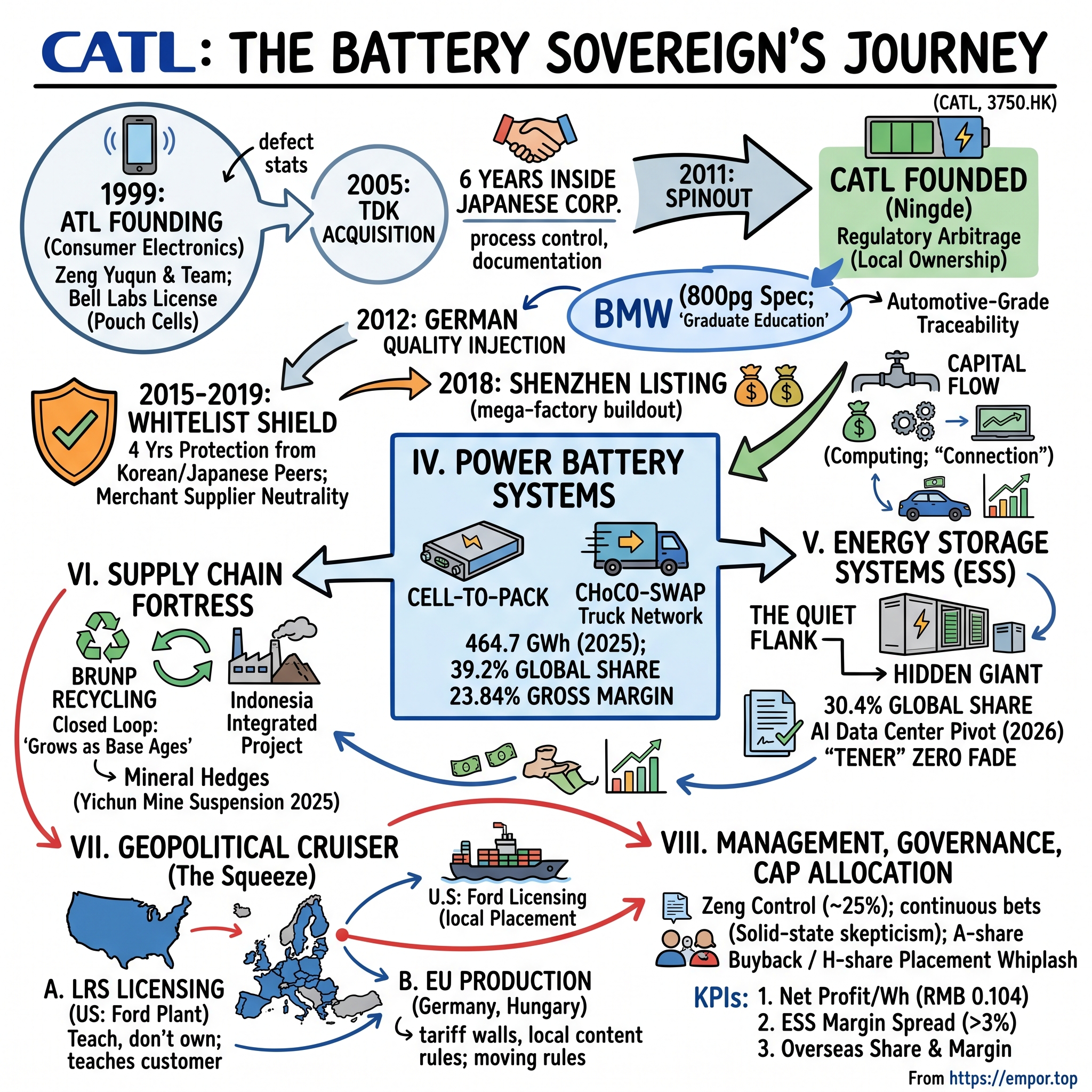
Contemporary Amperex Technology Co., Limited (CATL): The Battery Sovereign
I. Introduction & The $150B Battery Sovereign
On the evening of July 24, 2026, two filings landed on the Shenzhen and Hong Kong exchanges within minutes of each other, and together they told a story that no single number could.
The first was an interim report. In the six months to June 30, 2026, Contemporary Amperex Technology Co., Limited — 宁德时代 CATL — booked revenue of RMB 276.92 billion, up 54.8% year on year, and net profit attributable to shareholders of RMB 43.28 billion, up 42.0%.1 To put that in human scale: in half a year, a battery manufacturer in a coastal Fujian city most Chinese people could not find on a map earned roughly six billion U.S. dollars in profit, more than the combined net income of most of the automakers it supplies.
The second filing was stranger. The same company that had raised about $5 billion selling new H-shares in Hong Kong three months earlier announced it would spend up to RMB 40 billion buying its own A-shares back and cancelling them.1 Issue equity in April, retire equity in July. Either management had changed its mind about the cost of capital in ninety days, or — the more interesting reading — CATL has arrived at the point in a hard-tech company's life where it generates more cash than its own expansion plans can absorb, while still wanting foreign currency on its balance sheet for factories it is building outside China. Both interpretations will be tested in this story.
The scale is genuinely difficult to hold in the mind. In calendar 2025, CATL's batteries accounted for 39.2% of every kilowatt-hour installed in electric vehicles worldwide — 464.7 GWh out of a global 1,187 GWh, according to SNE Research's full-year tally.23 The company sold 661 GWh of lithium-ion batteries across all applications, up 39%, on revenue of RMB 423.7 billion and net profit of RMB 72.2 billion.4 It has held the global number-one position in EV batteries for nine consecutive years and in energy storage for five.4 Roughly two out of every five EVs sold on Earth now run on a CATL cell — not one in three, as the popular shorthand has it. The shorthand is out of date; the share went up.
What makes this an investment story rather than a manufacturing curiosity is the margin structure. Battery cells are, on paper, a commodity: standardized chemistry, standardized formats, brutal Chinese overcapacity, customers with in-house alternatives. Commodity manufacturers do not earn 24% gross margins and 17% net margins at scale. CATL does. In 2025 its power battery segment carried a 23.84% gross margin and its energy storage segment 26.71%, while the same period saw most of its Korean and Japanese rivals fighting to stay near break-even and several Chinese challengers selling below cost.5
By April 2026 the market had capitalized that gap: CATL's A-shares crossed RMB 2 trillion in market value, roughly $290 billion, a record for the company and one of the largest valuations ever assigned to a Chinese manufacturer.6
For an international investor, there is one more structural fact worth establishing up front, because it colors everything else. CATL is a dual-listed company: the original A-shares trade in Shenzhen, and since May 2025 the H-shares have traded in Hong Kong under the code 3750.56 The Hong Kong line exists partly to fund overseas factories in hard currency and partly because a company that intends to operate in Europe needs a share register that Europe recognizes. But the same listing was structured to exclude onshore U.S. investors, for reasons that are not financial at all.59 Very few industrial champions carry a capital structure that is itself an artifact of geopolitics. This one does, and the reason sits at the center of the story.
So the hook is simple to state and hard to answer. How did a spinout from a consumer-electronics battery maker — founded in 2011 in 宁德 Ningde, a third-tier city chosen mostly because it was the founder's hometown — end up dictating the supply-chain economics of Tesla, BMW, Volkswagen, Ford, Mercedes-Benz and Stellantis inside of fifteen years? And the harder question for anyone holding the stock in 2026: how much of that advantage is durable engineering and process control, how much was a Chinese policy shield that no longer exists, and how much of what management now promises — the energy-storage supercycle, the AI-data-center pivot, the asset-light licensing machine — is evidenced rather than asserted?
This story runs in six movements: the consumer-electronics crucible and the 2011 spinout; the German quality injection and China's regulatory shield; the engineering engine that produces the cost position; the energy storage business that is quietly becoming a second company; the geopolitical squeeze and the licensing gambit designed to escape it; and finally the strategic and financial stress test — powers, forces, bulls, bears, and the handful of numbers that actually matter from here.
It begins, as most Chinese industrial epics do, with a foreign patent that didn't work.
 Subscribe on LinkedIn
II. From ATL to CATL: The Consumer Electronics Crucible (1999–2011)
In 1999, a 31-year-old engineer named 曾毓群 Zeng Yuqun — Robin Zeng to the Western executives who would later negotiate across from him — left a comfortable job at a Hong Kong-listed electronics contractor to start a battery company with two colleagues. The venture, 新能源科技有限公司 Amperex Technology Limited (ATL), was capitalized with a modest amount of outside money and one very specific bet: a license to Bell Laboratories' lithium-polymer battery patents, which the founders bought in the United States.7
The bet nearly killed the company in its first year. The Bell Labs process, as licensed, produced pouch cells that swelled — the electrolyte generated gas during cycling, the soft aluminum-laminate packaging ballooned, and a device with a bulging battery is a device with a warranty claim. Roughly twenty other licensees had bought the same patents. Most of them gave up. Zeng's team, working from published electrolyte chemistry rather than the licensor's recipe, reformulated the solvent system and solved the gassing problem, which meant ATL could suddenly make thin, flexible, shaped cells that fit inside industrial designs where a cylindrical cell simply would not go.78
That is a more consequential fact than it sounds. In the early 2000s the entire consumer-electronics industry was racing toward thinner devices, and the battery was the thickest component. ATL became a supplier to MP3 players, then to Apple's iPod line, then to the first generation of smartphones — the ultimate demanding customer base, where a single field failure becomes a global news story and a recall. The discipline ATL absorbed in those years was not battery chemistry. It was defect statistics: consumer electronics buyers measure failures in parts per million and audit their suppliers relentlessly.
In 2005, Japan's TDK acquired ATL outright.7 Zeng stayed on to run it — an unusual arrangement, and one that mattered later, because it meant the founder spent the following six years operating inside a Japanese corporate structure, watching the world's most conservative component buyers work, and building a research organization on someone else's balance sheet.
Those six years are the least glamorous and most important part of the origin story. Working inside a Japanese components group meant absorbing a manufacturing culture built on incremental process improvement, obsessive documentation and a refusal to ship a part that had not been characterized to death. It also meant the founders learned what it feels like to be the supplier rather than the brand — to have margin dictated by a customer with alternatives, and to be audited by people who know more about your process than you would like. Everything CATL later did to make itself indispensable to automakers can be read as the response of a man who spent his formative decade on the wrong side of that relationship.
Then came the epiphany that defines the whole company. Around 2011, Chinese policy was converging on electric vehicles as a strategic industry, and the arithmetic was obvious to anyone who did the conversion: a smartphone battery holds around ten watt-hours; a car battery holds fifty thousand. Same physics, same manufacturing discipline, a market four orders of magnitude larger per unit. Consumer pouch cells were a pond. Vehicles were the ocean.
There was one obstacle, and it was regulatory rather than technical. Beijing's subsidy framework for new-energy vehicles was being written to favor domestically owned suppliers; a battery division inside a wholly Japanese-owned subsidiary was on the wrong side of that line. So in late 2011, Zeng and co-founder 黄世霖 Huang Shilin — a high-school classmate of Zeng's, and the man who would run the technical organization for the next decade — carved the automotive battery department out of ATL and established a new, domestically owned company in Ningde.9 TDK retained the consumer business. The new entity kept the research DNA, the manufacturing playbook, and a shared history with ATL that persists to this day through jointly held affiliates.
Two things about this founding deserve emphasis, because they recur throughout the story. First, CATL was born from a regulatory arbitrage, not from a technology breakthrough — the technology came from a company Zeng had already sold. The founder's genuine skill, visible again in 2023 and again in 2025, is reading where policy is going and restructuring ownership to sit on the correct side of it before the rule is written. Second, the choice of Ningde was not sentiment alone: a local government desperate for an anchor industry will move faster on land, power and permits than a first-tier city, and speed of capacity construction turned out to be the single most important operating variable of the next decade.
CATL spent 2012 as a company with excellent pouch-cell engineers, an unproven automotive product, and no reference customer. Then a German phone call arrived.
III. The German Quality Injection & China's Whitelist Shield (2012–2018)
Picture a delegation of BMW engineers arriving in Ningde in 2012 — a small city better known for tea and fishing — carrying a specification document that ran to roughly 800 pages, written in German, covering everything from vibration tolerance to thermal-runaway behavior to the documentation standards required of every sub-supplier.78 华晨宝马 BMW Brilliance needed a locally made battery for the Zinoro 1E, its first electric vehicle for the Chinese market. CATL, barely a year old, had been chosen mostly because Zeng's ATL track record with Apple suggested the team could hit consumer-grade quality; nobody yet knew whether they could hit automotive-grade quality, which is a different and far more expensive discipline.
The gap between those two standards is the most underappreciated fact in the battery industry. A phone battery that fails is an annoyance. A car battery that fails can burn a family alive, and the failure statistics are measured across a decade of thermal cycling, road vibration, humidity, fast charging and crash loads. Automotive qualification means traceability of every electrode coil, statistical process control on every coating line, and defect targets an order of magnitude — or several — beyond consumer norms. BMW did not just hand over a document; its engineers embedded in Ningde and co-developed the product line to that standard.7
CATL got something close to a free graduate education in German manufacturing rigor, paid for by a customer. That is the first playbook lesson of this story: the company did not build world-class capability and then win a premium customer. It won a premium customer, and used the customer's standards to build the capability. Once BMW had certified the plant, every domestic automaker in China — 吉利汽车 Geely, 上汽集团 SAIC Motor, 宇通客车 Yutong Bus — had a validated, German-audited local supplier they could adopt without doing their own qualification work from scratch.
There is a second, subtler consequence of starting with a German customer that shows up in the financial statements a decade later. Automotive programs are quoted years ahead of production, at prices that assume a cost curve the supplier has not yet achieved. A company that learns to quote that way early builds an internal culture of engineering toward a future cost rather than pricing off today's cost. That habit — designing the next generation to a target price rather than discovering the price after designing — is the operational reason CATL has been able to absorb repeated rounds of customer-driven price reduction without collapsing into losses, while several competitors that priced off actual cost simply ran out of margin.
Then the policy shield came down, and it was enormous.
From 2015, China's Ministry of Industry and Information Technology maintained a catalogue of approved power-battery manufacturers — universally known as "the whitelist." Vehicles using batteries from companies not on the list were effectively excluded from the recommended-model catalogue, and exclusion from that catalogue meant no purchase subsidy.10 LG新能源 LG Energy Solution (then LG Chem), 松下电器 Panasonic, Samsung SDI and SK all failed to make the list, which stranded their China investment plans and forced Chinese automakers to dump Japanese and Korean cells at exactly the moment domestic EV volumes began compounding.10 The list was formally abolished on June 21, 2019 — four years of protection, ending only after the domestic champions no longer needed it.1011
It is intellectually honest to say plainly: without the whitelist, CATL would not be the company it is. Foreign incumbents with better 2015-vintage technology were legislated out of the fastest-growing EV market on Earth during the precise window when scale curves were being set.
But it is equally honest to note what CATL did with the shield that its shielded peers did not. The other major beneficiary, 比亚迪 BYD, was a vertically integrated automaker that consumed its own cells and competed with every potential customer. CATL was a merchant supplier that competed with none of them. In an industry where the customer is deciding whether to hand a rival its vehicle roadmap five years ahead of launch, neutrality was worth more than any single technical advantage — and it is the reason CATL, not BYD, won essentially all of the non-captive domestic demand.
Capital followed. CATL listed on Shenzhen's ChiNext board on June 11, 2018, selling 217 million shares at RMB 25 apiece to raise roughly RMB 5.5 billion, and closing its first day at RMB 36.20 for a market value of about RMB 78.6 billion.1213 By the standards of what came later it was a small raise — the company had originally sought considerably more — but it funded the mega-factory buildout across Ningde, Yibin and Liyang that turned a domestic leader into a global one.13
The strategic reading of this period is that CATL converted a policy window into a process advantage before the window closed. That distinction determines everything that follows, because policy shields are temporary and process advantages compound. The next section examines whether the process advantage is real.
IV. Anatomy of the Core Engine: EV Power Battery Systems
Walk a modern CATL electrode line and the first thing that registers is the absence of people. Aluminum foil unspools at speeds measured in tens of meters per minute, receives a slurry coating whose thickness is controlled to micron tolerances, dries, is calendered, slit, wound or stacked, filled with electrolyte, sealed, formed, and aged — with cameras, thickness gauges and impedance testers sampling at every station. A gigafactory is not really a chemical plant. It is a printing press for energy, and like a printing press, its economics are decided almost entirely by line speed and scrap rate.
That framing explains the core engine's numbers. In 2025, the power battery systems segment generated RMB 316.51 billion in revenue, up 25.1%, representing 74.7% of the group, at a 23.84% gross margin.5 In the first half of 2026, that same segment produced RMB 192.12 billion, up 46.0% — but at a 20.63% gross margin, with group gross margin down 1.09 percentage points to 23.93%.1 Read those two data points together and the honest conclusion is uncomfortable for the simplest bull case: CATL's EV battery business is growing volume ferociously while its unit gross economics are drifting down. Lithium input costs rebounded, the Chinese domestic price war did not abate, and the mix shifted toward lower-priced LFP chemistries and toward customers with real negotiating leverage. Volume is compounding; price is not cooperating.
What has held up better is net profit per unit of energy. In the first quarter of 2026, total shipments reached roughly 200 GWh — about 150 GWh of power batteries, up around 50%, and roughly 50 GWh of storage — with net profit per watt-hour of about RMB 0.104 and a net margin of 17.6%.14 A company whose gross margin is compressing but whose net profit per watt-hour is broadly stable is a company defending its position through operating leverage and scale absorption rather than pricing power. That is a meaningfully different — and more fragile — story than "CATL sets the price."
How the cost position is actually built. Three mechanisms, none of them mysterious, all of them hard to copy:
Structural integration. Conventional packs were Russian dolls: cells inside modules inside a pack case, each layer adding steel, bolts, wiring and dead space. CATL's cell-to-pack architecture deleted the module layer, then the Kirin generation ran cooling plates between cells rather than beneath them — turning a structural liability into a thermal asset. The commercial point is not elegance; it is that the same chemistry delivers more kilowatt-hours per liter and per dollar of housing. The third-generation 麒麟电池 Qilin battery unveiled at the company's April 2026 technology day claims 280 Wh/kg at cell level, a 1,000-km range at a 625-kg pack weight, and a 6% reduction in energy consumption per 100 km.15 These are manufacturer specifications, not independently verified results, and should be read as such.
Chemistry agnosticism. CATL is one of the very few players that mass-produces high-nickel NCM for premium long-range vehicles, LFP for the mass market, and now sodium-ion — and can therefore sell whichever chemistry the raw-material cycle favors. When cobalt and nickel spike, LFP is the answer; when energy density is binding, nickel is. The 2020 decision to supply LFP cells to Tesla's Shanghai plant is the moment this optionality became visible to the world, and it reset global expectations for what a "cheap" battery could do.
The fast-charging line extends the same logic: the Shenxing family moved from a 4C LFP cell promising roughly 1,000 km of range with 4C charging in 2024 to a third generation claiming a 10C equivalent rate and a 10–80% charge in three minutes and forty-four seconds.1615 The 骁遥 Freevoy hybrid pack, launched in October 2024, addressed the segment nearly everyone underestimated — extended-range and plug-in hybrids — with a second generation now claiming 600 km of pure-electric range.1715
Yield. CATL's most-repeated claim is that its defect rate is measured in parts per billion against an industry norm of parts per million. That claim is not independently auditable, and investors should treat the specific figure as marketing. What is verifiable is the input: RMB 22.1 billion of R&D in 2025, more than RMB 90 billion cumulatively over the past decade, roughly 23,000 R&D personnel, and 54,538 patents granted or pending.4 The annual research budget alone exceeds the total revenue of several listed competitors. The competitive implication is structural: a fixed cost that large, spread across 661 GWh of output, becomes a rounding error per cell — and an existential burden for a rival shipping 30 GWh.
The field. The 2025 league table is a study in concentration: CATL at 39.2%, BYD at 16.4% (194.8 GWh), LG Energy Solution third at 9.2% (108.8 GWh), then 中创新航 CALB at 5.3%, 国轩高科 Gotion High-tech at 4.5%, SK On and Panasonic at 3.7% each, 亿纬锂能 EVE Energy at 2.6%, Samsung SDI at 2.4%, and 蜂巢能源 SVOLT at 2.4%.32 The Korean trio combined — once the presumptive winners of the global battery race — installed less than half of CATL's volume. That reversal happened in under a decade.
Myth versus reality. The consensus Western explanation is that CATL is cheap because of subsidies and cheap labor. Subsidies mattered enormously in the 2015–2019 window, as described. Labor matters far less than assumed: a modern cell line is capital-intensive, and the company's advantage now sits in equipment utilization, scrap rate, and the fact that its equipment suppliers build tools to CATL's line specifications first because CATL is the volume customer that funds their development. The uncomfortable corollary for Western industrial policy is that a subsidy can buy a factory but cannot buy fifteen years of yield-learning curve.
The quiet flank: trucks and the swapping network. While the passenger-car market absorbs the attention, CATL has spent the last three years building distribution the way a fuel company would. By the end of 2025 it operated more than 1,000 巧克力换电块 Choco-Swap stations for passenger cars across 45 Chinese cities, plus more than 300 heavy-truck swapping stations across 26 provinces, and it reported that over 24 million vehicles on the road carried its batteries.4 By April 2026 the combined supercharging and swapping network had reached 1,470 stations across 99 cities, with a stated target of 4,000 by the end of the year and route coverage across a grid of national highway corridors.15
Strip away the press-release language and the strategic logic is worth pausing on. Battery swapping decouples the battery from the vehicle, which means the battery can be owned by a third party, financed separately, cycled harder, and eventually recycled by whoever owns the fleet — a structure that turns a one-time component sale into a recurring energy service, and that happens to be perfectly suited to heavy trucks, where downtime is the dominant cost and where diesel replacement economics are compelling.
It is also, for an investor, an unproven capital sink: a swap network is infrastructure spending on a business model that has failed commercially more than once, most famously in the West. The honest read is that this is optionality worth watching, not a proven earnings stream, and that its principal near-term value may be defensive — a distribution channel that ties commercial-fleet customers to CATL cells regardless of which truck maker builds the chassis.
The bear reading of this segment is straightforward and should not be dismissed: China's EV market itself is slowing. The purchase-tax exemption for new-energy vehicles was halved from January 1, 2026, with the maximum deduction cut from RMB 30,000 to RMB 15,000 and full elimination scheduled for 2027, and China's electrified vehicle sales fell about 13% year on year in the first half of 2026.1819 CATL's power battery volumes still grew, which tells you it took share from weaker domestic rivals and leaned on exports.
But a domestic market that shrinks while capacity keeps arriving is the textbook setup for further price compression.
Which is precisely why the second pillar of the business has become so important.
V. The Second Pillar & Hidden Giant: Energy Storage Systems (ESS)
There is a photograph the industry likes to circulate: a field in the American Southwest, or Australia, or Saudi Arabia, filled with rows of white shipping containers baking under the sun, humming almost inaudibly. Each container is a power plant with no moving parts, no fuel, and no emissions — and roughly one in three of them, globally, is filled with CATL cells.4
For most of the last decade this was the company's overlooked business. It is not overlooked any more, and the reason is a demand shock nobody in the battery industry forecast correctly.
Start with the base. In 2025, CATL's energy storage battery systems segment generated RMB 62.44 billion of revenue — up only 9.0%, at 14.7% of the group — on 121 GWh shipped, up 29%, at a 26.71% gross margin.5 Note the tension in those numbers: volume up 29%, revenue up 9%. Storage pricing fell hard in 2025 as Chinese cell supply flooded the market. The segment held a 30.4% global share, first in the world for a fifth consecutive year — a genuinely dominant position, though notably not the "40%+" figure that circulates in secondary commentary.4
Then the shock. In the first half of 2026, storage revenue reached RMB 53.26 billion, up 87.5% — nearly matching the entire prior year in six months — with storage shipments roughly doubling year on year in the first quarter alone.114 What changed was not grid decarbonization policy. It was artificial intelligence. AI data centers require enormous, instantaneous, high-quality power, and grid interconnection queues in the United States and China now run years long. Batteries have become the bridging technology: for backup, for peak-shaving, and increasingly for smoothing the violent load swings that AI training clusters impose on local grids. In the first two months of 2026, new storage installations tied to China's AI computing centers accounted for more than 40% of the nation's new capacity additions.20 In other words, the marginal buyer of grid batteries in China stopped being a utility and became a computing company.
CATL has moved to own that channel rather than merely supply it. In April 2026 it agreed to pay roughly $598 million for a 45% stake in the controlling shareholder of a Hangzhou-based data-center power business — a deal reported at around $600 million — explicitly to position itself as a systems provider to AI facilities rather than a cell vendor.2122 That is a real strategic shift and deserves scrutiny: moving from cells to integrated power systems raises revenue per megawatt-hour but also pulls the company into engineering, procurement and construction risk, warranty exposure on other people's equipment, and customer relationships where it is now a competitor to its own integrator customers.
How large the segment becomes depends on assumptions nobody can yet verify. Sell-side work published after the first quarter modelled roughly 225 GWh of storage shipments for 2026 against about 675 GWh of power batteries, with storage rising toward a fifth of gross profit.14 Those are forecasts, not guidance, and they embed a view that AI-driven power demand keeps compounding. The falsification test is simple and will arrive quickly: if data-center storage orders are being pulled forward by a one-time interconnection bottleneck rather than a durable structural need, the growth rate normalizes sharply once grid connections catch up, and CATL will have added capacity into a market that stops growing at the moment its competitors' capacity also arrives.
The product line. The storage franchise rests on a straightforward proposition: capacity that does not fade. 天恒储能系统 TENER, launched on April 11, 2024, was marketed as the first mass-producible storage system with zero capacity degradation over its first five years — a claim that, if it holds in the field, changes project finance mathematics, because storage economics are dominated by the assumed annual capacity fade an owner must over-build to compensate for.23 The follow-on TENER Stack, unveiled at ees Europe on May 7, 2025, packed 9 MWh into a stacked half-height container format — a 45% improvement in volume utilization versus conventional 20-foot systems, meaning roughly a third fewer containers, less land, less cabling and lower balance-of-plant cost for the same delivered energy.24
The layman's version: the customer does not buy batteries, it buys delivered megawatt-hours over twenty years at the lowest possible cost per cycle. Every container removed from a site removes concrete, wiring, land, and installation labor from the project budget. That is why energy density in storage is an economic variable rather than a spec-sheet vanity metric.
Where the bull case needs testing. The standard thesis holds that ESS is structurally higher-margin than EV batteries because storage buyers are less price-sensitive and contracts run longer. The 2025 data supported that: 26.71% versus 23.84%, a premium of nearly three points.5 The first-half 2026 data complicates it: storage gross margin came in at 23.96% against power battery's 20.63%.1 The premium survived — about 3.3 points — but the absolute level fell by nearly three points in a single year. Growth that fast, that quickly, at falling prices is a share-capture story more than a pricing-power story. Investors who own CATL for storage margin expansion should watch that spread every half-year rather than assume it.
There is also a customer-concentration point hiding inside the storage boom that rarely gets discussed. EV batteries are sold to a few dozen automakers under multi-year platform contracts with heavy switching costs. Grid storage is sold to project developers, utilities, integrators and now data-center operators — buyers who run competitive tenders, who specify cells by price and warranty rather than by co-engineered fit, and who can switch supplier between one project and the next.
The storage business is therefore structurally less sticky than the automotive business it is growing alongside. That does not make it a worse business; it makes it a different one, and it means the durability of CATL's 30% storage share should not be assumed to behave like the durability of its 39% automotive share.
The strategic value of the segment, though, is not only its margin. It absorbs cell output when automotive demand is seasonally weak, which keeps utilization — reported at around 95% in the first half of 2026 — high across a fixed-cost asset base.25 In a business where the difference between profit and loss is whether the line runs, a second demand curve uncorrelated with car sales is worth more than a few hundred basis points of gross margin.
None of it works, however, without control of what goes into the cell. Which brings us upstream.
VI. Supply Chain Fortress, M&A, & The Brunp Recycling Engine
On August 9, 2025, a mining permit expired in Yichun, Jiangxi province, and the global lithium market convulsed.
The Jianxiawo mine is a lepidolite deposit — low-grade, hard-rock lithium, expensive to process — that CATL had developed as a strategic hedge rather than a profit center. When the permit lapsed under China's revised mining rules, CATL suspended operations at a site producing over 46,000 tonnes of lithium carbonate equivalent annually.26 Lithium carbonate futures on the Guangzhou exchange immediately hit their daily limit.26 The suspension lasted roughly eleven months; the mine restarted on the evening of June 29, 2026, after the company obtained its safety production permit.27
That episode is a compressed lesson in how CATL actually thinks about upstream integration. The company is the largest single buyer of lithium on Earth, which means every tonne it mines itself is a tonne it does not buy — but also that a mine it owns is a mine whose costs it must carry when prices fall.
The Jianxiawo episode cut both ways in a second sense. Suspending its own high-cost supply tightened the market and lifted the price of the very input CATL buys in enormous quantity from third parties — a reminder that the company is large enough that its operational decisions move its own cost curve. Reported production cost at Jianxiawo of around RMB 100,000 per tonne sat well above the prevailing market price during the suspension.26 Owning marginal-cost supply is not an unalloyed good; it is an option that costs money to hold and pays off only in shortage.
That framing explains what CATL did not do during the 2021–2022 lithium mania. When spot carbonate briefly approached extraordinary levels and Western automakers and battery makers were signing take-or-pay contracts at the top of the cycle, CATL largely declined to buy hyper-priced producing assets outright. It took minority equity positions, signed offtakes, and structured joint ventures instead — including leading a consortium that agreed in January 2023 to invest roughly $1.4 billion developing Bolivia's Uyuni and Oruro salt flats, a project chosen precisely because it was undeveloped, long-dated and cheap rather than producing and expensive.28
The most ambitious upstream move is in Indonesia. In July 2025, CATL and its partners — including state miner PT Aneka Tambang and the Indonesia Battery Corporation — broke ground on a nearly $6 billion integrated project spanning nickel mining, smelting, cell manufacturing and recycling, with a first-phase cell plant of 6.9 GWh.29 Indonesia holds the world's largest nickel reserves; building the whole chain in one jurisdiction converts a commodity exposure into a controlled cost input, and — not incidentally — creates a non-Chinese country of origin for material headed to markets that are increasingly hostile to Chinese-origin content.
The elegant part of the fortress is the closed loop at the other end. CATL took control of 邦普循环 Brunp Recycling in 2015, long before end-of-life battery volumes justified it. In 2025, Brunp processed 210,000 tonnes of spent batteries, up 63.2%, and produced 24,000 tonnes of regenerated lithium salts, up 40.4%.4 Its directional recycling process recovers 99.6% of nickel, cobalt and manganese and 96.5% of lithium, against conventional pyrometallurgical routes that typically recover around 95% of nickel and cobalt and often only a quarter to a third of the lithium.30 Roughly 80% of recovered material flows straight back into CATL's own cell production.30
Think of it as a mine that grows as the installed base ages. Every battery CATL sold in 2018 becomes ore in the late 2020s, at a grade far richer than any natural deposit and with no exploration risk. It hedges spot volatility, it lowers the effective cost curve, and — critically for the next section — it is the single strongest card the company holds under European rules that will require recycled-content thresholds and full material traceability.
The recycling loop also happens to be the company's best answer to the European regulatory turn described later in this story. Brussels' policy direction is toward material traceability, recycled-content thresholds and carbon-footprint declarations for batteries placed on the EU market — requirements that reward whoever can document where every kilogram of nickel came from and prove it was recovered rather than mined. A closed-loop system that already returns most of its recovered material into its own cells is, in that world, a compliance asset rather than a cost centre.30
It is worth noting the asymmetry: a Western competitor can license CATL's chemistry, but it cannot license twenty years of accumulated end-of-life battery flow, because that stock is created only by having sold the batteries in the first place.
The company has also begun centralizing procurement, establishing a dedicated resources group to manage raw-material supply across the organization as input-cost inflation returned in 2026.14 That is a sensible response to the margin compression visible in the half-year numbers, and a reminder that vertical integration at CATL is fundamentally defensive: it exists to make the cost of a cell predictable, not to make money mining.
Predictable costs, however, do not solve the problem that has come to dominate the company's strategic agenda — that in the two wealthiest markets on Earth, CATL's problem is no longer cost. It is nationality.
VII. The Geopolitical Crucible & The LRS Tech-Licensing Gambit
In Marshall, Michigan — population under 7,000, a hundred miles west of Detroit — sits a two-million-square-foot plant that is the most legally intricate structure in the global battery industry. Ford owns the building, the land, the equipment and the workforce. The chemistry, the process design and the equipment calibration are licensed from CATL, whose engineers travelled to Michigan to train American workers on how to run the lines.3132
That arrangement exists because of a single question: is a battery cell made in Michigan by American workers on Chinese-licensed technology an American battery?
The stakes are quantified in the tax code. The Inflation Reduction Act's manufacturing credit pays up to $35 per kilowatt-hour for domestically produced cells, and the One Big Beautiful Bill Act, enacted on July 4, 2025, rewrote the eligibility rules around a "prohibited foreign entity" framework that tests not only equity ownership but also debt, licensing arrangements and operational influence.3334 Congress came close to writing language that would have disqualified Ford's plant outright; the House version would have, and the enacted Senate text preserved a narrow pathway for licensed foreign technology under stringent conditions.3235
Ford has publicly maintained that the project qualifies, on the argument that it controls the site, the equipment and the people.32 Production of lithium iron phosphate cells at the site was scheduled to begin in 2026, with roughly 20 GWh of annual capacity and more than 1,700 jobs.31
Meanwhile the security-side pressure kept building. The U.S. Department of Defense added CATL to its Section 1260H list of "Chinese military companies" in January 2025 — a designation the company has consistently denied — and the list was expanded to 188 entities in June 2026.3637 The designation does not ban commercial sales, but it triggers defense-procurement prohibitions on a phased schedule and, more importantly, sets the political temperature for every American utility, data-center operator and automaker deciding whether to specify CATL hardware.
The rules bite hardest in exactly the place CATL is growing fastest. American grid-storage projects claiming investment or production credits must now navigate "material assistance" cost-ratio tests that look through the supply chain to the origin of the cells and the influence of the technology provider, which has pushed developers to re-paper contracts, seek domestic cell supply, or accept a lower after-tax return.34
For a company whose storage business nearly doubled in the first half of 2026, the implication is direct: the fastest-growing end market in the world's largest capital market is being made progressively harder to serve with Chinese-origin cells, regardless of price or performance.1 Whatever share CATL wins in U.S. storage from here will be won on a structure — licensed, localized, or joint-ventured — rather than on a container shipped from Fujian.
The counter-maneuver. CATL's answer is the LRS model — licensing, royalty and service. The company does not take equity in the host factory. It licenses chemistry, process IP and pack design, sells the initial equipment package and supply-chain setup, and collects running royalties tied to actual output.38 Management has said it discussed the structure with roughly a dozen automakers, and reports in 2024 described licensing negotiations with General Motors for a North American plant.3839
The intellectual elegance is real. A Western incumbent building cells must fund $5–10 billion of capex, absorb five years of yield-learning losses, and then compete against a licensor with zero invested capital in that geography and no downside if the plant underperforms. That is counter-positioning in its textbook form: the incumbent cannot copy the model without cannibalizing the very asset base it just financed.
Where the bull case overreaches. LRS is routinely described as a near-100%-margin royalty machine generating billions in free cash flow. There is no disclosed evidence for that today. CATL does not break out licensing revenue as a reported segment, the Ford plant only began ramping in 2026, and royalties scale with the licensee's production — which means CATL's American revenue depends on Ford selling electric vehicles into a U.S. market where federal EV purchase incentives have been curtailed. The model also has a structural flaw the company cannot fix: teaching a customer to manufacture is teaching a customer to eventually not need you. Licensing is a toll on someone else's road, and tolls can be renegotiated once the driver knows the route.
Europe is the real prize, and the rules are moving there too. CATL's owned European footprint began at Erfurt, Germany, where cell production started in January 2023 at the company's first overseas plant.40 The far larger commitment is Debrecen, Hungary — announced in August 2022 at up to €7.3 billion, with a target capacity of 100 GWh — intended to supply Mercedes-Benz, BMW and Volkswagen from inside the EU customs border.41 Construction finished and equipment was installed through 2025; CATL guided to production in early 2026, with serial cell output expected around spring, and reported that initial capacity was fully booked by customers.4243 Roughly 90% of the Hong Kong listing proceeds were earmarked for it.44
Erfurt deserves a sentence of context beyond its start date, because it functioned as a rehearsal. It was small by CATL's standards, it was built in a country with the world's most demanding automotive customers and among its most expensive labor and energy, and it forced the company to learn how to run a Chinese process manual through a German workforce, a German works council and a German permitting regime.40 Every subsequent European decision — the scale of Hungary, the partner structure in Spain — reflects lessons priced in that first plant.
The strategic question Erfurt could not answer is the one that now matters most: whether a Chinese-owned European gigafactory can achieve Chinese-level conversion cost. If it cannot, CATL's European plants will be defensive assets that secure customer access rather than profit engines, and the group's blended margin will drift toward the lower end of its history as the overseas mix rises.
In Spain, CATL took a different structure: a 50-50 joint venture with Stellantis announced in December 2024, investing up to €4.1 billion in an LFP plant at Zaragoza with capacity up to 50 GWh, which broke ground in November 2025 and targeted production by the end of 2026.4546 Note the inconsistency — asset-light licensing in America, half-owned equity in Spain, wholly owned in Hungary. That is not incoherence; it is regulatory arbitrage executed structure by structure, and it is the single clearest demonstration of how this management team thinks.
Europe, however, is now writing rules aimed squarely at that flexibility. The European Commission's proposed industrial framework would attach conditions to large foreign investments from countries holding more than 40% of global battery capacity — meaning China — potentially requiring joint ventures with EU partners, technology-transfer commitments, R&D localization and workforce thresholds, alongside proposed local-content requirements for vehicles to qualify for incentives.4748 For a company whose entire European strategy was built on being physically inside the tariff wall, a rule that reaches past location to ownership and know-how is the most material regulatory overhang on the story.
The investor takeaway is uncomfortable but clear: CATL's technology has escaped the tariff problem, and its capital has escaped the ownership problem, but neither escape is settled law. The company is executing a moving-target compliance strategy at multi-billion-euro scale, and the rules are being drafted faster than the factories are being built.
VIII. Management, Governance, & Capital Allocation Record
Robin Zeng is not a conventional Chinese industrialist. He holds a doctorate in condensed matter physics from the Chinese Academy of Sciences' Institute of Physics, which he pursued while already running a company, and his public persona is that of an engineer who happens to control a $290 billion enterprise rather than a financier who owns a factory.749 Colleagues describe an executive who reads cell-teardown reports personally and whose default posture toward his own company's technology is suspicion — a useful trait in an industry that has killed several generations of leaders who believed their chemistry was permanent.
His most quoted trait is a willingness to make discontinuous bets: spinning a division out of a Japanese parent on a read of unwritten policy; committing to LFP when the industry consensus said nickel; committing to sodium-ion when the consensus said sodium was a laboratory curiosity. That same instinct also produces his most contrarian public position today. In June 2026, Zeng publicly poured cold water on the solid-state battery hype that has driven valuations across the sector, saying the technology sits at roughly level four of a nine-step readiness scale, that CATL targets levels seven to eight and small pilot-scale production around 2027, and that a genuine inflection point is unlikely before 2030.5051
Read that carefully, because it is a two-sided statement. It is either admirable candor from the one company with the least incentive to hype an unproven successor technology — or it is exactly what the incumbent with the largest installed base of liquid-electrolyte capacity would say. Both can be true. What is verifiable is that CATL is funding the program anyway, which is the behavior of a management team hedging its own public skepticism.
The organization beneath him. Co-founder Huang Shilin resigned all executive posts in August 2022 to focus on charging and energy storage ventures; Zhou Jia became vice chairman and Zeng himself assumed the general manager role.5253 Huang subsequently trimmed his holding through block sales, a fact that periodically pressures the stock and that investors should treat as a normal founder-diversification event rather than a signal, absent other evidence.54 吴凯 Wu Kai, the chief scientist most closely associated with the structural-pack and fast-charging programs, remains the public face of the technology roadmap.
Ownership and control. As disclosed in a March 2026 Hong Kong circular, Xiamen Ruiting — the vehicle indirectly held by Zeng — held about 22.61% of issued shares, with vice chairman Li Ping holding a further 4.36%.55 That is founder control without a dual-class structure: roughly a quarter of the register, an unassailable position in practice given the dispersion of the remainder, and a governance profile that concentrates strategic judgment in one person. For investors, that has been an asset for fifteen years. It is also a single-point-of-failure risk that no disclosure mitigates.
Capital allocation — the part that deserves an activist's eye. The record has three chapters.
First, expansion. CATL ended 2025 with 772 GWh of global production capacity and a further 321 GWh under construction, having stepped capex back up after a period of restraint.4 Capacity that large, in a market where China's EV demand is decelerating, is a bet that storage and export demand fill the lines. So far it has: utilization ran near 95% in the first half of 2026.25 Should storage growth normalize, that same figure becomes the most dangerous number in the model, because unabsorbed fixed cost in cell manufacturing destroys margins with brutal speed.
Second, the equity raises. The Hong Kong listing on May 20, 2025 was the year's largest globally: HK$35.7 billion raised at the offering — about $4.6 billion, rising to roughly $5.2 billion after the greenshoe — with more than twenty cornerstone investors led by Sinopec and the Kuwait Investment Authority, and a retail tranche oversubscribed roughly 150 times.565758 The shares jumped over 16% on debut.57 Notably, the deal was structured under Regulation S, excluding onshore U.S. investors — a direct consequence of the Pentagon designation, and a reminder that CATL's cost of capital now has a geopolitical component.59 Two U.S. banks were publicly pressured by a congressional committee to withdraw as underwriters and did not.59
Then, in April 2026, the company placed 62.385 million new H-shares at HK$628.20 — a roughly 7% discount — raising about HK$39.19 billion, the largest equity placement in Hong Kong's history, covered within about an hour of launch, for global capacity expansion and advanced R&D.606162 The A-shares fell on the announcement, which is the normal market response to unexpected dilution from a company generating RMB 133.2 billion of operating cash flow in the prior year.4
Third — three months later — the buyback of up to RMB 40 billion, at a maximum price of RMB 573 per share, covering roughly 69.8 million shares or about 1.51% of capital, with the shares to be cancelled.1
A skeptical investor is entitled to ask the obvious question: why sell H-shares at a discount in April and buy A-shares back in July? The defensible answer is that these are different currencies for different purposes — offshore capital for offshore factories, onshore cash for onshore shareholder returns, with the A/H price relationship making each individually rational. The less flattering answer is that a company issuing and retiring equity within a single quarter does not have a settled capital-allocation framework, and shareholders should press management on what the target capital structure actually is.
The cash-quality question. One number in the interim report deserves more attention than it has received. Net profit rose 42% in the first half of 2026, basic earnings per share rose 37.4% to RMB 9.51, and weighted average return on equity improved slightly to 12.08% — but operating cash flow rose only 2.6%, to RMB 60.22 billion.1 Profit growing twenty times faster than operating cash is not automatically a red flag in a business ramping volumes this quickly; inventory and receivables build ahead of shipments, storage projects have longer collection cycles than automotive contracts, and a company adding hundreds of gigawatt-hours of capacity is filling pipelines everywhere.
But it is precisely the pattern that rewards scrutiny in the next few reporting periods. If receivables days keep extending — particularly in a storage business selling to project developers rather than to investment-grade automakers — then a portion of the reported profit growth is being financed by CATL's own balance sheet, and the quality of earnings deteriorates even as the headline improves. That is the single most useful thing a skeptical analyst can interrogate on the next call.
On narrative consistency, the record is comparatively good. Management guided in early 2026 toward stable unit profitability for the year and framed a 20–30% compound growth path over five years as the base case; the first-half results were consistent with the volume side of that framing, while gross margins came in below the prior year — a miss management attributed to input costs and mix.141 That is a company delivering on volume and being squeezed on price, disclosed reasonably promptly. It is not a company that has changed its story.
IX. The Strategic Power Matrix: Helmer's 7 Powers & Porter's 5 Forces
Strip away the narrative and ask the war-gamer's question: if a rival had unlimited capital and five years, what could it not replicate?
Scale economies — dominant, and the foundation of everything. A RMB 22.1 billion annual research budget spread across 661 GWh of shipments costs roughly three-hundredths of a cent per watt-hour.4 The same budget spread across a 30 GWh challenger would be more than twenty times that per unit — which is why the mid-tier field cannot fund a full chemistry roadmap and a fast-charging program and a sodium program and a solid-state program simultaneously. Scale also runs through the equipment chain: tool vendors develop next-generation coaters and stackers to CATL's line specifications because CATL's order book funds the development, which means rivals frequently buy the previous generation.
Process power — dominant, and the least copyable. Yield in cell manufacturing is accumulated, not purchased. It lives in thousands of process parameters, in the sensor networks that detect drift before it becomes scrap, and in the tacit knowledge of engineers who have debugged the same failure mode across dozens of lines. This is why Western gigafactory projects with excellent chemistry licenses and world-class capital have nonetheless taken years to reach commercial yield. It is also the honest reason CATL can license its technology to Ford without fearing immediate obsolescence: the documents transfer, the institutional muscle memory does not.
The powers CATL conspicuously lacks. An honest application of the framework has to name the absences, because they define where the company is vulnerable. There is no branding power: no automaker pays a premium because the badge inside the floor pan says CATL, and the handful of consumer-facing attempts to build cell brand recognition have not changed purchasing behavior. There are no network economies: a battery does not become more valuable to one customer because another customer bought it, which is why the business has none of the winner-take-all dynamics that protect software platforms from share loss.
And the process power that does exist is embodied in people and plants inside China, which is precisely the asset that cannot be exported when the strategy requires manufacturing elsewhere. A moat built on scale and process is a moat that must be re-dug in every new geography, at full cost, with no head start beyond documentation.
Cornered resource — moderate. More than 54,000 patents granted or pending create a genuine thicket around structural packs, LFP formulations and sodium chemistry.4 But patents expire, can be designed around, and are enforced unevenly across jurisdictions. Upstream, the mineral positions are hedges rather than chokeholds — CATL does not control lithium the way a De Beers controlled diamonds, and the Jianxiawo episode showed those assets cut both ways.
Counter-positioning — high, and specific to the West. LRS is the clean example, discussed above. Its limitation is that it only bites where regulation blocks direct supply.
Switching costs — high, but concentrated in the premium tier. A battery pack is co-engineered into a vehicle's structure, cooling system, software and crash architecture over a three-to-five-year development cycle and lives across a model's seven-year production life. Changing supplier mid-cycle means re-homologation. But automakers have learned this lesson, and dual-sourcing is now standard practice for exactly this reason.
Turning to Porter's frame:
Supplier power — low to moderate. As the largest single purchaser of lithium, nickel and separator film on Earth, CATL approaches monopsony in several inputs, reinforced by recycling and equity stakes. That advantage weakens when a specific input goes genuinely short.
Buyer power — moderate and rising. This is the force most likely to be underestimated. Every large automaker now runs an explicit strategy of qualifying second and third battery suppliers, and CALB, EVE Energy, Gotion and SVOLT exist largely because OEMs funded alternatives to CATL. The proof is in the pricing: gross margin compression in the first half of 2026 is buyer power showing up in the income statement.1
Barriers to entry — extremely high. Multi-billion-dollar capex, five-plus years to automotive qualification, and a yield curve that punishes newcomers. The barrier is now empirically demonstrated: several well-capitalized Western entrants have failed outright.
Threat of substitutes — low to moderate, and mostly self-cannibalizing. Sodium-ion is the near-term substitute for LFP in cost-sensitive and cold-climate applications, and CATL is leading it: the 钠新 Naxtra sodium-ion battery was launched on April 21, 2025 at up to 175 Wh/kg with claimed 90% usable capacity at −40°C; it became the first sodium-ion cell certified to China's GB 38031-2025 safety standard in September 2025; and CATL and 长安汽车 Changan put the first mass-production sodium-ion passenger vehicle on the road, with full-scale sodium production targeted by the end of 2026.63646515
Solid-state is the longer-dated substitute, and Zeng's own public timeline puts commercial inflection around 2030.50 A company that leads the substitute to its own product has converted a threat into a product line — but only for as long as it keeps leading.
Rivalry — severe in China, moderate globally. Domestic overcapacity has produced a multi-year price war in which only a handful of Chinese EV makers are profitable at all, which flows straight into component pricing.66
Globally, the Korean incumbents are rebuilding around LFP and storage, and the U.S. and EU are legislating a domestic industry into existence.
Net assessment: the moat is real, it is built on process and scale rather than patents or brand, and it is being attacked not by better manufacturers but by governments. The strategic risk to CATL in 2026 is not that someone builds a better cell. It is that its two richest end-markets make the nationality of the cell more important than its quality.
X. The Investment Story Spine: Bull vs. Bear Case & Key KPIs
The bull case, stated at its strongest.
First, profit-pool capture. In an industry where roughly two-thirds of global capacity struggles to earn its cost of capital, CATL earns a 17%-plus net margin at more than double the volume of its nearest competitor.143 If EV growth slows worldwide, the consolidation that follows should concentrate an even larger share of a slower-growing profit pool into the two Chinese leaders — a scenario in which CATL's share of industry profit rises even as unit growth falls. Consolidation dynamics in China's battery tail already point this way.
Second, the storage and AI-infrastructure supercycle. Storage revenue nearly doubled year on year in the first half of 2026 and carries a higher gross margin than power batteries even after compression.1 If AI data centers become a structural buyer of grid-scale storage — and the early Chinese installation data suggests they are — CATL is positioned as the volume supplier to a market whose growth rate is set by capital expenditure on computing, not by consumer car purchases.20 Sell-side forecasts have storage rising toward a fifth of gross profit.14
Third, capital-light global access. If LRS and the joint-venture structures hold up legally, CATL earns economics in the United States and Europe without owning the assets that geopolitics would otherwise strand.
The bear case, stated at its strongest.
First, the political ceiling. The Pentagon designation, the FEOC framework, the Regulation S exclusion of U.S. onshore investors, the proposed European ownership and technology-transfer conditions — each individually manageable, collectively a structural cap on how much of the world's wealthiest demand CATL can serve directly.36335947 A world in which CATL is the low-cost producer but is confined to China, the Global South and licensed arrangements in the West is a materially smaller company than the one implied by a 39% global share.
Second, the arithmetic of the home market. China's EV sales fell around 13% in the first half of 2026 as purchase-tax relief was halved, with full elimination scheduled for 2027, and Chinese battery prices already sit roughly 30% below North American equivalents.1918 Domestic volume growth was the engine of everything described here. When that engine idles and 321 GWh of new capacity continues arriving, the pressure lands on price.4
Third, customer vertical integration and dual-sourcing. Tesla, Volkswagen and others continue to pursue in-house cell programs, and every major automaker now deliberately funds a second Chinese supplier. The visible consequence is already in the numbers: power battery gross margin fell more than three points between 2025 and the first half of 2026.51
Fourth — the activist's list. A skeptic would press on four things: the capital-allocation whiplash of a $5 billion placement followed within a quarter by a RMB 40 billion buyback; the absence of disclosed segment economics for LRS licensing, which makes the most-hyped part of the equity story unauditable; the widening portfolio sprawl into data-center power, battery swapping, charging networks and skateboard chassis, each of which is defensible individually and collectively looks like the early stages of diworsification; and the concentration of strategic authority in a founder holding roughly a quarter of the shares with no obvious successor.60155 To management's credit, disclosure of segment revenue and margin is more granular than most Chinese industrials provide, and the mine-suspension episode was disclosed promptly rather than buried.26
What would settle the argument. The bull and bear cases here are not symmetric guesses; each makes a falsifiable prediction. The bull case predicts that as Chinese EV demand decelerates, CATL's unit profitability holds while weaker competitors' collapses, and that storage plus overseas mix offsets domestic price erosion. The bear case predicts that unit profitability compresses even for the leader, because the binding constraint is industry overcapacity rather than relative competence, and that Western regulation caps the mix shift that was supposed to rescue the margin. Both are testable within a few reporting periods, and neither requires believing anything about 2030. That is unusual and useful: this is a story where the evidence arrives quickly.
The three KPIs that matter from here.
-
Net profit per watt-hour shipped. This single figure — around RMB 0.104 in the first quarter of 2026 — collapses price, mix, cost and utilization into one honest number.14 Volume growth means nothing if this erodes; if it holds while volumes compound, the moat is intact. Watch it quarterly.
-
The energy-storage gross margin spread over power batteries. In 2025 the premium was about 2.9 points; in the first half of 2026, about 3.3 points on lower absolute levels.51 The bull case requires storage to be structurally more profitable, not merely faster-growing. A spread that narrows toward zero while storage mix rises would mean CATL is buying share in a commoditizing market — the opposite of the thesis.
-
Overseas revenue as a share of the total, and its margin. In 2025 overseas revenue was RMB 129.64 billion, 30.6% of the group, at a 31.44% gross margin versus 24.00% domestically.5 That gap is where the incremental profit lives. It is also precisely the revenue stream that Washington and Brussels are legislating against. Track the share and the margin together — if the share stalls while European rules tighten, the geopolitical bear case is winning in real time.
XI. Epilogue & Playbook Lessons
The final image of this story is not a factory. It is a legal structure.
In Michigan, an American company owns a plant running Chinese-designed processes. In Zaragoza, a Chinese company owns half of a European plant with a European partner. In Debrecen, a Chinese company owns a European plant outright and hopes the rules do not change beneath it. In Jakarta, a Chinese company mines Indonesian nickel to make cells with an Indonesian country of origin. Each structure is a different answer to the same question — how does the world's best manufacturer of a strategic good keep selling it in a world that has decided strategic goods should be made at home?
Four lessons travel beyond batteries.
Neutrality is a business model. CATL's most durable structural advantage over BYD was never technical. It was that CATL did not build cars. A supplier that competes with its customers is permanently capped by their willingness to strengthen a rival; a supplier that competes with none of them can serve all of them. This is the reason CATL, and not the vertically integrated alternative, won essentially all of the merchant market.
Let the demanding customer pay for your capability. The BMW relationship functioned as a subsidized apprenticeship in automotive-grade manufacturing at a moment when CATL could not have afforded to build that capability on its own account.7 The generalizable move is to seek the customer whose standards exceed your current ability, then treat the qualification process as R&D someone else is funding.
The corollary, less often noticed, is that this only works if the supplier is willing to lose money on the first program. CATL's early automotive volumes were trivial next to the engineering cost of meeting German specifications; the return arrived years later, in the form of a plant that every other automaker could buy from without re-auditing.
In hard-tech manufacturing, yield is strategy. Software companies compete on features; cell manufacturers compete on scrap. The learning curve accumulated across billions of cells is the asset that cannot be bought, licensed or reverse-engineered, and it is why the equipment can be sold to a competitor with limited fear. It is also why the company's process claims deserve continued independent scrutiny rather than acceptance: the moat is asserted in parts per billion and demonstrated only in gross margin.
Regulatory reading is a core competence, not a compliance function. Most industrial companies treat policy as weather — something that happens to them, to be lobbied about and absorbed. CATL has treated it as terrain. The 2011 spinout was a response to an ownership rule that had not yet been finalized; the Michigan licensing structure was designed against a tax statute that was still being drafted; the Indonesian integration creates non-Chinese origin for material long before any rule required it. That capability is genuinely rare and genuinely valuable, and it is also the capability most dependent on one person's judgment. The succession question at CATL is not who can run the factories. It is who can read the next rule.
When the wall goes up, sell the blueprint. The pivot from exporting cells to licensing the ability to make them is the most creative strategic response any Chinese industrial company has made to Western industrial policy. It is also unproven as an economic engine — no disclosed segment, no royalty run-rate, one plant ramping.38 The lesson is the instinct, not yet the outcome: when regulation makes your product's nationality a liability, find the layer of the value chain where nationality does not apply.
Fifteen years after two men pulled a battery department out of a Japanese-owned subsidiary in Dongguan and moved it to a fishing city in Fujian, the resulting company earns more in six months than most of its customers earn in a year.1 Whether it remains the battery sovereign depends less on chemistry than on whether the world's two richest markets decide they can live with the sovereign's passport.
References
-
CATL H1 net profit jumps 42%, announces massive share buyback — CnEVPost, 2026-07-24 ↩↩↩↩↩↩↩↩↩↩↩↩↩↩↩
-
From Jan to Dec 2025, Global EV Battery Usage Posted 1,187 GWh — SNE Research, 2026 ↩↩
-
Global EV battery market share in 2025: Full rankings and key takeaways — CnEVPost, 2026-02-04 ↩↩↩
-
Zero-Carbon Technology Powers "All-Domain Growth": CATL Releases 2025 Annual Report — CATL, 2026-03 ↩↩↩↩↩↩↩↩↩↩↩↩
-
CATL reports record-breaking financial results in 2025, with 10 billion USD net profit — CarNewsChina, 2026-03-10 ↩↩↩↩↩↩↩
-
CATL's market cap exceeds 2 trillion yuan (290 billion USD), hits record high — CarNewsChina, 2026-04-16 ↩
-
The Breakneck Rise of China's Colossus of Electric-Car Batteries — BloombergNEF ↩↩↩↩↩↩↩
-
China annuls "white list" of recommended EV battery suppliers, MIIT — Gasgoo, 2019 ↩↩↩
-
China abolishes list of battery makers for electric cars — China Daily, 2019-07-01 ↩
-
Battery Maker CATL Gets Green Light for $2.1 Billion IPO — Caixin Global, 2018-04-05 ↩
-
Big CATL Debut Lifts Fortunes Of China Battery Billionaires — Forbes, 2018-06-11 ↩↩
-
CATL Q1 Earnings Beat Estimates by 33%, Doubled Energy Storage and AIDC Foray Outline New Growth Trajectories — BigGo Finance, 2026 ↩↩↩↩↩↩↩↩
-
CATL Unveils Six Major Innovations: Multi-Chemistry Systems to Redefine New Energy Mobility Experience — CATL, 2026-04-21 ↩↩↩↩↩
-
CATL Unveils Shenxing PLUS Battery with 1,000 km Range and 4C Fast Charging — CATL, 2024-04-25 ↩
-
CATL Unveils Freevoy Super Hybrid Battery for EREVs and PHEVs — CATL, 2024-10-24 ↩
-
China ends full EV tax exemption in 2026, dealerships report year-end sales rush — CarNewsChina, 2025-11-09 ↩↩
-
China's Electrified Car Sales Sank 13%, And The World Is About To Feel It — Carscoops, 2026-07 ↩↩
-
From Backup Power to Critical Infrastructure, AIDC Is Rewriting the Energy Storage Playbook — TrendForce, 2026 ↩↩
-
CATL buys 45% stake in a Hangzhou green-energy company for US$598 million — South China Morning Post, 2026 ↩
-
CATL invests $600 million in Chinese data center power business — Energy Storage NEWS, 2026-04-10 ↩
-
CATL Launches TENER, World's First Mass-Producible Energy Storage System with Zero Attenuation — CATL, 2024-04-11 ↩
-
CATL Launches World's First 9MWh Ultra-Large Capacity TENER Stack Energy Storage System Solution — CATL, 2025-05-07 ↩
-
CATL Posts Over RMB 43 Bn H1 Net Profit, Capacity Utilization Hits 95%, Announces Largest-Ever A-Share Buyback — Yuan Talks, 2026-07 ↩↩
-
CATL suspends operations at Jianxiawo mine as permit expires — Benchmark Mineral Intelligence, 2025-08 ↩↩↩↩
-
CATL restarts Jiangxi lithium mine with 100,000-ton annual capacity — CnEVPost, 2026-07-01 ↩
-
China's CATL Leads Consortium in $1.4B Bolivia Lithium Deal — Reuters, 2023-01-20 ↩
-
CATL and Partners Break Ground on US$6 Billion Battery Integration Project in Indonesia — CATL, 2025-07 ↩
-
CATL unit Brunp achieves over 96% recovery rate for recycled battery materials — CnEVPost, 2025-10-22 ↩↩↩
-
Ford Resumes Work on Michigan EV Battery Plant with CATL Tech — Reuters, 2023-11-21 ↩↩
-
Ford says Michigan battery plant still qualifies for production tax credits under new Trump law — Associated Press via Yahoo Finance, 2025 ↩↩↩
-
Unpacking the FEOC Provisions in H.R. 1, the One Big Beautiful Bill Act — Bipartisan Policy Center, 2025 ↩↩
-
How FEOC Rules Are Reshaping Energy Storage Tax Credit Eligibility — Morgan Lewis, 2026-03 ↩↩
-
"One Big Beautiful Bill Act" Brings Big Changes to Green Energy Tax Credits — Kirkland & Ellis, 2025-08 ↩
-
New Year, Updated List: The U.S. Department of Defense Updates Its List of Chinese Military Companies — Crowell & Moring, 2025-01 ↩↩
-
Pentagon Adds 65 New Entities to the 1260H List of Chinese Military Companies — WilmerHale, 2026-06-11 ↩
-
Exclusive: CATL has talked with dozen automakers for tech licensing; working on 2nd-gen sodium batteries — CnEVPost, 2024-05-05 ↩↩↩
-
CATL plans to build plant with GM in North America through tech licensing, report says — CnEVPost, 2024-03-29 ↩
-
World's Top EV Battery Maker CATL Starts Production in Germany — Bloomberg, 2023-01-20 ↩↩
-
China's CATL to Invest $7.6B to Build Battery Plant in Hungary — Reuters, 2022-08-12 ↩
-
CATL expects its Hungarian plant to begin production by early 2026 — CnEVPost, 2025-09-08 ↩
-
Hungarian CATL factory to open in spring — electrive, 2025-12-05 ↩
-
Chinese battery giant and Tesla supplier CATL is expanding globally: Here's why it matters — CNBC, 2025-06-27 ↩
-
Stellantis and CATL to Invest Up to €4.1 Billion in Joint Venture for Large-Scale LFP Battery Plant in Spain — CATL, 2024-12 ↩
-
CATL, Stellantis break ground on battery plant in Spain — CATL, 2025-11 ↩
-
How the EU's Industrial Accelerator Act could rescue the gigafactory pipeline — S&P Global Mobility, 2026-04 ↩↩
-
EU will propose 70% local content rules for EVs to qualify for incentives, report says — Automotive News Europe, 2026-02-17 ↩
-
Solid-State Battery Tech Far From Mass Production, CATL Chairman Says — Caixin Global, 2026-06-25 ↩↩
-
CATL chief: solid-state batteries at 'level 4 of 9,' no leap until 2030 — Electrek, 2026-06-25 ↩
-
CATL sees management reshuffle with departure of co-founder — CnEVPost, 2022-08-02 ↩
-
Battery Giant CATL's Co-Founder Resigns — Caixin Global, 2022-08-03 ↩
-
CATL Drops After Revealing Major Shareholder to Pare Stake in Chinese Battery Giant — Yicai Global ↩
-
Contemporary Amperex Technology Co., Limited — Circular to Shareholders, HKEXnews, 2026-03-09 ↩↩
-
EV battery giant CATL lists in Hong Kong, marking largest IPO in years — Xinhua, 2025-05-20 ↩↩
-
Shares in China's CATL jump over 16% in Hong Kong debut after biggest IPO of the year — CNBC, 2025-05-20 ↩↩
-
CATL raises US$4.5 billion in Hong Kong IPO, 'deepens integration into global capital markets' — Energy-Storage.news, 2025-05 ↩
-
Blacklisted in the US, Chinese battery giant raises billions in Hong Kong trading debut — Euronews, 2025-05-20 ↩↩↩↩
-
CATL completes $5 billion Hong Kong share placement to support global expansion — CnEVPost, 2026-04-30 ↩↩
-
CATL Plans $5 Billion Hong Kong Share Placement for Global Expansion — Caixin Global, 2026-04-28 ↩
-
Firms steer CATL's HKD39.2bn H-share placement — Law.asia, 2026 ↩
-
Naxtra Battery Breakthrough & Dual-Power Architecture: CATL Pioneers the Multi-Power Era — CATL, 2025-04-21 ↩
-
CATL's Naxtra sodium-ion battery passes new national safety standards, ready for mass production — CarNewsChina, 2025-09-08 ↩
-
CATL and CHANGAN Launch World's First Mass-Production Sodium-Ion Passenger Vehicle — CATL, 2026 ↩
-
China EV makers brace for 2026 survival test as global expansion slows — CNBC, 2025-12-30 ↩
 LinkedIn
 WhatsApp
 Reddit
 Hacker News
 Email
Email Kindle
 RSS Feed
 Spotify
 Apple Podcasts
 Amazon Music
 Audible
 YouTube