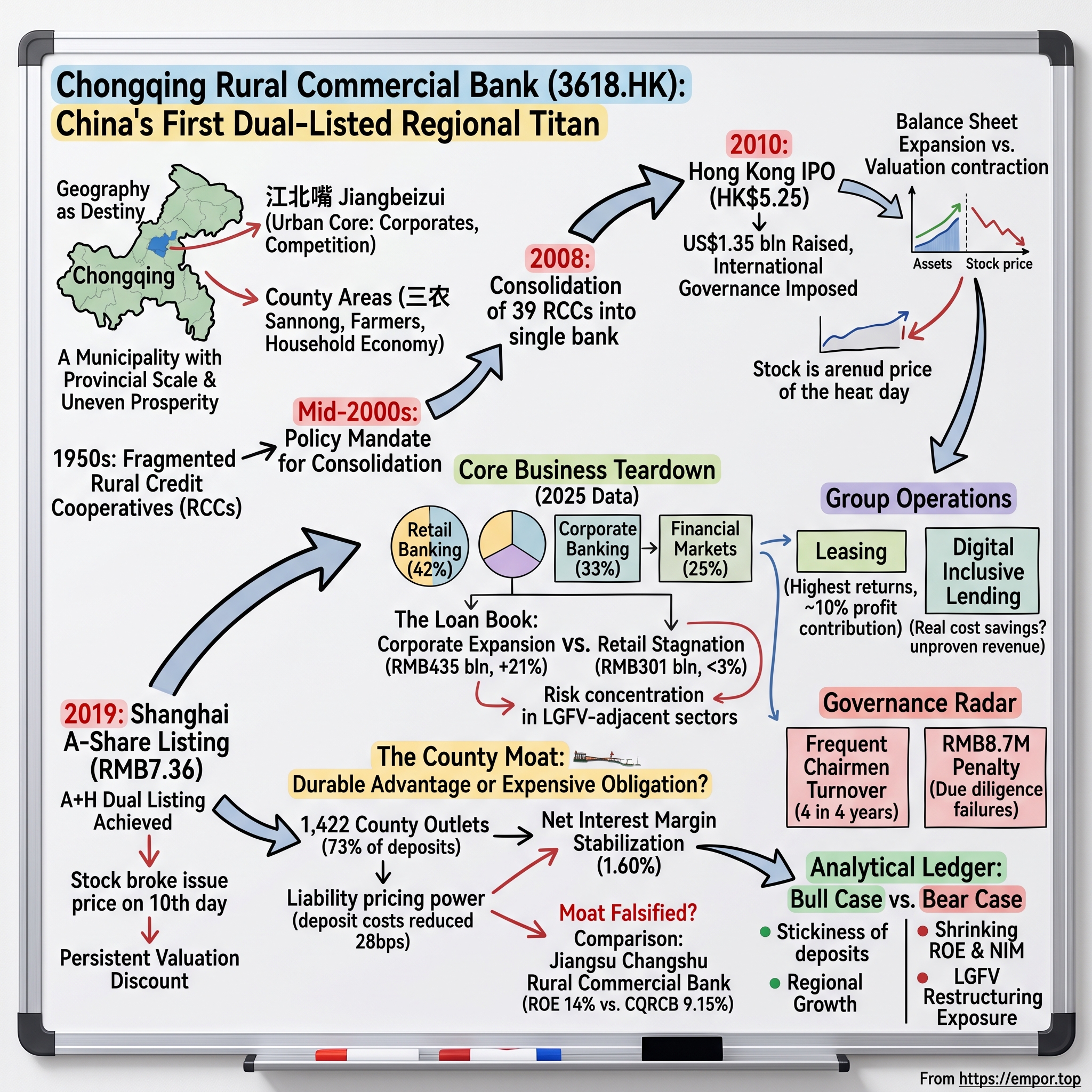
Chongqing Rural Commercial Bank: The Story of China's First Dual-Listed Regional Titan
I. Introduction & Episode Roadmap (00:00 – 00:10)
On the morning of July 20, 2026, 重庆农村商业银行 Chongqing Rural Commercial Bank published a routine-looking document to the Shanghai Stock Exchange: a half-year performance flash. By the standards of Chinese banking in 2026, the numbers were solid. Total assets had crossed RMB1.788 trillion. Operating income was up 7.81% year on year. Pre-tax profit was up 11.50%. The non-performing loan ratio had ticked down to 1.05%.1
Two days later, on July 22, the bank announced that its president, 隋军 Sui Jun, had resigned — effective immediately — from his roles as executive director, president, and chief compliance officer, citing a "work adjustment." Chairman 刘小军 Liu Xiaojun, who had only received formal regulatory approval for his own chairmanship on January 8, 2026, would act as president until a successor cleared the regulator.2
That is the essential tension of this company in a single week: an operating machine that keeps producing while leadership continually shifts.
This is the story of how a fragmented network of 39 township-level credit cooperatives in China's mountainous southwest was welded into a single institution in 2008, listed in Hong Kong in 2010 as the first Chinese rural commercial bank to go public anywhere, became the first "A+H" dual-listed rural lender in 2019, and now sits on roughly RMB1.79 trillion of assets and a physical branch network of 1,727 outlets — more than any other bank operating inside 重庆市 Chongqing Municipality.31
It is also the story of a valuation puzzle. The H-shares (3618.HK) priced their 2010 IPO at roughly 1.8 times book value.4 Sixteen years later, with a balance sheet more than five times larger and a cleaner loan book, the stock trades at roughly half of book value. The market is not confused about the assets; it is making a judgment about the returns those assets can generate, and about who ultimately decides how they get deployed.
The core question this episode tests is deceptively simple: is CQRCB's county-level branch density a genuine, durable economic moat — or is it an expensive obligation that happens to come with a lot of deposits?
The bull case holds that no competitor can replicate 1,422 outlets across rural Chongqing, making the resulting deposit base sticky and cheap, and turning the bank into a utility-like cash machine trading at a distressed multiple. The bear case counters that density does not automatically convert into returns — a point where peer evidence raises awkward questions. Both perspectives warrant close examination.
Here is the route:
- The geography and policy history that made a bank like this possible — and necessary.
- The 2008 consolidation of the 农村信用社 rural credit cooperative system, and the 2010 Hong Kong listing that imposed international disclosure on an institution born in township credit unions.
- The 2019 Shanghai listing, its troubled aftermath, and how the group built out leasing, wealth management, and consumer-finance arms.
- A segment-by-segment teardown of where the money actually comes from — with several findings that contradict the conventional description of this bank.
- The subsidiaries and digital platforms that matter more than their headline size suggests, and the ones that matter less.
- Governance: four chairmen in four years, a president who held three jobs at once, an RMB8.7 million regulatory penalty, and what management actually said when analysts pushed.
- The competitive structure through Porter and Helmer, tested against a small Jiangsu peer that earns nearly double the return on equity.
- The risk radar, the short-seller's brief, and the three metrics that will tell you whether the story is working.
Start with the ground the bank stands on. Because in this business, geography is not background — it is the balance sheet.
 Subscribe on LinkedIn
II. Chongqing Context & Rural Credit Cooperative DNA (00:10 – 00:25)
Fly into Chongqing Jiangbei airport and drive south, and within forty minutes you are in one of the densest urban environments on earth: the Jiangbeizui financial district rising out of the confluence of the Yangtze and Jialing rivers, light rail threading through apartment buildings, expressways stacked five layers deep in the fog. Drive four hours east instead, toward Wushan or Youyang, and the road climbs into terraced mountainsides where the economic unit is still the household, the main crop is navel oranges or tobacco, and the nearest bank branch is a two-room storefront on a county-town street.
Both of those places are Chongqing. That geography defines the bank's commercial identity.
A municipality that is really a province
Chongqing became a direct-administered municipality in 1997, carved out of Sichuan and handed responsibility for the Three Gorges resettlement. What it inherited was not a city in the traditional sense but a territory of roughly 82,000 square kilometres with around 32 million residents, administratively organised into 37 districts and counties — a scale closer to a mid-sized European country than to Shanghai or Shenzhen.3
The regional economy has grown into that scale. Chongqing's GDP reached about RMB3.37 trillion in 2025, up 5.3% year on year, driven by automobiles, new energy vehicles, electronics, and new materials.5 It is also the eastern anchor of the 成渝地区双城经济圈 Chengdu-Chongqing Economic Circle, the State Council's designated "fourth growth pole" — a 185,000-square-kilometre region of roughly 96 million people whose combined output has approached RMB10 trillion.6
However, prosperity is unevenly distributed across the region, creating the economic logic underpinning the bank's footprint. The eight urban districts hold the corporates, the commercial real estate, and the intense banking competition. The remaining twenty-nine districts and counties hold the agricultural households, farmland, pension disbursements, migrant remittances — and roughly three-quarters of CQRCB's total deposits.
The credit cooperative inheritance
Rural credit cooperatives were China's answer to a problem national state banks never solved: providing deposit-taking and small-scale lending in rural areas where a national branch network was economically unviable. From the 1950s onward, RCCs operated as hyper-localised institutions — township-level, member-owned in theory, administratively directed in practice — serving farm households and, starting in the 1980s, township-village enterprises.
While essential, the system was structurally flawed. Governance was fragmented across thousands of independent legal entities. Local officials routinely influenced credit decisions, capital buffers were thin, and non-performing loan ratios across the RCC system in the early 2000s reached severe levels by commercial standards, with accounting practices often masking the extent of the bad debt.
By the mid-2000s, Beijing determined that systemic consolidation was required rather than another round of capital injections. Two policy imperatives aligned. The first was 普惠金融 inclusive finance — the principle that access to basic credit and payment infrastructure is a public good, and that rural households and micro-enterprises required formal financial integration. The second was the pragmatic reality that a modern financial system could not operate on thousands of undercapitalised cooperatives lacking unified risk oversight.
The chosen solution was consolidation into provincial or municipal joint-stock rural commercial banks: pool assets and liabilities, carve out or write off legacy distressed loans, and establish a single balance sheet, a unified risk management function, and a corporate governance structure capable of seeking a public listing.
The bargain, and its permanent cost
This structural transition explains the bank's valuation multiple more directly than financial ratios alone. The restructuring was never designed to transform RCCs into purely profit-maximising commercial entities. Beijing offered a conditional agreement: an institution receives a commercial banking licence, a cleansed balance sheet, and capital-market access, in exchange for maintaining a county-level presence, continuing to support 三农 sannong (agriculture, rural areas, and farmers), and providing lower-cost credit to the local economy during policy-driven credit expansions.
Chongqing served as a key testing ground for this model. In 2007, the State Council designated Chongqing alongside Chengdu as a national experimental zone for coordinated urban-rural reform — an explicit policy mandate to facilitate the flow of capital, land, and labor between urban and rural districts. Within that framework, forming a municipality-wide rural commercial bank functioned less as a conventional corporate event than as core policy infrastructure.
This dual identity — a commercial enterprise with explicit policy obligations — remains unresolved and represents a persistent structural condition. The central investment question surrounding the institution remains: how much shareholder return can be extracted from a franchise established on the condition that commercial returns would not be its sole priority?
The practical answer began to take shape in the summer of 2008.
III. The 2008 Consolidation & The Landmark 2010 Hong Kong IPO (00:25 – 00:40)
Inflection Point 1: One balance sheet out of thirty-nine
On June 27, 2008, Chongqing Rural Commercial Bank Co., Ltd. was incorporated as a joint-stock limited company. Under the promoters' agreement executed that same day, it acquired all the assets and liabilities of 38 rural credit cooperative unions and Chongqing Wulong Rural Cooperative Bank — collectively referred to as the 39 Rural Credit Unions — alongside the municipal-level Chongqing Rural Credit Cooperative Union that had nominally supervised them.7
A key accounting detail underscores the complexity of the consolidation. Under international financial reporting standards, the restructuring could not be treated as a combination of entities under common control, because no single entity held ultimate control over the 39 credit unions before and after the transaction.7 In practical terms, these were 39 distinct institutions rather than branches of a unified parent. The June 2008 creation was a genuine consolidation of independent entities rather than a routine corporate reorganization.
The integration challenge was immense: harmonizing 39 distinct credit cultures, loan books of wildly varying quality, and local relationships where officials had long influenced lending decisions. Establishing a single underwriting standard, a unified core banking system, and a central risk-management command chain across more than 1,000 outlets scattered across mountainous terrain consumed the next two years. Crucially, the detailed historical accounting of what was written off, transferred, or carried forward during restructuring remains sparsely disclosed in public filings.
CQRCB became China's third provincial-level rural commercial bank, following similar consolidations in Shanghai and Beijing. What distinguished the Chongqing entity was its immediate push toward international public capital markets.
Inflection Point 2: Hong Kong, December 2010
While its counterparts in Shanghai and Beijing remained unlisted for years, CQRCB moved swiftly toward an international offering.
The bank priced its Hong Kong IPO at HK$5.25 per share — the midpoint of its HK$4.50 to HK$6.00 target range — issuing roughly 2 billion shares and raising approximately US$1.35 billion. Joint bookrunners Morgan Stanley and Nomura Holdings secured cornerstone and anchor orders from major institutional investors, including the life insurance unit of Taiwan's Fubon Financial and Abu Dhabi-backed Nexus Capital Investing. The shares debuted on the Main Board of the Hong Kong Stock Exchange on December 16, 2010.47
The valuation reflected global sentiment toward Chinese regional banking in 2010. Including the over-allotment option, the offering priced the bank at roughly 1.8 times book value — a discount to comparable regional listings at the time, but a multiple that in 2026 would look like a fantasy.4
Three main drivers propelled the decision to list in Hong Kong.
First was capital generation. Rapid loan expansion in a fast-urbanizing municipality required fresh Core Tier 1 capital, while mainland China's domestic A-share listing queue for commercial banks faced prolonged regulatory freezes.
Second was governance credibility. An HKEX listing required adoption of International Financial Reporting Standards, independent audits, continuous disclosure obligations, independent non-executive directors, and exposure to global institutional capital. For an entity assembled from local credit unions just 30 months prior, this external oversight accelerated the development of standardized underwriting, credit classification, and related-party reporting.
Third was the strategic investment narrative. In 2010, urban growth in western China stood among the most compelling themes in emerging-market investing. CQRCB offered international investors a rare pure-play vehicle on rural urbanization and consumption growth in inland China, backed by an extensive regional deposit franchise.
What the listing actually bought shareholders
Evaluated against its core objectives, the Hong Kong listing succeeded in securing capital and establishing a resilient governance framework. External oversight has remained consistent, with KPMG Huazhen auditing the PRC accounts and KPMG auditing the IFRS accounts, both delivering unqualified opinions for 2025.3
As an investment, however, the IPO demonstrated the distinction between balance-sheet expansion and shareholder value creation. Although total assets expanded significantly over the subsequent decade and a half, valuation multiples steadily contracted. Consequently, investors who bought at the HK$5.25 IPO price received steady dividend income but saw the stock trade below its offer price for much of the following 16 years.
This divergence between balance-sheet growth and market valuation remains the central consideration for investors evaluating the stock. Rather than indicating operational failure, it reflects market skepticism regarding whether loan expansion at a policy-directed regional bank translates efficiently into per-share equity value. The bank's subsequent listing in Shanghai provided a swift test of that dynamic.
IV. The 2019 A-Share Milestone & Expanding the Financial Engine (00:40 – 00:55)
Inflection Point 3: Twenty-seven percent, then straight down
At 9:30 a.m. on October 29, 2019, ticker 601077.SH opened on the Shanghai Stock Exchange main board at RMB8.83, compared with its issue price of RMB7.36. Within minutes, the stock touched RMB10.60 — hitting the 44% daily limit-up ceiling — and pushed the bank's market capitalisation past RMB120 billion. Raising RMB9.988 billion through the issuance of 1.357 billion new shares, the stock closed its first trading session at RMB9.35, up 27.04%, making CQRCB China's first rural commercial bank with dual A-share and H-share listings.8
The debut celebration was short-lived. On its tenth trading session, the stock broke below its offer price, becoming the first Chinese bank IPO of 2019 to fall below its listing level. The decline continued. From November 12 to December 9, 2019, the A-shares closed below their most recent audited net asset value per share for twenty consecutive trading days. Under the terms of the prospectus, that drop triggered a mandatory share-price stabilization mechanism requiring directors and senior executives to buy shares with personal funds. Media reports calculated those management purchases at roughly RMB740,000, a symbolic effort against a market capitalization loss running into tens of billions.9
The episode offers a clear signal. Within six weeks of its domestic debut, mainland investors priced the bank below its accounting equity value — a valuation discount that has persisted ever since. Whatever the H-share discount was assumed to reflect after the 2010 Hong Kong listing — whether offshore illiquidity, unfamiliarity, or governance doubts — domestic investors with direct access to mainland disclosures reached the same conclusion once given the opportunity.
The dual listing achieved its capital goal, but it made clear that the bank's valuation discount was not merely an offshore artifact.
Building the group: organic outposts, not acquisitions
With mainland capital access secured, management focused on expanding through new operating licences rather than bank acquisitions.
Village and township banks. CQRCB established a network of 重农商村镇银行 CQRC Village and Township Banks — small, separately licensed rural lenders operating in counties outside its primary market. By the end of 2025, the network comprised 12 institutions across 12 counties in five provinces, each at least 51%-owned, with combined registered capital of RMB1.662 billion.3
The financial returns from this network remain modest. In 2025, the 12 village banks held total assets of RMB4.924 billion and net assets of RMB1.956 billion, producing combined net profit of RMB24 million and an NPL ratio of 1.55%, above the group average.3 On RMB1.96 billion in equity, that represents a return on equity of roughly 1%. Furthermore, total loans of RMB4.194 billion significantly exceed total deposits of RMB2.489 billion, indicating these subsidiaries rely on parent funding rather than self-sustaining deposit franchises.3
To be sure, the village bank initiative carries policy obligations, remains immaterial to consolidated results, and avoided the integration risks and goodwill overhang created by peer acquisitions — CQRCB carries only RMB440 million of goodwill on its balance sheet.3 Nevertheless, the network functions not as an earnings driver, but as a small, low-return operation that has failed to scale after more than a decade of existence.
CQRC Financial Leasing. Formed in December 2014 with registered capital of RMB2.5 billion and 80% owned by the bank, 重农商金融租赁 CQRC Financial Leasing represents a far larger earnings contributor. By the end of 2025, its total assets reached RMB77.329 billion and net assets stood at RMB9.545 billion, generating full-year net profit of RMB1.436 billion.3 This delivers a return on net assets of approximately 15%, contributing roughly one-tenth of total net profit attributable to parent company shareholders after accounting for minority interests.
CQRC Wealth Management. Launched in June 2020 with RMB2 billion in registered capital, the unit was the first wealth management subsidiary established by a rural commercial bank in China and the first by any commercial bank in western China. It generated RMB302 million in net profit in 2025.3
Chongqing Xiaomi Consumer Finance. The bank holds a 30% equity stake in 小米消费金融 Chongqing Xiaomi Consumer Finance, Chongqing's second licensed consumer finance company, established in May 2020. The affiliate held RMB20.807 billion in total assets and generated RMB131 million in net profit in 2025.3
What the deployment record says
Overall, CQRCB's capital allocation has followed a cautious strategy: securing new licences organically, retaining controlling or strategic stakes, and avoiding costly bank acquisitions. Compared with regional peers such as 上海农村商业银行 Shanghai Rural Commercial Bank or 广州农村商业银行 Guangzhou Rural Commercial Bank, CQRCB has incurred virtually no M&A integration risk and carries minimal intangible assets subject to impairment.
The limitation of this approach is equally evident. Over a decade and a half of expansion, financial leasing stands out as the only subsidiary contributing materially to group earnings. The wealth management unit's RMB302 million profit remains modest relative to the bank's asset base, while the consumer finance affiliate contributes minimally. Concurrently, net fee and commission income dropped 19.71% in 2025 to RMB1.294 billion, representing 4.52% of operating income — down from 8.83% in 2021.3 Despite long-standing strategic goals to diversify beyond net interest margins, non-interest fee generation has contracted.
This performance reflects the inherent boundaries of the franchise's product distribution capabilities, underscoring where its core revenues are actually generated.
V. Core Business Deep-Dive: Segments, Economics, & County Moat (00:55 – 01:20)
Where the money actually comes from
Standard descriptions of CQRCB typically portray a corporate lender backed by a large retail deposit base and a modest treasury operation. The bank's reported segment results reveal a noticeably different structure.
In 2025, retail banking generated RMB12.139 billion in operating income, representing 42.42% of the total. Corporate banking contributed RMB9.351 billion, or 32.67%. The financial market business—spanning interbank operations, bonds, and investments—generated RMB7.027 billion, or 24.55%.3
Generating nearly a quarter of total revenue, the treasury operations function as a distinct third pillar of the business rather than a minor line item. Total financial investments averaged RMB548.2 billion during 2025 at a yield of 2.73%, down from 3.08% in 2024, while interest income from those investments fell 5.16%.3 Consequently, the financial market segment's share of total revenue slipped by 2.72 percentage points.3 In a declining interest rate environment, this investment portfolio produced mark-to-market gains alongside reinvestment pressure, as reflected in net other non-interest income—primarily investment-driven—which dropped 25.69% in 2025.3
Models treating CQRCB strictly as a traditional deposit-and-lending franchise risk misjudging its earnings dynamics, given that a significant portion of income depends directly on its bond portfolio.
The loan book: a quiet but decisive rotation
Total loans expanded 11.62% to reach RMB797.287 billion at the end of 2025.3 The structural composition of this expansion highlights an underlying shift in lending strategy.
Corporate loans rose to RMB434.974 billion, expanding their share of the total portfolio from 50.14% to 54.55% and reflecting approximately 21% year-on-year growth. Conversely, retail loans edged up to RMB301.022 billion, with their share contracting from 40.95% to 37.76%, representing growth below 3%.3
An examination of corporate credit distribution shows where capital was deployed. Leasing and commercial services grew to RMB112.105 billion, or 14.06% of total loans, while water conservancy, environmental, and public utility management reached RMB82.317 billion, or 10.32%. Combined, these two categories account for nearly a quarter of the bank's loan book—sectors that routinely include local government financing vehicles and municipal infrastructure projects in Chinese bank disclosures.3 Manufacturing loans remained essentially stagnant at RMB78.385 billion.3
By contrast, direct real estate lending remains minimal at RMB7.226 billion, representing 0.91% of total loans, with zero reported non-performing balances.3 This limited exposure has shielded the bank from the severe sector-specific property stress that impacted several domestic peers.
This portfolio shift toward government-aligned sectors carries pricing implications. The average yield on corporate loans decreased from 4.15% to 3.87% in 2025, while retail loan yields declined from 4.21% to 3.81%, pulling the blended loan yield down from 3.92% to 3.64%.3 The bank has expanded lower-yielding, state-adjacent lending driven by prevailing regional credit demand and policy direction.
The deposit franchise, examined honestly
Total deposits rose 9.21% to RMB1,028.727 billion at the end of 2025.3 County regions generated 73.30% of these funds, with county-area personal deposits climbing by RMB56.467 billion to RMB692.593 billion, accounting for 78.67% of the bank's total personal deposit base.3
This deposit collection relies on an extensive physical footprint. CQRCB operates 1,727 outlets—comprising its head office and business department, seven branches, 35 first-class sub-branches, 172 second-class sub-branches, and 1,511 branch offices—across all 37 districts and counties in Chongqing. The county area contains 1,422 outlets compared to 303 in the urban core. Supported by 6,276 self-service devices and 301 rural convenience financial service centers, the bank has issued 24.841 million debit cards in county regions, representing 78.97% of its total issuance.3 This network provides an unmatched retail reach within the municipality.
While market narrative often characterizes this distribution network as an ultra-low-cost liability engine, financial disclosures show a more nuanced reality.
The blended cost of customer deposits fell 28 basis points year on year to 1.45% in 2025.3 However, deposit composition differs from a low-cost demand deposit franchise: personal time deposits averaged RMB705.464 billion with an average cost of 1.83%, whereas personal demand deposits averaged RMB155.092 billion at a cost of 0.06%.3 Approximately three-quarters of personal deposits consist of interest-bearing term funds subject to periodic repricing rather than non-interest-bearing float.
The economic moat derived from this network resides in funding volume, customer retention, and limited local price competition. Rural depositors face few banking alternatives, regularly rollover time deposits, and display low rate sensitivity. Consequently, the bank's primary advantage lies in its ability to lower deposit rates without forfeiting balances—as evidenced by the 28-basis-point cost reduction—rather than an inherently zero-cost liability structure.
This distinction determines how effectively the bank can absorb broader loan prime rate reductions over time.
The margin arithmetic, and one genuinely good year
The net interest margin contracted by a single basis point in 2025 to 1.60%.3 Following sequential declines from 2.17% in 2021, 1.97% in 2022, 1.73% in 2023, and 1.61% in 2024, this minor reduction marked a stabilization after four consecutive years of margin compression.3
The mechanics of this stabilization highlight the bank's liability management. Total interest income dropped 1.32% to RMB46.465 billion as loan and bond yields declined. However, interest expenses fell substantially faster, declining 9.71% to RMB22.205 billion. This reduction was driven by a 28-basis-point drop in deposit costs, a 39-basis-point decline in interbank funding costs, and a deliberate reduction in higher-cost wholesale borrowings.3 Consequently, net interest income increased 7.85% to RMB24.261 billion despite falling asset yields.3
This performance demonstrates how controlling liability costs can insulate net interest income during periods of monetary easing, as the bank successfully passed lower rates through to its deposit base without triggering capital outflows.
Nevertheless, structural constraints remain evident across overall earnings. Total operating income rose 1.38% to RMB28.620 billion as declines in fee commissions and investment income offset net interest gains.3 The cost-to-income ratio stood at 31.25%, remaining above the 27.51% level recorded in 2021.3 Net profit attributable to shareholders rose 5.35% to RMB12.128 billion.3 Return on average total assets reached 0.78%, while weighted average return on net assets fell for a fifth consecutive year to 9.15%.3
Furthermore, liability cost reductions encounter natural floors as deposit rates approach structural minimums, with demand deposits already at six basis points. Management guidance for 2026 acknowledged that the broader interest rate environment will continue its downward movement.3
Asset quality: two books moving in opposite directions
Headline asset quality metrics appeared robust at year-end 2025, with the non-performing loan ratio dropping for a fifth consecutive year to 1.08%, special-mention loans at 1.42%, overdue loans at 1.19%, and provision coverage reaching 367.26%.3
Underneath these aggregate figures, corporate and retail credit performance diverged. Corporate non-performing loans dropped by RMB1.361 billion to RMB2.372 billion, lowering the corporate NPL ratio by 49 basis points to 0.55%.3 Conversely, retail non-performing loans expanded to RMB6.217 billion, pushing the retail NPL ratio from 1.60% to 2.07%.3
In its annual report disclosures, management attributed this retail credit deterioration to lower-than-expected income growth and weakened solvency among individual borrowers alongside subdued credit demand.3 To mitigate potential losses, management highlighted that 77.92% of non-performing retail loans are secured, 68.00% are collateralized or pledged, and total collateral value covers 1.68 times the outstanding principal.3
While collateral coverage offers structural protection, the underlying trend remains notable. Retail lending accounts for 37.76% of total loans and carries a non-performing loan rate nearly four times higher than the corporate portfolio. In a municipality experiencing ongoing rural demographic shifts, household credit pressure represents a key operational risk.
Credit concentration figures also show single-name exposure: loans to the bank's top ten borrowers equaled 24.31% of net capital.3 While within regulatory limits, this concentration indicates that despite its rural retail footprint, the bank maintains substantial exposure to a concentrated group of large, state-aligned corporate borrowers.
The competitive board
Within Chongqing, CQRCB competes against state-owned mega-banks—including 中国农业银行 Agricultural Bank of China, 中国工商银行 ICBC, 中国建设银行 China Construction Bank, and particularly 中国邮政储蓄银行 Postal Savings Bank of China, whose nationwide postal network represents the primary rival for rural retail reach. It also competes with local city commercial banks, including 重庆银行 Bank of Chongqing (1963.HK / 601963.SH) and unlisted 重庆三峡银行 Chongqing Three Gorges Bank.
In terms of regional market scale, CQRCB maintains a clear lead. Public data supports the bank's position as Chongqing's largest local financial institution by assets, capital base, and distribution network.3 The bank extended approximately one-fifth of the municipality's manufacturing loans, one-quarter of its inclusive micro and small enterprise loans, one-third of its agricultural loans, and half of its farm household loans, securing the top market share in regional manufacturing credit.3 Globally, the institution ranked 112th in The Banker's top bank rankings.3
This combination of market dominance and declining capital returns presents a central strategic question, which will be evaluated in subsequent competitive analysis. Before examining that framework, the next section reviews the group's subsidiary operations and digital platforms to identify which units materially influence earnings and which remain peripheral.
VI. Hidden & Fast-Growing Drivers: Sized to Weight (01:20 – 01:30)
Two internal operations within the group merit closer scrutiny than their line-item disclosures typically receive.
CQRC Financial Leasing: the quiet profit centre
While leasing is often treated as a peripheral business, the subsidiary generates disproportionate returns. On RMB9.545 billion in net assets, CQRC Financial Leasing earned RMB1.436 billion in 2025—a 15% return on equity that comfortably outpaces the parent group's 9.15%.3 With the bank holding an 80% stake, the subsidiary generated nearly RMB1.15 billion in net profit attributable to shareholders, contributing roughly one-tenth of consolidated net earnings.
In practice, financial leasing allows the group to extend equipment-backed credit rather than relying purely on traditional corporate balance sheets. By retaining title to underlying assets—such as construction machinery, municipal bus fleets, water-treatment facilities, or agricultural processing lines—the lessor can extend financing to county-level tourism operators, logistics providers, and ecological contractors that lack standard real estate collateral.
The subsidiary has focused this capability directly on its home market. Within Chongqing, its leased-asset balance reached RMB20.038 billion, with 78.12% deployed in county districts. Out of RMB9.146 billion in new Chongqing leasing projects written during 2025, county projects accounted for 77.48%.3
This strategy presents a double-edged profile. On one hand, leasing represents the group's highest-returning business line and a clear structural differentiator, monetizing established county relationships at superior margins. On the other hand, leasing portfolios carry longer durations, asset concentration, and lower liquidity than standard commercial loans. The higher returns reflect a higher risk profile rather than effortless margin. Because a significant portion of these leases funds cultural tourism and ecological engineering in rural counties, performance remains closely tied to local government fiscal health and municipal spending capacity.
Digital inclusive lending: real cost savings, unproven revenue
The second driver is embedded within retail banking rather than reported as a separate segment, making its financial impact more difficult to isolate.
Conceptually, digital inclusive lending addresses a long-standing operational bottleneck. Traditional rural credit underwriting relied on manual farm visits and paper applications—a slow, high-cost process that limited scalability and introduced personal discretion into loan decisions. Replacing manual reviews with automated data models—scoring utility bills, land contract records, agricultural production metrics, and internal transaction histories—enables credit decisions in minutes. In theory, automation lowers the unit cost of small-denomination loans while standardizing risk controls.
The bank reported serving nearly 210,000 inclusive small and micro enterprise loan customers with balances exceeding RMB144.0 billion, stating that it ranks first among Chongqing financial institutions in both inclusive micro and agricultural loan volumes.3 Operationally, the group established seven business-technology integration centers in 2025, deployed fifteen AI intelligent agents, and initiated a three-year digital risk control framework.3 The bank also launched a technology-finance customer acquisition platform, pushing loans to technology enterprises to RMB90.906 billion—the highest among local corporate lenders in Chongqing.3 Green lending reached RMB82.817 billion, up 22.2% year on year in alignment with national dual-carbon goals.3 Concurrently, its 渝快惠 "Yukuai Hui" merchant ecosystem surpassed two million registered merchants.3
Despite these operational milestones, consolidated financial results do not yet reflect clear efficiency gains. The bank's cost-to-income ratio has risen rather than fallen since 2021, while fee income has contracted for four consecutive years. In addition, the retail non-performing loan ratio rose to 2.07% during the same year management highlighted its digital risk systems.3 While three-year digital initiatives require time to mature, current evidence indicates that technology deployment has not yet translated into structural cost reductions or improved credit performance.
This divergence between operational narrative and financial output shifts attention to corporate governance and leadership stability.
VII. Governance, Current Management, & Earnings Call Audit (01:30 – 01:45)
Who owns this bank
A Chinese regional bank's capitalization table is its defining operational reality.
At the end of 2025, HKSCC Nominees held 22.08% as the H-share depositary. Behind it sat a bloc of Chongqing state entities: 重庆渝富资本运营集团 Chongqing Yufu Capital Operation Group at 8.70%; 重庆市城市建设投资(集团) Chongqing City Construction Investment (Group) at 7.02%; Chongqing Development and Real Estate Management at 5.19%; 重庆市水利投资(集团) Chongqing Water Conservancy Investment Group at 4.99%; 重庆发展投资 Chongqing Development Investment at 4.60%; and Chongqing Water Group at 1.10%. The bank disclosed that several of these act in concert—Chongqing Development and Real Estate Management with Chongqing Development Investment, and Chongqing Water Conservancy Investment Group and Chongqing Water Group with Yufu Capital Operation Group.3 The National Social Security Fund's Portfolio 116 held 0.83% and was adding to its position.3
No single shareholder controls the bank outright, but Chongqing's state apparatus plainly does collectively. Critically, several of these shareholders are also customers: the bank disclosed related-party credit arrangements including a group credit limit of RMB19.4 billion to 重庆渝富控股集团 Chongqing Yufu Holding Group.3 Furthermore, the three non-executive directors appointed in December 2025—马波 Ma Bao, 董斌 Dong Bin, and 袁刚 Yuan Gang—represent the Yufu system, Chongqing City Construction Investment, and Chongqing Development Investment, respectively.3
This ownership structure is neither hidden nor unusual for the sector. However, it means the board's economic interests and the municipality's financing needs sit on the same side of the table. Investors should assume that when those interests diverge, minority shareholders do not serve as the tiebreaker.
Four chairmen, four years
The leadership record is where the governance question stops being theoretical.
刘建忠 Liu Jianzhong, who ran the bank for years after its formation, stepped down in April 2022 on age grounds.10 谢文辉 Xie Wenhui succeeded him and lasted two and a half years before resigning in October 2024 on a work transfer to become party secretary and chairman of Chongqing Yufu Holding Group—the bank's own major shareholder.10 President Sui Jun then stepped in as acting chairman. In early 2025, executive director, vice president, and board secretary 张培宗 Zhang Peizong also departed, leaving Sui Jun holding three of the bank's most senior roles simultaneously: president, acting chairman, and board secretary.11
That concentration of authority drew explicit criticism. Chinese regulations cap acting-capacity service at six months, yet Sui Jun's tenure as acting chairman ran past nine months, and his role as acting board secretary similarly exceeded the statutory limit. Analysts noted that holding all three posts concurrently was extremely rare among China's listed banks, pointing to a 2023 precedent where another regional lender was fined RMB500,000 for a comparable governance breach.11
Liu Xiaojun was nominated as an executive director candidate and elected chairman in April 2025, having taken over as party secretary in March 2025; his chairmanship received formal regulatory approval on January 8, 2026.12133 Six and a half months later, Sui Jun resigned, and Liu took on the presidency in an acting capacity as well.2
That makes four chairmen—or acting chairmen—within four years at an RMB1.8 trillion institution. Strategy at Chinese regional banks is established at the party committee and board level. When leadership turns over at this rate, multi-year transformation programs struggle to survive intact, making long-term accountability difficult to assign.
The people currently in charge
Chairman Liu Xiaojun is, by the standards of this institution, an outsider. Born in December 1976, he earned a master's degree in economics from Fudan University in 2002. His career developed through 中信信托 CITIC Trust—where he rose from business director to general manager of the second trust business division—before transitioning into Chongqing's state holding system as party secretary and chairman of Chongqing Development Investment. He also served as a non-executive director of 中国宏桥集团 China Hongqiao Group, a Hong Kong-listed aluminum producer.313
His background is instructive. Liu is not a career retail banker who rose through branch management. He is a structured-finance and state-capital executive—experienced in trust products, holding companies, and listed-company boards—appointed to a bank whose core challenges involve balance-sheet structure, municipal debt alignment, and profit-mix transformation. That appointment signals what the primary shareholder prioritized, though it leaves an open question: the franchise's main distribution asset resides in its 1,422 county outlets, an operational network outside Liu's primary background.
His strategic framework emphasizes the "three new momentums" (三新动能)—digitally driven, industry-chain-driven, and scenario-driven growth—alongside a "1+11+3" transformation strategy aimed at building a "world-class modern rural commercial bank that is technology-based, industry-oriented and ecology-based."3
Former President Sui Jun, born in 1968, served as the insider balance. A professor-level senior economist holding a doctorate from Southwestern University of Finance and Economics, his career began at 中国建设银行 China Construction Bank's Nanchong branch and extended deep into the Chongqing rural credit system. He served as party secretary and chairman of the Jiangjin Rural Credit Cooperatives Union, president of the bank's Jiangjin sub-branch, general manager of the sales department, board secretary, and vice president—with intervals at Chongqing Automotive Finance and Bank of Chongqing—before returning as president in March 2023.3 His departure in July 2026 removed the executive with the deepest institutional memory of the credit cooperative network.
Capital allocation and the shareholder return record
The bank's dividend distribution record provides the clearest evidence of capital allocation policy.
For 2025, the bank paid an interim dividend of RMB2.0336 per ten shares and proposed a final dividend of RMB1.1755, bringing the total distribution to RMB3.2091 per ten shares.3 Total cash dividends expanded from RMB2.82 billion for 2022 to RMB3.645 billion for 2025—a compound annual growth rate near 9%—maintaining a payout ratio at or above 30% for five consecutive years and delivering cumulative distributions of RMB15 billion over that period.314 At market prices around the 2025 results announcement, that payout represented an annualized dividend yield of 4.49% on the A-shares and 5.53% on the H-shares.14 During this period, the bank was added to the CSI 300 and MSCI China H indices.3
Management reinforced this commitment with personal open-market purchases. Between January 5 and 7, 2026, directors and senior executives bought 192,000 A-shares using personal funds, marking the group's first voluntary executive purchase announcement in six years.314
Conversely, capital adequacy ratios compressed. Core Tier 1 capital fell from 14.24% to 12.67%, while total capital adequacy dropped from 16.12% to 14.46% during 2025.3 Disclosures attribute this drop to asset expansion: risk-weighted assets grew 16.5% to RMB1,034.8 billion, whereas net capital grew only 4.5%.3 Credit risk-weighted assets alone rose 17%.3 Paying out 30% of earnings while risk-weighted assets grow at 16.5% absorbs capital reserves over time. Consequently, the Core Tier 1 capital trajectory serves as a direct constraint on future dividend growth.
What management said when pushed
The 2025 annual results presentation took place on April 15, 2026. Chairman Liu Xiaojun was joined by vice president 张进 Zhang Jin, financial market department general manager 唐继东 Tang Jidong, asset-liability management general manager 朱国忱 Zhu Guochen, and fintech specialist 张浩 Zhang Hao.15
The session highlighted three principal themes.
Specific commitments. Regarding dividends, Liu committed to maintaining the twice-yearly distribution schedule and keeping the cash payout ratio above 30% of net profit, absent major structural shifts.15 On net interest margins, Tang Jidong outlined actionable levers—including asset-liability portfolio management, price guidance mechanisms, and differentiated loan pricing—rather than broad statements.15 The annual report supported this strategy with operational targets: curtailing high-cost time deposits, driving demand deposit growth through scenario-based acquisition, and managing active liability issuance.3
Forward targets. Management established operational targets for the 15th Five-Year Plan period: total assets exceeding RMB2 trillion, net profit above RMB15 billion, a non-performing loan ratio near 1%, and return on equity above 10%.15 Reaching an ROE above 10% requires reversing a five-year contraction, during which weighted average ROE fell from 9.82% in 2021 to 9.15% in 2025.3 Achieving that target while expanding lower-yielding, state-aligned assets requires sustained balance-sheet growth, margin stabilization, and fee recovery.
Information gaps. On structural exposure—specifically the yield and timing impact of local government debt swap programs for a bank with nearly a quarter of its loan book in LGFV-adjacent sectors—management disclosures remained general. While the annual report details asset quality across industries and acknowledges retail credit pressure, it does not quantify LGFV restructuring exposure or the yield impact of debt swaps.3 While consistent with standard reporting across domestic regional banks, this disclosure gap continues to weigh on market valuation multiples.
A complete governance assessment must also account for regulatory enforcement actions outside annual investor presentations. On December 25, 2025, the NFRA's Chongqing bureau fined the bank RMB8.7 million for infractions including inadequate loan due diligence, insufficient investigation and accountability for large risk losses, off-site statistical reporting errors, failure to verify margin deposit sources, and rolling bill issuance. Ten individuals received sanctions. Former vice president 舒静 Shu Jing—dismissed in March 2024 and expelled from the Party and public office in August 2024 following investigations into bribery and loan oversight failure—and former chief credit officer 封洪伟 Feng Hongwei were banned from the banking industry for life.16
Viewed constructively, these enforcement actions indicate the resolution of legacy credit issues and alignment with stricter underwriting discipline. Viewed critically, findings of inadequate due diligence and unaddressed risk losses highlight operational vulnerabilities at the executive level seventeen years after the 2008 consolidation. Both interpretations reflect the underlying governance considerations reflected in the stock's valuation discount.
VIII. Strategic Frameworks: Porter's 5 Forces & Hamilton Helmer's 7 Powers (01:45 – 01:55)
Evaluating Chongqing Rural Commercial Bank through formal strategic frameworks requires stripping away narrative assumptions to examine what structural advantages exist, how durable they are, and whether they ultimately translate into superior financial returns.
Hamilton Helmer's 7 Powers
Cornered Resource — the strongest claim, with a caveat. Helmer defines a cornered resource as preferential access to a valuable asset on attractive terms. For CQRCB, that asset is its 1,422 county outlets spanning all 37 districts and counties of Chongqing—assembled through a 2008 policy consolidation that cannot be duplicated.3 A national competitor seeking equivalent rural coverage would need to construct roughly 1,400 branches across mountainous terrain and wait years for deposit balances to accumulate, an economically unviable strategy when urban Chongqing can be served profitably from 100 outlets.
However, a cornered resource constitutes a true Power only if it generates differential returns. While the network demonstrably secures differential funding—generating 73.30% of a trillion-yuan deposit base from county regions—whether that deposit gathering translates into differential profitability remains subject to structural friction.3
Switching Costs — real but low-value. A rural household in Fengjie receiving pensions and agricultural subsidies through the bank, with debit cards and mobile banking established over decades, is unlikely to switch institutions for a minor rate premium. Financial disclosures confirm this relationship depth, with county regions accounting for 78.97% of debit cards and 79.22% of mobile banking users.3 Yet switching costs on a small-denomination personal term deposit generate far less economic value per account than switching costs within an enterprise treasury relationship, rendering this advantage broad but shallow.
Scale Economies — present, and eroding. A balance sheet crossing RMB1.7 trillion allows fixed costs—such as core IT platforms, compliance infrastructure, and digital initiatives—to be spread across a broad operational base. Yet financial metrics show scale efficiencies weakening: the cost-to-income ratio rose to 31.25% in 2025 from 27.51% in 2021, indicating that fixed-cost dilution has been outweighed by margin compression and ongoing technology expenditure.3 Concurrently, maintaining 1,727 physical outlets creates negative operating leverage, as fixed overhead costs remain constant even as asset yields contract.
Counter-Positioning, Network Economies, Branding, Process Power — largely absent. The remaining four powers offer little structural moat. Incumbents face no structural barriers to copying the bank's business models; deposit-taking exhibits no cross-side network effects; and local brand trust confers no pricing power. Furthermore, reported advances in digital underwriting have yet to translate into lower operating costs or improved retail credit performance.
An unlisted structural factor: the regulatory franchise. CQRCB's most significant advantage lies outside Helmer's taxonomy: a municipality-wide commercial banking licence paired with implicit local-government backing, granted under historical policy conditions that no newcomer can replicate. This asset functions as a protected franchise rather than a commercial Power, shielding the institution from entry without granting asset-side pricing power.
Porter's Five Forces
Threat of new entrants — very low. Commercial banking licences in China remain strictly controlled, capital requirements are high, and establishing physical rural coverage is economically prohibitive for new entrants. While digital lenders originate consumer credit in Chongqing, they cannot gather retail deposits at scale without a full banking licence.
Bargaining power of depositors — low, and proven so. The 28-basis-point reduction in average deposit costs during 2025, achieved while growing customer deposits by 9.21%, demonstrates that county depositors possess limited practical alternatives.3 This deposit stickiness represents the franchise's primary liability-side strength.
Bargaining power of borrowers — high, and rising. Large corporate borrowers and state-owned enterprises actively negotiate terms across major state-owned banks. The 28-basis-point drop in corporate loan yields during a year when corporate lending grew 21% illustrates that borrowers command significant pricing power.3
Threat of substitutes — moderate and asymmetric. Third-party payment platforms have largely captured transaction flows, contributing to ongoing pressure on bank fee income, while national wealth management platforms compete for younger rural savings. Nevertheless, large-scale licensed credit creation remains sheltered from non-bank substitutes.
Competitive rivalry — high in the urban core, muted in the counties. A pronounced geographic imbalance defines the bank's operational model. The urban-area loan-to-deposit ratio stands at 142.91%, compared with 53.68% in county regions.3 CQRCB gathers deposits in less competitive rural markets and deploys that liquidity into highly contested urban corporate lending, concentrating pricing pressure on its asset side.
The falsification test
If county branch density functioned as a high-return economic moat, superior profitability metrics should follow. However, a peer comparison with 江苏常熟农村商业银行 Jiangsu Changshu Rural Commercial Bank—a smaller rural lender operating in the Yangtze River Delta—highlights a clear performance gap. Changshu achieved a net interest margin above 2.5% and a weighted average return on equity exceeding 14% in 2025, compared with CQRCB's 1.60% net interest margin and 9.15% return on equity.173
Changshu lacks a municipal branch monopoly, but its business model focuses heavily on small and micro-enterprise underwriting, where higher loan yields compensate for credit risk and interest rates are determined by commercial service rather than policy directives.
This comparison leads to a core conclusion often overlooked in optimistic evaluations of the stock: CQRCB's distribution advantage is real, but it functions primarily on the liability side rather than driving asset yields. The extensive branch network provides low-cost, reliable deposit funding, but it does not confer pricing power on loans. Capital is deployed largely into municipal infrastructure, public utilities, and policy-aligned industrial projects where yields are dictated by broader market rates and policy mandates. A structural advantage that secures low-cost funding while assets remain yield-constrained yields a stable, low-return institution.
Rather than a high-growth franchise, CQRCB operates as a regional financial utility—and should be evaluated and valued as such.
IX. Risk Radar & Skeptical Investor Stress Test (01:55 – 02:10)
1. Margin compression, and the end of the liability lever
In 2025, the bank offset falling asset yields almost entirely by lowering funding costs. While effective in the short term, this mechanism faces operational limits.
Personal demand deposit costs sit at six basis points, leaving little scope for further reductions. Personal time deposits at 1.83% and interbank funding at 1.66% offer limited room for additional cuts. Despite balance sheet expansion of 9.95%, total interest income contracted in 2025.3 Should asset yields continue to fall while deposit cost reductions hit structural floors, net interest income growth risks turning negative. Meanwhile, non-interest income offers little cushion, as net fee and commission income represents just 4.52% of revenue and continues to shrink.3 Management has explicitly signaled that prevailing interest rates will continue to decline.3 Rather than a distant tail risk, margin pressure represents the primary ongoing challenge.
2. Municipal debt: the exposure nobody quantifies
Nearly a quarter of the bank's total loans are concentrated in leasing and commercial services, alongside water conservancy, environmental, and public utility management.3 In Chinese bank reporting, these categories typically represent credit extended to local government financing vehicles (LGFVs) and municipal infrastructure projects.
The primary risk in these exposures is not immediate default, as state policy generally limits public LGFV defaults, but refinancing pressure. Under provincial debt-swap programs, higher-yielding LGFV loans are systematically replaced by lower-yielding municipal bonds or restructured facilities with extended tenors. While credit risk drops, interest income contracts accordingly. For an institution whose corporate loan yield has already fallen to 3.87% and whose portfolio growth remains concentrated in state-aligned sectors, debt swaps operate as a persistent margin drag.3
Crucially, neither the annual report nor the results presentation quantifies the scale of this exposure or its direct yield impact.315 While consistent with reporting practices across Chinese regional banks, this omission leaves a critical analytical blind spot for investors.
3. Retail credit deterioration
Retail non-performing loans expanded from 1.60% to 2.07% within a single year, generating RMB1.531 billion in new non-performing balances while the corporate portfolio reduced non-performing loans by RMB1.361 billion.3 This corporate improvement masked the underlying deterioration in retail credit quality.
A provision coverage ratio of 367.26% and a provision-to-loan ratio of 3.96% provide a substantial buffer against unexpected losses.3 However, the provision-to-loan ratio declined from 4.28% a year earlier, indicating that headline coverage metrics improved partly through loan balance shifts, while credit impairment losses fell 8.61% to RMB5.444 billion, providing a temporary boost to 2025 earnings.3 Should retail credit quality continue to weaken, that earnings support could quickly evaporate. By June 2026, interim performance flashes indicated that provision coverage had already slipped to 357.47%.1
4. Real estate: smaller than you think, but not zero
Direct developer lending appears minimal, representing just 0.91% of total loans with zero reported non-performing balances.3 However, broader real estate exposure operates indirectly through residential mortgages in the retail portfolio, property collateral values supporting loan recovery claims, and county fiscal health tied to municipal land concessions. A sustained decline in lower-tier county real estate prices would pressure all three channels simultaneously, indicating that headline property figures understate total balance-sheet sensitivity.
5. Demographics: the decade-scale erosion
Demographic trends across Chongqing's rural counties present a long-term structural headwind. As younger residents migrate to urban hubs like Chengdu, Shenzhen, or central Chongqing, primary banking relationships gradually transition elsewhere, leaving a rural deposit base that skews progressively older and more prone to gradual decumulation. The bank's strategic expansion in pension finance—leading Chongqing financial institutions in social security card issuance and senior services, and earning an "Excellent" rating from the People's Bank of China—reflects a logical adaptation to an aging demographic.3 It also highlights the underlying shift. While demographic drag unfolds over decades rather than quarters, it remains the critical long-term variable governing the ultimate value of the county branch network.
6. Capital
A Core Tier 1 capital ratio of 12.67%—declining by 157 basis points in a single year while risk-weighted assets expanded at 16.5%—creates a structural capital constraint.3 Sustaining this trajectory eventually requires one of three adjustments: slowing asset expansion, reducing dividend payouts, or issuing fresh equity capital. Given management's concurrent commitments to maintain dividend distributions and cross the RMB2 trillion total asset threshold, these dual objectives remain in direct structural tension.
The short-seller's brief
Evaluating these factors from the perspective of an adversarial investor reveals a clear structural case against the stock.
The setup: A state-controlled institution, heavily influenced by municipal entities that double as its primary corporate borrowers, expanding credit most aggressively in local government financing sectors at yields dictated by policy rather than risk.3
The governance case: Four chairman leadership transitions within four years; a period during which a single executive held three top leadership posts concurrently in conflict with regulatory guidelines on acting tenures; a president who resigned two days after publishing half-year earnings, citing only a "work adjustment"; an RMB8.7 million regulatory penalty in December 2025 for inadequate credit due diligence and risk management failures; and lifetime industry bans imposed on senior officials following corruption and loan oversight investigations.11216
The returns case: Return on equity declining for five consecutive years to 9.15%; cost-to-income metrics deteriorating since 2021; net fee income contracting for four straight years; and smaller regional peers achieving returns on equity near 14% without requiring a branch monopoly.317
The activist question that has no answer: An activist investor might demand disciplined asset growth, higher dividend payouts, divestment of underperforming village banks, and detailed disclosure of LGFV exposures. However, with Chongqing state entities controlling the shareholder voting bloc and board appointments, minority shareholders lack any practical mechanism to compel strategic change.3
The rebuttal that has to be taken seriously
While the bear thesis is structurally coherent, much of this risk appears reflected in market valuations. The H-shares trade at approximately half of net asset value per share of RMB11.58.318 At these levels, the market is effectively pricing in a permanently depressed return on equity alongside significant potential credit losses.
Set against that skeptical view are documented operational realities: five consecutive years of non-performing loan ratio reductions, corporate non-performing loans at 0.55%, minimal direct real estate developer exposure, provision coverage near 367%, net interest margin stabilization, net interest income up 7.85%, deposit growth of 9.21%, a five-year track record of dividend payouts at or above 30%, and voluntary share purchases by management.314
Ultimately, the bank does not represent a distressed institution waiting to collapse. It operates as a low-return, state-directed utility whose 2025 operational performance surpassed what its depressed valuation suggests—even as its governance history and capital trajectory justify an ongoing market discount.
X. Strategic Playbook & Investing Lessons (02:10 – 02:20)
Three transferable lessons emerge from this history, and none of them suggest simply buying regional banks at low valuation multiples.
1. Physical density is a funding advantage, not a franchise
In 2026, prevailing market commentary often treats physical branch networks purely as legacy drag. Chongqing Rural Commercial Bank's trajectory complicates that view. Across rural Chongqing, the physical branch remains the primary customer touchpoint: it is where pensions are collected, term deposits are rolled over, and elderly depositors leave funds at yields below what digital-only platforms would require. That local stickiness enabled the bank to reduce deposit costs by 28 basis points while expanding total customer deposits by 9.21%.3
However, this distribution advantage carries a secondary reality that market analysis frequently overlooks: a distribution moat manifests on whichever side of the balance sheet is not constrained by policy or price controls. CQRCB's deposit liabilities benefit from local pricing power, but its asset side remains constrained by policy-directed lending rates, causing the entire economic benefit to concentrate in funding costs rather than expanding asset spreads. By contrast, Jiangsu Changshu Rural Commercial Bank monetizes its distribution edge through higher-yielding micro-loans, producing a return on equity roughly 50% higher.173 When evaluating a distribution moat, the central question is which side of the profit-and-loss statement the institution can actually monetize.
2. The restructuring arbitrage is a one-time gift, and it decays
The 2008 consolidation delivered genuine structural value: assembling thirty-nine undercapitalized, loosely governed credit unions into a unified institution allowed the bank to list in Hong Kong at 1.8 times book value within thirty months.74 That transaction represents one of the significant balance-sheet restructurings in Chinese regional finance.
Yet structural arbitrage functions as a one-time balance-sheet step rather than a perpetual growth driver. Once legacy bad debt is carved out and the joint-stock license is secured, the bank must generate ongoing returns through commercial execution. Sixteen years after its Hong Kong debut, the stock trades at roughly half of book value, while a December 2025 regulatory enforcement action cited loan due diligence failures extending to the vice-president level.16 The governance framework accompanying a public listing improves disclosure requirements far faster than it transforms risk culture. Underwriting a regional restructuring story on the assumption that operational discipline automatically accompanies a prospectus remains a fundamental analytical error.
3. Dual mandates are priced, and the price is the point
CQRCB operates under explicit policy expectations to extend credit to agriculture, inclusive micro-enterprises, strategic manufacturing, and municipal infrastructure—at interest rates calibrated to lower financing costs for the local real economy. While executive management frames this mandate around social responsibility and public mission, capital markets translate policy-driven asset pricing into a higher discount rate.
This dual-mandate structure does not render the institution uninvestable, but it requires investors to evaluate the asset accurately. An institution that expands its balance sheet, distributes at least 30% of earnings in cash dividends, operates below its cost of equity, and faces limited shareholder pressure to maximize commercial returns functions effectively as a bond-like asset carrying equity risk. Total returns depend on steady dividend yield and incremental valuation adjustments rather than compounding net asset value at elevated returns. The primary investment error lies in pricing a policy-driven utility as if it were a compounding commercial bank.
That structural reality sets up the final ledger.
XI. Analysis, Bull vs. Bear Case, & Key KPIs (02:20 – 02:30)
The bull case
The deposit franchise demonstrates genuine liability-side pricing power. Lowering customer funding costs by 28 basis points while expanding deposits by 9.21% and boosting net interest income by 7.85%—during a year when overall interest income fell—provides clear evidence of the bank's liability pricing power.3 Few regional peers achieved a similar liability offset in 2025.
Headline credit metrics stand at multi-year strength. Non-performing loans dropped for a fifth consecutive year to 1.08%, with corporate NPLs at 0.55%, special-mention loans at 1.42%, and overdue loans at 1.19%, supported by a provision coverage ratio of 367.26% and a provision-to-loan ratio near 4%.3 The balance sheet maintains a substantial loss buffer without heavy exposure to the developer property crisis that has burdened peer lenders.
The physical branch footprint remains uncontested within Chongqing. Operating 1,727 outlets across all 37 districts and counties, the bank extends one-third of the municipality's agricultural credit, half of its farm household loans, and holds the largest manufacturing loan market share among local institutions.3 Regardless of return on equity constraints, this network represents a durable competitive position.
Shareholder distributions remain consistent and supported by capital returns. The bank maintained a dividend payout ratio at or above 30% for five consecutive years, expanded annual cash distributions at nearly 9% annually, reaffirmed its twice-yearly payout schedule on the record, gained inclusion in the CSI 300 and MSCI China H indices, and recorded voluntary open-market share purchases by senior executives in January 2026.31415
Regional policy initiatives provide sustained asset-growth tailwinds. Anchoring the eastern wing of a national economic circle with regional output approaching RMB10 trillion, alongside Chongqing's 5.3% GDP growth in 2025, the bank operates within an expanding regional market.65 Its RMB71.122 billion in financing for the New International Land-Sea Corridor—ranking first among local corporate lenders—reflects that structural alignment.3
The bear case
Key profitability and efficiency ratios reflect sustained contraction. Weighted average return on equity declined for a fifth consecutive year to 9.15%, return on assets fell to 0.78%, the cost-to-income ratio worsened relative to 2021 levels, and net fee and commission income contracted for four straight years to represent just 4.52% of operating income.3 Ratios measuring earnings quality rather than asset scale show ongoing compression.
Asset expansion remains concentrated in lower-yielding sectors. Corporate lending expanded by approximately 21% while retail loans—the higher-margin segment—grew under 3%, leaving nearly a quarter of total loans in LGFV-adjacent public service and leasing sectors yielding under 4%.3 Balance-sheet growth relies primarily on low-margin, policy-aligned corporate volume.
Rapid risk-weighted asset expansion consumes capital buffers. Core Tier 1 capital adequacy dropped 157 basis points in 2025 as risk-weighted assets expanded 16.5% against 4.5% net capital growth.3 Management's target of exceeding RMB2 trillion in total assets while committing to a 30% cash payout ratio creates long-term structural tension.15
Retail credit quality is actively weakening. The retail non-performing loan ratio climbed from 1.60% to 2.07% in a single year, highlighting borrower stress across county households.3
Governance patterns offer limited protections for minority shareholders. Frequent executive turnover—marked by four chairmen or acting chairmen in four years—a prolonged concentration of executive roles that drew regulatory criticism, an RMB8.7 million fine involving two lifetime industry bans, a president resigning two days after half-year earnings publication, and a dominant state shareholder group that double as primary borrowers limit minority oversight.111623
Peer benchmarks highlight structural profit limits. Compared with Changshu Rural Commercial Bank's net interest margin above 2.5% and return on equity near 14%—or coastal peers like China Merchants Bank and Bank of Ningbo that historically delivered mid-teens returns—the bank's lower profitability reflects structural policy obligations rather than temporary cyclical headwinds.17
Where the frameworks land
Porter's five forces model indicates favorable conditions regarding entry barriers and depositor power, but challenging dynamics regarding borrower power and urban market competition. Helmer's 7 Powers framework reveals a single core advantage—a cornered county distribution network—accompanied by shallow customer switching costs and eroding scale economies. Both analytical frameworks point to a single conclusion: Chongqing Rural Commercial Bank operates as a protected franchise with limited asset-pricing power. Franchise protection without pricing power generates income stability rather than compounding equity value.
Consequently, the investment thesis rests on a narrower foundation than broad optimistic narratives suggest. The opportunity does not depend on outperforming peer returns on equity. Instead, it relies on maintaining funding cost advantages, preserving low credit costs, expanding the balance sheet alongside the regional economy, and distributing a growing cash dividend from a well-provisioned balance sheet—while market valuations reflect far greater distress.
Conversely, the skeptical case maintains that policy-driven asset growth, diminishing capital reserves, weakening retail credit quality, and a governance structure aligned primarily with municipal priorities confirm that the stock's valuation discount accurately reflects its operating model.
The three metrics to track
Rather than focusing solely on the headline non-performing loan ratio—which improved in 2025 as corporate credit recoveries offset retail deterioration—investors should monitor three core indicators:3
1. Net interest margin. This metric represents the central operational variable. The bank stabilized its net interest margin at 1.60% in 2025 by reducing deposit costs faster than loan yields declined.3 Sustaining the thesis requires continued liability cost control, whereas the counter-thesis asserts that deposit rate reductions have approached structural limits.
2. Retail loan non-performing ratio. Segment performance provides a clearer signal than aggregate figures. The retail non-performing loan ratio expanded from 1.60% to 2.07% in 2025 even as overall asset quality metrics improved.3 This trajectory offers the most direct measure of county household solvency, the efficacy of automated risk systems, and whether credit impairment trends will require higher provisioning.
3. Core Tier 1 capital adequacy ratio. This ratio binds asset expansion, dividend distributions, and potential equity needs. Standing at 12.67% after a 157-basis-point drop in 2025, it determines how long 16% risk-weighted asset expansion can coexist with a 30% cash payout ratio.3 Stabilization would indicate effective capital management, whereas further rapid decline would force a trade-off between balance-sheet growth and shareholder returns.
A supporting indicator worth monitoring is the county area's share of customer deposits, reported at 73.30% for 2025.3 Representing a core measure of franchise stability, the ratio dipped 23 basis points year on year—a modest shift, but aligned with long-term regional demographic trends.
XII. Epilogue & Conclusion (02:30 – 02:35)
A line in the 2025 chairman's statement captures the institution's implicit mandate better than any financial ratio: "Rooted in the fertile soil of the Bayu area and committed to the well-being of thousands of households, we have demonstrated the responsibility of a state-owned enterprise while integrating into the overall development landscape."3
Dismissed as corporate marketing, the statement loses its significance. Understood as an explicit operating contract, it clarifies the bank's structural trade-offs: its physical branch density, compressed interest margins, steady dividend payout, and persistent valuation discount.
Over eighteen years, thirty-nine township credit unions with fragmented governance and unreliable accounting were consolidated into an RMB1.79 trillion institution ranked 112th globally, listed on two exchanges, audited by a Big Four firm to international standards, and operating with its lowest corporate non-performing loan ratio on record alongside minimal direct real estate developer exposure.13 By any measure of institutional development, that structural transformation represents a notable operational milestone in a complex regional market.
Yet this institutional expansion has not yielded compounding equity returns. Return on equity has contracted annually since 2021, while fee income—intended to diversify earnings—has steadily declined. Balance-sheet expansion remains concentrated in lower-yielding corporate lending tied to local government financing. Furthermore, executive stability remains fragile, marked by four chairmen or acting chairmen in four years and a president resigning two days after publishing half-year performance results, citing only a "work adjustment."2
Ultimately, Chongqing Rural Commercial Bank serves as the financial backbone of its municipality—gathering deposits across thirty-seven districts and counties to fund regional infrastructure, industrial manufacturing, and household credit. That franchise is durable, policy-protected, and economically essential. By design, however, maximizing shareholder return remains secondary to its regional mandate.
For equity investors, the central valuation question is whether a heavily provisioned regional utility, offering a rising cash dividend from an unreplicable deposit network, warrants a higher valuation than half of its net asset value—or whether five years of contracting capital returns, eroding capital reserves, and a state-aligned governance framework justify the market's ongoing discount.
Management's five-year targets—total assets exceeding RMB2 trillion, net profit above RMB15 billion, and a return on equity above 10%—reflect its official ambition.15 Over upcoming reporting periods, the net interest margin, retail credit quality, and Core Tier 1 capital ratio will demonstrate whether that operational turnaround is taking hold.
References
-
渝农商行(601077):重庆农村商业银行股份有限公司2026年半年度业绩快报公告 — 中财网, 2026-07-20 ↩↩↩↩
-
Results Announcement for the Year 2025 (full text of the 2025 Annual Report) — Chongqing Rural Commercial Bank Co., Ltd. / HKEXnews, 2026-03-25 ↩↩↩↩↩↩↩↩↩↩↩↩↩↩↩↩↩↩↩↩↩↩↩↩↩↩↩↩↩↩↩↩↩↩↩↩↩↩↩↩↩↩↩↩↩↩↩↩↩↩↩↩↩↩↩↩↩↩↩↩↩↩↩↩↩↩↩↩↩↩↩↩↩↩↩↩↩↩↩↩↩↩↩↩↩↩↩↩↩↩↩↩↩↩↩↩↩↩↩↩↩↩↩↩↩↩↩↩↩↩↩↩↩↩
-
UPDATE 3-Chongqing Rural raises $1.35 bln in HK IPO -sources — Reuters via Investing.com, 2010-12 ↩↩↩↩
-
Chongqing Sets 5%+ Growth Goal Following 3.37 Trillion Yuan GDP in 2025 — iChongqing, 2026-01-28 ↩↩
-
Chengdu–Chongqing Economic Circle Targets Broader Reform as GDP Nears 10 Trillion Yuan — iChongqing, 2026-01-07 ↩↩
-
Chongqing Rural Commercial Bank Co., Ltd. — General Information and Basis of Preparation, 2025 Annual Report / HKEXnews, 2026-03-25 ↩↩↩↩
-
A股股息率4.49%、H股5.53%,重庆农商行凭借沪深300与MSCI双指数身份吸引长线资金 — 界面新闻 ↩↩↩↩↩
-
直击最大上市农商行业绩会,预计资产规模将突破2万亿元,维持一年两次分红 — 新浪财经, 2026-04-15 ↩↩↩↩↩↩↩↩
-
2025年A股上市银行净赚超2万亿元 18家银行ROE超10%,成都银行领跑 — 新浪财经, 2026-05-06 ↩↩↩↩
-
Chongqing Rural Commercial Bank Co Ltd (3618:HK) Market Summary — Bloomberg ↩
 LinkedIn
 WhatsApp
 Reddit
 Hacker News
 Email
Email Kindle
 RSS Feed
 Spotify
 Apple Podcasts
 Amazon Music
 Audible
 YouTube