Soulbrain Co., Ltd.: The Chemicals Behind the Chip Boom
I. The Material in the Middle
Somewhere in Gyeonggi Province, at three in the morning, a memory fab is running exactly as it ran at three in the afternoon. Wafers the size of dinner plates glide between tools in sealed carriers. None of the people who will one day carry the finished chips in a phone or a server rack will ever see this room, and almost none of them will ever hear the name of the company whose liquids are flowing through its pipes.
Before a wafer leaves the line, it will have been bathed, etched, rinsed and polished many times over, and at each step a chemical has to arrive at the right purity, in the right volume, on the right day. If one of those chemicals carries a few stray metal ions, the yield of the whole batch can suffer. If it stops arriving, the line stops.
That is the world of 솔브레인 주식회사 Soulbrain Co., Ltd. It makes the etchants that dissolve away unwanted layers, the cleaning solutions that strip residue between steps, the slurries that polish a wafer flat, and the precursor chemicals that are vaporized to lay down films a few atoms thick.
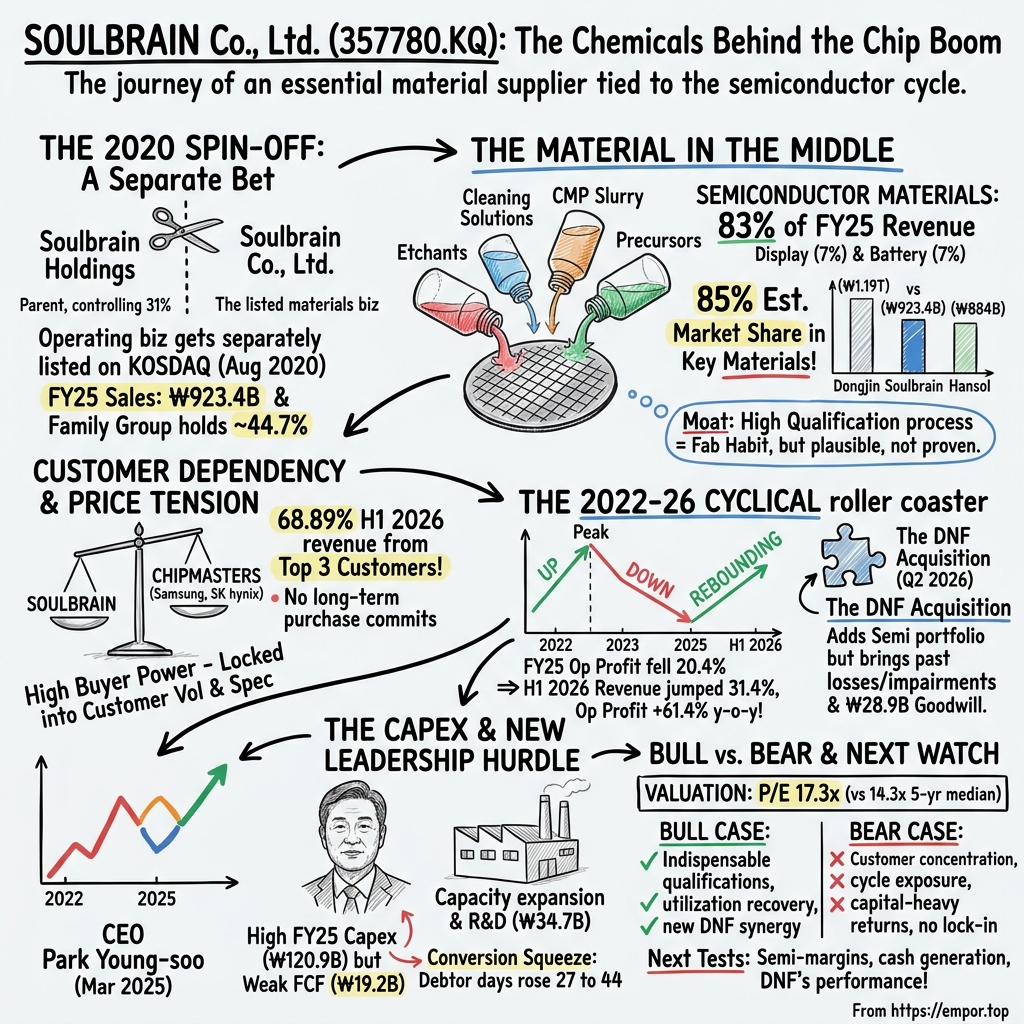
In FY2025 the company booked ₩923.4 billion of consolidated sales, and semiconductor materials made up about 83% of it, roughly ₩767 billion.1 Display materials contributed about 7%, and battery materials and other revenue made up the rest.2 This is, for all practical purposes, a chip-chemicals company with two smaller businesses attached.
The commercial shape of the company is just as concentrated as its product mix. In the first half of 2026, its three largest customers accounted for about 69% of consolidated revenue, and the largest alone for about 41%.3 The half-year filing does not name them, but the annual report names 삼성전자 Samsung Electronics, SK하이닉스 SK hynix, LG디스플레이 LG Display and 삼성SDI Samsung SDI as major customers.2 Anyone who follows Korean industry can guess which name sits behind that 41%.
Here lies the tension at the heart of this story. Soulbrain is essential in use: a fab cannot simply pour in a cheaper bottle of etchant from an unqualified supplier and hope for the best. Yet it is dependent in economics.
It sells as much as its customers consume, at prices it negotiates with buyers many times its size, to specifications those buyers write. Its products sit in the middle of the most important manufacturing process in the Korean economy, and they sit in the middle of its customers' purchasing departments too.
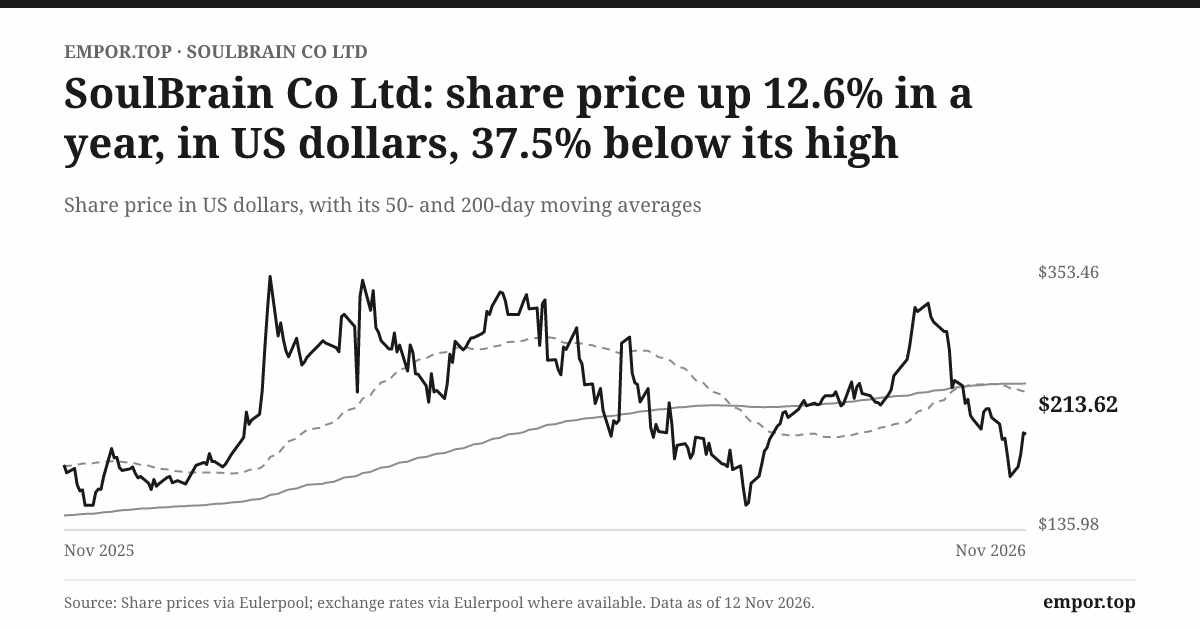
The stock has lived that tension loudly. At the 12 November 2026 close, the shares stood at ₩284,500, about 43% below their 52-week high of ₩501,000, after a year in which volatility ran at nearly 87%.4 The market valued the company at about ₩2.2 trillion. Investors had first priced in a powerful chip upswing, then had second thoughts, and they are still arguing about what kind of company they own.
That argument comes down to three questions. The first is how defensible Soulbrain's position really is with the handful of chipmakers that decide its fortunes. The second is how much of the 2026 rebound is organic, given that the company took control of a sister materials maker, 디엔에프 DNF, in the second quarter and began consolidating its sales.
The third is whether a management team that has been in place for less than two years can turn a heavy investment program, and that acquisition, into returns that reach shareholders as cash.
Before any of those questions can be answered, there is a boundary to draw. Soulbrain Co., Ltd., the listed manufacturer this story is about, is not the same company as 솔브레인홀딩스 Soulbrain Holdings, its controlling parent.3 They share a name, a history and a founding family. They do not share a set of financial statements, and confusing the two leads to bad conclusions about both. The place to begin, then, is the summer the two were pulled apart.
 Subscribe on LinkedIn
II. The Spin-Off That Made the Chemicals a Separate Bet
On 1 July 2020, in the strange first summer of the pandemic, a company that had been both a chemical maker and an owner of other businesses split itself in two.3 The operating materials business, with its plants, its process recipes and its customer qualifications, was carved out into a new entity called Soulbrain Co., Ltd.
What remained became Soulbrain Holdings, a holding company with its own subsidiaries and its own accounts. Five weeks later, on 6 August 2020, the new operating company listed on 코스닥 KOSDAQ.3
It was not an IPO in the usual sense. Nobody stood on a stage ringing a bell over freshly raised capital, and no prospectus courted new investors with a growth story. The listing followed a spin-off, which is a change in what existing shareholders own rather than a sale of new shares to the public.5
Before the split, an investor held one company that mixed a manufacturing business with a holding structure. After it, the same investor held two pieces of paper and could choose which one to keep. The new company began life with 7,778,566 shares in issue, and that count has not changed since.53
The more interesting move came a few months later. In November 2020, the group set out a share-exchange tender offer, under which the holding company invited shareholders of the operating company to swap their shares for Holdings stock.5
It is a well-worn path in Korean corporate structure: split the operating business out, then use a tender offer to consolidate the founding family's control through the parent. The result is visible in today's register. At FY2025 year-end, Soulbrain Holdings owned 31% of the listed company, and it still held 31% in June 2026.3
The control chain above that is short. 정지완 Chung Ji-wan, the founder, held 8% of the listed company directly at June 2026, and he owned 57% of Soulbrain Holdings as of March 2026.3 Counting Holdings, family members and other affiliates, the controlling-holder group owned about 44.7% at mid-2026, slightly down from about 44.9% at the end of FY2025 because two family members sold shares in the market.3
So the listed company is controlled the way many Korean mid-caps are controlled: not by an outright majority, but by a holding-company stake large enough that no other holder comes close. The rest of the register has its own surprises. At FY2025 year-end, Samsung Electronics, the company's best customer, held 5.6% of its shares, and Fidelity Management & Research was reported at 5.8% after a large-holdings filing in February 2026.26 Some 23,904 small shareholders held the remaining 38%.2
For an investor, the spin-off has an awkward consequence: the long financial record is not one continuous story. Figures for 2017 through 2019 describe the pre-split company, which bundled businesses that later went elsewhere.
They are useful for understanding the accumulated base of know-how, but they are not a like-for-like history of the company now trading on KOSDAQ.3 Even 2020 is distorted, because the listed company only existed for half of it. Its FY2020 revenue fell 54% and then appeared to rebound 118% in FY2021, which is an artifact of a half-year stub, not a collapse and a boom.2
That stub year matters more than it looks. Soulbrain's five-year revenue growth, measured from FY2020 to FY2025, works out to about 14.5% a year, while the three-year rate from FY2022 to FY2025 is a decline of about 5.4% a year.2 The longer number looks better largely because it starts from a half-year base. Strip that out and the honest picture of the listed company is shorter and flatter: a strong 2021 and 2022, a downturn, and a recovery that began in late 2024.
What the older history does explain is the moat question that runs through the rest of this story. The founding company spent decades selling process chemicals into Korean fabs, earning qualifications line by line and learning to produce liquids at the purities chipmakers demand. That inheritance came across in the spin-off: the plants, the people and the relationships went with the operating company. The comparable listed-company record starts in 2020, but the customer-qualification base it rests on is older.
The parent is a different business
The second consequence is a discipline of attribution. Soulbrain Holdings has its own businesses, its own acquisitions and its own consolidated revenue, and none of that belongs in an analysis of Soulbrain Co., Ltd.'s economics. Where the two companies meet is in the related-party tables.
In FY2025, the listed company recorded ₩1.4 billion of sales to Holdings, ₩3.1 billion of other income from it and ₩1.8 billion of other purchases, alongside management-support and technical-service agreements whose fees and pricing method the annual report does not quantify.2 Those amounts are small against ₩923 billion of revenue. They matter less for their size than for what they represent: a parent that sits above the listed company, collects some services income from it and controls its board.
The joint liability is the other thread that ties the two together. Under Korean company law, the listed company remains jointly liable with Holdings for debts the pre-split company owed at the time of the spin-off, and that obligation is its principal continuing disclosed contingent liability.3 It has not, on the record, cost anything. It is simply a reminder that a spin-off separates ownership more cleanly than it separates history.
So the spin-off did something genuinely useful. It made the chemicals business investable on its own, with its own share price, its own disclosure and its own capital decisions. It did not make the business independent. The family still controls it from above, and the customers still control it from the other side. The second of those pressures is the more important one, and it starts with a phone call from a fab.
III. Why a Chemical Formula Can Become a Fab Habit
Imagine a process engineer at a memory maker deciding to change one step in a new chip design. Perhaps the layers are getting thinner, or a new material has been added to the stack, and the etchant that has worked for years now removes a little too much, or too little, or leaves behind a residue that shows up as defects at the end of the line. The engineer calls the materials supplier.
What follows is not a sales meeting. It is a months-long process of samples, test wafers, adjustments to the formula, more test wafers and, eventually, a production trial at scale. Only when the customer is convinced that the new chemical will not hurt yield does it become part of the recipe. Once it is in, changing it again means repeating the whole process.
That, in a sentence, is the case for Soulbrain's competitive position. It is worth taking apart slowly, because it is both real and easy to overstate.
Start with the products. The biggest is etchants: liquids that dissolve specific materials off a wafer while leaving others untouched, like a solvent that removes paint from wood without harming the wood. An analyst at 미래에셋증권 Mirae Asset Securities estimated that etchants made up roughly ₩160 billion of the company's first-quarter 2026 sales, by far the largest product line.7 Next come cleaning chemicals, which strip away the debris and residue left by each process step.
Chemical-mechanical planarization slurry, or CMP slurry, is a liquid laced with fine abrasive particles that polishes each layer flat so the next layer can be built on top. A rough analogy is very fine wet sandpaper, chemistry and mechanics working together. Finally there are precursors, chemicals that are vaporized inside deposition tools and react to leave behind ultra-thin films. The same Mirae estimate put first-quarter CMP slurry and precursor sales at around ₩16 billion each.7
These products have one feature in common that matters for the business model: they are consumed. A chemical used to etch a wafer is used up and has to be replaced for the next wafer. That is why semiconductor materials are often described as a recurring business, and why an industry ranking of Korean materials suppliers noted that such chemicals are consumed in every wafer process step.8 The more wafers a customer starts, the more Soulbrain sells. The fewer wafers it starts, the less.
The contracts reinforce the point. Soulbrain receives purchase orders when customers need product, under annual or quarterly price contracts set item by item, which generally renew automatically.2 Payment terms are set contract by contract. The filings disclose no minimum purchase commitments, and they do not say what share of revenue comes from fixed recurring contracts.23
So the revenue is recurring in practice but not guaranteed in form. A customer that has qualified Soulbrain's etchant for a process step will keep ordering it while that step runs, but nothing in the disclosed terms forces it to order a particular volume, and the price is reset at least once a year.
This is the mechanism that makes Soulbrain cyclical. It is not exposed to the price of memory chips directly. It is exposed to how many wafers its customers process, which tends to follow the memory cycle with a lag, and to the price it can negotiate in each renewal, which depends on how hard the customer's purchasing team is being pushed to cut costs.
The case for an edge
Now the edge. There are three concrete reasons to think a qualified supplier is hard to dislodge. The first is qualification itself. Proving that a new chemical works at production scale takes time, engineering attention and test wafers, and a fab that already has a working supplier has little incentive to repeat that work unless the savings are large. The second is the recipe.
Soulbrain's formulations are tuned to customer specifications, which means the know-how is partly embedded in a shared process the supplier and customer developed together. The third is proximity. Chemicals are heavy, some are hazardous, and supply interruptions are expensive, so a supplier with plants near the fabs and engineers who can be on site quickly has a practical advantage over one shipping from abroad.
Purity is the hidden currency in all three. A bottle of industrial-grade acid and a bottle of semiconductor-grade acid can share a chemical formula and look identical on a shelf. The difference lies in what is not in them: trace metals, particles and organic contaminants that, on a transistor measured in nanometers, behave like boulders on a road.
Producing that absence consistently, batch after batch, is a manufacturing discipline rather than a recipe, and it is the sort of know-how that does not transfer easily from one company to another. It is also why customers audit their suppliers' plants and not just their products.
From the customer's side of the table, the calculation is simple. A fab running at full tilt produces wafers worth vastly more than the chemicals that touch them. A supplier change that saved a few percent on an etchant but cost even a fraction of a percent of yield would be a terrible trade. That asymmetry is the core of the switching-cost argument: the customer has little to gain and much to lose by switching an established material in a running process.
The same asymmetry cuts the other way when the process changes. At a new node, nothing is yet established, every material is being qualified fresh, and the customer has every incentive to invite several suppliers to compete. A switching cost protects yesterday's process step. It does not reserve tomorrow's.
Soulbrain's own claim to strength is striking. In its filings it estimates that it holds about 85% of the market in representative semiconductor materials, 40% in display materials and 30% in battery materials, and it has reported the semiconductor figure at 85% from 2023 through the first half of 2026.239 On the face of it, that is the profile of a dominant supplier.
The case against reading too much into it
The fine print matters, though. The company says these are its own estimates for representative products, not market-research figures, and not shares of its entire product range.2 An 85% share of a particular etchant supplied to a particular set of customers is entirely consistent with a much lower share of Korea's overall semiconductor-chemicals spending.
A flat 85% for three years is just as consistent with a stable, well-defended niche as it is with a figure that is simply carried forward from one report to the next. The filings do not provide the evidence that would distinguish the two: they disclose no customer retention rates, no data on whether customers dual-source the same products, no record of lost bids and no realized prices.23
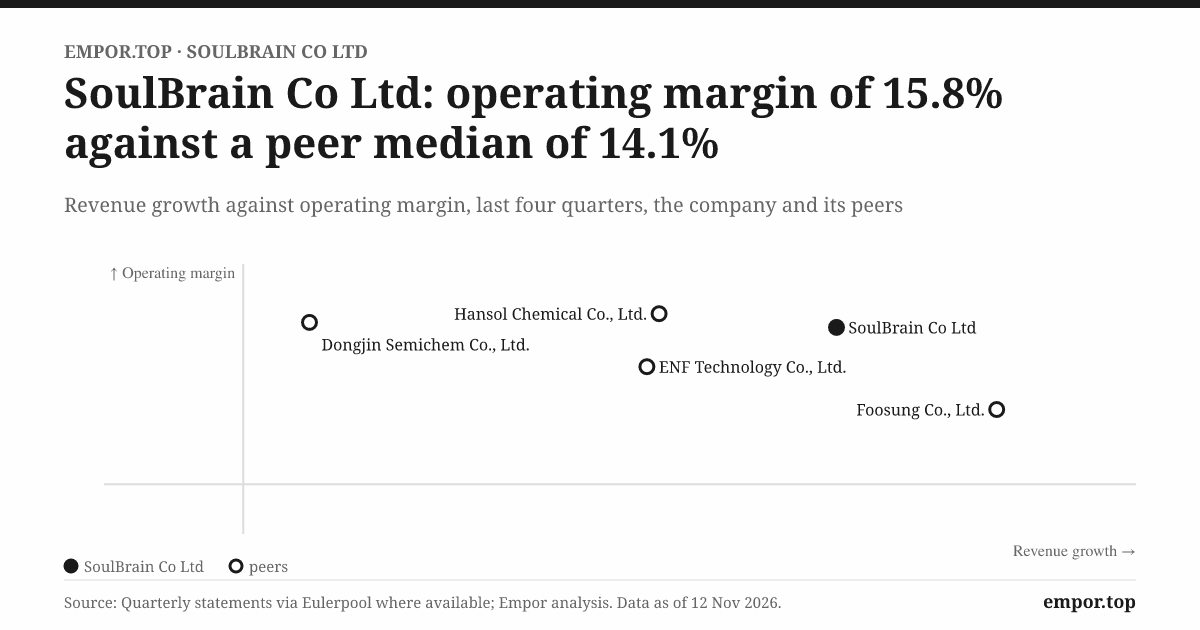
That absence is important because the strongest test of a supplier moat is not market share but price. A supplier with genuine switching costs should be able to hold or raise its margins when its customers are under cost pressure. Soulbrain's record here is mixed at best. Its consolidated operating margin, which reached about 22% in FY2020 and stayed near 18–19% in FY2021–FY2022, fell to 14.4% in FY2025, even though revenue grew that year.2
Korean reporting in mid-2026 described the broader pattern bluntly: the chip boom was lifting orders for materials suppliers while squeezing their margins.10 A supplier that cannot protect its margin in a year of rising sales is telling investors something about where bargaining power sits.
Competitor scale offers a second reality check. By FY2025 consolidated revenue, a ranking of Korean semiconductor materials companies put 엠케이전자 MK Electron first at about ₩1.40 trillion, 동진쎄미켐 Dongjin Semichem second at about ₩1.19 trillion and Soulbrain third at ₩923 billion, with 한솔케미칼 Hansol Chemical close behind at about ₩884 billion.8 Those portfolios differ widely.
MK Electron's business is centered on bonding wire and solder materials, Dongjin is strong in photoresists and other chemicals, and Hansol in hydrogen peroxide and precursors. The comparison that matters is product line by product line, and there the same ranking described 이엔에프테크놀로지 ENF Technology as a head-on competitor in Soulbrain's chemical lines.8 In other words, Soulbrain is a scaled leader in some products, but not a monopolist across the industry, and its biggest customers have domestic alternatives for at least some of what it sells.
Run the industry through Michael Porter's five forces once and the shape becomes clear. Buyer power is the dominant force: a few enormous, technically sophisticated customers who write the specifications, run their own qualification labs and negotiate prices annually or quarterly. Supplier power is moderate; Soulbrain buys raw chemicals and purifies and formulates them, and a commodity input price can swing its margins, as the battery business showed when raw-material prices fell by about 35% in FY2025.2
The threat of new entrants is limited by qualification and purity requirements, and the threat of substitutes comes less from a different product than from a customer changing its process so that a different chemistry is needed. Rivalry is real in overlapping materials, with ENF Technology, Dongjin Semichem and Hansol Chemical all positioned to compete when a customer opens a new process step to tender.
Put together, the forces describe a business with a durable place in its customers' processes and limited power to dictate terms. Qualification may create switching costs, but those switching costs mostly protect volumes in an existing step. They do less to protect price when a contract renews, and they offer no guarantee that Soulbrain will win the next step when the process changes.
The honest verdict, then, is that the moat is plausible but not proven. The record supports a narrower claim than the 85% headline suggests: Soulbrain holds strong, qualified positions in specific products with its major customers, and those positions have survived a downturn without any disclosed customer loss.23 It does not establish pricing power, and the margin record leans against it.
The evidence that would settle the question is specific: new qualification wins in leading-edge processes, semiconductor segment margins that hold up through a full renewal cycle, and any movement in disclosed customer concentration. Mirae's report pointed to one such data point, describing Soulbrain as the exclusive supplier of an acetic-acid-based etchant for Samsung's sub-3-nanometer process, though at about ₩2 billion a quarter it was a toehold rather than a revenue engine.7
That margin record deserves a story of its own, because the years since the spin-off have put this business through a full cycle of feast, famine and recovery.
IV. The 2022 Peak, the Downturn and the Rebound
In 2022, it seemed every fab in Korea was running flat out. The pandemic had sent demand for laptops, servers and phones surging, memory makers were adding capacity, and every wafer they started consumed Soulbrain's chemicals. The listed company's revenue rose again that year, to roughly ₩1.1 trillion, its high-water mark so far.2 Operating margins held around 19%, and return on capital employed was above 25%.2 It was the best version of the business shareholders had seen.
Then the memory market turned. Through 2023, chipmakers cut production to work down inventories of unsold chips, and the effect on suppliers was immediate. Soulbrain's quarterly revenue fell year on year by about 20% in the second quarter of 2023 and by about 32% in the third.2 Full-year FY2023 revenue fell by more than a fifth.2 The company had not lost a customer or a qualification. Its customers had simply started fewer wafers, and a consumable supplier sells by the wafer.
What happened next is more instructive than the downturn itself. Revenue stabilized in 2024 and began growing again in late 2024, yet profitability took a different path. In the first quarter of 2024, operating margin reached nearly 22%, a level that suggested the business had come through the slump in good shape.2
By the second quarter of 2025, it had fallen to about 8.8%, even though revenue was growing again.2 For the full year FY2025, revenue rose 7.0% to ₩923.4 billion, while operating profit fell 20.4% to ₩133.6 billion.1 Management's own summary of the year attributed the decline to margin pressure and higher costs.1
That is the crucial distinction in this story. Sales follow customers' utilization and the volume of materials they consume. Margins follow something else: the prices set in each contract renewal, raw-material costs, the product mix, and the cost of running plants that are not full. In FY2025 those forces moved against Soulbrain at the same time that volume recovered.
Its gross margin for the year was about 25%, and return on equity fell to about 8% from 12% the year before.1 Fixed costs from a growing asset base did not help: the company was still adding plant, its property and equipment rose over the year, and asset turnover fell to the lowest level since the spin-off.2 Display and battery lines ran at low utilization, which meant those factories absorbed overhead without contributing proportional profit.2
Reported net income fell even more, by 33.2% to ₩79.1 billion, because of a ₩29.5 billion impairment on the DNF associate stake, which sat below operating profit.12 That charge is a thread the acquisition chapter will pull on.
The bottom line had already flashed a warning a year earlier. In the fourth quarter of 2024, Soulbrain earned an operating profit yet reported a small net loss, because tax and non-operating charges swallowed everything the factories had made; the effective tax rate for the quarter exceeded 100%.2
The full-year FY2024 figures included the first write-down of the DNF stake, worth ₩44.8 billion.2 A quarter like that is easy to dismiss as accounting noise. It was also the first sign that the company's investments outside its own plants could move reported earnings as much as its customers could.
Tax added its own volatility through 2025. The quarterly effective tax rate swung from about 15% to over 44% within the same year, so net profit moved in ways that had little to do with how many liters of etchant left the plants.2 That is one more reason the operating line, not the net line, is the honest measure of how the business itself performed.
The lesson of 2025 is that a recovery in customer demand is not the same as a recovery in supplier economics. Soulbrain's customers were back to buying, but on terms that left less for the supplier.
The rebound and its asterisk
The first half of 2026 changed the mood. Filed consolidated revenue rose to ₩575.8 billion from ₩438.3 billion a year earlier, an increase of about 31%, and operating profit rose to ₩90.7 billion from ₩56.2 billion, up about 61%.39 On the surface, that is exactly what a bull would want: higher volume, a recovering margin, and operating leverage as the plants fill up.
The surface hides an important change in the base. In the second quarter of 2026, Soulbrain moved DNF from an associate, where only a share of its profit is recorded as a single line, to a subsidiary, where all of its revenue and costs flow into the consolidated accounts.3 So the first half's revenue growth is partly a customer recovery and partly a change in what is being counted.
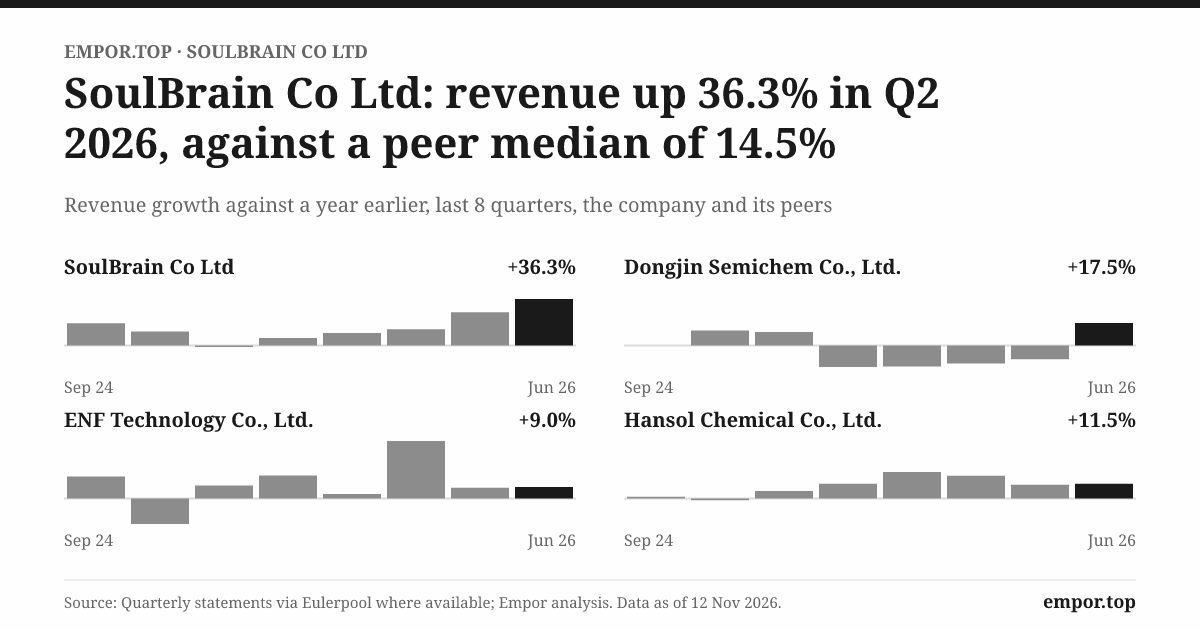
The quarterly figures show how big that effect is. First-quarter 2026 revenue was ₩263.8 billion, with operating profit of ₩44.7 billion, before DNF was consolidated.7 That was already about 26% higher than a year earlier, a genuine organic recovery.7 Second-quarter revenue then jumped to ₩312.0 billion.3 Before the consolidation was reflected, Mirae's analyst had expected second-quarter revenue of about ₩273 billion.7
The roughly ₩39 billion gap between that pre-deal forecast and the filed figure is a reasonable first approximation of DNF's contribution, though it is an inference, not a disclosed figure: analysts' forecasts are not results, and part of the gap could be stronger core demand. Some data services did not immediately reflect the full ₩312.0 billion, so investors comparing series should anchor on the filed number.
Operating profit tells the more sobering part. Subtracting the first quarter from the half-year total, second-quarter operating profit was about ₩46 billion on ₩312 billion of revenue, a margin of about 14.7%, lower than the first quarter's roughly 17%.37 That is consistent with consolidating a business that was losing money at the operating line in FY2025. More revenue came in, but at lower margins.
Net profit grew faster still, because the first half included a ₩17.6 billion gain on the disposal of an associate investment, which pushed net income above what operating results alone would have delivered.3
When an investor moves from significant influence to control, accounting rules generally treat the old stake as if it were sold and bought back at fair value, so a gain of this kind is consistent with the DNF step-up. However it is labelled, it is a one-time accounting gain rather than a recurring source of earnings, and anyone annualizing first-half net income would overstate the run rate.
Who is buying
Customer concentration rose along with revenue: the largest customer's share of consolidated revenue increased to about 41% from about 39% a year earlier.3 A recovery that runs through the same buyers makes the company more dependent on them, not less.
If the anonymized largest customer is, as the FY2025 customer list suggests, Samsung Electronics, then Soulbrain's results are tied closely to Samsung's memory and foundry utilization, including new capacity: Mirae reported that initial shipments to Samsung's Taylor, Texas fab were expected in June 2026.72
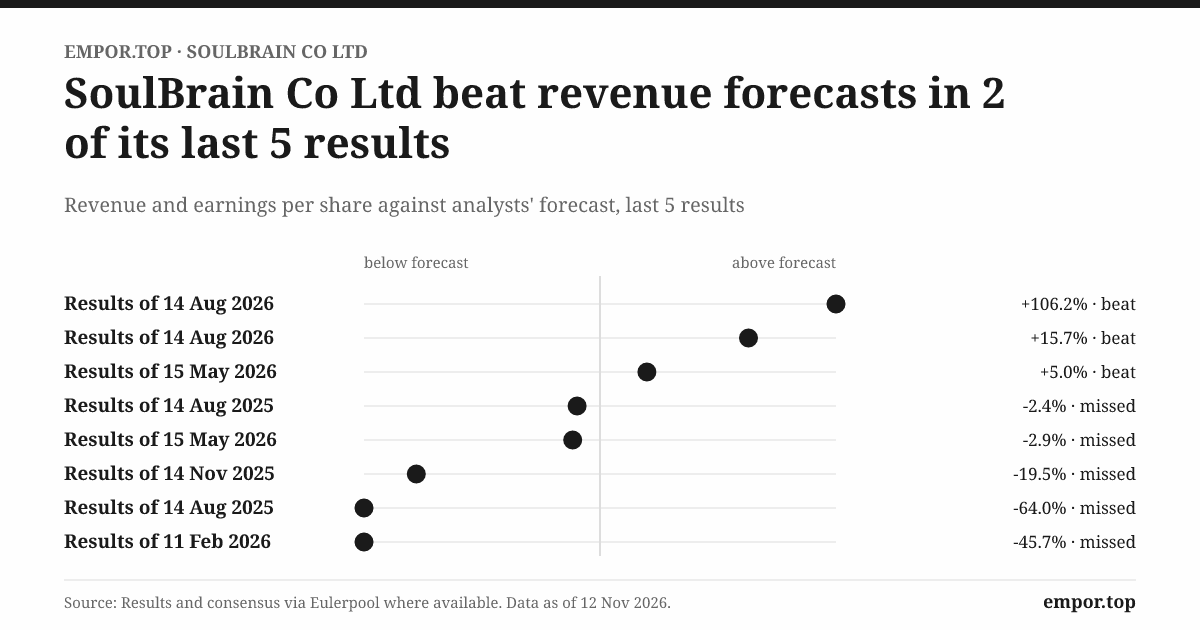
So the recovery is real. Orders were rising before DNF arrived, and the first quarter showed it. But the headline first-half growth mixes that recovery with a consolidation change, and the margin evidence does not yet show a return to the operating profitability of 2021–2022. The third-quarter report, due in mid-November, is the next comparable test of volume, pricing and margins, and it will be the first full quarter with DNF inside the numbers. Until it arrives, analyst forecasts are only that.
Which raises the human question. The person charged with turning this recovery into returns had only recently taken the job.
V. The New CEO Inherits a Factory-Building Strategy
In March 2025, as Soulbrain's margins were heading toward their trough, 박영수 Park Young-soo took over as chief executive, replacing 노환철 Noh Hwan-cheol.211 Park came from the customer side of the table: he was a former executive at a Samsung Electronics technology center, a career spent among the engineers who decide which materials go into which processes.2
It is not hard to see why a materials supplier whose largest customer is Samsung would value that background. A CEO who understands how chipmakers qualify materials, plan process changes and run development schedules can presumably speak the customer's language and anticipate its needs.
That logic is plausible. It is also untested. Park has been in charge for about 20 months, through a single annual report and one strong half-year. That is too short a span to judge guidance discipline, capital allocation or long-run execution. He did not set the strategy he inherited; he inherited a factory-building program already underway.
The program is substantial. In FY2025, consolidated additions to property, plant and equipment were ₩120.9 billion, about 13% of revenue, up from ₩95.5 billion the year before.2 The annual report says that investment went mainly into expanding semiconductor, display and battery production lines, upgrading equipment and building R&D facilities.2
Research spending rose too. In the company's separate accounts, R&D expense increased from ₩26.6 billion in FY2024 to ₩34.7 billion in FY2025, from about 3.4% to 4.4% of separate revenue, and ran at about 4.2% in the first half of 2026.23
The strategic logic for this is linked to what customers need. Each new generation of memory and logic chips adds layers and process steps, and each new step is a qualification opportunity. A supplier that wants to keep its share must have the R&D capacity to develop the next formulation and the plant capacity to supply it at scale. The Samsung Taylor fab is one example: new capacity abroad requires a supplier that can serve it reliably.7
The return hurdle
The difficulty is that the investment arrived just as the cash flow weakened. Operating cash flow fell to ₩146.9 billion in FY2025 from ₩262.3 billion in FY2024, and after capital spending, free cash flow shrank to about $19 million, a small fraction of what the business generated in FY2024.2
In plain terms, almost all of the cash the business generated in FY2025 went straight back into plant. That is not necessarily bad: a company should invest when it sees qualified demand ahead. But it means the payoff has to come later, through higher volumes and better margins, and until it does, shareholders are funding capacity on faith.
The headcount tells a similar story. Soulbrain employed 1,133 people at the end of FY2025 and 1,109 at mid-2026.23 The company is not growing its workforce to match its capex. It is adding equipment and capacity per employee, which raises the stakes on keeping that equipment busy.
There is a history lesson inside the capex line, too. The plant program of 2025 was not the first time this business had built ahead of demand. In 2021 and 2022, when customers were running hard, the company kept adding capacity, and then spent 2023 with revenue down by a fifth and those assets underused.2 Return on capital employed fell from above 25% in FY2022 to about 10% in FY2025, as profits fell and the asset base kept growing.2
That does not prove the latest round of investment is a mistake; materials suppliers have to build before the orders arrive or lose the qualification to someone who did. It does mean the burden of proof is on the new spending, and the measure is simple: whether return on capital climbs back toward the levels of the boom as the new lines fill.
Keep the battery business in proportion. Battery materials made up about 7% of FY2025 revenue.2 In FY2025, selling prices fell by about 3% while raw-material prices fell by about 35%, which shows how much of that business's pricing is tied to input costs, and battery lines ran at low utilization.2 The battery business might recover with electric-vehicle demand, but it is not what drives the company's value, and treating it as a growth engine would be wishful thinking.
The more intriguing option is glass substrates. Chip packaging, especially for AI accelerators, is moving toward glass cores that can be made flatter and more stable than today's organic materials. Soulbrain has long processed thin glass for display customers, which gives it relevant experience in the chemistry of etching glass.
Mirae described several glass-substrate materials in development, including hydrofluoric acid for through-glass vias, copper plating solutions and CMP slurry, with a pilot line scheduled for the third quarter of 2026 and sample shipments from the fourth.7 Those are analyst-reported milestones, not company revenue. A pilot line and samples are steps toward qualification, and qualification is a step toward orders. No one should count the revenue until it appears in a segment line.
The incentives behind the strategy
Pay is one way to see what management is incentivized to do. Park received ₩563 million for FY2025, including a ₩137 million bonus.2 The bonus formula weighs prior-year profit against target, company, team and individual KPIs, revenue growth and operating margin.2 Margin and profit are in the formula, which is encouraging.
Return on capital and cash flow are not explicitly named, which matters for a company spending heavily on plant. The highest-paid executive was executive director 임정훈 Im Jeong-hun, at ₩868 million.2 Aggregate key-management compensation fell to ₩4.9 billion from ₩5.3 billion, a modest decline in a year when operating profit fell by a fifth.2
Park held 500 shares at year-end, about 0.01% of the company.2 That is a token stake. His fortunes are tied to his compensation formula, not to the share price, and the formula rewards growth and margin, not returns on the capital he deploys. That is not unusual for a professional CEO at a family-controlled Korean company, but it means minority investors are relying on the controlling family's oversight more than on management's ownership.
Management's public narrative has been cautious. Its summary of FY2025 attributed lower profit to margin pressure and higher costs and offered only a qualitative outlook: global economic uncertainty in 2026, and a focus on R&D and new technology.1 A year earlier, the mid-2025 results summary promised flexible facility investment based on market and industry trends.9
There were no numeric targets in either, which spares management from the charge of missing guidance but also gives investors little to hold it to. Prepared presentations do not show how management answers tough questions about margins, capex returns or DNF; the public record of analyst Q&A is thin. The credibility test for Park's team will not be in its words but in its numbers: whether the capex added in 2025 shows up as higher margins and cash in 2026 and 2027.
The biggest capital decision of his tenure so far was not a factory. It was taking control of a company Soulbrain had already written down twice.
VI. The Five-Point Move That Turned DNF Into a Subsidiary
DNF is not a stranger to Soulbrain. It is a Korean maker of semiconductor materials, best known for precursors used in deposition, and Soulbrain owned 31.02% of it as an associate, a large but non-controlling stake.312 In the second quarter of 2026, Soulbrain increased that stake to 36.10%, and changes to DNF's board gave it control.3 Five percentage points of ownership, plus the boardroom, converted a passive investment into a consolidated subsidiary.
This is a staged change of control, not a clean takeover. Soulbrain did not pay a premium to buy all of DNF from a seller. It bought a modest additional stake and gained the right to direct the company's decisions. Under accounting rules, that triggers a full purchase-price allocation: the previously held stake is remeasured at fair value, the new stake is added, and the difference between the combined value and DNF's identifiable net assets becomes goodwill.
The acquisition note records ₩82.6 billion of consideration and ₩28.9 billion of goodwill, and states that the fair-value assessment was still in progress at mid-year.3 Those numbers need care. A consideration of ₩82.6 billion for five percentage points of DNF would imply a valuation far above what the market placed on DNF, so it almost certainly includes the fair value of the previously held 31% stake as well as the cash paid for the new shares.
The note does not cleanly separate the two in a way that allows a purchase multiple to be calculated. Until the fair-value assessment is finalized and the components are reconciled, calling the price cheap or expensive would be guesswork.
What can be said is that the bet is consequential relative to what DNF earns. DNF reported FY2025 revenue of ₩79.1 billion and an operating loss of about ₩0.7 billion.12 Its revenue in FY2023 through FY2025 remained below its FY2021–FY2022 levels, so it has not recovered from the memory downturn the way Soulbrain's core business has.12 Adding DNF increases Soulbrain's consolidated revenue by something like a tenth on an annual basis, but it adds very little operating profit, at least not yet.
The record before the bet
The history makes the hurdle higher. In FY2024, Soulbrain recognized a ₩44.8 billion impairment on its DNF associate investment; in FY2025, it recognized another ₩29.5 billion.2 Two consecutive write-downs mean that, by Soulbrain's own accounting, the investment had been worth substantially less than it had paid. Then, rather than exiting, it increased its stake and took control.
There are two ways to read that sequence. The charitable reading is that the impairments reflected the memory downturn and DNF's weak share price, and that Soulbrain saw an opportunity to gain control cheaply at the bottom, consolidate DNF's precursor portfolio with its own and use its customer relationships to lift DNF's utilization.
The skeptical reading is that management doubled down on a weak investment rather than accept a loss, and that consolidation makes the headline numbers bigger while hiding the investment's underperformance inside a larger whole.
The record does not allow a definite judgment. It does set clear expectations for the charitable reading to be true. DNF's operating profit should turn positive and grow, its utilization should rise and it should win new qualifications with Soulbrain's customers. If the companies are truly complementary, there should eventually be evidence of combined product wins or cost savings, and DNF's precursors should benefit from the same process transitions that drive Soulbrain's core materials.
The strategic fit is reasonable on paper. Both companies supply process materials to the same Korean chipmakers. Soulbrain already sells precursors, and DNF's specialty is deposition precursors, so the combination deepens a product category where Soulbrain is smaller.712 Deposition becomes more important with every additional layer in advanced memory and logic, which makes precursors a strategically relevant category. In principle, a materials supplier with a broader portfolio can offer customers a more complete set of qualified solutions.
Fit is not proof, however. Consolidation-driven revenue growth is not evidence of cross-selling. The first-half results show more revenue but a lower second-quarter margin, which is what one would expect from adding a loss-making business, not from realizing synergies.3 And the ₩17.6 billion first-half gain on the disposal of an associate investment, which flattered net income, is part of the same transaction mechanics rather than a sign of operating improvement.3
There is also a governance dimension to the move that deserves a sentence. DNF is a listed company with its own minority shareholders, and control was achieved partly through board changes rather than a full tender.123 That leaves Soulbrain consolidating all of DNF's revenue while owning only a little over a third of its economics.
On the income statement, the other two-thirds of DNF's profit or loss will be attributed to non-controlling interests, so the consolidated revenue line will overstate how much of DNF's business really belongs to Soulbrain's shareholders. Investors who look only at headline revenue will see a bigger company; investors who look at profit attributable to owners will see a much smaller change.
An activist looking at this deal would ask a few pointed questions. Why increase exposure to an investment that had just been impaired twice? What return on the combined investment, including the original stake, does management expect, and over what period?
How will DNF's performance be reported, so that shareholders can see whether it is improving? So far, the public record does not answer them. Soulbrain does not report DNF as a separate segment, and management's public statements have not set out a return target for the deal.
So the DNF move may be a sensible way to build a broader materials portfolio. It is also a larger commitment to a business that has already cost Soulbrain money. The test is DNF's operating return after consolidation: whether it rises enough, over a full cycle, to justify the step-up in control. That test sits alongside a broader one. A company that is spending heavily on plant and on deals has to show that its earnings are turning into cash.
VII. The Cash That Didn't Follow the Earnings
There is a simple way to check whether a manufacturer's earnings are real: follow the cash. Over the nine years from FY2017 through FY2025, spanning both the old company and the new one, Soulbrain's cumulative operating cash flow was about ₩1.6 trillion against cumulative net profit of about ₩960 billion, or roughly 165% conversion.2
That is a healthy record. It suggests that reported earnings have generally been backed by cash, with non-cash charges such as depreciation and timing in working capital explaining the gap. R&D is expensed rather than capitalized, which removes one common way companies flatter profits.2
FY2025 broke the pattern. Operating cash flow fell sharply.2 Part of the decline was taxes: cash taxes paid rose to ₩46.2 billion from ₩24.7 billion.2 Part was working capital, and that part is more revealing.
Slower collections, fuller warehouses
Debtor days, the average number of days it takes customers to pay, rose from 27 in FY2024 to 44 in FY2025.2 Inventory days rose from 54 to 65, and the full cash conversion cycle stretched from about 60 days to 83.2 In plain terms, more of Soulbrain's revenue was sitting in unpaid invoices and more of its production was sitting in warehouses at year-end.
For a company whose customers are among the largest and most creditworthy industrial firms in the world, a jump in debtor days is not a sign of credit risk so much as a sign of who sets the payment terms. Large buyers can choose to pay later, and a supplier that depends on them is not in a strong position to object.
The receivables detail adds a second wrinkle. At FY2025 year-end, gross trade receivables were ₩101.7 billion, of which ₩5.3 billion had been outstanding for more than a year, largely related-party balances.2 Allowances for doubtful receivables fell to ₩13.2 billion from ₩21.1 billion, mainly through a ₩5.7 billion reversal, and the company recorded no write-offs in FY2024 or FY2025.2
Old balances owed by affiliates are not, by themselves, evidence of anything improper. They are, however, the sort of item a minority investor should watch, because cash owed by a related party is cash that the controlling group, rather than the market, decides when to settle.
Over the nine years, free cash flow, operating cash flow less capital spending, totalled about ₩848 billion, and dividends paid amounted to about ₩118 billion, around 14% of it.2 Most of the cash was retained and reinvested, in plant, in investments such as DNF and, in the early years, in the pre-split company's other businesses.
In FY2025, the dividend payout ratio rose to about 22.5% of net profit even as cash flow weakened.2 That is not a large payout, and the dividend yield, at about 0.8% at the November 2026 price, is modest.4 Shareholders have mostly been asked to trust that retained cash earns its keep inside the business.
The balance sheet gives management room. At FY2025 year-end, cash and cash equivalents were ₩247.7 billion, including ₩81.5 billion of short-term deposits, against borrowings of ₩101.2 billion.2 Most of that debt, about ₩85.5 billion, was convertible bonds issued in 2025, which raised ₩91.1 billion in cash across two Korean-won tranches and a Japanese-yen tranche, with 2029 maturities and conversion-price reset provisions.2
The largest non-convertible loan was a ₩14.6 billion facility from Kyoto Bank at about 1%, secured on property and subject to financial covenants.2 NICE D&B rated the company AA in May 2026, unchanged from the two prior years.3 There is no near-term refinancing problem.
Two quieter items sit between operating profit and the bottom line. The first is non-operating income. In FY2025, other income was ₩24.0 billion and financial income ₩12.8 billion, against profit before tax of ₩113.4 billion, so roughly a fifth of pre-tax profit came from outside the core income statement.2 Against that, the same year carried the DNF impairment.2 The two roughly offset, which means FY2025 net profit was shaped heavily by items that had nothing to do with selling chemicals to fabs.
The second is currency. Soulbrain has yen-denominated borrowings, foreign-currency receivables and bank balances, and it reported no derivative hedges in the first half of 2026.3 The company estimated that a 10% move in exchange rates would change profit by about ₩11.5 billion at mid-2026, up from ₩9.3 billion at the end of FY2025.32
In FY2025, foreign-exchange gains and losses scattered across the finance and other-income lines largely cancelled out.2 Exposure of that size is manageable, but it is not hedged, and in a year when the won moves sharply it can add or subtract several percentage points of earnings without any change in the business.
The convertible bonds are worth a second look, though. A company with nearly ₩250 billion of cash raising ₩91 billion through convertibles is choosing cheap, equity-linked funding over spending its own cash. Conversion-price reset provisions mean that, if the share price falls, the bonds can convert into more shares, which can dilute existing shareholders.
In the same year, the company also bought back ₩15.0 billion of its own shares.2 Issuing equity-linked debt and buying back stock in the same year is not contradictory, but it is a form of financial engineering that minority holders should follow closely.
The governance question
The money trail leads to governance. In FY2025, the issuer-level related-party table showed ₩101.7 billion of sales and ₩126.8 billion of inventory purchases, plus ₩5.6 billion of other purchases.2 Inventory purchases from related parties equalled roughly a fifth of the separate company's cost of sales.2
Much of that involves subsidiaries and affiliates, which means it is not external consolidated revenue; it is the internal plumbing of a group. The separate parent-and-affiliate table is the right place to examine pricing and receivables, and the company does not disclose a pricing methodology for those transactions or separately quantify its management-support and technical-service fees.2
None of this, by itself, proves value is being transferred away from minority shareholders. It does justify scrutiny. Soulbrain Holdings owns 31% and controls the board; the CEO owns about 0.01% and is paid on profit, growth and margin; and a meaningful share of inventory flows through affiliates on undisclosed terms.32 The interests of the controlling family and outside shareholders may well be aligned, but the structure does not guarantee it.
One recent decision offers a partial test. On 31 July 2026, the company approved a ₩12 billion trust contract to buy back its own shares, sized at roughly 53,000 shares at the reference price.13 That is an authorization, not a completed purchase.
A trust contract gives a bank the mandate to buy over time; the evidence of execution will be in the later filing that reports the shares actually acquired. Whether those shares are cancelled or held in treasury will be another signal of whose interests the board weighs most.
So the long-run cash record supports the quality of Soulbrain's earnings, but the latest year is a warning. Collections slowed, inventory built, taxes rose and capex absorbed nearly everything that remained. That matters even more because of the price the market is now asking investors to pay.
VIII. Analysis & Bear vs. Bull Case
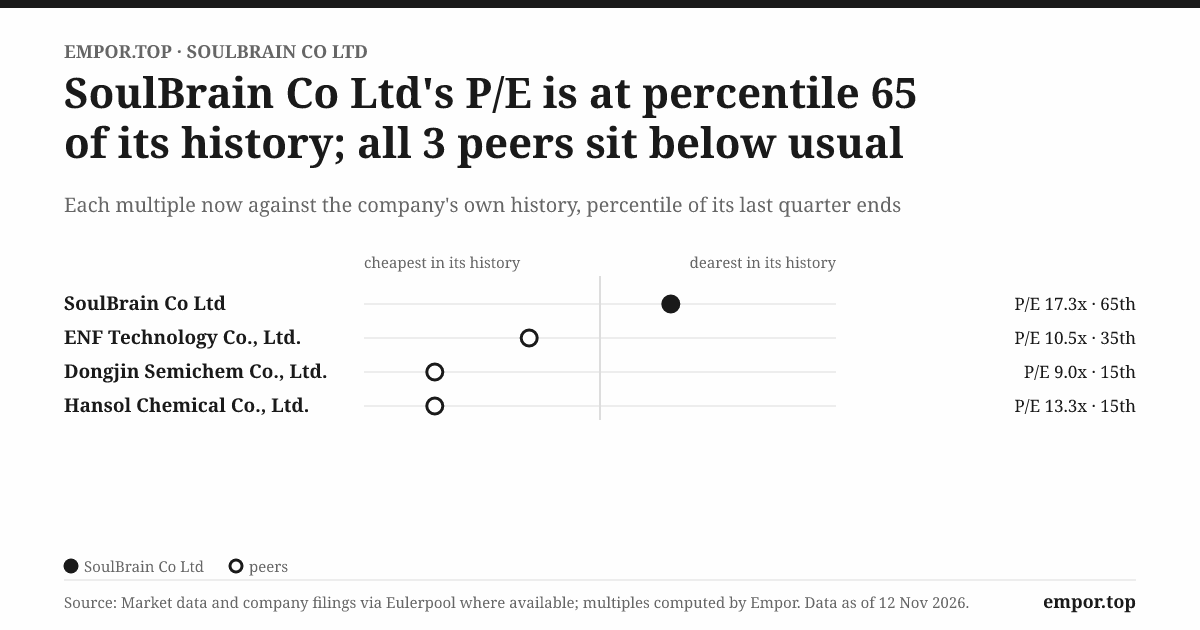
At ₩284,500 on 12 November 2026, Soulbrain traded at about 17.3 times trailing earnings, against a five-year median of about 14.3 times.4 Its enterprise value was about 9.1 times EBITDA and 11.4 times operating profit, and the stock yielded about 5.0% in free cash flow on trailing figures.4 The market, in other words, is paying more than it usually has for each won of Soulbrain's profit, at a time when those profits had fallen in FY2025 and then rebounded with an acquisition attached.
Domestic peers trade lower. Dongjin Semichem was reported at about 10.2 times trailing earnings in mid-October 2026, and Hansol Chemical at about 12 times in early November.1415 Those snapshots come from different providers and dates, and the businesses differ, so they are context rather than a verdict.
Mirae's analyst argued that global materials leaders such as Entegris and Tokyo Ohka Kogyo traded at much higher multiples, in the high 30s, which is the comparison bulls prefer.7 The gap between those two reference points is the market's argument in miniature: is Soulbrain a Korean materials supplier tied to a few customers, or a global-quality specialty chemicals franchise riding the AI cycle?
The bull case begins with mechanism: higher output in high-bandwidth memory and advanced logic, and more complex processes, can increase demand for Soulbrain's materials.
Qualification and on-site technical support may help protect those positions. Semiconductor materials made up 83% of FY2025 revenue, and Soulbrain's own estimates put its representative-product share at about 85% for three straight years.23
Bulls add that Soulbrain has room to invest. With net cash on the FY2025 balance sheet and an AA rating, it can fund capex and deals without stretching itself.23 DNF and glass-substrate materials offer additional growth options.
On this view, 2025 was a margin trough driven by low utilization and pricing pressure, and the first quarter of 2026, with organic growth of about a quarter and margins near 17%, shows what the business looks like when its customers are busy.7
The bear case begins with the buyer: concentrated sales and annual price resets leave Soulbrain exposed to its largest customers.32 Those customers are among the world's most sophisticated buyers of materials: they can dual-source, negotiate prices hard, develop alternative suppliers and change specifications in ways that reset the competitive field. The 85% share figure is a company estimate for representative products, without independent verification or disclosed retention data.2
The record supports the bears' concern about pricing. Operating margin fell from about 19% in FY2022 to 14.4% in FY2025, and return on invested capital fell from almost 30% to about 12% over the same period, even though the company kept investing.2 Free cash flow almost disappeared in FY2025 after capex.2
DNF had two consecutive impairments and an operating loss before Soulbrain took control, and consolidation adds sales before it proves value.212 And a multiple of 17.3 times earnings, above the five-year median, is harder to justify if earnings growth fades when customer utilization normalizes.
A skeptical long-short investor would press on a handful of points that cut across both cases. The first is disclosure. Soulbrain reports its segments by end market but does not publish semiconductor segment margins in a way that lets an outsider see whether the core business is gaining or losing pricing power; the consolidated margin blends in display, battery and now DNF. The second is capital allocation. In a single year the company issued convertible bonds, bought back shares, increased capex by about a quarter and took control of a twice-impaired associate.
Each decision can be defended alone; together they describe a management team busy with the balance sheet at a time when free cash flow was thin.23 The third is the shareholder register: a parent with 31%, a founder with control of that parent, and the company's biggest customer holding more than 5% of its shares.32 Samsung's stake gives the customer a seat in the shareholder base of its own supplier, which may cement the relationship. It also means that one party to Soulbrain's most important price negotiation is a shareholder with interests on both sides of the table.
The risk radar is short but specific. Demand is the obvious one: Korean memory output, particularly the AI-driven ramp in high-bandwidth memory, has pulled materials demand up, and a pause in that investment would hit volumes first. Geography remains a risk as customers build fabs in the United States; Taylor is an early test.7
Input costs and unhedged currency exposure also remain risks.23 Process changes can open the door to rival chemistries.
Weighing the powers
Hamilton Helmer's 7 Powers framework helps sort what is real. Switching costs are Soulbrain's strongest claim: qualification, embedded recipes and on-site support make it costly for a customer to change suppliers for an existing process step. But the evidence that those costs translate into pricing is weak, and they do little to secure the next step. Scale economies are modest: Soulbrain is large for a Korean specialist but smaller than Dongjin Semichem and far smaller than global players.
Process power, the accumulated know-how of producing ultra-pure chemicals consistently, is plausible and is the inheritance that came with the spin-off. Network effects, branding and counter-positioning do not apply in any meaningful way. Cornered resource is the claim implied by an 85% share, but the share is self-estimated and product-specific. The overall picture is one of moderate power concentrated in switching costs and process know-how, offset by the dominant buyer power of a concentrated customer base.
Weighing it all, the record narrows the bull case rather than rejecting it. Soulbrain has a credible operating mechanism for growth, more customer utilization and higher-value process materials, and the first quarter of 2026 showed that it works. But the evidence does not yet prove durable pricing power or the post-acquisition returns needed to justify a premium to the company's own history.
Three numbers will decide which version of this story is right. The first is semiconductor-materials revenue and margin, the core business's ability to hold profitability through renewal cycles; it was ₩767 billion in FY2025 and was growing again in early 2026, while the margin trajectory remains the open question.17 The second is operating cash flow after working-capital movements, including whether debtor days, 44 at the end of FY2025, come back down as sales rise.2
The third is DNF's operating return after consolidation, which began from a loss in FY2025.12 The next disclosures that could falsify the bull case are a further increase in customer concentration without margin gains, debtor days that keep lengthening, segment margins that stall, and a DNF that keeps losing money through a full cycle.
IX. Playbook: Business & Investing Lessons
Go back to the wafer line at three in the morning. The chemical flowing through the pipes is a small part of what a chip costs. It must also work every single time. That combination, cheap relative to the product and critical to its success, is what makes a company like Soulbrain both strong and vulnerable. The lessons it teaches belong to that particular position.
The first lesson is that a qualified product earns a place in the process; it does not write the customer's purchase order. Soulbrain's qualified positions have held through a downturn. Yet its margin fell as sales grew and customer concentration rose.
For founders building a supplier business, the lesson is that being indispensable to the engineer is not the same as being indispensable to the purchasing team. For investors, the evidence of a moat is not a share estimate but the price a supplier still gets when its buyer is under pressure.
The second is that the cycle can make a good supplier look like a growth company, and a weak year can expose the capital bill. In a boom, Soulbrain's revenue and returns made it look like a compounding growth story.
In 2025, spending on plant left free cash flow near zero. The plants did not change; the customers' utilization did. Anyone buying a materials supplier at the top of a cycle is buying the next capex bill along with the earnings.
The third: an adjacent materials company is not a synergy until the returns arrive. Soulbrain's DNF investment may yet prove wise, but its early effects were more revenue, a lower quarterly margin and a one-time accounting gain. A related business in the same supply chain is an option on synergy, not proof of it, and the burden of proof rises with each write-down.
The fourth is that when your best customer is also your shareholder, the relationship is a bond and a leash at once. Samsung Electronics held more than 5% of Soulbrain at the end of FY2025, while the largest anonymized customer supplied about two-fifths of its revenue.23 A stake like that can keep a supplier close to the roadmap and first in line for the next qualification.
It also means the supplier is negotiating prices with a party that sits on both sides of the table. For founders, a strategic investor who is also the biggest buyer is a vote of confidence that comes with a ceiling attached; for investors, it is a reminder to read the shareholder register alongside the customer list.
The fifth: cash is the final process check. In a fab, the last step is inspection, where defects that slipped through earlier finally show up. For a supplier, that step is the cash-flow statement. Soulbrain's long record of cash conversion weakened in FY2025 as working capital and taxes consumed more cash. Earnings can be negotiated, estimated and remeasured. Cash, like a wafer under the inspection microscope, shows what actually happened.
X. Epilogue
On the evening of 13 November 2026, Soulbrain is a company between two reports. Its first half showed a genuine recovery in customer demand, mixed with the arrival of DNF in the consolidated accounts. Its third-quarter report, due within days, will be the first full quarter with DNF inside the numbers, and the first chance to see whether margins continued to improve on a comparable basis or whether the second quarter's dip was the start of a new, lower plateau.
There are three things to watch, and each points to a different answer to the story's central questions. If semiconductor margins hold up or rise while revenue grows, that would be the first real evidence that Soulbrain's qualifications translate into pricing power, and the premium multiple would start to look less stretched. If margins stall while revenue grows, the 2025 lesson repeats: customers are buying more, but on their terms.
The second is cash. If receivables and inventory normalize as sales rise, bringing debtor days back toward the high-20s level of FY2024, the FY2025 cash shortfall will look like a one-off. If debtor days and the cash conversion cycle keep lengthening, the recovery is reaching the income statement but not the bank account, and the capex program becomes harder to justify.
The third is DNF. Its acquired revenue will be visible, but its profit contribution, and the cash Soulbrain invested to gain control, will determine whether the deal was a bargain at the bottom of the cycle or another round of good money after bad. The finalized purchase-price allocation, expected in a later filing, will also clarify what Soulbrain actually paid.
Two smaller signals will round out the picture. The ₩12 billion buyback trust will show, in the filing that reports shares acquired, whether the board follows through on returning capital alongside its spending.13 And the glass-substrate program will need commercial shipments, customer orders or a revenue line before it counts as anything more than an option.
Behind all three sits a fourth question that no single filing will settle: what happens when the cycle turns again. Every materials supplier looks clever when its customers are adding capacity. The real test of whether Soulbrain's 2026 recovery is a durable step up comes in the next slowdown, when customers cut wafer starts and renegotiate prices at the same time.
If the company comes through that period with margins well above the 2025 trough and cash flow intact, the qualification moat will have proven itself where it matters. If it slides back to a single-digit quarterly margin, as it did in the second quarter of 2025, the market will have paid an above-history multiple for a cyclical peak.
The story stays open because the first half's growth still carries the same asterisk: DNF's consolidation. Until the cash and the returns catch up with the headline, the market is being asked to pay for a durable step-up that the record has not yet proved.
XI. Outro
Return, one last time, to the wafer. A colorless liquid washes over it, removes exactly what it should and leaves the rest untouched, and the wafer moves on to the next step. No one at the end of the supply chain will know it was there. Yet without it, the chip would not work.
That tension defines Soulbrain's position: technically embedded in customers' processes, yet economically exposed to them.
References
-
Soulbrain Q4 2025 Earnings Event Summary — Quartr, 2026-03-22 ↩↩↩↩↩↩↩
-
Annual Report 2025 — Soulbrain Co., Ltd., FinancialFilings, 2026-03-16 ↩↩↩↩↩↩↩↩↩↩↩↩↩↩↩↩↩↩↩↩↩↩↩↩↩↩↩↩↩↩↩↩↩↩↩↩↩↩↩↩↩↩↩↩↩↩↩↩↩↩↩↩↩↩↩↩↩↩↩↩↩↩↩↩↩↩↩↩↩↩↩↩↩↩↩↩↩↩↩
-
Semiannual Report (2026.06) — Soulbrain Co., Ltd., Samara, 2026-08-14 ↩↩↩↩↩↩↩↩↩↩↩↩↩↩↩↩↩↩↩↩↩↩↩↩↩↩↩↩↩↩↩↩↩↩↩↩↩↩↩
-
Soulbrain Spin-Off and Share Exchange Tender Offer Filing — Korea Exchange KIND, 2020-11-24 ↩↩↩
-
Report on Large Holdings of Shares — Korea Exchange KIND, 2025-12-11 ↩
-
Soulbrain: New Growth Drivers Emerging — Mirae Asset Securities, 2026-05-26 ↩↩↩↩↩↩↩↩↩↩↩↩↩↩↩
-
Korean Semiconductor Materials Companies Ranking Based on FY2025 Revenue — VLSI Korea, 2026-11-12 ↩↩↩
-
Korea's Chip Boom Lifts Orders but Squeezes Materials Suppliers' Margins — ChosunBiz, 2026-07-13 ↩
-
Soulbrain Shareholding Report — Korea Exchange KIND, 2025-04-22 ↩
-
Soulbrain Treasury Share Trust Contract Decision — Korea Exchange KIND, 2026-07-31 ↩↩
 LinkedIn
 WhatsApp
 Reddit
 Hacker News
 Email
 Kindle
 RSS Feed
 Spotify
 Apple Podcasts
 Amazon Music
 Audible
 YouTube