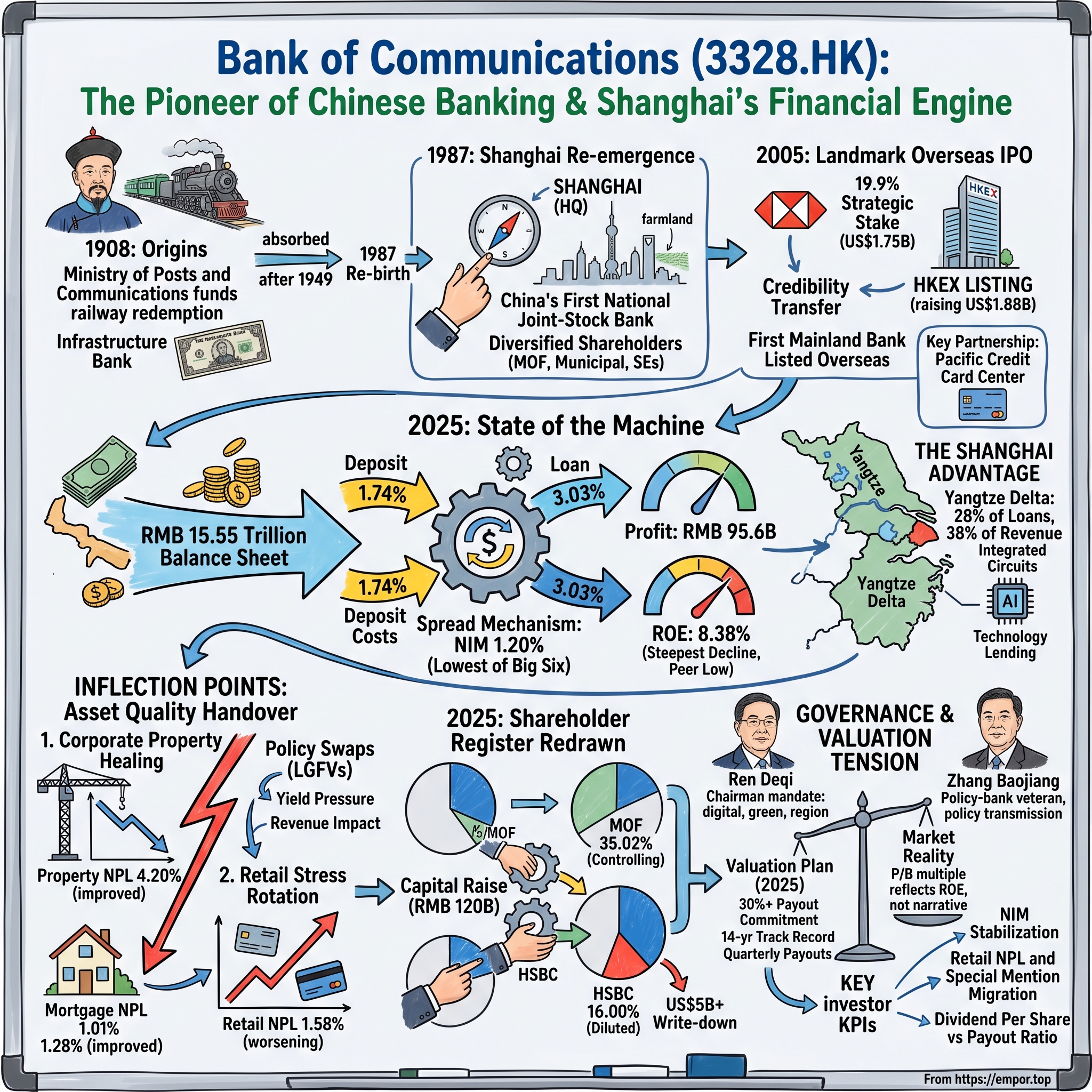
Bank of Communications: The Pioneer of Chinese Banking & Shanghai's Financial Engine
I. Introduction & Episode Roadmap
On the morning of March 27, 2026, 交通银行 Bank of Communications did what it has done every spring for two decades: it published a full-year results announcement and invited the market to admire the steadiness of a RMB 15.55 trillion balance sheet. Revenue had risen 2.02% to RMB 265.071 billion. Net profit attributable to shareholders had risen 2.18% to RMB 95.622 billion. The non-performing loan ratio had improved three basis points to 1.28%.1 For a Chinese state bank in the fourth year of a margin recession, this was a respectable, unremarkable result — exactly the sort of thing a bank with a 118-year history is supposed to produce.
Three days later, the bank published something rather more memorable: an apology.
The profit distribution announcement had contained a single-character error. Where it should have read "RMB 3.247 per ten shares," it read "RMB 3.247 per share" — a one-word slip that, taken literally, promised shareholders roughly RMB 286.9 billion of cash instead of RMB 28.69 billion. The gap was about RMB 258 billion, or roughly two and a half times the bank's entire annual profit. BoCom issued a correction on March 30, apologised, and said it would strengthen its information disclosure review procedures.2
It is a small thing. Nobody lost money. But it is a useful place to begin, because it captures something true about this institution that the polished English-language annual report does not: BoCom is an enormous, systemically vital, deeply competent machine that is also, in ways that matter to minority shareholders, run with the administrative reflexes of a state agency rather than the paranoid precision of a company whose stock price is the scoreboard.
The valuation paradox, corrected
The consensus story about BoCom, repeated in a thousand screener write-ups, goes like this: it is a dirt-cheap state bank trading at three-tenths of book value with a dividend yield somewhere between seven and nine percent — a bond proxy hiding in an equity, waiting to be discovered.
That story was true. It is now substantially out of date, and getting it right is the first analytical task of this episode.
As of late July 2026, the Hong Kong-listed shares changed hands around HK$7.34, giving the H-share line a market value of roughly HK$649 billion, within sight of a 52-week high of HK$7.83 rather than the HK$6.33 low.3 The trailing dividend yield sat near 5.1%, with an annual distribution of about HK$0.38 per share paid in two instalments.4 Price-to-book had drifted up toward the mid-0.4x range. The A-share line had already run 42.16% in 2024 alone.5
So the deep-value re-rating investors were waiting for has, in large part, already happened. Anyone underwriting BoCom today on the basis of a 0.35x book multiple and an 8% yield is underwriting a security that no longer exists. What remains is something more interesting and considerably harder: a bank at roughly half of book value, yielding about five percent, whose earnings grow at two percent a year and whose return on equity is the lowest of China's six largest banks.
That last fact deserves emphasis. BoCom's weighted average return on equity for 2025 was 8.38%, down 0.70 percentage points from 9.08% — the steepest single-year decline among the Big Six, and the lowest absolute level of the group. 农业银行 Agricultural Bank of China managed 10.16% and 建设银行 China Construction Bank 10.04%; 工商银行 ICBC posted 9.45%, 中国银行 Bank of China 8.94%, and 邮储银行 Postal Savings Bank 8.67%.6 Across the whole of China's listed banking sector, only 18 institutions still earned above 10% on equity in 2025, down from 33 in 2021. A discount to book value is not a mispricing when a bank earns 8.4% on equity and its cost of equity is plausibly higher; it is arithmetic. The investment question is not "why is it cheap" but "what changes the return on equity, and who captures the change."
The Shanghai distinction
There is a second correction to make. BoCom is routinely described as China's fifth-largest bank. By assets, at the end of 2025, it was the smallest of the Big Six: RMB 15.55 trillion against ICBC's more than RMB 53 trillion, CCB's and ABC's roughly RMB 45 trillion each, BOC's more than RMB 38 trillion, and Postal Savings Bank's RMB 18.68 trillion.5 BoCom is a giant by any global standard — but within its own peer group it is the runt, roughly 29% the size of ICBC.
What it has instead of scale is geography. BoCom is the only member of the 国有六大行 Big Six state-owned banks headquartered in Shanghai rather than Beijing, and it has spent the last decade converting that accident of 1987 administrative history into an explicit strategy. The evidence is real and quantifiable: at the end of 2025, the 长三角 Yangtze River Delta accounted for RMB 2.48 trillion of loans and advances, or 28.37% of the total, but generated RMB 100.878 billion of operating income — 38.09% of the group, up from 36.69% a year earlier.7 A region holding 28% of the loan book produced 38% of the revenue. That is not a slogan; that is a mix effect, and it is the single most important piece of evidence in the bull case.
The historical pioneer
BoCom's other distinction is that it went first. In 2004, 汇丰控股 HSBC paid roughly US$1.75 billion for 19.9% of the bank — at the time the largest single foreign investment in China's financial sector.8 In June 2005, BoCom listed in Hong Kong, raising US$1.88 billion and becoming the first mainland Chinese commercial bank to list overseas.9 Everything that followed — CCB later that year, BOC and ICBC in 2006 — walked through a door BoCom opened.
Two decades on, that partnership has become one of the more instructive case studies in cross-border accounting. HSBC wrote down US$3.0 billion against the stake in its 2023 results,10 and in 2025 booked a further US$2.1 billion: a US$1.1 billion loss from dilution when BoCom issued new shares, plus a US$1.0 billion impairment when a value-in-use test came in below carrying value.11 The dilution, from the largest state recapitalisation of Chinese banks in a decade, cut HSBC's holding from 19.03% to 16.00% and pushed the Ministry of Finance to 35.02% — figures that make BoCom's ownership structure meaningfully different today than at any point since the IPO.
What this episode covers
From a Qing dynasty ministry bank founded in 1908 to finance railways and telegraph lines,12 through a 1987 rebirth in Shanghai as China's first national joint-stock commercial bank, into the HSBC alliance and the landmark listing, through the credit expansion and shadow-banking era, the property de-risking that followed 三道红线 the Three Red Lines, the local government debt swaps, and into the present: a bank whose corporate loan book is healing while its retail loan book quietly deteriorates, whose headline asset quality improved in 2025 while every underlying retail category got worse, and whose management published a formal plan to raise its own valuation and then watched the price-to-book ratio move the wrong way. That last story — a state bank explicitly held to account by its own minority shareholders — is where the interesting tension lives.
To understand why a bank ended up in Shanghai when every one of its peers sits in Beijing, we have to go back to a railway dispute with Belgian bondholders.
 Subscribe on LinkedIn
II. Qing Dynasty Origins to the 1987 Re-Emergence: The Shanghai Advantage
In 1907, the Qing court had a problem that would be recognisable to any modern finance ministry: a strategic national asset was in foreign hands and the government wanted it back. The Beijing–Hankou Railway, the spine running south from the capital, had been built with Belgian capital and remained under Belgian concessionaire control. Redeeming it required money the treasury did not have and would not easily borrow.
The solution came from 梁士诒 Liang Shiyi, a Cantonese official of formidable political skill who ran what contemporaries called the Communications Clique — the network of men who controlled China's railways, telegraphs, postal service and steamship lines. His proposal was elegant: rather than borrow against the state's own weak credit, create a bank whose specific commercial purpose was to finance the redemption and then to unify funding for the whole transport and communications complex. In 1908, the 34th year of the Guangxu reign, the Ministry of Posts and Communications established the Bank of Communications to do exactly that.12
An infrastructure bank with a printing press
What the Qing created was not a conventional deposit-taking bank. It was a development finance institution with monetary privileges — mixed public and private capital, a mandate to fund steamships, railways, telegraphs and postal facilities, and the right to issue its own banknotes. BoCom became one of the small handful of early Chinese note-issuing banks, a status it retained through the collapse of the dynasty and deep into the Republic.12
Through the Republican decades, BoCom and Bank of China effectively operated as the state's fiscal agents, handling treasury receipts and payments and the issuance and exchange of national currency — central banking functions performed by commercial institutions, because the state had not yet built a central bank capable of doing the job itself. That arrangement ended in 1942, when the Nationalist government stripped note-issuing rights from BoCom, Bank of China and the Farmers Bank and consolidated the monopoly in the Central Bank of China.
Then, for four decades, the story essentially stops. After 1949 BoCom's mainland operations were absorbed into the new socialist banking architecture, and the name survived largely as a Hong Kong presence and a historical artefact. This is worth stating plainly rather than romanticising: the modern BoCom is not a continuously operating 118-year-old enterprise. It is a 1980s institution wearing a Qing dynasty name, and the name was chosen for a reason.
The 1987 decision that still shapes the balance sheet
By the mid-1980s, 改革开放 Reform and Opening-Up had created a specific structural problem. China's banking system consisted of specialised monobanks, each assigned a sector by administrative fiat: ICBC took urban industry and commerce, CCB took construction and fixed investment, ABC took the countryside, BOC took foreign exchange and trade. Each was, in effect, a government department that happened to hold deposits. None of them competed with any other, which meant none of them had any reason to price risk, court customers, or care about efficiency.
The State Council's answer, approved in July 1986, was to resurrect BoCom as something new: a nationwide joint-stock commercial bank, the first in the People's Republic. It reopened for business on April 1, 1987. And in the decision that matters most for this story, its head office was placed in Shanghai rather than Beijing.13
Consider what that meant in 1987. Pudong was farmland and warehouses; 陆家嘴 Lujiazui was not yet a skyline but a policy intention. Putting the country's designated banking reform pilot in Shanghai was a bet that the city would reclaim the financial primacy it had held before 1949, and a signal that the central government intended to build a genuine capital market there. BoCom was, in a real sense, part of the infrastructure of Pudong's development — an institution positioned to grow as the city grew.
The joint-stock structure mattered as much as the address. Where BoCom's peers were wholly state-owned with a single ministerial master, BoCom was built from the start with a diversified shareholder base: the 财政部 Ministry of Finance alongside local state enterprises, Shanghai municipal vehicles, and eventually foreign and public investors. This is the origin of BoCom's genuinely different governance DNA. It has always had a larger population of shareholders whose interests are not identical to the state's, and it has always been the bank where Beijing chose to run experiments it was not yet ready to run at ICBC.
How 1987 shows up in the 2025 accounts
The temptation with a history like this is to treat the Shanghai headquarters as an atmospheric detail. The 2025 numbers argue otherwise.
Beyond the Yangtze Delta revenue concentration already noted, BoCom's regional strategy has become explicitly directional. Loans to the three priority clusters — 京津冀 Beijing-Tianjin-Hebei, the Yangtze River Delta, and 粤港澳 the Greater Bay Area — reached 53.99% of the total book, and management has stated it intends to keep tilting resources toward Shanghai and the Delta.7 In Shanghai itself, general RMB lending grew more than 16% in 2025, which the bank characterised as market-leading.1
The composition of that lending is where the "home field" argument becomes testable. BoCom directed more than RMB 40 billion of cumulative credit into Shanghai's integrated circuit, biopharmaceutical and artificial intelligence sectors, and processed RMB 16.5 trillion of Bond Connect and Swap Connect transactions — a volume that reflects its physical proximity to the mainland's interbank market infrastructure, which sits in Shanghai.14 Group-wide, technology lending reached RMB 1.58 trillion, up 10.73%, with loans to specialised SMEs up 21.02% and to technology-type small enterprises up 36.29%.1
The analytical read: BoCom's Shanghai position is not a moat in the sense of preventing competition — ICBC and CCB lend in Shanghai too, at scale. What it plausibly provides is a mix advantage. A bank whose natural customer base skews toward Delta manufacturing champions, integrated circuit designers and cross-border traders should, other things equal, hold better-quality corporate credit and earn more fee income per unit of loan than a bank whose growth comes from second-tier city infrastructure. The 28%-of-loans, 38%-of-revenue asymmetry is consistent with that claim. What it does not yet demonstrate is durability, because the same period saw BoCom's overall return on equity fall faster than any peer's. A superior regional mix that produces the sector's worst profitability is a mix advantage being consumed by something else — and that something else is the subject of the next several sections.
Before we get to margins, though, there is the matter of how a Shanghai municipal experiment became the test case for whether Chinese banks could be trusted with foreign money at all.
III. The HSBC Strategic Alliance & The Landmark 2005 Overseas IPO
In 2004, the proposition that a Chinese state bank could be a sound investment was not obvious. It was close to contrarian. Non-performing loan ratios across the system were widely believed to be far above reported levels; the government had already spent years carving bad assets out of the big four into dedicated asset management companies. International investors looking at Chinese bank balance sheets tended to assume the equity was notional.
Into that scepticism walked HSBC, a bank whose full legal name — The Hongkong and Shanghai Banking Corporation — was itself a statement about where it believed its future lay.
The bet
HSBC agreed to pay roughly US$1.75 billion for 19.9% of BoCom, the largest single foreign investment in China's financial sector at that point.8 The 19.9% was not arbitrary: it sat just below the 20% regulatory ceiling for a single foreign shareholder, the maximum permitted expression of commitment.
Both sides were solving different problems. HSBC needed a mainland distribution network it could not build organically in any reasonable timeframe. BoCom needed something less tangible and more valuable: credibility. A bank preparing to sell shares to international investors needed a name on its register that those investors already trusted.
What actually got transferred
Strategic partnerships between global and emerging-market banks have a poor historical record — many amounted to expensive equity purchases with a memorandum of understanding attached. The BoCom arrangement was more substantive, and the clearest evidence is the 太平洋信用卡中心 Pacific Credit Card Center, a jointly operated credit card business.
Credit cards are the right place to look because they are the hardest consumer banking product to run well and the least amenable to political direction. A card business requires the bank to make millions of small, unsecured, statistically-driven credit decisions, price for expected loss, manage fraud, run collections, and build a loyalty proposition — capabilities that a lending culture built on state-directed corporate credit simply does not possess. HSBC brought underwriting scorecards, portfolio management discipline, and trade finance protocols. BoCom brought the branches and the customers.
The lesson that generalises: technical knowledge transfer works when it is embedded in a product with its own profit and loss and its own operating cadence, and it fails when it arrives as advice. The card centre gave BoCom a live laboratory where international risk practice had to survive contact with Chinese consumers. Two decades later, that same card book is one of the places where BoCom's retail credit stress shows up most clearly — an irony we will come to.
June 2005: the door opens
BoCom listed on the Hong Kong Stock Exchange on June 23, 2005, raising US$1.88 billion and becoming the first mainland Chinese commercial bank to list overseas.9 An A-share listing in Shanghai followed in 2007.15
It is difficult to overstate the significance for what came next. Before BoCom, no one knew whether a Chinese state bank could satisfy international disclosure standards, survive due diligence by global institutional investors, or clear a listing hearing. Afterwards, the template existed — and CCB, BOC and ICBC used it to raise vastly more, with ICBC's 2006 dual listing standing for years as the largest IPO ever completed. BoCom took the reputational risk of going first and captured a fraction of the proceeds. Being the pioneer is not the same as being the winner.
Two decades later: an accounting problem in slow motion
Here is where the story becomes genuinely instructive, because it illustrates a mechanism most investors never have to think about.
HSBC accounts for BoCom as an associate under the equity method. In plain terms: rather than marking the stake to the traded share price, HSBC records its 16% share of BoCom's profits each year and carries the investment at a book value that grows with those retained profits. For most of two decades this was a very good deal — a steady, large stream of earnings from a bank HSBC did not have to manage.
The problem is that accounting rules require a periodic reality check. HSBC must test whether the carrying value it has accumulated is still recoverable, and it does so using a value-in-use calculation — essentially a discounted cash flow model of the expected future earnings from the stake. That model is sensitive to exactly the variables that turned against Chinese banks: falling interest rates compressing future margins, a property downturn raising expected credit costs, and a slower growth path.
In its 2023 results, HSBC recognised a US$3.0 billion impairment against the stake.10 The traded market price of BoCom shares had been below HSBC's carrying value for years — but market price is not the test under the equity method, which is precisely why the write-down arrived years after the market had already formed its view.
Then 2025 delivered a second, more complex hit. When BoCom issued new shares to the Ministry of Finance and other state entities, HSBC did not participate. Its proportional ownership fell from 19.03% to 16.00%, and because the new shares were issued in a way that did not preserve HSBC's economic position, the accounting produced a US$1.1 billion dilution loss. A June 30, 2025 impairment test then generated a further US$1.0 billion charge, for US$2.1 billion in total.11 HSBC's reported profit before tax for 2025 fell US$2.4 billion to US$29.9 billion, with adverse notable items — the BoCom charges prominent among them — the main driver.11
The analytical takeaways cut in several directions. First, HSBC's cumulative write-downs against this stake now exceed US$5 billion, which tells you that a sophisticated bank with two decades of board-level access concluded its Chinese associate was worth materially less than it had been carrying. That is a data point about BoCom's forward earnings power, not merely about accounting.
Second — and this is the part that matters for BoCom shareholders — the dilution loss was created by a capital raise that BoCom's own management sought and Beijing designed. The recapitalisation strengthened BoCom's core capital, but it did so by issuing equity below book value to the controlling shareholder, transferring value from non-participating holders to participating ones. HSBC absorbed US$1.1 billion of that transfer. Every other minority holder absorbed a proportional share.
Third, it creates a standing question about intent. A shareholder that has written down more than US$5 billion, seen its stake diluted without consultation, and faces its own capital efficiency pressures is not an obviously permanent holder. We will return to this in the stress test.
Which brings us to the balance sheet that all this capital was raised to support — and to the question of what BoCom actually does for a living.
IV. Anatomy of a Big Six Mega-Bank: Segment Economics & Commercial Core
Strip away the history and a bank is a spread business. It buys money from depositors, sells it to borrowers, and keeps the difference. Everything else — the wealth management, the leasing subsidiaries, the Brazilian outpost — is decoration on that central mechanism. So the useful way to open the anatomy of BoCom is with the mechanism itself, because in 2025 it was under a kind of pressure that has no modern precedent in Chinese banking.
BoCom's net interest margin for 2025 was 1.20%.1 That means for every RMB 100 of earning assets, the bank captured RMB 1.20 of net interest income before a single cost or credit loss. It was the lowest margin among the Big Six — below ICBC's 1.23%, well below CCB's 1.34%, and dramatically below Postal Savings Bank's 1.66%.5
The composition explains the squeeze. Average loan yields fell 58 basis points to 3.03%, while average deposit costs fell 38 basis points to 1.74%.1 Assets repriced downward faster than liabilities. This is the arithmetic of a rate-cutting cycle running through a loan book indexed to the Loan Prime Rate: when the LPR falls, existing loans reprice at the reset date whether the bank likes it or not, while deposits — particularly the time deposits that anchor a corporate bank's funding — only reprice as they mature. BoCom's margin held up as well as it did precisely because a wave of expensive time deposits matured and rolled into cheaper ones.
What saved the year was that the margin decline was small: seven basis points, with the quarterly series stabilising in a 1.19%–1.22% band from the second quarter onward.16 Net interest income actually grew 1.91% to RMB 173.075 billion, because the loan book grew faster than the margin shrank.1 Loans reached RMB 9.12 trillion, up 6.64%; deposits RMB 9.31 trillion, up 5.77%.17 That is a bank buying growth to defend revenue — a strategy that works while credit quality holds and stops working immediately when it does not.
The segments, and a rotation worth noticing
BoCom reports four business segments, and the 2025 split reveals a strategic shift that the narrative around the bank has not caught up with.
公司金融业务 Corporate banking generated RMB 132.749 billion, or 50.08% of operating income — up from 48.55% in 2024.18 This is the core: lending to state-owned enterprises, infrastructure, green projects and Delta manufacturing champions, plus the cash management, settlement and trade finance relationships that come with them. It is also where BoCom's institutional advantages are most real. A corporate treasury that runs its payables, receivables, payroll and FX through a bank's systems does not move for 15 basis points; the integration cost is prohibitive. Corporate lending grew RMB 505.5 billion in new loans, up 10.1%.14
个人金融业务 Personal banking generated RMB 96.724 billion, or 36.49% — down sharply from 39.50%.18 Retail assets under management reached RMB 5.98 trillion, up 8.91%,1 so the wealth platform grew. But the credit side shrank: mortgage balances fell 1.65% and credit card balances contracted 1.3%.16
资金业务 Treasury and financial markets generated RMB 34.377 billion, or 12.97% — up from 11.58%.18 Interbank liquidity management, bond trading, foreign exchange, and debt underwriting. Rising treasury contribution in a falling rate environment usually means bond portfolio gains, which is real income but not repeatable income.
Other business contributed RMB 1.221 billion, or 0.46%.18
That rotation deserves interpretation rather than recitation. The consensus story about every Chinese bank for a decade has been "pivot to retail" — higher-margin consumer lending and fee-generating wealth management to escape the commoditised corporate market. BoCom's 2025 numbers show the opposite: retail's revenue share fell three percentage points in a single year while corporate's rose. The bank did not choose this as a strategic preference; it retreated from retail credit because retail credit stopped being safe, and it filled the gap with corporate lending and bond trading. Understanding that inversion is essential, and Section V is where the evidence for it lives.
Meanwhile the cost structure held. The cost-to-income ratio came in near 29%, and return on assets was 0.62%.18 Chinese state banks are genuinely efficient operators by global standards — a Western retail bank running below 30% would be exceptional. BoCom's problem has never been costs. Its problem is that the spread it earns on RMB 15.55 trillion of assets is too thin to generate an attractive return on the equity required to hold them, which is why the recapitalisation happened and why return on equity fell even as profits rose.
Subsidiaries, sized honestly
BoCom's non-bank subsidiaries generate a lot of narrative and comparatively little profit, and it is worth being disciplined about proportion.
交银金融租赁 BoCom Financial Leasing is the group's leasing arm, positioned in aircraft and maritime shipping — capital-intensive, dollar-denominated, long-duration assets. Leasing is genuinely useful to a bank like BoCom: it monetises the same corporate relationships at a wider spread than lending, and shipping and aviation exposure fits a bank whose founding purpose was literally financing steamships. Its standalone results are published separately rather than broken out in the group's headline announcement, and the unit's precise 2025 profit contribution was not separately disclosed in the group results reviewed here.
交银理财 BoCom Wealth Management is the off-balance-sheet asset management subsidiary, and here a widely-circulated figure needs correcting. BoCom Wealth is not among China's largest wealth management subsidiaries. At the end of 2025, five firms had crossed RMB 2 trillion in managed product scale — 招银理财 CMB Wealth at RMB 2.64 trillion, 兴银理财 CIB Wealth at RMB 2.43 trillion, 信银理财 CNCB Wealth at RMB 2.30 trillion, 农银理财 ABC Wealth at RMB 2.15 trillion and 工银理财 ICBC Wealth at RMB 2.09 trillion — and BoCom Wealth was not among them.19 Its 2025 net profit exceeded RMB 1 billion, placing it in a middle tier alongside 浦银理财, 建信理财, 平安理财 and 中邮理财, well behind ABC Wealth's RMB 3.754 billion.20 Across a market where 32 wealth management companies held RMB 30.7 trillion of products,21 BoCom's platform is a solid participant rather than a franchise. Its Schroders joint venture, 施罗德交银理财, reached RMB 34.017 billion, nearly doubling — a real growth rate on a small base.21
The implication is unflattering but important. Wealth management is the most attractive business in Chinese banking: fee-based, capital-light, and structurally advantaged as deposits migrate toward yield. A bank sitting in China's wealthiest region, with the country's densest concentration of high-net-worth households, ought to be a leader in it. BoCom is not. That gap between geographic endowment and competitive outcome is the strongest single argument that the Shanghai advantage is under-exploited — and it is an argument that cuts against management, since the endowment has been available for decades.
交银国际 BOCOM International (3329.HK), the Hong Kong-listed securities and investment banking platform founded in 1998, remained loss-making, though losses narrowed substantially year over year.22 It is economically immaterial to a group earning RMB 95.6 billion, and its main significance is optical: a listed subsidiary that loses money is a standing invitation for shareholders to ask why it exists.
Banco BOCOM BBM is the Brazilian trade-finance and commercial banking arm, acquired to serve China–Latin America trade flows. Strategically coherent, economically small.
What the peer set tells us
Set BoCom against the Big Six and a clear picture emerges. ICBC generated revenue of RMB 838.27 billion and net profit of RMB 368.56 billion; CCB RMB 761.05 billion and RMB 338.91 billion; ABC RMB 725.3 billion; BOC RMB 658.3 billion; PSBC RMB 355.73 billion.5 BoCom's RMB 265.071 billion of revenue makes it roughly a third of ICBC's size on the top line.
Subscale in banking is not a fatal condition — but it is a real one. Technology spending is the clearest illustration: BoCom devoted more than 5% of revenue to financial technology in 2025, deployed AI tools to more than 20,000 employees, cut counter authorisations by 60%, improved international settlement processing by more than 20%, and expanded its intelligent computing capacity by 50%.14 Impressive absolute progress — and yet 5% of RMB 265 billion is roughly RMB 13 billion, against whatever ICBC spends on a base three times larger. In a business where the marginal cost of serving one more customer through a well-built digital channel approaches zero, the bank with the largest technology budget compounds its advantage every year. BoCom must be more focused than its larger peers, because it cannot outspend them.
Which brings us to the part of the story where focus was not enough: the credit cycle.
V. Inflection Points: Shadow Banking, Real Estate Crunch, & Asset Quality
Every bank story eventually becomes a credit story. The revenue line is a matter of pricing and volume; the survival line is a matter of who repays. And in the spring of 2026, BoCom's credit story broke in a direction that almost nobody covering the stock had emphasised.
The headline said improvement. Non-performing loans stood at RMB 116.98 billion, a ratio of 1.28%, down three basis points, with provision coverage rising 6.44 percentage points to 208.38%.17 Read that alone and you would conclude a bank steadily working through its problems.
Now look underneath, and the picture inverts entirely.
The rotation nobody advertised
BoCom's corporate loan book got dramatically better in 2025. The corporate NPL ratio fell 28 basis points to 1.19% — the largest improvement among all six major banks. Corporate real estate NPLs, the epicentre of Chinese credit anxiety since 2021, fell 65 basis points to 4.20%.23 The bank also shrank its corporate property book by roughly RMB 12.4 billion, making it one of only two of the Big Six to improve its property NPL ratio.24
BoCom's retail loan book got materially worse. The retail NPL ratio rose 24 basis points to 1.58%.16 And the category detail is where it becomes uncomfortable:
Residential mortgages — historically the safest asset in Chinese banking, secured by property in a culture with enormous social pressure to keep paying — deteriorated from 0.58% to 1.01% over the course of the year. Personal business loans, extended to small proprietors, went from 1.21% to 1.94%. Consumer and other personal loans went from 1.12% to 1.77%. Credit cards, already the weakest category, rose from 2.34% to 2.68%.25
Mortgage delinquency nearly doubling in twelve months is not a rounding error. It is a signal about household balance sheets, and it was not unique to BoCom: across the Big Six, retail NPL ratios rose between 0.13 and 0.50 percentage points, and the sector's mortgage NPLs generally moved from the 0.6%–0.7% range into the 0.9%–1.1% range.24 Corporate NPLs, meanwhile, improved almost everywhere.
So the honest description of 2025 in Chinese banking is a handover. The property developer crisis that dominated 2021 through 2024 is being resolved — through debt restructuring, state coordination, and write-offs. What replaced it is a household credit cycle: consumers with weaker income growth, small business owners under margin pressure, and homeowners holding assets worth less than they paid.
This reframes BoCom's headline NPL improvement. The number went down because a large, badly-performing corporate property exposure improved from a terrible base while a very large, previously pristine retail book began to crack. The composition of BoCom's credit risk changed more than its level.
How it got here
The road to this point ran through two decades of policy-driven credit.
After 2008, China's response to the global financial crisis was a credit expansion of extraordinary scale, and the Big Six were its transmission mechanism. Infrastructure and property absorbed most of it. When regulators tried to restrain balance sheet growth, the lending migrated off balance sheet — into wealth management products and trust loans that funded the same borrowers through a structure that did not consume capital or count against loan quotas. The saver bought a WMP believing it was a term deposit with a better rate; the money financed a property developer or a local government vehicle; the bank collected a fee and disclosed a contingent relationship. Regulators spent the years from 2017 forcing this activity back onto balance sheets, which is why Chinese bank NPL ratios rose in the late 2010s even as the economy grew.
Then came 三道红线 the Three Red Lines in 2020 — leverage caps on property developers governing debt-to-assets, net-debt-to-equity and cash-to-short-term-debt. The policy worked exactly as intended and produced exactly the consequence one would expect: developers could no longer refinance, and a sector that had run on perpetual rollover discovered what happens when rollover stops. The defaults that followed put every Chinese bank's property book under scrutiny. BoCom's corporate property NPL ratio above 4% even after a 65-basis-point improvement is the residue of that episode — roughly triple the bank's overall ratio, four years into the workout.
The second overhang, 城投债 local government financing vehicles, was handled differently and deserves careful language. LGFVs are entities that provincial and municipal governments created to borrow for infrastructure, carrying implicit rather than explicit state guarantees. Rather than permit defaults, Beijing has orchestrated debt swaps — exchanging expensive short-term LGFV borrowing for cheaper, longer official municipal debt — and guided banks to reduce rates on infrastructure loans.
Investors should be clear-eyed about what this means for a lender. A debt swap that avoids default is a good outcome for reported asset quality and a poor one for reported earnings. The loan does not go bad, so no provision is required; but it is replaced by a lower-yielding, longer-duration asset, so the bank earns less on it for years. BoCom's compressing loan yield is partly the mathematical consequence of this policy. The credit risk did not disappear — it was converted into margin risk. That is a favourable trade for financial stability and an unfavourable one for shareholders, and it is one of the cleanest examples of the policy-versus-commercial tension that defines a Chinese state bank.
The live version: what management said, and what analysts asked
Earnings calls are where a narrative meets resistance, and BoCom's recent briefings show management being reasonably candid on margins and noticeably less specific on returns.
At the interim results briefing on August 29, 2025, Vice President 周万阜 Zhou Wanfu addressed the margin question directly. First-half NIM was 1.21%, and his formulation was that further downward pressure remained but the pace of decline would gradually narrow. He laid out three specific levers: strengthen the customer base, optimise the balance sheet by raising the share of low-cost deposits and reducing low-yielding assets, and refine pricing management while adhering to the industry's self-regulatory pricing mechanisms.26
Judge that against what followed. Full-year NIM came in at 1.20% — down one basis point from the interim level, consistent with "the decline narrows." First-quarter 2026 NIM then rose three basis points to 1.23%.27 On this specific, falsifiable claim, management guided accurately. That is worth crediting, particularly since the mechanism they named — maturing time deposits repricing lower — was the actual driver.
The April 2026 briefing, held after first-quarter results were released on April 29, went less comfortably. Zhou and Board Secretary 何兆斌 He Zhaobin fielded questions on the second-quarter project pipeline, to which Zhou said reserves remained steady and the bank would advance credit deployment to maintain year-over-year growth. On asset quality, with the NPL ratio at 1.30%, management pledged to keep quality stable through the year via enhanced collection and dynamic risk management.28
The sharper exchange was about the stock. Investors pressed on why the price-to-book ratio had declined against the bank's own 2025 targets, and asked about retail credit recovery and dividend sustainability. On return on equity, Zhou acknowledged that sector ROE had fallen since 2022 because of capital consumption and margin compression, said BoCom was following industry trends, and committed to persistent valuation management measures.28
That answer is worth pausing on, because of what it is not. It is an accurate description of an industry-wide phenomenon offered in response to a question about company-specific underperformance. BoCom did not merely follow the industry trend on ROE — it posted the steepest decline in its peer group and the lowest absolute level.6 "We are following industry trends" is true and incomplete. When a bank's chosen metric moves against it and the explanation is the sector rather than the strategy, a sceptical investor should note the absence of a specific plan, and should keep asking.
Meanwhile the first-quarter data carried its own warning. Net profit rose 3.11% to RMB 26.16 billion and net operating income rose 4.89% to RMB 69.69 billion, with net interest income up 7.21% to RMB 45.67 billion — genuinely the best revenue momentum in several years.27 But the NPL ratio ticked up to 1.30%, its first increase in five years; provision coverage fell to 202.80%; and credit impairment losses rose 12.41%.29 Basic earnings per share fell 11.76% to RMB 0.30, because the profit was now spread across the enlarged share count from the recapitalisation.29
That combination — accelerating revenue, rising credit costs, falling per-share earnings, thinning provision buffer — is the honest summary of where BoCom stands. The margin problem is stabilising. The credit problem is rotating rather than resolving. And the buffer being drawn down to absorb it is finite.
Which raises the question of who is making these decisions, and to whom they answer.
VI. Current Management, Governance, & Strategic Execution
In September 2025, BoCom's board elected 任德奇 Ren Deqi as chairman of its eleventh board of directors — a renewal of a mandate he had first taken up in January 2020.30 Six years is a long tenure for a Chinese state bank chairman, and it makes Ren the most consequential figure in the modern history of this institution. It also makes him accountable for it.
The risk manager who became chairman
Ren graduated from 清华大学 Tsinghua University in July 1988 — the country's premier engineering school, and the training shows in how he runs the bank. He then spent the first and longest phase of his career at China Construction Bank, moving through the machinery of credit control: deputy general manager of the credit approval department, general manager of the risk monitoring department, general manager of the credit management department, and from 2003 to 2014 president of CCB's Hubei provincial branch.31
That sequence is the key to reading him. Ren spent the formative part of his career on the defensive side of a bank, during the period when Chinese banks were learning, painfully, what credit risk actually costs. He sat in credit and risk roles while the post-2008 credit expansion was building the exposures that would trouble the system for the next decade.
In July 2014 he moved to Bank of China as vice president, and from September 2016 concurrently served as president of BOC's Shanghai RMB Trading Business Headquarters — an assignment that put him at the centre of interbank market operations and currency internationalisation policy, in the city he would later run a bank from.31 He joined BoCom in June 2018 as deputy party secretary, vice chairman and president, becoming the fifth chairman since the Hong Kong listing when he was elevated in 2020.15
Ren's public agenda has been consistent: digital transformation, 绿色金融 green finance, and the Yangtze Delta regional strategy. And unlike a great deal of state bank rhetoric, that agenda has traceable outputs. Green loans reached RMB 950.825 billion, up 14.16%; inclusive finance loans to small and micro enterprises reached RMB 910.05 billion, up 20.76%; agricultural loans rose 11.99%; digital economy loans reached RMB 319.32 billion, up 14.46%.1 The technology spending and AI deployment described earlier are his programme too, and management has framed Shanghai focus and AI integration as the strategic priorities for the 十五五 15th Five-Year Plan period.14
The fair assessment of Ren is that he has been an effective operator of a difficult franchise and a disciplined risk manager — corporate asset quality improving faster than any peer's is his most defensible achievement. The fair criticism is that six years of consistent strategy have produced the sector's lowest return on equity, an under-scaled wealth management franchise in the country's wealthiest region, and a share count expanded by dilutive issuance. Consistency of narrative is a virtue when the narrative is working.
The president from the policy bank
张宝江 Zhang Baojiang, appointed president on June 4, 2024 with regulatory approval following on June 27, brings a different résumé, and the difference is informative.32
Born in 1970, Zhang took a bachelor's in science from 北京师范大学 Beijing Normal University in 1993, then a master's in economics in 1998 and a doctorate in 2004 from the Central Party School's graduate institute. His career was made almost entirely at 中国农业发展银行 the Agricultural Development Bank of China — the policy bank that funds grain procurement and rural infrastructure. He served in ADBC's policy research office and general office, as deputy head of the Shaanxi branch, director of the head office general office, president of the Anhui branch from 2019, and was approved as an ADBC vice president in September 2022.33
Consider what that background is and is not. ADBC is not a commercial bank. It does not compete for deposits, optimise net interest margin, or answer to minority shareholders. It executes state policy with state funding. Zhang's expertise is in the machinery of policy credit, rural and inclusive finance, and the political economy of directed lending — and his doctorate from the Party School is a credential in exactly that domain.
Appointing such a person president of the most commercially-oriented of the Big Six, at a moment when the central strategic question is how to defend commercial returns against policy-driven margin compression, is a choice that says something. The optimistic reading is that a policy-bank veteran can execute national mandates efficiently while protecting the commercial core, and that his risk discipline suits a household credit downturn. The sceptical reading is that the appointment signals the state's priorities for BoCom lean toward policy transmission rather than return maximisation — which is precisely the tension a minority shareholder is exposed to.
One further personnel note carries a governance question. In late February 2026, BoCom's Chief Risk Officer 刘建军 Liu Jianjun additionally assumed the role of Chief Compliance Officer.34 Combining risk and compliance under one executive is common in Chinese banking and reduces coordination friction. It also concentrates two control functions that exist partly to check each other in a single pair of hands, at a bank whose retail credit quality is deteriorating. Not alarming; worth watching.
Ownership after the recapitalisation
BoCom's shareholder register was redrawn in 2025, and the numbers most commonly quoted are now wrong.
The board approved the plan on March 30, 2025: up to 13.777 billion new A-shares to raise RMB 120 billion, subscribed by the Ministry of Finance, 中国烟草总公司 China National Tobacco Corporation, and Shuangwei Investment.35 It was part of a coordinated state recapitalisation in which four major banks sought up to RMB 520 billion combined, with the MOF subscribing RMB 500 billion across the programme.35 BoCom's placement completed on June 17, 2025, issuing about 14.1 billion shares for net proceeds of RMB 119.9 billion.36
The result: the Ministry of Finance rose to 35.02% and became unambiguously the controlling shareholder, while HSBC fell to 16.00%.36 The National Social Security Fund held combined shares of about 13.75%, and China Tobacco entities appear across the top-ten register.18
The strategic consequence is straightforward and important. BoCom was founded in 1987 specifically as the bank with a diversified shareholder base — the counterweight to the wholly state-owned monobanks. In 2025 it moved decisively back toward central state control. The bank whose founding purpose was to be less state-dominated than its peers is now more state-dominated than it has been since before its IPO.
The capital effect was real: CET1 rose 1.19 percentage points to 11.43%.1 For a systemically important bank facing a household credit downturn, that buffer has genuine value. But the cost was borne by existing holders. New equity issued below book value at a bank earning 8.4% on equity is, mechanically, value-destructive per share — which is exactly why earnings per share fell almost 12% while net profit rose. Investors were handed a stronger, safer bank and a smaller claim on it.
The dividend, and the credibility of the promise
BoCom's dividend record is the strongest item in its governance case. The 2025 distribution totalled RMB 28.692 billion, a payout ratio of 32.3%1 — above 30% for the fourteenth consecutive year.23 The final dividend was RMB 1.684 per ten shares, bringing the full year to RMB 3.247 per ten shares.17 Distributions now come twice yearly rather than annually.4
Fourteen unbroken years through a property crisis, a margin collapse and a pandemic is a genuine track record. And in March 2025, responding to the securities regulator's November 2024 Guideline No. 10 on market capitalisation management, BoCom went further and published a formal valuation enhancement plan committing to distribute no less than 30% of net profit attributable to shareholders in cash for each year from 2025 through 2027, with multiple distributions per year where appropriate.37
Here is where an independent assessment has to be blunt. BoCom published a plan whose explicit purpose was to lift a share price trading below net asset value. It delivered on the mechanical commitments — the payout ratio, the semi-annual cadence. It did not deliver on the objective. At the April 2026 briefing, investors put precisely that to management: the price-to-book ratio had gone the wrong way relative to the 2025 targets.28 The A-shares had risen 42.16% in 2024 and still sat below the bank's 2023 net asset value per share of RMB 12.3.37
That is a specific, documented instance of management setting a target, being held to it by shareholders, and responding with an industry-level explanation. The plan's design is the reason. Every lever in it — higher payout, better disclosure, more investor communication, improved asset quality — addresses the numerator of shareholder return or the quality of the story. None of them addresses the denominator problem, which is that a bank earning 8.4% on equity will trade below book value almost regardless of how well it communicates. Dividend policy cannot fix a returns problem. Only a higher return on equity, or less equity, can.
Which sets up the central argument of this story.
VII. The Investment-Story Spine & Skeptical Stress Test: Bull vs. Bear Case
The case for and against BoCom comes down to a single question: is this a structurally advantaged regional franchise temporarily suppressed by a rate cycle, or a subscale state utility whose geographic endowment is being steadily consumed by policy obligations? The evidence supports both readings, which is why the stock sits at roughly half of book value rather than a quarter or a full multiple.
The bull case: the Delta franchise and the yield anchor
First, the regional mix advantage is documented rather than asserted. The Yangtze Delta generating 38% of revenue from 28% of loans is a real, measurable asymmetry, and it widened in 2025 rather than narrowing. The mechanism is credible: China's most productive region contains its best corporate credits, its densest concentration of exporters and advanced manufacturers, and its wealthiest households. A bank structurally overweight that region should hold better credit than one overweight declining industrial provinces, and the corporate NPL improvement — the largest of the Big Six — is consistent with the claim.
Second, the credit quality evidence on the corporate book is genuine. The property workout is visibly advancing: a 65-basis-point improvement in property NPLs alongside a shrinking exposure means BoCom is resolving rather than merely reclassifying. That distinction matters, and BoCom being one of only two of the Big Six to improve its property ratio is a meaningful relative datapoint.
Third, the deposit franchise and the sovereign backstop are real. RMB 9.31 trillion of deposits funding RMB 9.12 trillion of loans is a loan-to-deposit ratio under 100% — BoCom funds itself from customer deposits rather than wholesale markets. In a banking crisis, funding structure determines who survives, and a state-controlled bank with a 35% Ministry of Finance shareholder and deposit funding has minimal run risk. The 2025 recapitalisation demonstrated the backstop is not theoretical: when the largest banks needed capital, the sovereign provided it within months.
Fourth, the margin trough may be behind it. The first quarter of 2026 delivered a three-basis-point margin expansion and 7.21% net interest income growth. If deposit costs continue repricing downward faster than loan yields — the mechanical consequence of earlier deposit rate cuts flowing through a maturing time deposit book — then revenue growth accelerates from a depressed base.
The bear case: the returns problem
First, margin compression is policy, not cycle. This is the most important bear argument. BoCom's loan yield fell 58 basis points in a single year, and a meaningful share of that reflects state-guided pricing: LPR cuts, mandated rate reductions on LGFV and infrastructure loans, and directed low-cost lending into inclusive finance, technology and green sectors. Those mandates are not going away — they are the reason a state bank exists. A commercial bank facing margin pressure repositions toward higher-yielding lending. A policy bank is instructed to lend more cheaply to priority sectors. BoCom is both, and the second identity constrains the first. It already runs the thinnest margin of the Big Six, which means it has the least room left.
Second, retail credit deterioration is early, not late. The mortgage NPL doubling and personal business loan deterioration described earlier represent the first year of a household credit cycle, and household cycles are long. BoCom's response — shrinking mortgage and card balances — protects future asset quality but surrenders the highest-yielding assets it owns, which worsens the margin problem it is simultaneously trying to solve. Provision coverage falling toward 202% while impairment charges rise 12.41% shows the buffer being consumed. It cannot be consumed indefinitely.
Third, subscale in a scale business. Being a third of ICBC's size in an industry where technology, funding costs and compliance all reward scale is a structural handicap, and it compounds. BoCom's inability to build a top-five wealth management franchise despite an ideal geographic starting position is the concrete evidence that the handicap binds.
Fourth, the returns arithmetic. An 8.38% ROE, falling, lowest in the peer group. Two percent earnings growth. A share count that just grew by roughly 14 billion shares. There is no path to a book-value multiple from these inputs; the multiple follows the return.
Stress test one: will HSBC stay?
A sceptical investor's sharpest question concerns the 16% shareholder.
The bear argument is strong. HSBC has written down more than US$5 billion against this holding across 2023 and 2025. It absorbed a US$1.1 billion dilution loss from a capital raise it had no ability to influence. It holds a large minority stake conferring no control, in a bank whose controlling shareholder is a foreign finance ministry, generating equity-method earnings that its own value-in-use models keep marking lower. Under UK and Hong Kong capital rules, a significant investment in a financial institution is an expensive thing to hold. And HSBC has spent recent years aggressively simplifying its portfolio and returning capital via buybacks — a strategic posture in obvious tension with holding a US$20 billion-scale illiquid minority position in a Chinese state bank.
The counter is that the stake is close to un-sellable at anything near carrying value. A 16% block in a bank trading below book would require a buyer with strategic patience and Beijing's blessing, and selling would crystallise losses HSBC has so far only recognised through impairment. HSBC also continues to renew its commercial arrangements with BoCom, including interbank transaction frameworks, which suggests the relationship retains operating value. The most likely path is continued holding with periodic impairment — but investors should treat an eventual disposal as a live overhang rather than a remote scenario, since a block sale of that size would pressure the shares regardless of BoCom's fundamentals.
Stress test two: can the dividend survive?
The bull case leans heavily on the distribution, so it deserves rigorous testing.
The good news: the payout ratio of 32.3% is not stretched. A bank paying out a third of earnings retains two-thirds to fund growth and absorb losses, and BoCom's CET1 at 11.43% sits comfortably above requirements after the recapitalisation. Straightforward margin compression alone is unlikely to break the dividend.
The subtler risk is that the dividend per share and the payout ratio are different promises. The commitment is to distribute at least 30% of net profit — a ratio, not an amount. Net profit grows about 2% a year while the share count just expanded materially. Holding the ratio constant while the denominator grows means dividend per share can stagnate or fall even as management keeps its word perfectly. That is precisely what a 11.76% first-quarter EPS decline implies. Investors underwriting a yield should understand they are underwriting a percentage of a slowly-growing profit pool divided among more shares — not a fixed cash amount.
The genuine threat is credit, not margin. If retail deterioration accelerates and provision coverage keeps falling, impairment charges rise, net profit falls, and 30% of a smaller number is a smaller dividend. The dividend is safe from the margin cycle. It is exposed to the household credit cycle.
Stress test three: commercial return versus policy burden
The deepest issue is unresolvable, and honesty requires saying so.
BoCom is instructed to lend to technology SMEs, green projects, inclusive finance borrowers and agricultural clients at growth rates two to ten times its overall loan growth — and those are, by construction, borrowers who either cannot pay commercial rates or cannot bear commercial pricing for the risk they carry. Simultaneously, management is asked by minority shareholders to raise return on equity and close a price-to-book discount. These objectives conflict directly. The Ministry of Finance at 35.02% has interests that include financial stability, industrial policy transmission and employment, of which shareholder return is one input rather than the objective.
An activist's charge sheet would read: an under-earning core franchise; a wealth management subsidiary that has failed to exploit the best geography in China; a loss-making listed securities arm of no economic consequence; a Brazilian bank of unclear strategic value; equity issued below book value to the controlling shareholder; a published valuation plan that missed its own objective with an industry-trend explanation; and a dividend announcement requiring a correction three days later. None of these individually is severe. Collectively they describe an institution where minority shareholder value is a consideration rather than the organising principle.
The counter — and it is a real one — is that this is precisely what BoCom is, and the price partly reflects it. Nobody buying a Chinese state bank at half of book value should be surprised to find state priorities inside it. The question is whether the discount adequately compensates, and that depends on whether the Delta mix advantage can lift returns faster than policy obligations suppress them. On 2025 evidence, it did not: the mix improved and the return on equity fell anyway.
Let us formalise that competitive position.
VIII. Strategic Frameworks: Porter's 5 Forces, 7 Powers, & Business Playbook
Frameworks are most useful when they produce a conclusion the narrative has not already given away. Applied to BoCom, they produce a specific and slightly uncomfortable one: this is an industry with superb structural defences against outsiders and brutal internal dynamics, where the regulator — not the customer or the competitor — sets the profit pool.
Porter's Five Forces
Threat of new entrants: very low. Constructing a competitor to BoCom would require a national banking licence, tens of billions of dollars of regulatory capital, a branch and payments infrastructure, and Beijing's political consent. China has not licensed a new national commercial bank of this type in a generation. Even the internet giants that plausibly could have built one were confined to narrow licences and then constrained further after 2020. This force is essentially inactive — and it is the primary reason BoCom's franchise is durable regardless of its returns.
Bargaining power of corporate borrowers: high, and rising. A large state-owned enterprise or Delta manufacturing champion can invite all six major banks to price the same facility, and each will bid because loan growth targets must be met. Creditworthy corporate borrowers in China are a scarce resource competed for by lenders with more deposits than good assets. BoCom's 58-basis-point loan yield decline is this force made visible. Its high-quality Delta customer base is an advantage in credit terms and a disadvantage in pricing terms — the best borrowers command the finest pricing.
Bargaining power of depositors: moderate, and asymmetric. Retail depositors have little individual leverage and regulated rate ceilings limit price competition — which is why deposit costs fell 38 basis points, a genuine benefit. But depositors have an exit: they can move into wealth management products, money market funds and insurance. BoCom's own retail AUM growth of 8.91% partly represents deposits migrating to higher-yielding products, some of which the bank captures at a fee and some of which leaves. The power is not in negotiating rates; it is in reallocating.
Threat of substitutes: moderate to high. 蚂蚁集团 Ant Group's money market platforms taught hundreds of millions of Chinese savers that a deposit is a choice rather than a default, and 腾讯 Tencent's payment and wealth distribution rails did the same for transactions. Post-2020 regulatory tightening capped these platforms' balance sheet ambitions but did not reverse the behavioural change. For payments and savings allocation, substitution is real. For corporate credit, trade settlement and cross-border services, it is negligible — no fintech is underwriting a shipping fleet.
Competitive rivalry: intense. Six state banks with overlapping mandates and similar cost structures compete for the same borrowers under regulator-set price ceilings, alongside joint-stock banks like 招商银行 China Merchants Bank that consistently out-earn them on retail and wealth management. Because banks cannot differentiate much on regulated price and struggle to differentiate on product, competition expresses itself as volume growth and margin sacrifice — the defining dynamic of the current cycle. BoCom, as the smallest, has the least capacity to absorb it.
Net structural conclusion: an industry that is nearly impossible to enter and nearly impossible to earn excess returns in. The barriers protect incumbents from disruption while regulated pricing and state mandates cap the reward for winning. That combination — high durability, low returns — is the structural explanation for a persistent discount to book value, and no amount of investor communication changes it.
Hamilton Helmer's 7 Powers
Scale economies: present but relatively weak for BoCom specifically. The power is real in banking — technology, compliance and brand costs spread over a larger asset base — but Helmer's framework asks whether this company holds the power, and BoCom does not. At roughly a third of ICBC's revenue, it is on the wrong side of the very economics that advantage the sector's leaders. Its technology budget, however well directed, is structurally smaller.
Switching costs: strong, and BoCom's most reliable power. This is where the franchise genuinely defends itself. A mid-sized Delta exporter running payables, receivables, payroll, FX hedging, letters of credit and a supply-chain finance programme through BoCom's systems faces real cost to move: system reintegration, new documentation, renegotiated covenants, retrained treasury staff, and the loss of a credit relationship built over years. The switching cost is not the loan; it is the plumbing wrapped around it. This is why corporate deposits are sticky and why the corporate segment's revenue share can grow even in a hostile pricing environment.
Cornered resource: moderate, and under-exploited. The Shanghai headquarters is close to a cornered resource — a genuinely non-replicable position as the only Big Six bank domiciled in China's financial capital, with the institutional relationships, regulatory proximity and interbank market access that follow. The Bond Connect and Swap Connect volumes are evidence of the access. But a cornered resource only counts as a power if it converts into differential returns, and BoCom's sector-lowest ROE and mid-tier wealth franchise say the conversion is incomplete. The resource is real; the extraction is not.
Counter-positioning: absent. BoCom has no business model a competitor cannot copy and no structural reason a peer would decline to imitate it. All six banks operate under identical regulation with near-identical models. This is the cleanest negative in the framework.
Branding: weak as a differentiator. BoCom's 1908 heritage and state ownership confer trust — but every Big Six bank has the same trust, from the same source. Brand that all competitors share is table stakes, not power.
Network economies: largely absent. A BoCom depositor gains nothing from other BoCom depositors. The exception is the payments and settlement network, where breadth has genuine value — but that network is shared industry infrastructure rather than proprietary.
Process power: not demonstrated. The AI deployment, the 60% reduction in counter authorisations and the settlement processing gains are real operational improvements. They are also the kind of improvement every large bank is pursuing with similar tools, and none of it has yet produced a cost or capability advantage visible in relative returns.
The 7 Powers verdict: BoCom holds one strong power (switching costs in corporate banking), one real but under-monetised power (the Shanghai cornered resource), and is disadvantaged on the power that matters most in its industry (scale). That is a fair description of a durable business that struggles to earn its cost of capital.
What this story teaches
On foreign strategic stakes in state-controlled financial sectors: HSBC's twenty-two-year experience is the cautionary case. The investment thesis was sound and the knowledge transfer genuinely worked, but a minority stake without control in a state-controlled institution leaves the holder exposed to decisions it cannot influence — including a dilutive capital raise designed by the controlling shareholder. Influence in these arrangements is a function of control, not of shareholding size or partnership quality.
On accounting versus economics: The equity method let HSBC carry a stake at accumulated book value for years while the market priced it far lower, then required recognition all at once when a value-in-use test failed. Investors should treat large equity-method holdings as positions where reported carrying value may lag economic reality by years, and where the correction arrives as a discrete event rather than a gradual adjustment.
On dividend durability in a falling-rate world: The BoCom case separates two things retail investors routinely conflate. A payout ratio commitment is a promise about the share of profits distributed. A yield depends on profits per share and price. When a bank issues equity below book value to strengthen capital, it can honour the ratio precisely while the per-share dividend stagnates. Read the promise, not the historical yield.
On the limits of shareholder-return engineering: BoCom published a formal plan to raise its own valuation, executed the mechanical commitments faithfully, and watched the discount persist. The plan addressed distribution and disclosure; the problem was return on equity. When a company's multiple reflects its returns, only the returns will move the multiple.
IX. Epilogue & Key Investor KPIs
There is a symmetry to this story that is almost too neat. In 1908 a Qing ministry created a bank to solve a specific national problem — foreign control of a strategic railway — by mobilising capital the state itself could not raise. In 2025, the Chinese state created RMB 120 billion of new capital in that same bank to solve a specific national problem: the risk that a system-critical lender's buffers would prove too thin for a household credit downturn while it was simultaneously being asked to lend cheaply to technology, green and inclusive borrowers. The instrument has changed from silver-standard banknotes to a private placement. The function — a commercial bank as an arm of national development finance — has not.
That continuity is the single most useful thing to hold in mind. BoCom is not a mispriced commercial bank waiting for the market to notice its Delta franchise. It is a hybrid: a genuinely well-run, efficiently-operated, geographically-advantaged commercial institution that is also a policy instrument, whose controlling shareholder is a finance ministry, and whose returns reflect both identities. The Yangtze Delta advantage is real and measurable. So is the fact that it coexisted in 2025 with the lowest and fastest-falling return on equity among the Big Six.
The re-rating from deep distress has largely happened. What has not happened, and what the entire forward case depends on, is any improvement in the underlying return the bank earns on shareholders' capital. Management's stated plan for that is better communication, sustained distribution, and continued asset quality discipline. Two of those three are execution against things already achieved. None of them changes the spread.
Three things are worth tracking, and only three.
First, net interest margin. This is the engine. At 1.20% for 2025 and 1.23% in the first quarter of 2026, BoCom operates with the thinnest spread in its peer group and therefore the least tolerance for further compression. The specific thing to watch is not the headline figure but the relationship inside it: whether deposit costs keep falling faster than loan yields. That gap is the entire mechanism behind the recent stabilisation, and it is finite — deposits can only reprice down to zero, while loan yields can keep falling as long as policy directs them lower. Management has guided that the decline will continue but narrow, and has so far been accurate on that specific claim. Watch whether the first-quarter improvement holds through a full year or proves to be a repricing artefact.
Second, the retail non-performing loan ratio and special mention loan migration. The corporate property story is being resolved; the household story is beginning. Retail NPLs at 1.58% and rising, with mortgages, personal business loans, consumer credit and cards all deteriorating together, is the most important negative development in this bank's recent history — and the headline NPL ratio actively obscures it. 关注类贷款 special mention loans matter here because they are the leading indicator: loans not yet impaired but showing stress, the pool from which next year's NPLs emerge. Watch retail NPLs by category and special mention migration together. If both keep climbing while provision coverage keeps falling from 202.80%, credit costs will do to earnings what margin compression could not.
Third, CET1 alongside the dividend payout ratio. These two must be read as a pair, because they are the two ends of the same capital decision. CET1 at 11.43% after the recapitalisation is the buffer that permits a 32.3% payout to continue. If credit costs consume capital faster than retained earnings replenish it, one of the two must give — either the buffer thins toward regulatory discomfort, or the payout falls, or new equity is issued and per-share value is diluted again. That third path was taken once already, and the 11.76% first-quarter earnings-per-share decline is what it cost. Watch whether BoCom can fund its policy-mandated loan growth from retained earnings alone. If it cannot, the fourteen-year payout streak may survive intact as a ratio while the per-share dividend does something less impressive.
The bank that financed China's first railways is now financing its semiconductor designers and its AI companies, from the same city, under the same essential arrangement with the state. Whether its owners are compensated for that role is a separate question from whether the role gets performed. On the evidence of 2025, the role is being performed well.
References
-
Bank of Communications: 2025 Revenue and Net Profit Both Increase, Net Interest Income Shows Strong Performance — Longbridge, 2026 ↩↩↩↩↩↩↩↩↩↩
-
Bank of Communications Co., Ltd. (3328:HK) Stock Price Quote — Bloomberg ↩
-
Bank of Communications (HKG:3328) Dividend History, Dates & Yield — StockAnalysis ↩↩
-
国有六大行2025年成绩如何?交行净息差垫底,邮储不良率上升 — Sina Finance, 2026-03-30 ↩↩↩↩
-
上市银行ROE"保卫战":18家净资产收益率超10% — 21st Century Business Herald, 2026-05-09 ↩↩
-
HSBC-Bank of Communications Deal Progressing — China.org.cn, 2004-08 ↩↩
-
BoCom Raises US$1.88b in Hong Kong IPO — China.org.cn, 2005 ↩↩
-
HSBC takes $3 billion impairment on Chinese bank BoCom — CNBC, 2024-02-21 ↩↩
-
HSBC Holdings plc Annual Results 2025 Media Release — HSBC Holdings plc, 2026-02-25 ↩↩↩
-
Bank of Communications — Company Profile, Macau Branch — Bank of Communications ↩↩↩
-
见证中国金融改革 百年交行砥砺前行 — Shanghai Municipal Financial Regulatory Bureau, 2021-07-07 ↩
-
交通银行2025年度"答卷":强化上海"主场"优势,数字化转型成效凸显 — National Business Daily, 2026-03-31 ↩↩↩↩
-
交通银行(601328)2025年报点评:息差韧性较强 核心收入均实现正增长 — Tencent News, 2026-04-06 ↩↩↩
-
交通银行股份有限公司2025年年度报告摘要 — Shanghai Securities News, 2026-03-28 ↩↩↩↩↩↩
-
净利最高增92%,银行理财子业绩大排行 — 21st Century Business Herald, 2026-05-11 ↩
-
Bank of Communications Reports Steady Profit Growth in 2025, Technology Loans Surpass CNY 1.58 Trillion — BigGo Finance, 2026 ↩↩
-
六大行不良贷款余额1.6万亿:对公不良下行,零售全线承压 — 21st Century Business Herald, 2026-04-03 ↩↩
-
China's Bank of Communications posts 3.1% profit rise in first quarter — Reuters via TradingView, 2026 ↩↩
-
交通银行业绩会"解密"关键"话题":二季度项目储备情况如何?公司估值如何提升? — Sina Finance, 2026-05-15 ↩↩↩
-
BoCom Q1 Net Profit Up 3.11% Masks Concerns: EPS Drops 12%, NIM Holds Steady but Provision Coverage Slides — BigGo Finance, 2026 ↩↩
-
Bank of Communications to Boost Tier 1 Capital Via 120 Billion Yuan Shares Placement — MarketScreener, 2025 ↩↩
-
Bank of Communications Raises 120 Billion Yuan From Share Placement — MarketScreener, 2025 ↩↩
 LinkedIn
 WhatsApp
 Reddit
 Hacker News
 Email
Email Kindle
 RSS Feed
 Spotify
 Apple Podcasts
 Amazon Music
 Audible
 YouTube