China National Building Material (3323.HK): The Industrial Roll-Up, The Property Slump, and The High-Tech Pivot
I. Introduction & Episode Roadmap
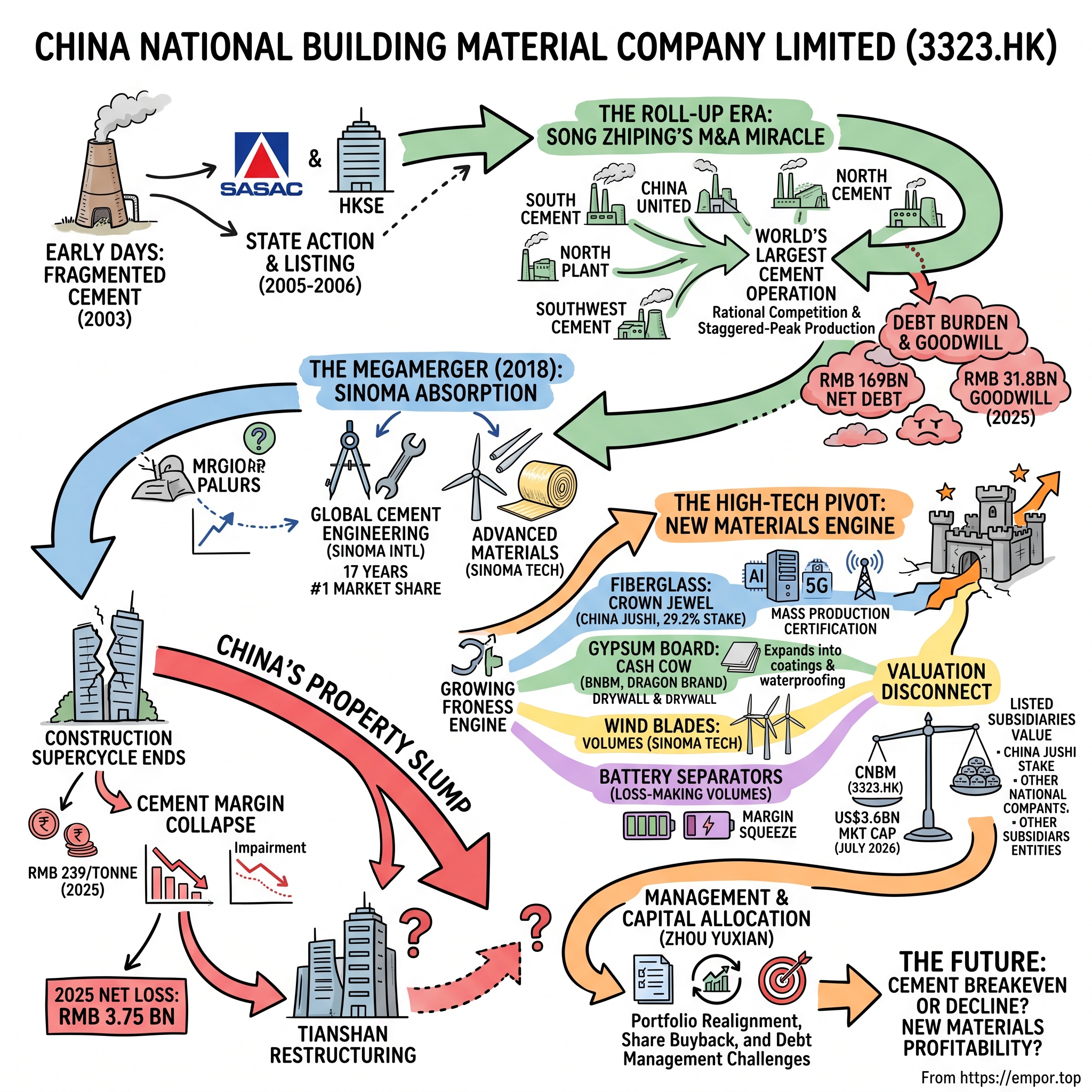
On 15 July 2026, 中国建材 China National Building Material Company Limited — the world's largest building materials manufacturer by physical output — issued a three-page filing on the Hong Kong Stock Exchange. The company reported an expected net loss attributable to shareholders of roughly RMB 890 million for the first half of 2026, a sharp reversal from the RMB 1.36 billion profit generated in the same period a year earlier.202
Investor reaction was swift. By the end of July 2026, CNBM's H shares traded at HK$3.73, just above their 52-week low of HK$3.50 and roughly half the HK$7.26 reached over the preceding twelve months.3 That gave the entire equity — a company consolidating over RMB 489 billion in assets, employing about 129,594 people, and controlling the world's largest cement operation — a market capitalization of approximately HK$28.3 billion, or roughly US$3.6 billion. That valuation sits below the market value of a single fibreglass associate company that CNBM does not consolidate.13
This valuation disconnect highlights the central analytical question facing 3323.HK.
The thesis under examination. Management frames CNBM as a materials group in mid-transformation: a legacy cement business pressured by China's property slump, balanced by a fast-growing new materials portfolio — including fibreglass, gypsum board, wind turbine blades, lithium battery separators, and carbon fibre — alongside a global cement engineering franchise that has held the world's largest market share for seventeen consecutive years.1 Proponents argue that this structure allows investors to acquire advanced-materials assets at a discount while obtaining the core cement business essentially for free.
Skeptics offer a more troubling picture. In 2025, CNBM's basic building materials segment generated a net loss attributable to shareholders of RMB 6.71 billion, more than erasing the RMB 3.48 billion contributed by the new materials segment and the RMB 987 million from engineering.1 Over the same period, its closest domestic peer, 海螺水泥 Anhui Conch Cement, grew net profit by 5.1% to RMB 8.46 billion.4 This performance divergence between two leading producers in the same downturn highlights structural and operational differences that new-materials growth has not offset.
What follows. This analysis traces how a state holding company assembled the world's largest cement business out of more than a thousand fragmented Chinese kilns; how a 2018 merger integrated a global engineering operation; how the property slump exposed what that consolidation actually cost; how the high-tech portfolio performs beneath headline growth rates; and how current leadership has allocated capital. Along the way, the analysis assesses whether arguments for hidden asset value hold up against RMB 169 billion of net debt and RMB 75.7 billion of minority interests.
The story starts, as most Chinese industrial stories do, with a government decision.
 Subscribe on LinkedIn
II. The Birth of a State Titan: SASAC, Industrial Context, & Early Cement Fragmentation
Picture a Chinese county town in 2003. On the outskirts, past the last row of tile-fronted shops, sat a vertical shaft kiln: a squat concrete cylinder belching grey dust, run by perhaps forty people, producing a few hundred thousand tonnes of low-grade cement a year for construction sites within a two-hour truck ride. Thousands of such plants operated across the country, owned by townships, families, collectives, or provincial bureaus. They competed fiercely on a single variable — price — because their output could neither be stored long-term nor economically shipped far.
That constraint defines the foundational economics of the cement sector.
Why cement is a strange business. Cement is heavy, low-value, and perishable. A tonne of it sold for RMB 239 in China during 2025 — roughly US$33.1 Trucking it beyond roughly 200 kilometres costs more than the cement itself is worth, confining every plant to a local sales radius rather than a national market. Water transport alters that equation: a barge on the Yangtze River can carry cement roughly a thousand kilometres economically, making control of river-adjacent facilities the primary strategic prize in Chinese cement. Furthermore, because cement absorbs ambient moisture and hardens in storage, producers cannot stockpile inventory through a downturn the way steelmakers store slab. Production must match local demand in near real time.
Combining those three physical characteristics yields a severe industry dynamic: localized monopolies that collapse into regional price wars whenever new capacity enters the market, with no inventory buffer to absorb demand shocks. In the early 2000s, as China built highways, high-speed rail lines, and housing developments at unprecedented speed, producers added kilns rapidly. Total capacity soon outstripped even that expansionary demand.
The state's answer. China National Building Material Company Limited was converted into a joint stock limited company on 28 March 2005, with its state parent, BNBMG, CNBM Trading, China Cinda, and the Building Materials Academy as promoters.1 Its state parent reported directly to 国务院国有资产监督管理委员会 SASAC, the State-owned Assets Supervision and Administration Commission — the entity established in 2003 to act as shareholder-of-record for central state enterprises and determine which should grow, merge, or close.
SASAC diagnosed the building materials sector with clear structural defects: severe fragmentation, sub-scale operations, weak pricing discipline, and poor environmental performance. Its chosen remedy was consolidation under a designated national champion. However, executing large-scale consolidation required substantial funding, and Chinese commercial banks in 2005 remained hesitant to finance debt-fueled industrial roll-ups.
Environmental regulation provided the critical lever for industry restructuring. Vertical shaft kilns operated far less efficiently than modern rotary kilns with precalciners: they consumed more fuel per tonne of clinker, produced inconsistent quality, and emitted high volumes of particulate matter and nitrogen oxides. For a central government that subsequently committed to carbon peaking and neutrality targets, thousands of distributed shaft kilns represented an unsustainable environmental liability. Subsequent regulatory enforcement — including capacity replacement ratios, energy efficiency benchmarks, ultra-low emission standards, and the national carbon emissions trading market — functioned simultaneously as environmental policy and as an aggressive consolidation mechanism. This dual purpose clarifies CNBM's corporate positioning: the company has acted not merely as a subject of environmental regulation, but as a principal beneficiary of state-enforced consolidation.
The primary obstacle facing Chinese cement was structural rather than technological. Domestic producers already had access to modern rotary kiln designs comparable to those used in Germany or Japan. The structural challenge lay in low entry barriers, local government incentives to build plants, and an absence of supply restraint. In a commodity sector serving fragmented regional markets, ownership concentration offered the only viable path to enforcing market discipline. Beijing consequently selected a corporate consolidation strategy over purely administrative controls, requiring a state vehicle with unprecedented scale.
The 2006 listing. To secure acquisition capital, the enterprise turned to international markets. CNBM's H shares were listed on the Stock Exchange of Hong Kong on 23 March 2006 under the code 03323.1 The listing was designed to establish a repeatable channel for foreign equity capital. CNBM utilized this financing mechanism systematically: approximately 150 million H shares were placed on 9 August 2007, another 300 million on 5 February 2009, and 240 million more on 14 September 2010, with a one-for-one bonus issue following on 13 June 2011.1
This capital-raising cadence reveals the core function of the listed entity: it served as the currency and funding conduit for a domestic consolidation campaign directed from Beijing. International equity investors provided minority funding, state banks supplied debt capital, and SASAC provided the consolidation mandate. From inception, public shareholders in Hong Kong financed a state-directed industrial policy program as junior equity partners.
So what for an investor. This structural origin highlights a governance feature that persists two decades later: CNBM has consistently functioned as a policy instrument first and a commercially driven listed company second. While this mandate built an extensive physical asset base, it established a precedent where state policy priorities take precedence if they diverge from the commercial interests of minority H-share holders. It also meant that the massive roll-up campaign was executed under a mandate that prioritized rapid market coverage and transaction completion over price discipline.
That expansion mandate was entrusted to the executive who orchestrated the national roll-up.
III. Song Zhiping's M&A Miracle & The "Rational Competition" Doctrine
Song Zhiping was appointed chairman of CNBM's board in 2005. By the time he stepped down at the annual general meeting in mid-2018, the company had expanded from a mid-sized state building materials firm into one of the largest materials manufacturers in the world.5 He remained chairman of the parent group until 2019. He currently teaches at Cheung Kong Graduate School of Business, chairs the China Association of Public Companies, has served as chairman of the World Cement Association, and has authored roughly fourteen books on management—a corpus with titles like Integration and Optimization and Three Essences of Management that function less as memoir than as operational doctrine.6 Harvard Business School has also studied his cement consolidation strategy as a formal case study.6
The problem he faced. A conventional corporate roll-up acquires competitors and shuts them down. In Chinese cement around 2007, that strategy was unfeasible for three reasons. Local governments depended heavily on regional plants for employment and tax revenue. Plant owners were frequently well-connected local entrepreneurs who could simply refuse buyouts. Finally, even if an outside buyer acquired a facility, incumbent management possessed localized knowledge of quarries, contractors, and municipal officials that a Beijing headquarters could not easily replicate.
Song's solution inverted the standard acquirer posture. Rather than buying and terminating incumbents, CNBM acquired facilities while retaining key personnel: sellers typically received cash alongside a minority equity stake in the regional platform, frequently maintaining operational control of their local plant. The company established regional holding platforms from scratch—中国联合水泥 China United Cement in the east, 南方水泥 South Cement across the Yangtze Delta and southeast, 北方水泥 North Cement in the northeast, and 西南水泥 Southwest Cement across Sichuan, Yunnan, and Guizhou—filling each platform with dozens of acquired producers.
Over roughly a decade, CNBM absorbed hundreds of private and regional cement producers into these four platforms, executing the largest industrial consolidation by transaction count in modern Chinese corporate history. The campaign was accomplished with minimal litigation or public friction, reflecting the effectiveness of its seller-friendly incentive structure.
The doctrine: 理性竞争 rational competition. Consolidating physical plants was only the first half of the strategy; the second required convincing the broader industry—including non-acquired competitors—that price wars were value-destructive. Song emerged as the sector's prominent advocate for rational competition, advancing the principle that in a high-weight, low-value commodity market, market share gained through price cutting destroys aggregate industry value rather than transferring it.
The operational mechanism of this doctrine was 错峰生产 staggered-peak production: coordinated seasonal kiln shutdowns originally introduced to address winter air quality in northern China and later deployed nationally as a supply-management tool. CNBM continues to utilize this mechanism. In its 2025 annual report, the company stated that it had "fully implemented staggered peak production to restore prices and stabilise market share," framing the initiative as part of an industry-wide "ecological improvement" effort alongside the retirement of inefficient capacity.1
Whether staggered-peak production represents disciplined commons management or a state-sanctioned production cartel remains an analytical question of perspective. Operationally, the mechanism requires universal participation to sustain pricing power—making it inherently vulnerable during broad demand contractions, as demonstrated during the 2025 downturn.
Did CNBM overpay? The evidence indicates yes. The acquisition campaign coincided with peak Chinese urbanization between 2009 and 2013, when regional kilns were acquired at peak-cycle valuation multiples on both enterprise value to EBITDA and enterprise value per tonne of capacity. The expansion was financed overwhelmingly through debt provided by state lenders. While the roll-up secured market leadership across eastern, central, and southwestern China, it left the balance sheet structurally leveraged.
The long-term cost of this acquisition strategy remains visible in the company's financial reporting. As of 31 December 2025—more than a decade after the core roll-up completed—CNBM carried approximately RMB 31.83 billion in goodwill, representing 6.50% of total assets.1 Goodwill reflects the premium paid above the fair value of identifiable net assets acquired. In 2025, the company recorded a RMB 3.09 billion goodwill impairment, allocating RMB 2.88 billion directly to the cement segment.1 This write-down represented a formal accounting acknowledgment that a portion of the assets acquired during peak expansion failed to retain their transaction value.
The trade-off, stated plainly. Song Zhiping's consolidation strategy secured tangible strategic assets: high production density along the key Yangtze shipping corridor, non-replicable quarry rights under modern environmental permitting rules, and an expansive national footprint. However, it also generated a heavy debt load and substantial goodwill balance that amplified the impact of subsequent cyclical downturns. By comparison, Anhui Conch, which expanded primarily through organic greenfield development, entered the downturn with total liabilities of RMB 52.31 billion against RMB 256.0 billion in assets.4 CNBM entered the same period with RMB 303.1 billion in liabilities against RMB 489.5 billion in assets.1
The two companies pursued contrasting strategies through the same industrial expansion. The financial obligations tied to CNBM's aggressive roll-up ultimately emerged as a persistent structural drag during market contractions.
Before those pressures fully materialized, however, state planners initiated another major structural reorganization.
IV. The Sinoma Mega-Merger: Building the Dual-Core Empire
By 2017, SASAC had a tidiness problem. It supervised two large, overlapping, separately listed building materials groups: CNBM, with its enormous cement footprint, and 中国中材 Sinoma — China National Materials Company Limited, listed in Hong Kong as 1893.HK — which owned its own cement plants plus something CNBM did not have: the world's dominant cement engineering and equipment business, and a portfolio of advanced materials including wind turbine blades, specialty glass fibre, and lithium battery separator technology.
Two central SOEs bidding against each other for the same overseas cement plant contract is exactly the kind of duplicated state investment SASAC was created to eliminate.
The deal. On 8 September 2017, CNBM announced it would absorb Sinoma by way of a share exchange, with each Sinoma share converting into 0.85 CNBM shares.7 It was the first time two PRC companies listed in Hong Kong completed a merger by absorption, and it was large: based on share prices at the time of the swap, the transaction was valued at approximately HK$75.1 billion, around US$9.57 billion.8 Sinoma's H shares were delisted from the Stock Exchange on 23 April 2018; the share exchange took effect on 2 May 2018, with the merged CNBM's shares resuming trading the following day; the business registration updating the corporate record was issued on 30 July 2018.18
Song Zhiping stepped down from the listed company's chairmanship at the annual general meeting weeks later.5 It is hard to imagine a cleaner capstone: he arrived to consolidate an industry and left having consolidated his own regulator's second-largest holding into his own balance sheet.
What CNBM actually acquired. Three things, in ascending order of long-term significance.
Cement. Sinoma's cement assets were folded into the existing pile — useful, incremental, and largely a story about eliminating overlap rather than adding capability.
Engineering. 中材国际 Sinoma International (600970.SH) is the genuinely unusual asset. It designs, procures, and builds cement plants on a turnkey basis, and it has been the world's largest cement engineering services provider for seventeen consecutive years by market share.1 Think of it as the company that builds the factories that make the product CNBM sells.
It is worth explaining what that business actually involves, because "EPC contractor" understates it. A cement plant is not a building with machines in it; it is a single continuous thermal process running at around 1,450 degrees Celsius, in which crushed limestone and clay are fed through a preheater tower, calcined, fused into clinker in a rotating kiln the length of a football pitch, cooled, and ground with gypsum into powder. Getting that process to hit design throughput and fuel efficiency on commissioning day requires proprietary knowledge of kiln aerodynamics, refractory selection, and raw material chemistry that varies with every quarry on earth. Engineering, procurement and construction means Sinoma does the process design, buys or manufactures the equipment, builds the plant, and hands over a facility guaranteed to produce a specified tonnage at a specified fuel consumption. Very few organisations globally can carry that guarantee at scale.
The strategic consequence is that Sinoma International sells into precisely the markets CNBM's cement business cannot reach. A cement plant in Nigeria or Indonesia is inaccessible to a Chinese cement producer — the physics of the 200-kilometre radius forbids exporting the product — but entirely accessible to a Chinese cement plant builder. And the business has extended downstream: by mid-2025 it was providing operations and maintenance services for 71 cement production lines and 312 mine projects, converting one-off construction revenue into recurring service revenue.2 Overseas equipment sales reached 51% of the segment's equipment revenue, with revenue from new industries beyond cement at 37%.2
The economics are entirely different from cement's: asset-light, contract-based, denominated substantially in hard currency, and driven by capital investment cycles in emerging markets rather than by Chinese property starts. In 2025 Sinoma International generated revenue of RMB 49.60 billion and net profit attributable to its own shareholders of RMB 2.86 billion, and signed new contracts worth RMB 71.24 billion, up 12%, of which overseas contracts of RMB 45.02 billion grew 24%.9
Advanced materials. Sinoma brought 中材科技 Sinoma Science & Technology (002080.SZ) — wind turbine blades, specialty fibreglass through 泰山玻纤 Taishan Fiberglass, hydrogen storage cylinders, and lithium battery separator production. This is the asset that would, seven years later, be doing the heaviest lifting in CNBM's profit statement.
Integration reality, without the press release. The stated synergies — joint procurement, cross-selling engineering services to overseas cement customers, shared R&D — are plausible and partially evidenced. The overseas engineering franchise did keep growing. But the merger also created something structurally awkward that has never been resolved: a listed holding company whose principal assets are themselves separately listed companies with their own minority shareholders, their own boards, and their own capital-raising ambitions.
As of 31 December 2025, CNBM held 81.14% of Tianshan Materials (000877.SZ), 70% of North Cement, 49.03% of Ningxia Building Materials (600449.SH), 37.54% of 北新建材 BNBM (000786.SZ), 29.22% of 中国巨石 China Jushi (600176.SH), 60.24% of Sinoma Science & Technology, and 41.28% of Sinoma International.1 Every one of those is a separate listed entity. Cash generated at the bottom must climb through several layers of partially-owned subsidiaries before it reaches a Hong Kong shareholder.
The arithmetic of that leakage is stark. In 2025, CNBM's consolidated net assets of RMB 186.41 billion included RMB 75.75 billion belonging to non-controlling interests — over 40% of the group's equity is owned by somebody other than 3323.HK shareholders.1 When we get to the holding company discount in Section VII, remember that number. It is not an accounting curiosity; it is the machine that converts operating profit into disappointment.
For the first few years after the merger, none of this mattered much. Chinese cement demand was still enormous, prices were firm, and the group was earning double-digit billions. Then the property market broke.
V. The Great Real Estate Slump, Tianshan Restructuring, & Cement Margin Collapse
Here is the number that defines the last five years of this company: in 2025, Chinese national cement output was approximately 1.69 billion tonnes, down 6.9% year on year — the fifth consecutive annual decline.1
For context, the industry peaked above 2.3 billion tonnes. China has removed roughly the entire annual cement consumption of the United States, India, and the European Union combined from its own market, in five years, without a financial crisis, a war, or a pandemic doing the removing. It is simply the end of a construction supercycle.
The mechanism. Chinese cement demand has two engines: property and infrastructure. In 2025 both stalled simultaneously. Real estate development investment fell 17.2% year on year to a new low, and new construction starts — the leading indicator that matters most for cement, because cement goes into foundations and structure early in a build — dropped 20.4%.1 Infrastructure had always been the counterweight; in 2025 it stopped counterweighting, declining 2.2% for what CNBM's own annual report describes as the first negative growth on record.1 National fixed asset investment fell 3.8% even as GDP grew 5.0%.1 The Chinese economy kept expanding; the part of it that pours concrete did not.
The Tianshan restructuring. CNBM saw the reckoning coming and, to its credit, moved on the structural problem before the worst of it. On 7 August 2020 the company entered an indicative agreement with its A-share listed subsidiary Tianshan Cement to inject its four regional cement platforms into that vehicle, with supplemental agreements finalising consideration on 2 March 2021.10 Tianshan acquired the entirety of China United Cement and Sinoma Cement, 99.9% of South Cement, and almost 96% of Southwest Cement, for roughly RMB 4 billion in cash and RMB 94.2 billion in newly issued shares — a total of about RMB 98.1 billion, roughly US$15.2 billion.11
The result was the largest single cement operating entity in the world, with annual capacity of around 483 million tonnes against Anhui Conch's 335 million.11
The logic was sound on paper. It ended intra-group competition between four platforms that had been quietly bidding against each other. It concentrated management accountability in one A-share listed company with real market scrutiny and a real currency for future incentives. It created a single balance sheet against which to plan the enormous decarbonisation capex the industry faces. And it moved the cement business into a market — the A-share market — where domestic investors historically pay more for cyclical industrials than Hong Kong does.
But it did not change the physics, and it did not reduce the debt.
What 2025 actually looked like. CNBM's basic building materials segment sold 193.4 million tonnes of cement in 2025, down 10.7%, and 23.4 million tonnes of clinker, down 17.4%.1 Volume declines of that magnitude are survivable if price holds. Price did not hold: average cement selling price fell 6.2% to RMB 239.0 per tonne, commercial concrete fell 8.2% to RMB 286.1 per cubic metre, and even aggregates — the supposedly high-margin adjacency — slipped to RMB 36.6 per tonne.1
Volume down double digits, price down mid-single digits: segment revenue fell 14.6% to RMB 77.85 billion.1
Now the part that separates a bad year from a structural problem. Management did cut costs, and cut them hard — cement costs fell 7% and concrete costs 12% year on year, helped substantially by cheaper coal.1 Those cuts were good enough that the segment's gross margin actually rose, from 14.5% to 15.5%.1 Read only that line and you would conclude the cement business was stabilising.
Then the impairments landed. Segment operating profit swung from RMB 3.98 billion in 2024 to negative RMB 3.74 billion in 2025, driven by RMB 3.01 billion of additional goodwill impairment and RMB 2.76 billion of additional property, plant and equipment impairment, the latter tied to the exit of certain cement and clinker production lines under China's capacity replacement rules.1 Add rising receivables provisions and the segment contributed a loss of RMB 6.71 billion to shareholders.1
The first-half illusion. This is where management credibility becomes testable, and the test is uncomfortable. At the half-year stage, CNBM reported a profit attributable to shareholders of RMB 1.36 billion, reversing a RMB 2.02 billion loss in the prior first half, with basic building materials gross margin nearly doubling from 8.8% to 16.1% and cement prices up 3.6%.2 The interim report's outlook section spoke of continuing "to consolidate the upward trend in business performance."2
Six months later the full year came in at a RMB 3.75 billion loss.1 That implies a second half of roughly negative RMB 5.1 billion. The company had flagged it: on 2 February 2026 it issued a profit warning guiding to a full-year loss of RMB 2.3 billion to RMB 4.0 billion, and the final figure landed near the bottom of that range.12
The honest reading is not that management lied. Impairment testing is genuinely a year-end exercise, and the drivers — a collapsing second-half cement price, capacity-replacement closures — were real. But it does mean that CNBM's interim results are a poor guide to its full-year results, and that a reader who took the "upward trend" framing at face value in August 2025 was badly served. Investors in this company should treat first-half profitability as provisional until the December impairment review is complete.
The auditors noticed too. Moore CPA Limited, CNBM's international auditor, flagged both the impairment assessment on property, plant and equipment, right-of-use assets, and intangibles, and the impairment assessment on goodwill, as key audit matters for 2025 — citing "the involvement of significant management judgements" and "the significant degree of judgement by the management associated with the determination of the recoverable amount."1 The audit opinion was unmodified. But when RMB 201.2 billion of PP&E and RMB 31.8 billion of goodwill both sit in the key-audit-matter section, the appropriate posture toward reported book value is scepticism rather than arithmetic.
The operational playbook now. Three moves are underway in basic building materials, and they are sensible. First, mix: sales of specialty and dedicated cement rose 13.3% in 2025, including a 13.4% increase in oil well cement and the first-ever sales of marine engineering cement — small volumes, but higher-margin and demand-insensitive to housing.1 Second, internationalisation: overseas revenue in the segment grew 93% and overseas profit 181%, and the company completed its first overseas equity acquisition in basic building materials, in Tunisia.1 Third, decarbonisation and cost: alternative fuel production lines reached 45% of the fleet by mid-2025 with a fuel substitution rate of 5.88%, and the company deployed an industry AI model across more than 140 cement production scenarios, reporting an average cost reduction of RMB 2.03 per tonne at accepted facilities.2
RMB 2.03 per tonne across ~193 million tonnes is roughly RMB 390 million a year — real money, and a useful reminder that in commodity businesses the digital transformation story is measured in single-digit renminbi per tonne, not in narrative.
The two adjacencies, and how they are actually performing. Two other moves get more airtime in bull cases than the numbers support, and both deserve a sober look.
The first is aggregates — crushed stone and sand, quarried from the limestone reserves CNBM already controls beside its cement plants. The industrial logic is excellent: the rock is already permitted, already mined, and the incremental processing cost is low, which is why aggregates have historically carried far higher gross margins than cement itself. The problem in 2025 was demand, not margin structure. Aggregate volumes fell 1.0% to 139.6 million tonnes and average price slipped 0.8% to RMB 36.6 per tonne, and management cut aggregates capital expenditure from RMB 2.34 billion to RMB 1.31 billion while telling shareholders the business would "focus on improving the input-output ratio and accelerating the completion and efficiency of ongoing projects."12 Translated: stop building new quarries and make the existing ones pay. That is the correct decision, but it also means aggregates will not be the growth engine that offsets cement decline in the near term.
The second is commercial concrete, and here the issue is credit rather than price. Ready-mix concrete is sold on terms to construction contractors and property developers, which in China since 2021 has meant selling to counterparties in various stages of financial distress. The consequence shows up in a line most readers skip: provision under expected credit losses rose 226.5% in 2025, to RMB 2.06 billion.1 CNBM's stated response has been to shift the concrete business toward a "light-asset model" concentrated in the Yangtze River Delta, prioritising market control in creditworthy regions over volume everywhere.2 Volumes duly fell 3.8% to 75.8 million cubic metres.1 Deliberately shrinking a business to protect the balance sheet is a defensible choice and evidence of learning from the developer defaults. It is also, unavoidably, a drag on reported revenue and a signal that management does not expect a broad property recovery soon.
So what for investors. The cement business is not going to be rescued by cost cutting. Volume is in secular decline, pricing depends on an industry-wide coordination mechanism that failed in the second half of 2025, and the balance sheet converts operating weakness into reported losses through impairment. What the segment can still do is generate cash — and it does, which is why group operating cash flow held at RMB 22.52 billion in 2025 despite the loss.1 The question is whether that cash gets allocated well. Hold that thought.
Because meanwhile, something genuinely different was happening in the other half of the company.
VI. Inside the "New Materials" Engine: The High-Tech Profit Fortress
In the first half of 2025, CNBM commissioned what it described as the fibreglass industry's first zero-carbon intelligent manufacturing facility, located in Huai'an, Jiangsu Province.1 Around the same time, its subsidiaries brought online production lines for low-dielectric and low-expansion specialty fibre fabrics—materials used in copper-clad laminates for high-frequency circuit boards in AI servers and 5G base stations. The company reported that its low-expansion fibre fabrics broke foreign monopolies, positioning CNBM as the sole domestic and second global supplier capable of mass-producing the material.2
This is hardly the language of a legacy cement producer. Yet the technological capability is genuine, representing the core of CNBM's growth thesis.
The scoreboard. In 2025, the new materials segment generated RMB 55.56 billion in revenue, a 14.4% increase, and contributed RMB 3.48 billion in net profit attributable to shareholders—a 33.3% jump.1 Segment operating profit reached RMB 6.26 billion.1 In a year when the group suffered an overall loss, new materials expanded profit by a third, providing essential support for the company's valuation.
However, "new materials" operates as a diverse portfolio rather than a single unified business, with individual components performing on vastly different trajectories. Examining each component reveals that headline segment figures mask both the group's strongest asset and one of its weakest.
Fibreglass: the crown jewel, and it is not consolidated. Fibreglass consists of molten glass drawn into fine filaments, bundled into rovings or woven into fabric to reinforce wind turbine blades, lightweight automotive panels, and printed circuit boards. The economics resemble a continuous-process commodity governed by scale and technology: larger, highly automated melting tanks reduce energy and labor costs per tonne, operating continuously for years between major rebuilds.
中国巨石 China Jushi, the world's largest fibreglass producer by capacity, delivered strong 2025 results: revenue rose 19.1% to RMB 18.88 billion, while net profit grew 34.4% to RMB 3.29 billion.13 Across the broader group, CNBM sold 4.10 million tonnes of fibreglass at an average price of RMB 4,711 per tonne—a 12.8% price increase, making fibreglass the only major product in the company's portfolio to achieve meaningful price gains.1
The critical structural factor for valuing 3323.HK is that CNBM holds only a 29.22% stake in China Jushi. Because Jushi is treated as an associate under the equity method rather than a consolidated subsidiary, its revenue does not appear in CNBM's top line; only CNBM's proportional share of net income flows through as a single line item. In February 2025, CNBM completed an acquisition announced the prior December, purchasing 89,913,017 additional Jushi shares for approximately RMB 1 billion to raise its holding from 26.97% to 29.22%.1 Allocating RMB 1 billion to acquire an additional 2.25 percentage points of an entity generating over RMB 3 billion in annual net profit proved to be one of management's most effective capital deployments.
By 31 July 2026, China Jushi carried a market capitalization of approximately RMB 150.2 billion.13 CNBM's 29.22% stake was valued at roughly RMB 44 billion—exceeding the market capitalization of CNBM as a whole. This valuation disconnect plays a central role in assessing the group's overall value.
Gypsum board: the cash cow with a demand problem. 北新建材 BNBM produces gypsum wallboard under the Dragon Brand name, holding a dominant share of the Chinese drywall market. Drywall enjoys superior economics compared to cement because it is a branded, specified product distributed to contractors who prioritize consistency, fire resistance, and structural integrity, supporting a price premium over generic regional alternatives. While switching costs for an individual sheet are low, replacing an approved supplier across a national contractor network carries real friction.
The 2025 results demonstrated the limits of that market position during a real estate downturn. BNBM's net profit fell 20.31% to RMB 2.906 billion.14 Across the group, gypsum board sales volumes slipped 1.1% to 2,146.9 million square metres, while average selling prices dropped 7.7% to RMB 5.42 per square metre.1 Although first-half unit costs fell 6.2% to help preserve gross margins, a 7.7% annual price drop in a branded product indicates a competitive advantage under cyclical strain.2
In response, BNBM pursued a strategy framed as "one body and two wings," expanding from drywall into waterproofing and architectural coatings. The coatings expansion relied heavily on the acquisition of 嘉宝莉 Carpoly, providing a revealing test of acquisition discipline. Under the share transfer agreement, Carpoly's selling shareholders guaranteed minimum net profit targets from 2024 through 2026. Against a 2024 target of RMB 413 million, Carpoly delivered an audited net profit of RMB 335.66 million.2 The RMB 77.34 million shortfall was deducted from the remaining purchase consideration in accordance with contract terms. While the earn-out mechanism protected capital as structured, the 19% first-year profit miss underlines the execution challenges facing the expansion strategy.
Wind blades: enormous volume growth, modest profit. 中材科技 Sinoma Science & Technology represents the group's largest consolidated new-materials subsidiary, with CNBM holding a 60.24% stake. In 2025, Sinoma Tech reported a 25.9% increase in revenue to RMB 30.20 billion, while net profit attributable to its shareholders doubled to RMB 1.82 billion—a 104% gain.15
Group wind blade delivery volumes rose 50.8% to 36,180 megawatts, while average selling prices declined by a modest 2.1%.1 Following intense price competition among domestic equipment makers, blade prices stabilized while first-half unit costs fell 10.7%.2 The blade subsidiary generated RMB 620 million in net profit.15
That performance highlights an ongoing profitability constraint: 36.2 gigawatts of blade capacity yielded RMB 620 million in net profit, equating to roughly RMB 17 in profit per kilowatt shipped. Manufacturing blades over 100 metres long requires complex moulds and advanced composite labor. CNBM holds established technical leadership in this segment, having deployed the first domestic recyclable blade exceeding 220 metres in rotor diameter and completed trial production of a 16-megawatt floating offshore blade.2 However, as a component supplier selling to concentrated turbine original equipment manufacturers, technical capability has not translated into strong pricing power.
Lithium battery separators: the story that does not survive the numbers. The financial performance of the lithium battery separator business provides a crucial reality check to growth projections.
A battery separator is a microporous plastic film placed between a lithium-ion cell's anode and cathode. It must insulate electrical charges while permitting ion transfer, resist physical punctures, and shut down if the battery overheats. Thin films enhance energy density, but mass-producing uniform membranes at sub-micron tolerances presents severe manufacturing hurdles. CNBM achieved commercial production of 5-micron base film, developed technical capabilities for 4- and 3-micron specifications, completed formula design for semi-solid battery separators, and began construction on its first overseas separator facility in Hungary.2
Volume growth was substantial, with total separator sales rising 75.5% in 2025 to 3,328 million square metres.1 Sinoma Tech separately reported sales of 3.33 billion square metres, representing a 76% increase.15
Despite those gains, the separator business recorded a net loss of RMB 25 million in 2025.15
Average selling prices fell 10.0% to RMB 0.72 per square metre.1 Industry-wide capacity additions outstripped rapid EV market expansion, enabling dominant battery makers like 宁德时代 CATL and 比亚迪 BYD to squeeze supplier margins. Consequently, CNBM expanded sales volume by three quarters while operating at a net loss in the segment.
Scale and technological proficiency may yield value if industry capacity rationalizes, and CNBM demonstrated capital discipline by reducing separator capital expenditures from RMB 3.02 billion in 2024 to RMB 1.34 billion in 2025.1 Nevertheless, current financial metrics contradict claims that battery separators function as an active earnings driver.
Carbon fibre and the ownership structure question. In carbon fibre, group sales volumes grew 53.3% to 25,050 tonnes, while average prices declined 8.7% to RMB 86,328 per tonne; management reported that total production capacity ranks among the top three globally.1 Development of the 30,000-tonne production facility in Lianyungang continued during 2025.2
However, corporate ownership structures complicate the earnings picture for public shareholders. CNBM's disclosures specify that its wholly owned China Composites subsidiary holds its wind blade and carbon fibre investments through equity participation rather than direct operating control.1 The listed carbon fibre entity, 中复神鹰 Zhongfu Shenying, is controlled by CNBM United Investment—an entity belonging to the unlisted parent group rather than 3323.HK. China Composites held a 24.11% interest in Zhongfu Shenying, with the broader acting-in-concert group holding 55.99% as of 7 May 2026.16 Similarly, advanced glass producer 凯盛科技 Triumph Science & Technology operates under Triumph Group, which is a 16.73% shareholder of 3323.HK rather than a subsidiary.1
As a result, several high-profile advanced materials assets frequently highlighted in investment theses reside at the parent level rather than within the listed company. Shareholders in 3323.HK participate in carbon fibre earnings only through a minority interest, while receiving no financial exposure to Triumph's ultra-thin flexible glass business.
So what for investors. The new materials segment represents a higher-quality asset base than basic building materials, as demonstrated by its one-third profit expansion during a severe cyclical downturn. However, earnings quality remains concentrated in China Jushi—an unconsolidated associate—and BNBM's gypsum board business, which faces pricing pressure. Meanwhile, wind turbine blades and battery separators generate high volume growth but compressed margins due to buyer concentration among turbine and battery manufacturers. Rather than providing a seamless offset to legacy cement operations, the new materials engine comprises one excellent equity-method associate, one good branded business under pricing pressure, and two heavy-capex component businesses that have not yet earned their cost of capital.
VII. Management & Governance Deep Dive: Zhou Yuxian, Incentives, & Capital Allocation
Zhou Yuxian was born in April 1963 and holds a master's degree from the School of Materials Science and Engineering at Wuhan University of Technology, earned in December 2003—the same institution and discipline as executive director Wang Bing's doctorate.1 A professor-level senior engineer and recipient of the State Council special government allowance, Zhou became chairman of CNBM's parent group in November 2019 and chairman of the listed company in November 2021, while also serving as president of the China Cement Association.1
His stated background—encompassing "materials engineering, corporate reorganization and restructuring, international operation, equity investment, and fund management"—presents a clear contrast to Song Zhiping's profile.1 Where Song operated as a consolidator who persuaded hundreds of private owners to sell, Zhou's career resembles that of an asset manager focused on portfolios, restructuring, and equity allocation.
That distinction is visible in how the company has allocated capital since 2021.
The president and the board. Wei Rushan, born in December 1974, has served as president since December 2022 and holds a doctorate in political economy from Renmin University; he also chairs the executive committee of the World Cement Association.1 Miao Xiaoling joined the board as an executive director in January 2025, succeeding Liu Yan, and serves as deputy party secretary and secretary to the board.12
Independent non-executive director Sun Yanjun brings a distinct background for a Chinese central SOE. Serving on the board since October 2014, Sun was a global partner at TPG Capital from 2011 to 2018, leading its Greater China operations after seven years as a managing director in Goldman Sachs's private equity division.1 Having an experienced buy-side principal on the board provides institutional discipline in asset valuation, which has influenced the company's capital markets transactions in recent years.
The buyback: a pivotal capital allocation test. On 6 December 2024, CNBM announced a conditional cash offer to buy back up to 841,749,304 H shares at HK$4.03 per share—representing roughly 9.98% of issued share capital for a maximum outlay of about HK$3.4 billion, or approximately US$436 million.17
Investor demand far exceeded the target. Valid acceptances reached 1,765,036,367 H shares—more than double the maximum offer, with approximately 39% of the H-share class seeking to tender at HK$4.03.17 The company purchased and cancelled the maximum permitted amount, distributing total consideration of HK$3,392,249,695 on 12 March 2025.1
This transaction carried two primary structural implications.
From a value perspective, cancelling 10% of total shares at a price the board described as reflecting "confidence in its long-term prospects and intrinsic value" was accretive to remaining equity holders.1 Total issued share capital decreased to 7,593,021,358 shares, increasing the proportional ownership of continuing shareholders.1
From a governance perspective, the parent group's aggregate equity stake rose from approximately 45.02% to 50.01% without requiring parent capital expenditure—a result made possible by a whitewash waiver, which avoided triggering a mandatory general offer upon crossing the control threshold.17 Corporate cash effectively funded the transaction that granted the controlling shareholder an absolute majority stake. While fully disclosed and approved by independent shareholders, the transaction delivered control benefits to the parent while using company cash.
Market performance added another layer to the outcome. Although executed at HK$4.03 in March 2025, the stock fell to HK$3.73 by late July 2026.3 Approximately RMB 3.21 billion in shareholder cash—accounted for within capital expenditure across interim and annual financial reports—was deployed at a valuation above subsequent trading levels.12 While short-term share price movements do not invalidate capital allocation decisions, the repurchases occurred at a premium to subsequent market prices shortly before the company reported full-year operating losses.
Where the rest of the money went. Group capital expenditure reached RMB 21.23 billion in 2025, down from RMB 23.50 billion in the prior year.1 Excluding the RMB 3.21 billion share buyback, core operating capital expenditure totaled approximately RMB 18.0 billion. Within that budget, cement capital expenditure fell from RMB 10.05 billion to RMB 7.75 billion, aggregates spending dropped from RMB 2.34 billion to RMB 1.31 billion, and lithium battery separator capex was reduced by more than half.1 Conversely, fibreglass capital expenditure expanded from RMB 1.73 billion to RMB 2.94 billion.1
As a portfolio reallocation strategy, this pivot shifted capital away from declining commodity segments and loss-making component units toward the single product category generating pricing gains. This adjustment indicates an increased management focus on returns over volume expansion.
The persistent debt burden. Balance sheet deleveraging showed less progress. Total borrowings finished 2025 at RMB 193.04 billion, compared to RMB 191.91 billion a year earlier.1 The net debt ratio—borrowings minus cash divided by net assets—rose from 86.6% to 90.8%, after reaching 93.1% at mid-year.12 Total debt remained largely stable, but net equity contracted due to operating losses and share repurchases.
The debt maturity schedule presents near-term refinancing requirements, with RMB 90.63 billion—roughly 47% of total borrowings—falling due within one year or on demand.1 For a central SOE with approximately RMB 405.6 billion in unutilized banking facilities and registered bond issuance quotas, liquidity risks remain low, as evidenced by continued issuances of science and technology innovation corporate bonds through 2025 and 2026.1 However, carrying costs remain substantial: finance expenses of RMB 4.34 billion in 2025 absorbed the bulk of net earnings generated by the new materials segment.1
Dividend policy amidst operating losses. In its 2025 annual results published on 30 March 2026, CNBM reported a net loss attributable to equity holders of RMB 3.745 billion and a loss per share of RMB 0.483, while simultaneously proposing a final dividend of RMB 0.15 per share.19 The board recommended a total distribution of RMB 1,138,953,203.70, which received shareholder approval at the annual general meeting on 29 April 2026 and was scheduled for payment on or before 30 June 2026.1
Distributing RMB 1.14 billion during a loss-making year was supported by RMB 22.52 billion in operating cash flow, the non-cash nature of asset impairments, and distributable reserves of RMB 22.83 billion.1 The dividend maintained shareholder distributions and provided a trailing yield of approximately 4.7% at mid-2026 prices.3 Nevertheless, paying cash dividends alongside rising net debt ratios relies on balance sheet capacity rather than current earnings.
Key structural risks for minority investors. A detailed evaluation of the corporate structure highlights five main areas of investor friction:
Portfolio complexity. The group operates through six separately listed subsidiaries and associates, each with independent boards, minority shareholders, and equity incentive programs. In 2025, parent shareholding percentages fluctuated slightly due to subsidiary-level equity grants and share buybacks.1 Maintaining this multi-tiered listed structure creates ongoing administrative and governance overhead.
Minority interest leakage. Non-controlling interests earned RMB 4.51 billion in 2024 and RMB 2.42 billion in 2025, while 3323.HK shareholders experienced a net loss of RMB 3.75 billion.1 Subsidiary-level minority holders remained profitable because debt obligations and goodwill impairments reside primarily at the top-level listed holding company.
Related-party transactions. In the first half of 2025, product and service purchases from the parent group totaled RMB 3.84 billion (5.71% of cost of sales), while construction services added RMB 2.73 billion (4.06%).2 Although these continuing connected transactions complied with Chapter 14A of Hong Kong Listing Rules, transactions approaching 10% of total sales costs require ongoing scrutiny regarding transfer pricing discipline.
Unrealized goodwill risk. Following 2025 impairments, RMB 31.83 billion in goodwill remains on the balance sheet against an operating loss in the cement segment.1 Further demand contractions in Chinese construction would increase the risk of additional write-downs. While auditor sensitivity tests concluded further impairments were unlikely under baseline models, that assessment depends on management's assumptions regarding demand recovery and discount rates.1
Policy mandate alignment. CNBM manages 129,594 employees, assists in national carbon market design, drafts technical standards, and advances state self-reliance goals in aerospace composites and specialty fibres.1 Fulfilling broader policy objectives can create operational trade-offs with maximizing minority shareholder returns.
So what for investors. Capital allocation under Zhou Yuxian demonstrates greater return discipline than during the initial M&A expansion—reflected in targeted capex reductions, selective equity repurchases, expanded ownership in China Jushi, and enforced acquisition earn-outs. However, balance sheet leverage and structural complexity continue to weigh on equity returns. The current strategy aligns more closely with commercial discipline, but balance sheet debt remains a central constraint.
VIII. Playbook & Strategic Frameworks: 7 Powers & 5 Forces
Strip away state ownership and segment reporting, and what competitive advantages does the company actually retain? Hamilton Helmer’s 7 Powers framework is useful here because it forces the question of persistence: not whether a business is large, but why a competitor cannot simply replicate it.
Scale economies — strong, but localized. In fibreglass, the advantage is physical and durable. A modern glass-melting furnace is a continuous-process asset running for years without interruption, where unit energy and labor costs fall sharply as tank capacity and automation expand. China Jushi operates the world's largest furnace fleet, maintaining a structurally lower cost position than Western and Japanese peers like Owens Corning and Nippon Electric Glass due to tank scale, domestic energy pricing, and capital efficiency. The evidence lies in the 2025 performance: fibreglass was the group's only major product line where average selling prices rose—up 12.8%—even as sales volumes expanded.1 In a commodity market, simultaneous price and volume growth signals a cost-curve leader capable of enforcing pricing discipline when competitors cannot.
In cement, scale functions locally rather than nationally. World-leading aggregate capacity provides minimal pricing power because cement cannot be economically shipped beyond a 200-kilometer radius. Strategic advantage instead stems from operational density within specific logistics basins—specifically along the Yangtze River corridor, where concentrated plant footprints allow CNBM to optimize barge routing, share raw limestone reserves, and influence regional pricing. That density does not create a national moat, as demonstrated in 2025 when global scale failed to prevent an operating loss in the basic building materials segment.
Process power — verified in specialty fabrics, ineffective in battery films. Specialty low-expansion and low-dielectric fibre fabrics represent the clearer example of process power. Customers—copper-clad laminate manufacturers supplying circuit board makers for AI servers and high-frequency communications—require lengthy qualification cycles before specifying a new input into board stack-ups. CNBM reported that its specialty fibre fabric line received customer certifications across domestic and international markets for mass production, while its ultra-low-loss low-dielectric fabrics achieved industry-first certifications with copper-clad laminate producers.2 That qualification process creates substantial switching costs, as replacing an approved supplier requires re-certifying the end product.
Lithium battery separators illustrate the opposite dynamic. CNBM possesses advanced process capabilities, including mass production of 5-micron film and development of 3- and 4-micron specifications, yet the segment generated an operating loss because concentrated battery makers wield far greater market power than film producers hold product differentiation.215 Technical process capability that fails to yield pricing power reflects engineering skill rather than economic power.
Cornered resource — high-value quarry access. Chinese limestone quarry permits with direct access to navigable waterways represent a scarce, non-replicable asset class, as environmental permitting rules prohibit new entrants from securing equivalent access. CNBM acquired its quarry positions during an earlier regulatory period. This position provides a long-duration cornered resource that underpins the fundamental value of the cement footprint despite cyclical operating losses. It also represents an asset likely understated on a historical cost balance sheet, countering the view that 2025 impairment charges reflect complete economic value destruction.
Branding and switching costs — limited pricing power. Dragon Brand drywall remains the group's sole consumer-adjacent brand with market dominance. However, its 7.7% average price decline in 2025 demonstrated the limits of brand loyalty during a residential construction contraction.1 Brand equity preserves market share, but it cannot insulate selling prices when new housing starts fall.
Regulatory alignment — a state-contingent moat. Beyond Helmer's framework, CNBM benefits from structural alignment with state environmental mandates. Capacity replacement rules, ultra-low-emission targets, energy efficiency benchmarks, and national carbon market compliance systematically raise operating costs for smaller, less efficient kilns. CNBM has consistently satisfied these compliance metrics; by mid-2025, 36.59% of its cement production lines met ultra-low-emission standards—an increase of 14.49 percentage points over six months—and all 210 of its key emitting facilities completed carbon market registration.2 Environmental enforcement acts as an ongoing consolidation mechanism by removing sub-scale competitor capacity.
Porter's five forces across the two core divisions.
For basic building materials, competitive dynamics remain challenging across all five dimensions: - Industry rivalry is intense, driven by severe national overcapacity, homogenous product characteristics, and the breakdown of staggered-peak production coordination in late 2025, when full-year cement average selling prices fell 6.2% despite a 3.6% gain in the first half.12 - Threat of new entrants is near zero due to strict capacity replacement quotas, though this provides limited relief when existing industry capacity far exceeds current demand. - Bargaining power of buyers is strong and expanding as distressed property developers and constrained infrastructure budgets depress demand, driving group-wide credit loss provisions up 226.5% to RMB 2.06 billion in 2025.1 - Bargaining power of suppliers remains substantial because coal producers and state power grids hold superior market power, even though lower coal input costs provided temporary margin relief in 2025. - Threat of substitutes remains negligible, as no cost-effective industrial substitute for concrete exists at scale.
Consequently, basic building materials operates in a market where rationalization depends entirely on permanent capacity retirements and regional consolidation.
For new materials and engineering, structural forces are more favorable: - Industry rivalry is moderate in consolidated oligopolies like fibreglass and drywall, but high in fragmented markets like battery separators and wind turbine blades. - Threat of new entrants is constrained by heavy capital requirements and long customer qualification cycles in specialty composites. - Bargaining power of buyers represents the primary earnings constraint, keeping segment operating margins at 11.3% rather than higher potential levels, as wind turbine manufacturers and battery producers represent highly concentrated buyer pools.1 - Bargaining power of suppliers is low due to abundant domestic supplies of synthetic gypsum, silica sand, and resin inputs. - Threat of substitutes is minimal, given that advanced composites serve as core structural inputs for industrial decarbonization and electrification.
The peer benchmark: CNBM versus Anhui Conch. Comparing CNBM against its primary domestic competitor, Anhui Conch Cement, illustrates the long-term impact of opposing expansion models. In 2025, Conch reported revenue of RMB 82.53 billion (down 9.3%) and net profit of RMB 8.46 billion (up 5.1%), carrying total liabilities of RMB 52.31 billion against RMB 256.0 billion in total assets.4 By contrast, CNBM's basic building materials segment generated comparable cement revenue of RMB 77.85 billion but recorded an operating loss of RMB 3.74 billion.1
This profitability gap reflects differing capital structures and historical acquisition premiums rather than stark operational divergence. CNBM achieved real unit cost reductions and gross margin gains in 2025, but its earnings were weighed down by debt service and goodwill write-downs from its M&A expansion. Conch built greenfield plants organically, while CNBM acquired regional producers through leverage. In an expanding market, acquisition-led consolidation delivered rapid scale; in a contracting market, greenfield development leaves a cleaner balance sheet without goodwill impairments or high debt service obligations.
IX. Analysis, Risk Radar, & Bull vs. Bear Case
Risk radar — four things that actually matter.
The L-shaped property recovery. This is not a forecast risk; it is the observed base case. Cement demand has fallen for five consecutive years, and 2025 was the first year in which infrastructure investment — the historical counterweight — also contracted.1 The mechanism to watch is not demand itself but the interaction between demand and coordination: staggered-peak production only defends price if the whole industry participates, and the second half of 2025 demonstrated that participation weakens when everyone is losing money. A prolonged period of individually rational, collectively destructive price competition is the single most likely path to further impairment.
Buyer power in the energy transition supply chain. The bull narrative treats wind blades and battery separators as growth assets. The 2025 evidence is that they are volume assets with negligible or negative profit — 36.2 GW of blades for RMB 620 million of subsidiary net profit, and 3.33 billion square metres of separators for a negative RMB 25 million contribution.15 The risk is not that these businesses shrink; it is that they keep growing and keep consuming capital without earning a return. CNBM's decision to halve separator capex suggests management sees this too.1
Energy, carbon, and compliance capex. Coal price declines were a meaningful tailwind in 2025, contributing to the 7% cement cost reduction — a tailwind that will not repeat indefinitely.1 Meanwhile cement's inclusion in China's national carbon market is proceeding: all of CNBM's key emitters have registered, it reports 100% carbon trading compliance, and it participated in drafting six industry carbon management standards.12 Being the compliant incumbent is an advantage against small competitors. It is still a cost.
Trade barriers. The fibreglass, blade, and specialty fabric businesses are increasingly export-oriented, and the group is pushing overseas hard on every front — production bases in Tanzania, Uzbekistan, Thailand, Bosnia and Herzegovina, Brazil, South Africa and Papua New Guinea, a first separator plant in Hungary, and overseas cement revenue up 93% in 2025.12 Every one of those export streams runs through a trade policy environment in the United States and European Union that has grown steadily more restrictive toward Chinese advanced materials. This is a genuine, non-hypothetical risk to the exact assets the bull case values most.
A second-layer note on disclosure. CNBM's international auditor is Moore CPA Limited, with Da Hua as domestic auditor.1 For a company consolidating RMB 489.5 billion of assets across six listed subsidiaries and dozens of jurisdictions, the audit relationships are worth monitoring, particularly given that both key audit matters for 2025 concerned impairment judgements on assets totalling well over RMB 230 billion.1
Myth versus reality
Four consensus narratives attach themselves to this company. Each contains something true and something that does not survive the filings.
"CNBM is a cement company." Half true, and decreasingly so. Basic building materials generated RMB 77.85 billion of 2025 revenue against RMB 55.56 billion in new materials and RMB 48.84 billion in engineering — cement is no longer a majority of the top line.1 But it remains the majority of the risk, because it carries the goodwill, the heaviest fixed assets, and the leverage. A company can be diversified in revenue and concentrated in fragility at the same time, and CNBM is.
"The new materials portfolio is high-margin." Partially. The segment's 2025 operating margin was 11.3%, down slightly from 11.5%, on gross margin of 21.8%.1 That is better than cement but nowhere near specialty-chemicals economics. The genuinely high-return asset — fibreglass through China Jushi — is an equity-method associate whose margins never appear in CNBM's own income statement at all.
"CNBM owns the leading Chinese carbon fibre and flexible glass businesses." Not as a listed-company shareholder. Zhongfu Shenying is controlled by a parent-group entity, with the listed company's subsidiary holding a 24.11% minority; Triumph Science sits under Triumph Group, a shareholder of 3323.HK rather than a subsidiary.161 The listed company describes its own carbon fibre position as "equity participation."1
"The 2025 loss was one-off." Impairments are non-recurring by accounting convention and recurring by pattern. CNBM recorded goodwill impairment of RMB 3.09 billion and asset impairments of RMB 4.08 billion across property, plant and equipment, right-of-use assets and intangibles in 2025, and the July 2026 warning cites higher impairment on both property, plant and equipment and goodwill again.120 With RMB 31.83 billion of goodwill still on the books against a loss-making cement segment, treating impairment as an unusual item requires a view on cement demand that the last five years does not support.1
Why CNBM could win from here.
The asset value argument, done honestly. Take CNBM's disclosed stakes and apply market values as at 31 July 2026: 29.22% of China Jushi at a market capitalisation of about RMB 150.2 billion, 60.24% of Sinoma Science & Technology, 81.14% of Tianshan Materials, 37.54% of BNBM, 41.28% of Sinoma International, and 49.03% of Ningxia Building Materials.113 The arithmetic produces roughly RMB 134 billion — about HK$145 billion — of listed stake value against a market capitalisation of HK$28.3 billion.3 On its face, an approximately 80% discount.
But state the caveats, because they are not small. The group carries net debt of approximately RMB 169 billion, derived from a net debt ratio of 90.8% on net assets of RMB 186.41 billion.1 Much of that debt sits inside the very subsidiaries whose equity value is being counted, so it is already reflected in their share prices — but the portion at intermediate holding levels is not. Dividends from A-share subsidiaries must be declared by boards that answer to their own minority shareholders before any cash reaches Hong Kong. And roughly 40% of consolidated equity belongs to non-controlling interests.1 The true discount is wide, but it is not 80%, and no mechanism currently exists to close it.
The mix shift is real and measurable. New materials contributed RMB 3.48 billion of attributable profit in 2025 against basic building materials' RMB 6.71 billion loss.1 In a year when cement was maximally bad, the non-cement businesses generated RMB 4.47 billion of combined attributable profit.1 If cement merely returns to breakeven — not to prosperity, just to zero — the group's earnings profile changes character entirely. That is a lower bar than the bull case usually sets for itself, and it is worth watching.
Global engineering is a genuinely different business. Sinoma International's RMB 71.24 billion of new contracts in 2025, with overseas up 24%, is exposure to cement plant construction in the Middle East, Southeast Asia, and Africa — markets that are at the start of the construction cycle China has just finished.9 The caution: first-quarter 2026 new contracts fell 8% to RMB 25.55 billion, so the trend is not linear.18
Early evidence of a turn. First-quarter 2026 loss attributable to shareholders narrowed to approximately RMB 170 million from RMB 517 million a year earlier, on fibreglass price increases and lower costs, higher electronic fabric and separator volumes, financial asset fair value gains, and better associate contributions — partly offset by falling cement prices.18
Why CNBM may not win.
The structural cement trap. Chinese cement demand has passed its secular peak, and CNBM's cement assets carry both the highest fixed cost base and the largest goodwill balance in the industry. The Conch comparison establishes that the problem is company-specific, not merely cyclical.4
The debt does not shrink. Borrowings were flat in 2025 and the net debt ratio rose.1 RMB 4.34 billion of annual finance costs is a permanent claim on group profits senior to equity holders.1 Deleveraging has been a stated priority for years and has not happened; that is a track record, not a plan.
The discount may be permanent. Holding company discounts close when someone forces them to close — a spin-off, a sale, a takeover. None of those is available here. SASAC is not going to dismantle a structure it built, and the 2025 buyback moved the parent to majority control, which makes any future change of control even less likely.17
The interim-to-final pattern. Twice now the market has been given a materially more optimistic mid-year picture than the year delivered. First half 2025: profit of RMB 1.36 billion and an "upward trend."2 Full year: a RMB 3.75 billion loss.1 First half 2026: a warned loss of RMB 890 million, with the same drivers — lower cement, concrete and aggregate prices, weaker concrete and gypsum board volumes, higher impairment on property, plant and equipment and goodwill, and larger fair value losses on financial assets — appearing again, this time at the half-year stage.20 That the impairments have arrived earlier in 2026 may indicate more conservative accounting; it may equally indicate the underlying deterioration is faster. The full interim results, due by the end of August 2026, will settle it.20
The falsification test. If the bull case is right, three things become visible over the next several reporting periods: cement segment operating profit returns to positive without further large impairments; new materials attributable profit continues compounding while separator and blade contributions turn meaningfully positive; and the net debt ratio falls. If instead cement stays in operating loss, goodwill takes another leg down, and net debt keeps rising while dividends are maintained, then the discount is not an anomaly — it is the market correctly pricing a leveraged holding company whose largest asset is in secular decline.
X. Epilogue & Key KPIs to Watch
In Zhou Yuxian's 2025 chairman's statement, published on 30 March 2026, one sentence captured the company's predicament better than any analyst framework: "The path forward has never been smooth."1 It was a candid departure from standard state-owned enterprise commentary, which typically frames market headwinds as growth opportunities. He wrote those words after CNBM posted a full-year net loss of RMB 3.75 billion.
CNBM stands as a textbook case study of what occurs when a state-directed industrial roll-up encounters the end of the construction cycle it was designed to serve. Visually and physically, the consolidation succeeded: CNBM became the world's largest cement producer, the largest commercial concrete supplier, the top drywall manufacturer, the leading fibreglass producer through its associate, and the dominant global cement engineering contractor for seventeen consecutive years.1 In physical terms, every mandate was fulfilled.
Yet the company's equity trades at roughly one-fifth the combined market value of its listed subsidiaries and associates. The debt-financed M&A campaign that built this physical titan also burdened its balance sheet with heavy interest obligations and unamortized goodwill, transforming cyclical downturns into substantial accounting losses.
What to read, and how. Investors evaluating the company should analyze its annual and interim filings on HKEXnews in a structured sequence: start with the operational highlights for unit pricing and sales volumes; review the segment operating profit analysis, where asset impairments are detailed; and finish with the liquidity and debt schedule. The Chairman's Statement offers strategic intent rather than financial rigor. Crucially, interim performance should be benchmarked against the prior full year rather than the prior interim period, as second-half impairment adjustments frequently disrupt mid-year trends.
Profit warnings provide another vital analytical signal. Ahead of its 2025 full-year results, its first-quarter 2026 update, and its 2026 interim report, CNBM issued sequential warnings detailing specific operational pressures.121820 Evaluated together, these filings offer a transparent narrative of the operating environment, highlighting persistent trends: declining cement prices, solid fibreglass demand, and recurring goodwill impairments.
Where the live version of the story is. Unlike US-listed firms, CNBM does not hold quarterly earnings conference calls with public verbatim transcripts. Instead, management conducts structured post-earnings outreach. Following its 2024 annual and 2025 interim disclosures, the company held 35 investor sessions in Hong Kong as part of a broader program of 110 meetings reaching 320 institutions and 500 market participants, with both the chairman and president participating directly.1 Sell-side research published immediately after these briefings provides the clearest proxy for management Q&A.
Four critical questions require ongoing monitoring during these analyst interactions, as historical disclosures remain non-specific: 1. What specific cement pricing and kiln utilization assumptions underpin management's goodwill impairment models, given that audit sensitivity tests depend entirely on these unquantified metrics? 2. When will the battery separator division achieve profitability, and what are the operational contingencies for the Hungarian production facility if losses persist? 3. What is the explicit numerical target and timeline for reducing the net debt ratio, beyond general commitments to balance sheet management? 4. How much cash dividend volume will flow upward from A-share listed subsidiaries, considering each entity operates with an independent board and minority equity holders?
The three KPIs that matter most.
Cement and clinker gross profit per tonne. Neither total sales volume nor average selling price alone reveals segment health. The spread between selling price and cash production cost per tonne determines whether basic building materials operates as a cash-generating engine or a structurally loss-making division. Derived from disclosed sales volumes and segment gross profit, this figure reflects coal cost pass-through, product mix optimization, and industry discipline around staggered-peak shutdowns.
New materials attributable profit, split by product line. Consolidated segment results combine highly profitable fibreglass operations with loss-making battery separator lines. Diagnostic evaluation requires tracking subsidiary disclosures in the financial reports of Sinoma Science & Technology and BNBM. If segment profit growth relies solely on fibreglass price increases, the trend reflects a cyclical rebound; if wind turbine blades and battery separators deliver sustained positive profit, the segment presents a genuine structural growth story.
Net debt ratio. Although leadership has repeatedly highlighted balance sheet deleveraging, CNBM's net debt ratio moved from 86.6% at year-end 2024 to 93.1% at mid-2025, before settling at 90.8% at year-end 2025.12 This metric offers a definitive gauge of capital discipline. Decreasing leverage alongside maintained dividend distributions would demonstrate financial progress; sustained high leverage indicates that holding company valuation discounts remain fully justified.
CNBM presents a striking contrast: its physical manufacturing footprint is world-class, its specialty fibre and carbon fibre technology is industry-leading, its capital structure remains heavily leveraged, and its governance framework systematically favors parent-level state objectives over Hong Kong minority shareholders. All four conditions exist simultaneously. Ultimately, evaluating CNBM's investment case depends less on management statements than on the trajectory of gross profit per tonne, segment profit splits, and net debt reduction over upcoming reporting cycles.
References
-
Annual Report 2025 — China National Building Material Company Limited, HKEXnews, 2026-03-31 ↩↩↩↩↩↩↩↩↩↩↩↩↩↩↩↩↩↩↩↩↩↩↩↩↩↩↩↩↩↩↩↩↩↩↩↩↩↩↩↩↩↩↩↩↩↩↩↩↩↩↩↩↩↩↩↩↩↩↩↩↩↩↩↩↩↩↩↩↩↩↩↩↩↩↩↩↩↩↩↩↩↩↩↩↩↩↩↩↩↩↩↩↩↩↩↩↩↩↩↩↩↩↩
-
Interim Report 2025 — China National Building Material Company Limited, HKEXnews, 2025-08-28 ↩↩↩↩↩↩↩↩↩↩↩↩↩↩↩↩↩↩↩↩↩↩↩↩↩↩↩
-
China National Building Material Company (HKG:3323) — Stock Analysis, accessed 2026-08-02 ↩↩↩↩↩
-
Anhui Conch Cement Lifts 2025 Profit Despite Revenue Decline — The Globe and Mail / TipRanks, 2026 ↩↩↩↩
-
Song Zhiping to step down as chairman of China National Building Material — Global Cement, 2018 ↩↩
-
Song Zhiping — Faculty Profile, Cheung Kong Graduate School of Business ↩↩
-
Slaughter and May is advising CNBM on its Merger by Absorption of Sinoma to become the Global Leading Cement Producer — Slaughter and May ↩↩
-
中国中材国际工程股份有限公司 2025 年年度报告 (Sinoma International Annual Report 2025), 2026-03-25 ↩↩
-
Inside Information: Update on Restructuring of Cement Assets — China National Building Material Company Limited ↩
-
Massive Merger Will Make Little-Known Cement-Maker a National Giant — Caixin Global, 2021-03-05 ↩↩
-
中国建材(03323.HK)盈警:预计2025年权益持有人应占亏损23亿元至40亿元 — 新浪财经, 2026-02-02 ↩↩
-
China Jushi Co., Ltd. (SHA: 600176) Stock Price & Overview — Stock Analysis, accessed 2026-08-02 ↩↩↩
-
China National Building Material (03323.HK): Beijing New Building Materials' net profit for 2025 is RMB2.906 billion, down 20.31% — Futu News, 2026 ↩
-
Slaughter and May is advising on China National Building Material Company Limited's USD436 million pre-conditional share buy-back by general offer and the related whitewash waiver — Slaughter and May ↩↩↩↩
-
中国建材(03323)发盈警 预期一季度股东应占亏损同比收窄至约为1.7亿元 — 东方财富网, 2026-04-17 ↩↩↩
-
中国建材(03323)公布2025年业绩 权益持有者应占亏损为约37.45亿元 同比盈转亏 末期息每股0.15元 — 新浪财经, 2026-03-30 ↩
-
China National Building Material Flags RMB890 Million Interim Loss on Building Materials Slump — The Globe and Mail / TipRanks, 2026-07-15 ↩↩↩↩↩
 LinkedIn
 WhatsApp
 Reddit
 Hacker News
 Email
Email Kindle
 RSS Feed
 Spotify
 Apple Podcasts
 Amazon Music
 Audible
 YouTube