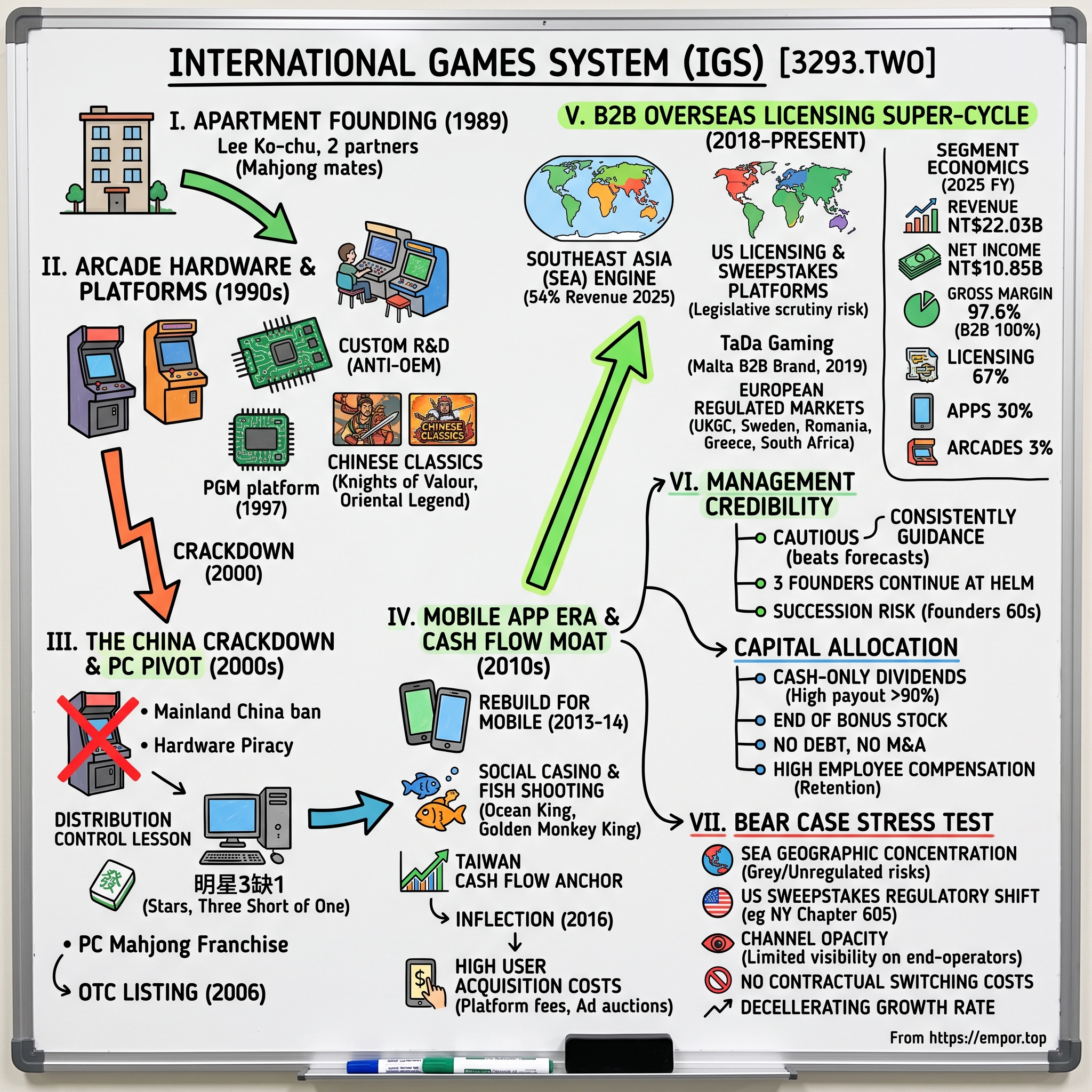
International Games System (3293.TWO): The Untold Story of the World's Highest-Margin Gaming Giant
I. Introduction & Episode Roadmap
There is a building on Wu-Gong Road in the Wugu District of New Taipei City that looks like nothing at all. It sits in an industrial zone north of the Tamsui River, surrounded by machine shops, logistics depots, and the low-slung concrete anonymity of Taiwanese light manufacturing. No campus. No sculpture garden. No lobby wall of framed magazine covers. If you drove past it, you would assume it made connectors, or injection-molded housings, or some other unglamorous component in somebody else's supply chain.
Inside, roughly eleven hundred people run what is, by gross margin, the most profitable publicly traded video game company on the planet.3
In its 2025 fiscal year, 鈊象電子 International Games System — IGS — generated NT$22.03 billion of revenue and kept NT$21.50 billion of it as gross profit. That is a gross margin of 97.6%. Operating income came in at NT$13.07 billion, an operating margin of 59.3%, and net income reached NT$10.85 billion, marking the first time the company cleared the NT$10 billion mark.4 For scale: Electronic Arts, Ubisoft, Take-Two, Nexon, and NetEase all run gross margins in a band from roughly 50% to 80%. A 97.6% gross margin means that for every hundred dollars of revenue, IGS spends about two dollars and forty cents producing what it sells.
That number is the hook. It is also, on its own, deeply misleading — and understanding why it is misleading is the real work of this story.
The stock. IGS trades as 3293.TWO on the 財團法人中華民國證券櫃檯買賣中心 Taipei Exchange, Taiwan's over-the-counter market, where it listed on July 12, 2006.3 It carries a market capitalization in the neighborhood of NT$219 billion — roughly US$7 billion — on 281.8 million shares.23 Taiwanese retail investors call it 遊戲股王, "the king of gaming stocks," a title earned less by size than by the fact that it has spent years as one of the highest-priced shares on the exchange.
The thesis under examination. The conventional telling of IGS is a pivot story: an arcade cabinet maker that became a PC game company that became a mobile app company that became a global business-to-business gambling content supplier, three existential transitions navigated across thirty-six years without ever raising dilutive outside capital and without ever carrying meaningful debt. At the end of 2025, the company held roughly NT$17.2 billion in cash and short-term investments against total debt of about NT$27 million — an amount so small it is essentially rounding error on lease obligations.4
All of that is true. But a pivot story is not an investment case, and this article is not written from management's side of the table. The harder questions are these: What is IGS actually selling in 2026, to whom, under what legal framework, and how durable is any of it? A 97.6% gross margin does not appear because a company is clever. It appears because a company has arranged to collect a fee while somebody else bears the cost — and in the licensing business, "somebody else" also tends to bear the regulatory exposure, the payment risk, and the customer relationship. That arrangement is enormously profitable right up until the moment a regulator decides the fee collector is a participant rather than a vendor.
What the company actually does, before the narrative starts. It is worth being unromantic about this at the outset. IGS today makes most of its money by building slot machines, fish-shooting games, and card games as software, then licensing that content to online gambling operators — predominantly in Southeast Asia, increasingly in Europe and North America — who put the games in front of players and take the bets. A smaller business sells the company's own social casino and mahjong apps directly to consumers, mostly in Taiwan. A vestigial business still ships physical arcade cabinets.10
This is a gambling supply company. Not a gaming company in the Nintendo sense, not a social app company in the Zynga sense. Every structural feature discussed in this article — the margin profile, the geographic concentration, the regulatory exposure, the opacity of the customer base — follows from that fact, and the analysis is impossible to do honestly without stating it plainly first.
The roadmap. This article walks through the hardware origins in Taiwan's electronics trade of the late 1980s and 1990s; the mainland Chinese arcade crackdown that killed the original business and forced a pivot into PC mahjong; the mobile app decade that built a domestic cash flow base in Taiwan; and the licensing super-cycle from 2019 onward that turned a NT$3 billion company into a NT$22 billion one. Then the focus turns analytical: the segment economics, the capital allocation record including the abrupt end of the "buy one get one free" stock dividend era, management's forecasting track record measured against what actually happened, the activist stress test, a structural read using Hamilton Helmer's 7 Powers and Porter's Five Forces, and the small number of indicators that actually matter for tracking this company from here.
It begins, as these stories usually do, with a few people who were good at a game.
 Subscribe on LinkedIn
II. The Apartment Hardware Era: 1989–2000
Picture a student cafeteria at 台灣工業技術學院, the Taiwan Institute of Technology, in the early 1980s. Four seats, a folding table, tiles clacking. Three engineering students — 李柯柱 Lee Ko-chu, 江順成 Chiang Shun-cheng, and 陳阿見 Chen A-chien — are ball-court partners and mahjong regulars, bound by the specific intimacy of losing money to each other repeatedly over four years.1
It is worth sitting with that image, because it is not decorative. Mahjong is a game of incomplete information, probability management, and reading the table. Four decades later, the company these three men built makes most of its money selling exactly that: the mathematics of games where the outcome is uncertain and the player keeps returning. The founders did not stumble into slot mathematics; they had been living inside the psychology of gambling-adjacent games since their student days.
The company was founded on November 10, 1989.3 Lee launched it with NT$500,000 — roughly US$19,000 at the time — out of a rented apartment. The initial business was utilitarian and unpretentious: repairing Japanese arcade circuit boards and trading electronic components.2 Taiwan in 1989 was the world's workshop for this trade. Japanese arcade operators shipped boards that broke, and technicians with soldering irons and logic analyzers built businesses fixing them.
Taipei in the late 1980s had entire commercial districts — such as the electronics bazaars around Guanghua and Zhonghua Road — devoted to components, cloned boards, salvaged chips, and the informal knowledge economy surrounding them. Hundreds of small firms operated like IGS. Almost all remained small, and most eventually disappeared. The defining question for IGS is not how it started, which was standard for the era, but why it avoided the fate of its peers.
The choice that shaped its trajectory was a refusal.
The refusal to be an OEM. Taiwan's electronics boom in the 1990s rested on a clear bargain: take contract manufacturing work, accept single-digit margins, build volume, and leave brand ownership and intellectual property to international clients. While that model generated substantial wealth across Taiwan, it also capped long-term corporate independence. Lee's stated philosophy, which he articulated repeatedly over subsequent decades, was blunt: without in-house R&D capability, "destiny remains in others' hands." From 1989 onward, IGS invested across the entire product stack — hardware, software, audio, visual art, 3D graphics, game design, and scripting — rather than specializing in a single contract-specified layer.2
To execute that strategy, Lee assembled his founding team. He recruited his mahjong partners: Chiang Shun-cheng, then a hardware engineer at Philips, and Chen A-chien, a firmware engineer at Sampo. Both left stable positions at established multinationals and took pay cuts to join an apartment startup.1 Decades later, all three remain at the helm — Lee as chairman, Chiang as general manager, and Chen overseeing the business group — maintaining a consistent division of labor: Chiang manages hardware and manufacturing, Chen directs software and firmware, and Lee leads business development.1
The PGM gambit. The technical culmination of the anti-OEM philosophy arrived in 1997 with the PolyGame Master, or PGM — a proprietary cartridge-based arcade system board designed to compete directly with SNK's Neo Geo MVS, then the dominant multi-game arcade platform in Asia.5 Developing a proprietary arcade architecture in 1997 was an ambitious, high-risk strategy for an eight-year-old firm. Neo Geo was the established industry standard, backed by deep operator inventory, existing cabinets, and entrenched commercial habits.
The economic logic behind the move explains the company's subsequent evolution. A contract manufacturer sells labor and capacity: its revenue is bounded by factory footprint, its margins are dictated by clients, and its competitive standing erodes as cheaper manufacturing centers emerge. A platform owner, by contrast, sells an ecosystem into which content flows, capturing a share of every game played. IGS chose the platform model at a time when local peers overwhelmingly chose contract manufacturing. It was the harder path: building an arcade platform required designing custom logic, sourcing components, authoring software tools, and convincing operators to buy hardware for an unproven game library.
What established the PGM platform was not the underlying silicon, but its software library. IGS developed a series of titles that became enduring hits across the Chinese-speaking world: 西遊釋厄傳 Oriental Legend in 1997, adapted from Journey to the West, and 三國戰紀 Knights of Valour in 1999, adapted from Romance of the Three Kingdoms and designed in the style of Capcom's side-scrolling beat-'em-ups.5 Rather than localizing Japanese imports, IGS rendered Chinese literary classics into four-player arcade brawlers that drew steady coin drops from players across Taiwan, Hong Kong, mainland China, and Southeast Asia. That legacy proved durable enough that in April 2023, IGS released eight PGM titles as the IGS Classic Arcade Collection on the Nintendo Switch.5
What the arcade era actually taught them. The crucial analytical lesson of this period lies beyond nostalgia.
An arcade cabinet operates as a direct economic test. Sitting on a commercial floor, it incurs daily rent for the operator. Its sole function is to convert player attention into continuous coin drops at a rate high enough to justify its footprint. If the difficulty curve is too steep, players walk away; if it is too forgiving, they finish the game without spending more. If the reward cadence is poorly calibrated, the cabinet becomes unviable within weeks and is replaced. The game mechanics must perform on their own merit, without marketing campaigns or digital re-engagement loops.
For eleven years, IGS refined this feedback loop across thousands of machines. In doing so, the company accumulated an institutional mastery of how to calibrate uncertainty, reward timing, and player retention. That core competency became its primary asset, laying the foundation for every digital product it sells in 2026.
The fish-shooting cabinet provides the clearest illustration of this transition. Designed around a shared tabletop screen, a fish-shooting machine charges credits per shot, with each target offering a payout multiplier governed by an underlying probability table. Mathematically, it is a multiplayer slot machine presented in an arcade format: the player experiences aim and skill, while the house edge is enforced by hit-probability algorithms. Creating a cabinet that operators retain requires balancing two competing demands — the player must feel a sense of active skill, while the machine must deliver a predictable operator margin. IGS perfected these mechanics physically long before migrating them to digital platforms. When TaDa Gaming later listed "fish-shooting titles" alongside slots and crash games in its European product portfolio,22 it was exporting an Asian arcade innovation into regulated Western online casinos.
By 2000, however, the physical venues that generated these cash flows faced sudden disruption — beginning in the company's most critical market.
III. The Great China Crackdown & The PC Pivot: 2000–2010
In June 2000, seven Chinese ministries—including Culture, Public Security, and the State Economic and Trade Commission—jointly issued a directive launching a crackdown on video game arcades. The official justification cited protecting minors from unsupervised venues and unhealthy content. In practice, the policy choked off mainland China's arcade parlor industry, which had served as the primary growth market for Taiwanese arcade hardware manufacturers.
For IGS, this regulatory shift created an existential challenge. Demand disappeared not because of superior competition or technological obsolescence, but through administrative enforcement. Its primary export market was administratively eliminated.
A second blow followed in short order: regional hardware cloning. Counterfeiters across Asia reverse-engineered PGM cartridges and produced low-cost knockoffs. A company whose strategic foundation rested on owning proprietary hardware and software architectures discovered that intellectual property carries little economic value without enforcement mechanism. The core business model—selling high-margin hardware boards and software cartridges into an expanding installed base—collapsed once supply control vanished.
This double failure exposed structural vulnerabilities in both revenue drivers. Regulatory enforcement eliminated the venue operators that purchased cabinets, while widespread piracy commoditized cartridges into software that could be copied onto blank boards for nominal cost. IGS could out-design competitors on game quality, but without distribution control or legal enforcement, it could no longer monetize that design edge.
The experience delivered a fundamental lesson: long-term value accrues where distribution is controlled rather than where content is created. In physical arcades, venue operators held the floor space and counterfeiters controlled board supply, leaving the software designer with minimal margin capture. Decades later, IGS structured its growth around supplying software to operators who manage distribution and regulatory exposure, rather than attempting to control distribution directly.
Choosing software over the sunk cost. Facing a severe contraction in arcade demand, many Taiwanese hardware makers defended their existing installed base—cutting costs, pursuing secondary markets in Southeast Asia and Latin America, litigating clones, and waiting for regulatory relief. Most eventually faded.
IGS chose instead to pivot toward PC software. In 2002, the company released its first PC network game, 明星三缺一 2002 ("Stars, Three Short of One"), referencing a mahjong table awaiting a fourth player.3 The core insight was that mahjong in Chinese-speaking markets operates as a social ritual, where the primary barrier to play is assembling four players. By digitizing the table and incorporating Taiwanese celebrity voice packs, IGS converted an offline social activity into an always-available digital service.
The title developed remarkable longevity. More than two decades after launch, 明星3缺1 still ranked as one of the company's top global revenue generators in early 2024, second only to Southeast Asian licensing.7
Why the pivot held. The success of the mahjong transition stemmed from domain continuity rather than luck. IGS did not enter an unfamiliar genre; it digitized the exact game its founders had played since their university days. The title relied on the same core mechanics that powered its arcade business: small, repeated payments driven by managed uncertainty. While the delivery channel shifted, the underlying mathematical and psychological design competence remained intact.
This established a recurring corporate pattern: IGS adapts its distribution channels aggressively while preserving its core design capabilities.
Commercially, however, the initial PC business yielded far lower margins than peak hardware sales. During the 2000s, Taiwan's PC gaming market was dominated by mass multiplayer online games and major publishers. A digital mahjong game with celebrity voice tracks was a niche product in a localized market. For years, IGS operated as a modestly profitable developer rather than a high-growth company; its dramatic compounding phase did not begin until roughly 2016. Investors evaluating the company in the years following its listing would have reasonably categorized it as a mature small-cap firm.
This history tempers romanticized pivot narratives. The company's evolution was not a series of flawless strategic leaps delivering instant returns. Each phase required managing a declining legacy business while building an unproven replacement funded by internal cash flow, with no external capital or performance guarantees. Survival depended less on sudden strategic brilliance than on patient execution enabled by founder control and a debt-free balance sheet.
Going public, quietly. IGS registered on Taiwan's emerging stock market in 2004 and listed on the Taipei Exchange on July 12, 2006, under ticker 3293.3 The listing was not an equity raise to fund aggressive expansion. Operating with roughly NT$1.9 billion in annual revenue as late as 2015, the company funded growth entirely from internal operations.4 Taiwanese OTC listings of that era served primarily as liquidity and credibility milestones for founder-led businesses rather than capital-raising vehicles.
This approach produced an unconventional capital structure: no acquisition debt, no convertible securities, no private equity governance, and no equity dilution. Because the founders never required external capital, they retained full operational control. That ownership structure shaped the company's long-term capital allocation strategy, while also generating governance questions regarding minority shareholder oversight.
The company's distribution policy originated during this period. IGS issued both cash and modest stock dividends in the second half of the 2000s—with stock distributions ranging from NT$0.50 to NT$1.50 per share—before transitioning to a cash-only payout model in the 2010s.15 Beyond the payout amounts, the critical metric is consistency: the company achieved twenty-four consecutive years of dividend distributions, maintaining payouts through two structural business model transitions.14 Payout discipline maintained during lean operational periods reflects capital allocation priorities that persisted as earnings expanded.
By 2010, IGS stood as a profitable PC game developer with a strong domestic mahjong franchise and a declining arcade unit. It was about to navigate another major industry transition, driven by the rapid spread of smartphones.
IV. The Mobile App Era & Taiwan Cash Flow Moat: 2010–2018
The second existential crisis arrived far more quietly than the Chinese arcade ban, making it all the more dangerous. No regulatory authority issued a directive that killed PC browser gaming; users simply stopped opening their laptops.
According to Chairman Lee Ko-chu, IGS's response required years of internal restructuring, dismantling and rebuilding its organization around mobile development in 2013 and 2014. The financial payoff did not arrive until 2016 — marking the first year revenue took a visible step up.2 For a company navigating its second major pivot, this entailed a three-year stretch of capital outlay against a market that had not yet materialized. The numbers from that transition were unflattering: 2014 revenue of NT$1.65 billion produced net income of just NT$228 million, while 2015 revenue of NT$1.92 billion produced NT$307 million.4 At that point, IGS remained a small-cap Taiwanese software developer operating with modest profits and an unproven long-term trajectory.
Rebuilding the catalog for a four-inch screen. Porting 明星3缺1 to iOS and Android provided the anchor, but the more consequential development was the surrounding portfolio, which revealed what IGS was actually becoming.
Alongside mahjong, the company built out a suite of social casino titles: 金猴爺 Golden Monkey King slots, 滿貫大亨 Full House Tycoon, 金好運 Golden Luck, and 海王寶藏 Ocean King — the last a mobile adaptation of the fish-shooting arcade cabinets that IGS had been building physically for years.16 By 2022, all of these ranked among the company's top mobile revenue generators.16
The adaptation of 海王寶藏 Ocean King was the most revealing of the group. Rendering a physical, four-player tabletop cabinet as a smartphone app was not an obvious port; the original cabinet's appeal depended on four strangers shooting at a shared screen in a public room. What survived the translation was not the social environment, but the underlying reward mathematics — the precise engineering domain where IGS held a deep competency. The company was discovering that its arcade assets were digitally portable in the single dimension hidden from view: the mathematical engine behind the game.
This shift reflected a deliberate evolution in product design. While 明星3缺1 was a skill-based social game, Golden Monkey King was a slot machine, and Ocean King brought coin-op wagering dynamics to mobile screens. Between 2012 and 2018, IGS quietly migrated the center of gravity of its catalog away from casual social gaming and toward casino mechanics — reel spins, progressive jackpots, and fish-shooting wagers — delivered as free-to-play mobile applications with in-app currency purchases. This was not a superficial rebrand. It was a company aligning its portfolio with its core mathematical capabilities and the higher-margin monetization curves those mechanics generate.
The 2016 inflection, and what it cost to get there. The mobile transition took roughly six years from the first serious effort to the first clear financial payoff.2 Over that span, IGS funded software migration while its legacy PC revenue eroded — a multi-year lag that would have tested the patience of public markets under an external management team. Revenue barely moved between 2014 and 2015, and net margins sat in the mid-teens — respectable for a small software firm, but modest compared to what the business eventually became.4
Then the business turned. Revenue jumped to roughly NT$3.32 billion in 2016 and net income to NT$890 million — nearly triple the prior year's profit on a 73% revenue increase, the signature of a fixed cost base suddenly carrying a much larger revenue line.4 The mobile portfolio had reached the scale where incremental players cost almost nothing to serve.
That inflection established a recurring structural pattern. The IGS business model involves long, capital-intensive incubation cycles that generate little immediate financial visibility, followed by sharp step-function growth once a new distribution channel reaches critical mass. It is an operational cadence that punishes short-term linear extrapolation.
The unit economics problem hiding inside the success. The Taiwanese mobile business was effective: it generated steady cash, required minimal capital, and retained a player base that had followed 明星3缺1 since the PC era. As recently as 2021, Taiwan alone accounted for roughly 40% of company revenue.16
Yet direct-to-consumer mobile gaming carries two structural burdens that game design skill cannot eliminate. The first is platform fees, as Apple and Google extract a commission on in-app purchases. The second, and more damaging, is user acquisition. In a free-to-play model, publishers acquire players through auction-based advertising inventory on platforms like Meta and Google, competing against every other publisher globally. The cost per install is dictated by the highest bidder in the category rather than internal operational efficiency.
The industry dynamics are illustrated by Playtika, the world's largest pure-play social casino operator. In its 2025 fiscal year, Playtika generated US$2.76 billion of revenue — and spent US$949.8 million on sales and marketing, up from US$705.0 million the year before. It reported a full-year net loss of US$206.4 million.20 Approximately thirty-four cents of every revenue dollar went strictly toward acquiring and retaining players.
That was the growth ceiling facing IGS around 2018. Taiwan, with a population of 23 million, was a fully saturated market for the company. Expanding the consumer model internationally meant bidding for players at global ad rates against competitors with vast marketing budgets in regions where IGS had no brand recognition.
A second operational constraint involved regulatory and overhead friction. Owning the end-user relationship requires publishers to manage age verification, responsible-gaming controls, payment processing disputes, data protection compliance, and localized regulatory oversight. A direct consumer model does not scale cleanly; it accumulates compliance overhead across every new jurisdiction.
The primary strength of IGS lay in crafting game mathematics. The remainder of the direct-to-consumer stack represented operational overhead it could not leverage and regulatory risk it could not easily price.
An alternative growth pathway remained. Having spent three decades building game mathematics that demonstrably retained players, IGS could stop acquiring consumers directly and instead license its core mathematical engine to operators who already managed active player bases.
V. The B2B Overseas Licensing Super-Cycle & TaDa Gaming: 2018–Present
The strategic shift underlying International Games System's current financial profile was straightforward and operational: the company transitioned from acting primarily as a direct game operator to supplying software content to third-party distributors.
Under this business model, an online gambling operator in a market such as Thailand, Brazil, or the United Kingdom maintains the platform infrastructure, payment gateways, marketing budgets, player acquisition channels, customer service, and local regulatory compliance. What the operator requires is a continuous pipeline of slot games, which drive the majority of wagering activity. IGS develops, certifies, and delivers the game software. The operator integrates the content, promotes it to end users, collects deposits, processes payouts, handles chargebacks, and addresses regulatory requirements, while IGS receives a contractual fee.
Because IGS does not fund direct user acquisition for these titles, its marketing expense against B2B revenue remains negligible. Because the core software engines are pre-built, incremental delivery costs are minimal. Consequently, management has characterized the gross margin of its B2B licensing segment as effectively 100%, compared to roughly 97% for the consolidated business.7 The company's high gross margin reflects a structure where user acquisition costs, payment processing fees, and operational overhead sit on the distributor's balance sheet rather than IGS's income statement.
The pricing model is stranger than it looks.
While conventional software licensing often relies on a continuous revenue-share arrangement, IGS structures its distributor agreements around negotiated fixed licensing fees reset on a quarterly or semi-annual basis. IGS does not manage the distributor's daily operations. However, contracts require partners to submit monthly traffic and wagering data for all IGS titles. The company uses this performance data both to recalibrate fee levels during upcoming contract renewals and to guide future game design.67
This mechanism carries distinct strategic tradeoffs. On one hand, IGS's revenue is not directly tied to short-term fluctuations in player losses during any single month. Contracted fees smooth cash flows and insulate the firm from isolated distributor operational setbacks. Additionally, aggregating player traffic data across hundreds of operators provides IGS with centralized analytical insight into player behavior without taking on direct customer-facing overhead.
On the other hand, the structure requires frequent fee renegotiations two to four times per year with operators that also host competing software vendors. Maintaining pricing power depends on whether IGS titles consistently outperform competing games on the same platform. That leverage must be re-established during each renewal cycle, and because performance metrics remain proprietary to IGS and its partners, the underlying traffic trends are not visible to public market investors.
Southeast Asia: the engine nobody outside Taiwan saw coming.
The geographic distribution of IGS's revenue shifted significantly between 2021 and 2025. In 2021, Taiwan generated approximately 40% of total revenue, while mainland China, the United States, and Southeast Asia contributed roughly 20% each.16 By full-year 2023, Southeast Asia accounted for 31% of revenue compared to Taiwan's 34%, with mainland China at 16% and the United States at 15%.7 Southeast Asia's share expanded to approximately 40% in 2024,9 reached 52% in the first two months of 2025,8 and settled at roughly 54% for full-year 2025, while Taiwan declined to 21% and the United States stood at 10%.11
Over a four-year period, IGS transformed from a domestic Taiwanese developer with international exposure into a Southeast Asia-centric B2B supplier headquartered in Taiwan.
Two structural shifts in this geographic realignment warrant analytical emphasis. First, revenue from mainland China decreased as a proportion of total sales, falling from 20% in 2021 to 16% in 2023 and approximately 12% in 2024,1679 before dropping out of headline segment disclosures. This rebalancing reflects rapid expansion in Southeast Asia rather than an explicit operational retreat, as a stable revenue stream shrank relative to a growing top line. Nevertheless, the shift reduced the company's relative exposure to mainland Chinese regulatory conditions during a period of heightened cross-strait geopolitical tension.
Second, the company's product hierarchy reordered rapidly. In early 2024, IGS's largest revenue generators were Southeast Asian licensing, 明星3缺1, United States licensing, and domestic slot titles, in that order.7 By early 2025, licensing lines occupied two of the top three positions.8 The flagship mahjong title that anchored the company's initial digital pivot in 2002 remains a profitable legacy asset, but it no longer represents the primary growth driver.
Management has acknowledged that IGS entered Southeast Asian markets as a late entrant, attributing revenue gains to product competitiveness and market share capture from established incumbents rather than general market expansion.7 That assessment aligns with reporting trends: the growth rate outpaced broader regional market expansion and occurred while domestic and mainland Chinese revenue shares were contracting.
TaDa Gaming and the regulated-market project.
A substantial portion of Southeast Asian online gambling activity occurs within grey and unregulated legal jurisdictions, presenting ongoing valuation discounts and regulatory tail risks. To establish exposure in compliance-heavy Western jurisdictions, IGS founded TaDa Gaming in 2019 as a Malta-based B2B corporate brand.18
The regulatory approval process in Europe has progressed deliberately. IGS secured a B2B licence from the Malta Gaming Authority in September 2023, with twenty games cleared following technical review, and initiated distributor partnerships for a fourth-quarter 2023 launch, while management advised investors that substantial European revenue contributions would require eighteen to forty-eight months to materialize.6 Subsequent licensing approvals were granted by Sweden's Spelinspektionen, Romania's ONJN, and the Hellenic Gaming Commission in Greece. The United Kingdom Gambling Commission licence — covering a jurisdiction management estimated at roughly 30% of the European online gambling market — was issued in 2025.818 Regulatory access was extended to Italy and Spain by late 2025,10 and South Africa granted a licence in early 2026, with management projecting initial revenue contributions before year-end.13
TaDa distributes a portfolio comprising slot titles, fish-shooting games, and crash games. Chief Executive Andy Huang highlighted the UKGC authorization as validation under a rigorous regulatory framework, while Business Development Director Ray Lee described a localized product strategy combining standardized game engines with region-specific audio-visual assets.18
Despite these regulatory approvals, Western market expansion remains in an early stage. Combined revenue from European and secondary markets expanded by approximately one percentage point annually through early 2025.8 While bullish forecasts frame Western regulated markets as the next long-term growth driver, current financial disclosures show that European operations represent an emerging operational initiative rather than a major earnings contributor.
North America and the sweepstakes question.
IGS entered the United States market around 2019, taking advantage of increased demand for online gaming during pandemic lockdowns.2 The company supplies game software to social casino and sweepstakes platforms operating under a legal framework where users purchase non-redeemable virtual currency and receive promotional entries that can be converted to cash prizes.
Management commentary regarding North American prospects remained cautious through mid-2024. During a September 2023 investor conference, executives characterized the United States market as mature and stable, noting slower-than-projected mobile expansion.6 In March 2024, management reiterated that the market faced structural entry barriers and anticipated plateauing growth.7 However, following the late-2024 launch of a dedicated United States TaDa integration platform designed to accelerate operator onboarding,8 North American revenue accelerated, reaching record levels by the March 2026 investor conference.21
This revenue acceleration coincided with heightened legislative scrutiny, as several United States state legislatures introduced measures restricting sweepstakes gaming frameworks. That regulatory collision represents a key structural vulnerability for the North American segment.
The financial result.
Financial performance over this period reflected a structural change in operating leverage. Annual revenue expanded from NT$3.07 billion in 2018 to NT$5.29 billion in 2019, NT$8.43 billion in 2020, and NT$11.29 billion in 2021, before rising to NT$11.95 billion in 2022, NT$14.18 billion in 2023, NT$18.51 billion in 2024, and NT$22.03 billion in 2025.4 Net income increased from NT$877 million to NT$10.85 billion over the same period — representing approximately a twelvefold expansion in net profit alongside a sevenfold increase in top-line revenue.4
This profit expansion outpaced top-line growth due to shifts in business segment mix. Consolidated gross margin increased from approximately 88% in 2018 to 97.6% in 2025 as low-margin physical arcade sales declined relative to high-margin B2B software licensing.4
The expanding cash flows generated by this transition directed market focus toward management's capital allocation strategy, which presented distinct governance considerations alongside operating growth.
VI. Segment Economics & Capital Allocation Mechanics
A company's segment disclosures often reveal its true trajectory far more clearly than a corporate strategy deck. At IGS, reporting across its three operating lines shows where future value is concentrating.
Three businesses, moving in three directions. IGS reports results across three segments: online game licensing, online game apps, and commercial arcade machines (商用遊戲機). In 2023, apps generated 50% of revenue, licensing contributed 43%, and arcades accounted for 7%.7 By December 2024, licensing had expanded to 63% of sales, while apps fell to 31% and arcades to 6%.9 Across full-year 2025, the split settled at roughly 67% licensing, 30% apps, and 3% arcades.10 Through the first two months of 2026, licensing represented 64% of total revenue,21 with Chairman Lee Ko-chu guiding for licensing to exceed 70% of full-year 2026 sales.13
That trajectory highlights an operational reality that optimistic narratives often gloss over: the consumer app business is stagnating. While its relative revenue share fell primarily because licensing expanded so rapidly, a segment that dropped from 50% to 30% of sales while overall corporate revenue roughly doubled represents, at best, modest absolute growth. The Taiwanese consumer app business operates as a mature cash generator rather than a growth engine. Evaluating IGS as an investment thesis requires underwriting the B2B licensing business above all else.
The arcade division has diminished to a legacy contribution—representing 3% of revenue and continuing to contract—with management noting that U.S. tariffs pressured arcade machine exports to North America while describing the overall financial impact of tariffs as insignificant.10 The unit survives less as a commercial driver than as the historical incubator of the game mathematics and design capabilities that now power the licensing segment.
Money per person. Operating leverage at IGS is illustrated most directly by its employee productivity metrics. As of March 31, 2024, the company employed 1,130 people.17 On full-year 2025 revenue of approximately NT$22.03 billion, that equates to roughly NT$18 million—or well over US$500,000—in revenue per worker, with nearly the entire amount converting directly to gross profit.
IGS shares those returns directly with its workforce. For fiscal 2024, the company distributed NT$2.768 billion in employee compensation, a 41% year-over-year increase that averaged approximately NT$2.45 million per employee—equivalent, according to local financial reports, to roughly 49 months of a standard NT$50,000 base monthly salary.17 In 2023, average employee compensation reached NT$3.167 million, ranking second among all companies listed on the Taipei Exchange.2
This compensation structure carries clear strategic implications. The company's primary competitive advantage rests on specialized institutional knowledge of game mathematics and player psychology—assets embodied entirely in its engineering talent. Compensation at the top percentile of the Taiwanese technology sector represents the essential maintenance cost of protecting that intellectual capital. It also establishes a permanent claim on corporate cash flows, committing approximately 20% of pre-bonus operating profits to employee retention each year.
What the company did not do. The defining element of capital allocation at IGS is what management chose to avoid: the company has made no major corporate acquisitions.
This stands in sharp contrast to global industry peers. The digital gaming and casino sectors underwent extensive M&A consolidation over the past decade, characterized by Light & Wonder's separation from Scientific Games, Aristocrat's digital acquisitions, and Playtika's aggressive studio roll-ups. Much of that transaction activity relied on leverage; Playtika's 2025 net loss resulted in part from a non-cash remeasurement of earnout obligations tied to its SuperPlay acquisition.20
By avoiding debt-funded acquisitions, IGS closed 2025 with NT$17.2 billion in cash and short-term investments against negligible debt.4 Set against shareholders' equity of NT$19.06 billion and average annual equity of approximately NT$17.7 billion, net income of NT$10.85 billion produced a return on equity near 60%—a metric mechanically elevated by management's policy of maintaining a lean equity base through near-total dividend distributions.4
The dividend record and the "buy one get one free" era. IGS maintained uninterrupted annual dividend distributions for twenty-four consecutive years.14 The payout expanded rapidly over the past decade: NT$10 per share in 2016, NT$11 annually in 2017 and 2018, NT$25 in 2019, NT$42 in 2020, and NT$50 in cash alongside a NT$10 stock dividend in 2021.14
Under Taiwan's par-value regulatory convention, a NT$10 stock dividend on shares with a NT$10 par value represents a one-for-one bonus issue that doubles total share count. The 2021 distribution marked the company's first stock dividend in thirteen years, intended by management to expand the capital base and improve trading liquidity after share price appreciation raised the entry cost for retail investors buying standard round lots.16 Management repeated the structure for fiscal 2023, issuing NT$35 in cash alongside another one-for-one stock distribution that went ex-dividend on July 24, 2024.14 Paid-in capital consequently expanded from NT$1.409 billion at year-end 2023 to NT$2.818 billion at year-end 2024.4
Retail investors responded enthusiastically to the distributions, which earned the local moniker 買一送一 ("buy one, get one free"). Over time, retail market expectations treated bonus stock issues as permanent capital allocation policy rather than periodic balance-sheet adjustments.
That practice ended abruptly. For fiscal 2024, IGS declared a cash dividend of NT$29 per share with no stock component. For fiscal 2025, it declared NT$36 in cash—again without stock distributions—which went ex-dividend on July 8, 2026.14 During its March 2025 investor conference, management announced that stock distributions would cease, establishing cash dividends near 100% of net income as the sole return mechanism. The stock dropped over 4% in the following trading session,8 and Chairman Lee confirmed that bonus share issues would not resume in the near term.
Evaluating the shift. Analyzing this market reaction requires separating economic reality from retail sentiment. A stock dividend creates no operational value, reallocating existing equity across a larger number of shares. The market selloff reflected retail disappointment over the end of bonus shares rather than fundamental deterioration. For context, reported 2021 earnings per share of NT$67.21 adjusted to NT$16.80 on a comparable share count following the two subsequent bonus distributions—reflecting identical underlying net income distributed across four times as many shares.164
However, retail sentiment remains a relevant market dynamic. The adverse trading reaction indicated that a segment of the shareholder base owned the stock for distribution mechanics rather than core B2B licensing fundamentals. Conversely, management's decision to discontinue bonus distributions demonstrated a willingness to eliminate cosmetic share adjustments, accepting short-term market friction to establish a simplified capital return framework.
The key capital allocation metric is the cash payout ratio. Distributing NT$36 per share against fiscal 2025 earnings per share of NT$38.51 equates to a cash return of roughly 93% of net income.414 That high payout ratio signals that management sees limited opportunities to reinvest incremental capital internally at superior rates of return. For an asset-light software licensor requiring minimal capital expenditure, that discipline aligns with business economics. However, it also dictates that future earnings expansion must depend on organic market execution funded through current R&D spending, as the company is accumulating neither cash reserves nor M&A optionality.
Reinvestment occurs primarily on the research and development line. While a 93% payout ratio might suggest capital harvesting, historical financial statements indicate ongoing reinvestment. R&D expenditure expanded from approximately NT$835 million in 2018 to NT$4.06 billion in 2024, growing in line with top-line revenue.4 Rather than curtailing product development to sustain dividend payments, IGS fully funds its engineering operations and distributes remaining cash flow.
This distinction is central to evaluating the company's expansion runway. Geographic growth into Europe, Ontario, and South Africa is funded directly from operating cash flow, meaning the pace of market entry is constrained not by capital availability, but by development bandwidth and regulatory licensing timelines. Both constraints are tied directly to human talent—making its 1,130-person workforce, rather than its NT$17.2 billion liquid asset reserve, the company's primary limiting factor.
Which raises the key question of whether management's track record justifies investor confidence as market expansion continues.
VII. Management Credibility & Skeptical Investor Stress Test
The most useful way to assess an executive team is not to read forward-looking statements in investor decks. It is to evaluate historical guidance against subsequent operational execution.
IGS provides a clear natural experiment.
The forecasting record: consistently, systematically too cautious. At the September 27, 2023 investor conference, with the licensing business already accelerating, management informed investors that high comparison bases required prioritizing operational stability over growth, describing opportunities in new markets as limited.6 Instead, full-year 2024 revenue expanded 30.6% to NT$18.51 billion, while net income climbed roughly 41% to NT$9.06 billion.9 Pre-tax profit crossed the NT$10 billion threshold for the first time, rising 41.1% year over year.9
The pattern repeated the following year. At the March 25, 2025 conference, executives again signaled that growth would moderate given elevated comparables—a cautious outlook that sent the stock down more than 4% in the following session.8 Yet full-year 2025 revenue reached NT$22.03 billion, up approximately 19%, while net income expanded roughly 20% to NT$10.85 billion.4
Two consecutive years of understated guidance followed by material operational beats represent a distinct corporate pattern. Systematically conservative guidance is preferable to chronic overpromising, particularly among companies with retail-heavy shareholder registers where management faces persistent pressure to project aggressive expansion. IGS executives have repeatedly accepted short-term stock pressure rather than commit to financial targets lacking high internal confidence.
However, persistent conservatism reduces the informational value of forward commentary. If management's public outlook consistently understates performance, guidance ceases to function as an effective analytical benchmark. When Chairman Lee Ko-chu forecasts that licensing will exceed 70% of full-year 2026 revenue,13 analysts cannot straightforwardly model that figure as a baseline, given that the same leadership team characterized large-scale expansion in new markets as unlikely in late 2023.
A secondary, less flattering interpretation also exists. A supplier that consistently exceeds its own guidance while controlling contract pricing resets and receiving real-time player data may simply maintain higher operational visibility than it discloses publicly. IGS provides limited disclosure compared to developed-market standards: it conducts no Western-style quarterly earnings calls, provides no detailed operator concentration figures, and omits breakdowns of licensing revenue by counterparty or contract structure. Taiwanese institutional conference practice is inherently less granular than U.S. or European reporting standards, and IGS does not go beyond local regulatory baselines. While the company publishes monthly revenue reports and maintains an English investor relations portal,[^22] substantive operational context—such as regional revenue splits and forward segment mix—is provided only once or twice annually at Mandarin-language conferences, reaching international markets through third-party brokerage summaries rather than published company transcripts.
For international institutional investors, this disclosure friction limits analytical transparency and contributes to the company's light global research coverage. It also means the external record relies on secondary reporting. References to management statements at specific conferences reflect reporting by attendees and local financial media rather than official company transcripts.
What management does say, consistently. Across investor conferences from 2023 through 2026, three strategic themes have remained constant. First, executives prioritize geographic diversification over top-line growth rates.6 Second, management maintains that Western licensing expansion will proceed gradually due to regulatory friction and competitive intensity, rather than through rapid market penetration.7 Third, leadership refrains from issuing precise numerical targets. This messaging has remained stable, with no abrupt strategic reversals, quietly abandoned targets, or re-framed earnings misses.
The principal inconsistency in management commentary involves the North American market. Executives characterized the United States as "mature and plateauing" in 2023 and 2024,67 before describing it as a record-setting growth story by the March 2026 investor conference.21 Public disclosures did not explicitly reconcile this shift. One contributing factor was the launch of the dedicated U.S. TaDa integration platform, which accelerated operator onboarding.8 Another driver was rapid broader growth across the U.S. sweepstakes sector during the same period. Management has not disaggregated revenue between these drivers, making it difficult to evaluate the long-term durability of North American sales.
The activist case, taken seriously. A skeptical institutional analyst evaluating IGS would highlight several structural vulnerabilities in its operational profile.
Channel opacity is the central issue. B2B licensing generates roughly two-thirds of group revenue, with more than half originating in Southeast Asia, where online gambling regulations vary widely across jurisdictions. Management describes IGS as a software content supplier that collects contractual fees and receives monthly traffic reports without managing distributor operations.6 While this structure creates a clear legal boundary, it also limits external visibility. Outside investors cannot independently verify end-operator identities, local licensing status, player fund segregation, age verification compliance, or the proportion of wagering activity occurring in regulated versus grey jurisdictions. The company does not disclose customer concentration, leaving open the possibility that a small group of regional distributors generates a significant share of consolidated revenue without public market visibility.
U.S. sweepstakes exposure represents an active regulatory vulnerability. Legislative bodies across multiple U.S. states have enacted restrictions on dual-currency sweepstakes casino models, writing statutes that extend regulatory oversight to software and content suppliers. In New York, Senate Bill S.5935A was signed into law as Chapter 605 on December 8, 2025, prohibiting the operation, promotion, or profiting from dual-currency online sweepstakes games, establishing penalties ranging from US$10,000 to US$100,000 per violation and vesting enforcement authority in the State Gaming Commission, State Police, and Attorney General.19 Similar restrictive measures have been enacted or enforced in Montana, Connecticut, California, Michigan, Idaho, Louisiana, Nevada, New Jersey, Tennessee, Indiana, and Washington.
Because these statutes target software licensors alongside operators, content suppliers face direct legal exposure regardless of whether they handle customer wagers. This regulatory shift directly impacts the region driving IGS's strongest recent revenue acceleration.21 The company has not disaggregated its U.S. revenue across sweepstakes platforms, licensed real-money operators, and non-monetized social casino applications—leaving a material gap between a highlighted growth segment and an escalating state-level regulatory challenge.
Concentration on a single growth driver. With Southeast Asia generating 54% of sales,11 and B2B licensing contributing roughly two-thirds of revenue on a trajectory toward 70%,13 a major regulatory shift by a single regional authority could affect a substantial portion of group earnings. While IGS successfully navigated the loss of its Chinese arcade business in 2000 through a multi-year pivot, historical adaptability does not constitute an operational hedge against sudden policy changes.
Governance and founder concentration. The three founders who launched the company in 1989 continue to serve simultaneously as chairman, general manager, and business group general manager.1 The company has disclosed no formal succession framework for an executive team now in their sixties. While thirty-six years of leadership continuity without restructuring or governance disputes represents a notable record, it also introduces key-person risk tied to institutional knowledge that remains concentrated within a small core leadership group.
What the bear case lacks. A balanced assessment must also recognize the structural strengths that limit traditional short thesis arguments. The company maintains conservative accounting practices, recognizing revenue strictly as contracted licensing fees. Accounts receivable at year-end 2025 stood at NT$2.11 billion against NT$22.03 billion in revenue—representing approximately 35 days of sales—and the balance sheet carries zero goodwill due to the absence of speculative acquisitions.4 IGS operates with no debt, no refinancing exposure, and no debt covenants, supported by a transparent capital allocation model. Fundamental risks to the business stem from regulatory and channel dynamics rather than balance sheet fragility.
This leaves the central analytical question: whether International Games System's high profitability reflects structural competitive moats or temporary positioning in a favorable market environment.
VIII. Strategic Playbook & Helmer's 7 Powers Analysis
Strip away the margin theatrics and ask the central question for any long-term investor: if a well-capitalized competitor decided to target IGS's market share, what structural barriers would stand in the way?
Process Power — the strongest claim, and the hardest to verify. Hamilton Helmer's Process Power describes an organizational capability that competitors cannot readily replicate even with full visibility, because the institutional knowledge is tacit and accumulates over decades.
For IGS, that capability is a thirty-six-year history of calibrating game mathematics to drive sustained player engagement. That process began on physical arcade cabinets where performance feedback was immediate, extended through PC and mobile titles, and is currently expressed through slot mathematics and reward schedules licensed to operators globally. While a competent studio can build a slot game in months, creating a library of hundreds of titles with retention mechanics validated across diverse geographic markets—supported by operational performance data from distribution partners—requires a far longer investment horizon.67
The empirical evidence supporting this advantage is indirect. IGS expanded into Southeast Asia as a late entrant and captured market share, a gain management attributes to product competitiveness.7 Similarly, 明星3缺1 has maintained a top-tier revenue rank for over two decades.7 While these outcomes demonstrate commercial execution, they do not conclusively prove that the underlying capabilities are impossible to replicate.
The clearest limitation of this thesis is the deliberate pace of Western market expansion. European operations have required several years to generate material top-line contributions,8 suggesting that the company's design expertise is at least partially cultural and regional, rather than a universally applicable mastery of game mathematics. Process power that remains geographically bound is inherently constrained.
Counter-Positioning — real, and structurally the most compelling power. Counter-Positioning occurs when an incumbent cannot adopt a challenger's business model without damaging its existing economic structure.
IGS operates a B2B licensing model with negligible direct user acquisition costs. By contrast, traditional social casino operators function as B2C publishers whose largest expense is player acquisition—evidenced by Playtika spending nearly $1 billion ($949.8 million) on sales and marketing in 2025 to support $2.76 billion in revenue.20 For a B2C publisher to transition into a B2B supplier requires competing with its own customer base, cannibalizing self-funded user networks, and replacing substantial gross revenue with smaller, higher-margin licensing fees that public equity markets typically penalize during the transition.
However, counter-positioning offers protection primarily against B2C operators moving upstream. It provides no structural defense against established B2B suppliers—such as Pragmatic Play, Evolution, or Light & Wonder's digital division—that already operate under the same high-margin licensing economics.
Scale Economies — present but modest. Because software development represents a fixed cost and digital distribution incurs negligible marginal expense, incremental licensing revenue translates efficiently into operating income. Operating margins expanded from roughly 31% in 2018 to 59.3% in 2025 as total revenue grew.4
Yet the relevant metric in content supply is content throughput per market rather than aggregate corporate revenue. Competitors like Evolution and Pragmatic Play maintain larger footprints across regulated Western jurisdictions. IGS's scale advantage is concentrated in regional Asian markets, while its expanding R&D expenditure indicates that entering new jurisdictions requires ongoing capital allocation for localized product adaptation.10
Branding — thin, and acknowledged. While the TaDa brand is building recognition among European aggregators and its regulatory certifications serve as quality signals,18 B2B gambling supply is fundamentally not a brand-driven business. Operators select titles based on measured performance within their specific player cohorts. A supplier's brand identity facilitates initial platform integration, but ongoing player retention determines long-term commercial placement.
Switching Costs — weak. The absence of switching costs represents a notable vulnerability in the company's competitive position. Operators integrating TaDa software via content aggregators face low technical friction to swap or reorder content. Digital platforms routinely host dozens of game suppliers simultaneously, adjusting lobby placement based on real-time earnings metrics. Because contractual agreements involve periodic fee resets, IGS must continually justify its commercial terms through sustained player engagement. This dynamic explains why systematic collection of monthly wagering performance data is essential to the company's renewal negotiations.
Porter's Five Forces Framework.
Threat of new entrants: low-to-moderate. Securing regulatory licenses across jurisdictions such as Malta, the United Kingdom, Sweden, Romania, Greece, Ontario, and South Africa involves significant administrative timelines and financial costs. For example, IGS required two years, from September 2023 to 2025, to progress from its initial Malta Gaming Authority authorization to UKGC approval.618 Independent testing and certification of random number generator software present additional entry barriers. However, these obstacles are financial and operational rather than insurmountable, as numerous content studios have completed the process.
Bargaining power of buyers: high. Operators and content aggregators can substitute game libraries with minimal friction, distribute competing titles concurrently, and negotiate licensing terms during regular renewal windows. IGS's primary counterweight is documented player retention, which must be sustained across successive content releases.
Bargaining power of suppliers: negligible. IGS develops its software in-house across the product stack—including game engines, graphics, audio, and mathematical logic—without reliance on third-party game engine licenses.2 This independence reflects the long-term execution of the founder-led strategy initiated in 1989, insulating the company from third-party middleware fees or platform policy shifts.
Threat of substitutes: moderate and rising. Online slot games compete directly with alternative digital entertainment formats for player spend, including sports wagering, live dealer casino streams, crash games, and prediction platforms. Live dealer gaming in particular has captured a growing share of online casino activity over the past decade, representing a vertical in which IGS does not maintain a product offering.
Rivalry: intense. B2B gaming content supply remains a fragmented market featuring well-capitalized global providers alongside specialized independent studios.
Clarifying the peer group. Industry analyses frequently group IGS alongside pure-play social casino operators like Playtika. That comparison is economically outdated. Social casino operators run direct-to-consumer businesses dominated by user acquisition overhead, whereas IGS has increasingly focused on B2B software supply outside Taiwan. The appropriate operational benchmark consists of specialized B2B content licensors. Compared to this group, IGS's gross margin profile aligns with standard B2B licensing economics: its market position is highly concentrated in Asia, while its presence in Western regulated markets remains in a setup phase relative to established category leaders.
Evaluating technology risk. Generative artificial intelligence tools are lowering software production costs across the gaming industry, particularly in asset creation and foundational mathematical design. If automated tools reduce the capital required to produce functional slot content, the value of static game libraries could compress over time. The counter-argument is that AI generation cannot replicate multi-market player behavioral datasets or substitute for regulatory licensing frameworks. While technology risk presents no immediate threat to near-term earnings, it represents a long-term strategic variable that management has not formally addressed in public disclosures.
Strategic synthesis. The financial efficiency of International Games System is fundamentally a function of its operating model—supplying licensed software rather than managing consumer-facing platforms—a structural benefit shared by all B2B licensors. The company's core differentiation rests on three elements: deep operational scale across Asian markets, an extensive content library refined through decades of player data, and a debt-free capital structure maintained through rigorous cost discipline. What the model does not provide is contractual lock-in or structural protection against competitors that develop higher-performing content.
IX. Strategic Position, KPIs & Bull vs. Bear Case
The most disciplined approach for a long-term investor analyzing International Games System is to look past short-term commentary and track three critical metrics.
KPI 1: Overseas licensing revenue as a share of total, and its absolute growth rate. This metric encapsulates the entire investment thesis. Licensing expanded from 43% of total revenue in 2023 to 63% by December 2024, and reached roughly 67% across full-year 2025, with management guiding for the segment to exceed 70% in 2026.791013 IGS publishes monthly sales figures on its investor relations portal,12 disclosing its segment mix during periodic investor conferences. The key variable is not merely the licensing share drifting higher—which occurs mechanically as the consumer app business flatlines—but whether licensing revenue continues to compound at double-digit rates in absolute terms after easy market share gains in Southeast Asia taper off. Performance during the first half of 2026 provides a benchmark: monthly revenue ranged from NT$1.99 billion in January to NT$2.17 billion in June, maintaining year-over-year monthly growth between 12% and 19%—a deceleration from the 30% expansion recorded in 2024, but still reflecting solid momentum.12
KPI 2: Geographic composition, specifically Southeast Asia's share and Western market expansion. Southeast Asia, accounting for roughly 54% of revenue, serves as both the company's primary growth engine and its main concentration risk.11 The bull case requires regulated European and North American markets to mature into a second growth pillar. The key operational test is whether the combined revenue share from Europe and North America expands meaningfully over the next several years, or continues creeping upward by one to two percentage points annually, as observed through early 2025.8 While regulatory license approvals serve as a leading indicator, securing a license merely grants permission to compete rather than guaranteeing commercial traction.
KPI 3: Gross and operating margin stability. Gross margin has consistently ranged between 96% and 98%, while operating margin has climbed above 59%.4 Margins provide the earliest signal of business model health. If IGS is forced to discount licensing fees to preserve lobby placement against competitors like Pragmatic Play, or if entering regulated Western markets requires sustained increases in compliance and localization expenses, operating margins will contract well before top-line revenue reflects the shift. A persistent decline in gross margin below the mid-90s, or a sustained contraction in operating margin alongside revenue growth, would offer clear evidence that pricing power is eroding.
Everything else—dividend announcements, short-term share price fluctuations, and retail trading sentiment—is secondary to these core indicators.
Myth versus reality. Four prevailing market assumptions about the company require scrutiny against the empirical record.
Myth: A 98% gross margin proves an unassailable competitive moat. Reality: It reflects structural positioning within the supply chain. Pure-play business-to-business content suppliers across the online gambling industry enjoy similar margin economics because operators absorb player acquisition costs, payment processing fees, and regulatory exposure. What distinguishes IGS is its regional scale in Asia and its proprietary game library, rather than its gross margin profile—a margin that would look identical at a supplier with inferior content and weaker commercial prospects.
Myth: IGS is primarily a Taiwanese domestic gaming firm. Reality: It is a Taiwan-headquartered software exporter centered on Southeast Asia, where more than half of its revenue originates.11 Domestic Taiwanese mobile apps have declined to approximately 30% of sales and no longer drive growth.10 Valuing the company based on Taiwan's demographic trends or domestic consumer economy misinterprets its operational model.
Myth: The company's arcade origins are historical nostalgia with no current relevance. Reality: The fish-shooting format that IGS now licenses into regulated European casinos originated on Asian arcade floors. The company's core competency in game mathematics was developed through a decade of physical cabinet performance loops that software-native competitors never operated. While physical arcades account for just 3% of revenue, they represent a foundational element of its product design capability.
Myth: Conservative management guidance reflects underlying operational uncertainty. Reality: Two consecutive years of management projecting growth moderation, followed by actual revenue gains of 30% and 19%, indicate a deliberate communication strategy rather than limited visibility.694 Consequently, management guidance functions as an operational floor rather than an explicit forecast—meaning a firm equipped with real-time monthly traffic telemetry across its licensee base maintains greater forward visibility than its public statements suggest.
The bull case, stated at its strongest. IGS operates a scalable model: design slot and fish-shooting content refined by decades of behavioral data, secure supplier licenses in target jurisdictions, partner with local distributors, and allow minimal incremental delivery costs to convert top-line growth into operating profit. The company executed this strategy in Southeast Asia, advancing from a late entrant to generating the majority of its sales within four years.711 It now holds regulatory approvals across Malta, the United Kingdom, Sweden, Romania, Greece, Italy, Spain, Ontario, and South Africa,101318 establishing the framework that preceded its Southeast Asian expansion. Supported by NT$17.2 billion in liquid assets and virtually no debt,4 IGS can fully fund its Western expansion from cash flow while distributing over 90% of earnings to shareholders14—a financial position unmatched by leveraged Western peers. Furthermore, the founding executive team has maintained thirty-six years of disciplined capital allocation.
The bear case, stated at its strongest. Roughly two-thirds of group revenue depends on third-party operators in jurisdictions where online gambling laws remain ambiguous, opaque to external analysis, and vulnerable to policy reversals—a regulatory risk that previously eliminated the company's Chinese arcade business in 2000. In North America, growth faces expanding state-level legislation designed to target content licensors alongside operators, exemplified by New York's Chapter 605.19 Simultaneously, the consumer app segment has flatlined, and the core licensing moat relies on content quality that must be re-established during frequent fee renegotiations without contractual switching costs. Revenue growth is decelerating—from 31% in 2024 to 19% in 2025, and into the mid-teens during the first half of 2026412—a trajectory that equity markets evaluating high-margin compounders rarely re-rate upward. Finally, a cash payout ratio near 100% leaves limited capital reserves or M&A flexibility if a key market encounters sudden disruption.
The deceleration question, stated precisely. The critical analytical consideration for investors is not whether top-line expansion continues, but the rate at which it stabilizes. Revenue grew approximately 31% in 2024 and 19% in 2025, while first-half 2026 growth settled into the mid-teens, with monthly year-over-year increases ranging between 12% and 19%.412 Earnings growth tracked a similar path, with first-quarter 2026 net income rising roughly 20% year over year.13
While compounding in the mid-to-high teens on a NT$22 billion base reflects strong operating execution, the mathematical impact of market saturation in Southeast Asia remains central. With Southeast Asia accounting for 54% of sales,11 incremental share gains in the region have a diminishing impact on consolidated growth, causing overall expansion to converge toward baseline market growth. As a result, long-term growth depends on European and North American markets contributing meaningfully to offset maturing core regions—a hypothesis that will be tested in geographic segment updates at upcoming investor conferences.
Risk radar, focused on material exposures. Foreign exchange fluctuations present a direct operational factor: revenue is collected across Southeast Asia, Europe, and the United States, whereas operating costs are denominated almost entirely in New Taiwan dollars, meaning TWD appreciation depresses reported earnings without operational deterioration. Import tariffs represent a minor factor, impacting U.S. arcade exports within a segment that now contributes just 3% of total sales.10 Cybersecurity and data protection represent ongoing operational considerations for any provider managing global player telemetry, though IGS has reported no material breaches. Credit, leverage, refinancing, and liquidity risks remain negligible given the company's net cash balance sheet. Demand cyclicality presents a modest factor, as wagering expenditure historically demonstrates greater resilience during economic downturns than general discretionary consumer spending.
The synthesis. Both the bull and bear arguments derive from the same operational facts, reflecting differing assessments of structural risk. The central economic reality is that IGS's elevated margins stem from its position as a B2B software supplier that transfers user acquisition costs and regulatory exposure to its distribution partners. While this structure generates exceptional returns during expansion phases, regulatory authorities evaluating unlicensed market activity may ultimately scrutinize software licensors alongside platform operators. While IGS maintains strict corporate compliance, external investors have limited visibility into end-operator counterparty practices.
X. Epilogue & Lessons for Founders and Investors
Return to the building on Wu-Gong Road.
In 1989, the business inside it repaired other companies' broken circuit boards. In 1997, it was a proprietary arcade architecture competing directly with SNK. In 2002, it was an online mahjong table. In 2014, it was a mobile app studio. By 2026, it is a licensor of gambling mathematics to operators across five continents, generating NT$22 billion in revenue with eleven hundred employees and almost no cost of goods sold.
Four businesses, one company, three founders, thirty-six years—with no major acquisitions, no debt, and no outside capital.
What the record actually teaches. Four distinct lessons emerge from this trajectory, none of them the conventional takeaways.
First: the willingness to abandon a product is rarer and more valuable than the ability to build it. IGS developed the PGM board as a statement of identity—proof it was not a contract manufacturer. When China closed its arcade parlors, the company walked away from its signature hardware platform rather than defending a dying market. Most firms struggle to make that break because the product marked for elimination is the one that created the business. The pattern repeated on the PC, and it is repeating again with the domestic app business, which IGS is allowing to contract toward 30% of group revenue without visible operational distress.10 What remained constant across every transition was not a single product line, but an underlying core competency: calibrating game mathematics so that players keep returning.
Second: gross margin reflects supply chain positioning rather than competitive quality. IGS's 97.6% gross margin exists because the company deliberately positioned itself upstream of the expensive, capital-intensive, and heavily regulated operational layer.4 That choice carries clear trade-offs: IGS does not own its end-user relationships, lacks visibility into player behavior on partner platforms, and depends on operators it does not control. Reading a 97% gross margin as proof of an unassailable competitive moat mistakes position for protection—and strategic positioning can be altered by legislation.
Third: capital discipline is primarily defined by what a company declines to do. The most consequential capital allocation choices at IGS were negative decisions: refusing to become a contract manufacturer in 1989, avoiding dilutive equity raises for three decades, resisting debt-funded acquisitions while global peers consolidated, and ending cosmetic stock dividends in 2025 despite retail shareholder expectations.814 Each decision imposed short-term friction. Together, they yielded a net-cash balance sheet that allows management to operate patiently—an asset that becomes vital when operating in markets exposed to sudden regulatory changes.
Fourth: founder continuity creates both operational focus and unhedged succession risk. The three founders who launched the business out of a rented apartment continue to serve as chairman, general manager, and business group head thirty-six years later. The company has no professional chief executive chapter, no private equity governance phase, and no history of board disputes. Whether that concentration represents an operational advantage or an unaddressed succession vulnerability remains untested, leaving investors with no historical guidance for the executive transition ahead.
Final thoughts. 鈊象電子 International Games System presents a dual reality: a founder-led Taiwanese software licensor that has generated higher margins and stronger compounding returns than prominent Western peers, while operating with minimal visibility outside its home market. At the same time, its financial performance remains tied to a global gambling supply chain that is inherently opaque and subject to evolving regulatory standards.
Both dynamics define the business. The compounding history and balance-sheet discipline are established facts, but the regulatory risks are equally concrete—already unfolding through state-level legislation in the United States after previously eliminating the company's primary market in 2000. Going forward, the company's trajectory will depend less on its proven ability to design engaging games than on where regulatory authorities draw the line between supplying a gambling platform and operating one.
References
-
鈊象三位創辦人⋯昔是球友兼牌咖 同學相揪創業 玩出一片天 — 工商時報 Commercial Times, 2024-06-17 ↩↩↩↩
-
鈊象董事長 李柯柱靠研發實力抓準線上遊戲趨勢 — 工商時報 / 中時新聞網 China Times, 2024-06-17 ↩↩↩↩↩↩↩
-
公開資訊觀測站 Market Observation Post System — IGS (3293) consolidated financial statements, TWSE/TPEx ↩↩↩↩↩↩↩↩↩↩↩↩↩↩↩↩↩↩↩↩↩↩↩↩
-
Surprise! Eight Classic PolyGame Master Arcade Titles Are Out Now On Switch — Nintendo Life, 2023-04 ↩↩↩
-
鈊象:歐美市場成長潛力大 推在地化產品線 — 經濟日報 Economic Daily News, 2025-09-26 ↩↩↩↩↩↩↩↩↩↩
-
每月營收 Monthly Revenue — 鈊象電子股份有限公司 International Games System ↩↩↩↩
-
鈊象Q2新遊戲上線/美國新增授權平台 全年獲利再拼高 — MoneyDJ 理財網, 2022-03-28 ↩↩↩↩↩↩↩
-
太羨慕了!鈊象豪發27.6億年中獎金 平均每位員工可領49個月 — 工商時報 Commercial Times, 2025-03-07 ↩↩
-
TaDa Gaming Secures UKGC License, Expanding Access to UK Gambling Market — Casino Guardian, 2025-09-18 ↩↩↩↩↩↩
-
Senator Addabbo Sweepstakes Bill Signed into Law, Protecting New Yorkers — New York State Senate, 2025-12-08 ↩↩
-
Playtika Holding Corp. Reports Q4 and 2025 Financial Results — GlobeNewswire, 2026-02-26 ↩↩↩
-
台股法說|鈊象(3293) 授權遊戲大幅增長推動東南亞市場強勁表現 — 永豐金證券 豐雲學堂 SinoTrade ↩↩↩↩
-
International Games System (3293) Financial Metrics & Dividend History — StatementDog ↩
 LinkedIn
 WhatsApp
 Reddit
 Hacker News
 Email
Email Kindle
 RSS Feed
 Spotify
 Apple Podcasts
 Amazon Music
 Audible
 YouTube