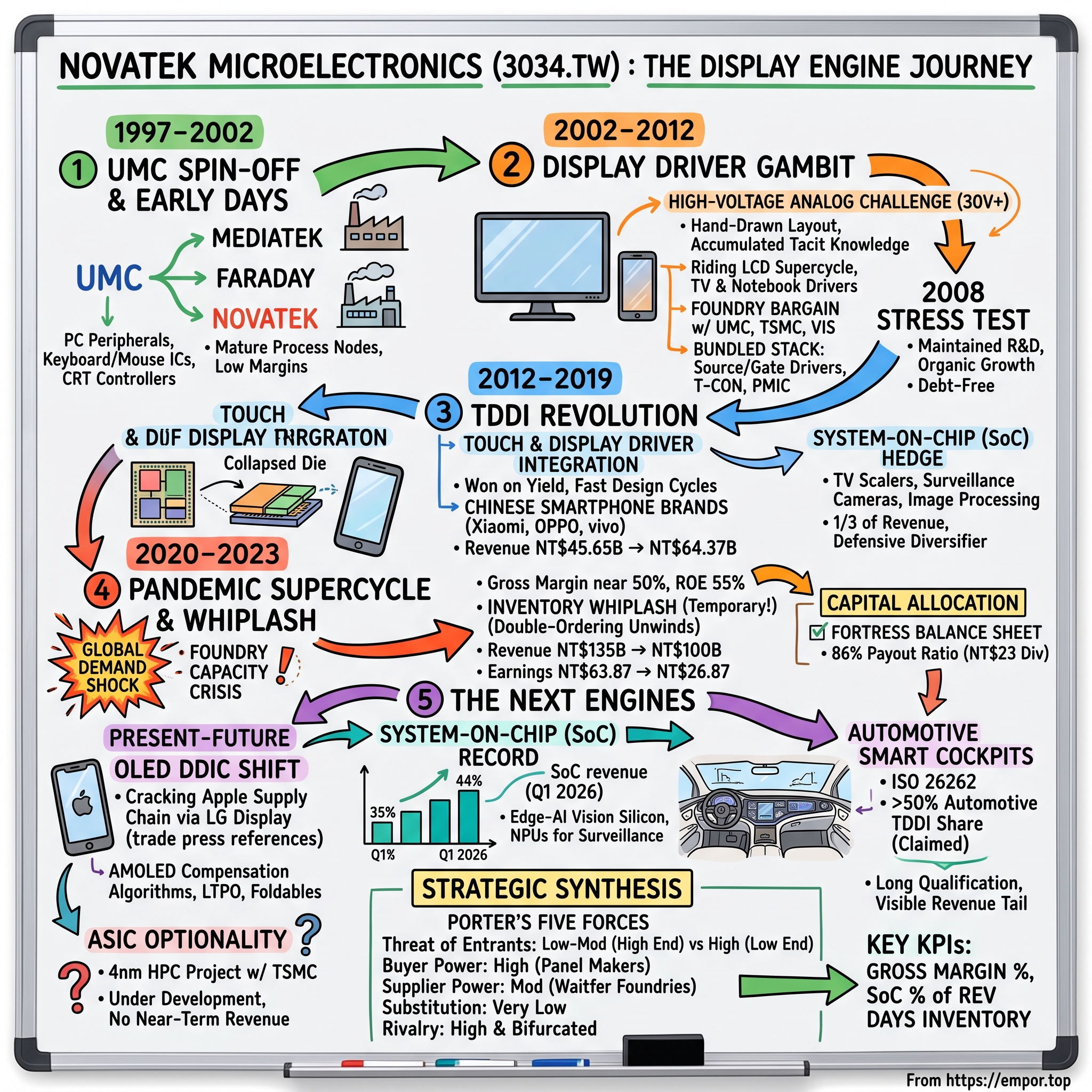
Novatek Microelectronics: The Display Engine of Global Tech
I. Introduction & Episode Roadmap
Hold your phone at arm's length and look at it. Not at what's on the screen — at the screen itself. Somewhere between the glass you're touching and the battery behind it sits a sliver of silicon roughly the size of a grain of rice, bonded directly to the edge of the display panel. It is doing something that sounds trivial and is in fact brutally hard: taking a digital video stream and converting it, sixty to a hundred and twenty times per second, into precise analog voltages delivered to millions of individual sub-pixels, each of which must light up at exactly the right brightness or the whole illusion collapses into a smeared, flickering mess.
That chip is a display driver IC. And there is a reasonable chance it was designed in an unremarkable office block in Hsinchu Science Park by a company most people outside the semiconductor industry have never heard of.
聯詠科技 Novatek Microelectronics Corp. (3034.TW) is one of the strangest success stories in Taiwanese semiconductors. It was spun out of 聯華電子 United Microelectronics Corporation in May 1997, listed on the Taiwan Stock Exchange in August 2002, and today employs roughly 4,051 people against a paid-in capital base of just NT$6.085 billion.1 In fiscal 2025 it generated NT$100.66 billion in consolidated revenue — a little over US$3 billion — on a gross margin of 37.66% and earnings of NT$26.87 per share.[^2] It carries no bank debt. It ended 2025 with NT$42.4 billion of cash against total equity of NT$67.7 billion, a net cash position of roughly NT$41.9 billion.[^3] It has paid out most of its earnings in cash dividends for two decades, most recently NT$23.00 per share for the 2025 financial year, an 85.61% payout ratio approved by shareholders on May 29, 2026.2
Here is the paradox worth sitting with. Display driver ICs are, by every textbook definition, a commodity. They are made on mature process nodes that have been fully depreciated for years. They are sold to a handful of enormous panel makers who buy in the millions and negotiate price cuts annually as a matter of ritual. The end markets — televisions, monitors, notebooks, smartphones — are cyclical, saturated, and increasingly contested by state-backed Chinese design houses. And yet Novatek has generated return on equity above 24% in what was, by its own account, a soft year, and above 40% at the peak of the cycle.[^5]
How? That is the question this story is built around. And the honest answer, which we will test rather than assert, is that Novatek's advantage is not the chip. It is the accumulated, tacit, largely undocumented knowledge of how to lay out high-voltage analog circuits on a specific foundry's specific process, at yields high enough to make money at prices that would bankrupt a less experienced designer. That is a real moat. It is also a moat that is currently being probed from three directions at once — by Chinese competitors climbing the low end, by rising input costs that Novatek does not control, and by the company's own bet that it can become something other than a display company.
The roadmap: we start with the 1997 UMC restructuring that accidentally created half of Taiwan's fabless industry. We follow Novatek out of low-margin PC peripheral chips into flat-panel displays, and through the LCD supercycle that made it a NT$50 billion revenue company. We examine the touch-and-display integration wave that reshaped the smartphone supply chain, the pandemic boom that briefly pushed gross margins near 50%, and the whiplash that followed. We look hard at the present: a company where the System-on-Chip business hit a record 44% of revenue in the first quarter of 2026, driven not by displays at all but by edge-AI vision silicon.3 We examine the Apple breakthrough that everyone in Taiwan talks about and that Novatek's management will not confirm by name. We audit management's credibility against five consecutive earnings calls. And we build the bull and bear cases with Hamilton Helmer's 7 Powers and Porter's Five Forces as the scaffolding — testing, not assuming, where the advantage actually lives.
It starts with a decision made not by Novatek, but about it.
 Subscribe on LinkedIn
II. The UMC Spin-Off & The Birth of Taiwan's Fabless Ecosystem (1997–2002)
The Conflict That Broke a Business Model
In the mid-1990s, 聯華電子 UMC had a problem that would be familiar to any company that has ever tried to be both a supplier and a competitor to the same customer. UMC was Taiwan's first semiconductor company, founded in 1980 as a spin-out of the government's Industrial Technology Research Institute. It designed chips and it manufactured them — the classic integrated device manufacturer model, the model of Intel and Texas Instruments. But sitting a few kilometres away in the same science park was 台灣積體電路製造 TSMC, which had made a very different bet: manufacture only, design never, and therefore never compete with the fabless design houses who were becoming the fastest-growing customers in the industry.
TSMC's bet was working. Every design house that considered UMC as a foundry had to weigh the awkward possibility that UMC's own product teams would see their designs. So between 1995 and 1997, UMC did something structurally radical: it dismantled its own design business, spinning the product groups out as independent companies and converting itself into a pure-play foundry.
The debris field of that decision is extraordinary. 聯發科技 MediaTek came out of it and became a global mobile chipset power. 智原科技 Faraday Technology came out of it as an ASIC design services house. 聯陽半導體 ITE Tech came out of it. And in May 1997, a team focused on PC peripheral and display controller silicon was incorporated as Novatek Microelectronics, headquartered in Hsinchu Science Park with UMC retaining a major shareholding.1
It is worth being precise about what this meant, because the mythology of "spin-off" tends to imply a heroic act of entrepreneurship. It wasn't. Novatek's founding team did not quit their jobs to chase a vision. They were reassigned by a corporate restructuring into a business unit that had been given its own balance sheet and told to survive. The engineering talent was real; the strategic direction was, initially, whatever the PC market happened to be paying for.
Six Years of Selling Cheap Silicon
And in 1997, what the PC market was paying for was not much. Novatek's early product lines were keyboard controllers, mouse ICs, and the control chips that sat inside CRT monitors handling on-screen display menus and deflection timing. These were the definition of low-value silicon: tiny die, cents of gross profit, sold into a Taiwanese contract-manufacturing base that competed almost entirely on cost. If you wanted to design a business that could never generate a 30% operating margin, this was it.
What saved Novatek was a change in the physical world. Cathode ray tubes were being displaced by flat panel displays — first in notebooks, then in desktop monitors, then, eventually, in televisions. And a liquid crystal display has a fundamentally different electrical architecture from a CRT.
Here is the simplest way to understand it. A CRT paints an image by sweeping an electron beam across a phosphor screen; the control electronics steer the beam. An LCD does nothing of the sort. Every single sub-pixel in an LCD is a tiny cell of liquid crystal molecules sandwiched between electrodes, and to make that pixel bright or dark you must physically twist the crystals by applying a voltage across them. Millions of pixels, each individually addressed, each needing its own precisely metered voltage, refreshed dozens of times per second. That is not a control problem. That is a massively parallel analog problem.
Which meant a new category of chip had to exist, and someone had to be good at making it.
Running Toward the Bad Business
The Taiwanese panel industry was ramping at exactly this moment. 友達光電 AU Optronics and the predecessors of what would become 群創光電 Innolux were pouring billions into fabs, racing the Koreans and Japanese down the cost curve on glass. They needed driver silicon, and they needed it co-developed with the panel itself, because every panel generation changed the electrical characteristics the drivers had to handle. Buying that silicon from a Japanese or Korean supplier meant slow iteration cycles, awkward information sharing, and — in the Korean case — buying a critical component from a company owned by your fiercest competitor.
Novatek's insight was less a flash of genius than a recognition of geography. It was in Hsinchu. The panel fabs were an hour's drive away. Its engineers could be on the glass line the same afternoon. Its foundry partner was its own largest shareholder.
Most industry observers at the time considered display driver ICs a bad business, and they had good reasons. Average selling prices were low and falling. Demand was violently tied to panel maker capital expenditure cycles. Customer concentration was extreme — a handful of panel makers controlled essentially all demand. It was, in short, exactly the kind of business a strategy consultant would tell you to exit.
Novatek ran at it. That decision — to concentrate rather than diversify, into a segment everyone else considered structurally unattractive — is the single most consequential choice in the company's history. The reason it worked has less to do with the market and more to do with what kind of engineering problem display driving actually is, which is where the story gets genuinely interesting.
III. The Display Driver Gambit: Riding the LCD Supercycle (2002–2012)
Why Thirty Volts Changes Everything
To understand why display driver ICs turned out to be a defensible business rather than a commodity trap, you have to understand the one physical fact that governs everything: display drivers operate at high voltage, and almost nothing else in modern electronics does.
The logic chips in your laptop run at somewhere under two volts. That's the whole point of shrinking transistors — lower voltage, lower power, more speed. But you cannot twist a liquid crystal molecule with two volts, and you certainly cannot drive an OLED emitter that way. Display drivers have to produce output swings measured in tens of volts, and they have to produce hundreds or thousands of those outputs simultaneously, each one accurate to within a few millivolts, on a die narrow enough to fit along the bezel of a panel.
Think of it as the difference between designing a whisper-quiet home stereo and designing an electrical substation that also has to be whisper-quiet. You are managing high voltages on the same piece of silicon as delicate analog reference circuits, where a few millivolts of noise or a few degrees of thermal drift show up on a customer's screen as visible banding or mura — those faint, blotchy brightness variations that make a panel unsellable. And you are doing it on a mature process node, because high-voltage transistors don't shrink the way logic does.
This is the crux of the whole business. Advanced logic design is increasingly a matter of automated synthesis tools laying out billions of standard cells. High-voltage mixed-signal design is not. It is hand-drawn layout, deep familiarity with a specific foundry's device models, and years of accumulated knowledge about what actually yields versus what merely simulates correctly. That knowledge does not exist in a textbook. It exists in the heads of a few hundred engineers and in a design library that has been refined across a thousand tape-outs.
The Foundry Bargain and the Bundled Stack
Novatek spent the 2000s building exactly that. And it built it in partnership with three foundries — 聯華電子 UMC, 台灣積體電路製造 TSMC, and 世界先進積體電路 Vanguard International Semiconductor — through a bargain that suited both sides. Novatek committed enormous, predictable volume to specific high-voltage process flows. The foundries committed capacity and co-engineered the process to Novatek's device requirements. Neither party could easily walk away: the foundry had tuned a process line around Novatek's needs, and Novatek's entire design library was calibrated to that process. Omdia's foundry tracking later illustrated how deep this ran — as of the third quarter of 2024, UMC held 26% of the AMOLED driver IC foundry market, with Novatek identified as its largest customer.4
The product portfolio expanded in a deliberate pattern. Novatek did not just sell source drivers, the chips that set the color and grayscale of each column of pixels. It added gate drivers, which switch each row of pixels on and off. It added timing controllers — T-CONs — which sit upstream and translate the incoming video signal into the precise sequence of commands the drivers execute. It added power management chips to generate the various supply rails a panel needs.
Sell a panel maker one of those and you are a component vendor. Sell them all four, tuned to work together, with firmware that has been debugged against their specific panel design, and you are something closer to a subsystem supplier. The re-engineering cost of swapping out one piece of that stack is no longer just a price comparison; it is a qualification cycle measured in quarters. This is a modest switching cost rather than a dramatic one — panel makers are sophisticated, they dual-source deliberately, and they use the threat of switching as annual negotiating leverage. But it is real, and it shows up in the persistence of Novatek's design wins across panel generations.
2008: The First Stress Test
Then came 2008. The financial crisis hit the display supply chain with unusual violence because panel makers are among the most capital-intensive manufacturers on earth, and when credit froze, panel capex stopped essentially overnight. Driver IC demand fell off a cliff. Several smaller Taiwanese and Japanese design houses were absorbed, restructured, or quietly wound down.
Novatek's response established a pattern that has repeated in every downturn since: it did not cut research and development. The balance sheet was already debt-free and cash-heavy, which meant the company could fund a full engineering roadmap through a demand trough without borrowing or issuing equity. Coming out of the crisis, it had higher-resolution television controllers ready for the Full HD transition and a mobile driver portfolio positioned for the smartphone wave that was just beginning.
The other structural decision of this era was Novatek's approach to acquisitions, which is best described as unenthusiastic. The company has done tuck-in deals — most visibly to bolster video and imaging system-on-chip capability, which is why NT$2.08 billion of goodwill sits on the balance sheet more than a decade later.[^3] What it has conspicuously not done is buy revenue. There is no transformative merger in Novatek's history, no debt-funded consolidation play, no write-down of a strategic misadventure. For investors, the significance is not that acquisitions are bad — it is that Novatek's growth has been overwhelmingly organic, which means the returns on capital it reports are returns on engineering, not on financial structuring.
By the early 2010s, Novatek had won the position it wanted in large panels. The problem with winning a position in a mature market is that the growth has to come from somewhere else. It came from a device you could hold in one hand.
IV. The TDDI Revolution & Mobile Disruption (2012–2019)
Two Chips That Were Fighting Each Other
For the first several years of the smartphone era, the display module inside every phone contained two separate chips that had no idea the other existed.
One was the display driver, doing the high-voltage work of illuminating pixels. The other was the touch controller, monitoring a grid of capacitive sensors for the tiny change in capacitance that occurs when a finger approaches the glass. They were made by different companies — Synaptics was the dominant touch controller vendor — mounted on different substrates, and connected by separate flexible circuits back to the main board.
This was, from a systems perspective, absurd. The two chips were operating on the same physical stack of glass, microns apart, and they were actively interfering with each other. The display driver's high-voltage switching created electrical noise that the touch sensor had to filter out. The touch sensor layer sat on top of the display, absorbing light and forcing the backlight to work harder. Every additional layer added thickness to a device where thickness was the primary axis of competition.
Touch and Display Driver Integration — TDDI — collapsed the two into a single die. The chip drives the display and senses touch in interleaved time slots, so the two functions never fight. One chip instead of two. One flex connector instead of two. A thinner module, better light transmission, lower bill of materials.
The engineering difficulty was that touch sensing is an extraordinarily sensitive analog measurement — you are detecting a capacitance change of a few femtofarads — and you are now performing it on the same piece of silicon that is slamming tens of volts around at high frequency. Getting that to work is not a matter of putting two designs next to each other. It requires careful time-domain choreography, deep noise isolation, and firmware that adapts to the specific electrical signature of each panel design.
Winning on Yield, Not on Vision
This is precisely the kind of problem where a decade of high-voltage mixed-signal experience compounds. Novatek competed against 敦泰電子 FocalTech, 奇景光電 Himax Technologies, and Synaptics, and it won the execution race on unglamorous grounds: better yields on the 80-nanometre and 55-nanometre high-voltage processes it had co-tuned with its foundries, firmware that worked, and design-in cycles fast enough to keep pace with Chinese smartphone brands who were launching new models at a cadence that made Western product planning look geological. 小米 Xiaomi, OPPO, and vivo were shipping hundreds of millions of units a year and iterating models quarterly. A supplier who could turn a design in weeks rather than months captured share almost mechanically.
The financial trajectory of this period tells the story plainly. Novatek's revenue was NT$45.65 billion in 2016 with earnings of NT$8.22 per share. By 2019 revenue had reached NT$64.37 billion and earnings NT$13.03 per share.[^2] That is a compound revenue growth rate of roughly 12% and profit growth of nearly 17% over three years, in a segment that was supposedly commoditizing.
Building the Hedge
But the strategically important move of this decade was not TDDI. It was Novatek's decision to build a second business that had nothing to do with driving pixels.
The System-on-Chip division grew out of the television controller business — the scaler chips that take an incoming signal at one resolution and format and convert it to the panel's native resolution, handle motion interpolation, manage color processing. From there it expanded into set-top boxes, security and surveillance cameras, and image signal processing. These are digital-heavy products with substantial software and firmware content, sold on different cycles to different customers than driver ICs.
The rationale was straightforward and it has held up. Driver IC demand tracks panel fab utilization, which is one of the most violently cyclical variables in electronics. SoC demand tracks end-product design cycles, which are somewhat more stable. By the end of this period, SoC represented roughly a third of revenue, and it functioned as a genuine diversifier rather than a rounding error.
What management could not have anticipated is that this hedge would eventually become the growth engine — and that it would take a global pandemic to reveal how much of the display business's profitability was structural and how much was simply scarcity.
V. The Pandemic Supercycle, Inventory Whiplash, & Capital Allocation (2020–2023)
When a Commodity Business Suddenly Had Pricing Power
In the spring of 2020, the world simultaneously decided it needed another screen.
Everyone working from home needed a monitor. Everyone schooling from home needed a tablet. Everyone stuck at home upgraded the television. Notebook demand, which had been in structural decline for the better part of a decade, inverted violently. And every one of those panels needed driver ICs.
The demand shock alone would have been significant. What made it extraordinary was that it collided with a foundry capacity crisis. High-voltage display driver processes run on mature nodes — the same 90, 80, and 55-nanometre lines that also make power management chips, microcontrollers, and automotive silicon. Those lines had received essentially no capacity investment for years, because the entire industry's capital had gone into leading-edge logic. When demand for everything mature spiked at once, there was simply nowhere to put the wafers.
For a company that had spent twenty years accepting annual price reductions as the cost of doing business, the result was surreal. Prices went up. Not marginally — dramatically, and repeatedly.
The numbers are worth stating once, carefully, because they define the reference point for everything that has happened since. Novatek's revenue went from NT$79.96 billion in 2020 to NT$135.37 billion in 2021, a 69% increase in a single year. Gross margin, which had run in the low thirties, reached 49.8%. Operating income was NT$48.13 billion — meaning roughly thirty-six cents of every revenue dollar fell to operating profit. Earnings per share were NT$63.87, more than triple the prior year. Return on equity hit 55%.[^2][^5]
That last figure deserves a moment of scepticism rather than admiration. A 55% return on equity in a business with no meaningful capital intensity is not evidence of a durable competitive advantage. It is evidence of a temporary supply-demand dislocation flowing through an operating model with very high incremental margins. Novatek's fixed costs — engineering headcount, mask sets, EDA licenses — barely moved while revenue rose 69%. Nearly all of the upside dropped through. The same mechanism works in reverse, and it did.
The Four-Year Walk Down
The reversal, when it came, was one of the sharper bullwhips in recent semiconductor history. Every customer in the chain had double-ordered to protect against shortage. When end demand normalized in 2022, those orders unwound simultaneously. Panel makers cut utilization hard. Channel inventory that had been built at peak prices had to be cleared at whatever the market would pay.
Novatek's revenue held at NT$109.96 billion in 2022 and NT$110.43 billion in 2023 — remarkably stable topline — but the margin structure told the real story, compressing from 49.8% to 46.3% and then to 41.8%.[^2] By 2024, revenue was NT$102.79 billion with gross margin near 40%, and in 2025 revenue slipped to NT$100.66 billion with gross margin of 37.66%.[^2] Earnings per share walked down the same staircase: NT$45.96, NT$38.32, NT$33.42, NT$26.87.
Four consecutive years of declining profitability is not a rounding error, and it is the central fact any investor looking at this company today has to reckon with. The question is what it means. One reading is that 2021 was an anomaly and the company is simply returning to a normal margin range — Novatek's gross margin averaged roughly 28% to 32% for most of the 2010s, which makes 37.66% look historically strong rather than weak. The competing reading is that Chinese competition and rising input costs are structurally eroding a business whose peak is behind it. Both readings are supported by the same data, and distinguishing them requires looking at mix, which we will.
The behavioral evidence from the downturn is more clear-cut. Novatek took inventory adjustments early rather than defending reported margins by holding stock at cost. It reduced wafer starts quickly, which is easier said than done when your foundry relationships depend on volume commitments. It did not chase the bottom of the market on price to hold unit share. And it did not raise a dollar of capital.
Look at where inventory sits now: days of inventory outstanding of roughly 49 days at the end of 2025, against 74 days at the end of 2022 when the destocking was at its worst.[^5] That is a supply chain in equilibrium, not one carrying a hidden write-down.
The Cash Question
Capital allocation through the whole cycle was almost monotonous in its consistency. Novatek pays out the overwhelming majority of its earnings in cash dividends. For 2025 that meant NT$23.00 per share, NT$13.995 billion in total, against net income of NT$16.35 billion.2[^2] There is no buyback program of consequence, no leveraged recapitalization, no special dividend gimmickry.
An activist would look at that and ask a sharp question: why is a company sitting on NT$42.4 billion of net cash — more than 60% of shareholders' equity — while paying out 86% of earnings and reporting declining returns? The cash is not being deployed into acquisitions, not being returned via buybacks at what is arguably a cyclical trough valuation, and is earning modest interest income. The defence is that a fabless company with concentrated customers and violent cyclicality needs a fortress balance sheet to fund R&D through troughs, and Novatek's R&D spending of NT$16.56 billion in 2025 — 16.5% of revenue, up from 12.3% at the 2021 peak — is exactly what that fortress buys.[^2] Whether that is prudence or capital inefficiency is a genuinely open argument, and it is one of the few places where Novatek's otherwise unimpeachable financial discipline is legitimately contestable.
Which brings us to what that R&D is actually buying, and to a company whose revenue mix looks meaningfully different today than the display business its name is built on.
VI. Current State & Segment Economics: DDIC vs. SoC
The Month the Display Company Stopped Being One
If you had looked at Novatek's revenue mix in 2019 and been told to project it forward seven years, you would almost certainly have gotten it wrong — because the fastest-growing part of the company in 2026 is not driving pixels at all.
Novatek reports its business in three buckets. Small and medium display driver ICs cover smartphones, tablets, wearables, and automotive cockpit displays. Large display driver ICs cover televisions, monitors, and notebooks. System-on-Chip covers television and monitor scalers, timing controllers, and — increasingly — image and vision processors.
In the fourth quarter of 2025, that split ran 43% small-medium driver IC, 35% SoC, and 22% large driver IC.5 By the first quarter of 2026, SoC had climbed to 44% of revenue, a record, while small-medium drivers fell to 33% and large drivers edged up to 23%.3 In April 2026 alone, SoC accounted for 53.7% of monthly revenue.6 For a single month, in a company whose brand is display drivers, the majority of sales came from something else.
The driver was edge-AI vision silicon. Management has been consistent about this across three consecutive calls: the growth is in image processing SoCs with integrated neural processing units, going into security cameras, drones, robotics, and computing boxes.53 On the third-quarter 2025 call, management quantified it — AI-integrated products represented roughly 20% of SoC revenue, with expansion expected.7
It is worth being precise about what this silicon does, because "edge AI" is one of the more abused phrases in technology. A traditional security camera captures video and sends it somewhere else to be analyzed. An edge-AI camera runs the analysis on the chip inside the camera: is that a person or a cat, is that person carrying something, has that vehicle been parked there for two hours. Doing that locally requires a processor that can run a neural network at low power and low cost. This is not a new business for Novatek so much as an upgrade to an existing one — the company has been selling image signal processors into surveillance for years, and adding an NPU raises the average selling price and the software content of a chip it was already shipping.
That is the honest framing, and it matters for how much credit to extend. Novatek is not entering a new market. It is riding a specification upgrade in a market it already serves — which is lower risk and lower reward than the "AI company" framing some commentary applies to it.
Two Very Different Display Businesses
The display side has its own economics, and they diverge sharply between the two ends.
Large panel drivers — for televisions, monitors, and notebooks — are the mature, volume-driven end of the business. Customers are the enormous Chinese and Taiwanese panel makers: 京東方 BOE Technology, 華星光電 TCL CSOT, 群創光電 Innolux, 友達光電 AUO. Margins here are structurally lower and correlate tightly with panel fab utilization. When panel makers run their lines hard, they consume drivers; when they idle, driver orders stop. Novatek has essentially no ability to influence that variable.
Small and medium drivers are where the value concentrates. Mobile OLED drivers, TDDI, automotive cockpit displays, wearables. Higher average selling prices, more software content, longer qualification cycles, and — critically — a technology transition underway from LCD to AMOLED that resets the competitive field every time it advances.
The Cost Equation, and Who Controls It
The unit economics of a display driver come down to a fairly simple equation with two hard-to-control terms. On the cost side: wafer price for the high-voltage process node, plus packaging and test, divided by the number of good die you get per wafer. On the revenue side: the average selling price the panel maker or handset OEM will accept. Moving OLED drivers from 40-nanometre to 28-nanometre high-voltage processes shrinks the die, which puts more chips on each wafer and pulls unit cost down — but the wafer itself costs more, so the migration only pays if the shrink is large enough and the yield holds.
In 2026, that equation has come under pressure from a direction nobody in the display industry controls. Management has flagged rising costs across memory, gold, wafer foundry services, substrates, and packaging as a persistent headwind, and has said explicitly that it will raise prices where it can while acknowledging that pricing may not fully offset the compression.37 That is an unusually candid admission, and it is the single most important qualifier on any bullish read of the margin trajectory.
There is one more dynamic in 2026 worth naming because it cuts both ways. Rising memory prices have caused notebook and system customers to pull orders forward — buying components early to get ahead of further increases. That inflated second-quarter revenue to NT$28.66 billion, up 24% sequentially and 9.6% year-over-year, an eleven-quarter high that exceeded the company's own guidance range of NT$27.5 to 28.5 billion.89 June revenue alone reached NT$10.023 billion, the highest single month in three years.10
An investor should read that number carefully rather than celebrate it. Pull-forward demand is borrowed demand. It flatters the current quarter and creates a hole in a later one, and the display industry's history is littered with companies that mistook inventory building for end demand. First-half 2026 revenue of NT$51.81 billion was still down 2.75% against the prior year.8 The underlying trend is stabilization, not acceleration — and the second-quarter earnings call, which had not yet been held as of late July 2026, is where management's characterization of how much of that strength was genuine will matter.
Meanwhile, the most-discussed story about Novatek over the past two years has been about a customer the company will not name.
VII. The Strategic Holy Grail: Cracking Apple's Supply Chain & The OLED DDIC Shift
The Korean Wall
For roughly a decade, the display driver business had a ceiling, and everyone in Hsinchu knew exactly where it was.
The ceiling was Apple. Not because Apple's volumes were unattainable — Novatek shipped to Chinese handset makers at scale comparable to any iPhone program — but because Apple's OLED display driver supply chain had been closed to Taiwan entirely. 삼성디스플레이 Samsung Display supplied OLED panels with driver ICs designed by Samsung's own LSI division. LG Display supplied OLED panels with driver ICs from LX Semicon, the Korean designer that had been LG Display's exclusive partner for iPhone panels. Two Korean panel makers, two Korean chip designers, one very large customer, and no way in.
The technical barrier was real and it is worth explaining, because AMOLED driver ICs are meaningfully harder than their LCD predecessors.
In an LCD, the driver's job is comparatively forgiving: apply a voltage, twist the crystal, let a constant backlight through. Brightness is a function of how much of the backlight you let past. In an AMOLED display, there is no backlight. Each sub-pixel is its own light source, and its brightness depends on the current flowing through it. That is a much less stable thing to control. Organic emitters age — a pixel that has displayed bright blue for a thousand hours does not respond to the same drive current the way a fresh one does. Left uncompensated, that is how you get burn-in: the ghost of a status bar permanently etched into a screen.
So a modern AMOLED driver is not just a voltage generator. It is a compensation engine, running algorithms that model the aging characteristics of each sub-pixel and adjust drive levels accordingly. Add LTPO — the backplane technology that lets a display drop its refresh rate from 120Hz down to 1Hz to save power on a static image — and the driver must handle dynamic refresh transitions without visible flicker as the panel's electrical behavior changes underneath it. Add sub-pixel rendering, power management integration, and the thermal constraints of a chip bonded to a phone display, and you have a design problem where a decade of high-voltage analog experience is table stakes rather than an advantage.
The Opening, and What Can Actually Be Verified
Novatek's opening came from a convergence of two pressures it did not create.
Apple has spent years methodically reducing single-source dependencies across its bill of materials, and display drivers were a conspicuous exception. Simultaneously, LG Display was under sustained margin pressure and needed a competitive second source for the driver ICs going onto its iPhone panels — both to reduce cost and to improve the yield economics of the panel module as a whole.
Trade reporting from Taiwan and Korea tracked what followed. Novatek qualified into LG Display's iPhone OLED driver supply through 2024, ending LX Semicon's exclusivity on that channel; by October 2024, industry reporting described LX Semicon's share of iPhone OLED driver orders as roughly halved as Novatek's allocation grew, with the transition complicated by driver quality testing delays.111213
Two important caveats. First, Novatek has never confirmed Apple as a customer, and it will not — Taiwanese suppliers to Apple operate under non-disclosure terms that make naming the customer a contract breach. Management discusses "high-end OLED driver growth momentum" and "US brand customers" and leaves the inference to analysts. Second, the trade press is directionally reliable on Asian supply chains but is not a primary source, and the specific volume splits reported should be treated as informed estimates rather than disclosed fact.
What can be assessed with more confidence is the adjacent product where Novatek has been explicit. OLED TDDI — the integration of touch sensing into an OLED driver, which is harder than the LCD version for all the reasons above — entered mass production in the second quarter of 2025, and shipments exceeded 10 million units for the full year.57 Management has said Novatek has entered the supply chains of American, Korean, and Chinese smartphone brands with this product, and expects continued growth in 2026 driven by the foldable phone market, which is projected to grow 30% to 45%, with specification upgrades supporting higher prices.14
Ten million units is not a large number against a global smartphone market of over a billion. It is a beachhead, not a conquest. The relevant question is the slope, and here the evidence supports cautious optimism: a new product category, mass production achieved on schedule, multiple brand customers across three geographies, and an adjacent market — foldables — growing fast enough to pull volume through.
Myth vs. Reality: The Market Share Number
One frequently repeated claim deserves direct scrutiny, because it appears in a great deal of commentary about this company: that Novatek holds roughly a fifth of the global AMOLED smartphone driver IC market. Novatek does not disclose that figure, and the market research that does exist tends to measure the foundry layer rather than the design layer. The Omdia data available measures who fabricates AMOLED drivers, not who designs them.4 An investor should treat specific AMOLED design share percentages as estimates of uncertain provenance and watch the disclosed operating evidence instead — segment mix, gross margin, and OLED TDDI unit growth.
The strategic significance of the Apple channel is nonetheless real for reasons beyond the revenue. Passing Apple's qualification process is the most demanding validation available in consumer electronics, and it establishes a reference that matters when selling to every other premium customer. It also opens a runway: OLED is spreading from phones to tablets, and eventually to notebooks, each of which needs drivers with the same compensation architecture and higher content per unit. Management confirmed on the first-quarter 2026 call that OLED drivers for notebooks are among the new products planned for the second half of 2026.3
And it changes the competitive geometry. Every socket Novatek takes at LG Display is a socket LX Semicon loses. That is a direct transfer of share from a Korean incumbent to a Taiwanese challenger in the highest-value segment of the market — which is a far better place to be fighting than the low end, where the pressure is coming from the opposite direction.
VIII. The Next Engine: Automotive Smart Cockpits & AI Custom Silicon / ASIC Optionality
Count the Screens
Sit in a car built in the last three years and count the screens. Instrument cluster. Center infotainment stack. Possibly a passenger-side display. Possibly a head-up display projected onto the windshield. Increasingly, camera-fed digital side mirrors. In premium electric vehicles, the count runs to five or six, some of them enormous, and at least one of them is a touchscreen that has replaced physical controls for functions people used to operate by feel.
Every one of those screens needs a driver IC. And automotive display drivers are a structurally better business than consumer ones for reasons that have nothing to do with the silicon and everything to do with the qualification regime.
An automotive display driver must meet ISO 26262 functional safety requirements, which means the chip has to detect and report its own failures — if the instrument cluster goes blank at highway speed, the system needs to know. It must operate reliably from -40°C to +125°C, because cars sit in Minnesota winters and Arizona summers. And it must remain available for seven to ten years, because automotive platforms have long production lives and even longer service obligations.
Those requirements do three things simultaneously. They lengthen the design cycle, which raises the barrier to entry. They reduce price competition, because a Tier 1 supplier who has qualified a driver into a platform is not going to requalify to save a few cents. And they extend the revenue tail, because a design win generates volume for the better part of a decade.
Novatek moved into this segment early and holds a leading position. Management stated that automotive revenue represented over half of the small-medium driver business in the fourth quarter of 2024, and that the company's global automotive TDDI market share substantially exceeds 50%.14 That last figure is a management claim rather than an independently verified statistic, and should be read accordingly — but a dominant position in automotive TDDI specifically is consistent with Novatek having been the company that industrialized TDDI in smartphones a decade earlier and then carried the technology into a market where the barriers are higher.
The near-term reality is more mixed than the structural story. On the first-quarter 2026 call, management characterized automotive demand as slightly better in China and roughly flat elsewhere.3 Global vehicle production has been soft, and the screen-count-per-vehicle trend does not fully offset a weak unit market. Automotive is a good business that is not currently growing fast.
The 4-Nanometre Side Quest
The more speculative bet is ASIC.
Over the past two years Novatek has been building a custom silicon capability aimed at high-performance computing — a market with essentially no overlap with anything the company has ever sold. The vehicle is a proof-of-concept design built on TSMC's N4P 4-nanometre process, integrating Arm's Neoverse Compute Subsystem N2 platform with sixteen CPU cores, four dedicated accelerators, and HBM3E memory.15 The proof-of-concept was targeted for completion by the end of 2025 and, per management on the first-quarter 2026 call, the 4nm HPC project remains under development with no near-term revenue contribution.73
It is worth being blunt about what this is and is not.
What it is: a credible technical demonstration that Novatek's design organization can execute at an advanced node with a modern server-class CPU subsystem and high-bandwidth memory. That is not trivial. Physical design at 4nm with HBM3E involves signal integrity, thermal, and packaging challenges that most design houses cannot handle.
What it is not: a business. There is no announced customer, no disclosed revenue, no stated timeline to production. Novatek would be entering a custom-ASIC market where Broadcom and Marvell hold entrenched positions with the hyperscale customers who actually buy this silicon, and where relationships and track record matter as much as capability. Management's own framing — an aspiration to lift non-display revenue to 30% or more of the total, repositioning the company as an intelligent computing solutions provider — is a statement of ambition, not a plan with milestones.15
For investors, the correct treatment is to value this at approximately zero and be pleasantly surprised. It is optionality, and it is cheap optionality since the spending is absorbed within an R&D budget that would exist regardless. But a company with a demonstrated advantage in high-voltage analog design pursuing digital HPC ASICs is moving away from its area of competence, and the history of semiconductor companies attempting exactly that transition is not encouraging. The relevant discipline test is whether Novatek walks away if the customer engagements do not materialize, or whether it keeps funding a prestige project.
Which raises the broader question of whether this management team has earned the benefit of the doubt — and unusually for a company of this size, there is a clear record to audit.
IX. Management Credibility, Governance, & Analyst Q&A Audit
The Least Charismatic Management Team in Hsinchu
Novatek's leadership is notably, almost aggressively, unremarkable in public. Chairman 何泰舜 T.S. Ho and President and Vice Chairman 王守仁 Steve Wang have both been in senior roles at the company for many years, and both were re-elected to their positions at the board level in the 2024 director election cycle.116 Neither gives keynote speeches. Neither appears on magazine covers. Taiwanese business media has described Ho's style as low-key and steady — which reads as faint praise until you consider how many semiconductor companies have been damaged by the opposite.
The substantive test of management is not personality. It is whether they do what they said they would do, and whether they explain it clearly when they don't. Novatek is unusually easy to audit on this because it guides quarterly on three specific metrics — revenue range, gross margin range, and operating margin range — and then reports against them.
Here is the record across five consecutive quarters.
For the second quarter of 2025, Novatek reported revenue of NT$26.15 billion with gross margin of 36.30%, and guided the third quarter to NT$23.7–24.7 billion with gross margin of 34–37% and operating margin of 15–18%.17 The third quarter came in at NT$24.57 billion with gross margin of 36.29% and operating margin of 15.70% — inside the range on all three, in the upper half on margin.7 Guidance for the fourth quarter was NT$22–23 billion, gross margin 35–38%, operating margin 14.5–17.5%. The fourth quarter delivered NT$22.82 billion at the high end of the revenue range, with gross margin of 38.19% — above the top of the guided band — and operating margin of 16.92%.5 Guidance for the first quarter of 2026 was NT$22.2–23.2 billion with gross margin of 36–39%; the quarter came in at NT$23.145 billion with gross margin of 39.06%, again at the top of revenue guidance and marginally above the margin band.3 Second-quarter guidance was NT$27.5–28.5 billion; reported revenue was NT$28.66 billion, above the range.89
Five consecutive quarters of hitting or modestly beating a self-set range. That is a specific, checkable pattern, and it says something concrete: management sets ranges it is confident it can clear, and it does not use guidance as a promotional instrument. The mild cynic's reading — that the ranges are deliberately conservative — is probably correct, and is not really a criticism. A guidance philosophy that consistently under-promises is more useful to a long-term investor than one that consistently reaches.
How They Talk About Bad News
More revealing is how management explains things going wrong. On the third-quarter 2025 call, the margin pressure was attributed to two specific causes: appreciation of the New Taiwan dollar against the US dollar, and the retreat of Chinese consumer subsidy policy that had been supporting appliance and electronics demand.7 Both are external, which is the kind of explanation that should trigger scepticism — but both are also verifiable and specific rather than vague. Currency is a genuine and mechanical exposure for a company that sells in dollars and reports in NT dollars, and the timing of the Chinese subsidy rollback is a matter of public record.
On input costs, management has been notably direct. Across the third-quarter 2025 and first-quarter 2026 calls, the company named rising gold prices, known-good-die pricing, memory, wafer, substrate, and packaging costs as headwinds, and described its response in two parts: sharing cost increases with suppliers where possible, and raising prices to customers selectively.73 Crucially, management also stated that pricing adjustments may not fully offset the margin impact.3 That is the opposite of spin. A promotional management team facing input cost inflation says it will "manage costs" and leaves the impression that margins are protected.
Narrative consistency across the five calls is high. The same three growth pillars appear every quarter — OLED products including TDDI and foldables, edge-AI vision SoCs, and automotive — with the mix shifting in emphasis as the quarters develop but no strategic reversals. The 4nm ASIC project has been described the same way each time: proof-of-concept, no near-term revenue. There is no quarter where a previously touted initiative silently disappears from the script, which is one of the more reliable warning signs in corporate communication.
Governance is straightforward. There is no dual-class share structure. The share count has been essentially static at roughly 608 to 609 million shares for over a decade, meaning shareholders have experienced effectively zero dilution.[^2] UMC remains a significant shareholder, which is a legacy of the spin-off; that relationship is worth noting for the obvious reason that UMC is also a major foundry supplier, though there is no public evidence of the arrangement operating on non-arm's-length terms.
The Activist Stress Test
Where would a genuinely adversarial investor press?
Three places. First, the capital structure: NT$42.4 billion of cash generating modest returns while return on equity has fallen from 55% to 24% across four years. A large cash pile that is neither deployed nor returned beyond the ordinary dividend is a drag on returns, and management has not articulated a specific use for it. Second, disclosure granularity: Novatek reports three broad product categories and does not break out margins by segment, geography, or customer concentration in any detail. An investor trying to assess how much of the margin decline is mix versus price has to infer it. Third, customer concentration — Novatek's largest customers are among the largest panel makers and handset OEMs on earth, and the company does not quantify the exposure. That is standard practice for Taiwanese suppliers under confidentiality obligations, but it is a genuine information gap.
None of these are red flags. They are the legitimate friction points in an otherwise conservative governance profile — which sets up the real question of whether the underlying business advantage is as durable as the balance sheet suggests.
X. Strategic Playbook & Competitive Moat Analysis (7 Powers & 5 Forces)
Strip away the narrative and ask the hard question: if a well-capitalized competitor decided tomorrow to take Novatek's business, what exactly would stop them?
Hamilton Helmer's 7 Powers
Process Power is the strongest of Novatek's advantages and the one most often misunderstood. Process Power in Helmer's framework means an advantage embedded in an organization's activities that competitors cannot replicate even with full knowledge of what you're doing, because it took years of iteration to develop. High-voltage mixed-signal design fits this definition well. A competitor can hire away engineers, license the same EDA tools, and buy wafers from the same foundry — and still spend three to five years discovering, one failed tape-out at a time, which layout techniques actually yield on that specific process at that specific voltage. Novatek has been running that learning loop since the late 1990s, across every node from 0.18 micron down to 28 nanometres.
The honest limitation: Process Power is strongest where the process is hardest. It protects Novatek's high-end OLED and automotive business well. It protects the low-end LCD driver business much less, because those designs are mature enough that the learning curve has flattened and competitors have caught up. That is precisely where Chinese share gains have concentrated.
Scale Economies operate here in an unusual form. Novatek's scale does not lower its manufacturing cost directly — it has no fabs. What scale buys is priority: preferential wafer pricing, guaranteed capacity allocation during shortages, and the ability to amortize mask sets and design costs across larger volumes. The 2021 shortage demonstrated the value of this vividly, when access to capacity mattered more than price. The Omdia foundry data — Novatek as UMC's largest AMOLED driver customer — is the clearest available evidence of that leverage.4
Cornered Resource applies in a qualified way. Novatek does not own a scarce input, but qualification credentials with the world's major panel makers and Tier 1 automotive suppliers function similarly. These relationships took years to establish and cannot be purchased. Qualified for automotive with a Tier 1, you are on the platform for its production life; not qualified, you wait for the next platform.
Switching Costs exist but should not be overstated. Once a panel design has been laid out around a specific driver and T-CON pairing with debugged firmware, changing suppliers means re-engineering and re-qualification. But panel makers deliberately maintain multiple qualified sources and treat switching as ordinary leverage. These are real friction costs, not lock-in.
Three of Helmer's seven powers are absent, and their absence is informative. There are no Network Economies — a driver IC does not become more valuable because other people use it. There is no meaningful Branding power — the panel maker's procurement team cares about yield and price, not the logo. And Counter-Positioning is not available: Novatek is the incumbent, not the insurgent, and it is the Chinese entrants who are counter-positioning against it with lower cost structures.
Porter's Five Forces
Threat of new entrants: low to moderate. Building a display driver design house from scratch requires the high-voltage design expertise described above, capital for tape-outs at 28nm and below, and qualification cycles measured in years for automotive and premium mobile. The qualifier: entry is materially easier at the low end, and state-backed Chinese entrants have access to patient capital that changes the ordinary economics of entry.
Bargaining power of buyers: high. This is the structurally weakest position in Novatek's competitive picture and it should not be minimized. The customer base is a small number of very large panel makers and handset OEMs with sophisticated procurement, multiple qualified sources, and a cultural expectation of annual cost reduction. The 2026 input cost situation illustrates the asymmetry perfectly: costs rose across memory, gold, wafers, substrates, and packaging, and management's own assessment is that it cannot fully pass them through.3 A company with genuine pricing power would not have to say that. Where buyer power weakens is at the premium end — a single-sourced automotive driver in a qualified platform, or a differentiated OLED TDDI in a foldable, has real pricing leverage. Mix migration is therefore not just a growth strategy; it is a defence of pricing power.
Bargaining power of suppliers: moderate. Novatek depends entirely on 聯華電子 UMC, 台灣積體電路製造 TSMC, and 世界先進積體電路 VIS for wafers, and on assembly and test subcontractors for packaging. Its volume makes it a priority customer on mature high-voltage nodes, which is meaningful counterweight. But 2026 has demonstrated the limits — when foundries, substrate suppliers, and memory makers all raise prices in the same period, a fabless designer absorbs it.
Threat of substitutes: very low. Every active matrix display ever manufactured — LCD, OLED, micro-LED — requires driver silicon and timing control. The chip may be integrated differently over time, but the function cannot be eliminated. This is the most stable element of Novatek's position.
Competitive rivalry: high, and bifurcated. At the top end, Novatek fights Samsung LSI and LX Semicon, both of which have captive or preferential relationships with Korean panel makers. In the middle, it fights 奇景光電 Himax, 瑞鼎科技 Raydium, 矽創電子 Sitronix, 敦泰電子 FocalTech, and Synaptics. At the low end, it faces 集創北方 Chipone, ESWIN, and a widening field of mainland designers whose LCD smartphone driver and TDDI share has been rising on the back of domestic demand and state support for supply chain localization.18
The synthesis is straightforward. Novatek's competitive position is strong where the engineering is hard and weakening where it is not. Its strategy — migrate mix toward OLED, automotive, and AI-enabled SoCs while conceding the commoditized low end — is the correct response to that reality. The open question is whether the migration is fast enough to outrun the erosion, and that question resolves in the numbers over the next several years rather than in any argument that can be made today.
XI. Investment Thesis: Bull vs. Bear Case & Key KPIs
Why Novatek Wins From Here
The mix shift is real and it is showing up in reported numbers, not just slides. SoC rose from 35% of revenue in the fourth quarter of 2025 to a record 44% in the first quarter of 2026, and gross margin rose alongside it — 38.19% to 39.06%, both above the top of guidance.53 That is the specific evidence the bull case requires: a higher-value mix arriving simultaneously with margin expansion during a period of rising input costs. Correlation over two quarters is not proof, but it is the right kind of evidence.
The OLED runway has multiple independent legs. Foldable phones, projected to grow 30–45% in 2026, consume more expensive drivers per unit than conventional phones.14 OLED notebook drivers are in the second-half 2026 product plan.3 The tablet transition to OLED is underway across the industry. Each of these is a separate driver of content growth in the segment where Novatek's Process Power advantage is strongest, and each carries higher average selling prices than the LCD business it displaces.
Automotive provides a long-duration, high-barrier revenue base. Design wins with seven-to-ten-year production lives, functional safety qualification that deters entrants, and a claimed dominant position in automotive TDDI create a business with far more visibility than consumer displays.14
Edge-AI vision is an upgrade to an installed business, not a speculative new market. Novatek has sold image processors into surveillance for years; adding NPUs raises ASP and software content in sockets it already holds. That is a materially lower-risk path to AI-driven growth than most companies claiming AI exposure.
The balance sheet converts cyclicality from a threat into an advantage. No debt, NT$42.4 billion net cash, current ratio of 3.7x, and R&D spending that has risen to 16.5% of revenue while revenue declined.[^3][^5][^2] A competitor without that cushion cuts engineering in a downturn and emerges with a weaker roadmap. Novatek has done the opposite through three consecutive cycles.
What Could Break the Case
Chinese localization is the central structural threat, and it is not cyclical. Mainland designers led by Chipone have been taking share in LCD smartphone drivers and TDDI with domestic demand and policy support behind them.18 Chinese panel makers now dominate global LCD capacity and have both commercial and political incentives to localize their component supply. The bear case is not that Novatek loses the low end — it is already conceding it — but that Chinese competitors climb into mid-tier OLED faster than Novatek migrates upward, compressing the segment where the profits actually are.
The margin trend has been down for four consecutive years. Gross margin has fallen from 49.8% in 2021 to 37.66% in 2025, and earnings per share from NT$63.87 to NT$26.87.[^2] The bull framing is normalization from an anomalous peak. The bear framing is structural erosion. Four years is long enough that the burden of proof has shifted toward the bears, and the counter-evidence — two quarters of margin improvement — is thin.
Input cost inflation is outside management's control and management says so. Memory, gold, wafer, substrate, and packaging costs have all risen, and the company has stated it may not fully offset them through pricing.3 For a business with high buyer power, sustained input inflation is a direct transfer from Novatek's margin to its suppliers.
The 2026 revenue strength is partly borrowed. Second-quarter outperformance was driven substantially by customers pulling orders forward ahead of expected memory price increases.38 Pull-forward creates an air pocket. Anyone extrapolating the second quarter's 24% sequential growth is extrapolating an inventory decision, not end demand.
Concentration risk is geographic and existential. Design, foundry, and much of the packaging supply chain sit in Taiwan. This is a risk no company-level action mitigates, and it applies to the entire Taiwanese semiconductor complex.
Consumer end-market stagnation caps the volume story. Smartphone, PC, and television unit shipments are mature to declining globally. Novatek's growth must come from content per device and mix, not from more devices — which is a harder, slower path.
The Three KPIs That Matter
Gross margin percentage. This is the single most informative number Novatek reports, because it integrates everything that matters — product mix, pricing power against buyers, and cost pass-through from foundries and material suppliers. Watch it against the guided range each quarter and against the same quarter a year prior. Sustained readings in the high thirties and above, particularly during periods of input cost inflation, would indicate the mix migration is working. A slide back toward the low thirties would indicate the Chinese competition thesis is winning.
SoC as a percentage of total revenue. This is the cleanest available proxy for the strategic transition away from cyclical display dependence. It moved from 35% to a record 44% between the fourth quarter of 2025 and the first quarter of 2026.53 Because Novatek does not disclose segment margins, this ratio is the best publicly available signal of whether the higher-value business is genuinely scaling — and management has stated an aspiration to lift non-display revenue toward 30% or more of the total on a sustained basis.15
Days of inventory outstanding. Display driver ICs are a bullwhip business, and inventory is the earliest available warning that demand assumptions have broken. It ran near 49 days at the end of 2025, against 74 days at the end of 2022 during the destocking crisis.[^5] Given how much of 2026's revenue strength has come from customer pull-forward, a rise in inventory days alongside flat or falling revenue would be the first concrete indication that the borrowed demand is being repaid.
XII. Epilogue & Strategic Outlook
There is a version of Novatek's history that reads as luck. A corporate restructuring assigned a group of engineers to an unfashionable product line; flat panels happened to replace cathode ray tubes; Taiwan happened to build the world's panel industry an hour's drive away; smartphones happened to need exactly the chip they had spent a decade learning to build.
The luck is real. But luck does not explain twenty-four years of profitability without a single year of debt financing, or a share count that has not moved in a decade, or an engineering budget that rose to 16.5% of revenue precisely when revenue was falling. Those are choices, repeated across three complete industry cycles, by a management team that has never once tried to grow its way out of a downturn with someone else's money.
The playbook, reduced to its essentials, is unglamorous and specific. Pick a technical problem hard enough that experience compounds and automation cannot substitute for it. Locate yourself inside the supply chain rather than adjacent to it. Take the annual price cuts without complaint at the low end and migrate the engineering effort upward faster than the commoditization can follow. Never carry debt into a cycle you do not control. And return the cash, because a fabless business that cannot reinvest at high returns should not pretend otherwise.
What is genuinely unresolved is whether that playbook still works in its next decade. The three bets on the table are different in character. OLED and automotive are extensions of the existing advantage into higher-value adjacencies — the highest-confidence part of the story, and the part with the clearest evidence behind it. Edge-AI vision silicon is an upgrade cycle in a business Novatek already owns, which is a modest bet dressed in fashionable language. And the 4nm HPC ASIC effort is a genuine departure into territory where the company's accumulated advantage does not obviously transfer, with no customer, no revenue, and no announced timeline.
A reasonable investor should weight those very differently, and should be watching for the moment management either commits to the third bet with a named customer or quietly stops mentioning it.
Meanwhile the underlying position remains what it has been. Displays are not going away; they are multiplying, into cars and wearables and glasses and every surface that ambient computing wants to make interactive. Every one of them needs something to translate intent into light. Novatek does not make the glass, does not make the wafers, and does not own the brand on the box. It sits in a narrow, unglamorous, technically brutal layer in between — and for the better part of thirty years, it has been very difficult to displace from it.
Whether the next thirty look like the last thirty depends on a race that is already running: mix migration upward against commoditization pushing up from below. The scoreboard reports quarterly, in a single number, and it is worth checking.
References
-
About Novatek — Company Overview, Novatek Microelectronics Corp. ↩↩↩
-
Novatek Microelectronics (TPE:3034) Dividend History, Dates & Yield — StockAnalysis ↩↩
-
聯詠法說會重點內容備忘錄:未來展望趨勢 — 富果 Fugle Research, 2026-05-07 ↩↩↩↩↩↩↩↩↩↩↩↩↩↩↩↩
-
Omdia: NexChip and Samsung Foundry lead LCD and OLED driver IC markets in 3Q24 — Omdia / Informa Tech, 2024-10 ↩↩↩
-
2026/05/07 聯詠(3034.TW)法說會:Q1 EPS 6.19元,Q2營收指引季增上看23% — vocus, 2026-05-07 ↩
-
Novatek gains ground as LX Semicon's share of iPhone OLED orders gets halved — DIGITIMES, 2024-10-17 ↩
-
Novatek sees OLED DDI orders for Apple increase in 2024 — DIGITIMES, 2024-04-30 ↩
-
Novatek strives to play major role in OLED DDI supply chain for iPhones, say sources — DIGITIMES, 2024-07-03 ↩
-
Novatek to mass-produce OLED TDDI in 2Q25; Apple expected among first customers — DIGITIMES, 2024-10-04 ↩↩↩↩
-
Display Driver IC Market — Competitive Landscape and Chinese Suppliers, Valuates Reports ↩↩
 LinkedIn
 WhatsApp
 Reddit
 Hacker News
 Email
Email Kindle
 RSS Feed
 Spotify
 Apple Podcasts
 Amazon Music
 Audible
 YouTube