First Financial Holding: The Sovereign-Backed Champion of Taiwan's SME Engine
I. Introduction: The Quiet Giant of Taiwan's Industrial Engine
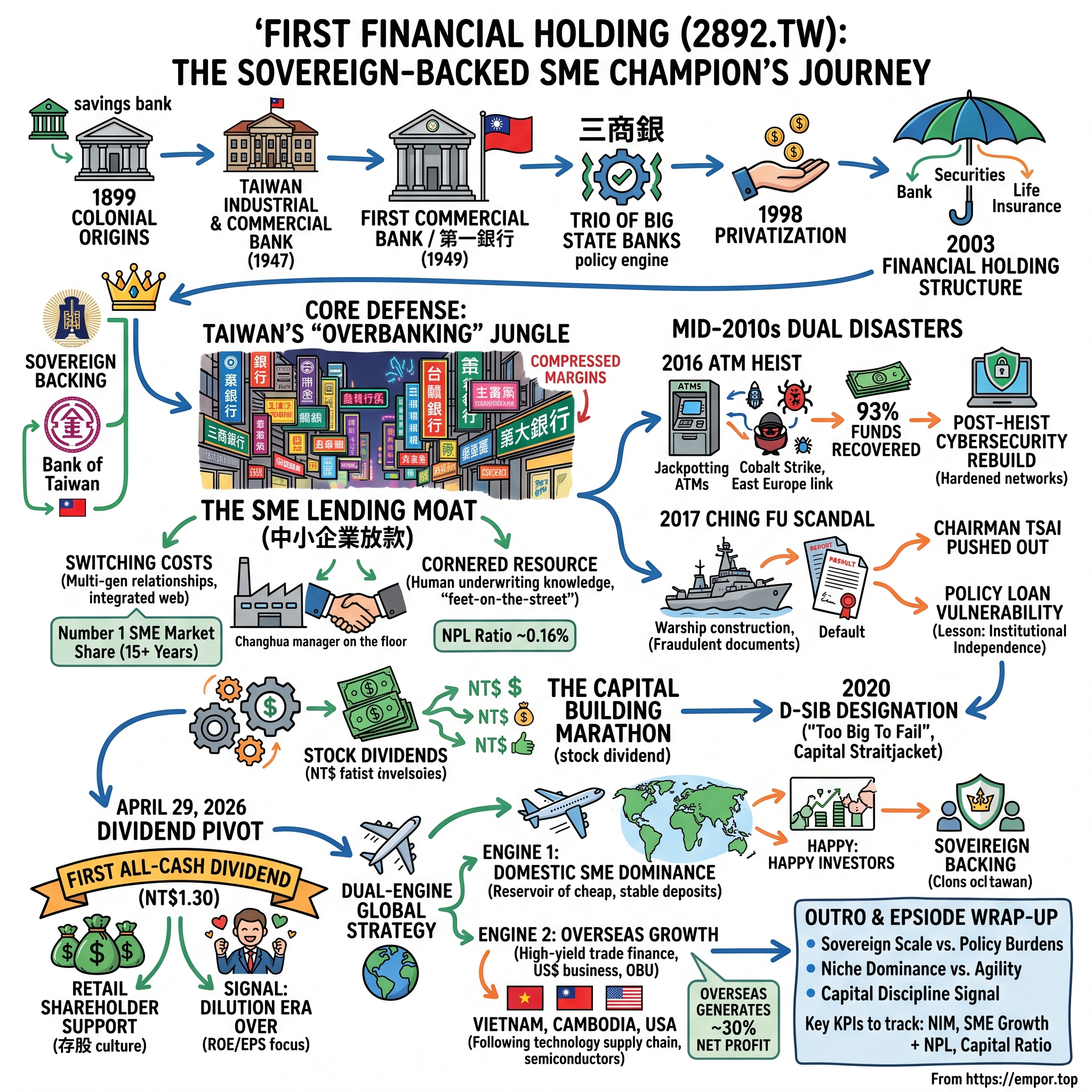
On the afternoon of April 29, 2026, in a conference room at the First Financial Holding headquarters on Chongqing South Road in central Taipei, the board of 第一金融控股股份有限公司 First Financial Holding Co., Ltd. did something it had never done in the twenty-three years since the holding company was created. It declared a dividend of NT$1.30 per share and distributed the entire amount in cash — not a single share of stock dividend attached.1
For most global banks, this would be a footnote. For First Financial, and for the roughly 460,000 retail shareholders who own its stock, it was a genuine break with history.2 Since the holding company was assembled in 2003, First Financial had almost always paid its owners partly in paper — issuing new shares as a "stock dividend" that let the bank hand something to shareholders while quietly hoarding cash on the balance sheet. That paper came at a cost: every new share issued diluted earnings per share and diluted return on equity, the two numbers that sophisticated investors actually watch. The 2026 decision buried that habit. It was the largest cash payout in the company's history bar one, and the first ever paid entirely in cash.3
The math told the story of a company that had finally been let off a regulatory leash. The NT$1.30 represented a payout ratio of roughly 69.5% of the prior year's earnings — a near seven-year high — struck against a 2025 net profit of NT$26.93 billion, up 6.2% year over year, and earnings per share of NT$1.87, the fifth consecutive annual record.2 At the closing price the day of the announcement, the implied yield sat around 4.5%.3 Here is why that combination mattered. A conservative, government-controlled bank does not casually raise its payout ratio to a multi-year high. It does so only when it is confident that it has enough capital in reserve to satisfy the regulators who, six years earlier, had branded it "too big to fail" and ordered it to fatten its cushion. The all-cash dividend was, in effect, First Financial declaring victory over a capital-building marathon — and signaling to the market that the era of dilution was over.
There is a second reason the announcement landed the way it did. Taiwan has a peculiar and enormous retail investing culture built around dividend income — the practice locals call 存股, literally "saving stocks," in which ordinary savers accumulate shares of stable, high-yielding companies the way a previous generation accumulated time deposits. Bank and financial-holding shares are the beating heart of that culture. When thirteen Taiwanese financial holding companies announced their 2026 payouts across the same few weeks, the aggregate distribution reached a record, and roughly nine of them offered cash yields above 4%.19 First Financial was not the highest yielder in that pack. What made it stand out was the structure of the payout — the deliberate, visible abandonment of dilution.
That is the destination. This is a story about how a bank got there, and it runs across more than a century.
The roadmap: First Financial began life as a Japanese colonial savings bank in 1899 and grew into a multi-trillion-New-Taiwan-dollar financial holding company. Along the way it carved out something rare in the brutally competitive world of Taiwanese banking — a genuine, multigenerational moat in lending to small and medium enterprises, the 中小企業放款 (SME loans) that are the actual engine of the island's economy. It survived two crises in the mid-2010s that read like movie scripts: an international cyber-heist that turned its ATMs into cash fountains, and a military shipbuilding fraud that cost it billions and its chairman's job. And today it runs a "dual-engine" strategy — domestic SME dominance funding an aggressive overseas push to bank the Taiwanese technology supply chain as it fans out across the world.
Whether that strategy deserves the market's confidence is the question this article exists to test. Let us start at the beginning.
 Subscribe on LinkedIn
II. The Colonial Origins and Post-War Sovereign Backing
To understand why Taiwanese savers trust First Bank with their money almost without thinking, you have to go back to a Taiwan that was a colony, not a country.
In 1899, four years into Japan's fifty-year rule of the island, a small institution called the 臺灣貯蓄銀行 Savings Bank of Taiwan opened its doors.4 Its purpose was mundane and profoundly important: to gather the modest savings of a largely agrarian population and channel that capital toward the sugar mills, rail lines, and trading houses that Japan was building to knit Taiwan into its empire. In 1912 it merged into the 臺灣商工銀行 Taiwan Commercial and Industrial Bank, and over the following decade it did what ambitious colonial banks did — it absorbed smaller local rivals, folding in institutions such as 嘉義銀行 Chiayi Bank and 新高銀行 Shinko Bank around 1923.4 By the time the Second World War ended, this bank had spent nearly half a century learning a single craft: taking deposits from ordinary Taiwanese and lending to Taiwanese businesses. That craft, not any particular product, is the through-line of the entire company.
It is worth pausing on what that colonial period actually built, because the popular telling — "a Japanese bank that later became Taiwanese" — misses the point. The Japanese administration's project in Taiwan was infrastructural: railways down the west coast, harbors at Keelung and Kaohsiung, sugar refineries, camphor and tea export houses. All of it required capital, and capital in an agrarian colony had to be assembled from thousands of tiny sources — farmers, shopkeepers, small traders — rather than drawn from a deep pool of existing wealth. The banks that thrived were the ones that could physically reach those small savers and then redeploy their money into commerce. That is a very specific institutional skill: dense branch coverage, small-ticket deposit gathering, and lending to modestly sized local enterprises whose books were, even then, informal.
Read the modern First Bank against that description and the continuity is striking. The bank that dominates SME lending in 2026 is doing, at vastly greater scale and with vastly better technology, more or less exactly what its predecessor did in 1910. The mergers of the 1910s and 1920s were not diversification; they were the accumulation of branch density and local relationships in one region after another. Institutions build competitive advantages the way rivers cut canyons — slowly, in one direction, for a very long time.
When the Republic of China government took control of Taiwan after 1945, the bank was nationalized and renamed. In 1947 it became the 臺灣工商銀行 Taiwan Industrial and Commercial Bank, and in 1949 — the same year the Nationalist government retreated wholesale to the island — it took the name it would carry into legend: 第一商業銀行 First Commercial Bank, universally shortened to 第一銀行 First Bank.4
Here the story stops being about one bank and becomes about the machinery of an economic miracle. Through the 1950s, 60s, and 70s, Taiwan transformed from a poor agricultural society into an industrial exporter — the "Miracle on the Taiwan Strait." State-directed credit was the fuel, and three state-owned commercial banks were the pumps. First Bank, alongside 華南銀行 Hua Nan Bank and 彰化銀行 Chang Hwa Bank, formed the trio Taiwanese still call the 三商銀 — the Three Big Commercial Banks. They were, for decades, effectively arms of national industrial policy: where the government wanted factories built, their loan officers followed.
That heritage is the foundation of everything that came later, and it cuts two ways. The benefit is a brand of near-sovereign safety burned into the national consciousness across three generations. The cost — the burden of being an instrument of policy rather than a purely commercial lender — is a theme that will return, painfully, in this story.
Consider what it meant for a Taiwanese family in, say, 1972. A father starting a small workshop making bicycle components would walk into the local First Bank branch not because he had shopped around for the best rate but because that was where a serious business banked. There was no meaningful alternative; the state banks were the credit system. When his son took over the workshop in the 1990s and turned it into a components exporter, the banking relationship transferred along with the business, the personal accounts, and the family's savings. When his granddaughter modernized it into a precision-parts supplier in the 2010s, the relationship was already three decades deep. Multiply that by tens of thousands of families across the island and you have something no marketing budget can buy: a customer base inherited rather than acquired. Taiwan's post-war credit monopoly, in other words, seeded a private-sector advantage that persisted long after the monopoly itself was dismantled.
For most of the twentieth century First Bank was fully state-owned. That changed in 1998, when the government privatized it, floating shares while retaining a controlling grip. The next structural leap came in 2003, when Taiwan's wave of financial consolidation swept it into a holding-company structure. 第一金融控股股份有限公司 First Financial Holding Co., Ltd. was created that year, placing the venerable bank alongside newly built securities, asset-management, and eventually insurance arms under a single corporate umbrella — the model Taiwan copied from the American and Japanese financial-holding template.4
But "privatized" is a slippery word here, and investors should hold onto the nuance. The Taiwanese state never really let go. Today the 中華民國財政部 Ministry of Finance, R.O.C. directly holds around 11.5% of the company, and the state-owned 臺灣銀行 Bank of Taiwan holds roughly 7.5%; add other government-linked agencies and the public sector controls somewhere in the region of a quarter to a third of the shares — enough to command the board and to install the chairman and president.5 First Financial is what Taiwanese call a 公股行庫, a "public-share bank": legally a listed company answerable to private shareholders, but practically an institution whose top leadership rotates with the political weather in Taipei. That dual identity — private capital, sovereign control — is the master key to the whole business. It explains the moat. It also explains the risks.
To see why, we need to understand the strange, overcrowded jungle in which First Financial has to hunt.
III. The Structural Trap: Surviving Taiwan's "Overbanking" Jungle
Picture a single mid-sized city street in Taipei or Kaohsiung. Walk two blocks and you may pass branches of five, six, seven different banks, their neon signs stacked one after another. This is not an illusion. It is the single most important fact about the economics of Taiwanese banking, and it is called "overbanking."
Taiwan is a market of roughly 23 million people served by more than thirty domestic commercial banks, plus a thicket of credit cooperatives and the local branches of foreign lenders.6 By way of comparison, that is a density of banking institutions per capita that would make a European or American regulator blanch. The country liberalized bank licensing aggressively in the early 1990s, unleashing a swarm of new private banks, and then — crucially — never consolidated. Political sensitivities around laying off bank workers, and the difficulty of merging state banks with private ones, left the industry frozen in a state of permanent oversupply.
The consequences flow directly to the income statement. When too many banks chase the same borrowers, they compete on the only variable that a commodity lender can move: price. The result is chronically compressed net interest margins — the spread between what a bank earns on loans and pays on deposits — and structurally depressed return on equity across the whole sector when set against banks in less crowded markets. A Taiwanese bank that would be considered mediocre in the United States might be a solid performer at home simply because the entire pond is shallow. Understanding this is essential, because it reframes what "good" looks like: First Financial does not need to be a great bank by global standards. It needs to be a durable winner in a structurally difficult market, and those are different tests.
It is worth understanding how Taiwan got here, because the history explains why the problem is so stubborn. For four decades after the war, banking was a tightly licensed, largely state-run utility. Then, in 1989, financial liberalization opened the gates, and in the early 1990s a wave of new private commercial banks received licenses. The theory was textbook: competition would improve service and lower borrowing costs for businesses. The theory worked, arguably too well. Borrowing costs fell, service improved — and margins collapsed. In a normal market, the next act would have been consolidation: weak banks fail or get absorbed, capacity shrinks, and returns normalize. That act never really came. Successive governments attempted "financial reform" programs aimed at halving the number of banks, and each ran aground on the same rocks — the political impossibility of large-scale layoffs at institutions with unionized workforces, the difficulty of valuing and merging state banks without accusations of selling public assets cheaply, and the entrenched interests of families and conglomerates that controlled the private banks. Taiwan ended up with the competition of a deregulated market and none of the consolidation that normally follows it.
The lived consequence for a bank like First is a permanent price war on the most visible products. Mortgage rates, large-corporate loan spreads, and deposit rates are all bid to the bone by rivals who need the volume. A blue-chip Taiwanese technology exporter with a pristine balance sheet can call six banks and run an auction for its borrowing needs, and it will get a spread so thin the winning bank makes almost nothing on the loan itself, hoping instead to earn back the relationship through foreign-exchange fees, cash management, and syndication mandates. This is the reality that any assessment of First Financial's performance has to be measured against.
The competitive field splits into two camps that barely play the same game.
On one side stand the private titans — 富邦金控 Fubon Financial Holding, 國泰金控 Cathay Financial Holding, and 中國信託金控 CTBC Financial Holding. These are aggressive, capital-markets-driven machines. They dominate high-yield consumer finance and credit cards, they run enormous life-insurance operations that gather premiums and invest them globally, and they build wealth-management franchises around Taiwan's rich savers. They are growth-hungry, marketing-savvy, and willing to take balance-sheet risk in pursuit of returns.
On the other side stand the state-affiliated banks — First Financial itself, plus 兆豐金控 Mega Financial Holding, 合作金庫金控 Taiwan Cooperative Financial Holding, and its old sibling 華南金控 Hua Nan Financial Holding. These are the descendants of policy banking: conservative, deposit-rich, deeply embedded in the real economy of factories and family businesses, and carrying the implicit backing of the state.
That implicit backing is First Financial's core structural advantage, and it is worth being precise about the mechanism. Because savers perceive a government-controlled bank as effectively unable to fail, they park money there without demanding a premium for safety. First Bank can therefore gather an enormous mountain of cheap, sticky retail deposits through a domestic network of well over two hundred branches — the kind of low-cost funding base that a small private bank, forced to bid up deposit rates to attract nervous savers, simply cannot match.4 In the language of Hamilton Helmer's 7 Powers, this is a scale-and-cost advantage: a lower cost of funds that competitors cannot replicate no matter how cleverly they price, because they cannot manufacture sovereign trust.
It is worth being concrete about why cheap deposits matter so much, because it is the least glamorous and most decisive fact in banking. A bank's raw material is money, and its cost of goods sold is the interest it pays for that money. If Bank A funds itself with current and savings accounts paying near-zero, and Bank B has to fund itself by offering promotional time-deposit rates to lure savers away from the incumbents, then Bank A can lend at the same rate as Bank B and still earn a wider spread — or it can undercut Bank B and still match its profitability. Over decades, that gap compounds into an unbridgeable structural difference. It is the banking equivalent of a manufacturer that owns its own low-cost power plant.
There is a second, less-discussed dimension: stability. Deposits gathered on the strength of a high promotional rate are "hot" money that leaves the moment a rival offers ten basis points more. Deposits gathered on the strength of institutional trust, held by customers who have banked at the same branch for thirty years and whose businesses run through those accounts, are close to inert. In a funding crisis, hot money runs and sticky money stays. That difference does not show up in a normal year's income statement at all — and then it is the only thing that matters. First Bank's deposit franchise is its true crown asset, and it is one of the few competitive advantages in finance that a rival genuinely cannot buy, build, or copy on any reasonable timeframe.
But a cheap funding base is only half a business. Cheap deposits are worthless if you lend them out at commodity rates to blue-chip borrowers who squeeze you on price. The genius of First Bank — and the source of whatever durable edge it truly possesses — lies in where it puts that money to work. It lends to the businesses almost no algorithm can price: Taiwan's small and medium enterprises.
That is the crown jewel, and it deserves its own chapter.
IV. The Crown Jewel: Inside the SME Lending Moat
Drive south out of Taipei into Changhua County, and the landscape changes. The gleaming towers give way to a dense sprawl of small factories — machine shops, fastener makers, plastics moulders, precision-parts suppliers — often family-run, frequently occupying the ground floor of the same building where the owner's family lives upstairs. These are the firms that make the screws, hinges, connectors, and sub-assemblies that feed Taiwan's famous export machine. They are also, individually, credit nightmares.
A typical Changhua factory owner keeps informal books. The company's finances and the family's finances blur together. The "collateral" might be a factory, a fleet of machines of uncertain resale value, and the owner's personal reputation among the local business community. Plug that borrower into a modern quantitative credit-scoring model and the model chokes — there is not enough clean data to score. Most large, sophisticated banks look at that profile and walk away, or lend only against hard real-estate collateral at punitive terms.
First Bank runs toward it. The bank has held the number-one market share in SME lending in Taiwan for more than fifteen consecutive years, and in April 2026 its SME loan book crossed the symbolic NT$1 trillion mark.7 That is the operational KPI that defines the franchise, and it did not happen by accident. It is the product of two distinct competitive powers working together.
The first is switching costs. Consider what it actually means for that Changhua factory to "change banks." The owner's working-capital line, his trade-finance facilities for importing raw materials and exporting finished goods, the mortgage on the factory, the loans on the machinery, very often the personal savings and mortgages of the owner and his family — all of it sits at First Bank, frequently built up over two or three generations of the same family. The relationship is not a product; it is a web. Unwinding it to save a few basis points on a loan rate is not just disruptive, it risks severing a credit line the business depends on to make payroll. So the borrower stays. That stickiness is why First Bank's SME deposits and loans are among the most durable liabilities and assets in Taiwanese banking.
The second power is subtler and, from an investor's standpoint, more interesting: a cornered resource in the form of human underwriting knowledge. First Bank's relationship managers — its RMs — are not spreadsheet jockeys. They are, in effect, field investigators. A good SME RM in central Taiwan can walk onto a factory floor and read the health of the business from the physical evidence: Are the machines running two shifts or idle? Is the order book stacked with purchase orders from creditworthy buyers, or thinning out? Does the owner pay his suppliers on time — a signal of character that no credit bureau captures? This "feet-on-the-street" intelligence, accumulated over decades and embedded in a workforce that knows the local business community personally, is genuinely hard to replicate. A new entrant cannot hire it off the shelf; it has to be grown over years in a specific place.
An analogy helps here. Think of large-corporate lending as selling wheat on a commodity exchange: the product is standardized, the buyer knows the market price to the decimal, and the seller has no pricing power whatsoever. SME lending is closer to being a country vet in a farming district. The work is unglamorous, it requires showing up in person, and much of the value comes from knowing the animals and the farmers personally. But nobody can undercut you on price from a call center in Taipei, because they cannot do the job at all. First Bank's SME book earns better spreads not because it charges predatory rates, but because there are fewer credible bidders for the business.
There is a further economic subtlety that explains why banks like First fight so hard for SME relationships even when the individual loans are small. The lending relationship is the anchor, but it drags a great deal else behind it. The factory keeps its operating deposits at the bank — cheap funding. It buys foreign exchange to pay overseas suppliers — fee income. It uses letters of credit and trade documentation to ship its exports — more fees, and short-dated, self-liquidating credit that is among the safest lending a bank can do. The owner's family holds its personal savings, mortgages, and eventually its wealth-management and insurance products at the same institution. The loan is the tip of the iceberg; the profitability sits in the mass beneath the waterline. This is why the SME franchise is worth far more to First Financial than a simple analysis of loan spreads would suggest, and it is also why the securities and insurance subsidiaries exist at all — as capture mechanisms for the rest of the iceberg.
The financial result is the number that ought to make a skeptic sit up. Despite lending to exactly the kind of small, informal, "risky" borrower that theory says should generate high losses, First Bank has kept its non-performing loan ratio around 0.16%, with a bad-debt coverage ratio — reserves set aside against every dollar of bad loan — running well above 800%.7 Read those two numbers together and they tell a story: this is a bank that has, so far, married higher-margin lending to world-class credit control. SME loans carry fatter spreads than the wafer-thin rates blue-chip technology giants extract when they borrow, because the tech giants can play a dozen banks against each other while the small factory cannot. First Bank captures that extra spread while — on the evidence of the NPL ratio — barely losing money to defaults.
A word of caution the bull case tends to skip: an NPL ratio of 0.16% is a number struck in benign conditions. Taiwan has not run a serious domestic recession or a sharp property downturn in years, and SME credit quality is exactly the kind of metric that looks pristine right up until a cycle turns. The moat is real; its stress-tested durability is an assumption, not a proven fact. That is why, later, we flag the NPL ratio as the single most important number to watch.
A second caution concerns what "number-one SME market share" actually means in a market this fragmented. Leading a category in which more than thirty banks compete does not imply anything close to monopoly; it implies a plurality, held by a nose, that must be defended every year against rivals with essentially the same ambition. Taiwan Cooperative and Hua Nan run comparable playbooks with comparable histories and comparable sovereign backing. The gap between First Bank and its closest state-affiliated peers on this dimension is one of degree, not of kind. Investors should therefore be careful about the mental leap from "fifteen years at number one" to "unassailable." The correct reading is that First Bank has been the best executor in a peer group that shares its structural advantages — which is genuinely impressive, and materially less exciting than a monopoly.
The bank has also been layering technology on top of the human craft. Products such as 微企e時貸 ("micro-enterprise e-loans") use automated algorithmic scoring to underwrite the smallest loans quickly and cheaply, letting First Bank serve micro-businesses that would be uneconomic to underwrite by hand while keeping risk controls tight. The strategic logic is sound: reserve the expensive human RMs for the complex, relationship-heavy loans where their judgment adds real value, and automate the small, standardized ones. Whether that digital layer meaningfully widens the moat or merely defends it against fintech encroachment is still an open question.
The moat, in short, is the best part of the story. But no moat protected First Bank from the two disasters that struck in the middle of the last decade — disasters that had nothing to do with SME credit and everything to do with the two other faces of a big state bank: its technology, and its politics.
V. Two Movies, One Bank: The Hacking Heist and the Shipbuilding Disaster
Movie 1: The 2016 ATM Jackpotting Heist
It began, as these things do, quietly. Over the weekend of July 9 and 10, 2016, First Bank's ATMs across Taipei and other cities began, without anyone inserting a card or entering a PIN, to dispense cash. Not a jam, not a glitch — the machines simply counted out bills and pushed them into the trays, where waiting couriers scooped them into backpacks and vanished. By the time the bank understood what was happening, 41 ATMs across 22 branches had spat out NT$83.27 million, roughly US$2.6 million, into the hands of an international crew of money mules.89
This was not a physical break-in. It was 第一銀行ATM盜領案 — a remote cyber-heist, and a technically elegant one. Investigators and the security firm that traced it attributed the attack to a syndicate that came to be code-named "Cobalt," after its use of the Cobalt Strike penetration-testing tool, and linked it to a group operating out of Eastern Europe.8 The attackers did not touch the ATMs physically at all. They penetrated the bank's internal network — reportedly through a vulnerability connected to an overseas branch — moved laterally to the servers that controlled the ATM fleet, and pushed malware down to the machines that instructed them to "jackpot": to empty their cassettes on command. The mules only had to stand at the right machine at the right moment and carry the cash away.
It is worth explaining "jackpotting" plainly, because the term obscures how simple the underlying idea is. An ATM is not a vault with a lock; it is a computer attached to a cash dispenser. The computer's job is to check with the bank's systems that a withdrawal is authorized and then instruct the dispenser to count out bills. If an attacker can get their own instructions onto that computer — or onto the servers the computer trusts — they can skip the authorization step entirely and simply tell the dispenser to empty itself. The name comes from the way the machine behaves like a slot machine paying out a jackpot. No card, no PIN, no account is needed, because the attack never touches the accounts. It targets the machine's obedience, not the customer's money.
That distinction matters for how investors should read the event. No First Bank customer lost money from their account; the loss fell on the bank's own cash. But the more troubling implication is what the attack revealed about the bank's internal architecture. To push malware to ATMs across 22 branches, the attackers had to have moved freely from an entry point deep into the network that controlled critical infrastructure. A well-segmented bank network is built like a submarine, with watertight compartments — a breach in one floods only that compartment. First Bank's network in 2016 was evidently more like an open warehouse.
For a country that prided itself on technological sophistication, it was a national humiliation. But what happened next became the part Taiwanese still tell with a certain pride. The police response was ferocious and fast. Within roughly a week, authorities had identified and captured key members of the mule network, and — critically — recovered NT$77.48 million of the stolen money, about 93% of the total, most of it never having left the island.9 The manhunt stretched internationally; a suspected ringleader was arrested in Spain in 2018.10 For a heist of this sophistication, recovering the overwhelming majority of the cash was an extraordinary outcome.
The lasting significance, though, is what it did to First Bank internally. The heist was a five-alarm wake-up call that a bank's balance sheet is only as safe as its network. In the aftermath, First Bank rebuilt its information-security posture from the studs: it stood up a dedicated cybersecurity organization, moved toward hardening and isolating the internal networks that controlled critical systems so that a breach in one corner could not cascade to the ATM fleet, and turned itself — at least in the retelling management prefers — from a cautionary tale into a domestic benchmark for financial cybersecurity. For investors, the honest reading is mixed. The response was genuinely impressive, and the institutional learning was real. But the episode also exposed how a large, systemically important bank is a permanent, high-value target, and no amount of remediation makes that target go away. Cybersecurity is not a problem First Bank solved in 2016; it is a cost and a risk it will carry forever.
If the ATM heist was a crime committed against First Bank, the second disaster was a wound at least partly self-inflicted — and it cut far closer to the bone of what a state bank is.
Movie 2: The 2017 Ching Fu Shipbuilding Scandal
In 2014, the Republic of China Navy awarded a multi-billion-New-Taiwan-dollar contract to build a fleet of minesweepers — warships designed to clear naval mines, a genuine national-defense priority for an island that lives under the shadow of a potential blockade. The contractor was 慶富造船 Ching Fu Shipbuilding, a Kaohsiung-based yard. To finance the work, Ching Fu needed a mountain of capital, and First Bank stepped up as lead arranger of a syndicated loan of roughly NT$20.5 billion, pulling together a consortium of domestic lenders behind it.11
It was, on paper, exactly the kind of loan a patriotic state bank is expected to make: financing a strategic defense project, at the government's implicit encouragement. And it was a catastrophe. In 2017, Ching Fu was exposed as a fraud. Prosecutors alleged that its executives, knowing the company was over-indebted and cash-starved, had used fraudulent documents — including fake contracts — to deceive the banks and draw down funds they were never entitled to.11 The company collapsed. The syndicate faced losses that regulators estimated could run into the mid-teens of billions of New Taiwan dollars across the group of lenders.12
The fallout for First Bank was severe and public. As lead arranger, it took the heaviest reputational blow. The Financial Supervisory Commission fined fourteen banks over the affair, and First Bank drew the largest single penalty — NT$10 million, the maximum the Banking Act allowed at the time.12[^13] And in the most visible sign of accountability, Chairman 蔡慶年 Tsai Ching-nain was pushed out.11
Step back and consider how this loan could have been made at all by an institution that is, on the evidence of its SME book, an excellent judge of credit. Ching Fu was a shipbuilder attempting a project of a scale far beyond its demonstrated capability, funded with borrowed money against a government contract. The warning signs an experienced credit officer looks for in project finance — a contractor whose balance sheet is too thin for the contract, cash flows dependent entirely on milestones the borrower has never before achieved, collateral that is essentially a half-built ship of no value to anyone else — were structural features of the deal, not hidden details. The fraud made the losses larger and gave everyone a villain to point at, but the underlying credit decision was fragile before any documents were falsified.
Why did a bank that scrutinizes a Changhua factory's order book approve it? The uncomfortable answer is that the two decisions were made by different parts of the institution under different pressures. SME lending is decentralized, granular, and judged on outcomes the RM will personally live with. A headline syndicated loan for a national defense program is decided at the top of the house, where the borrower is not a factory owner but a project the government wants completed, and where the reputational reward for leading the deal — and the reputational cost of refusing it — are political as much as commercial. The failure at Ching Fu was not a failure of credit skill. It was a failure of institutional independence.
Here is the structural lesson, and it is the darker mirror image of the SME moat. The very sovereign character that makes First Bank's deposits cheap and sticky also makes it vulnerable to "policy loans" — lending where national objectives and political pressure crowd out cold, independent credit analysis. When a state bank is nudged to finance a strategic defense contractor, the RMs' instinct to walk the factory floor and read the order book gets overridden by the understanding that this is a loan the government wants made. That is precisely the discipline that failed at Ching Fu. The scandal forced a cultural reckoning, and subsequent management worked to build firewalls between state policy recommendations and professional risk assessment — to insist that even a politically favored borrower had to clear the same underwriting bar as a Changhua factory.
Whether those firewalls actually hold is not something an investor can verify from the outside, and the recurrence of a Ching Fu-style failure remains a permanent tail risk baked into the state-bank model. We will return to it. But the two movies of the mid-2010s did something useful: they exposed First Bank's two great vulnerabilities — technological and political — at exactly the moment when a third pressure, this one from the regulator, was about to reshape how the bank could use its capital.
VI. The "Too Big to Fail" Dilemma: Navigating D-SIB and the Dividend Pivot
In December 2020, the Financial Supervisory Commission handed First Bank a designation that was simultaneously a compliment and a straitjacket. It named First Commercial Bank the sixth of Taiwan's Domestic Systemically Important Banks — a D-SIB — joining CTBC, Cathay United, Taipei Fubon, Mega International, and Taiwan Cooperative on the roster of institutions the regulator judged "too big to fail."1314
The compliment was implicit: First Bank had grown large and interconnected enough that its failure would threaten the whole financial system. The straitjacket was explicit. D-SIB status came with a demand for extra capital — an additional buffer of 2% of risk-weighted assets required by statute, plus a further 2% "internal management" buffer, phased in over several years. The internal portion was later deferred in timing to ease the pandemic's blow, stretching the build-out toward the mid-2020s.13 The intent was straightforward: force the most important banks to hold a thicker cushion of shareholder capital so that they could absorb losses without a taxpayer bailout.
For First Financial's shareholders, this created a genuine dilemma, and it is worth walking through the mechanics because it is the direct cause of the dividend behavior that opened this article. A bank builds capital in two ways: it can issue new equity, or it can retain earnings instead of paying them out. Issuing equity into a low-return market is unattractive. So the natural path was to retain more of each year's profit. But First Financial's retail shareholder base — heavily populated by income-seeking 存股 ("stock-parking") investors who buy bank shares precisely for the dividend — expected a payout every year.
The company squared this circle with a hybrid dividend: part cash, part stock. The stock dividend was the clever, and quietly costly, trick. By handing shareholders new shares instead of cash, First Financial could give the appearance of a full payout while keeping the actual money inside the bank as capital. In 2024 it paid NT$0.85 in cash plus NT$0.30 in stock; in 2025, NT$0.95 in cash plus NT$0.25 in stock.2 Shareholders got their "dividend" — but every stock dividend minted new shares, and more shares spread the same earnings thinner, mechanically depressing earnings per share and dragging on return on equity. In effect, income investors were being paid partly in dilution. For a capital-building phase, it was a rational compromise. As a permanent policy, it was a slow bleed on per-share value.
It is worth being clear about why regulators cared enough to impose this, because the D-SIB framework is often misread as bureaucratic box-ticking. A bank is, structurally, one of the most leveraged businesses in existence: for every dollar of shareholders' equity, it may carry more than ten dollars of assets funded by depositors' money. That leverage is what makes banking profitable and what makes it dangerous. Capital is the shock absorber — the buffer of shareholder money that must be entirely wiped out before a depositor loses a cent. The lesson regulators worldwide drew from 2008 was that the largest banks had been running with shock absorbers far too thin for their systemic weight, so that when losses arrived, the choice was between depositor losses and taxpayer bailouts. The D-SIB surcharge exists to force the biggest institutions to carry a thicker buffer than everyone else, precisely because their failure would be everyone's problem.
For shareholders, this is an unambiguous transfer: safety is purchased with returns. Holding more equity against the same assets mechanically lowers return on equity, all else equal. A D-SIB designation is therefore a permanent, structural headwind to First Financial's profitability relative to a smaller bank running the same business. That is not a criticism of management; it is a feature of the model that any valuation has to accommodate. The bank is safer than its peers and, for that reason, will likely earn a lower return on equity than it otherwise could.
Which is what makes the 2026 pivot the strategic climax of the whole capital story. By the end of 2025, First Bank had reached its D-SIB capital targets with room to spare: its common equity tier-1 ratio stood at 11.7%, its tier-1 capital ratio at 13.22%, and its total capital adequacy ratio at 15.46% — all comfortably above the regulatory thresholds.2 The marathon was finished. And so, on April 29, 2026, under the leadership of Chairwoman 邱月琴 Ye-Chin Chiou — who had taken the top job in November 2020, the only woman then leading a state-controlled Taiwanese financial group, and by 2024 was working alongside President Fen-Len Chen — the board eliminated the stock dividend entirely and declared the all-cash NT$1.30.152
The strategic meaning is what matters, not the number itself. By halting stock dividends, management stopped diluting its own shareholders and signaled that its priority had shifted from building the balance sheet to lifting per-share returns. It was a statement that the capital-conservation era was over and a return-focused era had begun. It also cemented First Financial's identity as a premier holding for Taiwan's vast income-investing community — the retirees and savers who want a dependable cash coupon from a bank they believe cannot fail. For a company so often dismissed as a sleepy bureaucratic institution, it was a moment of genuine corporate-finance discipline: choosing per-share value over the reflexive habit of balance-sheet expansion.
There is a management-credibility question buried in this sequence that deserves attention, because it is the kind of behavioral evidence worth more than any strategy slide. Across the D-SIB build-out years, First Financial's leadership told shareholders a consistent story: the hybrid dividend was a temporary function of a regulatory capital requirement, not a permanent policy. Many management teams say such things and then discover that retaining capital is comfortable and quietly keep doing it. First Financial did not. When the capital ratios cleared the thresholds, the stock dividend was eliminated in a single step rather than tapered over several years — a decision that gave up the optionality of holding back capital "just in case." Whether one views that as discipline or as a concession to a retail shareholder base that had grown impatient, the narrative and the action matched. On the specific, testable question of "did they do what they said they would do when the condition they named was met," the answer is yes.
The counter-observation a skeptic should hold alongside it: this was a promise kept in favorable conditions. Profits had risen for five consecutive years and capital ratios cleared comfortably. The harder test of capital discipline is what happens in a bad year — whether the all-cash dividend survives an earnings decline, and whether management would cut it honestly or strain to maintain it by other means. That test has not yet arrived.
Sustaining that discipline, of course, depends on the bank continuing to earn enough to fund both the payout and future growth — which is why the second engine of the story, the overseas business, matters so much.
VII. The Dual-Engine Global Playbook
There is a hard ceiling on how good the domestic business can ever be. Everything covered so far — the cheap deposits, the SME moat, the pristine credit — runs into the same wall: Taiwan's overbanked market caps how much margin any lender can extract at home. A bank that only played defense on its home island would be a stable, slow-growing dividend stock and little more. First Financial's answer is what management calls the "dual-engine" strategy, and it is the part of the story with the most genuine upside and the most genuine risk.
Engine one is everything already described: domestic SME dominance, throwing off a huge, cheap, stable pool of deposits. Think of it as the reservoir. Engine two is what the bank does with the overflow — deploying that funding into higher-yield operations abroad, through international branches and the Offshore Banking Unit that books foreign-currency business out of Taiwan.
The scale of engine two is more significant than the asset figures suggest. Overseas operations, including the OBU, generate close to 30% of First Bank's net profit while occupying only a fraction of its assets — a sign that a dollar lent abroad, into trade finance and cross-border corporate deals, earns considerably more than a dollar lent into the domestic price war.16 That is the whole point: the overseas book is where the margins live.
The strategy behind it is elegant and specifically Taiwanese. First Bank follows its customers. As Taiwanese semiconductor, electronics, and component manufacturers have spread their factories and supply chains across the world — pulled by the reshoring of chip production to North America, by diversification into Southeast Asia, and by the "China plus one" retreat from mainland concentration — First Bank has planted branches along the route. Its footprint spans North America, Japan, Europe, and Southeast Asia, with particular emphasis on Vietnam and Cambodia, where Taiwanese manufacturers have clustered.16 When a Taiwanese electronics firm opens a plant in Vietnam, it needs someone to finance the imported machinery, handle the US-dollar trade payments, and lend working capital in an unfamiliar market. First Bank, which already banks the parent company back home, is the natural provider. This is the SME switching-cost moat, exported: the relationship travels with the customer across the border.
The Offshore Banking Unit deserves a plain-English explanation, because it is a peculiarly Taiwanese instrument and it does real work in this story. An OBU is a ring-fenced division of a domestic bank, licensed to conduct business in foreign currencies with non-residents, operating under lighter regulatory and tax treatment than the onshore bank. In practical terms, it lets a Taipei-headquartered bank book US-dollar loans to the offshore holding companies through which Taiwanese manufacturers own their overseas factories — without those transactions running through the domestic balance sheet's constraints. Because Taiwanese corporate groups characteristically hold their foreign operations through such structures, the OBU is where a great deal of the real cross-border financing of the Taiwanese supply chain actually happens. It is high-margin, dollar-denominated, and closely tied to the same corporate relationships the bank already owns at home.
Trade finance itself is worth understanding, because it is unusually attractive business when done well. When a Taiwanese components maker ships to a buyer in the United States, months can pass between dispatching the goods and receiving payment. The bank bridges that gap — advancing funds against the shipping documents and the buyer's letter of credit, then getting repaid when the buyer pays. The loans are short-dated, typically self-liquidating (the transaction that creates the debt also generates the cash that extinguishes it), and secured by real goods in transit. Compared with lending against a factory for seven years, it turns over quickly, carries lower credit risk per dollar, and generates fee income alongside interest. A bank positioned along the physical routes of a large trading economy's supply chain has access to a genuinely good business — which is precisely the position First Bank has spent the last decade buying with new branches.
The economic prize is higher-yield business — trade finance, US-dollar corporate syndications, cross-border lending — that lifts the group's overall net interest margin above what the domestic book alone could produce. In effect, the safe, cheap deposits gathered from cautious Taiwanese savers are being routed into the more profitable arteries of the global technology supply chain.
But investors should hold the enthusiasm up to the light. Overseas expansion is where banks most often get hurt, precisely because it lacks the home-market advantages that make the domestic book so safe. Abroad, First Bank has no sovereign-trust funding edge — it must fund US-dollar assets with US-dollar liabilities that it has to bid for at market rates, so when US interest rates are high, the cost of that funding squeezes the very margins the strategy is built to capture. It has no multigenerational relationship knowledge of local borrowers in Cambodia or the United States the way it does in Changhua. And it is exposed to credit, legal, and political environments its RMs understand far less intimately. The Ching Fu lesson — that First Bank's worst losses come from lending outside its circle of genuine competence — is worth remembering here. The overseas engine is the best growth story the company has. It is also the place where the next big loss is most likely to originate. Both things are true.
The overseas push is a bank story. The rest of First Financial — the non-bank subsidiaries — is a much smaller story, and honesty about its size is itself part of the analysis.
VIII. Subsidiary Underdogs: Sized to Economic Weight
Here is the single most important thing to understand about First Financial's non-bank businesses: they barely move the needle. The banking segment accounts for the overwhelming majority of the group's profit and value — over 90% — and everything else is a rounding error dressed up as diversification. Any analysis that spends as much time on the subsidiaries as on the bank has lost the plot. So this section is deliberately brief, in proportion to what these businesses actually contribute.
第一金證券 First Securities and First Asset Management exist largely as cross-selling conduits. They live inside the physical branch network, capturing retail brokerage commissions and mutual-fund distribution fees from customers who are already there for their banking. That gives them a distribution advantage — a captive audience of millions of bank customers — but it also chains their fortunes to market cycles. When Taiwanese retail investors are euphoric and trading volumes surge, the securities arm earns well; when markets sag, so do its fees. They are amplifiers of sentiment, not builders of durable value, and they should be modeled as cyclical fee businesses riding on the bank's footprint.
第一金人壽 First Life Insurance has a better story, though not a better business. Its origin is a small classic of opportunistic capital deployment. The company began as First-Aviva Life, a joint venture with the UK insurer Aviva. In 2017, as part of a broader retreat to focus on its core markets, Aviva decided to quit Taiwan and sold its 49% stake in the venture to First Financial for a token consideration of US$1, with the deal completing in early 2018.1718 Buying out a partner's near-half of an insurer for a single dollar sounds like a coup, and as a headline it is a good one.
The reality is more sober, and management has treated it soberly. First Life is not a value driver. Like much of the Taiwanese life-insurance industry, it carries a legacy of high-guaranteed-rate policies sold in a higher-rate past, which become a millstone when prevailing interest rates fall and the insurer must still pay the promised returns. Rather than chase scale — which in life insurance means taking on capital-adequacy strain and balance-sheet risk — management has deliberately kept First Life small, tilting its product mix toward lower-risk protection and investment-linked products that pass market risk back to policyholders. That is the disciplined choice. But it also means First Life will never be more than a minor complement to the bank. It is optionality, not an engine — and treating it as anything more would misread the company.
With the pieces on the board, we can now step back and extract what this whole history teaches.
IX. Playbook: Business & Investing Lessons
Strip away the century of detail and First Financial offers a handful of durable lessons about how businesses like this actually work — and where the naïve version of the bull case goes wrong.
The first is that sovereign scale is a double-edged sword, and you cannot own one edge without the other. The advantage is the cheap, sticky, sovereign-trusted deposit base — the closest thing to a permanent, low-cost raw material that a bank can possess. But the same government relationship that manufactures that trust also imposes "policy burdens": the expectation that the bank will fund government relief programs, national infrastructure, or strategic projects like a minesweeper contractor, sometimes at yields that no commercial lender would accept, and sometimes with credit discipline that bends to political will. Ching Fu was the extreme expression of this burden; the day-to-day expression is subtler, a persistent drag on returns from being an instrument of the state as much as an agent of its shareholders. An investor buying First Financial is buying both edges of the blade, and pretending otherwise is the most common mistake in the bull case.
The second lesson is the power of niche dominance over general agility. Fubon and Cathay win by being aggressive, diversified, capital-markets athletes — chasing consumer credit, wealth management, and insurance float with private-sector hunger. First Financial wins in the opposite way: by being quietly, unglamorously excellent at one hard thing — generational, relationship-based SME credit underwriting that resists commoditization because it depends on human judgment and human relationships that cannot be bought or copied quickly. In a market where everyone competes on price, the bank that competes on a capability no one else has built is the one that keeps its margins. The lesson generalizes far beyond banking: a deep moat around a narrow territory can beat broad reach across a shallow one.
The third lesson is capital-allocation discipline as a signal. The 2026 dividend pivot demonstrated that even a state-affiliated institution, run by rotating political appointees, can behave with genuine corporate-finance sophistication — choosing to protect per-share earnings and lift return on equity over the reflexive instinct to grow the balance sheet and pay shareholders in dilutive paper. That is a meaningful, behavior-based data point about management quality, and it should be weighed against the governance concerns that come with political appointment. The pivot was not a promise; it was an action, and actions are what an investor can actually underwrite.
A fourth lesson runs underneath the other three: the same institutional trait produces both the best and worst outcomes. First Financial's defining characteristic is that it is embedded in the Taiwanese state and the Taiwanese real economy simultaneously. That embedding is why savers hand it money cheaply, why factory owners stay for generations, and why it survived a century of political upheaval. It is also why it financed a fraudulent warship-builder, why its leadership rotates with elections, and why it carries policy burdens no private competitor bears. Investors instinctively want to separate a company's strengths from its weaknesses and own only the first. In this case they are the same trait viewed from two angles, and the correct analytical posture is to size the position for both.
Myth vs Reality
Three consensus narratives about this company deserve examination, because each is roughly half true.
Myth: "It's a government bank, so it's guaranteed." The reality is more precise and less comforting. What the state's involvement realistically guarantees is the safety of deposits — the government has strong incentives to prevent a systemically important bank from failing on its depositors. It guarantees nothing whatsoever about the equity. Shareholders in banks that get rescued typically do very badly; rescue mechanisms exist to protect the financial system, not the owners. Sovereign backing lowers the bank's cost of funds, which is a genuine and valuable transmission to shareholders. It is not a put option on the share price.
Myth: "The 15-year SME leadership means the moat is unassailable." As discussed, leadership in a fragmented field of thirty-plus banks means a defended plurality against peers running near-identical strategies, not dominance. The moat is real at the level of the individual customer relationship — switching costs and local underwriting knowledge genuinely bind borrowers. It is considerably weaker at the level of the market, where several state-affiliated rivals possess the same structural advantages.
Myth: "The pristine 0.16% NPL ratio proves superior risk management." It partly does, and the sustained gap between what SME lending theoretically should cost in losses and what it has actually cost First Bank is meaningful evidence. But Taiwan's entire banking sector has been running at exceptionally low NPL levels in a benign environment, with sector-wide ratios in the same low range.20 A substantial portion of First Bank's excellent credit performance is a rising tide, not a superior boat. Distinguishing the two requires observing a downturn — which is exactly why the NPL ratio, tracked over a cycle rather than at a point in time, is the most informative number an investor can follow.
These lessons set up the central question any prospective owner has to answer. Does First Financial win from here — and what would break the case?
X. The Investor's Stress Test: Bull & Bear Case
Let us war-game this the way a skeptical long/short investor would, testing the moat against the frameworks rather than taking it on faith.
The "Why Win" / Bull Case
The bull case rests on three legs. The first is the sustained SME moat. Run it through Hamilton Helmer's 7 Powers and it registers on at least two: switching costs (the multigenerational, deeply integrated banking relationships that make defection painful) and a cornered resource (the RM underwriting knowledge that quantitative models cannot replicate). Run it through Porter's five forces and the same edge appears as a defense against rivalry and new entrants: a new bank cannot simply undercut First Bank on price to win a Changhua factory, because price was never why the factory stayed. The evidence that the moat is real, not rhetorical, is the combination the sector cannot easily match — number-one SME share for over fifteen years, an NPL ratio near 0.16%, and coverage above 800%, all held while earning fatter spreads than commodity corporate lending.7
The second leg is the sovereign yield play. The shift to an all-cash dividend near a 4.5% yield makes the stock structurally attractive to Taiwan's enormous 存股 retail community — a deep, price-insensitive, income-hungry buyer base that provides real valuation support for the shares.3 This is a demand-side moat on the stock rather than the business: as long as the cash dividend holds, a wall of domestic savers wants to own it.
The third leg is the global realignment tailwind — the overseas engine capturing higher-yield cross-border trade finance as Taiwan's technology supply chain relocates, lifting group margins above the domestic ceiling.16 Of the three legs, this is the one with the most upside and the least certainty.
The "Why Not" / Bear Case
The bear case is equally coherent, and a serious investor should sit with it. Start with overbanking and NIM compression. First Financial's core profitability is hostage to an interest-rate cycle it does not control. If global and domestic rates decline, net interest margins compress across Taiwan's hyper-competitive market, and a bank whose earnings are heavily geared to spread income feels it directly. The moat protects market share and credit quality; it does not protect against a falling-rate environment squeezing the spread on every loan.
Next, political and governance risk — the structural weakness an activist would attack hardest. The chairman and president are, in practice, political appointees whose tenure can turn with presidential elections and cabinet reshuffles. That injects a risk of strategic discontinuity that a stable private-sector board does not carry: a management team executing a coherent plan can be swapped out for reasons that have nothing to do with performance. And the Ching Fu episode proved that policy pressure can override credit discipline with billion-dollar consequences. The firewalls management built afterward are unverifiable from the outside, and a recurrence remains a live tail risk rather than a closed chapter.
Third, cybersecurity vulnerability. The 2016 heist was survived and learned from, but a systemically important bank is a permanent, high-value target for sophisticated state-sponsored and international attackers. This is not a risk that gets solved; it is a recurring cost and a low-probability, high-severity tail.
Running the Five Forces
Porter's framework is unusually clarifying here, because it exposes that First Financial's problems are industry-structural rather than company-specific.
Rivalry among existing competitors is the dominant force and it is brutal — thirty-plus domestic banks, no meaningful consolidation, undifferentiated core products, and high exit barriers that keep weak competitors alive. This single force explains most of the sector's depressed returns.
Threat of new entrants is moderate but changing shape. Traditional bank licensing is restrictive, but Taiwan has licensed internet-only banks, and digital challengers can attack the profitable, easily automated edges of the business — payments, consumer lending, deposit gathering from younger customers. What they cannot easily attack is the part of First Bank that actually generates its advantage: nobody is going to disrupt walking onto a factory floor in Changhua to read an order book. The digital threat is real for the retail flank and weak against the core.
Bargaining power of buyers is starkly split, and this split is First Financial's strategy. Large corporate borrowers have enormous power — they run auctions and extract near-zero spreads. SME borrowers have very little, because their alternatives are few and their switching costs high. A bank's profitability in Taiwan is largely determined by its mix between these two customer types, which is why the SME concentration is not a quaint legacy but the central profit engine.
Bargaining power of suppliers — in banking, depositors — is where the sovereign-trust advantage lives. Retail depositors at a state-backed bank exercise unusually little power, accepting low rates for perceived safety. In the overseas dollar business, this force reverses sharply: wholesale dollar funding providers have full power, and First Bank pays the market price.
Threat of substitutes is the slow-burn force. Taiwan's capital markets, direct lending, corporate bond issuance, and alternative financing channels can disintermediate bank lending over time, particularly for larger borrowers. For the small factory that cannot issue a bond, the substitute threat remains minimal — another reason the SME niche is more defensible than the corporate one.
The Activist's Stress Test
A skeptical activist investor examining First Financial would not spend much time on the SME franchise, which is defensible. The attacks would land elsewhere, and they are worth naming because they are legitimate.
The first would be governance and management accountability. A board effectively controlled by government shareholders, with a chairman and president who are political appointees, has a structural conflict: management's principal constituency is not the minority shareholder. An activist would ask what mechanism exists to hold leadership accountable for commercial underperformance, and would find the honest answer unsatisfying. Related, an activist would press on whether policy-directed lending is adequately disclosed — how much of the loan book is written at concessionary terms in service of government programs, and what that costs shareholders annually. This is precisely the kind of cost that gets absorbed into aggregate margins without being separately quantified.
The second would be portfolio complexity and the case for the non-bank subsidiaries. If the securities, asset-management, and life-insurance arms together contribute a small fraction of group profit, an activist would demand to know why the holding company structure is worth its cost — and would question whether First Life, a subcritical insurer carrying legacy guaranteed-rate liabilities, belongs in the group at all rather than being sold or run off. Management's answer, that these units capture cross-sell revenue from the branch network, is plausible but is exactly the sort of claim that is asserted more often than it is demonstrated with segment economics.
The third would be the return-on-equity question itself. The 2026 dividend pivot addressed dilution, which was the easy half of the problem. It did not address the harder half: whether a bank carrying D-SIB capital requirements, policy burdens, and a domestic price war can generate returns that meaningfully exceed its cost of equity over a cycle. Ending stock dividends stops the bleeding from share count. It does not, by itself, improve the underlying profitability of the assets. An activist would want to see the next act — evidence of structural margin improvement or cost efficiency, not just a cleaner payout.
The Risk Radar
Two macro exposures sit above the company-specific risks and deserve explicit naming because the business mechanism is direct. The first is geopolitical risk: any serious escalation across the Taiwan Strait would hit domestic asset quality and deposit stability simultaneously — the ultimate systemic event for an institution whose entire funding base and loan book sit on one island. No amount of underwriting skill hedges a blockade. The second is US-dollar funding and refinancing risk: because the overseas engine funds dollar assets with dollar liabilities bid at market rates, a period of high or volatile US rates raises the cost of that funding and squeezes OBU margins unless asset yields keep pace. The very engine built to lift group margins can, in the wrong rate environment, drag on them.
Key KPIs to Track
For all the complexity, the ongoing health of this company can be monitored through a very small number of dials. Three matter most.
The first is the net interest margin — the single cleanest measure of whether the bank's deposit-gathering edge and loan-pricing power are holding up against the overbanking grind. NIM is where the whole competitive story ultimately shows up as a number.
The second is the pairing of SME loan growth with the NPL ratio, watched together. Growth alone is easy to manufacture by loosening standards; the discipline is growing the number-one loan book while keeping credit pristine. A meaningful, sustained rise in the NPL ratio — say, a move above 0.25% — would be the early warning that the moat's credit quality is cracking, or that a cycle has finally turned.
The third is the capital adequacy ratio. Having fought through the D-SIB build-out to earn the right to pay an all-cash dividend, First Financial must keep a comfortable cushion above its regulatory minimums. If CAR erodes toward the D-SIB floor, the cash dividend that underpins the entire investment thesis for the retail base would come under pressure. The capital ratio, in other words, is the dividend's life-support monitor.
XI. Outro & Episode Wrap-up
First Financial Holding is not a growth story, and any pitch that dresses it up as one should be treated with suspicion. It is something older and, in its way, more interesting: a foundational pillar of Taiwan's economic architecture, a bank that has spent 127 years learning to do one thing — take the savings of ordinary Taiwanese and lend them to Taiwanese businesses — better than almost anyone else on the island. Its value does not come from disruption or reinvention. It comes from a genuinely low cost of capital manufactured by sovereign trust, a generational SME relationship moat that resists commoditization, and, newly, a demonstrated willingness to allocate capital with per-share discipline.
The final irony is the one worth sitting with. A bank whose ATMs were turned into cash fountains by a Hollywood-grade cyber-syndicate, and which lit billions of New Taiwan dollars on fire financing a fraudulent warship-builder at the state's encouragement, spent the following decade turning those humiliations into the raw material of reinvention — rebuilding its cybersecurity into a national benchmark, hardening its credit culture against political pressure, grinding through a regulator's capital marathon, and emerging as one of Taiwan's safest and most disciplined income engines. Whether that discipline endures the next rate cycle, the next political transition, and the next test of its overseas ambition is the open question every prospective owner has to answer for themselves. The history says the institution is durable. It does not promise that the next chapter will be.
References
-
不發股票了!第一金首度全配現金 1.3元股息次高、殖利率4.5%衝前三 — 經濟日報 (Economic Daily News), 2026-04-29 ↩
-
46萬股東注意!第一金宣布配息1.3元 股息殖利率約4.55% — ETtoday財經雲, 2026-04-29 ↩↩↩
-
Introduction / About Us — First Bank (First Commercial Bank) ↩↩↩↩↩
-
Overview / Corporate Governance — First Financial Holding Co., Ltd. ↩
-
Taiwan's Overbanking Problem and the Push for Consolidated FHCs — Taiwan Business TOPICS (AmCham Taiwan), 2022-06-18 ↩
-
First Bank's SME Lending Portfolio Surpasses NT$1 Trillion — Commercial Times (工商時報), 2026-04-12 ↩↩↩
-
Looking Back at the First Bank's ATM Heist — Taiwan Business TOPICS (AmCham Taiwan), 2017-02 ↩↩
-
A Brief of "First Commercial Bank ATM Heist" Investigated by MJIB — Ministry of Justice Investigation Bureau, R.O.C. ↩↩
-
Suspected leader in 2016 ATM heist arrested in Spain — Taipei Times, 2018-03-28 ↩
-
Will a Loan Scandal Sink Taiwan's Warship-building Ambitions? — Taiwan Business TOPICS (AmCham Taiwan), 2018-04 ↩↩↩
-
Banks face NT$20bn loss in Ching Fu loan blunder — Taipei Times, 2017-11-03 ↩↩
-
FSC awards First Commercial Bank D-SIB status — Taipei Times, 2020-12-25 ↩↩
-
FSC designates First Commercial Bank as Taiwan's 6th systemically important bank — Financial Supervisory Commission, R.O.C., 2021-02-09 ↩
-
First FHC 2025 Full-Year Earnings Presentation — First Financial Holding, 2026-03-15 ↩↩↩
-
13家金控股利全揭曉!2026股息總額創高 這9家現金殖利率衝破4% — 今周刊 (Business Today), 2026-04-29 ↩
-
Financial statistics — domestic banks' non-performing loan ratios — Central Bank of the Republic of China (Taiwan) ↩
 LinkedIn
 WhatsApp
 Reddit
 Hacker News
 Email
Email Kindle
 RSS Feed
 Spotify
 Apple Podcasts
 Amazon Music
 Audible
 YouTube