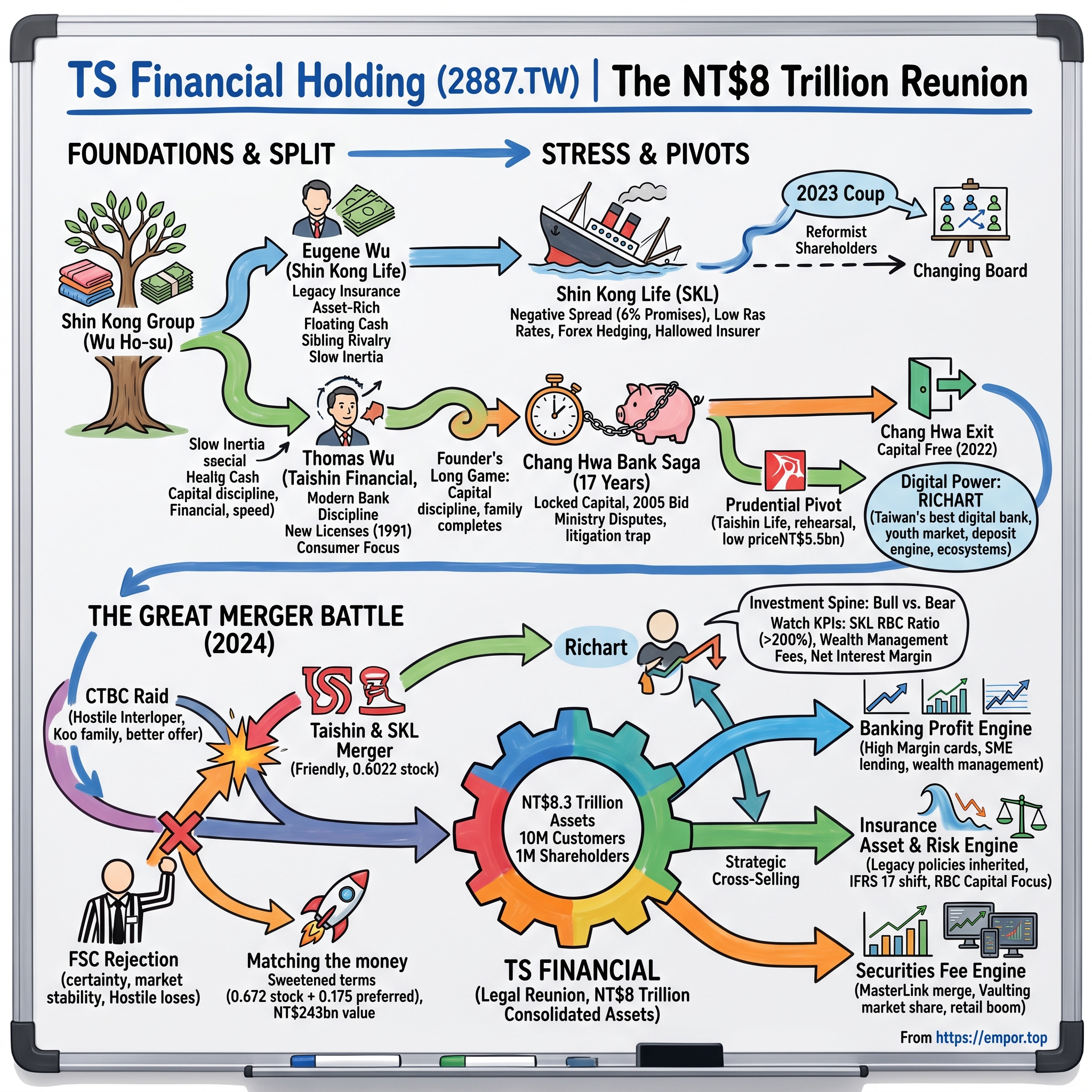
TS Financial Holding: Sibling Rivalry, Sovereign Litigations, and the NT$8 Trillion Reunion
I. Introduction & Episode Roadmap
On a humid morning in September 2024, a small group of regulators inside Taipei's Financial Supervisory Commission did something that almost never happens in Taiwan's clubby, consensus-driven financial establishment: they said no to a raider. 中信金融控股股份有限公司 CTBC Financial Holding Co., Ltd., one of the island's largest and most aggressive financial groups, had launched an audacious cash-and-stock tender offer to seize control of 新光金融控股股份有限公司 Shin Kong Financial Holding Co., Ltd. — right out from under a long-planned, family-blessed merger with its smaller rival 台新金融控股股份有限公司 Taishin Financial Holding Co., Ltd. The FSC rejected CTBC's bid, citing a lack of certainty around funding and the interests of shareholders and market stability.1 With that ruling, the regulator did not just kill a deal. It effectively picked a winner in the most dramatic corporate war Taiwanese finance had seen in a generation.2
The prize was the creation of 台新新光金融控股股份有限公司 TS Financial Holding Co., Ltd., listed under the ticker 2887.TW. When the merger legally completed on July 24, 2025, it produced Taiwan's fourth-largest financial holding company — roughly NT$8.3 trillion (about US$282 billion) in consolidated assets, more than 10 million customers, over one million shareholders, some 557 branches, 5,000 ATMs, and a workforce of around 32,000.3
Here is the thing to understand up front, and it is what makes this story more than a routine consolidation. This was not two strangers negotiating in a boardroom. This was two brothers. Shin Kong and Taishin were both children of the same post-war industrial dynasty, the Shin Kong Group founded by 吳火獅 Wu Ho-su. When the founder died in 1986, his empire eventually split, and the two most important pieces landed with two of his sons: the eldest, 吳東進 Eugene Wu, who inherited the old, asset-heavy insurance empire; and the younger, more restless 吳東亮 Thomas Wu, who went off to build a nimble modern bank of his own.4 The two men spent much of the 1990s estranged over the carve-up of their father's textile fortune.4 The 2025 merger, then, was billed as a reunion — but it was a reunion engineered on Thomas Wu's terms, after Eugene Wu had lost control of the very company his father built.
This is a story about capital and its opposite: capital that gets trapped. For seventeen years, Taishin sat on a fortune it could not touch, frozen inside a state-owned bank the government had promised — and then declined — to let it control. It is a story about a legacy insurance giant hollowed out by promises it made to policyholders in the 1990s, promises that became ruinous in a world of low interest rates. And it is a story about whether a disciplined, retail-savvy operator can absorb a troubled NT$4 trillion insurance book without letting it sink the whole enterprise.
It is also, at a higher altitude, a story about how Taiwan itself does capitalism. The island runs one of the most crowded financial systems in the world — more than a dozen major financial holding companies competing for the savings of 23 million people, a structure regulators have wanted to consolidate for two decades but have struggled to force. Every attempted merger becomes a test of the same three actors: the founding families who still control most of these groups, the FSC that must bless any deal, and the minority shareholders who bear the consequences. The birth of TS Financial is the most consequential answer that system has produced in years — a consolidation that finally happened, but only on terms the regulator approved and a family engineered. Understanding why it happened this way, and not the other way, tells you as much about Taiwan's political economy as about the company itself.
Our roadmap runs in five movements. First, the Wu family dynasty and the founding split that created two opposite corporate cultures. Second, the Chang Hwa Bank saga — a 17-year legal trap that crippled Taishin's ambitions. Third, the pivot to survive, through the Prudential Life acquisition and the 2023 boardroom coup that toppled Eugene Wu. Fourth, the 2024 merger battle and CTBC's hostile raid. And finally, the mechanics of the NT$8 trillion balance sheet itself — the banking profit engine, the Richart digital franchise, and the honest "why win, why not" investment case for what TS Financial has become.
 Subscribe on LinkedIn
II. The Wu Family Dynasty & The Split Engines
To understand two feuding brothers, start with the father who never told them who would inherit what. Wu Ho-su was a rags-to-riches archetype of Taiwan's economic miracle. In 1945, in the chaotic months after Taiwan reverted from Japanese to Chinese administration, he opened a modest cloth-trading business in Taipei called Shinkong.5 Fabric was the seed. From it grew one of the island's great sprawling conglomerates: he founded Shinkong Spinning in 1951 to move upstream into textiles, and in 1963 he planted what would become the crown jewel — Shin Kong Life Insurance.5
Why does an insurer become the crown jewel of a textile family? Because life insurance is, at bottom, the most powerful cash-collecting machine ever legally invented. Policyholders hand you premiums for decades before you ever pay a claim. That torrent of "float" — other people's money you get to invest in the meantime — let Wu Ho-su build department stores, synthetic-fiber plants, and a skyline's worth of prime commercial real estate across Taiwan's cities. By the 1980s the Shin Kong name was on towers, textiles, and insurance policies held by millions of Taiwanese families.
Then, in 1986, Wu Ho-su died — and, crucially, he died without leaving a clean, formal blueprint for succession.4 This is the original sin of the entire saga. An empire built by one iron-willed founder was suddenly handed to a fragile collective: his widow, 吳桂蘭 Wu Kuei-lan, and their sons. In a Confucian business culture, the eldest son carries a presumption of primogeniture, and Eugene Wu, the firstborn, moved into the patriarch's chair.4 But presumption is not the same as a signed will, and the younger sons had ambitions of their own. The 1990s became, in the family's own telling, a period of estrangement over who controlled what.4
Out of that tension came the two engines. Eugene Wu consolidated the ancestral core and, in 2002, folded the insurance empire into a listed vehicle: Shin Kong Financial Holding, anchored by Shin Kong Life.5 This was the establishment franchise — old money, politically connected, real-estate heavy, and culturally cautious to the point of inertia. Meanwhile Thomas Wu, the ambitious younger brother, did something a scion of a great house rarely does: he left to build his own. In the early 1990s, when Taiwan's government issued its first wave of private banking licenses to break the state's grip on finance, Thomas Wu seized one and founded Taishin — literally "new Tai(wan)," a name that announced the whole thesis. He assembled it into Taishin Financial Holding, and where his brother had inherited scale, Thomas Wu built for speed.4
The timing of that founding was itself a piece of good fortune married to good judgment. Taiwan's 1991 liberalization, which licensed sixteen new private banks in one stroke, was a once-in-a-generation opening — the moment the state finally let entrepreneurs into a business it had monopolized for decades. Most of those sixteen licenses went to industrial families betting that banking was an easy adjacency to their existing empires; many of the resulting banks struggled, merged, or quietly disappeared in the consolidation waves that followed. Taishin was among the handful that not only survived but thrived, and the reason is instructive. Thomas Wu treated banking not as a financing arm for a family conglomerate but as a standalone business to be won on the merits — hiring professional managers, importing modern retail-banking techniques, and pushing early and hard into credit cards and consumer lending when most Taiwanese banks still saw households as an afterthought to corporate lending. That choice — to build a genuine consumer franchise rather than a captive lender — is the seed from which Richart and the wealth-management engine would eventually grow.
Two DNAs could hardly have been more different, and the contrast is the analytical spine of everything that follows. Shin Kong was asset-heavy and float-rich but bureaucratic — a company that in the 2000s and 2010s repeatedly ran into governance penalties and let its capital adequacy drift dangerously.6 Its culture was that of an old landed house: rich in accumulated assets, slow to change, and prone to the twin temptations of insurers everywhere — chasing yield in a low-rate world and speculating in property. Taishin was asset-light by comparison and obsessive about the modern consumer: credit cards, wealth management, and eventually digital banking. It behaved less like an heir managing an estate and more like a challenger bank clawing for every customer. One brother owned the trophy assets; the other owned the operating discipline. For thirty years the market's open question was which model would win — and whether the two would ever be forced back together.
It is worth pausing on the human cost of the split, because it colors everything that came later. In a Taiwanese business dynasty, a public rupture between the eldest and a younger brother is not merely a management disagreement; it is a breach of Confucian family order, the kind of thing that gets discussed in whispers at weddings and funerals for a generation. The Wu brothers reportedly went years barely speaking. Eugene, the keeper of the flame, carried the weight of the ancestral name and the expectation that he would preserve what his father built. Thomas, the entrepreneur, carried the chip on the shoulder of the son who was told the crown was not his and went out to forge a bigger one. By the mid-2020s the elder brother's fortune was estimated around US$1.6 billion and the younger's around US$2.2 billion — a gap that, more than any balance sheet, told the story of where three decades of divergent execution had led.4
The irony that hangs over this section is that Thomas Wu, the brother who walked away with the smaller, newer franchise, would spend the next three decades proving that operating discipline compounds faster than inherited scale. But before he could prove anything, he would nearly destroy his own company by making one enormous, patriotic, and catastrophically ill-fated bet on a state-owned bank.
III. The 17-Year Capital Trap: The Chang Hwa Bank Saga
In July 2005, Taishin shocked the Taiwanese market with the sheer size of a single check. The government was trying to clean up 彰化銀行 Chang Hwa Bank, a venerable state-linked lender buried under non-performing loans, and it auctioned a controlling block of new shares. Taishin bid an astonishing NT$36.5 billion for a 22.5 percent stake — a figure so far above expectations that it made front-page news, and it handed Taishin a majority of the bank's board seats.7
Why would a nimble, cost-conscious operator pay a rich premium to rescue a lumbering state bank? Because of what came with it. The prize was not the distressed loan book; it was the promise. Thomas Wu understood he was buying the right to eventually merge Chang Hwa into Taishin and instantly triple his banking scale. The Ministry of Finance, desperate for private capital to plug the hole, gave Taishin board control and a written understanding that Taishin would be allowed to run — and ultimately absorb — the bank.8 It was a classic public-private bargain: private money rescues a public asset today, in exchange for control tomorrow.
Tomorrow never came. The political winds in Taiwan shifted, and a state selling control of a beloved domestic bank to a private family became a liability no minister wanted to own. The bargain curdled. The breaking point arrived in December 2014, when the Ministry of Finance mobilized its remaining influence and other state-aligned shareholders to win back a majority of Chang Hwa's board — stripping Taishin of the management control it had paid a premium to obtain.8 Taishin cried breach of contract and went to war in the courts, suing the ministry and demanding it honor the 2005 agreement, at one point seeking around NT$10 billion in damages for its losses.8
Now sit with the financial consequence, because this is the part that actually mattered for shareholders. Taishin's tens of billions of NT dollars were not lost — they were frozen. Accounting rules would not let Taishin consolidate Chang Hwa as a subsidiary once it lost board control, so the stake sat on the books as a large, illiquid, contested, low-returning holding.8 Capital is only valuable if you can redeploy it. For the better part of two decades, roughly a fifth of Taishin's balance sheet was handcuffed to a court case. This is the hidden cost of the whole affair: while Taishin litigated, its true peers were compounding. Fubon and Cathay — the two giants of Taiwanese finance — spent those same years executing large domestic and regional insurance and banking acquisitions, pulling structurally ahead. Taishin fought the government from the sidelines.
The litigation itself was a grinding, multi-front war that ran through Taiwan's court system for years. Taishin won an early skirmish in 2016, when a district court ruled the ministry had breached the 2005 agreement on board-seat allocation, and management insisted publicly, as late as 2019, that a final loss was "highly unlikely."8 But winning legal points is not the same as winning control, and the deeper problem was structural: even a favorable judgment could compel the ministry to honor a governance arrangement, but it could not force a merger that successive governments had decided was politically toxic. Taishin was, in effect, litigating for a door that the state had bricked over. Every year the case dragged on, the opportunity cost mounted — not just the dead capital, but the deals Taishin could not do, the insurance platforms it could not buy, and the regional expansion it watched rivals execute.
There is a subtler governance lesson here that a sharp investor should not miss. The Chang Hwa episode exposed how much of Taishin's early strategy depended on a single, unhedged assumption: that the counterparty was trustworthy and that a written "understanding" with a ministry carried the force of a binding contract. It did not. When control rests on a promise that a future political administration can simply decline to honor, the value of that control is not an asset — it is an option written by someone who can tear it up for free. Taishin learned that lesson at a cost measured in a lost decade of growth.
The trap sprang open only through exhaustion and compromise. By 2022, after years of grinding litigation with no clean victory in sight, Taishin agreed to stand down. It withdrew its Supreme Court case against the Ministry of Finance and, in the same period, began selling down the Chang Hwa stake — offloading more than a billion shares in a block trade at NT$18.2 apiece for roughly NT$19.09 billion, and progressively converting a frozen holding back into deployable cash.9 A newspaper editorial at the time captured the mood precisely: there were no winners in the Chang Hwa saga.10 Taishin never got its bank; the government never got a clean privatization; a generation of growth was lost to a courtroom.
The resolution was, in truth, a defeat dressed as a settlement — and how management framed it is itself a small test of credibility. Taishin did not win the bank it had chased for seventeen years; it accepted a negotiated stand-down, withdrew its case, and sold out of a position it had once paid a premium to build.9 To its credit, management did not pretend otherwise or spin the exit as a triumph. There is a version of corporate leadership that would have kept litigating indefinitely to avoid admitting the original bet had failed — throwing shareholders' good money after bad to protect an executive's pride. Taishin instead took the loss, freed the capital, and moved on. In the psychology of capital allocation, the willingness to cut a losing position and recycle the proceeds is a rarer and more valuable trait than the ability to pick winners, and it is the through-line that connects the Chang Hwa exit to everything Thomas Wu did next.
But there is a strategic lesson buried in the wreckage, and it defines Thomas Wu's later moves. The Chang Hwa disaster taught Taishin two things it would apply with precision in the 2020s: never again let control depend on the goodwill of a politician, and the moment capital is freed, redeploy it fast. The instant those Chang Hwa shares turned back into money, Taishin was ready to spend — and it already had a target in mind.
IV. Rebirth: The Prudential Pivot and the 2023 Boardroom Coup
The first redeployment was almost the opposite of a splashy megadeal — it looked, at first glance, like a bargain-bin purchase of an unwanted business. In August 2020, Taishin announced it would buy the Taiwan life-insurance operations of America's Prudential Financial for a strikingly low NT$5.5 billion, with the price rising to as much as NT$8.5 billion only if Taiwanese long-bond yields cooperated over the following two years.11 The deal closed in mid-2021, and Taishin rebranded the unit as Taishin Life.12
Consider the strangeness of paying so little for a life insurer. In insurance, a low price is often a warning, not a gift — it usually means the buyer is inheriting a book of long-dated liabilities that will bleed for years. Prudential wanted out of a small, subscale Taiwanese position; Taishin wanted an insurance beachhead of any kind, having been starved of one for decades. The clever detail was the contingent structure: the headline NT$5.5 billion could rise toward NT$8.5 billion only if Taiwan's long-bond yields climbed over the following two years — meaning Taishin agreed to pay more precisely in the scenario where the acquired insurance book would be worth more.11 That is a textbook example of a buyer aligning the purchase price with the underlying economics rather than betting the farm on a single interest-rate forecast. The FSC scrutinized the deal for months and attached commitments before finally approving it in mid-2021, a foretaste of how closely Taiwan's regulator polices insurance ownership.12
The Prudential pivot gave Thomas Wu his own — modest — insurance engine and, more importantly, the institutional muscle memory of running one. It was a rehearsal. Taishin learned how to underwrite, how to manage an investment portfolio against long-dated liabilities, and how to navigate the FSC's insurance supervisors — capabilities that would prove essential when the main event arrived. And the main event, the acquisition of a genuinely enormous insurer, would require his brother's company to first fall apart.
And fall apart it did. While Taishin was quietly rebuilding, Eugene Wu's Shin Kong Life was walking into a slow-motion capital crisis that had been thirty years in the making. Here is the mechanism, explained plainly, because it is the single most important risk in the entire TS Financial story. Back in the high-interest 1990s, Shin Kong Life — like most Taiwanese insurers — sold policies promising customers fat guaranteed returns of 5 to 6 percent for the life of the contract. Those promises were cheap to make when government bonds also yielded 6 percent. But interest rates fell for two decades, and the insurer was left owing customers 6 percent while the safe assets it could buy yielded a fraction of that. That gap — the "negative spread" — is a wound that widens every year the policies stay on the books.
Layer on top of that a second drain: currency hedging. Taiwanese life insurers collect premiums in NT dollars but, lacking enough high-yielding local bonds, invest heavily in U.S. dollar assets. To protect against a rising NT dollar wiping out those overseas gains, they must hedge — and as the gap between U.S. and Taiwanese interest rates widened, the cost of that hedging ballooned into a persistent, grinding drag on profits. The result: by the end of 2023, Shin Kong Life's risk-based capital ratio — the regulator's core gauge of an insurer's financial cushion — had sunk to roughly 176 percent, well under the statutory 200 percent floor.[^13] An insurer below the line is an insurer the regulator can force to raise capital. Eugene Wu's crown jewel had become a liability.
Into that vacuum stepped a rebellion. Frustrated by years of underperformance and governance stumbles, reformist shareholders — a bloc associated with Thomas Wu's camp and figures such as 洪士琪 Hung Shih-chi — mounted a proxy campaign at Shin Kong's June 2023 board election.13 Proxy fights are the shareholder equivalent of a coup: rather than persuade the sitting board, an insurgent bloc lines up enough votes to replace it outright at the annual meeting. The insurgents argued, in effect, that the founder's family had run the ancestral company into a capital hole and that new hands were needed. The vote reshaped the board and broke the founder-family faction's grip, opening the door for management aligned with the Taishin school of operating discipline to steer the ailing insurer.13 For the first time since 1986, the ancestral company was no longer controlled by the son who inherited it.
The symbolism was hard to overstate. Eugene Wu had already stepped back from the Shin Kong chairmanship in 2020, but the 2023 rebellion severed the family's operating grip entirely — and it did so with the fingerprints of his own brother's camp on the knife. Whatever the boardroom mechanics, the emotional subtext was unmistakable: the younger brother's allies now held the keys to the empire the elder brother had spent his life stewarding. From a cold governance standpoint, the outcome was arguably healthy — a capital-starved, penalty-prone insurer being handed to a more disciplined management team is the kind of accountability that markets are supposed to enforce. But it also set up an obvious conflict-of-interest question that a skeptic would rightly raise about the merger that followed: when the buyer's allies already control the seller's board, how truly arm's-length is the price?
The chessboard was now set in a way that would have been unimaginable a decade earlier. Eugene Wu had been sidelined at the company his father built. Thomas Wu had cash freed from the Chang Hwa trap and an insurance platform of his own. And the two family franchises — the trophy assets and the operating discipline — were, for the first time, positioned to be reunited. A friendly, long-desired family merger was finally back on the table. What nobody at the family dinner had planned for was that a rival dynasty would try to steal the bride at the altar.
V. The Hostile Interloper: The Great Taiwan Merger Battle of 2024
The engagement was announced with the decorum of a family affair. On August 22, 2024, Taishin and Shin Kong unveiled an all-share merger: Taishin would issue 0.6022 of its shares for each Shin Kong share — a ratio that valued the storied insurance group at a notable discount to its book value.14 The logic was neat and the tone was friendly. Two houses of the same bloodline, reunited under Thomas Wu's disciplined management, at a price that reflected Shin Kong's damaged balance sheet. In an ordinary Taiwanese deal, that would have been the end of the drama and the start of the paperwork.
This was not an ordinary deal, because someone else wanted the bride. Enter CTBC Financial Holding, controlled by the powerful Koo family under 辜仲諒 Jeffrey Koo Jr., and one of the few groups in Taiwan with the ambition and the balance sheet to build an undisputed financial colossus. Sensing that Shin Kong was being handed to Taishin cheaply, CTBC did something almost unheard of in a market that prizes negotiated harmony: it went hostile. It launched a competing bid to buy 51 percent of Shin Kong through a mix of cash and its own shares, pitched at a clear premium to Taishin's offer — an unsolicited raid designed to blow up the family reunion.2
Thomas Wu had a choice: match the money or lose the prize he had waited thirty years for. He matched. On September 11, 2024, Taishin sweetened its terms sharply, raising the common-share exchange ratio to 0.672 and adding 0.175 of a newly created preferred share for each Shin Kong share — a package that lifted the implied value to around NT$14.18 per Shin Kong share and valued the whole target near NT$243 billion, roughly 25 percent above the original bid.15 The preferred-share design is the tell of a sophisticated operator. Preferred shares let Taishin match CTBC's economic value without flooding the market with new common stock and massively diluting existing Taishin holders. It was, in effect, a way to pay more without giving away more of the company — clever financial engineering under fire.
The battle turned public and personal in a way Taiwanese finance rarely does. This was not a genteel disagreement conducted through press releases; it spilled into open verbal warfare, competing shareholder solicitations, and accusations traded across the financial press. CTBC framed its bid as simple economic logic — its offer was worth more, so shareholders should take it. Taishin and its allies framed CTBC as an opportunistic interloper trying to hijack a family reconciliation and pick off a wounded institution on the cheap. Some large Shin Kong shareholders, unhappy with the Taishin terms, publicly agitated to veto the merger, adding a third front to what was already a two-front war. For a few weeks in the autumn of 2024, the fate of two century-spanning family fortunes and a quarter-trillion-NT-dollar prize hung on proxy votes and a regulator's judgment.
Then the referee walked onto the field. In mid-September 2024, the FSC rejected CTBC's tender offer, and its stated reasons are worth dwelling on because they reveal how Taiwan actually governs its financial system. The regulator faulted CTBC for failing to spell out how it would fund the tender, how it would handle Shin Kong shares if the deal collapsed, and — pointedly — for declining to commit to the capital injections Shin Kong Life so obviously needed.1 The FSC also made plain its distaste for hostile share-swap raids that whipsaw share prices and destabilize the firms involved.1 Days later, CTBC abandoned the pursuit.16 For CTBC, it was a rare and public defeat; for the Koo family, a reminder that in Taiwan, financial ambition runs through Taipei's regulators as much as through the market.
Strip away the drama and a structural truth stands exposed: in Taiwan, friendly and negotiated wins, and hostile loses. The FSC's ruling was not merely about CTBC's paperwork; it cemented a regulatory preference for orderly, pre-arranged mergers over Wall-Street-style raids. For an outside investor, that is a double-edged insight. It protects incumbents and their chosen deals from opportunistic disruption — a kind of soft moat around the establishment — but it also means the market for corporate control is politically administered rather than freely contested, and the "best" bid does not always win. In this case, the family's bid won. Shareholders of both companies approved the merger in October 2024,14 Shin Kong was delisted,17 and on July 24, 2025, TS Financial Holding was legally born.3 Thomas Wu had his reunion — and his brother's company.
The wedding was over. Now came the far harder work of actually living together: merging two banks, two insurers, and two brokerages with incompatible systems, cultures, and balance sheets — one disciplined and profitable, the other large and wounded.
VI. Inside the NT$8 Trillion Balance Sheet: Segment-Level Economics
Picture the merged entity not as a single company but as a machine with three engines of very different character — one that reliably generates cash, one that holds enormous assets but sputters unpredictably, and one that spins off fees when markets are hot. The whole investment question about TS Financial comes down to whether the first engine is powerful enough to smooth out the second. Legal merger was the easy part, completed in July 2025; the operational integration was deliberately staggered across roughly two years so that no single subsidiary combination would overwhelm the group at once.3
The Banking Segment — the profit engine. The heart of TS Financial's earnings is the bank, built around the old Taishin International Bank and now being combined with the smaller Shin Kong Bank, with full banking integration scheduled to complete during 2026 and into 2027.3 This is the disciplined half of the family DNA at work: high-margin credit cards, strong small-and-medium-enterprise lending, and a large wealth-management operation. Historically the banking business generated the overwhelming majority of pre-merger Taishin's profits — on the order of two-thirds to three-quarters of earnings in typical years — and its role in the new structure is explicit: it is the steady cash-flow provider designed to absorb the volatility of the insurance book. The logic of the whole merger, reduced to a sentence, is that a reliable earnings machine can carry a volatile-but-huge asset gatherer, provided the machine is powerful enough and the volatility does not spike at the wrong moment. SME lending deserves a special mention here because it is quietly one of the best businesses in Taiwanese banking: small and medium enterprises are the backbone of Taiwan's export economy, they are stickier and less price-sensitive than blue-chip corporate borrowers, and they generate the kind of relationship-based fee and lending income that rewards a bank willing to do the granular credit work. Taishin's strength in that niche is a large part of why its returns held up even while its capital was trapped in Chang Hwa. The early evidence is encouraging: in the first quarter of 2026, Taishin Bank's net interest income rose about 27 percent year over year, and the group posted net income of roughly NT$21.1 billion with an annualized return on equity around 16.5 percent — though that figure flatters the underlying picture, since it reflects one-time merger accounting and a shift to the new IFRS 17 insurance accounting standard that limits clean comparison with the prior year.18
The Insurance Segment — the asset and risk engine. On January 1, 2026, Taishin Life and Shin Kong Life legally merged, with the combined entity adopting the Shin Kong Life name and becoming Taiwan's fourth-largest life insurer, holding on the order of NT$3.9 trillion to NT$4 trillion in assets — a book valued at roughly US$126 billion.19 This is where the trophy assets — and the trouble — live. The negative-spread legacy policies and the persistent USD hedging costs described earlier do not vanish because the company changed its name; they are inherited in full. The insurance engine is enormously sensitive to two forces largely outside management's control: global interest rates and the NT-dollar exchange rate. When rates rise and the NT dollar is stable, the book can hum; when the NT dollar sharply appreciates or markets turn, hedging losses and asset write-downs can force the parent to inject capital. The single most important fact about this engine is that it is a source of scale and float, but it is not yet a reliable source of profit.
There is a further accounting wrinkle that sophisticated investors must hold in mind when reading any of TS Financial's insurance numbers over the next few years: the industry-wide shift to the IFRS 17 accounting standard, which took effect for Taiwanese insurers in 2026. IFRS 17 fundamentally changes how insurers recognize the profit embedded in long-dated policies — spreading it over the life of the contract rather than recognizing it up front — and it revalues liabilities in ways that make year-over-year comparisons with the old IFRS 4 regime genuinely difficult.18 In practical terms, this means the reported insurance earnings in 2026 are not cleanly comparable to 2025, and headline figures should be treated with caution until a few clean quarters establish a new baseline. For a company selling a turnaround story on its insurance arm, an accounting regime change that muddies the scoreboard is an uncomfortable coincidence — not sinister, but a reason to lean on cash-flow and capital metrics rather than headline profit. The regulator's demonstrated willingness to force capital injections at Shin Kong Life — reports pointed to a capital raise on the order of NT$107 billion tied to the insurer's restoration above the 200 percent RBC threshold — is a reminder that the parent is the insurer's backstop of last resort.[^24]
The Securities Segment — the fee engine. The third engine came together fastest and most cleanly. On April 6, 2026, Taishin Securities merged with MasterLink Securities (the former Shin Kong-affiliated brokerage), together with their futures arms.20 The effect was dramatic in market-share terms: the combined Taishin Securities vaulted from around 16th place to roughly 4th in Taiwan's brokerage rankings, with market share rising from about 2.19 percent to 5.13 percent, operating 55 offices with a workforce near 2,763.20 This is a genuine fee-generating franchise riding Taiwan's retail-trading boom — a boom fueled in no small part by the global enthusiasm for 台積電 TSMC and the broader AI-driven rally in Taiwanese equities that turned the island's stock exchange into one of the world's hottest markets in the mid-2020s. It is the smallest of the three engines, but it is the one where merger synergy showed up most immediately and cleanly on the scoreboard: a leap from roughly 16th to 4th in brokerage market share is precisely the kind of step-change in competitive position that consolidation is supposed to deliver, and it happened in a single quarter.20 The caveat for investors is that brokerage income is inherently cyclical — it swells in bull markets and shrivels in bear ones — so this engine flatters group earnings today but should not be extrapolated as a stable base. When Taiwan's retail-trading fever eventually cools, the securities segment will give back some of what it is contributing now. (One cautionary aside: within weeks of the merger, Taishin Securities disclosed a trading-system glitch involving potentially significant erroneous transactions — a reminder that integrating incompatible technology platforms carries real operational risk, not just spreadsheet synergy.)
Stand back and the architecture is clear: a reliable bank and a lumpy insurer, stapled together, with a modest securities kicker. The bull case and the bear case both live inside the relationship between engine one and engine two. But there is a fourth element that does not show up cleanly in the segment tables — and it may be the most strategically valuable asset in the whole group.
VII. The Strategic Engine: Richart Digital Bank & Retail Power
In 2016, while the giants of Taiwanese finance were still treating mobile apps as a marketing afterthought, Taishin launched something that looked almost too simple to matter: a cheerful, cartoon-branded digital bank called Richart, aimed squarely at Taiwanese aged roughly 25 to 40.21 The pitch was radical for a conservative banking market — open an account on your phone in minutes, no branch visit, no paperwork, a clean interface, and a genuinely high interest rate on savings to pull young people in. It worked with startling speed. Within its first months, Richart captured a dominant share of Taiwan's fledgling digital-account market, and industry observers were soon crowning it the island's best digital bank.[^23] By the mid-2020s it had grown into the country's most-used digital banking platform, with a user base in the millions.3
Why does a fun app for twenty-somethings belong in an analysis of an NT$8 trillion financial holding company? Because Richart solves the two hardest problems in retail banking at once: how to acquire customers cheaply, and how to fund your loan book cheaply. Take customer acquisition first. A traditional bank pays enormous fixed costs — branches, staff, rent — to win each new customer. Richart acquires them at a fraction of the cost through a smartphone, and it acquires the demographic every bank covets: young, digitally native, and at the beginning of their earning and borrowing lives. Once inside the ecosystem, those customers become a funnel for higher-margin products the group actually profits from — credit cards, personal loans, mutual funds, and, increasingly, insurance.
The second advantage is subtler and arguably more valuable: cheap, sticky funding. Every one of Richart's millions of accounts is, from the bank's perspective, a low-cost deposit. Banks make money on the spread between what they pay for deposits and what they earn on loans; a large base of loyal retail deposits is the cheapest and most stable funding a bank can have, far better than borrowing from wholesale markets that can dry up in a crisis. Richart, in effect, manufactures a durable low-cost funding advantage for the entire Taishin Bank loan book — a structural edge that compounds quietly every year.
Then there is the ecosystem play — the attempt to turn a bank account into a daily habit. Through electronic payments under the Taishin Pay+ brand and a flexible "Taishin Point" rewards system, the group has tried to weave Richart into the everyday spending of its users, raising the friction of ever leaving.3 The strategic word here is switching costs: once a customer's salary, spending, rewards, and cards all live inside one app, moving to a rival bank becomes a genuine hassle, and inertia becomes the bank's friend.
It helps to appreciate just how counterintuitive Richart's early success was. In 2016, Taiwan's banking market was famously overcrowded and conservative, dominated by branch networks and relationship managers; the conventional wisdom held that Taiwanese savers, especially older ones, would never trust a bank they could not walk into. Taishin's insight was to stop trying to convert the skeptics and instead win the young outright — build a product so clean and mobile-native that a 28-year-old would never want a branch in the first place. Within roughly half a year of launch, Richart had seized a commanding share of the nascent digital-account market, and it kept that lead as the category grew.21 The demographic capture matters more than the raw account count: banks make the bulk of their lifetime profit from customers in their thirties, forties, and fifties, when those customers borrow for homes, invest for retirement, and pay for advice. Acquiring them at 28, cheaply, is the equivalent of planting an orchard — the fruit comes later, but the trees are already in the ground.
A neutral investor should hold two ideas in tension, though. Richart is unquestionably a real and rare asset — most legacy insurers, including old Shin Kong, could only dream of a digital franchise this strong, and it is precisely the kind of capability TS Financial hopes to cross-sell into Shin Kong Life's millions of policyholders. But digital banking in Taiwan is no longer uncontested. Pure-play internet banks and the digital arms of larger rivals are all chasing the same young, deposit-rich customers, and the high savings rates that fueled Richart's early growth are expensive to sustain — a promotional deposit rate is a subsidy, and subsidies compress margins for as long as they run. Richart is a leadership position, not a monopoly — and leadership in fintech has a way of eroding faster than leadership in branches, because the switching cost of moving between two apps is far lower than the switching cost of changing the bank down the street. The real test is whether Richart's cheap deposits and engaged users can be turned into durable, high-margin relationships as those customers age into their peak borrowing and investing years. That test runs directly into the question of who is steering the whole enterprise.
VIII. Management Assessment & Capital Allocation Discipline
Any honest assessment of TS Financial has to begin and end with one man, because this is, unusually for a company this size, still a founder's story. Thomas Wu built Taishin from a single new banking license in the early 1990s into a top-tier financial holding company, and then engineered the reunification of his father's empire under his own control. Judge management by behavior over time, and Wu's record reads as that of a genuine long-game capital allocator. Consider the sequence: he made a bold, ultimately failed bet on Chang Hwa, but when it turned into a trap he did not throw good money after bad in perpetuity — he negotiated an exit and freed the capital.9 He then redeployed that capital quickly and cheaply into the Prudential platform,11 used the wait to build Richart into a genuine franchise, and finally out-maneuvered a more powerful and better-capitalized rival, CTBC, in a live takeover battle by combining a sweetened bid with financially clever preferred-share structuring.15 That is not the record of a lucky heir; it is the record of a strategist who plays for position and waits years for the board to open.
Ownership alignment reinforces the case. Thomas Wu and the Wu family hold significant stakes in TS Financial, which broadly ties their fortunes to those of ordinary shareholders — the kind of skin in the game that long-term investors prize.4 And the tonal consistency across three decades matters too: Wu has been remarkably steady in his strategic message — retail discipline, digital leadership, and patient scale-building — where his brother's Shin Kong drifted through governance penalties and capital shortfalls.6
But a neutral platform does not hand out halos, and there are real, unresolved questions that a skeptical investor should press. The first is the preferred-share overhang. Those H-class preferred shares issued to win the Shin Kong battle are not free money; they carry a multi-year dividend obligation that sits ahead of common shareholders, quietly siphoning off a slice of future returns to fund the victory. Clever engineering during the deal can become a persistent drag afterward. The second, and larger, question is the one nobody at TS Financial can fully answer yet: did Thomas Wu overpay — in strategic and financial terms — for the satisfaction of absorbing his brother's company? He bought Shin Kong at a discount to book value, which sounds cheap, but "cheap" is meaningless if the acquired insurer's true economic liabilities are larger than its stated book. The entire bull case rests on a claim that must still be proven: that the Taishin management school can actually repair Shin Kong Life's balance sheet, rather than merely inheriting its slow bleed.
One further dimension of management quality is worth naming: succession and depth. This has been, for three decades, overwhelmingly a story about one man. Thomas Wu is the strategist, the dealmaker, and the face of the franchise, and much of the market's confidence in TS Financial is, at bottom, confidence in him personally. That is a strength while he is at the helm and a concealed risk beneath it. A financial holding company of this scale and complexity — three regulated businesses, a wounded insurer mid-repair, and a live multi-year integration — needs institutional bench strength that does not depend on a single founder's judgment. The elevation of Taishin-school executives into key roles across the merged group is, read charitably, exactly the kind of leadership pipeline the situation demands; read skeptically, it concentrates the whole enterprise around one man's protégés and one man's playbook. Investors should watch whether TS Financial builds genuine institutional decision-making or remains a founder-and-loyalists operation, because the difference determines how the company navigates the first crisis Thomas Wu is not personally around to manage.
The right posture here is patience and evidence. Wu has earned credibility through decades of execution, and the market should extend him a reasonable benefit of the doubt. But the Shin Kong integration is the single hardest thing he has ever attempted — an order of magnitude more complex than buying a small unit from Prudential — and the proof will come not from investor-day rhetoric but from the RBC ratio, the hedging line, and the wealth-management fee trend over the next several years. Credibility is a bank account you can overdraw; the integration will show whether Wu's balance holds.
IX. The Investment Spine: Bull vs. Bear and Hamilton Helmer's 7 Powers
So where does the durable edge actually come from — and where might the whole thesis crack? Run TS Financial through Hamilton Helmer's 7 Powers, the framework that asks not "is this company good?" but "what specifically stops a competitor from copying it?"
Scale economies (genuine, but qualified). At roughly NT$8.3 trillion in assets, TS Financial has real fixed-cost leverage — one technology stack, one marketing budget, one back office spread across a vastly larger revenue base, plus the balance-sheet heft to underwrite and syndicate large corporate loans that were previously out of reach.3 This is the most tangible source of merger value. The qualifier: scale in financial services is common — Cathay, Fubon, and CTBC all have it in equal or greater measure — so scale keeps TS Financial in the game but does not by itself confer an edge over the specific rivals it competes with.
Switching costs (moderate and concentrated in retail). As discussed, embedded wealth-management relationships and the Richart ecosystem make the retail customer genuinely sticky. But switching costs are weak in the commoditized parts of the business — a corporate borrower or an insurance-policy shopper will move for a better price — so this power is real but narrow.
Cornered resource (the family legacy and the real estate). Here lies the most distinctive, least replicable asset. Through the Shin Kong inheritance, TS Financial now controls a portfolio of prime commercial real estate assembled by Wu Ho-su over decades in Taiwan's most valuable urban cores — holdings that simply cannot be bought at today's prices and that no competitor can replicate.5 The Wu family's networks and political relationships, for all the trouble they caused at Chang Hwa, are also a form of cornered access. This is optionality that sits quietly on the balance sheet.
The other four powers — network economies, counter-positioning, branding, and process power — are largely absent or contested, which is itself an honest finding: TS Financial's moat is built on scale, stickiness, and irreplaceable assets, not on a proprietary business model rivals cannot match.
Now the Porter's Five Forces reality check, because the industry structure is unforgiving. Taiwan is chronically over-banked, with dozens of financial holding companies fighting over a wealthy but finite population of 23 million — that means intense internal rivalry and structurally thin lending margins (Taishin Bank's net interest margin sits around 1.48 percent, a slim spread by global standards).18 Buyer power is high because depositors and borrowers face abundant choice. The one force working in incumbents' favor is the threat of new entrants: the FSC's demonstrated preference for orderly, licensed, negotiated finance — the same instinct that killed CTBC's raid — makes it genuinely hard for disruptors to storm the gates.1
Set against its peers, TS Financial occupies an awkward but defensible middle position. 國泰金 Cathay Financial and 富邦金 Fubon Financial are the twin giants — larger, with deeper and better-managed insurance franchises and long records of cross-strait and regional expansion; they are the benchmarks against which TS Financial's insurance turnaround will be judged. CTBC, the thwarted raider, remains the most aggressive retail-and-credit-card powerhouse and a perpetual competitive threat, all the more motivated after being denied Shin Kong. Against that field, what distinguishes TS Financial is not size — it is fourth, not first — but the specific combination of a genuinely best-in-class digital-retail franchise (where it arguably leads even the giants) bolted onto a newly enlarged insurance and securities base. The strategic bet is that this combination, executed well, lets a number-four player punch above its weight in the fee-rich, capital-light corners of finance — wealth management, payments, digital deposits — while the giants remain preoccupied with their massive insurance balance sheets. Whether that bet pays off depends entirely on execution, and execution is exactly what the merger has not yet been tested on.
The bull case is the wealth-management synergy. TS Financial takes the premium, high-margin wealth-management machine honed inside Taishin Bank and cross-sells it into Shin Kong Life's base of several million policyholders — turning a sleepy insurance customer list into an active investment-products franchise. If, at the same time, the group stabilizes Shin Kong Life's capital and a higher-rate world gradually lifts the investment yield on that NT$4 trillion asset book, the negative spread narrows and a long-suffering liability slowly turns into an earnings tailwind. In this scenario the disciplined bank and the healing insurer reinforce each other, and the merger's logic is vindicated.
The bear case is the capital sinkhole. Shin Kong Life's legacy guarantees and hedging costs keep draining capital faster than the bank can generate it. A sharp appreciation of the NT dollar or a downturn in global markets triggers hedging losses and asset write-downs, the RBC ratio slips back below the line, and the FSC forces TS Financial to inject capital into the insurer — pulling money out of the highly profitable bank, depressing group ROE, and diluting the common shareholders who already sit behind the preferred stock in the payout queue. In this scenario the trophy asset drags down the operating engine, and Thomas Wu's reunion becomes an expensive act of familial completism.
It is worth stress-testing the consensus narrative directly, in the spirit of separating myth from reality. The prevailing story, especially in the friendlier corners of the financial press, is that this is a straightforward "1 plus 1 equals 3" combination: a great bank buys a big insurer cheaply, applies its magic operating discipline, and everyone wins. A neutral reading complicates that on three fronts. First, "cheaply" is doing enormous work in that sentence — Shin Kong was acquired below stated book value, but the entire point of the negative-spread problem is that the insurer's economic liabilities may exceed its accounting book, so the true price is unknowable until the liabilities run off over decades. Second, the "operating discipline" thesis is unproven at this scale; running a lean retail bank and repairing a NT$4 trillion legacy insurance book are different sports, and success at the former does not guarantee competence at the latter. Third, the deal was negotiated when the buyer's allies already influenced the seller's board, which is precisely the situation where a truly independent price is hardest to establish. None of this means the merger will fail. It means the burden of proof sits with management, and the polite consensus should be treated as a hypothesis, not a conclusion.
An activist investor eyeing TS Financial today would zero in on a handful of pressure points. The preferred-share overhang and its perpetual dividend claim ahead of common holders. The portfolio complexity of running a bank, a life insurer, and a brokerage under one roof — a structure that can obscure where value is created and where it leaks. The related-party optics of a merger between two branches of the same family. And the sheer integration risk of combining incompatible technology platforms, a risk that showed up almost immediately in the Taishin Securities trading glitch. The counterweight to all of this is Thomas Wu's demonstrated capital discipline and his own family's substantial ownership stake — an activist would find a management team that is already, by virtue of its own wealth, on the same side of the table as outside shareholders. That alignment does not eliminate the risks, but it changes their character: the biggest danger here is not that management enriches itself at shareholders' expense, but that a proud founder overreaches in pursuit of a legacy.
The honest answer is that both outcomes are live, and which one dominates depends on variables — global rates, the NT dollar, execution — that are only partly in management's hands. That is precisely why the KPIs matter more than the narrative.
The three KPIs to watch. First and most important, Shin Kong Life's risk-based capital (RBC) ratio — it must climb and stay comfortably above the statutory 200 percent floor without recurring, dilutive capital calls on the parent; each forced injection is the bear case materializing in real time.[^13] Second, wealth-management fee growth, the single cleanest proof point that the cross-selling synergy is real rather than rhetorical. Third, net interest margin and hedging costs, the twin economic drivers of the multi-trillion insurance book — the line items where a rising-rate tailwind or a currency shock will show up first. Watch those three, and the rest of the story explains itself.
X. Playbook, Lessons & Epilogue
Step back from the family drama and the merger arithmetic, and TS Financial leaves behind two business lessons durable enough to outlast the current news cycle.
The first is the hazard of the capital trap. The Chang Hwa Bank saga is a near-perfect case study in the danger of public-private partnerships where your control depends on a political promise rather than a legal certainty. Taishin paid a premium for a promise, and when the political winds shifted, the promise evaporated while the capital stayed frozen for seventeen years.8 The lesson for any investor is to scrutinize situations where a company's stated value rests on a counterparty — especially a sovereign one — doing something in the future that it is not yet legally bound to do. Political goodwill is not an asset you can put on a balance sheet, and it can be revoked without compensation.
The second lesson is the long, quiet victory of meritocracy over inheritance. Two brothers started with wildly unequal hands — one inherited the trophy insurance empire, the other left with a single new banking license — and thirty years later the younger brother's operating discipline had compounded into control of both. The divergent fates of Eugene Wu's bureaucratic, capital-strained Shin Kong and Thomas Wu's efficient, retail-focused Taishin are a masterclass in how corporate culture, not starting assets, drives long-term shareholder value. Scale you inherit; discipline you build — and over a long enough horizon, discipline wins.
As of mid-2026, TS Financial stands in the thick of its own second act. The holding-company merger is done, the life-insurance arms combined on the first day of 2026, and the securities consolidation was completed cleanly in April 2026, already vaulting the brokerage into the market's top tier.1920 What remains is the hardest and most consequential step: the full integration of the two banks, which management has scheduled to complete over 2026 and into 2027, and — running underneath all of it — the multi-year project of nursing Shin Kong Life's wounded balance sheet back to health.
The sequencing of the integration tells you something about management's instincts. TS Financial deliberately combined the easier, higher-synergy pieces first — the securities brokerages, where the market-share math was immediate and the platforms comparatively simple — while leaving the two banks, with their tangled core systems, deposit bases, and branch networks, for last. That is a sensible way to bank early wins and build integration muscle before tackling the hardest job. But it also means the biggest operational risk in the whole program still lies ahead. Merging two banks is a notoriously perilous exercise: core-banking migrations have humbled far more experienced acquirers, and the Taishin Securities trading glitch of April 2026 was a small but pointed reminder that when you fuse incompatible systems, things break in ways spreadsheets never predict. The bank merger is where the synergy case will be won or lost — and where a botched cutover could cost customer trust that took Richart a decade to build.
Investors should also keep one eye on the macro backdrop that TS Financial cannot control. The entire insurance thesis is a leveraged bet on the path of global interest rates and the NT dollar. A world of higher-for-longer rates gradually heals the negative spread and lifts investment yields on the NT$4 trillion book; a sharp reversal — falling rates, or a rapidly strengthening NT dollar that inflates hedging costs and erodes the value of overseas assets — reopens the capital wound the merger was supposed to close. Layer on the ever-present tail risk that shadows every Taiwanese enterprise — cross-strait geopolitics, which could disrupt markets, funding, and confidence overnight — and it becomes clear that even flawless execution leaves TS Financial exposed to forces far larger than any single management team.
The reunion, in other words, is complete on paper but unproven in practice. Thomas Wu has won every battle he set out to fight: he escaped the Chang Hwa trap, built a digital franchise his rivals envy, out-dueled a hostile raider, and brought his father's empire back under one roof. Whether that empire becomes a durable NT$8 trillion powerhouse or a disciplined bank forever tethered to a leaking insurer is the one question he has not yet answered — and it is the question every long-term investor in 2887.TW will spend the next several years watching him try to.
References
-
FSC rejects CTBC Financial's Shin Kong takeover — Taipei Times, 2024-09-17 ↩↩↩↩
-
FSC rejects CTBC Financial's tender offer to acquire Shin Kong Financial — Focus Taiwan, 2024-09-16 ↩↩
-
TS Financial launches following completion of merger — Focus Taiwan, 2025-07-24 ↩↩↩↩↩↩↩
-
Wu Brothers Unite To Form Taiwan's Fourth Largest Financial Holding Company — Forbes, 2025-06-04 ↩↩↩↩↩↩↩↩
-
FSC penalizes Shin Kong over governance issues — Taipei Times, 2022-03-12 ↩↩
-
Taishin Financial shocks market with Chang Hwa bid size — Taipei Times, 2005-07-23 ↩
-
Taishin Financial says court loss highly unlikely — Taipei Times, 2019-03-12 ↩↩↩↩↩↩
-
Taishin withdraws case against Ministry of Finance — Taipei Times, 2022-08-11 ↩↩↩
-
EDITORIAL: No winners in Chang Hwa Bank saga — Taipei Times, 2022-08-15 ↩
-
Taishin to buy Prudential Life Insurance for NT$5.5 billion — Focus Taiwan, 2020-08-11 ↩↩↩
-
Prudential Financial completes sale of Taiwan business to Taishin Financial — Prudential Financial, 2021-06-30 ↩↩
-
Battle for Control in Taiwan: Taishin and Shin Kong Financial Holding — TEJ, 2024 ↩↩
-
Taishin, Shin Kong Financial shareholders approve merger plan — Taipei Times, 2024-10-10 ↩↩
-
Taishin Financial updates its terms for Shin Kong merger — Taipei Times, 2024-09-12 ↩↩
-
CTBC Financial drops bid to acquire Shin Kong Financial — Focus Taiwan, 2024-09-21 ↩
-
Shin Kong Financial to be delisted on July 24 after merger — Taipei Times, 2025-07-15 ↩
-
TS Holdings Investor Presentation Q1 2026 Results Update — TS Financial Holding, 2026-06-03 ↩↩↩
-
Taiwan FSC Approves Taishin Life & Shin Kong Life Insurance Merger — Caproasia, 2025-11-28 ↩↩
-
Taishin Securities to be fourth-largest following merger — Taipei Times, 2026-04-07 ↩↩↩↩
-
What is Brief History of Taishin Financial Holdings Company? — MatrixBCG ↩↩
 LinkedIn
 WhatsApp
 Reddit
 Hacker News
 Email
Email Kindle
 RSS Feed
 Spotify
 Apple Podcasts
 Amazon Music
 Audible
 YouTube