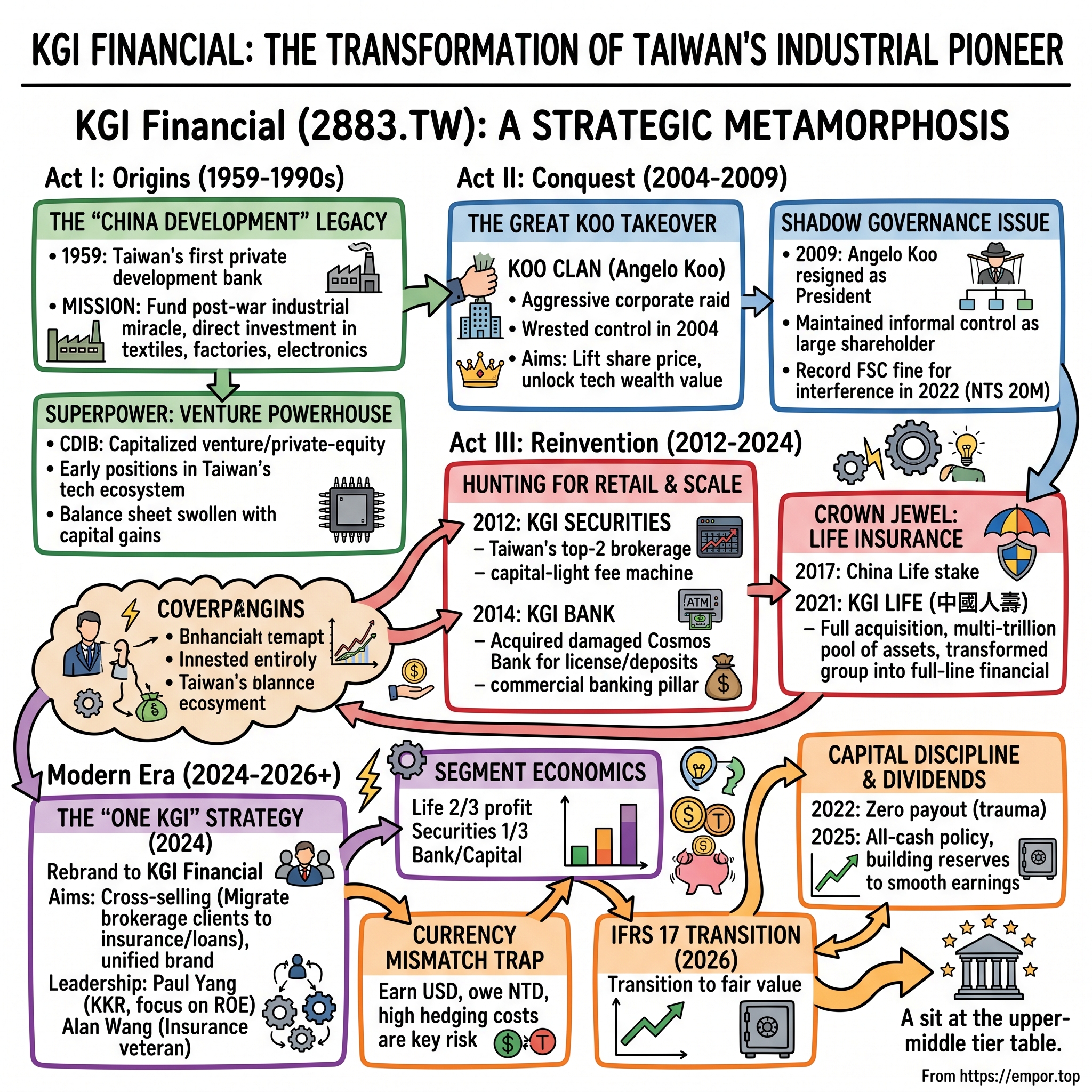
KGI Financial: The Transformation of Taiwan's Industrial Pioneer
There is a particular kind of corporate death that most companies never survive: the deliberate killing of your own name. Not a bankruptcy, not a takeover, but a conscious decision to walk away from a brand that spent six decades accumulating meaning. On October 9, 2024, one of the oldest and most storied institutions in Taiwanese finance did exactly that. 中華開發金融控股 China Development Financial Holding — known to a generation of investors, bankers, and bureaucrats simply as 開發金 CDF — announced that it would henceforth be called 凱基金融控股 KGI Financial Holding.12
To understand why that mattered, you have to understand what "China Development" once meant. This was the institution that helped finance Taiwan's post-war industrial miracle, a de facto sovereign development bank that seeded the island's technology ecosystem when it was still a cluster of workshops and dreams. Retiring the name was not a marketing refresh. It was the final, symbolic act in one of the most complete corporate metamorphoses in Asian finance — the transformation of a high-risk industrial venture fund into a diversified, retail-facing insurance and wealth-management machine. This is the story of how that happened, who fought over it, and whether the reinvention actually works.
I. Introduction & The "ONE KGI" Rebrand
Picture the branding problem KGI's leadership faced. The group had, over two decades, assembled a life insurer, a brokerage, a commercial bank, and a private-equity arm, each carrying its own legacy name and its own reputation. Customers who trusted the securities arm had no reason to know the bank existed. The insurance salesforce and the brokerage's wealth advisers might as well have worked for different companies. The holding company sat on top like a landlord who had never introduced his tenants to one another. The 2024 rebrand — everything folded under the single "KGI" banner, with only the alternative-assets unit 凱基資本 CDIB Capital keeping its heritage name — was the outward expression of an internal strategy management called "ONE KGI": a bet that the whole could finally be made worth more than the sum of its historically fractious parts.1
The two men driving it were not newcomers. The returning chief executive was 楊文鈞 Paul Yang, a dealmaker who had already run the group once, left to become KKR's head of Greater China, and come back with a private-equity investor's obsession with return on equity.11 The chairman was 王銘陽 Alan Wang, a veteran insurance executive who had spent two decades building the very life insurer that now anchors the group's balance sheet.12 Their pitch was simple to state and hard to prove: that a customer who bought a mutual fund through the brokerage could be sold a life-insurance policy, a mortgage, and a wealth-management relationship, all inside one house, at a fraction of the cost of acquiring three separate customers.
It helps to place this inside the peculiar structure of Taiwanese finance, because the island is one of the most overbanked developed markets on earth. Roughly a dozen and a half financial holding companies compete for the savings of just 23 million people, a density that produces vicious competition on price and thin margins across the board. In that crowded field, the hierarchy is stark. At the top sit the two dynastic behemoths, Cathay and Fubon, each built around a life-insurance arm so large it functions as a national savings institution. Below them jostle a cluster of mid-to-large groups — CTBC, 兆豐金控 Mega Financial, 玉山金控 E.Sun, 台新金控 Taishin, and others — each with a distinct strength. KGI has spent two decades clawing its way from specialist outsider toward that upper-middle tier, and the rebrand is best understood as a declaration that it now intends to be measured against the giants rather than the also-rans. Whether the market grants it that seat is a question its valuation has yet to fully answer.
The scale behind that pitch is real. By the end of 2024, KGI Financial ran a balance sheet approaching NT$3.9 trillion and generated net income of NT$33.55 billion, its second-highest result on record and a 77% jump over the prior year.34 Those are the numbers of a genuine top-tier financial holding company. But scale is not the interesting part of this story. The interesting part is the journey — because almost nothing about the modern KGI resembles the institution that carried the "China Development" name for the first fifty years of its life.
This episode traces that arc across three acts. First, the origin: a state-backed development bank, funded by the World Bank and Taiwan's post-war planners, that became a private venture-capital powerhouse riding the island's technology boom. Second, the conquest: a legendary financial dynasty's dramatic seizure of control in 2004, and the long, contested aftermath that turned its architect into a "shadow boss" and drew record regulatory penalties. Third, the reinvention: the methodical acquisition of a bank and a life insurer, the winding-down of the old industrial-bank model, and the current attempt to close the valuation gap with Taiwan's giants, 國泰金控 Cathay Financial and 富邦金控 Fubon Financial. Each act asks the same question in a different way: has this company actually become something durable, or has it simply changed costumes?
It is worth naming the consensus narrative up front, because much of this story is an exercise in testing it. The bullish telling — the one management would prefer — is that a storied institution has been rebuilt into a modern, integrated financial group under a disciplined new leadership team, that its wild earnings swings are being tamed by better accounting and hedging, and that a re-rating toward its larger peers is merely a matter of time. Each of those claims contains truth. But each also papers over a harder reality: that the group's competitive advantages are narrower than the "one integrated powerhouse" branding implies, that its insurance earnings remain hostage to forces no management controls, and that the shareholder whose interference once drew a record fine has never left the building. The task of this piece is not to accept or reject that narrative wholesale, but to separate the parts backed by evidence from the parts that are still, for now, a promise.
 Subscribe on LinkedIn
II. The Origins: Funding the Taiwan Miracle
Begin in 1959, in a Taiwan that most modern investors would not recognize. The island was poor, agricultural, and living under martial law, its economy propped up by American aid and the anxious energy of a government-in-exile determined to industrialize or perish. Capital was the scarcest resource of all. There was no venture-capital industry, no deep bond market, barely a functioning private banking sector. Into that vacuum stepped an institution designed almost from a textbook of development economics: 中華開發信託 China Development, established through the combined efforts of the Executive Yuan's economic planners, the World Bank, and a pool of private capital, and chartered as Taiwan's first private-sector development finance institution.23
Its mandate was not to take deposits or process checks. It was to make direct investments — to put risk capital into the factories, textile mills, and eventually the electronics firms that would drag Taiwan out of agrarian poverty. In an economy where ordinary banks were cautious, politically constrained, and allergic to industrial risk, China Development was built to do the opposite: to underwrite the ventures no one else would touch. It was, in the most literal sense, an engine of the "Taiwan miracle," and for decades it operated with a prestige that ordinary commercial bankers could only envy.
The World Bank's involvement is easy to skate past, but it was the seal of legitimacy that made the whole thing work. In the late 1950s, a fledgling economy under an authoritarian government struggled to attract foreign capital; a development institution blessed and part-funded by the World Bank carried an implicit credibility that opened doors to international lenders and reassured domestic industrialists. The template was borrowed from the development-finance playbook of the era — an institution that channeled long-term, patient capital into industry, sitting somewhere between a government agency and a merchant bank. What distinguished China Development from a pure state entity was that it was structured as a private-sector body with private shareholders, giving it a commercial incentive its purely governmental peers lacked. That hybrid DNA — public mission, private appetite — would echo through the company's entire history, and it is precisely the ambiguity that a hunter would later exploit.
In 1999 the institution formally reconstituted itself as 中華開發工業銀行 China Development Industrial Bank, or CDIB — an "industrial bank," a specialized license that captured exactly what it was.2 The distinction is worth dwelling on, because it explains both the company's golden age and its eventual crisis. An industrial bank in Taiwan was legally something other than a commercial bank. It could not build a retail branch network and gather everyday deposits from the public. Its funding came instead from long-term instruments and its own capital, and it deployed that funding not into ordinary loans but into equity — taking direct ownership stakes in the companies it backed. In effect, CDIB was a giant, permanently capitalized private-equity and venture-capital fund wearing a bank's charter.
That structure was a superpower during the technology boom. CDIB became one of the pioneering venture and private-equity investors in Taiwan's electronics and semiconductor ecosystem, and it remains the dominant venture-capital franchise on the island decades later, commanding a share of the domestic venture market that most rivals cannot approach.23 When the companies it backed went public and their share prices compounded through the 1980s and 1990s, CDIB's balance sheet swelled with capital gains. Its equity portfolio became a vault of technology wealth, and for a period it was arguably the most envied financial brand in the country — a private institution that functioned like a national development fund, its fortunes rising and falling with the tech cycle it had helped create.
Consider what it meant to be a venture investor in Taiwan during those decades. The island was becoming the workshop of the global electronics industry, its industrial parks — above all the Hsinchu Science Park, opened in 1980 — filling with semiconductor foundries, component makers, and contract manufacturers that would grow into household names. An investor with capital, government relationships, and the mandate to take equity stakes in unproven ventures was positioned at the exact chokepoint of one of the great wealth-creation events of the twentieth century. CDIB was widely reputed to have taken early positions across the rising tech ecosystem, and while the specifics of any individual holding are a matter of historical record rather than something to overstate, the aggregate effect is not in dispute: for years, a rising tide of Taiwanese technology equity lifted its book value and made its returns the envy of every commercial banker on the island. The institution was, in a sense, long the entire Taiwan tech miracle.
But read that description again and the flaw reveals itself. A balance sheet powered by concentrated technology equity is a high-beta machine. In a bull market it prints money; in a downturn it bleeds. CDIB's earnings were feast-or-famine, lashed to the fortunes of a handful of listed holdings and the mood of the equity market. And crucially, it had no stable, low-cost funding base — no army of retail depositors whose checking accounts and savings would fund a steadier, more diversified business. It was a magnificent asset with a fragile liability structure. That mismatch would define the company's strategic problem for the next quarter-century, and it made CDIB, for all its prestige, a tempting and vulnerable prize. It did not take long for a hunter to notice.
III. The Great Koo Takeover & Corporate Warfare
To understand what happened to China Development in 2004, you first have to understand the family that took it. The 辜 Koo clan is one of the great dynasties of Taiwanese capitalism, a lineage stretching back to the Japanese colonial era, when the family patriarch 辜顯榮 Koo Hsien-jung built the original fortune. The dynasty's twentieth-century figurehead, 辜振甫 Koo Chen-fu, was not merely a businessman but a statesman — the man Taipei chose to lead its side of the historic cross-strait talks with Beijing in the 1990s, a role that gave the family a political weight few commercial houses could match. Its towering modern financial patriarch was 辜濂松 Jeffrey Koo Sr., the architect of the Chinatrust banking empire that would become 中國信託金融控股 CTBC Financial Holding.
In 2003, the sprawling Koos Group was carved between branches: the cement and heavy-industry businesses went to Koo Chen-fu's side, while Jeffrey Koo Sr.'s side retained the crown jewels of finance — CTBC, the leasing group Chailease, and the vehicles that would eventually become KGI.5 Family splits of this kind are a recurring motif in Asian conglomerate history, and they usually happen for the same reason: as a founding generation ages and its descendants multiply, the only way to prevent a ruinous succession war is to divide the empire cleanly while the elders can still enforce the peace. The Koo partition set the stage for what came next, because it left the finance-focused branch with both the ambition and the firepower to expand — and one son in particular determined to build something of his own.
The protagonist of this act is Jeffrey Koo Sr.'s second son, 辜仲瑩 Angelo Koo. While his elder brother was groomed for the Chinatrust banking throne, Angelo built his own power base from a different corner of the industry: securities. He took the helm of 凱基證券 KGI Securities in the mid-1990s and turned it, in under a decade, into one of Taiwan's most formidable brokerages, growing its asset base many times over. KGI was his instrument — an independently built financial powerhouse that gave him capital, market access, and the ability to move decisively on the open market. He was, by reputation, a hunter: aggressive, opportunistic, and unafraid of a fight.
His target was China Development. Here was an institution stuffed with valuable but underperforming technology equity, its shares trading below what the underlying assets were arguably worth, its management aligned with the old government-influenced establishment rather than with maximizing shareholder value. To a financier of Angelo Koo's temperament, that gap between the market price and the intrinsic value was an invitation. Using KGI Securities and allied investment vehicles, he accumulated a strategic position in CDF's stock and pressed for control — a campaign that Taiwanese business lore remembers as a landmark of corporate raiding, the moment an outside financier wrested a national institution from its incumbent guardians.
On April 22, 2004, the battle reached its climax. Angelo Koo took office as president of China Development Financial, alongside a new chairman, vowing to look after the interests of the company's 600,000 shareholders and, pointedly, to lift a share price he complained "lagged far behind" its peers.6 It was a stunning capture: a privately built brokerage empire had swallowed a piece of Taiwan's post-war financial establishment. But the aggression that won the prize would also become the source of a decade of trouble, because Angelo Koo's style did not soften once he was inside.
His years at the top were marked by continuous friction — expansionist ambitions, contested acquisitions, and running battles with regulators and rivals over how far a financier could push. This was the era when Taiwan's newly consolidated FSC was still defining the boundaries of acceptable behavior in a financial-holding system it had only recently created, and Angelo Koo's appetite for aggressive dealmaking repeatedly tested those boundaries. To his admirers, he was a rare Taiwanese financier who thought like a Wall Street principal — willing to use leverage, market operations, and hardball tactics to force change on sleepy incumbents. To his critics and to regulators, that same style blurred the line between shareholder activism and self-dealing, and it concentrated too much power in one unaccountable pair of hands.
The reckoning came in 2009. Following an indictment tied to securities dealings, the Financial Supervisory Commission — Taiwan's 金融監督管理委員會 FSC — ordered CDF to remove him from the presidency, and he resigned.7 But here is the twist that shapes everything that follows: losing his formal executive title did not mean losing control. Angelo Koo remained the group's largest individual shareholder and, in the eyes of regulators and the market, its true center of gravity — a "shadow boss" whose influence radiated through the organization long after his name left the executive roster. It is worth pausing on how unusual and how corrosive that arrangement is. In most well-governed public companies, a major shareholder who wants influence takes board seats and exercises it in the open, through votes and directors. A shareholder who instead operates through informal channels — advisers, aides, back-channels to management — creates a governance structure that no outside investor can see or trust, because the real decisions happen off the map. That ambiguity, between the man on the org chart and the man who actually held sway, would eventually detonate into the worst governance scandal in the company's modern history. First, though, the group had a more existential problem to solve.
IV. The FHC Transition: Hunting for Scale and Retail Funding
By the 2010s, the industrial-bank model that had once made China Development glamorous had become a strategic dead end. Taiwanese regulators were phasing out the specialized industrial-bank license, and the logic that had powered CDIB for decades was running dry. The company sat atop billions of dollars of illiquid technology equity and private-equity positions — valuable, but lumpy, cyclical, and hard to monetize on demand. What it did not have was the one thing every modern financial group is built on: a franchise of ordinary customers whose deposits provide cheap, sticky, diversified funding. CDF was asset-rich and franchise-poor, a venture fund pretending to be a bank.
The strategic answer was to buy what it lacked. And the first great purchase was in securities — which, on the surface, looked circular, because Angelo Koo's own KGI Securities was already the family's brokerage jewel. In 2012, CDF publicly acquired KGI Securities in a deal valued at roughly NT$54.6 billion, at the time billed as one of the largest mergers in Taiwanese corporate history.2 The transaction had an unmistakable logic of consolidation: it folded the brokerage empire Angelo Koo had personally built into the holding company he already dominated, unifying the family's securities and finance interests under one listed roof. The following year, in June 2013, KGI was merged with 大華證券 Grand Cathay Securities — a brokerage CDF had already controlled for a decade — with KGI surviving as the combined brand.2 The result was a securities powerhouse that ranked among the top two brokerages in Taiwan.
This was the group's first true retail-distribution engine, and it is worth understanding why a brokerage is such a prize for a group with CDF's problem. A large retail brokerage is a machine for gathering customers and generating fees: millions of trading accounts, a national branch footprint, a salesforce, and a steady stream of commissions, underwriting fees, and — increasingly — wealth-management income from selling funds and structured products. Crucially, most of that income is capital-light: it does not require the brokerage to put its own balance sheet at risk the way lending or proprietary investing does. For a company whose legacy business was the ultimate capital-heavy, balance-sheet-at-risk model, acquiring a capital-light fee machine was a strategic pivot as much as a purchase. It gave the group its first taste of the kind of steady, recurring, distribution-driven income that defines a modern financial group — and a foundation of retail customers it could later cross-sell.
The second purchase filled the bigger hole — commercial banking — and it came, characteristically, from the wreckage of someone else's disaster. In 2014, CDF agreed to acquire 萬泰商業銀行 Cosmos Bank for NT$23.09 billion, taking full control by September of that year and rebranding it 凱基銀行 KGI Bank the following January.8 Cosmos was not a healthy institution being bought at a premium. It was a survivor of one of the most notorious episodes in Taiwanese consumer finance.
Cosmos had made its name as the pioneer of the cash-card boom. Its "George & Mary" card — a play on a Taiwanese phrase for borrowing money — offered small, unsecured cash loans to ordinary consumers with almost no underwriting friction, and for a few years it was wildly profitable.9 The genius of the product, and later its poison, was its simplicity: it let ordinary people borrow modest sums instantly from an ATM, no collateral, no lengthy approval, at interest rates that looked small per month but compounded punishingly over a year. In a society where consumer credit had traditionally been scarce and conservative, it was a revelation, and Cosmos rode it to the top of the cash-card market while a crowd of imitators piled in behind.
Then it curdled. When many lenders push easy, high-interest credit at the same consumers at once, individual borrowers quietly accumulate debts across several cards that none of the lenders can see in full — and the system tips from profit to catastrophe almost overnight. That is exactly what happened. The easy credit that Cosmos and its imitators pushed into the market fueled Taiwan's mid-2000s "dual-card" debt crisis — a reference to the cash cards and credit cards at its center — a wave of over-indebtedness and defaults that pushed bad-loan rates toward 5% and left hundreds of thousands of borrowers financially wrecked, some driven to ruin and worse.24 It became a national social trauma and a regulatory scandal, prompting a crackdown on consumer lending that reshaped the industry. Cosmos, the pioneer, was among the hardest hit: gutted by write-offs, restructured under foreign private-equity ownership, and left as a licensed but wounded shell — a cautionary monument to what happens when financial innovation outruns underwriting discipline.
For CDF, that wound was the opportunity. A healthy mid-tier commercial bank would have commanded a steep premium; a recovering, distressed one could be had near book value. What CDF actually needed was not Cosmos's damaged loan book but its commercial-banking license and deposit-gathering plumbing — the retail funding base its industrial-bank heritage had never allowed it to build. By pouring CDIB's commercial banking assets into the acquired bank, the group finally had a legitimate deposit franchise. Meanwhile, CDIB itself surrendered its industrial-bank license and, by 2017, reconstituted as 凱基資本 CDIB Capital Group, a pure asset-management and private-equity general partner that would manage third-party money rather than warehouse risk on its own balance sheet.23 The old high-beta engine was being dismantled and its capital recycled into steadier businesses. But a securities arm and a mid-sized bank were still not enough to play in Taiwan's top tier. For that, the group needed the one asset class that turns a financial holding company into an asset-gathering colossus: life insurance.
V. The Crown Jewel: The KGI Life Acquisition
In Taiwan, life insurance is not merely a product line — it is the commanding height of the financial system. The reason is structural. Taiwanese households are prodigious savers, and for decades they have poured that savings into life-insurance policies that function as long-term investment vehicles. The result is that the island's large life insurers sit on some of the biggest pools of investable capital in Asia. To compete with 國泰金控 Cathay Financial and 富邦金控 Fubon Financial — the twin giants whose life-insurance arms dwarf everything else — a challenger simply must own a large life insurer. Without one, a financial holding company is a rowboat trying to keep pace with aircraft carriers.
There is a darker side to this structure that any investor must understand, because it is the ghost haunting every Taiwanese life insurer. For years, the industry sold policies promising fixed returns that, in hindsight, were far too generous — guaranteed rates locked in during higher-rate decades that the insurers then could not earn once domestic yields collapsed. That legacy of "negative spread," where an insurer earns less on its investments than it has promised to pay policyholders, has quietly burdened the sector's older policy blocks for a generation, and it is a large part of why these companies are forced to chase yield so aggressively overseas. Owning a life insurer, in other words, means inheriting not just an ocean of assets but a mountain of long-dated promises whose economics depend on interest rates and currencies no management can control.
CDF understood the prize and its perils, and it moved deliberately rather than in one dramatic swoop. In September 2017, it took an initial stake of roughly a quarter of 中國人壽 China Life Insurance — a major domestic insurer whose name, confusingly to outsiders, has nothing to do with the mainland Chinese state-owned giant of the same name — becoming its single largest shareholder.2 For four years CDF held that position, learning the business and biding its time, before deciding to swallow the company whole. This staged approach was itself a form of discipline: rather than betting the balance sheet on a single hostile plunge, the group bought optionality, integrated gradually, and preserved the flexibility to walk away if the economics soured. That patience stands in quiet contrast to the aggression of the 2004 takeover era — a hint that the institution's dealmaking temperament had matured.
The full buyout came in 2021. In August of that year, CDF agreed to acquire the remaining shares it did not already control — an additional stake of about 44%, valued at roughly NT$77.6 billion — through a share swap in which each China Life share was exchanged for a package of CDF common and preferred shares plus a small cash payment.10 By the end of December 2021 the transaction was complete: China Life was fully absorbed, delisted, and set on the path to being rebranded 凱基人壽 KGI Life at the start of 2024.2
Was it a good deal? The honest answer is that it was contested at the time, and the debate is instructive. The share-swap structure is the crux. When a company buys another business by printing new shares rather than paying cash, it avoids draining its capital — but it does so by handing existing shareholders a smaller slice of a larger pie. If the acquired business is worth every penny, that dilution is fair value for value. If it is overpaid for, existing owners are quietly made poorer even as the company grows. Critics argued precisely this: that CDF was issuing a flood of new stock to buy an insurance balance sheet whose earnings were notoriously volatile, and that the swap ratio flattered the seller. Defenders countered that the price sat broadly in line with where comparable Taiwanese insurers traded, and that the strategic logic was overwhelming: overnight, CDF gained control of a multi-trillion-NT-dollar pool of insurance assets and a recurring engine of fee and investment income that transformed it from a mid-sized specialist into a genuine full-line financial group.
The truth is that both readings would prove correct at different moments. Scale is only an advantage if the acquired earnings are durable, and as we will see, the insurance earnings CDF bought turned out to be anything but steady in the years immediately after the deal. An acquisition that looks like a masterstroke in a calm market can look like a millstone the moment the underlying business hits a storm — and the storm arrived faster than almost anyone expected.
Both sides were partly right, and that tension is the key to reading KGI even today. Life insurance did make the group big. It also imported a set of risks that would, within a year, blow a hole in the company's book value and force a decision so painful it alienated the very retail shareholders the group was trying to court. The insurer that made KGI a heavyweight also made it fragile in a way its securities and banking arms never had. Before we get to that reckoning, though, we need to meet the people brought in to manage it — because the modern KGI story is, above all, a story about who was put in charge.
VI. Modern Era & The "A-Team" Comeback
Every turnaround needs a credible cast, and KGI's leadership recruited two men whose résumés were designed to reassure a skeptical market. The first was Paul Yang. He was not a stranger to the group — he had run it once before, serving as its group chief executive in the early 2010s, where he was credited with restructuring the old proprietary private-equity operation into a fee-earning asset-management franchise and steering the string of acquisitions that reshaped the company.11 Then, in early 2017, he did something unusual for a Taiwanese financial executive: he left to join the global private-equity firm KKR as a partner and head of its Greater China business, spending several years allocating billions of dollars across the region.11
His return brought a specific worldview back into the building. Private-equity investors are trained to think in one language above all others: return on equity. They ask relentlessly whether each unit of capital is earning its keep, whether a business should be grown or harvested, and whether cash is better reinvested or returned to owners. At KKR, Yang oversaw billions of dollars deployed across Greater China in sectors from healthcare to advanced manufacturing, operating in a discipline where every investment is underwritten to a target return and every dollar of committed capital is expected to work. Bringing that mindset back to a Taiwanese financial holding company — an industry not historically famous for ruthless capital efficiency — was the entire theory of his rehiring.
For a group that had spent decades as a sprawling, cyclical conglomerate, importing that discipline was the whole point. But an investor should treat the pedigree as a hypothesis, not a conclusion. Plenty of celebrated dealmakers have arrived at operating companies and found that running a regulated bank or insurer, with its capital rules, legacy liabilities, and political constraints, is a very different game from buying and flipping businesses. Whether the ROE rhetoric actually translated into harder capital allocation, sharper disposal of underperforming assets, and cleaner disclosure is one of the central questions an investor should hold the current management to — and it is answered by behavior over several years, not by a résumé.
The second recruit was Alan Wang, who took the chairmanship in the group's April 2024 leadership overhaul.12 Wang's credibility rested on the asset now at the heart of the company. He had joined China Life two decades earlier and spent his career building it, driving the acquisitions and growth that turned it into one of Taiwan's larger life insurers before it was absorbed into the group.12 Installing the man who built the insurer as chairman of the whole holding company sent a deliberate signal: the life business was now the strategic core, and the person who understood its risks best was in the top seat.
The "A-Team" framing is management's own, and independence requires asking what these two were actually brought in to fix. The answer is uncomfortable, and it brings us back to the shadow boss. In August 2022, the FSC handed the group a landmark punishment. It fined the holding company NT$20 million — part of a group-wide penalty totaling roughly NT$28.4 million once its insurance and securities subsidiaries were included — for allowing a major shareholder to interfere in its affairs.13 The regulator's findings were extraordinary in their specificity. Between October 2020 and October 2021, company executives had funneled confidential internal information — including plans for the China Life acquisition, and employees' performance evaluations and payroll data — to aides of Angelo Koo, a man who at the time held no formal executive role in the holding company.13 The FSC suspended Chairman 張家祝 Chang Chia-juch for six months for failing to supervise the company, and docked the general manager's pay.1314
Strip away the "A-Team" branding and the episode is damning. It demonstrated, with regulatory findings rather than rumor, that the formal governance of the company had been hollowed out — that decisions and information were flowing to a shareholder outside the accountability structure. The detail that internal plans for the China Life acquisition itself were among the leaked material is especially telling, because it means the group's single most important strategic transaction was being briefed to someone with no formal role in approving it. This is the "shadow governance" problem in its purest form, and it is precisely the kind of finding that justifies a persistent valuation discount, because it tells investors that the org chart is not the real map of power.
Here is where independence demands a hard look at the "A-Team" narrative. Management's story is one of redemption: seasoned professionals brought in to restore order and credibility after a lapse. That may well be true. But an equally plausible reading is that the same major shareholder whose interference drew the fine remains the group's dominant owner, and that the new executives serve at the pleasure of that ownership. The genuine test of Yang and Wang is not the profit they report in a good year, nor the reassuring language of their investor conferences; it is whether they have actually built institutional firewalls robust enough to withstand pressure from the very shareholder base that appointed them. That is a question of behavior over time, not of a single press release, and it is not yet fully answered. An investor who takes the redemption story purely on faith is ignoring the structural reality that the "shadow" never sold his shares.
VII. Segment Economics & Financial Deep Dive
Now open the hood, because the financial anatomy of KGI is where the strategy meets reality. In 2024, the group's NT$33.55 billion of net income broke down along revealing lines. KGI Life contributed the lion's share — around NT$22.2 billion, roughly two-thirds of the total, and more than double its prior-year result.3 KGI Securities delivered about NT$10.1 billion, close to a third, up almost 40% on a booming trading market.3 KGI Bank chipped in around NT$5.5 billion, and CDIB Capital a modest NT$0.7 billion.3 Read those proportions and the modern group snaps into focus: it is an insurance company with a very good brokerage attached, supported by a bank and an alternatives arm.
That composition is both the strength and the vulnerability. The securities arm is, quietly, the most attractive business in the group. In 2025 it earned a return on equity of around 17.3%, comfortably above the industry average, on the back of a retail trading frenzy in Taiwan driven by the global appetite for AI-linked semiconductor names.16 It holds the number-two position in Taiwanese brokerage with a market share above 11%, and it throws off high-margin fee income without consuming enormous amounts of capital.16 If you were designing the ideal financial business, it would look a lot like this: capital-light, cash-generative, and geared to activity rather than balance-sheet risk. The catch is that brokerage earnings rise and fall with market sentiment; a cold spell in Taiwanese equities would take a bite out of the group's steadiest-looking profit stream.
The bank sits in between — steady but strategically constrained. KGI Bank contributes reliable, deposit-funded interest and fee income, and it is the retail funding franchise the group spent years acquiring. But it is a mid-sized player in a market dominated by giants, and in commercial banking size is destiny. A larger bank gathers deposits more cheaply, spreads its fixed costs over more customers, and can therefore lend at competitive rates while still earning a healthy margin. A sub-scale bank is squeezed from both ends. KGI Bank is a competent contributor, not a competitive weapon, and expecting it to out-earn the likes of CTBC on its home turf would be to misread the economics of the business.
The insurance arm is the opposite kind of animal — enormous, systemically important to the group's profits, and structurally exposed to a problem that afflicts every Taiwanese life insurer. The problem is a currency mismatch, and it is worth explaining plainly because it drives the entire risk profile. KGI Life collects premiums in New Taiwan dollars and owes its policyholders in New Taiwan dollars. But Taiwan's domestic bond market is too small and too low-yielding to absorb the ocean of premium cash the insurer must invest. So, like its peers, KGI Life sends the majority of its investment portfolio abroad, overwhelmingly into higher-yielding US-dollar bonds.17 That solves the yield problem and creates a currency problem: the insurer now earns in dollars but must ultimately pay in NT dollars, and the gap between the two must be hedged. Notably, in response to the hedging squeeze, KGI Life has been reducing its reliance on currency hedges — cutting its hedge ratio from around 65% at the end of 2024 toward roughly 40% and expecting overall hedging costs in the range of 1.0% to 1.5% for 2026 — a deliberate strategic shift that trades one risk for another, accepting more raw currency exposure in exchange for lower hedging bills.17
It helps to make the hedging mechanism concrete, because it is the single most important thing to understand about this company. Imagine you are a Taiwanese insurer holding a US Treasury bond that pays, say, 4% in dollars. That looks great next to a Taiwanese government bond paying far less. But your policyholder will eventually be paid in NT dollars, so you must lock in an exchange rate for the future to avoid the risk that the dollar weakens and wipes out your gain. You do this with instruments like currency swaps and non-deliverable forwards — contracts that let you convert future dollars back to NT dollars at a pre-agreed rate. The price of that protection is set, in essence, by the gap between US and Taiwanese interest rates. When US rates sit far above Taiwan's, the market charges you a large premium to hedge — and that premium can consume most, or occasionally all, of the extra yield the dollar bond was supposed to earn you. The insurer is left running to stand still.
That is precisely the trap that sprang shut in 2022. When US rates surged far above Taiwanese rates, the cost of hedging dollars back into NT dollars exploded, and the mechanism that had quietly taxed insurers for years became a wrecking ball. Simultaneously, as global interest rates rose, the market value of the insurer's existing bond portfolio fell — because a bond paying yesterday's lower rate is worth less once new bonds pay more. This combination, sometimes called a "stock-and-bond dual kill," battered the insurer's balance sheet from two directions at once, and much of the damage flowed through the accounting item known as other comprehensive income, gutting reported net worth.15 The damage to CDF's book value was severe enough that the group took the drastic step of paying no dividend at all on its 2022 earnings — a zero payout that deeply angered a retail shareholder base that had come to count on the income.18 For a company simultaneously trying to court ordinary investors, skipping the dividend was a self-inflicted wound, and it exposed a brutal truth: management had far less control over the insurer's currency-driven earnings than its confident strategy decks implied.
The response to that trauma is where the current strategy gets genuinely interesting — and where an investor has to weigh management's framing against the mechanics. In December 2025, KGI Life deliberately took a one-time provision of about NT$5.9 billion — roughly 30% of the insurer's pre-tax income — to bulk up its foreign-exchange price-fluctuation reserve, a regulatory buffer designed to smooth hedging costs over time.1516 That provision was the main reason group net income for 2025 fell to NT$30.1 billion, with earnings per share of NT$1.74, down from 2024's NT$1.97.15 On the surface, a lower profit looks like a setback.
Management's argument is that it is the opposite — that voluntarily absorbing a big charge in a strong year builds a war chest that will smooth earnings for years to come, especially as Taiwan's insurers adopt the IFRS 17 accounting standard and a revamped FX-reserve regime in 2026.16 The FX price-fluctuation reserve works like a shock absorber: in years when hedging is cheap, the insurer sets money aside into the reserve; in years when hedging is expensive, it draws the reserve down to offset the cost, dampening the swing in reported profit. Building it up when earnings are strong is, in principle, exactly the prudent, counter-cyclical behavior a regulator wants to see. IFRS 17 adds another layer to the story. The new standard forces insurers to account for their long-term policy obligations at fair value and to recognize the profit embedded in in-force policies — the "contractual service margin" — more transparently over time. For KGI Life, the transition lifted reported net worth to over NT$214 billion, nudged its net-worth ratio up toward 9%, and surfaced a large store of embedded future profit.16
There is a real mechanism here: reserves built in good years genuinely can cushion bad ones, and fair-value accounting does make embedded profitability more visible. But the skeptic's read is equally valid and should not be waved away: a discretionary reserve is also a discretionary lever, and both reserve-building and the fresh judgment calls that IFRS 17 requires give management more, not less, latitude to shape the profit number in any given period. Heavy provisioning can be used to manage the optics of earnings — smoothing a lumpy year into a smooth story — as much as to protect against genuine risk. The honest verdict is that this is a bet on management's judgment and integrity, and the early evidence is being watched closely rather than taken on trust. By the first five months of 2026, cumulative net income had already reached NT$22.33 billion, suggesting the smoothing thesis was, at least in a favorable market, holding up.19 The group's capital position also looked robust, with KGI Life's risk-based capital ratio around 363% — well above the 200% regulatory minimum, and a sign that the insurer has ample cushion to absorb shocks and fund growth.17
Finally, the dividend, because it is where management's promises meet investor memory. Stung by the 2022 zero payout, the group has pivoted toward a clear, cash-based distribution policy. Here, though, precision matters, because the marketing and the mechanics diverge slightly. The FY2024 distribution of NT$0.95 per share was not, in fact, all cash — it was NT$0.85 in cash plus NT$0.10 in stock.321 The distinction is not pedantry. A stock dividend hands shareholders new shares rather than money, which sounds generous but quietly increases the total share count, so that future earnings must be divided across a larger base — a subtle dilution that erodes per-share value over time. It was only with the FY2025 proposal of NT$1.00 per share, all in cash, that the group formally committed to an all-cash policy and swore off stock dividends altogether, a payout representing roughly 57% of earnings and an increase of about a fifth over the prior year.20 For income-seeking shareholders, that shift is the single most tangible sign that the ROE discipline management preaches is showing up in behavior rather than merely in slogans.
This is also where an investor should weigh management credibility the way it is actually earned — through consistency between what is said and what is done, tracked across successive investor conferences rather than judged on any single upbeat presentation. The favorable read is that the leadership has, so far, matched its words with concrete acts: a genuine all-cash dividend, a large voluntary reserve built in a good year, and a transparent explanation of the accounting transition. The cautious read is that all of these gestures have been made in a period of strong markets and rising profits, when generosity and discipline are cheap. The narrative will only be truly tested when hedging costs spike or markets turn, and the question becomes whether the all-cash commitment survives contact with a bad year — or whether, as in 2022, the dividend once again becomes the shock absorber of last resort. Whether it holds through the next downturn is the real test, and it is one no amount of present prosperity can answer in advance.
VIII. Playbook: Business & Investing Lessons
Step back from the numbers and the KGI story yields a handful of lessons that travel well beyond Taiwan.
The first is the art of conglomerate re-engineering. KGI's central achievement was not an acquisition; it was the patient dismantling of a legacy business model. The group inherited an illiquid, high-beta industrial-bank balance sheet and, over a decade, systematically recycled that capital out of proprietary technology bets and into fee-generating, deposit-funded, and asset-gathering businesses. The lesson is that transformation in finance is rarely a single bold stroke. It is a grind of license surrenders, asset sales, and capital reallocation, executed while the old engine is still running. Investors evaluating any "transforming" conglomerate should watch the capital flows, not the slogans — where is the balance sheet actually moving, and is the freed-up capital earning more than it did before?
The second is acquiring for capability over scale. The Cosmos Bank purchase is a small classic of opportunistic dealmaking. KGI did not need a big, healthy bank; it needed a banking license and a deposit franchise, and it bought those cheaply by taking on a distressed asset that the market had left for dead. The discipline lies in knowing precisely which capability you are buying — and refusing to pay a premium for the parts you do not need. A healthy mid-tier bank would have cost a fortune; a wounded one delivered the essential plumbing at a fraction of the price.
The third is the shadow-governance discount, and it is the darkest lesson in the file. A powerful, hands-on major shareholder operating outside the formal accountability structure is not a quirk to be admired as founder-like commitment; it is a concrete risk that manifests as regulatory penalties and a persistent valuation gap. The market is right to demand a discount for it, because it signals that the published governance is not the real governance. The only cure is demonstrated, sustained separation of ownership from operational control — and the burden of proof sits with management, not the skeptic.
The fourth is the geographic mismatch risk, which is really a lesson about asset-liability matching in disguise. When your obligations are denominated in one currency and your best available yield sits in another, you have not eliminated risk by earning that yield — you have merely converted interest-rate risk into currency-hedging risk, and handed your earnings over to a variable you do not control. Taiwan's entire life-insurance industry is a live demonstration of this trap, and no amount of reserve engineering makes the underlying mismatch disappear. It can only be smoothed, financed, and endured.
A fifth lesson sits underneath all of these, and it concerns the difference between a good asset and a good business. CDIB's technology portfolio was a magnificent collection of assets, but it did not constitute a good financial business, because its returns were cyclical, its funding was fragile, and its earnings could not be forecast from one year to the next. Much of KGI's twenty-year project has been the conversion of good assets into a good business — trading the thrill of concentrated equity bets for the boring durability of fees, deposits, and diversified income streams. Investors are often seduced by the asset and forget to ask whether it is wrapped in a business that can compound reliably. The distinction is the whole game, and it explains why a company can own extraordinary things and still trade at a discount: the market pays for durable, predictable earning power, not for a vault of volatile treasures. That structural truth — the tension between spectacular assets and steady businesses, between what a company owns and what it can reliably earn — is the hinge on which the bull and bear cases turn.
IX. Analysis & Bear vs. Bull Case
War-game the company through the frameworks investors actually use, and a nuanced picture emerges — neither the triumphant reinvention of the marketing nor a hopeless value trap.
Start with competitive advantage. In the language of Hamilton Helmer's 7 Powers, KGI's clearest source of durable strength is a cornered position of scale in one specific business: brokerage. Taiwan's securities market is consolidated, and KGI Securities' entrenched number-two position — behind only the market leader 元大證券 Yuanta Securities — gives it distribution reach, cost advantages, and a wealth-management flywheel that a new entrant cannot easily replicate. Scale economies in a brokerage are self-reinforcing: more accounts and more trading volume spread the fixed costs of technology, research, and compliance over a larger base, which funds better service, which attracts more clients. That is a real, if narrow, moat, and it is the single most defensible thing the group owns.
But apply Porter's Five Forces to the rest of the group and the picture is harsher. The Taiwanese financial market is defined by intense internal rivalry — too many holding companies chasing too few customers — which keeps pricing power scarce and margins compressed across the industry. The threat of substitutes and new entrants is muted by heavy regulation and licensing, which protects incumbents but also caps their growth; the bargaining power of customers is high, because Taiwanese savers are price-sensitive and spoiled for choice. In that environment, KGI Bank suffers a genuine scale deficit: it is a mid-sized deposit-taker competing against giants like CTBC Bank, and in commercial banking, scale directly determines your cost of deposits and therefore your net interest margin. A sub-scale bank is a price-taker, and price-takers earn thin, unspectacular returns. There is little evidence of a moat there — only a competent participant in a commoditized business. The insurance arm, meanwhile, has scale but not a scale advantage in the Helmer sense: it is large, but it competes in a product that is largely undifferentiated and dominated by two much bigger rivals whose brand permanence and distribution dwarf its own. The uncomfortable conclusion is that KGI's competitive strength is concentrated in one business, and the group's fortunes rest heavily on whether the "ONE KGI" strategy can leverage that single genuine advantage across the weaker units.
The bull case rests on three pillars. The first is the "ONE KGI" cross-selling thesis: that the group can migrate the brokerage's large wealth-management client base into insurance and lending products, spinning a capital-light, high-margin fee loop across the whole group. The logic is that KGI already has a trusted relationship with millions of investing customers through its brokerage, and that turning even a fraction of them into insurance policyholders and banking clients would generate fee income at almost no incremental acquisition cost. It is a genuinely attractive idea. But note that it remains largely a promise — cross-sell synergies are among the most over-claimed and under-delivered benefits in all of financial services, precisely because the customer bases, incentives, and IT systems of different subsidiaries are usually harder to knit together than the strategy decks suggest. An investor should demand hard evidence of fee-income growth across segments before crediting it, and should treat "ONE KGI" as a hypothesis under test rather than a synergy already banked.
The second pillar is earnings smoothing: the bet that IFRS 17, the beefed-up FX reserves, and disciplined hedging will finally tame the wild swings in insurance profits and earn the stock a higher, less volatile valuation. Volatile earnings are penalized by markets because they make future profits hard to forecast and raise the perceived risk of another dividend cut; if KGI can convincingly demonstrate a smoother trajectory over a full cycle, a re-rating toward its steadier peers is plausible. The catch is that the tools of smoothing are also tools of obscuration, and the market may reasonably wait for several years of proof before paying up. The third pillar is the quality of the capital allocators, with Paul Yang's KKR pedigree as the headline argument for disciplined recycling and shareholder returns — a bet that the people now in charge will treat shareholder capital with the rigor of principal investors rather than the empire-building instincts of conglomerate managers.
The bear case is the mirror image. Its first pillar is the hedging-cost trap: a prolonged period of high US rates and a weak NT dollar could keep draining insurance profits through expensive currency swaps, no matter how cleverly the reserves are managed. And the group's recent decision to cut its hedge ratio, while it lowers hedging bills in a calm market, cuts both ways — it leaves the insurer more exposed to a sharp move in the NT dollar, which could turn a hedging saving into a currency loss with little warning. The second bear pillar is geopolitical, and it is the ultimate overhang for any Taiwanese financial institution — an escalation across the Taiwan Strait would trigger capital flight, currency depreciation, and asset impairments on a scale that would overwhelm any company-specific strategy. This is not a risk KGI can hedge or manage away; it is a tail risk embedded in the postcode, and it applies with particular force to an insurer whose assets are parked overseas while its franchise and policyholders sit on the island. The third pillar is governance relapse: any recurrence of the shadow-director pattern would reopen the wound of 2022, invite fresh penalties, and shatter the institutional credibility the current leadership is trying to rebuild. Because the major shareholder at the center of that episode remains in place, this is not a purely historical risk but a live structural feature of the investment.
An activist would press hardest on three points. First, portfolio complexity: does a single holding company genuinely add value by housing an insurer, a brokerage, a sub-scale bank, and a private-equity arm, or would the parts be worth more unbundled? Second, the governance overhang: what concrete, structural safeguards now prevent a major shareholder from reaching around the board, and can management prove they work? Third, capital allocation: after the pain of the 2022 dividend cut, is the all-cash policy a durable commitment or a fair-weather gesture that will vanish the next time hedging costs spike? These are not rhetorical jabs; they are the specific questions on which the investment case actually rests.
That leaves the three KPIs worth tracking above all others. The first is KGI Life's hedging cost as a percentage of its foreign assets — the single cleanest read on whether the currency mismatch is being contained or is eating the insurer alive. The second is KGI Life's capital adequacy ratio, currently a robust figure north of 360%, which measures the balance sheet's ability to absorb shocks and fund growth.17 The third is wealth-management fee-income growth across the integrated group — the hard evidence that will either validate or falsify the entire "ONE KGI" cross-selling thesis. Watch those three, and you are watching the real business rather than the branding.
X. Epilogue
By the first half of 2026, the transformation looked, on the scoreboard, like a vindication. The group was riding a wave of record equity-market gains through its brokerage, its insurance earnings were being smoothed by the very reserves it had built up in 2025, and its accumulated profits were running well ahead of the prior year.19 At its first-quarter investor conference in June 2026, management pointed to headline quarterly earnings that, once the disposal gains flowing through other comprehensive income were included, marked a record for the period — and the stock responded in kind.22 For a company that had endured a zero-dividend humiliation just three years earlier, the turnaround in optics was striking.
But an investor should read a booming quarter with more skepticism than a struggling one, because prosperity flatters everyone. The very fact that so much of the reported strength flowed from disposal gains and favorable markets is a reminder of how much of this business remains geared to the cycle rather than to durable, recurring earning power. A brokerage riding an AI-driven trading frenzy and an insurer booking gains on a strong market are both, in effect, selling the same tailwind twice. The honest question is not how KGI performs in a year like this, but how it performs — and how it treats its shareholders — in the next year that resembles 2022. The commitment to an all-cash dividend and the reserves built for a rainy day are the group's answers to that question, but they are promises made in sunshine, and their value will only be known in the rain.
But optics are not the same as durability, and the honest verdict on KGI Financial is a suspended one. The decades-long metamorphosis from industrial venture fund to integrated retail financial group is, structurally, complete. The old high-beta engine has been dismantled; the securities, banking, and insurance pillars are in place; the leadership carries genuine pedigree. What remains unproven is whether the reinvention produces something that is not just bigger but better — whether the cross-selling synergies are real, whether the currency mismatch can be endured without periodic wreckage, and whether the governance failures of the past have truly been walled off rather than merely quieted.
The final question is the one that has hung over the company since 2004: can KGI permanently close its conglomerate discount and challenge Cathay and Fubon for the crown of Taiwan's premier financial stock? The bull case is coherent and the recent numbers are strong. But a single good cycle is exactly what a high-beta franchise produces before its next reckoning, and the deepest risks here — the hedging trap, the Strait, the shadow of a powerful shareholder — are precisely the ones that do not show up in a booming quarter. The reinvention has changed what KGI is. Whether it has changed what KGI is worth, over a full cycle rather than a good one, is a verdict the market has wisely declined to render in full.
References
-
Development Financial Rebrands to KGI Financial to Drive ONE KGI — KGI Financial / Commercial Times, 2024-10-09 ↩↩
-
KGI Financial 2024 full-year net income and subsidiary contributions — Anue (鉅亨網), 2025-01-09 ↩↩↩↩↩
-
KGI Financial Holding (TPE:2883) Balance Sheet — StockAnalysis.com, 2025 ↩
-
Angelo Koo takes office as president of China Development Financial — Taipei Times, 2004-04-23 ↩
-
FSC and the removal of Angelo Koo from China Development Financial — Taipei Times, 2009-06-04 ↩
-
China Development acquires Cosmos Bank for NT$23.09 billion — Taipei Times, 2014-09-16 ↩
-
George and Mary no longer enough: Cosmos Bank — Taipei Times, 2004-09-30 ↩
-
China Life Insurance Co., Ltd. Form 6-K (share-swap acquisition by CDF) — U.S. SEC / EDGAR, 2021 ↩
-
Paul Yang named Head of KKR Greater China — Business Wire, 2016-09-20 ↩↩↩
-
China Development Financial management reshuffle: Alan Wang chairman, Paul Yang CEO — Taipei Times, 2024-04-27 ↩↩↩
-
FSC fines China Development NT$20 million for major-shareholder interference — Taipei Times, 2022-08-03 ↩↩↩
-
Major Enforcement Actions: FSC imposes sanctions on China Development Financial Holding Co. — Banking Bureau, Financial Supervisory Commission R.O.C., 2022 ↩
-
KGI Financial 2025 full-year results and FX reserve provision — Anue (鉅亨網), 2026-01-09 ↩↩↩
-
KGI Financial investor conference recap: KGI Securities ROE, IFRS 17, FX reserve — vocus, 2026-04-02 ↩↩↩↩↩
-
KGI Life hedging strategy, hedge ratio and RBC ratio — Anue (鉅亨網), 2026-04-02 ↩↩↩↩
-
KGI Financial and the FY2022 zero-dividend decision — Business Today (今周刊), 2026 ↩
-
KGI Financial January–May 2026 cumulative net income — Anue (鉅亨網), 2026-06-12 ↩↩
-
KGI Financial FY2025 all-cash dividend of NT$1.00 per share — Anue (鉅亨網), 2026-04-27 ↩
-
KGI Financial dividend policy shift and FY2024 cash-plus-stock split — Anue (鉅亨網), 2026-04-02 ↩
-
KGI Financial 1Q 2026 investor conference — KGI Financial Investor Relations / IRPro, 2026-06-02 ↩
-
What Does Taiwan's Cash Card Crisis Mean for Consumer Finance? — Crowdfund Insider, 2016-04 ↩
 LinkedIn
 WhatsApp
 Reddit
 Hacker News
 Email
Email Kindle
 RSS Feed
 Spotify
 Apple Podcasts
 Amazon Music
 Audible
 YouTube