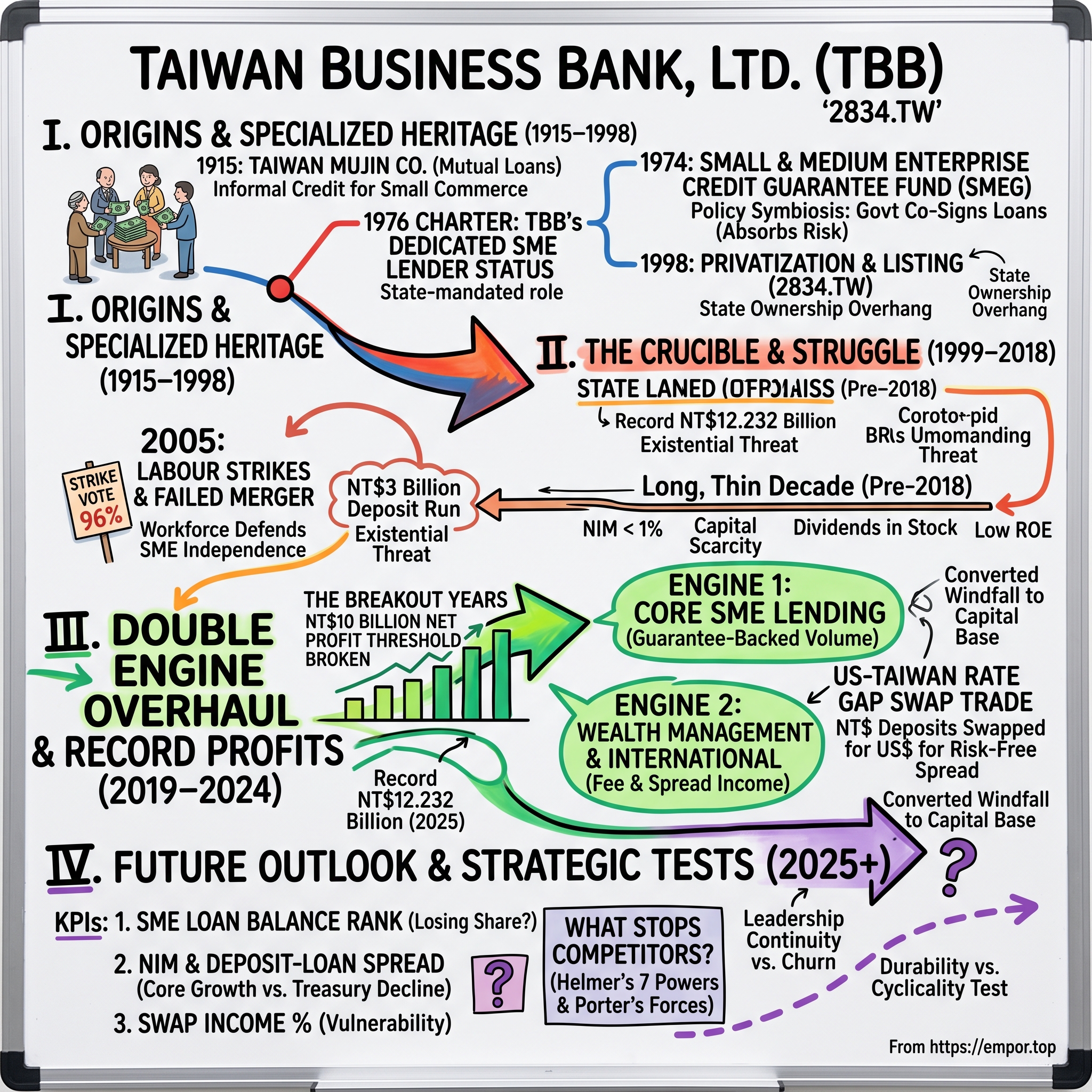
Taiwan Business Bank, Ltd.: Taiwan's SME Lending Engine
I. Introduction & Episode Roadmap (00:00 - 08:00)
On a humid morning in September 2005, roughly three hundred bank clerks stood outside a grey office building on Tacheng Street in Taipei's Datong District, holding placards instead of loan files. They were not demanding higher pay. They were demanding that the government stop trying to sell the bank they worked for. Within two weeks, roughly NT$3 billion of deposits walked out the door as customers wondered whether the institution would still exist by Christmas.1 The Ministry of Finance's auction attracted three bidders and produced nothing. The finance minister held a press conference to announce failure. The chairman resigned two days later.1
That building was the headquarters of 臺灣中小企業銀行 Taiwan Business Bank, Ltd. — TBB, ticker 2834.TW on the 臺灣證券交易所 Taiwan Stock Exchange. Twenty years later, the same institution has posted five consecutive years of net profit above NT$10 billion, closing 2025 at a record NT$12.232 billion on earnings per share of NT$1.26.2 The bank that nobody wanted to buy in 2005 has become, by its own accounting, one of the more consistently profitable of Taiwan's government-linked lenders.
This is not a story about a technology breakthrough or a charismatic founder. It is a story about a specific and unglamorous kind of financial machine: a bank whose entire statutory identity is lending to companies too small, too collateral-poor, and too relationship-dependent for the large financial holding groups to chase efficiently. TBB is Taiwan's designated small-and-medium-enterprise specialist, and its economics are built on three things that rarely appear in the same sentence — a government credit guarantee scheme that absorbs much of the downside on risky loans, a branch network physically embedded in industrial parks, and, for a remarkable four-year stretch, a treasury desk that quietly monetised the gap between US and Taiwan interest rates.
The core question this article tests is straightforward. TBB's profits roughly doubled between 2021 and 2022 and have compounded since. How much of that was structural transformation, and how much was a macro windfall that is now fading? The answer matters, because the two possibilities imply very different things about what the bank earns in 2028.
The route we will take runs roughly as follows. First, the origins: a Japanese-colonial-era mutual loan society that became, by legislative fiat in 1976, Taiwan's only bank chartered specifically to serve small business. Then the crucible — the 2005 strike that killed a state-orchestrated merger and preserved TBB's independence, followed by a long stretch of thin margins and capital scarcity that left the bank paying its shareholders mostly in paper. Then the breakout years, when a new chairman, a Federal Reserve tightening cycle, and a wealth management push converged. Then the machinery itself: how 中小企業信用保證基金 Small and Medium Enterprise Credit Guarantee Fund guarantees actually work, why they matter to a lender's loss curve, and where TBB genuinely ranks against its peers — which, as we will see, is not where the promotional version of the story places it.
After that, the harder material. Governance at a bank where the state-linked bloc holds roughly a quarter of the shares and where three chief executives or chairs have been pushed out in six years, the most recent under criminal investigation. Capital allocation at an institution that has historically paid shareholders in stock because it could not spare the cash. And a bull-versus-bear stress test using Helmer's 7 Powers and Porter's Five Forces, aimed at one question a sceptical investor would ask first: what exactly stops any of Taiwan's other three-dozen banks from doing this?
It begins, as many Taiwanese institutional stories do, in 1915.
 Subscribe on LinkedIn
II. Origins & Specialized Heritage (1915–1998) (08:00 - 20:00)
Taiwan in 1915 was a Japanese colony twenty years into its administration, and the island's commercial life ran on a financial system that had almost no interest in the people actually doing the commerce. Sugar mills and camphor monopolies had access to Tokyo capital. The rice trader, the dye-house owner, the family running a small foundry did not. What they had instead was an old Chinese and Japanese institution called the mutual loan society — a rotating pool where members contributed regularly and took turns drawing out the accumulated sum. It was informal credit, enforced by social pressure rather than collateral.
That year, 臺灣無盡株式會社 Taiwan Mujin Co. was incorporated in Taipei to put a corporate structure around that practice, with a sister company established in Tainan.3 The Japanese word 無尽 (mujin) literally means "inexhaustible," which was optimistic branding for what was essentially a formalised savings-and-lending club. Over the following decade a series of consolidations produced 臺灣勸業無盡株式會社, capitalised at ¥500,000, which absorbed the earlier entities; by 1926 a further reorganisation created the southern-Taiwan arm.3 These were not banks in the modern sense. They were mechanisms for pooling small sums among people who knew each other.
The interesting thing about this origin is how directly it maps onto what TBB does today. A mutual loan society solves one specific problem: how to lend money to a borrower who has no audited financial statements and no property to pledge, using social and commercial information instead. That is still, a century later, the central underwriting problem of SME banking in Taiwan.
The post-war reorganisation was messy and bureaucratic. Successive mergers and renamings between 1946 and 1948 produced 臺灣省合會儲蓄股份有限公司 — Taiwan Provincial Mutual Savings — by January 1948.3 For nearly three decades it operated as a provincial savings institution, which is to say a second-tier lender in a financial system dominated by state banks that funnelled capital to state industry and large exporters.
The 1976 charter that created a category
Then came the moment that defined everything after. Taiwan's Banking Act revision led to the institution's conversion in 1976 into 臺灣中小企業銀行股份有限公司 — Taiwan Business Bank — becoming the island's first and, ultimately, only dedicated small-and-medium-enterprise lender.3
It is worth pausing on why a government would do this. Taiwan's version of the East Asian growth model was structurally different from South Korea's. Korea built chaebol: a handful of enormous conglomerates with privileged access to state-directed credit. Taiwan built the opposite — an economy of tens of thousands of small, family-owned factories and trading houses, subcontracting to each other in dense supply chains. The 台灣經濟奇蹟 Taiwan Economic Miracle was, in large measure, a story of small firms. That structure had one glaring weakness: small firms are terrible bank customers by conventional standards. They lack collateral, their accounting is opaque, and any single loan is too small to justify the underwriting cost.
So the state built two institutions to fix it. One was TBB — a bank whose charter obliged it to serve that constituency. The other, arguably more important, was the Small and Medium Enterprise Credit Guarantee Fund, a non-profit body that stands behind SME borrowers who lack adequate collateral, guaranteeing a portion of the loan so the bank will make it. The fund's guarantee coverage runs as high as 90% of principal on qualifying credits.4
Think of it as the government co-signing the loan. If the borrower defaults, the bank recovers most of the exposure from the fund rather than eating it. This changes the arithmetic of SME lending completely. A loan that might carry a 3% expected loss rate on an unguaranteed basis becomes, with a 70–80% guarantee, an exposure with a fraction of that severity. It lets a bank price for volume rather than for catastrophe, and it lets it lend to a borrower whose only real asset is a purchase order.
That symbiosis — a mandated SME lender paired with a public guarantee fund — is the foundation of TBB's business model and remains so today. It is also, as we will discuss later, an advantage the bank does not own exclusively.
Privatisation, on paper
On 22 January 1998, TBB formally transitioned from government enterprise to private ownership and listed on the Taiwan Stock Exchange.3 The following year the headquarters moved from Chongqing South Road to Tacheng Street in Datong District.3
The word "privatisation" deserves scare quotes. What actually happened was that TBB's shares began trading publicly while the state's economic apparatus retained a large anchor position through a constellation of entities — the 臺灣銀行 Bank of Taiwan, the 國家發展基金 National Development Fund, the 土地銀行 Land Bank of Taiwan, and the 財政部 Ministry of Finance itself. That arrangement is not a historical footnote; it is the governance structure the bank still operates under, and it has produced both stability and recurring embarrassment.
For a listed company, this creates a permanent tension. Minority shareholders own claims on a bank whose largest shareholder group has objectives — SME credit availability, policy lending programmes, employment — that are not identical to maximising return on equity. Most of the time these objectives are compatible. Occasionally they are not, and when they collide, the state has the votes.
Which brings us to the seven years after listing, when the government decided that what Taiwan really needed was fewer banks — and that TBB should be one of the ones to disappear.
III. The Crucible: Labor Strikes, Failed Mergers, and Public Bank Overhang (1999–2018) (20:00 - 35:00)
By the early 2000s, Taiwan's banking system had a diagnosis and a prescription, and both were widely agreed upon. The diagnosis: too many banks, too little differentiation, and net interest margins competed down to levels that made it hard to earn a decent return on capital. This condition even acquired a nickname in the local press — 金融紅海, the financial red sea. The prescription, embodied in the Chen Shui-bian administration's second phase of financial reform, was consolidation. Halve the number of state-linked banks. Create national champions. Sell the rest.
TBB was on the sell list.
Four days in September
The bank's labour union saw the plan for what it was in institutional terms: a share-swap-driven absorption into a larger financial holding company, with the workforce redundancy that implies, executed without collective bargaining and — the union argued — structured specifically to avoid Legislative Yuan scrutiny. On 27 August 2005, the union convened an emergency general meeting. Of roughly 4,500 members, 3,619 voted, and 3,467 of them — nearly 96% of those voting — authorised a strike.1
That level of consensus is worth registering. Bank employees are not natural militants. A 96% strike vote in a white-collar financial institution signals that the workforce believed the alternative was existential.
The union's three demands were precise rather than emotional: no use of stock swaps by state shareholders to bypass legislative oversight; no merger before the Banking Act amendments that would govern such a transaction; and no execution before a collective agreement was concluded.1
The strike began on 8 September 2005, with simultaneous actions in northern, central and southern Taiwan. It was the first strike in the history of Taiwan's financial industry.1 The following day the bidding deadline arrived, and three financial holding groups submitted offers: 兆豐金控 Mega Financial Holding, 富邦金控 Fubon Financial Holding, and 玉山金控 E.Sun Financial Holding.1 On 13 September the union suspended the four-day action. On 14 September, Finance Minister 林全 Lin Chuan announced that the sale had produced no result, citing employee demands among the contributing factors. On 16 September, TBB's chairman resigned.1
The cost was real. Around NT$3 billion of deposits left in the two weeks following the strike as depositors questioned the bank's stability.1 But the strike accomplished exactly what it set out to accomplish: TBB remained independent, and it remained a specialist SME lender rather than a division inside somebody else's conglomerate.
The episode had a long tail across Taiwan's financial sector. Unions at other state-linked banks organised in its wake, though none replicated the actual work stoppage.1 For investors, the durable lesson is about the governance texture of Taiwan's public-bank ecosystem: the workforce is a genuine stakeholder with demonstrated veto power over structural change. That cuts both ways. It protected minority shareholders from being swept into a merger on terms they had no say over. It also means that any future restructuring — cost programmes, branch rationalisation, a sale — faces an organised constituency that has already proved it will fight.
The long, thin decade
Independence preserved, TBB then spent more than a decade demonstrating why the consolidation advocates had a point.
The structural problem was arithmetic. Taiwan hosts roughly three dozen domestic banks competing for the deposits and loans of a population of 23 million. Nobody has enough share to price with any authority. The result is a system-wide compression of net interest margins to levels that would be considered distressed in most banking markets — TBB's own net interest margin sat below 1% for years, and even after the improvements of the last cycle it was still only 0.88% in the first quarter of 2026.5
To translate: for every NT$100 of assets the bank funds, it earns well under NT$1 of net interest income before any costs. There is essentially no room for error. A bank operating at that margin cannot absorb a credit cycle through spread; it has to avoid the losses in the first place or it does not earn anything.
Layered on top was a capital problem specific to SME lending. Under Basel capital rules, a bank must hold equity against the risk-weighted value of its assets. Small business loans — unrated, unsecured or thinly secured, concentrated in cyclical manufacturing — carry heavy risk weights relative to, say, a mortgage or a government bond. TBB's mandated business was therefore among the most capital-hungry a Taiwanese bank could run. Every additional NT$100 of SME lending consumed disproportionately more of the equity base than the same loan at a mortgage-heavy competitor.
And the bank could not easily raise that equity. Trading at a persistent discount to book value, issuing new shares meant selling a claim on the bank's assets for less than those assets were carried at — value-destructive for existing holders. So TBB did the only thing available: it retained earnings by paying its shareholders in stock rather than cash. Stock dividends (股票股利) transfer nothing out of the bank; they simply divide the same equity into more shares. Shareholders received paper that diluted per-share earnings while the actual capital stayed put, funding loan growth and rebuilding capital ratios.
For a decade, that was the deal on offer to TBB shareholders: a low-margin lender in a hyper-competitive market, with a policy mandate that consumed capital efficiently, paying dividends that were mostly an accounting entry. It was not obviously a good deal.
What changed the arithmetic was a combination of a new chairman with an unusually specific agenda and, shortly afterward, the most aggressive monetary tightening cycle in forty years.
IV. The "Double Engine" Overhaul & The Record Profit Era (2019–2024) (35:00 - 57:00)
林謙浩 Lin Chien-hao was born in June 1959, read law at National Taiwan University, and joined 第一銀行 First Bank in 1984 — the beginning of a career that would run nearly four decades inside Taiwan's public-bank system.6 He worked his way through the institution in a sequence that reads like a deliberate education in how a bank actually functions: secretary to the chairman, manager of the Hong Kong branch, chief auditor, deputy general manager. In 2018 he became chief executive of 第一金控 First Financial Holding.6
In 2021 he took the chairmanship of Taiwan Business Bank and arrived with what he called a "Seven Tasks" agenda, centred on SME lending, digital finance, and ESG.6 Lin's background as a chief auditor is not incidental. Auditors are trained to look at where an institution's processes leak — where controls fail, where reported numbers diverge from operational reality. Chairmen who come up through that route tend to run transformation programmes as remediation exercises rather than as visionary campaigns.
The strategic frame that emerged became known internally and in the local press as the double-engine model. Engine one was the traditional core: SME lending, funded by a cheap and sticky retail deposit base. Engine two was everything that generated income without consuming loan-book capital — fee income from wealth management, and treasury operations.
Then the Federal Reserve did TBB an enormous favour.
The swap trade, explained plainly
Beginning in March 2022, the Fed raised US policy rates at the fastest pace since the early 1980s. The 中央銀行 Central Bank of the Republic of China (Taiwan) raised rates too, but modestly — Taiwan's inflation problem was smaller and its central bank has long prioritised exchange-rate stability and the competitiveness of exporters. The result was a wide and persistent gap between US dollar and New Taiwan dollar interest rates.
Here is the mechanism, stripped of jargon. TBB sits on an enormous pool of NT dollar deposits — average deposits reached NT$2.11 trillion in 2025 — that it cannot profitably lend out in full.7 In a foreign exchange swap, the bank exchanges NT dollars for US dollars today and simultaneously agrees to swap them back at a fixed rate on a set future date, typically weeks or months out. In between, the US dollars sit in short-dated US instruments earning the higher US rate. Because the return leg is contracted at the outset, there is no exposure to where the exchange rate actually goes. The bank captures the interest rate differential, less the cost embedded in the swap points.
The elegance is in what the trade does not require. It takes no credit risk — no borrower can default on it. It takes no meaningful currency risk, because both legs are locked. And critically, it takes almost no duration risk: these are short-dated instruments, rolled continuously, so a rise in long-term yields does not blow a hole in the portfolio the way it did at several US regional banks in 2023. TBB was earning a rate spread while carrying essentially none of the risks that usually accompany one.
The scale of the contribution was substantial. Through the first three quarters of 2023, net income from financial products and exchange gains reached NT$5.952 billion — a 167.63% increase on the prior year — and became a primary profit driver.8 For the full year 2023 the line totalled NT$8.149 billion, roughly double the NT$3.927 billion it had contributed in 2022.9
The numbers, and what they actually say
The profit trajectory over these years is genuinely striking. In 2022, TBB's consolidated after-tax net profit reached NT$10.102 billion — the first time in the bank's history it crossed the NT$10 billion threshold, and a 97.05% increase on the prior year.6 2023 delivered NT$10.568 billion.9 2024 set a fresh record at NT$11.231 billion, EPS NT$1.23, marking three consecutive years above the ten-billion mark.10
A near-doubling of profit in a single year at a bank is almost never an operating story. It is a rates story. And the honest reading of 2022 is that the Fed handed TBB — and every other Taiwanese bank sitting on excess NT dollar liquidity — a windfall that management did not create and could not sustain by effort alone.
But there is a more interesting second-order point, and it is the one that determines whether this is a durable business improvement or a cyclical blip. What TBB did with the windfall matters more than the windfall itself. The swap income arrived as capital, and capital was precisely the binding constraint that had held the bank back for a decade. Retained swap earnings rebuilt capital ratios, which permitted loan growth, which built the interest-earning asset base that generates income after the swap spread closes. In effect, a treasury windfall was converted into balance sheet capacity.
Whether that conversion has worked is testable, and the test is now running. By 2025, the swap-driven line had begun to reverse: net gains from financial products and foreign exchange fell to NT$7.211 billion amid market volatility — and yet full-year profit still rose 8.85% to NT$12.232 billion.2 The offset came from the core: interest income grew 7.79% to NT$20.606 billion, representing 58.73% of total revenue, driven by both a larger loan book and a wider spread.7 Average loans grew 7.08% to NT$1.6621 trillion, and the bank's interest spread measure widened from 1.16% to 1.18%.7
That is the single most important piece of evidence in TBB's favour anywhere in this story. In a year when the macro engine went into reverse, the lending engine grew enough to more than compensate. One year does not prove a structural transformation. It does falsify the simplest bear thesis — that TBB was purely a levered bet on the US-Taiwan rate gap.
Leadership turbulence in the middle of it
The human story running underneath the numbers was considerably less orderly. In June 2023, Lin Chien-hao was elected chairman of 合庫金控 Taiwan Cooperative Financial Holding — a promotion within the public-bank hierarchy. Two weeks into the new role, on 2 July 2023, he died at the age of 64. The company did not disclose the cause, at the family's request.6
His successor at TBB, appointed the same month he departed, was 劉佩真 Liu Pei-chen — the bank's first female chair, previously chair of the Export-Import Bank. Her tenure ended in February 2025 under circumstances we will examine in the governance section, and it did not end well.
Hokii and the retail flank
Alongside all this, TBB built out a digital retail brand called Hokii — NT dollar and foreign currency deposit accounts opened entirely online through digital certificate or third-party verification, with no branch visit. The marketing is aggressive on rate: new NT dollar account holders have been offered a 2.1% promotional rate against 1.9% for existing customers, with up to a further 0.9% available for meeting balance or foreign exchange conditions, applied to balances up to NT$150,000, plus bundled fee waivers on cross-bank transfers and withdrawals.11
The strategic logic is more about liabilities than about assets. A bank's cost of funds is the raw material price of its entire business. Digital-native depositors — typically younger, typically maintaining smaller balances they do not actively rate-shop — can be an attractive funding source, and they are acquired without the fixed cost of a branch. Whether the promotional rates that attract them actually deliver a lower blended funding cost once the teaser periods are accounted for is the sort of thing that is difficult to verify from outside; TBB has not disclosed Hokii's account count or deposit balance. The digital brand should be treated as a plausible funding and cross-sell strategy rather than a proven one.
To understand whether any of this constitutes an advantage, we have to open up the loan book itself.
V. Core Business Economics: Inside Taiwan's SME Lending Engine (57:00 - 01:17:00)
Drive into any of Taiwan's industrial zones — Linkou, Guishan, the sprawl of small plants along the western corridor — and the physical signature of TBB's business model becomes obvious. Among the metal-stamping shops and injection-moulding operations and second-tier component suppliers, there is a bank branch. Not a marble-floored flagship; a working branch with a relationship manager who has visited these factories, knows which owner overextended on a machine purchase last year, and can tell whether the inventory in the yard represents an order book or a problem.
TBB operates 125 domestic branches alongside nine overseas units.3 The domestic network is the asset. It is not a distribution channel in the retail-banking sense so much as an information-gathering apparatus.
What the guarantee fund actually does to the loss curve
The reason TBB can lend into this segment at all comes back to the credit guarantee structure. When a small manufacturer needs working capital but can pledge only equipment of uncertain resale value, the guarantee fund steps in to cover a defined share of the principal — up to 90% on qualifying credits.4
The effect on a lender's economics is best understood through severity rather than frequency. Guarantees do not stop borrowers from defaulting. What they do is cut loss-given-default. A bank facing a portfolio where defaults are relatively common but each default costs it only a fraction of the exposure has a fundamentally different business than one where defaults are rare but total. The first can be run as a volume business with statistical underwriting. The second cannot.
There is a second, less obvious benefit on the capital side. Because a guaranteed portion of the exposure carries the credit standing of the guarantor rather than the borrower, it consumes less regulatory capital than an equivalent unguaranteed loan. For a bank whose binding constraint has historically been capital, that is not a minor detail — it is the difference between being able to grow the book and not.
Credit quality: excellent, and worth interrogating
TBB's reported asset quality is, on its face, outstanding. As of end-2025, the non-performing loan ratio stood at 0.16% with a loan loss reserve coverage ratio of 830.51%.2 Mid-2025 figures showed the same picture — NPL at 0.16%, improved from 0.18%, with coverage at 845.35%, up from 718.61% a year earlier.12 Taiwan Ratings upgraded the bank's outlook to positive.2
Coverage above 800% means the bank holds more than eight times the reserves against the loans it has already classified as non-performing. For context, a coverage ratio of 150% is generally considered comfortable in most banking systems.
Now, the honest interpretation. Numbers this good invite two competing readings, and a serious investor should hold both. The favourable reading is that guarantee-backed lending plus disciplined underwriting plus a benign Taiwanese economy has genuinely produced a portfolio with minimal problem credits. The sceptical reading is that a 0.16% NPL ratio across a book of small manufacturers is close to arithmetically implausible as a measure of the underlying risk in that customer base — it reflects the guarantee structure absorbing losses before they surface as NPLs, aggressive write-off timing, and, critically, an economic environment that has not been genuinely tested. Taiwan's export sector has been buoyed for three years by an AI-driven electronics upcycle. SME credit quality in a downturn is a different question entirely, and one on which this data provides limited information.
The very high coverage ratio is itself ambiguous evidence. It signals conservatism — the bank is over-reserving relative to identified problems. It also means reported profits have been suppressed by provisioning that could, if management chose, be released in a weaker year. That is a legitimate accounting judgment, not an accusation. But it is a lever, and investors should know it exists.
Where TBB actually ranks
Here is where the promotional version of the TBB story requires correction. The bank is frequently described as Taiwan's SME lending leader. In balance terms, it is not.
As of 31 March 2026, domestic banks' outstanding SME loans reached NT$11.0393 trillion — a record for the quarter.13 Ranked by SME loan balance, First Bank led with NT$1,038.34 billion, followed by 合庫銀行 Taiwan Cooperative Bank at NT$864.24 billion, then Taiwan Business Bank at NT$830.27 billion, 華南銀行 Hua Nan Bank at NT$771.70 billion, and 兆豐銀行 Mega International Commercial Bank at NT$749.03 billion.13
TBB ranks third, with roughly 7.5% of the market by balance — not the "10%-plus" leadership position sometimes attributed to it. Two of the banks ahead of it are substantially larger institutions for which SME lending is one business line among many.
This reframes the competitive picture in an important way. TBB is not a dominant player in its own designated segment. It is a mid-sized specialist competing against larger diversified banks that have found SME lending attractive enough to pursue at scale. And the growth is going elsewhere: in the quarter to March 2026, the largest increases in SME loan balances came from Taishin Bank (+NT$37.694 billion), Yongfeng Bank (+NT$22.618 billion), Taipei Fubon (+NT$15.055 billion), First Bank (+NT$15 billion), and E.Sun (+NT$14.29 billion) — TBB was not among the leaders.13
Nor is the SME segment starved of enthusiasm. Across 2025, bank lending to Taiwanese SMEs rose NT$550.4 billion against a government growth target of NT$460 billion, comfortably exceeding it, with CTBC Bank alone adding NT$80.1 billion.14 The regulator attributes the growth to export expansion and financing tied to US tariff-related programmes.14
The analytical conclusion is uncomfortable but clear: whatever advantage TBB's specialisation confers, it is not preventing larger, better-capitalised competitors from taking share in its core market. The moat, if it exists, is not visible in the market-share data.
Where TBB does appear to have an edge
The more defensible claim is about the tail of the market rather than the whole of it. Bank credit is genuinely indispensable to small Taiwanese firms — equity markets are effectively closed to a NT$200 million-revenue component maker, and bond markets more so. Within that dependency, the smallest and least collateralised borrowers are the ones a large bank's centralised credit model handles worst and a relationship-heavy branch model handles best. TBB's advantage, to the extent it is real, sits in that segment: too small to be worth a large competitor's origination cost, too information-opaque for algorithmic underwriting.
That is a real niche. It is also a narrow one, and it is not where the industry's growth is.
Reshoring, and what it did and did not deliver
The tailwind most frequently cited in TBB's favour is 台商回流 Taishang reshoring — Taiwanese manufacturers relocating capacity out of mainland China in response to tariffs, geopolitical risk, and customer pressure, either back to Taiwan or into Southeast Asia under the 新南向政策 New Southbound Policy.
The mechanism is straightforward and genuinely favourable to an SME lender. Relocating production requires capital expenditure — land, buildings, equipment, automation — which is exactly the kind of multi-year, collateralised term lending that carries better spreads than working capital revolvers. The regulator has explicitly linked SME loan growth to economic recovery and rising capital demand from electronics firms, including renewable energy syndicated loans and working capital needs in high-tech sectors.13
The qualification is that this tailwind is available to every bank in Taiwan, and the share data above suggests competitors have captured it at least as effectively. Reshoring is a sector tailwind, not a TBB advantage.
Segment mix, and what it reveals
The 2025 revenue composition tells the story cleanly. Total net revenue reached NT$35.088 billion, up 9.73%. Interest income contributed NT$20.606 billion, or 58.73% of the total. Fee income was NT$6.692 billion, up 2.06%, with wealth management contributing roughly 60% of that. Financial products and FX contributed NT$7.211 billion.72
So roughly six-tenths lending, two-tenths treasury, one-tenth fees, with the remainder in other income. The treasury share is the swing factor and the vulnerability: a fifth of revenue from a business whose profitability is set by a rate differential neither TBB nor Taiwan controls.
Which raises the governance question. Who is making these allocation decisions, and on whose behalf?
VI. Management, Governance, & Capital Allocation Test (01:17:00 - 01:29:00)
On 8 February 2025, prosecutors from the New Taipei District Prosecutors Office searched Taiwan Business Bank's offices. The bank's chairwoman, Liu Pei-chen, was taken in for questioning on suspicion of special breach of trust under the Banking Act and subsequently released on NT$500,000 bail.15 The allegation concerned 91.5 days of medical leave taken in 2023 during which she continued to work remotely and received NT$1.91 million in compensation.15
Liu's defenders noted that she claimed compensation only for dates with documented remote work records, and that the bank's performance and asset quality improved during the period in question.15 She submitted a verbal resignation to the Executive Yuan in February 2025, ahead of the Legislative Yuan's 25 February session — timing that local reporting read as an effort to keep the case from becoming a political liability for the administration.15 President 李國忠 Lee Kuo-chung served as acting chairman until 李嘉祥 Lee Chia-hsiang, previously president of First Bank, took the chairmanship on 10 April 2025.16
A pattern, not an incident
The Liu case would be less significant if it were isolated. It is not. Local financial media have documented three forced departures from TBB's top two roles inside roughly six years: a president who left in 2019 following reporting on a relationship with a subordinate; a chairman who departed in April 2021 amid nepotism allegations, with the Ministry of Finance citing "personal career planning"; and Liu in 2025.17 The commentary in Taiwan's financial press has been blunt, characterising the chairmanship of a state-linked bank as a high-risk occupation.17
For an investor, this is not gossip. It is a structural observation about the appointment mechanism. Leadership at TBB is determined through a political process — the Ministry of Finance ecosystem, the Executive Yuan, the calendar of legislative sessions. That process produces executives with deep public-bank experience and genuine institutional knowledge. It also produces churn driven by scandal cycles and administration priorities rather than by performance against strategy.
The practical consequence is that strategic continuity at TBB depends on institutional momentum rather than on any individual's tenure. That is not necessarily fatal — the double-engine framework has survived three chairs — but it means an investor should discount any single leader's stated multi-year plan more heavily than at a bank with stable control.
Ownership: who actually decides
The state-linked bloc's position is substantial without being outright control. As of a 2023 disclosure of the top ten shareholders, Bank of Taiwan held 16.21%, the National Development Fund 5.87%, Land Bank 2.29%, and the Ministry of Finance 2.08% — a combined government-related holding of 26.45%.18 Foreign institutions occupied four of the top ten positions, including Vanguard's emerging markets vehicle, a global composite index fund, Morgan Stanley International, and Norway's central bank.18 An employee stock trust, established in 2019 with roughly 95.93% staff participation, held 0.97% and had climbed from ninth to fifth largest holder.18
Roughly a quarter of the register, voting as a bloc, is enough to control board composition in practice while leaving three-quarters of the economics with outside investors. The employee trust is a quietly interesting feature — an organised workforce that is also a shareholder, which aligns incentives on profitability while reinforcing the constituency that killed the 2005 merger.
The dividend pivot, and what it signals
Capital allocation is where a bank's real priorities become visible, and TBB's dividend history reads as a direct log of its capital position.
The pattern for most of the past decade was stock-heavy. For fiscal 2023, the bank distributed NT$1.15 in stock and NT$0.20 in cash — NT$1.35 total, described at the time as a 24-year high, and representing a payout ratio above 100%.910 That exceeded earnings because the stock component costs the bank nothing in cash. For fiscal 2024, distribution moderated to NT$0.20 cash and NT$0.60 stock — NT$0.80 total, a payout ratio of about 65%.19
Then, on the fiscal 2025 results, the board proposed NT$0.30 cash and NT$0.70 stock — NT$1.00 total, lifting the payout ratio to 79.37%, with the shareholders' meeting set for 18 June.19 Against a NT$15.5 share price, the cash component implied a yield of roughly 1.94%.19
Management's framing has been consistent across calls, which is itself worth noting. At the 2023 results conference, a deputy general manager stated the policy was stock dividends as primary, supplemented with cash.8 At the fiscal 2025 conference held on 19 March 2026, the language was essentially unchanged: stock dividends remain the primary vehicle, with partial cash considered based on shareholder preferences.7 Narrative consistency across multiple leadership changes is a modest positive signal — the strategy is institutional rather than personal.
Capital: the constraint, quantified
The capital position explains why the dividend policy is what it is. At end-2025, common equity tier 1 stood at 9.91%, tier 1 capital at 11.18%, and the total capital adequacy ratio at 14.01%.7 By the first quarter of 2026 the figures read CET1 at 9.82% against a 7.00% regulatory minimum, tier 1 at 11.05% against 8.50%, and BIS at 13.50% against 10.50%.20
The ratios sit comfortably above minimums. They are not lavish, and the slight sequential softening is consistent with a bank growing risk-weighted assets faster than it retains capital. A CET1 ratio under 10% at an institution whose asset mix is heavy in risk-weighted SME credit leaves limited headroom for aggressive growth — which is precisely why TBB continues to pay most of its dividend in paper. Management has also indicated that the Wealth Management 2.0 licence application, which carries capital requirements of its own, is contingent on capital ratio confirmation.7
The activist question here writes itself. A sceptical investor would ask why a bank generating NT$12 billion of annual profit and trading near book value cannot fund its own growth and pay a meaningful cash dividend. The answer is that the risk-weighted intensity of the mandated business consumes capital faster than a comparable retail-heavy bank, and the state-linked ownership structure makes a large equity raise politically and economically awkward. That is not mismanagement. It is a structural feature of the business, and it caps how much cash minority holders can extract from it.
The credibility scorecard, on evidence
Where has management delivered? Credit costs have been contained through a period of considerable macro volatility. The transition of profit drivers from treasury to core lending in 2025 happened without a profit decline — a genuine execution result. Dividend policy language has been consistent across three chairs. External validation has arrived in ESG assessments, with a third consecutive inclusion in the S&P Global Sustainability Yearbook and a top-decile ranking among global banks, plus a first inclusion in a Dow Jones emerging markets leaders index.25
Where is the record thinner? Market share in the bank's own designated segment has not kept pace with faster-growing competitors. Key digital metrics for Hokii remain undisclosed, making the retail transformation claim unverifiable from outside. And the governance record — three forced departures in six years, one under criminal investigation — is a real cost that no amount of operational competence offsets.
The open test is whether the bank can hold NT$11 billion-plus in annual profit as the rate differential that powered the treasury engine continues to compress. Early evidence is encouraging: first-half 2026 net profit reached NT$7.412 billion, up 15.54% year on year, with EPS of NT$0.76.21 But that is two quarters, in an economy running hot on AI-driven electronics demand.
Which brings us to the part of the business management would most like investors to focus on.
VII. Fast-Growing Growth Engine: Wealth Management & International Footprint (01:29:00 - 01:39:00)
Every bank facing margin compression eventually arrives at the same conclusion: sell customers something that generates a fee rather than a spread. The logic is sound. Fee income does not consume regulatory capital, does not carry credit risk, and — in theory — does not evaporate when the rate cycle turns.
TBB's wealth management business generated NT$1.316 billion in fee income in the first quarter of 2026, up 3.79% year on year.5 Within that, fund-related fee income surged 48.33%, which management attributed to product mix optimisation.5 For the full year 2025, wealth management contributed roughly 60% of the bank's NT$6.692 billion fee income line.7
Two observations follow. First, the headline growth rate is modest — under 4% — and the impressive 48% figure applies to a sub-component. Fund fees growing at that rate while total wealth management fees grow at 4% implies weakness or high base effects elsewhere in the mix, most likely in bancassurance. This is worth watching rather than celebrating.
Second, wealth management fees are less countercyclical than the standard argument suggests. Fund and insurance product sales are highly sensitive to investor sentiment. In a market decline, retail clients stop buying funds precisely when a bank's other income lines are also under pressure. Fee income diversifies the source of revenue without fully diversifying the cycle.
The forward strategy has two concrete components. The bank has been preparing an application for high-net-worth wealth management operations — the Wealth Management 2.0 regime, which permits banks to serve qualified high-asset clients with a broader product range — and plans to establish a presence in the Kaohsiung Asian asset management hub.25 Both are credible extensions. Both also put TBB into direct competition with private financial holding groups that have spent years and considerable capital building private banking capability. TBB's brand equity with a NT$100 million-net-worth client is not obviously its strong suit.
The overseas network
TBB's nine overseas units cluster where Taiwanese manufacturers and traders operate: Los Angeles and New York in the United States; Sydney and Brisbane in Australia; Tokyo; Hong Kong; Shanghai and Wuhan in mainland China; and a representative office in Yangon, Myanmar.22
This is a follow-the-customer network rather than an international expansion strategy. A Taiwanese component supplier selling into a US assembler needs trade finance, letters of credit, foreign currency working capital, and hedging — and prefers a bank that already knows its Taiwan operation. The economics can be genuinely attractive: foreign currency lending typically carries wider spreads than domestic NT dollar competition allows, and cross-border trade finance generates fees.
The results support the claim. In the first quarter of 2026, pre-tax earnings from the offshore banking unit and overseas branches rose 30.81% year on year, driven by syndicated lending and foreign currency loans.5 That growth rate is well ahead of the group, meaning overseas is currently the fastest-improving part of the franchise.
The risk sits in the geography. Two branches in mainland China represent exposure to a jurisdiction where Taiwanese financial institutions face both regulatory and geopolitical uncertainty, and where cross-strait tensions could impair operations in ways that have nothing to do with credit quality. TBB has not disclosed the size of these exposures separately.
Also on the modernisation front, TBB secured Asian Banking and Finance's Taiwan digital transformation award for a third consecutive year in 2026, for work spanning machine-learning fraud prediction models, telecom API integration for real-time fraud protection, and Hokii customer experience improvements.21 Industry awards are marketing artefacts rather than evidence, but the underlying fraud-prevention investment is the kind of unglamorous operational spending that quietly protects a retail deposit franchise.
With the business mapped, the question becomes structural: is any of this actually defensible?
VIII. Strategic Frameworks: Helmer's 7 Powers & Porter's 5 Forces (01:39:00 - 01:49:00)
Strip away the narrative and the investment question reduces to something a war-gamer would recognise. If you were running 富邦金控 Fubon Financial Holding or 中信金控 CTBC Financial Holding, with more capital, better technology, and a stronger consumer brand, what would stop you from taking Taiwan Business Bank's business? The honest answer determines everything.
Hamilton Helmer's 7 Powers, applied without generosity
Process Power is the power TBB's supporters would nominate first: a century of accumulated SME credit assessment capability, embedded in branch-level relationships and in workflows integrated with the credit guarantee fund's procedures. The argument is that this knowledge is tacit — it lives in relationship managers who know which factory owners are reliable — and therefore cannot be bought or copied quickly.
There is something to this. Process Power in Helmer's framework requires exactly this profile: an advantage built through long, hard-to-observe organisational learning that resists replication because it is not written down anywhere.
The evidence, however, does not fully cooperate. If TBB's SME underwriting process were meaningfully superior, it should show up as either better credit performance or better growth than competitors in the same segment. The credit data is excellent but the guarantee structure — available to every bank — explains much of it. And the growth data actively contradicts the claim: competitors added SME loan balances faster than TBB in early 2026.13 A process advantage that produces neither share gains nor demonstrably superior loss experience is difficult to distinguish from no advantage at all.
Scale Economies are weak. TBB's 125 branches give it density in industrial zones, but it is the third-largest SME lender, not the largest, and the two banks ahead of it have substantially larger total balance sheets over which to spread technology, compliance, and funding costs.133 In banking, scale economies accrue to the largest, and TBB is not.
Counter-Positioning is the most interesting candidate and also the most fragile. The argument: large financial holding groups face an internal allocation problem where a NT$20 million loan to a component maker, requiring a site visit and ongoing relationship management, generates less revenue per unit of effort than a corporate loan to a listed manufacturer or a consumer credit card portfolio. A specialist whose entire cost structure is built for that loan size can serve it profitably where a generalist cannot.
Counter-Positioning requires that the incumbent be unable to respond without damaging its existing business. That is not clearly the case here. Nothing prevents CTBC or Taishin from building an SME unit — and the 2026 share data shows they are, successfully. What TBB has is a cost structure suited to small-ticket lending, which is a genuine but ordinary operating advantage, not a Helmer power.
Cornered Resource, Switching Costs, Branding, and Network Economies are all thin. The bank's specialist charter is a historical designation rather than an exclusive licence. Switching costs for an SME borrower are real but modest — relationships create friction, not lock-in, and Taiwanese SMEs routinely bank with multiple institutions. TBB has no consumer brand premium. And SME lending generates no network effects.
The uncomfortable conclusion: TBB's competitive position rests on operational fit with a niche and on a policy infrastructure it shares with everyone else. It does not appear to hold a durable Helmer power.
Porter's Five Forces
Threat of new entrants: low. Banking licences in Taiwan are issued sparingly by the 金融監督管理委員會 Financial Supervisory Commission, capital requirements are substantial, and the market is already regarded as over-banked. Nobody is starting a new SME bank in Taiwan.
Bargaining power of buyers: moderate to high, and rising. This is where the outline's framing needs revision. With three dozen banks competing and several growing SME balances aggressively, a creditworthy small manufacturer has genuine choice. The share data is essentially a measure of buyer power in action — borrowers are moving. Guarantee fund access, available to all banks, does not lock anyone in.
Bargaining power of suppliers: low. A bank's suppliers are its depositors, and Taiwanese retail deposits are abundant, stable, deposit-insured, and cheap. TBB's average deposits of NT$2.11 trillion against average loans of NT$1.6621 trillion imply substantial excess liquidity — the bank has more funding than lending opportunities, which is the definition of weak supplier power.7 This surplus is also precisely what made the swap trade possible.
Threat of substitutes: low. Small private Taiwanese companies have essentially no access to public equity or bond markets. Bank credit is not one funding option among several; it is the funding option. This is genuinely TBB's strongest structural force, and it is a sector-level protection rather than a company-level one.
Competitive rivalry: very high. This is the dominant force and the one that determines sector economics. Roughly three dozen domestic banks, none with pricing authority, competing for the same borrowers, produce the sub-1% net interest margins that define Taiwanese banking. Rivalry is why TBB's NIM is 0.88% and why it will likely remain structurally low regardless of what management does.5
The synthesis: TBB operates in an industry with strong protection against outsiders and near-zero protection against insiders. The sector as a whole is defensible; no individual participant is. That is a reasonable position for a stable, moderately profitable business — but it constrains how much of the record-profit narrative can be attributed to competitive advantage rather than to cycle and to sector-wide policy support.
IX. Bear vs. Bull Case & Material Risk Radar (01:49:00 - 02:01:00)
The interesting thing about TBB in mid-2026 is that the bull and bear cases are not arguing about the facts. They agree on the numbers. They disagree entirely about what the numbers mean.
The bull case
The transformation is real and 2025 proved it. This is the strongest argument available, and it deserves to be stated at full strength. In 2025, the treasury income that had powered the breakout fell — financial products and FX net gains dropped to NT$7.211 billion — and full-year profit still rose 8.85% to a record.2 The core lending engine grew loans 7.08% and widened spreads simultaneously.7 If TBB were merely a levered bet on the US-Taiwan rate gap, 2025 would have been a down year. It was not.
The core is compounding. First-half 2026 profit of NT$7.412 billion, up 15.54%, extends the pattern into a second year of narrowing rate differentials.21 Overseas pre-tax earnings up 30.81% in the first quarter show a genuinely improving margin mix.5
Credit quality provides a genuine cushion. An NPL ratio of 0.16% with coverage above 830% means the bank could absorb a substantial deterioration in the SME book before it touched capital or earnings.2 In a downturn, that reserve buffer is a real asset.
Sector tailwinds remain intact. SME lending across Taiwan grew NT$550.4 billion in 2025, beating the government target, and the regulator attributes growth to export expansion and tariff-related financing programmes — both of which are structural rather than cyclical drivers.14 Peer commentary supports the picture: Taiwan Cooperative Financial has projected Taiwanese economic growth of at least 8% in 2026 on AI-related electronics demand, and both it and 彰化銀行 Chang Hwa Bank guided toward record full-year profits with corporate lending and wealth management as drivers.23
Valuation reflects the old TBB. The stock has traded around book value — a NT$15.5 share price against fourth-quarter 2025 net asset value of NT$15.12 implies roughly 1.0 times book.19 That is a valuation appropriate to a low-return policy bank, not to one generating consistent record profits.
The bear case
The treasury engine has further to fall. The swap trade works only while the US-Taiwan rate gap is wide. As the Federal Reserve continues easing, that gap narrows, and the trade's contribution compresses toward nothing. TBB has already given back roughly NT$0.9 billion from the 2023 peak on this line.92 The remaining exposure is a fifth of revenue.
Currency volatility compounds it. The New Taiwan dollar appreciated 4.27% across 2025 — but the path was violent, with a 9.63% appreciation in the first half followed by a 4.89% depreciation in the second, and the central bank net-purchasing US$7.69 billion of foreign exchange over the year, equivalent to about 0.8% of GDP.24 That kind of volatility widens swap costs and makes the trade's economics unpredictable quarter to quarter. TBB itself attributed the 2025 decline in this line to market volatility.2
Share is going to competitors. The single most damaging fact in the file is that TBB was not among the top five banks by SME loan growth in early 2026, in the segment it was chartered to lead.13 A specialist losing relative ground in its speciality is the beginning of a serious problem.
Credit quality is untested. The 0.16% NPL ratio has been earned during an exceptional electronics upcycle with substantial government support programmes. Taiwanese SMEs are, in aggregate, a levered bet on global export demand. A meaningful downturn in orders — from tariff escalation, a China slowdown, or an AI capex pause — would test the portfolio in a way nothing since 2009 has.
The real estate lending cap constrains diversification. Banking Act Article 72-2 limits a commercial bank's total residential and corporate construction lending to 30% of the sum of deposits and financial bonds outstanding, subject to defined exceptions for policy housing programmes.25 For a bank looking to grow lower-risk-weight mortgage assets as a counterweight to capital-intensive SME credit, this is a hard ceiling — and the industry has spent recent years pressed against it.
Governance is a recurring cost. Three forced departures from the top two roles in six years, the most recent involving a prosecutorial search of the bank's offices, is a pattern.1517 Beyond the direct disruption, it signals that leadership is determined by a political process in which minority shareholders have no voice.
Capital limits the cash return. CET1 under 10% means TBB will keep paying most of its dividend in stock.7 Investors seeking cash yield are receiving under 2%, with the remainder in paper that dilutes per-share metrics.19
The activist stress test
A concentrated investor examining this business would push on four points. First, disclosure: TBB has not published Hokii account or deposit figures, nor a geographic breakdown of overseas branch profitability, nor a segment breakdown showing the mainland China exposure separately. That is thin for a bank asking investors to underwrite a digital and international growth story. Second, the reserve position: coverage above 830% is either extreme conservatism or a substantial earnings smoothing reservoir, and shareholders deserve to know which. Third, the payout structure: a bank earning a mid-single-digit to high-single-digit return on equity while retaining most of its earnings needs to demonstrate that retained capital earns more inside the bank than it would in shareholders' hands — and at roughly 1.0 times book, that case is not self-evident. Fourth, board independence: with a quarter of the register voting as a state-linked bloc and a documented pattern of political appointments, the mechanism protecting minority interests is unclear.
The risk radar, restricted to what is material
Demand and geopolitics dominate. TBB's borrowers are Taiwanese exporters. A tariff escalation, a cross-strait incident, or a global electronics inventory correction transmits to the loan book with little delay.
Rate cycle risk is the near-term earnings issue, discussed above.
Regulatory and political risk is bidirectional. Policy lending mandates — subsidised housing, disaster relief, SME support programmes — can be imposed at returns below commercial hurdle rates. Equally, the government growth targets that drive sector SME lending are supportive.14
Cybersecurity and fraud matter more than they appear to. A bank building a digital-only deposit brand is expanding attack surface, and TBB's investment in machine-learning fraud detection and telecom API integration is a direct response.21
Execution risk on the wealth management and high-net-worth push is real, since it moves TBB into competition with specialists on their home ground.
The KPIs that actually matter
If an investor tracks only two or three numbers, these are the ones that determine the thesis.
1. SME loan balance and its rank among Taiwanese banks. This is the single cleanest test of whether TBB's specialisation is an advantage or a legacy label. The bank sits third with NT$830.27 billion of a NT$11.0393 trillion market as of March 2026, and it has not been among the fastest growers.13 If the balance grows and the rank holds or improves, the specialist thesis is intact. If it slips, the moat argument is finished.
2. Net interest margin and the deposit-loan spread. NIM of 0.88% in the first quarter of 2026, up 5 basis points, with the total spread widening from 1.13% to 1.26%, is the measure of whether the core engine can offset the treasury decline.5 This is where the transformation either shows up or does not.
3. The financial products and FX net income line. At NT$7.211 billion in 2025, this is the swap engine.2 Tracking it against total revenue shows exactly how much of TBB's profitability still depends on a macro condition outside its control.
Everything else — fee growth, NPL ratio, capital ratios — is secondary. The NPL ratio in particular is currently uninformative precisely because it is so good; it will only start carrying information when it moves.
X. Playbook: Key Business & Investing Lessons (02:01:00 - 02:09:00)
Three transferable lessons emerge from a hundred and eleven years of this institution, and none of them is about banking specifically.
1. Monetising macro divergence without taking duration risk
The elegant thing about TBB's swap trade was what it declined to do. In 2022 and 2023, a great many financial institutions worldwide responded to rising rates by reaching for yield in ways that embedded duration — buying longer-dated bonds to capture higher coupons, and thereby accepting that if rates kept rising, the mark-to-market losses would be brutal. Several US regional banks discovered exactly how brutal in March 2023.
TBB, sitting on surplus NT dollar deposits, took a different route: short-dated foreign exchange swaps, continuously rolled, capturing a rate differential with both legs contractually fixed. No credit risk, negligible currency risk, minimal duration.8
The generalisable lesson is that macro dislocations create opportunities, and the discipline lies in identifying which risk you are actually being paid to take. TBB was paid for holding a currency-hedged position across a rate gap. It was not paid for taking duration, so it did not take any. The trade's income has now begun to fade — as it always would — but it faded rather than exploded. Income that gracefully declines is worth a great deal more than income that abruptly reverses.
2. Policy-backed structures create real economics, but rarely exclusive ones
The credit guarantee fund genuinely transforms SME lending economics. By absorbing up to 90% of principal on qualifying credits, it converts a business with unmanageable loss severity into one that can be underwritten statistically and priced for volume.4 Without it, Taiwan's small-firm economy would be materially more capital-constrained, and TBB's charter would be an unfundable mandate.
The investing lesson is the qualification. A policy structure that improves an industry's economics is not the same as a competitive advantage for any participant in it. Every Taiwanese bank can access the fund. The structure raises the floor for everyone and creates a moat for no one — which is precisely what the market share data shows.
The pattern generalises well beyond Taiwan. Government-supported lending programmes, tax credit regimes, and subsidy structures make businesses viable that otherwise would not be. They almost never make any single participant defensible. When a company attributes its advantage to a public programme, the first question should be who else can access it.
3. Navigating the public-private paradox
TBB is a listed company where roughly a quarter of the shares vote as a state-linked bloc, where the chairman is effectively appointed through a political process, and where the workforce has demonstrated it can block structural change.181 Minority shareholders own economics without control.
The paradox is that this structure has, over the last five years, mostly worked. Profits reached successive records. Credit quality improved. Dividend payouts increased. The state's interest in a stable, well-capitalised SME lender turned out to be broadly compatible with shareholder returns, because a bank that lends prudently and earns consistently serves both objectives.
But the alignment is contingent, not structural, and the limits are visible. Capital retention has been prioritised over cash distribution — defensible on capital adequacy grounds, and also convenient for a state shareholder that wants a bigger bank. Governance failures have been resolved through political processes with no minority shareholder input. And in a genuine conflict — a policy lending mandate at uneconomic rates, say, or a state-directed merger — the outcome is not in doubt.
The practical lesson for investors in any state-linked listed entity: underwrite the alignment, not the ownership. Ask whether the controlling shareholder's objectives currently happen to coincide with yours, and what would have to change for them to diverge. At TBB in 2026, they largely coincide. That is a statement about the present, not a guarantee about the future.
XI. Outro (02:09:00 - 02:11:00)
There is a version of the Taiwan Business Bank story that reads as triumph: a 111-year-old institution nobody wanted to buy, which nearly disappeared into a state-arranged merger, which spent a decade earning almost nothing on a sub-1% margin, and which has now delivered five consecutive years above NT$10 billion in profit and a record NT$12.232 billion in 2025.2
That version is accurate as far as it goes. It also leaves out the parts that matter most for the next five years.
The profit breakout began with a macro gift — the widest US-Taiwan rate differential in four decades — that TBB harvested competently and, to its credit, converted into capital rather than dissipating. The genuinely encouraging development is what happened next: when the gift began to be withdrawn in 2025, the lending engine grew enough to more than offset it, and first-half 2026 extended the pattern.21 That is evidence of a real operating improvement, not just a rate trade.
Against that sits an equally clear set of facts. The bank ranks third in its own designated speciality and was not among the fastest-growing SME lenders in early 2026.13 Its capital position, while adequate, keeps most of the shareholder return in paper rather than cash. Its governance has produced three forced departures from the top two roles in six years. And its excellent credit statistics have been earned entirely in favourable conditions.
What TBB has built is a competent, moderately profitable, capital-constrained specialist lender operating in an industry with strong barriers against outsiders and almost none against insiders — supported by a public guarantee structure that improves the economics of its business and every competitor's business equally.
The mutual loan societies of 1915 existed to solve a problem: how to get credit to people the formal financial system would not serve, using relationships in place of collateral. A century later, in industrial parks along Taiwan's western corridor, relationship managers are still solving that problem, and the state is still standing behind the loans. The scale is different. The mechanism, remarkably, is not.
Whether that century-old mechanism is a durable competitive advantage or simply an institutional identity is the question the next few years will settle. The market share data has begun offering an answer, and it is not yet the one the bull case requires.
 LinkedIn
 WhatsApp
 Reddit
 Hacker News
 Email
Email Kindle
 RSS Feed
 Spotify
 Apple Podcasts
 Amazon Music
 Audible
 YouTube