Chang Hwa Commercial Bank: Taiwan's Imperial Legacy Bank & The 17-Year Battle for Control
I. Introduction & Episode Roadmap
On the morning of June 18, 2026, in a shareholders' hall in Taipei, the chairman of a 121-year-old bank did something Taiwanese state-linked bank chairmen almost never do in public. He put his own scorecard on the screen.
胡光華 Hu Kuang-hua pointed out that when he had taken the chair of 彰化商業銀行 Chang Hwa Commercial Bank on August 14, 2024, the stock traded at NT$17.40. On the day of the meeting it changed hands around NT$23.10 — roughly a 30% gain before counting a single dividend.1 It was an unusually promotional gesture from an institution whose defining characteristic, for most of two decades, had been that nobody could agree on who actually ran it.
That same meeting approved the largest shareholder distribution the bank had made in about fifteen years: NT$0.80 per share in cash plus NT$0.25 in stock, a combined NT$1.05, representing a payout ratio of 69.54% of 2025 earnings.12 It also elected a board that expanded independent directors from three seats to five, and re-confirmed both Hu and president 簡志光 Chien Chih-kuang in their posts.2
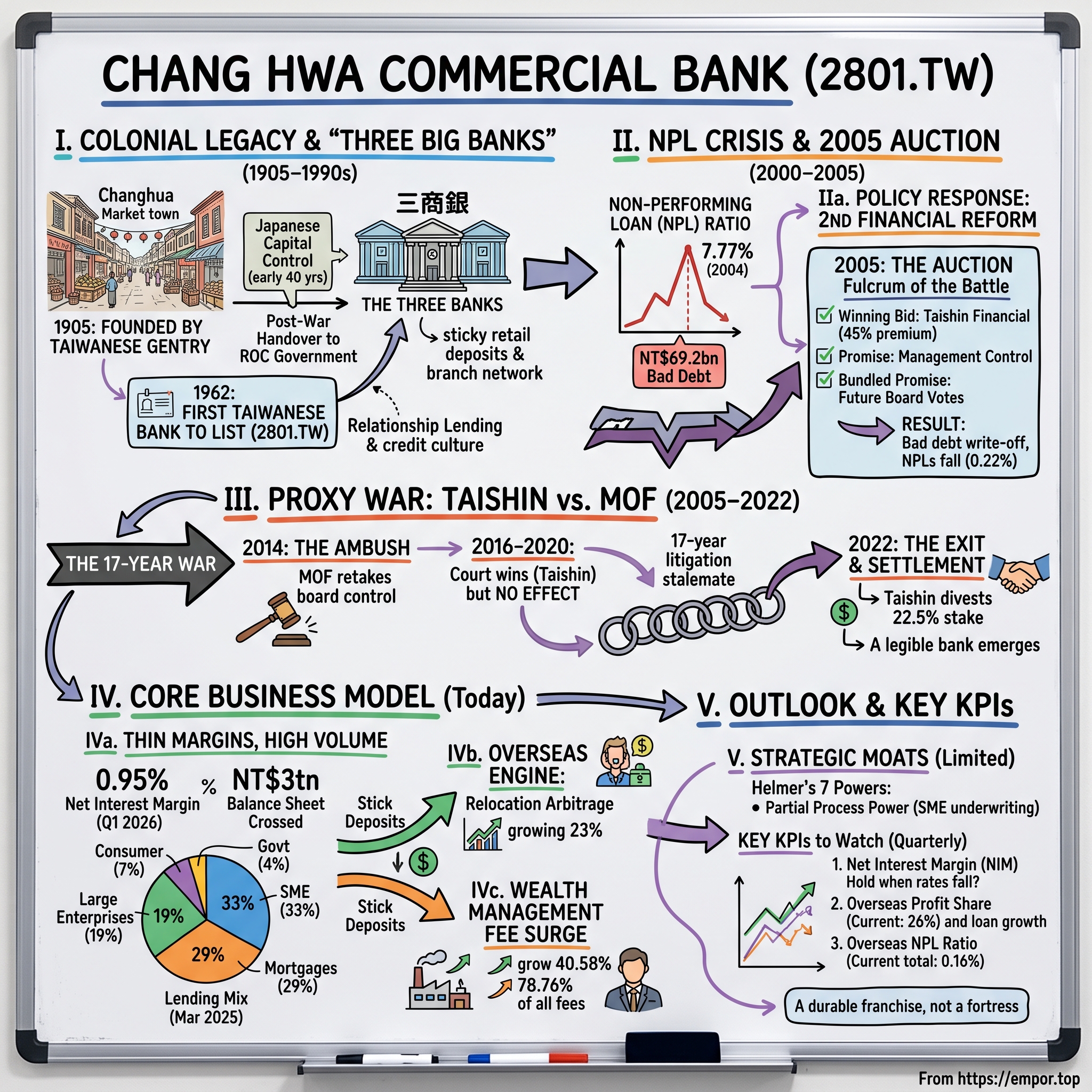
Behind those housekeeping items sat a genuinely remarkable number. For the twelve months of 2025, CHB earned NT$17.775 billion after tax, up roughly 19% year on year, with earnings per share of NT$1.51 and return on equity of 8.43%.2 For a bank that in 2004 was carrying NT$69.2 billion of bad assets and a non-performing loan ratio approaching 8%, that is not a rounding-error improvement. It is a different institution.3
The scale today. CHB is not a giant by Asian standards, but it is not small either. Its balance sheet crossed NT$3 trillion for the first time during 2024 — a milestone management flagged at the March 2025 investor conference — and it operates roughly 185 domestic branches supported by a subsidiary bank in mainland China, seven overseas branches and a representative office spanning New York, Los Angeles, Tokyo, London, Hong Kong, Singapore and Manila.45 Its shares trade on the 臺灣證券交易所 Taiwan Stock Exchange under 2801.TW, a ticker that dates to February 1962, when CHB became the first bank in Taiwan to list.6
The central question. This article is not a celebration of a turnaround. It is a test of one specific proposition: that a bank whose controlling influence sits with the 財政部 Ministry of Finance, whose domestic market is one of the most overbanked in Asia, and whose net interest margin is under 1%, can nonetheless compound shareholder value by exporting cheap Taiwanese deposits into higher-yielding overseas lending and by selling investment products to the owners of Taiwan's manufacturing base.
That proposition has real evidence behind it — and real ways it could break. Both deserve airtime.
Three myths worth dismantling up front. The first is that CHB was founded as an expression of Taiwanese economic self-determination. It was founded by Taiwanese gentry, yes, but the historical record of its first four decades describes an institution firmly inside the Japanese colonial capital system.7 The second is that the 17-year war with 台新金控 Taishin Financial Holding was a fight about a bank. It was a fight about whether a contract signed by a sovereign government binds its successors — and the courts largely said yes, repeatedly, without changing the outcome.89 The third is that CHB is a sleepy domestic utility. In the first quarter of 2026, its overseas loan book grew north of 23% year on year while its domestic book grew in the low single digits.10 The growth engine is no longer in Taiwan.
The roadmap. The story runs in five arcs. First, a colonial bank that became a provincial policy instrument. Second, the balance-sheet crisis of the early 2000s that put the bank up for sale. Third, the auction and the war that followed — the single most instructive corporate governance case study in modern Taiwanese finance. Fourth, the business as it actually operates today: where the money is made, and how fragile those sources are. Fifth, an honest reckoning with what a state-influenced bank can and cannot do with its capital.
It begins in a market town in central Taiwan, with a group of landlords holding government paper they did not know what to do with.
 Subscribe on LinkedIn
II. Imperial Roots & The "Three Big Banks" Legacy (1905–1990s)
Picture central Taiwan in 1905. The island had been a Japanese colony for a decade. The colonial administration was in the middle of an aggressive land reform, abolishing the layered tenancy rights that had governed Taiwanese agriculture for centuries and compensating the old landholding families with government bonds. The bonds were safe. They were also illiquid, and for gentry families accustomed to rent income, faintly useless.
Out of that problem came a bank. On June 5, 1905, a group of central Taiwanese notables led by 吳汝祥 Wu Ju-hsiang established Chang Hwa Bank in 彰化 Changhua with capital of 220,000 yen — pooling the compensation bonds into an institution that could lend against them.76 It is remembered as the earliest bank capitalised by Taiwanese themselves, and that description is accurate but incomplete. Within two years the bank had moved its head office to 臺中 Taichung, following the colonial administration's decision to make that city the regional centre, and by the account preserved in Taiwan's national cultural memory archives, the institution through the colonial period was effectively controlled by Japanese capital.7
The most famous name attached to the bank belongs to 林獻堂 Lin Hsien-tang of the 霧峰林家 Wufeng Lin family — one of the great landholding houses of central Taiwan and the leading figure of Taiwan's early home-rule movement. Lin invested in the bank in 1908 and served as a supervisor from 1911.7 That combination — a nationalist political figure sitting inside a colonial financial institution — is the through-line of CHB's entire history. The bank has always been an instrument of whoever held political authority, and always had a Taiwanese face on it.
The post-war handover. When Japanese rule ended, the bank's Japanese shareholdings passed to the Republic of China government. A preparatory committee formed in October 1946 with Lin as its head, and on March 1, 1947, the institution was formally reconstituted as Chang Hwa Commercial Bank — a mixed public-private provincial bank with Lin as chairman.6 The timing is worth sitting with: the reorganisation happened in the same weeks as the 二二八事件 February 28 Incident, the violent crackdown that shaped Taiwanese politics for the next half-century. Lin himself would eventually leave for Japan and die there. The bank stayed, and became provincial property.
The three-bank oligopoly. For the next four decades CHB operated as one of the 三商銀 "Three Provincial Commercial Banks," alongside 第一銀行 First Bank and 華南銀行 Hua Nan Bank. This was not competition in any meaningful sense. Taiwan's post-war financial system was a closed loop: household savings flowed into a small number of licensed banks at administratively set rates, and those banks channelled credit toward the exporters and industrial firms the government wanted funded. Deposits were abundant, safe and cheap because savers had nowhere else to go. Loan pricing was largely a policy variable.
This produced two enduring inheritances. The good one: an extraordinarily sticky retail deposit base and a branch network embedded in central and southern Taiwan's manufacturing towns — the trading, machining and textile clusters that would later become the island's small-and-medium-enterprise backbone. The bad one: a credit culture in which lending decisions were shaped by relationships and policy direction rather than by underwriting rigour, and in which nobody was ever really punished for a bad loan.
Listing without letting go. CHB listed in February 1962 — the first Taiwanese bank to do so — but a stock exchange listing in a system without a market for corporate control is closer to a fundraising mechanism than an accountability mechanism.6 Real change came only with deregulation. In 1998, government shareholding formally dropped below 50%, and CHB was declared privatised; with the dissolution of the provincial government's functions, the state's shareholder role transferred from the Taiwan Provincial Government to the Ministry of Finance.6
Here is the part that matters for everything that follows. Falling below 50% removed the label of state ownership without removing state control. Because Taiwanese shareholding is fragmented and the MOF could count on other state-affiliated banks, funds and enterprises to vote alongside it, a stake in the low teens plus allies delivered board outcomes. "Privatisation" in 1998 was a change in accounting classification and very little else.
For a decade nobody much cared, because the alternative to state influence was untested. Then the loans went bad, and the question of who controlled Chang Hwa Bank stopped being academic.
III. The NPL Crisis & The 2005 Auction Drama (2000–2005)
Every banking crisis looks the same from the inside: nothing happens for years, and then everything happens at once.
Taiwan's happened in slow motion across the late 1990s and early 2000s. The Asian Financial Crisis of 1997–98 did not hit the island as hard as it hit Thailand or Korea — Taiwan had low external debt and enormous foreign reserves — but it exposed what had been building underneath. Domestic property prices stagnated. Traditional manufacturers, squeezed by the migration of production to mainland China, defaulted. Family-controlled conglomerates that had borrowed against cross-held shares unwound messily. And Taiwan's state-influenced banks, which had spent four decades lending on relationships, discovered that a large share of their loan books had been underwritten on hope.
Chang Hwa Bank was among the worst affected of the large banks. By the end of 2004, its overdue loans totalled NT$69.2 billion, and its non-performing loan ratio stood at 7.77% — meaning roughly one dollar in thirteen of its lending had stopped performing.9 For a bank, that is not a profitability problem. It is a solvency question, because loan losses eat directly into the equity that supports every other loan on the book. A bank in that position cannot grow, cannot price aggressively, and cannot absorb another shock.
The policy response. The government's answer came in two waves, and the second one is the one that mattered here. The so-called 二次金改 second financial reform pushed state-influenced banks to write off bad debt aggressively and, crucially, to bring in private strategic capital that could recapitalise them without the government writing the cheque itself. For CHB, the mechanism chosen was a capital increase: the Ministry of Finance would auction 1.4 billion newly issued preferred shares, and — this is the load-bearing detail — the ministry committed that after the capital increase completed, management control of the bank would pass to the winning investor.39
Read that sentence again, because it is the fulcrum of the next seventeen years. The government was not selling shares. It was selling shares bundled with a promise about future board votes.
The auction. Bidding closed on July 22, 2005, and the result stunned the market. Taishin Financial Holding — a mid-sized private group built around consumer banking and credit cards, chaired by 吳東亮 Thomas Wu — bid NT$26.12 per share against a floor price of NT$17.98, a premium of roughly 45%, for a total of NT$36.568 billion and a 22.55% stake.911 Six rival bidders were beaten, including Singapore's Temasek Holdings and 富邦金控 Fubon Financial Holding. Contemporaneous reporting put the winning price at roughly triple CHB's net book value, with the preferred shares carrying a 1.8% dividend.11
Why pay that? Because Wu was not buying a bank's assets; he was buying a step-change in scale. Taishin post-deal became Taiwan's second-largest financial services group with around NT$2.1 trillion in assets, and Wu described the outcome as "a triple-win deal for Taishin Financial, Chang Hwa and the government."11 The plan was straightforward: take control, fix the credit book, then merge CHB into Taishin to create a private financial champion with genuine national scale.
The first half of that plan worked almost immediately. On November 25, 2005, Taishin took eight director seats and three supervisor positions — a clear board majority — and CHB became a Taishin subsidiary in consolidation terms.9 The bad loans were written off in a single sweeping action against the recapitalised balance sheet. Overdue loans fell from NT$69.2 billion to NT$2.8 billion, and the NPL ratio collapsed from 7.77% to 0.22%.9
What that number actually proves — and what it doesn't. A collapse in NPLs following a capital injection is not evidence of underwriting genius. Writing off bad loans against fresh capital is arithmetic, not skill. What is meaningful is that the ratio stayed low for the next two decades through multiple credit cycles, long after Taishin had lost operational control. That durability suggests the 2005–2014 period installed processes — credit approval discipline, collateral standards, provisioning conservatism — that outlived the management that installed them. It is one of the few unambiguous facts in the whole saga, and even the eventual settlement statement between the ministry and Taishin acknowledged Taishin's management contribution to improving CHB's performance.12
For an investor, the lesson from 2005 is about the price of governance promises. Taishin paid a 45% premium over the floor price, and essentially all of that premium was payment for control rights that existed only as a contractual commitment from a government department. There was no dual-class share structure, no shareholders' agreement enforceable against future boards, no golden share. Just a promise.
Promises, it turned out, have a shelf life measured in electoral cycles.
IV. The 17-Year Proxy War: Taishin vs. Ministry of Finance (2005–2022)
The war did not start with a lawsuit. It started with an election result on the other side of Taipei.
Phase one: cohabitation (2005–2013). For the first few years the arrangement functioned. Taishin ran CHB day to day, cleaned the credit book, and pushed for the merger that was the entire point of the exercise. But the merger required more than board control; it required political consent, and that consent evaporated. The optics were brutal: a private financial group acquiring a century-old institution that ordinary Taiwanese still thought of as a public asset, at what critics framed as a bargain. After the change of political power in 2008, the ministry withdrew its support for Taishin securing a board majority, and CHB slid into an ambiguous co-management arrangement in which nobody had a mandate to do anything decisive.133
This is the phase that should worry any investor evaluating a governance-dependent thesis. Nothing was formally revoked. There was no announcement, no breach declared. The commitment simply stopped being honoured, and the counterparty — a sovereign ministry — had no market discipline forcing it to comply.
Phase two: the ambush (December 2014). The rupture came at a director election. The ministry ran a proxy campaign, engaging securities houses to solicit voting instruments and mobilising state-affiliated shareholders. When the votes were counted, the public-sector camp had taken four of six ordinary director seats and two of three independent director seats.9 Taishin, holding the largest single block of shares in the company, had lost the board.
The reaction was immediate and expensive. Taishin wrote off substantial asset value — it could no longer consolidate CHB as a subsidiary — and in December 2014 sued the Ministry of Finance for breach of the 2005 agreement.12 The claim was not about the shares. It was about the promise.
Phase three: winning in court, losing in fact (2016–2020). What followed is one of the more surreal legal sequences in Asian corporate history, because Taishin kept winning and it kept not mattering.
On April 27, 2016, the Taipei District Court ruled that the 2005 agreement remained valid and binding — rejecting the ministry's argument that it had expired after the 2005 election — and held that the ministry must not obstruct Taishin from winning a majority of CHB board seats. In the same breath it dismissed Taishin's NT$16.5 billion damages claim, finding the ministry not responsible for the 2014 election outcome.8 Then-finance minister 張盛和 Chang Sheng-ford's response to the ruling was to say he would pass the controversy to his successor — a remark that captures the institutional posture better than any analysis could.8
The High Court went further on May 17, 2017, holding that the ministry must actively support Taishin's nominees to a majority of ordinary director seats.9 The Supreme Court vacated and remanded in 2019. On retrial in August 2020, the High Court reached the same conclusion again.9
So Taishin won at first instance, won on appeal, got sent back, and won again. And through all of it, the ministry controlled the board. Court rulings about future corporate elections are exceptionally hard to enforce; each shareholders' meeting is a fresh event with fresh proxy solicitation, and by the time a judgment lands the composition has moved on. Meanwhile CHB spent those years as a hybrid: the largest shareholder was structurally hostile to management, and management answered to a ministry whose objectives included policy lending, employment stability and political defensibility alongside profit.
The cost showed up in what did not happen. No transformational M&A. No aggressive strategic repositioning. No conversion into a financial holding structure. A bank cannot make decade-length capital commitments when its ownership is being litigated.
Phase four: the exit (2020–2022). The resolution came, as these things usually do, from an unrelated corporate need. Taishin agreed in 2020 to acquire Prudential Life Insurance's Taiwan business, and that deal required capital.129 The CHB stake — enormous, illiquid, generating dividends but no control — was the obvious funding source.
On August 11, 2022, Taishin filed a notice of withdrawal with the Supreme Court. Taishin president Welch Lin framed it plainly: the withdrawal followed the ministry and Taishin reaching what he called a satisfactory consensus.12 The settlement committed Taishin to divest its 22.5% holding over a period of six years and to stop nominating directors, ending the dispute.9 The joint statement had both sides agreeing to encourage cooperation between their subsidiaries, and included the ministry's acknowledgement of Taishin's management contribution.12 Part of the divestment ran through a block trade of 1.048 billion shares at NT$18.20 apiece.
Do the arithmetic on that. Taishin bought at NT$26.12 in 2005 and sold at NT$18.20 seventeen years later — a nominal capital loss, before dividends and stock dividends, on the largest strategic investment the group had ever made.13 Over the same span, CHB's own net worth expanded by NT$52.2 billion to NT$171.4 billion across the seven years following the investment.12 The bank got better. The investor who paid for making it better did not capture the value.
The strategic damage compounded. While Taishin was litigating, 國泰金控 Cathay Financial, Fubon and 中國信託 CTBC consolidated the industry around it.13 Taishin eventually got its scale — but by a completely different route, merging with 新光金控 Shin Kong Financial Holding on July 24, 2025 to form 台新新光金控 TS Financial Holding, with NT$8.3 trillion in assets and fourth place among Taiwanese financial holding companies.14 Wu, still chairman, told the press that Taiwan's financial sector needed sufficient scale to back Taiwanese firms competing abroad — nearly the same argument he had made in 2005, executed two decades late.14
For CHB shareholders, the settlement's importance is simple and structural. A permanently hostile 22.5% block sitting on the register suppresses any valuation that depends on strategic optionality, because no buyer, partner or merger counterparty will engage with a company whose control is contested in court. Removing it did not make CHB a better bank. It made CHB a legible one.
Which raises the obvious question: with the fog cleared, what exactly is the business underneath?
V. Core Business Model & Segment Economics
Start with an uncomfortable number. In the first quarter of 2026 — a very good quarter — Chang Hwa Bank's net interest margin was 0.95%.10
For readers unfamiliar with bank economics, that figure deserves a moment. Net interest margin is what a bank earns on its assets after paying for its funding — the spread between the interest it collects and the interest it pays, expressed against its earning assets. A large US regional bank typically runs somewhere near 3%. An Indian private bank might run above 4%. CHB earns 95 basis points. On a NT$3 trillion balance sheet, that is a business model with almost no room for error: a modest rise in credit costs or funding costs can consume a meaningful share of the margin.
So how does a bank with a sub-1% margin generate an ROE approaching 8.5%? Leverage and volume. Banks turn thin margins into acceptable equity returns by running large balance sheets against relatively small equity bases. That is the entire trick, and it is why asset quality matters more for a Taiwanese bank than for almost any other kind of financial institution. At a 0.95% margin, a credit cost of 30 basis points is not an annoyance — it is a third of the gross spread.
Understanding that constraint is the key to understanding every strategic choice CHB has made in the last five years.
The loan book: an SME bank with a mortgage problem
CHB's lending mix as of March 2025 broke down roughly as follows: small and medium enterprises at 33% of loans, mortgages at 29%, large enterprises at 19%, consumer credit at 7%, and government-related lending at 4%.5 Its deposit base skewed almost evenly between demand and time deposits.5
The SME concentration is the identity of the bank, and it traces directly back to that provincial branch network. A machine-tool maker in 台中 Taichung or a fastener manufacturer in 岡山 Gangshan is not going to issue a corporate bond. It borrows from a branch manager who has known the family for two decades, who understands the seasonality of its order book, and who will roll a working-capital line when a shipment is delayed. That relationship supports better pricing than a syndicated loan to a listed electronics giant, where a dozen banks compete on basis points.
The mortgage book is the other side of the coin, and it is where policy risk lives. Taiwan's central bank has spent two years deliberately cooling housing credit. The seventh round of selective credit controls, imposed in September 2024, worked: real estate lending as a share of total bank lending fell to 35.2% by May 2026 from a peak of 37.6% in June 2024, and housing loan growth decelerated sharply.15 CHB felt this directly. Mortgage lending grew 12.33% in 2024 and 10.06% in the first quarter of 2025, but by the first quarter of 2026 total retail lending growth had slowed to 3.82%.41610
That deceleration is not a CHB execution failure — it is regulatory design working as intended. But it removes a growth engine, and it is why what happened overseas matters so much.
The overseas engine: exporting cheap deposits
Here is the most important operating fact in this entire business, and it developed remarkably fast.
At the end of 2024, CHB's overseas locations contributed 12.4% of profit. By the first quarter of 2025 that had jumped to 23.7%. Through the third quarter of 2025 it ran at 22.2%. By the first quarter of 2026, overseas contribution reached roughly 26%.161718 Meanwhile overseas lending grew 23.49% in the first quarter of 2025 and 23.61% in the first quarter of 2026 — sustained growth at more than four times the pace of the total loan book.1610
The mechanism is a geographic spread arbitrage, and it is worth explaining in plain terms. Taiwan has a structural savings surplus: households and companies save far more than the domestic economy can profitably absorb, which is precisely why deposit rates and loan yields are both compressed. A Taiwanese bank therefore sits on a mountain of cheap, sticky funding it cannot deploy at attractive rates at home. Lend that same money to a Taiwanese manufacturer building a plant in Texas, Malaysia or Vietnam — where dollar loan spreads are materially wider and the borrower is a known credit — and the margin roughly doubles without the credit risk doubling.
The demand driver is supply-chain relocation. As Taiwanese electronics and component makers built capacity outside mainland China, they needed banking relationships in the new locations, and they preferred banks that already knew them. CHB's management has been explicit that overseas loan growth is driven by supply chain reorganisation and cross-border financing demand.10 The bank's top three overseas profit centres shifted between 2025 and 2026 — Hong Kong, the United States and the United Kingdom in the earlier period; Hong Kong, the United States and Singapore more recently.16
The expansion plan is concrete rather than aspirational, which is itself a credibility signal. Regulatory approval for a Labuan branch and a Kuala Lumpur service centre in Malaysia was disclosed in November 2025 with opening targeted for the second quarter of 2026; Sydney and Toronto branches have been in application.18 And in May 2026, the bank went further, approving plans for a branch in Phoenix, Arizona explicitly to serve the North American semiconductor supply chain — reported as the first Taiwanese bank to publicly commit to that location.19
The honest counter-argument. Overseas profit share rising from 12% to 26% in five quarters is not purely an overseas success story. Ratios have two sides. Part of the shift reflects domestic profitability being squeezed by credit controls and margin compression, which mechanically raises the foreign share. And overseas lending carries risks the domestic book does not: foreign-currency funding cost volatility, single-name concentration in a smaller book, and exposure to US and regional credit cycles that CHB's Taichung-honed credit committees have far less institutional experience underwriting. The bank has not disclosed granular loss experience by overseas location, which is a real disclosure gap for anyone underwriting this thesis.
Fee income: the wealth management surge, and its dependency
The third engine is fees, and it has been extraordinary — with an asterisk.
Wealth management fee income grew 11.05% year over year in the first quarter of 2025.16 One year later, in the first quarter of 2026, it grew 40.58% and accounted for 78.76% of total fee income, driven by insurance product sales and demand from high-net-worth clients.10
That is a spectacular growth rate, and it points to a genuine structural advantage: CHB banks the founders of Taiwan's manufacturing economy, and those founders are aging into wealth-transfer decisions. A branch manager who has financed a factory for twenty years is unusually well positioned to sell that family an insurance or investment product.
But near-79% concentration in one fee line is a vulnerability dressed as a strength. Bancassurance and investment product commissions are among the most cyclical revenue streams in banking — they surge when markets are buoyant and evaporate when they are not. They are also perennially exposed to regulatory intervention on mis-selling and commission disclosure, a recurring theme for the 金融監督管理委員會 Financial Supervisory Commission. A 40% growth rate in a market where the central bank has just flagged rapid growth in equity-investment-related lending is a number to interrogate, not to extrapolate.15
The precise revenue split between net interest income, fees and treasury operations is not disclosed in the materials reviewed for this article. What the disclosed data does support is a clear directional statement: CHB's earnings growth in 2025 and early 2026 came from three sources in roughly descending order of durability — overseas lending spread, domestic volume growth, and wealth management commissions.
Which brings the story to the people making those allocation decisions, and to the question of whose interests they actually serve.
VI. Current Management, Ownership Structure, & Capital Allocation
There is a particular genre of executive in Taiwanese state-influenced finance: the career technocrat who has run the balance sheet at two or three institutions, is known to the ministry, and is appointed to steady a franchise rather than reinvent it. Both of CHB's top executives fit the genre precisely.
The chairman. 胡光華 Hu Kuang-hua took the chair in August 2024. His background is a tour of the state-linked banking system: chairman of Taiwan Cooperative Bills Finance, executive vice president at 合作金庫 Taiwan Cooperative Financial Holding and its bank, and president of 兆豐金控 Mega Financial Holding and 兆豐銀行 Mega Bank. He holds a business administration master's degree from Iowa State University and a statistics degree from National Chung Hsing University.
The president. 簡志光 Chien Chih-kuang was appointed by board resolution in April 2025. He came from the First Financial group — executive vice president at 第一銀行 First Bank, chief compliance officer at 第一金控 First Financial Holding, and directorships including First Commercial Bank's US operation — and holds an executive MBA from National Chiao Tung University.
Note what those résumés have in common: compliance, risk and treasury, at other state-influenced institutions. Neither is a digital banking specialist, a retail brand builder, or a dealmaker. That is not a criticism; it is a signal about what the appointing shareholder wants. In April 2026 both were re-nominated for the incoming board, and one contemporaneous account described the slate for CHB and Taiwan Cooperative as a conservative one.20
Who actually owns the bank. The Ministry of Finance's own direct stake sits at approximately 12.19% — a striking figure, because it means the state's formal ownership is barely one-eighth of the company.21 Control comes from the surrounding constellation: the National Development Fund, and holdings by other state-linked institutions including First Bank, 兆豐金控 Mega Financial Holding, 華南銀行 Hua Nan Bank, 臺灣銀行 Bank of Taiwan, 土地銀行 Land Bank, 臺灣中小企銀 Taiwan Business Bank, 中華郵政 Chunghwa Post and 台灣菸酒 Taiwan Tobacco & Liquor. In aggregate the pan-public bloc has run around 36%, and rose further as Taishin exited.216
The board elected in June 2026 makes the arrangement concrete. Six ordinary directors include the chairman, the president, a deputy director of the National Treasury Administration, a research dean from the Taiwan Institute of Economic Research, the chair of the bank's own enterprise union, and the general manager of a network authentication company; five independent directors include two academics newly added.220 Direct treasury representation on the board is not a subtle arrangement.
What this means in practice. An investor in CHB is a minority partner alongside a controlling coalition whose objectives are broader than share price. Those objectives include credit availability to SMEs during downturns, employment stability, participation in government housing and industrial programmes, and avoidance of headline risk. Sometimes those align with shareholder returns — a state-influenced bank has strong incentives to avoid credit blowups, which is one plausible explanation for two decades of pristine asset quality. Sometimes they do not — most obviously in the reluctance to pursue M&A or aggressive repricing.
There is one further constraint worth flagging. CHB is a standalone listed bank, not the subsidiary of a financial holding company. Hu addressed this directly at the 2026 annual meeting, noting that banks face more regulatory requirements than financial holding companies, including capital adequacy standards, and that the bank's 69.54% payout ratio nonetheless sat in the mid-to-upper tier among peers.1 That is a candid acknowledgement of a real structural disadvantage: rivals organised as holding companies can move capital between banking, insurance and securities subsidiaries in ways CHB cannot. Specific Tier 1 and total capital adequacy ratios were not disclosed in the materials reviewed here.
The capital allocation record — and a genuine credibility test. This is where CHB's management has, on the evidence, done something worth noting.
At the November 26, 2025 investor conference, with nine-month profit of NT$14.15 billion already up 25.79% and October cumulative earnings of NT$15.5 billion having surpassed the entire prior year, the bank guided that the next dividend would increase, that cash would be weighted more heavily than stock, and that the total would likely exceed the NT$1.00 paid on 2024 earnings — potentially a fourteen-year high.18
Seven months later the board delivered NT$0.80 cash plus NT$0.25 stock. Cash rose from half the payout to more than three-quarters of it; the total exceeded NT$1.00; and it was characterised as roughly a fifteen-year high.12 Guidance given, guidance met, with the mix shifting exactly as signalled.
Hu also explained the reason for the shift rather than just announcing it: weighting toward cash avoids excessive share-count expansion that would dilute earnings per share.1 Stock dividends in Taiwan are popular with retail investors and cost the bank no cash, but they mechanically increase shares outstanding, so a bank paying heavy stock dividends must grow earnings just to hold EPS flat. Choosing cash over stock is a mildly shareholder-friendly decision that a management team optimising for popularity would not necessarily make. Combined with a payout ratio that exceeded 70% for three consecutive years through 2024, the pattern suggests a genuine preference for returning capital over hoarding it.4
The counterweight: the payout ratio dipped below 70% in the most recent year, and a bank retaining roughly 30% of earnings while growing assets meaningfully is running toward its capital constraints, not away from them. Sustained double-digit balance sheet growth and a 70% payout cannot both persist indefinitely without either capital raising or slower growth. Investors should watch which one gives.
That constraint is sharpened by the market CHB competes in — which is, by most measures, the most crowded banking market in developed Asia.
VII. Competitive Landscape & Industry Economics
Here is the structural fact that explains Taiwanese banking better than any other: 39 domestic banks and 31 local branches of foreign and mainland Chinese banks serve a population of roughly 23.5 million people.22
For comparison, Canada — with 1.7 times the population and a vastly larger geography — is dominated by six banks. Australia has four. Taiwan has thirty-nine institutions competing for the deposits and lending of an island smaller than the Netherlands, and none of them holds a commanding share.
This is the origin of the sub-1% net interest margin discussed earlier, and it is not a cyclical condition. It is the permanent equilibrium of a market with too many licences and too much capital chasing too few good loans. When a Taichung machinery exporter wants a NT$200 million facility, it can run a competitive process among eight banks that all want the business. The borrower captures the surplus. The banks compete away the spread.
Why hasn't consolidation fixed it? Because the obstacles are political rather than economic. Taiwan has seen very few bank mergers over the past two decades, particularly among larger or state-controlled institutions, blocked by a combination of labour union resistance and political sensitivity to state assets changing hands. The Taishin–CHB saga is the canonical illustration: the single largest attempt to consolidate a state-influenced bank into a private group produced seventeen years of litigation and a capital loss. That outcome did not encourage imitators.
Where CHB sits. The competitive set splits into two camps. On one side, the state-influenced peers: First Bank, Hua Nan Bank, 兆豐銀行 Mega Bank and 合作金庫銀行 Taiwan Cooperative Bank — institutions with similar branch networks, similar deposit franchises, similar policy obligations and similar structural margins. On the other, the private financial conglomerates: CTBC Bank, 國泰世華 Cathay United Bank and 台北富邦 Taipei Fubon Bank, which compete on technology, credit card economics, wealth management platforms and cross-sell from insurance operations.
CHB's precise deposit and loan market share ranking is not disclosed in the sources reviewed for this article, and readers should treat commonly quoted rankings with caution. What is verifiable is a telling regulatory data point: when the FSC published its 2025 list of domestic systemically important banks in November 2025, the six designated institutions were CTBC Bank, Taipei Fubon, Cathay United, Taiwan Cooperative Bank, Mega International Commercial Bank and First Commercial Bank — with the Bank of Taiwan flagged as a potential seventh candidate.23 CHB was not on the list, and neither was Hua Nan.
That absence cuts two ways, and both matter. The disadvantage is a statement about relative scale: CHB is meaningfully smaller than the tier above it, including its own historical peer First Bank. The advantage is capital. D-SIBs must phase in an additional 2% of statutory capital and 2% of internally managed capital over four years, submit business crisis contingency plans, and pass two-year scenario stress tests annually.23 CHB carries none of that incremental burden — which means, all else equal, more of its earnings are available for distribution rather than retention. For a bank paying out close to 70%, that is not a trivial exemption.
The asset quality evidence. Where CHB's competitive record is genuinely strong is credit. The NPL ratio has held at 0.16% across every quarter reported through this period, with loan loss coverage running from roughly 795% in early 2025 to 837% at year-end 2025 to around 865% in the first quarter of 2026.16210
Coverage of 865% means the bank holds about NT$8.65 of reserves for every NT$1 of recognised non-performing loans. That is extraordinary by any international standard, where 100–150% is considered conservative. Two readings are possible and both are partly true. The charitable reading: exceptional underwriting discipline and a fortress provisioning philosophy, giving the bank enormous capacity to absorb a credit shock without touching capital. The sceptical reading: over-reserving is a form of earnings smoothing, since provisions build in good years and can be released in bad ones, and a ratio that high on a 0.16% NPL base tells you as much about the denominator being tiny as about the numerator being large.
The more useful question is what a 0.16% NPL ratio implies about risk appetite. A bank that essentially never loses money on loans is a bank that declines a great deal of business. In a market this competitive, extreme credit selectivity and thin margins are two descriptions of the same posture: CHB competes on safety, not on yield. That posture has kept it solvent through two decades. It also caps how fast it can grow.
Whether that posture constitutes a durable competitive advantage — or merely a survivable one — is the question the strategic frameworks are built to answer.
VIII. Strategic Moats: Helmer's 7 Powers & Porter's 5 Forces
Banking is an industry where the word "moat" is used loosely and earned rarely. Deposits are commoditised. Loans are commoditised. Most of what banks call competitive advantage is either regulatory protection or an accident of geography. So it is worth applying Hamilton Helmer's framework with some rigour, and being willing to conclude that several of the seven powers simply do not apply.
Helmer's 7 Powers, tested
Cornered Resource — partial, and eroding. CHB's strongest claim here is not a patent or a mine; it is the implicit sovereign association. A bank whose largest shareholder coalition is the state attracts institutional and corporate deposits from entities that value perceived safety over yield, which lowers funding cost. It also holds a branch portfolio assembled over 121 years — physical locations acquired in central and southern Taiwanese commercial districts long before those districts were expensive. Both are real. Both are shared with First Bank, Hua Nan, Taiwan Cooperative and Mega, which have essentially identical claims. A resource that four competitors also possess is not cornered; it is a category characteristic. And the branch real estate advantage is becoming a liability as transaction volumes migrate to mobile, converting prime locations from an asset into a fixed cost.
Process Power — the most credible claim, and the hardest to verify. The argument is that CHB's SME underwriting represents accumulated organisational capability: branch managers embedded in specific manufacturing ecosystems who can assess a fastener maker's creditworthiness from information that never appears in financial statements. The evidence is the sustained 0.16% NPL ratio across cycles, which did not deteriorate when Taishin's management departed. Process power, by Helmer's definition, is exactly this — an advantage embedded in an organisation's routines rather than in any individual, and therefore slow to build and slow to copy.
The falsification test is specific and worth watching: if AI-driven and data-driven credit assessment by private banks begins matching relationship-based underwriting on loss rates while operating at lower cost, this power dissolves. It has not happened yet in Taiwanese SME lending. It is not implausible within a decade.
Switching Costs — real but modest. An SME with payroll processing, an FX line, trade finance facilities and revolving working capital at CHB faces genuine friction moving banks: re-documentation, re-underwriting, new counterparty limits with suppliers. But Taiwanese SMEs typically bank with multiple institutions simultaneously, precisely to preserve negotiating leverage. Switching costs raise the price of moving the whole relationship; they do not prevent a competitor from taking the next incremental loan at a tighter spread. Which is exactly what a 0.95% margin looks like in practice.
Scale Economies — absent. CHB is not the low-cost producer in its market, and its exclusion from the D-SIB list is a formal acknowledgement that it lacks the scale of its largest competitors.
Network Economies — absent. A depositor gains nothing from other depositors joining.
Counter-Positioning — absent, and structurally so. Counter-positioning requires a new business model incumbents cannot copy without damaging themselves. CHB is the incumbent, and its ownership structure makes it the least likely institution in Taiwan to attempt disruptive repositioning.
Branding — weak. In Taiwanese banking, brand is largely a proxy for perceived government backing, which returns to the cornered-resource discussion and is shared across the state-linked group.
Net assessment: one genuine power (process), one shared quasi-power (implicit state backing), one modest power (switching costs), four absent. That is a defensible franchise, not a fortress. The honest framing is that CHB's durability comes more from regulatory structure and credit conservatism than from any advantage it could carry into a new market.
Porter's Five Forces
Rivalry: high, and structurally permanent. Thirty-nine banks, no dominant player, and political obstacles to consolidation. This is the force that sets the margin.
Buyer power: moderate, and cyclical in an interesting way. SME borrowers hold pricing power in benign conditions because they can run competitive processes. That inverts during tightening — when credit gets scarce, availability matters more than price, and relationship banks with committed lines gain leverage. CHB's business is therefore counter-cyclically advantaged in a narrow, specific sense: its pricing power improves precisely when the macro environment deteriorates.
Supplier power: low. Depositors are the suppliers of a bank's raw material, and Taiwanese depositors have historically accepted low yields because the island's savings surplus leaves them limited alternatives. This is CHB's genuine structural gift. The caveat is that it is weakening: the central bank noted in June 2026 that households are increasingly borrowing for investment purposes, driving growth in wealth-management revolving credit, and flagged rapid growth in equity-investment-related lending as something banks should watch.15 Deposits migrating toward securities accounts would raise funding costs across the industry.
Threat of new entrants: very low. Bank licensing in Taiwan is tightly controlled by the FSC, and capital requirements are substantial. Taiwan's digital bank licensees have not achieved meaningful share.
Threat of substitutes: low to moderate, and asymmetric. Large Taiwanese corporates can issue bonds and bypass banks entirely; CHB's 19% large-enterprise book is exposed to that disintermediation. Mid-market SMEs have no such option — the fixed costs of a bond issue are prohibitive below a certain size. The substitute threat is therefore concentrated in the lowest-margin part of the loan book, which is a favourable place for it to sit.
Myth versus reality
Three consensus narratives deserve testing against the evidence assembled here.
Myth: CHB is a defensive, low-volatility holding because it is state-influenced. Reality: its earnings have been anything but stable in direction — profit rose 15% in 2024 and roughly 19% in 2025 — and its fastest-growing profit source is overseas lending exposed to global credit and rate cycles.42 The volatility is masked by asset quality, not absent.
Myth: the SME franchise is the growth story. Reality: on the disclosed numbers, growth is coming from overseas lending and wealth management fees. Domestic corporate lending grew 5.49% in the first quarter of 2026 while overseas grew 23.61%.10 The SME franchise is the funding and stability base; it is not currently the growth engine.
Myth: the Taishin exit unlocked strategic freedom. Reality: it removed a blocker, but the controlling coalition that replaced it has shown no appetite for transformational action. Freedom from litigation is not the same as freedom to act.
Which leads directly to the risks that could break the current trajectory.
IX. Risk Radar & Skeptical Investor Stress Test
On June 18, 2026 — the same day CHB's shareholders approved their dividend — the 中央銀行 Central Bank of the Republic of China (Taiwan) held its policy rate at a 2% discount rate for another quarter, and published a growth forecast that would look like a typographical error in most economies: GDP expansion of 9.45%, driven by AI-related export demand and private investment.15
That is the macro backdrop, and it is a peculiar one for a bank. Explosive AI-driven growth in the export sector, a central bank holding rates steady, a deliberately suppressed property market, and inflation near 1.9%.15 Sorting which parts of that help CHB and which hurt takes some care.
Rate cycle sensitivity — the single largest exposure. CHB's margin recovery is substantially a rate story. Net interest margin moved from 0.77% to 0.87% across 2025 and reached 0.95% with a loan-deposit spread of 1.31% by early 2026.1810 A meaningful portion of that improvement came from foreign currency assets, where US dollar yields have been elevated.
Management has been unusually direct about the risk. At the November 2025 conference, the bank told investors that US rate cuts in 2026 could compress margins, and framed its response around asset allocation adjustment, cost control and differentiated pricing.18 That is a specific plan rather than a deflection, which counts for something. But the mechanism is unforgiving: when dollar rates fall, foreign-currency loan yields reprice down faster than the deposit base that funds them, and the overseas earnings engine — now roughly a quarter of profit — compresses first. The bank's greatest recent success and its greatest near-term vulnerability are the same business line.
Geopolitical and cross-strait exposure. CHB maintains a mainland Chinese subsidiary bank and branches serving Taiwanese manufacturers across Asia. Two distinct risks live here. The obvious one is cross-strait escalation, which for a Taiwanese bank is an existential rather than manageable scenario and cannot be sensibly hedged. The subtler and more probable one is that supply-chain relocation — the very trend generating 23% overseas loan growth — is itself a response to geopolitical fracture. If reshoring accelerates further toward the United States, CHB's Asian branch network becomes less relevant faster than its North American network can be built. The Phoenix decision reads as an acknowledgement of exactly this.19
Concentration in a single fee line. Nearly four-fifths of fee income from wealth management is the kind of concentration that looks like momentum on the way up and like a cliff on the way down.10 A market correction would hit this line immediately and simultaneously reduce the collateral values supporting margin lending.
The digital transformation deficit. This risk is structural and under-discussed. State-influenced Taiwanese banks operate within compensation frameworks that make it genuinely difficult to hire senior engineering and data science talent against private financial groups and technology firms. CHB's stated 2026 priorities include advancing digital transformation and AI applications alongside deepening customer relationships, strengthening core operations, enhancing risk management and sustainable finance.2 Those are reasonable priorities. They are also the same priorities every Taiwanese bank published. Nothing in the disclosed materials distinguishes CHB's digital capability from peers, and the leadership team's background is in risk and compliance rather than technology. An investor should treat digital transformation here as a cost line to be managed, not a source of advantage.
Regulatory and political risk. With direct treasury representation on the board and a state coalition controlling outcomes, CHB will be expected to participate in policy programmes — housing schemes, SME relief during downturns, industrial initiatives — whether or not the risk-adjusted returns justify it. The 2024 mortgage growth of over 12% coincided with government housing programmes; the subsequent slowdown coincided with credit controls.418 The bank's loan book responds to policy signals, and shareholders do not get a vote on those signals.
The skeptical investor stress test
Put an activist in the room and the challenge writes itself.
The bear argument: CHB is a sub-scale, sub-1%-margin utility, structurally excluded from consolidation by its own ownership, run by risk-and-compliance careerists appointed by a ministry that holds barely 12% of the equity, generating an ROE in the eight-percent range that has not covered a demanding cost of equity for most of two decades. Its best asset — pristine credit — is evidence of excessive conservatism as much as skill. Its best growth — overseas lending — is a rate-cycle trade dressed as a strategy. Its capital cannot be redeployed into acquisitions because no Taiwanese state-influenced bank has successfully done so, and the one group that tried lost money and seventeen years.
The operational counter-evidence: the numbers have moved in the right direction for three consecutive years, and not marginally. Net profit rose from NT$14.945 billion in 2024, up 15.12% with EPS of NT$1.33 and ROE of 7.68%, to NT$17.775 billion in 2025 with EPS of NT$1.51 and ROE of 8.43%.42 The first quarter of 2026 delivered NT$5.221 billion, up 26.27% year on year, with ROE improving to 2.34% for the quarter from 2.03%.10 Net revenue grew 8.35% in 2025 while profit grew nearly 19%, which means operating leverage is real — the bank is growing revenue faster than costs.2 And the earnings mix has genuinely shifted toward higher-margin sources.
The unresolved question: whether ROE in the eight-to-nine-percent range represents a ceiling or a waypoint. The bull answer is that overseas mix shift and fee growth continue lifting it. The bear answer is that a 0.95% margin, a 70% payout ratio and no consolidation path arithmetically cap it. Nothing in the current disclosure settles that argument, and investors should be suspicious of anyone who claims it does.
X. The Investment Spine: Bull vs. Bear Case & Key KPIs
Strip away the history and the frameworks, and what remains is a straightforward disagreement about a thin-margin bank with a fast-growing foreign business.
The bull case
One: governance clarity has a compounding value that is easy to underestimate. For seventeen years, no serious strategic decision at CHB could be taken without asking how it would be characterised in litigation. That constraint is gone. The board elected in 2026 expanded independent directors from three to five — modest, but directionally the right signal for a company with a contested governance history.2 A bank that can plan on a five-year horizon behaves differently from one that plans quarter to quarter, and the overseas branch build-out is precisely the kind of long-payback investment that a contested board cannot commit to.
Two: the overseas engine is a genuine structural arbitrage, not a trade. The margin difference between deploying Taiwanese deposits at home versus lending them to Taiwanese manufacturers abroad exists because of Taiwan's savings surplus, and that surplus is not going away. The client relationships transfer naturally — a bank that has financed a company's Taichung plant for twenty years is the obvious lender for its Malaysian one. Growth of roughly 23% in consecutive first quarters, with profit share more than doubling in five quarters, is not a one-off.161017
Three: the credit fortress converts into distributable cash. A bank that reserves at 865% coverage against a 0.16% NPL ratio has no realistic near-term need to build provisions, which is why it can pay out close to 70% of earnings while still funding growth.101 Add the D-SIB capital exemption, and the structural capacity to distribute is real rather than promotional.23
The bear case
One: the margin is hostage to a rate cycle the bank does not control. If US and global rates ease materially, the foreign-currency spread that drove the earnings inflection compresses — and management has said so itself.18 Domestic rates offer no offset, since Taiwan's policy rate has been static and the domestic market is too competitive to reprice.
Two: domestic growth has structurally slowed. Retail lending growth of 3.82% in the first quarter of 2026 against mortgage growth above 12% in 2024 is a large deceleration, and it reflects deliberate policy.104 Taiwan's property transaction volumes fell sharply and the central bank has shown no inclination to loosen. A bank with 29% of its loans in mortgages cannot fully replace that engine with overseas growth from a much smaller base.
Three: the ownership structure caps strategic ambition. CHB's leadership is appointed by a coalition whose priorities include policy execution and headline-risk avoidance. It is not organised as a financial holding company, which limits capital mobility relative to peers — a constraint the chairman himself has publicly acknowledged.1 And the industry's consolidation history suggests that any attempt to change that would be politically fraught.
The three KPIs that matter
Three metrics carry most of the information about whether this business is working. They are all disclosed quarterly.
One: net interest margin and the loan-deposit spread. This is the master variable. At 0.95% and 1.31% respectively in the first quarter of 2026, both had been improving for roughly two years.10 The specific thing to watch is whether they hold when US rates decline — because that separates a durable mix-shift story from a rate-cycle story. If NIM holds while dollar rates fall, the overseas thesis is validated. If it tracks dollar rates down, it was a trade.
Two: overseas share of pre-tax profit. The path from 12.4% at end-2024 to roughly 26% in early 2026 is the single clearest evidence of strategic execution.1617 Continued increases would confirm the geographic arbitrage is scaling; stalling in the low-to-mid twenties would suggest the easy gains have been taken. Watch this alongside overseas loan growth: profit share rising while loan growth decelerates would indicate margin expansion rather than volume expansion, which is a better outcome but a more fragile one.
Three: the NPL ratio, watched specifically for the overseas book. A ratio pinned at 0.16% through this period is remarkable, but it has never been tested on a large foreign loan book underwritten in the last three years.2 Credit problems in newly built overseas portfolios typically emerge in years three to five. Any drift above 0.20%, particularly if disclosed as concentrated in foreign locations, would be the earliest indication that the expansion's returns were not adequately risk-adjusted.
Everything else — fee income growth, cost ratios, dividend levels — is downstream of those three.
XI. Playbook & Core Lessons
Three lessons generalise well beyond one Taiwanese bank.
Lesson one: governance promises are only as good as the enforcement mechanism attached to them. Taishin paid roughly a 45% premium over the auction floor in 2005, and essentially the whole premium was consideration for control rights that rested on a ministry's written commitment.11 The courts subsequently agreed the contract was valid and binding, more than once — and Taishin still never regained the board.89 The gap between having a right and being able to exercise it is where minority investors get destroyed.
The practical translation: when evaluating any investment where the thesis depends on control, board representation, or a counterparty's future conduct, ask what happens when the counterparty simply declines to perform. If the answer is "we would sue," ask how long that takes, and what the asset looks like meanwhile. When the counterparty is a sovereign entity with electoral incentives that change every four years, the answer is usually "longer than your holding period." The seventeen-year timeline and the NT$26.12-to-NT$18.20 round trip are the price of learning that lesson at scale.13
Lesson two: relationship-based underwriting is a real but narrow moat, and it is measurable. The most striking fact in CHB's history is that its credit discipline survived a complete change of control. The processes installed during Taishin's operational tenure persisted after Taishin lost the board, and a 0.16% NPL ratio has held through subsequent cycles.2 That is what genuine process power looks like: capability embedded in an organisation's routines rather than in the people who wrote them.
But note the boundaries. This moat protects CHB in one segment — mid-market SME lending in specific Taiwanese manufacturing regions — and it protects margins only weakly, as the sub-1% NIM demonstrates. It does not protect against disintermediation of large corporate lending, against competition in mortgages, or against data-driven underwriting eventually matching relationship judgment at lower cost. Relationship moats defend market share far better than they defend pricing.
Lesson three: geographic spread arbitrage is one of the most reliable value creators in banking — and one of the most commonly mispriced. The trade is elegant: raise deposits where savings are abundant and yields are crushed, deploy them where your existing clients are expanding and spreads are wider. CHB has executed it well, taking overseas profit share from roughly an eighth to roughly a quarter in five quarters while doubling down with new locations across Malaysia, Australia, Canada and Arizona.1819
The mispricing risk is that investors capitalise the earnings from this arbitrage at the same multiple as domestic earnings, when the risk characteristics are materially different. Foreign lending carries currency funding risk, unfamiliar legal jurisdictions, thinner local information, and credit cycles uncorrelated with the domestic franchise. Higher-spread lending is higher-spread for reasons. The correct posture is to treat the overseas earnings stream as genuinely valuable and as structurally more volatile than the domestic base — and to demand disclosure of loss experience by geography before assuming otherwise.
XII. Epilogue & Conclusion
There is a symmetry to Chang Hwa Bank's 121 years that is almost too neat.
It began in 1905 as a vehicle for landowners holding government paper they could not use, capitalised by Taiwanese gentry but operating inside a colonial financial system they did not control.7 It passed to a new government in 1947, became a provincial policy instrument, listed in 1962 without meaningfully changing who decided anything, and was declared private in 1998 while remaining under state direction.6 It nearly broke in the early 2000s under the weight of loans made for reasons other than credit quality. It was rescued by private capital that paid a large premium for a promise, and then spent seventeen years discovering what that promise was worth.9
And it emerged, in the mid-2020s, as a competently run, conservatively underwritten commercial bank with a genuinely improving earnings trajectory, a fast-growing international business, and a controlling coalition that returns most of the profit to shareholders.21
What changed was not primarily the assets. CHB's credit quality had been excellent for a decade before the litigation ended. What changed was legibility. An institution whose control was contested in court could not be valued on its cash flows, because no one could say who those cash flows ultimately served. Once that question was answered, the ordinary work of banking — pricing loans, opening branches, selling insurance to factory owners, deciding how much to pay out — could resume being the thing that determined the outcome.
That is the durable insight for anyone analysing a financial institution with a complicated ownership structure. Asset quality is measurable and improvable. Capital ratios can be rebuilt. Margins respond to mix and to rates. But governance ambiguity is not a discount that gradually amortises — it is a condition that persists until it is resolved, and it suppresses every other decision the institution might make. The Taishin case cost one financial group most of two decades and a nominal capital loss on its largest-ever investment; it cost the bank itself the strategic optionality that its peers used to consolidate the industry around it.13
The open questions remain genuinely open. Whether a bank with a 0.95% margin can sustain the earnings growth of the last three years once dollar rates ease. Whether overseas expansion into Malaysia, Australia, Canada and the United States will still look wise when those loan books season. Whether an eight-and-a-half-percent ROE is a floor or a ceiling. Whether a management team appointed by a coalition holding barely a third of the votes will ever be pressed to do something uncomfortable.
None of those questions has an answer yet. What the last three years established is only that they are now the right questions — which, for an institution that spent seventeen years arguing about who was entitled to ask them, is progress of a kind.
References
-
〈彰銀股東會〉通過配發股利1.05元 胡光華續任董座 獨董增至5席 — 鉅亨網, 2026-06-18 ↩↩↩↩↩↩↩↩↩↩↩↩↩↩
-
台新金為併保德信與財政部達成和解,為「彰銀案」17年糾葛劃下句點 — The News Lens 關鍵評論網, 2022-08-11 ↩↩↩
-
《金融股》彰銀Q1獲利登峰 財管、海外業務雙引擎升溫 — 中時新聞網, 2026-05-26 ↩↩↩↩↩↩↩↩↩↩↩↩↩↩↩
-
Taishin Financial shocks market with Chang Hwa bid size — Taipei Times, 2005-07-23 ↩↩↩↩
-
Taishin withdraws case against Ministry of Finance — Taipei Times, 2022-08-11 ↩↩↩↩↩↩
-
EDITORIAL: No winners in Chang Hwa Bank saga — Taipei Times, 2022-08-15 ↩↩↩↩↩
-
Taishin, Shin Kong finalize merger — Taipei Times, 2025-07-25 ↩↩
-
Monetary Policy Decision of the Board Meeting (2026 Q2) — Central Bank of the Republic of China (Taiwan), 2026-06-18 ↩↩↩↩↩
-
Banking Laws and Regulations 2026 — Taiwan — Global Legal Insights, 2026 ↩
-
Taiwan keeps 6 domestic systemically important banks — Taiwan News, 2025-11-05 ↩↩↩
 LinkedIn
 WhatsApp
 Reddit
 Hacker News
 Email
Email Kindle
 RSS Feed
 Spotify
 Apple Podcasts
 Amazon Music
 Audible
 YouTube