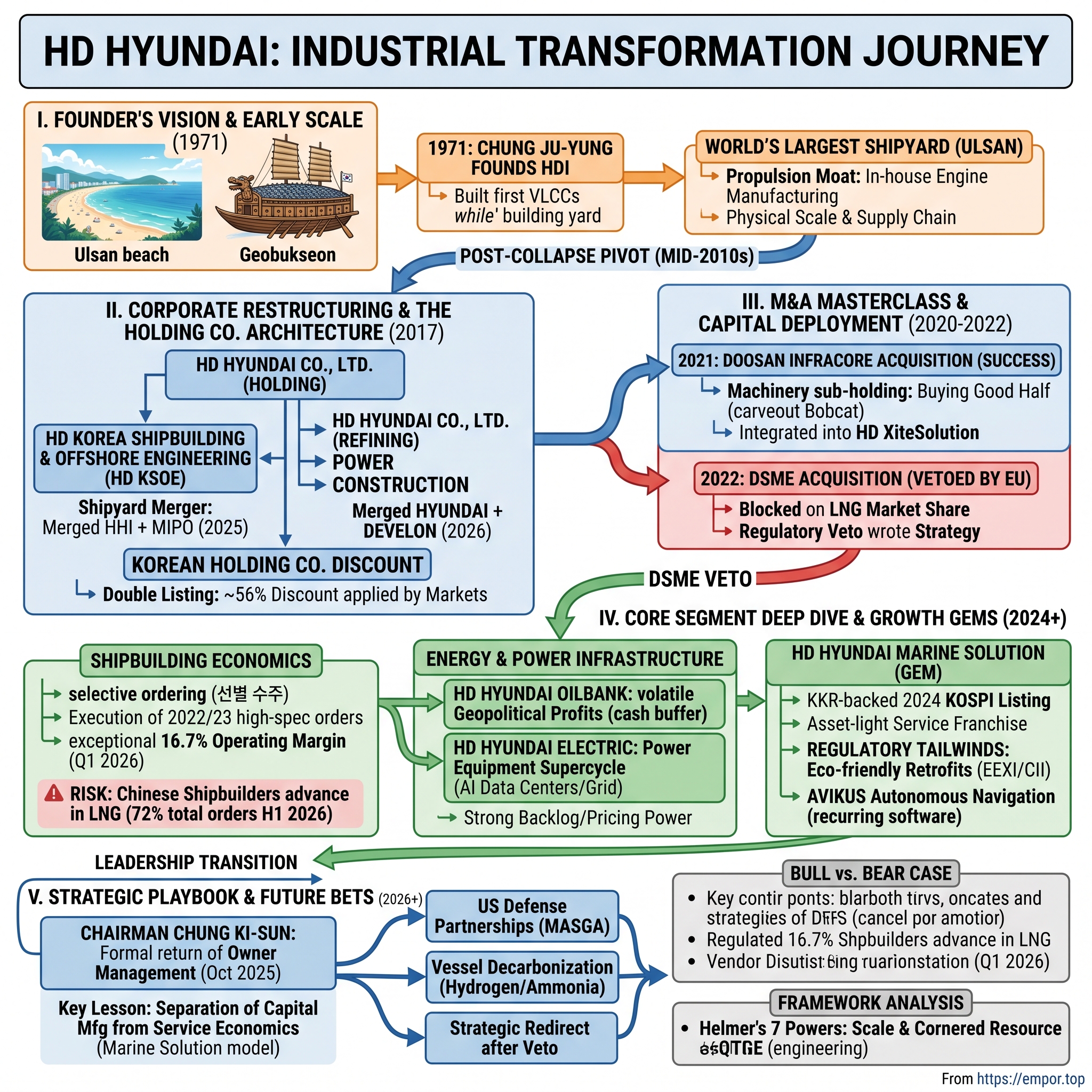
HD Hyundai: The Industrial Transformation of Korea's Heavy Weight
I. Introduction & Episode Roadmap
On July 31, 2026, HD Hyundai Co., Ltd. (HD현대) reported a quarterly operating profit of ₩4.12 trillion — a 262% increase year over year — on revenue of ₩22.4 trillion.1 For a company with a total market capitalization near ₩14 trillion that same week, the figures highlighted a striking valuation disconnect: a single quarter's operating profit equaled roughly 30% of the holding company's entire equity value.2
Yet equity markets offered little immediate response. In early August 2026, shares of HD Hyundai (267250.KS) traded around ₩200,000 — significantly below their 200-day moving average near ₩235,000 and well off their 52-week high of ₩333,000.2 This gap between record operating performance and a subdued stock price defines the central question facing investors.
HD Hyundai serves as the apex holding company for South Korea's largest heavy-industrial group — a conglomerate (chaebol, 재벌) whose consolidated revenue rose 5.2% in fiscal 2025 to ₩71.26 trillion (approximately $49.5 billion), while operating profit more than doubled to ₩6.1 trillion.3 It sits atop a corporate pyramid that includes a major global shipyard complex, South Korea's second-largest oil refiner, an electrical power-equipment vendor expanding alongside AI data-center buildouts, a construction-equipment producer acquired from a distressed competitor, and a marine aftermarket service provider backed by a New York private equity firm prior to its public listing.
HD Hyundai trades on the Korea Exchange (한국거래소), as do nearly all of its principal operating subsidiaries. This structure creates a fundamental market tension: HD Hyundai operates not as a direct producer, but as an equity claim on separately listed entities — a category that South Korean capital markets historically evaluate at a substantial holding-company discount.
The narrative spine rests on several key operational and structural dynamics:
Growth catalysts and operational advantages. Three key factors support the operational outlook: a substantial order book in high-specification gas carriers where Chinese shipbuilders are only beginning to compete; an electrical equipment division with record order backlogs and pricing power in North America; and an aftermarket marine services unit generating high margins without heavy capital expenditure requirements.
Structural risks and competitive headwinds. Counterbalancing those strengths are three primary challenges: Chinese shipbuilders captured 72% of global new orders by compensated gross tonnage in the first half of 2026 compared to South Korea's 19%, expanding directly into large liquefied natural gas (LNG) carrier contracts.4 Additionally, the refining division's early 2026 profit surge stemmed from temporary geopolitical disruptions rather than structural cost advantages. Finally, the holding-company structure itself limits the parent entity's ability to capture the full market value of its underlying holdings.
This analysis examines the critical strategic questions facing long-term investors. How did the 2021 acquisition of a distressed competitor's excavator business prove successful while the group's planned takeover of Daewoo Shipbuilding was blocked by European regulatory authorities? How management responded following that regulatory veto offers a case study in corporate capital discipline. Similarly, the market must account for why a ship-maintenance subsidiary achieved a valuation exceeding ₩7 trillion upon listing, and how regulatory reforms in Seoul targeting double-listing discounts could alter holding-company governance.
Governance dynamics took a decisive turn in October 2025, when the founding family reclaimed the chairmanship after three decades of professional executive leadership.
 Subscribe on LinkedIn
II. Succinct Historical Context: The Founder, Ulsan, and National Industrialization
The founding scene is the most-told anecdote in Korean industrial history, and like all such stories, it has been polished by repetition.
The year was 1971. 정주영 Chung Ju-yung, a former rice-shop delivery boy turned construction magnate, wanted to build ships. He had no shipyard, no dry dock, no design capability, no order book, and no customers. He held only a photograph of a quiet stretch of beach at 울산 Ulsan on South Korea's southeastern coast. What he needed was capital from British lenders, who hesitated to underwrite an unproven shipbuilding venture.
So — the story goes — Chung pulled a 500-won banknote from his pocket and pointed to the engraving of the 거북선 Geobukseon, the ironclad "turtle ship" Admiral Yi Sun-sin used to defeat a Japanese fleet in the 1590s. Korea, he argued, had built armored warships three centuries before Britain launched an ironclad; the nation's industrial capacity had merely lapsed.5
Whether that gesture secured the loan remains unverifiable. What is documented is the outcome: Hyundai began constructing the Ulsan yard and its first two very large crude carriers simultaneously, building hulls inside a shipyard still under construction around them. That choice — building the factory and the product at the same time out of necessity — established an aggressive operational ethos that persisted across the group. Ulsan grew into the world's largest single shipbuilding site, and shipbuilding became a central export engine of the Miracle on the Han River (한강의 기적).
For an investor in 2026, the key question is not whether the legend is exact, but what it produced structurally.
Mainly two enduring competitive assets. First, physical scale: a contiguous yard complex with dock capacity, quay length, block-assembly halls, and a dense local supply chain of hundreds of subcontractors within driving distance. Second, in-house propulsion capabilities. Hyundai built its own engine manufacturing works, ensuring that when the marine industry eventually pivoted to dual-fuel technology, HD Hyundai was not a hull fabricator dependent on European licensors for delivery slots. It produced the core machinery that gave the hull its value.
The governance story followed a different path. 정몽준 Chung Mong-joon, the founder's sixth son, inherited control of the heavy-industries branch but largely stepped back from management. He served seven terms in the National Assembly, became vice president of FIFA, and ran for the South Korean presidency. By retaining his economic stake while relinquishing operational control, he left the group in an unusual position for a chaebol: managed for three decades by professional executives rather than family members.
That arrangement faced a severe test in the mid-2010s during a global shipbuilding collapse. Korean yards had booked massive volumes of low-priced offshore and drilling projects during the 2007–2011 energy boom. When oil prices crashed, those fixed-price contracts generated devastating losses. Hyundai Heavy Industries posted consecutive years of deep losses, while rival Daewoo Shipbuilding required a state bailout, forcing industry-wide restructuring.
Out of that downturn emerged 권오갑 Kwon Oh-gap, a career Hyundai executive known for rigorous cost restructuring, and the strategic pivot that created the modern holding company. Group leadership concluded that the core vulnerability was structural: housing shipyards, refineries, engine plants, power equipment, robotics, and construction machinery on a single balance sheet meant a cyclical collapse in one segment eroded the borrowing capacity of all.
The solution was a comprehensive corporate separation.
III. Corporate Restructuring & The Holding Company Architecture (2017–2022)
By 2016, Hyundai Heavy Industries operated under a conglomerate structure where operational risk in one division spilled directly into others. A loss on an offshore drilling rig contract in Ulsan could raise borrowing costs for a transformer factory in Cheonan, while lenders to the refining arm struggled to isolate their collateral.
The 2017 restructuring split the conglomerate into standalone entities, each with its own listed equity, credit profile, and capital-allocation framework underneath an umbrella holding company. Shipbuilding, construction equipment, electrical systems, robotics, and aftermarket services were established as separate corporate units, with the holding entity—later renamed HD Hyundai Co., Ltd.—at the top.
The strategic rationale behind this split addressed a classic conglomerate dilemma. When a volatile, capital-intensive business shares a balance sheet with a stable, cash-generating one, equity markets often price the consolidated entity at a discount reflecting the riskier unit. Separating the divisions allowed stronger units to raise capital at lower costs and permitted struggling business segments to restructure without jeopardizing sister entities, while giving each management team distinct operational benchmarks. The new structure also consolidated family control, enabling the founding family to govern the corporate pyramid through a single controlling stake at the holding company level.
The resulting corporate architecture features two major intermediate sub-holding companies.
HD한국조선해양 HD Korea Shipbuilding & Offshore Engineering (HD KSOE) serves as the sub-holding company for shipbuilding operations. Beneath HD KSOE sit the group's primary operating shipyards: HD현대중공업 HD Hyundai Heavy Industries in Ulsan, HD현대삼호 HD Hyundai Samho in Yeongam, and HD현대미포 HD Hyundai Mipo, a specialist in mid-sized vessels. In late 2025, management simplified this tier by merging HD Hyundai Heavy Industries and HD Hyundai Mipo. The boards of both shipyards approved the combination in August 2025, South Korea's Fair Trade Commission cleared the transaction in September, and shareholders approved the plan in October with 98.5% support at HHI and 87.6% at Mipo. The combined shipyard launched on December 1, 2025, under the HD Hyundai Heavy Industries name.67 Management set a target for the merged entity to reach ₩37 trillion in annual revenue by 2035, with ₩10 trillion targeted from defense sales.8
HD현대사이트솔루션 HD Hyundai XiteSolution functions as the intermediate sub-holding company for construction machinery. It previously controlled two separately listed equipment manufacturers—HD현대건설기계 HD Hyundai Construction Equipment and HD현대인프라코어 HD Hyundai Infracore—until they were consolidated into a single operating company effective January 1, 2026, with the merged shares trading by late January.9 Management targeted $10 billion in annual revenue by 2030, representing roughly a 95% increase over 2024 levels.9
This sequence reveals a clear operational progression. The group spent 2017 through 2022 dismantling its monolithic structure to isolate balance-sheet contagion across cyclical divisions. By 2025 and 2026, with healthier individual balance sheets, management began re-consolidating overlapping business units to eliminate administrative duplication and streamline operations. For investors, the long-term success of these mergers depends on whether management can deliver expected cost synergies and dealer-network rationalizations—outcomes that must be validated through operating margin performance over time rather than corporate projections alone.
In December 2022, the conglomerate formally retired the name "Hyundai Heavy Industries Group" and adopted HD Hyundai—standing for "Human Dynamics, Human Dreams."[^10] Beyond the marketing language, the rebranding reflected an explicit strategic goal: shifting equity market perception from a traditional, cyclical heavy-industry enterprise toward a technology-driven capital goods group.
The discount that will not die
This structural evolution directly intersects with the central valuation challenge facing the group: the 지주회사 할인, or Korean holding-company discount.
In early 2026, Samsung Securities published a sum-of-the-parts valuation for HD Hyundai that valued its equity stakes in listed affiliates at ₩26.54 trillion and its unlisted assets—primarily HD Hyundai Oilbank and HD Hyundai Robotics—at ₩12.155 trillion. To arrive at a target price, however, the report applied a 56% holding-company discount to those asset values.10 Even positive research coverage assumed that more than half of the underlying equity value vanished at the holding-company level.
The primary driver of this discount is 중복상장, or double listing. Because HD KSOE, HD Hyundai Electric, HD Hyundai Marine Solution, and the merged construction machinery business trade independently on the stock exchange, investors seeking targeted exposure to electrical transformers or marine aftermarket services can purchase shares directly in those operating subsidiaries. Consequently, shares in the parent holding company trade at a discount reflecting double taxation on dividend flows, corporate overhead, governance risk, and persistent investor skepticism regarding cash allocation across subsidiary layers.
Management's response has relied on standard corporate measures: passing subsidiary dividend income through to holding-company shareholders and retiring treasury shares. While these actions provide modest support to equity holders, they do not eliminate the discount inherent in a multi-tiered listed structure.
The critical variable in 2026 is that South Korean regulatory authorities and market reformers began applying direct pressure on listed conglomerates to reduce structural holding-company discounts.
IV. M&A Masterclass & Capital Deployment Benchmarking
Two major transactions define HD Hyundai's recent capital deployment record: one completed successfully, while the other was blocked by regulators in Brussels, ultimately exerting a deeper influence on group strategy than the acquisition that closed.
The Doosan Infracore purchase: buying the good half of a distressed seller
In late 2020, 두산그룹 Doosan Group faced severe financial strain as its power-plant construction arm suffered from South Korea's policy shift away from coal and nuclear energy. Creditors extended emergency support on the condition that Doosan divest key assets, placing Doosan Infracore — an excavator and diesel-engine manufacturer with an established Chinese presence and broad product lineup — on the market.
HD Hyundai executed the acquisition through Hyundai Genuine, the machinery sub-holding later renamed HD Hyundai XiteSolution, purchasing a 34.97% controlling stake for approximately ₩850 billion (about $663 million) in August 2021.[^12]11 Two structural features defined the transaction.
First, the Bobcat carveout. Doosan Infracore's most profitable division was Doosan Bobcat, a North American compact-equipment brand with pricing power and a dealer network developed over decades. Doosan excluded Bobcat prior to the sale. Consequently, HD Hyundai acquired the heavy excavator line, engine manufacturing operations, and emerging-market distribution, while the seller retained its premier asset.
Second, valuation and market timing. At a mid-single-digit EBITDA multiple, the purchase price appeared modest compared to global peers such as Caterpillar and 小松製作所 Komatsu, which traded at higher valuations. While acquiring a cyclical business at a low multiple during seller distress is a standard strategy, it carried substantial risk: construction equipment demand in China — Doosan Infracore's historical profit center — was on the verge of a multi-year contraction driven by a severe downturn in Chinese real estate development.
The strategic rationale relied on combining two major South Korean equipment producers to achieve scale parity against Caterpillar, Komatsu, and expanding Chinese competitors 三一重工 SANY and 徐工集团 XCMG. Full operational integration required five years, culminating in the legal merger of the group's construction machinery units in January 2026 alongside a transition to the Develon brand. The combined segment delivered strong financial results in mid-2026: HD Hyundai Construction Equipment posted a 92% year-over-year jump in second-quarter 2026 operating profit to ₩248.9 billion,12 while the consolidated construction machinery division generated ₩272 billion in operating profit on ₩2.52 trillion in revenue during the same quarter.1
The transaction demonstrated disciplined, patient capital integration in a core industry. However, ultimate returns owed as much to the recovery in global equipment demand and management's willingness to wait out the Chinese market downturn as to immediate operational synergies.
The DSME veto: when the regulator writes your strategy
The group's parallel attempt at shipbuilding consolidation was far more ambitious — and ultimately unsuccessful. Beginning in 2019, HD KSOE (then operating as Hyundai Heavy Industries Holdings) pursued the acquisition of Daewoo Shipbuilding & Marine Engineering (DSME) from the state-owned Korea Development Bank, which had controlled the yard since its government bailout. Combining South Korea's two largest shipbuilders was designed to create an entity of unprecedented scale, curbing domestic price competition and countering expanding Chinese market share with strong backing from industrial policymakers in Seoul.
However, European Commission regulators evaluated the merger through a narrower market lens focused on large liquefied natural gas (LNG) carriers — a specialized vessel class built by only a small number of global yards. European shipowners represented nearly half of all global orders for these vessels over the preceding five years in a market valued at up to €40 billion. Regulators calculated that the combined entity would control at least 60% of global market share in this segment.
On January 13, 2022, the Commission formally blocked the transaction, ruling that it would create a dominant position in the global market for large liquefied gas carriers. Crucially, the merging parties did not submit formal remedies to address regulatory concerns.1314 The absence of proposed remedies indicated that any divestiture package sufficient to satisfy European competition authorities — such as relinquishing LNG carrier capacity — would have undermined the underlying deal rationale.
Following the veto, DSME was acquired by 한화그룹 Hanwha Group and renamed Hanwha Ocean. The outcome converted a distressed shipyard into a well-capitalized domestic competitor with expanding defense-industrial capabilities, fundamentally altering the competitive environment for HD Hyundai.
What management did next
HD Hyundai's post-veto response reflected strategic redirection rather than a search for alternative acquisition targets. Capital was reallocated into three primary areas: dual-fuel and alternative-propulsion vessel engineering, digital and autonomous ship systems, and a high-margin marine aftermarket services business structured for independent monetization. Concurrently, the group shifted its expansion approach toward strategic partnerships.
This partnership strategy culminated in October 2025, when HD Hyundai signed an agreement with Huntington Ingalls Industries, the largest defense shipbuilder in the United States. The agreement encompassed joint design and construction of next-generation U.S. Navy logistics support vessels, the supply of modular hull blocks from South Korea to Huntington Ingalls facilities, the formation of a joint engineering venture, and the expansion of maintenance, repair, and overhaul services for U.S. and allied naval fleets.[^17] Marking the first participation of a South Korean shipbuilder in U.S. naval construction, the arrangement aligned with South Korea's $150 billion "Make American Shipbuilding Great Again" (MASGA) initiative targeting an American military shipbuilding market estimated at $30 billion annually.[^17] Group leadership framed the agreement as an active commitment to U.S. maritime strategy, spanning fleet construction and shipyard modernization.[^17]
Earlier, in July 2025, HD Hyundai initiated a U.S. commercial shipbuilding project with Edison Chouest Offshore, featuring joint construction of small-to-mid-sized LNG dual-fuel container ships at Edison Chouest's Tampa yard targeted for completion by 2028.[^18] The group also partnered with Siemens on shipyard digitalization technology across U.S. facilities.15
These U.S. initiatives establish strategic positioning that Chinese shipbuilders cannot readily replicate due to political and security barriers. However, as of mid-2026, many of these arrangements remain preliminary frameworks and joint development agreements rather than contracted revenue. Long-term commercial execution depends on legislative developments in Washington — where the SHIPS for America Act remains pending in Congress — as well as statutory restrictions under the Jones Act and Byrnes-Tollefson Amendment governing foreign participation in U.S. naval construction. Consequently, these programs represent valuable strategic optionality rather than immediate earnings, even as the group's core shipyards entered one of the most profitable operational periods in their history.
V. Core Segment Deep Dive 1: Shipbuilding Economics & The Decarbonization Supercycle
At its core, a commercial shipyard functions less like a conventional manufacturing plant and more like a hotel booking rooms years in advance.
A dry dock is a fixed asset with a finite number of slots per year. Once a slot is committed, capacity is locked. The yard signs a fixed-price contract today for a ship to be delivered in 2029, receives staged progress payments, and absorbs fluctuations in steel prices, labor costs, and foreign exchange rates during construction. Profitability is determined almost entirely by two factors: the price agreed upon when the slot was sold, and the input costs incurred when the vessel is built. Consequently, shipbuilding earnings lag market conditions by two to three years, making current reported profits a reflection of commercial decisions made in 2022 and 2023.
The numbers, and what they mean
HD Korea Shipbuilding & Offshore Engineering (HD KSOE) delivered ₩29.93 trillion in fiscal 2025 revenue, a 17.2% increase, while operating profit surged 172.3% to ₩3.9 trillion.316 Within the unit, HD Hyundai Heavy Industries generated ₩2.04 trillion in operating profit, while HD Hyundai Samho contributed ₩1.36 trillion.3 Margin expansion accelerated into 2026: the shipbuilding segment posted a 16.7% operating margin in the first quarter,17 followed by a second-quarter operating profit of ₩1.65 trillion — up 72.5% year over year — on revenue of ₩8.93 trillion.1
A 16.7% operating margin is exceptional for commercial shipbuilding, a sector where South Korean yards historically operated near break-even or at a loss. Rather than dramatic cost reduction, this margin expansion reflects the execution of orders booked at peak contract prices during 2022 and 2023, heavily weighted toward high-specification vessels. Management calls this approach seonbyeol suju (선별 수주), or selective ordering, framing the strategy during its second-quarter earnings call as prioritizing profitability through high-value vessels rather than raw order volume.1
Executing a selective ordering strategy requires turning away lower-margin work even when dry docks have open slots, demanding both pricing conviction and balance-sheet strength. Order composition through mid-2026 supports management's claim: during the first half of the year, HD KSOE secured $16.39 billion across 142 vessels, reaching 70.3% of its $23.31 billion annual target, with 17 liquefied natural gas (LNG) carriers included in the total.18 By achieving more than two-thirds of its full-year revenue goal in six months while ceding commodity tonnage to Chinese competitors, the group demonstrated disciplined capacity allocation.
The moat, examined honestly
Three technological and operational factors distinguish high-specification gas carriers from standard bulk vessels, explaining South Korea's historical pricing premium:
Containment. Liquefied natural gas must be stored at minus 162 degrees Celsius. The containment system uses a cryogenic membrane integrated directly into the steel hull, engineered to absorb thermal contraction and hull flexing without structural failure. While membrane technology is licensed primarily from France's Gaztransport & Technigaz (GTT), the specialized ability to install these systems at scale without defects represents decades of accumulated operational knowledge across hundreds of vessels.
Propulsion. Dual-fuel engines switch seamlessly between conventional marine fuels and boiled-off gas from the cargo. HD Hyundai manufactures its own medium-speed HiMSEN (힘센엔진) engine family alongside licensed large two-stroke engines. In-house machinery manufacturing enables the group to capture higher value per vessel while avoiding delivery bottlenecks from third-party engine licensors.
Reference fleet. Shipowners financing a $250 million vessel over a twenty-year operational lifespan display extreme risk aversion, preferring established designs with proven sea-trial histories. A track record of reliable deliveries functions as an effective switching cost for competing shipbuilders.
This pricing premium remains evident in market data: South Korea held 69% of the global order backlog for large LNG carriers in mid-2026, with industry analysts noting that newbuilding prices for Korean and Chinese yards remained split into two distinct tiers, reflecting shipowners' willingness to pay a premium for Korean delivery.18
Where the moat is being tested
However, structural shifts in global shipbuilding order share pose a direct challenge to this competitive advantage.
During the first half of 2026, Chinese shipbuilders secured 31 million compensated gross tons (CGT) in new orders — representing a 72% global market share — compared to South Korea's 7.97 million CGT and 19% share, widening the market gap to 53 percentage points. The divergence was stark in June 2026 alone, when China booked 171 vessels totaling 4.45 million CGT while South Korea signed 13 vessels totaling 500,000 CGT. Of the 206.59 million CGT global order backlog at the end of June, China controlled 65%, while South Korea's share stood at 19%.4
Industry observers interpret these figures through two contrasting perspectives.
The optimistic interpretation emphasizes that South Korean orders increased 60% year over year in dollar terms, indicating sustained demand rather than absolute contraction. Because domestic dry docks are operating near full capacity through 2028, yards have deliberately yielded low-margin commodity vessels to Chinese competitors. Furthermore, market share measured in raw tonnage reflects physical steel volume rather than revenue or profit value.
The cautious interpretation views capacity constraints as a structural bottleneck while Chinese yards rapidly advance into high-value vessel segments. In January 2026, state-owned giants China State Shipbuilding Corporation (CSSC) and China Industry Shipbuilding Corporation (CSIC) completed their merger to form the world's largest shipbuilding conglomerate.19 By early July 2026, Chinese shipbuilders had narrowly surpassed South Korean yards in LNG carrier orders on a vessel-count basis for the first time, led by Jiangnan Shipyard and Hudong-Zhonghua securing orders from major international fleets including COSCO, ADNOC L&S, Eastern Pacific Shipping, and MISC, pushing China's global share of LNG carrier construction above 30%.20
This expansion into complex gas carriers directly impacts HD Hyundai's core valuation thesis. If Chinese yards gain broad owner acceptance in large LNG carriers, the historical two-tier pricing framework will compress, eroding the premium margins that underpin HD Hyundai's selective ordering policy. While South Korea's 69% backlog share and existing price premium demonstrate current market leadership, order backlogs reflect past contract awards rather than future pricing power.
The cost side: steel, labor, and the squeeze
Beyond competitive dynamics, two volatile input costs govern whether high-priced contract backlogs convert into actual operating profit.
Heavy plate (후판). Thick steel plate accounts for more than 20% of total vessel construction costs, making recurring price negotiations with domestic steelmakers POSCO and Hyundai Steel a major determinant of yard margins. Steel suppliers and shipbuilders transitioned to quarterly price adjustments, with POSCO settling second-quarter 2025 plate prices with HD KSOE, Hanwha Ocean, and Samsung Heavy Industries at approximately ₩800,000 per ton.[^25] In April 2026, POSCO and Hyundai Steel raised prices across product lines including heavy plate, citing elevated energy and logistics expenses stemming from Middle East supply disruptions.21 Because shipyards operate under long-term fixed-price construction contracts, raw material cost increases cannot be passed on to clients, directly diluting operating margins.
Labor constraints. The skilled workforce in Ulsan is aging rapidly, forcing South Korean shipyards to rely heavily on foreign contract workers. This structural demographic shift presents an ongoing cost challenge and constrains physical expansion, ensuring that dock capacity remains bound by labor availability.
HD Hyundai's shipbuilding business benefits from a peak-priced order backlog, yet faces persistent input inflation and accelerating competition in its core high-margin segments. Meanwhile, the group's second-largest earnings driver operates under an even more direct reliance on external macroeconomic forces.
VI. Core Segment Deep Dive 2: Energy & Electrical Infrastructure
The financial trajectory of HD현대오일뱅크 HD Hyundai Oilbank illustrates the volatility inherent in energy refining. In the second quarter of 2026, the division generated ₩9.48 trillion in revenue and ₩1.82 trillion in operating profit, reversing a loss of ₩241.3 billion from the same period a year earlier.1 That surge followed a first quarter in which operating profit rose by roughly 2,902% year over year, driven by Middle East geopolitical supply disruptions and favorable inventory valuations.17
Such extreme percentage swings reflect macro-environmental conditions rather than structural operational gains.
Refining: the cash balancer nobody should extrapolate
Oil refining fundamentally operates as a spread business, earning the margin between crude input costs and refined product prices—the crack spread—less operating expenses. When geopolitical conflicts curtail crude supplies or alter shipping routes, crack spreads expand rapidly, allowing complex refiners with advanced conversion units to capture outsized profits. Korean complex refining margins surpassed $20 per barrel in November 2025, reaching that threshold for the first time in nearly two years. However, as trade flows normalize, these premium margins evaporate just as quickly. Oilbank’s recent financial results underscore this cyclicality: full-year 2025 operating profit reached ₩474 billion—an 83.7% increase—even as revenue declined 8%,3 only for a single quarter in 2026 to generate nearly four times the operating profit of the entire preceding year.
Within HD Hyundai’s holding structure, Oilbank functions primarily as a cash-flow buffer and dividend contributor rather than a secular growth engine. It produces substantial cash flow during favorable market conditions that can be upstreamed to the parent company, while absorbing losses during cyclical troughs. To mitigate exposure to volatile transport fuel markets, the company established petrochemical joint ventures—HD현대케미칼 HD Hyundai Chemical and HD현대쉘베이스오일 HD Hyundai Shell Base Oil—and management outlined plans to reduce refining’s share of total revenue from approximately 85% to 45% by 2030.
The IPO that never happened, and now may never happen
Oilbank’s public listing history demonstrates the challenges of corporate market timing and evolving regulatory standards.
The refining subsidiary attempted initial public offerings on three separate occasions—in 2012, 2018, and 2022. During the 2022 attempt, the company received preliminary approval for a second-half listing on the main KOSPI board before withdrawing the offering in July 2022 as equity market conditions worsened.2223 Management attributed each withdrawal to valuation concerns, declining to proceed at prices deemed below intrinsic value.
While preserving capital discipline, this approach allowed the parent group to retain full ownership of a cash-generative subsidiary without exposing it to independent public market valuation. As a result, the holding company's net asset value depends significantly on private valuations. A research report by Samsung Securities valued HD Hyundai's unlisted assets—primarily Oilbank and HD Hyundai Robotics—at ₩12.155 trillion,10 a sum equivalent to roughly 86% of the parent company's entire market capitalization.
Regulatory conditions have since tightened. Beginning in early 2026, South Korean financial regulators took steps to restrict dual listings, identifying the practice as a key structural contributor to the holding-company valuation discount. The delayed release of finalized governance guidelines subsequently prompted major conglomerates to halt subsidiary public listings.24 Consequently, HD Hyundai suspended preliminary IPO preparations for HD Hyundai Robotics in February 2026, citing the division's ongoing capital requirements; the parent company retains an 81.82% stake in the unit.24 Under the proposed regulatory reform, dual listings would be prohibited by default with limited exceptions, requiring minority shareholder approval—subject to a 3% voting limit on controlling shares—before listing subsidiaries created through corporate split-offs.[^30]25
For HD Hyundai, these reforms introduce competing structural implications. While closing the traditional path of monetizing subsidiaries through public offerings, the regulations simultaneously target the multi-tier listing structure that created the parent entity's valuation discount. As of August 2026, the net impact on holding-company valuation remains unresolved.
Power equipment: the one business with unambiguous pricing power
HD현대일렉트릭 HD Hyundai Electric, spun off during the 2017 corporate restructuring, originally operated as a standard manufacturer of transformers and electrical switchgear before benefiting from a structural surge in global power infrastructure demand.
The drivers behind this demand expansion reflect persistent structural constraints. High-voltage power transformers serve as critical bottleneck components in electrical grid modernizations; they are large, custom-engineered units constructed from specialized grain-oriented electrical steel and manufactured in capital-intensive facilities requiring long construction lead times. Demand drivers converged as North American utilities initiated replacement cycles across aging grid networks, renewable energy projects required grid connections, and artificial intelligence data centers scaled up power requirements by hundreds of megawatts per facility. Manufacturing supply could not adjust rapidly to this demand influx given the multi-year lead times needed to build new production capacity.
This supply-demand imbalance generated clear pricing power across the division's operating results. Full-year 2025 revenue reached ₩4.08 trillion—a 22.8% increase—while operating profit surged 48.8% to ₩995.3 billion.3 Operating profit grew at more than double the rate of revenue expansion, demonstrating margin expansion driven by higher unit pricing rather than volume increases alone.
Operational momentum extended into 2026. In the first quarter, revenue reached ₩1.04 trillion with operating profit of ₩258.3 billion—up 18.4% year over year—supported by a record $1.8 billion in new orders (a 34.6% increase) that expanded the total order backlog to $7.888 billion, up 28.2%.2617 Second-quarter performance showed further expansion, with revenue rising to ₩1.14 trillion and operating profit climbing 37.3% to ₩287 billion, as the order backlog grew to $8.49 billion.127 The business also secured additional contracts for ultra-high-voltage equipment in North America.28
These operational metrics establish HD Hyundai Electric as the group's highest-margin subsidiary, supported by multi-year revenue visibility and long-term utility capital commitments. However, capacity additions across the global sector—including expansions by Hitachi Energy, Siemens Energy, GE Vernova, and emerging manufacturers in China and India—will eventually address market shortages. While an order backlog extending into 2028 provides medium-term revenue protection, historical capital equipment cycles suggest supply expansion ultimately moderates elevated industry margins.
Consequently, two of HD Hyundai's primary earnings divisions remain exposed to broader macroeconomic and commodity cycles, while the third business segment operates under distinct service-oriented fundamentals.
VII. The "Hidden" Growth Gem: HD Hyundai Marine Solution
On May 8, 2024, a company that most Korean retail investors had never heard of listed on the KOSPI and nearly doubled on its first day of trading.
HD현대마린솔루션 HD Hyundai Marine Solution priced its shares at ₩83,400, the top of the indicative range, raising ₩742.3 billion — approximately $545 million — in what was South Korea's largest IPO since January 2022, with J.P. Morgan, UBS and KB Securities as joint global coordinators.29 On debut the stock traded as high as ₩166,100, a 99.1% gain, and closed at ₩163,900, up 96.5%, lifting the company's market value above ₩7.2 trillion — roughly $5.3 billion.30
Which raises the obvious question: why did the market assign a technology-company reception to a business that services ship engines?
What it actually does
Start with the asset base of the maritime industry. There are roughly 100,000 commercial vessels afloat. Each has an engine that requires parts, a hull that requires inspection, and — increasingly — regulatory obligations it was not designed to meet. Every one of those ships is a recurring-revenue annuity for whoever services it.
HD Hyundai Marine Solution was spun out of the group's service operations in 2016 with a specific insight: the group had built thousands of vessels and manufactured the engines inside a great many more, including vessels built by rival yards. That installed base was an aftermarket franchise that nobody had ever organized as a standalone business. Chairman Chung Ki-sun founded it personally.31
The business has three legs. Parts and service — the steady annuity, selling genuine components and technical support for engines the group built. Eco-friendly retrofits — the growth engine, physically modifying existing vessels to meet environmental rules: exhaust scrubbers, dual-fuel engine conversions, shaft generators, energy-saving devices. Digital solutions — voyage optimization software and, increasingly, autonomous navigation systems.
The retrofit leg deserves explanation because it is where the structural growth lives. The International Maritime Organization imposed rules — EEXI, an efficiency index applied to existing ships, and CII, an annual carbon-intensity rating — that grade vessels on emissions performance. A ship that rates poorly faces commercial and eventually regulatory consequences. The owner then has two options: scrap a hull with twenty years of life left, or retrofit it. For most owners the arithmetic favors retrofit, and someone must do the work. This is regulation converting into a capital-spending obligation across a global fleet, on a schedule set by treaty rather than by economic cycle.
The KKR chapter
In 2021, KKR invested ₩653.4 billion for a 38% stake, valuing the business at roughly ₩1.7 trillion. The private equity playbook that followed was conventional and effective: professionalize the service organization, build systematic spare-parts logistics, develop turnkey retrofit capability rather than piecemeal work, and prepare the business for public markets.
The exit has been methodical and, by any measure, extremely profitable. In February 2025, KKR sold 4.49% for ₩295 billion — about $206 million.[^38] In May 2025 it placed roughly 4.26 million shares, a 9.5% stake, at ₩145,500 per share — a 9.5% discount to the prior close of ₩160,800 — raising approximately $450 million.[^39] In January 2026, KKR launched a further block deal for 1.833 million shares, about 4.1%, out of remaining holdings of 4.48 million shares, for proceeds near ₩310 billion, lifting cumulative profit on the investment to around $719 million.32[^41]
Two observations for an investor. First, a roughly threefold return on a Korean industrial services carve-out is an unusually good private equity outcome, and it suggests the 2021 entry price was low relative to what the business became — which is a mild criticism of HD Hyundai's own capital allocation, since the parent sold a third of a crown-jewel asset cheaply to fund a business it already controlled. Second, KKR's repeated block sales have been a persistent overhang on the stock, each executed at a discount to market. That is a mechanical, predictable source of share-price pressure that has nothing to do with operating performance — and it is now largely worked through.
Does the business justify the multiple?
The operating record is genuinely good, though not explosive. Full-year 2025 revenue was ₩1.98 trillion, up 13.6%, with operating profit of ₩350.1 billion, up 28.9%.3 First-quarter 2026 operating profit rose 12.5% to ₩93.4 billion.33 Second-quarter 2026 revenue reached ₩580.4 billion with operating profit of ₩97.6 billion, up 24.1% and 17.6% respectively; the eco-friendly solutions segment grew 38.1% to ₩45.3 billion as major retrofit projects ramped.1
So: a business compounding revenue in the mid-teens to mid-twenties percent, with operating margins in the high teens, minimal capital intensity, and a regulatory tailwind with a multi-decade runway. That is a legitimately different animal from a shipyard, and the market's willingness to pay a premium multiple is defensible rather than delusional.
The honest caveats are three. The eco-friendly segment, while growing fastest, remains a modest fraction of revenue — meaning the story is more promise than present. Retrofit demand is regulation-dependent, and the IMO's implementation timeline has slipped before. And service businesses attached to captive installed bases attract competition precisely because they are profitable; independent service providers and rival engine makers want this revenue too.
The digital leg is where the group is planting its longest-dated flag. 아비커스 Avikus, HD Hyundai's autonomous navigation venture, secured a contract in January 2026 to supply its HiNAS Control system to 40 HMM vessels — the largest single order for the system — making Avikus the first company to exceed 100 cumulative autonomous-solution installations on large commercial vessels via retrofit.34[^44] HiNAS Control goes beyond route recommendation to actual vessel control, and holds a DNV type approval. Cumulative orders across newbuilds and retrofits have run into the hundreds of ships.34
Whether autonomous navigation becomes a meaningful profit pool or remains a differentiating feature bundled into ship sales is unresolved. What it does demonstrate is that the group is attempting to build recurring software revenue on top of hardware — the same move every industrial company is attempting, with a better-than-average installed base to attempt it from.
Which brings us to the people making these bets, and to a leadership transition that ended a thirty-year experiment.
VIII. Management, Governance, & Capital Allocation Record
On October 17, 2025, HD Hyundai announced executive appointments that marked a pivotal shift in its leadership history: 정기선 Chung Kisun, then 43, was promoted to group chairman.31 권오갑 Kwon Oh-gap became honorary chairman and stepped down as chief executive following the March 2026 annual meeting.31
The transition marked the formal return of owner management after three decades of professional executive leadership.
Kwon Oh-gap: the architect who is leaving
Kwon’s impact on the conglomerate was defined primarily by fundamental structural turnarounds. Taking operational command during severe shipbuilding losses, he executed deep cost restructurings and directed the 2017 corporate split that created the current holding company architecture. His balance-sheet cleanup stabilized divisions burdened by legacy offshore construction losses.
At the same time, Kwon presided over the European regulatory veto of the Daewoo Shipbuilding acquisition and a period during which the holding-company valuation discount widened significantly. His tenure as a professional executive sits between those structural recoveries and persistent valuation gaps.
Chung Kisun: the heir with an operating record
Chung Kisun’s elevation stands out because his operating track record presents a stronger merit-based case than typical chaebol successions.
Born in 1982, Chung holds an economics degree from Yonsei University and an MBA from Stanford, and began his career in 2009 in Hyundai Heavy Industries' finance division.31 He joined the boards of HD Hyundai and HD KSOE in March 2022, was promoted to vice chairman in 2023, senior vice chairman in November 2024, and chairman less than a year later.3531
Two major strategic initiatives highlight his operating role. He personally founded HD Hyundai Marine Solution in 2016, developing an aftermarket services business that eventually achieved valuation multiples far exceeding the shipyards.31 He also led the 2021 Doosan Infracore acquisition.31 Beyond those transactions, Chung has directed the group’s technology investments—including autonomous navigation, hydrogen systems, AI-driven vessel management, and small modular reactor marine propulsion—while serving as the primary executive face of the group’s U.S. defense partnerships.
Governance structure, however, presents persistent challenges. Chung Mong-joon held a 26.60% stake in HD Hyundai late in the reporting period, while Chung Kisun held roughly 6.12%, having purchased 682,500 common shares between April 29 and July 15 in his first shareholding adjustment in six years.36 This ownership gap highlights the generational transfer issue. With South Korea’s top marginal inheritance tax rate among the highest globally, transferring a 26.6% controlling stake creates a substantial tax liability that historically prompts controlling families toward share sales, stock collateral loans, or internal restructurings that shift value toward entities owned by the successor.
Consequently, minority shareholders closely evaluate intra-group mergers, exchange ratios, and subsidiary restructurings. Although neither the HHI–Mipo merger nor the construction machinery combination faced credible claims of improper valuation, structural incentives remain a primary focus for investors assessing holding-company governance.
The capital allocation record, tested
Evaluating management’s capital allocation record reveals contrasting approaches between operational discipline and shareholder returns.
HD Hyundai’s stated policy centers on passing through the majority of dividend income received from operating subsidiaries. In practice, capital returns have remained conservative.
During the second-quarter 2026 earnings call—held shortly after reporting a 262% surge in operating profit—management addressed questions regarding treasury shares and dividend expansion. On treasury shares, the company acknowledged the legal requirement to cancel them under the third amendment to the Commercial Act and stated it would prioritize shareholder value in its handling, though no concrete plans had been finalized.37 Regarding dividends, management reaffirmed a stable distribution framework tied to its value-enhancement plan, explaining that despite record first-half earnings, second-half economic uncertainties precluded plans for expanded special or year-end dividends.37
That exchange highlighted the parent entity's approach to capital deployment. Despite generating record operating performance while trading at a holding-company discount exceeding 50%, management declined to commit additional capital to shareholders, treating a mandatory treasury share cancellation as a discretionary value initiative while citing macroeconomic uncertainty.
A conservative interpretation views this stance as prudent cyclical management. Refining profits remain tied to geopolitical factors, Chinese competition in gas carriers is accelerating, and parent dividend capacity depends on subsidiary declarations that occur later in the financial year. Committing peak earnings to recurring dividends risks balance-sheet stress during downcycles.
A critical interpretation suggests the shareholder-return posture remains largely reactive to regulatory mandates rather than leading capital markets reform. Without clear mechanisms guaranteeing that cash flows reach parent-level investors on an underwriteable schedule, the holding-company discount persists.
Regulatory changes reinforce the significance of this capital framework. The third amendment to South Korea's Commercial Act, passed by the National Assembly on February 25, 2026, and effective March 6, 2026, mandates the cancellation of newly acquired treasury shares within one year, with a six-month grace period for existing holdings, subject to specific exceptions.38 This legislation followed a first amendment expanding directors' fiduciary duties to shareholders and a second requiring cumulative voting at listed firms with assets exceeding ₩2 trillion.38 As legal mechanisms traditionally used to consolidate chaebol control are restricted, HD Hyundai's execution under these mandates will provide a clear measure of its governance alignment.
By contrast, operational guidance has demonstrated greater consistency. Management has maintained its emphasis on selective ordering, margin expansion, and high-value vessel mix without shifting strategy during periods of lost market share in commodity tonnage. Detailed disclosures regarding Ulsan labor constraints and heavy-plate steel pricing reflect operational transparency, establishing a credible operational track record even as capital allocation policies evolve.
IX. Framework Analysis: Hamilton Helmer's 7 Powers & Porter's 5 Forces
Strip away the narrative and ask the structural question: what, precisely, prevents a competitor from taking HD Hyundai's profits?
Helmer's 7 Powers, applied with a skeptical eye
Scale Economies — strong but narrowing. The Ulsan complex, now merged with former Mipo operations, spreads fixed costs across a volume no single competitor site matches, while in-house engine manufacturing adds a vertical layer of scale. But scale economies are relative, and CSSC's January 2026 combination with CSIC created a group with over 530 vessels on order.19 Chinese scale is now larger in absolute terms. HD Hyundai's scale advantage today is better described as scale within the premium vessel segment rather than absolute scale outright.
Cornered Resource — real, and the most durable power here. This power rests not in dry docks, which can be constructed, but in the accumulated engineering organization: naval architects, cryogenic containment specialists, engine designers, and the tacit process knowledge of a workforce that has delivered hundreds of complex gas carriers. Competing shipbuilders can recruit personnel and replicate designs, but the reference fleet global shipowners demand requires a decade of successful vessel deliveries to establish. That said, this resource is less exclusive than it was five years ago, given China's expansion past a 30% share of global LNG carrier construction.20
Counter-Positioning — present, but in one subsidiary only. HD Hyundai Marine Solution represents a clear counter-position: it generates revenue across global fleets regardless of shipyard origin, without maintaining dry dock assets. An incumbent shipbuilder struggles to replicate this model because its organization and cost structure naturally prioritize selling new hulls, leaving service units operating as warranty cost centers rather than independent profit centers. This structural advantage is well-formed, though it currently applies to roughly 3% of consolidated group revenue.
Process Power — high and underappreciated. Modular block assembly, dock turnover sequencing, and automated welding across South Korean yards reflect decades of incremental refinement that cannot be acquired off the shelf as equipment. Process power represents a classic slow-to-replicate advantage, though it remains vulnerable to competitors automating greenfield yards with lower structural capital costs.
Switching Costs — moderate, and stronger in services than in newbuilds. While a shipowner's next vessel order can be placed with any qualified yard, an operator whose fleet relies on HiMSEN engines, utilizes HD Hyundai Marine Solution for aftermarket support, and operates Avikus software encounters tangible friction when attempting to transition to alternative suppliers mid-life.
Branding and Network Economies — largely absent. Commercial shipowners award contracts based on pricing, slot availability, technical specifications, and delivery records. Beyond a general reputation for operational quality, there is no meaningful brand premium, nor do network effects exist in heavy industrial fabrication.
Porter's Five Forces
Threat of new entrants — very low, with an asterisk. Greenfield shipyards require billions of dollars in capital, dense local supply chains, and a specialized naval architecture workforce that takes a generation to build. However, the exception is substantial: Chinese shipbuilders are state-backed incumbents expanding capacity through industrial policy rather than strict equity-return discipline. Meanwhile, policy initiatives in the United States, such as MASGA, seek to foster domestic naval construction—prompting HD Hyundai to pursue strategic partnerships rather than direct competition.
Bargaining power of suppliers — high, and rising. Concentrated domestic steelmakers supply heavy plate representing over 20% of total vessel construction costs to shipyards operating under fixed-price delivery contracts.[^25]21 Historical attempts by shipbuilders to import Chinese plate for pricing leverage have faced domestic political resistance. Compounded by a shrinking domestic trade workforce, supplier power remains formidable.
Bargaining power of buyers — currently favorable, structurally medium. Major fleet operators, including QatarEnergy, Maersk, and MSC, are sophisticated repeat purchasers conducting competitive global tenders. Current pricing leverage favors HD Hyundai due to tight dock slot availability through 2028 and the technical premium reflected in two-tier LNG carrier contract pricing.18 Because both drivers are cycle-dependent, buyer leverage will reassert whenever open yard capacity expands.
Threat of substitutes — low. With approximately 90% of global trade by volume moving by sea, no alternative exists for bulk maritime transport. Strategic risk instead resides within vessel categories: LNG demand expansion currently drives vessel retrofits and fleet construction, but should hydrogen or ammonia adoption timelines diverge from expectations, carrier backlogs could face repricing.
Competitive rivalry — high and intensifying. Three well-capitalized domestic shipbuilders compete directly in South Korea, with Hanwha Ocean—the former DSME—now supported by a parent entity expanding into defense and U.S. maritime assets. Concurrently, state-backed Chinese yards continue to consolidate and move up market into high-specification vessel categories.
HD Hyundai's core shipbuilding business retains real but compressing structural power, its power-equipment division is monetizing a favorable demand cycle, and its marine service unit maintains the group's most durable competitive position at a smaller scale. The consolidated entity represents a portfolio in strategic transition, priced by capital markets at a substantial holding-company discount.
X. The Investment Story Spine: Bull vs Bear Case & Key KPIs
The bull case, stated at its strongest
Fleet replacement is a treaty obligation, not a preference. The International Maritime Organization's decarbonization rules compel global shipowners to replace or modify vessels built for a fuel regime being phased out by regulation. HD Hyundai builds compliant new vessels and retrofits existing fleets, benefiting from demand driven by international treaties rather than general economic cycles.
The electrical supercycle has years of visibility. A backlog of $8.49 billion against annual revenue near ₩4 trillion gives the electrical equipment division multiple years of booked work at locked-in prices, in a product category constrained by global manufacturing capacity.127
Mix shift expands profit margins. As HD Hyundai Marine Solution and HD Hyundai Electric grow faster than the core shipbuilding and refining divisions, consolidated returns on capital improve without requiring operational changes at the shipyards. Generating ₩6.96 trillion in group operating profit during the first half of 2026—exceeding the ₩6.1 trillion earned in all of 2025—demonstrates the operational leverage in this corporate structure when multiple business lines perform simultaneously.13
Regulatory reform targets the holding-company discount. Mandatory treasury share cancellation, expanded director fiduciary duties, cumulative voting, and restrictions on dual listings address structural holding-company discounts directly.38[^30] With the parent entity trading at a fraction of its sum-of-the-parts value,10 structural narrowing offers mathematical leverage for equity holders.
The bear case, stated at its strongest
China is advancing into high-value vessel segments. A 53-percentage-point order-share gap and China's initial lead in LNG carrier vessel counts indicate a competitor advancing beyond low-margin tonnage.420 Should the two-tier price structure compress, HD Hyundai's selective ordering strategy lacks a fallback after yielding the commodity volume market.
Peak-cycle earnings coincide with weak equity performance. Equity markets remain focused on profit normalization rather than record results: trading near ₩200,000, the stock sits well below its 200-day moving average and roughly 40% off its 52-week high, even as the group posted record operating profit.2
Key earnings drivers remain cyclical and geopolitical. The refining profit surge stemmed from temporary Middle East supply disruptions,17 while power equipment margins depend on market shortages that global competitors are expanding capacity to address. Neither factor provides a permanent competitive moat.
Labor constraints and input inflation compress fixed-price contracts. With shipbuilding revenue locked into long-term fixed-price contracts, an aging workforce in Ulsan and domestic steelmakers raising heavy-plate prices create an immediate margin squeeze with no cost pass-through mechanism.21
Holding-company discounts may persist. Equity research analysts applied a 56% holding-company discount even in bullish valuation models.10 With regulatory reforms restricting subsidiary dual listings,24 the traditional avenue for surfacing value in unlisted units like HD Hyundai Oilbank and HD Hyundai Robotics has narrowed.
The activist's stress test
An institutional investor seeking to unlock value at HD Hyundai would likely focus on five structural demands:
First, complexity reduction. HD Hyundai maintains a multi-tiered corporate structure where listed parent entities hold stakes in listed sub-holding companies and operating subsidiaries. Because each tier adds administrative overhead and governance risk, an activist would advocate simplifying the pyramid by absorbing intermediate sub-holding units or distributing subsidiary equity directly to shareholders.
Second, a concrete capital-return commitment. Management's stance during its July 2026 earnings call—stating it had no plans for special or expanded dividends despite record profits—illustrates the central shareholder grievance.37 An activist would demand a binding, multi-year total-shareholder-return framework with a guaranteed payout floor rather than discretionary dividend guidance.
Third, detailed disclosure on unlisted assets. With unlisted holdings like HD Hyundai Oilbank and HD Hyundai Robotics estimated to account for roughly ₩12 trillion in asset value,10 investors require detailed segment-level reporting on capital employed and return metrics rather than external equity research estimates.
Fourth, governance guardrails around succession. Given the gap between former chairman Chung Mong-joon's 26.6% controlling stake and Chairman Chung Kisun's 6.12% holding,36 minority shareholders require independent fairness opinions and enhanced structural protections during any future intra-group reorganizations to guard against value transfer.
Fifth, capital discipline regarding U.S. expansion. Initiatives tied to the U.S. MASGA program remain capital-intensive, politically dependent, and largely uncontracted.[^17]39 Investors would seek explicit hurdle rates and strict caps on committed capital before naval partnership commitments dilute consolidated returns.
The KPIs that actually matter
Three key performance indicators provide the clearest measure of long-term value creation:
1. HD KSOE's order intake mix and the price spread between South Korean and Chinese shipbuilders on large gas carriers. Raw order volume is less critical than vessel mix and pricing power. The core investment thesis relies on shipowners paying a premium for South Korean-built LNG and ammonia carriers. If contract prices between Korean and Chinese yards converge toward parity, the group's selective ordering policy loses its effectiveness regardless of backlog size. Investors must track high-specification order intake against annual targets and monitor whether two-tier market pricing persists.18
2. HD Hyundai Electric's order backlog and operating margin combined. Backlog alone reflects current market demand, whereas operating margin reveals whether industry capacity shortages continue to confer pricing power. An expanding backlog paired with flattening margins would indicate that global power-equipment production has caught up with demand. Evaluating both metrics together provides the true signal of division health.
3. Parent company cash dividend receipts and shareholder payout relative to the net asset value discount. This metric serves as the primary governance indicator. If rising dividend payments from operating subsidiaries lead to corresponding increases in parent-level distributions and share cancellations, the structural discount has reason to contract. Conversely, if parent cash distributions remain static despite higher dividend inflows, the holding-company discount accurately reflects structural capital retention.
These metrics require continuous tracking, as multi-year directional trends matter far more than single-quarter readings.
XI. Strategic Playbook & Key Investing Lessons
Three broader strategic lessons emerge from HD Hyundai's half-century evolution, offering insights that apply well beyond South Korean heavy industry.
Separating capital-intensive manufacturing from service economics can unlock hidden valuation premiums. For decades, HD Hyundai's ship-servicing operations functioned as internal support units within its shipyards, their steady earnings obscured by volatile shipbuilding equity multiples. Once carved out, structured with private equity backing, and publicly listed, the aftermarket business commanded valuation multiples far higher than traditional shipyard assets. The broader takeaway is not an imperative to spin off every division—the group's 2025 and 2026 subsidiary re-mergers demonstrate the operational limits of corporate fragmentation. Rather, assets with distinct cash-flow profiles and capital requirements warrant distinct valuation frameworks, and high-margin service annuities often remain undervalued when buried inside industrial conglomerates.
In long-cycle capital goods, commercial discipline is defined by orders declined rather than volume secured. Shipbuilding history demonstrates that severe margin erosion often originates at market peaks, when shipbuilders fill dry-dock capacity at contract prices that fail to absorb multi-year input inflation. The fixed-price offshore contracts that generated steep losses for the group between 2014 and 2016 reflected overextension during an earlier energy boom. Management's recent strategy of selective ordering takes the inverse approach: yielding low-margin tonnage share to preserve dry-dock slots for high-value gas carriers. For long-cycle, fixed-price manufacturing enterprises, evaluating which contracts management rejects—and at what price—provides a more reliable indicator of future profitability than aggregate backlog figures alone.
Regulatory barriers can force effective strategic redirection. European antitrust authorities' 2022 block of the proposed merger with Daewoo Shipbuilding closed HD Hyundai's primary avenue for domestic market consolidation. Rather than pursuing alternative acquisition targets in a heavily regulated global market, management redirected capital toward vessel decarbonization technology, autonomous navigation systems, and aftermarket marine services, while pursuing U.S. defense market access through strategic partnerships rather than direct acquisitions. How management adapts under regulatory and competitive constraints offers a practical benchmark for evaluating capital allocation discipline across changing industrial cycles.
XII. Epilogue
Fifty-five years after a construction executive allegedly produced a banknote to argue that South Korea could build ships, the company that argument created reported the largest quarterly profit in its history and watched its shares fall.
That is the central tension, compressed. HD Hyundai is executing at record operational levels while equity markets price the business as though that performance belongs to someone else — which, structurally, it partly does. Operating profits are generated in Ulsan, Yeongam, Daesan, and Cheonan, while investors hold shares in a parent entity two corporate layers removed.
The next horizon is being built across several fronts simultaneously. Autonomous commercial navigation is moving from technical demonstration to fleet-scale deployment. Hydrogen and ammonia propulsion research continues at the engine works, while small modular reactor concepts for marine applications remain long-dated research initiatives rather than commercial products. Construction equipment is being consolidated under a single global brand platform. Meanwhile, a series of U.S. partnerships seeks to convert technical capabilities into participation in a defense market historically closed to foreign yards.
Whether those initiatives narrow the gap between operating earnings and market valuation depends less on engineering than on three variables investors can track: whether shipowners continue paying a premium for South Korean vessel deliveries, whether transformer shortages outlast global capacity additions, and whether capital flowing into the top of the holding company reliably reaches public shareholders.
Chung Ju-yung built the shipyard and its first vessels simultaneously because the enterprise could not afford to wait. His grandson faces a different challenge: reshaping an industrial group's corporate identity and capital structure while its docks operate at full capacity.
References
-
HD Hyundai Q2 Operating Profit Jumps 262% to 4.12 Trillion Won — Seoul Economic Daily, 2026-07-31 ↩↩↩↩↩↩↩↩↩
-
HD Hyundai Co., Ltd. Stock Overview & Financials (267250:KS) — Bloomberg ↩↩↩
-
HD Hyundai's 2025 profit more than doubles on shipbuilding boom — AJU Press, 2026-02-12 ↩↩↩↩↩↩↩
-
South Korea's Shipbuilding Share Slips to 19% in H1 2026 as China Surges to 72% of Global Orders — iMarine, 2026 ↩↩↩
-
HD Hyundai Official Corporate and Investor Relations Portal — HD Hyundai Co., Ltd. ↩
-
HD Hyundai Heavy Industries to merge with HD Hyundai Mipo — Naval News, 2025-09 ↩
-
Shareholders approve merger of HD Hyundai Heavy and HD Hyundai Mipo — Baird Maritime, 2025 ↩
-
HD Hyundai Heavy Industries and HD Hyundai Mipo Complete Merger, Launch Unified Entity Targeting $25 Billion in Sales by 2035 — BigGo Finance, 2025-12 ↩
-
Hyundai–Develon Merger Creates HD Construction Equipment — Equipment World, 2026 ↩↩
-
HD Hyundai Enters Full Phase of Holding Company Discount Reduction: Robot and Refining Subsidiaries Expected to be Revalued — BigGo Finance, 2026-02 ↩↩↩↩↩
-
HHI acquires Doosan Infracore after Chinese arm dispute resolution — The Korea Herald, 2021 ↩
-
HD Hyundai Construction Equipment Q2 Operating Profit Jumps 92% to 248.9 Billion Won — Seoul Economic Daily, 2026-07-29 ↩
-
Mergers: Commission prohibits proposed acquisition of Daewoo Shipbuilding & Marine Engineering by Hyundai Heavy Industries Holdings — European External Action Service / European Commission, 2022-01-13 ↩
-
EU Vetoes $1.8bn Hyundai Merger with Daewoo Shipbuilding — Financial Times, 2022-01-13 ↩
-
HD Hyundai and Siemens Accelerate Modernization of U.S. Shipbuilding with Smart Technology — PR Newswire, 2025 ↩
-
HD KSOE reports increase in annual profit and revenue for 2025 — Baird Maritime, 2026-02 ↩
-
HD Hyundai Posts Record Q1 Operating Profit of 2.8 Trillion Won — Seoul Economic Daily, 2026-05-12 ↩↩↩↩
-
K-Shipbuilders Fill 70% of Annual Orders in Half Year on LNG Boom — Seoul Economic Daily, 2026-07-18 ↩↩↩↩
-
CSSC-CSIC Merger Is Officially Complete: China Creates World's Largest Shipbuilding Giant — Maritime News, 2026-01 ↩↩
-
China Surpasses South Korea in LNG Carrier Orders for First Time as Korean Shipyards Hit Capacity Limits — iMarine, 2026-07 ↩↩↩
-
POSCO Raises Prices Across All Steel Products Amid War Shock — Seoul Economic Daily, 2026-04-07 ↩↩↩
-
South Korea's Hyundai Oilbank scraps IPO bid as financial market conditions deteriorate — S&P Global Commodity Insights, 2022-07-21 ↩
-
Hyundai Oilbank calls off plan to go public, cites market conditions — Korea JoongAng Daily, 2022-07 ↩
-
HD Hyundai, LS, SK hit pause on IPO plans as Korea delays dual-listing rules — The Korea Times, 2026-06-25 ↩↩↩
-
South Korea unveils stricter dual listing rules to protect shareholders and tackle Korea discount — Korea JoongAng Daily, 2026 ↩
-
HD Hyundai Electric Q1 Operating Profit Jumps 18.4% on North American Transformer Orders — Seoul Economic Daily, 2026-04-28 ↩
-
Korean Power Equipment Booms as HD Hyundai Electric Wins 2 Trillion Won in New Orders — Seoul Economic Daily, 2026-07-28 ↩↩
-
HD Hyundai Electric Lands $119.3 Million Ultra-High-Voltage Equipment Order at U.S. Trade Show — BigGo Finance, 2026 ↩
-
Paul Hastings Advised HD Hyundai Marine Solution on its $545 Million IPO and Listing on the Korea Exchange — Paul Hastings LLP, 2024 ↩
-
HD Hyundai Marine Solution doubles in South Korea's largest IPO since January 2022 — CNBC, 2024-05-08 ↩
-
HD Hyundai enters new era as Chung Ki-sun takes helm as new chairman — The Korea Herald, 2025-10-17 ↩↩↩↩↩↩↩
-
KKR to Sell 4.1% Stake in HD Hyundai Marine Solution via Block Deal — Seoul Economic Daily, 2026-01-07 ↩
-
HD Hyundai Marine Solution Q1 Operating Profit Rises 12.5% to 93.4 Billion Won — Seoul Economic Daily, 2026-04-24 ↩
-
HD Hyundai's Avikus to supply autonomous navigation system to 40 HMM vessels — The Korea Herald, 2026-01 ↩↩
-
Chung Ki-sun Promoted to Senior Vice Chairman in HD Hyundai's Leadership Overhaul — Businesskorea, 2024-11 ↩
-
Next General Manager Chung Ki-sun: Will the Succession Plan Be Accelerated? — TopDaily ↩↩
-
Conference Call: HD Hyundai — "Treasury Shares to Be Handled with Priority on Shareholder Value; No Plans to Expand Dividends" — The Asia Business Daily, 2026-07-31 ↩↩↩
-
Third Amendment to Korean Commercial Code on Mandatory Treasury Share Cancellation — The Legal 500, 2026 ↩↩↩
-
Report: HD Hyundai in Talks to Buy U.S. Shipyard — The Maritime Executive, 2025 ↩
 LinkedIn
 WhatsApp
 Reddit
 Hacker News
 Email
Email Kindle
 RSS Feed
 Spotify
 Apple Podcasts
 Amazon Music
 Audible
 YouTube