EVA Airways: The Quiet Giant of the Transpacific
I. Introduction & Episode Roadmap
At around one in the morning, Taiwan Taoyuan International Airport does something almost no other major Asian hub does: it wakes up.
Between roughly 23:00 and 02:00, a wall of green-tailed widebodies pushes back nearly in unison. Some are inbound from Ho Chi Minh City, Manila, Bangkok, and Jakarta, having discharged their passengers into a terminal designed for exactly this choreography. Others are loading those same connecting passengers, alongside several hundred tonnes of servers, GPUs, optical modules, and semiconductor test equipment, for the ten- to thirteen-hour haul to Los Angeles, San Francisco, Seattle, Chicago, New York, Toronto, and Vancouver. By the time the sun rises over the Pacific, a meaningful share of the world's highest-value air freight—measured in value per kilogram rather than bulk tonnage—has departed in the holds of aircraft bearing a shade of green borrowed from a shipping line.
That shipping legacy is central to the enterprise. 長榮航空 EVA Airways Corp. (2618.TW, listed on the 台灣證券交易所 Taiwan Stock Exchange) is not fundamentally an airline that happened to discover freight. It is a container-shipping group's second act, built by executives who spent their careers managing container utilization, schedule integrity, and the demanding economics of moving high-value trade across oceans at a margin.
The financial profile today resembles that of a mid-cap industrial firm holding an outsized position in a key transpacific corridor. EVA closed a recent trading session at NT$43.30, giving it a market capitalisation of roughly NT$234 billion—approximately US$7.4 billion—on a trailing price-to-earnings ratio of about 8.1 For fiscal 2025, the group reported revenue of NT$220.33 billion and a net profit of NT$26.15 billion, representing an 11.9% net margin.2 This marked the second-highest net profit in company history, trailing only fiscal 2024's record NT$29.01 billion.3 Delivering double-digit net margins across two consecutive years is rare in commercial aviation, aligning closer to what a disciplined logistics franchise earns during an expansion cycle.
The central thesis to test across this analysis is straightforward, and deliberately narrower than management's public positioning. EVA's durable advantage stems neither from its five-star service rating—a distinction now shared by regional rival STARLUX—nor from sheer scale, given EVA's modest size compared to American and Gulf megacarriers. Instead, the advantage is geographic and structural: Taoyuan sits at an ideal geographic midpoint between Southeast Asia and North America, while Taiwan's technology sector generates light, urgent, and exceptionally high-value freight that relies on air transport. EVA monetises both passenger demand and high-yield cargo from the same aircraft on the same timetable. The core financial question is whether this structural operational model constitutes a true economic moat.
Several analytical threads run through what follows.
First is the origin story: how a private challenger broke the effective monopoly of state-linked flag carrier 中華航空 China Airlines (2610.TW), and how, in December 1992, it introduced a cabin class between business and economy that global competitors spent the next two decades adopting.4
Second is the family succession conflict, which carried direct financial consequences: the death of founder 張榮發 Chang Yung-fa in January 2016, the contested handwritten will, the ousting of his youngest son 張國煒 Chang Kuo-wei from the EVA chairmanship, and the boutique competitor that son subsequently built with personal capital—星宇航空 STARLUX Airlines (2646.TW).5
Third is labor relations: the seventeen-day cabin crew strike of 2019, the longest in Taiwanese aviation history, and the legal challenges that followed all the way to a final ruling in 2025.6
Fourth is the pandemic period, when EVA achieved profitability rare among legacy carriers because the freight business it had built alongside passenger routes briefly became almost the entire enterprise.7
Fifth is the capital-allocation question dominating the next five years: managing a backlog of 24 Airbus A350-1000s and 18 A321neos, ordered to replace a Boeing 777-300ER fleet that is aging against newer international competition.89
Underneath all of it sits an asset often overlooked by investors: 長榮航太 Evergreen Aviation Technologies Corp. (2645.TW), the group's separately listed maintenance, repair, and overhaul arm, which earns higher profit margins than the airline itself.
The story begins where the green livery started—not at an airport, but at a seaport.
 Subscribe on LinkedIn
II. The Evergreen Genesis & Breaking the Monopoly (1989–2000s)
Understanding EVA Air begins with the operating philosophy of a founder obsessed with schedule reliability: whether the vessel departs on time.
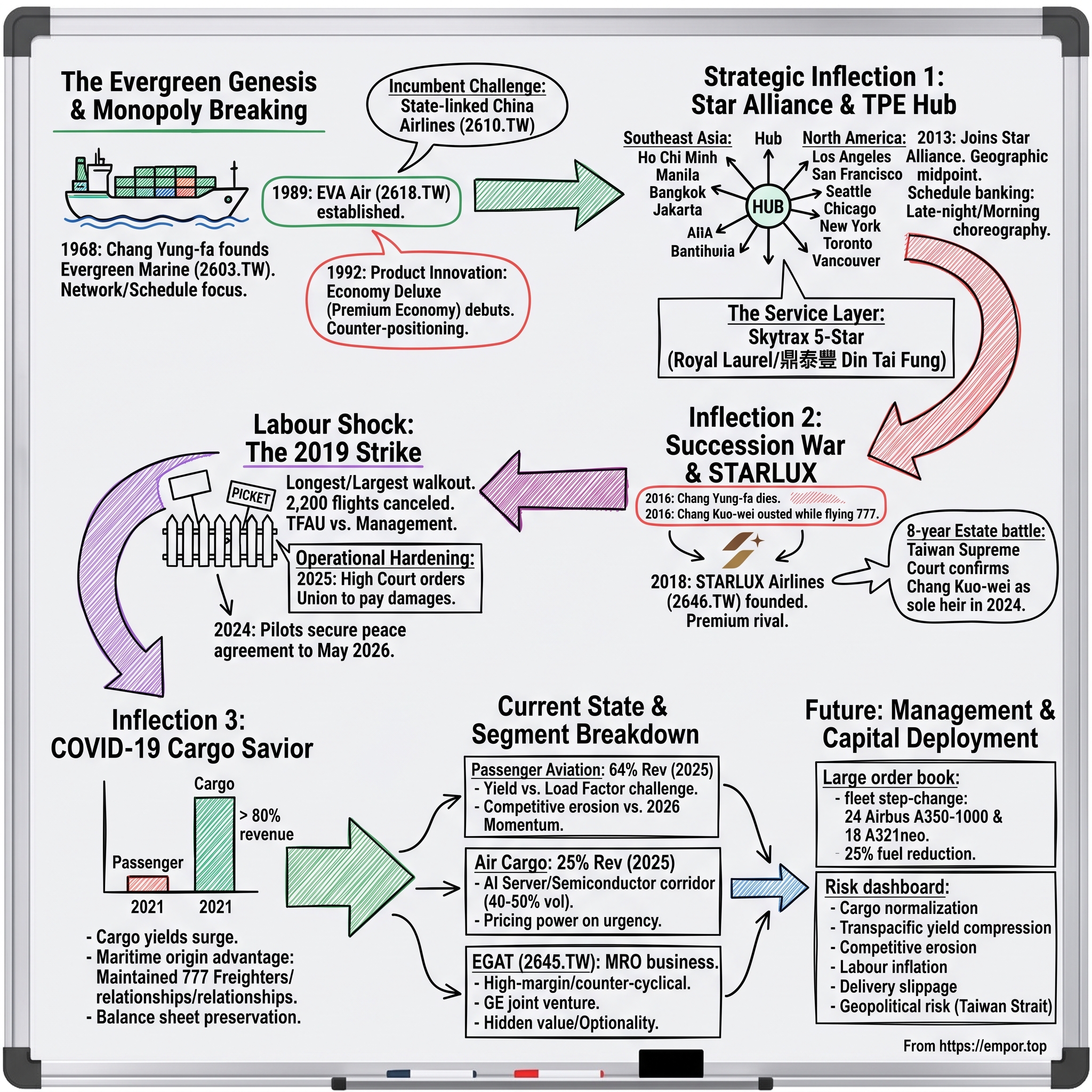
張榮發 Chang Yung-fa was born in 1927 in Japanese-ruled Taiwan, the son of a carpenter, and went to sea at an early age. He founded 長榮海運 Evergreen Marine Corp. (2603.TW) in 1968 with a single second-hand cargo ship. By the 1980s, he had built one of the world's largest container shipping lines on a conviction many competitors resisted: containerized shipping is not a spot-market trading business, but a network business won through schedule discipline. Evergreen operated round-the-world services on fixed weekly departures. Vessels sailed on schedule whether fully loaded or not, managing capacity utilization through dynamic pricing rather than delayed departures.
That maritime discipline transferred directly to commercial aviation. Aircraft, like ships, are capital-intensive assets that generate revenue only while in motion. Standardizing fleet configurations, maintaining schedule integrity so crews and spare parts remain interchangeable, and pricing to fill capacity rather than waiting for late bookings were all principles carried over from ocean shipping.
In 1989, when Taiwan began liberalizing an aviation market long reserved for state-linked 中華航空 China Airlines, Chang moved quickly. EVA Air was established that year as part of the Evergreen Group, launching commercial operations in 1991.
Overcoming the incumbent was a formidable operational hurdle. China Airlines was not merely an established carrier; it was the national flag carrier with deep political ties, prime airport real estate, and priority access to bilateral air service agreements—the government-to-government treaties governing international routes and landing slots. Lacking political entitlement, a private entrant could not out-lobby the flag carrier. It had to out-operate it by identifying underserved market segments.
EVA targeted two key opportunities.
The first was the Taiwanese diaspora. In the early 1990s, Taiwan was exporting both manufactured goods and talent: students attending American universities, engineers moving to Silicon Valley, and families settling along the U.S. West Coast. This long-haul traffic flow demanded more comfort than a standard economy seat offered, yet remained too price-sensitive for business class fares.
That demand led directly to EVA's most consequential product innovation.
The cabin that didn't exist
On 12 December 1992, EVA operated a Taipei–Los Angeles flight on a newly delivered Boeing 747-400 featuring a dedicated cabin called "Economy Deluxe." Configured in a 2-4-2 layout with a 38-inch seat pitch, footrests, and individual seatback screens, it marked the first time an airline offered personal video monitors in a mid-tier cabin.4
The economics relied on spatial efficiency. An airline's seat cost is governed primarily by floor space. A business class seat occupies three to four times the footprint of an economy seat and commands five to ten times the fare. Economy Deluxe occupied roughly 1.5 times the space of standard economy while selling at a premium well above that spatial ratio, generating higher margins per square meter of cabin floor.
Strategically, legacy carriers struggled to respond. Introducing a premium economy cabin threatened to cannibalize corporate business class sales—the discounted corporate fares and frequent-flyer upgrades that drove long-haul profitability. For an established flag carrier, adding a cheaper cabin directly behind business class risked undercutting its own primary profit engine. For a new challenger without a legacy business class franchise to protect, the cabin presented pure upside—a classic example of counter-positioning.
Industry context requires a qualification. Virgin Atlantic introduced a comparable "Mid Class" product in mid-1992, and historical records do not definitively establish which carrier flew first, suggesting parallel development.4 EVA's distinct achievement was persistence: making the cabin a permanent structural feature of its long-haul fleet and systematically expanding the concept from Evergreen Deluxe to Elite Class, and eventually Premium Economy.4
Through the 1990s and 2000s, EVA expanded its route network across North America and Europe, built out a regional Southeast Asian feeder system, and established a distinct service reputation built on Taiwanese hospitality. In 1998, the company took another strategic step by forming an engine maintenance joint venture with General Electric, laying the groundwork for what became 長榮航太 Evergreen Aviation Technologies.10 That engineering venture would later evolve into a vital source of high-margin earnings for the group.
The competitive pattern established during this foundation era remains instructive. EVA succeeded not through sheer scale or price discounting, but by identifying underserved passenger segments and executing a product strategy that legacy competitors could not easily match without diluting their own business models.
By 2010, EVA had established an efficient operating model. The next requirement was building a global alliance network.
III. Strategic Inflection 1: Star Alliance & Building the Transpacific TPE Hub (2010–2015)
An airline faces a fundamental constraint: it can only sell the routes it flies.
For its first two decades, EVA operated primarily as a point-to-point carrier. A passenger in Chicago traveling to Taipei could buy an EVA ticket if the airline flew directly from Chicago. A passenger in Omaha could not, unless they were willing to purchase two separate tickets, recheck baggage, and absorb the risk of an uncompensated delay on the connecting leg. Most travelers and corporate travel departments refuse those terms.
Alliance membership solves this limitation through commercial integration rather than capital expenditure. Interline and codeshare agreements allow partner airlines to sell seats on EVA flights as part of a single itinerary—complete with through-checked baggage, protected connections, and reciprocal frequent-flyer benefits and lounge access. Without purchasing an additional aircraft, the carrier expands its distribution network.
EVA joined 星空聯盟 Star Alliance on 18 June 2013.11 The choice of alliance was as critical as the timing. Star Alliance's North American anchor, United Airlines, operated major hubs in San Francisco, Los Angeles, Chicago, Newark, and Washington, D.C.—the exact gateway cities anchored by EVA's transpacific network. United's domestic feeder routes connected mid-sized American cities where Taiwanese and Southeast Asian communities resided. In Europe, Lufthansa and its group carriers provided parallel feed. Meanwhile, China Airlines had joined SkyTeam in September 2011, placing Taiwan's primary carriers in opposing alliance blocs—a structural separation that has defined corporate travel contracting in Taipei ever since.
Why Taoyuan, specifically
While alliance membership provided reach, geography provided a structural advantage far harder to replicate.
A great-circle route from Ho Chi Minh City, Manila, Bangkok, Jakarta, or Singapore to Los Angeles passes directly over or near Taiwan. Routing those same city pairs through Tokyo or Seoul adds unnecessary flight miles, while routing through Hong Kong adds distance in the opposite direction. Although Taoyuan is not the only viable connecting hub between Southeast Asia and North America, it sits near the geographic midpoint. That geometry enables EVA to offer transpacific connections requiring less fuel and shorter block times than competitors routing passengers through Northeast Asia.
Geography alone does not create a successful hub. Transforming a well-positioned airport into an efficient connecting machine requires schedule banking—clustering inbound arrivals and outbound departures so every incoming flight feeds multiple outgoing legs within a practical window. This operational design explains the late-night activity at Taoyuan described earlier: evening flights from Southeast Asia arrive in Taipei late at night, feeding a transpacific departure bank that launches in the early morning hours and arrives in North America the same morning. A traveler departing Manila after dinner arrives on the U.S. West Coast in time for breakfast.
The underlying network economics explain why established hubs are difficult to challenge. A carrier serving ten Southeast Asian origin cities and eight North American destinations through a single connecting bank is not merely operating eighteen point-to-point routes; it is marketing eighty distinct origin-and-destination city pairs. Adding an eleventh Southeast Asian city opens eight new sellable markets at the marginal cost of a single aircraft rotation. This multiplier effect represents EVA's core structural strength, though it carries an ongoing economic risk: thin connecting traffic discounted to maintain load factors can erode overall yields even as it fills aircraft holds.
The service layer
To complement its network scale, EVA developed a premium service tier. The airline introduced Royal Laurel and Premium Laurel business class cabins, amenity kits from Rimowa and Ferragamo, 鼎泰豐 Din Tai Fung cuisine served at altitude, and rigorous cabin crew training standards that became an industry benchmark. Industry recognition followed: as of May 2026, EVA held the Skytrax 5-Star Airline Rating for an eleventh consecutive year, placing it among only ten carriers worldwide with that designation.12
For investors evaluating EVA's competitive position, premium service presents a dual dynamic. High service quality yields tangible pricing power, enabling a carrier to command premium fares over commodity competitors. Yet service excellence remains the most replicable advantage in commercial aviation, requiring capital and operational discipline rather than regulatory protection or scarce physical assets. That vulnerability soon proved more than theoretical—triggered by a family funeral that reshaped Taiwanese aviation.
IV. Corporate Drama & Inflection 2: Succession War, Ouster, and STARLUX (2016–2018)
In March 2016, 張國煒 Chang Kuo-wei—chairman of EVA Air, youngest son of the founder, and a type-rated Boeing 777 captain who actively flew commercial routes—was in the cockpit during a flight. While he was airborne, EVA's board convened an extraordinary meeting and removed him.5
Two months earlier, founder 張榮發 Chang Yung-fa had died in January 2016 at age 88. He left behind a sealed will, drafted in 2014, naming Chang Kuo-wei—his only son by his second wife—as sole beneficiary of his personal fortune and as his successor at the head of the Evergreen Group.13
The disclosure sparked immediate conflict within the family. The founder had three older sons by his first wife, whom the will passed over in favor of their half-brother. The dispute highlighted a critical principle for investors in founder-controlled enterprises: a will dictates the distribution of personal assets, whereas corporate control is governed by voting rights, share registers, and board majorities.
On that measure, the elder brothers held the decisive advantage. Contemporaneous reporting indicated that Chang Kuo-wei held a direct stake of approximately 14.4% in EVA Airways, while 張國華 Chang Kuo-hua and his two full brothers collectively controlled roughly 16.3%—a voting block that, combined with allied holdings through parent entities such as 長榮國際 Evergreen International and 長榮海運 Evergreen Marine, commanded the boardroom.5 Mobilizing those shares, the elder siblings removed Chang Kuo-wei from the chairmanship and appointed 林寶水 Lin Bou-shiu (Steve Lin), a veteran Evergreen executive who had previously chaired EVA Airways from 2005 to 2011 and had most recently served as chairman of Evergreen Steel.5
Management framed the leadership change as an operational decision. Lin stated that the board had decided "to return management control of EVA Air to an industry expert."5 Chang Kuo-wei expressed regret that the executors and heirs had overridden the founder's explicit directives, warning of potential operational disruption resulting from the sudden leadership change.5
The legal fight over the estate persisted for eight years, eventually reframing the financial outcome of the dispute. On 14 August 2024, Taiwan's Supreme Court dismissed the final appeal, confirming Chang Kuo-wei as the sole inheritor of an estate valued at approximately NT$14 billion.13 While he secured the personal inheritance, control of the airline had already passed to the broader family group.
What replaced charisma
The 2016 governance shift established a corporate management structure led by Lin Bou-shiu as chairman and 孫嘉明 Clay Sun (Sun Chia-ming), who assumed the presidency in 2018. Both leaders were long-time Evergreen executives rather than external hires, representing a transfer of executive authority from one branch of the founding family to professional managers aligned with the majority shareholders rather than an overhaul toward independent board oversight.
From a bullish perspective, EVA replaced key-person dependency with institutional continuity, a transition supported by the financial performance of the subsequent decade. From a cautious perspective, the board remains embedded within a family-controlled holding architecture where the strategic priorities of the airline do not always align perfectly with those of the shipping parent. For minority shareholders, corporate governance risks persist even during periods of operational stability.
The counter-strike
Rather than stepping away from aviation, Chang Kuo-wei founded 星宇航空 STARLUX Airlines in 2018, positioning it as a boutique, premium-focused carrier competing directly in the long-haul and regional markets that EVA had spent thirty years cultivating.13
Although initially viewed by industry observers as a capital-intensive niche entry, STARLUX expanded its operational footprint rapidly. Its transpacific build-out began with Los Angeles in April 2024, followed by San Francisco in August 2024, Seattle, and Ontario, California, in 2025, alongside a European expansion route to Prague launching in August 2026.14 Operating a modern fleet of Airbus A321neos, A330neos, and A350-900s, STARLUX retained its Skytrax 5-Star Airline Rating in 2026 for a second consecutive year, matching EVA's quality certification tier within six years of its commercial debut.15
This rapid certification highlights a strategic reality for legacy carriers: while premium service awards require significant capital and operational discipline, external ratings alone do not create an unassailable economic moat against well-funded entrants.
A detailed financial analysis of STARLUX's competitive impact follows in later sections. Ultimately, the 2016 succession war did not eliminate market competition; it established a direct rival operating from the same hub. Before EVA could address this emerging threat, it faced internal disruption when its cabin crew walked out.
V. Labour Shock & Operational Hardening: The 2019 Strike
On 20 June 2019, EVA Air flight attendants executed a rare large-scale industrial action in post-martial-law Taiwan, halting work and establishing an encampment outside the airline's Taoyuan headquarters.
The walkout lasted seventeen days, making it the longest and largest strike in Taiwan's aviation history. Over 2,200 flights were cancelled.16 Organized by the 桃園市空服員職業工會 Taoyuan Flight Attendants Union (TFAU), the action involved more than 2,300 workers.
The immediate grievances centered on operational compensation: overnight layover allowances, long-haul duty pay, holiday premiums, and union representation rights. The broader tension was structural. For premium Asian carriers, cabin crew directly deliver the core passenger product—from five-star ratings to service consistency that justifies fare premiums over low-cost alternatives. In the union's view, crew compensation had lagged both the value generated by staff and the profits accumulated by the airline.
Management took a firm stance, refusing rapid concessions and framing the dispute as an effort by the union to control crew scheduling—a core operational function the company deemed non-negotiable. The eventual settlement reflected a tactical compromise: flight attendants secured bonuses for short-haul and transoceanic flights alongside improved rest provisions on select routes, but conceded on primary demands for higher layover allowances and double holiday pay. The agreement also established a strike moratorium on domestic routes.6
EVA's subsequent legal actions revealed even more about its corporate posture than the standoff itself. The company filed a lawsuit against the union.
The airline sued the union for damages, citing losses of NT$34 million per day during the stoppage. Multi-year litigation produced a split legal record: in March 2022, a lower court ruled the strike was legal,17 but in February 2025, the Taiwan High Court ruled in EVA's favor, ordering the union to pay damages in a final decision with no further right of appeal.6 The union characterized the lawsuit as retaliatory deterrence against future collective action and announced plans to seek a constitutional interpretation as a final recourse.6
Evaluating management's strategy
Investors must evaluate two competing interpretations of EVA's response.
The first perspective highlights operational discipline: management protected its scheduling authority, absorbed significant short-term losses rather than lock in a higher long-term cost structure, and established a legal deterrent. In commercial aviation, where labor accounts for 20% to 30% of operating expenses and rigid contracts compound over time, such discipline protects long-term unit costs. EVA's cost advantage per available seat kilometer relative to regional peers like Cathay Pacific and Singapore Airlines stems in part from these management choices.
The second perspective emphasizes brand and cultural risk: winning a lawsuit against a front-line workforce union carries unseen costs for a carrier whose premium status depends on discretionary employee effort. Service excellence cannot be strictly contracted or litigated into existence.
Subsequent events suggested management recognized this operational risk. When the 桃園市機師職業工會 Taoyuan Union of Pilots approached a strike in December 2023—voting to authorize a walkout during the peak Lunar New Year travel period despite an upgraded company offer18—EVA reached a settlement before flights were impacted. In January 2024, the airline agreed to increase pilot pay and benefits in exchange for a commitment to refrain from industrial action through May 2026.19 This marked a shift from the 2019 confrontation, adopting a preemptive strategy to secure labor peace ahead of major fleet expansion.
This approach bought temporary labor stability rather than permanent resolution, and the pilot moratorium expired in May 2026. In a tight labor market where local competitors actively recruit experienced personnel, ongoing wage negotiations remain an active cost exposure rather than a settled historical issue.
The 2019 strike also functioned as an inadvertent stress test, revealing how much grounded capacity and revenue loss the balance sheet could absorb. Within six months, those crisis-management lessons were put to a far larger test.
VI. Inflection 3: The COVID-19 Cargo Savior (2020–2022)
In the spring of 2020, global airline forward booking curves collapsed as international borders closed and passenger traffic fell by more than 90%. Carriers that had leveraged balance sheets to expand widebody fleets found those aircraft suddenly transformed from revenue-generating assets into heavy fixed-cost liabilities.
Major flag carriers required state intervention: Lufthansa received a German government bailout, Singapore Airlines raised capital from state investor Temasek, and Cathay Pacific underwent a government-backed recapitalisation in Hong Kong. Across the sector, national treasuries served as lenders of last resort to airlines that had recently been executing share buybacks.
EVA also recorded a downturn in 2020, reporting a net loss of NT$3.36 billion.7 However, the deficit was modest relative to industry peers, representing a loss of roughly US$100 million during the severe downturn for a carrier operating without state equity or government bailouts.
By 2021, EVA returned to profitability, posting a net profit of NT$6.6 billion as revenue rose 15% to NT$103 billion.7
How a passenger airline became a freight company for two years
This recovery was driven by air cargo economics. Historically, roughly half of global air freight moves in the lower-deck belly holds of passenger aircraft. When international passenger networks were grounded, that belly capacity vanished while global demand for transport surged, driven by consumer electronics, ocean shipping bottlenecks, and urgent semiconductor shipments.
As belly supply contracted and cargo yields rose, EVA benefited from its maritime origin. Unlike regional peers that had phased out dedicated freighters to rely exclusively on passenger belly space, EVA had maintained an active Boeing 777 freighter fleet alongside an established cargo commercial organization and long-term freight-forwarder relationships.
The financial impact reshaped the group's earnings mix. In 2021, cargo revenue surged 70% to NT$85 billion, far surpassing passenger revenue of roughly NT$18 billion.7 Freight generated approximately 82% of total revenue that year, while gross margin expanded from 9.6% to 18.6%.7 Rather than treating the surge as a passive windfall, management expanded freighter capacity; President Clay Sun cited an optimistic cargo outlook as the company reallocated aircraft, leading the board to contract Israel Aerospace Industries to convert three Boeing 777-300ER passenger aircraft into freighters starting in 2025 at approximately US$40 million per plane.7
Balance sheet preservation over emergency capital
Beyond short-term earnings, cargo cash generation protected EVA's balance sheet. Generating operational cash flow throughout the 2020–2022 period enabled the airline to avoid dilutive equity offerings, high-cost emergency debt, or government assistance with operational restrictions. The company also maintained dividend payouts, distributing NT$0.592 per share in 2022 and NT$0.799 in 2023.20 While modest, these payouts signaled financial stability while global peers were conserving cash or restructuring debt.
This capital preservation positioned EVA favorably for post-pandemic fleet renewal. By the end of fiscal 2025, the group held cash and short-term investments of approximately NT$86 billion against total debt of roughly NT$76 billion, maintaining a net-cash position as it prepared to take delivery of its largest aircraft order.2 While competitors emerged from the pandemic focused on balance sheet repair, EVA possessed the liquidity to fund fleet modernization.
Skeptics might attribute this performance primarily to external factors, noting that EVA benefited from its hub location in Taiwan during an unprecedented surge in semiconductor export demand. Nevertheless, capturing that demand required prior strategic positioning. By retaining dedicated freighters when prevailing industry consensus deemed them redundant, EVA maintained an operational hedge that proved decisive.
The key analytical question is whether EVA's cargo franchise represents a permanent structural advantage or a temporary cyclical driver. Evaluating that durability requires examining the group's underlying business segments.
VII. Segment Breakdown & Core Business Economics
Strip away the narrative and EVA is three businesses sharing a balance sheet: a premium passenger network, a freight operation, and a maintenance company. They have different economics, different cycles, and — critically — different competitive exposures.
Segment 1: Passenger aviation
In fiscal 2025, passenger revenue was NT$140.34 billion, about 64% of the group total, on 13.33 million passengers carried and a load factor of 77.8%.3
Note what that revenue line did: it fell 3.2% year on year, which management attributed to market competition.3 For an airline in a growing region during a period of healthy travel demand, a declining passenger revenue line is a signal worth sitting with. It is the first clear quantitative evidence in EVA's own numbers that the competitive environment out of Taipei has changed.
Then 2026 happened, and the picture flipped. First-quarter passenger revenue reached a record NT$40.30 billion, up 10.7%, with the load factor climbing to 84.1% and passenger volumes up 10.1%.21 By June, monthly passenger revenue was NT$14.13 billion, up 19.0%, with load factors on both Americas and European routes holding above 90% and a newly launched Washington D.C. service filling from day one.22 Management flagged frequency increases across Southeast Asia and a new Delhi destination.22
So which is it — competitive erosion or renewed momentum? The most defensible reading is that 2025 was a capacity-absorption year in which EVA, STARLUX and the North American carriers all restored transpacific seats faster than demand grew, compressing fares; and that 2026 has seen demand catch up while EVA's own capacity growth has been constrained by aircraft it does not yet have. That is a cyclical explanation, not a structural one. It means the 2026 strength is real but should not be extrapolated as evidence of a widening moat.
The competitive set, honestly assessed
Against 中華航空 China Airlines, the comparison is now clearly favourable to EVA. In fiscal 2025 China Airlines reported record consolidated revenue of NT$209.14 billion and net profit attributable to parent of NT$14.7 billion, EPS of NT$2.42 — with cargo revenue of NT$66.83 billion, up 10.1%.23 So on slightly less revenue, China Airlines earned roughly 56% of EVA's profit. Two things fall out of that. First, EVA converts revenue to profit materially better than its domestic peer, which is the strongest available evidence for the "process power" claim. Second, China Airlines is the more cargo-weighted of the two — its freight revenue exceeded EVA's by over NT$12 billion — which quietly undercuts the popular framing of EVA as Taiwan's cargo specialist. EVA is the better operator; China Airlines is the bigger freight house.
Against 星宇航空 STARLUX, the numbers are more reassuring than the headlines. STARLUX grew fiscal 2025 revenue 24% to NT$44.05 billion — impressive — but net income collapsed to NT$273 million from NT$1.32 billion in 2024, an EPS of NT$0.09.24 A net margin of roughly 0.6% against EVA's 11.9%. STARLUX has said the pressure came from high upfront staffing costs plus external disruptions including tariffs and visa issues hitting US and Japan routes.25
The analytical conclusion is specific and matters: STARLUX is presently a yield problem for EVA, not an existential one. It adds premium seats to the same city pairs, which caps EVA's ability to raise fares. But it has not yet demonstrated it can earn an acceptable return on the capital required to compete at transpacific scale, and it lacks the two things that make EVA's economics work — a full connecting bank and alliance feed. Watching whether STARLUX's margins recover as its fleet matures is the single best leading indicator of how much lasting damage it can do.
Against 國泰航空 Cathay Pacific, 全日本空輸 ANA and Singapore Airlines, EVA's edge is cost position rather than product. Taiwanese labour costs sit below Hong Kong's, Japan's and Singapore's, and EVA's fleet utilisation is high. That translates into a structurally lower cost per available seat kilometre — the industry's core unit-cost metric, effectively the cost of flying one seat one kilometre whether or not anyone is sitting in it. A lower CASK means EVA can profitably accept a fare that would lose money for a higher-cost competitor. That is a real and durable advantage, though it is an advantage of geography and wage arbitrage, not of ingenuity, and it erodes if Taiwanese wages converge upward.
Segment 2: Air cargo
Fiscal 2025 cargo revenue was NT$54.76 billion — about 25% of group revenue — up 5.0% on 840,000 tonnes carried, up 7%.3
The composition of that freight is what makes it interesting. Management disclosed in mid-2026 that AI server-related cargo accounts for as much as 40–50% of EVA's total cargo volume, with semiconductors and servers driving demand.22 June 2026 cargo revenue was NT$6.65 billion, up 48.3% year on year.22
Here is the mechanism in plain terms. A rack of AI servers or a shipment of advanced processors is worth an enormous amount per kilogram — often thousands of dollars per kilo. Ocean freight from Taiwan to the US West Coast takes two to three weeks and ties up working capital. For a hyperscaler racing to bring a data centre online, or a customer waiting on a scarce component, three weeks of delay costs far more than the air freight premium. So this cargo does not shop on price. It shops on capacity availability and reliability.
That is genuine pricing power — but it is conditional pricing power, and the condition is a capital expenditure cycle in AI infrastructure that is currently running hot. Air freight is a notoriously mean-reverting business. Rates that look structural at the top of a cycle look absurd eighteen months later. EVA's cargo moat is real in the sense that Taiwan will keep making the chips and EVA has the belly capacity, the freighters and the forwarder relationships to move them. It is fragile in the sense that a pause in AI capex would hit a revenue line that has been carrying the group's growth.
An additional wrinkle worth flagging as second-layer diligence: EVA's cargo and its passenger network are physically coupled. Belly capacity only exists where passenger aircraft fly. If passenger demand on a route weakens, cargo capacity on that route disappears with it — and vice versa. The two segments are less diversified than a revenue split suggests.
Segment 3: The maintenance business nobody prices
長榮航太 Evergreen Aviation Technologies is a majority-owned subsidiary of EVA Airways, separately listed under 2645.TW, headquartered in Taoyuan with around 3,200 employees.26 It was established in 1998 as a joint venture with GE, and its relationship with the engine maker has deepened over time — it was named an independent TRUEngine authorised MRO for GE's CF6 engines in 2014, and GE and EGAT formed a joint venture for GEnx overhaul work the same year.10
The financials show a business quietly compounding. EGAT's revenue grew from NT$9.62 billion in fiscal 2021 to NT$18.18 billion in fiscal 2025 — an 89% increase — with operating income rising from NT$1.15 billion to NT$3.00 billion.27 Gross margin expanded from 16.6% to 20.3% and operating margin from 12.0% to 16.5% over the same span.27 Net income reached NT$2.05 billion in 2025.27
Two things make this asset more interesting than its size suggests.
First, the counter-cyclicality. Aircraft need heavy maintenance on a schedule driven by flight hours and cycles, not by the fare environment. Engine overhauls happen whether or not the airline made money that quarter. In a downturn, MRO revenue holds up far better than passenger revenue does — as EGAT's steady growth through 2021 and 2022 demonstrated while the parent's passenger business was flat on its back.
Second, the scarcity. Global MRO capacity has been genuinely constrained since the pandemic, with engine shop visit backlogs stretching quarters and airlines grounding aircraft waiting for slots. Owning a certified engine shop in that environment is a real strategic asset: EVA schedules its own fleet's maintenance without queueing behind third parties, which protects utilisation.
The honest framing on scale: EGAT's EBITDA of roughly NT$3.8 billion sits against group EBITDA of about NT$66 billion in fiscal 2025.227 It is not the profit engine. It is roughly a twentieth of the group — a genuine but modest contributor, plus an operational insurance policy, plus a separately-valued equity stake. Investors describing it as the "hidden jewel" are usually overstating the arithmetic. It is a good business inside a bigger one.
Which brings us to the people deciding what to do with all of this cash.
VIII. Current Management, Governance & Capital Deployment
The most revealing management document EVA has produced over the past three years is not a strategy deck; it is a purchase order.
Judging management by behaviour
林寶水 Lin Bou-shiu and 孫嘉明 Clay Sun have led EVA Airways for roughly a decade and eight years, respectively, providing an established operational record to evaluate.
Start with what did not happen. EVA did not suffer catastrophic losses on fuel hedges—a critical distinction given that several Asian carriers, most notably Cathay Pacific, incurred steep losses in 2020 on hedges struck before oil demand and aircraft utilization collapsed. When an airline hedges fuel and subsequently grounds its fleet, the derivative contract becomes a naked bet on crude oil without offsetting physical fuel consumption. EVA's restrained hedging posture prevented a demand shock from turning into a derivatives loss. The airline also avoided dilutive equity offerings during the crisis and operated without a government bailout.
Consider also what did happen. Revenue grew from NT$103.9 billion in 2021 to NT$220.3 billion in 2025.2 Net income expanded from NT$6.6 billion to a peak of NT$29.0 billion in 2024 before settling at NT$26.1 billion in 2025.2 On a standard invested-capital basis, return on invested capital ran at roughly 10% to 11% in both 2024 and 2025, alongside return on equity of 23.5% in 2024 and 18.9% in 2025. In an industry that has historically destroyed capital on aggregate, generating returns consistently above the cost of capital across a full cycle represents a notable achievement.
Dividend policy has similarly reflected financial discipline over shareholder signaling. Payouts rose alongside earnings before stepping down: NT$0.592 per share for 2021, NT$0.799 for 2022, NT$1.80 for 2023, NT$2.40 for 2024, and NT$2.00 for fiscal 2025, paid in August 2026—representing a payout ratio of roughly 46%.203 Reducing the dividend by 17% in a year when net profit fell 10% and a multi-billion-dollar fleet renewal program was ramping represents defensible capital allocation. Prioritizing aircraft deliveries over dividend expansion clearly underscores management's operational focus.
Important qualifications remain regarding investor relations. EVA's disclosure practices are concise compared to global peers. Communication occurs primarily through Taiwanese monthly revenue announcements, quarterly investor conferences, and Market Observation Post System filings rather than the elaborate slide decks and extended analyst Q&A sessions common among North American and European carriers.2829 Public management commentary focuses mainly on short-term operational metrics—such as peak Lunar New Year travel, AI server cargo demand, and load factors exceeding 90%—rather than detailed multi-year financial targets.2122 While this approach reflects regional market norms rather than intentional opacity, it creates a looser accountability loop than seen at peers providing formal guidance. Consequently, investors must evaluate management primarily on realized financial results rather than forward commitments.
The order book
That capital deployment strategy is most clearly visible in the fleet order book. On 7 November 2023, EVA announced a commitment for 33 Airbus aircraft valued at up to US$10.1 billion at list prices,30 finalized on 9 January 2024 as a firm order for 18 A350-1000s and 15 A321neos.8 In April 2025, the airline added six more A350-1000s and three additional A321neos—a follow-on agreement capped at roughly US$3.1 billion, with unit cap prices of US$436 million per A350-1000 and US$150 million per A321neo—bringing the total Airbus order to 24 A350-1000s and 18 A321neos.931 Parallel to the Airbus investment, EVA continued expanding its Boeing widebody capacity, with the board approving four additional Boeing 787-9s valued at up to US$1.94 billion in December 2025, scheduled for delivery through 2033.32
Although list prices are nominal—with airlines typically negotiating discounts of 40% or more—the strategic direction is unambiguous. Representing the largest capital commitment in EVA's history, this fleet expansion reflects three distinct rationales, only two of which management publicly highlights.
First is fuel efficiency and carbon reduction. Airbus reports that the A350-1000 burns approximately 25% less fuel per seat than previous-generation widebodies while delivering matching emissions reductions across a range of 9,700 nautical miles.8 For a carrier operating 12-hour transpacific routes where jet fuel constitutes the single largest operating expense, a 25% reduction in seat fuel burn significantly improves unit economics while mitigating exposure to tightening environmental regulations on European and long-haul routes.
Second is supplier diversification. Having relied almost exclusively on Boeing widebodies throughout its history, committing its future flagship long-haul fleet to Airbus—powered by Rolls-Royce engines—reduces single-vendor dependency at a time when Boeing manufacturing delays have created operational bottlenecks across the global airline industry.
Third is competitive defense—a factor management rarely emphasizes publicly. STARLUX operates modern Airbus A350-900s featuring contemporary cabin interiors, and 2026 industry analysis underscored that EVA's aging Boeing 777-300ER cabins require an overhaul that remains several years off.14 On passenger-facing cabin hardware, EVA's flagship long-haul product has fallen behind its younger rival; the A350-1000 acquisition serves as the long-term solution to that product gap.
Consequently, delivery timing represents a primary operational risk. EVA initially anticipated receiving its first A350-1000 in 2026, but the airline subsequently signaled that deliveries would commence in the first quarter of 2027—a delay relative to initial schedules.33 Meanwhile, A321neo narrowbodies are not slated to enter service until 2029.33 Each quarter of delay prolongs the operation of Boeing 777s that burn more fuel, incur higher maintenance costs, and command lower yield premiums while a rival operating newer aircraft competes directly for premium passenger share.
Financial position provides a meaningful buffer. Ending fiscal 2025 in a net-cash position and generating operating cash flow that comfortably covered capital expenditure—with capex consuming roughly half of operating cash flow in 2025—EVA enters this fleet renewal cycle equipped to fund aircraft deliveries through internal cash generation and export credit agency debt rather than equity dilution.2 Few global airlines taking delivery of two dozen widebody aircraft maintain comparable balance sheet flexibility.
The stress test an activist would run
For an institutional investor conducting a critical risk assessment or engagement analysis, several corporate pressure points stand out. First, corporate governance remains embedded within a family-controlled conglomerate structure where related-party transactions across shipping, airline, maintenance, and logistics entities are structurally present and sparsely detailed in English-language disclosures. Second, segment reporting remains aggregated: EVA does not disclose route-level margins, making it difficult for external analysts to independently verify management's assertion that transpacific routes serve as the primary profit engine. Third, the 3.2% passenger revenue contraction in fiscal 2025 received only a brief attribution to market competition rather than a detailed driver decomposition. Finally, conglomerate complexity—a legacy airline holding a majority stake in a publicly listed maintenance provider within a broader shipping group—raises persistent questions regarding whether standalone valuations would unlock higher shareholder value.
These structural characteristics do not signal operational impropriety; rather, they reflect the standard considerations associated with investing in a family-controlled Asian industrial enterprise, warranting measured risk analysis rather than speculative concern.
IX. Framework Analysis: The Playbook & Business Lessons
Stepping back from operational details raises a fundamental strategic question: which of EVA's competitive advantages are structurally defensible, and which merely reflect temporary market conditions?
Hamilton Helmer's 7 Powers, applied and graded honestly
Scale economies — Partially present. EVA commands genuine purchasing leverage on widebody aircraft orders and distributes maintenance fixed costs across a sizable fleet via Evergreen Aviation Technologies. Globally, however, EVA remains a mid-sized carrier, lacking the massive scale of United Airlines, Delta Air Lines, or Emirates, and it is not the dominant scale player within Star Alliance. Scale provides a modest benefit against smaller regional competitors, but offers limited advantage against global mega-carriers on transpacific routes.
Network economies — Present and significant. The scheduled flight banks at Taoyuan International Airport are difficult to replicate because they require simultaneously coordinating slots, aircraft, crew, and alliance feeds across dozens of origin-and-destination markets. An entrant cannot construct an effective connecting hub incrementally; network value materializes only when a comprehensive schedule is operational. This structural barrier explains why STARLUX Airlines initially targeted point-to-point premium traffic rather than attempting to replicate EVA's hub structure. However, network value depends entirely on passenger preference for Taoyuan over alternative one-stop routing through competing hubs such as Seoul Incheon or Middle Eastern gateways.
Process power — Present and empirically measurable. The group's operating culture—built on schedule discipline, fleet standardization, and strict cost management—helps explain why EVA converted NT$220 billion of revenue into NT$26 billion of profit while its domestic peer converted NT$209 billion into NT$14.7 billion.323 Because process power resides in organizational habits rather than physical assets, it remains difficult for rivals to copy, though it remains vulnerable to executive succession and cultural drift.
Counter-positioning — Historically decisive, but largely exhausted. Introducing premium economy in 1992 exploited a strategic blind spot among legacy carriers protecting business class yields. However, global competitors long ago adopted premium economy, making it a standard long-haul offering rather than a proprietary advantage. Today, STARLUX holds the counter-positioning edge in Taipei, leveraging a modern fleet unburdened by legacy cabin hardware to challenge EVA's aging Boeing 777-300ER interiors.
EVA lacks the remaining three strategic powers: switching costs, as frequent-flyer programs offer mild customer retention rather than structural lock-in; brand power, as pricing authority independent of product quality remains limited when local rivals hold matching five-star service ratings; and cornered resources, as flight rights and aircraft technology remain accessible to adequately capitalized entrants.
Porter's Five Forces
Supplier power — High, and the binding constraint. Commercial aviation relies on a duopoly of widebody airframers, a concentrated engine manufacturing sector, and unhedged exposure to jet fuel prices—the airline's largest variable expense. Furthermore, Airbus delivery schedules directly dictate the timeline for EVA's fleet modernization and unit-cost improvements, leaving the carrier dependent on manufacturer production throughput.
Buyer power — Moderate and bifurcated. Leisure travelers remain highly price-sensitive, while corporate clients negotiate volume discounts. In air freight, global forwarders such as Kuehne+Nagel, DHL, and DB Schenker exercise significant bargaining power by aggregating volume, though elevated demand for urgent semiconductor and artificial intelligence server shipments has temporarily enhanced carrier pricing leverage.
Threat of new entrants — Moderate, but demonstrated. High capital requirements, slot constraints, and bilateral air agreements historically shielded legacy airlines. However, STARLUX Airlines proved that a well-funded entrant can establish a premium long-haul operation from the same hub. The primary barrier to entry is not regulatory access but financial return, as STARLUX's 0.6% net margin demonstrates the difficulty of achieving profitable scale.24
Threat of substitutes — Low for long-haul passenger travel, rising at the edges. No direct substitute exists for transpacific air travel, though remote communication tools have reduced structural business travel demand. In freight, ocean transport serves as a lower-cost substitute whenever cargo urgency or value density declines, underscoring the revenue concentration risk inherent in EVA's high exposure to artificial intelligence hardware shipments.
Rivalry — High and intensifying. EVA faces domestic competition from China Airlines, premium yield pressure from STARLUX, regional hub competition from 대한항공 Korean Air, All Nippon Airways, Cathay Pacific, and Singapore Airlines, and direct capacity competition from North American legacy carriers across transpacific routes.
The lesson
The broader strategic lesson reflects the maritime principle imported by founder Chang Yung-fa: in a capital-intensive network industry, a durable competitive edge rarely relies on passenger-facing amenities. Service features are easily replicated over time, whereas schedule discipline, network architecture, and unit-cost control remain far more resilient.
X. Investment Spine: Bull vs. Bear Case & Risk Radar
Why this wins from here
The bull case rests on four mechanisms, presented in descending order of empirical support.
The strongest is cost position combined with hub geometry. EVA earns nearly twice the net profit of its domestic peer, China Airlines, on comparable total revenue, sustains double-digit net margins in an industry where a 5% margin is considered respectable, and generated a return on invested capital of roughly 10% in both fiscal 2024 and 2025.2323 This outperformance reflects structural efficiency across comparative peer results.
Second is the AI freight corridor. As long as Taiwan produces most of the world's advanced logic chips and assembles a major share of artificial intelligence server capacity, high-value components will rely on air transport. EVA captures this demand through dedicated freighters and passenger belly space across its existing network. Management's disclosure that AI-related cargo accounts for 40% to 50% of total freight volume, alongside a 48.3% year-on-year surge in June 2026 cargo revenue, underscores this near-term tailwind.22
Third is the fleet step-change, offering the most direct path to unit-cost improvement. Airbus A350-1000 aircraft promise a 25% reduction in fuel burn per seat on key long-haul routes—a tangible efficiency gain, provided deliveries occur on schedule.8
Fourth, and weakest, is EGAT optionality. While Evergreen Aviation Technologies represents a high-margin, counter-cyclical maintenance provider in a constrained global market, the unit remains too small relative to group earnings to drive the broader investment thesis on its own.27
What breaks the case
The bear case does not assume EVA is poorly managed, but rather that the airline is earning peak-cycle returns across two separate business segments simultaneously.
Cargo normalisation is the largest single risk. Should artificial intelligence infrastructure expenditure slow, cargo revenue growth—which jumped over 48% in mid-2026—could reverse rapidly. Because the marginal cost of filling belly space on existing flights is minimal, cargo revenue drops almost directly to operating profit. The operational leverage that boosts earnings during upcycles amplifies downside risk during contractions. Fiscal 2025 illustrated this dynamic when freight earnings offset declining passenger revenue; however, passenger demand cannot be guaranteed to cushion a cargo downturn.3
Transpacific yield compression is the second risk. The 3.2% drop in passenger revenue during fiscal 2025 demonstrated how expanding industry capacity compresses passenger fares.3 While load factors above 90% in mid-2026 reflect high passenger volume, high load factors do not ensure strong yields if tickets are heavily discounted. Without detailed route-level disclosures, investors cannot easily evaluate underlying fare trends.
Competitive erosion at the premium end. STARLUX Airlines now matches EVA's five-star Skytrax rating, operates modern aircraft, and continues expanding its transpacific and European routes.1415 While STARLUX's thin profitability limits its current commercial threat, its modern cabin hardware creates a head-to-head product challenge until EVA deploys its new widebody fleet.
Labour inflation. The pilot agreement reached in January 2024 included a peace moratorium that expired in May 2026.19 Amid global pilot shortages, active recruitment by regional competitors, and a union that previously authorized strike action, conditions favor renewed wage pressure that could raise operating expenses.
Delivery slippage. Initial deliveries of the Airbus A350-1000 have shifted from 2026 to the first quarter of 2027.33 Ongoing global supply chain delays mean further postponement remains possible, delaying fuel-efficiency gains while increasing maintenance expenses for the aging Boeing 777 fleet.
Current risk radar
Geopolitical and airspace risk represents an unhedgeable exposure. EVA operates its entire hub network out of a single airport in a region facing geopolitical tensions. Historical precedent highlights this vulnerability: during military exercises around Taiwan in August 2022, six designated danger zones forced international carriers like Korean Air to reroute flights, prompted Cathay Pacific to mandate contingency fuel loads, and caused mainland airports near the Taiwan Strait to cancel hundreds of flights.34 While short-term airspace closures are manageable, sustained regional conflict would disrupt flight paths, increase insurance premiums, impair crew availability, and curtail semiconductor export traffic. This structural tail risk largely explains why EVA trades at a single-digit price-to-earnings ratio compared to international peers operating in less exposed jurisdictions.
Fuel price and crack spread volatility remains a core operational vulnerability. EVA's restrained fuel-hedging strategy prevents derivative losses during demand shocks, but leaves operating expenses directly exposed to spot price spikes.
Cost of capital and refinancing presents a manageable near-term risk. Supported by a net-cash position at the close of fiscal 2025 and solid operating cash flow, EVA can fund its initial aircraft deliveries internally, though a severe downturn during the capital deployment phase would erode this financial buffer.2
Concentration risk. Operations remain concentrated around a single primary hub, one domestic home market, and a heavy reliance on technology shipments. Route and cargo diversification both remain tied to Taoyuan International Airport.
In summary, EVA Airways operates as an efficient carrier in a notoriously difficult industry, generating peak-cycle earnings across both passenger and cargo segments. The group maintains a resilient balance sheet to absorb potential downturns and a substantial fleet order designed to reduce long-term unit costs. While market valuation reflects operational quality alongside a geopolitical discount, current pricing may not fully account for a simultaneous contraction in cargo yields and transpacific passenger fares.
XI. Epilogue & Key KPIs to Watch
There is a fitting symmetry in how this story closes.
A shipping magnate built an airline by applying the logic of container schedules to passenger aviation, and thirty-seven years later the airline's most profitable cargo is the semiconductors and AI servers that Taiwan manufactures—moving by air precisely because they are too valuable and urgent to move by sea. The company he founded now competes, on the routes he pioneered, against an airline founded by the son he chose as his heir and who was removed from the EVA chairmanship while flying one of its aircraft.
The summary judgment is that EVA Airways is a well-run, financially conservative operator that has survived a family succession war, a seventeen-day strike, a global aviation grounding, and the arrival of a determined premium rival—emerging with a net-cash position, double-digit net margins, and the largest fleet order in its history. It is also a carrier whose current earnings depend on two cyclical tailwinds and whose primary hub sits in a geopolitically sensitive region. Both statements are true, and neither cancels the other.
For an investor tracking the carrier from here, three key performance indicators carry most of the analytical weight:
1. Cargo revenue and its AI-server mix. This is the primary swing factor. EVA discloses monthly revenue with a cargo split, and management has been unusually specific about the AI share of volume.22 Investors should monitor whether cargo revenue growth decelerates and whether management's characterisation of the AI mix shifts. A move from 40% to 50% of volume toward a lower proportion, or a period of flat monthly cargo revenue against easy comparisons, would provide an early warning that the freight cycle has turned.
2. Passenger yield, not load factor. A load factor above 90% generates headlines, but yield per revenue passenger kilometre determines underlying profitability. The 2025 experience—when passenger revenue fell despite rising passenger numbers—showed how these two metrics can diverge.3 Tracking passenger revenue against passenger volumes across quarters reveals underlying pricing power. If revenue grows more slowly than traffic volume, EVA is purchasing market share through discounting, signaling that the transpacific yield environment is softening regardless of how full aircraft appear.
3. A350-1000 delivery milestones and unit cost ex-fuel. The margin-expansion thesis depends heavily on aircraft deliveries. First delivery was expected in the first quarter of 2027 as of the latest indication.33 Each confirmed delivery verifies progress on fleet renewal; every delay postpones fuel-efficiency gains while the Boeing 777 fleet ages and incurs higher maintenance expenses. Pairing the delivery schedule with unit cost excluding fuel isolates operational discipline, showing whether cost controls hold as new aircraft types, flight crews, and maintenance schedules enter the system.
Focusing on these three metrics provides a clear view of EVA Airways' performance, cutting through operational details from its green-tailed widebodies to its midnight hub choreography at Taoyuan.
References
-
EVA Airways (TPE:2618) Statistics & Valuation Metrics — Stock Analysis ↩
-
EVA Airways (TPE:2618) Financials — Income Statement — Stock Analysis ↩↩↩↩↩↩↩↩
-
EVA Air Reports 2025 Profit of NT$26.15 Billion and EPS of NT$4.84, Second-Highest in History; Proposes NT$2 Cash Dividend Per Share — BigGo Finance, 2026-03-12 ↩↩↩↩↩↩↩↩↩↩
-
How Virgin Atlantic and EVA Air invented premium economy — Head for Points, 2026-02-16 ↩↩↩↩
-
EVA Airways head Chang Kuo-wei removed from post — Taipei Times, 2016-03-12 ↩↩↩↩↩↩
-
Court Rules in Favor of EVA Air Over Demand for Compensation for 2019 Strike — New Bloom Magazine, 2025-02-18 ↩↩↩↩
-
EVA reverses losses, reports NT$6.6bn in net profit last year — Taipei Times, 2022-03-15 ↩↩↩↩↩↩
-
EVA Air places landmark order with Airbus — Airbus, 2024-01-09 ↩↩↩↩
-
EVA Air expands fleet with more A350-1000 and A321neo aircraft — Airbus, 2025-04-07 ↩↩
-
Evergreen Aviation Technologies named CF6 TRUEngine Authorized MRO — GE Aerospace, 2014-07-15 ↩↩
-
EVA Air Joins the Star Alliance Network — Star Alliance, 2013-06-18 ↩
-
EVA Air awarded 5-Star Airline Rating for eleventh consecutive year — Skytrax, 2026-05-14 ↩
-
Chang Kuo-wei wins sole NT$14 billion inheritance from Taiwan's Evergreen founder — Taiwan News, 2024-08-15 ↩↩↩
-
Long-Haul Comfort: How These Transpacific Airlines Are Dominating The Premium Market In 2026 — Simple Flying ↩↩↩
-
Starlux, EVA Air retain Skytrax five-star status — Taipei Times, 2026-05-21 ↩↩
-
Taiwanese Flight Attendant Strike Cancels 2,250 Flights — Labor Notes, 2019-07 ↩
-
Strike at EVA Airways in 2019 was legal: court — Taipei Times, 2022-03-26 ↩
-
EVA Air pilots mull strike action over wage dispute with airline — Focus Taiwan, 2023-12-12 ↩
-
EVA Air Pilots Call Off Lunar New Year Strike — Simple Flying ↩↩
-
EVA Airways Corp. (TPE: 2618) Dividend History, Dates & Yield — Stock Analysis ↩↩
-
EVA Air reports record high Q1 net profit — Focus Taiwan, 2026-05-14 ↩↩
-
EVA Air's June Revenue Hits Another Record High, Surpassing NT$20 Billion for Fourth Consecutive Month — BigGo Finance, 2026-07 ↩↩↩↩↩↩↩
-
China Airlines Reports Record 2025 Financial Results with Revenue, Profit, and EPS All Hitting Historic Highs — BigGo Finance, 2026 ↩↩↩
-
STARLUX Airlines (TPE:2646) Financials — Income Statement — Stock Analysis ↩↩
-
Evergreen Aviation Technologies (TPE:2645) Company Profile & Description — Stock Analysis ↩
-
Evergreen Aviation Technologies (TPE:2645) Financials — Income Statement — Stock Analysis ↩↩↩↩↩
-
EVA Air Annual Reports & Financial Statements Repository — EVA Airways Corp. ↩
-
Taiwan Stock Exchange Market Observation Post System (MOPS) — TWSE Regulatory Filings ↩
-
Taiwan's EVA Air orders 33 Airbus aircraft worth up to $10.1 billion at list prices — Reuters, 2023-11-07 ↩
-
EVA Airways Finalizes Order For 6 More Airbus A350s & 3 More A321neos — Simple Flying, 2025 ↩
-
EVA Air Approves US$1.94bn Order for Four Boeing 787-9 Dreamliners — Aviation Source News, 2025-12 ↩
-
Taiwan's EVA Air confirms six A350-1000s, adds three A321neo — ch-aviation, 2025 ↩↩↩↩
-
Airlines steer clear of Taiwan danger zones during Chinese military exercises — Fortune, 2022-08-03 ↩
 LinkedIn
 WhatsApp
 Reddit
 Hacker News
 Email
Email Kindle
 RSS Feed
 Spotify
 Apple Podcasts
 Amazon Music
 Audible
 YouTube