China Pacific Insurance: The Shanghai Giant Navigating China's Financial Transformation
I. Introduction & The $400 Billion RMB Insurance Titan
On the morning of 27 March 2026, in a conference room in Shanghai's Huangpu district, the senior management of 中国太平洋保险(集团)股份有限公司 China Pacific Insurance (Group) Co., Ltd. presented a set of numbers that would have seemed implausible four years earlier. Group operating income of RMB 435.156 billion, up 7.7%. Net profit attributable to shareholders of RMB 53.505 billion, up 19.0%. And the headline that analysts had been waiting on since the company's life insurance arm nearly stalled out in 2022: new business value of RMB 18.609 billion, a 40.1% year-on-year increase, with margin expanding 3.2 points to 19.8%.1
It was, on its face, a triumphant scorecard. It was also a scorecard that deserves to be read slowly, because almost every number in it carries an asterisk about why it moved.
CPIC — the ticker is 2601.HK in Hong Kong, 601601.SH in Shanghai, and CPIC.L in London — is China's third-largest listed insurance group by most measures, sitting behind 中国人寿 China Life Insurance and 中国平安 Ping An Insurance, and roughly alongside 中国人保 PICC depending on which segment you count. It manages RMB 3.891 trillion in group assets under management, serves nearly 190 million customers, and carries a group embedded value of RMB 613.365 billion.1 Those are the vital statistics of a genuine financial giant.
The central conundrum. CPIC is controlled, through a cluster of Shanghai municipal vehicles, by the 上海市国有资产监督管理委员会 Shanghai SASAC. Its largest domestic shareholders as of the end of March 2026 were 申能集团 Shenergy Group at 14.05%, Hwabao Investment at 13.35%, Shanghai State-Owned Assets Operation at 6.34%, and Shanghai Haiyan Investment Management at 4.87% — a state-owned bloc holding roughly 40% of the register, with HKSCC Nominees (the Hong Kong custodian) holding 28.82% on behalf of international investors.3 The question this article tests is whether a state-controlled composite insurer, born in 1991 as a challenger to a state monopoly and now itself a pillar of the state financial system, can convert a legacy headcount-driven distribution machine into a value-per-policy compounder — while the ground beneath it, the level of Chinese long-term interest rates, keeps sinking.
That last point is not a background risk. It is the risk. A life insurer is, in economic substance, a leveraged bond fund that sells guarantees. When it writes a policy promising a 3.5% guaranteed accumulation rate and can only reinvest maturing assets at government bond yields near 1.8%, the difference compounds into a hole. Chinese insurers have a word for it: 利差损, negative spread loss. Caixin reported in May 2025 that Chinese insurers had closed additional-payment channels on legacy universal life policies carrying 3.0% and 3.5% guarantees, and that crediting rates had fallen below 3.3% — down from a pre-2017 era when some products credited above 7%.11 That is the industry's inherited problem, and CPIC carries its share.
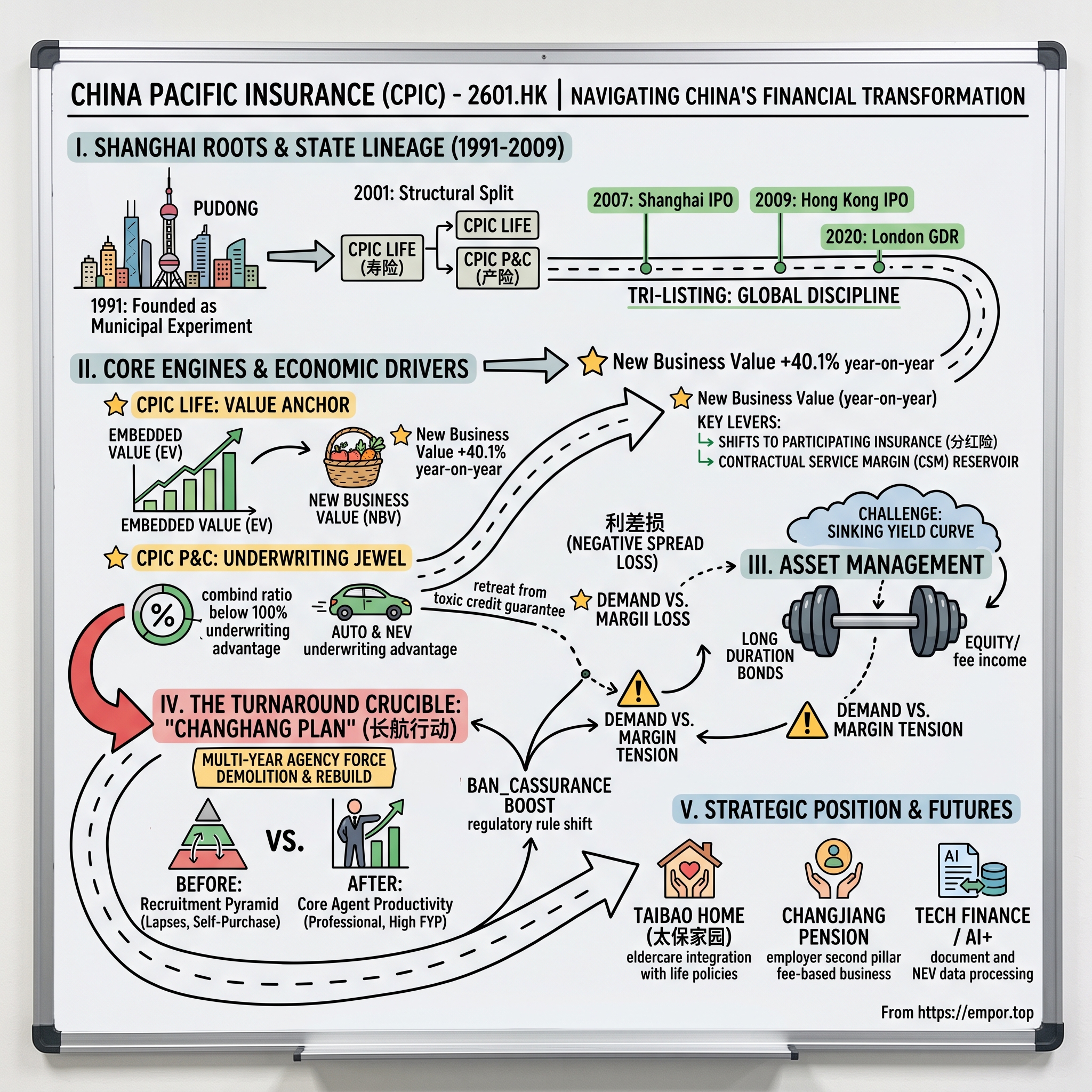
The tri-listing. CPIC is unusual in having voluntarily submitted itself to three separate disclosure regimes. Its A shares listed in Shanghai on 25 December 2007. Its H shares listed in Hong Kong on 23 December 2009. And in June 2020 it issued 102,873,300 Global Depositary Receipts on the London Stock Exchange, followed by a further 8,794,991 in July — each GDR representing five A shares — making it the first Chinese insurer with a simultaneous Shanghai–Hong Kong–London footprint.7 For an international investor, this matters less as a liquidity feature than as a discipline: three regulators, three sets of continuous-disclosure obligations, and a persistent, visible gap between what A-share and H-share buyers will pay for the same cash flows.
The roadmap. This story runs through five arcs. First, how a Shanghai municipal experiment became a national composite insurer. Second, the machinery of the three engines — life, property & casualty, and asset management — and what actually drives each. Third, the 长航行动 Changhang Transformation, the multi-year demolition and rebuild of CPIC Life's agency force, which is the single most consequential strategic decision the company has made this decade. Fourth, the "insurance + health + eldercare" ecosystem and whether 太保家园 CPIC Home is a genuine moat or an expensive amenity. And fifth, an honest accounting of the bull and bear case, including the parts of the 2025 result that look better on the headline than in the footnotes.
Three myths worth dismantling up front. The first is that CPIC is a cheap proxy for Chinese household wealth accumulation. It is a proxy for Chinese long-term interest rates first and household savings second; the two have moved in opposite directions since 2021. The second is that the company pays out 30–50% of operating profit — the arithmetic below shows it has been running at the bottom of that band, and materially lower against reported earnings. The third is that the agency transformation is a growth story. On the evidence, it has been a margin story: agency first-year annual premium in 2025 was almost exactly what it was in 2024.2
Because that is where this story begins in earnest: with a company whose reported profit grew 19% while its underlying operating profit grew 6%, and with the question of which of those two numbers is telling the truth.
 Subscribe on LinkedIn
II. Shanghai Roots & State-Backed Lineage (1991–2009)
To understand CPIC you have to understand what Chinese insurance looked like before it existed. For most of the 1980s there was essentially one insurer: the People's Insurance Company of China, an arm of the central bank in all but name. Insurance was not a market; it was an administrative function. Premiums were collected, claims were paid, and nobody thought very hard about pricing risk because there was no competitor against whom to be wrong.
That began to change in Shanghai. In May 1991, China Pacific Insurance Company was established in the city as a nationwide joint-stock commercial insurer — the first of its kind — with a shareholder base drawn from the state banking and industrial system rather than from a ministry. The point of the exercise was competitive: Shanghai in the early 1990s was being deliberately rebuilt as China's financial capital, Pudong was rising out of farmland across the river, and the municipal leadership wanted financial institutions headquartered locally that could actually compete.
CPIC's culture inherited that founding logic, and it shows in how the company behaves relative to peers. 中国平安 Ping An, born in Shenzhen the same era, became the aggressive technology-and-conglomerate builder — banking, healthcare, fintech, everything. 中国人寿 China Life, headquartered in Beijing, became the scale player with the deepest reach into county-level China. CPIC settled into a narrower identity: a composite insurer that would rather be profitable than largest. That temperament produces both the company's most attractive quality — underwriting discipline in property and casualty — and its most persistent criticism — that it is a follower, not a shaper, of industry structure.
The 2001 unbundling. The decisive structural event came in October 2001, when China Pacific Insurance Co., Ltd. was restructured into China Pacific Insurance (Group) Co., Ltd. pursuant to State Council approval and a circular from the then-China Insurance Regulatory Commission. The group received a new business licence on 24 October 2001 with issued capital of RMB 2,006.39 million, headquartered in Shanghai.7 Underneath the new holding company sat two separately capitalised operating subsidiaries: 中国太保寿险 CPIC Life and 中国太保产险 CPIC P&C.
This was not a cosmetic reorganisation. Regulators across the world separate life and general insurance for a reason: the two businesses have almost nothing in common financially. A P&C insurer writes one-year contracts, collects premium, pays claims within months, and can reprice annually if it gets the risk wrong. A life insurer writes twenty-year and thirty-year contracts, cannot reprice, and is exposed to interest rates for decades. Mixing their capital lets losses in one leak into the other and makes solvency unmeasurable. The 2001 split gave CPIC the architecture that still defines it: two very different machines under one roof, plus an asset manager to invest the float they generate.
Capital, in three acts. The group then spent thirteen years building its capital base in public markets. In December 2007 it offered 1,000 million A shares on the Shanghai Stock Exchange, taking issued capital to RMB 7,700 million, with the shares listing on 25 December 2007.7 The timing looks fortunate in hindsight — capital raised at the top of a domestic bull market, months before the global financial crisis.
The Hong Kong listing two years later was harder work. On 23 December 2009 CPIC's H shares began trading after a global offering of 861.3 million shares priced at HK$28.00, raising roughly $3.1 billion — the world's seventh-largest IPO that year. The deal was priced near the midpoint of an indicated HK$26.80–HK$30.10 range, valued at approximately 1.8 times estimated 2010 embedded value, a discount to China Life and Ping An. Five cornerstone investors — including Allianz and Mitsui Sumitomo — committed a combined $395 million, with Carlyle Group agreeing to hold for at least a year.4 The signal in that pricing was clear even then: global investors would fund CPIC, but they would not pay peer multiples for it. Sixteen years later, the discount has not closed; it has widened.
A further non-public placement of 462 million H shares followed in November 2012, lifting issued capital to RMB 9,062 million.7 Then in June 2020, the London GDR — raising approximately $1.8 billion before the over-allotment option, described by the London Stock Exchange Group as the largest capital raising via an LSE admission that year to that point, and the second issue completed under the Shanghai–London Stock Connect mechanism.5 Total issued capital settled at approximately RMB 9,620 million.7
Read the sequence and a pattern emerges. CPIC has raised equity roughly once a decade, in size, into receptive markets, and has not diluted shareholders opportunistically in between. For an insurance company — an industry where capital raises are frequently a confession that reserves were wrong — that is a meaningful piece of evidence about capital discipline. It is also the backdrop against which the September 2025 convertible bond, which we will come to, should be judged.
What the corporate structure tells you about the risk culture. There is one more inheritance from this period worth naming, because it shapes everything that follows. CPIC emerged from the 2001 restructuring as a composite insurer — one holding company owning both a large life business and a large general insurance business, plus an asset manager, plus later a pension company and a health insurer. In most developed markets, that structure has been dismantled over the past thirty years. Life and general insurance attract different investors, require different capital, and rarely produce genuine synergies; conglomerate discounts followed, and boards broke the groups up.
In China the composite structure survived, and CPIC is among its purest expressions. The defence is that the two books are counter-cyclical in a specific way: P&C generates short-duration float and annual repricing ability, which stabilises group earnings when life results are being whipsawed by interest rates and equity marks. The 2025 numbers bear this out in a modest way — CPIC P&C's net profit rose 33.7% in a year when the life business's operating profit grew only 4.8%.1 The critique is that composite structures obscure segment economics, allow weak businesses to hide inside strong ones, and make the whole harder to value than the parts. Both propositions have merit, and an investor should note that the persistent price-to-embedded-value discount is at least partly a complexity discount.
By the mid-2010s the group had reached a comfortable position: a top-three market share, an intact composite franchise, capital raised, and a life business growing on the back of an army of agents that seemed to expand indefinitely. What none of that capital could solve was the problem quietly building underneath: the army was not an asset. It was a liability wearing a badge, and it was about to disband.
III. The Core Engine: Segment Breakdown & Economic Drivers
Picture two factories on the same industrial estate, sharing a canteen and a treasury, manufacturing completely different products on completely different timescales.
Segment 1: 中国太保寿险 CPIC Life — the value anchor
The life business is where most of CPIC's equity value sits. At the end of 2025, life business embedded value was RMB 465.479 billion out of a group EV of RMB 613.365 billion — roughly three-quarters of the total.1
Embedded value deserves a plain-English explanation, because it governs how this company is valued and it is not intuitive. EV is the sum of two things: the adjusted net worth (the shareholders' equity, marked to market) plus the present value of all future profits expected to emerge from policies already sold, discounted back to today and reduced by the cost of holding regulatory capital against them. New business value, or 新业务价值, is the same calculation applied only to policies written in the past twelve months. So EV is the accumulated store, and NBV is the annual harvest.
Both are model outputs, not cash. They depend entirely on assumptions about how much the company will earn on its investments over the next thirty years and what discount rate applies. CPIC discloses the sensitivity, and it is startling. On the end-2025 basis, lowering the assumed investment return by just 50 basis points would cut the value of in-force business from RMB 244.880 billion to RMB 177.712 billion — a 27% haircut — and cut NBV from RMB 18.609 billion to RMB 14.632 billion.2 A half-point assumption change, a quarter of the value gone. That single table is the most important disclosure in the entire annual report, and it is buried in an appendix.
The 2025 harvest itself was genuinely strong. NBV of RMB 18.609 billion on first-year annual premium of RMB 94.080 billion, against RMB 13.279 billion on RMB 80.026 billion the prior year.2 Both volume and margin improved. Written premiums reached RMB 295.855 billion, up 12.7%, and net profit at the life subsidiary hit RMB 42.165 billion, up 17.7%.1
Product mix is doing the heavy lifting. The most consequential change is the shift into 分红险 participating insurance — policies where the guaranteed rate is low but policyholders share in a variable dividend. In 2025, participating business accounted for 50.0% of CPIC Life's first-year regular premiums, and 61.4% of first-year regular premiums in the agency channel.1 Annuity new premiums nearly doubled, up 93.4% to RMB 43.042 billion.1
Why this matters is worth dwelling on. A traditional guaranteed-rate policy is a fixed liability: the insurer promises a number and eats the entire consequence if investment returns fall short. A participating policy converts most of that into a variable liability: the guarantee is small, and the upside is shared. In effect, the insurer transfers interest-rate risk to the policyholder. This is the industry's structural answer to 利差损, and CPIC has moved faster into it than several peers. It is also, quietly, a reduction in the product's appeal — customers are being offered less certainty for the same money — which is why it required the regulator to cut permitted guaranteed rates industry-wide before the shift could happen without competitors undercutting each other.
The other number to learn: contractual service margin. Since IFRS 17 took effect, a second measure sits alongside embedded value, and it is arguably more honest because it is an accounting balance rather than an actuarial projection. Contractual service margin, or CSM, is the unearned profit already locked into policies the company has sold, sitting on the balance sheet waiting to be released into earnings over the life of those contracts. Think of it as a profit reservoir: new business fills it, and each year a slice drains into the income statement.
CPIC Life's CSM stood at RMB 352.981 billion at end-2025, up 3.2% from the end of 2024.1 Two things are worth noting. First, positive CSM growth after several years of transformation means the reservoir is refilling faster than it drains — the life business is not in run-off. Second, 3.2% is modest. It tells you the underlying profit-generation rate of the life franchise is growing at low single digits, which is a very different picture from a 40% NBV increase. Both are correct; they measure different things. NBV measures this year's harvest under actuarial assumptions, CSM measures the accounting stock of unearned profit across the whole book. When those two diverge as sharply as they did in 2025, the reservoir is the more conservative guide.
There is also a subtlety worth flagging in how insurance top-line is reported. CPIC Life's written premiums were RMB 295.855 billion in 2025, but its insurance revenue — the IFRS 17 measure that flows through the income statement — was only RMB 85.980 billion, up 2.9%.1 The gap is not an error. Under IFRS 17, the savings component of a life policy is treated as a deposit rather than revenue, so the deposit-like portion of premiums never appears as revenue at all. This is why life insurance "revenue growth" is a nearly useless metric in China and why NBV, CSM and OPAT do the analytical work instead.
The regulatory ratchet. The tightening of permitted guaranteed rates has been relentless. The maximum assumed interest rate for new ordinary life policies was cut from 3.0% to 2.5% effective 1 September 2024, alongside a mechanism linking product rates to market rates so future adjustments happen dynamically. Further reductions followed for participating and universal products, and in March 2026 Caixin reported that regulators were lowering the maximum illustrated rate on participating policies to 3.5% from 3.9% — applying immediately to new products, with a transition period for existing ones — explicitly to keep advertised payouts achievable and to contain spread risk.10 Note what that last move targets: not the guarantee, but the sales illustration. Regulators concluded that the marketing was outrunning the economics.
Segment 2: 中国太保产险 CPIC P&C — the underwriting jewel
If the life business is a thirty-year bet, the P&C business is a one-year test you sit every twelve months and cannot bluff. The scorecard is the 综合成本率 combined ratio: claims plus expenses as a percentage of premium earned. Below 100% means the underwriting itself made money before any investment income. Above 100% means the business is subsidised by the float.
In 2025, CPIC P&C recorded an underwriting combined ratio of 97.5%, down 1.1 points, producing underwriting profit of RMB 4.836 billion — up 81.0%.1 Primary premium income was essentially flat at RMB 201.499 billion, up 0.1%.1 Net profit at the subsidiary rose 33.7% to RMB 9.864 billion.1
Read those two numbers together and the strategy is unmistakable: CPIC P&C deliberately stopped chasing volume. Underwriting profit rose 81% on flat premium. That is not a growth story; it is a quality story, and it required management to walk away from business.
The clearest evidence is in personal credit guarantee insurance — essentially insuring lenders against consumer loan defaults, a line that destroyed capital across the Chinese industry. CPIC P&C's primary premium income in that line was negative RMB 1.691 billion in 2025, a swing of RMB 5.521 billion from 2024, as the company unwound exposure.1 Negative premium income is an unusual line item. It means cancellations and refunds exceeded new writing — a deliberate retreat, at a cost. Strip that line out and non-auto's combined ratio was 97.0%, down 2.1 points; leave it in and non-auto was 99.9%, up 0.8 points.1 Management chose to take the hit visibly rather than let the book run off quietly. That is a point in favour of disclosure quality.
Not everything works. Agricultural insurance ran a combined ratio of 103.2% in 2025, up 4.5 points, on RMB 19.939 billion of premium.1 Liability insurance ran 102.3%, improved but still loss-making.1 Both are lines where policy objectives — supporting 三农 agriculture, rural areas and farmers, and covering emerging industrial liabilities — sit uneasily alongside underwriting returns. A state-controlled insurer does not get to simply exit them.
The offsetting evidence is that the lines management can fix, it fixed hard. Health insurance within P&C delivered a combined ratio of 95.0% in 2025, an improvement of 9.3 points year on year on essentially flat premium of RMB 20.298 billion.1 Commercial property came in at 94.1%, down 9.7 points on RMB 7.962 billion.1 Nine-point single-year improvements in a combined ratio are not normal. They indicate either the deliberate shedding of a badly-priced cohort, a favourable claims year, or both — and because a single benign catastrophe season can flatter property results, one year is not enough to declare either line structurally repaired. What the pattern does establish is that CPIC P&C is willing to re-underwrite entire books rather than defend premium volume, which is the behaviour you want from a general insurer and the opposite of what most Chinese carriers did through the 2010s.
The NEV question. Auto insurance delivered RMB 110.511 billion of premium in 2025 at a combined ratio of 95.6%, down 2.6 points and described by the company as the best level in recent years.1 Within that, 新能源汽车 new energy vehicle premiums reached RMB 25.017 billion, or 22.6% of total auto premiums.1
Electric vehicles are genuinely harder to insure, and it is worth understanding why rather than treating it as a slogan. AM Best's analysis of the Chinese motor market found NEV loss ratios running 10 to 20 percentage points above conventional motor, driven by three compounding factors: NEV buyers skew younger and higher-risk, a meaningful share of NEVs run on ride-hailing platforms and therefore log far more miles, and repair economics differ — a damaged battery pack can total a vehicle that would otherwise be repairable.15 The same analysis found that outside the three largest insurers, the rest of the market collectively failed to break even in NEV motor in each of the preceding seven years.15
That is the structural point. NEV underwriting is a data problem, and data problems reward scale. An insurer writing hundreds of thousands of NEV policies across hundreds of models can build model-level loss curves; an insurer writing thousands cannot. In January 2025, regulators widened the independent pricing coefficient band for NEV insurance from [0.6, 1.4] to [0.55, 1.45], giving insurers more room to price to risk.15 CPIC's own disclosure describes pushing for the sharing of pricing and repair data and refining pricing models.3 The company has not disclosed specific named partnerships with individual automakers, and claims that it has secured exclusive data arrangements with particular EV manufacturers should be treated as unverified.
What is verifiable is that scale players are pulling ahead in a line where smaller competitors are losing money, and that CPIC extended the franchise internationally in 2025 by covering more than 20,000 NEVs exported to Thailand — the company describes it as the first time a domestic insurer provided international NEV insurance services.1 Small in revenue, potentially significant as an option on Chinese automakers' export push.
Segment 3: Asset management — RMB 3.9 trillion against a falling yield curve
Group AuM reached RMB 3,891.033 billion at end-2025, up 9.8%, of which in-house investment assets were RMB 3,039.987 billion and third-party AuM RMB 851.046 billion.1 Within third-party money, 长江养老 Changjiang Pension accounted for RMB 476.867 billion, up 17.3%, and CPIC AMC RMB 245.395 billion, down 16.6% as money-market products contracted in a low-rate environment.1
The reported investment results were the single largest contributor to 2025's profit growth, and they require scrutiny. Comprehensive investment yield was 6.1%, total investment yield 5.7%, and net investment yield 3.4%.1 Those first two are excellent. The third is the one that matters for the next thirty years — and it fell 0.4 points.
Here is the mechanism, in plain terms. Net investment yield counts only recurring income: coupons, dividends, rent. Total investment yield adds realised trading gains and mark-to-market moves. In 2025, gains from securities trading were RMB 25.344 billion, against RMB 1.338 billion in 2024 — an increase of nearly 1,800%.1 That is not a business improving; that is an equity market that rallied hard and a portfolio that harvested it. Interest income grew a far more sober 5.1%.1
Meanwhile the company has been running what it calls a "dumbbell" allocation — extending duration through long-dated government bonds at one end while adding secondary-market equities and private equity at the other.1 Debt-category assets fell to 72.4% of the portfolio, down 3.5 points, while equity-category assets rose to 16.7%, up 2.2 points, with core equity (stocks and equity funds) at 13.4%.1
The strategic logic is defensible: if you cannot earn your liability cost in bonds, you must either take more equity risk or accept a spread loss. But investors should be clear-eyed that CPIC is answering a duration problem partly by adding volatility. The first quarter of 2026 showed the other side of that trade — net investment yield of 0.7% for the quarter, down 0.1 point, and total investment yield of 0.8%, down 0.2 points, on investment assets of RMB 3,123.840 billion.3
There is a second, quieter shift inside the asset management franchise worth noting: the growth of fee income. Third-party management fees reached RMB 3.057 billion in 2025, up 41.1%.1 That is small against a group earning RMB 53.5 billion, but it is the only revenue line in the entire company that does not depend on either underwriting risk or investment spread. CPIC AMC has been building it deliberately — registering roughly RMB 23 billion of new debt investment products, completing five exchange-based ABS registrations and issuances, and launching what it describes as the industry's first green held-for-investment real estate ABS for data centres and the first ABS combining carbon neutrality with rural revitalisation objectives.1 These are small transactions with outsized signalling value: they position CPIC as an originator of assets for the wider institutional market rather than purely a buyer, which over time is a higher-margin, lower-capital business.
Three engines, then: a life book being structurally rebuilt, a P&C book being deliberately shrunk toward profit, and an investment portfolio being pushed up the risk curve. The rebuild is where the story turns.
IV. The Turnaround Crucible: The "Changhang Plan" (长航行动)
In 2021, CPIC Life ran an agency force averaging 525,000 people month to month. In 2022, that number was 279,000 — a 46.9% collapse in a single year, with year-end headcount down to 241,000.7 By 2025, the monthly average had settled at 181,000.1
Read that again. In four years, the distribution machine that generated most of the company's value shrank by roughly two-thirds — and 2021 was itself already well below the peak of the late 2010s. This was not a restructuring announcement with a target and a timeline. It was closer to a controlled demolition, and CPIC was not an outlier: the same implosion swept every large Chinese life insurer in the same window.
How the old model worked, and why it died. The Chinese tied-agent system, imported from Taiwan and Japan in the 1990s, was a recruitment pyramid dressed as a sales force. Agents earned commission on their own sales and overrides on the sales of agents they recruited. The most reliable way to hit a target was therefore not to sell more policies but to recruit more people — each of whom would typically sell policies to their own family and friends, generate a burst of first-year premium, fail to build a real client book, and leave within eighteen months. The industry called this 自保件 and 人情单 — self-purchased policies and relationship policies. It produced enormous headline premium growth and terrible persistency.
The model died for several reasons at once. Regulators tightened qualification and conduct rules. The COVID period made face-to-face recruitment impossible. Alternative gig work — food delivery, ride-hailing, livestream commerce — absorbed exactly the marginal recruit the pyramid depended on, and paid weekly. And critically, the pool of untapped family-and-friends buyers was finite; after two decades of pyramid recruitment, it had been exhausted.
The financial consequence of this model, while it lasted, was insidious. Because an agent's family-and-friends policies lapsed at high rates once the agent left, the insurer booked new business value on premiums that never fully materialised, then absorbed the lapse. Growth was real on the way up and partly illusory in aggregate. Any honest reading of Chinese life insurance embedded value from the 2010s has to carry that caveat, which is one reason international investors have never paid book value for the sector.
CPIC Life saw this earlier than most and, on 1 January 2022, launched 长航行动 — the Changhang Transformation, literally "long voyage action" — an eighteen-month Phase 1 programme covering eight projects spanning distribution, product and service, in-force book optimisation, organisation and culture, and communications.8 The naming was deliberate. This was not framed as a cost-cutting exercise but as a decade-long re-founding of the sales channel.
The near-term cost was brutal and management did not disguise it. NBV fell 31.4% in 2022 to RMB 9.205 billion, even as monthly average first-year premium per core agent rose 31.7% to RMB 28,261 from RMB 21,460.8 That is the transformation in a single pair of numbers: the value the company created shrank by a third while the productivity of the people it kept rose by a third. You are watching a company voluntarily destroy revenue to change the composition of who produces it.
Where it stands now. By 2025, the agency force had stabilised — monthly average 181,000, year-end headcount 185,000 — with core agent headcount at 46,000 on a monthly average basis and monthly average first-year premium per core agent of RMB 63,605, up 17.1%.1 Agency channel written premiums reached RMB 211.606 billion, up 4.5%.1 In the first quarter of 2026, total agents stood at 187,000 with monthly average FYP per core agent of RMB 118,000, up 43.3% year on year.3
That productivity trajectory — RMB 21,460 in 2021 to RMB 63,605 in 2025 — is close to a tripling. It is the strongest single piece of evidence that the transformation worked.
But the skeptical reading deserves airtime. Productivity per core agent measures output divided by a denominator the company defines. When headcount falls by 77% and the least productive three-quarters leave, average productivity mechanically rises even if nobody individually improved. The honest test is whether total channel value grew, and here the record is mixed-to-good: agency channel NBV was RMB 10.780 billion in 2025 against RMB 9.650 billion in 2024 on essentially unchanged first-year annual premium of RMB 35.284 billion versus RMB 35.287 billion.2 Value up 11.7% on flat volume — real margin improvement, not just denominator arithmetic. But the agency channel is no longer growing volume at all, which means the entire premium growth story in 2025 came from somewhere else.
That somewhere else was the bank. Bancassurance written premiums grew 46.4% to RMB 61.618 billion in 2025, with new regular premiums up 43.2% to RMB 16.956 billion, and bancassurance NBV more than doubling to RMB 6.743 billion from RMB 3.327 billion.12 Bancassurance now contributes roughly a third of group NBV.
This is the more surprising outcome, because bank-distributed insurance had historically been a low-margin volume dump — high commissions to the bank, thin value to the insurer. What changed was regulation. 报行合一, the "commission consistency" requirement, mandates that the fees an insurer actually pays a distribution channel must match the expense assumptions it filed with the regulator when pricing the product. Before it, banks could extract fees far above filed assumptions; after it, they could not. The National Financial Regulatory Administration effectively used price control to reallocate economics from banks to insurers.
CPIC Life states that it "strictly implemented the Commission Consistency Requirement" in its bancassurance channel.3 The margin evidence supports this: bancassurance NBV more than doubled on premium that grew less than half as fast.
The investor-relevant conclusion is uncomfortable for the bull case, though. A large share of the margin expansion celebrated as transformation success came from a regulatory change that applied equally to every competitor. It is real, it is durable while the rule holds, but it is not a competitive advantage. On the Q3 2025 call on 30 October 2025, management guided to 2026 regular premium growth of 5–10% with the bank channel expanding 10–20%, and flagged 30–40% potential growth in bank outlet coverage.12 That is a company betting its next phase of growth on a channel it does not own, under rules it does not control.
The third channel nobody talks about. Alongside agency and bancassurance, CPIC runs a group channel — selling into employers, unions and government-sponsored programmes. It produced RMB 17.543 billion of written premiums in 2025, up 10.7%, including RMB 1.12 billion of new regular premiums from work-site marketing, up 22.9%, and the issuance of 230 million policies under various inclusive insurance programmes.1 In Q1 2026 the channel's new regular premiums grew 48.5%, albeit from a tiny base of RMB 536 million.3
Two things make this channel interesting despite its size. It is a customer acquisition funnel — an employee who receives a low-cost group policy is a warm lead for an individual policy later — and it is where CPIC's state relationships convert into distribution that competitors cannot simply buy. It is also, bluntly, where policy obligations get discharged: issuing hundreds of millions of inclusive insurance policies is not a high-margin activity. The channel is best understood as strategically useful and financially immaterial, and investors should resist management framing that treats its growth rates as evidence of commercial momentum.
And the first data point on the bancassurance bet was ambiguous. In Q1 2026, CPIC Life's NBV was RMB 6.372 billion, up 9.6% — a sharp deceleration from 2025's 40.1% pace.3 Bancassurance written premiums actually fell 22.0% year on year to RMB 20.917 billion, as a 39.9% drop in single-premium new policies swamped a 37.8% rise in new regular premiums.3 The mix is improving; the top line is not. Management's 5–10% guidance now looks less conservative than it did in October.
V. Capital Deployment, Ecosystems, & Strategic M&A
There is a building in Chengdu, and another in Hangzhou, and thirteen more scattered across eleven other Chinese cities, that represent CPIC's most contrarian capital allocation decision of the past decade.
太保家园 CPIC Home and the eldercare bet
As of the end of 2025, fifteen CPIC Home retirement communities were operating across thirteen Chinese cities, delivering more than 11,000 beds and housing over 3,000 long-term residents, with a growing share of nursing-care beds.1 Alongside them: three hospitals under the Yuanshen Rehab programme, two of them operational in Xiamen and Ji'nan; a home-based care brand, Longevity Retreat; a direct-payment network covering 1,184 healthcare providers, more than 80% of the hospitals in the Fudan University hospital rankings; and internet medical consultations exceeding 6,000 cases per day.1 Cumulatively the health and eldercare system had served more than 12 million customers.1
Two numbers in that paragraph sit awkwardly together: 11,000 beds and 3,000 long-term residents. That implies an occupancy rate in the region of 27% across the built portfolio. Some of that is straightforward — communities opened recently do not fill overnight, and senior living ramps over years. But investors should note that the disclosure does not break out occupancy by vintage, does not disclose the capital invested in the programme, and does not disclose whether the eldercare segment is profitable. That is a material gap. CPIC has committed land and construction capital to the CPIC Home project through a dedicated structure,1 and a reader cannot presently calculate a return on it.
The strategic logic, and how to test it. The commercial idea is not that eldercare is a good business on its own. It is that access rights to a CPIC Home community — 保单+服务, "policy plus service" — are bundled with high-ticket life policies, typically requiring a premium commitment in the millions of renminbi. The community becomes a reason to buy a large policy from CPIC rather than an identical policy from a competitor, and a reason not to surrender it, because surrendering forfeits the eldercare entitlement.
If that works, you would expect to see it in three places: rising high-value customer mix, falling surrender rates, and premium growth concentrated in the affluent segment. All three are visible. Mid-tier and above customers reached 28.1% of CPIC Life's customers in 2025, up 5.4 points; in bancassurance, 41.0%.1 The surrender rate fell to 1.4% from 1.7%.1 In Q1 2026, mid-tier and above customers in the agency channel rose 9.6 points to 38.0%.3
That is genuine supporting evidence — but it is not proof of causation. The same period saw an industry-wide shift toward wealthier buyers as mass-market demand weakened, a regulatory squeeze on product yields that made surrender less attractive, and a deliberate CPIC push into high-net-worth segmentation. The eldercare bundle is one plausible driver among several, and CPIC has not disclosed the conversion metrics — how many eldercare-linked policies were sold, at what average premium, with what persistency versus unbundled policies — that would settle the question. Peers including Ping An and China Life run comparable senior-living programmes, so this is a table-stakes offering as much as a differentiator.
长江养老 Changjiang Pension and the second pillar
The less glamorous and possibly more durable asset is Changjiang Pension, 61.10%-held by the group,7 which manages corporate annuity money — China's employer-sponsored "second pillar" retirement system.
At end-2025, Changjiang Pension held RMB 576.788 billion of third-party assets under trusteeship, up 19.8%, and RMB 476.867 billion under investment management, up 17.3%, having added over RMB 170 billion in pension assets during the year from new and renewed mandates with large state-owned enterprises.1 By Ministry of Human Resources and Social Security statistics for Q3 2025 measured on three-year cumulative investment yields, it ranked second and third in the industry for single-plan and collective-plan fixed income portfolios respectively, and sixth in both equity-inclusive categories.1
This business has qualities the insurance operations lack: it is fee-based rather than spread-based, so falling interest rates do not create a liability mismatch; institutional mandates are sticky; and it scales without consuming solvency capital. Changjiang also holds an unusual position as an innovation partner to Shanghai's municipal government — the talent enterprise annuity plan in the Lingang New Area, trusteeship for the Caohejing Hi-Tech Park scheme — and it extended the model to Xiong'an New Area's automatic enrolment mechanism and a provincial platform in Anhui.1 The Shanghai SASAC relationship, which is a governance complication elsewhere, is a distribution advantage here.
The strategic case for Changjiang is demographic and mechanical rather than promotional. China's pension architecture rests on three pillars: a state basic scheme that is underfunded relative to the coming retiree cohort, an employer-sponsored second pillar that covers a small minority of workers, and a private third pillar that only launched nationally in recent years. If policy pushes coverage of the second and third pillars upward — and the direction of policy has been consistently toward doing so — the addressable pool of managed pension assets grows for reasons that have nothing to do with interest rates or insurance demand. That is genuine structural optionality, and it is almost certainly under-valued inside a group whose share price moves with bond yields.
CPIC Health, and the honest disclosure gap. The group's health insurance subsidiary sits inside the "insurance + health + eldercare" framing and is described as consolidating its strength as a specialised health insurer through product innovation and service-led risk reduction.1 The company's stated 2026 direction is to capitalise on new commercial health insurance policy opportunities.1 What is not separately disclosed is CPIC Health's standalone premium, loss ratio, or profitability — the subsidiary is folded into group reporting. For a business that management positions as one of three strategic pillars, that is a disclosure gap worth naming. Investors are asked to assume a strategy is working without being given the segment data to check it.
The three strategic initiatives, and the AI question
The 2025 chairman's statement organised the company's forward agenda around three initiatives: health and eldercare, internationalisation, and "AI+".1 Each deserves a calibrated read.
Health and eldercare is the most advanced and is discussed above. Internationalisation is the least developed — the stated plan positions Hong Kong as a "stepping stone" for cross-border connectivity and a launchpad for innovation, with gradual integration into international markets.1 The concrete evidence to date is thin: CPIC Investment (HK) managed RMB 11.456 billion of third-party assets at end-2025, up 66.7% but immaterial at group scale, and CPIC Life (HK) is small enough that its results are consolidated into the life segment without separate disclosure.1 International expansion by Chinese insurers has a poor historical record, and investors should treat this as an option with no ascribed value rather than a plan with a timetable.
"AI+" is where the disclosure is most enthusiastic and most difficult to verify. The company describes advancing an insurance large-model foundation and computing platform, and deploying AI across customer resource management, agent enablement, P&C risk mitigation and health claims settlement.1 It launched "CPIC Long-Term Care 2.0", embedding AI into long-term care fund calculation and disability assessment.1
Here is the sober framing. Insurance is, among other things, a document-processing and pattern-recognition industry — underwriting is classification, claims handling is document extraction and fraud detection, and agent support is retrieval. These are genuinely the tasks large language models do well, so the opportunity is real rather than a slide. But every competitor is pursuing the same thing with the same tools, and Ping An has been building insurance AI for a decade with far larger technology spending. CPIC has not disclosed technology capital expenditure, headcount, or a quantified efficiency benefit from any AI deployment. Until it does, the correct treatment is as a cost-defence programme — necessary to keep pace — rather than a source of advantage.
The one place technology could genuinely differentiate is NEV motor pricing, where proprietary claims data is the input and no amount of general-purpose AI substitutes for it. That is where investors should look for evidence, and the metric that would show it is the auto combined ratio holding below 96% as NEV share of the book rises past a third.
The capital allocation record
The dividend is where a state-controlled insurer's promises meet its behaviour, so the record matters. CPIC's dividend per share has run: RMB 1.20 in 2019, RMB 1.30 in 2020, then a cut to RMB 1.00 in 2021, RMB 1.02 in 2022, RMB 1.02 in 2023, RMB 1.08 in 2024, and RMB 1.15 for 2025 — a 6.5% increase, totalling RMB 11.063 billion and payable on or about 17 July 2026 following board recommendation on 26 March 2026.12
Two honest observations. First, the dividend was cut in 2021 and took four years to recover to its 2020 level — this is not an unbroken progressive record, and the cut coincided with the worst of the life transformation. Second, and more importantly for anyone modelling the shares: at RMB 1.15 against basic EPS of RMB 5.56, the payout ratio on reported net profit was approximately 21%. Against operating profit after tax of RMB 36.523 billion — roughly RMB 3.80 per share — it was approximately 30%.1 The common description of CPIC as paying out 30–50% of operating profit is generous at the top end; the company has been running at the bottom of that range. On the Q3 2025 call, management confirmed the board bases dividends on operating profit while balancing performance and solvency considerations.12 The retained capital is going somewhere — into solvency buffers, into eldercare construction, into the equity portfolio — and shareholders receive less cash than the headline framing implies.
The convertible bond. On 18 September 2025, CPIC issued HK$15.556 billion of five-year zero-coupon convertible bonds due 2030 on the Hong Kong Stock Exchange, at an initial conversion price of HK$39.04 per H share.1 The bonds priced at 100.15% of principal — a premium to face on a zero-coupon instrument, which means investors accepted a negative yield to maturity for the option to convert. Management characterised the issue as setting multiple historical records and attracting international long-term investors.1
The financing was, on its own terms, remarkable: raising roughly HK$15.6 billion at a negative cost of debt is a genuine coup, and it says something real about how international investors view the option value in CPIC's equity.
But the accounting consequences deserve flagging, because they touch the quality of reported earnings. The conversion right is carried as a derivative, and in Q1 2026 revaluation gains on the conversion value of the convertible bonds and related impacts contributed approximately RMB 679 million to non-recurring items, out of a total non-recurring gain of RMB 522 million after tax.3 More pointedly: in Q1 2026, basic earnings per share rose 4.3% to RMB 1.04, while diluted earnings per share fell 6.0% to RMB 0.94.3 The gap is the dilution the bond represents if converted. An investor reading only the headline "net profit up 4.3%" would miss that per-share economics went the other way.
VI. Current Management, Governance, & Credibility Stress Test
The people
Chairman 傅帆 Fu Fan, born in October 1964, is a career Shanghai state-finance executive rather than an insurance lifer. His path ran through deputy general manager roles at Shanghai Investment Corporation and China International Fund Management, general manager and vice chairman of Shanghai International Trust, chairman of Shanghai State-Owned Assets Operation Co., Ltd., and director and general manager of 上海国际集团 Shanghai International Group — the municipal financial holding vehicle that sits atop much of Shanghai's state-owned financial system — before becoming president and then chairman of CPIC.6
That biography is the company's governance in miniature. Fu came to CPIC not from underwriting or actuarial work but from the capital-allocation and state-asset-stewardship side of Shanghai's financial apparatus. The observable consequence is a chairman comfortable with balance sheet engineering — the London GDR, the record convertible bond, the RMB 30 billion strategic emerging industries M&A fund and RMB 20 billion private equity fund launched in 20251 — and one whose institutional loyalties run to the Shanghai municipal system as much as to minority shareholders. Whether those interests align depends on the decision. On dividend policy and solvency conservatism, they largely do. On deploying insurance float into policy-directed investment such as technology finance and green infrastructure, they may not.
President 赵永刚 Zhao Yonggang is the operator. He joined the group in 1995 and built his career inside the life business — director of the Strategic Transformation Office at CPIC Life, general manager of the Heilongjiang and Henan branches, then group vice president, with a stint as a board member at Haitong Securities before returning as group president.614 In August 2024 he was appointed concurrently as chairperson of CPIC Life, following the retirement of Pan Yanhong after more than three decades at the company; Li Jinsong, appointed the life subsidiary's general manager the previous month, took over as head of its Party committee.14
The significance of Zhao holding both the group presidency and the life chairmanship is that it removes any ambiguity about who owns the Changhang outcome. A career agency-and-branch operator who ran the Strategic Transformation Office is now personally accountable for the transformation he helped design. That is good accountability architecture. It also concentrates a great deal in one person.
CFO 苏罡 Su Gang holds a PhD and came up through investor relations and investment — former chief investment officer, deputy general manager of CPIC Life, chairman of Changjiang Pension, with earlier experience at Shenyin Wanguo Securities.6 He fronts the quarterly calls.
Governance dynamics
The board is 85.7% external directors and 35.7% female directors.1 In 2025 the company completed the dissolution of its Board of Supervisors, migrating from the traditional Chinese "shareholders' meeting + board of directors + board of supervisors + management" structure to a "shareholders' meeting + board of directors + management" model, with oversight strengthened through the audit committee.1 This follows the 2023 Company Law revision and is now standard across Chinese listed companies. Whether it strengthens or weakens oversight is genuinely debatable — the Board of Supervisors was widely regarded as ineffective, but its removal concentrates monitoring in a committee of the board itself.
Executive compensation is modest by international standards and constrained by SOE pay rules. For 2024, Fu Fan's disclosed remuneration was RMB 2,045 thousand and Zhao Yonggang's figures were similarly scaled; the 2025 amounts for both remained subject to review and approval at the time of the annual results.1 There is no meaningful executive equity ownership programme of the kind that aligns management with share price performance at a Western insurer. Investors should understand what this means: CPIC's leadership is not compensated for closing the valuation discount. They are compensated for stable operation, policy alignment, and state asset preservation.
There is a further governance feature that international investors frequently underweight. In a Chinese state-controlled financial institution, the Party committee sits alongside the board, and the general manager of a major subsidiary heading its Party committee — as Li Jinsong does at CPIC Life14 — is a structurally significant appointment, not an administrative one. This is not a criticism; it is the operating reality of the sector, and it applies equally to China Life, PICC and to a lesser extent Ping An. But it means that the decision-making chain on major strategic questions runs through channels a minority shareholder cannot observe, let alone influence.
The practical consequence is that governance analysis of CPIC has to be conducted through behaviour rather than structure. Structure will always look compliant — 85.7% external directors is better than many Western boards. Behaviour is what reveals whether minority interests are being weighed: whether dividends get cut when the state needs capital deployed, whether the investment portfolio drifts toward policy priorities at the expense of return, whether disclosure degrades when results disappoint.
On the first test, the record is mixed — the 2021 dividend cut coincided with the transformation rather than with a state capital call, which is the benign explanation. On the second, there is genuine reason for vigilance: technology insurance sum assured exceeding RMB 67 trillion, green insurance sum assured above RMB 310 trillion, more than RMB 130 billion invested in the technology sector and over RMB 300 billion in green investments,1 plus a RMB 30 billion strategic emerging industries M&A fund and a RMB 20 billion private equity fund launched in 2025.1 These figures are presented as achievements against national priorities. They may also be perfectly good investments. The disclosure does not permit an outsider to distinguish, and no return-on-capital data is provided for policy-directed deployment.
On the third test — disclosure quality when things go wrong — CPIC scores comparatively well, which brings us to the transcripts.
What analysts push on, and how management answers
The transcripts are more useful than the presentations. On the Q3 2025 call, Su Gang led with net profit up 19.3% to RMB 45.7 billion and life premiums up 14.2%, and analyst questioning went straight to the pressure points.12
On product mix, management disclosed that participating products had reached 27.7% penetration in the bank channel and that October 2025 had reached roughly 70% participating composition — a specific, checkable answer rather than a directional one.12 On interest rate risk and duration, management said it maintains "a reasonable level" of duration gap and explicitly declined to pursue a zero-gap strategy in order to preserve yield opportunity.12 That is a defensible position honestly stated: closing the duration gap entirely would lock in today's low yields permanently. It is also an admission that the company is running a deliberate mismatch.
The disclosure record on hard quarters is a reasonable credibility test, and CPIC passes it better than most. In the first quarter of 2025, net profit fell 18.1% year on year and net assets declined 9.5% from year-start to RMB 263.6 billion — the first quarterly decline on record.13 Management's explanation on that call was technical and specific: OCI fell RMB 37.3 billion because of mark-to-market losses on FVOCI bonds as the 10-year government bond yield rose 14.4 basis points, while the discount rate applied to traditional insurance liability reserves uses a 50-day moving average and therefore still reflected the previous quarter's rate decline.13 Management quantified the historical scale of this asset-liability yield curve mismatch at roughly RMB 1.0 billion per quarter over 1Q23–4Q24, less than 0.5% of quarterly net assets, and disclosed that the OCI drag had already narrowed to RMB 27.0 billion by April as yields fell back.13
That is a good answer. It is specific, quantified, falsifiable, and it distinguishes an accounting artefact from an economic loss. Management also flagged on that same call the likelihood of a further pricing interest rate cut in the third quarter of 202513 — which duly happened. Guiding accurately to a regulatory change that would hurt your own product economics is a modest but real credibility marker.
Where the narrative deserves more pressure. Three things.
First, the RMB 7.228 billion in the 2025 embedded value movement attributed to "change in methodology, assumptions and models."1 That is a positive contribution equal to roughly 14% of the year's total EV growth, arising from the company changing its own model rather than from anything happening in the world. It sits in the same table as an investment experience variance of negative RMB 2.597 billion and a market value adjustment of negative RMB 4.479 billion.1 The disclosure does not decompose which assumptions changed or by how much. For the single most model-dependent metric in the business, that is thin.
Second, the gap between reported net profit growth of 19.0% and OPAT growth of 6.1%.1 OPAT is management's own preferred measure precisely because it strips short-term investment volatility. The 13-point gap is the equity rally. Investors who anchor on the 19% figure are anchoring on a market outcome.
Third, the year-on-year NBV comparisons across 2023–2025 are not clean. CPIC reset its embedded value economic assumptions in that period, and the 2024 annual results explicitly note that NBV grew 57.7% year on year before adjustment of economic assumptions.9 Comparing a 2022 NBV of RMB 9.205 billion computed on old assumptions to a 2025 NBV of RMB 18.609 billion computed on new ones overstates the improvement. The trajectory is real; its steepness is partly definitional.
VII. Strategic Position, Hamilton Helmer's 7 Powers & Porter's 5 Forces
War-game the Chinese insurance market and the first thing you notice is that it is not one market. It is a tightly regulated oligopoly in life, a scale-driven data business in motor, and a fee business in pensions — and CPIC's competitive position differs in each.
Applying Helmer's 7 Powers
Scale economies — real, and concentrated in P&C. Motor insurance is the clearest case. Pricing accuracy is a function of claims data volume; claims-handling cost per policy falls with network density. The evidence that this is a genuine power rather than a talking point is the divergence in NEV underwriting: PICC, Ping An and CPIC reached NEV underwriting profitability while the rest of the market collectively failed to break even for seven consecutive years, and smaller carriers scaled back or exited following the 2020 pricing reforms.15 That is a power with an observable body count. In life insurance, by contrast, scale economies are weak — China Life is far larger than CPIC and does not obviously earn better margins.
Counter-positioning — arguable, and the claim needs care. The bull framing is that CPIC committed to the agency shakeout early and forced peers to react. The evidence is timing: Changhang launched on 1 January 2022,8 and CPIC absorbed a 31.4% NBV decline that year.8 But counter-positioning in Helmer's sense requires that incumbents cannot follow because following would damage their existing business. Every Chinese life insurer's agency force collapsed in the same window, driven by the same regulatory and demographic forces. CPIC did not create a trap for competitors; it responded earlier to a shared shock. The correct label is better timing and execution, not counter-positioning.
Switching costs — genuine but bounded. Long-duration life policies have inherent switching costs: surrendering early crystallises a loss, and a new policy at age 55 costs more than one bought at 40. The eldercare entitlement adds a second layer. The surrender rate of 1.4%, down from 1.7%,1 is consistent with high stickiness. The bound is that switching costs protect the existing book, not new sales — they do not help CPIC win the next customer against Ping An.
Cornered resource — the Shanghai relationship. This is CPIC's least-discussed and most durable advantage. State ownership by the Shanghai municipal system produces perceived solvency safety for retail policyholders buying thirty-year promises, privileged access to municipal pension mandates through Changjiang Pension, and a seat at the table on policy-directed initiatives. It also produces its mirror image: an obligation to write agricultural insurance at a 103.2% combined ratio,1 and to deploy capital into policy priorities.
Process power — the most interesting open question. If CPIC has built something competitors cannot easily copy, it is the operating system underneath the transformed agency channel — recruitment standards, training, CRM, digital tooling. Process power is real but slow and hard to verify from outside. The tripling of core agent productivity since 2021 is the best available proxy.18
Branding and network economies are weak here. Insurance brands in China carry trust value but do not command price premiums, and insurance has no network effect — your policy is not more valuable because your neighbour bought one. The one partial exception is the eldercare community, where a filled, well-regarded facility does become more attractive to the next buyer than an empty one; but at roughly 27% occupancy that effect is prospective rather than operating.
Netting the seven powers, CPIC holds one clear power (scale economies in motor underwriting), one durable but non-transferable power (the Shanghai cornered resource), one bounded power (switching costs on the in-force book), and one unproven power (process advantage in the rebuilt agency channel). That is a real but narrow moat, concentrated in the smaller of its two insurance businesses. It is not the profile of a company that can compound through a hostile rate environment on competitive advantage alone.
Porter's Five Forces
Rivalry: high, but structurally moderated. The "Big Five" — China Life, Ping An, PICC, CPIC and 新华保险 New China Life — dominate, and price competition is constrained by regulation rather than restraint. Guaranteed rate caps, filed pricing, and 报行合一 commission limits mean the regulator effectively sets the floor on product economics. The 2025 result illustrates the point: the industry's margin expansion was largely handed down, not won.
Bargaining power of channels: recently and dramatically shifted. Banks held the whip hand in bancassurance for a decade. Commission consistency broke that, and CPIC's bancassurance NBV more than doubling on 46.4% premium growth12 shows where the economics went. The fragility is obvious: this is a rule, not a moat, and CPIC's growth guidance now leans heavily on a channel whose economics depend on that rule persisting.
Threat of substitutes: significant and rising. With guaranteed rates cut to around 2%, a long-term insurance policy competes against bank deposits, 理财产品 wealth management products, government bonds and money market funds on yield — and loses on liquidity. What insurance retains is tax treatment, mortality and morbidity protection, forced savings discipline, and eldercare access. The regulator's March 2026 move to cut illustrated participating rates from 3.9% to 3.5%10 narrows the marketing gap further. Substitution risk is the most underappreciated threat in the sector.
Threat of new entrants: low in life, real in motor. Life insurance licences are scarce and capital requirements under C-ROSS II are severe. Motor is different: automakers are acquiring insurance brokers and establishing their own insurance operations,15 and 比亚迪 BYD has moved into auto insurance directly. An OEM has the vehicle telematics data, the repair network and the customer relationship at point of sale. This is the most credible medium-term structural threat to CPIC P&C's best business.
Bargaining power of customers: low individually, rising in aggregate. Retail policyholders have no negotiating power on price. But comparison is easier than it was, agents no longer control information flow, and the shift toward high-net-worth customers — 28.1% mid-tier and above1 — means a growing share of premium comes from sophisticated buyers with advisers.
Myth versus reality
Four consensus narratives about CPIC deserve testing against the filings.
Myth: CPIC's NBV recovery proves the agency transformation worked. Reality: the agency channel contributed RMB 10.780 billion of the RMB 18.609 billion 2025 NBV, growing 11.7% on flat volume, while bancassurance NBV doubled to RMB 6.743 billion.2 The transformation produced margin, not growth; the growth came from a channel whose economics were rewritten by regulation.
Myth: the P&C business is a straightforward compounder. Reality: primary premium income grew 0.1% in 2025 and fell 0.3% in Q1 2026.13 It is a profitability story running on a static top line. That is a fine thing to own, but it will not compound earnings without either premium growth or continued combined ratio improvement, and combined ratios have a floor.
Myth: the 6% dividend yield reflects a generous payout policy. Reality: it reflects a share price at a large discount to book and embedded value. The payout is roughly 21% of reported net profit and roughly 30% of OPAT.1 A yield created by a low denominator is not the same as a yield created by a high numerator.
Myth: state ownership is purely a governance negative. Reality: it is a two-sided ledger. It caps alignment and removes any activist pressure mechanism. It also supplies genuine trust value in a market where policyholders are buying thirty-year promises from a financial institution, privileged access to municipal pension mandates, and a shareholder base that will not force short-term decisions. Ping An's independence has not produced a better shareholder outcome over the past five years.
The composite verdict: CPIC's strongest structural position is in P&C motor underwriting, where scale and data create a measurable advantage over sub-scale competitors. Its life business is well-run but operates in a market where the regulator, not the insurer, sets the terms of profitability. Its pension business is genuinely advantaged by geography and relationships. Anyone underwriting the equity is primarily underwriting the direction of Chinese long-term interest rates and the durability of the current regulatory settlement.
VIII. Investor Playbook: Bull vs. Bear Case, Risk Radar, & Key KPIs
The bull case
The bull case rests on four legs, and they are of unequal strength.
One: the value engine is genuinely repaired. NBV margin at 19.8%, up 3.2 points;1 core agent productivity roughly tripled since 2021;18 surrender rate down to 1.4%;1 participating products at half of first-year regular premium.1 That last item is structurally important because it converts a fixed liability into a shared one — the observable proof is in the sensitivity table, where a 50 basis point cut in assumed investment returns reduced NBV by 21% on the end-2025 basis versus 36% on the end-2024 basis.29 The book is measurably less rate-sensitive than it was a year earlier. That is the single best piece of evidence for the bull case, and it is rarely cited.
Two: P&C underwriting is a durable profit pool. A 97.5% combined ratio with auto at 95.6%,1 achieved while shrinking a toxic credit guarantee book, in a market where sub-scale competitors lose money on the fastest-growing segment.15 Underwriting profit up 81% on flat premium is the definition of quality over quantity.
Three: capital strength and optionality. Group comprehensive solvency of 273% and core solvency of 206% at end-2025, against a 100% regulatory minimum, with both improving year on year.12 MSCI upgraded the group's ESG rating to AAA in 2025.1 The company financed at a negative yield in September 2025.1 Balance sheet is not the constraint.
Four: valuation. CPIC has traded persistently at a fraction of embedded value. In April 2025, CMB International noted the stock at approximately 0.31x forward price-to-embedded-value and 0.62x price-to-book with a roughly 6% dividend yield.13 Whether that is cheap or correctly priced depends entirely on whether you believe the embedded value.
The bear case
One: net investment yield is the tell, and it is falling. Net investment yield dropped from 3.8% to 3.4% in 2025.1 Recurring income — coupons, dividends, rent — is the only source of return that reliably repeats. Total investment yield of 5.7% was propped up by RMB 25.344 billion of securities trading gains against RMB 1.338 billion the prior year.1 Q1 2026 showed net investment yield at 0.7% for the quarter, down again.3 If Chinese long-term yields stay where they are, the reinvestment problem compounds every year as higher-coupon legacy bonds mature.
Two: the growth engine has already decelerated. Q1 2026 NBV growth of 9.6%3 against 2025's 40.1%.1 Bancassurance written premiums down 22.0%.3 CPIC P&C primary premium income down 0.3%, with non-auto down 0.5%.3 Group operating income down 1.2% and profit before tax down 11.5%.3 One quarter is not a trend, but the direction of every one of those numbers is the wrong one, and it arrived immediately after the year management framed as a breakthrough.
Three: embedded value is a model, and the model was adjusted favourably. The RMB 7.228 billion positive contribution from methodology, assumption and model changes1 is roughly 14% of EV growth, undecomposed. Combined with the disclosure that prior-year NBV growth was materially different before economic assumption adjustments,9 an investor who takes EV at face value is taking management's actuarial judgement at face value.
Four: the agency channel has stopped growing. Agency first-year annual premium was RMB 35.284 billion in 2025 against RMB 35.287 billion in 2024 — flat to the last decimal.2 All the value growth came from margin and from bancassurance. Margin expansion has a ceiling; volume growth does not. If agency volume does not resume, the value engine's growth rate converges on whatever the banks deliver.
Five: the payout is smaller than the reputation. Approximately 21% of reported net profit and approximately 30% of OPAT.1 Investors attracted by the yield should understand it is a function of a depressed share price, not a generous distribution policy.
The activist stress test
A skeptical investor would press on five things. Why is the eldercare programme's invested capital, occupancy by vintage, and segment profitability undisclosed when 11,000 beds house 3,000 residents? Why does the EV assumption change contribute RMB 7.2 billion without decomposition? Why is executive compensation entirely detached from shareholder returns at a company trading at a fraction of its own stated embedded value? Why does the group carry three listing venues — Shanghai, Hong Kong and London — with the attendant cost, when GDR liquidity has never been material? And what governance protection do minority holders retain following the dissolution of the Board of Supervisors, in a company where roughly 40% of the register is Shanghai state entities?
None of these are scandals. All are legitimate disclosure and alignment gaps that a Western insurer with a comparable valuation discount would face pressure on. In a Shanghai SASAC-controlled company, that pressure has no mechanism through which to operate. That absence is itself part of why the discount persists.
Risk radar
Interest rate risk is the dominant one, and the mechanism is worth restating: legacy policies carry guarantees written when yields were higher, new assets are bought at today's yields, and the gap accrues for the life of the policy. Caixin has documented the industry-wide exposure explicitly.11 CPIC's mitigations are real — the participating shift, duration extension, the sensitivity improvement — but partial.
Regulatory risk cuts both ways and should not be modelled as uniformly negative. Guaranteed rate caps and commission consistency helped insurer margins in 2025. Further illustrated-rate cuts10 hurt product attractiveness. C-ROSS II solvency refinements can constrain the equity allocation that is currently supporting returns. The regulator is the most important variable in this business and it does not consult shareholders.
Credit and asset risk. CPIC states it has continued to control corporate debt securities exposure.1 Impairment losses on investment assets were RMB 1.127 billion in 2025, up 23.0%1 — small in context, but the direction bears watching given ongoing stress in Chinese property and local government financing.
Catastrophe and climate risk. Agricultural insurance at a 103.2% combined ratio1 is directly exposed to weather. CPIC has unveiled five-year carbon reduction targets and describes strengthened quantitative climate risk management,1 but the underwriting exposure is structural.
Competitive/technology risk. Automaker entry into motor insurance15 threatens the group's most profitable underwriting pool at exactly the moment NEVs are becoming the majority of new sales.
Execution risk. Changhang is now in its fifth year. The easy gains — removing unproductive agents — are banked. What remains is the harder task of growing a professional force from 181,000 without recreating the old pyramid.
Demand risk, which is distinct from all of the above. Every mitigation CPIC has deployed against interest rate risk — lower guarantees, participating structures, capped illustrated returns — makes the product less attractive to the buyer. That is not a side effect; it is the mechanism. A savings-substitute policy competing against a bank deposit on a 2% guarantee and a capped 3.5% illustration10 is a materially weaker proposition than the same policy was in 2019. The Q1 2026 decline in bancassurance written premiums3 is the first visible instance of that trade-off showing up in volume. Investors should expect the tension between margin protection and demand to define the next several years, and should watch first-year regular premium growth as the tell.
Concentration risk in P&C. CPIC P&C derived RMB 134.918 billion of primary premium income from its top ten regional markets in 2025 — 67.0% of the total, a share that rose 1.0 point year on year.1 Regional concentration is normal in Chinese general insurance, and the top ten regions are largely China's wealthiest provinces, which is where the vehicles and the commercial property are. But a rising concentration ratio in a book exposed to catastrophe means less geographic diversification of weather risk, not more.
The three KPIs that matter
Everything above collapses into three numbers worth tracking each reporting period.
1. New business value and NBV margin (新业务价值). This is the annual harvest from the life franchise and the truest forward indicator of profitability. Watch the growth rate and the margin together — margin expansion with flat volume, which is the 2025 pattern, has a natural ceiling. Read the disclosed EV sensitivity alongside it each year: if a 50 basis point investment return cut damages NBV by progressively less, the participating shift is genuinely working.
2. CPIC P&C underwriting combined ratio (综合成本率). The one-year truth test. Sustained readings below 98% indicate durable pricing and claims discipline; watch the auto sub-ratio and, within it, whether NEV growth dilutes it as the mix shifts.
3. Net investment yield (净投资收益率). Not total investment yield — net. Total yield tells you what markets did; net yield tells you what the portfolio earns without help. It is the number that must eventually exceed the average guaranteed cost of the liability book, and it fell in 2025.
IX. Epilogue & Long-Term Lessons
There is a version of the CPIC story that is simply about a company that lost two-thirds of its salespeople and got better. That version is true, incomplete, and less interesting than what actually happened.
What CPIC demonstrated between 2022 and 2025 is that a state-controlled financial institution can execute a genuinely painful structural reform — accepting a 31.4% decline in the metric its investors watch most closely8 — without breaking its dividend, its solvency, or its social obligations. That is unusual. The default behaviour of a state-owned enterprise facing a broken business model is to defend the headline and let the rot compound. CPIC took the hit in a single year, disclosed it, and rebuilt. The productivity numbers four years later suggest the diagnosis was right.
The lesson does not generalise to a happy ending, though, because the harder problem was never distribution. It was arithmetic. An insurer earning 3.4% on its investments and falling,1 against a book of promises written when 3.5% guarantees were routine,11 is running a race it cannot win by selling more efficiently. It can only win by changing what it sells — which is exactly what the participating shift is, and exactly why the improvement in the EV sensitivity between 2024 and 202529 deserves more attention than the 40% NBV headline it sat behind.
For the Chinese economy, this story is a preview. The country is ageing faster than it is enriching — management's own framing in the 2025 chairman's statement acknowledges the challenge of "getting old before getting rich."1 The second and third retirement pillars are underbuilt. Household savings sit overwhelmingly in property and deposits, both of which have disappointed. Insurance conglomerates are the institutional bridge between that stock of savings and the long-dated liabilities of an ageing society, which is why the regulator manages them so tightly and why their product economics will keep being set administratively rather than competitively.
There is one further lesson in the record, and it is about what disclosure is for. CPIC's most valuable pages are not the ones management leads with. They are the embedded value sensitivity table in an appendix, the net investment yield line beneath the flattering total yield, the negative premium income in a credit guarantee book being wound down, and the single line showing diluted earnings per share falling while basic earnings per share rose. None of those numbers appear in a press release. All of them tell you more about the next five years than the headline profit growth does. The company deserves credit for publishing them; investors have an obligation to read them.
Where the disclosure genuinely falls short is on the strategy management most wants to be believed. The eldercare communities, the health subsidiary, the AI programme and the international ambition are described qualitatively and measured almost not at all. If CPIC wants those initiatives valued, the remedy is not more narrative. It is segment capital employed, occupancy by vintage, and a return number. Until then, a disciplined investor values them at close to nothing — not out of scepticism about the idea, but because there is nothing to value.
CPIC enters this next period with a rebuilt sales force, a P&C book earning underwriting profit while competitors lose money on the fastest-growing motor segment, a pension franchise with a privileged municipal position, capital raised at a negative cost of debt, and a valuation that says the market does not believe the embedded value. Whether that gap is opportunity or accuracy depends on a single question that no amount of transformation can settle: what Chinese ten-year government bonds yield in 2036.
References
-
Announcement of Audited Annual Results for the Year Ended 31 December 2025 — China Pacific Insurance (Group) Co., Ltd., 2026-03-26 ↩↩↩↩↩↩↩↩↩↩↩↩↩↩↩↩↩↩↩↩↩↩↩↩↩↩↩↩↩↩↩↩↩↩↩↩↩↩↩↩↩↩↩↩↩↩↩↩↩↩↩↩↩↩↩↩↩↩↩↩↩↩↩↩↩↩↩↩↩↩↩↩↩↩↩↩↩↩↩↩↩↩↩↩↩↩↩↩↩↩↩
-
2025 Annual Results Announcement Presentation — China Pacific Insurance (Group) Co., Ltd., 2026-03-27 ↩↩↩↩↩↩↩↩↩↩↩↩
-
2026 First Quarter Report — China Pacific Insurance (Group) Co., Ltd., 2026-04-28 ↩↩↩↩↩↩↩↩↩↩↩↩↩↩↩↩↩↩
-
China Pacific Insurance raises $3.1b in HK IPO — China Daily, 2009-12-16 ↩
-
Shanghai-London Stock Connect welcomes China Pacific Insurance Group Co., Ltd — London Stock Exchange Group, 2020-06-17 ↩
-
Senior Management — China Pacific Insurance (Group) Co., Ltd. Investor Relations ↩↩↩
-
2022 Annual Report (Stock Code: 02601) — China Pacific Insurance (Group) Co., Ltd., 2023-04-21 ↩↩↩↩↩↩↩
-
2022 Annual Results Announcement Presentation — China Pacific Insurance (Group) Co., Ltd. ↩↩↩↩↩↩↩
-
2024 Annual Results Announcement Presentation — China Pacific Insurance (Group) Co., Ltd., 2025-03-27 ↩↩↩↩
-
Exclusive: China Weighs Lower Cap on Life Insurance Return Projections — Caixin Global, 2026-03-27 ↩↩↩↩
-
Interest Rate Spread Risk Looms Large for China's Insurance Industry — Caixin Global, 2025-05-03 ↩↩↩
-
Earnings call transcript: China Pacific Insurance Q3 2025 — Investing.com, 2025-10-30 ↩↩↩↩↩
-
CPIC (2601 HK): Participating sales noticeably increased; MTM losses dragged a profit miss in 1Q25 — CMB International Global Markets, 2025-04-29 ↩↩↩↩↩
-
China Pacific Insurance President to Also Chair Life Insurance Unit — Caixin Global, 2024-08-21 ↩↩↩
-
When EVs Take Off: AM Best Reviews Impact on China Motor Insurance — Carrier Management, 2025-01-08 ↩↩↩↩↩↩↩
 LinkedIn
 WhatsApp
 Reddit
 Hacker News
 Email
Email Kindle
 RSS Feed
 Spotify
 Apple Podcasts
 Amazon Music
 Audible
 YouTube