Nanya Technology: The Last Survivor of Taiwan's DRAM Wars
I. Introduction & Episode Roadmap
On July 10, 2026, in a conference room in New Taipei City, 南亞科技 Nanya Technology Corporation reported quarterly financial results that departed sharply from its performance over the preceding decade. Revenue reached NT$82.5 billion, gross margin climbed to 79.5%, and net income reached NT$50.2 billion within a single three-month period.1 Two years earlier, persistent cash losses forced the company to skip dividend payments entirely for 2023 and 2024.2 In the first half of 2026 alone, Nanya generated NT$76.25 billion in net income, compared with a loss of roughly NT$6 billion in the first half of 2025.3
That financial swing—from multi-billion-dollar losses to record profits within eighteen months—illustrates the structural reality of both Nanya and the broader memory market. Dynamic Random-Access Memory, or DRAM, serves as the working scratchpad for digital computing: the fast, volatile memory a processor relies on to execute active tasks, distinguishing it from slower flash storage that retains data when powered off. Structurally, DRAM functions as a commodity. The chips are largely interchangeable across vendors, fabrication facilities require billions in capital investment, and pricing is dictated by the balance of global supply and demand rather than product differentiation.
Nanya occupies a distinct position in this industry. It stands as Taiwan's sole remaining pure-play DRAM manufacturer of scale—the last survivor of a domestic sector that once included five major competitors. On the global stage, however, its market share remains modest. In the first quarter of 2026, Samsung Electronics (삼성전자) accounted for roughly 38.6% of global DRAM revenue, SK Hynix (SK하이닉스) held 28.8%, and Micron Technology represented 22.4%.4 Together, these three producers command nearly 90% of global revenue. Furthermore, the fourth position no longer belongs to Nanya: China's state-backed 長鑫存儲 CXMT (ChangXin Memory Technologies) reached a 7.7% revenue share in the same quarter.4 Nanya's market share sits in low single digits, challenging company marketing materials and industry shorthand that continue to designate Nanya as the world's fourth-largest DRAM vendor.
This dynamic creates a central strategic question: How has a company holding a low single-digit share in a scale-dominated commodity market—a sector that bankrupted Qimonda, エルピーダメモリ Elpida Memory, 茂德科技 ProMOS Technologies, and numerous peers—maintained operations for thirty years? Moreover, how did it enter 2026 with proprietary 10-nanometer-class process technology, freedom from foreign licensing royalties, NT$78.7 billion in fresh equity from four global technology companies, and a 2027 capital budget projected to reach NT$200 billion?35
The answer rests on three distinct factors, only one of which involves internal operational execution. The first is access to patient capital: Nanya has operated as an affiliate of 台塑集團 Formosa Plastics Group, one of Taiwan's largest industrial conglomerates, whose petrochemical cash flows funded the memory division through cyclical downturns that eliminated independent rivals. The second is a strategic transaction in 2016 that converted a captive manufacturing stake into cash and flexibility. The third factor is external: surge demand driven by artificial intelligence applications has tightened DRAM supply, creating favorable market conditions for Nanya's product portfolio.
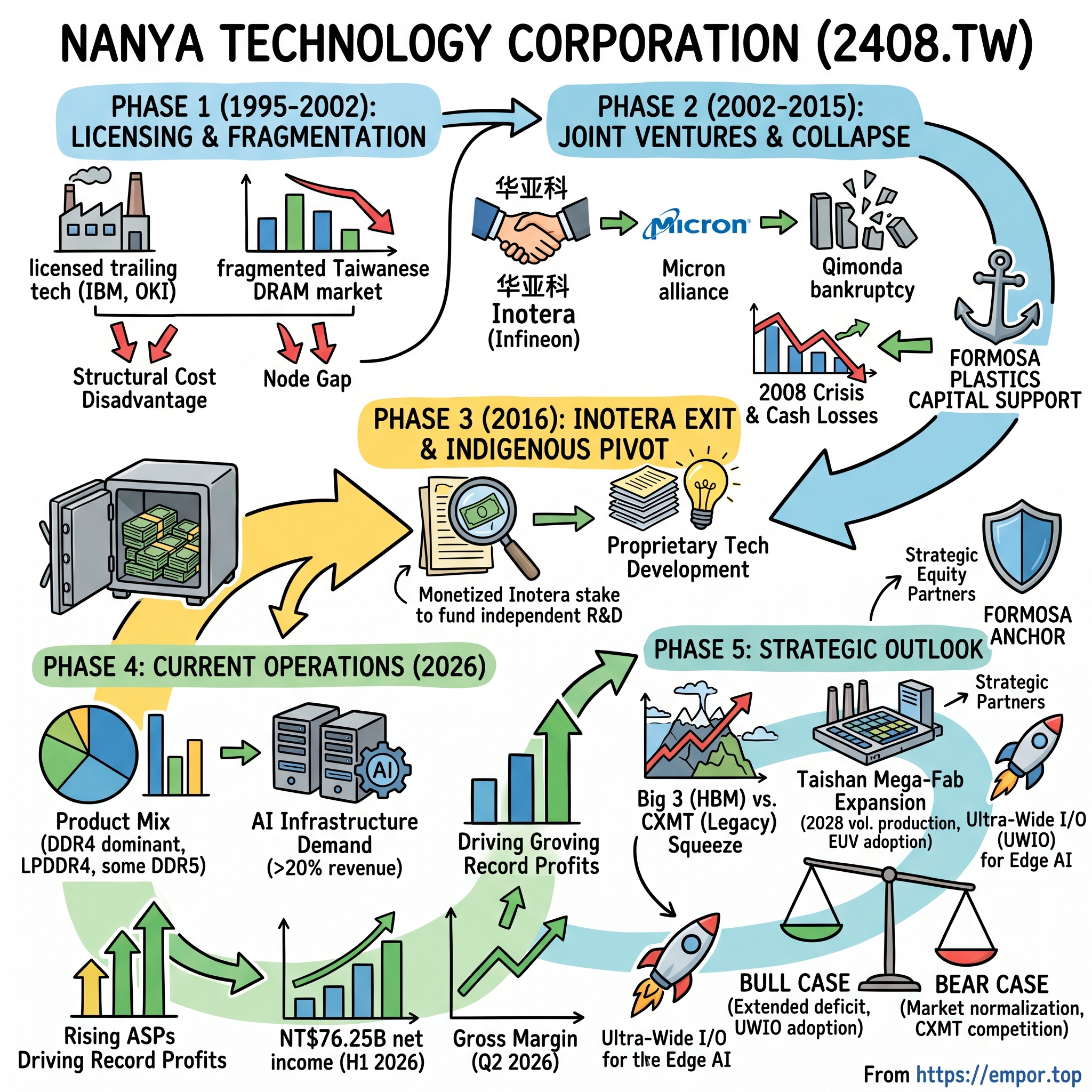
The analysis unfolds across five distinct phases:
Phase 1 (1995–2002): The Formosa investment, Taiwan's "DRAM Inc." expansion, and the technology licensing model that constrained domestic manufacturers.
Phase 2 (2002–2015): The 華亞科 Inotera Memories joint venture with Infineon, the collapse of Qimonda, the 2008–2009 industry crisis, and the subsequent alliance with Micron.
Phase 3 (2016): The exit from Inotera, the transition to indigenous technology development, and the associated financial costs.
Phase 4: Current operations—examining product mix, unit economics, the Taishan mega-fab, and market dynamics shaped by AI infrastructure demand.
Phase 5: Strategic outlook—evaluating operational frameworks, risk factors, and contrasting bull and bear investment cases.
For market participants evaluating the company in 2026, the central question extends beyond historical survival. The key issue is whether present profitability reflects a structural improvement in Nanya's competitive position or a temporary high point in a historically cyclical market.
 Subscribe on LinkedIn
II. The DRAM Meat Grinder & Formosa's Ambition (1995–2002)
Understanding why Taiwan's industrial establishment embraced memory chips in the mid-1990s requires examining what the island had just achieved in logic semiconductors. 台灣積體電路製造 TSMC and 聯華電子 UMC had demonstrated that a small economy combining disciplined manufacturing with global capital could claim a segment of the value chain that American firms viewed as low-margin—contract fabrication—and transform it into a durable, high-return industry. The logic appeared portable: if Taiwan could manufacture third-party logic designs more efficiently than integrated device manufacturers, it should be able to apply the same model to memory chips.
That logic, however, proved flawed. While pure-play foundries and memory manufacturers both operate capital-intensive semiconductor fabrication facilities, their underlying economics differ fundamentally. A foundry sells a service to hundreds of fabless clients that design proprietary chips. Customers remain sticky because transferring a design to another facility incurs high switching costs and operational risk. In contrast, a DRAM producer sells a standardized product that is functionally identical across vendors into a volatile market where customer switching costs are virtually zero. Foundries compete on customer trust and process flexibility; DRAM producers compete almost exclusively on cost per bit, a metric governed by manufacturing scale and process node leadership.
Compounding this commodity dynamic is the memory industry's structural supply cycle. While demand grows relatively steadily, new DRAM capacity arrives in large, discrete increments because semiconductor fabrication plants cannot be built incrementally. When multiple producers expand capacity during an upcycle, the market rapidly transitions from shortage to oversupply within a few quarters. Spot prices drop toward cash operating costs as capital-constrained producers attempt to maintain high fab utilization rates. Industry-wide losses follow, forcing financially weaker competitors out of business until supply tightens, prices recover, and the cycle repeats. Nanya has operated within this volatile environment since its inception.
Into this market stepped 王永慶 Y.C. Wang, founder of Formosa Plastics Group and a prominent figure in Taiwanese industrial development. Wang built an industrial conglomerate based on PVC, petrochemicals, and synthetic fibers—capital-intensive, cyclical commodity sectors. That background influenced both his decision to enter memory manufacturing and his view that long-term survival depended primarily on balance-sheet strength rather than immediate technological leadership. Nanya Technology was incorporated in March 1995, inheriting a 16-megabit DRAM development project that Formosa's plastics division had initiated with Japan's 沖電気工業 OKI Electric Industry.6 Construction of Nanya's Fab I had begun two months prior. In November 1995, Nanya signed a licensing agreement with OKI for 0.36-to-0.32-micron 64-megabit DRAM technology; in November 1997, it executed a technology transfer contract with IBM covering 0.2-to-0.175-micron 64-to-256-megabit components.6
Examining those two agreements reveals an underlying structural vulnerability. Nanya was not developing proprietary memory technology; it was licensing process technology on a generation-by-generation basis from partners with every incentive to reserve leading-edge nodes for their own manufacturing operations. Under this arrangement, licensees consistently reached new process nodes after licensors had already captured peak margins at the top of the cost curve. In a commodity market driven entirely by unit costs, entering a node a generation late converts potential operating profits into sustained cash losses.
Royalty structures further eroded unit economics. A licensee paid ongoing technology fees out of margins that were already narrower than those of industry leaders, in an environment where market leaders set pricing levels that pushed higher-cost producers below cash breakeven. While technology licensing functions effectively in markets with differentiated products, it imposes severe financial burdens in commodity memory manufacturing.
Nanya was one of several Taiwanese manufacturers adopting this strategy. During the mid-1990s, Taiwan's memory sector expanded into a fragmented market of licensed producers: 茂德科技 ProMOS Technologies partnered with Infineon and later エルピーダメモリ Elpida Memory; Powerchip—now 力積電 PSMC—aligned with Mitsubishi and subsequently Elpida; and 華邦電子 Winbond Electronics relied on technology derived from Toshiba. Five domestic producers operated without global manufacturing scale, each licensing technology from foreign partners that were themselves competing against Samsung. The resulting market structure left the domestic industry exposed during severe downcycles.
An additional mechanism further weakened the competitive position of Taiwanese licensees. When a foreign licensor transferred a trailing process node, it established an additional supply source for that specific product, accelerating price declines on the precise components the licensee had capitalized to produce. Japanese and European technology providers monetized legacy nodes by adding production capacity to market segments they were preparing to exit. Consequently, Taiwanese licensees invested in capital equipment for products entering oversupplied markets, effectively converting technology licensing into legacy capacity monetization for foreign partners.
The model nevertheless enabled rapid production scaling in the short term. Nanya achieved commercial production of 0.20-micron 64-megabit SDRAM in 1999, listed shares on the 台灣證券交易所 Taiwan Stock Exchange in August 2000, and initiated construction of Fab II.6 Despite operational execution that met industry standards of the time, the company remained bound by structural cost disadvantages.
The structural constraint underscored a broader principle in commodity manufacturing: the terms of access to core technology set an upper bound on gross margins, which operational efficiencies downstream cannot fully offset. While Nanya's management recognized this limitation, developing a proprietary DRAM process node required billions of dollars and years of focused research and development—resources the company lacked between 1998 and 2002. Consequently, management pursued an alternative strategy: securing a partner willing to share both technology development costs and capital expenditure requirements.
III. The Joint Venture Era & The Inotera Triumph (2002–2015)
In October 2002, Nanya signed a joint venture agreement with Germany's Infineon Technologies to co-develop 0.09 and 0.07-micron process technology and build a 300-millimeter (12-inch) wafer fabrication facility under a newly formed entity, 華亞科 Inotera Memories.6 On paper, the partnership addressed the twin structural constraints that had defined Nanya's first seven years: capital requirements and technology access.
Transitioning to 300-millimeter wafers represented a step change in capital intensity. Larger wafers yield substantially more chips per pass, improving long-term unit economics, but the associated cleanroom facilities and specialized equipment require dramatically higher upfront outlays and raise the threshold for minimum economic scale. Splitting those capital expenditures equally with a European partner enabled Nanya to enter 300-millimeter manufacturing. On the technology front, a joint development model offered clear advantages over standard licensing contracts: rather than adopting trailing-generation processes and remitting royalties for legacy nodes, Nanya participated directly in co-developing next-generation process technology.
Initially, the venture delivered on its objectives. Inotera established an efficient manufacturing engine, giving Nanya access to leading-edge trench-capacitor DRAM technology at a scale it could not have financed independently. However, external corporate restructuring soon altered the relationship.
In 2006, Infineon spun off its memory division into an independent public company, Qimonda. While the divestment insulated Infineon's core automotive and analog semiconductor divisions from memory market volatility, it left Nanya's joint-venture partner without the balance-sheet backing of a diversified parent company. Qimonda entered the impending market contraction as a standalone memory producer facing heightened liquidity risks.
The 2008–2009 global financial crisis triggered one of the severe downturns in DRAM history. Industry-wide capacity additions coincided with a sharp drop in global demand, pushing DRAM spot prices below cash manufacturing costs. Because high fixed costs persisted regardless of fab utilization, producers incurred mounting operating losses whether they maintained or curtailed output. Qimonda filed for insolvency in January 2009. In Taiwan, the crisis created systemic financial stress across the memory sector: the combined debts of the island's five major DRAM manufacturers—including Nanya, Powerchip, and ProMOS—reached approximately NT$377.5 billion.7
Taiwan's Ministry of Economic Affairs attempted to stabilize the sector in 2009 by sponsoring the creation of Taiwan Memory Company (TMC), a state-backed vehicle intended to consolidate domestic DRAM assets into a single scaled producer and acquire foreign technology through partnerships with Elpida or Micron.8 Although the initiative aimed to resolve domestic market fragmentation, it collapsed due to disagreements over valuation, governance, and capital commitments among domestic firms. Industrial consolidation ultimately occurred not through policy intervention, but through market attrition and strategic exits: ProMOS ceased competitive operations, Powerchip pivoted to foundry services, and Winbond redirected its focus toward specialty and niche memory products.
Nanya survived the collapse primarily through sustained financial backing from Formosa Plastics Group. When Micron agreed in October 2008 to acquire Qimonda's 35.6% stake in Inotera for $400 million in cash, a portion of Micron's financing was provided through a $200 million loan from 南亞塑膠 Nan Ya Plastics Corporation, a Formosa affiliate.9 This capital support enabled the American producer to assume Qimonda's position in the joint venture, underscoring the degree to which Nanya's operational continuity depended on its conglomerate parent's willingness to underwrite downturn losses.
The ensuing partnership with Micron temporarily stabilized Nanya's operational position. In the third quarter of 2008, Micron and Nanya established a separate joint venture, MeiYa, under which Nanya and MeiYa agreed to pay Micron an aggregate $232 million in licensing and technology transfer fees through 2010.9 Inotera converted its facilities from Qimonda's trench-capacitor architecture to Micron's stack DRAM process, evolving into one of the industry's lowest-cost manufacturing operations and supplying both parent companies.
Despite these operational gains, the underlying structural arrangement remained largely unchanged. Nanya had replaced one technology licensor with another, continuing to remit significant technology transfer fees and royalties outward. Within the partnership, Nanya functioned primarily as a capital contributor and volume off-taker rather than an equal technology partner. Inotera achieved competitive unit manufacturing costs, but its process roadmap was increasingly dictated by Micron.
The 2008–2009 downturn demonstrated that long-term survival in commodity DRAM hinged less on immediate technological design than on access to patient capital. Competitors with sophisticated technology bases—such as Qimonda with its European engineering footprint, and Elpida, which filed for bankruptcy protection in 2012 despite decades of accumulated expertise—failed when severe price drops depleted their liquidity without external financial backing. Nanya survived because Formosa Plastics Group consistently absorbed cyclical cash losses.
Between 2009 and 2015, global DRAM consolidation reduced the primary supplier base to three major international players, restoring pricing discipline and driving a multi-year financial recovery across the sector. Nanya returned to profitability, but remained strategically vulnerable as a junior partner reliant on licensed process technology. Because Micron possessed the scale and strategic incentive to eventually consolidate full ownership of Inotera, Nanya faced the long-term risk of losing access to its primary manufacturing engine without possessing an independent technology roadmap.
While conglomerate support protected Nanya through the industry's worst downturn, patient capital ultimately bought time rather than structural competitive positioning. By 2015, as Micron evaluated its long-term manufacturing requirements in Taiwan, Nanya was forced to confront the limits of its joint-venture model.
IV. The 2016 Inflection Point: The Inotera Exit & The Indigenous Technology Pivot
By late 2015, Micron faced a strategic limitation that mirrored Nanya's own. As the smallest of memory's primary producers, Micron competed against two South Korean manufacturers with significantly greater consolidated scale, while a substantial portion of its manufacturing capacity remained tied up in a joint venture it did not fully control. Every wafer Inotera produced for Nanya represented capacity Micron could not allocate to its direct customer base, and major operational decisions required ongoing bilateral negotiations. In a market where competitive advantage hinges on unit cost and rapid node transitions, such operational friction carried a substantial financial cost.
To resolve this constraint, Micron sought to acquire full ownership of Inotera. The move presented Nanya with a pivotal strategic choice: continue operating as a junior partner in a joint venture where its leverage was diminishing, or monetize its stake to fund an independent technological roadmap.
Nanya's board approved the transaction in November 2015, and following its announcement in early 2016, the deal closed on December 6, 2016.1011 Micron acquired all remaining Inotera shares at NT$30 per share, valuing the transaction at approximately $4.0 billion net of Inotera's cash and debt.11 Under the terms of the agreement, Nanya transferred its entire holding of 1,587,483,714 Inotera shares to Micron Semiconductor Taiwan for NT$47.62 billion.12 Four days prior to closing, on December 2, 2016, Nanya reinvested a portion of the proceeds, acquiring 57,780,138 shares of Micron common stock for approximately NT$31.5 billion—roughly $1 billion—representing a 5.26% equity stake in its former partner.12
The transaction structure served a dual strategic purpose. Rather than executing a simple asset divestment, Nanya converted its interest in a single-purpose manufacturing entity—whose value depended entirely on a terminating joint venture—into two distinct assets: a substantial pool of unrestricted cash and an equity holding in the industry's third-largest producer. The Micron position provided Nanya with continuing economic exposure to DRAM industry consolidation, a structural anchor for ongoing technology licensing, and a liquid security that could be monetized incrementally over time.
Management subsequently executed that monetization strategy. Nanya began trimming its Micron position in 2017 and accelerated sales through 2019, liquidating tranches into a rising market to lock in capital gains. For example, an early 2019 sale of just over 1.26 million shares at approximately $31.55 per share generated roughly $18 million in gains; by late 2019, Nanya had disposed of more than half its initial stake.13 This phased exit systematically converted paper equity into liquid balance-sheet reserves, creating a multi-year, self-funding capital buffer.
This approach contrasted sharply with common capital allocation practices in cyclical commodity sectors. Historically, producers receiving windfalls near market peaks frequently reinvested immediately in expanded physical capacity, constructing fabrication facilities or acquiring equipment at peak valuations just as market conditions deteriorated. Nanya instead monetized its primary manufacturing asset near a cyclical high and retained the capital, executing a counter-cyclical allocation strategy despite broader industry pressure to deploy excess liquidity immediately.
Securing liquidity, however, addressed only part of Nanya's long-term challenge; the critical question remained how those resources would be deployed.
President 李培瑛 Lee Pei-ing—an engineer with prior experience at IBM, Nanya, and Inotera—alongside Chairman 吳嘉昭 Wu Chia-chao, representing Formosa Plastics Group on the board, directed those funds toward developing proprietary process technology, an asset Nanya had lacked throughout its history.14
Developing an independent DRAM process required substantial engineering and financial resources. Ground-up process development entails designing both the individual memory cell—the physical capacitor storing bit charge and its controlling transistor—and an intricate manufacturing sequence encompassing hundreds of steps to produce billions of defect-free cell structures per chip. Nanya focused its development on a buried-gate cell architecture paired with stacked capacitors, an effort that required building an intellectual property portfolio capable of navigating the dense patent coverage held by the three major global producers.
The execution timeline highlighted the technical complexity of standalone development. Nanya initiated a 20-nanometer pilot run in 2017, but its first-generation 10-nanometer-class node, designated 1A, did not reach pilot production until 2021—five years after the Inotera transaction funded the initiative.6 By the time Nanya reached pilot status on its 1A node, market leaders were already commercializing equivalent 10-nanometer-class technology. The company committed significant capital over five years to achieve process capability that leading competitors were already deploying in high-volume production.
This reality underscored the economic trade-offs of the indigenous technology pivot. Transitioning away from external licensing did not immediately eliminate Nanya's node gap; rather, it altered the nature of that disadvantage—converting a permanent contractual lag into an internal engineering challenge. While Nanya retained the licensing royalties it previously remitted outward and gained control over its technology roadmap, it continued to trail leading producers by approximately one generation. Furthermore, the company was forced to absorb the full research and development expense of subsequent process nodes independently, spreading those fixed costs over a revenue base substantially smaller than those of its larger global peers.
By 2026, that strategic pivot provided Nanya with advantages unachievable under its former licensing model: operational independence and a proprietary technology platform capable of attracting external strategic investment. In March 2026, four global technology companies validated that capability by making major equity investments in the firm.
V. Inside Nanya's Business Model & Segment Economics
Behind Nanya's corporate history lies a straightforward operational question: what products does the company actually sell, and to whom?
As of the second quarter of 2026, product revenue is dominated by legacy standards. DDR4 and low-power DDR4 (LPDDR4) together accounted for roughly 70% of total sales. DDR3 and LPDDR3—memory standards introduced in the late 2000s—contributed another 10%. Meanwhile, DDR5, the current mainstream standard for personal computers and servers, represented approximately 10%.1
This distribution underscores Nanya's primary role in the global market: it is overwhelmingly a supplier of previous-generation memory. Rather than operating as a niche specialist in exotic architectures or a leading high-bandwidth memory provider for artificial intelligence, Nanya manufactures mature DDR4 and LPDDR4 components—standards that the three major global producers have been actively phasing out.
Where those chips go is more varied than the product mix suggests. Nanya's traditional strength lies in consumer and networking applications, including televisions, set-top boxes, routers, networking hardware, IP cameras, smart-home devices, gaming systems, and a wide range of industrial and automotive electronics. These markets exhibit characteristics that major producers generally find unattractive: modest order volumes per stock-keeping unit and extended product lifecycles spanning five to ten years. Customers in these segments require specific part numbers to remain available and qualified for a decade, rather than constantly migrating to the newest, densest die. Nanya has historically served roughly 800 customers—a highly fragmented base by semiconductor industry standards.15 The company also supplies PC and server module makers alongside mobile low-power applications, though it does not break out quarterly revenue by end application or disclose precise segment percentages.
The newest segment is what management categorizes as AI infrastructure exposure, which accounted for more than 20% of revenue in the second quarter of 2026.1 This category encompasses memory integrated into AI servers, networking gear, and storage systems, rather than high-bandwidth memory stacks directly.
The underlying economics of this model are direct and subject to extreme operational leverage. Nanya's cost structure is largely fixed. A fabrication facility's depreciation, cleanroom operations, utility expenses, and engineering personnel do not fluctuate with DRAM spot prices. While raw materials and silicon wafers introduce variable costs, the primary margin driver remains capacity utilization. Under almost all operating conditions, the rational posture is to run fabs at full capacity. Consequently, total revenue functions almost entirely as a product of two variables: bit shipment volume and average selling price.
Average selling price does not merely influence margins; it determines them. Across five consecutive quarters, this relationship was clearly visible. In the fourth quarter of 2025, revenue reached NT$30.1 billion with a 49% gross margin.16 In the first quarter of 2026, average selling prices increased by more than 70% sequentially even as bit shipments fell by a mid-single-digit percentage; revenue nonetheless jumped 63% to NT$49.1 billion, and gross margin expanded to 67.9%.17 In the second quarter, bit shipments remained flat while average selling prices rose by approximately another 60%, pushing gross margin to 79.5%.1 During the second-quarter earnings call, Chief Executive Officer Lee Pei-ing stated the operational dynamic directly: with flat shipment volumes and a stable cost structure, margin expansion was almost entirely driven by higher average selling prices.1
This pricing sensitivity defines the company's financial model. When DRAM prices rise, nearly all of the gain flows directly to gross profit because manufacturing costs remain unchanged. When prices decline, that operational leverage operates in reverse—explaining why Nanya recorded a negative 15% gross margin in the first quarter of 2025, just one year before reaching 67.9%.18 Management possesses no operational lever that approaches the impact of global DRAM pricing.
The second driver of revenue growth is bit volume expansion, which occurs through two mechanisms. The first is constructing new wafer fabrication capacity—a slow, capital-intensive process. The second is die shrinkage, which increases the number of usable chips harvested from each wafer at virtually the same processing cost. Historically, die shrinkage has served as the industry's primary engine of cost reduction, mechanically lowering unit costs per bit even before yield optimizations. This reliance on die shrink explains why process node leadership is critical, and why trailing by a generation imposes a persistent cost disadvantage under normal market conditions.
This structural dynamic highlights Nanya's competitive cost position. Nanya cannot match Samsung or SK Hynix on bit manufacturing costs for mainstream commodity DRAM. It lacks the volume scale required to amortize research and development expenditures, lacks the node leadership to shrink die dimensions as aggressively, and lacks equivalent purchasing leverage with equipment vendors. On comparable components during standard market conditions, Nanya remains a higher-cost producer than the industry leaders—a reality that has persisted for thirty years.
Nanya relies on three partial offsets to mitigate this disadvantage. First, it operates older, fully depreciated process nodes, which reduces cash manufacturing costs on legacy parts even if its total cost per wafer remains higher. Second, the company has not yet incurred the massive capital expenditure associated with extreme ultraviolet lithography—the costly, cutting-edge toolset adopted by top-tier producers—keeping its capital costs per wafer on mature nodes comparatively low. Third, Nanya operates in market segments where customer purchasing decisions are not driven solely by price per bit. A networking manufacturer that has qualified a Nanya component for a seven-year product lifecycle faces substantial switching costs, while automotive suppliers face strict qualification regulations.
These offsets provide real but bounded protection, allowing Nanya to maintain profitability through the mid-point of an industry cycle. They do not, however, insulate the company during cyclical troughs, as demonstrated by the losses in 2023 and 2024. Furthermore, these factors do not account for the financial surge in 2026; Nanya's cost structure and customer relationships remained essentially unchanged between 2024 and 2026. The primary transformation occurred in external market conditions.
Myth versus reality
Three widespread market assertions regarding Nanya warrant examination:
Myth: Nanya is the world's fourth-largest DRAM manufacturer. While this statement was accurate for years and remains common in marketing literature, it no longer reflects revenue market share. CXMT captured 7.7% of global DRAM revenue in the first quarter of 2026, establishing a position well ahead of Nanya's low single-digit share.4 This distinction is significant: being fourth in a tightly consolidated oligopoly suggests active participation in setting industry pricing and technology direction. Holding a low single-digit market share leaves Nanya strictly as a price-taker.
Myth: Nanya's financial recovery proves the success of its indigenous technology strategy. The reality is more nuanced. While Nanya's 1B process node is in volume production and verified by independent teardown analysis, financial results show that technology was not the primary driver of the turnaround.23 Bit shipments declined by a mid-single-digit percentage in the first quarter of 2026 and remained flat in the second quarter; the entirety of the revenue and profit growth stemmed from price increases.117 Flat shipment volumes indicate that the company is not capturing market share, but rather receiving higher prices for equivalent output—a market-driven windfall rather than an operational achievement. The true test of Nanya's proprietary technology strategy will occur when DRAM prices normalize and the company must compete strictly on unit cost and product performance.
Myth: Equity investments from four technology customers validate Nanya's technological differentiation. A more direct explanation is supported by industry context: NAND flash and solid-state drive manufacturers require DRAM controllers to complete their storage products.2028 With primary DRAM suppliers unable to meet demand, customer equity investments served as the cost of securing guaranteed chip allocations. These transactions demonstrate that Nanya's manufacturing capacity is highly valuable during a market deficit—an important distinction. If Nanya's DDR4 supply were readily available elsewhere, customers would not have acquired equity stakes to secure access.
These factors do not diminish Nanya's operational execution. They indicate that its 2026 financial performance reflects broader industry dynamics rather than a fundamental shift in its competitive position. That distinction forms the core boundary between the optimistic and cautious outlooks for the company.
VI. The 10nm Frontier & The Big 3 vs. CXMT Squeeze
In early March 2026, Chief Executive Officer Lee Pei-ing stated that the global DRAM shortage would persist through 2028, with the tightest supply conditions extending into the first half of 2027. Asked whether planned industry capacity additions would resolve the deficit, he noted that the disparity between supply and demand was immense and that proposed additions appeared insufficient.19 For an executive with a decade-long record of conservative guidance, it was an unusually direct assessment—one supported by broader manufacturing dynamics across the memory sector.
The primary driver behind this market deficit lies in a fundamental wafer-allocation shift among the industry's top three producers: Samsung Electronics, SK Hynix, and Micron Technology.
High Bandwidth Memory (HBM)—the specialized memory stacked alongside artificial intelligence accelerator chips—consists of DRAM dies bonded vertically and linked by thousands of interconnects to yield higher bandwidth than standard memory. However, HBM is exceptionally wafer-intensive. Producing a given volume of HBM bits consumes roughly three times the wafer capacity required for equivalent DDR5 bits due to lower stacking yields and advanced packaging overhead.20 Although HBM's share of global DRAM bit output was projected to reach 10% in 2026—up from 7% in 2025 and 4% in 2024—its actual strain on fabrication capacity is far greater.19
Because every percentage point of HBM market share absorbs roughly three percentage points of conventional wafer capacity, the top three producers have aggressively reallocated production toward HBM, where prices command significant premiums from less price-sensitive AI infrastructure buyers. This shift created a severe supply deficit across standard DRAM products. Micron disclosed it could fulfill only 55% to 60% of core customer demand, while Samsung and SK Hynix extended production lifecycles for DDR4 components they had previously intended to phase out.20
Nanya, lacking the scale and advanced packaging required to compete in HBM, retained production capacity in the exact mature standards the industry leaders had curtailed. Rather than outmaneuvering competitors, Nanya benefited as major rivals vacated legacy market segments.
This dynamic is reflected in Nanya's product transition strategy. During the second-quarter 2026 conference call, when asked why DDR5 remained at only 10% of total revenue, management explained that wafer capacity was the primary constraint and that customers could source DDR5 from multiple vendors, whereas DDR4 and LPDDR4 supply remained restricted.1 Consequently, Nanya prioritized legacy chip production because tight supply produced superior gross margins compared with the competitive environment for newer standards. Industry analyst TrendForce reported in May 2026 that the DDR4 shortage was delaying Nanya's transition to DDR5, with management noting that gross margins across its traditional DRAM portfolio exceeded standard HBM margins.21
While economically rational in the short term, this approach carries strategic risk. Every quarter Nanya dedicates to capturing elevated DDR4 margins postpones building DDR5 manufacturing volume, yield experience, and customer qualifications—capabilities required once market supply normalizes.
The homegrown node roadmap
Nanya's technological strategy centers on its proprietary 10-nanometer-class process generations. Its 1A node established that the company could design and manufacture an independent DRAM cell without foreign licensing. The second-generation 1B node serves as the core manufacturing process, supporting 16-gigabit DDR5, DDR4, and LPDDR4 chips with smaller die sizes, lower operating voltages, and higher speeds. Chairman Wu Chia-chao identified 1B as the primary expansion focus in 2024, and management targeted the node to represent over 30% of total bit output in 2025.2218 Teardown analysis by TechInsights of Nanya's 1B 16-gigabit DDR5 component confirmed that the process reached commercial volume production.23
Looking ahead, Nanya's 16-gigabit DDR5 on the 1C process was scheduled to complete customer qualification in the second half of 2026, while a 1D process variant entered pilot production. Management indicated that 1C, 1D, and 1E process development and extreme ultraviolet (EUV) lithography preparation were progressing on schedule, with EUV integration targeted for approximately 2028.1
The planned 2028 adoption of EUV lithography represents a critical milestone. EUV tools enable single-exposure patterning of nanoscale features, replacing complex multi-patterning techniques. Leading global competitors have operated EUV tools in DRAM fabrication for several years. Adopting EUV would narrow Nanya's process gap, but it will also expose the company to substantial capital expenditure requirements. Nanya's temporary cost advantage from avoiding EUV tools stems from trailing the technology frontier rather than a sustainable cost strategy.
The mega-fab, and a credibility check
Nanya's expansion plan centers on a new 12-inch fabrication facility in Taishan District, New Taipei City. Announced in April 2021 with an estimated investment of NT$300 billion, the project targeted an initial phase of 15,000 wafers per month with commercial shipments expected in 2024.15 Groundbreaking occurred in June 2022.6
By mid-2026, the facility had not initiated commercial shipments. Equipment installation is scheduled for the first quarter of 2027, with volume production expected in 2028 at 30,000 wafers per month and a long-term target of 45,000 wafers.119 Total projected investment to reach full capacity was revised upward to NT$480 billion—with nearly NT$100 billion already deployed—and senior management indicated that total expenditure could reach NT$500 billion including EUV tooling.35
This shift represents a four-year timeline delay and an approximate 60% increase in projected costs from the initial announcement. While capital expenditure reductions during the 2022–2024 industry downturn and broader equipment inflation offer partial explanations, the variance remains significant. Nanya guided 2026 capital expenditure to approximately NT$52 billion—up from NT$13.4 billion in 2025—and outlined a preliminary 2027 capital budget exceeding NT$200 billion (roughly US$6.2 billion), subject to formal board approval.320
The squeeze from below
While top-tier producers vacated mature memory nodes from above, China's state-backed CXMT expanded aggressively from below. Unburdened by immediate return requirements, CXMT scaled DDR4 and LPDDR4 capacity rapidly. Chief Executive Officer Lee Pei-ing noted in February 2025 that without additional Chinese production capacity, the global DRAM market would have recovered sooner.18 By the first quarter of 2026, CXMT captured 7.7% of global DRAM revenue—surpassing Nanya—while industry reports indicated that CXMT was beginning to shift capacity from DDR4 toward DDR5, achieving reported DDR5 manufacturing yields around 80%.41824
CXMT's transition toward DDR5 temporarily reduces pricing pressure on Nanya's legacy DDR4 business, but it establishes a well-capitalized competitor in Nanya's target growth segment.
What the market has done with all this
Public equity markets responded dramatically to Nanya's financial turnaround. Over the twelve months ending in mid-2026, Nanya's share price increased approximately sevenfold within a 52-week range of NT$42.10 to NT$505.00, pushing the company's market capitalization above NT$1 trillion.29 This valuation shift reflects market expectations that elevated earnings will persist rather than revert to historical cyclical averages.
This repricing highlights the core investment debate. Equity markets are no longer valuing Nanya based on its 2025 net income of NT$6.6 billion or its cumulative losses in 2023 and 2024.162 Instead, current valuations reflect the continuation of peak margin conditions. Consequently, investor returns depend primarily on the duration of the global DRAM deficit—a market factor outside Nanya's direct control.
The AI hedge that is not HBM
To address its absence from the HBM market, Nanya introduced customized Ultra-Wide I/O (UWIO) memory utilizing wafer-on-wafer bonding. This architecture directly joins a DRAM wafer to a logic processor or ASIC wafer, bypassing lateral packaging. Senior Vice President Joseph Wu stated that UWIO delivers five to ten times higher bandwidth while consuming one-third to one-tenth the energy of HBM, making it suitable for power-constrained edge and AI inference workloads.5 UWIO generated initial revenue in the first quarter of 2026, with several customers engaged in custom design and pilot production and reports indicating over ten global clients evaluating the technology.172526
While UWIO offers a logical architecture for edge AI applications where HBM energy consumption is prohibitive, the technology remains early in its commercial adoption. Nanya has not disclosed separate UWIO revenue figures or major volume supply contracts. Until UWIO generates material, transparent revenue contributions, it represents a long-term technology option rather than a core financial driver.
VII. Management, Corporate Governance, & The Formosa Anchor
There is a particular kind of executive produced by three decades inside a business that nearly died twice, and Lee Pei-ing is the archetype. An engineer who came up through IBM before spending his career across Nanya and Inotera, he became President of Nanya and has run it through the entire indigenous-technology pivot.14 His public communication style is notably unlike the average semiconductor CEO's: technical, incremental, and reluctant to make claims beyond the next quarter or two. On earnings calls he tends to answer questions about pricing with specifics about supply-demand mechanics rather than aspiration.
That temperament has a track record worth examining, because management credibility in a cyclical business is best judged by what someone said at the bottom, not the top.
In February 2025, with the company still losing money, Lee forecast a DRAM recovery in the first half of 2025, attributed the prolonged downturn primarily to Chinese oversupply, and set a target of achieving quarterly profitability during 2025.18 Nanya delivered: full-year 2025 revenue reached NT$66.6 billion, up 95.1%, with net income of NT$6.6 billion versus a prior-year loss, and the fourth quarter alone produced NT$11.1 billion of net income at a 49% gross margin.16 The recovery arrived somewhat later in the year than "first half" implied, but the profitability commitment was met.
The 1B node targets have similarly been met roughly on schedule — over 30% of bit output during 2025 was the stated goal, and third-party teardown evidence confirms the product shipped.1823 Against that, the Taishan fab timeline slipped by four years and its budget by more than half. A fair summary of management's record: reliable on technology execution and on near-term financial commitments, unreliable on large multi-year capital project timelines — which is, to be fair, a very common pattern in semiconductor manufacturing, and the delay coincided with a downturn in which spending less was the right answer.
One narrative shift deserves scrutiny. Lee has recently framed AI demand as driving a structural change in memory supply-demand dynamics that mitigates the industry's cyclicality.3 That is a meaningfully different claim from anything Nanya's management said in prior cycles, and every previous generation of memory executives has made a version of it near a peak — the "this time the cycle is different" argument has an unbroken record of being wrong in DRAM. Nanya's own results, which swung from a negative fifteen percent gross margin to a positive seventy-nine and a half percent inside six quarters, are themselves the strongest available evidence against the de-cyclicalization thesis. Investors should treat that framing as a claim requiring proof, not an established fact.
Chairman 吳嘉昭 Wu Chia-chao serves as the link to the parent group, representing 南亞塑膠 Nan Ya Plastics Corporation on the board alongside Lee.14 The Formosa Plastics Group structure is the defining governance fact about this company: Nanya's controlling shareholders are the group's industrial entities — Nan Ya Plastics, 台灣塑膠 Formosa Plastics, 台灣化學纖維 Formosa Chemicals & Fibre, and 台塑石化 Formosa Petrochemical — which collectively hold a controlling position.27
The advantages of that structure have been described. The costs deserve equal billing, and an activist investor would name them precisely.
First, minority shareholders in Nanya do not control the company's destiny; a group of affiliated petrochemical companies does, and their objective function includes considerations — group-level financial health, Taiwanese industrial policy relationships, long-horizon strategic positioning — that are not identical to maximizing return on Nanya's capital. Second, related-party dealings are structurally embedded: the group financed the Micron-Qimonda transaction, and Nanya acquired 19% of Formosa Advanced Technologies, a group affiliate, in July 2018.69 Such transactions may be entirely fair, but they are not arm's-length by construction. Third, the willingness to fund through downturns that saved Nanya is the same willingness that could fund a bad project through a downturn.
The March 2026 private placement changed the register modestly. Nanya raised NT$78.72 billion — about US$2.5 billion — issuing 351.57 million shares at NT$223.9, a discount of only about 1.15% to market, completing on April 8.28 The buyers were SanDisk Technologies at roughly 4%, and Kioxia (キオクシア), Solidigm — SK Hynix's NAND subsidiary — and Cisco Systems at roughly 2% each, taking a combined 10.19% of the enlarged share count.1728 Three of the four are primarily NAND and SSD companies; SanDisk and Kioxia both entered long-term DRAM supply agreements alongside their investments.28
Two second-layer observations are worth noting alongside it. First, the placement was struck at a moment when Nanya's shares had already risen dramatically, meaning the company issued equity into strength rather than dilution into weakness — the mirror image of the rights issues it relied on during the 2008–09 period. Second, the composition of the buyers is itself a disclosure: when Cisco, a networking company with no memory manufacturing ambitions, takes an equity position in a DRAM maker, it is signaling that memory scarcity has propagated beyond servers into the control-plane and packet-buffering layers of AI networking hardware.20 That is a useful data point about the breadth of the shortage, and a reminder that the same breadth implies a large amount of incremental capacity is being commissioned across the industry right now.
The strategic reading is straightforward and important: NAND makers need DRAM to build complete enterprise SSDs, the Big 3 could not supply them, and equity was the price of securing allocation.20 For Nanya, that is a genuine validation — customers do not buy 2% of a supplier for sentiment — and it introduces a bloc of large, sophisticated, non-Formosa shareholders with their own view of how the company should be run. Whether that improves governance or simply adds a second set of non-financial objectives is not yet clear. The near-zero discount, at least, indicates Nanya negotiated from strength rather than desperation.
VIII. Playbook: Business, Strategy, & Investing Lessons
Four transferable lessons emerge from thirty years of Nanya's operational history, and the most useful applications carry critical qualifications.
1. Conglomerate patient capital is an asymmetric advantage — but it is a survival mechanism, not a competitive one. The clearest natural experiment in this narrative unfolded across Taiwan's DRAM sector between 2008 and 2012. Five domestic producers entered the downturn; those lacking deep-pocketed, diversified corporate parents—most notably ProMOS—did not survive. Nanya, whose parent group was willing to extend credit and support rights issues, did.79 In a capital-intensive commodity market where the severity of a downcycle is measured in multi-year periods of negative gross margins, the ability to absorb cash losses longer than rivals represents a decisive survival asset.
Yet conglomerate backing did not confer an operational cost advantage, close the technology gap, or eliminate fifteen years of dependency on foreign licensors. Patient capital bought time, and time creates value only when effectively deployed. Between 2009 and 2016, Nanya operated primarily as a junior partner in an external manufacturing system. The true value of its survival became apparent only when the 2016 Inotera transaction provided management with the capital required to execute an independent strategy. Investors evaluating conglomerate-backed cyclical companies should ask not merely whether the firm will survive, but how management intends to capitalize on that survival.
2. Counter-cyclical asset monetization beats counter-cyclical asset accumulation. Conventional wisdom in capital-intensive industries advises purchasing distressed assets during market troughs. Nanya's trajectory illustrates a complementary and less frequently practiced discipline: monetizing assets when a strategic buyer requires them more than the seller does. In 2015, Micron was not acquiring Inotera opportunistically; it required full operational control to compete against its two larger South Korean rivals. That strategic imperative dictated the transaction price. Nanya's stake in a joint venture with a terminating partnership held far greater value for Micron than for Nanya, allowing the seller to capture that premium.
The structure of the reinvestment proved equally critical. Rather than accepting a pure cash payout, Nanya took cash alongside equity in the acquirer, preserving economic exposure to the industry consolidation it was helping facilitate while acquiring a liquid security it could monetize on its own timeline.1213 Selling into a buyer's strategic necessity—and structuring the proceeds to preserve long-term optionality—offers a far more effective strategy than an immediate exit or an expensive battle for control.
3. The licensing trap is real, and escaping it is expensive enough that most companies shouldn't try. Nanya's two decades as a technology licensee to OKI, IBM, Infineon, and Micron demonstrated the structural ceiling of dependent manufacturing: a licensee in a commodity market reaches new process nodes late and remits royalties to competitors for trailing technology.69 Escaping that trap required allocating roughly $1 billion in Inotera sale proceeds and spending five years to produce its first-generation 10-nanometer-class pilot node.6
The long-term outcome remains nuanced. Nanya eliminated ongoing royalty payments and secured full control over its technology roadmap—a permanent structural gain. However, it did not eliminate its process node lag; it transformed a contractual disadvantage into an internal engineering challenge while assuming the full research and development burden independently. The broader strategic rule is specific: if competition centers entirely on unit cost and the technology licensor is also a direct competitor, licensing imposes a structural cost ceiling that operational execution cannot overcome. Only under those specific conditions is the substantial cost of technological independence justified.
4. Niche positioning in an oligopoly works where scale matters least — and the definition of "least" is set by the giants, not by you. Nanya's defensible market footprint rests in legacy segments: consumer components with decade-long product lifecycles, automotive and industrial chips requiring lengthy qualifications, and smaller customers that tier-one DRAM producers overlook. In these segments, customer switching costs are genuine, and the scale advantages of major producers are partially muted.
Crucially, however, Nanya occupies this market space because the top three global producers selectively vacated it to reallocate wafer capacity toward high-bandwidth memory. When artificial intelligence capital expenditures normalize and top-tier suppliers reallocate mature-node capacity, these legacy segments will face renewed competition. A market position held through competitor indifference is temporary rather than inherently defensible. The central strategic challenge for Nanya is whether it can translate this temporary opening into durable market share—through custom architectures like UWIO, deep automotive qualifications, and strategic customer equity ties—before competitive pressure returns.
This leads directly to the strategic frameworks and investment evaluations that follow.
IX. Strategic Frameworks, Risk Radar, & Bull vs. Bear Stress Test
Hamilton Helmer's 7 Powers
Process Power — moderate and developing, but unproven at the level that matters. Nanya has built a genuine indigenous 10-nanometer-class DRAM process, verified by third-party teardown analysis of its 1B 16-gigabit DDR5 component.23 That is a real technical milestone few global semiconductor companies can claim. In Hamilton Helmer's framework, however, Process Power requires an operational advantage that competitors cannot replicate even when understood. Nanya's process does not surpass industry leaders; it trails them by roughly a generation. What Nanya possesses is operational sufficiency rather than superiority—the capability to compete without relying on a foreign licensor. That represents a removed liability rather than a structural power.
Counter-Positioning — moderate, and currently the strongest card. Nanya serves mature-node, long-lifecycle, high-mix demand that the top three global producers are structurally disinclined to prioritize, because every wafer allocated to legacy DRAM represents capacity diverted away from high-bandwidth memory commanding substantial price premiums. This creates a genuine counter-position: the incumbents' rational capital allocation creates Nanya's market opportunity, and reversing that choice would require sacrificing their highest-margin product lines. The core vulnerability is that this position relies on persistent artificial intelligence capital expenditure. It reflects counter-positioning against a temporary allocation decision rather than an enduring business-model conflict.
Scale Economies — clearly negative, representing the dominant structural limitation. Compared with Samsung Electronics at 38.6%, SK Hynix at 28.8%, and Micron Technology at 22.4% of global DRAM revenue, Nanya operates across a fraction of the volume required to amortize research, development, and capital investments.4 China's CXMT has also surpassed Nanya in revenue scale. Because scale serves as the primary driver of cost per bit in memory manufacturing, this represents a permanent structural constraint rather than a temporary operational deficit.
Switching Costs — high across a narrow minority of revenue, low across the majority. In automotive infotainment, advanced driver-assistance systems, industrial automation, and networking equipment with seven-to-ten-year product lifecycles, requalifying a memory component is expensive and time-consuming, providing Nanya with a defensible customer base. Conversely, in mainstream personal computer and server DRAM—which are standardized commodity components—switching costs are negligible. The March 2026 equity investments from SanDisk, Kioxia, Solidigm, and Cisco Systems, combined with multi-year supply agreements, represent a deliberate effort to create customer switching costs where the underlying product does not generate them.28 While strategic, a commercial agreement tied to a 2% equity stake forms a weaker bond than a deep hardware design-in.
Branding, Network Economies, Cornered Resource — essentially absent. DRAM buyers do not pay a premium for brand identity, memory hardware lacks network effects, and Nanya controls no proprietary raw inputs.
The composite assessment indicates that Nanya's durable competitive advantages remain narrow, while its structural cost disadvantage remains broad. Current financial results are driven primarily by favorable market dynamics rather than proprietary strategic power.
Porter's Five Forces
Rivalry — extreme, and only temporarily suspended. High fixed costs and standardized products make DRAM a classic candidate for destructive price competition during industry downturns. While current supply tightness has suspended active price wars, it has not eliminated underlying competitive dynamics, as major producers expand capacity simultaneously into the same supply deficit.
Threat of new entrants — bifurcated by capital structure. The barrier is prohibitive for private commercial capital; expanding the Taishan mega-fab alone requires NT$480 billion to reach full capacity.3 The barrier is substantially lower for state-backed entrants unburdened by market-return thresholds, which enabled CXMT to expand from inception to a 7.7% global DRAM revenue share.4 Where capital requirements represent the primary entry barrier, sovereign backing effectively neutralizes the constraint.
Buyer power — variable, and currently inverted. Buyer power is historically strong among personal computer original equipment manufacturers and cloud hyperscalers that purchase large volumes from multiple vendors. With Micron fulfilling only 55% to 60% of core customer demand, severe supply shortages have forced buyers to take minority equity positions in Nanya to secure component allocations.2028 This inversion highlights the unusual nature of current market conditions and signals an eventual return to historical buyer leverage as industry supply normalizes.
Supplier power — high and rising. ASML holds a near-monopoly on extreme ultraviolet lithography tools; Applied Materials, Lam Research, and Tokyo Electron dominate key equipment categories; and silicon wafer supply remains concentrated. As memory producers expand capacity simultaneously, lead times and tool pricing move against buyers.20 Nanya's planned adoption of extreme ultraviolet lithography around 2028 will expose the company to the most concentrated supplier in the semiconductor value chain at a time of peak tool demand.1
Substitutes — low over the near term. No commercial computing architecture currently replaces DRAM for primary system memory, while emerging non-volatile memory alternatives remain cost-prohibitive. This represents Nanya's most secure competitive force.
Risk radar
Cycle-timing and capital expenditure risk represents the primary operational hazard. Nanya is committing NT$480 billion to reach full Taishan capacity, with its preliminary 2027 capital budget potentially exceeding NT$200 billion, into a market that management projects will remain tight through 2028.319 Major competitors are making similar capacity commitments. Historical DRAM cycles demonstrate that simultaneous facility expansions authorized during peak pricing routinely enter production as market demand softens. With Nanya's new capacity scheduled for volume production in 2028—precisely when management expects supply conditions to normalize—this timing alignment constitutes the central unhedged risk in the corporate outlook.
CXMT's move upmarket. The migration of Chinese manufacturing capacity from legacy DDR4 into mainstream DDR5 reduces pricing pressure on Nanya's current core revenue base while introducing a subsidized competitor into its primary growth segment.24 Nanya must scale its DDR5 output into a market segment where a state-backed rival with low capital costs is expanding simultaneously.
AI market divergence. Nanya remains absent from high-bandwidth memory, where industry profits are concentrating. Its alternative architecture, Ultra-Wide I/O, has generated initial revenue without disclosed financial metrics.1725 If artificial intelligence memory demand remains concentrated in high-bandwidth memory while edge inference adoption proceeds slowly, Nanya risks remaining confined to standard commodity segments during a highly profitable industry expansion.
Product-transition lag. DDR5 representing only 10% of second-quarter 2026 revenue highlights a slow portfolio transition.1 While management's strategy of prioritizing higher-margin DDR4 production during a supply deficit is economically rational in the short term, it risks leaving Nanya with trailing product qualifications once legacy market conditions normalize.
Execution and geopolitical exposure. The Taishan project's history of schedule revisions and cost increases remains an ongoing operational consideration. Furthermore, Nanya's manufacturing footprint remains entirely concentrated in Taiwan, creating a structural disadvantage as global customers increasingly demand geographic supply-chain diversification—a requirement that larger peers with manufacturing operations in the United States, Japan, and South Korea can satisfy.
The activist's case
A skeptical investor evaluating Nanya in 2026 would highlight several structural concerns. On capital allocation, committing NT$480 billion near the peak of an unprecedented memory upcycle raises questions about capital discipline, particularly given that the same management team's previous mega-fab project ran four years behind schedule and 60% over its initial budget.153 On corporate governance, a controlling ownership block held by affiliated petrochemical companies with a history of related-party transactions may not consistently align with minority shareholder interests.9 On executive narrative, management's recent assertion that artificial intelligence demand mitigates industry cyclicality mirrors claims made near the top of previous market cycles—a notable stance for a company whose gross margin swung 94 percentage points across six quarters.318 On financial disclosure, Nanya does not break out Ultra-Wide I/O revenue, detail sales by end application, or report its spot-versus-contract pricing mix, making it difficult for outside investors to distinguish structural market gains from temporary price windfalls.
The counter-argument rests on concrete operational milestones. Completing a March 2026 private placement at a modest 1.15% discount to market value with four major strategic technology buyers represents meaningful external validation.28 The 2016 Inotera monetization demonstrated strong long-term capital allocation. Furthermore, the company's balance sheet—supported by a book value per share of NT$62.25 at the end of the first quarter of 2026 and expanded cash reserves following the strategic equity placement—provides financial flexibility that was absent during the 2008 downturn.173
Bull case
Nanya successfully scales its 1B and 1C process nodes across DDR5 and LPDDR5 production, converting current cash flows into a modern product portfolio. The top three global producers remain committed to high-bandwidth memory production through the end of the decade, permanently ceding mature and mainstream market segments. The Taishan facility begins volume production into an extended supply deficit, while Ultra-Wide I/O establishes a profitable revenue stream in power-sensitive edge computing applications where high-bandwidth memory is unsuited. Customer equity investments translate into multi-year supply agreements that dampen spot-market price volatility. Meanwhile, Formosa Plastics Group's controlling stake provides the balance-sheet backing needed to fund capital expansions without diluting equity value, enabling Nanya to emerge from the cycle as a structurally stronger competitor.
This optimistic outlook requires three conditions to occur simultaneously: sustained artificial intelligence capital expenditure, on-time execution of the Taishan facility buildout, and competitive DDR5 volume scaling against state-subsidized rivals. While each condition is achievable, their simultaneous execution presents a demanding operational requirement.
Bear case
The global DRAM shortage resolves earlier than anticipated as industry-wide capacity additions arrive simultaneously between 2027 and 2028. As DRAM prices normalize, Nanya's high operational leverage—which drove gross margins to 79.5% during the upcycle—operates in reverse during the downturn. The NT$480 billion capital commitment lands in an oversupplied market, converting cash reserves into a heavy depreciation burden. Subsidized DDR5 capacity from CXMT limits pricing power in Nanya's primary growth market, while Ultra-Wide I/O fails to achieve commercial scale beyond pilot projects. Ultimately, Nanya expends its cyclical windfall on fixed manufacturing assets near the top of the market cycle, remaining a generation behind industry leaders and exposed to standard commodity price swings.
The cautious outlook requires only one underlying condition: that the memory cycle follows its historical pattern.
X. Epilogue & The 3 KPIs That Matter
Three metrics carry nearly all the signal regarding whether Nanya's trajectory represents a structural shift or a familiar historical repeat.
1. Blended average selling price change, quarter over quarter and year over year. Average selling price is the primary financial driver. Nanya's cost structure is largely fixed and shipment volumes have remained flat, meaning the entire swing from a negative 15% gross margin to a positive 79.5% came almost entirely from pricing.118 Average selling price determines gross margin, gross margin dictates cash flow, and cash flow determines whether the NT$480 billion Taishan commitment is funded from operations or balance-sheet reserves. Direction matters more than magnitude: the first sequential drop in average selling prices will signal the cycle's inflection far more clearly than any single positive quarter.
2. DDR5 share of revenue, and 1B and 1C node share of bit output. These two metrics measure whether Nanya is converting a temporary pricing windfall into permanent product competitiveness. DDR5 represented approximately 10% of revenue in the second quarter of 2026, while DDR4 and LPDDR4 accounted for roughly 70%.1 If DDR5 revenue remains near 10% a year from now, Nanya will have spent the most favorable pricing environment in its history harvesting legacy products rather than advancing its market position—leaving it exposed to a normalized market with a trailing portfolio. Process node share serves as the leading indicator: bit production must transition to the 1B and 1C nodes before product revenue can follow.
3. Capital expenditure execution against the Taishan schedule. The full-capacity commitment stands at NT$480 billion, with equipment installation scheduled for the first quarter of 2027, initial volume production in 2028 at 30,000 wafers per month, and a long-term target of 45,000 wafers per month.319 For a project that has slipped four years behind schedule and incurred substantial budget increases, each milestone met or missed provides direct evidence of management's ability to execute at scale.15 This timeline should be evaluated alongside inventory days: rising inventory paired with falling average selling prices is the classic early signal of a turning memory upcycle, and that combination arriving alongside an unfinished fabrication facility represents the exact vulnerability described in the bear case.
Thirty-one years ago, a petrochemical conglomerate entered memory chip manufacturing with licensed technology. It stepped into an industry that would eventually bankrupt most of its initial peers, in an economy whose state-sponsored attempt to consolidate the sector collapsed under internal friction. Nanya remains operational while most of its 1995 domestic competitors have exited the market.
Survival stories, however, require careful analytical distinction. Nanya survived because its conglomerate parent possessed the balance sheet to absorb prolonged cash losses. It secured a second phase because Micron required full control of its primary manufacturing asset. Its 2026 financial performance reflects a market environment where the world's three largest memory producers reallocated capacity toward high-bandwidth memory. Each of these factors reflects external industry conditions as much as internal operational capability.
What belongs genuinely to the company is the technological foundation built after 2016—the strategic decision to transition from licensed technology to proprietary process development, funded through a disciplined asset monetization. That transition provided Nanya with competitive components to sell during the current shortage and prompted four global technology companies to acquire equity stakes in March 2026. The coming years will demonstrate whether that technological independence is sufficient to alter the company's trajectory when the memory cycle inevitably turns.
References
-
Earnings call transcript: Nanya Technology posts Q2 2026 profit surge on pricing — Investing.com, 2026-07-10 ↩↩↩↩↩↩↩↩↩↩↩↩↩
-
Nanya Technology Corp Q4-2025 Earnings Call — Alpha Spread ↩↩
-
Nanya to increase capital expenditure — Taipei Times, 2026-07-11 ↩↩↩↩↩↩↩↩↩↩↩
-
Samsung Leads DRAM Market Share at 38.6%: SK hynix Trails on Revenue but Tops Profit Margins — TechTimes, 2026-06-09 ↩↩↩↩↩↩
-
Nanya Tech Sees Memory Market to Reach Record US$800B in 2026, Nearly Half of Semiconductor Revenue — TrendForce, 2026-07-23 ↩↩↩
-
Corporate Milestone — Nanya Technology Corporation ↩↩↩↩↩↩↩↩↩
-
Should the Government Save Taiwan's DRAM Industry? — CommonWealth Magazine, 2008-12-11 ↩↩
-
Micron Technology Inc — Form 10-Q, FY2009 Q1 (SEC EDGAR) ↩↩↩↩↩↩
-
Nanya board approves Micron acquisition plan — Taipei Times, 2016-11-10 ↩
-
Micron Technology Completes Acquisition of Inotera Memories of Taiwan — GlobeNewswire, 2016-12-06 ↩↩
-
Nanya to invest NT$300bn for new 12-inch fab — Taipei Times, 2021-04-21 ↩↩↩↩
-
Nanya Technology Corp (TPE:2408) Q4 2025 Earnings Call Highlights — Yahoo Finance / GuruFocus ↩↩↩
-
Nanya Technology Reports Results for the First Quarter 2026 — Nanya Technology, 2026-04 ↩↩↩↩↩↩
-
Nanya Technology Predicts 1H 2025 DRAM Rebound, Cites Chinese Oversupply as Main Cause of Prolonged Downturn — TrendForce, 2025-02-27 ↩↩↩↩↩↩↩↩
-
DRAM shortage to last through 2028: Nanya Technology — Taipei Times, 2026-03-05 ↩↩↩↩↩
-
Nanya Tech Q1 2026: Legacy DRAM Squeeze Confirmed, and Three NAND Rivals Just Bought Equity to Secure Supply — 01.co Research, 2026 ↩↩↩↩↩↩↩↩
-
DDR4 Shortage Reportedly Limits Nanya Tech's DDR5 Shift; GM Says DRAM Margins Across Segments Top HBM — TrendForce, 2026-05-21 ↩
-
Nanya Technology Chairman Names 10nm 1B Process as Key Expansion Focus for the Year — TrendForce, 2024-05-29 ↩
-
Nanya 1B nm 16Gb DDR5 DRAM Full Process Essentials — TechInsights ↩↩↩↩
-
CXMT deepens DDR4 retrenchment; Nanya draws interest from US cloud giants — DigiTimes, 2025-12-04 ↩↩
-
Nanya Tech Reportedly Starts Custom AI Memory Trial, Progress Set to Show in H2 2026 — TrendForce, 2026-03-06 ↩↩
-
DRAM maker Nanya's custom AI memory gains traction with 10+ clients — DigiTimes, 2026-03-12 ↩
-
Nanya fundraising draws NT$78.72bn — Taipei Times, 2026-03-27 ↩↩↩↩↩↩↩
-
Nanya Technology (TPE:2408) Stock Price & Overview — Stock Analysis ↩
 LinkedIn
 WhatsApp
 Reddit
 Hacker News
 Email
Email Kindle
 RSS Feed
 Spotify
 Apple Podcasts
 Amazon Music
 Audible
 YouTube