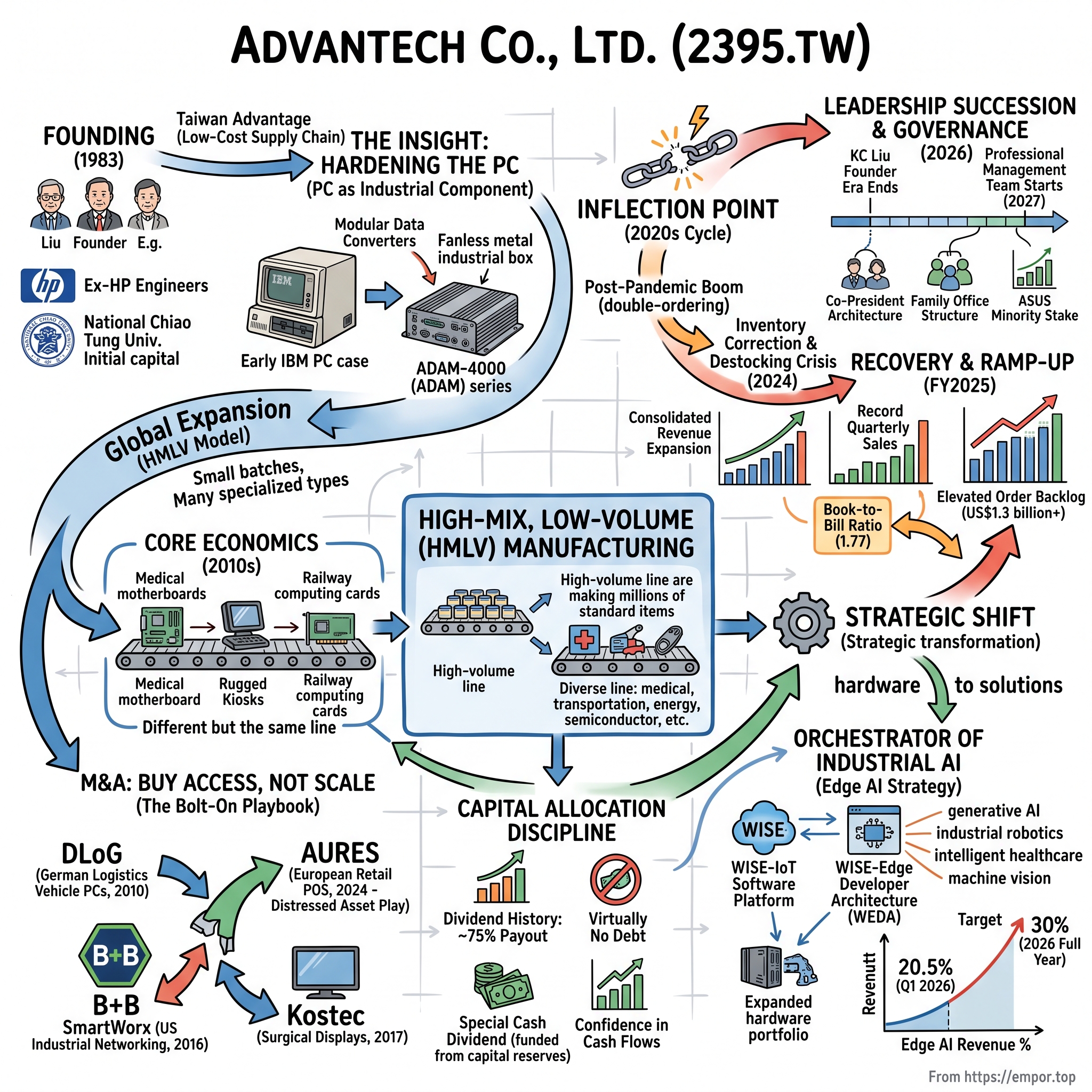
Advantech Co., Ltd.: The Architecture of Industrial IoT and Edge AI
I. Introduction & Episode Roadmap [00:00 - 08:00]
There is a particular kind of company that almost nobody outside its industry can name, yet almost everybody encounters several times a week without knowing it. The screen that dispenses a boarding pass. The controller inside a hospital's CT scanner. The fanless box bolted to the ceiling of a semiconductor fab that watches wafers go by. The panel on the forklift in a distribution centre. The gateway humming inside a wind turbine's nacelle. Strip away the brand names on the outside of those machines and, more often than not, you find the same Taiwanese logo on the board inside.
On July 31, 2026, 研華科技 Advantech Co., Ltd. — ticker 2395 on the 臺灣證券交易所 Taiwan Stock Exchange — reported that it had earned NT$5.20 per share in the second quarter, marking record highs for both the quarter and the first half.1 That result capped an eighteen-month operational rebound. In the first half of 2026 alone, revenue reached NT$46.51 billion, up roughly 32% year-on-year, with June becoming the first month in company history to clear NT$10 billion in consolidated sales.2 Two years earlier, the company's top line had been contracting.
First, consider the question of scale. For the full year 2025, Advantech reported consolidated revenue of NT$70.882 billion — about US$2.274 billion — up 19% in local currency and 22% in U.S. dollars,3 with earnings of NT$12.25 per share.4 Its FY2025 annual report cites research firm Omdia in claiming a 41.5% share of the global industrial PC market in 2025.5 That is a substantial figure for a hardware sector, and subsequent analysis will examine both the metric and its underlying methodology — particularly because the same annual report notes that the market is so fragmented and reshaped by consolidation that its actual market share "is difficult to precisely estimate."5 Reconciling these two statements is central to evaluating the company's market position.
The company's origins mirror a classic tech startup path transplanted to Taipei. In 1983, three former employees of 惠普 Hewlett-Packard's Taiwan instrument division left to start their own enterprise.6 Among them was twenty-nine-year-old 劉克振 KC Liu, a telecommunications engineering graduate of 國立交通大學 National Chiao Tung University who had been selling electronic test instruments for HP in Taiwan — a salesman with an engineer's training, a combination that fundamentally shaped how the company was managed.7 Rather than building a single flagship product, they established a broad category position: providing the default computing substrate for machines that are not traditional computers.
Three structural threads run through this business story.
The first is operational. Advantech's core business represents the economic inverse of consumer electronics. Instead of shipping millions of units across a handful of standardized products, it produces thousands of specialized product variants in small batches. This high-mix, low-volume manufacturing model is operationally complex and difficult to replicate at scale, making its execution a primary source of competitive advantage.
The second is capital allocation. For a quarter century, Advantech has distributed roughly three-quarters of its earnings in dividends, maintained virtually no net debt, and pursued small acquisitions rather than major buyouts.89 In 2026, management altered this policy by eliminating its traditional triennial stock dividend, raising the target payout ratio, and introducing a three-year special dividend funded from capital reserves.5 This shift reflects confidence in mature cash flows while imposing an explicit constraint on capital available for reinvestment.
The third is strategic transformation. Advantech is attempting to transition from a pure hardware supplier into an "orchestrator" of industrial AI — combining hardware, software platforms, and sector-specific applications.5 Management has articulated variations of this strategy for nearly a decade. Edge AI products reached 20.5% of first-quarter 2026 revenue, with a target of 30% for the full year.10 However, it remains uncertain how much of this revenue represents high-margin software economics versus higher-priced hardware containing third-party AI chips. Evaluating that distinction is essential for long-term investors, as the current evidence cuts both ways.
Understanding this evolution begins in a Taipei that did not yet possess a major semiconductor industry.
 Subscribe on LinkedIn
II. Founding Context & The Early HP Playbook (1983–1990s) [08:00 - 22:00]
In the early 1980s, Taiwan's electronics sector operated largely as a subcontracting economy focused on assembly for foreign brands with thin margins and limited direct distribution. TSMC had not yet been established. Within this environment, Hewlett-Packard's Taiwan operation functioned as a training ground for technical and commercial talent. HP sold American test-and-measurement instruments to local factories, requiring sales personnel to evaluate factory floors, understand operational requirements, and engage directly with process engineers.
KC Liu worked as an electronic instrument sales engineer at HP Taiwan after earning his telecommunications engineering degree from National Chiao Tung University.7 That experience combined technical training with commercial outreach, instilling an emphasis on distribution channels while grounding product decisions in real-world component costs. In 1983, at age twenty-nine, Liu left HP with two colleagues to start their own enterprise.67 Corporate registry records show the business entity was originally incorporated in 1981 with NT$2 million of capital stock, with formal operations commencing in 1983.6 Entering the market with modest capital, the founders faced established German and American industrial incumbents holding decades of installed base.
The insight: the PC as an industrial component
The company's founding thesis rested on an architectural shift in computing. In the early 1980s, factory automation relied primarily on expensive, proprietary hardware from European and American vendors. Meanwhile, IBM-compatible personal computers were emerging as standardized, open platforms with rapidly declining cost curves. Advantech sought to capitalize on this cost differential by hardening standard PC architecture—enabling equipment to withstand vibration, dust, and extreme temperatures—to deliver industrial computing hardware at a fraction of incumbent prices.
The initial product sequence reflected this strategy. Reorganized as a limited company in 1985, Advantech began marketing standardized PC-based automated test systems.6 In 1987, it launched the PC-LabCard series—plug-in cards that converted standard PCs into measurement instruments—and opened a San Francisco branch.6 By 1989, the company established its Xindian manufacturing facility to develop dedicated industrial PC lines, shipping its first industrial PC model, the IPC-600, in 1990.6 In 1992, Advantech introduced its Industrial Workstation line alongside the ADAM-4000 series.6
Why ADAM mattered
The ADAM series illustrates Advantech's core hardware strategy. Industrial environments generate vast amounts of analog data, from thermocouple temperature voltages to pressure sensor currents and limit switch states. Converting these physical signals into digital data and transmitting them across electrically noisy factory settings requires specialized interface hardware.
ADAM modules act as ruggedized data converters positioned near physical sensors. They convert analog signals into digital values and transmit them over two-wire serial buses to central controllers. By utilizing open communication protocols rather than proprietary standards, Advantech enabled factory operators to integrate individual data acquisition modules into existing infrastructure without purchasing complete single-vendor automation systems. This modular approach allowed plant engineers to deploy units incrementally, driving broad adoption across industrial facilities.
The Taiwan advantage, and its limits
Advantech leveraged Taiwan's emerging electronics supply chain to establish a cost structure that European incumbents could not readily match. Proximity to local suppliers for motherboards, chassis fabrication, power supplies, and contract assembly significantly lowered bill-of-materials costs compared to Western vendors operating with higher domestic manufacturing overhead.
To avoid becoming a low-margin contract supplier, Advantech established a direct international sales and support footprint rather than relying solely on third-party distributors. The company earned ISO-9001 certification in 1993 alongside the opening of European offices in Germany, France, and Italy; established a wholly owned German subsidiary in 1994; added subsidiaries in Japan, the United Kingdom, and France in 1997; and established entities in the Netherlands and Germany alongside ISO-14001 certification in 1998.6 A Beijing office had previously opened alongside the ADAM launch in 1992.6
Establishing this global sales infrastructure required upfront investment and weighed on reported operating margins during the 1990s. However, maintaining localized sales engineers who assisted customer design teams with component integration created durable client relationships and steady replacement demand. Having received approval for a public offering in 1997, Advantech completed its initial public offering on the Taiwan Stock Exchange on December 13, 1999.6 The listing provided growth capital as a profitable, cash-generative business—establishing a foundation that shaped its subsequent capital allocation and dividend policies.
III. Decoding the Core Business Model: The Economics of High-Mix, Low-Volume (HMLV) [22:00 - 45:00]
Walk into a smartphone assembly plant and you see a single product manufactured fifty million times. Walk into an industrial computing plant and you see something closer to a disciplined machine shop: a production line runs one specialized configuration for a few hours, retools, and switches to a completely different layout.
This operational paradigm—high-mix, low-volume manufacturing—defines Advantech's core business model.
The anti-consumer-electronics model
Consumer electronics operates on predictable parameters. Product lifecycles span twelve to twenty-four months, unit volumes are massive, and fixed engineering costs amortize to negligible levels per unit. Component sourcing prioritizes immediate bill-of-materials cost, with yield and cycle time dictating profitability.
Industrial computing inverts every element of that equation.
Equipment lifecycles are measured in years or decades rather than quarters. An original equipment manufacturer (OEM) that integrates an Advantech motherboard into a medical analyzer or semiconductor inspection tool requires that exact specification—not a revised successor or a nominally compatible alternative—for an extended operating period. Because re-qualifying complex machinery often costs significantly more than the underlying computing boards, continuity of supply is paramount. Volumes remain modest; a typical design win might call for only a few hundred units annually. As a result, engineering cost per unit is substantial—an expense industrial buyers anticipate and accept.
In its FY2025 annual report, Advantech notes that it sells primarily through distributors, equipment builders, and system integrators who adapt the hardware before it reaches end users across transportation, aerospace, and "any field that requires computing capability."5 That structure means Advantech rarely deals directly with end users. Instead, its direct customer is the design engineer building capital equipment. A successful sale becomes a long-term design win, locked into the machine's multi-year lifecycle.
This operational complexity forms the company's competitive moat. Managing thousands of active SKUs—each with distinct bills of materials, extended service obligations, and component obsolescence risks—creates an inventory and planning hurdle that deters mass-market competitors. Advantech closed 2025 with inventory turnover of 96 days and a cash conversion cycle of 84 days.4 While modest by consumer hardware metrics, these figures represent disciplined operational control for a high-mix catalog, improving from 105 days of inventory and a 97-day cash cycle in 2024.8 Management achieved this by actively paring inventory during an industry downturn rather than allowing stock to stagnate.
Segment anatomy: what actually makes the money
Dissecting sector disclosures provides a clearer view of Advantech's unit economics than surface-level consolidated figures.
Advantech modified its financial reporting structure between 2024 and 2025. In FY2024, management reported six strategic business groups: Industrial-IoT, Embedded-IoT, Applied Computing, Industrial Cloud & Video, Service-IoT, and Advantech Service+.8 Beginning in FY2025, disclosures were realigned into five sector categories: IoT Automation, Intelligent Systems, Embedded, Intelligent Service, and Advantech Service+.4 While this structural shift reflects strategic realignments, it also altered historical segment comparability across reporting periods.
Under the FY2025 reporting structure, Embedded remained the largest division, generating US$820 million (36% of total revenue), representing 10% year-over-year growth, gross margins between 30% and 35%, and an operating margin near 20%.4 Intelligent Systems functioned as the primary growth engine, expanding 32% to US$770 million (34% of revenue), backed by 40% to 45% gross margins and a 23% operating margin driven by robotics, semiconductor tooling, and video streaming projects.4 Intelligent Service generated US$239 million (up 39%), producing 40% to 45% gross margins but a lower 9% operating margin.4 Advantech Service+ and auxiliary categories contributed US$280 million, operating at thinner gross margins of 20% to 25% and a 7% operating margin.4
By contrast, IoT Automation was the smallest sector at US$165 million (roughly 7% of revenue), yet proved by far the most profitable, delivering gross margins of 60% to 65% and a 39% operating margin.4 In the first quarter of 2026, IoT Automation gross margins expanded further to between 65% and 70%, with an operating margin of 42%.11
This high-margin sector represents the direct lineage of the ADAM product line introduced in 1992. Decades after launch, these automation modules, industrial networking tools, and controllers generate software-like profitability on physical hardware. This margin profile illustrates the impact of customer switching costs: industrial clients pay premium margins for data acquisition modules not because alternative hardware is unavailable, but because replacing installed, certified, and programmed units introduces systemic operational risk.
Conversely, higher-level integration carries margin trade-offs. The two lowest-margin divisions—Intelligent Service and Advantech Service+—represent the areas where Advantech has expanded most aggressively into turnkey systems, services, and corporate acquisitions. Downstream expansion into full-service integration has historically diluted group margins rather than expanding them, presenting a structural hurdle for the company's broader software-orchestration thesis.
The consolidated picture, and an honest look at it
At the consolidated level, Advantech generated a 39.8% gross margin and a 16.3% operating margin in FY2025.4 These figures challenge the common market perception of Advantech as a perpetual 40% gross margin and 18% to 20% operating margin business. Gross margin dipped below 40% in 2025 due to input cost inflation—specifically tightening DRAM and SSD component supply throughout the year—5 while operating margins have remained below 18% on a full-year basis since 2023.48
Research and development expenditure reached NT$5.816 billion in 2025, accounting for 8.2% of total revenue and supporting 9,044 full-time equivalent personnel.5 For a hardware manufacturer, this heavy R&D commitment reflects the overhead required to maintain thousands of active product variants. Rather than pure exploratory research, these expenses primarily fund firmware updates, component qualifications, documentation, and multi-year customer support across the product catalog.
Geographically, Asia (including Taiwan) accounted for 41% of FY2025 revenue, the Americas represented 32%, Europe contributed 20%, and remaining regions totaled 7%.5 On a country level, North America stood as the single largest market at US$702 million (31%), followed by mainland China at US$487 million (21%) and Europe at US$364 million (16%).4 Unlike many Taiwanese electronics suppliers that depend heavily on mainland assembly demand, Advantech maintains its largest commercial concentration in the United States.
Myth versus reality: the market share number
Industry commentary frequently cites market-share metrics positioning Advantech as controlling roughly a third of global industrial computing, while company disclosures reference an Omdia market share figure of 41.5% for 2025.5 Public promotional materials have similarly cited a 41% market share alongside global brand rankings.12
However, Advantech's annual report explicitly notes the limitations of this metric. Because embedded computing boards are integrated into diverse capital machinery, defining total market boundaries is inherently imprecise. Furthermore, consolidation across the sector—such as ABB acquiring B&R Automation in 2017, 樺漢科技 Ennoconn acquiring Kontron in 2017, and Reliance acquiring and delisting Radisys in 2018—has removed major competitors from standalone public disclosures.5
Consequently, market share figures serve as directional indicators of market leadership rather than precise economic boundaries. If defined narrowly as merchant industrial PCs and standalone embedded boards, a market share in the high-30s to low-40s percentage range is credible. If defined broadly to include captive industrial computing produced internally by conglomerates like Siemens, Beckhoff, or Mitsubishi Electric, Advantech's share represents a much smaller fraction of total industrial deployment.
The peer war-game
Advantech's scale advantages are most evident when evaluated against direct peers.
凌華科技 ADLINK Technology, its closest listed Taiwanese competitor, reported FY2025 revenue of NT$11.80 billion, up 17.09% year-over-year.13 By comparison, Advantech's FY2025 revenue was approximately six times larger. Niche suppliers such as 研揚科技 Axiomtek and 立端科技 Lanner Electronics operate at smaller scales, while 樺漢科技 Ennoconn, backed by 鴻海精密 Hon Hai Precision, represents the primary domestic peer with comparable volume, built largely through M&A.
In Europe, Kontron posted nine-month 2025 revenue of EUR 1,182 million (compared to EUR 1,208 million in the prior-year period) and revised its full-year guidance to EUR 1.7 billion.14 More significantly, Kontron's revenue shift reflected a strategic decision to exit standard computer-on-module manufacturing to focus on higher-margin defense, aerospace, and rail applications.14 Europe's largest industrial computing specialist actively withdrew from the core merchant embedded-board segment where Advantech's Embedded division generated US$820 million with 10% growth.4
This strategic divergence highlights the operational mechanics of high-mix manufacturing. Below critical volume thresholds, the fixed overhead of supporting thousands of board variants across global sales channels degrades return on capital, prompting competitors to narrow their focus. Advantech's scale enables it to sustain this catalog complexity profitably where smaller peers cannot.
This operational scale also provides the balance sheet capacity to fund selective acquisitions, establishing the foundation for the company's capital allocation strategy.
IV. M&A Strategy & Capital Deployment: The Bolt-On Playbook [45:00 - 01:05:00]
There is a version of this company that does not exist. In that version, around 2015, flush with cash and holding a dominant market position, Advantech acquires a European industrial software company for a billion dollars, takes on debt, dilutes shareholders, and spends the following decade explaining integration challenges to analysts.
That scenario never materialized. The discipline of refraining from transformational buyouts remains the defining characteristic of Advantech's capital allocation.
The philosophy: buy access, not scale
The company's approach across two decades has remained remarkably consistent. Advantech acquires small, focused targets that provide one of two assets: privileged access to a specialized vertical market that would be difficult to build organically, or an established distribution channel in an underpenetrated region. It avoids purchasing revenue for its own sake and shies away from businesses requiring entirely new operational capabilities.
The year 2010 established this template. Advantech acquired Germany's DLoG GmbH, South Korea's Advantech KR, and the UK's Innocore Gaming in a single year.6 DLoG manufactured vehicle-mounted computers—ruggedized terminals used on forklifts and logistics equipment—bringing a German automotive and logistics customer base that would have required years to cultivate from Taipei. Innocore produced logic boards for regulated casino gaming, a niche characterized by stringent certification requirements and high switching costs. Neither acquisition was large, but both opened distribution pathways Advantech could not easily access independently.
The largest transaction in the company's history applied this same logic at a broader scale. On November 16, 2015, Advantech agreed to acquire B+B SmartWorx, based in Ottawa, Illinois, for US$99.85 million, closing the deal on January 12, 2016.15 B+B provided industrial wireless networking and media conversion products alongside an established American industrial connectivity channel. While paying roughly 1.8 times revenue represented a full valuation for hardware assets at the time, the strategic justification rested on channel access: building an American industrial distribution network organically is slow and capital-intensive, and the acquisition effectively purchased a decade of established relationships.
Subsequent transactions maintained this focus: acquiring a 60% stake in South Korean medical display specialist Kostec in 2017 alongside an investment in Winmate; completing the acquisition of Japan's オムロン Omron Nohgata and securing a 20% stake in ITTS in 2019; and acquiring machine-vision specialist BitFlow in 2023.6 Kostec established a footprint in surgical-grade monitors, while Nohgata provided a Japanese manufacturing base—a position that subsequently proved far more strategically important than it appeared in 2019.
AURES: buying a wounded incumbent
The most instructive recent deal was the 2024 acquisition of France's AURES Technologies.6
AURES manufactured point-of-sale terminals and check-out kiosks across Western Europe. A listed French company, it had been hit hard by the post-pandemic downturn in retail hardware spending. Advantech acquired a 35.76% controlling equity block from founder and CEO Patrick Cathala. Crossing the mandatory 30% takeover threshold required Advantech to file a tender offer with the Autorité des marchés financiers for all remaining shares at the same price of EUR 6.31 per share.16 The initial block trade of 1,430,381 shares closed on October 1, 2024, alongside a EUR 2.5 million convertible bond investment.16
This deal highlights two distinct operational realities. First, acquiring a distressed incumbent during a cyclical trough reflects a value-oriented M&A strategy consistent with forty years of patient balance-sheet management. Second, retail point-of-sale operates as a structurally lower-margin business than industrial automation. AURES was integrated into the Intelligent Service division, which delivered a 9% operating margin in FY2025 and grew just 3% in the first quarter of 2026, as healthcare gains only partially offset retail weakness.411 The transaction secured European retail presence and scale, but provided no margin expansion.
This dynamic raises a central strategic question: if Advantech's stated priority is transitioning toward higher-margin software and solutions, why direct significant capital into a commoditized hardware segment with single-digit operating margins? Management maintains that retail represents a key target environment for edge AI deployment, with AURES providing the underlying installed base. While logically coherent, this premise remains unproven, and segment financials do not yet show software-driven margin expansion.
Clarifying market assumptions is equally important regarding ecosystem holdings. While Advantech's strategic minority investments in Taiwanese technology firms are widely noted, official company disclosures reviewed for this period confirm minority positions in Winmate and ITTS, but do not verify an equity stake in Lanner Electronics.6
The dividend: forty years of the same answer
While acquisitions represent targeted capital deployment, dividend policy reflects how Advantech manages excess cash flow.
The company's distribution record shows exceptional stability. Cash payout ratios remained within a tight band of roughly 72% to 80% across nine consecutive years—measuring 77.3% in 2016, 74.7% in 2017, 75.5% in 2018, 74.2% in 2019, 75.5% in 2020, 74.0% in 2021, 72.2% in 2022, 75.0% in 2023, and 80.0% in 2024 through pandemic disruptions, supply chain bottlenecks, demand surges, and cyclical pullbacks.8 The 2024 distribution totaled NT$8.4 per share, paid entirely in cash.8 Historically, the company also distributed a stock dividend roughly every three years, most recently with its 2022 payout.89
In 2026, management formally restructured this framework. The company eliminated the triennial stock dividend, shifted to an all-cash model, raised the baseline cash payout target from 70–75% to 70–80%, and introduced a three-year special cash dividend of NT$2 per share annually from capital reserves for 2026, 2027, and 2028—a supplemental distribution expected to exceed NT$5.2 billion.59 For FY2025, this resulted in a proposed regular cash dividend of NT$9.2 per share at a 75% payout ratio, plus the NT$2 special dividend, totaling NT$11.2 per share and a 91.4% total payout.53
The balance sheet comfortably supports this distribution level. At the close of 2025, Advantech held NT$19.181 billion in cash against NT$291 million in short-term debt and NT$1.626 billion in long-term debt, backed by NT$55.049 billion in total equity.4 Net cash stood at approximately NT$17 billion, keeping leverage negligible.
This capital allocation pattern offers two contrasting interpretations for investors.
The constructive view emphasizes financial discipline and cash generation. Returning over 90% of earnings while order backlogs expand signals that management can finance its edge AI expansion from operational cash flow without diluting equity or accumulating debt. Paying a special dividend while concurrently funding global manufacturing expansions underlines the cash-generative strength of the high-mix model.
The critical view questions whether a 90% payout aligns with a company undergoing a capital-intensive strategic pivot. If industrial edge AI represents a multi-decade architectural shift, a low capital retention rate could constrain long-term reinvestment—suggesting the special dividend may function partly as a short-term yield enhancement during a favorable earnings cycle. Whether this policy holds depends on whether planned production capacity proves sufficient to meet growing demand.
That operational test follows five years of dramatic industry fluctuations—a period marked by rapid expansion, inventory corrections, and structural reorganization.
V. Inflection Points: Post-Pandemic Boom, Destocking Crisis, & Sector Transformation (2020–2025) [01:05:00 - 01:30:00]
The industry cycle between 2020 and 2025 offers a clear demonstration of Advantech's operational mechanics and management priorities.
The boom and the double-book
When global supply chains seized in 2021, customers dependent on semiconductors acted defensively by double-ordering components across multiple vendors. Lead times on industrial components stretched from weeks to nearly a year. Across North America, Europe, and China, distributors and OEMs placed advance orders, while medical equipment demand surged and factory automation spending accelerated in response to labor shortages.
This order wave propelled Advantech's financials to then-record levels in 2023: consolidated revenue reached NT$64.568 billion, with a 40.5% gross margin, operating profit of NT$12.128 billion at an 18.8% operating margin, net income of NT$10.838 billion, and earnings of NT$12.65 per share.8 Yet this financial peak represented the tail end of the expansion. Because Advantech was still fulfilling the massive order backlog accumulated during 2021 and 2022, reported revenue reached new highs in 2023 even as incoming order velocity was already slowing.
The correction, and what it really revealed
The resulting inventory correction materialized in full during 2024, when consolidated revenue fell 7% to NT$59.786 billion.8 The contraction reflected geographic destocking across regions that had accumulated excess inventory: European revenue dropped 20%, North America declined 13%, North Asia fell 9%, and China slipped 2%, whereas Taiwan bucked the trend with an 18% gain.8 Product categories showed similar stress: Industrial Cloud & Video dropped 23%, Embedded-IoT fell 13%, Applied Computing declined 11%, and Service-IoT contracted 9%, while Industrial-IoT grew by just 1%, supported by semiconductor equipment, healthcare, and energy projects.8
This downturn highlights a crucial distinction in Advantech's cost structure.
Conventional commentary often points out that Advantech's gross margin expanded during the 2024 contraction—rising to 40.8% from 40.5% in 2023—and cites this as proof of both pricing power and operational flexibility.8 While gross margin did expand slightly due to lower component input costs and favorable product mix, operating performance tells a different story. Operating margin contracted sharply from 18.8% to 15.1% as operating expenses climbed from 21.7% to 25.6% of revenue.8 Consequently, operating profit dropped 25% and net income declined 17%.8
Rather than cutting overhead to protect short-term earnings, management maintained fixed investments in edge AI engineering, software development, global sales infrastructure, and organizational restructuring. The empirical evidence demonstrates pricing power at the gross margin line—where high customer switching costs preserved pricing—but no operational cost elasticity. Instead of an automatic stabilizer, the 2024 financial result reflected a deliberate strategic choice to invest through a cyclical trough.
The sector-driven reorganisation
During this period, Advantech also restructured its global organization. Historically, the company operated through hardware-focused divisions grouped by product type—such as embedded boards, industrial computers, and video platforms. The updated framework realigns the business around target end markets, reflecting management's goal of supplying integrated sector solutions rather than standalone hardware components.5
Financial disclosures reflect this transition: the six strategic business groups reported in FY2024 were replaced in FY2025 and 2026 by five sector categories—IoT Automation, Intelligent Systems, Embedded, Intelligent Service, and Advantech Service+.84 Realigning a global enterprise around end markets required shifting personnel, reassigning divisional profit-and-loss responsibility, and restructuring sales incentives, adding near-term administrative overhead during a cyclical slowdown.
Advantech's FY2025 annual report articulates the broader objective: combining its edge computing hardware, the WISE-IoT software platform, and domain-specific applications into an "orchestration" model driven by sector specialization, targeted acquisitions, and diversified growth vectors.5 This strategy targets six priority application areas identified in a 2024 strategic planning initiative: generative AI integration, industrial robotics, renewable energy and storage, intelligent healthcare, machine vision, and industrial wireless systems.5
The recovery
The payoff from maintaining overhead through the downturn became clear in FY2025, when consolidated revenue expanded 19% to a record level, operating profit rose 28%, and net income increased 18%.43 Geographically, every primary market achieved double-digit growth except North Asia, which remained flat.34 North American sales increased 22% to US$702 million, Taiwan surged 27%, Europe grew 17%, and mainland China expanded 15%.4
The mechanics of the margin recovery highlight the leverage inherent in the business model. Although gross margin fell from 40.8% to 39.8% due to rising raw material costs, operating margin recovered from 15.1% to 16.3% as the operating expense ratio dropped from 25.6% to 23.5%.48 The margin expansion resulted entirely from operating leverage on the cost base management had chosen to preserve in 2024.
By the fourth quarter of 2025, leading demand indicators showed broad-based acceleration. The consolidated book-to-bill ratio rose to 1.33, driven by ratios of 1.57 in Europe, 1.28 in North America, and 1.25 in China—indicating that incoming order velocity exceeded shipping capacity across all major operating theaters.3
This demand expansion signaled a transition beyond simple inventory replenishment, setting the stage for the company's next architectural expansion.
VI. Edge AI & Hidden Optionality: Software-Hardware Orchestration [01:30:00 - 01:50:00]
Consider a robotic arm on a production line that must determine, in milliseconds, whether a passing component is defective.
Sending that image to a cloud data center, running inference on a large model, and awaiting a response creates a latency of tens or hundreds of milliseconds—an unworkable delay on an active assembly line. Factor in bandwidth overhead across thousands of cameras, along with strict customer requirements preventing operational imagery from leaving factory premises, and cloud infrastructure becomes practically unusable.
This operational reality underscores the core premise of edge computing. Specialized applications—such as robotics, semiconductor inspection, autonomous equipment, medical imaging, and real-time quality control—require processing capabilities physically adjacent to data generation. Furthermore, the underlying hardware must withstand harsh operating conditions, demanding fanless enclosures, wide operating temperature ranges, vibration resistance, long-term support, and specialized certifications.
In essence, edge AI hardware represents Advantech's core industrial catalog outfitted with higher-performance processing architectures.
How large is it, actually
The company has begun providing detailed segment disclosures for its edge AI operations.
In the first quarter of 2026, edge AI generated US$132 million in revenue, accounting for 20.5% of consolidated sales.10 Within this category, edge AI products generated US$123 million, expanding 67% year-over-year, while edge AI components contributed US$9 million, up 58%.10 Management has targeted an edge AI revenue contribution of 30% for the full year 2026.10
Forward-looking metrics indicate shifting project economics. Advantech secured 53 design wins in the first quarter of 2026, up from 46 in the prior-year period, with estimated annual revenue attached to those wins reaching US$158 million—roughly 2.3 times the prior-year level.1017 While overall project volume grew modestly, average value per design win more than doubled.
This shift reflects increased content value per deployment rather than pure unit expansion. Utilizing existing distribution networks and sales channels, the company is securing higher-value sockets by integrating AI accelerators alongside standard embedded processors.
Separately, management disclosed a robotics project pipeline involving approximately twenty key global accounts, representing an estimated US$120 million in potential revenue across humanoid and autonomous mobile robot applications.10 This figure represents prospective pipeline value rather than contracted revenue.
The order book, and the constraint
Demand indicators expanded sharply in early 2026. The consolidated book-to-bill ratio reached 1.77 for the first quarter, driven by regional ratios of 2.37 in North America, 1.76 in Europe, and 1.30 in China.18 Total order backlog exceeded US$1.3 billion, with 47% of first-quarter bookings scheduled for delivery beyond a six-month horizon—providing extended operational visibility.10
However, primary operational constraints have shifted from demand generation to component supply and input costs. Management highlighted year-over-year price increases of 30% to 50% for DDR5 memory and 10% to 20% for central processing units, while the FY2025 annual report noted tightening DRAM and SSD supply that required forward inventory commitments and capacity allocation agreements with key suppliers.105 During the first-quarter earnings call, management indicated that the company had successfully passed the majority of these input cost increases on to customers.10
First-quarter 2026 financial results align with this assessment: gross margin registered at 39.1%, down 0.5 percentage points year-over-year, while operating margin expanded to 18.3% from 15.7% in the preceding quarter due to operating leverage.11 This margin profile indicates substantial, though incomplete, pass-through of component cost increases.
The software question, unresolved
This dynamic brings the analysis to the unproven element of Advantech's long-term strategy: its software platform transformation.
Advantech has consistently pursued software-integration initiatives alongside its hardware catalog. The FY2025 annual report outlines plans to expand the WISE-IoT platform and deploy the WISE-Edge Developer Architecture (WEDA)—an open framework designed to integrate domain-specific edge software across industry partners.5 Unveiled at Computex 2026, WEDA incorporates AI agents, digital twin capabilities, and real-time edge processing, offering compatibility across NVIDIA, AMD, Intel, Qualcomm, and NXP silicon while integrating NVIDIA NIM microservices.19
Management has articulated an ambitious strategic positioning. Chairman KC Liu located the company at the top application layer of NVIDIA's five-layer AI framework—encompassing energy, silicon, infrastructure, models, and applications—stating the goal of establishing Advantech as a primary platform orchestrator for industrial applications.19 Liu identified three core competitive pillars: a hardware portfolio exceeding one thousand products, an established global sales and support network, and proprietary software platform capabilities.19
While financial disclosures validate the breadth of Advantech's hardware catalog and global distribution network, the standalone economic contribution of its software platform remains unverified.
Advantech does not report standalone software or subscription revenue, recurring revenue metrics, net revenue retention rates, or software-specific gross margins in its investor disclosures. Published reporting remains organized around hardware-centric sector categories. Given that management voluntarily provides detailed disclosures for edge AI revenue and design-win pipelines, the absence of separate software reporting suggests that software functions primarily as an enablement tool to drive hardware sales and reinforce customer switching costs rather than as a standalone profit center.
This functional role remains strategically valuable. Enterprise software tools, device management interfaces, and integrated data pipelines create high switching costs that protect customer relationships and help sustain gross margins of 65% to 70% within the IoT Automation sector.11 However, current disclosures do not support evaluating Advantech as a recurring software or SaaS business.
A key test of the orchestration strategy will be whether expanded software content drives group gross margin expansion over time, offsetting hardware component cost pressures.
The executive responsible for guiding this strategic transition is also preparing for an operational leadership succession.
VII. Current Management, Leadership Succession, & Governance [01:50:00 - 02:10:00]
In July 2026, KC Liu reflected in an interview on a dilemma common to founder-led enterprises: the hardest element of executive succession is the founder's willingness to relinquish operational control.
At seventy-two years old, more than four decades after leaving HP, Liu outlined an explicit timeline for his exit.
The handover
Liu confirmed plans to step down as chief executive at the end of 2026, concluding the founder-CEO era. Beginning in 2027, top executive authority will transition to a professional management team comprising a chief executive, chief operating officer, and chief financial officer operating under international governance standards.20 Subject to board approval, Liu indicated he may serve an additional term as chairman to oversee the transition before fully retiring from the board around 2029 at age seventy-five.20 Industry coverage of Advantech's Computex announcements presented this leadership evolution alongside the company's five-year edge AI roadmap.21
The family ownership structure has been organized with equal clarity. The Liu family established a family office modeled on multi-generational European enterprises like Merck and Hermès, utilizing a holding company to retain equity control while delegating operational management to professional executives.20 Two second-generation family members sit on the board representing investment entities, contributing to human resources and financial oversight rather than day-to-day operations.20 In public statements, Liu emphasized that long-term family ownership depends on structured equity planning rather than direct operational appointments.20
This structure addresses a frequent vulnerability among Taiwanese technology firms, where founders often delay succession or appoint family members without professional management backgrounds. By professionalizing executive leadership while formalizing family ownership during an operational upturn, Advantech is executing its transition from a position of relative financial strength.
The co-president architecture
This transition builds on an organizational framework established nearly a decade earlier. Since 2017, Advantech has operated under a co-president structure, dividing executive responsibilities among three leaders rather than relying on a single chief operating officer beneath the founder.[^22]
陳清熙 Eric Chen oversees general management and finance, serving as the primary executive representative on quarterly earnings calls and investor conferences.3112 蔡淑妍 Linda Tsai leads the Industrial IoT sector, while 張家豪 Miller Chang heads the Embedded division—the company's largest revenue contributor and the primary vehicle for its edge AI expansion.[^22]
Distributing profit-and-loss responsibility across three senior executives creates a tested management bench for the post-founder era. However, a multi-president structure also carries governance risks: dividing operational authority among peers can lead to coordinated execution or operational friction once the founder departs, a dynamic that will only be tested after 2027.
At the same time, public disclosures provide limited visibility into executive compensation structures. Remuneration tables in the annual report summarize director and officer pay in aggregate ratio form rather than tying compensation to specific operating metrics like sector gross margins, inventory turnover, or design-win targets.5 While common among Taiwan-listed companies, this lack of granular detail obscures how executive incentives align with long-term strategic goals.
Ownership and alignment
Ownership records confirm strong alignment between family equity and corporate performance. Disclosures of ultimate beneficial ownership filed as of March 31, 2026, identify major family holding vehicles among the top ten shareholders: AIDC Investment Corp., where KC Liu holds an 18.77% stake and the Advantech Foundation holds 10.08%, and K and M Investment Co., where Liu holds 32.92% alongside Mary Chang's 31.95%.22 Together with direct family holdings, these entities rank among Advantech's largest shareholders.22
The top shareholder list also includes consumer technology manufacturer 華碩 ASUS (Asus Computer Co., Ltd.).22 ASUS's persistent minority stake in Taiwan's leading industrial computing firm highlights the interconnected equity relationships within the local electronics supply chain. For minority investors, having a major industrial partner as a cornerstone shareholder offers capital stability, though it also reinforces concentrated ownership within Taiwan's broader tech ecosystem.
This equity distribution aligns founder incentives directly with public shareholders. The Liu family's wealth remains concentrated in company equity managed through multi-generational holding vehicles, ensuring that dividend payouts accrue to family holdings on the same terms as public investors. Advantech maintains a single-class share structure without dual-class voting rights, controlling stakes disproportionate to economic ownership, or undisclosed related-party transactions.
Credibility, tested against the record
The most useful test of a management team is not what it promises, but whether its prior projections held true.
Advantech's disclosure record provides a clear benchmark because the company publishes explicit quarterly revenue and margin guidance. The third-quarter 2025 investor presentation guided fourth-quarter revenue to between US$550 million and US$570 million; actual revenue reached NT$17.921 billion—exceeding the top of the guided range at prevailing exchange rates.234 For the first quarter of 2026, management guided revenue to between US$590 million and US$610 million, whereas actual sales reached US$644 million.418 First-quarter guidance for the second quarter set revenue expectations at US$650 million to US$670 million, but actual second-quarter sales surged to NT$26.13 billion, well above guidance.112
Three consecutive quarters of beating guidance offer two potential interpretations. A favorable view suggests demand accelerated faster than internal planning models anticipated, supported by expanding design-win metrics. A more cautious perspective indicates management set systematically conservative targets to manage market expectations. If subsequent quarterly guidance continues to underestimate revenue by wide margins, conservative target-setting becomes the more persuasive explanation.
During cyclical downturns, management demonstrated notable reporting transparency. Throughout the 2024 contraction, Advantech detailed regional and segment declines with specific operational context—attributing drops to European automotive weakness, North American healthcare delays, and Japanese factory automation softness—rather than attributing underperformance to generic macroeconomic headwinds.8 Providing granular geographical and sector breakdowns during a downturn reflects disciplined investor communications.
Whether this reporting discipline and operational focus persist after KC Liu's departure remains a key governance test as Advantech navigates its transition into a professionalized, edge AI-focused enterprise.
VIII. Strategic Frameworks: Helmer's 7 Powers & Porter's 5 Forces [02:10:00 - 02:25:00]
Frameworks are only useful when tested against empirical evidence rather than asserted as broad claims. Advantech provides a clear case study: while several of its strategic advantages withstand rigorous analysis, others remain unproven.
Hamilton Helmer's 7 Powers
Scale economies — the strongest and most demonstrable power. The fixed costs of this business are substantial and largely independent of unit volume: maintaining a global network of sales and support engineers, operating regulatory testing labs, writing firmware and drivers for thousands of product variants, and supporting local repair infrastructure in every active market. Advantech spreads that fixed cost base across NT$70.9 billion in revenue and roughly 9,044 employees.45 By comparison, ADLINK spreads a similar structural footprint across NT$11.8 billion in sales.13 The most compelling evidence of scale lies in rival behavior: Kontron, Europe's largest listed specialist, deliberately exited standard computer-on-module manufacturing, whereas Advantech's Embedded division expanded.144 When a capable peer concludes it cannot earn its cost of capital in a core segment where the market leader continues to grow, scale economies are demonstrably operating.
Switching costs — high, and quantifiable through margin. The underlying mechanism is specific. An industrial machine containing an Advantech board is certified as a single integrated system. Replacing that board requires re-testing, re-certifying, potentially re-submitting regulatory filings, and re-validating software—expenses that dwarf the board's purchase price and fall entirely on the equipment builder rather than the component supplier. The financial evidence appears in unit profitability: the IoT Automation division sustained gross margins of 60% to 65% through 2025 and reached 65% to 70% in the first quarter of 2026, on product lineages tracing back to 1992.411 Standard hardware does not command software-like gross margins on technical specifications alone.
Process power — real but harder to isolate. Four decades of managing high-mix, low-volume manufacturing across facilities in Kunshan, China; Guishan in Taoyuan, Taiwan; and Nogata, Japan reflect accumulated operational expertise that competitors cannot easily replicate.5 Empirical proof appears in inventory control: managing thousands of active product variants with extended service commitments while reducing inventory turnover from 105 days to 96 days during a cyclical downturn demonstrates disciplined execution rather than chance.84 However, process power remains difficult to isolate from scale advantages, as operational efficiency often stems directly from cumulative volume.
Branding — modest and B2B-focused. Advantech is a recognized brand among industrial design engineers, yet remains virtually unknown outside commercial manufacturing.12 Reputation reinforces pricing power during component selection, but brand equity alone does not generate demand.
Cornered resource, counter-positioning, and network economies — largely absent. Advantech possesses no exclusive access to scarce materials, sourcing standard silicon from major semiconductor manufacturers. It is not counter-positioned against legacy incumbents that cannot respond; it is the incumbent. Nor do core hardware sales benefit from direct network effects, as onboarding a new customer does not enhance product value for existing clients. The software partner ecosystem surrounding WISE-IoT and WEDA represents the primary area where network effects could potentially materialize, though disclosures do not yet show measurable adoption.519
Porter's 5 Forces
Threat of new entrants — very low. The primary barriers to entry are structural rather than purely technological, as designing a basic industrial motherboard is relatively straightforward. Instead, barriers stem from establishing a global sales and support footprint, funding rigorous system certifications, and guaranteeing multi-year component availability. Because prospective entrants must fund these overhead capabilities before generating meaningful sales, the market has steadily consolidated rather than attracting new competitors.
Supplier power — moderate and currently rising. Supplier power represents the competitive force exerting the greatest pressure on Advantech. Reliance on major silicon vendors—including Intel, AMD, and NVIDIA—and global memory manufacturers is structural. The 2025–2026 component cycle exposed this vulnerability directly: DDR5 prices surged 30% to 50%, processor costs rose 10% to 20%, and tightening DRAM and SSD supplies forced forward capacity commitments.105 Advantech's purchasing scale secures supply allocation priority and allows it to pass through most cost increases to customers—a clear advantage over smaller peers. Nevertheless, consolidated gross margins contracted over two consecutive years, illustrating the direct impact of supplier pricing power.4
Buyer power — low and fragmented. Advantech's customer base spans tens of thousands of equipment builders, system integrators, and regional distributors, with no single client representing a material share of consolidated revenue. Combining extreme customer fragmentation with high design-in switching costs leaves buyers with minimal pricing leverage—providing the structural foundation that enabled Advantech to maintain price discipline through a 7% revenue contraction in 2024.8
Threat of substitutes — low in core hardware, emerging at the edge. Standard commercial computers cannot withstand industrial operating environments, limiting direct hardware substitution. However, an architectural substitution risk is emerging: as highly integrated system-on-chip modules gain processing capability and standardization, lower-end applications that historically required full industrial PCs can increasingly be served by smaller, lower-cost embedded boards—potentially sourced from lower-overhead competitors. This shift represents a long-term risk of margin erosion at the entry level.
Competitive rivalry — moderate and structurally favorable. While the lower end of the market remains fragmented and price-sensitive, rivalry in the upper tier—where global support, extended lifecycles, and strict system certifications are required—remains muted. Within this segment, Hon Hai-backed Ennoconn stands out as the peer most capable of utilizing capital deployment to build competing scale.
In summary, Advantech occupies a structurally defensible position in industrial computing, supported by tangible scale economies and high switching costs. However, two critical assumptions remain unverified: establishing network effects through its software ecosystem, and insulating gross margins from rising supplier power. Assessing these vulnerabilities leads directly to the core investment risks.
IX. Skeptical Investor Stress-Test & Material Risk Radar [02:25:00 - 02:40:00]
Every dominant company accumulates an explanation for why its dominance is safe. The useful exercise is to ask what would have to be true for that explanation to fail.
China: exposure on both sides of the ledger
Mainland China generated US$487 million of FY2025 revenue, about 21% of the group.4 It grew 15% in 2025 and accelerated to 38% growth in the first quarter of 2026, with first-half China revenue up 51%.4112 That is the fastest-growing large market in the portfolio, which makes the exposure a growth asset and a risk simultaneously.
The manufacturing exposure is more consequential than the revenue exposure. Advantech's FY2025 annual report describes a manufacturing network spanning Kunshan in China, Guishan in Taoyuan, Taiwan, and Nogata in Japan.5 Kunshan has historically been the largest node.
The response is documented and specific rather than aspirational. New manufacturing equipment investment increased capacity approximately 15% in Taoyuan and 35% in Nogata.5 The company established system assembly capability in Milpitas, California, and is building a new North America operational headquarters in Tustin, expected to be completed by the end of 2026, at which point local US assembly capacity is expected to double — an explicit "local-for-local" production and delivery strategy.524 In Japan, the Nogata site is positioned as a third manufacturing base outside Taiwan and China, with a backup facility targeted for 2028.24 In Taiwan, a fourteen-storey manufacturing centre at Linkou's Huaya Science Park is scheduled for completion in 2027 and is expected to roughly double Taiwan production capacity.19
One correction worth making: the commonly repeated version of this plan includes new assembly lines in Vietnam. Advantech established a Vietnamese subsidiary in 2018, but the FY2025 annual report's description of the manufacturing network lists Kunshan, Taoyuan, and Nogata, plus US assembly.65 Investors should not assume a Vietnamese manufacturing base on current disclosure.
The residual risk is straightforward. A serious escalation across the Taiwan Strait would affect Kunshan output, Taiwan output, and roughly a fifth of revenue at once. Diversification reduces the concentration; it does not eliminate a regional shock.
Cost inflation is the live risk, not demand
The risk that is actually biting right now is input cost. Group gross margin has now declined for two consecutive years, from 40.8% in 2024 to 39.8% in 2025 and 39.1% in the first quarter of 2026.8411 Management attributes this to raw material costs, principally memory, and says most of the pressure is being passed through.510
Two things follow. First, inventory rose sharply — from NT$11.835 billion at the end of 2025 to NT$15.389 billion at the end of the first quarter of 2026, a roughly 30% quarterly increase, though inventory days actually improved to 97 as revenue grew faster still.411 Building inventory into a memory shortage while the order book is at record levels is defensible; building it into a demand air pocket would not be. This is the single most important balance sheet line to watch.
Second, a note on the same quarter's balance sheet: total liabilities jumped from NT$20.669 billion to NT$34.044 billion and total equity declined from NT$55.049 billion to NT$49.725 billion despite NT$3.334 billion of net income, with accounts payable rising from NT$7.681 billion to NT$11.302 billion.411 The payables increase is straightforwardly explained by the production ramp. The equity decline alongside profitable operations is consistent with the record dividend being recognised, but the quarterly deck does not break out the movement. It is worth confirming against the interim financial statements.
Execution risk in the transformation
The sector reorganisation carries a specific, identifiable failure mode: added coordination overhead without corresponding revenue. The 2024 operating expense ratio of 25.6% is partly evidence of that cost being incurred.8 The 2025 recovery to 23.5% suggests it is being absorbed.4 But the underlying promise — that reorganising around end markets produces higher-value solution sales — is only validated if group gross margin eventually rises. It has not.
The related risk is the one flagged earlier: the software layer generates no separately disclosed revenue. If the orchestration model turns out to be a marketing architecture layered over a hardware business, the R&D spending that supports it is a permanent margin drag rather than an investment in a new economic engine.
Low-end commoditisation
Chinese IPC manufacturers compete aggressively on price in non-critical edge gateway applications, where certification requirements are light and switching costs are low. This is not an existential threat to the design-in business, but it caps growth in the volume tail and is a plausible contributor to the mix shift toward lower-margin categories visible in the Advantech Service+ line.4
Cyclicality has not been repealed
The most important discipline for a long-term owner: industrial capital spending is cyclical, and the current book-to-bill of 1.77 is a cycle peak reading, not a run rate.18 The 2021–2022 boom produced exactly this kind of order book, and it was followed by a two-year correction. A meaningful portion of today's backlog is likely to reflect the same defensive over-ordering behaviour, particularly given documented memory shortages that give customers a rational reason to book early.
That does not invalidate the edge AI thesis. It does mean the next downturn is a question of when, not whether — and it makes the bull and bear cases sharper than they first appear.
X. The Investment Story Spine: Bull vs. Bear Case & Key KPIs [02:40:00 - 02:55:00]
On July 8, 2026, Advantech shares closed limit-up at an all-time high of NT$546. The surge followed news that June revenue had reached NT$10.12 billion—up 73.4% year-on-year—capping a second quarter in which sales grew 46.5%.225 Institutional commentary noted that these results significantly exceeded expectations, citing an elevated book-to-bill ratio as evidence of strong second-half visibility while pointing to supply chain constraints and raw material inflation as key risks to monitor.25
That single trading day encapsulates both the bull and bear arguments.
Why this company wins from here
The strongest bullish argument rests not on market share statistics, but on distribution control: Advantech owns the route to market for a technological transition it did not need to invent.
Deploying edge AI requires precisely what Advantech already possesses: ruggedised industrial computers, design-in relationships with tens of thousands of machine builders, local engineering support across every major market, and multi-year availability commitments. To participate in this shift, the company did not need to construct a new sales infrastructure. Instead, it integrated upgraded processors into existing product enclosures and sold them to established customers through proven channels. This explains why the total value of its design wins roughly doubled while the overall design-win count remained virtually flat.1017
The second pillar of the bull case is financial resilience. With net cash of approximately NT$17 billion, negligible debt, and a capital allocation framework that distributed 91.4% of FY2025 earnings to shareholders, Advantech can concurrently absorb an industry downturn, expand manufacturing capacity, and sustain capital returns.45 Few hardware manufacturers command similar balance-sheet flexibility.
The third argument is pricing power. Passing through the majority of a 30% to 50% increase in memory costs without forfeiting order volume offers direct empirical evidence that customer switching costs remain effective.10
What could break the case
Conversely, the bear case rests on three distinct structural vulnerabilities.
The margin trend is moving downward. Gross margin contracted across two consecutive fiscal years and dropped further in the first quarter of 2026.8411 While the bullish narrative assumes higher-value software and solution content will expand profitability, financial disclosures show component cost inflation and lower-margin acquired assets weighing on group margins. Until consolidated gross margin turns upward, the strategy of moving up the value stack remains an ambition rather than a proven financial result.
The software contribution remains undisclosed. Published financial reports contain no standalone software revenue line, no recurring software metrics, and no subscription performance indicators. If the orchestration initiative functions primarily as a hardware pull-through tool—as current disclosures indicate—Advantech should be evaluated as a high-performing industrial hardware manufacturer with a software marketing narrative, rather than a platform provider.
The order book reflects a cyclical peak. A book-to-bill ratio of 1.77, paired with 47% of orders scheduled for delivery beyond six months, represents a strong order backlog but also signals potential cyclical risk.1810 During the 2021–2022 expansion, similar order backlog figures were driven partly by customer double-ordering, which ultimately led to a correction that reduced annual revenue by 7% and operating profit by 25%.8 Expanding capacity and accumulating inventory at the peak of an order cycle introduces operational exposure if demand normalises rapidly.
A fourth structural constraint complicates the outlook: as a dominant incumbent in a sector growing at mid-single-digit rates, expanding purely through market-share gains in core industrial PCs offers a finite runway. Long-term growth requires either redefining the addressable market through edge AI orchestration or continuing to deploy capital into acquisitions.
The activist's questions
A rigorous investor audit highlights four unresolved strategic questions. First, why did Advantech direct capital toward AURES—a retail hardware maker operating in a single-digit-operating-margin segment—when its stated priority is shifting toward higher-margin software solutions? Second, why does corporate reporting disclose executive compensation only in aggregate ratios rather than linking pay to specific operational targets? Third, why return over 90% of earnings through regular and special dividends at the exact juncture when management describes a generational, capital-intensive edge AI transition? Finally, after nearly a decade of promoting its software platform, why has the company yet to report a standalone software revenue stream?
While none of these issues undermine the core hardware franchise, all four represent notable gaps between strategic narrative and capital deployment.
The three KPIs that matter
Evaluating Advantech's trajectory ultimately depends on three primary key performance indicators.
Book-to-bill ratio. Serving as the primary leading indicator for order velocity, this metric is reported quarterly by region.318 The trajectory and geographic distribution matter more than the peak level. A ratio that moderates from current highs while remaining above 1.0 signals healthy demand normalisation, whereas simultaneous drops below 1.0 in North America and Europe would indicate an emerging cyclical downturn similar to 2023–2024.
Consolidated gross margin. This metric provides the clearest test of strategic execution. If edge AI, sector specialization, and software platforms add genuine economic value, gross margin should expand once component cost inflation eases. Conversely, if gross margin remains stagnant in the high 30% range as revenue grows, Advantech is successfully expanding a hardware catalog rather than executing a software transformation.
Edge AI revenue contribution. Management has set a clear, testable operational target: increasing edge AI products and components from 20.5% of first-quarter sales to 30% of total revenue by the end of 2026.10 Achieving this threshold—and demonstrating that the revenue shift expands overall profit margins—serves as the definitive benchmark for evaluating the company's edge AI expansion.
All other operational metrics—regional growth rates, sector realignments, and dividend distributions—derive their significance from how they affect these core indicators.
XI. Earnings Call Transcripts & Primary Source Roadmap [02:55:00 - 03:05:00]
For investors building an independent thesis, Advantech offers a level of disclosure uncommon among Taiwanese mid-caps, though analyzing it effectively requires reading primary sources in a deliberate sequence.
Start with the quarterly investor conference decks. Published in English on the company's investor relations portal, these presentations provide the highest concentration of operational data. The FY2024 deck, presented on March 5, 2025, provides the detailed account of the cyclical downturn: it includes regional decline tables, segment-level gross and operating margins under the legacy business group structure, inventory and cash conversion metrics, and the nine-year payout history establishing its baseline capital allocation pattern.8 The FY2025 deck, presented on March 4, 2026, serves as its counterpart, introducing the sector-based reporting framework and offering the primary benchmark for assessing how the reorganization alters year-over-year comparability.4
Then read the guidance pages in sequence. Each presentation concludes with explicit next-quarter targets for revenue, gross margin, and operating margin alongside baseline exchange rate assumptions.23411 Evaluating consecutive guidance decks against subsequent actual results provides the most direct test of management's forecasting discipline—offering clearer analytical signal than any single quarter's executive commentary.
Use earnings call disclosures for qualitative context. The first-quarter 2026 briefing, held on May 6, 2026, offers the most detailed recent breakdown: it details edge AI revenue split between products and components, design-win counts and attached annual revenue, total backlog figures alongside the percentage scheduled beyond six months, prospective robotics pipelines, and management's strategy for passing through component cost inflation.10 The third-quarter 2025 disclosure materials provide the baseline for evaluating how the edge AI narrative evolved before order velocity accelerated.23
Read the FY2025 annual report for critical operational nuances. The market share disclosures provide an unusually candid assessment, explicitly acknowledging calculation difficulties and citing industry consolidation events that complicate peer comparisons.5 The chairman's letter outlines supply chain dynamics—addressing DRAM and SSD supply constraints, capacity expansions in Taoyuan and Nogata, and facility developments in Milpitas and Tustin—with far greater operational specificity than standard press releases.5 The annual report also details the full mechanics of the restructured dividend policy.5
Consult regulatory shareholder filings to evaluate governance. Filings detailing major shareholder ownership as of March 31, 2026, reveal the underlying structure of family holding vehicles and clarify the exact minority stake held by ASUS.22
Review regional financial media for leadership succession details. The most detailed disclosures regarding the CEO transition timeline, family office governance, and KC Liu's approach to long-term equity planning appeared in Taiwanese financial publications in July 2026, providing context not yet fully captured in English-language reporting.20
The second-quarter 2026 financial results, published on July 31, 2026, represent the most recent operational update, with complete regional and segment disclosures scheduled for release in the accompanying investor conference presentation.1
XII. Epilogue & Playbook Lessons [03:05:00 - 03:15:00]
There is a photograph that does not exist but should: three former Hewlett-Packard engineers in Taipei in 1983, with NT$2 million in capital stock and no finished product, setting out to compete with established incumbents like Siemens.
What they understood, and what remains frequently overlooked about the industrial computing sector, is that the central strategic question was never whether they could manufacture a better industrial computer. It was whether any vendor could profitably build ten thousand slightly different configurations.
Fragmentation as fortress
The first playbook lesson runs counter to standard platform economics. Advantech's addressable market appears unattractive by almost every metric mainstream technology giants use to evaluate opportunity: small unit volumes per design, thousands of product variants, extended support obligations, and industrial customers who spend years evaluating hardware before locking it into a multi-year equipment lifecycle. Those operational demands explain why consumer technology leaders like Apple, Dell, and Samsung have avoided the space, and why merchant industrial computing has consolidated around a single dominant supplier rather than fragmenting further.
The broader principle holds: a market that punishes operational complexity rewards the enterprise that masters it. Operational mastery often proves far more durable than leadership in any single technology generation. The 60%-plus gross margins generated by product lines descended from a 1992 data acquisition module are not primarily a story about software or silicon design.4 They are a story about remaining the reliable vendor willing to support that specialized module thirty-four years later.
Compounding without dilution
The second lesson concerns the arithmetic of financial discipline. Advantech has distributed roughly three-quarters of its earnings to shareholders for a decade, maintained virtually no net debt, and funded its bolt-on acquisitions entirely from operating cash flow.84 The company did not issue dilutive equity or take on heavy leverage to buy growth. The largest acquisition in its history cost under US$100 million—for a business that now generates over US$2 billion in annual sales.154
As a result, long-term shareholders have captured the underlying compounding of the operating model without equity dilution. That conservative balance sheet enabled Advantech to enter the 2026 demand surge capable of funding global capacity expansions across Taiwan, Japan, and North America while simultaneously raising shareholder distributions.5
The counter-argument deserves equal weight. Sustaining a 90% total payout ratio reflects an implicit assumption that the business will not require a massive capital war chest. If the edge AI transition ultimately demands capital on a scale Advantech has never previously deployed—whether for a transformative software acquisition or an accelerated manufacturing expansion—the payout discipline that supported decades of steady compounding could constrain strategic flexibility. Financial discipline and capital inflexibility can become indistinguishable depending on where a company stands in the industry cycle.
Evolving one layer at a time
The third lesson reflects Advantech's ongoing operational transition. The company has navigated four technology shifts across four decades—moving from measurement cards to industrial PCs, embedded computing modules, and now edge AI systems. Notably, each transition was initiated while the core legacy business remained profitable, rather than under the pressure of terminal disruption.
The historical pattern is instructive: each expansion moved one adjacent layer up the value stack, leveraging established customer relationships and existing sales channels. None required jumping into unfamiliar markets. The company that commercialized PC-LabCards in 1987 and the enterprise delivering edge AI platforms in 2026 remain fundamentally the same organization, serving the same industrial design engineer.
Whether the current strategic pivot fully succeeds remains an open question. Transitioning from selling specialized hardware boxes to orchestrating industrial AI applications represents more than an incremental product upgrade—it requires redefining the company's core economic identity. Empirical evidence to date confirms that Advantech is capturing higher hardware content per unit from edge AI adoption. However, the standalone economics of its software layer remain undisclosed, and its direct contribution to group margin expansion is not yet evident in reported financials.411
This tension defines the central thesis for long-term investors. Underlying the strategic transition is an enterprise with a defensible position in a fragmented industry, a pristine balance sheet, an executive succession plan being executed from financial strength, and an order backlog at levels that have historically preceded both strong operational years and subsequent inventory corrections.
The founders who left Hewlett-Packard in 1983 built an enterprise that has outlasted many of its early customers and competitors. The next phase of that enterprise must prove it can thrive without its founder in the chief executive chair—an operational test that begins in five months.
References
-
Investor News: Advantech Reports 2Q26 EPS of NT$5.20 / Both 2Q26 and 1H26 Results Hit Record Highs — Advantech Co., Ltd., 2026-07-31 ↩↩
-
Advantech posts record revenue in second quarter — Taipei Times, 2026-07-08 ↩↩↩↩↩
-
Advantech Reports FY2025 EPS of NT$12.25 and Announces 3-Year Special Dividend Program — Advantech Co., Ltd., 2026-03 ↩↩↩↩↩↩↩
-
Advantech Investor Conference: 4Q25 & FY2025 Financial Results — Advantech Co., Ltd., 2026-03-04 ↩↩↩↩↩↩↩↩↩↩↩↩↩↩↩↩↩↩↩↩↩↩↩↩↩↩↩↩↩↩↩↩↩↩↩↩↩↩↩↩↩
-
ADVANTECH Co., Ltd. 2026 Annual General Shareholders' Meeting Annual Report (FY2025) — Advantech Co., Ltd., 2026 ↩↩↩↩↩↩↩↩↩↩↩↩↩↩↩↩↩↩↩↩↩↩↩↩↩↩↩↩↩↩↩↩
-
Advantech Investor Conference: 4Q24 & FY2024 Financial Results — Advantech Co., Ltd., 2025-03-05 ↩↩↩↩↩↩↩↩↩↩↩↩↩↩↩↩↩↩↩↩↩↩↩↩↩
-
Dividend History — Investor Relations, Advantech Co., Ltd. ↩↩↩
-
Advantech Q1 2026 Earnings Call: Record Q1 Revenue of NT$20.39 Billion, Edge AI Hits 20.5% — BigGo Finance, 2026-05-06 ↩↩↩↩↩↩↩↩↩↩↩↩↩↩↩↩
-
Advantech 1Q26 Online Investor Conference Presentation — Advantech Co., Ltd., 2026-05-06 ↩↩↩↩↩↩↩↩↩↩↩↩↩↩
-
Kontron publishes preliminary figures for the first nine months of 2025 — Kontron AG, 2025 ↩↩↩
-
Advantech Acquires B+B SmartWorx for $99.85 Million — Industrial Equipment News, 2015-11 ↩↩
-
Jeantet advises ADVANTECH CO. LTD on the acquisition of a block of shares prior to the filing of a draft mandatory tender offer for AURES TECHNOLOGIES — Jeantet, 2024-10 ↩↩
-
Advantech Design-Wins Surge 2.3x, IPC Sector's Second-Half Outlook — BigGo Finance, 2026-07 ↩↩
-
Advantech Reports 1Q26 EPS of NT$3.85 — Advantech Co., Ltd., 2026-05 ↩↩↩↩↩
-
Advantech Expands in U.S., Japan, and Taiwan to Seize Top Layer of Jensen Huang's AI Cake — BigGo Finance, 2026-05 ↩↩↩↩↩
-
研華劉克振:參考默克、愛馬仕成立家族辦公室 傳承關鍵在股權規劃 — 經濟日報 Economic Daily News, 2026-07 ↩↩↩↩↩↩
-
Advantech charts five-year edge AI roadmap alongside CEO-to-chair transition plan — DIGITIMES, 2026-05-17 ↩
-
Advantech Co., Ltd. Major Shareholders of the Institutional Shareholders — Advantech Co., Ltd., 2026-03-31 ↩↩↩↩
-
Advantech 3Q25 Investor Conference Presentation — Advantech Co., Ltd., 2025-11 ↩↩↩
-
Taiwan's Advantech unveils 5-year AI expansion plan — Taiwan News, 2026-05-14 ↩↩
-
Advantech June Revenue Tops NT$10 Billion, Hits Triple Record High; Shares Surge Limit-Up to NT$546 — BigGo Finance, 2026-07-08 ↩↩
 LinkedIn
 WhatsApp
 Reddit
 Hacker News
 Email
Email Kindle
 RSS Feed
 Spotify
 Apple Podcasts
 Amazon Music
 Audible
 YouTube