Realtek Semiconductor: The Silicon Engine Behind Global Connectivity
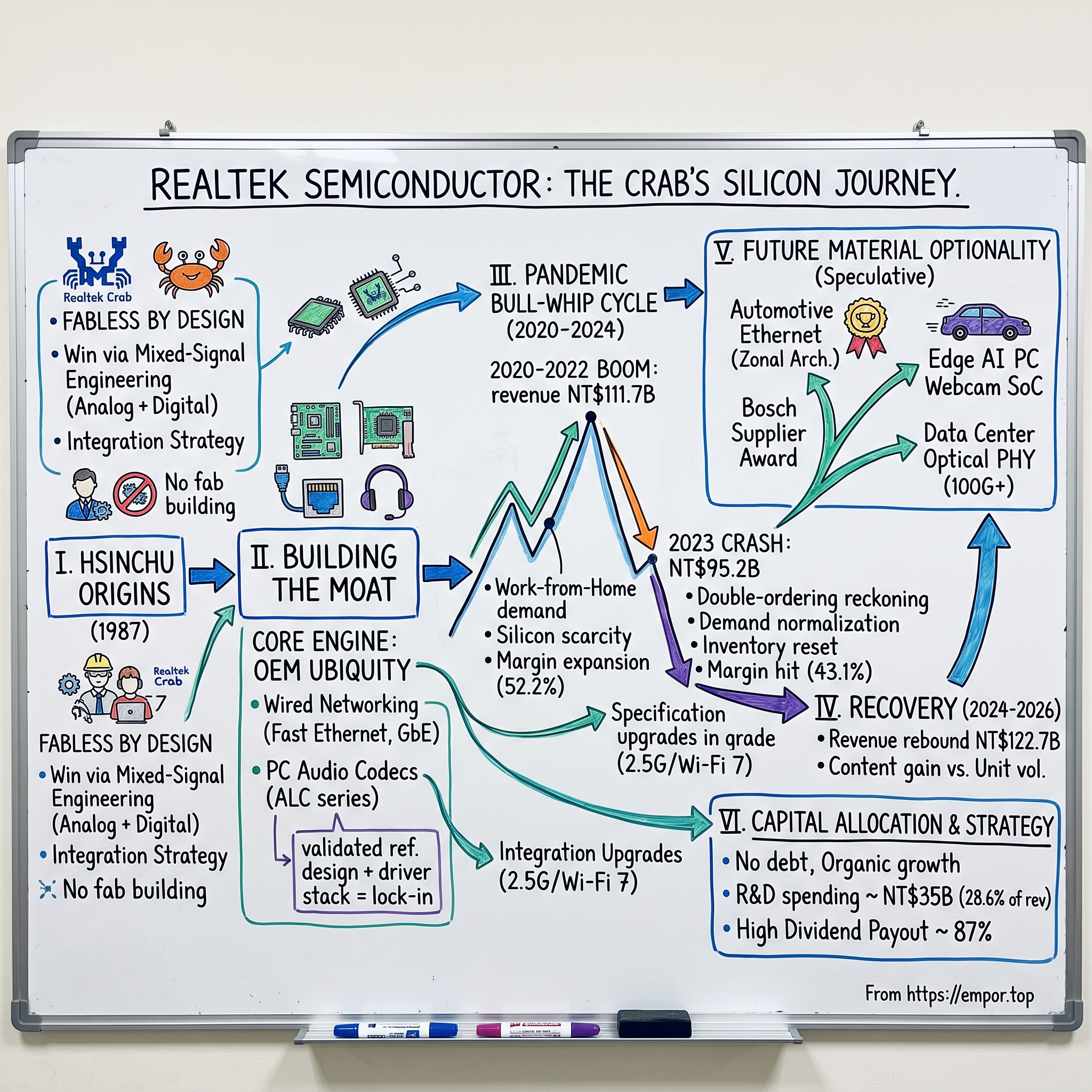
I. Introduction & The "Crab" Empire Roadmap
Somewhere in the room you are sitting in, there is almost certainly a crab.
Not a real one. A tiny picture of one, etched onto a plastic package roughly the size of a fingernail, soldered to a green circuit board inside a laptop, a desktop, a router, a television, a games console, or a network-attached storage box. If you have ever opened a PC case and squinted at the motherboard, you have seen it: a stylized crustacean, claws raised, printed beside a part number beginning ALC or RTL. It has been the corporate mark of 瑞昱半導體股份有限公司 Realtek Semiconductor Corp. since the company was incorporated in Hsinchu on October 21, 1987, and it has never been redesigned.12
The crab is one of the most widely distributed corporate logos in the history of consumer electronics, and almost nobody knows whose it is. That is not an accident — it is the business model. Realtek sells to the engineering departments of the world's PC makers, router builders, and television brands. It has no consumer marketing budget worth discussing, no flagship launch events, no brand ambassadors. It sells silicon that must work perfectly and cost almost nothing, and it has been doing so for thirty-nine years.
The scale is easy to underestimate. In 2025 the Realtek Group booked consolidated revenue of NT$122.71 billion — roughly US$3.8 billion — up 8.21% on the prior year, with operating gross profit of NT$61.37 billion and net profit after tax of NT$14.75 billion, or NT$28.77 per share.34 Those are respectable numbers for a mid-cap semiconductor company. What they conceal is unit volume. Realtek does not sell a few thousand expensive chips; it sells hundreds of millions of cheap ones, and its economics are built entirely on that arithmetic.
Here is the paradox worth sitting with. Realtek is, by any reasonable reading of the evidence, the dominant supplier of PC audio codecs — the small mixed-signal chip that turns digital audio into the analog waveform your headphones actually play — and one of the two or three most important suppliers of consumer Ethernet controllers on earth.5 Yet the company has essentially zero pricing leverage over the end consumer, because the end consumer has never heard of it. Its customers are the contract manufacturers who assemble the world's computers — Foxconn, Quanta, Compal, Wistron — and the brands they build for, all of whom exist to shave cents off a bill of materials. How do you build a durable, high-return business selling commodity-adjacent components to the most ruthless cost-cutters in global manufacturing?
That question is the spine of this story, and the answer turns out to be less romantic and more interesting than the word "moat" suggests. It has three parts.
The first is a specific and underappreciated engineering discipline: mixed-signal design, the art of putting sensitive analog circuitry on the same slab of silicon as noisy digital logic without the two destroying each other. This is a craft that does not scale with Moore's Law, does not benefit much from the newest fabrication node, and is learned slowly by human beings over decades. Realtek employed 7,858 people at the end of 2025, of whom 6,883 — about 88% — worked in research and development, with an average tenure of 7.9 years and nearly three-quarters holding a master's degree or doctorate.4 That is not a sales organization with an engineering department attached. It is an engineering organization that happens to invoice.
The second is the way that engineering converts into customer lock-in. Realtek does not win because its chips are magical. It wins because a motherboard reference design, once validated with a Realtek codec and a Realtek Ethernet controller and the accompanying Windows and Linux drivers, becomes a piece of infrastructure the manufacturer does not want to touch again. Swapping the chip means re-laying the board, re-qualifying the drivers, and re-running certification. The cost of that work usually exceeds the saving.
The third is the cycle. Realtek is levered to PC and broadband unit volumes, and those volumes are violently cyclical. The company lived through the wildest inventory whipsaw in modern semiconductor history between 2020 and 2024, and how it behaved during that whipsaw — what it did to prices, to inventory, to R&D spending, to the dividend — tells you far more about the durability of the franchise than any market-share statistic ever could.
The roadmap from here runs in sequence. First, the frugal Hsinchu origins, and why fabless was a philosophical choice as much as a financial one. Then the construction of the motherboard franchise in audio and Ethernet, and the mechanism that made it stick. Then the pandemic boom, the 2023 crash, and the 2024–2026 recovery, which together form the only complete cycle test this business has faced in a decade. Then the genuinely new businesses — automotive Ethernet, optical PHYs, edge AI silicon — and an honest attempt to size how much of the story they can carry. Then governance and capital allocation, including a related-party arrangement that deserves scrutiny. And finally the bull and bear case, tested rather than asserted, with the handful of metrics that actually settle the argument.
Start where it started: with a small group of engineers, no fab, and no obvious reason to succeed.
 Subscribe on LinkedIn
II. Hsinchu Origins & The Mixed-Signal Engineering Culture
In October 1987, Taiwan was not yet a semiconductor superpower. It was an aspiring one.
台灣積體電路製造 TSMC had been founded that same year as an experiment nobody was certain would work — a factory that would build other people's chips and design none of its own. 聯華電子 UMC had been running since 1980 as a government-seeded integrated device maker. 新竹科學園區 Hsinchu Science Park, opened in 1980 on the model of Stanford Industrial Park, was a few hundred hectares of new roads, low buildings, and returning Taiwanese-American engineers who had decided that the interesting work might now be at home. The island's electronics industry at that point was mostly assembly: cheap labor putting together components designed elsewhere.
Into that setting walked a small group of young engineers who incorporated Realtek Semiconductor Corporation on October 21, 1987.2 They had no fab, no capital to build one, and no intention of acquiring one.
That decision looks obvious in retrospect. It was not obvious then. In 1987 the prevailing model in semiconductors worldwide was integrated: you designed chips and you built them, because process technology and circuit design were considered inseparable arts. Intel built its own. Texas Instruments built its own. The pure-play fabless design house was a hypothesis, not an industry, and the hypothesis had an obvious flaw — if you did not control manufacturing, what stopped your manufacturer from simply taking your business?
What made the hypothesis workable in Hsinchu specifically was proximity plus a peculiar alignment of incentives. Realtek's founders were setting up shop within driving distance of what would become the world's foundry capital, and those foundries had made a credible commitment never to compete with their own customers. That geographic and structural accident became an advantage that compounds to this day: Realtek's primary raw material is the silicon wafer, and its named key suppliers remain TSMC, UMC, and other professional foundries and outsourced assembly and test houses.4 Realtek never had to build a fab because Taiwan built the fabs, and the fabs promised not to become Realtek.
But the fabless choice forced a second, subtler decision — and this is the one that actually defines the company. If you do not own a fab, you cannot win by having a better process. You have to win somewhere else. Realtek chose to win in mixed-signal design.
It is worth slowing down on what that means, because it is the technical heart of the entire investment case and it is routinely glossed over.
Digital circuits deal in ones and zeros, and they are forgiving. A voltage that is approximately high still reads as a one; a little electrical noise changes nothing. Analog circuits deal in continuous quantities — the actual shape of a sound wave, the precise voltage swing on an Ethernet cable, the faint radio signal arriving at a Wi-Fi antenna — and they are unforgiving, because a millivolt of noise is a millivolt of distortion. Now put both on the same piece of silicon. The digital logic is switching billions of times per second, spraying electrical noise through the shared substrate; the analog front end, a few hundred micrometers away, is trying to resolve signals a thousand times smaller than that noise. It is like recording a violin solo in a room where somebody is operating a jackhammer, and being required to deliver a clean recording.
There is no software tool that solves this. There is no shortcut node — in fact, shrinking to a more advanced process often makes analog performance worse, because the supply voltages get lower and the noise margins get thinner. The problem is solved by engineers who have made the mistake before: who know the layout tricks, the guard rings, the substrate isolation techniques, the parasitic capacitances that only reveal themselves in silicon three months and several hundred thousand dollars after tape-out. That knowledge accumulates in people and in reusable circuit blocks, and it accumulates slowly.
Realtek's own account of its competitive strengths puts radio frequency, analog, and mixed-signal circuit design capability first on the list, ahead of its customer base and ahead of its cost structure.4 For once, a corporate self-assessment is probably in the right order — and it explains a piece of the financial profile that otherwise looks strange. A company whose advantage lives in accumulated human expertise must keep buying that expertise regardless of the cycle, which is exactly what the R&D line shows.
The early product record demonstrates the strategy working precisely in this domain. In December 1991 Realtek's Pocket Ethernet Controller took an Innovative Technology Award from the Hsinchu Science Park Administration. In February 1995 a full-duplex plug-and-play Ethernet controller won a product innovation award from EDN Asia. In June 1997 the company's single-chip Fast Ethernet controller swept both Best Component and Best Product at Computex Taipei, and in November of that year took a new product development award from the Ministry of Economic Affairs' Industrial Development Bureau.2
Notice the pattern. Every one of those is a networking part, and every one is fundamentally about integration — collapsing what used to be several chips into one. That is the recurring move, and it is worth understanding why it works commercially rather than just technically. When Realtek folds the physical-layer transceiver, the media access controller, and the power regulation onto a single die, the customer does not merely save the cost difference between one chip and three. The customer saves board area, saves the passive components that used to sit between those chips, saves assembly steps, saves inventory line items, and saves the engineering time of making three parts from three vendors cooperate. The value delivered is a multiple of the silicon price. That is how you sell a cheap chip and still earn a decent margin.
That was the wedge. The 1990s Wintel PC boom created enormous demand for network interface cards at a price point the incumbent American suppliers found uninteresting, and Realtek's Fast Ethernet controllers filled it at volumes that made the low price sustainable. The chips were never the fastest available. They were adequate, cheap, and everywhere — which is how a company with a crab on its logo ended up giving its nickname to an entire category of hardware among PC builders across the Chinese-speaking world.
The capital markets caught up in stages, and the sequence tells you something about the culture. Realtek listed on the Gre Tai Securities Market, Taiwan's over-the-counter venue, in September 1997, then moved to the main board of the Taiwan Stock Exchange in October 1998 under the code 2379.2 It issued its first unsecured convertible bonds in May 2000, raising NT$1.4 billion, and its first overseas depositary receipts in January 2002, raising US$240.2 million — securities that remain listed in Luxembourg.2
And then it essentially stopped raising money. The company has not run a significant equity raise in more than two decades, and the direction of capital flow has been outward ever since. For a semiconductor company that has grown revenue roughly fourfold since 2014, funding that entire expansion from operating cash flow is an unusual achievement, and an unusual choice. It is the financial signature of a management team that treats external capital as an admission of failure.
What the founding decades established was a template Realtek has essentially never abandoned: pick sockets the premium players consider beneath them, win them on integration and cost, fund the next socket from cash flow, and never, ever buy a fab. The next question is whether that template could scale past networking cards into something resembling an empire — and the answer arrived, improbably, through a chip that makes noise.
III. The Core Engine: PC Audio Codecs, Ethernet, and OEM Ubiquity
There is a moment in the life of every PC design that decides several hundred million dollars of chip revenue, and almost nobody outside the industry has heard of it.
It happens in a contract manufacturer's engineering office — Quanta in Taoyuan, Compal in Taipei, an equivalent facility in Chongqing — where a team is laying out the motherboard for a laptop that will ship eighteen months later. They are working from a reference design: a template board, already proven to function, that the chip vendor supplies free of charge. Somewhere in the block diagram there is a box labelled "audio codec" and another labelled "LAN controller." Those boxes have already been filled in, because the reference design arrived pre-validated with parts whose drivers are certified, whose electrical behavior is characterized, and whose supply chain the manufacturer trusts.
Changing them means re-doing the board layout, re-running electromagnetic compliance testing, re-validating thermals, and re-submitting drivers for certification with the operating system vendor. That work costs real engineering months. The saving from a cheaper part, multiplied across even a large production run, frequently does not cover it — because the part in question already costs well under a dollar.
That is the mechanism. Not a patent thicket, not a network effect, not a brand. A validated reference design and a working driver stack: the least glamorous moat in technology, and one of the most effective ones ever constructed.
Realtek built it first in audio, and the product sequence reads like a strategy document written backwards. The ALC650 six-channel codec took a Best Choice Award at Computex Taipei in June 2002, in the era of Intel's AC'97 standard. The ALC882, unveiled in March 2005, moved the franchise to 7.1-channel High Definition Audio as Intel replaced AC'97 with HD Audio — a standard transition that could have reset the competitive field and instead confirmed Realtek's position. The ALC888 generation followed in 2006. Then, in October 2007, came the ALC269: the first HD audio codec to integrate a two-watt Class D amplifier alongside aggressive low-power specifications, aimed squarely at extending laptop battery life.2
Read that sequence as strategy rather than product history and it is the same move performed four times: absorb an adjacent function onto the die, kill an external component, shrink the customer's board area and bill of materials. The ALC269 is the purest example. Before it, a laptop needed a codec and a separate amplifier chip to drive its speakers. After it, the laptop needed one part. Realtek captured some of the eliminated component's value in its own price and handed the rest to the customer as savings. Everybody won except the company that used to sell the amplifier.
Myth versus reality: the market-share number
It is worth being precise about Realtek's position in PC audio, because the figure most often repeated — a global share above 70% — is not one the company publishes, and no audited figure exists in the public record. Realtek's annual report does not disclose audio codec market share, and neither do its investor materials.46
What can be said from evidence is narrower and, in some ways, more telling. Essentially every major motherboard and notebook brand ships Realtek audio in volume. More revealingly, the company describes its 2026 objective in this segment not as gaining share but as strengthening "leadership in specification setting and market share" while participating in the early-stage development of next-generation PC audio interface standards, so that customers can transition smoothly when the standard changes.3 Companies with modest share do not get seats at standards tables, and they do not describe their job as helping the industry migrate. Investors should treat the dominance as well-evidenced and the specific percentage as undisclosed — and should notice that the standards-body position is itself a competitive asset, because whoever helps write the next interface specification is rarely surprised by it.
The wired networking franchise
The Ethernet story ran on a parallel track and eventually became the larger one. Realtek's Fast Ethernet controllers of the late 1990s gave way to the RTL8169S and RTL8110 single-chip Gigabit controllers, recognized with a Hsinchu Science Park innovation award in October 2003, then to PCI Express Gigabit parts from 2004 onward. In July 2007 the company released the RTL8366 series — six-port Gigabit Ethernet switch controllers on a single chip, carrying its patented Green Ethernet power-saving technology — and in October 2009 the RTL8111E, the first Gigabit Ethernet controller SoC built to the IEEE 802.3az energy-efficient Ethernet standard.2
Each step widened the addressable socket in a specific way: from an add-in card, to a function integrated on the motherboard, to the switching silicon inside the home router itself. The company was following the physical path a packet takes through a home, buying up the real estate one hop at a time.7
Bundling was the accelerant. A manufacturer that took the Realtek codec and the Realtek LAN controller from the same reference design got one vendor, one support relationship, one driver package, one quality process, and one negotiation. That is a materially lower total cost of ownership than best-of-breed sourcing, and it explains why Realtek's presence on a motherboard tends to be plural rather than singular. The company's peripheral franchise widened the same way — into card readers, where the RTS5111 arrived in August 2005 as the world's first USB 2.0 all-in-one card reader controller with integrated regulator and power MOSFET, and where by October 2007 the RTS5161 series had absorbed a NAND flash reader, a smart card reader, a fingerprint reader, and an infrared receiver into a single controller.26
The competitive geography
None of this makes Realtek a monopolist, and the company does not claim to be one. The field around it is worth mapping honestly.
Broadcom sits above Realtek in enterprise and data-center networking, where performance requirements and gross margins are both far higher and where Realtek does not seriously contend. 聯發科技 MediaTek, a fellow Hsinchu-born fabless house and by a wide margin the larger company, overlaps directly in Wi-Fi and in television SoCs, while concentrating its firepower on smartphones. Qualcomm presses from the premium mobile and enterprise Wi-Fi side. Marvell and Synaptics overlap at the edges — enterprise PHYs, display and audio interfaces. And in the entry tiers of Wi-Fi and Ethernet, mainland Chinese fabless design houses compete aggressively on price with the advantage of a large protected domestic market.
The rivalry is not always polite, and one episode is a matter of court record. In 2023 Realtek filed a complaint in the Northern District of California against MediaTek, Future Link Systems LLC, and IPValue Management — Future Link's parent — alleging violations including United States antitrust and unfair competition law. The case remained pending as of the 2025 annual report, with the company stating it could not reliably determine the outcome.4 Whatever its ultimate merits, the filing is a useful signal about how the competition actually feels from inside: Realtek believed its principal domestic rival was using third-party patent assertion as a competitive weapon, and was willing to spend legal money and reputational capital saying so publicly.
The structural squeeze
The commercial reality underneath all of this is captured in one uncomfortable set of numbers. In 2025 Realtek's three largest customers accounted for 20%, 18%, and 14% of consolidated revenue respectively — 52% of the entire business concentrated in three relationships — while its three largest suppliers absorbed 25%, 25%, and 17% of total purchases, or 67% of procurement.4 Geographically, 57.4% of 2025 revenue came from Asia excluding Taiwan and 41.3% from Taiwan itself, reflecting where electronics are assembled rather than where they are consumed.4
Realtek therefore sits between a concentrated customer base and a concentrated supplier base, and it is the smaller party in most of those conversations. That structural squeeze is the permanent condition of the business. The reference-design lock-in is not a luxury or a bonus; it is the only thing standing between Realtek and pure commodity pricing, and every strategic decision the company makes should be read as an attempt to keep it intact.
The next question is what happens to a franchise built on that mechanism when demand stops behaving rationally — which, starting in 2020, it did.
IV. Key Inflection Points: The Pandemic Bull-Whip, 2.5G Upgrade, & Inventory Reset
In the first half of 2020, the world's white-collar workforce went home, and every one of them discovered two things at once: that their domestic broadband was inadequate, and that their personal laptop was six years old.
For a company selling the connectivity silicon inside both, what followed was extraordinary and ultimately treacherous. Realtek's revenue had been NT$60.74 billion in 2019. It reached NT$77.76 billion in 2020, then NT$105.50 billion in 2021, then NT$111.79 billion in 2022 — an 84% increase across three years in a business whose end markets grow, in a normal decade, at low single digits.5 Gross margin, which had run in the low forties in 2018 and 2019, climbed above 50% in 2021, and in the first quarter of 2022 touched 52.2%.58
It is important to be clear-eyed about where that margin came from, because the answer determines how much of it was ever repeatable. It was not primarily a product-mix triumph. It was scarcity. Foundry capacity was rationed worldwide, lead times stretched past a year, and any supplier who could actually deliver silicon held temporary pricing power over customers desperate to keep assembly lines running. Realtek's margins in that window were a market condition wearing a company's uniform. Investors who extrapolated them were extrapolating a shortage.
The reckoning
The bill arrived in 2022 and came due in 2023. Global PC shipments fell roughly 14% in 2023, returning to pre-pandemic levels, while the entire supply chain simultaneously discovered it had double-ordered.2 The bullwhip effect — where a modest change in end demand is amplified into a violent swing in component orders as each layer of the chain adjusts its own inventory buffer — ran in reverse and ran hard. Every distributor, every contract manufacturer, and every brand had built safety stock during the shortage. When demand normalized, all of them stopped ordering simultaneously, and the component makers at the end of the whip absorbed the full amplitude.
The first quarter of 2023 was the trough, and it was ugly. Revenue fell to NT$19.63 billion, down 34% year over year. Net profit collapsed 65.4% to NT$1.79 billion, the lowest in three years, and earnings per share fell to NT$3.50 from NT$10.15 a year earlier. Gross margin dropped to 43.1%, hit simultaneously by unfavorable product mix, inventory valuation losses, and intensifying price competition. Inventory itself was cut 17% to NT$21.22 billion. PC products, then 29% of revenue, faced a market management expected to contract about 10% for the year.8
What management said at that moment deserves recording, because it is one of the few places in this company's public history where a specific, testable claim was made under real pressure. Vice President and spokesman 黃依瑋 Huang Yee-Wei told the market in April 2023: "We believe we have hit the trough of this downcycle." He paired it with a forecast that the second quarter would improve, and an unglamorous admission that visibility into the second half remained dim.8
He was, as it turned out, approximately right — and the pairing of a confident near-term call with a candid admission of uncertainty is a useful behavioral marker. Full-year 2023 revenue landed at NT$95.18 billion, down 14.9%. Operating income fell 57.7% to NT$6.66 billion and net profit dropped 43.5% to NT$9.15 billion, with earnings per share of NT$17.85.2 Gross margin for the year settled at roughly 42.8%, with the fourth quarter recovering toward the mid-forties as destocking ended and replenishment orders appeared.29
Three aspects of Realtek's conduct during that year deserve investor attention, because they are the difference between a company that is merely cyclical and one that is badly run.
R&D did not get cut. Realtek spent NT$26.43 billion on research and development in 2023 — a year in which operating income fell by more than half.5 The absolute figure was down from 2022's NT$30.08 billion, but measured against a much smaller revenue base it actually rose, to roughly 27.8% of sales. A management team optimizing for a single year's reported earnings would have done the opposite, and many peers did. The behavior is consistent with the stated belief that the company's advantage lives in accumulated design capability, which decays if you stop feeding it.
There was no panic acquisition. The 2023 annual report's risk disclosure on mergers and acquisitions reads, in its entirety, "None" — and the identical entry appears in the 2025 report.24 Across the worst downcycle in a decade, while Western peers were paying record multiples to buy growth, Realtek bought nothing. That is either admirable discipline or a failure of ambition, and reasonable investors disagree about which.
The balance sheet absorbed the shock without financing. The company describes its investment policy as conservative, states plainly that it does not engage in high-risk or highly leveraged investments, and notes that its interest rate exposure is not significant because borrowings are minimal and incurred only to support operations.4 There was no rescue equity, no distressed asset sale, no dividend suspension.
The recovery, and what it actually showed
The rebound was sharp. Revenue rose 19.1% in 2024 to NT$113.39 billion, net profit reached NT$15.29 billion, and gross margin snapped back above 50%.4 Then 2025 added another 8.21%, taking revenue to a record NT$122.71 billion with gross profit of NT$61.37 billion and a gross margin right at 50%.34
But look closely at 2025 and a more complicated picture emerges — one that matters more than the headline growth. Revenue rose 8.21% while gross profit rose 7.37%, meaning gross margin slipped slightly. Operating expenses grew 7.68%, roughly in line, so operating income rose 6.36% to NT$14.36 billion. And net profit fell 3.52% to NT$14.75 billion, because income tax expense more than doubled, rising 138.85% to NT$2.51 billion, which the company attributes to tax generated by current income.4
The honest reading: 2025 was a year of solid top-line growth with flat-to-slightly-deteriorating unit economics, in which the reported earnings decline was driven by tax normalization rather than operational failure. It is neither the triumph the revenue record implies nor the deterioration the profit line implies. It is a company growing volume while quietly losing a little ground on price.
The fourth quarter made that visible. Revenue slipped to NT$26.28 billion, down 10.9% sequentially and 0.3% year over year, as customers trimmed year-end inventory positions, and gross margin fell to 48.1%, down 1.6 percentage points from the third quarter.10 Management's framing going into 2026 was "cautiously positive," resting on customer restocking and — revealingly — on pre-buying ahead of expected memory price increases.10 When a chip company's near-term optimism rests partly on customers hoarding ahead of cost inflation, that optimism has a shelf life.
The content thesis takes shape
Underneath the aggregate, the product mix was shifting in the direction the bulls wanted, and this is where the forward story actually lives.
The upgrade from Gigabit to 2.5GbE Ethernet is the clearest example. In plain terms: for two decades, the wired network port on a motherboard ran at one gigabit per second, and the chip that drove it was a mature, cheap, thoroughly commoditized part. The move to 2.5 gigabits requires a meaningfully harder analog design — faster signaling over the same ordinary copper cable, which is precisely the mixed-signal problem Realtek is built to solve — and it commands a materially higher price for what is, from the customer's perspective, the same single port. Realtek's second-generation 2.5GbE part became the standard on flagship motherboards, and the company followed with 5GbE and then 10GbE.23 The 10GbE products launched in 2025 penetrated server-grade edge AI platforms, opening a market Realtek had not previously served, and high-end 24- and 48-port 10GbE campus aggregation switches launched the same year were adopted by major telecom operators and networking brands.3
The wireless equivalent is Wi-Fi 7. Realtek entered the first wave in 2024 targeting mainstream PCs and routers, and by the 2026 first-quarter call management expected penetration to exceed 30% in PC notebooks during the year — roughly double the prior year's level.211 Broadband access moved in parallel, with governments and telecom operators accelerating 10G PON fiber deployment, which in turn pulls multi-gigabit Ethernet switching into the home.3
That is the structural argument in a sentence: even if the number of PCs sold never grows again, the amount of Realtek silicon value inside each one can. It is a genuinely different claim from "we will sell more units," and it is the claim on which everything from here depends.
Whether it is strong enough to carry a valuation is what the rest of this story tests — beginning with the businesses that do not matter yet, but might.
V. Future-Material Optionality & Sizing Speculative Businesses
In 2025, Realtek received something it had never received before: a Bosch Global Supplier Award, in the Materials and Components category.3
That is a small line in a business report and a large signal about direction. Bosch is the world's largest automotive components supplier, and its qualification process for a new silicon vendor is measured in years, not quarters. Clearing it means Realtek has satisfied the quality, reliability, traceability and failure-rate standards that separate consumer semiconductors from automotive ones — a set of hurdles that has stopped many technically capable chip companies cold. Consumer silicon may fail one part in ten thousand; automotive silicon is expected to survive fifteen years of thermal cycling in an engine bay and fail at rates measured in parts per billion.
Why cars became a networking problem
The opportunity is real and mechanically easy to understand once the physics is laid out.
A car built in 2005 contained a few dozen electronic control units chattering to each other over CAN and LIN buses — slow, robust, purpose-built networks that move kilobits per second and were designed for messages like "the driver pressed the brake." A car being designed in 2026 has cameras producing 4K video, lidar producing point clouds, radar producing continuous returns, and a central compute module that needs all of it simultaneously and in real time. CAN cannot carry that. It was never meant to.
Automotive Ethernet can, and the industry standardized on single-pair variants — 100BASE-T1 and 1000BASE-T1 — that push high bandwidth down thin, light, cheap two-wire cabling, because a modern vehicle's wiring harness is already among its heaviest and most expensive components. Then came the architectural shift that turns this from a component swap into a market: vehicles are moving to "zonal" designs, where a handful of regional controllers replace dozens of scattered ECUs, and every zone controller is, functionally, an Ethernet switch. Somebody has to sell that switch silicon, and it is a socket that did not exist a decade ago.
Realtek has been building toward it for years and is now shipping into it. Its portfolio spans automotive Ethernet PHY transceivers and highly integrated switch controllers.12 A second-generation PHY supporting dual-mode MACsec — link-layer encryption, which matters when a network carries steering and braking commands — at 100/1000BASE-T1 was adopted by European and US carmakers.2 A fourth-generation switch is set for mass production supporting ASIL-D, the highest automotive functional-safety integrity level, which is the classification reserved for systems whose failure can kill someone.3
At Computex 2026 the RTL9072Dx automotive Ethernet switch took the Best Choice Golden Award. The chip integrates six 100/1000BASE-T1 PHYs for doors, seats and low-resolution cameras; four 10Gbps XFI ports for lidar, 4K cameras and autonomous-driving computers; and one 1000BASE-T/100BASE-TX port for diagnostic and inspection equipment.13 That single part is the zonal architecture rendered in silicon — the low-speed edge and the high-speed core of a vehicle network on one die. Around it, Realtek is developing asymmetric PHY bridge transceivers to the Automotive SerDes Alliance Motion Link specification for in-vehicle camera data bridging, automotive gateway solutions, modular smart cockpit single-chip products, automotive-grade Wi-Fi 7, AI-enabled voice DSP SoCs, and audio power amplifiers.3
The sizing discipline
Now the part that matters for anyone modelling this.
Realtek does not disclose automotive revenue separately in its annual report, and no audited segment figure exists in the public record.4 Management describes automotive as a major driver of future growth and reports solid growth across Korea, Europe and the United States, with Ethernet adoption tied to zonal architectures.311 Those are directional statements, not measurements.
What can be said with confidence is bounded. The automotive line is small relative to a NT$122.71 billion revenue base. Its design cycles run five to seven years from win to volume, which means a design victory announced in 2026 contributes meaningfully to revenue somewhere around the end of the decade. And the absence of segment disclosure makes the growth claims impossible to verify independently — a limitation investors should hold in mind every time they hear the automotive story told.
Treat this as valuation optionality with a long fuse, not as a near-term earnings driver. The Bosch award and the Computex recognition are genuine evidence that the products are competitive. They are not evidence that the revenue has arrived.
The nearer bets
The second cluster of new businesses sits much closer to the core, and the payoff is nearer and easier to verify.
Realtek shipped a USB4 40Gbps hub controller — one of a small number of parts meeting the specification, and the company claims the highest integration in the category — and is now developing a USB4 v2 80Gbps successor.23 It has fully launched a third-generation AI PC webcam SoC, an image signal processor with an integrated edge AI engine, which has attracted major brand clients with mass production scheduled to begin in 2026.3 The imaging franchise has been building for years: the company introduced a video high-dynamic-range solution in 2023 to fix the backlit-face problem that plagued video calls, and major PC brands upgraded business and premium laptop camera specifications comprehensively from 2024, with 1080p becoming mainstream and 8-megapixel 4K entering the high end.4 New lines in fingerprint recognition and embedded controller chips are being adopted by major PC manufacturers.3
At Computex 2026 the company also took category awards for the RTL9151AS — a PCIe 4.0 bridge that fans a single lane into one Ethernet port, seven USB ports and four SATA ports for industrial PCs and edge devices — and the RTD2811, an edge AI accelerator for notebooks and smart displays supporting both convolutional and transformer models, with a neural processing unit rated at 20 trillion operations per second.13
The strategic logic here is cleaner than the automotive case. Realtek is already inside the PC. Every one of these products adds another socket to a board it already occupies, sold through a customer relationship it already has, into a design cycle it already participates in. This is bill-of-materials share expansion, and it is the most capital-efficient growth available to a company in Realtek's position — no new customers to acquire, no new qualification to survive, no new sales channel to build.
The longest shot
Then there is the most speculative bet on the board. Realtek launched 100G optical PHY products in 2025 and has PAM4 DSP chips under development to support 400G and 800G modules, positioning explicitly into data center, telecom backbone, high-performance computing and AI server markets, with 25GbE Ethernet solutions and 25Gbps fiber access products also mapped out.3
This is a direct move toward the highest-value, fastest-growing pocket in networking silicon — and also the pocket where Broadcom and Marvell are entrenched, technically formidable, and vastly better resourced. It is the one place in Realtek's plan where the company is attacking uphill against incumbents who are better at exactly the thing being contested.
Management has been notably restrained about the timeline. On the 2026 first-quarter call, 100G optical modules were not expected to generate meaningful revenue until 2027 or 2028.11 That restraint is creditable, and it is the correct way to describe a research program. It is also a reminder that this is a multi-year option rather than a plan, and that options expire.
Applied honestly, the sizing rule reads: near-term cash flows remain anchored in PC and broadband networking cycles; the PC-adjacent expansion is the one bucket where the evidence and the timeline both support the story today; and automotive and optical are real, credible, and currently unmeasurable from outside.
Which raises the obvious question of who is making these allocation decisions, and how well they have made them before.
VI. Management, Governance, & Capital Allocation Record
Realtek's chairman is not a founder, and the transition that put him in the chair is one of the quieter succession stories in Taiwanese technology.
邱順建 Chiu Sun-Chien holds a master's degree in electrical engineering from National Taiwan University, first joined the board in June 2000, and became chairman on August 9, 2021, succeeding founder 葉南宏 Yeh Nan-Horng.2 He holds the chief executive title alongside the chairmanship. 顏廣裕 Yen Kuang-Yu, who holds a master's in communications engineering, has served as president since 2017 and also sits on the board.32 The vice chairman, Chern Kuo-Jong, holds an MBA from the City University of New York and serves as vice chief executive and chief financial officer — an unusual combination that concentrates finance and corporate strategy in a single seat.2 The public voice of the company remains Vice President Huang Yee-Wei, who has served as spokesperson across the entire cycle described above, with a special assistant to the president serving as deputy.2
That continuity matters for a specific analytical reason: it makes management testable. The same person made the trough call in April 2023 and is making the cost-pressure warnings in 2026, so an investor can actually check whether the narrative has held together. Broadly it has. The company has framed its business in terms of specification upgrades driving content per device rather than unit-volume growth in the 2023 report, in the 2025 report, and on the 2026 calls alike.2311 Management has also been willing to publish uncomfortable numbers without spin: the 2025 annual report flags the 138.85% jump in tax expense in a table explicitly titled "Analysis of Changes equal to or over 20%," with a one-line explanation, rather than burying it in a footnote.4
The ownership question
The ownership structure does not match the founder-controlled narrative that outside commentary often assumes, and investors should look at it directly.
As of September 16, 2025, Realtek's largest shareholders were the Cathay MSCI Taiwan ESG Sustainability High Dividend Yield ETF at 5.60% and the Yuanta Taiwan Dividend Plus ETF at 5.54%, followed by Cotek Pharmaceutical Industry Co. at 4.32%, Nan Shan Life at 2.94%, Fubon Life at 2.02%, a UOB Taiwan high-dividend ETF at 1.61%, the New Labor Pension Fund at 1.41%, a Yuanta Taiwan Top 50 ETF at 1.29%, an individual holder at 1.28%, and director Ni Shu-Ching at 1.23%.4 Chairman Chiu's directly disclosed personal holding was 0.17% of shares outstanding as of April 2024, held alongside a 0.64% position in United Glory Co., Ltd., the investment vehicle through which his board seat is held.2 Total shares outstanding stood at 515,512,641, and 87.83% of them were represented at the 2026 annual meeting on May 27 in Hsinchu.3
Read that register carefully and the picture is unusual. It is dominated by passive dividend-oriented ETFs and domestic institutions. There is no controlling family block, no strategic corporate holder with an effective veto, no dual-class structure, and insider ownership among executives is small in percentage terms.
This cuts both ways. On the positive side, there is no obvious channel for shareholder-level self-dealing and no entrenchment mechanism. On the negative side, alignment between management and owners rests on compensation design and professional reputation rather than on personal wealth concentrated in the stock. And the shareholder base's heavy tilt toward dividend ETFs creates a genuine institutional pressure to keep paying out, regardless of what the reinvestment opportunity set looks like in any given year. A register full of high-dividend index funds is a register that punishes a payout cut severely.
The payout, examined
Which brings us to a number that deserves more attention than it usually receives. For 2025, the board resolved a cash dividend of NT$25.00 per share, distributing NT$12.888 billion out of retained earnings against net income of NT$14.753 billion.3
That is a payout ratio of approximately 87% — materially higher than the 70-to-80% range Realtek is commonly assumed to run, and far above the floor its own articles of incorporation require, which is 50% of the increase in distributable retained earnings for the year.4 Employees' compensation for 2025 was set at NT$4.339 billion, or 21.92% of profits, with NT$700 million of that ring-fenced for basic-level employees, against directors' remuneration of NT$100 million, or 0.51%.3 The ratio between those two figures — engineers collectively receiving more than forty times what the board receives — is a reasonably precise description of where this company believes value is created, and it is a genuinely unusual allocation among listed companies of this size.
An 87% payout on a cyclical semiconductor company is a real choice with real costs. It signals confidence that the business does not need the capital. It also means the cushion is thinner than the reputation suggests: the group ended 2025 with a cash balance of NT$13.07 billion, down from NT$14.81 billion at the start of the year, after generating NT$23.02 billion from operating activities and spending NT$24.76 billion on investing and financing activities, the latter driven principally by the dividend.4
Realtek carries essentially no net debt and does not need to borrow. But the popular characterization of a fortress balance sheet holding NT$30 billion-plus of cash does not survive contact with the actual cash flow statement, and investors should adjust accordingly. This is a company that distributes nearly everything it earns and funds growth from the operating line.
The reinvestment record
Judged across the full history, the capital allocation record is unusual and mostly admirable.
Realtek's approach is organic to a degree that borders on ideological. Research and development consumed NT$35.12 billion in 2025, or 28.63% of revenue, up from NT$33.54 billion and 29.58% in 2024, with expected R&D spending of approximately NT$37.2 billion budgeted for 2026.4 That level of reinvestment — roughly two and a half times the company's operating income — is extraordinary for a business of this size, and it is precisely what a company does when it believes its competitive advantage consists of a library of circuit designs and the people who write them. Realtek filed 286 invention patent applications in 2025, ranking sixth among Taiwanese domestic applicants, and was named to Clarivate's Top 100 Global Innovators for a fifth consecutive year.3
The company also builds its own talent pipeline, operating a "Realtek Corporate University" with six internal colleges, and launched an employee stock purchase plan in June 2025 to broaden employee ownership.43 Average salary for full-time non-managerial employees was disclosed at close to NT$2 million, a figure Realtek benchmarks against listed semiconductor peers.4
On the acquisition side the record is close to blank by choice, and the affiliate structure is composed largely of wholly-owned R&D and investment holding entities rather than acquired operating businesses.4 While Western peers spent the last decade paying premium multiples for scale, Realtek did not participate. That has kept the balance sheet clean and avoided the goodwill impairments that have punctuated peer results — and it has also meant Realtek has never bought its way into a market it could not enter on its own.
The single most striking capital decision in company history runs in the opposite direction from growth entirely, and it appears in section X.
The item an activist would open with
There is one governance matter a sceptical investor should not skip.
In 2025, transactions between Realtek and its subsidiaries and the related party GMI Technology Inc. totalled NT$17.495 billion, or 14.25% of consolidated net operating revenue, on collection terms of 30 to 60 days after monthly billing — against a board-approved annual ceiling of 25% of consolidated revenue.3 Cross-referencing the annual report's customer concentration table confirms the identification: the third-largest customer, at 14% of 2025 revenue, is footnoted as a related party, and the amount matches to the thousand.4
GMI is a long-established Taiwanese electronic components distributor and a legitimate channel partner; the company states that transaction prices and collection terms did not differ materially from those available to non-related parties, that the amount did not exceed the board-approved limit, and that terms were in line with general business practice.3 The arrangement is disclosed, audited by PricewaterhouseCoopers, and was reviewed by an audit committee chaired by independent director Hsieh Yin-Ching, which raised no objections.3 The full filings are available through Taiwan's public disclosure system.14
It is also, structurally, a seventh of the revenue line flowing through a related entity. Nothing in the public record suggests impropriety. But an investor should note the arrangement, watch the percentage over time relative to its 25% ceiling, and recognize that this is exactly the kind of item that appears on an activist's first slide — not because it is wrong, but because it is large, related, and self-reported.
VII. Hamilton Helmer's 7 Powers & Porter's 5 Forces Analysis
Strip away the narrative and ask the structural question directly: what, precisely, prevents a well-funded competitor from taking this business away? Two frameworks, applied without charity.
The seven powers
Scale economies — strong, and the most underrated element of the story. A chip design carries a fixed cost — engineering, verification, photomask tooling, driver development — that must be amortized across every unit shipped. Realtek's fixed costs are enormous. Spread across a few million units, an R&D base of NT$35 billion is ruinous. Spread across the hundreds of millions of units that flow through global PC, router, television and console production, it becomes a per-unit rounding error that a smaller rival simply cannot match on price without losing money on every chip. This is the actual engine, and it is self-reinforcing: volume funds R&D, R&D wins the next socket, the next socket adds volume.
Cornered resource — moderate to high, with an important qualification. The proprietary mixed-signal, RF and DSP intellectual property accumulated across thirty-nine years is genuinely hard to replicate, and the patent output supports the claim. But the resource lives in people, and people can be hired. Realtek's average employee tenure of 7.9 years suggests the institution is retaining its knowledge, but this is a power that requires continuous defense rather than one that sits behind a legal wall.4 It is closer to a craft guild than a patent estate.
Switching costs — high, and the most durable power in the portfolio. The mechanism was described earlier: the manufacturer's cost of change exceeds the manufacturer's saving from change. Note the asymmetry that makes it work — Realtek's price is already so low that the absolute saving available from switching is small, while the fixed engineering cost of switching is not. A company that charged more would, paradoxically, be easier to displace.
Process power — real but narrower than usually claimed. Realtek executes tape-outs, yield optimization and packaging integration competently, and states that it deliberately does not concentrate wafer purchases on a single foundry.4 But it does not own the process. Its manufacturing execution is a supplier-management skill, not a proprietary capability, and TSMC will sell the same node to anyone who can pay. Calling this a "high" power, as the consensus framing often does, overstates it.
Counter-positioning — low. Realtek does not employ a business model its competitors cannot copy without damaging their existing economics. It plays in mainstream volume markets with a conventional fabless structure.
Network effects — essentially absent. Ethernet, Wi-Fi and USB are open standards; the value of a Realtek chip does not rise because other people own Realtek chips. There is one adjacent effect worth naming, though it is not a true network effect: because Realtek parts are ubiquitous, operating system vendors ship support for them by default, which lowers the friction of choosing Realtek again. That is a distribution advantage, and it is real.
Branding — low with consumers, moderate with buyers. No end user pays a premium for a Realtek chip; most could not name one. Procurement and design engineers, however, assign genuine value to predictability, and thirty-nine years without a supply catastrophe is a form of brand equity that does not show up in surveys.
The five forces
Now Porter, which is where the picture darkens considerably.
Supplier power — high. Realtek's entire manufacturing base is outsourced, so foundry price increases pass into cost of goods sold with almost no buffer, and the company has minimal leverage over TSMC. The 2026 first-quarter call made the current version vivid: DDR4 memory prices had nearly doubled since January, contract prices were forecast to rise a further 58-63% quarter over quarter, assembly and test capacity was described as a major bottleneck, and foundries were signalling further increases on top.11 Management stated explicitly that the gross margin outlook was under pressure and that the extent of cost pass-through would depend on the strategies of system makers and brands.11 That is an honest answer describing a weak position.
Buyer power — high. Three customers, 52% of revenue, all of whom compete with each other on price and pass every gram of that pressure upstream.4
Threat of new entrants — low for the incumbent franchise, moderate at the edges. Nobody is going to enter PC audio codecs from scratch; the combination of analog expertise, driver legacy and scale requirement makes it economically irrational. But entering the entry tier of Wi-Fi or Ethernet with a cost-optimized part and a protected domestic customer base is entirely feasible, and mainland Chinese design houses have done exactly that.
Threat of substitutes — genuinely low. Something has to move data between chips, boxes and networks, and no alternative technology is emerging. Wireless does not substitute for wired in the applications Realtek serves; increasingly it complements it, and Realtek sells both sides of the trade.
Competitive rivalry — high and intensifying. Wi-Fi 7 is the current battleground, contested simultaneously by MediaTek, Qualcomm, Broadcom and Realtek in a market where the specification is standardized and differentiation therefore reduces mostly to integration and price. Price competition in standardized silicon ends one way, and everyone involved knows it.
The synthesis
Put the two frameworks together and a specific, uncomfortable conclusion emerges.
Realtek's powers are strongest where its markets are oldest — scale economies and switching costs in mature PC and consumer networking sockets, protected by reference designs laid down over two decades. Its powers are weakest exactly where its growth is supposed to come from. In Wi-Fi 7, in automotive Ethernet, in optical PHYs, Realtek is competing without the incumbency that protects its core, against opponents who are frequently much larger and, in the optical case, better at the specific technology.
The company's advantage is real. The company's advantage is not evenly distributed across its own growth plan. That tension is the heart of the investment case, and everything in the bull and bear argument flows from it.
VIII. Investment Story Spine: Bull vs. Bear & Skeptical Stress Test
Reduce the argument to two sentences, then attack both.
Why Realtek wins from here. The company occupies incumbent sockets in a device category that is not disappearing, and the value of each socket is rising faster than the category is shrinking: the migration from Gigabit to multi-gigabit Ethernet, from Wi-Fi 6 to Wi-Fi 7, from USB 3.2 to USB4, and from basic webcams to AI-accelerated imaging all raise silicon content per unit inside designs Realtek already owns — funded by an R&D budget few competitors of similar size can sustain, and defended by a switching-cost mechanism that has held for twenty years.
Why Realtek might not. It is a price-taker on both sides of its income statement — squeezed by foundry, memory and packaging costs it cannot control, and by three customers who account for over half its revenue — competing in newly standardized categories where its historical reference-design advantage does not apply, with a payout ratio near 87% that leaves limited retained capital if the cycle turns while the transition is incomplete.
Now the stress test, in the form a sceptical investor would actually pose it.
Challenge one: "This is a mature PC proxy with capped growth"
The bear says Realtek's fortunes rise and fall with global PC shipments, which are structurally flat, and that everything else is decoration on a cyclical commodity business.
The evidence cuts both ways, and precision matters. Management restructured its own reporting in 2026 to split the business into PC at roughly 36% of revenue and non-PC at roughly 64%.11 That immediately weakens the pure-PC-proxy framing: nearly two-thirds of revenue comes from televisions, gaming consoles, networking equipment, IoT devices, Bluetooth audio, and automotive. The non-PC drivers cited on the 2026 first-quarter call were concrete rather than aspirational — television builds ahead of the 2026 World Cup, 任天堂 Nintendo's Switch 2 described as the fastest-selling Nintendo hardware, 10G PON deployment, and AI infrastructure upgrades.11
But the bear retains a real point about the PC portion. IDC projected 2026 PC shipments down approximately 11%, following a year in which the Windows 10 to Windows 11 migration and AI PC adoption pulled demand forward and lifted 2025 shipments.114 Realtek's answer is content gain rather than volume — Wi-Fi 7 attach rates, AI peripherals, USB4, imaging silicon.
The 2026 results so far offer partial support. First-quarter revenue reached NT$36.4 billion, up 38.6% sequentially and 4.0% year over year, with earnings per share of NT$8.44 and inventory days improving to 105 from 127.1115 Second-quarter revenue of NT$37.55 billion set a record, up 3.11% sequentially and 17.68% year over year, with June revenue of NT$12.31 billion up 20.6% on the prior year and first-half revenue of NT$73.98 billion up 10.52%.16
Growing double digits while your largest end market is forecast to shrink 11% is meaningful evidence for the content thesis. It is not yet proof, and the reason is specific: part of that growth came from customers pulling orders forward ahead of announced price increases — borrowing from future quarters, which management itself flagged while describing second-half visibility as limited.11 The test of the thesis is not the first half of 2026. It is whether the second half holds without the pull-forward.
Challenge two: "Chinese competitors will commoditize the low end"
The bear says entry-tier Ethernet and Wi-Fi will be competed to zero margin by domestic Chinese design houses with lower cost structures and procurement tailwinds from national supply-chain policy.
Realtek's implicit answer is migration: keep climbing the specification ladder faster than the commodity tier can follow. The evidence that this works is the multi-gigabit transition already described — 2.5GbE becoming flagship-motherboard standard, 10GbE entering server-grade edge AI platforms, campus switches winning telecom customers.23 Each rung is a fresh analog design problem, which is where the accumulated expertise pays.
The evidence that it might not work comes from the company itself. Realtek's stated competitive disadvantage, in its own annual report, is that "fierce market competition and short product life-cycle" mean a failure to introduce new products on time could cost market share and profits.4 Its listed countermeasures are to invest in new products, improve yields on existing ones, and co-develop with customers.4 That is the entire bear case, written by management, without euphemism.
The honest verdict: this is a treadmill, not a fortress. Realtek has run it successfully for three decades, and running it successfully requires being right about which rung to climb next, every time, forever. Nothing in the record guarantees the next decade — though the record is the best available evidence about the odds.
Challenge three: "Input cost inflation will crush gross margin"
This is the live issue of 2026, and it is more serious than the standard version of it.
The pressure is not only foundry wafer pricing. It is memory — DDR4 nearly doubling since January 2026, with contract prices forecast to rise a further 58-63% in the second quarter. It is assembly and test capacity, which management called a major bottleneck. And it is foundries signalling further increases on top of both.1115 These are not sequential problems; they are simultaneous, and they hit a company that buys everything and makes nothing.
Realtek's gross margin path shows the strain accumulating: 50.4% in 2024, 50.0% for full-year 2025, 48.1% in the fourth quarter of 2025 as customers trimmed inventory, and 49.7% in the first quarter of 2026 — up 1.6 points sequentially, but down 1.9 points year over year, with inventory write-offs cited as a contributor.41011
The counterargument is that Realtek can pass costs through, and there is evidence it intends to try: third-quarter 2026 results were expected to benefit from price increases.16 The counter-counterargument is management's own framing, which placed the outcome in someone else's hands — pass-through depends on the strategies of system makers and brands, and Realtek emphasized "mutually beneficial partnerships" rather than unilateral pricing action.11 Companies with genuine pricing power do not describe the process that way. They announce a price and the market pays it.
What an investor should watch is not the rhetoric but the sequence: costs rose first, prices are expected to follow, and the gap between the two shows up in gross margin one or two quarters later. If margin holds near 50% through the second half of 2026 while input costs are inflating at these rates, the pass-through claim is validated. If it drifts toward the mid-forties, it is not.
The activist's file
A sceptical fund building either a long or a short case would assemble roughly this list, and it is worth stating plainly because none of the items is hidden — all of them come from the company's own disclosures.
The related-party channel at 14.25% of revenue, disclosed and audited but structurally significant, with headroom to 25% before the board-approved ceiling binds.3 The absence of segment-level profitability disclosure, which makes it impossible to verify whether automotive and networking carry the margins management implies, or whether the mature PC franchise is quietly subsidizing new ventures that lose money. An 87% dividend payout on a cyclical business holding NT$13.07 billion of cash while budgeting NT$37.2 billion of R&D for the coming year.34
Five active patent matters as of the 2025 report: two separate ParkerVision actions filed in 2022 and 2023 in the Western District of Texas, a Redwood Technologies action filed in 2025 in the same venue, Realtek's own antitrust complaint against MediaTek and IPValue, and a Philips appeal to the Federal Circuit after Realtek won final judgment in the District of Delaware in August 2025 — the tail of a case in which the International Trade Commission had already found non-infringement in March 2022.4 The company states in each pending matter that it cannot reliably determine the outcome.4
And a board structure in which the chairman also holds the chief executive title while the vice chairman also holds the chief financial officer title — a concentration a governance-focused investor would question regardless of the competence of the individuals involved.
None of these is a scandal. Collectively, they are a fair explanation for why a company earning returns on equity in the high twenties on a debt-free balance sheet does not command a premium multiple.5
IX. Material Risk Radar & Earnings Call Guidance for Writers
The single largest risk facing Realtek is one it cannot manage, mitigate, or diversify away in any meaningful timeframe — and the company says so, in its own words, in its own filings.
Realtek owns no fabrication capacity. Its primary raw material is the silicon wafer; its named key suppliers are TSMC, UMC and other professional foundries and outsourced assembly and test facilities.4 The 2025 letter to shareholders states that the company is mindful of geopolitical factors and is reinforcing supply chain resilience by diversifying wafer foundry and packaging and testing operations to spread risk.3 That diversification is genuine — the company confirms it does not concentrate wafer purchases on a single foundry, and describes cross-regional production support designed to reduce exposure to economic, accidental, epidemic and geopolitical events.4
But it is diversification within a supply base whose center of gravity remains one island. A serious cross-strait disruption would not compress Realtek's margins. It would halt the company. This is not a risk that can be modelled, hedged, or priced with any confidence, and it should be treated as a binary condition attached to the entire investment. It is also, importantly, shared with essentially every Taiwanese fabless company, which means it is not a reason to prefer one over another — only a reason to size the whole category deliberately.
The second-order risks are more tractable and currently more active.
Input cost inflation is the acute problem of 2026. The memory spike, the packaging and test bottleneck, and signalled foundry increases together represent the sharpest cost pressure Realtek has faced since the shortage years — with the crucial difference that in 2021, scarcity arrived bundled with pricing power, and in 2026 it has not obviously arrived bundled with anything.11
PC cyclicality remains structural. With the PC segment at roughly 36% of revenue against a forecast double-digit shipment decline, and with a demand pull-forward already acknowledged, the second half of 2026 carries visible risk that management has explicitly declined to underwrite.11 There is an additional wrinkle worth tracking: management flagged Apple's entry into the sub-US$600 notebook segment as causing significant disruption and driving polarization between entry-level and premium tiers.11 That mix shift could cut either way for a supplier whose content value per unit is higher in premium designs — more premium notebooks helps, more ultra-cheap ones does not.
Wi-Fi 7 price competition is intensifying in retail and carrier routers, in a category standardized enough that differentiation is limited and where at least two competitors have deeper pockets.
Litigation is a live if manageable overhang. Five matters were pending or on appeal as of the 2025 report.4 None appears existential on the available evidence; collectively they represent a recurring legal cost, a management-attention tax, and a source of headline risk in a business whose entire product line is built on patented analog technique.
Cybersecurity and product-security risk deserve a brief mention precisely because Realtek's products are network infrastructure. The company maintains a formal cybersecurity framework covering product development security, vulnerability response, network segmentation for R&D environments, and customer confidential information protection, and reports regular audits and social-engineering drills.4 For a vendor whose chips terminate internet connections in hundreds of millions of homes, a serious firmware vulnerability is a reputational event of a different order than a bad quarter.
Reading the calls
For anyone working through the primary evidence, the conference call record is where this company is most revealing, and the pattern across calls is consistent enough to be genuinely useful. The company posts quarterly results and earnings materials through its investor relations pages, and full filings through Taiwan's disclosure system.914
The April 2023 call is the benchmark for management under pressure. The spokesman made an explicit, falsifiable trough call and paired it with an admission of poor visibility, rather than either denying the problem or catastrophizing it.8 Judged against what followed, the call was substantially right. That is one data point in favor of management's honesty about its own cycle, and it should be weighed against the vaguer, more promotional language that appears in better times.
The April 30, 2026 call is the most informative recent document, and three things stand out for a careful reader.1115
First, management volunteered the cost problem in specific, quantified terms — naming the DDR4 move, the forecast quarterly increase, and the packaging bottleneck — rather than gesturing at "macro headwinds." Specificity under bad news is a credibility marker.
Second, when analysts pressed on pass-through and on customer inventory levels, the answers were conditional and hedged: cost absorption determined by system integrators, customer inventories "somewhat above average but manageable." Those are honest answers. They are also weak ones, and the distinction between honesty and strength is the whole point of reading transcripts.
Third, management reorganized its own segment reporting into PC and non-PC. That change simultaneously clarified the demand mix and made comparison against the older product-category framing harder. A reporting change that happens to reframe the growth story in the company's favor is worth reading twice, even when — as here — the new framing is genuinely more useful than the old one.
The consistent gap across all of these calls is the same one, and it is the most important disclosure limitation in the entire analysis: management speaks fluently about design wins, penetration rates and specification upgrades, and much less specifically about the profitability of individual product lines. Realtek discloses consolidated gross margin and nothing below it. That is legal, entirely standard in Taiwan, and a real constraint on what any outside analyst can honestly conclude about where the money is actually made.
X. Strategic Playbook, Key KPIs, & Episode Outro
There is one decision in Realtek's history that captures the company's temperament better than any product launch, and it is almost never mentioned.
In January 2007, at an extraordinary shareholders' meeting, Realtek's owners approved a capital reduction of NT$4.18 billion — a 50% reduction ratio, returning approximately NT$5 per share to shareholders.2 Not a buyback. A formal shrinking of the company's capital base, executed because the company had more capital than it could productively deploy and saw no reason to pretend otherwise.
Very few technology companies of any nationality have ever done this. Growth companies do not voluntarily become smaller. But it is the single clearest statement of the operating philosophy: Realtek does not want capital it cannot earn a return on, and it is willing to make itself structurally smaller to prove the point. Nineteen years later, the same instinct shows up in an 87% dividend payout and an empty acquisition history.
That philosophy generates a playbook with four rules, all of them visible in the record rather than in a strategy deck.
Take the sockets nobody glamorous wants. Audio codecs and Ethernet PHYs are unglamorous, low-priced, high-volume components that premium semiconductor companies have historically found beneath their margin structure. Realtek took them, dominated them, and used the resulting volume base to fund entry into adjacent sockets. The strategy only works if you are genuinely content to be invisible — which is a cultural precondition, not a financial one.
Integrate until the competition's bill of materials looks expensive. Every significant Realtek milestone is an integration story: the pocket Ethernet controller, the single-chip Fast Ethernet controller, the audio codec that swallowed the amplifier, the card reader that absorbed the fingerprint sensor and infrared receiver, the automotive switch that carries eleven ports of three different types.213 Integration reduces the customer's component count, board area, assembly steps and inventory complexity simultaneously — which is worth far more to a manufacturer than raw performance ever is.
Win the engineering department and the purchasing department follows. The reference design is the real product. The chip is what gets invoiced.
Stay solvent, stay fast, buy nothing. No meaningful net debt, no equity raised in over two decades, no acquisitions of consequence, R&D held near 29% of revenue through the worst downcycle in a decade.45 The cost of this conservatism is that Realtek has never bought its way into a new market and consequently enters every one of them from a standing start. The benefit is that it has never had to sell its way out of one.
The three metrics that settle the argument
For investors tracking whether this playbook still works, three measures carry nearly all the signal. They should be read as a system, because each one alone can mislead.
Consolidated gross margin is the master variable. It sits at the intersection of everything that matters: product mix as higher-value silicon replaces commodity parts, competitive intensity as rivals push into Wi-Fi 7 and entry Ethernet, and cost pass-through as foundry, memory and packaging prices move. It held near 50% across 2024 and 2025 against roughly 43% at the 2023 trough.4 A sustained drift back toward the mid-forties would indicate that either the mix upgrade has stalled or the pass-through has failed — and from outside, those two causes are nearly indistinguishable, which is exactly why the number needs watching every quarter rather than every year.
Wi-Fi 7 and multi-gigabit Ethernet penetration is the direct proxy for the content-per-device thesis on which the entire growth case rests. Management guided Wi-Fi 7 to exceed 30% penetration in PC notebooks during 2026.11 The diagnostic is the combination: if penetration tracks that path while PC units decline and revenue still grows, the thesis is validated by observation rather than assertion. If penetration rises while revenue does not, it means the price uplift is being competed away — which would be the single most important negative signal available, and would arrive well before it showed up in the margin line.
Inventory days of supply is the early-warning system for the bullwhip that nearly halved this company's profits in 2023. The figure improved to 105 days in the first quarter of 2026 from 127, and management characterized customer inventories as somewhat above average but manageable.11 The specific pattern to fear is rising days combined with rising revenue, because it means product is moving into the channel rather than through it — precisely the configuration that preceded the last crash.
Two of the three are disclosed on quarterly calls; the third is discussed qualitatively. Together they answer the only questions that matter for this business: is the mix still upgrading, is the upgrade still being paid for, and is the channel still healthy.
The long view
Realtek's shares traded around NT$744 in late July 2026, against a fifty-two-week range of roughly NT$438 to NT$970 and a market capitalization near NT$382 billion.17 The width of that range is the market's honest confession about how much visibility anyone has into a business that grew first-half revenue 10.52% while its largest end market was forecast to shrink by double digits, and while its input costs inflated at rates it does not control.16
Thirty-nine years after a small group of engineers incorporated a company in a science park that had recently been farmland, Realtek has never been the most advanced semiconductor company in Taiwan, or the largest, or the most discussed. 台灣積體電路製造 TSMC builds the world's most sophisticated transistors; MediaTek designs the brains of a billion phones. Realtek makes the parts that plug things into other things.
That turns out to be a rarer business than it sounds, and over a long enough horizon, arguably a harder one: consistently indispensable at a price nobody bothered to argue about, in sockets nobody thought worth defending until Realtek already owned them. The crab does not chase. It holds ground, and it is very difficult to dislodge.
Whether holding ground is enough for a decade in which the cost base is inflating, the principal end market is contracting, and the growth is concentrated in categories where incumbency does not apply — that is the open question. The evidence will arrive one gross margin print at a time.
References
-
TSE Code: 2379 Realtek Semiconductor Corp. 2023 Annual Report — Realtek Semiconductor Corp., 2024 ↩↩↩↩↩↩↩↩↩↩↩↩↩↩↩↩↩↩↩↩↩↩↩↩↩
-
Realtek Semiconductor Corp. 2026 Annual Shareholders' Meeting Minutes and 2025 Business Report — Realtek Semiconductor Corp., 2026-05-27 ↩↩↩↩↩↩↩↩↩↩↩↩↩↩↩↩↩↩↩↩↩↩↩↩↩↩↩↩
-
TSE Code: 2379 Realtek Semiconductor Corp. 2025 Annual Report — Realtek Semiconductor Corp., 2026-05-06 ↩↩↩↩↩↩↩↩↩↩↩↩↩↩↩↩↩↩↩↩↩↩↩↩↩↩↩↩↩↩↩↩↩↩↩↩↩↩↩↩
-
Realtek Semiconductor Investor Relations — Annual Reports Portal ↩↩↩↩↩↩
-
Realtek quarterly profit hits 3-year low — Taipei Times, 2023-04-22 ↩↩↩↩
-
Realtek Semiconductor IR — Quarterly Earnings Releases & Financial Statements ↩↩
-
Realtek tops US$3.8 billion in 2025 revenue, signals solid growth from customer restocking in 1H26 — Digitimes, 2026-01-28 ↩↩↩
-
Realtek Semiconductor Q1 2026 Earnings Call: Revenue Surges 38.6% QoQ to NT$36.4B — BigGo Finance, 2026-04-30 ↩↩↩↩↩↩↩↩↩↩↩↩↩↩↩↩↩↩↩↩
-
Realtek Wins Three Chip Awards at Computex 2026 for Automotive, PC and Edge AI Technologies — The Elec, 2026 ↩↩↩
-
Taiwan Stock Exchange — Market Observation Post System (MOPS) Company Filings, 2379 ↩↩
-
2026/04/30 瑞昱 (2379.TW) 法說會:營收強彈+AI 網通升級,成長動能延續 — Vocus, 2026-04-30 ↩↩↩
-
Realtek 2Q26 revenue driven by networking demand, 3Q26 set to gain from price hikes — Digitimes, 2026-07-07 ↩↩↩
-
Taiwan Stock Exchange — Realtek Semiconductor Corp. (2379) Historical Stock & Trading Data ↩
 LinkedIn
 WhatsApp
 Reddit
 Hacker News
 Email
Email Kindle
 RSS Feed
 Spotify
 Apple Podcasts
 Amazon Music
 Audible
 YouTube