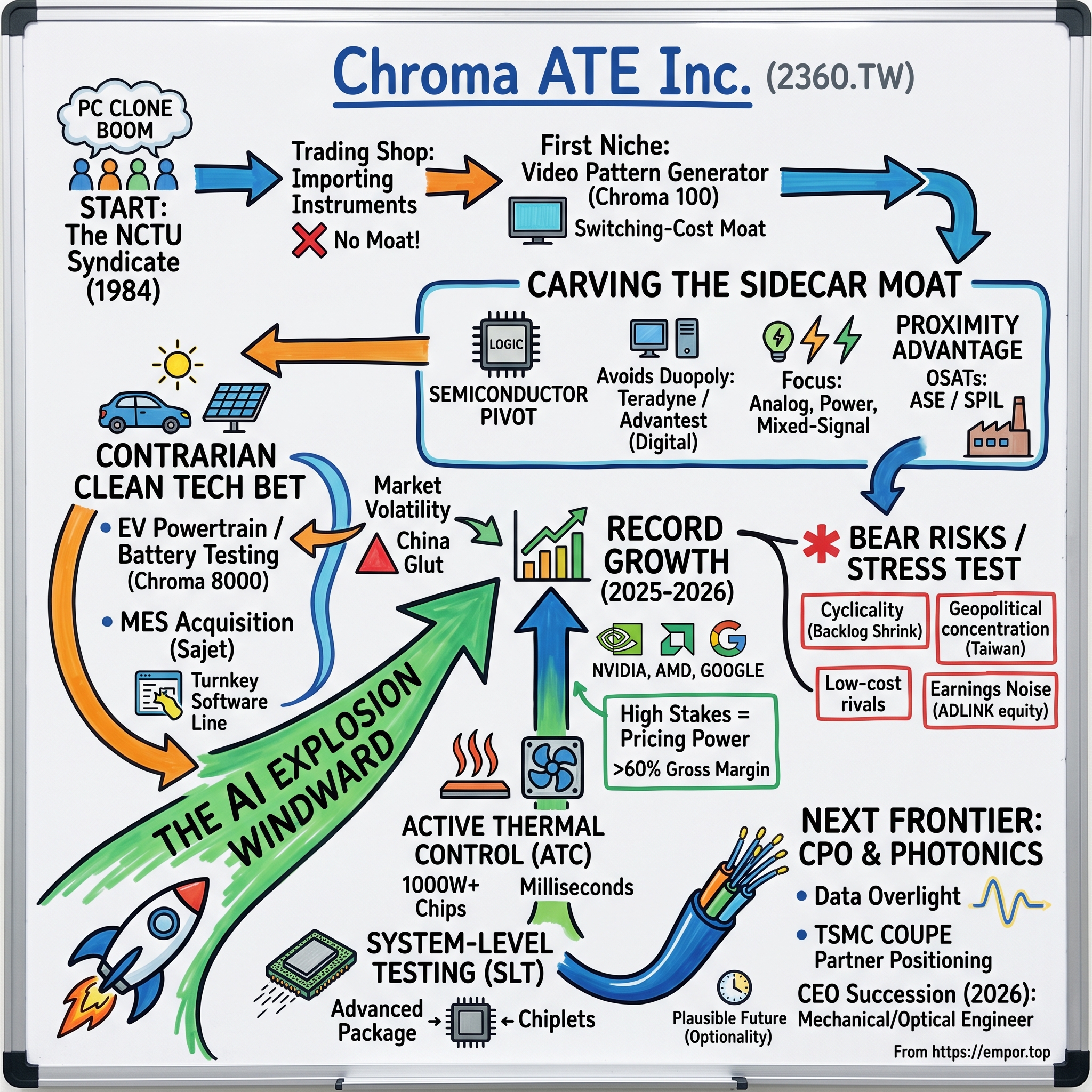
Chroma ATE Inc.: The Hidden Testing Engine of the AI and EV Revolutions
I. Introduction & Episode Roadmap
Picture the most expensive object in a modern data center. It is not the building, not the diesel generators, not even the liquid-cooling plant humming in the basement. It is a silicon rectangle roughly the size of a playing card, drawing north of a thousand watts, running so hot that if the cooling fails for a few seconds it will cook itself into a paperweight worth tens of thousands of dollars. Now imagine you have just manufactured one of these chips. Before you can sell it, you have to prove it works — not in the gentle idealized world of a wafer probe, but under a punishing, real-world software workload, at temperature, for hours, without melting. Who builds the machine that does that?
The answer, for a surprising share of the world's most advanced AI accelerators, is a company most Western investors have never heard of: 致茂電子 Chroma ATE Inc., listed in Taipei as 2360.TW on the Taiwan Stock Exchange (TAI). It is not a chip designer. It is not a foundry. It does not appear in a single Nvidia keynote. And yet it has quietly become one of the essential toll collectors of the semiconductor age — the company that sells the thermometers, the scales, and the electronic torture chambers that everyone else's silicon has to pass through before it ships.
The numbers are the sort that make you double-check the currency. In its 2025 financial year, Chroma reported consolidated revenue of NT$28.31 billion, up roughly 31% from NT$21.60 billion the year before, and net income of NT$11.69 billion — a 122% surge that more than doubled the prior year's profit.12 Its full-year gross margin ran above 61%, and in the record first quarter of 2026 it hit 63% gross and 40% operating margin — the kind of profitability profile you associate with enterprise software, not with heavy test-and-measurement hardware bolted to factory floors.23 By mid-July 2026 the company carried a market capitalization of roughly NT$843 billion, around US$26 billion, having briefly commanded well over a trillion New Taiwan dollars at its 52-week peak.4 For a business that started life in 1984 as a small trading shop importing instruments, that is a remarkable arc.
So here is the central puzzle this story tries to answer. How does a hardware company that sells physical machines earn software-like margins — and is that advantage durable, or is it a cyclical mirage riding the AI capex wave? Test equipment is supposed to be a commodity-adjacent business, competed down to thin margins by Japanese and Chinese rivals. Chroma is doing the opposite. To understand why, and to test whether it lasts, we need to trace five distinct chapters:
- The
國立交通大學 National Chiao Tung Universityengineering syndicate that founded the company amid an oil crisis, and rode Taiwan's PC-clone boom by becoming the industry's default quality gatekeeper. - The decision not to fight the global test duopoly of Teradyne and
アドバンテスト Advantesthead-on, but to carve out specialized "sidecar" niches in analog, power, and mixed-signal testing. - The contrarian, decade-early bet on clean technology — batteries, EV powertrains, solar — that briefly made Chroma a silent partner to early electric-vehicle pioneers, and now cuts both ways as China's battery glut bites.
- The AI explosion, and how System-Level Testing and Active Thermal Control turned a mid-cap instrument maker into an indispensable node in the advanced-packaging supply chain.
- And the 2026 leadership succession, which ended a 42-year founder era and pointed the company toward the next frontier: silicon photonics and co-packaged optics.
We will keep a skeptic in the room the entire time. Chroma is a genuinely excellent business, but excellent businesses attract narratives that outrun their evidence, and the semiconductor equipment world is where cyclicality goes to humble the overconfident. Let's begin where all of it started — in a Taiwan that had almost no electronics industry to speak of.
 Subscribe on LinkedIn
II. The NCTU Syndicate: Born in the PC Dawn (1984–1995)
In 1984, Taiwan was not yet the center of the electronics universe. It was a low-cost assembly outpost, cranking out cheap PC-compatible clones for foreign brands, and the island's engineers were mostly hired hands executing other people's designs. Into this moment stepped four graduates of the electrical engineering department at National Chiao Tung University — the school that functions in Taiwan's tech mythology roughly the way Stanford does in Silicon Valley's. One of them, 黃欽明 Leo Huang, had cut his teeth as an IC sales representative at Philips Semiconductors, which meant he had seen, up close, how the global chip business actually worked and how far behind Taiwan's homegrown capabilities lagged.5
The company they founded was not, at first, an engineering company at all. It was a trading shop — originally styled "Ko Mao Technology" — importing and reselling test and measurement instruments from foreign suppliers to Taiwan's hungry, unglamorous electronics factories.5 It was a sensible business for four young men with contacts and no capital: buy low abroad, sell with a markup at home, carry no R&D risk. And it very nearly killed them. The global oil shocks and the economic turbulence of the early 1980s hammered their first year. A trading business, they learned the hard way, has no moat — no proprietary product, no pricing power, nothing to stop a customer from cutting you out and buying direct, or a competitor from undercutting you on the same imported box.
This is the founding lesson that shaped everything Chroma became, and it is worth dwelling on because it explains the company's DNA. Huang and his partners concluded that survival required building something with a defensible margin — a niche product that no local rival could copy. The timing was providential. The personal computer was exploding, and every PC needed a monitor, and every monitor needed a way to be tested. So Chroma built one: the Video Pattern Generator, a device that pumps precisely defined color and geometry test signals into a display so a factory can verify the screen renders them correctly.5 The company's very name comes from this: "Chroma," for the colored graphics of those test patterns. The first model, the Chroma 100, was named for a modest sales projection of a hundred units. The follow-on Chroma 1000 sold over 3,000 — a runaway success for a small Taiwanese startup, and proof that the pivot from trader to builder had legs.5
What happened next established the playbook Chroma has run for forty years. As Taiwan's display and power-supply manufacturers — companies like 台達電子 Delta Electronics and 光寶科技 Lite-On — scaled from local workshops into globe-spanning giants, they needed testers that could keep pace with their production lines. Chroma positioned itself as the co-developer: designing test equipment in lockstep with each customer's next-generation product, so that by the time the customer ramped volume, the Chroma tester was already validated, already installed, already the standard. When your test parameters are written around a specific vendor's machine, swapping that machine out means re-qualifying your entire production process — a cost most factories will do almost anything to avoid.
The strategic read here matters more than any single product. Chroma did not win the PC era by being cheaper or by out-marketing anyone. It won by embedding itself into customers' manufacturing DNA so deeply that ripping it out became riskier than keeping it. That is a switching-cost moat, built one co-development project at a time, and it is the same mechanism — scaled up and made vastly more expensive — that underpins the company's AI-era margins today. But a tester of computer monitors is a modest business. To become something bigger, Chroma had to walk into the most brutally competitive arena in electronics: the testing of semiconductors themselves. And there, two giants were already waiting.
III. The Semiconductor Pivot: Carving Out the "Sidecar" Moat (1996–2005)
By the late 1990s, the ground under Taiwan's electronics industry was shifting in a way that would remake the world. 台積電 TSMC and the fabless-foundry model were detonating the old logic of chipmaking: instead of every chip company owning a fab, design and manufacturing split apart, and Taiwan became the workshop of global silicon. Chips were getting smaller, more integrated, and — crucially for our story — dramatically harder to test. Every new node created new failure modes, and every failure mode created demand for a machine that could catch it.
Here Chroma ran headlong into a wall. The global market for Automated Test Equipment — the machines that verify chips at wafer-sort and final test — was dominated by two incumbents: Teradyne of the United States and Japan's Advantest. Between them they held something approaching an 80% grip on the high-volume digital-logic and wafer-sort testing that sits at the heart of the industry.5 These were multi-billion-dollar companies with decades of accumulated software, enormous installed bases, and the kind of customer relationships that make displacement nearly impossible. A Taiwanese mid-cap charging directly at that fortress would have been committing corporate suicide.
So Chroma did the opposite of charging. It practiced what strategists call counter-positioning: rather than attack where the incumbents were strong, it went where they were structurally uninterested. The ATE giants had built their empires on digital testing — the ones and zeros of logic chips, where volume is enormous and software is king. But a growing share of the semiconductor world was analog and mixed-signal: power management ICs that regulate voltage, chips with radio-frequency interfaces, high-power devices that the digital-first testers handled clumsily and expensively. These were smaller, messier, more physics-intensive markets — exactly the sort of thing a giant optimized for scale finds unattractive, and exactly the sort of thing a nimble specialist can own.
Chroma launched dedicated SoC and analog test platforms — the Chroma 3650 and later 3680 systems — aimed squarely at these mixed-signal, power, and RF interfaces.[^6] The pitch was not "we're cheaper than Teradyne." The pitch was "for this specific class of device, we test it better, faster, and with more relevant capability than a general-purpose digital tester ever could." And Chroma had a home-field advantage no foreign competitor could match: proximity. Taiwan is home to the world's largest cluster of Outsourced Semiconductor Assembly and Test houses — the OSATs — led by 日月光 ASE and 矽品 SPIL. Chroma built deep, structural relationships with these firms, co-developing test solutions on their factory floors, iterating in days rather than the months a US or Japanese vendor would need to fly engineers across the Pacific.[^6]
The analytical point is that Chroma was not building a better mousetrap so much as a differently shaped one, aimed at mice the big cats ignored. This is a lower-glory strategy — you will never dominate the headline ATE market — but it is a far more defensible one for a challenger. It let Chroma compound expertise, relationships, and installed base in categories where it could actually be number one, while avoiding the capital bonfire of a frontal assault. It also had a hidden option value that would not pay off for two decades: the skills required to test high-power, thermally demanding, mixed-signal devices turn out to be exactly the skills the AI-accelerator era would eventually demand at a premium. Chroma could not have known that in 2000. But its instinct to plant itself in power and thermal complexity — the physical, sweaty, hard-to-commoditize corners of testing — would prove prophetic. First, though, it took that same instinct in a direction almost no one saw coming: into batteries and electric cars, years before the world was ready.
IV. Clean Tech & The Electric Vehicle Gamble (2006–2018)
Rewind to the mid-2000s and say the words "electric vehicle" in an investment meeting, and you would have gotten a polite smile. Tesla was a money-losing curiosity with a Lotus-based roadster. Chinese battery makers were mostly making cells for laptops and phones. "Clean energy" was a subsidy story, not an industrial one. This is precisely the moment Chroma chose to pour engineering resources into testing systems for batteries, photovoltaics, and LEDs — a bet so early it looked, at the time, like a distraction from the profitable semiconductor and PC businesses.
The logic, in hindsight, was elegantly opportunistic. Chroma already knew how to do the hardest thing in this domain: precisely source, sink, and measure large amounts of electrical power without frying the device under test or the tester itself. That capability had been built for server power supplies and power-management chips. The insight was that an electric vehicle is, from a test engineer's point of view, essentially a very large, very dangerous power-electronics problem. A battery pack, a battery-management system, an on-board charger, a traction inverter — these are all things that move serious current and must be validated for safety and performance before they go anywhere near a human being traveling at highway speed.
The vehicle for this expansion was the Chroma 8000 Automatic Test System, a modular platform originally conceived for complex power-supply testing. Management refactored it into a Swiss-army framework for the whole EV powertrain: battery packs, battery-management systems, on-board chargers, and even the charging stations (EVSE) that would eventually dot the roadsides.[^6][^7] As the first serious EV programs spun up — the early Tesla Roadster, and the mass-market Chinese vehicles from players like 比亞迪 BYD — the companies building them needed test systems that simply did not exist off the shelf, and Chroma was one of the few vendors with both the power-electronics pedigree and the willingness to co-develop from scratch. It became a quiet, unglamorous supplier of the validation gear behind the electrification wave, years before that wave was fashionable.
The other defining move of this era was strategic rather than technical. In 2007, Chroma acquired Sajet Technology and folded it in as the company's Manufacturing Execution Systems division.[^6] To appreciate why this mattered, you have to understand the difference between selling an instrument and selling a system. An instrument is a box a customer buys, plugs in, and operates. An MES is the software brain that coordinates an entire automated production line — scheduling, data collection, traceability, yield analysis — the nervous system of a smart factory. By owning MES capability, Chroma could stop selling isolated testers and start selling turnkey, software-orchestrated automated test-and-manufacturing lines. It moved the company up the value chain from component vendor toward solutions partner, and it deepened the switching costs we discussed earlier: a customer running Chroma's MES across a factory floor is bound far more tightly than one who merely bought a few instruments.
Here the neutral posture earns its keep. The clean-tech bet looks visionary in 2026, but we should be honest that it was a diversified bet, not a laser one, and for a long stretch it was a modest contributor rather than a growth engine — solar and LED testing in particular became commoditized and cyclical, and Chinese competition eventually turned battery and generic power-electronics testing into a margin battlefield we will return to in the bear case. The EV and clean-energy story is best understood not as the source of Chroma's greatness but as evidence of a repeatable instinct: to plant itself, early and cheaply, in emerging domains where its core competence in power and precision measurement gives it a running start. Most of those seeds stay small. Occasionally one of them catches a hurricane. And in 2019, the biggest hurricane in the company's history began to form — not in cars, but in the data center.
V. The AI Explosion: System-Level Testing (SLT) & Active Thermal Control (2019–2025)
To understand the windfall that hit Chroma, you first have to understand something that broke in the physics of chipmaking. For half a century, the industry improved chips by shrinking transistors — Moore's Law. But shrinking got brutally hard and expensive, and the industry found a workaround: instead of building one giant perfect chip, stitch together several smaller "chiplets" into a single advanced package. TSMC's CoWoS — Chip-on-Wafer-on-Substrate — is the flagship example, the packaging technology that physically assembles the GPUs powering the AI boom. This is Heterogeneous Integration, and it solved one problem while creating another, and that second problem is Chroma's opportunity.
Here is the analogy that makes it click. Imagine hiring a team by testing each candidate individually — every one aces their interview. Then you put them in a room to actually work together, and the team collapses, because the interactions between people surface problems no individual test could catch. Chiplets are the same. A modern AI accelerator can pass wafer-sort (each chiplet checked alone) and even final package test, and still fail when it is run as a complete system executing real software, because the complex hardware-software interactions only appear under genuine operating conditions. Catching those failures requires System-Level Testing — SLT — which runs the finished chip in a socket, under a realistic workload, as if it were already installed in a server. In the chiplet era, SLT went from a nice-to-have to mandatory for high-end accelerators, and Chroma had spent decades building exactly the physical, thermal, mixed-signal expertise that SLT demands.3
Then comes the thermal problem, which is where Chroma's moat gets genuinely hard to replicate. A top-end AI chip can draw a thousand watts and dump that energy as heat almost instantly. If you run its software test loops without managing that heat with millisecond precision, the chip will overheat and either throttle (giving you a false failure) or burn out (destroying a five-figure device). So Chroma integrates its pick-and-place test handlers — the Chroma 3100 and 3200 series robots that place each chip into the test socket — with Active Thermal Control systems that can dynamically chill or heat the device under test across a wide range, keeping a thousand-watt processor thermally stable while its logic is exercised.3 Think of it as a tiny, ultra-responsive climate-control system wrapped around a single chip, reacting faster than the chip can heat up. This is not primarily a software problem; it is a mechanical, fluidic, thermodynamic engineering problem — precisely the "sweaty," physics-heavy corner that a specialist can defend and a general-purpose digital-test giant finds unattractive.
The financial results of sitting in the right place at the right time were spectacular. Consolidated revenue climbed from NT$18.68 billion in 2023 to NT$28.31 billion in 2025, with the sharpest leg — that ~31% jump — landing in 2025 as AI demand went vertical.16 Net income more than doubled to NT$11.69 billion, and by the fourth quarter of 2025 the testing-equipment segment alone accounted for roughly 96% of revenue, with the overall gross margin pushing toward the low 60s.12 The momentum did not pause at year-end: the first quarter of 2026, normally the seasonally weakest of the year, instead delivered a record — revenue around NT$11.8 billion, up 73% year over year, net income of about NT$3.9 billion, EPS of NT$9.12, gross margin of 63% and operating margin of 40%.3 Management noted on the Q1 call that all three of the major AI chip makers — Nvidia, AMD, and Google — had adopted its SLT solutions, with AMD in particular ramping cycle times and orders, and said it was "seriously considering revising up" its SLT forecast on the strength of multi-quarter visibility.3
What does the evidence actually tell us, stripped of the excitement? Three things. First, the margin structure is real and it is a function of value, not accounting: customers testing thousand-watt silicon are not price-shopping their test handlers, because a tester that lets defective chips through, or that cannot hold temperature, can scrap millions of dollars of product — so they buy on yield certainty and thermal performance, and that is where pricing power lives. Second, the revenue concentration in AI test is a double-edged sword: 96% of revenue from testing equipment is wonderful when AI capex is vertical, and terrifying if it digests. Third — and this is the honest caveat management itself gestures at by refusing to give hard full-year guidance — this is lumpy equipment revenue tied to customers' capex cycles, not a smooth subscription stream.3 The right way to hold this chapter is that Chroma has demonstrably earned its seat at the AI table on genuine engineering merit, and that the same demand vertical that made 2025 extraordinary is exactly what makes the forward numbers hostage to a cycle it does not control. Which raises a different question about a company suddenly awash in cash: what has management actually done with it?
VI. Capital Allocation & Strategic Asset Plays (The ADLINK Swap)
Great operating businesses are not always great capital allocators, and the fastest way to judge a management team is to watch what it does with money and assets when no one is forcing its hand. Chroma's most illuminating case study here is its long, tangled relationship with 凌華科技 ADLINK Technology (6166.TW), a Taiwanese maker of industrial and embedded computers — the rugged PCs that run factories, medical devices, and machine-vision systems.
Chroma had been a significant long-term shareholder in ADLINK, at one point among its largest, a strategic financial holding rather than an operating one.7 The relationship produced a genuinely clever piece of capital recycling around 2020. ADLINK needed to consolidate its headquarters and manufacturing, and Chroma owned a factory at Hwaya Technology Park that fit the bill. Chroma sold the property to ADLINK, booking a substantial disposal gain that flowed into its capital reserves, while structuring the deal to avoid operational disruption — and redeployed the proceeds toward building a large new state-of-the-art campus in the A7 Technology Park in Taoyuan City, the facility now central to its AI-era capacity.[^7]7 It is a textbook example of monetizing a low-returning asset (an old factory and a passive equity stake) and rotating the capital into a high-returning one (advanced manufacturing capacity right as demand inflected).
But the neutral lens requires us to keep reading past the flattering version. The ADLINK saga did not end in a tidy strategic embrace. In 2025, 友達光電 AUO — the giant flat-panel maker — completed its own acquisition of ADLINK, and Chroma's stake in ADLINK by then had been reduced to a minority position of roughly 6%, no longer the commanding second-largest holding it had once been.78 The AUO–ADLINK transaction, moreover, became entangled in an insider-trading investigation involving individuals connected to ADLINK's leadership — a reminder that the cozy cross-shareholding webs common among Taiwanese industrials carry governance and reputational risks that are easy to ignore when the stocks are going up.8 None of this implicates Chroma in wrongdoing, but a skeptical investor is entitled to ask how much of the group's historical earnings volatility came from these non-operating equity swings — disposal gains, fair-value marks, and associate income that flatter or depress net income in ways that have nothing to do with selling test equipment. Indeed, in some years the swing in non-operating income has been large relative to operating profit, which is exactly the sort of thing that makes headline net-income growth rates less clean than they look.
Beyond the financial stakes, Chroma controls a genuine ecosystem of specialized subsidiaries that extend its testing reach into corners it could not economically build from scratch: Testar Electronics in optoelectronic and laser-diode probing, ADIVIC Technology in RF and wireless test, and DynaScan Technology in high-brightness commercial displays.9 These are not trophy assets; they are capability tuck-ins, and the optoelectronic probing expertise in particular is about to matter enormously for the photonics chapter ahead.
Which brings us to the most consequential capital-allocation-adjacent decision of all — succession. On January 1, 2026, after 42 years, co-founder Leo Huang stepped down as chief executive, remaining as active Chairman, and handed the CEO role to 曾一士 Dr. I-Shih Tseng.910 The board approved the change unanimously at an extraordinary meeting on December 3, 2025.10 Tseng is not an outsider parachuted in; he joined Chroma in 1998, holds a PhD in mechanical engineering from Pennsylvania State University and a degree from National Taiwan University, and had been running the integrated-system-solutions and optical-inspection business units — the parts of the company aimed squarely at automated systems and photonics.910 The signal is deliberate. Handing the company to a mechanical-and-optical engineer, rather than a finance or legacy-hardware executive, tells you where management believes the next decade of value will be created. It is a bet on physics — and specifically on light.
VII. The Next Frontier: Silicon Photonics & Co-Packaged Optics (CPO) (2026–Beyond)
There is a wall coming, and everyone in the AI infrastructure business can see it. As accelerators get faster, the bottleneck is no longer the compute — it is moving data between chips. Today that data travels over copper interconnects, and copper is running out of room: push more bits per second down a metal wire and you hit brutal limits on distance, power, and signal integrity. The industry's answer is to stop using electrons for the journey and start using photons — to move data as light. This is silicon photonics, and its most aggressive form is Co-Packaged Optics (CPO), which places the optical engine that converts electrical signals to light right next to the processor, inside the same package, instead of at the edge of the circuit board.
Now consider the test engineer's nightmare this creates. A conventional chip test is an electrical problem: apply signals, measure signals. A co-packaged optical device is three brutal problems at once. You have to align optical fibers or waveguides to sub-micron precision — a misalignment finer than a human hair's width kills the signal. You have to feed the thing high-speed electrical inputs. And you have to hold it at a controlled temperature the whole time, because photonic components drift with heat. Doing all three simultaneously, at production volume and speed, is a testing discipline that barely exists yet. As industry analysts have noted, CPO testing is currently one of the least-solved bottlenecks in the entire roadmap, with no unified standards and much of the process still manual.11
This is precisely the kind of physically-hard, multi-domain problem Chroma has spent four decades learning to love, and it is why the Tseng succession and the optoelectronic-probing subsidiaries suddenly look like pieces of a plan. Chroma has been deploying 3D optical-interface measurement and high-precision laser and photonic testers, positioning itself to be a testing partner as TSMC's COUPE (Compact Universal Photonic Engine) platform moves toward volume production — a platform TSMC has targeted for 2026 ramp as the optical on-ramp for AI data centers.1112
But here the neutral posture is non-negotiable, because this is where a company's own optimism and an investor's evidence must be held apart. As of mid-2026, CPO is a real technology on a real roadmap, but it is not yet a material revenue line for Chroma, and there is no confirmed, disclosed exclusive testing partnership that guarantees Chroma the COUPE socket. What exists is genuine early positioning, real product deployment, and — per the Q1 2026 call — purchase orders for three of four planned CPO test insertions, which is encouraging but small.3 Advantest and other established test players are chasing the same silicon-photonics prize, so Chroma's incumbency in SLT and thermal control is an advantage, not a lock.11 The honest framing is that CPO represents optionality: a plausible, potentially large future market where Chroma's competences are unusually well-matched, whose payoff — if it comes — will drive the capex cycle of 2027–2030 rather than the numbers of today. It is a reason to watch the company, not yet a reason it has already won. The prudent investor treats it as a call option with real underlying value and uncertain strike, and sizes their expectations accordingly.
VIII. Playbook: Business & Investing Lessons
Strip away the specifics and Chroma's forty-two years offer a set of transferable lessons about how a challenger builds a durable, high-margin business in the shadow of giants — lessons worth extracting precisely because they are so often stated but so rarely executed.
The first is the sidecar niche strategy. Chroma's foundational choice was to not fight Teradyne and Advantest where they were strong, but to identify the mechanical, thermal, and power-intensive problems adjacent to the incumbents' software-centric core — problems that are physically complex, unglamorous, and unattractive to a scale player optimized for high-volume digital test. The general lesson is that a challenger's best real estate is often the territory the incumbent has rationally chosen to ignore. The subtlety, which Chroma got right, is that the niche has to be one where your specific competence compounds over time and where the physics is hard enough to deter fast followers. A niche that is merely small, without being hard, is a trap; a niche that is small and deeply technical is a fortress.
The second is customer interlock as a moat — Hamilton Helmer's switching-costs power, made concrete. When TSMC, Delta, or an AI accelerator designer builds its production test parameters and yield-management flows around a specific Chroma handler, thermal-control system, or MES software suite, replacing that equipment stops being a procurement decision and becomes a production-risk decision. Re-qualifying a test flow can mean pausing a line, revalidating yields, and risking scrapped silicon — a cost calculus that keeps incumbents entrenched long after a nominally cheaper competitor appears. The lesson for investors is to look, in any equipment or tooling business, for evidence that the product is embedded in a workflow rather than merely sold into a facility. The former is sticky; the latter is a commodity waiting to happen.
The third is the margin of high-power customization, which explains the >60% gross margins better than any other single idea. In test and measurement for high-value silicon, the customer is not buying a machine; they are buying yield certainty and thermal performance on products where a single test escape can destroy millions of dollars of output. When the cost of the tester is trivial relative to the cost of being wrong, price sensitivity collapses and the vendor captures value proportional to the risk it removes, not the bill of materials it ships. This is the deep reason a hardware company can earn software-like margins — but note the boundary condition that also defines Chroma's vulnerability: it holds only where the stakes are high enough. In lower-value, lower-power testing — generic battery cells, commodity power electronics — the same logic evaporates, the customer becomes price-sensitive, and margins compress toward the commodity mean. Chroma's premium is not a property of the company; it is a property of the segment, which is exactly why the mix shift toward AI silicon has been so financially powerful, and why a shift back toward lower-value work would hurt.
The meta-lesson tying these together is that Chroma's advantages are real but conditional. They depend on continuing to sit in high-stakes, physically-hard, workflow-embedded corners of testing. The moment the company drifts into commoditized segments, or the moment a segment it dominates commoditizes underneath it, the playbook stops protecting it. That conditionality is the natural bridge to the hardest question: how strong is this business really, and what could break it?
IX. Analysis: Bear vs. Bull Stress Test
Let's war-game the company properly, using two frameworks that force discipline: Michael Porter's five competitive forces and Hamilton Helmer's Seven Powers. The point is not to reach a verdict but to locate the real fault lines.
Start with Porter's five forces, because they frame the industry Chroma operates in. Rivalry is bifurcated: at the high end (AI SLT, thermal control), competition is limited and technical, and Chroma competes on capability; at the low end (battery, generic power-electronics test), rivalry is savage and Chinese-led. Buyer power is high in the abstract — Chroma's customers are giants like TSMC and the AI chip designers who could in principle squeeze any supplier — but is blunted in practice by the switching costs and yield-risk dynamics we have discussed. Supplier power is modest. Threat of substitutes is subtle and important: the "substitute" for buying more test equipment is designing chips that need less testing, or shifting where in the flow testing happens — a slow but real risk. And the threat of new entrants at the high end is low because the mechanical-thermal-optical know-how is hard-won, but at the low end it is precisely the ongoing problem.
Now Helmer's Seven Powers, which locate durable advantage. Chroma most plausibly holds two. The first is a cornered resource: deeply specialized intellectual property and accumulated engineering know-how in active thermal control and high-density handling for high-power semiconductor test — the kind of tacit, multi-domain expertise that cannot be bought off a shelf or reverse-engineered from a datasheet. The second is scale economies in R&D: Chroma reinvests a heavy share of revenue into engineering — R&D ran around NT$2.56 billion in 2025, roughly 9% of sales, and higher as a share in leaner years — which is a larger absolute and relative commitment than most localized Asian competitors can sustain, allowing it to amortize development across a broad installed base.1 Switching costs, discussed at length, are the third genuine power. What Chroma does not obviously have is network economies or branding power in the consumer sense; its moat is industrial and technical, not viral or emotional.
The bull case, stated fairly, rests on evidence rather than hope. Chroma is a demonstrably chosen partner across the advanced-packaging and AI-accelerator test flow, with all three leading AI chip designers using its SLT solutions and a record, seasonally-defiant Q1 2026 to show demand is not slowing.3 The margin profile — 63% gross, 40% operating in that quarter — is evidence of real pricing power in high-stakes testing, not an accounting artifact.3 The leadership handoff to a mechanical-and-optical engineer aligns the company with the CPO inflection where its competences are unusually well-suited. And the company throws off cash with a light balance sheet. If AI infrastructure spending compounds for several more years and CPO becomes real, Chroma sits in an enviable spot.
The bear case is equally grounded, and a serious investor should weight it heavily. Cyclicality is the master risk: semiconductor capital equipment is one of the most boom-bust categories in all of industry, and Chroma's own history shows it — revenue actually fell from NT$22.07 billion in 2022 to NT$18.68 billion in 2023 before the AI surge, a reminder that this backlog can shrink fast when customers digest capacity.6 A pause or digestion phase in AI buildouts would hit Chroma's concentrated, lumpy, equipment-driven revenue hard, and the 96% dependence on testing equipment offers little cushion.2 EV and battery softness is a live drag: overcapacity in Chinese lithium-battery gigafactories has depressed the near-term outlook for the very powertrain and battery-test systems Chroma pioneered. Low-cost Chinese competition — players like Neware and Sinexcel — is aggressively undercutting Chroma in battery and generic power-electronics test, compressing margins in the lower tiers and validating the warning that the company's premium is segment-conditional, not permanent. Governance and non-operating volatility — the ADLINK-style equity swings and Taiwan's cross-shareholding culture — inject earnings noise and reputational tail risk. And looming over all of it is geopolitical concentration: essentially all of Chroma's advanced R&D and manufacturing sits in Taiwan, which makes the entire enterprise a leveraged bet on the stability of the Taiwan Strait — a risk no operating excellence can hedge away.
An activist or short-seller would press three points in particular: that headline net-income growth is flattered in some years by non-operating gains and should be judged on operating profit quality; that the AI-test revenue concentration is a single-point-of-failure disguised as a strength; and that the CPO narrative is being valued today as if it were already won when it remains optionality. None of these are knockdown arguments — Chroma's operating core is genuinely strong — but they are the right questions, and a valuation that ignores them is a valuation running on enthusiasm.
If you track only a few things to know whether the story is intact, track these. First, the trajectory of AI System-Level Test orders and the SLT forecast — this is the single most important demand signal, and management's willingness to revise it up or down is the tell.3 Second, gross margin — because it is the cleanest real-time readout of whether Chroma is still selling into high-stakes, pricing-power segments or drifting toward commoditized ones; a sustained slide toward the 50s would signal mix deterioration long before revenue showed it. Third, the semiconductor-test share of revenue versus the clean-energy/EV segments — the balance between them tells you whether Chroma is riding its best moat or leaning on its most competed one. Those three, watched over several quarters, will tell you more than any single blowout headline.
X. Epilogue & Outro
There is a particular kind of company that the headlines never quite find — not the brain that designs the chip, not the muscle of the foundry that prints it, but the inspector at the door who decides whether the thing is fit to leave the building. For forty-two years, through a PC boom, a foundry revolution, an electric-vehicle false-dawn-then-real-dawn, and now an AI explosion, 致茂電子 Chroma ATE has made itself into that inspector for an ever-widening slice of the electronics world. It never had to bet the company on being right about which chip would win or which car would sell, because whoever won, their silicon still had to be measured, stressed, heated, and proven — and Chroma sold the machine that did it.
That is the deep lesson, and also the deep caveat. Building the ultimate thermometer and scale for the technology economy is an extraordinary position when the economy is building furiously, because everyone must pay the toll at the door. It is a far more exposed position when the building stops, because a tollbooth collects nothing on a road no one is traveling. Chroma today sits at the confident end of that cycle, with record margins, a credible new frontier in photonics, and a freshly-handed baton. Whether the next decade proves that the sidecar strategist has become something structurally larger — or merely enjoyed the best years of a cyclical business at exactly the right moment — is the question the numbers have not yet answered. The instruments, at least, are pointed in an interesting direction.
References
-
Chroma ATE Inc (2360) Earnings Exceed Expectations with NT$11.69 Billion Net Income — Smartkarma, 2026 ↩↩↩↩
-
Chroma ATE Inc (TPE:2360) Q4 2025 Earnings Call Highlights: Record Growth in Sales and Net Income — Yahoo Finance / GuruFocus, 2026 ↩↩↩↩
-
Chroma ATE Q1 2026 Earnings Call: Record Q1 Revenue of NT$11.8B, EPS NT$9.12; SLT Forecast Upgrade as AI Giants Ramp — BigGo Finance, 2026-04-30 ↩↩↩↩↩↩↩↩↩↩
-
Chroma ATE (TPE:2360) Stock Price & Overview — StockAnalysis.com, 2026-07-16 ↩
-
Who Owns ADLINK Tech? 6166 Shareholders — Investing.com, 2026 ↩↩↩
-
AUO's acquisition of Adlink Technology sparks insider trading allegations — DIGITIMES, 2025-08-20 ↩↩
-
Chroma appoints I-Shih Tseng as new CEO to strengthen governance and operations — DIGITIMES, 2025-12-04 ↩↩↩
-
Chroma ATE Announces Leadership Transition — Chroma ATE Inc. Newsroom, 2025 ↩↩↩
-
Silicon Photonics Race Intensifies as TSMC Targets 2026 COUPE Production — TrendForce, 2026-04-01 ↩↩↩
-
TSMC COUPE (Compact Universal Photonic Engine) Platform and Advanced Packaging Forums — TSMC ↩
 LinkedIn
 WhatsApp
 Reddit
 Hacker News
 Email
Email Kindle
 RSS Feed
 Spotify
 Apple Podcasts
 Amazon Music
 Audible
 YouTube