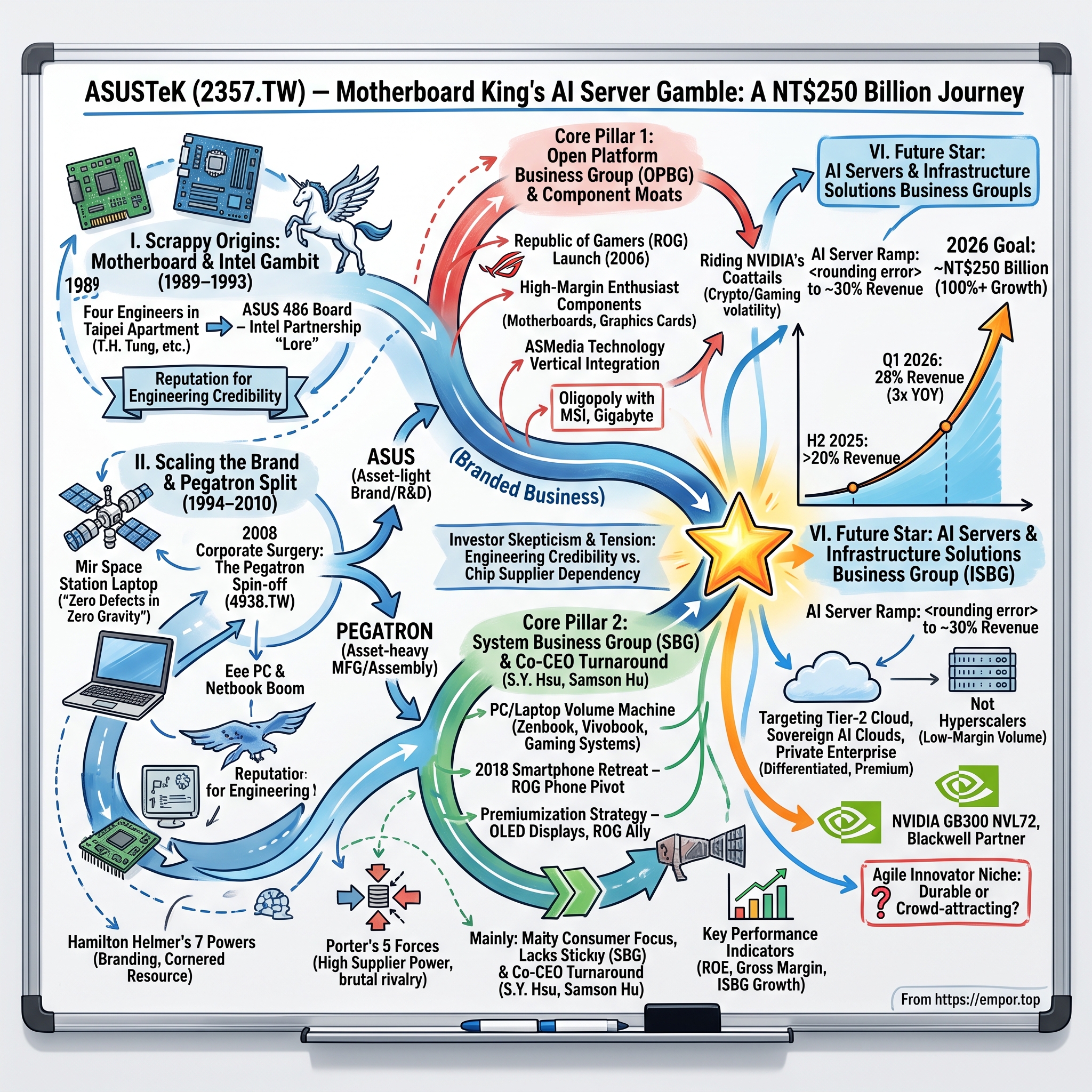
ASUSTeK Computer Inc.: The Motherboard King's NT$250 Billion AI Server Gamble
I. Introduction & Episode Roadmap
Here is a puzzle that captures everything strange and interesting about the company trading in Taipei under the ticker 2357. In June 2026, ASUSTeK Computer Inc.'s consolidated group revenue crossed NT$100 billion in a single month for the first time in its history — NT$106.72 billion, up more than 55% year over year.8 For a business most of the world still thinks of as "that gaming-laptop brand," or the outfit that stamps its name on the motherboard tucked inside a self-built desktop PC, that is a remarkable number. And it was driven not by laptops or motherboards at all, but by racks of artificial-intelligence servers stuffed with NVIDIA chips — a business ASUS was barely in three years earlier.
Start with the scale, because the scale is the first surprise. For the full year 2025, ASUS reported consolidated revenue of NT$738.9 billion — roughly US$23 billion — up more than a quarter from the prior year, with net profit after tax of NT$48.2 billion and a record profit attributable to shareholders of about NT$44.6 billion.65[^32] This is a genuine global giant. Yet it is a giant with an identity problem, and that problem is the heart of the investment story.
Because on the surface, ASUS looks like a low-margin hardware assembler. It sells around 6.5%–7% of the world's PCs, which sounds impressive until you notice it ranks fifth globally, trailing Lenovo, HP, Dell, and Apple, and that consumer laptops are one of the most brutally commoditized products in all of consumer electronics.30 A company that assembles millions of notebooks earns thin, cyclical margins for its trouble. If that were the whole story, ASUS would be a cyclical box-shifter deserving a cyclical box-shifter's valuation.
But that is not the whole story, and the gap between the surface and the interior is the core paradox worth sitting with. Underneath the commodity PC business sit two very different engines. One is a high-margin components franchise — motherboards and graphics cards sold under the 玩家共和國 Republic of Gamers (ROG) banner, where enthusiasts happily pay a premium for the brand. The other is the explosive newcomer: an AI-server and infrastructure business that ASUS elevated, effective March 1, 2026, into a standalone fourth division called the Infrastructure Solutions Business Group (ISBG).2 In the first quarter of 2026, that infrastructure segment already accounted for 28% of revenue, up from essentially nothing two years before.1 The question this article exists to test is whether ASUS is quietly transforming from a PC-hardware company into an AI-infrastructure company — and, more skeptically, whether the market should believe management's framing that it can do so profitably.
That skepticism matters, because ASUS is not a neutral narrator of its own story. Management has guided investors toward a doubling of server revenue in 2026, an implied scale in the neighborhood of NT$250 billion, and a strategic posture it likes to call being the "agile innovator."1 Those are claims. The job here is to separate what ASUS has actually proven from what it merely asserts, to ask what evidence supports the bull case and what would falsify it.
A word on myth versus reality before we start, because ASUS attracts a particular kind of consensus narrative worth puncturing early. The popular framing casts ASUS as a scrappy underdog that will out-innovate lumbering giants and ride AI to a glorious re-rating — a story management is happy to encourage. The more sober reality is that ASUS is a mid-sized, high-quality, but structurally constrained player: genuinely excellent at engineering and brand-building, genuinely riding a powerful tailwind, but also genuinely sandwiched between all-powerful chip suppliers above and capable rivals alongside, with an AI-server business that is growing spectacularly and diluting margins simultaneously. Neither the bull's fairy tale nor a reflexive dismissal captures it. The interesting truth lives in the tension between a real, proven competitive culture and a set of dependencies the company does not control — and holding both halves of that tension at once is the whole discipline of valuing this business.
The roadmap runs like this. First, the origin: four engineers in a Taipei apartment in 1989 who built a reputation on a single audacious motherboard. Second, the arrival of chairman 施崇棠 Jonney Shih and the scaling of a global brand. Third, the painful corporate surgery of the 和碩 Pegatron spin-off — arguably the most consequential decision in the company's history. Fourth and fifth, the two core pillars as they stand today: the components moat and the mainstream-PC turnaround engineered by the co-CEO duo. Sixth, the AI-server land grab that has rewritten the thesis. Then governance and capital allocation, a formal competitive-forces analysis, the bull-and-bear spine with a risk radar, and finally the lessons. Let us begin in that apartment.
 Subscribe on LinkedIn
II. Scrappy Origins: Motherboards & The Intel Gambit (1989–1993)
Taipei, 1989. The Taiwanese hardware miracle was in its violent adolescence — a swarm of small firms clustered around the personal-computer supply chain, most of them destined to be forgotten, competing on price and speed and sheer willingness to work. Into this scrum stepped four hardware engineers who had all cut their teeth at Acer, then Taiwan's most prominent computer maker: T.H. Tung (童子賢), Ted Hsu, Wayne Hsieh, and M.T. Liao.10 They left steady jobs to rent a small flat and build motherboards — the flat, layered green circuit boards that serve as the nervous system of a PC, the plane onto which the processor, memory, and everything else are bolted.
The name tells you something about the temperament. They reached for Pegasus, the winged horse of Greek myth, a symbol of wisdom and knowledge and, not incidentally, of high-flying speed.11 Then they did something coldly practical: they lopped off the first three letters, leaving "ASUS," so that the company would sit near the top of any alphabetized trade directory or exhibitor list.10 It is a small, revealing detail. This was a company engineered, from its very name, to be noticed in a crowd — a firm that understood distribution and visibility mattered as much as the product.
It is worth pausing on what these four men were actually risking, because the origin-story shorthand flattens it. Leaving Acer in 1989 meant walking away from the single most prestigious employer in Taiwanese computing — the local equivalent of quitting IBM — to gamble on a category, the standalone motherboard, that barely existed as an independent product. A motherboard, for the non-engineer, is the large circuit board that everything else in a computer plugs into: the processor sits in a socket on it, the memory slots into it, the expansion cards clip into it, and a dense lattice of copper traces beneath the green lacquer carries electrical signals between all of them at frequencies where the physical length and layout of each wire begins to matter. Getting that layout right — so that signals arrive in phase, without interference, without a hair of extra delay that would crash the machine — is a discipline that sits at the intersection of electrical engineering and something close to craft. The four founders bet their careers on being better at that craft than anyone else. In an industry that mostly competed on price, they chose to compete on a skill that was invisible to the end customer but decisive to whether the computer worked at all.
But the product is where the legend lives, and it is worth telling the legend carefully, because the company has burnished it for decades and a neutral observer should separate the documented core from the mythology. In the late 1980s, Taiwanese motherboard makers lived downstream of the American giants. When Intel readied a new processor, it shared the technical layouts with established Western multinationals first; Taiwanese firms could wait roughly six months after a chip's launch before they had enough information to begin their own designs.10 Six months, in an industry where product cycles were measured in quarters, was a life sentence to second-tier status.
The ASUS founders refused to wait. Leaning on their intimate knowledge of the prior-generation 386 architecture and whatever public engineering detail they could assemble, they designed a motherboard for Intel's new 486 processor before they had comfortable access to the chip itself. The dramatic version of the tale — that ASUS solved a signal-routing flaw that had stumped Intel's own engineers and thereby earned pre-release access to engineering samples forever after — is the version ASUS's fans love to retell, and it should be flagged as company lore rather than independently documented fact.10 What is documented, in ASUS's own corporate history, is the substance beneath the drama: the independently developed ASUS ISA-486 board was praised by Intel, and that moment marked the beginning of a long and privileged partnership.12 Whatever the precise choreography, the outcome is not in dispute. A tiny Taipei startup demonstrated engineering it was not supposed to be capable of, and the world's dominant chipmaker took notice.
Why does a thirty-five-year-old motherboard story matter to an investor in 2026? Because it established the one asset ASUS has never lost: a reputation for engineering credibility that let it collapse the time-to-market disadvantage that crippled its peers. Getting Intel's silicon early meant ASUS could ship a working board while rivals were still reading the manual. That head start, compounded across hundreds of product cycles, is the origin of the brand premium the company still charges today. And notice the pattern that will recur throughout this story: ASUS's competitive edge has almost always come from a privileged relationship with the company that makes the most important chip in the box — Intel in the 1990s, NVIDIA in the 2020s. The identity of the indispensable supplier changes; ASUS's strategy of getting closest to it does not. That is both the source of its advantage and, as we will see, the root of its greatest structural vulnerability.
There is a broader context that makes the achievement legible. Taiwan in 1989 was in the middle of assembling what would become the most formidable electronics supply chain on earth — a dense cluster of fabricators, board houses, connector makers, and assemblers packed into an island smaller than the Netherlands, all learning from one another at a speed no dispersed geography could match. ASUS was a product of that ecosystem, but it distinguished itself within it by refusing the ecosystem's default posture of humble subcontractor. Most Taiwanese firms of the era were content to build to a Western customer's specification and compete on cost. ASUS wanted to be the firm whose specification others copied. That ambition — to lead on design rather than follow on price — is the through-line from the 486 board to the AI server, and it is why the company is worth studying as more than a commodity manufacturer.
In 1993, the founders brought in the man who would turn that engineering culture into a global enterprise. Jonney Shih had spent his career at Acer, where the legendary Stan Shih was his early mentor, and he arrived at ASUS as chairman and chief executive — a role he would hold as CEO until 2007 and as chairman ever since.1314 Shih was a temperamental match for the founders: obsessive about product quality, drawn to a near-Zen discipline of long-term technical excellence over quick wins. Under him, the plan crystallized — take a pure component maker and build it into a company that put its own name on finished systems. That ambition would soon collide with the industry's most dangerous conflict of interest, and to understand that collision we have to follow ASUS out of the motherboard and into the whole machine.
III. Scaling the Brand & The Pegatron Split (1994–2010)
The 1990s were ASUS's land-grab years, and the company moved with the confidence of a firm that had already beaten the odds once. It pushed out from motherboards into graphics cards, optical drives, and, in 1997, its first notebook computers.12 The marketing was as inventive as the engineering. When two ASUS notebooks were carried aboard the Russian 和平號 Mir space station and ran trouble-free for some 600 days in the punishing thermal environment of orbit — where heat does not rise and dissipate as it does on Earth — ASUS had a story no competitor could buy.15 "Zero defects in zero gravity" was the kind of proof point that turned reliability from a marketing claim into a demonstrated fact, and it fed directly into the brand promise ASUS would later put on its products: rock solid, heart touching.
The decade's most audacious product bet, though, came right at its end, and it deserves its own moment because it reveals the ASUS instinct at full stretch. In 2007, ASUS launched the Eee PC — a tiny, cheap, low-powered laptop that essentially invented a category the industry would come to call the "netbook." The idea was heretical at the time: strip a laptop down to the bone, price it near US$200 to US$400, and sell it to people who mostly wanted to browse the web and check email rather than run heavy software. It was an instant phenomenon, and for a couple of years it was one of the fastest-growing product lines in all of computing, dragging the entire industry into a frantic race to build ever-cheaper mini-laptops. The episode is a perfect illustration of ASUS's willingness to create a market rather than wait for one — and, just as instructively, of the category's fragility. The netbook boom collapsed almost as fast as it arose once Apple's iPad arrived in 2010 and redefined what a cheap, casual computing device should be. ASUS had proven it could conjure a category out of nothing; it had also learned, expensively, that a category built purely on being cheap has no defense when someone changes the terms of the game. That lesson — that price alone is not a moat — would shape the premium strategy the company runs today.
But success bred a structural trap, and the trap is one of the most instructive episodes in modern hardware history. By the mid-2000s ASUS was running two businesses that fundamentally could not coexist under one roof. On one side, it was an Original Brand Manufacturer — designing and selling ASUS-branded PCs and components at a premium. On the other, it was one of the planet's largest contract manufacturers, an Original Design Manufacturer building laptops, motherboards, and components for the very giants it competed against: Apple, HP, Dell.
Put yourself in the seat of a Dell or HP procurement executive around 2006. You are handing your proprietary product designs and your enormous assembly volumes to ASUS — a company that then turns around and uses that same manufacturing scale and design knowledge to sell competing machines under its own logo. Why would you keep funding your rival's brand ambitions? You would not. And so the giants began pulling their high-volume orders, unwilling to subsidize a direct competitor.16 ASUS faced a stark choice: stay conflicted and watch the contract business bleed, or perform surgery on itself.
Jonney Shih chose surgery. Effective January 1, 2008, ASUS split into three distinct companies.16 The branded business — design, R&D, marketing, the ASUS name — stayed as 華碩 ASUS, deliberately asset-light. The high-volume contract manufacturing of PCs and motherboards went to a new entity, 和碩 Pegatron. And the non-PC work — chassis, molding, industrial assembly — went to Unihan, later folded under Pegatron.16 Co-founder T.H. Tung, who had helped build the whole thing, went with the manufacturing arm and became Pegatron's chairman, a role he still holds.18
The separation was completed in stages that reveal how carefully it was managed. Pegatron formally separated from ASUS on June 1, 2010, and listed on the Taiwan Stock Exchange under ticker 4938 later that summer, with ASUS reducing its holding toward 25%.1718 The ASUS group kept trimming — a US$157 million block-trade sale in April 2013 cut roughly a fifth off its remaining Pegatron stake — steadily resolving the conflict of interest by putting distance between the brand and the factory.19
The mechanics of the separation also matter for understanding what ASUS became. This was not a simple sale; it was a demerger executed through a share swap, in which ASUS shareholders received shares in the new Pegatron, so that the value was distributed to owners rather than extracted by an outside buyer.17 The design mattered because it aligned the interests of the two companies' shareholders during a delicate transition and avoided the fire-sale dynamics that so often accompany a forced divestiture. It was corporate surgery performed with a scalpel, not an axe.
The strategic logic here is worth dwelling on, because it is the opposite of the value destruction that so often accompanies corporate restructuring. Freed from its ownership entanglement, Pegatron could compete for exactly the high-volume assembly contracts it had been locked out of — and went on to become one of Apple's primary iPhone assemblers, a business that would have been unthinkable while it wore the ASUS badge. Meanwhile ASUS shed the capital intensity of running factories and kept the high-return activities: designing products and building a brand. Compare this to the American playbook of the same era — HP absorbing Compaq, or its later Palm misadventure — where scale was bought at enormous cost and frequently destroyed value. ASUS did the reverse. It gave scale away and kept the returns. For an investor, the lesson is that the split converted ASUS into a structurally higher-return, lower-capital business, and it is the foundation of the asset-light model the company still runs today. The next question is what, exactly, that leaner ASUS chose to keep — and the answer starts with the components that made its name.
IV. Core Pillar 1: Open Platform Business Group (OPBG) & Component Moats
Walk the aisles of a Computex show floor in Taipei, or scroll a subreddit devoted to building your own PC, and you will find a subculture that treats certain motherboards the way audiophiles treat vacuum-tube amplifiers. The board they covet very often carries the red-eyed ROG logo. This is the Open Platform Business Group — ASUS's components franchise — and it is the clearest example in the company of a genuine, defensible margin moat.
By revenue, OPBG is not the giant of the company; in the fourth quarter of 2025 the Open Platform group represented roughly a quarter of the total.4 But its contribution to profit is disproportionate, because this is where ASUS charges premiums that a commodity assembler can only dream of. The mechanism is the ROG brand, launched in 2006 with an enthusiast motherboard and built ever since into a full ecosystem of components, peripherals, and software.12 Serious gamers and overclockers will pay meaningfully more — often 30% to 50% more — for an ROG board over a functionally comparable generic one, and they do it for reasons that are only partly rational: better power components, yes, but also the software glue (Aura Sync lighting, the Armoury Crate control suite) and the tribal identity of the brand. That willingness to pay is pricing power, and pricing power is the rarest thing in hardware.
The second pillar of the components business is graphics cards, and here the tech is worth a plain-English detour because it explains why the business is both lucrative and treacherous. A graphics card is a self-contained subsystem — its own processor (the GPU, made by NVIDIA or AMD), its own memory, its own power delivery and cooling — that plugs into a motherboard to render the increasingly photorealistic worlds that modern games demand. ASUS does not design the GPU itself; NVIDIA and AMD do that. What ASUS does is design everything around the chip: the board it sits on, the power circuitry that feeds it, and above all the cooling solution that keeps a component drawing several hundred watts from cooking itself. This is called being an "add-in board" partner, and it is a classic razor-and-blade dependency — ASUS's graphics business rises and falls with NVIDIA's product cycles and, crucially, with how many chips NVIDIA chooses to allocate to it. During the cryptocurrency-mining booms of the past decade, when gamers and miners fought over scarce GPUs, this was a gusher; when the booms burst and channels clogged with unsold inventory, it was a millstone. The graphics business, in other words, taught ASUS both the upside of riding NVIDIA's coattails and the whiplash of depending on a single, all-powerful supplier — a lesson that maps directly onto the AI-server story to come.
It helps to understand the shape of the market ASUS wins in. The global do-it-yourself motherboard and graphics-card business is a tight oligopoly dominated by four Taiwanese names: ASUS, 技嘉 GIGABYTE, 微星 MSI, and 華擎 ASRock.22 The last of those has a piquant history — ASRock was spun out of ASUS itself in 2002, originally to chase the budget, commodity end of the market that the premium ASUS brand did not want to sully itself with; it now sits under Pegatron.21 Four players, all clustered on one island, all buying the same core silicon from the same handful of suppliers, competing on design, cooling, software, and brand. It is a war of inches, fought daily.
ASUS's most interesting weapon in that war is one most consumers have never heard of: 祥碩 ASMedia Technology, a chip-design house of which ASUS is the largest, controlling shareholder.20 ASMedia designs the high-speed interface controllers — the USB, PCI Express, and SATA chips — that shuttle data around a motherboard. Think of them as the on-ramps and interchanges of the board's internal highway system. By having a captive designer of these controllers, ASUS can put cutting-edge or proprietary connectivity on its boards, differentiating them from GIGABYTE and MSI in ways that are hard to replicate on a short timeline. This is a real, if modest, vertical-integration advantage — a source of process and product edge rather than mere branding.
The competitive texture of the DIY market deserves a word, because it is unusually intimate. The buyers are not passive consumers; they are enthusiasts who read component reviews obsessively, argue about voltage-regulation-module quality on forums, and form durable brand loyalties that can last a decade of upgrade cycles. This is a market where reputation is made and destroyed at the margin, review by review, and where a single generation of overheating boards or flaky firmware can drive a builder into a rival's camp for years. It rewards exactly the trait ASUS has cultivated since 1989 — relentless engineering polish — and it punishes cost-cutting shortcuts more visibly than almost any other consumer market. That is why the four Taiwanese incumbents have proven so hard to dislodge: the barrier is not capital, it is credibility, accumulated one satisfied builder at a time. It is also why the total pie is shrinking slowly as PC gaming migrates partly to consoles and laptops, which means the incumbents are increasingly fighting over share of a mature market rather than riding a growing one.
So what does the components pillar mean for an investor? It means ASUS possesses at least one business with authentic switching costs and brand equity — system integrators and enthusiasts who trust the platform, purchasing scale that lowers component costs, and a design edge reinforced by ASMedia. This is the high-quality core that a low-margin assembler does not have. The caveat, and it is important, is that this jewel is comparatively small and tied to the health of the enthusiast PC market, which is mature and cyclical. A moat around a slow-growing pond is still a moat, but it will not, by itself, re-rate the company. For growth, ASUS needs volume — and volume lives in the mainstream systems business, which is where the story turns next.
V. Core Pillar 2: System Business Group (SBG) & The Co-CEO Turnaround
If OPBG is the connoisseur's business, the System Business Group is the volume machine — and for years it was also the company's biggest headache. SBG is the largest slice of ASUS by revenue, the home of the Zenbook and Vivobook consumer laptops, commercial PCs, and gaming systems. It is also the part of ASUS most exposed to the grinding commoditization of the mainstream notebook, a market where ASUS's fifth-place global share leaves it without the corporate-fleet volume that lets Dell and HP squeeze out scale advantages.30
The strategic response to being sub-scale in a commodity market has been to refuse to play the commodity game. Rather than chase the cheapest laptop shelf, ASUS pushed relentlessly up-market — into higher average-selling-price niches where design and technology, not price, decide the sale. It became an early and aggressive adopter of OLED displays in laptops, betting that premium screens would command premium prices. The bet is a shrewd one, and worth unpacking: an OLED panel, in which every pixel emits its own light rather than being backlit like a conventional LCD, delivers deeper blacks and richer color, and it is exactly the kind of upgrade a shopper can see on a store shelf without understanding the technology. That visibility lets ASUS charge more for a feature whose cost premium is modest and falling — a textbook example of using a differentiated component to escape a commodity price fight. The company leaned equally hard into gaming hardware, including the ROG Ally handheld, a Windows-based portable games console that competes on experience rather than dollars-per-unit and slots neatly into the same enthusiast ecosystem as its motherboards and graphics cards. The evidence that this pivot is working shows up in the mix: on the Q1 2026 earnings call, co-CEO Samson Hu noted that the System group's PC revenue grew 25% year over year despite fierce component-cost pressure, with gaming and high-value products making up roughly 60% of that revenue.1 Premiumization, in other words, is not a slogan here; it is visible in the numbers.
But the defining test of this era was not laptops. It was phones. For years ASUS bled money on its Zenfone smartphone line, trying to fight Chinese mass-market juggernauts like 小米 Xiaomi and Huawei on their own terms — enormous marketing spend, thin margins, and a scale ASUS could never match. The losses became untenable, and in December 2018 the company announced that Jerry Shen (沈振來), its CEO for more than a decade, would step down as part of a broad restructuring, with the mobile business explicitly slated for a rethink.27
Effective January 1, 2019, ASUS installed an unusual two-headed leadership structure: co-CEOs S.Y. Hsu (許先越) and Samson Hu (胡書賓), both long-serving company engineers and operators.28 Their first act on mobile was surgical rather than expansionary. They wrote down the smartphone business, killed the mass-market ambition, and refocused the line on two narrow, defensible niches: premium power users, and, above all, hardcore mobile gamers via the ROG Phone, which ASUS had unveiled at Computex in 2018.29 The point was not to win the smartphone war; it was to stop losing it — to convert a bleeding, marketing-heavy volume business into a small, focused, cash-stable one that fit the ROG brand.
One structural weakness of the System business deserves to be named plainly, because it is the flip side of the premiumization strategy. ASUS's PC business is overwhelmingly a consumer business — gamers, students, creators, home users — and it lacks the deep, sticky corporate-fleet relationships that let Dell and HP sell millions of managed, serviced machines to IT departments on multi-year contracts. Corporate demand is more stable, more profitable, and far harder for a rival to poach than consumer demand, which swings with sentiment and the broader economy. ASUS has been trying to build out its commercial and expert-PC lines to close this gap, and the AI-server push gives it an enterprise sales motion it can eventually cross-sell into. But as of today, the reliance on the fickle consumer is a genuine vulnerability, and it is the reason the "AI PC" upgrade cycle matters so much to this segment's future: without a corporate refresh wave to lean on, ASUS needs consumers to feel a reason to buy a new laptop, and a compelling one has been slow to arrive.
For an investor weighing management credibility, the 2018–2019 mobile restructuring is a useful data point, and it cuts in the company's favor. Here was a management team willing to admit a strategy had failed, take the write-down, and retreat to a defensible position rather than throw good money after bad. That is exactly the behavior you want to see, and it is the same instinct — cut the losing fight, concentrate on the profitable niche — that the co-CEOs would later apply, in reverse and at far greater scale, when a genuine growth opportunity appeared. That opportunity was the AI server, and it is where the modern ASUS story truly ignites.
VI. The Future Star: AI Servers & The ISBG Restructuring
For most of its life, ASUS's server business was an afterthought — a modest line selling boxes to businesses, dwarfed by laptops and motherboards. Then generative AI arrived, the world's cloud providers and governments began a frantic race to build data centers full of NVIDIA accelerators, and a sleepy corner of ASUS caught fire. This is the single most important development in the company's recent history, and it demands to be examined with both excitement and cold scrutiny.
Consider the trajectory, because it is genuinely startling. By the fourth quarter of 2025, the infrastructure business had grown to 22% of ASUS's revenue; across the full year 2025 it represented about 18% of the total, and in the second half of the year it exceeded 20%, approaching one-fifth of revenue as early as the third quarter.47 In the first quarter of 2026, server revenue tripled year over year, lifting the infrastructure group to 28% of company revenue.1 In March 2026, ASUS reported that its enterprise segment — the umbrella that includes AI servers — had grown 85% in 2025, the fastest-growing part of the whole company.3 A business that was a rounding error is now approaching a third of the company.
The organizational response was to give the growth its own home. On the Q4 2025 earnings call, co-CEO S.Y. Hsu explained that, effective March 1, 2026, ASUS had elevated its existing server business unit into a full-fledged fourth core division, the Infrastructure Solutions Business Group.2 This is a meaningful signal of intent — pulling servers out from under the components org and giving them dedicated leadership, capital, and reporting — though a careful reader should note it was a promotion of an already-separately-reported unit rather than a dramatic carve-out from scratch. Structure follows strategy, and the structure now says: servers are a headline business, not a sideline.
How big can it get? Management has been increasingly bold. Through 2026 ASUS repeatedly raised its full-year server growth target, ultimately guiding to at least a doubling — 100%-plus growth — from the 2025 base, up from an earlier 50%-to-100% range.18 Doubling a business that finished 2025 north of NT$110 billion points toward an infrastructure line in the neighborhood of NT$250 billion in 2026, which would push servers past 30% of consolidated revenue. That is management's framing, and it should be held as an ambitious target rather than a banked result — but the first-quarter tripling gives it more credibility than a mere aspiration.
Before judging the strategy, it helps to picture what ASUS is actually selling, because "AI server" undersells the engineering. A modern AI training system like NVIDIA's GB200 NVL72 is not a pizza-box computer on a shelf; it is a refrigerator-sized rack that welds seventy-two GPUs and thirty-six CPUs into what behaves, electrically, like a single enormous processor, connected by a dense mesh of high-speed links and drawing on the order of a hundred kilowatts of power — as much as dozens of homes — in a single cabinet. Cramming that much computing into that small a space generates so much heat that traditional air cooling simply fails; the newest systems must be liquid-cooled, with coolant piped directly across the chips to carry the heat away. Building, plumbing, and validating one of these racks so that it runs reliably under a punishing, sustained AI-training load is a genuinely hard systems-engineering problem — and it happens to draw on exactly the disciplines ASUS has spent thirty-five years mastering: dense board layout, power delivery, thermal design, and structural chassis engineering. The AI server is, in a real sense, the motherboard problem of 1989 scaled up by four orders of magnitude. That is why a components company could credibly pivot into it at all.
The strategically interesting claim is not that ASUS is growing servers but where it chooses to compete, and this is where the "agile innovator" thesis lives. The mega-contracts for the hyperscale "Big Four" — Microsoft, Amazon, Google, Meta — are dominated by enormous ODMs like 鴻海 Foxconn, 廣達 Quanta, and 緯穎 Wiwynn (a subsidiary of 緯創 Wistron). This is a volume game played at razor-thin margins: Foxconn, the largest, reported a full-year 2025 operating margin of just 3.2%, and Quanta operates in a similar low-single-digit band.26 ASUS says it deliberately does not fight for that low-margin hyperscale volume. Instead, ISBG targets Tier-2 cloud service providers, sovereign and government AI clouds, private enterprise AI, and smaller businesses — buyers who value turnkey systems, local support, and hardware-software integration, and who will pay a premium for a configured, supported solution rather than a bare-metal commodity rack.
The logic behind this positioning is more than corporate spin, and it is worth taking seriously. A hyperscaler like Amazon or Meta employs armies of its own engineers and wants a bare, cheap, standardized rack it can integrate itself; it has the scale to squeeze every dollar and the expertise to need no hand-holding. It is a buyer with maximum bargaining power, which is precisely why the ODMs who serve it earn so little. A national telecom building a "sovereign" AI cloud to keep its citizens' data on home soil, a hospital network standing up a private AI system, or a mid-sized cloud provider without a thousand-strong engineering team is a completely different customer. That buyer wants someone to deliver a working "AI factory," support it, and integrate the software — and will pay for the service. In principle, this is a segment where a design-led, service-oriented firm like ASUS can earn a premium that the commodity ODMs cannot. The proliferation of government-backed sovereign-AI initiatives across the Middle East, Europe, and Asia has made this a genuinely large and fast-growing pool of demand, not a niche in the pejorative sense. Whether ASUS can defend that premium as larger rivals notice the same opportunity is the open question — but the strategic reasoning is sound, not merely convenient.
Does the evidence support the "healthier margins" claim? Partially, and honestly this is where an investor should keep a skeptical eye. ASUS's consolidated operating margin held at 5.4% in Q1 2026, which is genuinely above the sub-4% of the pure hyperscale ODMs.1 That is consistent with a more differentiated mix. But the comparison is not clean — Wiwynn, one of the "commodity" ODMs, actually earns mid-to-high single-digit margins, higher than the caricature suggests, so the neat story of "commodity ODMs earn nothing, ASUS earns more" is too tidy. And the more telling pressure point is that ASUS's overall gross margin slipped to 13.8% in Q1 2026, down year over year, precisely as servers grew — because turnkey AI servers, however "premium," still carry lower gross margins than a high-end ROG motherboard, and because memory prices roughly doubled in the quarter.1 Growth and margin dilution are arriving together.
The memory squeeze deserves a closer look, because it is the clearest example of how the AI boom cuts both ways for ASUS. Memory chips — DRAM, the working memory of every computer, and its exotic cousin HBM, the ultra-high-bandwidth memory stacked next to AI GPUs — are made by a tiny handful of suppliers, and the AI build-out has sent demand for them soaring. When memory prices roughly doubled in the first quarter of 2026, ASUS felt it twice over: as a cost on the very servers it was rushing to sell, and as a cost on the laptops and motherboards that still make up most of its volume.1 Because memory is a large slice of the bill of materials in both a PC and a server, ASUS has little choice but to either absorb the hit to its margins or pass it on to customers and risk denting demand. This is the mechanism behind the gross-margin slip, and it is not a one-quarter blip: as long as AI keeps consuming memory faster than the suppliers can add capacity, the component that powers the boom will keep taxing the companies riding it. ASUS's answer — leaning on its purchasing scale and long supplier relationships to secure allocation — mitigates the problem but cannot eliminate it, because the pricing power sits with the memory makers, not with ASUS.
The supply side is the other half of the story, and it is both a moat and a chokepoint. ASUS is a designated NVIDIA partner and has moved fast to the front of the line for the newest silicon: at the OCP conference in October 2025 it unveiled its "AI POD" built on NVIDIA's GB300 NVL72 platform and servers running the HGX B300 system, positioning itself as a launch partner for Blackwell-generation hardware, and on the Q1 2026 call management pointed to strong orders for NVIDIA's next Vera Rubin platform.251 Access to constrained, cutting-edge GPUs is a genuine competitive advantage during a shortage. It is also a genuine dependency — the entire ISBG growth engine runs on NVIDIA's shipment schedule and on ASUS's allocation within it, neither of which ASUS controls. That tension — real momentum resting on a supplier's goodwill — is the essential thing to hold in mind as we turn to the people steering the company and how they allocate its capital.
VII. Corporate Governance, Management Credibility & Capital Allocation
Every founder-led Asian technology company eventually faces the same question from outside investors: is management aligned with us, or with itself? For ASUS, the honest answer is a nuanced "mostly yes, with an asterisk," and the details are worth laying out because they bear directly on how much trust to extend to the ambitious server guidance.
Start at the top. Chairman Jonney Shih remains, decades on, the intellectual and cultural anchor of the company, and his interests are demonstrably tied to public shareholders': the 2024 annual report shows him holding 30,093,638 shares, about 4.05% of the company.9 At current market prices that stake is worth well over NT$20 billion — a personal fortune that rises and falls with the stock, which is precisely the alignment outside investors want in a chairman. Whatever one thinks of ASUS's strategy, Shih is not a hired hand indifferent to the share price; he is one of its largest individual owners.
The co-CEOs are a different picture, and here the asterisk appears. S.Y. Hsu and Samson Hu are career ASUS engineers who rose through the operating ranks, but their equity stakes are modest — the same annual report lists Hsu at 107,019 shares and Hu at 100,592 shares, each roughly 0.01% of the company.9 Their alignment, in other words, is rooted less in ownership than in reputation and in variable compensation tied to operating performance. That is not unusual for professional managers, but it does mean an investor is underwriting their credibility rather than their skin in the game — which puts a premium on their track record.
On that record, the evidence is reasonably encouraging. The co-CEOs have, so far, done what they said they would do. They executed the 2018–2019 mobile retreat cleanly, absorbed the write-downs, and stabilized a chronic loss-maker. They then presided over the server ramp, and — importantly for credibility — they raised guidance as results came in rather than setting a bold target and quietly walking it back, which is the more common and less trustworthy pattern. The narrative across recent earnings calls has been consistent: premiumize the PC business, ride the AI-server wave, defend margins through mix and brand. Consistency of story across filings and calls is itself a governance signal, and ASUS scores well on it.
Capital allocation reinforces the picture of a conservative, shareholder-conscious company. ASUS has long run a stable, generous dividend, historically distributing a large share of earnings — the kind of policy that anchors a base of Taiwanese retail and institutional holders who buy the stock partly for yield. And rather than swinging for expensive, dilutive acquisitions, ASUS has favored a "coalition" model of strategic minority and control stakes in specialized industrial-computing players. It brought 研揚 AAEON Technology (Taipei-listed under 6579), a maker of industrial PCs and AIoT hardware, into the ASUS group in 2011, and in 2021 it took a 30% stake in industrial-PC maker 瑞傳 Portwell for about NT$1.5 billion, with an option to raise the holding further.2324 These are cheap, synergistic bets on procurement and R&D sharing — the antithesis of a debt-fueled empire-building spree.
One more dimension of governance is increasingly material and deserves mention rather than a shrug: sustainability, which for a Taiwanese electronics giant is no longer a public-relations sideline but a hard commercial constraint. ASUS's largest customers — the American hyperscalers and multinationals buying its hardware — increasingly impose supply-chain decarbonization requirements on their vendors, and ASUS has committed to renewable-energy transition targets under the RE100 framework and tied a portion of executive incentives to sustainability milestones alongside the traditional operating metrics of return on equity and margin growth. An investor should read this with appropriate neutrality: it is partly genuine risk management (a supplier that cannot meet a customer's carbon requirements loses the contract) and partly the reputational positioning every large company now undertakes. The concrete point is that energy sourcing and supply-chain emissions have become a real input to winning enterprise business, and a company clustered in Taiwan — where the grid is still heavily fossil-fueled — faces a genuine cost and logistics challenge in meeting those commitments. It is a second-order risk, not a headline one, but it is no longer immaterial.
The activist's stress test, then, would not focus on reckless capital allocation, because there is little evidence of it. It would focus instead on two subtler concerns. First, portfolio complexity: ASUS is now a sprawling federation of a brand business, a components business, a server business, and a web of affiliated industrial-computing stakes, and complexity can hide underperformance. Second, and more pointedly, the concentration of strategic authority in a small group of long-tenured insiders — a strength when they are right, a governance risk if the server bet goes wrong and the same people who made it are the ones judging it. Those risks are manageable, not alarming. But they frame the real debate about ASUS, which is not about honesty or alignment — it is about whether the competitive advantages are as durable as management believes. To that we now turn, formally.
VIII. Hamilton Helmer's 7 Powers & Porter's 5 Forces
Strip away the narrative and ask the structural question a strategist would ask: what actually protects ASUS's profits from competition, and how strong is that protection? Hamilton Helmer's 7 Powers framework and Michael Porter's Five Forces are useful lenses precisely because they force a sober inventory rather than a hopeful one.
Begin with Helmer, and be disciplined about grading. ASUS's strongest power is Branding. The ROG brand is a real one, commanding durable premiums in motherboards, graphics cards, laptops, and monitors, sustained over nearly two decades — this is the closest thing ASUS has to an unambiguous, high-strength moat. Next is Scale Economies, which is genuine but medium-strength: as one of the four large Taiwanese board-and-GPU builders, ASUS's purchasing volume with Intel, AMD, and NVIDIA lowers its component costs, but three domestic rivals enjoy broadly similar scale, so the advantage is relative, not absolute. Process Power — decades of accumulated know-how in complex PCB layout, thermal design, and, increasingly, the liquid-cooling architectures that Blackwell-class server racks demand — is real but hard to quantify and partly shared across the Taiwanese cluster. Finally, a Cornered Resource of sorts: close, senior-level relationships with NVIDIA that translate into GPU allocation during shortages. This is powerful right now, but an investor should weigh it honestly — it is a supplier relationship, not an owned asset, and NVIDIA can widen or narrow that door at will. ASUS notably lacks the two most durable powers: it has no meaningful Network Economies and no Switching Costs strong enough to lock in mainstream buyers. The moat is real but narrower than the bull case implies.
Now Porter, force by force. Threat of new entrants is very low: designing, building, and distributing motherboards and AI servers at global scale requires billions in working capital, deep distributor networks, and engineering experience accumulated over decades — the barriers here genuinely protect the incumbents. Bargaining power of suppliers is very high, and this is arguably ASUS's single biggest structural weakness: the company depends critically on a tiny number of chip designers — NVIDIA, AMD, Intel — and on memory makers, and when DRAM and HBM prices spike, as they roughly doubled in Q1 2026, that cost flows straight into ASUS's margins with little the company can do about it.1 Bargaining power of buyers is mixed: mainstream consumers have near-zero switching costs and buy on price, but enthusiast DIY builders and enterprise AI customers exhibit real brand stickiness and prize availability over the last dollar of price — a bifurcated customer base where the premium end is defensible and the mass end is not. Threat of substitutes is moderate: game consoles like Sony's PlayStation and smartphones nibble at the low end of DIY PCs, but they have not eroded the enthusiast PC or the enterprise AI-infrastructure markets that matter most to ASUS's profits. And competitive rivalry is high — brutal daily margin wars with GIGABYTE and MSI in components, and against Foxconn, Quanta, and Wiwynn in the broader server market, where competitors with deeper pockets and lower margin requirements can undercut on price.
A concrete comparison with the competition sharpens the picture better than any abstract grade. Set ASUS beside its closest DIY rivals, GIGABYTE and MSI, and the three look broadly similar — comparable scale, comparable supplier access, comparable engineering heritage — with ASUS distinguished mainly by the strength of the ROG brand and the captive ASMedia design capability. That is an edge, but a modest and contestable one; none of the three can raise prices without the others noticing. Now set ASUS beside the server ODMs — Foxconn, Quanta, Wiwynn — and the contrast inverts. Those firms dwarf ASUS in manufacturing scale and capital, and they win the hyperscale volume ASUS cannot and does not chase; but they earn commodity margins for it, and, in Wiwynn's case, a somewhat better but still single-digit return.26 ASUS is trying to occupy the ground between these two worlds: more differentiated and higher-margin than the volume ODMs, but far smaller and less capital-heavy than they are. It is a defensible middle position precisely because it is uncomfortable for both sides to attack — too design-intensive for the volume players to bother with cheaply, too small to threaten them at scale. But "defensible because it is awkward to attack" is a weaker statement than "defensible because it is impossible to attack," and an honest analyst should hold the distinction firmly in mind.
Synthesize the two frameworks and a clear-eyed verdict emerges. ASUS is genuinely well-protected against new competition — the entry barriers are formidable — and it has one strong, durable power in the ROG brand. But it is not well-insulated against its existing rivals or, most importantly, against its suppliers. Its profits are structurally sandwiched: squeezed from above by a handful of indispensable chipmakers who capture the lion's share of the industry's value, and pressed from the side by three or four capable domestic competitors. That is a defensible, high-quality business — but it is not a fortress, and the AI-server push, by deepening the NVIDIA dependency, arguably raises supplier power even as it raises growth. That double-edged quality is exactly what the bull and bear cases fight over.
IX. The Investment-Story Spine: Bull vs. Bear Case & Risk Radar
How, then, should a long-term investor judge where ASUSTeK goes from here? The honest answer is that the company sits at a genuine fork, and the two paths lead to very different valuations. The task is not to pick a side by faith but to specify what each case requires and what would prove it wrong.
The bull case — the "why win" — rests on three legs. First and loudest is the server growth engine: if ISBG scales toward NT$250 billion in 2026 and keeps its higher-margin Tier-2 and enterprise focus, ASUS transforms from a low-growth PC-hardware story into a high-growth AI-infrastructure story, the kind of transition that earns a company a higher earnings multiple.1 Second is premium niche resiliency: the deliberate move into OLED laptops, ROG gaming systems, and enthusiast components insulates ASUS from the erosion of vanilla consumer-laptop demand, letting it earn more per unit even as the mainstream market stagnates. Third is the asset-light model inherited from the Pegatron split, which lets ASUS earn a strong return on equity — around 16.6% in 2025 — by keeping capital in R&D and brand rather than sinking it into factories.[^32] A high-growth engine, a defended premium core, and capital efficiency: that is a compelling combination if all three hold.
The bear case — the "why lose" — attacks each leg with uncomfortable specificity. First, server margin dilution: turnkey AI servers carry structurally lower gross margins than high-end components, and the Q1 2026 slide in consolidated gross margin to 13.8% is the early evidence that a server-heavy mix drags the blended number down — push it too far and the prized profitability erodes toward commodity levels.1 Second, GPU dependency: the entire server thesis is hostage to NVIDIA's shipment cadence and to ASUS's allocation; any delay in Blackwell or next-generation deliveries, or any decision by NVIDIA to favor a larger ODM, would stall ISBG's momentum overnight, and ASUS has essentially no control over that lever. Third, the AI-PC skeptic's test: much of the hope for the core System business rests on a consumer and corporate "AI PC" upgrade cycle that has been promised for two years and not yet clearly materialized in a demand surge — if that refresh disappoints, SBG faces structural stagnation and the premiumization strategy runs into a shrinking pond.
It is worth war-gaming how the bull and bear cases actually resolve, rather than leaving them as a static list, because the two are not symmetric. The bear case is front-loaded and visible: margin dilution and memory-cost inflation are showing up in the numbers now, in real time, quarter by quarter. The bull case is back-loaded and requires faith: it depends on servers scaling for years, on the premium Tier-2 positioning holding as competition intensifies, and on an AI-PC cycle that has not yet clearly arrived. This asymmetry is important for how an investor should weight the evidence. The near-term data will look noisy and often disappointing on margins even if the long-term thesis is intact, because rapid growth in a lower-margin mix mechanically drags the blended figure down before scale and software attach-rates can pull it back up. The single hardest analytical task here is distinguishing healthy dilution — margin falling because a good new business is growing fast — from unhealthy dilution, where ASUS is simply buying revenue by accepting commodity economics it will never escape. The two look identical for several quarters. The tell, over time, is whether the server business's own margins stabilize and firm as it scales, or keep grinding lower; only management's segment disclosure and the trajectory of the consolidated gross margin will reveal which.
A skeptical short-seller would press one more point that the bulls tend to wave away: the durability of the "agile innovator" niche. The uncomfortable historical pattern in contract electronics is that profitable niches do not stay uncrowded. If Tier-2 and sovereign AI genuinely offer fatter margins than hyperscale, the giant ODMs — Foxconn and Quanta, with their vastly deeper capital bases and procurement scale — have every incentive to build out enterprise and turnkey offerings of their own and compete the premium away. ASUS's defense is speed, design flexibility, and a brand enterprises trust, but none of those is a structural barrier of the kind that keeps new entrants out of, say, motherboards. The bull must therefore believe not just that the niche exists today, but that ASUS can keep out-innovating far larger rivals for years. That is a bet on execution and culture, not on an unbreachable moat — which is a perfectly reasonable bet to make, but investors should be clear-eyed that it is what they are making.
Around this spine sit the material risks that could move the whole picture. The most fundamental is geopolitical and supply-chain concentration: essentially all of ASUS's engineering, sourcing coordination, and executive direction is clustered around Taiwan, which places the company squarely inside the single most-watched geopolitical fault line in global technology. Any serious disruption in the Taiwan Strait would hit ASUS in ways no operational excellence could offset — this is an unhedgeable tail risk that belongs in every investor's assessment. The second material risk is input-cost inflation: the roughly 100% surge in memory prices in early 2026 is a live demonstration that DRAM and HBM volatility is an uncontrollable drain on short-term profit, and the AI build-out is itself intensifying memory demand.1 Currency swings and the cyclicality of consumer electronics round out the picture.
For an investor who wants to cut through all of this and simply watch the scoreboard, three key indicators matter more than any others. The first is consolidated gross margin — the cleanest single test of whether high-growth servers are diluting the high-margin components and brand business; watch whether it holds in the mid-teens or slides toward 12%. The second is ISBG revenue growth — the direct readout on execution against the doubling target, best watched sequentially quarter to quarter, where a stumble would show up immediately. The third is return on equity — the ultimate measure of whether the asset-light model is still converting all this growth into efficient shareholder returns rather than just bigger, thinner revenue. Track those three, and you will know which way the fork is bending long before the narrative catches up.
X. Outro, Lessons, & Epilogue
Step back from the quarterly numbers and the frameworks, and ASUS resolves into a story about a single, stubbornly consistent trait: engineering credibility, converted again and again into commercial advantage. The four founders who reverse-engineered a motherboard they were not supposed to be able to build were doing, in 1989, the same thing the company is trying to do in 2026 with liquid-cooled AI racks — win the trust of the industry's most powerful chipmaker and use that trust to get to market first. The players and the products have changed; the underlying move has not.
Three lessons deserve to outlive this article. The first is know your superpower. ASUS never became the cheapest assembler on the island — it left that game to the ASRocks and the contract manufacturers. It won by being the best at the specific, hard thing: motherboard and system engineering good enough to earn Intel's, and later NVIDIA's, respect. When the AI wave arrived, that same reputation is what put ASUS near the front of the GPU allocation line. Superpowers compound; commodity positions do not.
The second is the courage to cut. The Pegatron split was risky, painful, and correct. Separating the branded business from the contract-manufacturing business resolved a conflict of interest that was quietly strangling both, and it converted ASUS into the higher-return, asset-light company it is today. The same instinct — amputate the losing fight, concentrate on what can win — reappeared in the 2018 smartphone retreat. Good management is often defined less by what it builds than by what it is willing to kill.
The third is the agile niche. Faced with giants it cannot out-scale — Dell and HP in PCs, Foxconn and Quanta in servers — ASUS has repeatedly chosen not to fight on the giants' terms. It sells premium where they sell volume, and configured enterprise systems where they sell commodity racks. Whether that niche strategy can hold as the AI-server market matures and the giants notice the higher-margin corners is the open question, and it is a real one: niches have a way of attracting crowds once they prove profitable.
Which brings the story to its genuine cliffhanger. ASUS today is a NT$738.9 billion enterprise standing at the most consequential inflection since the Pegatron split, wagering that it can convert three decades of brand and engineering equity into a durable position in AI data centers. The bull sees a components-and-brand company transforming into an infrastructure growth story; the bear sees a thin-margin assembler chasing a supplier-dependent boom that will dilute the very margins that made it special. The evidence so far — real revenue, raised-and-met guidance, defended operating margins — tilts toward the optimists, but the gross-margin slide and the NVIDIA dependency keep the skeptics honest. Whether Jonney Shih's founding culture and the S.Y. Hsu–Samson Hu partnership can finish the conversion is the defining test of this chapter, and it will be settled not by narrative but by the gross margin, the server growth rate, and the return on equity, quarter after quarter, in plain sight.
References
-
Asustek Computer Inc Q1-2026 Earnings Call — Alpha Spread, 2026 ↩↩↩↩↩↩↩↩↩↩↩↩↩
-
Asustek Computer Inc Q4-2025 Earnings Call — Alpha Spread, 2026 ↩↩
-
Asus launches infrastructure solutions group as AI server revenue surges — DIGITIMES, 2026-03-12 ↩
-
ASUSTeK Q4 FY2025 Results Highlight Server Mix Shift and AI-Led Portfolio Expansion — Futurum Group, 2026 ↩↩
-
Asustek posts record NT$44.6 billion profit in 2025, server revenue to double in 1Q26 — DIGITIMES, 2026-03-10 ↩
-
Asus reports strong revenue growth in 2025 despite memory price surge — DIGITIMES, 2026-01-12 ↩
-
ASUS AI servers near 20% of 3Q25 revenue — DIGITIMES, 2025-11-12 ↩
-
ASUS June Revenue Surpasses NT$100 Billion for First Time, Hits Record High; Full-Year AI Server Growth Target Raised to Over 100% — BigGo Finance, 2026 ↩↩
-
Shih, Jonney (Chong-Tang) oral history — Computer History Museum, 2011-02-15 ↩
-
About ASUS — Marks in History: ASUS Notebooks — ASUSTeK Computer Inc. ↩
-
Asus formally splits into three companies — Engadget, 2008-01-03 ↩↩↩
-
Asustek, Pegatron eye same-day listing — Taipei Times, 2010-01-02 ↩↩
-
Asustek trims Pegatron stake with $157 million block trade — FinanceAsia, 2013-04-29 ↩
-
Taiwan motherboard brands see drastic decline in combined shipments in 2022 — DIGITIMES, 2023-02-09 ↩
-
Asustek teams up with Portwell on AIoT business — Taipei Times, 2021-02-05 ↩
-
ASUS Unveils AI Factory and Next-Gen Servers with NVIDIA HGX B300 systems at OCP 2025 — ASUS Pressroom, 2025-10-14 ↩
-
Hon Hai Technology Group (Foxconn) Announces FY2025 & 4Q25 Financial Results — Hon Hai Technology Group, 2026-03-16 ↩↩
-
Asustek CEO Jerry Shen to resign in business restructuring — Focus Taiwan (CNA), 2018-12-13 ↩
-
ASUS Republic of Gamers Unveils First Gaming Smartphone at Computex 2018 — ASUS Pressroom, 2018-06-04 ↩
-
IDC: PC Sales Jumped 9.4 Percent in Q3 — Thurrott.com, 2025-10-08 ↩↩
 LinkedIn
 WhatsApp
 Reddit
 Hacker News
 Email
Email Kindle
 RSS Feed
 Spotify
 Apple Podcasts
 Amazon Music
 Audible
 YouTube