Winbond Electronics: The Specialty Memory Giant Powering the Hardware World
I. Introduction & Episode Roadmap
In the first six months of 2026, 華邦電子股份有限公司 Winbond Electronics Corporation booked NT$98.1 billion in consolidated revenue—surpassing what the company earned in the whole of 2025.12 Following seven consecutive months of record sales, second-quarter revenue reached NT$59.8 billion, up 56% from the first quarter and up 185% from the prior-year period.1 For a company whose revenue remained largely stagnant between 2019 and 2024, this performance marks a dramatic operational shift.
The stock has tracked that upward trajectory. Over the trailing twelve months, 2344.TW traded between the mid-teens and a peak of NT$233.50, before settling near NT$157 in early August 2026 for a market capitalisation of roughly NT$707 billion.3 That volatile trajectory highlights two critical dynamics: the sharp cyclical upturn currently working in Winbond's favor, and the market's growing debate over how long the recovery can last given that shares already trade roughly a third below their peak.
Underlying this surge is an unexpected profile. Winbond is not a mega-cap memory producer. It does not build high-bandwidth memory for AI accelerators, nor does it compete with 삼성전자 Samsung Electronics, SK하이닉스 SK Hynix, and Micron Technology on leading-edge DDR5. Instead, it supplies ubiquitous specialty components—chips that store boot code in automotive instrument clusters, low-density DRAM inside 5G base stations, and serial flash embedded in wireless earbuds or smart utility meters. Winbond describes itself as one of the few global manufacturers with proprietary technology across both memory and logic integrated circuits, operating two 12-inch fabs in Taiwan.4 These components function as essential electronic infrastructure: low in unit cost, unobtrusive, and difficult to displace once designed into a customer's platform.
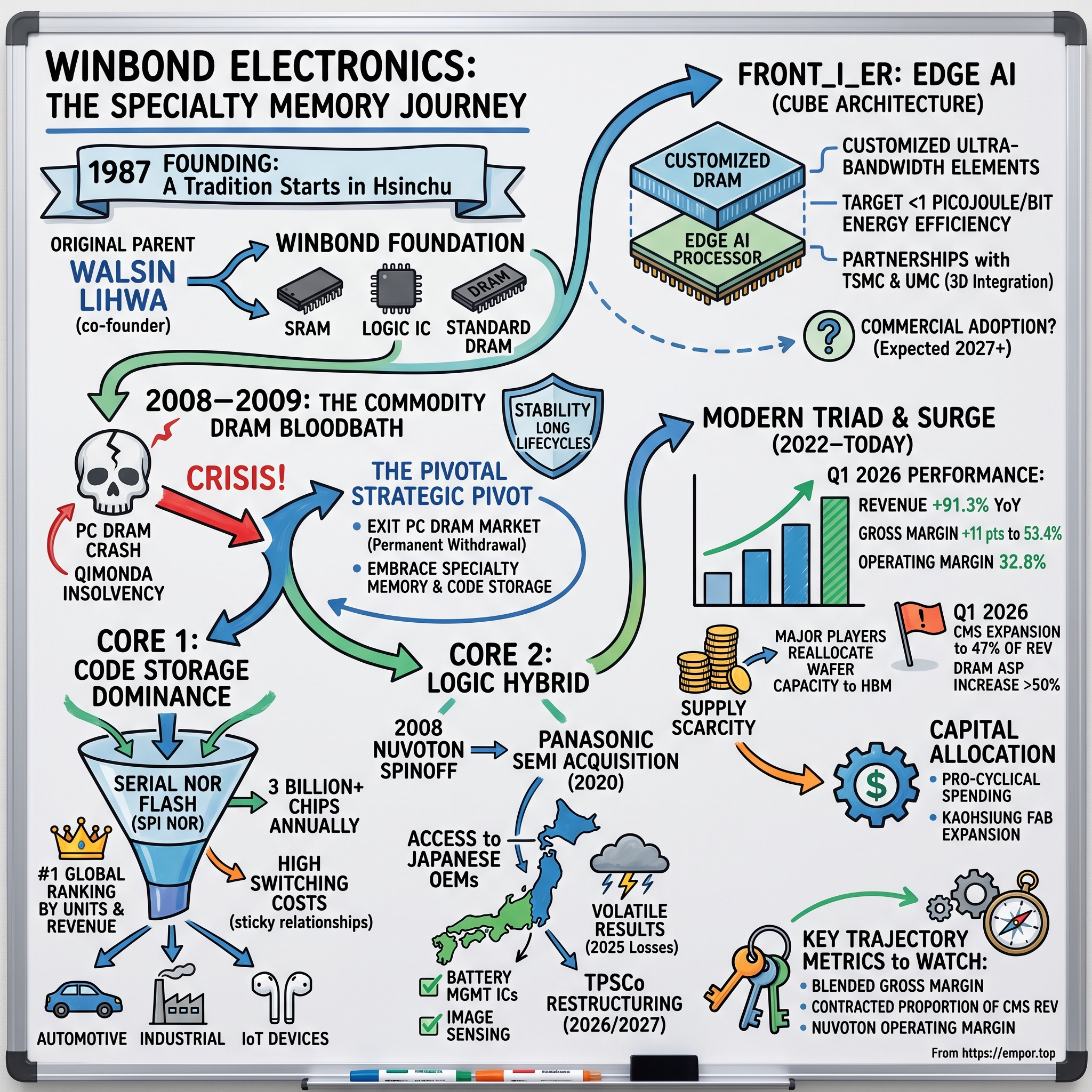
Winbond reached this market position through a strategic retreat. During the severe industry downturn of 2008–2009, the company abandoned the commodity PC DRAM market that had long defined Taiwan's memory sector—an exit that ultimately reshaped its corporate survival and identity.
Four central themes define Winbond's trajectory, each subject to empirical evaluation rather than management rhetoric.
The near-death pivot. The 2007–2009 commodity DRAM crash ruined Qimonda, drove Elpida into receivership, and forced Taiwan's memory sector onto state support. Winbond's exit from PC DRAM into specialty memory and code storage forms the bedrock of its corporate narrative, though the move was driven as much by competitive survival as strategic foresight.
The logic hybrid. In 2008, Winbond spun off its logic division into 新唐科技股份有限公司 Nuvoton Technology Corporation, which subsequently acquired Panasonic's semiconductor business in 2020. While presented as a strategic expansion, the unit's financial performance has proved more volatile than initial projections suggested, with headwinds becoming particularly pronounced in 2025.
The edge AI frontier. Winbond's CUBE architecture—stacked, customized DRAM mounted directly on an edge AI processor—offers a potential path from cyclical specialty supplier to structural content growth. However, as of mid-2026, the technology remains pre-revenue at commercial scale.
Capital allocation and governance. Chairman 焦佑鈞 Arthur Yu-Cheng Chiao has led the company since 1987.5 A four-decade leadership tenure spanning four complete memory cycles provides an extensive record for evaluation, revealing a mixed track record across capital deployment and corporate governance.
Understanding that evolution requires returning to Hsinchu in the late 1980s, when Taiwan set out to establish a domestic semiconductor industry and a wire and cable manufacturer decided to begin fabricating microchips.
 Subscribe on LinkedIn
II. The Genesis: Hsinchu, Walsin Lihwa, & Taiwan's Semiconductor Awakening (1987–1999)
In September 1987, Hsinchu Science Park was becoming the epicenter of Taiwan's industrial policy. TSMC had been incorporated months earlier, and the Industrial Technology Research Institute — 財團法人工業技術研究院 ITRI — had spent a decade licensing foreign process technology and seeding spinoff companies. With inexpensive land, returning Silicon Valley engineers, and government risk-underwriting, Taiwan was building a domestic semiconductor industry from scratch.
At that pivotal moment, a traditional industrial conglomerate entered the sector.
華新麗華集團 Walsin Lihwa was primarily a manufacturer of copper wire, cable, stainless steel, and industrial materials — a business far removed from semiconductor photolithography. Yet Walsin co-founded Winbond in September 1987 and has held a board seat since inception.45 That marked the start of a nearly four-decade commitment by a family-owned industrial group to a technology business with fundamentally different economics.
Conglomerate sponsorship in cyclical, capital-intensive industries creates distinct corporate dynamics. On the positive side, parent companies provide balance-sheet patience: a controlling shareholder with a multi-decade perspective can tolerate multi-year downturns that might destabilize a company dependent solely on public equity markets. On the negative side, conglomerate backing can entrench management, weaken pressure to return capital, and leave minority shareholders bearing the cost of an extended investment horizon. Winbond's history reflects both dynamics.
The early Winbond operated as a conventional integrated device manufacturer (IDM), designing and fabricating its own chips in-house. It produced SRAM, consumer logic ICs, and standard DRAM using 6-inch and later 8-inch fabrication plants in Hsinchu before listing on the Taiwan Stock Exchange in 1995.4 In the 1990s, Winbond functioned as a diversified semiconductor producer across memory, logic, and consumer components without a single dominant product focus.
This IDM structure stood in sharp contrast to the pure-play foundry model Taiwan was pioneering. TSMC's model separated chip design from fabrication, allowing fabless firms to design chips while foundries focused purely on manufacturing — an arrangement that transformed the global semiconductor industry. Winbond chose the integrated path and retained it. Subsequent strategic choices — including node migrations, facility expansions such as the Kaohsiung fab, and keeping NOR flash production internal — stemmed from this early decision to own manufacturing capacity.
The IDM model carries substantial operational burdens. It requires heavy capital investment, exposes a producer to utilization swings, and turns demand slowdowns into expensive idle capacity. Conversely, during periods when specialized production becomes strategically valuable, an IDM controls its manufacturing lines directly rather than competing for foundry allocation. Winbond repeatedly bore the capital costs of this model in its early decades, positioning it to leverage dedicated capacity in later cycles.
Winbond's dual footprint — memory fabrication alongside microcontroller and logic design — initially served as an operational hedge. Memory was sharply cyclical, whereas logic ICs delivered steadier revenues. Over time, however, managing both businesses within a single corporate entity created structural complexities.
A second structural factor shaped Winbond's early trajectory. As a mid-sized IDM, the company lacked the capital scale required to lead DRAM process technology, where competitors like Samsung Electronics and Micron Technology set the pace. Winbond operated as a technology follower, licensing process nodes from foreign partners, running them a generation behind the leading edge, and relying on high market demand to keep commodity DRAM prices above cash costs.
During the rapid expansion of the personal computer market in the 1990s, that model proved viable. Taiwanese DRAM producers — including Winbond, Powerchip, ProMOS, Nanya Technology, and later Inotera — invested heavily to expand DRAM bit volume. The Asian financial crisis of 1997–1998 signaled the risks inherent in competing as a capital-constrained technology follower in commodity memory markets, foreshadowing larger structural challenges ahead.
III. The Commodity DRAM Bloodbath & The Pivotal Strategic Pivot (2000–2008)
Between 2007 and 2009, Taiwan's memory industry experienced the full market volatility of commodity semiconductor economics.
The mechanics of commodity memory are relentless. Standard DRAM is an undifferentiated product regardless of manufacturer. Because cost per bit falls with each process shrink, producers running the newest manufacturing nodes achieve the lowest unit costs, allowing them to price lagging competitors into severe losses. Upgrading nodes requires regular, capital-intensive investments—tens of billions of New Taiwan dollars every eighteen months—to construct new fabs or re-tool existing facilities. Missing a single process node leaves a manufacturer's cost structure permanently uncompetitive, while simultaneous industry-wide capacity expansions routinely turn demand slowdowns into market gluts.
As a technology follower, Winbond navigated this environment through licensing agreements. In 2004, the company signed a 90-nanometer DRAM technology transfer agreement with Infineon Technologies. When Infineon spun off its memory unit into Qimonda AG in 2006, Winbond extended the partnership, eventually contracting for 75-nanometer and 58-nanometer process technology.6 To deploy these processes, Winbond constructed a 12-inch fabrication plant in the Central Taiwan Science Park in Taichung, opening the facility in April 2006 with a planned investment of NT$49 billion—a massive commitment for the firm, targeted at producing specialty DRAM, pseudo-SRAM, and DDR2.7
That expansion collided directly with the 2008 global financial crisis and severe industry oversupply. Contract prices crashed below cash operating costs, forcing producers to incur heavy losses on every chip manufactured while facing continuous fixed overhead if production was halted. Qimonda, Winbond's primary technology partner, filed for insolvency in January 2009. Japan's Elpida Memory entered receivership and was later acquired by Micron Technology, while Taiwanese memory makers recorded massive losses while pursuing a state-backed rescue initiative that ultimately failed to materialize.
Winbond's financial results from the first quarter of 2009 illustrate the severity of the crisis. Revenue fell 17% quarter-over-quarter to NT$3.13 billion, while net losses after tax reached NT$5.218 billion—a quarterly loss more than 1.6 times total sales. The loss, equivalent to NT$1.43 per share, included inventory write-downs caused by Qimonda's insolvency and approximately NT$1.35 billion in investment losses from asset disposals.8 Beyond the immediate financial damage, Qimonda's collapse wiped out Winbond's process technology roadmap, impaired inventory built for that platform, and undermined the strategic foundation of its commodity memory business.
Yet the same earnings release pointed to the company's future trajectory. Specialty DRAM and mobile RAM already accounted for roughly 60% of net sales, while NOR flash and commodity DRAM each represented about 20%.8 Management highlighted anticipated growth in specialty DRAM and NOR flash, driven by expanding consumer electronics demand in China.
This crisis accelerated a strategic transformation. Winbond did not exit commodity DRAM from a position of financial strength; rather, the collapse of its technology partner and unsustainable cash burn made continuing in PC DRAM untenable, even as its specialty memory line already generated most of its revenue. Chairman 焦佑鈞 Arthur Yu-Cheng Chiao made the pivotal strategic decision to make this withdrawal permanent, resisting the temptation to re-enter commodity markets when prices eventually recovered—a path that led several peers back into financial distress. Winbond has not sold commodity PC DRAM in significant volumes since.
The strategic logic of this transition rests on three fundamental mechanisms:
Product lifecycle. While PC DRAM components become obsolete within eighteen months, automotive and industrial memory components remain in active production for seven to ten years. Extended lifecycles convert continuous product development into long-term revenue streams, allowing manufacturing nodes that are legacy by leading-edge standards to remain fully depreciated and operational for up to a decade.
Capital intensity. By stepping off the leading-edge process treadmill, capital expenditure relative to revenue drops substantially compared to top-tier manufacturers. Winbond exchanged cost-per-bit leadership for long-term balance-sheet stability.
Customer stickiness. Industrial and automotive clients rarely re-qualify core components like memory controllers to capture marginal unit price savings, as the cost and regulatory burden of re-qualification creates high switching costs.
Although competitors like Macronix International pursued similar niche strategies, Winbond executed a complete operational exit when the alternative was insolvency.
While this pivot secured Winbond's position in memory, it left another structural challenge unresolved: how to manage its non-memory logic operations.
IV. The Logic Fork: Spinoff & Evolution of Nuvoton Technology (2008–2018)
By 2008, two fundamentally distinct semiconductor businesses operated within Winbond, driven by conflicting economic models and operational priorities.
One was a capital-intensive memory IDM measured in wafer starts and bits per die, where profitability hinges on manufacturing yields and depreciation schedules. The other was a logic IC business designing microcontrollers, voice ICs, PC motherboard Super I/O chips, and embedded controllers—a software-centric operation where success depends on design wins, development toolchains, firmware support, and customer ecosystems. Process engineers drove the memory fab; software and compiler engineers powered logic design.
Housing both operations under a single balance sheet within a fab-heavy company created structural friction. During severe memory downturns, the logic business was routinely starved of capital, its R&D budget serving as a balance-sheet shock absorber for memory cycle swings.
In 2008—as the global memory sector collapsed—Winbond addressed this friction by spinning off its logic unit as Nuvoton Technology Corporation, an independently listed subsidiary in which Winbond retained majority control. Chairman Arthur Yu-Cheng Chiao chaired Nuvoton from 2008 until 2019 before handing over the role.5 Winbond maintains roughly half of Nuvoton's equity, consolidating the subsidiary's financial results into its own.9
This corporate structure represents a hybrid model between a conglomerate and a full corporate separation. By listing Nuvoton while retaining control, Winbond provided the logic business with its own acquisition currency, cost of capital, independent board, and dedicated management incentives, while allowing Winbond to continue consolidating Nuvoton's revenue line. However, hybrid structures can also accumulate the operational drawbacks of both models.
For nearly a decade, the arrangement delivered solid operational results. Nuvoton established a durable presence in ARM Cortex-M microcontrollers—the general-purpose processors embedded across industrial sensors, consumer appliances, and automotive sub-systems. It also expanded its legacy PC franchises in Super I/O and embedded controllers, building a strong position in baseboard management controllers (BMCs).
A BMC functions as a server's background manager: an independent processor that remains active even when the primary system is powered down, monitoring thermal parameters, voltage levels, and enabling remote system diagnostics or firmware restoration without physical intervention. In standard enterprise web server racks, BMCs represent standard commodity hardware. However, in modern artificial intelligence data centers operating high-density accelerator racks drawing tens of kilowatts, hardware downtime is extremely costly—transforming BMCs into critical infrastructure. Although this trend was not predictable in 2010, Nuvoton's early investment in embedded controllers positioned the company to capture this high-margin market segment.
The spinoff provided Winbond with structural clarity. From 2008 onward, parent company management could focus exclusively on memory operations, directing capital expenditure toward fab upgrades while a dedicated leadership team managed the logic business independently.
Yet retaining control carried distinct opportunity costs. Winbond could have sold the logic division outright in 2008, using the cash proceeds to strengthen its balance sheet and fund its memory pivot when capital was scarce. By retaining majority ownership, Winbond preserved strategic optionality and consolidated revenue, but left Nuvoton reliant on group resources when it later pursued large-scale international acquisitions.
This hybrid arrangement also introduced a persistent valuation challenge for investors: determining the appropriate valuation multiple for a specialty memory manufacturer that consolidates a publicly traded microcontroller subsidiary it only partially owns. That valuation disconnect remained minor while both units were small, but grew more pronounced as memory profitability surged while logic growth moderated.
Nevertheless, Nuvoton soon embarked on a major international expansion, acquiring a core semiconductor business from one of Japan's legacy industrial conglomerates.
V. Code Storage Dominance: Building the World's #1 Serial NOR Flash Powerhouse
Press the power button on an automobile, a wireless router, a smart television, a drone, or a pair of wireless earbuds. In the fraction of a second before any interface appears, a processor must retrieve its initial instructions. It cannot retrieve them from a hard drive or solid-state drive because those storage devices require system drivers, and those drivers form part of the code being loaded. The processor requires memory that can execute instructions directly and instantly from a cold start.
That memory is NOR flash. Unlike NAND flash—which is optimized for inexpensive, bulk storage like consumer photos and video files—NOR flash is a small, fast, permanently addressable memory chip that stores boot code and embedded device firmware.
A helpful analogy compares NAND to a warehouse and NOR to the instructions taped inside the front door explaining how to unlock the building. While the warehouse contains far more physical volume, nothing functions if the instructions are missing.
For years, boot code relied on parallel NOR flash, which required dozens of address and data pins, occupied substantial circuit board space, and added system cost. The industry's migration to serial NOR (SPI NOR)—which communicates with a processor over just a few wires—reshaped market economics. Serial NOR reduced package sizes, simplified board layouts, and lowered overall system costs. It also altered competitive dynamics, favoring manufacturers equipped to handle high unit volumes at low average selling prices—a profile that major American and European memory producers actively avoided.
Producers including Spansion, Numonyx, and ultimately Micron Technology progressively scaled back low-density NOR production to focus capital on high-density NAND and DRAM, where per-device dollar content was significantly higher. For manufacturers managing multi-billion-dollar annual capital expenditures, low-margin components selling for well below one dollar offered limited strategic appeal.
Winbond stepped into the vacancy left by those exiting incumbents.
According to data from WebFeet Research, by 2019 Winbond had become the world's leading NOR flash supplier by revenue with a 22.8% market share, while ranking first in unit shipments at 27.3% after delivering 3.1 billion chips in a single year. In serial NOR specifically, the company had held the top global position since 2012, commanding a 27.1% share of an estimated US$2 billion market.10
Shipping three billion units annually reflects a design-win footprint distributed across thousands of customers and tens of thousands of end products, preventing any single client from exercising outsized commercial leverage.
That customer structure is uncommon in the semiconductor memory sector. Commodity DRAM relies heavily on a small group of large buyers—personal computer original equipment manufacturers, smartphone makers, and hyperscale cloud providers—each possessing substantial pricing leverage. By contrast, serial NOR serves a broad base of embedded electronics customers purchasing modest individual volumes. Because switching suppliers requires re-engineering and testing, clients rarely change vendors to capture minor price reductions. Customer concentration risk, a frequent driver of margin compression in memory manufacturing, is largely absent from Winbond's code storage business.
Myth versus reality. While industry consensus often attributes Winbond's serial NOR position to operational execution over established competitors, the transition was primarily driven by incumbents vacating a low-margin market. Competitors like Spansion and Numonyx made rational portfolio allocation decisions based on their respective cost structures. Winbond's operational accomplishment lay in scaling production to billions of units on internal 12-inch wafers at viable yields, then navigating multi-year automotive qualification processes that converted low-cost components into sticky customer relationships.
That market position has proven durable. During its first-quarter 2026 earnings call, management estimated Winbond's global NOR flash market share at roughly 23% and positioned the company third in single-level cell (SLC) NAND with approximately 10% share.11 That stability highlights a key dynamic: seven years of aggressive market entry by Chinese producers—led by 兆易创新 GigaDevice—has not displaced Winbond from the top position, nor has it enabled Winbond to expand its market share further.
Two principal mechanisms defend this market share.
The first is internal manufacturing. Winbond produces NOR and SLC NAND on its own 12-inch fabrication lines rather than outsourcing to commercial foundries, while advancing products across successive process nodes. Management has noted plans to expand its 2D NAND presence using 46-nanometer, 32-nanometer, and 24-nanometer manufacturing nodes.12 While owning fabrication plants increases fixed overhead costs, in high-volume, low-ASP product categories it allows Winbond to retain manufacturing margins internally.
The second mechanism is customer qualification. Automotive components must pass rigorous AEC-Q100 stress testing, while safety-critical systems require functional safety compliance. Winbond states that it was the first memory manufacturer in Taiwan to earn ISO 26262 certification, the international standard for automotive functional safety.4 Tier-1 automotive suppliers that spend two to three years qualifying a Winbond component into an advanced driver-assistance system or digital cockpit face substantial switching costs, providing Winbond with pricing stability in automotive and industrial markets.
Winbond has also sought to layer higher-margin products atop its commodity volume through its TrustME secure flash line, which incorporates cryptographic identity and secure boot capabilities for internet-of-things devices and energy grid infrastructure where regulators increasingly mandate firmware integrity.4 While the strategy aims to move components beyond pure per-bit pricing, consolidated financial disclosures do not isolate TrustME revenue, making its contribution to overall gross margins difficult to quantify independently.
Winbond's code storage business remains a durable, cash-generating franchise that secures Tier-1 automotive customer relationships. However, on its own, a mature NOR flash market generates limited structural top-line expansion, making performance in the remaining two-thirds of Winbond's business central to its long-term growth trajectory.
VI. The Panasonic Semiconductor Acquisition: A Japanese Turnaround Drama (2019–2021)
Panasonic invented, at various points, some of the foundational consumer electronics of the twentieth century. By 2019, its semiconductor division was a cautionary tale about what happens when a proud engineering organisation loses the volume to justify its own fabs.
In November 2019, Panasonic agreed to sell it. The buyer was not a Japanese rival, not a private equity fund, not a Chinese state-backed vehicle. It was Nuvoton — a Taiwanese microcontroller company roughly a decade old, itself a subsidiary of a mid-cap memory maker.
The transaction completed at the start of September 2020, delayed from a June target by pandemic-related regulatory hold-ups.13 What transferred was substantial: 100% of Panasonic Semiconductor Solutions, equipment and inventories from Panasonic Semiconductor (Suzhou), and assets, liabilities and contracts from Panasonic Industrial Devices Semiconductor Asia — plus R&D personnel and technology portfolios in sensing, microcontrollers, and components, and real estate in Nagaokakyo City, Kyoto Prefecture and four other locations.14 The acquired entity was renamed Nuvoton Technology Corporation Japan, or NTCJ.14 Panasonic framed the divestment as part of a pivot toward B-to-B: automotive CASE, information network infrastructure, and automation.13
Neither company published a headline purchase price in its completion announcements — a fact worth stating plainly rather than papering over with a number of uncertain provenance. Contemporaneous press reporting placed the consideration in the tens of billions of yen, or roughly US$250–300 million.
Take that range at face value for a moment and the arithmetic is arresting: a few hundred million dollars for a business with revenue several times that figure. On a multiple of sales, it looks close to free.
It was not free, and understanding why is the most useful part of this story.
A chronically loss-making semiconductor business with owned fabs in Japan is not an asset you buy cheaply — it is a liability you are paid to assume. The purchase price is the smallest number in the transaction. The real cost is the restructuring: rationalising Japanese fixed costs in a labour market where headcount reduction is slow, culturally fraught, and expensive; pruning product lines that individual customers still depend on; and filling underutilised fabs whose depreciation runs whether or not wafers move through them.
This is the standard error in reading distressed carve-outs, and it is worth stating as a general principle because it recurs constantly in semiconductors. A fraction-of-revenue purchase multiple looks like a bargain only if you assume the revenue is worth having at the cost structure attached to it. When a seller as sophisticated and as capital-rich as Panasonic decides that a business with hundreds of millions of dollars of revenue is worth less to it than the management attention it consumes, the sale price is not a measure of the asset's value. It is a measure of how much the seller was willing to pay someone else to take the problem. The buyer's real cost is purchase price plus every yen of restructuring, retention, and idle-capacity absorption that follows — a number that is never in the press release and often is not knowable for five years.
Five years is roughly how long it has taken to find out here, and the answer is mixed rather than damning.
What Nuvoton bought, genuinely, was access. Battery management ICs for electric vehicles and power tools. Image sensing, time-of-flight sensors, and head-up display controllers. And most valuable of all, incumbent supplier relationships with Japanese automotive OEMs — relationships that a Taiwanese microcontroller company could not have built organically in twenty years. Design cycles in Japanese automotive supply chains are measured in half-decades and rest on institutional trust. You can buy your way in. You cannot argue your way in.
The design-win record since suggests the access was real. Nuvoton has reported fourth-generation battery management IC wins on new EV and hybrid platforms with Japanese customers, occupant-classification time-of-flight sensor placements with a European customer, and mass production of a fourth-generation automotive HMI display IC series for cockpit and motorcycle-meter applications.1215
The financial record is a different matter, and this is where the tidy turnaround narrative breaks.
In 2025, Nuvoton lost money. Full-year revenue came in around NT$30.5 billion, down roughly 4% year on year, with a full-year loss per share of NT$3.97. The fourth quarter alone produced revenue of NT$7.04 billion, a gross margin of 34.3%, an operating margin of negative 10%, and a net loss of NT$694 million — a loss per share of NT$1.65.1216 Nuvoton's chairman 蘇源茂 Su Yuan-mao attributed the consecutive quarterly losses principally to the Japanese subsidiary's operations, and set the objective of returning the Japanese business to its 2023 level of performance.12
Read that carefully. Five years after the acquisition closed, the acquired Japanese operation was still the identified source of group losses. Whatever turnaround occurred in the early years did not prove durable through the 2024–25 downcycle.
The response has been structural. In March 2026, NTCJ, Tower Semiconductor, and their joint venture Tower Partners Semiconductor entered a framework agreement to split the venture: Tower takes full ownership of the 12-inch fab and foundry business at Uozu, while the 8-inch fab at Tonami becomes wholly owned by NTCJ, with NTCJ paying Tower US$25 million at closing. The deal is expected to close on 1 April 2027, subject to approvals.17
That is a meaningful admission encoded in a corporate action: Nuvoton is shedding its share of a 12-inch Japanese foundry it could not fill and consolidating around the 8-inch capacity its own products actually need. It is the right decision. It is also evidence that the Panasonic assets carried more fixed-cost baggage than the original purchase multiple implied.
By the first quarter of 2026, Nuvoton had crawled back to roughly breakeven — revenue of NT$7.988 billion and net income of NT$7 million, an EPS of NT$0.02.15 Not a disaster. Not a turnaround either. And, as the next section shows, an increasingly awkward passenger on a parent company that has suddenly discovered what a real memory upcycle feels like.
VII. The Modern Triad: Segment Breakdown, Financials, & Capital Allocation (2022–Today)
Understanding Winbond's position in August 2026 requires comparing two sharply contrasting financial profiles: the operational baseline of 2025 and the surge that followed.
2025 — the base. In 2025, Winbond posted consolidated revenue of NT$89.41 billion, up 9.55% year over year, with a gross margin of 35%, net profit attributable to the parent of NT$3.96 billion, and earnings per share of NT$0.88. Flash memory accounted for 35% of total revenue, logic ICs represented 34%, customized memory solutions (CMS—the specialty DRAM unit) generated 29%, and other lines made up 2%. By end market, consumer electronics drove 29% of sales, automotive and industrial applications 27%, communications 24%, and computer-related hardware 20%.2
This performance reflected a mid-single-digit return on a large asset base—respectable during an industry downturn, but modest overall.
Q1 2026 — the regime change. First-quarter 2026 results marked a sharp operational shift. Consolidated revenue jumped 91.3% year over year to NT$38.25 billion, while gross margin expanded 11 percentage points in a single quarter to 53.4% and operating margin reached 32.8%. Net profit attributable to the parent reached NT$10.11 billion, producing EPS of NT$2.25—more than double the prior year's full-year earnings in just three months.1118
Underlying this acceleration was a substantial shift in product economics. Memory revenue reached NT$29.92 billion at a 56.6% gross margin. Within memory, DRAM accounted for 60% of sales and grew 93% sequentially, propelled by average selling price increases exceeding 50%. Flash memory comprised the remaining 40%, expanding 23% sequentially as selling prices rose over 30%. Bit volume grew roughly 20% for DRAM and in the teens for flash.11
The Q1 surge was primarily driven by pricing power rather than volume growth alone—a characteristic common to memory upcycles, where rapid price appreciation can reverse quickly. The product mix realigned accordingly: CMS expanded to 47% of consolidated revenue on sequential growth above 90%, flash contracted to 32%, and logic—represented by Nuvoton—fell to 21% of the total.18
Although Nuvoton's revenue remained stable, the contrast across segments widened: a lower-margin logic subsidiary now diluted a memory business generating gross margins above 50%, reinforcing market debate over the unit's drag on parent valuation.
End-market distribution shifted as well. Computer-related sales fell from 20% to 13% of revenue as personal computer demand softened, while automotive and industrial applications rose to 30% and consumer products reached 30%.18 On its earnings call, management noted that full-year PC shipments could contract by 20% to 30%.11 Paradoxically, Winbond's record quarter occurred alongside weakness among PC manufacturers, who faced higher memory procurement costs.
Why now. This price appreciation stems from structural capacity reallocation across the semiconductor industry rather than direct artificial intelligence adoption. Leading memory manufacturers—Samsung Electronics, SK Hynix, and Micron Technology—have directed substantial wafer capacity toward High Bandwidth Memory (HBM) and high-density DDR5 for AI data centers. Because HBM requires significantly more wafer area per gigabyte than standard DRAM, major suppliers scaled back production of legacy DDR4, DDR3, and low-power DRAM. Rather than losing market share to Winbond, top-tier producers vacated legacy categories, leaving embedded hardware and networking equipment buyers with few alternative suppliers.
Management addressed this supply shortfall across three consecutive earnings calls. On the third-quarter 2025 call, CEO 陳沛銘 Chen Pei-ming noted that contract prices for legacy DDR4 and DDR3 were trending structurally higher as competitors exited, projecting supply tightness into 2026 and potentially 2027.19 At the full-year earnings briefing in February 2026, Chen stated that production capacity was fully committed through 2026 and into 2027, noting: "再賣下去就會超賣"—if the company took further orders, it would be oversold.20 By the May 2026 call, management extended that horizon, cautioning that DDR4 and LPDDR4 supply gaps could persist past 2028.11
While consistent management guidance reinforces credibility, an extending forecast horizon also highlights the risk of overestimating the duration of a cyclical upturn.
Capital allocation — the uncomfortable history. Evaluating Winbond's long-term returns requires examining its capital deployment record, which historically exhibited pro-cyclical investment patterns: heavy outlays near market peaks and reduced spending during downturns.[^21]
- In 2021, at peak cycle profitability—with net income of NT$13.6 billion and operating cash flow of NT$30.4 billion—capital expenditure was held to NT$10.1 billion, generating NT$20.2 billion in free cash flow.
- In 2022, as market conditions softened, capital spending expanded to NT$42.5 billion to build out the Kaohsiung fabrication plant, driving free cash flow to negative NT$26.9 billion.
- In 2023, revenue fell to NT$75.0 billion and the company recorded a net loss of NT$1.15 billion, yet capital spending remained at NT$14.1 billion, resulting in negative free cash flow of NT$10.5 billion.
- In 2024, net income reached just NT$601 million on revenue of NT$81.6 billion, while annual depreciation and amortization ran at NT$12.7 billion and capital expenditure totaled NT$17.5 billion, necessitating an NT$6.7 billion equity capital raise.
- In 2025, capital spending was curtailed to NT$6.9 billion—its lowest point in several years—restoring free cash flow to NT$4.3 billion.
Annual depreciation of roughly NT$12.7 billion against 2024 operating income of NT$336 million underscores the timing challenges of the Kaohsiung expansion.[^21] The facility opened into an industry downturn, creating heavy depreciation expenses that suppressed earnings for two years. Dividend distributions reflected that pressure: annual payouts of NT$1.00 per share in 2021 and 2022 were followed by zero dividends in 2023 and 2024, before resuming at NT$0.50 for 2025.21
Winbond is again committing significant capital during an upcycle, funded this time by internal cash generation rather than debt. For 2026, capital expenditure is budgeted at approximately NT$40.5 billion, with roughly 95% directed to front-end wafer fabrication. In May, the board approved an additional NT$7.3 billion, allocating over NT$5 billion to equipment for the CUBE architecture. Kaohsiung fab capacity is slated to expand from roughly 15,000 wafers per month to 24,000 by year-end, with further expansion planned into 2027.11
The balance sheet currently supports this expansion. As of March 31, 2026, total debt stood at NT$76.2 billion against cash and short-term investments of NT$61.0 billion, leaving net debt at approximately NT$50.7 billion against NT$122.9 billion in total equity.[^21] While manageable at current earnings levels, leverage would increase if memory pricing normalizes before new capacity is fully absorbed.
This capital plan leaves one major portion of the spending budget dedicated not to expanding existing products, but to commercializing a new architectural model.
VIII. The Edge AI Frontier: CUBE, 3DCaaS, & Next-Gen Memory Architectures
Every artificial intelligence device faces the same physical constraint: processor performance is ultimately limited by how quickly memory can deliver data. In data centers, the industry addresses this memory bottleneck with high-bandwidth memory (HBM), stacking DRAM dies vertically and connecting them to the processor through thousands of microscopic vertical interconnects, or through-silicon vias, creating a high-speed data conduit millimeters long.
While HBM delivers high throughput, it carries high unit costs, substantial power draw, and high thermal output. That trade-off is manageable in server racks backed by liquid cooling and hundreds of watts of power. It is prohibitive, however, in battery-powered edge hardware—such as smart glasses, surveillance cameras, warehouse robotics, or automotive cockpit controllers running compact vision models.
That performance gap—where conventional DRAM lacks sufficient bandwidth, yet HBM exceeds power and thermal budgets—is the target for Winbond’s CUBE architecture.
Announced in September 2023, CUBE—short for Customized Ultra-Bandwidth Elements—is designed for modest density but high energy efficiency. The architecture offers capacities from 256 megabits to 8 gigabits per die, delivering bandwidth between 32 and 256 gigabytes per second on a 20-nanometer process node, with a 16-nanometer generation planned. Critically for edge deployment, it targets energy consumption below one picojoule per bit.22
Energy per bit is the crucial metric for battery-powered applications, where power constraints dictate how much data can be moved without draining the system. By reducing energy consumption per bit, hardware designers can extend battery life or run larger models. Winbond positions CUBE as delivering bandwidth comparable to HBM2 within a power envelope suitable for edge systems. It achieves this by stacking customized DRAM directly onto a customer's logic die using chip-on-wafer, wafer-on-wafer, or 2.5D and 3D interposer configurations through its 3D Chiplet Architecture and Packaging Solutions platform.22
Management frames CUBE's economics at roughly half the cost of HBM3E, positioning the architecture to fill the gap between standard DRAM and high-density HBM rather than competing head-to-head with leading-edge memory.
This strategy aligns with Winbond’s core manufacturing capabilities. For fifteen years, the company focused on low-density, low-power, customized DRAM on mature process nodes—a niche originally adopted to avoid direct competition with commodity memory giants like Samsung. CUBE leverages those same specialty capabilities for edge artificial intelligence applications, applying established manufacturing lines to an emerging market rather than funding entirely new process capabilities.
Ecosystem partnerships have provided external validation for the platform. In October 2023, United Microelectronics Corporation announced a wafer-on-wafer 3D integrated circuit initiative incorporating Winbond alongside Faraday, ASE, and Cadence. More recently, in June 2026, TSMC and Winbond announced a partnership to establish localized DRAM integration in Taiwan via 3D wafer-on-wafer stacking, in which Winbond supplies customized DRAM wafers for TSMC to integrate with logic dies using its advanced packaging platforms.23
The TSMC arrangement represents a notable structural development. TSMC traditionally relied on Samsung, SK Hynix, and Micron for memory components integrated into its advanced packaging. Partnering with a domestic memory supplier offers TSMC supply-chain flexibility during tight memory markets. However, whether the alliance yields high-volume commercial adoption remains unverified, as neither company has disclosed manufacturing yields or production schedules, and public details of the agreement remain sparse.23
A strategic collaboration agreement demonstrates ecosystem positioning, but it does not equate to commercial purchase orders.
Winbond's internal roadmap offers a clearer guide to commercial timing. Management projects material financial contributions from CUBE starting in 2027, the targeted year for mass production, and allocated over NT$5 billion of its 2026 capital budget to CUBE manufacturing equipment.1119 CEO Chen Pei-ming has outlined a commercial strategy focused on long-term earnings stability over peak pricing, indicating a willingness to accept lower initial margins in exchange for long-term supply contracts.11
This approach reflects a dual commercial posture. In standard legacy memory markets, Chen declined to sign long-dated supply agreements during the 2026 price surge, telling analysts in February 2026 that Winbond would not accept orders beyond three months to avoid locking customers into peak prices that could damage client relationships during subsequent downcycles.20 Conversely, for CUBE, management seeks long-term, multi-year volume commitments to establish a steady, low-volatility revenue stream.
Establishing that recurring revenue stream remains the central unproven element in Winbond's long-term thesis. While CUBE features ongoing customer design engagements, packaging partners, and dedicated capital expenditure, the platform has not yet generated disclosed commercial revenue or secured public high-volume customers. Winbond is deploying billions of New Taiwan dollars in capital equipment today against revenue expectations that depend on customer adoption starting in 2027.
Until those commitments materialize, CUBE represents a strategic growth option backed by real capital deployment rather than an established commercial revenue stream.
IX. Management, Governance, & Capital Deployment Audit
Arthur Chiao has served as chairman of Winbond since the company's founding in 1987, and also serves as chief executive officer.5 That tenure spans nearly four decades—longer than most of its customers' products have existed—navigating the Asian financial crisis, the dot-com bust, the DRAM depression, the smartphone boom, the pandemic shortage, the 2023–2024 downturn, and the 2026 AI-driven memory squeeze.
That extended leadership record reflects both strategic execution and governance trade-offs.
The case for. Chiao made the critical structural decision to exit commodity PC DRAM in 2009 and maintained that positioning when market prices recovered. He preserved the company's independence while Taiwan's memory sector underwent consolidation, government-backed restructuring, or liquidation. He also established the logic business as an independently listed subsidiary with its own corporate strategy. Under his leadership, Winbond secured and maintained global leadership in code storage memory categories abandoned by major producers.
The case against. Combining the chairman and chief executive roles for 39 years presents structural governance concerns for institutional investors. The board comprises eleven directors, of whom four are independent — 36% of the board — with three women, while co-founder and largest shareholder Walsin Lihwa holds a director seat.5 Four independent directors out of eleven meets Taiwanese regulatory standards, but represents a modest independence ratio for a corporation executing NT$40 billion capital expenditure programs.
Day-to-day operations sit with President Chen Pei-ming, who serves as the primary executive voice on earnings calls and provides concrete operational guidance: specific wafer-per-month targets, average selling price direction, process node migrations, and explicit operational limits. He has also been willing to highlight challenging realities on the same calls that carried positive results — the projected contraction in personal computer shipments being the clearest example.11
Ownership and alignment. Walsin Lihwa remains the largest shareholder with a stake in the low twenties as a percentage of shares outstanding, and Chin Xin Investment — whose chairman is also Winbond's chairman — holds an additional block.5 Directors and executive management collectively hold a meaningful share of the company.
However, alignment saw a notable shift in May 2026, when Walsin Lihwa disposed of 14,145 lots of Winbond shares — roughly 14.1 million shares — worth about NT$1.817 billion at a reference price of NT$128.50, while retaining over 965,000 lots and its designation as a strategic shareholder. Walsin's stated reasons were realizing long-term investment gains and supporting its own fund allocation and financial planning; its chairman 焦佑倫 Chiao Yu-lun noted that the prior year's results had been hurt by trade tensions while the current year was benefiting from AI-driven strength in electronics.24
The disposal is small relative to Walsin's total position — under 2% of its holding — and aligns with routine corporate treasury management. However, a controlling-family vehicle reducing equity exposure during a multi-fold stock rally provides an important data point alongside management's optimistic public framing.
The activist stress test. Four key structural questions define the current investment case:
First, the conglomerate discount. Winbond consolidates a listed subsidiary in which it holds roughly half the equity. In the first quarter of 2026, that subsidiary contributed 21% of consolidated revenue while generating NT$7 million in net profit against the parent group's NT$10.1 billion.1518 A sum-of-the-parts analysis highlights the valuation drag of combining a world-class specialty memory business and a separately traded microcontroller business in a single wrapper. Management attributes the structure to cross-domain design synergies between memory and logic, though specific financial metrics for these synergies remain undisclosed.
Second, capex timing. Capital expenditure for the 2022 Kaohsiung expansion peaked near market highs and resulted in heavy depreciation expenses during the subsequent downturn, prompting a two-year dividend suspension. With the current expansion program substantially larger, fixed depreciation costs could re-emerge if market conditions normalize before capacity is fully absorbed.
Third, margin sustainability. Gross margin expansion driven primarily by rapid quarterly price increases rather than cost reductions carries downside risk if supply-demand dynamics rebalance.
Fourth, disclosure granularity. Winbond does not separately disclose individual product line profitability, revenue contributions from secure flash products, or commercial metrics for the CUBE platform, limiting visibility into multi-year technology bets.
These structural factors highlight the central analytical frameworks that determine Winbond's long-term competitive positioning.
X. Strategic Frameworks & Playbook
Stripping away historical context leaves a fundamental structural question: what prevents competitors from replicating Winbond's business model?
Hamilton Helmer's 7 Powers
Scale Economies — high, but narrowly. Shipping billions of serial NOR units annually spreads fixed R&D and photomask costs across a volume that niche entrants cannot match, enabling Winbond to profitably sell chips at price points that leading-edge manufacturers avoid. However, this scale is substantial only within specialty memory; it remains modest compared with the absolute wafer volumes of Samsung or Micron. Winbond maintains market leadership primarily because it occupies a specialty niche abandoned by larger competitors.
Switching Costs — high in automotive and industrial, low elsewhere. A qualified component embedded inside a safety-critical automotive system carries multi-year requalification timelines and program risks that procurement teams avoid incurring. This represents the strongest structural power in Winbond's portfolio, explaining why the automotive and industrial segments—representing 30% of first-quarter 2026 revenue—carry strategic importance beyond their immediate sales contribution.18 Conversely, switching costs in consumer electronics are minimal, subjecting suppliers to intense price competition.
Cornered Resource — medium, and contested. Winbond's proprietary 20-nanometer specialty DRAM process, its buried-wordline DRAM heritage stemming from Qimonda technology transfers, and its combined memory and logic design capabilities are distinct. Yet these capabilities are not exclusive; competitors such as GigaDevice can purchase comparable process capabilities from commercial foundries.
Counter-Positioning — medium, and decaying by construction. This dynamic has driven operational results over recent quarters, yet remains frequently mispriced by investors. Winbond's advantage in legacy DRAM persists because top-tier producers chose to reallocate wafer capacity to high-bandwidth memory (HBM). This is not an insurmountable barrier to entry, but a choice driven by higher per-wafer margins in HBM. Should HBM economics normalize or demand soften, top-tier suppliers could redeploy capacity into legacy DRAM. Counter-positioning remains durable only when incumbents cannot respond without harming their core business; in this instance, incumbents simply choose not to compete in legacy nodes for now.
Process Power — medium-high. Two decades of yield optimization on mature manufacturing nodes for NOR flash, SLC NAND, and specialty DRAM represent accumulated process expertise that equipment purchases alone cannot replicate. Winbond's ability to advance NAND production through 46-nanometer, 32-nanometer, and 24-nanometer nodes on its own lines provides empirical evidence of this manufacturing capability.12
Two remaining powers—network economies and branding—are largely absent, which is consistent with component supplier economics.
Porter's Five Forces
Threat of new entrants: low. Constructing a 12-inch memory fabrication facility requires a multi-billion-dollar capital commitment with a decade-long payback period, while automotive qualification adds years before initial revenue materializes. Consequently, new entry typically requires state underwriting, which characterizes the competitive threat from Chinese producers.
Bargaining power of buyers: currently weak, structurally medium. With production capacity committed through 2027 and management characterizing DRAM supply as extremely constrained, buyers currently possess minimal pricing leverage—driving recent average selling price increases.1120 However, major automotive Tier-1 suppliers and consumer original equipment manufacturers remain concentrated and sophisticated, and will reassert commercial leverage when supply tightness eases. Current pricing reflects temporary supply scarcity rather than permanent pricing power.
Bargaining power of suppliers: medium-high. Winbond relies on key equipment suppliers—including ASML, Applied Materials, Lam Research, and Tokyo Electron—alongside silicon wafer vendors, all of which maintain broad customer bases. During global capital expenditure expansion cycles, equipment lead times create tangible constraints on facility expansion plans.
Threat of substitutes: low for the core. Executable non-volatile boot memory has no direct economic substitute in embedded systems today. Over a longer horizon, architectural shifts pose a potential risk: as system-on-chip designs integrate embedded flash, demand for discrete, low-density NOR flash could gradually decline. This transition represents a slow structural erosion rather than an immediate risk.
Competitive rivalry: high. 旺宏電子 Macronix International competes directly and has sampled 3D NOR technology aimed at higher-density applications. GigaDevice competes on price, supported by domestic Chinese demand and industrial policy, while expanding into automotive-qualified serial NOR. On Winbond's first-quarter 2026 earnings call, CEO Chen Pei-ming noted that virtually none of Winbond's customers were using Chinese DRAM.11 While this statement reflects the current qualified customer base, it does not guarantee long-term market protection.
Synthesis. Winbond's structural protections stem from switching costs in qualified applications and process expertise on mature nodes. However, its current earnings surge is driven primarily by temporary scarcity and capacity reallocation among major competitors—the least durable elements of its competitive moat. The ultimate investment outcome depends on whether the company can convert this cyclical windfall into permanent structural growth.
XI. Analysis & Bear vs. Bull Case
Two investors can look at the same first half of 2026 and reach opposite conclusions, with both reasoning logically from the disclosed figures.
The Bull Case
Structural, not cyclical, supply scarcity. The primary bullish argument holds that the current market dynamics extend beyond a conventional memory upcycle. Standard upcycles typically end when major producers expand manufacturing capacity. In this instance, top-tier competitors are not choosing whether to add legacy DRAM capacity; rather, they are reallocating wafer capacity toward high-bandwidth memory (HBM), which offers superior unit economics. So long as artificial intelligence infrastructure demands leading-edge wafer allocation, legacy DDR4 and LPDDR4 memory required by industrial, networking, and automotive customers will remain in short supply. Management has extended its projected shortage horizon three times across consecutive earnings briefings, most recently projecting tight supply past 2028.111920
Mix shift into higher-margin end markets. Automotive and industrial applications expanding to 30% of total revenue represents a more structural improvement than top-line growth alone, as these sectors involve high switching costs and maintain pricing stability through industry downturns.18 Incremental gains in qualified application mix serve to raise baseline revenue during subsequent market troughs.
CUBE as content expansion. If commercial production of the CUBE platform begins as targeted in 2027, Winbond transitions from selling discrete memory components to supplying customized, co-designed subsystems. Partnerships with TSMC and UMC provide packaging integration and ecosystem access that an independent memory manufacturer could not develop alone.2223 The bullish thesis does not require massive volume initially; securing contracted, multi-year volume would meaningfully reduce overall corporate revenue volatility.
Operating leverage across internal manufacturing. The heavy depreciation overhead that constrained profitability in 2023 and 2024 is now substantially absorbed, allowing an 11-percentage-point margin expansion driven by average selling prices to flow directly to operating income.11[^21] Owning fabrication assets imposes fixed costs during market troughs, but accelerates margin growth during pricing upcycles.
Nuvoton's operational recovery. With Nuvoton returning toward breakeven, sustained demand for server baseboard management controllers, and the TPSCo restructuring expected to reduce fixed operating expenses starting in 2027, the logic subsidiary provides a potential source of consolidated earnings growth independent of memory pricing cycles.151617
The Bear Case
Pricing spikes historically mean-revert. In the first quarter of 2026, Winbond's DRAM bit volume expanded roughly 20% sequentially while average selling prices rose over 50%, indicating that higher pricing accounted for approximately three-quarters of segment revenue growth.11 Memory pricing remains highly cyclical across the semiconductor industry, meaning a 53.4% gross margin built primarily on supply scarcity reflects a cyclical peak rather than a permanent operational baseline.
Industry capacity additions are planned. Winbond is doubling wafer output at its Kaohsiung facility by late 2026 with further expansion planned into 2027, while industry peers pursue similar expansions.11 The bullish outlook relies on major competitors maintaining disciplined legacy capacity allocations over several years without contractual commitments. If legacy memory pricing remains elevated, leading producers may eventually reallocate capacity back into those categories.
Risks of capital expenditure timing. During Winbond's previous major capital expansion in 2022—totaling NT$42.5 billion—new production capacity arrived into an industry downturn, generating fixed depreciation overhead that led to two years of minimal profitability and suspended dividend payouts.[^21]21 Although the 2026 capital program is funded from internal operating cash flow rather than debt, a 12-inch fabrication plant creates continuous depreciation expense regardless of factory utilization rates.
Subsidized regional competition. GigaDevice continues to expand its position in entry-level NOR flash backed by domestic market volume and industrial policy support, while actively seeking automotive qualifications. While automotive customer qualification creates high switching costs, every new vehicle platform redesign presents an opportunity for competitive displacement.
Geographic concentration risk. Both of Winbond's 12-inch fabrication plants are located in Taiwan, at Taichung and Kaohsiung.4 This represents a single-region geographic exposure to geopolitical stability across the Taiwan Strait. Furthermore, while this proximity encourages strategic collaboration with domestic partners like TSMC, it deepens supply chain concentration within the same region.
Governance and organizational complexity. Combining the chairman and chief executive roles, consolidating a half-owned listed subsidiary, withholding product-line margin disclosures, and controlling shareholders reducing equity positions during a share rally each present structural considerations for institutional investors evaluating sum-of-the-parts valuations.524
The Honest Synthesis
The bullish and bearish perspectives do not fundamentally dispute current operational facts, but differ on the durability of market conditions.
Both viewpoints acknowledge that Winbond is generating elevated returns due to capacity reallocations by larger memory producers. The bullish perspective interprets this reallocation as a multi-year structural shift driven by AI infrastructure demand, whereas the bearish view regards it as a temporary tactical choice that could reverse. Current empirical evidence—including fully committed plant capacity, extended shortage forecasts, and management's refusal to sign multi-year sales contracts at peak pricing—supports elements of both interpretations.
A definitive resolution will depend not on additional quarters of record revenue, but on whether Winbond has elevated its operational floor through a higher mix of automotive and industrial sales, commercial CUBE contracts, and structural margin improvements at Nuvoton. Demonstrating a higher baseline across an industry trough will require two to three years of financial results.
The second-quarter 2026 financial report, scheduled for the investor conference on August 6, 2026, will provide visibility into whether gross margins held as pricing gains annualized.25 However, near-term quarterly results alone will not resolve the broader question of long-term structural durability.
XII. Epilogue & Key KPIs to Watch
The most instructive aspect of Winbond's trajectory is not the pivot itself, but what that pivot cost.
In 2009, Winbond lost more in a single quarter than it generated in revenue, watched its primary technology partner enter insolvency, and abandoned the commodity DRAM business that had justified its largest fabrication investment. It then spent roughly fifteen years in relative obscurity—profitable during upcycles, loss-making during downturns, compounding slowly, and periodically suspending its dividend—building a position in market niches that competitors with larger capital budgets avoided. For most of that decade and a half, the strategy appeared less like strategic foresight than the only viable path for a company that had run out of alternatives.
Then the industry's largest producers simultaneously reallocated their wafer capacity toward high-bandwidth memory, and fifteen years of unglamorous niche positioning converted, across roughly four quarters, into the strongest financial results in the company's history.
The lesson for long-term investors is not simply that focus beats scale; Samsung's scale is precisely what allowed it to exit legacy DRAM on its own terms. The narrower, more practical lesson is that in deeply cyclical industries, structural returns accrue to whichever producer remains standing in a specialized niche when leading-edge competitors reallocate capacity. Remaining standing, however, requires surviving long stretches during which the underlying strategy provides little tangible proof of success. Winbond's shareholders were required to endure two consecutive years of no dividends and two years of negligible profits to participate in the 2026 surge.
The open question is whether Winbond can convert a cyclical windfall into a durable structural franchise. That goal underlies its CUBE capital spending, its expansion into automotive applications, and Nuvoton's restructuring. Each initiative will ultimately be evaluated not by press announcements, but by whether the company's baseline profitability holds during the next industry downturn.
Three critical metrics will define the company's trajectory:
1. Blended gross margin against fab utilization and depreciation. This remains the master operational variable. It captures average selling prices, product mix, utilization rates across the Taichung and Kaohsiung facilities, and the cost drag of newly commissioned capacity in a single metric. A gross margin that holds firm as bit volumes expand and new depreciation expenses land would signal a higher structural floor. Conversely, a gross margin that contracts as rapidly as it expanded would confirm a transient price-spike thesis.
2. CMS revenue and 20-nanometer contribution—specifically, the contracted proportion. Customized Memory Solutions is where current profitability resides and where the CUBE platform will eventually land. The central metric is not merely top-line CMS revenue growth, but the proportion secured under multi-year customer agreements versus quarterly spot-market negotiation. That ratio represents the distinction between a volatile cyclical business and a recurring annuity.
3. Nuvoton's operating margin rather than top-line revenue. Nuvoton's revenue scale is well established, but its underlying profitability remains the primary operational question. The specific test is whether Japanese operations return to sustained profitability and whether the TPSCo separation provides the anticipated fixed-cost relief by 2027. A logic subsidiary operating at standard semiconductor margins would eliminate the primary rationale for a conglomerate discount across the consolidated parent entity.
References
-
Winbond Announces 2025 Full Year Business Results — Winbond, 2026-02-10 ↩↩
-
Winbond Electronics (2344) Market Data — Taiwan Stock Exchange ↩
-
Board of Directors — Corporate Governance — Winbond ESG ↩↩↩↩↩↩↩
-
Winbond Electronics Corporation and Qimonda AG Announce New Agreement for 75 Nanometer and 58 Nanometer Technology Transfer — Winbond ↩
-
Winbond Electronics Held the Grand Opening Ceremony for Its 12-inch Fabrication Plant at Central Taiwan Science Park — Winbond, 2006-04-20 ↩
-
Winbond Announces the Financial Results for the First Quarter of 2009 — Winbond, 2009 ↩↩
-
Winbond Q1 FY2026 Earnings Call: Gross Margin 53.4%, EPS NT$2.25, Full-Year Capex NT$40 Billion — BigGo Finance, 2026-05-05 ↩↩↩↩↩↩↩↩↩↩↩↩↩↩↩
-
Panasonic Completes Transfer of Semiconductor Business to Winbond Subsidiary Nuvoton — Semiconductor Today, 2020-09-03 ↩↩
-
Completion of the Acquisition of the Semiconductor Business from Panasonic Corporation — Nuvoton, 2020-09 ↩↩
-
Nuvoton Technology Holds Investor Conference for the First Quarter of 2026 — Nuvoton, 2026 ↩↩↩↩
-
Nuvoton Technology Holds Investor Conference for the Fourth Quarter of 2025 — Nuvoton, 2026-02-12 ↩↩
-
Nuvoton Technology Corporation Japan and Tower Semiconductor Announce Strategic Business Restructuring of TPSCo — Nuvoton, 2026-03-25 ↩↩
-
Winbond Announces Q1 2026 Business Results — Winbond, 2026 ↩↩↩↩↩↩
-
「再賣下去就會超賣!」華邦電今明年產能都賣光 總座曝:不敢簽長約 — Yahoo奇摩股市, 2026-02-10 ↩↩↩↩
-
Winbond Introduces Innovative CUBE Architecture for Powerful Edge AI Devices — Winbond, 2023-09-27 ↩↩↩
-
TSMC Accelerates Local DRAM Supply Chain with Winbond Collaboration — Crypto Briefing, 2026-06-29 ↩↩↩
 LinkedIn
 WhatsApp
 Reddit
 Hacker News
 Email
Email Kindle
 RSS Feed
 Spotify
 Apple Podcasts
 Amazon Music
 Audible
 YouTube