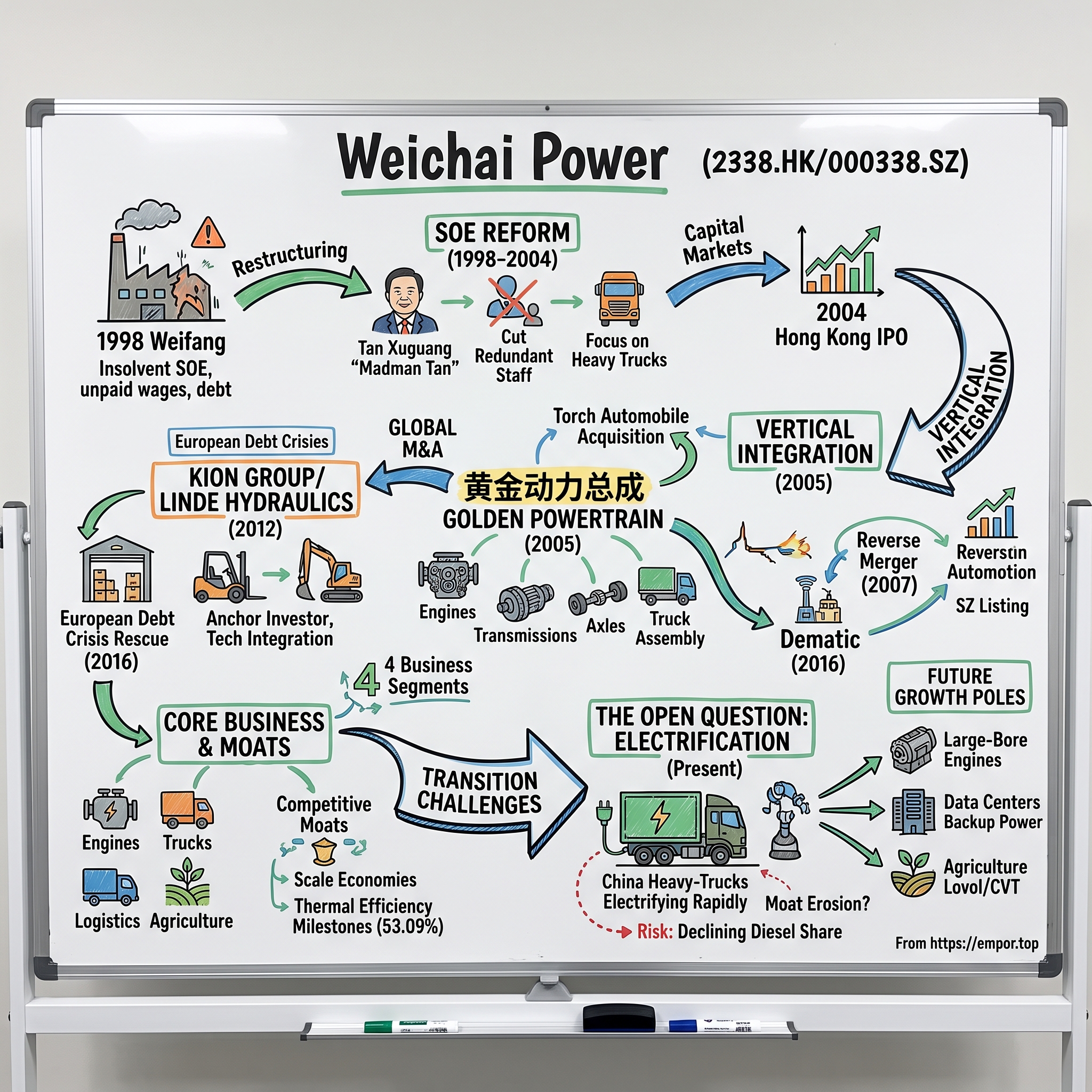
Weichai Power: The Engine of China's Heavy Industrial Might
I. Introduction & Episode Roadmap
In June 1998, a 37-year-old engineer walked into a factory compound in Weifang, a second-tier city on the Shandong peninsula, and inherited a catastrophe. More than 10,000 workers had not been paid in six months. The enterprise carried over RMB 300 million in debt, while finished engines nobody wanted were stacked in the yards. The state-owned diesel works that had been building marine and industrial motors since the founding of the People's Republic of China was, in every practical sense, insolvent.1
Twenty-eight years later, the entity that grew out of that compound reported revenue of roughly RMB 231.8 billion — about US$33 billion — and net profit attributable to shareholders of RMB 10.9 billion for the 2025 financial year.2 It sold 743,000 engines. Beyond its core power business, it owns the largest heavy-truck brand in western China, the country's dominant heavy-duty transmission maker, the country's largest agricultural machinery business, and — through a German subsidiary listed on the MDAX — a controlling position in the world's leading warehouse automation provider and the largest industrial truck manufacturer in Europe, the Middle East, and Africa.23
Those top-line figures highlight a substantial turnaround. The critical question for shareholders is whether the operating model that built this industrial group remains sustainable.
The core thesis, and what would falsify it
潍柴动力 Weichai Power Co., Ltd. — dual-listed as 2338.HK in Hong Kong and 000338.SZ in Shenzhen — is usually described as an engine maker. That description is now only partially accurate. Engines contributed roughly RMB 52.9 billion of external revenue in 2025, representing less than a quarter of the group total, though they remain the profit bedrock and technological spine.2 What Weichai actually represents is a vertically integrated powertrain conglomerate that learned early that the cheapest time to acquire strong industrial assets is during liquidity crises.
Three primary mechanisms have driven this expansion. First, vertical integration — controlling the engine, transmission, axle, and truck to tune them as a single system. Second, opportunistic cross-border M&A executed during industry downturns, notably in Hunan in 2005 and in Frankfurt in 2012. Third, an aggressive execution of 国企改革 state-owned enterprise (SOE) reform, in which a state-backed company operated with founder-like urgency under decisive leadership.
Each mechanism can be empirically tested. Vertical integration should yield durable market share in Chinese heavy-duty engines and margin resilience through economic cycles. Crisis M&A must be judged by returns on capital deployed — a mixed track record once the 2018 clean-tech investments are included. SOE reform should show up in capital discipline and in performance following leadership transitions, such as the reformer's departure on 12 August 2024.4
The falsification test is equally concrete. China's heavy-truck market is electrifying rapidly: new-energy heavy trucks reached 29% of the domestic market in 2025 and crossed 50% in a single month for the first time in December of that year.5 Meanwhile, Weichai's most profitable engine segment — natural gas — lost market share in the same period.6 If internal combustion engines are the core moat, that moat is steadily eroding. The bull case therefore cannot rely on diesel; it depends on what Weichai builds next.
What follows
Part one covers the near-death of 潍坊柴油机厂 Weifang Diesel Engine Works and the rise of 谭旭光 Tan Xuguang, whom Chinese industry nicknamed "Madman Tan." Part two covers the 2005 auction of 湘火炬 Torch Automobile Group and the creation of the 黄金动力总成 "golden powertrain." Part three covers the European strategy — KION Group, Linde Hydraulics, and Dematic. Part four dissects segment economics, thermal-efficiency milestones, and the gas-engine boom that is now fading. Part five audits capital allocation and the handover to 马常海 Ma Changhai. Part six runs the strategic stress test — applying Helmer's 7 Powers and Porter's Five Forces to evaluate bull and bear cases alongside core operating metrics.
It begins with a factory that was on the verge of failure.
 Subscribe on LinkedIn
II. The Birth of Weichai & SOE Survival: From Weifang to HKEX (1946–2004)
The Weifang plant traces its lineage to 1946 and a small workshop for repairing weapons — an origin common to a generation of Chinese state industrial enterprises that were founded in wartime and repurposed for peacetime production. By the 1980s, it had become Weifang Diesel Engine Works, a competent maker of medium-speed diesels for fishing boats, generator sets, and industrial applications. Competent, but not commercial. It operated as a production unit inside a planned economy, judged on physical output rather than customer demand.
The pivotal technical event of that era was licensing: in the 1980s, the plant acquired rights to build the Steyr WD615 heavy-duty diesel, an Austrian design that became the workhorse of Chinese trucking for the next two decades. That single license mattered more than any strategy document. It gave a provincial engine works a modern high-speed diesel platform at the precise moment China began pouring concrete for its modern infrastructure.
The crisis, and the man
The challenge was that a viable product could not offset a distressed balance sheet. By 1998, the plant carried the full weight of the old danwei model — thousands of surplus workers, a hospital, schools, housing, and a sprawl of loss-making side businesses — against collapsing demand and stalled receivables. Six months of unpaid wages was not merely a financial statistic; it was a social crisis in a single-factory town.
Tan Xuguang had joined the plant in 1977 as a teenage worker and rose through sales and exports — a telling detail, as he advanced on the commercial side rather than engineering, which was traditionally the prestige track. Appointed factory director in June 1998, he did three things immediately that broke with SOE convention.1
He started with executive accountability. His 约法三章 — literally "three articles of agreement," referencing Han-dynasty statecraft — was a compact imposed on the management cadre: hold to principle and actively manage rather than acting as passive bureaucrats; engage directly in operational work for the enterprise and its workforce; and lead by example, holding cadres to stricter standards than the shop floor.7 In a system where managerial privilege was standard, publicly reversing the hierarchy of accountability sent an immediate signal.
Then came the structural surgery. Redundant headcount was cut, non-core businesses were closed or spun off, and the distribution network was purged of intermediaries who had arbitraged the plant's disorganization. The most consequential move arrived in the second half of 1999 with the 三三制, or "one-third system," a property-rights restructuring that split the enterprise into three parts. One-third — the high-speed engine business and its core workforce — was carved out to form a new company with a modern corporate structure designed for a public listing. A second third, the legacy medium-speed engine operation, remained inside the parent group. The remaining third, comprising component plants and social functions, was pushed out with transitional funding or handed over to municipal authority.1
This division formed the single most important structural decision in the company's history. It did not attempt to fix the legacy enterprise overnight; instead, it quarantined the viable commercial asset, providing it with a clean capitalization table, a focused product line, and a path to external capital. Everything that followed — the Hong Kong listing, the acquisition strategy, and the European expansion — depended on that separation.
Betting the company on heavy trucks
The accompanying strategic choice was equally focused. Rather than defending a broad catalog of small and medium engines against commodity competition, Weichai concentrated its resources on heavy-duty truck diesels. In the late 1990s, that focus appeared narrow. In hindsight, it was a leveraged bet on China's massive infrastructure expansion: the expressway network, ports, mines, and property development all ran on heavy trucks, and heavy trucks ran on 10-to-13-liter diesels.
The strategy succeeded because the WD615 platform was already certified, in production, and trusted by fleet operators, allowing Weichai to scale rapidly without a development lag. Volume generated unit-cost advantages, which enabled competitive pricing that drove further volume. By the early 2000s, the enterprise had moved from unpaid wages to becoming the reference engine supplier for Chinese heavy-duty trucking.
Hong Kong, 2004
Weichai Power Co., Ltd. was incorporated as a joint-stock company in December 2002 and listed H shares on the 香港交易所 Hong Kong Stock Exchange in March 2004, becoming the first Chinese internal-combustion engine enterprise to list overseas.8 The heavily oversubscribed initial public offering provided value far beyond the capital raised.
The listing secured three strategic assets: hard currency, at a time when cross-border acquisitions by Chinese firms required scarce foreign exchange; external discipline, through Hong Kong's continuous-disclosure regime and an institutional shareholder base; and an equity currency for future transactions. Weichai would deploy all three within eighteen months.
In the two decades following the listing, Weichai's market value rose roughly thirty-fold, and the company distributed more than RMB 28 billion in cumulative dividends.8 That financial record stands out among Chinese state-owned industrial enterprises, demonstrating that the 1998–1999 restructuring created durable economic value rather than a simple corporate rebranding.
The war chest was assembled. What Weichai did next was not incremental.
III. The Masterstroke: Torch Automobile, "Golden Powertrain," and the Reverse Merger (2005–2007)
In 2004, D'Long Group collapsed. For several years, the private conglomerate had built a sprawling network of listed vehicles, industrial holdings, and financial companies fueled by cheap debt. When credit froze, the structure unwound, forcing creditors to liquidate assets in a market ill-equipped to price them.
One of those assets was 湘火炬 Torch Automobile Group, a Hunan-listed entity holding a unique industrial portfolio: controlling stakes in 陕西重汽 Shaanxi Heavy Duty Motor, the truck assembler behind the SHACMAN brand; 法士特 Fast Gear, the dominant Chinese heavy-duty transmission manufacturer; and 汉德车桥 Hande Axle, a leading producer of heavy axles. In effect, every major component required to assemble a heavy truck—other than the engine—sat inside a distressed seller's estate.
The auction
The bidding was competitive. Wanxiang Group, then one of China's largest private auto-parts manufacturers, actively contested the auction. Weichai ultimately won with a bid of RMB 1.02338 billion—a figure incorporating its own Shenzhen stock code, 338. The transaction structure comprised roughly RMB 622 million in cash for a 28.12% stake held by D'Long and two subsidiaries, alongside the assumption of about RMB 401 million in Torch liabilities.9 At the time, it represented the largest cash acquisition in Chinese capital-markets history.10
Skeptics immediately questioned the deal's logic. Weichai was a single-product engine manufacturer with a recent public listing and limited management bandwidth, attempting to integrate a debt-burdened conglomerate carve-out plagued by complex minority shareholders. For a component supplier, acquiring a customer carries inherent risk: it threatens relationships with competing truck makers while exposing a specialized component maker to lower-margin assembly economics.
Why it worked
The transaction proved to be a pivotal industrial bargain, driven by distinct valuation and structural advantages.
Weichai acquired the assets at liquidation prices. In a normalized market, comparable auto-component businesses commanded mid-to-high single-digit EBITDA multiples through that cycle. Paying roughly RMB 1 billion—approximately US$125 million—secured controlling influence over China's premier transmission, axle, and truck-assembly operations just before domestic heavy-truck demand exploded. By 2025, Hande was shipping one million axles and Fast Gear was delivering 911,000 gearboxes annually.2 Replicating that production scale and market position organically would have cost far more and taken decades.
Beyond valuation arbitrage, the deeper operational logic rested on systems engineering.
The golden powertrain
A heavy truck's driveline functions as an integrated system: the engine generates torque, the transmission converts it through gear ratios, and the axle delivers power to the wheels. Before Weichai's integration, Chinese truck manufacturers typically bought each component from separate suppliers that optimized their parts in isolation. The resulting drivelines were often mismatched. Engine torque curves misaligned with transmission shift points, proprietary control software failed to communicate across components, and warranty claims degenerated into disputes among competing vendors.
Weichai addressed this friction through the 黄金动力总成 "golden powertrain"—an integrated system where the engine, transmission, and axle were co-designed, calibrated, and packaged together, with the engine's electronic control unit pre-tuned to match the exact gearbox behind it.
The commercial benefits were immediate and self-reinforcing. First, fuel efficiency improved because a synchronized driveline minimizes energy loss during gear changes—a crucial advantage in China's fuel-cost-sensitive long-haul freight market. Second, warranty disputes declined because a single group owned the entire driveline. Third, Weichai expanded its dollar content per vehicle, capturing revenue across three key structural components instead of one.
This created a durable competitive barrier. Competing engine manufacturers could no longer win market share simply by matching Weichai on engine specs, because Weichai was no longer selling standalone engines—it was selling a fully integrated powertrain.
The reverse merger nobody had done
The final step involved a novel corporate restructuring. On 30 April 2007, Weichai Power absorbed Torch Automobile through a share exchange in which each Torch share converted into one new Weichai A share. Torch was subsequently delisted, and Weichai Power gained a direct listing on the 深圳证券交易所 Shenzhen Stock Exchange under ticker 000338.SZ.10
The transaction marked the first time a Hong Kong-listed mainland entity secured an A-share listing without completing a traditional domestic initial public offering—a process then subject to strict regulatory quotas and multi-year delays. By absorbing a listed domestic target and inheriting its listing status, Weichai established a precedent dubbed the "Weichai model" by domestic investment bankers.
This dual listing provided access to complementary capital markets: Hong Kong for international institutional capital and foreign currency, and Shenzhen for higher-multiple domestic retail and institutional liquidity. Weichai repeatedly tapped both venues, including a RMB 13.0 billion private A-share placement completed in May 2021 at RMB 16.40 per share.2 The dual structure also subjected management to disclosure standards across two regulatory jurisdictions.
By 2008, Weichai possessed a modern corporate structure, dual stock listings, and operational control over China's heavy-truck powertrain supply chain. However, it still lacked proprietary technologies comparable to leading global peers, as well as a commercial presence outside China. The impending global financial crisis soon provided opportunities on both fronts.
IV. Global M&A Expansion: KION, Linde, and the European Debt Crisis Rescue (2009–2016)
A rehearsal in Marseille
In 2009, Weichai made its initial move overseas with little public fanfare, acquiring Moteurs Baudouin, a French builder of marine diesel engines founded in the nineteenth century that was then near bankruptcy.11 The purchase price was modest enough that it did not register as a material transaction in Weichai's financial statements.
Strategically, however, Baudouin served as an operational dress rehearsal. The acquisition provided Weichai with a European engineering hub, an established marine brand with decades of goodwill, and essential experience in a challenge that had historically frustrated Chinese acquirers: managing a European industrial enterprise without eroding its core capabilities. Weichai preserved the brand and engineering team while steering Baudouin up-market into high-speed marine engines and power generation. The transaction created a low-risk environment to master cross-border management before scaling the approach dramatically.
Frankfurt, 2012
By 2012, the European sovereign debt crisis had strained German industrial balance sheets much as the D'Long collapse had disrupted Hunan years earlier. KION Group—the world's second-largest manufacturer of forklift trucks and material handling equipment, owning Linde Material Handling and STILL—possessed strong underlying operations burdened by an unsustainable capital structure. Purchased from Linde AG in a 2006 leveraged buyout by KKR and Goldman Sachs Capital Partners, KION entered the recession carrying heavy debt, while unfavorable market conditions repeatedly delayed its initial public offering.
Weichai proposed a structured solution: rather than seeking immediate operational control over an enterprise of that scale, it injected equity as an anchor investor—deleveraging KION and clearing a pathway to an IPO—while acquiring a controlling stake in the specific unit it targeted for technology integration.
The transaction closed on 28 December 2012. Weichai invested €738 million in total, comprising €467 million for a 25% stake in KION via a capital increase and €271 million for a 70% majority position in Linde Hydraulics, with Linde Material Handling retaining 30%. An additional €671 million shareholder loan was converted into equity, with the proceeds applied primarily to repaying senior debt. Weichai also secured options to increase its KION holding to 30% upon the IPO, alongside a secondary option for an additional 3.3%.12
Both parties highlighted the speed of execution. "Our teams have done a tremendous job in closing this transaction in a very short timeframe," Tan Xuguang said at closing, while KION's then-CEO Gordon Riske noted that teams completed more than 3,000 action items in under four months.12
What Weichai actually bought
The transaction delivered three main advantages—one technological, one operational, and one financial.
The primary technological gain was high-pressure hydraulics. Precision hydraulic pumps, motors, and valves control heavy machinery components under extreme loads. Manufacturing these parts to exacting tolerances and metallurgical standards had long been a technical chokepoint for Chinese construction equipment manufacturers, who relied on expensive imports from Germany and Japan. Securing 70% of Linde Hydraulics and subsequently establishing local production in Weifang allowed Weichai to bypass years of domestic development and address a structural vulnerability in China's industrial supply chain.
The second gain was global commercial reach. KION provided immediate distribution infrastructure across Europe and North America, complete with established local brands, service networks, and enterprise client relationships—a footprint Chinese industrial firms had struggled to build organically.
The third element was valuation arbitrage. Weichai acquired a European market leader when European industrial equities traded at depressed multiples due to sovereign debt concerns, well below global peers such as Toyota Industries and Caterpillar relative to normalized earnings.
Weichai subsequently increased its ownership stake and now consolidates KION as an overseas controlling subsidiary.2 This consolidation substantially alters the presentation of Weichai's financial statements. Because KION generates high revenue at lower operating margins, consolidating its results roughly doubles Weichai's top line while diluting group-level margins. Consequently, evaluating Weichai's consolidated margins directly against pure-play engine manufacturers distorts the operating comparison.
Dematic, and the cost of being early
On 21 June 2016, KION announced the acquisition of Dematic—an American warehouse-automation specialist—from funds managed by AEA Investors and Ontario Teachers' Pension Plan for a transaction value of approximately $2.1 billion, based on an enterprise value of $3.25 billion. The transaction closed on 1 November 2016.13
The core thesis rested on e-commerce expansion. The global growth of online retail increased demand for automated distribution centers capable of picking, sorting, and dispatching packages amid rising labor costs and shortages across developed markets. Dematic supplied the automated guided vehicles, conveyor systems, shuttles, and software required for these operations.
Execution, however, encountered macro headwinds. Warehouse-automation projects typically involve fixed-price, multi-year contracts. When raw material, electronic component, and logistics costs escalated during 2021–2023, KION absorbed the cost overruns. Operating margins within its project segment compressed significantly as the company fulfilled legacy contracts priced under lower-cost assumptions.
Operational performance subsequently stabilized. In 2025, KION's supply chain solutions segment increased adjusted EBIT to €183.2 million from €112.9 million in the prior year, lifting its margin from 3.8% to 6.0% through contract repricing and expansion in higher-margin service offerings.3
Conversely, KION's industrial trucks and services segment faced operational pressures. Revenue declined 3.9% to €8.27 billion in 2025, while adjusted EBIT fell 21.3% to €721.8 million, reducing segment margin from 10.7% to 8.7% due to lower sales volumes, pricing pressure, and product mix shift.3 Consolidated adjusted EBIT fell 14% to €788.6 million, and net income decreased 34.9% to €240.5 million, reflecting restructuring costs from an efficiency program launched on 4 February 2025. That program generated €168.8 million in non-recurring expenses in 2025, aimed at securing roughly €150 million in annualized structural savings.3
Forward indicators reflect an improving demand trajectory alongside near-term cash flow adjustments. Order intake rose 13.4% to €11.7 billion, propelled by a 39.5% surge in supply chain solutions orders from major e-commerce clients, while full-year free cash flow reached €709.5 million.3 Because order book growth typically leads revenue realization by roughly twelve months, top-line performance is positioned to benefit in 2026. However, KION guided 2026 free cash flow lower to between €430 million and €570 million, as the cash outlays associated with its restructuring program take effect during the year.3
In sum, Weichai's European expansion delivered mixed outcomes: the Linde Hydraulics transaction resolved a critical component bottleneck, the KION investment captured favorable cyclical valuation, while the Dematic acquisition faced multi-year margin dilution from fixed-price contracts and inflationary cost pressure before initiating recovery.
This global footprint expands Weichai's scale, yet the primary engine of group profitability remains centered in its domestic industrial operations.
V. Deep-Dive: Core Business Mechanics, Segment Breakdown, & Competitive Moats
Picture a long-haul tractor unit running the Beijing–Guangzhou corridor: 250,000 kilometres a year, diesel or LNG, hauling containers south and manufactured goods north. Its owner is often an individual or a small fleet operator, financed on thin margins, and acutely aware that fuel represents the dominant line in the operating budget. That owner is Weichai's real customer, and the economics of that truck explain the mechanics of group profitability.
The four businesses, and what each one is for
Weichai's 2025 revenue of roughly RMB 231.8 billion broke into four unequal segments with distinct operational profiles.2
Intelligent logistics — comprising KION and Dematic — contributed about RMB 91.1 billion of external revenue, forming the largest single block at roughly 39% of group top line. It operates as a high-volume business with mid-single-digit segment margins, driving revenue scale rather than net earnings.2
Automobiles and automobile components — including SHACMAN trucks, Fast transmissions, and Hande axles — generated about RMB 69.0 billion, up 15.7%. Shaanxi Heavy Duty sold 153,000 vehicles in 2025, a 29.4% increase. Domestic sales rose 60.2% to 94,000 units, alongside 59,000 exported vehicles.2 Two temporary policy drivers spurred that expansion: an expanded trade-in subsidy programme covering older China IV-standard trucks, and a pull-forward of purchases ahead of changes to the new-energy vehicle purchase-tax exemption effective 1 January 2026.2 Institutional investors should discount both factors, as a 60% domestic volume increase fueled by subsidies and tax deadlines represents borrowed demand that creates difficult year-over-year comparisons in 2026.
Engines generated about RMB 52.9 billion of external revenue, up 8.1%, a figure that understates total production because a substantial volume of engines is transferred internally to sister business units.2 Management attributed the growth primarily to expanding demand in stationary power generation rather than heavy trucks — a meaningful shift in segment revenue composition.
Agricultural equipment — represented by Weichai Lovol — contributed about RMB 18.8 billion, up 2.4%, amid broader pressure in the domestic agricultural machinery market.2
Group gross margin reached approximately 21.5%, marking a slight decline. Domestic gross margin contracted 2.2 percentage points to 18.9%, which management attributed to an increased share of lower-margin new-energy vehicle sales.2 That disclosure highlights the central operational friction: the product mix shift toward electrification is dilutive to group margins today, providing clear company-sourced evidence of the primary risk in the investment case.
Overseas revenue reached RMB 122.9 billion against RMB 108.9 billion generated in mainland China, marking the first time international markets accounted for more than half of group sales, though KION's European operations represent the majority of that figure rather than direct Chinese exports.2
Myth versus reality
Myth: Weichai is primarily a Chinese diesel-engine manufacturer. Reality: standalone engines accounted for under a quarter of external revenue in 2025, over half of group revenue originated outside mainland China, and the fastest-growing engine demand during the year stemmed from stationary power generation rather than commercial vehicles.2 The accurate operational model is a diversified powertrain and industrial equipment conglomerate holding a major European logistics subsidiary — exposing shareholders to European industrial cycles, euro translation risks, and German restructuring outlays.
Myth: the enterprise operates as a high-margin compounder. Reality: consolidated net margin stood at approximately 6.0% in 2025, down from 6.6%.2 While the core engine segment maintains robust profitability, the consolidated group functions as a mid-single-digit-margin industrial enterprise burdened by lower-margin international subsidiaries.
Myth: dominance in gas engines forms a structural competitive moat. Reality: market leadership in gas engines represents a cyclical arbitrage position tied to fuel-price spreads. That price differential is now shifting rapidly.
The physics of the moat: thermal efficiency
A heavy-duty diesel engine converts chemical energy in fuel into mechanical work at the crankshaft. Historically, most of that energy was lost through exhaust heat, cooling systems, and mechanical friction. Brake thermal efficiency measures the percentage of fuel energy converted into usable work. For decades, production commercial vehicle diesels remained capped in the mid-forties percentage range, with incremental gains requiring extensive engineering cycles.
Weichai achieved four successive thermal efficiency milestones: 50.23% in September 2020, 51.09% in January 2022, 52.28% in November 2022, and 53.09% in April 2024, with the final record verified by TÜV SÜD and the China Automotive Technology and Research Center. The company reported that the final increment required over 500 days of development across four core sub-systems — high-expansion combustion, mixed-flow pressurisation, high-efficiency fuel injection, and low-resistance friction reduction — generating 176 invention patents and 68 utility model patents.14
The commercial implications outweigh the record itself. Improving engine thermal efficiency from the 45–46% baseline to 53% reduces diesel fuel consumption by approximately 14%. For a long-haul tractor covering 250,000 kilometres annually, that efficiency gain saves roughly 12,000 litres of diesel per year — equivalent to about RMB 98,000 in operating costs.14 Relative to a initial vehicle purchase price of RMB 400,000, a five-figure annual fuel saving serves as a decisive purchasing factor for fleet operators.
Two operational caveats qualify those figures. First, laboratory record engines differ from mass-produced commercial units; peak records demonstrate underlying engineering capability rather than immediate fleet-wide performance. Second, thermal efficiency remains a competitive moat only as long as commercial transport relies on internal combustion. Against battery-electric powertrains, thermal efficiency metrics cease to be the primary competitive factor.
The gas engine boom — and its turn
For three years, LNG heavy trucks operated as the most profitable segment in Chinese commercial vehicle manufacturing. The business model relied on fuel arbitrage: cheap liquefied natural gas relative to diesel allowed fleet operators to recoup higher upfront vehicle prices through operating savings. Weichai capitalized early on this trend, securing approximately 60% of China's heavy-duty gas engine market and producing its 800,000th gas engine in February 2025 alongside the launch of its WP16NG engine platform.15
That fuel price arbitrage is now narrowing. An LNG truck carries a price premium of roughly RMB 80,000 over a comparable diesel model. At an annual operating distance of 200,000 kilometres, recovering that capital premium within one year requires a diesel-to-LNG price spread of roughly RMB 1.30 per litre. However, the price differential between diesel and LNG has declined by approximately two-thirds from its 2024 peaks.6 While total LNG truck sales grew 11.6% to approximately 198,700 units in 2025, their share of the heavy-truck market fell 4.85 percentage points to 24.8%.6
Market share shifted directly toward battery-electric powertrains. New-energy heavy trucks reached 231,100 units sold in 2025 — a 182% increase — surpassing gas trucks for the first time with a 29% market penetration rate, up from 0.7% in 2021 and 13.6% in 2024. Diesel's total market share contracted to 46%, down from 91% in 2020, while monthly new-energy penetration reached 53.89% in December 2025.5 Commercial adoption surpassed industry forecasts, with electric trucks capturing 22% of new heavy-duty sales in the first half of 2025 and rising to 28% by August.16
This shift impacts Weichai's core operating thesis. The company has established electrification capabilities: its "three-electric" component segment — covering batteries, motors, and controllers — doubled revenue to RMB 3.04 billion in 2025, supported by a 162% increase in battery shipment volumes and a 219% rise in electric motor sales, while group new-energy truck sales rose 262% to 25,000 units.217 However, RMB 3.04 billion in new-energy revenue relative to RMB 52.9 billion in legacy engine revenue indicates that the replacement business currently represents roughly one-twentieth the scale of the traditional core, operating at lower gross margins.
The competitive landscape
Weichai faces competition across three distinct operating fronts.
Captive OEM engine divisions — such as 一汽解放 FAW Jiefang and 东风汽车 Dongfeng Motor — manufacture engines primarily for internal vehicle production. While captive producers lack Weichai's unit-cost scale due to volume constraints, they can price components aggressively because engine profitability is secondary to total vehicle sales.
Independent engine manufacturers — notably 玉柴 Yuchai and the 福田康明斯 Foton Cummins joint venture — compete directly for third-party OEM supply contracts, with Foton Cummins offering international technological backing.
Finally, 中国重汽 Sinotruk operates under a unique structural arrangement: it sits alongside Weichai under the shared control of 山东重工集团 Shandong Heavy Industry Group.[^18] That intercompany structure creates overlapping commercial incentives and remains a key consideration in evaluating group governance.
Weichai's competitive model relies on system-level integration: co-designing engines, control software, and transmissions to optimize driveline efficiency while amortizing fixed R&D expenses across 743,000 annual engine units.2 Sustaining that engineering lead required an R&D intensity of approximately 6% within the engine segment in FY2025 — an elevated reinvestment rate relative to global industrial peers.2
The long-term valuation question centers on the value of that system integration advantage in a commercial vehicle market shifting toward gearless, zero-combustion electric architectures.
VI. Hidden Engines & Future Optionality: Data Centers, Off-Highway, and the Hydrogen Bet (2018–Present)
Inside a modern data center, server racks process artificial intelligence workloads while emergency diesel generator sets wait nearby, designed to activate only during power grid outages. Operators purchase these engines not for daily performance, but as essential insurance against costly server downtime. This specialized market has emerged as one of Weichai's most compelling growth vectors.
The large-bore engine business
Large-bore engines feature cylinders spanning hundreds of millimeters and generate output measured in megawatts rather than horsepower. These massive power units supply energy for marine vessels, mining trucks, oilfield operations, and, increasingly, emergency backup systems for data centers. Western incumbents—including Caterpillar, Cummins, and Rolls-Royce Power Systems' MTU brand—have long dominated the global market through deep distribution networks and extensive installed bases.
Weichai's M-series represents its direct challenge to those incumbents, expanding in 2025 beyond a niche operation. Annual M-series sales topped 10,000 units for the first time, marking a 32% volume increase and driving segment revenue up 65% to roughly RMB 5.81 billion. Within that total, sales of data-center backup power units surged 259% to approximately 1,400 engines.217 To support this expansion, Weichai introduced the 20M61 engine, which management presented as the world's first five-megawatt high-speed diesel generator product, claiming industry-leading power density per liter.2
That growth continued into early 2026. In the first quarter, group revenue reached RMB 62.56 billion—up 8.9% year-over-year—while net profit rose 13.8% to RMB 3.09 billion. This expansion was supported by large-bore engine sales exceeding 3,000 units, up 21%, and data-center engine deliveries surpassing 500 units, a gain of more than 240%.18 Profit outpacing revenue growth aligns with a favorable mix shift toward higher-margin industrial power products.
Weichai maintains a North American presence through Power Solutions International (PSI), its Nasdaq-listed subsidiary. PSI manufactures gas and diesel power equipment across a 22-to-110-liter displacement range. In 2025, power-generation equipment accounted for 81% of PSI's total sales as the subsidiary expanded revenue and earnings in the North American energy market.2 While a US-domiciled corporate vehicle offers strategic access amid heightened Western oversight of Chinese technology hardware, it also concentrates geopolitical and regulatory risks for the group.
At RMB 5.81 billion, large-bore engines represented roughly 2.5% of group revenue in 2025. Nevertheless, the segment commands premium pricing and targets capital expenditure in artificial intelligence infrastructure rather than Chinese construction activity. The strategic objective for large-bore operations is not to replace commercial vehicle engines, but to expand rapidly enough to lift group margins before domestic heavy-truck engine volumes soften.
However, demand for backup power remains tied to tech sector capital spending cycles. Should data-center operators enter a period of reduced spending, Weichai's large-bore growth would face headwinds, shifting its exposure from domestic industrial cycles to global technology investment trends.
Off-highway integration through Lovol
Beyond stationary power, Weichai has expanded into agricultural machinery. Weichai Group completed its restructuring of Lovol Heavy Industry in December 2020, acquiring a 60% controlling stake while Tianjin Lovol retained 38.62%.19 The operational strategy aimed to deploy Weichai's powertrain technology across off-highway equipment—specifically through continuously variable transmissions (CVTs), which adjust gear ratios seamlessly to maintain engine efficiency across varying field conditions.
CVT technology serves as a key differentiator between high-end international agricultural equipment and standard domestic machinery, while Lovol provided an established brand and distribution network. In its 2025 disclosures, management highlighted market leadership in power-shift tractors, the release of a 16-kilogram-per-second capacity harvester, energy-efficient harvesting platforms that reduce fuel usage by 15%, and China's initial deployment of a large artificial intelligence model for precision agriculture.2
Financial performance has lagged initial corporate targets. Segment revenue grew 2.4% in 2025, driven by international sales that offset domestic weakness.2 Following the 2020 acquisition, management publicly set an annual revenue target of RMB 50 billion for Lovol by 2025. The agricultural equipment segment inside Weichai Power delivered under RMB 19 billion. Although the original target encompassed a wider entity structure than the current reported segment, the disparity highlights the gap between executive growth projections and realized segment results.
A corporate reorganization of the unit is underway. Weichai Power announced a potential spin-off and separate Hong Kong listing for Weichai Lovol Intelligent Agricultural Technology on 8 April 2025, with Lovol filing its formal listing application on 20 June 2025.2 A completed listing would establish an independent equity valuation and funding structure for the agricultural unit, though it would also dilute Weichai Power's direct economic stake in the operation.
The hydrogen bet, priced honestly
In 2018, during a period of expanding valuations across clean technology sectors, Weichai executed two strategic cross-border investments.
On 29 August 2018, the company announced the acquisition of a 19.9% stake in Canada's Ballard Power Systems for $163 million, becoming its largest shareholder with board representation rights tied to a 15% threshold, accompanied by a joint venture in China.2021 Separately, Weichai invested in the UK's Ceres Power, deploying approximately £17 million for an initial 10% interest at 15.08 pence per share, followed by roughly £23.2 million via warrants at 16.45 pence to reach a 20% holding alongside a domestic manufacturing joint venture.22 The Ceres partnership targeted solid oxide fuel cell (SOFC) technology, which operates on conventional fuels like natural gas without requiring dedicated hydrogen infrastructure.
Commercialization across both platforms has lagged early projections, as hydrogen fuel-cell heavy trucks in China remain confined to pilot projects. Financial disclosures reflect these delays: Weichai's 2025 income statement recorded an RMB 226 million fair-value loss, while the group's total investments in other equity instruments stood at RMB 8.28 billion, with unrealized valuation adjustments recognized through other comprehensive income.2
Execution timelines are further detailed in capital deployment disclosures from the company's 2021 A-share placement. Of the RMB 13.0 billion raised, RMB 8.87 billion was allocated by the end of 2025, leaving RMB 4.13 billion unspent. Management cited delayed commercial timelines for the deferred capital spending, noting that "the commercialisation planning of SOFC was later than expected, and the payment schedule for the production line construction was postponed accordingly." Similarly, capital deployment for hydraulic and large-CVT powertrain projects was delayed because "industry development fell short of expectations."2
While these disclosures provide operational transparency, the underlying figures confirm that two of the group's primary alternative-powertrain initiatives remain substantially behind their original development schedules.
However, the target market for solid oxide fuel cells has shifted from commercial transport to stationary power generation. Weichai's SOFC generation system received European CE certification with a reported maximum generation efficiency exceeding 65%. In November 2025, the company expanded its partnership with Ceres to cover cell, stack, and system development while initiating production line construction for cells and stacks.2 This pivot aligns fuel cell development with the broader growth in data centers and distributed energy systems.
From an equity valuation perspective, these early-stage technologies function primarily as long-dated options rather than core earnings assets, carrying uncertain commercial timelines alongside the risk of future asset impairments.
Which raises the question of who is making these strategic decisions today.
VII. Management, Capital Allocation, & The Post-Tan Xuguang Transition (August 2024–Today)
On 12 August 2024, the board of Weichai Power received a written resignation from Tan Xuguang. Citing age, Tan stepped down as chairman, legal representative, director, and head of the strategic development and investment committee, relinquishing all executive roles. The board elected Ma Changhai to succeed him as chairman, head of the strategic development committee, and legal representative.4
Twenty-six years after taking over a distressed provincial factory, the executive who shaped modern Weichai departed in a single board meeting.
What "Madman Tan" actually built
His industry nickname, 谭疯子 ("Madman Tan"), reflected an aggressive operational style: mandatory early-morning briefings, public reprimands for executives missing operational targets, strict unit-cost controls, and a willingness to commit capital to high-risk M&A during market distress.
Four core operating practices defined his leadership model and now serve as benchmarks for evaluating the post-transition group:
First, opportunistic transaction timing. The acquisitions of Torch Automobile in 2005 and KION Group in 2012 were both executed during liquidity crises from distressed sellers when broad market sentiment was negative.
Second, localized governance. Rather than dispatching Chinese management teams abroad, Weichai preserved local executive structures. KION retained its independent management board, its German MDAX listing, and its existing chief executive, avoiding the operational friction that impaired other cross-border Chinese industrial acquisitions.
Third, performance-linked equity incentives. Tan introduced manager stock incentive schemes rarely granted inside state-owned enterprises, aligning executive compensation directly with corporate performance targets.
Fourth, concentrated institutional authority. At various points, Tan simultaneously chaired the parent group Shandong Heavy Industry, Weichai Power, and Sinotruk. While this concentration of power enabled seamless cross-entity coordination across supply chains, it relied on a single leader rather than transferable institutional mechanisms.
The successor, and what is not yet knowable
Ma Changhai assumed the chairmanship after decades within the Shandong Heavy Industry Group system, having joined the original Weifang diesel factory in the 1990s.4 While his insider background provides deep operational familiarity, two years of execution offer an initial baseline to assess management discipline post-transition.
Financial guidance has demonstrated early consistency. For FY2025, management projected top-line growth between 5% and 10%—targeting RMB 226.5 billion to RMB 237.3 billion—and delivered actual revenue of approximately RMB 231.8 billion, landing comfortably near the midpoint.2 For FY2026, the company guided full-year revenue to between RMB 250.4 billion and RMB 259.6 billion, representing 8% to 12% expansion.2
Incentive plan enforcement shows strict adherence to targets. On 26 March 2026, the board approved the repurchase and cancellation of restricted A shares because corporate performance targets for the second unlocking period of the 2023 restricted share incentive plan were not fulfilled.2 The clawback confirmed that executive equity awards remain tied to verified financial hurdles.
Capital allocation remains shareholder-aligned through cyclical softening. For FY2025, Weichai declared an interim dividend of RMB 0.358 per share and proposed a final dividend of RMB 0.374 per share on 26 March 2026, bringing total distributions to approximately RMB 0.73 per share against basic earnings per share of RMB 1.27—representing a payout ratio near 58%.223 Total per-share distributions increased relative to 2024 despite lower net profit. Complementing cash dividends, an A-share buyback program authorized on 29 April 2025 for up to RMB 1.0 billion resulted in the cumulative repurchase of 50,252,475 A shares for approximately RMB 761 million.2 These shareholder payouts were underpinned by RMB 28.68 billion in operating cash flow.2
Balance-sheet strength provides a defensive buffer. The group closed the period with approximately RMB 68.7 billion in cash and cash equivalents against interest-bearing liabilities of RMB 55.8 billion, yielding a net cash position, a gearing ratio of 29.88%, and a current ratio of 1.15x.2
The activist's list
Four structural governance and operational risks warrant ongoing scrutiny:
Related-party structure and channel friction. Parent company Shandong Heavy Industry holds controlling stakes in both Weichai Power and Sinotruk, while Weichai also controls SHACMAN through Shaanxi Heavy Duty Motor. Consequently, Weichai supplies heavy-duty engines to independent equipment manufacturers—such as FAW Jiefang and Dongfeng Motor—that compete directly with its sister and subsidiary vehicle brands. Although Weichai's powertrain integration and fuel efficiency have historically mitigated customer attrition, this structural overlap creates inherent channel conflicts that constrain third-party market expansion.
Portfolio complexity and conglomerate discount. The group operates across heavy trucks, engines, industrial forklifts, warehouse automation, agricultural machinery, high-pressure hydraulics, stationary generators, and hydrogen fuel cells. While core powertrain technology translates effectively across commercial vehicles, agricultural machinery, and power generation, broader operational synergies—such as linking European warehouse robotics with domestic agricultural harvesting—remain limited. Group disclosures acknowledge this complexity: management initiated a proposed Hong Kong listing for Weichai Lovol while pausing a planned ChiNext spin-off for Weichai Torch Technology to optimize capital structure.2
Delayed capital deployment. At the end of 2025, RMB 4.13 billion in unutilized proceeds from the May 2021 private placement remained unspent due to delayed project schedules across solid oxide fuel cell, high-pressure hydraulic, and large-CVT powertrain development.2 Multi-year capital deferrals diminish equity returns from primary issuance funds and highlight execution lags in alternative technologies.
Working capital and credit exposure. Accounts receivable reflected a credit-loss provision of RMB 3.37 billion against a gross balance of RMB 37.7 billion, with individually assessed exposures reserved at 47.89%. Total asset impairment provisions reached approximately RMB 1.18 billion in FY2025, including RMB 885 million in inventory write-downs.2 While detailed disclosures demonstrate transparent accounting, receivable collection metrics in a challenging domestic freight environment represent a primary leading indicator of credit stress across commercial vehicle buyers.
These governance, capital, and credit dynamics frame the fundamental strategic evaluation: whether Weichai's operational foundation represents a durable competitive moat or the legacy accumulation of past industrial successes.
VIII. The Investor Stress Test: Porter's 5 Forces, 7 Powers, & Strategic Positioning
Stripping away the narrative raises a strategic question: if a well-capitalized competitor sought to challenge Weichai's core Chinese powertrain business, what structural barriers would stop them?
Hamilton Helmer's 7 Powers
Scale economies — strong and measurable. Weichai sold 743,000 engines in 2025, alongside 1.0 million axles and 911,000 transmissions.2 Engine development is largely a fixed cost: emissions calibration, durability testing, and control-software development require similar capital outlays whether a manufacturer produces 50,000 units or 700,000. Spread across Weichai's production volume, unit fixed costs are a fraction of what sub-scale competitors bear. This represents the group's most durable advantage—and one that partially transfers to electric drivetrains, where manufacturing scale in electric motors, controllers, and battery packs operates on similar economics.
Cornered resource and process power — strong today, eroding tomorrow. The 53.09% thermal-efficiency milestone and its associated patent portfolio constitute a genuine cornered resource in internal combustion. The control software coordinating engine and transmission functions represents process power built on two decades of proprietary operating data that competitors cannot easily purchase. However, both assets exist within a shrinking technological domain. A cornered resource in a declining market functions as a depreciating asset.
Switching costs — moderate and often overstated. A fleet standardized on Weichai maintains trained mechanics, stocked spare parts, and established service relationships. While this operational inertia creates real friction, it is weaker than in enterprise software: commercial engines are replaced at vehicle purchase, and each fleet procurement decision turns primarily on total cost of ownership. Switching costs delay market share loss rather than prevent it.
Counter-positioning — demonstrated historically, now leveraged by rivals. Weichai's early, aggressive commitment to natural gas engines while diesel-focused competitors hesitated was a classic counter-positioning maneuver: incumbents recognized the opportunity but could not reallocate manufacturing capacity quickly enough. Today, battery-electric entrants are applying that same dynamic against Weichai. Pure-play electric truck makers carry no legacy diesel plants to protect, no engine engineers to redeploy, and no combustion profit pool to cannibalize.
Branding — moderate. The "Weichai Power Engines," "Fast Gear Transmissions," "Hande Axle," and SHACMAN brands retain strong recognition among domestic fleet operators, and Weichai lists them among its most-trusted brands.2 For capital goods purchased on unit economics, brand equity supports pricing at the margin rather than commanding a structural premium.
Network economies — essentially absent. While a broad service network offers operational scale, it generates no true network effect: a second fleet adopting Weichai engines does not increase the operating value of an existing owner's truck.
In sum, Weichai's competitive powers are well-documented in internal combustion. Scale advantages carry over into electrification, but technological barriers do not.
Porter's Five Forces
Rivalry — high and intensifying. Captive original equipment manufacturer (OEM) engine divisions price components aggressively because engine profitability is secondary to total vehicle sales, while merchant engine makers bring Western technology through joint ventures. Structural overlaps across parent group holdings further prevent a stable pricing umbrella.
Buyer power — moderate to high and rising. Large freight fleets buying hundreds of tractor units at a time negotiate aggressively on price and demand strict total-cost-of-ownership guarantees. As freight rates remain compressed and logistics fleets consolidate, buyer leverage increases.
Supplier power — low in combustion, high in electric. Raw materials and standard mechanical components are commoditized, giving Weichai strong purchasing leverage over traditional component suppliers. In an electric driveline, however, the highest-value component is the battery cell, where suppliers such as CATL 宁德时代 command substantial pricing power. Electrification shifts driveline value toward a supplier tier where Weichai possesses less purchasing leverage.
Substitutes — the decisive force. Battery-electric heavy trucks represent an immediate market shift, reaching 29% of Chinese domestic sales in 2025 and exceeding 50% in December of that year.5 While Weichai participates in electrification, its new-energy sales currently generate less revenue and lower margins than the traditional combustion business being displaced.2
New entrants — low for combustion, moderate for electric. Developing a China VI-compliant heavy diesel engine from scratch requires heavy capital expenditure, complex emissions certification, and a national service network—barriers that have protected incumbents for two decades. Assembling an electric powertrain requires substantially less capital and regulatory validation, lowering entry barriers that previously shielded legacy manufacturers.
The synthesis
Weichai maintains a strong competitive position in traditional internal combustion. However, its moat in the emerging electric architecture remains unproven. Manufacturing scale transfers to the new market, but combustion technology patents do not, and the entry barriers that long protected the core business are substantially lower in electric vehicles.
This dynamic does not represent an immediate bear case—established industrial groups frequently navigate architectural shifts by leveraging cash flow from legacy products. Nevertheless, it defines the core framework within which Weichai's long-term valuation must be evaluated.
IX. Analysis, Bull vs. Bear Case, & Key Operating KPIs
The bull case
One: the mix shift is already happening, and it is toward better business. Large-bore engines grew revenue 65% to RMB 5.81 billion in 2025 and data-centre power products grew unit sales 259%, with first-quarter 2026 momentum accelerating on both.218 The evidence that this is real, rather than a management talking point, is that Q1 2026 profit grew faster than revenue.18 If a segment growing at these rates carries premium pricing and reaches meaningful scale over the next several years, Weichai's earnings mix changes materially — and it changes toward demand driven by AI infrastructure and global electrification, not Chinese property.
Two: KION's recovery is measurable and its order book leads. The supply chain solutions margin recovery from 3.8% to 6.0%, the 39.5% jump in that segment's order intake, and completion of the efficiency programme with roughly €150 million of annual savings landing through 2026 are all documented.3 KION guided 2026 group adjusted EBIT of €850–1,040 million against €788.6 million in 2025 and ROCE improving to 8.3–9.7%.3 These are guidance, not results — but they rest on an order book already won.
Three: the export and overseas position is now structural, not opportunistic. More than half of group revenue was earned outside mainland China in 2025, engine exports grew 8% to 75,000 units, SHACMAN exported 59,000 vehicles with the high-end X6000 obtaining EU whole-vehicle type approval, and Lovol's growth came from overseas.2 For a company whose historical risk was single-country cyclicality, that is genuine diversification.
Four: the balance sheet allows patience. Net cash, gearing under 30%, RMB 28.7 billion of operating cash flow and a payout near 58% mean Weichai can fund the transition and pay shareholders simultaneously.2 Many industrials facing an architectural transition have to choose.
The bear case
One: the core market is being disrupted faster than the replacement is scaling. This is the whole argument, and the numbers are not ambiguous. Diesel fell from 91% of Chinese heavy trucks in 2020 to 46% in 2025; new-energy took 29% and crossed half the market in a single month.5 Weichai's three-electric revenue of RMB 3.04 billion sits against engine revenue of RMB 52.9 billion, and the company itself states that the new-energy mix shift is diluting domestic gross margin.2 Growing 100% from a small base while the large base erodes is arithmetic that only works if the erosion is slow. Current evidence says it is not slow.
Two: the gas-engine profit pool is a spread trade, and the spread has moved. The economics that made LNG trucks compelling required a fuel differential that has compressed by roughly two-thirds since 2024, and gas trucks lost 4.85 points of share in 2025 despite unit growth.6 Weichai's ~60% share of the gas engine market is a leading share of a market that has stopped taking share.15 Investors treating gas dominance as a durable margin engine are extrapolating a commodity spread.
Three: the domestic demand base is policy-supported. The 29.4% increase in Shaanxi Heavy Duty vehicle sales in 2025 was explicitly attributed to trade-in subsidies and to a pull-forward ahead of the new-energy purchase-tax change effective 1 January 2026.2 Policy-driven volume creates a payback period. The 2026 guidance of 8–12% revenue growth has to be delivered against that borrowed base.2
Four: the succession and structure questions are open. The clawback of unearned incentive shares is encouraging evidence of surviving discipline.2 But the specific thing Tan Xuguang did — hold personal authority across parent, Weichai and Sinotruk simultaneously, and use it to force cross-entity decisions — is not replicable by an ordinary successor. The related-party structure remains, RMB 4.13 billion of 2021 proceeds remains unspent on programmes that slipped, and no crisis-scale acquisition has yet been executed under the new chair to test whether the deal-making instinct was institutional or personal.2
Five: European and geopolitical exposure cuts both ways. More than half of revenue outside China means exposure to European industrial cycles, euro translation, German labour restructuring, and — for the North American power-generation business — the risk that Chinese-owned infrastructure hardware attracts policy scrutiny. KION's 2026 free cash flow is guided lower precisely because the restructuring bill comes due this year.3
The three KPIs that matter
Everything above reduces to three observable series. Investors should track these rather than the headline revenue line.
One: Weichai's engine unit sales split by powertrain type — diesel, gas, and new energy — read alongside monthly Chinese heavy-truck industry volume and new-energy penetration. This is the single most informative number. It answers whether Weichai is holding total powertrain share as the mix shifts, or simply holding share in a shrinking segment. The two look identical on a revenue line and are completely different investments.
Two: large-bore and data-centre power product revenue and its share of group revenue. The bull case requires this to become a material earnings contributor before the truck engine pool contracts. Unit growth is interesting; revenue as a percentage of the group is the number that determines whether the mix shift is real. Watch also whether disclosed margin commentary on this line holds up as volumes scale, since early-stage premium pricing frequently compresses.
Three: KION's adjusted EBIT margin by segment and its free cash flow conversion. KION is roughly two-fifths of group revenue and has been the main drag on group profit. The specific question is whether the industrial trucks margin stabilises after its fall from 10.7% to 8.7%, and whether the supply chain solutions margin continues climbing from 6.0% toward the historical ambitions of the automation business.3 This is where a large part of the group's earnings recovery, or its absence, will show up first.
X. Epilogue & Playbook Lessons
The compound in Weifang is still there. It now sits inside an industrial park attached to an enterprise with more than 101,000 employees worldwide, of whom over 42,000 work for a German subsidiary that most of the original workforce would never have heard of.23 The enterprise that could not pay wages in 1998 generated nearly RMB 29 billion in operating cash flow in 2025 and raised its dividend in a year when profits fell.2
Three lessons generalise beyond this company.
Vertical integration pays when components share software and tolerances — and only then. The golden powertrain worked because an engine, a gearbox, and an axle form a coupled system whose joint optimisation produces measurable fuel savings. Vertical integration across genuinely independent products mostly produces a conglomerate discount. The test is whether integration changes the physics of the product, not whether it changes the organisational chart.
Distress is the only reliable source of price dislocation in mature industries. Weichai's two best acquisitions were bought from a collapsed Chinese conglomerate and from private equity owners trapped by a sovereign debt crisis. Neither asset was better after the acquisition than before; both were simply cheap because the seller had run out of time. Chinese industrial groups have made many overseas acquisitions since 2010; the ones that succeeded were disproportionately bought from forced sellers, while those that disappointed were disproportionately acquired at auction from willing vendors.
In cyclical capital goods, the buyer's spreadsheet always wins. Weichai's 53.09% thermal-efficiency engine is compelling not because it set a technical record, but because it saves an owner-operator roughly RMB 98,000 annually in fuel.14 That economic saving forms the core commercial strategy. It is also why the electric transition poses such a threat: the moment the spreadsheet favours a different powertrain, decades of accumulated combustion excellence stop being decisive.
The open question
Weichai's next decade will not be decided by its history. That history is established: a distressed state enterprise was rescued by focused management, restructured with operational rigour, and leveraged two capital markets and two economic crises to build a global industrial group.
What remains unsettled is whether an institution built to perfect internal combustion can lead in a market that is rapidly electrifying — and whether the engineering capabilities that established China's dominant diesel supplier can be redirected into megawatt-scale power generation, electric drivetrains, and fuel cells fast enough to offset core market contraction. The company's 2026 outlook framed the year as the start of China's 15th Five-Year Plan period and identified the power and energy segment as "a new strategic growth pole."2 That states the core ambition clearly.
Ambition stated is not ambition delivered. The operational scoreboard remains public, quarterly, and straightforward to evaluate: the powertrain mix shift, the large-bore expansion, and KION's operating margin recovery. Investors do not have to guess; they simply need to watch the data.
References
-
Weichai Power Co., Ltd. Final Results Announcement for the Year Ended 31 December 2025 — HKEXnews, 2026-03-26 ↩↩↩↩↩↩↩↩↩↩↩↩↩↩↩↩↩↩↩↩↩↩↩↩↩↩↩↩↩↩↩↩↩↩↩↩↩↩↩↩↩↩↩↩↩↩↩↩↩↩↩↩
-
KION with solid financial year 2025 – strong order intake — KION GROUP AG, 2026-02-26 ↩↩↩↩↩↩↩↩↩↩↩
-
Weichai Power Leadership Transition: Tan Xuguang Resignation and Ma Changhai Appointment — Global CE, 2024-08-13 ↩↩↩
-
China's shift to electric heavy trucks pressures LNG use in transport — ICIS, 2026-02-12 ↩↩↩↩
-
Two Decades Post-IPO, Weichai Power's Market Value Soars 30-Fold, Distributing RMB 28 Billion in Dividends — PR Newswire, 2024-03-27 ↩↩
-
Weichai acquires truck maker — South China Morning Post, 2005 ↩
-
China acquires French engine manufacturer — The Motorship, 2009 ↩
-
Weichai Power and KION Group Successfully Close Transaction to Form Long-Term Strategic Partnership — PR Newswire, 2012-12-28 ↩↩
-
KION Group's $2.1 Billion Acquisition of Dematic — Cravath, Swaine & Moore LLP, 2016 ↩
-
Four World Records Set: Weichai Power Unveils World's First Diesel Engine with 53.09% Thermal Efficiency — PR Newswire, 2024-04-20 ↩↩↩
-
Weichai Rolls Out Its 800,000th Gas Engine and Launches the New WP16NG4.0 — Chinatrucks.org, 2025-02-25 ↩↩
-
China Electric Heavy Trucks Surge as Diesel and LNG Slide — The China-Global South Project, 2025-11-20 ↩
-
Weichai Power 2025 Revenue Exceeds 230 Billion Yuan — Gasgoo Auto News, 2026-03 ↩↩
-
Weichai Power disclosed its operating performance for the first quarter of 2026 — Seetao, 2026 ↩↩↩
-
Weichai Group officially completed the strategic restructuring of Lovol Heavy Industry — EqualOcean, 2021-01-06 ↩
-
Chinese firm Weichai Power to acquire stake in Ballard Power Systems — Canadian Manufacturing, 2018-08-29 ↩
-
Ballard and Weichai Power Create Historic Strategic Partnership in China — Ballard Power Systems, 2018-08-29 ↩
-
Weichai Power's strategic equity investment in Ceres receives final Chinese approval — Ceres Power Holdings plc, 2018-06-25 ↩
-
Weichai Power Co Ordinary Shares Class H (02338) Dividends — DividendMax ↩
 LinkedIn
 WhatsApp
 Reddit
 Hacker News
 Email
Email Kindle
 RSS Feed
 Spotify
 Apple Podcasts
 Amazon Music
 Audible
 YouTube