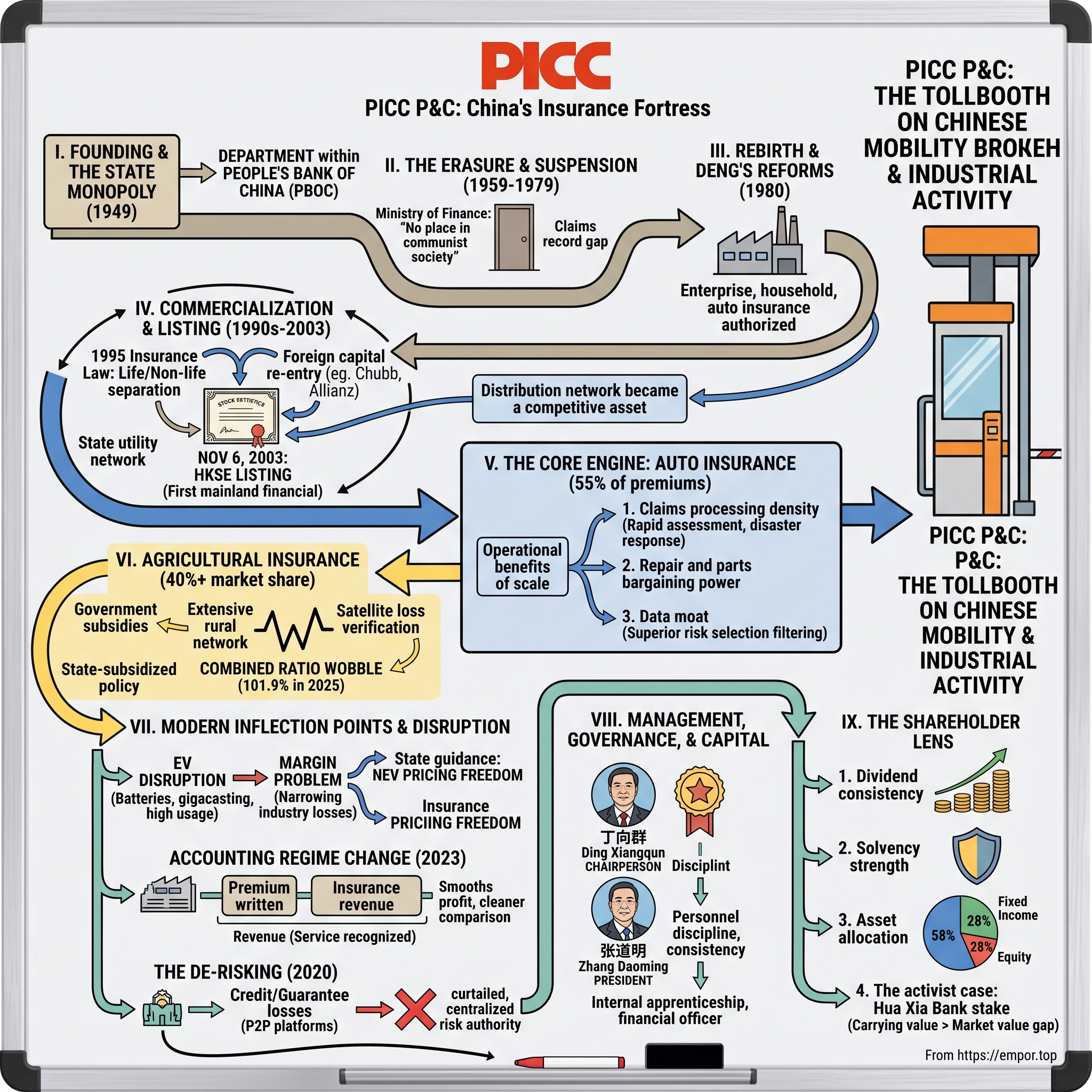
PICC Property and Casualty Company Limited: China's Insurance Fortress
I. Introduction & Executive Thesis
On a Friday in late November 2025, Yu Ze was at his desk on the executive floor of PICC P&C's Beijing headquarters, running China's largest property and casualty insurer. By Saturday, word had spread through the building that authorities had taken him away.1 On December 9, he resigned as president and vice chairman of the board.2 By June 2026, the Central Commission for Discipline Inspection confirmed what the market had already priced: Yu was expelled from both the Communist Party and public office — the disciplinary action Chinese officialdom calls 双开, or a "double expulsion."3
It is an unusual opening for a story about a company whose defining characteristic is stability. Yet it captures the central tension in owning 中国人民财产保险股份有限公司 PICC Property and Casualty Company Limited (2328.HK, listed on the 香港联合交易所 Hong Kong Stock Exchange). The company's underlying economics are among the most durable in Chinese financial services, but its control rests entirely outside the hands of the minority shareholders who own its H-shares.
The financial results illustrate that durability. In 2025, PICC P&C written original insurance premiums rose 3.3% to RMB555.8 billion, securing a 31.6% share of China's non-life insurance market — a market position it has maintained in various forms since operating as the country's sole insurer.45 Its combined ratio stood at 97.5%, meaning that claims and operating expenses consumed RMB97.50 of every RMB100 in earned revenue, leaving RMB2.50 as underwriting margin. That margin yielded RMB12,535 million in pure underwriting profit — a 119.4% surge year over year — prior to counting investment earnings.4 Including investment income, net profit grew 25.5% to RMB40,377 million, delivering a return on equity of 14.7%.5
The core question this analysis addresses: How did a state monopoly that was abolished for two decades — shuttered during the Great Leap Forward after the Ministry of Finance declared that insurance "had no place in a communist society"6 — rebuild itself into a franchise that out-earns technology-backed private competitors, and how much of that business represents a genuine competitive advantage rather than economic rent extracted through state support?
The roadmap outlines the analysis ahead.
The story begins with the company's origins: tracing its development from a department within the 中国人民银行 People's Bank of China established in October 1949, through the two-decade shutdown, to becoming the first mainland Chinese financial enterprise to list overseas when it debuted on the Hong Kong Main Board on November 6, 2003.7
Next is the core driver of the business. Auto insurance generates roughly 55% of total premiums and provides the baseline for scale economics. The analysis examines why the 2020 车险综合改革 Comprehensive Reform of Auto Insurance — initially viewed as a regulatory squeeze on underwriting margins — ultimately reinforced the market leader's competitive advantage.
The focus then turns to agricultural insurance (农险), where PICC P&C holds over 40% of a state-subsidized market. While often viewed as a reliable growth pillar, its combined ratio deteriorated to 101.9% in 2025, generating an underwriting loss and exposing a vulnerability in the optimistic investment narrative.5
Subsequent sections address emerging headwinds: the rapid adoption of electric vehicles, the entry of automakers like 比亚迪 BYD into insurance underwriting, and the yield drag of a low-interest-rate environment on an RMB760 billion investment portfolio.
The analysis concludes with capital allocation and corporate governance — specifically highlighting a legacy bank equity stake carried on the balance sheet at nearly three times its market valuation alongside the executive investigation, which together form the central governance critique of the company.
The core thesis is that PICC P&C functions as a tollbooth on Chinese mobility, agriculture, and industrial activity. Its cost advantage in motor insurance is substantial and measurable, but its non-motor portfolio is structurally less profitable than consensus assumes, and its corporate governance prioritizes state objectives over shareholder interests. The subsequent sections test this thesis against the company's operational and regulatory environment.
 Subscribe on LinkedIn
II. The 75-Year Origin Story: Monopoly, Suspension, & Rebirth
In October 1949, weeks after Mao Zedong declared the founding of the People's Republic from the Tiananmen rostrum, a new entity appeared inside the People's Bank of China: 中国人民保险公司 The People's Insurance Company of China.6 It was an administrative organ rather than a commercial enterprise in any modern sense. It priced nothing competitively because there was no competition. Within four years, deposit requirements and punitive taxation squeezed out the last foreign insurers, while remaining private Chinese underwriters were consolidated into a single entity operating as an arm of PICC.6
Then came the erasure.
During the Great Leap Forward, China's Ministry of Finance concluded that insurance as an independent industry had no place in a communist society — reasoning that a socialist state absorbs risk directly without needing financial intermediaries — and closed PICC.6 The only commercial insurance operations that survived on the mainland were the insurance departments of the Shanghai and Harbin branches of the central bank. The PICC name was briefly reinstated in 1964, but the Cultural Revolution halted the revival two years later. By 1969, commercial insurance had effectively ceased to exist in mainland China. Institutional knowledge survived only in Hong Kong and Macau subsidiaries, which continued trading in a British colony that had become a major fire and marine insurance hub.6
This history created a distinct data profile. While most global insurers compound underwriting data continuously for a century, PICC's claims record has a two-decade gap in the middle. Where marketing narrative claims "seventy-five years of proprietary claims data," the operational reality is closer to forty-five years of usable underwriting history built on top of an older state identity.
Yet that period of suspension created something more valuable than continuous data: a nationwide physical network that no purely commercial logic would ever have financed.
When Deng Xiaoping's economic reforms began in 1979, domestic insurance restarted in 1980 under the People's Bank of China. In 1982, the State Council formally approved the recovery of the industry, authorizing enterprise property, household property, and automobile insurance.6 PICC rebuilt not as a business optimizing for return on equity, but as a national utility required to maintain a presence wherever the state operated. That mandate established county-level branches in regions where addressable premium volume could not justify the fixed costs, along with township service stations across agricultural prefectures — laying the foundation for an organization that grew to employ 165,656 people.5
A private insurer would have shuttered most of those remote offices. PICC could not, and that structural obligation ultimately turned into a competitive asset — a key factor in its agricultural insurance franchise and catastrophe response operations.
Commercialization unfolded through the 1990s. In 1985, the State Council adopted interim regulations defining PICC's scope and establishing a multilevel insurance framework — marking the first time since 1949 that Chinese law contemplated multiple market participants.6 The 1995 Insurance Law subsequently mandated the separation of life and non-life underwriting, breaking the original PICC empire into distinct property-and-casualty, life, and reinsurance entities. Foreign capital re-entered in stages: AIG had already opened a Shanghai branch, and the first Sino-foreign joint venture life insurer was established in November 1996, followed by branch openings and joint ventures involving Chubb, Samsung Fire & Marine, Mitsui, Allianz, and Prudential.6
Within roughly fifteen years, an institution whose sole operating experience had been state administration transitioned into one competitor among dozens, divided into standalone business lines and tasked with earning a return on capital. That transition succeeded because the state managed the breakup gradually, allowing successor entities time to develop commercial underwriting capability while retaining legacy distribution infrastructure.
This restructuring culminated in July 2003 with the incorporation of PICC Property and Casualty Company Limited, with 中国人民保险集团股份有限公司 PICC Group (2338.HK) as its sole promoter.7
On November 6, 2003, PICC P&C listed on the Main Board of the Hong Kong Stock Exchange, becoming the first mainland Chinese financial enterprise to complete an overseas listing.7 American International Group took a 9.9% strategic stake through three US subsidiaries, maintaining that holding for years afterward.7 For Chinese regulators, anchoring the listing with a major Western insurer brought institutional credibility to an underwriter that had operated as a central bank unit within living memory.
The overseas listing also imposed structural disclosure discipline. Public reporting required PICC P&C to disclose combined ratios, reserve movements, and segment profitability under international accounting standards, creating an auditable underwriting record spanning more than two decades — disclosure that most of China's eighty-plus smaller non-life insurers do not provide.
The through-line to the present is straightforward. State patronage across monopoly, suspension, and reconstruction endowed PICC P&C with a distribution network reaching into counties and townships across China that competitors cannot economically duplicate. That footprint forms the operational foundation for its auto claims processing and agricultural insurance dominance, while representing a substantial fixed-cost base that requires massive national volume to sustain.
Which raises the central operational question: what does that scale actually buy in a market where products and pricing are strictly regulated?
III. The Core Engine: Decoding China's P&C Industry Structure & The "Big Three" Oligopoly
The Chinese non-life insurance market resembles a highway dominated by three heavy trucks and followed by eighty motorcycles. The trucks—PICC P&C, 中国平安财产保险股份有限公司 Ping An P&C, and 中国太平洋财产保险股份有限公司 CPIC P&C—control roughly 63% of total market volume between them.8 The dozens of smaller underwriters compete for the remaining tail, where underwriting profitability is rare.
This concentrated structure forms the centerpiece of the investment case for the market leaders, making its underlying mechanics essential to examine.
Why combined ratio is the only number that matters
Underwriting economics rest on a simple equation. An insurer collects premiums and covers two core categories of outflows: claims payouts (the 赔付率, or loss ratio) and operating costs such as commissions, salaries, marketing, and technology (the 费用率, or expense ratio). Combined, these two metrics yield the combined ratio (综合成本率). A combined ratio below 100% signifies an underwriting profit. Above 100%, the insurer operates its core business at a loss, relying on investment returns generated from policyholder funds to turn a net profit.
In property and casualty insurance, the expense ratio is largely a fixed-cost equation. While claims scale directly with insured volume, corporate overhead, technology platforms, actuarial teams, and branch networks do not. Consequently, the insurer with the largest premium base can spread fixed administrative expenses across the broadest volume. In a market where regulators standardize coverage terms and cap distributor commissions, the expense ratio becomes the primary competitive battlefield.
PICC P&C’s 2025 financial performance demonstrated this operational mechanism clearly. In its motor line, the comprehensive expense ratio fell 3.3 percentage points to 20.9%, even as its loss ratio rose 1.8 percentage points to 74.4%.5 Despite higher claims costs, the company improved its motor combined ratio by 1.5 percentage points to 95.3% and expanded motor underwriting profit by 53.6% to RMB14,258 million.5 The entire margin expansion stemmed from operational cost efficiency rather than superior risk selection.
This result provides clear evidence for the power of scale, while also defining its boundaries: cost leadership represents a durable, measurable advantage, but it is distinct from technical underwriting superiority.
What scale actually delivers
Scale generates operational benefits through three distinct mechanisms, each supported by varying degrees of empirical evidence.
Claims processing density. PICC P&C’s extensive county-level footprint allows company assessors to reach accident sites faster than competitors relying on third-party contractors. Rapid on-site loss assessment (快赔) reduces claims leakage—the cost inflation resulting from delayed inspections, disputed liabilities, or padded repair estimates. Disclosures from 2025 highlight the scale of this physical infrastructure: the company responded to 244 major disasters and accidents, launched 39 emergency responses, deployed over 110,000 claims personnel, and paid more than RMB13.1 billion in disaster claims.4 No competing Chinese insurer maintains comparable physical mobilization capacity.
Repair and parts bargaining power. High claim volumes grant leverage over authorized dealer networks and independent repair shops, as referral traffic from the market leader carries substantial commercial weight. While directionally significant, neither PICC P&C nor its peers disclose specific repair pricing discounts, leaving the precise financial benefit unquantified in public disclosures.
The data moat. PICC P&C possesses extensive claims history spanning vehicle models and geographic regions across China. However, regulatory restrictions moderate the direct pricing power derived from this repository. Regulators constrain the independent pricing coefficient within a strict band.9 Because underwriters cannot freely price risk, superior historical data functions primarily as a tool for risk selection—filtering which policies to write or renew—rather than as an unconstrained pricing mechanism.
The float, explained without jargon
A second engine reinforces underwriting operations: the investment float. Property and casualty insurers collect premiums upfront and settle claims later. In the interim, the insurer invests these reserves. When an underwriter achieves a combined ratio below 100%, the economics are particularly favorable: the business generates positive underwriting cash flow while simultaneously holding capital for investment.
PICC P&C commands a massive float. Total investment assets reached RMB760,366 million at the end of 2025, an increase of 12.4% over the year.4 The asset allocation remains conservative: 57.6% in fixed-income securities, 27.9% in equity investments, 9.6% in associates and joint ventures, 3.1% in cash, and 1.8% in investment properties and other holdings, including statutory deposits.4 In 2025, this portfolio generated RMB38,639 million in total investment income, achieving a 5.8% investment yield.4
Comparing the two profit sources highlights the business model's distribution: underwriting operations yielded RMB12,535 million in pre-tax profit in 2025, while the investment portfolio produced RMB38,639 million.4 The investment portfolio generated roughly three times the income of the underlying insurance operations.
This imbalance reframes PICC P&C’s financial profile. Rather than an underwriter that happens to invest, the firm operates effectively as a large investment portfolio anchored by an underwriting engine that runs at a modest profit. Underwriting performance remains critical, as a positive margin ensures the capital funding the portfolio carries a negative cost. A 2.5-percentage-point underwriting margin provides the foundation for returns above the cost of capital. Nevertheless, forecasting earnings without evaluating broader domestic bond and equity market dynamics addresses only the smaller portion of total profits.
The long tail's problem
China's smaller non-life underwriters face structural economic disadvantages. Operating below efficient scale, these firms carry higher fixed-cost ratios and lack bargaining leverage over repair networks. To maintain volume, sub-scale insurers often absorb higher cost structures or write higher-risk coverage declined by market leaders—conditions that frequently result in underwriting losses. In 2025, the overall non-life insurance industry recorded a combined ratio of 98.57%, approximately one percentage point higher than PICC P&C's 97.5%.10 Because industry average metrics reflect the heavy weighting of the dominant players, performance across the long tail of smaller competitors is substantially weaker.
Dynamics among the market leaders reveal a more nuanced competitive landscape than a simple dominant-tier model implies. Ping An P&C reported a combined ratio of 96.8% for 2025—its best operating result in five years and 0.7 percentage points stronger than PICC P&C’s company-level 97.5%.10 PICC P&C’s operational advantage lies specifically in motor volume and nationwide distribution, rather than uniform underwriting superiority across every product line.
The structural landscape leads to a clear conclusion: the market oligopoly and PICC P&C’s cost advantage in motor insurance are well supported by operational data, even if the company does not lead in every efficiency metric. PICC P&C maintains its clearest advantages in business lines where physical network density is essential, whereas peer competitors match or exceed its performance in pure underwriting efficiency.
This operational distinction becomes especially evident when examining specific business segments.
IV. Underwriting Breakdown: Segment Economics & Materiality
Evaluating PICC P&C requires moving beyond the consolidated combined ratio to inspect its six operating segments individually. The six lines perform markedly differently, with three generating underwriting losses in 2025.5 The consolidated combined ratio of 97.5% reflects an exceptionally profitable motor business offsetting underwriting losses across much of the non-motor portfolio.
In 2025, original written premiums totaled RMB305.75 billion for motor vehicle insurance (up 2.8%), RMB107.59 billion for accidental injury and health (up 6.4%), RMB55.95 billion for agricultural insurance (up 1.9%), RMB38.23 billion for liability insurance (up 1.7%), RMB17.66 billion for commercial property insurance (up 4.4%), and RMB30.61 billion for all remaining lines — including cargo, household property, and credit and guarantee insurance.5
Underwriting profitability diverged sharply across these lines. Motor vehicle insurance delivered a 95.3% combined ratio and RMB14.26 billion in underwriting profit. Accidental injury and health achieved a 99.0% combined ratio, yielding RMB621 million in underwriting profit on RMB61.79 billion of insurance revenue. Agricultural insurance recorded a 101.9% combined ratio, resulting in an underwriting loss of RMB1.06 billion. Liability insurance posted a 104.5% combined ratio, generating a loss of RMB1.74 billion. Commercial property insurance registered a 101.0% combined ratio, remaining unprofitable despite a 12.4-percentage-point margin improvement. The remaining business lines recorded a combined ratio of 98.0%.5
Motor insurance generated RMB14.26 billion in underwriting profit, exceeding the company’s total consolidated underwriting profit of RMB12.54 billion. In the aggregate, non-motor business lines operated at an underwriting loss in 2025, counterbalancing the bullish market narrative surrounding diversification.
Deep Dive 1: Auto Insurance & The 2020 Reform Shockwave
In September 2020, the regulator then known as the China Banking and Insurance Regulatory Commission introduced a comprehensive reform of auto insurance. Designed to enhance consumer protection, the regulatory overhaul expanded coverage terms while curbing distributor expense caps. The liability cap for compulsory traffic accident coverage rose significantly — increasing the death and injury limit from RMB110,000 to RMB180,000, medical expenses from RMB10,000 to RMB18,000, and total coverage where the insured is liable from RMB122,000 to RMB200,000.11 Concurrently, regulators capped the maximum allowable loading for advertising, broker commissions, and customer gifts at 25%, down from 35%, while expanding no-claims discounts for qualifying drivers from 30% to 50%.11
Rating agencies initially viewed the combination of broader coverage, reduced prices, and restricted commissions as a margin squeeze, with S&P Global Ratings warning that the reform would erode industry profitability.12 While accurate regarding immediate industry-wide pressure, this assessment overlooked how the reform shifted competitive dynamics among market participants.
Commission caps fundamentally altered distributor incentives. Prior to the reform, sub-scale insurers lacked operational cost advantages but could capture market share by offering agents 35% commissions. Restricting commissions to 25% removed this equalizer, favoring market leaders capable of absorbing fixed overhead across a massive premium base. The regulatory reform did not create PICC P&C’s scale advantage; rather, it eliminated the commercial mechanism that smaller competitors used to counter it.
Subsequent performance validated this structural shift. By 2025, PICC P&C’s motor expense ratio compressed to 20.9% — well below the regulatory cap, leaving the ceiling non-binding for the market leader while continuing to constrain smaller peers.5 Motor underwriting profit expanded by 53.6% in 2025 despite premium growth remaining below 3%, demonstrating that margin expansion rather than top-line expansion drove earnings growth.
Changes in distribution channels reinforced this cost efficiency. Premiums sourced through individual insurance agents fell 10.1% in 2025 to RMB149.37 billion, whereas direct sales grew 12.3% to RMB189.10 billion, representing 34.0% of motor premiums.5 Migrating policy acquisition from third-party agents to direct sales channels reduces commission leakage, providing a steady structural margin buffer.
However, top-line growth in motor insurance has reached a plateau. In the first quarter of 2026, motor premium income stood flat at RMB71.69 billion, reflecting 0.0% year-over-year growth.13 While motor insurance revenue grew 2.3% during the quarter due to the recognition lag from previously written policies, stagnating premium volume indicates that future earnings gains must rely on cost discipline or improvements in non-motor lines.
Deep Dive 2: Agricultural Insurance — The Powerhouse That Wobbled
Investment theses regarding agricultural insurance (农险) typically emphasize government premium subsidies, PICC P&C's market share above 40%, and high entry barriers created by extensive rural distribution networks, satellite loss verification, and local government relationships. While these operational factors exist, recent financial performance undermines the assumption that the segment functions as a consistently profitable, policy-protected annuity.
PICC P&C’s agricultural operations maintain significant national scale. In 2025, the insurer established a "four-in-one" grain production protection system providing approximately RMB2 trillion in risk coverage to rural households, earning selection for the fourth consecutive year among the Ministry of Agriculture and Rural Affairs’ top ten innovation models for agricultural financial support.4 To verify crop damage across remote terrain efficiently, the company deployed satellite remote sensing technology and unmanned aerial vehicles.5
Despite this technological and distribution network, the segment's financial results deteriorated in 2025. Agricultural insurance revenue declined 1.6% to RMB54.56 billion, while the combined ratio rose 2.2 percentage points to 101.9%, pushing the line into an underwriting loss of RMB1.06 billion.5 Both cost components weakened, with the loss ratio rising to 85.6% and the expense ratio increasing to 16.3%.5 Top-line contraction continued into early 2026, with first-quarter agricultural premium income falling 4.3% year over year.13
This downturn highlights a structural constraint in state-subsidized insurance lines. Unlike commercial P&C products where underwriters can freely adjust prices after elevated catastrophe losses, agricultural premium rates in subsidized programs are largely administered by government policy rather than negotiated commercially. When weather events or climate volatility elevate loss ratios, PICC P&C must absorb the claims burden without immediate repricing flexibility. Consequently, the contraction in premiums indicates a selective retreat from higher-risk, unprofitable coverage rather than rate increases.
These dynamics clarify the nature of PICC P&C's agricultural franchise. The business represents a distribution and policy-relationship moat that reinforces alignment with government agricultural priorities and secures rural market presence. However, it does not grant independent pricing power, leaving underwriting margins exposed to severe weather patterns and administered rate structures.
Deep Dive 3: The De-risking of Credit & Guarantee Insurance
Management's cautious approach toward rapid expansion into non-motor product lines stems directly from risk-management failures during the late 2010s expansion into credit and guarantee insurance.
During that period, PICC P&C underwrote substantial financial guarantees linked to China’s peer-to-peer lending platforms. As default rates surged across the sector, underwriting losses in credit and surety insurance escalated from RMB2.88 billion in 2019 to RMB5.10 billion in 2020.14
The operational risks were highlighted by the 武汉金凰珠宝 Kingold Jewelry scandal. In that case, the Wuhan-based jewelry manufacturer pledged approximately 83 tonnes of gilded copper bars as collateral for roughly RMB20 billion in loans from onshore financial institutions, in what Caixin reported as one of the largest gold-backed loan frauds in Chinese history.15 The underlying credit assets were backed by property insurance policies issued by PICC P&C, exposing internal control deficits in collateral verification.16
In response, management restructured the business by curtailing high-risk consumer credit guarantees and centralizing underwriting approval authority. Reflecting this retrenchment, credit and surety insurance was removed as an individually reported segment in the 2025 annual report and folded into "other insurance" alongside cargo and household property.5 Although the line remains within PICC P&C’s licensed business scope,5 its reduced volume no longer meets individual segment disclosure thresholds.
This reduced reporting granularity presents a notable disclosure trade-off for investors. While the retrenchment curtailed underwriting losses, merging the historically volatile credit guarantee business into a RMB30.61 billion catch-all segment reduces visibility, requiring market participants to rely on internal risk management rather than line-by-line financial data.
The geography underneath the numbers
The geographic distribution of PICC P&C's premium book illustrates a key operational dynamic. Premiums are heavily concentrated in China’s affluent coastal regions: Guangdong (RMB59.66 billion), Jiangsu (RMB57.17 billion), and Zhejiang (RMB47.67 billion) collectively generate approximately 30% of total national premiums, with Shandong, Hebei, Sichuan, Hubei, Anhui, Hunan, and Fujian rounding out the top ten regional markets.5
This regional concentration highlights a structural trade-off. While PICC P&C maintains a national branch presence, underwriting earnings are concentrated in economically developed, vehicle-dense coastal provinces, effectively cross-subsidizing fixed administrative overhead across less profitable inland branches.
This regional exposure creates two operational implications. First, motor premium expansion is closely tied to vehicle sales and replacement cycles in mature coastal markets, contributing to the flat motor premium growth recorded in the first quarter of 2026.13 Second, regional growth trends have diverged; written premiums contracted in two top-ten provinces in 2025, with Hunan declining 2.5% and Fujian falling 6.4%.5 While pruning unprofitable policy volumes reflects underwriting discipline, it underscores that top-line expansion across mature markets requires increased selectivity.
The operational analysis across these segments reveals a distinct financial structure: underwriting profits depend heavily on motor vehicle insurance, the agricultural segment faces underwriting margin headwinds, and expansion into credit guarantees previously produced substantial loss volatility. This structural reliance on motor underwriting profitability makes the industry-wide transition toward electric vehicles a pivotal factor for future performance.
V. The Great Inflection Points & Modern Disruption
Every large financial institution has a handful of moments where the trajectory bends. PICC P&C has had four in twenty years, and the most consequential one is still unresolved.
Inflection Point 1 (2015–2016): The AIG Exit and Full Domestic Autonomy
AIG's stake had been the foreign validation stamp on the 2003 listing, held through Chartis Property Casualty, Commerce and Industry Insurance and Lexington Insurance.7 After the 2008 financial crisis, AIG itself passed through United States Treasury control — for a period, the US Treasury was a deemed indirect holder of PICC P&C H-shares, a fact recorded in the company's own filings and one of the odder footnotes in Chinese financial history.7 AIG progressively exited its position in the following years.
The exit mattered less for the capital than for what it signified. The technical-assistance phase was over. PICC P&C would build its own actuarial and claims capability, and — critically — its own direct customer channels. The 人保App and WeChat mini-programme infrastructure that now underpins the direct-sales channel dates from this period. The 34.0% direct-sales share achieved in 2025 is the compounded result of a decade of that investment.5
The analytical read: the company converted a governance dependency into an operating capability. That is a genuine execution win, and it is the strongest evidence available that this management system can deliver a multi-year technology programme.
Inflection Point 2 (2018–2020): The Credit Crisis and the Centralisation of Risk Authority
We have covered the losses. What matters strategically is what changed afterward. Underwriting authority migrated from provincial branch general managers — who were compensated on growth and who had, in the P2P era, written business the centre did not fully see — toward head office risk functions.
There is a piece of quiet biographical evidence that this shift was institutionalised rather than announced. Zhang Daoming, the executive who now runs the company, spent part of his career as General Manager of the Compliance Department and then of the combined Compliance and Risk Management Department, before running the Jiangxi and Guangdong provincial branches.5 A compliance chief who becomes a branch head, and then president, is a signal about which competency the organisation decided to promote.
Inflection Point 3 (2021–Present): The New Energy Vehicle Disruption
Here is the problem in plain language. Insuring a 新能源汽车 NEV is harder than insuring a petrol car for three physical reasons that have nothing to do with the driver.
First, the battery. In a conventional car, a moderate impact damages replaceable panels and components. In an EV, the battery pack is a structural floor element running the length of the vehicle. Damage it — or even raise a credible suspicion of damage — and safety protocols often require replacing the entire pack, which can approach a large fraction of the vehicle's value. A fender-bender becomes a total loss.
Second, manufacturing method. Several EV makers use single-piece aluminium castings (gigacasting) for large body sections. This is brilliant for production cost and terrible for repair cost: you cannot cut out and weld in a damaged section of a monolithic casting the way you can with a stamped steel assembly. The repairable becomes the replaceable.
Third, usage. NEVs in China skew heavily toward ride-hailing and high-mileage urban use, which mechanically raises accident frequency independent of vehicle design.
The result was an industry-wide margin problem. NEV insurance premiums have been estimated to have reached roughly RMB200 billion in 2025 with growth above 30%, and the industry as a whole still recorded an NEV underwriting loss of RMB5.6 billion for the year — though that loss narrowed and the segment combined ratio fell 1.3 points.17 Chinese EV owners had been complaining loudly about premiums and about being refused coverage altogether, which is what made this a political problem rather than merely a commercial one.
In January 2025, the National Financial Regulatory Administration and three other ministries issued China's first dedicated guidelines on NEV insurance, and the independent pricing coefficient band was widened from [0.6, 1.4] to [0.55, 1.45].1817 Read that carefully: the state's answer to unprofitable NEV insurance was to give insurers more pricing freedom, not less. That is an unusually market-friendly regulatory response, and it is the strongest single argument that Beijing intends the Big Three to earn an underwriting return on this transition rather than subsidise it.
PICC P&C's position in the transition is now the largest in the market by a wide margin. The company insured 15.56 million new energy vehicles in 2025, up 34.3% year on year.5 NEV premium income reached RMB67.1 billion, up 31.9%, and NEV now contributes 22.1% of motor premiums, up 4.9 points in one year.4 The three largest property insurers, PICC P&C among them, have reportedly achieved underwriting profitability in NEV — a threshold most of the market has not cleared.17
The OEM threat. 比亚迪 BYD acquired the licensed insurer 易安财险 Yi'an P&C and received regulatory approval to sell auto coverage in 2024, positioning it to underwrite policies on the cars it builds.[^19] The logic is compelling on paper: BYD knows its own repair costs, controls its own parts supply, and owns the telematics data. Tesla and Nio have pursued variants of the same idea.
The early results are instructive but not yet decisive. BYD's insurance unit reportedly generated insurance business revenue of about RMB2.87 billion in 2025 — roughly double the prior year — and swung to a small net profit of about RMB93.6 million from a loss, with its combined ratio collapsing from an eye-watering 308.81% to 102.49%.19 Two readings are available. The bullish-for-BYD reading: enormous improvement, real momentum, a credible new competitor. The sober reading: after all that improvement, BYD is still writing at above 100% — losing money on underwriting — on a premium base under 1% the size of PICC's motor book, in the single vehicle category where it has the maximum possible information advantage.
Vertical integration solves the data problem. It does not solve the fixed-cost problem, and in insurance the fixed-cost problem is the one that kills you. An OEM insurer needs a national claims-handling network, a solvency capital base, and reserve adequacy across a full weather and litigation cycle. Those take a decade and a great deal of capital to build.
PICC P&C's defence is unglamorous and probably correct: partner with OEMs for telematics rather than fight them, build specialised NEV repair capability, and let scale grind the combined ratio down to a level no sub-scale competitor can match. Management's stated expectation, given at the results briefing in March 2026, is that NEV combined ratios will improve further and profitability will rise.20 That is a forecast, not a fact, and it should be tested against reported segment data rather than accepted.
Inflection Point 4 (2023–2024): The Accounting Regime Change
From January 1, 2023, the company adopted the new insurance contracts standard alongside the new financial instruments standards.13 The practical effect for an outside investor is significant and under-appreciated.
The old regime recognised premium largely as it was written. The new regime recognises "insurance revenue" as service is provided over the life of the contract, and pushes financial-market volatility through the income statement differently. This is why PICC P&C now reports two top-line numbers that do not match: original insurance premium income of RMB555,777 million and insurance revenue of RMB511,594 million for 2025.4 The first is the sales number; the second is the earned number.
The change smooths reported profit and — the genuine benefit — makes cross-period comparison of underwriting quality cleaner. It also makes the accounting judgement layer thicker. Combined ratio under the new definition includes finance expenses from insurance contracts issued and changes in premium reserves, items that involve discount-rate assumptions.13 Investors comparing PICC P&C's 97.5% against a historical figure computed under the old rules are not comparing like with like, and any analysis that splices the two series without adjustment is unreliable.
One disclosure deserves specific attention. Net loss and loss-adjustment-expense reserves rose 7.6% to RMB204,497 million during 2025, and the reserve ratio rose 1.6 percentage points.4 The company frames this as prudently strengthening its ability to withstand risk. That framing is plausible and, on balance, shareholder-friendly — building reserves faster than premiums depresses current profit and creates future flexibility. But the same mechanics run in reverse: a company that has built reserve cushion can release it later to smooth a bad year. This is not an accusation; it is a reason to watch reserve development disclosures rather than headline combined ratio alone.
There is a further wrinkle specific to this company's structure. PICC P&C maintains a dedicated catastrophic loss reserve, appropriated from profit when agriculture and nuclear insurance business meets defined conditions, and that reserve can only be used to settle catastrophic losses from the agricultural book.5 During 2025 the company both appropriated to and drew down from it.5 For a business whose agricultural line just turned loss-making in a heavy weather year, the movement in this specific reserve is a more informative signal about underlying agricultural economics than the headline segment combined ratio, and it is disclosed in the statement of changes in equity rather than in the segment tables where most readers look.
The broader point on accounting: nothing here suggests anything improper. What it suggests is that under the new standard, reported underwriting profit at a Chinese insurer is the output of several defensible but consequential judgements — discount rates, reserve adequacy, catastrophe appropriations, and the treatment of a large equity-method associate. An investor who reads only the results presentation is reading the conclusions without the assumptions.
Which brings us to the people making these judgements — and to the most serious unresolved question in the story.
VI. Management, Governance, and Capital Allocation
The governance section of most Chinese SOE write-ups is a formality. Here it is the main event.
The chairperson
丁向群 Ding Xiangqun, aged 60, became a non-executive director and Chairperson of the Board of PICC P&C in December 2024, having become chairperson of PICC Group the month before.5 Her curriculum vitae is not that of an insurance operator; it is that of a senior party-state cadre with financial-sector depth.
She served as deputy general manager of China Taiping Insurance Group, then vice president of China Development Bank — the policy bank that funds China's infrastructure and industrial strategy. Then she moved into government proper: member of the Party Group and vice chairperson of the People's Government of Guangxi Zhuang Autonomous Region, followed by member of the Standing Committee and head of the organisation department of the Anhui Provincial Party Committee.5 That last role is worth dwelling on. A provincial organisation department head controls personnel appointments across a province — it is one of the most powerful positions in the party apparatus and has essentially nothing to do with pricing motor risk. She is also a member of the 20th Central Committee and holds a master's degree in economics from Renmin University of China.5
What does this tell an investor? That the controlling shareholder selected, at a moment of heightened corruption enforcement across Chinese finance, a chairperson whose primary qualifications are political authority and personnel discipline rather than underwriting expertise. That is a rational appointment given the circumstances, and it also tells you exactly whose priorities sit at the top of this board.
The president, and the hole he filled
Yu Ze had been the operating face of the company — an insurance lifer who joined the PICC system in July 1994 after a Nankai University economics degree, and who rose to executive director, vice chairman and president.21 He resigned all positions on December 9, 2025, days after being taken away by authorities.21 Shares in PICC P&C fell close to 4% and PICC Group nearly 6% on the news.1 In June 2026, the disciplinary outcome was confirmed and made public.3 The company's own annual report records his resignation and his prior board and committee attendance without editorial comment.5
The board designated 张道明 Zhang Daoming as temporary responsible officer immediately, formally appointed him president in April 2026, and the National Financial Regulatory Administration approved his qualification effective June 2, 2026.223 Zhang, aged 50, holds an MBA and is a senior economist whose entire career has been inside the PICC system — deputy division chief roles in human resources and strategic development, the market research and channel management functions, deputy general manager of the Zhejiang branch, general manager of compliance and then of compliance and risk management, then general manager of the Jiangxi and subsequently Guangdong provincial branches, then assistant to the president, vice president and responsible financial officer.5
That is about as complete an internal apprenticeship as the organisation offers: front office, risk, finance, and two of the largest provincial P&L units. He is also, notably, the company's responsible financial officer — meaning the person who now sets guidance is the same person who signs off on the reserving judgements underneath it.
The activist's case
A sceptical investor looking at this company would build a case around four points, and all four are supported by disclosed facts rather than speculation.
First, executive accountability. A sitting president was removed for alleged serious disciplinary and legal violations, and this was not an isolated event within the group — a former PICC Group vice president was separately reported under investigation in 2026.23 Chinese financial-sector anti-corruption enforcement has been broad, and the company is one node in it rather than an outlier. But an outside shareholder has no visibility into what was found, whether it touched underwriting or procurement decisions, or whether any restatement risk exists. The company has made no disclosure connecting the investigation to its financial statements. That silence is itself a fact investors must price.
Second, the Hua Xia Bank stake. This is the sharpest and most quantifiable governance point available, and it deserves careful reading. PICC P&C and its subsidiaries hold a 16.11% equity interest in 华夏银行 Hua Xia Bank, with board representation, accounted for as an associate under the equity method. As at December 31, 2025, the carrying amount of that stake was RMB51,113 million — approximately 5.9% of total assets. The fair value was RMB17,610 million, approximately 2.0% of total assets.5
The stake is carried on the balance sheet at nearly three times what the market says it is worth. The company performed an impairment test and concluded there was no impairment, because the recoverable amount determined by a value-in-use approach exceeded the carrying amount.5 That is a legitimate accounting position — value-in-use models discount expected future cash flows rather than marking to a stock price, and the standard permits it. It is also a significant accounting judgement, and it is precisely the kind of judgement an activist would attack.
In fairness, the stake earns its keep in cash terms: the company recognised RMB4,151 million as its share of Hua Xia Bank's profit in 2025 and received RMB1,038 million in cash dividends.5 The dividend alone is a real, recurring contribution. But the equity-method profit share flows through reported earnings at a rate the market plainly does not believe, and the RMB33.5 billion gap between book and market is a live question about capital efficiency: that capital, if redeployed at insurance-underwriting returns or returned to shareholders, would look very different. Investors should not treat this as a scandal — it is disclosed clearly and audited — but they should treat headline book value and headline ROE as flattered by it.
Third, disclosure granularity. As noted, credit and surety insurance has disappeared from segment reporting. So has any standalone NEV combined ratio disclosure — investors get premium growth and policy counts for NEV,45 and management commentary about profitability,20 but not a reported NEV combined ratio they can independently track. For the single most important disruption facing the largest segment, that is a real gap.
Fourth, the alignment question. PICC Group holds 15,343,471,470 shares, or 68.98% of the company's 22,242,765,303 total shares, with the H-share float at 31.02%.5 With state control that concentrated, minority shareholders have no realistic path to influence strategy, board composition or capital allocation. Their protection is not governance; it is the alignment of interests that exists when the state also wants dividends. Under the 一利五率 "one return and five ratios" performance framework applied to central SOEs, and in the context of the 中国特色估值体系 Chinese Characteristics Valuation System re-rating push, that alignment has genuinely favoured minorities in recent years. It is not contractual, and it can change.
Capital allocation and the dividend
On the record of returning cash, the behaviour has been consistent and improving. For 2025 the board proposed a final dividend of RMB0.44 per share, taking the full-year distribution to RMB0.68 per share including the RMB0.24 interim.5 The interim dividend alone amounted to RMB5,338 million.5 Comprehensive solvency stood at 232.4% and core solvency at 213.4% at year-end — the latter improving 2.4 points during the year, comfortably above regulatory minimums under C-ROSS Phase II (偿二代二期).5
Capital deployment elsewhere has been conservative rather than acquisitive. Total investment assets grew 12.4% to RMB760,366 million, with the portfolio at 57.6% fixed income, 27.9% equity investments, 9.6% investments in associates and joint ventures, 3.1% cash and 1.8% investment properties and other.4 Total investment income rose 12.8% to RMB38,639 million at a 5.8% total investment yield, up from 5.7%.4
Testing the narrative for consistency
The most reliable way to assess a management team is not to evaluate its current story but to check whether the story has stayed the same. On that test, PICC P&C scores reasonably well and unusually.
The strategic language across the 2024 and 2025 annual reports and the results briefings is repetitive to the point of tedium — the "Five Priorities" of financial work, the role of "economic shock absorber and social stabiliser," the pursuit of "high-quality development" rather than volume.4524 Western investors often read this as content-free political boilerplate. That reading misses something. In an environment where the controlling shareholder is the state, consistent political framing is how a management team signals that it is not about to change direction. The absence of a bold new strategic pivot in any of the past three years' materials is itself information: nobody is being asked to justify a transformation.
What has changed, and changed specifically, is the numerical guidance. At the March 2026 briefing, management committed to two concrete things: that the 2026 motor combined ratio would remain broadly stable versus 2025, and that non-motor insurance would reach underwriting profitability during 2026.20 Those are falsifiable statements with a deadline. The second one is genuinely ambitious given that three non-motor lines were loss-making in 2025.5 Management did not hedge it, did not blame weather in advance, and did not offer a range.
An investor should hold them to it — and should note, fairly, that the March 2026 guidance was given by a president who had been in the role in an acting capacity for three months and had not yet received formal regulatory approval.22 Guidance issued under those conditions is either a sign of confidence in the operating plan or a sign of someone establishing credibility quickly. The 2026 results will distinguish between the two.
A second-layer look
Three items sit slightly outside the main narrative but are worth a sentence each. First, external credit assessment: Fitch Ratings affirmed PICC P&C's Insurer Financial Strength rating at 'A' with a Stable Outlook in November 2023, reflecting the company's leading market position and capital strength.25 Second, environmental and social ratings: the company's MSCI rating was upgraded to AAA during 2025, a level few Chinese financials hold, driven by the green finance and ESG work system and disclosure improvements.4 Third, the human capital point that rarely gets attention: a workforce of 165,656 people5 is not just a cost line, it is the physical mechanism of the moat — and it is also the largest single source of operational and conduct risk in a company where a president was just removed for disciplinary violations.
The read on management credibility from behaviour rather than rhetoric: the company has not made a large speculative acquisition, has raised dividends, has strengthened reserves, has shrunk the line that once blew up, and has grown solvency while doing all of it. Set against that, it lost a president to a corruption investigation, carries a legacy bank stake at a large premium to market, and has reduced disclosure in areas investors most want to see. Both sets of facts are true simultaneously.
The frameworks now let us test which set dominates.
VII. Strategic Frameworks: Helmer's 7 Powers & Porter's 5 Forces
Strategic frameworks are useful only if they are tested rigorously. Applied honestly, Hamilton Helmer's 7 Powers reveals two genuine sources of power for PICC P&C, one contested advantage, and several commonly cited claims that fail to survive scrutiny.
What holds
Scale economies — the primary power, and the real one. The test for scale economies is whether unit costs decline with volume in a manner rivals cannot duplicate. PICC P&C passes this test with clear empirical evidence: its motor expense ratio stood at 20.9% against a regulatory ceiling of 25% that continues to bind smaller competitors, even as loss ratios worsened.511 Spreading fixed information technology infrastructure, a national service footprint, and standardized claims assessments across a premium base exceeding RMB500 billion yields a cost advantage that no competitor of similar structure can match. This scale advantage is not diminishing; performance over recent years demonstrates a widening operational gap.
Cornered resource — the rural network, with an asterisk. The company's county- and township-level service footprint cannot be purchased at a reasonable price because it was built under a government service mandate rather than a purely commercial business case. Regional catastrophe coverage across 157 cities in 23 provinces protecting 480 million people flows directly from this physical network rather than innovative product design.4 However, a critical caveat remains: a cornered resource constitutes true strategic power only if it generates excess returns. Its primary commercial output, the agricultural line, recorded a 101.9% combined ratio in 2025.5 The resource is cornered, but its monetization remains weak.
What is contested
Process power. Proponents argue that seven decades of actuarial refinement yield superior risk selection. The financial evidence indicates otherwise: Ping An P&C, a younger and smaller competitor, achieved a stronger consolidated combined ratio in 2025.10 PICC P&C's margin improvement in 2025 was driven by expense compression while its loss ratio deteriorated.5 Process power in claims handling—including response speed, leakage control, and emergency deployment—is well supported by evidence. Process power in risk selection is not demonstrated by the reported figures.
Counter-positioning. This concept is often misapplied. Counter-positioning occurs when a challenger adopts a business model an incumbent cannot replicate without damaging its core business. Here, the incumbent possesses a physical presence that digital challengers cannot replicate—specifically, claims adjusters stationed across lower-tier cities that online underwriters cannot economically fund. This advantage represents scale combined with a cornered resource rather than counter-positioning.
What is not a Helmer power at all
Regulation. Solvency rules under C-ROSS Phase II, strict licensing requirements, and oversight by the National Financial Regulatory Administration create significant barriers to entry. However, regulatory protection does not represent a proprietary competitive power; it is an administrative policy setting that can be altered by authorities and applies equally to major peers like Ping An and CPIC. It serves as a favorable industry condition rather than a company-specific moat. The same regulatory framework that capped commissions in 2020 and expanded electric vehicle pricing flexibility in 2025 can compress margins whenever state policy priorities shift.
Porter's Five Forces
Bargaining power of buyers — moderate, and rising in NEV. Retail policyholders face standardized coverage terms and pricing under the regulatory framework, while brand recognition and prompt claims settlement reduce price sensitivity. However, electric vehicle owners have demonstrated sufficient leverage to trigger national policy adjustments,18 while automaker-affiliated insurers offer bundled coverage at the point of sale that traditional agency channels cannot match.
Bargaining power of suppliers — low. Auto repair facilities and dealership networks depend heavily on claim referral volume from market leaders, inverting traditional supplier leverage. The notable exception occurs in electric vehicles: battery manufacturers effectively function as single-source original equipment suppliers, with virtually no independent aftermarket for structural battery pack repairs. In the electric vehicle segment, supplier power is substantially higher than in conventional internal combustion engine lines.
Threat of new entrants — very low for general P&C, moderate for market niches. Capital requirements, regulatory licensing, and the scale necessary to achieve underwriting profitability render broad entry impractical. BYD's entry into the sector by acquiring an existing corporate license rather than applying for a new authorization illustrates this dynamic.[^19] Entry occurs primarily through license acquisition, and operational licenses remain scarce.
Threat of substitutes — low. Motor third-party liability insurance is legally compulsory in China, while commercial property and cargo insurance are required by institutional lenders and trade counterparties. Self-insurance remains an option only for large corporate enterprises.
Competitive rivalry — high among the Big Three, brutal below. Consolidated combined ratios among the top three underwriters improved in 2025, with Ping An and CPIC each narrowing their figures by approximately 1.5 percentage points.10 Competition currently manifests through operational cost discipline rather than destructive price discounting. While this dynamic maintains market stability, the equilibrium is sustained by regulatory oversight rather than voluntary corporate restraint.
In summary, PICC P&C commands a durable, defensible franchise anchored by a dominant scale power in its primary motor line, operating within an industry structure maintained by state regulatory policy. Without this supportive regulatory framework, the strategic position would be markedly weaker. That regulatory dependency remains the central premise of the bear case.
VIII. The Investor Stress Test: Bull vs. Bear Case & Key KPIs
Myth versus reality: four consensus claims, checked
Evaluating PICC P&C requires testing four widespread market assumptions against disclosed financial results.
Myth: "PICC P&C is China's best P&C underwriter." Reality: It is China's largest property and casualty insurer and the leader in motor insurance, but scale does not guarantee superior underwriting performance across every line. At the group level, Ping An P&C reported a 2025 combined ratio of 96.8%, compared with PICC P&C's 97.5%.10 Conflating premium volume with uniform underwriting quality creates a false impression of operational perfection.
Myth: "Agricultural insurance is the hidden high-margin growth engine." Reality: Agricultural insurance revenue fell 1.6% in 2025, generating an underwriting loss of RMB1.06 billion (RMB1,056 million) at a 101.9% combined ratio, while premium volume contracted a further 4.3% in the first quarter of 2026.513 The segment represents a policy-critical national franchise, rather than an insulated, high-margin growth engine.
Myth: "The 2020 auto reform hurt the incumbents." Reality: The reform squeezed industry margins initially, but ultimately strengthened the market leader's cost advantage. PICC P&C's motor expense ratio of 20.9% sits four percentage points below the 25% acquisition-cost ceiling imposed by regulators.511 The commission cap constrains smaller competitors with higher fixed overhead while no longer binding the low-cost producer.
Myth: "The dividend yield is backed by underwriting cash flow." Reality: Capital returns depend heavily on investment earnings rather than pure underwriting margins. In 2025, underwriting operations generated RMB12.54 billion (RMB12,535 million) in profit, compared with RMB38.64 billion (RMB38,639 million) in total investment income.4 Dividend durability relies as much on domestic capital market conditions as on claims experience—a dependency highlighted by volatile first-quarter 2026 investment results.13
Correcting these consensus assumptions does not invalidate the investment thesis, but it reframes the fundamental operational metrics investors must monitor.
Why this wins from here
The cost gap in motor is widening. Between 2024 and 2025, PICC P&C's motor expense ratio fell 3.3 percentage points to 20.9%, offsetting a 1.8-percentage-point increase in the loss ratio to expand overall underwriting margins.5 Sub-scale competitors lacking equivalent volume could not absorb higher claims costs through administrative cost cuts. Cost leadership that expands during periods of rising loss severity provides a structural operational buffer.
Direct distribution channels continue to expand. Direct sales reached 34.0% of motor premiums in 2025, while premiums sourced from individual agents fell more than 10%.5 Migrating policy acquisition toward direct digital channels permanently reduces commission expense, creating an internal operational efficiency lever independent of broader pricing cycles or weather events.
Scale leadership in electric vehicles is established. With 15.56 million electric vehicles insured generating RMB67.1 billion in premiums—representing 22.1% of the motor portfolio—and reported underwriting profitability in the segment, PICC P&C leads the industry along the primary technology transition curve.5417
Investment asset yields remain resilient. Achieving a 5.8% total investment yield on RMB760 billion in assets during a declining interest rate environment reflects active asset allocation, supported by a 27.9% allocation to equity holdings.4 While this positioning supports portfolio returns, it also introduces earnings volatility.
Capital returns are supported by solvency strength. A full-year dividend of RMB0.68 per share for 2025 is backed by comprehensive solvency of 232.4% and core solvency of 213.4%, leaving substantial headroom above regulatory minimums.5
What could break it
Non-motor lines operate at an aggregate underwriting loss. Underwriting losses across three segments—agricultural insurance at a 101.9% combined ratio, liability at 104.5%, and commercial property at 101.0%—created roughly RMB4 billion in combined underwriting drag in 2025.5 At the March 2026 results briefing, management stated that non-motor lines would achieve overall underwriting profitability during 2026.20 Delivering on this specific operational commitment represents a critical test of management's execution ability.
Climate volatility impacts administered-price segments. Natural disasters in 2025—including earthquakes, landslides, severe flooding, and harvest-season rainfall—generated over RMB13.1 billion in claims.4 Agricultural and commercial property books absorb these weather shocks directly. In policy-subsidized lines where premium rates are administered rather than negotiated freely, rising catastrophe frequency compresses underwriting margins, as reflected in the 2.2-percentage-point deterioration in the agricultural combined ratio.5
Investment returns introduce quarterly profit volatility. Market movements during the first quarter of 2026 demonstrated this vulnerability. Equity market declines in March reduced total investment income for the quarter to RMB4.6 billion (RMB4,600 million), representing an unannualized yield of 0.7%.13 Consequently, net profit fell to RMB8.63 billion (RMB8,631 million), even as underwriting profit rose 7.5% and the group combined ratio improved to 94.2%.13 With more than a quarter of investment assets allocated to equities, quarterly net earnings fluctuate with broader market performance rather than core underwriting results.
Premium growth has slowed to near-stagnation. In the first quarter of 2026, original premium income grew 1.4% year over year, with motor premiums flat, agricultural premiums down 4.3%, and other lines contracting 9.5%.13 Earned insurance revenue rose 1.9%.13 Top-line expansion matching general inflation indicates that total returns depend on cost discipline and capital distribution rather than rapid volume growth.
Automaker insurance initiatives pose long-term distribution risks. Although BYD's insurance subsidiary operated at an underwriting loss in 2025 with a combined ratio above 100%, OEM entry threatens traditional distribution by capturing policy sales at the vehicle point of purchase.19 This disintermediation risks leaving established underwriters with an older, higher-claim-frequency renewal pool over time.
Corporate governance and asset valuation risks persist. The president was removed from office and expelled from the Communist Party following official investigations.3 State entities retain roughly 69% control,5 while a 16.11% equity stake in Hua Xia Bank is carried on the balance sheet at a RMB33.5 billion premium over its market valuation based on internal value-in-use accounting models.5 These structural factors represent ongoing governance conditions that minority shareholders must factor into valuations.
State policy obligations constrain commercial margins. Describing its role as an "economic shock absorber and social stabilizer," the company served policyholders 863 million times through social medical insurance and covered over 17 million new urban residents with specialized products in 2025.4 Fulfilling state policy mandates requires underwriting broad social coverage at constrained margins, as demonstrated by the accident and health segment's 99.0% combined ratio, which generated RMB621 million in underwriting profit on RMB61.79 billion (RMB61,788 million) in revenue.5
The three KPIs that matter
Evaluating operational performance requires tracking three core metrics each reporting period.
1. Motor combined ratio. As the primary profit driver, this metric indicates whether cost advantages remain intact. Management guided that the 2026 motor combined ratio will remain broadly stable compared with 2025,20 a target supported by the first-quarter 2026 group combined ratio of 94.2%.13 Any margin erosion driven by rising expense ratios would signal diminishing scale returns.
2. Aggregate non-motor underwriting result. Tracking consolidated non-motor profitability tests management's commitment to achieve positive non-motor underwriting margins in 2026 across its previously loss-making lines.205 This aggregate result demonstrates whether non-motor business lines can self-sustain or remain permanently subsidized by motor earnings.
3. Core solvency margin ratio. Standing at 213.4% at year-end 2025, core solvency determines capital flexibility, dividend capacity, and catastrophe absorption without equity dilution.5 It serves as the fundamental constraint on shareholder payouts and balance sheet resilience.
IX. Essential Playbook & Investment Lessons
Lesson 1: In regulated financial commodities, cost position is the entire strategy. When a regulator standardizes the product, sets coverage limits, bands pricing coefficients, and caps acquisition spending, there is nothing left to differentiate on except the cost of delivery. PICC P&C's 2025 motor result — where margin expansion was achieved entirely through a 3.3-percentage-point expense reduction against a worsening loss ratio5 — provides a clear demonstration. Investors evaluating any regulated financial business should ask one primary question: who is the low-cost producer, and is the efficiency gap widening?
Lesson 2: Deregulation prunes the weak, and the results take years to emerge. The 2020 auto reform initially appeared to threaten insurer profitability, an outcome highlighted by rating agencies at the time.12 Years later, the market leader's expense ratio sits four percentage points below the regulatory cap that continues to constrain smaller competitors.511 Reforms that lower prices and cap variable costs simultaneously do not distribute pressure evenly; they transfer market share to the operator with the lowest fixed cost per unit. The lag between regulatory policy shifts and visible financial impacts often leads investors to misjudge market direction.
Lesson 3: Physical presence is a genuine asset in a digital age — but only when it is the binding constraint. A claims adjuster capable of reaching a flooded county in Guizhou within hours cannot be replaced by a mobile application, and the 110,000 claims personnel PICC deployed during the 2025 disaster season are difficult for competitors to duplicate.4 Yet that same physical network generated an underwriting loss in agricultural insurance during the same year.5 An extensive physical footprint creates a competitive moat only where customers cannot be served remotely and the business is permitted to price coverage to reflect serving costs. If either condition fails, the physical network becomes overhead.
Lesson 4: In state-controlled enterprises, judge capital allocation by what management refuses to do. The most impactful capital allocation decisions at PICC P&C over the past six years were negative choices: shrinking credit and surety insurance following P2P and Kingold lending losses,1416 centralizing underwriting authority away from volume-incentivized branches, and avoiding large acquisitions while raising dividends and building solvency reserves.5 Conversely, the primary legacy diversification retained on the balance sheet — a bank stake carried at nearly three times its prevailing market valuation5 — represents the type of allocation a disciplined standalone underwriter would avoid. Capital discipline is measured by restraint, which proves far more meaningful than strategic positioning narratives.
Lesson 5: Separate the institutional machine from individual executive stewards. PICC P&C's underwriting performance improved through 2025 and into 2026 even as the company's president was investigated, removed, and expelled from office.313 This divergence provides two distinct insights: it indicates that the core operating franchise is institutional rather than dependent on single executives, while also reminding shareholders that corporate governance risks in state-linked entities often surface through official disciplinary actions rather than board disclosures.
X. Epilogue & Outro
The most useful way to conceptualize PICC P&C is not as a conventional insurer, but as a financial tollbooth. Every registered vehicle in China requires compulsory liability coverage. Every state-supported grain harvest relies on subsidized policy protection. Every cargo vessel, industrial facility, and major construction project requires an insurance certificate before financing or commercial contracts can proceed. PICC P&C collects a small toll across a 31.6% share of that market volume—a position that has remained remarkably durable across seventy-five years, two distinct economic models, and a two-decade period during which the enterprise did not formally operate.
The 2025 financial results reflected core operational strength: underwriting profit more than doubled, the combined ratio improved by over a percentage point, solvency margins expanded, and shareholder distributions increased.45 Performance in the first quarter of 2026 indicated continued underwriting efficiency—highlighted by a 94.2% combined ratio and 7.5% growth in underwriting profit—even as volatile equity markets illustrated the earnings sensitivity of holding a quarter of total investment assets in equities.13
The long-term outlook hinges on two distinct structural dynamics. The first is whether the dominant oligopoly can endure the transition to electric vehicles. The evidence suggests that it will: automaker-affiliated insurers possess proprietary telematics data but lack efficient cost structures, regulators have chosen to expand pricing flexibility rather than mandate artificially low premiums,18 and the market leader has already achieved underwriting profitability in new energy vehicles while most peers remain loss-making.17 The second dynamic is whether prolonged low interest rates will force the firm to increase equity risk to maintain asset yields, introducing market volatility into an otherwise stable underwriting cash flow. First-quarter 2026 performance offered an early illustration of this sensitivity.
Several clear operational metrics would challenge this thesis: a motor combined ratio drifting back above 97% due to rising expense ratios, non-motor business lines remaining unprofitable past year-end 2026 despite management commitments, or a contraction in core solvency that forces a trade-off between capital distributions and balance sheet strength. Evaluating these key indicators requires no broad assumptions about Chinese macroeconomic growth.
For investors conducting further analysis, regulatory filings and company disclosures provide the necessary foundation: segment tables in the annual report reveal line-by-line performance concealed by consolidated figures; quarterly unaudited results isolate core underwriting trends from investment yield fluctuations; solvency disclosures filed with the National Financial Regulatory Administration detail capital adequacy; and management briefing transcripts establish explicit operational guidance against which future reported results can be evaluated.
References
-
President of China's Biggest Property Insurer Under Investigation — Caixin Global, 2025-12-01 ↩↩↩
-
Former president of PICC P&C under investigation — Insurance Asia News ↩↩
-
人保财险原总裁于泽被"双开",张道明已正式补位 — 新浪财经 Sina Finance, 2026-06-05 ↩↩↩↩↩
-
2025 Annual Results Presentation, PICC P&C (2328.HK) — PICC Property and Casualty, 2026-03-26 ↩↩↩↩↩↩↩↩↩↩↩↩↩↩↩↩↩↩↩↩↩↩↩↩
-
2025 Annual Report, Stock Code: 2328 — PICC Property and Casualty Company Limited, 2026-04 ↩↩↩↩↩↩↩↩↩↩↩↩↩↩↩↩↩↩↩↩↩↩↩↩↩↩↩↩↩↩↩↩↩↩↩↩↩↩↩↩↩↩↩↩↩↩↩↩↩↩↩↩↩↩↩↩↩↩↩↩↩
-
Chinese Insurance Markets: Developments and Prospects (NBER Working Paper 31292) — National Bureau of Economic Research ↩↩↩↩↩↩↩↩
-
2012 Annual Report, Stock Code: 2328 — PICC Property and Casualty Company Limited, 2013-04 ↩↩↩↩↩↩
-
China unveils first guidelines on NEV insurance — China Daily, 2025-01-26 ↩
-
财险公司2025业绩出炉:保费增速趋缓 净利润同比增长近四成 — 新浪财经 Sina Finance, 2026-05-02 ↩↩↩↩↩
-
Brief Introduction of New Chinese Auto Insurance Rules — The National Law Review ↩↩↩↩↩
-
Auto Insurance Reform Squeezes China P/C Sector's Profitability — S&P Global Ratings, 2020-07-14 ↩↩
-
Unaudited Results Announcement for the Three Months Ended 31 March 2026 (Stock Code: 2328) — PICC Property and Casualty Company Limited, 2026-04 ↩↩↩↩↩↩↩↩↩↩↩↩↩↩
-
PICC widens credit and surety insurance underwriting losses in 2020 — Asia Insurance Review ↩↩
-
Cover Story: The Mystery of $2 Billion of Loans Backed by Fake Gold — Caixin Global, 2020-06-29 ↩
-
Explainer: How Kingold Jewelry's fake gold bars slipped through scrutiny in one of China's biggest loan scams — South China Morning Post, 2020-06-30 ↩↩
-
China's New Energy Vehicle Insurance Industry Narrows Losses; Top Insurers First to Achieve Underwriting Profit — BigGo Finance ↩↩↩↩↩
-
China unveils first guidelines on NEV insurance — govt.chinadaily.com.cn, 2025-01-26 ↩↩↩
-
BYD's Insurance Unit Turns Profit, Nearing 100 Million Yuan Annually — Tiger Brokers ↩↩
-
中国人保张道明:预计2026年车险综合成本率将保持稳定 — 新浪财经 Sina Finance, 2026-03-27 ↩↩↩↩↩↩
-
Former vice-president of PICC Yu Xiaoping under investigation — China Daily, 2026-06-13 ↩
-
2024 Annual Report, Stock Code: 2328 — PICC Property and Casualty Company Limited, 2025-04 ↩
-
Fitch Affirms PICC Property and Casualty at 'A'; Outlook Stable — Fitch Ratings, 2023-11-15 ↩
 LinkedIn
 WhatsApp
 Reddit
 Hacker News
 Email
Email Kindle
 RSS Feed
 Spotify
 Apple Podcasts
 Amazon Music
 Audible
 YouTube