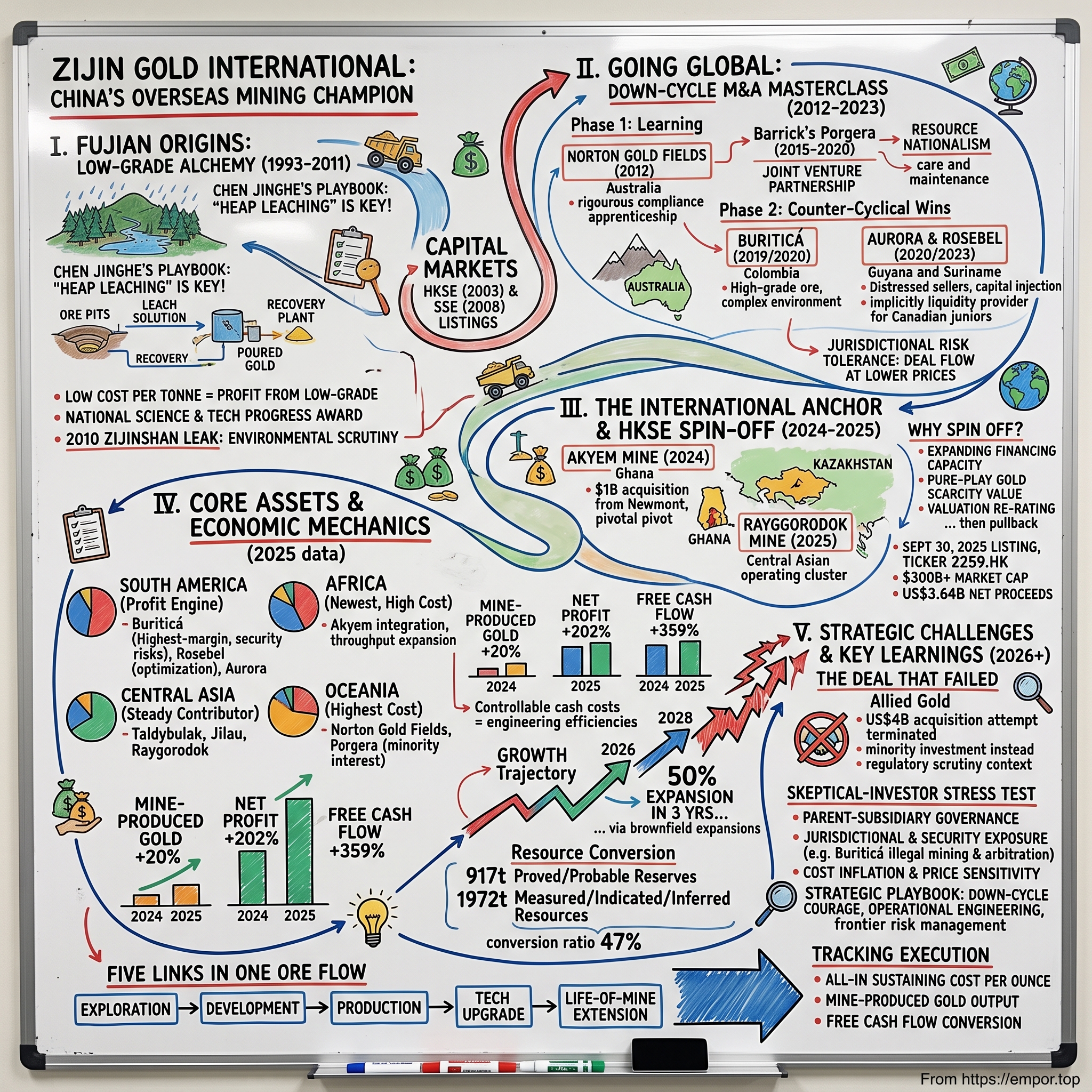
Zijin Gold International: China's $25B Overseas Mining Champion
I. Introduction & Episode Roadmap [00:00:00 - 00:10:00]
On the morning of September 30, 2025, the Hong Kong Stock Exchange hosted a listing ceremony for a Chinese gold company whose operations spanned Colombia, Suriname, Guyana, Ghana, Kazakhstan, Kyrgyzstan, Tajikistan, Australia, and Papua New Guinea — but not a single site within China.
Trading under stock code 2259, shares of 紫金黃金國際有限公司 Zijin Gold International Company Limited opened following an initial public offering priced at HK$71.59. By the closing bell, the stock had settled at HK$120.6 — a day-one gain of roughly 68% that lifted the company's market capitalisation from HK$187.9 billion at listing to well above HK$300 billion.12 The company issued 348,990,700 shares in its base offering. Following the full exercise of the over-allotment option on October 8, total shares sold reached 401,339,300, generating net proceeds of approximately HK$28.3 billion, or roughly US$3.64 billion.2 Twenty-six cornerstone investors — including GIC, BlackRock, Schroders, and Fidelity International — committed approximately US$1.6 billion before book-building opened, and Hong Kong retail demand reached 240.7 times the allotted tranche.1
By gross proceeds, the transaction marked the largest gold mining IPO globally on record and the second-largest Hong Kong listing of 2025, trailing only 宁德时代 CATL.3
From a Fujian county bureau to four continents
Understanding the company's positioning requires examining a trajectory longer than a single trading session. Its parent, 紫金矿业 Zijin Mining Group Co., Ltd. (2899.HK / 601899.SH), originated as a county-level mining bureau in 上杭县 Shanghang County, a mountainous district in Fujian province. Its foundational asset was a gold deposit so low in grade that visiting geologists had previously dismissed it as commercially unviable.
Zijin turned the low-grade deposit into one of China's most profitable gold operations, developing technical processing capabilities that established the foundation for its subsequent expansion. Over the following three decades, the group applied that engineering model to assets acquired from major international producers — including Newmont Corporation, IAMGOLD Corporation, and Barrick Gold Corporation — often purchasing mines during industry downturns.
The five questions this article tests
First, what defines the "Zijin playbook," and does it reflect a sustainable engineering advantage or a strategy centered on acquiring distressed assets in complex operating environments?
Second, how disciplined was the group's down-cycle acquisition strategy when evaluated against current mine-level production?
Third, where do operating economics sit across individual assets, given that the group's headline all-in sustaining cost of US$1,501 per ounce in 2025 masks a wide range from roughly US$1,000 to over US$2,000 per ounce depending on the mine?2
Fourth, what are the governance and valuation implications of holding a 15% public float in an entity where the parent retains 85% ownership alongside control over technology, management, and capital supply?
Fifth, what does the recent collapse of the company's first major transaction as a standalone listed entity signal for its independent growth strategy?
That transaction, a proposed US$4 billion acquisition of Allied Gold Corporation, terminated on July 29, 2026.4 The deal's dissolution marks the first major structural test for the international vehicle as a standalone public company.
The corporate structure itself was built deliberately over a multi-year period. Zijin Gold International was not newly incorporated for the listing; it was registered in Hong Kong on October 22, 2007, as Jinfeng (HK) International Mining Company Limited. It operated quietly within the corporate hierarchy for eighteen years before being renamed and assigned Zijin Mining's gold assets outside mainland China.2 While the IPO represented the visible milestone, it was preceded by extensive asset consolidation across eight jurisdictions, involving complex tax, treasury, and legal reorganisations. The associated costs were substantial: administrative expenses rose 52% to approximately US$210 million in 2025, an increase management attributed primarily to restructuring and listing expenditures.2
The expansion story begins with the original Fujian deposit.
 Subscribe on LinkedIn
II. The Fujian Origin Story: Engineering Low-Grade Alchemy (1993–2011) [00:10:00 - 00:26:00]
Picture a wet, forested hill in western Fujian in the late 1980s. Rainfall was heavy and near-constant. The rock contained gold, but at grades hovering between half a gram and one gram per tonne. In domestic terms, a tonne of ore the size of a small car yielded only enough gold for a modest wedding band, assuming full recovery. Conventional milling economics dictated that the ore was worthless because crushing and grinding it would cost more than the extracted metal.
陳景河 Chen Jinghe, a geologist trained at Fuzhou University assigned to the Zijinshan survey, took a different view. His argument was not that geologists were wrong about the grade — they were right. Rather, he maintained that the processing method was wrong for that grade of ore.
Heap leaching, explained without the chemistry
The technique he championed was heap leaching. In plain terms: instead of crushing ore into fine powder to process through an expensive mill, workers pile coarsely crushed rock onto a lined pad, apply a chemical solution over the top, and allow gravity and chemistry to dissolve the metal as the solution percolates downward over weeks and months.
It was the mining equivalent of cold-brew coffee rather than an espresso machine — vastly slower, dramatically cheaper, and viable at concentrations that would defeat faster methods. On the copper side of the same orebody, Zijin later scaled bacterial heap leaching, utilizing naturally occurring microbes to oxidize sulphide minerals and liberate metal that would otherwise require a smelter.
The prevailing wisdom inside China's mining establishment held that heap leaching belonged in the arid American West, not in subtropical southern China where heavy rainfall would dilute the solution and flood the leach pads. Chen pushed ahead anyway, proposing a first phase built around a modest 50,000-tonne-per-year heap leach operation rather than a conventional plant.5 The 紫金山金铜矿 Zijinshan Gold and Copper Mine poured its first gold in 1993.
What a worthless mountain actually proved
What followed established the foundational playbook for the next three decades. Zijinshan became, by Zijin's own account, the Chinese gold mine with the largest utilisable single-mine reserves, the largest processing scale, the highest gold output, the lowest processed ore grade, the lowest unit processing cost, and the best economic returns in the country.6 Chen's team was awarded China's National Science and Technology Progress Award, First Prize, for the work.5
On the surface, lowest grade and best returns appear contradictory. In mining, however, if the cost per tonne of ore processed is sufficiently low, grade ceases to be destiny. While a conventional miner depends on high-grade rock, an operator with a lower cost structure can generate profits from rock competitors classify as overburden — and can afford to pay more for marginal deposits while still earning a return.
That capability represents a real, if focused, process advantage. Its limits are equally clear: heap leaching is not proprietary and is used globally. What Zijin constructed was not a secret formula but an organizational capability: an engineering structure that designs low-cost, fit-for-purpose plants, accepts lower recovery rates in exchange for reduced capital intensity, and continually iterates on small process upgrades. These operational habits are harder to copy than a patent, though also harder for outside investors to verify independently.
A second technical thread recurs across the modern portfolio. Some gold ore is "refractory," meaning the gold is locked inside sulphide crystals where cyanide cannot reach it, causing recovery rates to collapse. The industry solution is to break the crystal open first using heat (roasting), pressure and oxygen (pressure oxidation), or bacteria. Each method requires substantial capital, creating a barrier that has stranded thousands of deposits worldwide. An operator that can construct these circuits economically and run them reliably can acquire assets that competitors view as untreatable. Zijin's 2025 disclosures show that strategy in action: the Zeravshan operation in Tajikistan invested US$0.5 million in a concentrate roasting upgrade, while Norton in Australia advanced studies on refractory ore projects such as Racetrack.2
Two listings, and the shadow side of low cost
Capital markets arrived next. Zijin Mining listed in Hong Kong in 2003 and added a Shanghai listing in 2008, converting the Zijinshan cash flow into a permanent balance sheet. The dual listing imposed continuous disclosure and external audit discipline on an enterprise that originated inside a county government, while providing an acquisition currency unavailable to purely domestic peers.
The focus on low cost also had a shadow side. In July 2010, a leak from a wastewater holding pond at the Zijinshan copper operation released contaminated water into the Ting River, killing large quantities of fish and triggering national scrutiny, regulatory penalties, and public criticism of the company's environmental practices.
The incident illustrated that "lowest unit cost" and "lowest standard of care" can appear similar on a spreadsheet, explaining why international markets have historically viewed Zijin's environmental claims with greater skepticism than its engineering capabilities.
Management's current reporting emphasizes progress: all mines achieved a target of zero material environmental incidents in 2025, with 100% compliance rates on wastewater, exhaust gas treatment, and solid waste disposal, alongside zero environment-related administrative penalties.2 However, these figures represent self-reported metrics against internal targets rather than independent verification.
By the early 2010s, the company faced a constraint common to domestic resource operators: China possesses limited high-grade gold reserves. As domestic grades declined and environmental enforcement tightened, future growth required expanding internationally.
The group possessed engineering technology, a cost-focused culture, and capital, but lacked sufficient domestic ore. That imbalance defined the next two decades, making a Fujian hillside the starting point for a portfolio that now spans four continents.
III. Going Global: The Down-Cycle M&A Masterclass (2012–2023) [00:26:00 - 00:48:00]
Global mining M&A follows a predictable but value-destructive cycle: when metal prices rise, corporate boards approve costly acquisitions; when prices fall, they write down those assets. The industry's post-2011 gold downturn generated tens of billions of dollars in impairments across Western majors, almost all stemming from transactions executed near market peaks.
Zijin's overseas expansion stands out because it inverted that timing—not perfectly or entirely by design, but consistently enough to establish a distinct strategic model.
Phase one focused on learning to operate under foreign regulatory frameworks. In 2012, Zijin's Hong Kong subsidiary launched a bid for Norton Gold Fields, a mid-tier producer based around Kalgoorlie in Western Australia. Zijin already held roughly 16.8% of the company and offered 25 Australian cents per share for the remaining stake, valuing Norton at approximately A$212 million; the board recommended acceptance.7 Marking Zijin's first full overseas takeover, the transaction's primary value was operational and regulatory rather than purely financial. Western Australia represents one of the world's most heavily regulated, unionized, and transparent mining jurisdictions. Managing assets under Australian safety laws, environmental reporting standards, and labor costs provided a rigorous compliance apprenticeship that domestic experience could not replicate.
Norton also provided a strategic operational hub around Paddington capable of integrating bolt-on deposits and processing lower-grade ore. In that district, the company holds 168 mining permits, 8 exploration licenses, and 27 prospecting rights, reporting a fourteen-year reserve life.2 Australia essentially served as the group's testing ground for expanding scale through incremental regional integration rather than isolated mega-projects.
Three years later, Zijin pursued a high-profile credibility transaction. In 2015, it acquired a 50% interest in Barrick Niugini Limited, the entity holding the Porgera gold mine in the highlands of Papua New Guinea, partnering with Barrick Gold Corporation on a 50/50 basis. Porgera was a major tier-one asset operating in a highly complex local environment; for Zijin, the venture demonstrated an ability to co-own assets alongside a premier Western gold producer.
That joint venture faced a severe test in 2020 when the Papua New Guinean government declined to extend the mine's special mining lease. Consequently, Porgera—historically one of the world's largest producing gold mines—was placed on care and maintenance in April 2020. Operations remained halted during prolonged multilateral negotiations until the formal completion of the Porgera Project Commencement Agreement enabled recommissioning in December 2023, with production resuming in the first quarter of 2024 under a revised ownership structure with Barrick remaining as operator.8
The restructuring illustrates the financial realities of resource nationalism. What began as a 50% economic share in the mine was reduced to a 24.5% attributable interest held through Porgera (Jersey) Limited and equity-accounted as a joint venture.2 Although Zijin retained an equity stake, it surrendered roughly half its interest and forewent three years of production to resolve a sovereign lease dispute—an outcome that underscores the persistent political risks across the group's global portfolio.
Phase two involved a series of counter-cyclical acquisitions during market downturns.
In December 2019, when gold traded well below subsequent record highs and junior developers faced severe funding shortages, Zijin agreed to acquire Continental Gold Inc. for C$5.50 per share in cash, valuing the transaction at roughly C$1.4 billion, or approximately US$1.0 billion. The acquisition closed on March 4, 2020, during the initial onset of global pandemic market volatility.910 The core asset was Buriticá in Antioquia, Colombia—a high-grade undeveloped narrow-vein underground deposit with reserve grades averaging around 6.6 grams per tonne, approximately eight times the grade of a typical open-pit gold mine.2
The deal logic reflected a calculated risk trade-off. Continental Gold was a single-asset developer that had not reached commercial production, operated in a country without an established modern large-scale gold mining framework, and had suffered a fatal security attack on its exploration personnel in 2018. These factors depressed the asset's purchase price. Zijin acquired high-grade geology while absorbing substantial country risk—a trade that subsequently required significant operational and security commitments.
The structural details of the transaction also highlight key financial encumbrances. Zijin's interest in the Buriticá operating entity stands at 68.77% rather than full ownership.2 Furthermore, prior management had monetized part of the deposit's future cash flows through a metal streaming agreement on silver by-products, which remains on the balance sheet with silver revenue recognized against contract liabilities each year.2 Stream agreements are permanent encumbrances that grant stream holders a portion of production in perpetuity. Acquiring development-stage assets from capital-constrained developers often means taking on residual economics after early-stage financiers have secured their claims, affecting true acquisition multiples per reserve ounce.
Four months later, Zijin expanded its South American footprint by agreeing in June 2020 to acquire Guyana Goldfields Inc. for C$1.85 per share—roughly C$323 million in total—outbidding a competing proposal by about 35%. The transaction closed in August 2020, securing the Aurora Gold Mine in Guyana.11
In early 2023, Zijin capitalized on another distressed seller when IAMGOLD Corporation, facing balance-sheet pressure from cost overruns at its Côté project in Canada, sold its 95% interest in Suriname's Rosebel Gold Mines N.V. Zijin paid approximately US$360 million in cash, while releasing IAMGOLD from roughly US$41 million in equipment lease liabilities; the deal closed on February 1, 2023, with the Government of Suriname retaining a 5% interest.12 Rosebel represented a mature, higher-cost open-pit mine accompanied by the adjacent Saramacca deposit, where Zijin subsequently launched active exploration drilling.
What does this acquisition pattern demonstrate? Three central strategic dynamics emerge.
First, Zijin exhibited consistent counter-cyclical timing. Both Continental Gold and Rosebel were acquired from capital-constrained sellers during market troughs when major Western producers hesitated to commit capital to development-stage or higher-cost assets.
Second, the group demonstrated a high tolerance for jurisdictional risk, effectively expanding its asset pipeline by operating in countries like Colombia, Suriname, Guyana, Tajikistan, Kyrgyzstan, and Papua New Guinea, where major Western miners face strict risk limits. However, entering these jurisdictions trades lower initial acquisition costs for ongoing political, legal, and operational risks.
Third, low reserve acquisition prices per ounce do not automatically guarantee high financial returns. Value creation depends on converting reserves into profitable production. While Buriticá delivered strong operating economics, Rosebel remains in the group's higher-cost operating tier and requires ongoing capital investment. By 2024, Zijin's M&A activity was no longer limited strictly to distressed assets.
The standing bid under the Canadian junior complex
Zijin's deal history reveals a broader structural role within the global mining industry. The sellers across these transactions—a Toronto-listed developer, a Toronto-listed junior producer, a Toronto-listed mid-tier under financial strain, and later a Toronto-listed West African operator—highlight how Zijin became an implicit liquidity provider of last resort for the Canadian junior gold sector. When exploration companies raised capital in Toronto, built frontier assets, and ultimately exhausted their funding or risk appetite, Zijin stepped in as the primary buyer.
This positioning offers a reliable deal pipeline in a sector where small developers discover deposits and larger entities operate them. However, it leaves Zijin's M&A model dependent on Western public markets continuing to fund frontier exploration—a dynamic subject to changing geopolitical and capital constraints.
IV. The International Anchor: Akyem & The HKSE Spin-Off (2024–2025) [00:48:00 - 01:08:00]
By 2024, the global gold market had fundamentally shifted. Prices were rising, central banks were accumulating reserves, and Western mining majors had renewed their focus on capital discipline. Newmont Corporation, following its acquisition of Newcrest Mining, launched a divestment program to shed non-core operations and pay down balance-sheet debt. Among the assets offered was Akyem, an established open-pit mine in Ghana's Eastern Region.
In October 2024, Newmont agreed to sell Akyem to Zijin for up to US$1 billion: US$900 million payable at closing and a contingent US$100 million tied to the successful renewal of a key mining lease.13 The transaction completed in April 2025, and after Ghana's Parliament ratified the lease renewal, the contingent US$100 million was paid.14 The deal signaled a distinct operational pivot for Zijin. Unlike its earlier down-cycle acquisitions, this transaction did not involve a distressed seller. Newmont conducted a competitive auction in an appreciating gold market, which Zijin won through aggressive pricing along with execution speed and certainty of closing.
Akyem delivered an immediate financial impact. During its partial year under Zijin ownership in 2025, the mine produced approximately 5.1 tonnes of gold, generating roughly US$610 million in revenue and US$170 million in profit. However, it carried a post-acquisition all-in sustaining cost of about US$1,719 per ounce—among the highest across the company's entire portfolio.2 Management attributed the elevated cost structure to one-off integration items, including an SAP software migration and accounting adjustments, alongside capital works to raise tailings storage facility dams. While software and accounting expenses are transient, tailings storage expansion represents an ongoing capital demand common to open-pit gold operations. To dilute these fixed overheads, management plans to expand processing throughput from the original design capacity of 8 million tonnes per year to more than 13 million tonnes, targeting an annual output of roughly 13 tonnes of gold.2
The structure of the Ghanaian deal illustrates the sovereign tenure dynamics inherent in frontier mining. Conditioning a portion of the purchase price on parliamentary lease ratification meant that Newmont transferred, and Zijin acquired, an asset whose long-term legal foundation was not fully secured at signing. The transaction faced scrutiny within Ghana, including critique from the Institute of Economic Affairs regarding the statutory basis of the transfer, before parliament ultimately ratified the extension and triggered the contingent US$100 million payout.14
This process highlights a central reality for international resource investors: in West Africa and other frontier mining regions, concessions function as political licenses subject to periodic legislative review rather than absolute property rights. Akyem's disclosed operating permits extend through January 2030 for open-pit mining and January 2037 for underground operations, while two key exploration licenses expire in 2027.2 These expiration milestones define the strict operational horizon of the mine.
Zijin's second major 2025 transaction expanded its footprint into Kazakhstan. On June 30, 2025, the group announced the acquisition of the Raygorodok gold mine—held via RG Gold LLP and RG Processing LLP and previously developed by Verny Capital—for a headline valuation of US$1.2 billion.1516 The deal closed in October 2025, with final consideration recorded at approximately US$1.0 billion in annual financial filings.2 Raygorodok expanded an established Central Asian operating cluster that includes a 70% interest in the 吉劳/塔罗尔 Jilau and Taror Gold Mines in Tajikistan and a 60% stake in the 塔尔德布拉克-左岸 Taldybulak Levoberezhny Gold Mine in Kyrgyzstan. As at Akyem, management outlined an ambitious expansion strategy: scaling annual processing capacity from 6 million tonnes to 16 million tonnes to push annual gold production to approximately 11 tonnes.2
Committing US$2 billion to mine acquisitions in a single year created substantial capital requirements, setting the stage for the Hong Kong listing.
Why spin off at all? Management and advisors advanced three main rationales for separating the overseas gold business, each supported by varying degrees of empirical evidence.
The most direct rationale was expanding financing capacity. Parent company Zijin Mining was simultaneously funding major capital expenditures across copper projects in the Democratic Republic of Congo and Serbia, lithium developments in Argentina and Tibet, and zinc operations globally. Allocating capital to international gold development directly competed with these industrial metal projects for parent-level funding. Establishing an independent, publicly listed international vehicle provided a dedicated equity currency and direct access to global capital markets. The initial public offering delivered immediate liquidity: as of December 31, 2025, the international entity reported US$3.62 billion in cash against US$580 million in interest-bearing debt, driving its gearing ratio down from 46% to 29% while boosting its quick ratio from 0.8 to 3.5.2 For an enterprise executing multi-billion-dollar asset purchases, the spin-off significantly fortified balance-sheet liquidity.
The second rationale rested on pure-play scarcity value—the premise that capital markets assign a valuation premium to unbundled gold assets. Specialized gold funds and sector-specific exchange-traded funds face mandate restrictions against holding diversified base-metal producers. Creating a focused gold equity captured institutional demand that the parent company could not access directly. Institutional appetite was underscored by the IPO order book, which featured 26 cornerstone investors and 20.4 times coverage on the international placement tranche.1
The third argument—a structural valuation re-rating toward North American majors—proved far less enduring. While market momentum initially validated the thesis as the stock surged to HK$268 on January 29, 2026—nearly four times its IPO offer price—the rally proved temporary. By early August 2026, the share price had retraced to approximately HK$118, corresponding to a market capitalization near HK$317 billion.17 This pullback partially mirrored macro trends in bullion, which crested above US$5,600 per ounce in January 2026 before easing to roughly US$4,050 per ounce by early August.18 However, the stock contracted significantly more than underlying gold prices, indicating that the market rapidly unwound the initial scarcity premium. Accessing a dedicated investor base does not guarantee a permanent valuation multiple expansion.
Crucially, the spin-off did not eliminate structural governance discounts. While unbundling isolated gold assets from broader base-metal operations mitigated the classic conglomerate discount, it introduced a controlled-subsidiary discount. Public shareholders hold a 15% float in an entity where an 85% controlling owner operates as a listed peer in the same sector while retaining authority over executive management, capital allocation, and technical resources. Rather than creating a fully independent producer, the transaction substituted a parent-level diversification discount for a controlled-subsidiary governance discount.
This corporate transformation occurred against an unprecedented macroeconomic backdrop. Benchmark LBMA gold prices averaged US$3,439 per ounce in 2025—a 44% year-over-year increase that registered 53 distinct record highs. Global demand driver highlights included net central bank purchases of 863.3 tonnes, a reversal in gold ETF flows to 801.2 tonnes of net inflows, and a 16% rise in physical bar and coin demand to a twelve-year high of 1,374.1 tonnes, pushing total demand past 5,000 tonnes for the first time.2 Conversely, global gold supply grew by only 1% to 5,002.3 tonnes, with total mine production expanding 1% to 3,671.6 tonnes.2 While execution was swift, launching a standalone gold vehicle during an historic bull market provided a powerful macro tailwind that heavily influenced the company's recorded performance.
V. Core Asset Portfolio & Segment-Level Economic Mechanics [01:08:00 - 01:32:00]
The company reports as a single operating segment—a disclosure choice worth noting at the outset, as management reviews the business as one unit for capital allocation.2 Fortunately, disclosures provide production and all-in sustaining costs on a mine-by-mine basis, alongside revenue by country, allowing the underlying economics to be reconstructed. What emerges is not a uniform operation, but four distinct regional businesses joined under one corporate umbrella.
South America is the profit engine. Colombia, Suriname, and Guyana together generated approximately US$2.51 billion of the group's US$5.38 billion in 2025 revenue—around 47%.2 Within that region, Buriticá functions simultaneously as the portfolio's highest-margin asset and its most complex operational site.
Buriticá produced approximately 8.8 tonnes of gold in 2025, down 12% year on year, at an all-in sustaining cost of about US$1,003 per ounce.2 Against an average realized gold price of US$3,524 per ounce, that yielded a margin of roughly US$2,500 per ounce—a figure that ranks among the highest for underground gold mines globally. The primary driver is ore grade: reserves average about 6.57 grams per tonne and resources 6.95 grams per tonne.2 High grade means moving less rock per ounce extracted, directly holding down unit costs.
Management attributed the year's production decline and cost increase to lower feed grades in certain periods, heavier underground development spending, and a processing plant operating at full capacity that could not deliver incremental economies of scale.2 While technically plausible, that explanation remains incomplete without security context, which Section VIII addresses in detail—as a mine losing ore to organized illegal mining reflects those pressures directly in these line items.
Rosebel, by contrast, represents a volume and optimization model. It produced approximately 8.3 tonnes in 2025, up 11%, at an all-in sustaining cost of about US$1,573 per ounce—where reserve grades of 0.78 grams per tonne require moving roughly eight times as much rock per ounce as Buriticá.2 Here, Zijin's engineering approach is clearly reflected in the financial performance: a US$2.0 million investment to replace aging crushing systems and optimize grinding mill liners expanded processing capacity from 8.83 million tonnes per year in 2023 to 10.65 million in 2025, adding 1.6 tonnes of gold output and, by company calculations, US$110 million in incremental benefit.2 This demonstrates the economics of debottlenecking: modest capital outlays yielding significant throughput gains by leveraging existing plant infrastructure.
Aurora in Guyana rounds out the South American portfolio, producing approximately 4.5 tonnes at an all-in sustaining cost of about US$1,432 per ounce, with economics improving as the mine transitions from open pit to underground and dilutes fixed costs over higher volumes.2 Aurora also faces a firm operational deadline: disclosed reserves support roughly two remaining years of open-pit mining against twelve years of underground operations, making the transition an imperative rather than an option. A plant upgrade to 3.3 million tonnes per year was completed in 2025, and phase one of the underground project advanced.2 Whether Aurora meets its 5.0-tonne production target for 2026 serves as a key test of Zijin's ability to execute pit-to-underground conversions—one of the more demanding technical transitions in mining and one required across several portfolio assets.
Africa is the newest and, for now, the most expensive region. Akyem's all-in sustaining cost of US$1,719 per ounce reflects an asset still undergoing operational integration. Management targets a lower cost structure post-expansion, but that potential remains a plan rather than a demonstrated result.
Central Asia functions as a steady contributor. Jilau and Taror produced approximately 6.1 tonnes at about US$1,380 per ounce, benefiting from higher volume that diluted fixed costs. Taldybulak produced 3.5 tonnes at about US$1,685 per ounce, impacted by grade fluctuations, while Raygorodok contributed 1.2 tonnes during its stub period at an all-in sustaining cost of approximately US$1,249 per ounce.2 Raygorodok represents a notable asset to watch, as its post-acquisition cost structure was competitive prior to the application of Zijin's engineering modifications.
Oceania represents the group's highest-cost region. Norton Gold Fields produced approximately 7.9 tonnes at an all-in sustaining cost of about US$2,092 per ounce—the highest in the portfolio and roughly double that of Buriticá.2 At elevated gold prices, Norton remains profitable, though at a US$2,000 gold price its margins would narrow significantly. Norton highlights that the group's cost structure varies across assets, qualifying overarching claims of a uniform low-cost profile across the enterprise. Meanwhile, Porgera—held at 24.5% and equity-accounted—contributed 1.5 attributable tonnes of gold and US$70 million in profit share.2
Aggregated across all operations, the financial performance expanded significantly. Mine-produced gold rose 20% to 46.9 tonnes; revenue increased 80% to US$5.38 billion; gross margin expanded from 37.9% to 52.7%; net profit surged 202% to US$1.87 billion, with US$1.60 billion attributable to owners; operating cash flow grew 174% to US$2.4 billion; and free cash flow rose 359% to US$1.79 billion against US$620 million in capital expenditure.2
A substantial portion of that expansion was driven by gold prices rather than operational gains alone. The average realized gold price rose from US$2,310 to US$3,524 per ounce—a 53% increase across 46.6 tonnes sold—while volume growth contributed roughly 22%. Together, price gains and volume expansion accounted for the bulk of the 80% revenue increase before accounting for broader operational improvements.
Meanwhile, the group's overall all-in sustaining cost rose 3%, to US$1,501 from US$1,458 per ounce, during a year that included two asset acquisitions and tax scope adjustments.2 Maintaining relatively stable unit costs while integrating two major international mines represents a notable execution result in the 2025 financial figures.
A closer look at revenue and expense details clarifies these dynamics. The company realized US$3,524 per ounce against an average market benchmark of US$3,439, reflecting sales mix and transaction timing rather than premium pricing power.2 More revealing is the composition of cost of sales: raw materials represented 34.1%, depreciation and amortization 23.0%, royalties 11.3%, labor 10.3%, and energy 10.0%.2 Non-cash depreciation accounts for nearly a quarter of cost of sales, while royalties scale directly with gold prices. Excluding those components leaves controllable cash costs—materials, labor, and energy—at slightly over half the cost base. This controllable portion is where engineering efficiencies directly affect unit costs, providing a clear benchmark for assessing future operational savings claims.
The growth pipeline introduces higher execution requirements. Company guidance targets 59.2 tonnes in 2026—a 26% increase—and 70 to 75 tonnes by 2028, representing roughly a 50% expansion over three years.2 Nearly three-quarters of the planned 2026 growth depends on three primary sources: Akyem ramping up by 3.4 tonnes, Raygorodok by 5.2 tonnes, and Porgera by 1.8 tonnes. The first two involve assets in their first full year of integration, while the third relies on a joint venture where Zijin does not act as operator—creating a concentrated set of operational dependencies.
This production trajectory also shifts the company's geographic profile. Under the 2026 guidance, South America is projected to account for 22.9 tonnes or 38.6% of total output, Central Asia 16.1 tonnes or 27.2%, Oceania 11.7 tonnes or 19.8%, and Africa 8.5 tonnes or 14.4%.2 By comparison, in 2025, South America and Oceania generated the clear majority of production, while Africa contributed a minimal share.
This rebalancing reduces reliance on any single country, mitigating individual asset risk. However, it increases total exposure to jurisdictions where state participation and mining royalty demands have expanded. While geographic diversification spreads country-specific risks, it maintains overall exposure to frontier operating environments—a critical distinction for a portfolio operating simultaneously across Colombia, Suriname, Guyana, Ghana, Papua New Guinea, Tajikistan, Kyrgyzstan, and Kazakhstan.
The focus on brownfield expansions—expanding existing processing capacity rather than developing new greenfield discoveries—shortens the timeline from capital deployment to cash flow from the typical seven-to-twelve years for new mines to roughly two years. This approach adds credibility to the growth targets compared to plans reliant on unproven discoveries. Nevertheless, brownfield projects require environmental permitting, expanded tailings capacity, and, at Akyem and Raygorodok, approximately doubling plant throughput, introducing clear execution requirements.
Two structural features of the resource base shape the long-term outlook beyond annual production figures.
The first is the reserve-to-resource conversion ratio. The group reported 917 tonnes of proved and probable gold reserves against 1,972 tonnes of measured, indicated, and inferred resources at year-end 2025—a conversion ratio of 47%.2
More than half of the identified mineral resource has not yet been converted into reserves. Inferred resources represent geological estimations rather than fully drilled reserves, and conversion rates vary. However, the price assumptions behind these estimates are notable: reserves were calculated using a gold price assumption of US$2,200 per ounce and resources at US$2,700 per ounce across nearly the entire portfolio, with Porgera using more conservative assumptions of US$1,500 and US$2,000 per ounce, respectively.2 Relative to prevailing gold prices above US$4,000 per ounce, these conservative price deck assumptions mean that if gold prices remain near current levels, additional resources may convert to reserves based on economic feasibility alone, without requiring additional drilling. This provides measurable optionality that standard reserve life metrics understate.
The second factor is exploration efficiency. During 2025, group subsidiaries invested approximately US$20 million in geological exploration, completing over 128,000 meters of drilling and adding 56.7 tonnes of gold resources at the inferred level or higher—45.6 tonnes on an attributable basis.2
The largest additions occurred at Rosebel, where 62,000 meters of diamond drilling around the central and northwestern Saramacca areas returned intercepts of 1.5 to 10 grams per tonne across apparent widths of 1 to 54 meters—with certain mineralized intervals reaching 30 to 60 grams per tonne—adding an estimated 21 tonnes. At Norton's Golden Kilometer target, drilling added 15 tonnes at an average grade of 3.09 grams per tonne.2 Adding roughly 57 tonnes of resource for US$20 million represents an addition cost in the low single-digit dollars per ounce—substantially below typical asset acquisition costs per reserve ounce. This efficiency stems from operating within established, historically under-drilled mineral belts, though near-mine exploration primarily extends existing mine life rather than creating new production hubs.
On the balance sheet, three specific accounting items warrant analysis.
Intangible assets rose 111% to approximately US$3.03 billion, driven by purchase price allocations that recognized valuation uplifts on mining and exploration rights for the Akyem and Raygorodok acquisitions; deferred tax liabilities increased 97% to roughly US$1.13 billion for the same reason.2 Allocating purchase prices between mineral rights, physical plant, and goodwill directly influences future amortization schedules and reported earnings. Depreciation and amortization reached 23.0% of cost of sales in 2025, up from 17.3% in 2024.2 Amortization charges on acquired intangibles will continue to impact reported net income relative to operating cash flow—an important distinction when comparing accounting results against peers with fully depreciated asset bases.
Restricted cash increased from approximately US$10 million to US$110 million, primarily reflecting higher environmental rehabilitation deposits required for the newly acquired mines.2 Mine closure and environmental obligations represent long-term liabilities, serving as a reminder that acquiring mature open-pit operations entails assuming future closure costs.
Finally, debt disclosures show borrowings denominated in US dollars, Australian dollars, and Kazakhstani tenge, with approximately 79% at fixed interest rates spanning 4.15% to 16.75%.2 The upper end of that interest rate range reflects local-currency borrowing costs in frontier markets, illustrating that operating in these regions incurs specific financing costs alongside geopolitical risk—though the group's overall moderate leverage mitigates the immediate impact of higher local interest rates.
VI. Current Management, Governance & Investor Call Analysis [01:32:00 - 01:50:00]
Evaluating Zijin Gold International's long-term trajectory requires examining a major leadership transition, as the executive most closely associated with the group's historical growth no longer directs parent-level strategy.
On December 1, 2025 — nine weeks after the Hong Kong listing — Chen Jinghe, then 68, announced that he would not accept nomination for a further term as chairman of Zijin Mining Group, citing age and family reasons. He framed the decision in institutional terms, arguing that a mature company must transition from being founder-driven to institution-driven, and that the management team's development made this the appropriate moment.19 On December 31, 2025, the ninth board elected 鄒來昌 Zou Laichang as chairman and appointed 林紅福 Lin Hongfu as president. In recognition of the founder's contributions, the board named Chen lifetime honorary chairman and senior advisor, an arrangement formalized in the company's articles of association.20
Founder transitions are routinely presented as planned shifts from personal leadership to institutional process. Whether an organization retains its strategic discipline following a founder's departure becomes apparent only when it faces major capital allocation decisions — a test that arrived within two months through the largest acquisition attempt in the group's history.
This transition carries direct implications for the investment thesis. Zijin's historical operational performance was built over three decades around a technical and capital-allocation strategy directed by a single geologist. The counter-cyclical acquisitions executed in 2019 and 2023 reflected Chen's personal strategic orientation. Whether the broader organization maintains that analytical rigor without its founder remains an open question that future transactions will help clarify.
At the subsidiary level, the governance architecture requires careful examination. As of the 2025 annual results disclosure, the board of Zijin Gold International comprised three executive directors — 郭現堅 Guo Xianjian as chief executive, Huang Zhihua as chief operating officer, and Yiu Kai as chief financial officer — alongside three non-executive directors, Lin Hongfu as chairman, Wang Chun, and Jian Ximing, and three independent non-executive directors: Xie Shaobo, Chan Hon, and Hui Lai Kwan.221
The structural composition highlights key corporate control dynamics. Chairman Lin Hongfu serves simultaneously as president and chief executive of the controlling parent company.20 Because he sits as a non-executive director at the subsidiary, board leadership connects directly to the controlling shareholder's executive management. While three independent directors among nine seats fulfill Hong Kong's minimum regulatory threshold, this structure aligns with standard Chinese state-linked spin-offs rather than providing independent board oversight if parent and subsidiary interests diverge.
The equity ownership structure reinforces this control framework. The initial public offering was structured to leave the parent group with 86.7% ownership at launch.3 Following the global offering and full exercise of the over-allotment option, the company was held 64.6% by Gold Mountains (H.K.) International Mining Company and 20.4% by Zijin Mining Northwest — maintaining an 85% parent stake and leaving a public float of roughly 15%.2 Functionally, the listed entity operates as a consolidated subsidiary with publicly traded shares.
An examination of pre-IPO share issuances clarifies how capitalization evolved ahead of listing. Of the 2,676,339,300 shares outstanding at year-end 2025, 1,729,000,000 shares were issued to parent vehicle Gold Mountains (H.K.) during 2025 — 1,171,000,000 on March 14 at approximately HK$6.7 per share, and 558,000,000 on May 6 at approximately HK$28.5 per share.2 Four and a half months after the May issuance, public investors purchased shares at HK$71.59. Pre-spin-off share reorganizations are standard practice and were disclosed in the prospectus, reflecting non-cash asset and capital contributions. However, this share creation schedule explains why 2025 earnings per share fell to US$0.82 from US$0.88 even as net profit attributable to owners more than tripled: the weighted average share count expanded from 546 million to 1.95 billion.2 Evaluating headline profit growth without adjusting for share dilution produces an incomplete picture of per-share earning power.
On disclosure practices, the company presents a mixed profile. The group retained SRK China to prepare Competent Person's Reports for all eight core overseas assets, reporting mineral resources and reserves under the 2012 JORC Code, and committed to annual third-party verification — a notable credibility measure for reserve disclosures.2 Ernst & Young serves as auditor, issuing an unqualified audit opinion for 2024.2 Conversely, single-segment reporting hides segment-level profitability, and the company does not publish quarterly operating results comparable to North American peers. Investors receive mine-level production and all-in sustaining cost figures once or twice a year, relying on annual reporting to infer operational trends.
Two balance-sheet items warrant ongoing monitoring. First, related-party borrowing interest of US$31.3 million in 2025, down from US$44.3 million, confirms that the parent functioned as a debt financier alongside its equity ownership.2 Second, the financial statements recorded an initial Pillar Two current tax charge of US$681,000; while modest, the introduction of the global minimum tax framework across eight operating jurisdictions represents a permanent structural cost consideration.2 Management explicitly highlighted plans to strengthen its "management and monitoring framework for connected transactions and cross-border transfer pricing," acknowledging the operational importance of intercompany tax mechanics.2
Management's post-listing communication emphasizes refined operational management, technological upgrades, free cash flow discipline, and a stated goal to become a "globally competitive tier-one gold mining company."2 The company declared a first final dividend of HK$1.5 per share, totaling approximately US$516 million, payable following the annual general meeting held on May 29, 2026.2 Relative to US$1.79 billion in generated free cash flow, this payout reflects capital retention prioritizing growth investments over cash distribution.
How should investors assess management credibility here? Evaluating management's operational track record remains difficult because the company has operated as an independent public entity for ten months with one full year of reported financial results. There is no multi-year history of performance against corporate guidance or earnings call transcripts to evaluate narrative consistency. While common to recent spin-offs, this limited track record places greater weight on the parent company's operational history, even as leadership transitions at the parent level take effect.
Where management performance can be tested is in variance reporting. On this metric, 2025 disclosures provided specific operational detail. When Buriticá experienced lower output and higher unit costs, management cited three explicit factors: feed grade variations, accelerated underground development, and processing plant capacity bottlenecks.2 When group all-in sustaining costs rose 3%, disclosures attributed the increase to tax scope adjustments, asset integration expenses, and phased capital expenditure.2 Similarly, operational underperformance at Norton and Taldybulak was linked directly to ore feed grades and grade volatility.2 Providing specific operational drivers offers a measurable basis for evaluating reporting quality.
Regarding executive incentive structures, specific compensation mechanics are not fully detailed in the results announcement. Comprehensive disclosures on executive remuneration — including whether variable compensation is tied to return on invested capital, reserve replacement, unit costs, or safety benchmarks — are contained in the annual report, with the company publishing its first annual report as a listed entity in April 2026.2 Evaluating executive alignment against long-term shareholder returns requires monitoring these incentive structures across full operating cycles.
At the shareholder level, the controlling parent and minority investors share direct economic alignment on core operational performance — specifically production volume, unit costs, and cash generation — because the parent owns 85% of attributable cash flows. Potential interest alignment risks concentrate in connected-party transactions between parent and subsidiary rather than daily mine operations.
A notable operational distinction between the company and major North American producers lies in investor communication frequency. Producers such as Agnico Eagle, Barrick, and Newmont hold quarterly earnings calls with interactive analyst Q&A sessions, publish detailed quarterly operating metrics, and maintain public transcripts. Zijin Gold International adheres to the Hong Kong market standard of interim and annual reporting, leaving its public disclosure record limited to its prospectus, annual results, and regulatory announcements. For investors assessing operational progress against management targets, this reduced disclosure cadence provides less continuous data.
Selective disclosure omissions also merit consideration. The 2025 annual results announcement details the Akyem and Raygorodok acquisitions, the Bullabulling asset sale in Australia — which closed in April 2025 for US$109 million, generating a US$78.4 million gain recognized within the year's US$160 million in other income alongside listing interest income — and the Allied Gold transaction agreement as a post-period event.2 However, the results announcement omitted quantitative estimates of operational and financial impacts from illegal mining at Buriticá, as well as updates regarding pending ICSID arbitration proceedings. For the group's highest-margin mine, these omissions leave notable information gaps regarding primary operational risk factors.
Finally, management outlines its operational strategy through a distinct internal framework. Disclosures describe an integrated operating model progressing through "resource acquisition — development and construction — stable production and production growth — technological upgrade — life-of-mine extension and reserve addition — value enhancement," managed via a "Five Links in One Ore Flow" framework spanning exploration, mining, processing, metallurgy, and environmental protection.2 This terminology reflects a centralized engineering pipeline designed to standardize technical operations across diverse geographic assets, representing the core operational model behind the company's stated expansion targets.
VII. Competitive Landscape & Strategic Frameworks [01:50:00 - 02:08:00]
Gold mining is a challenging sector to evaluate using traditional strategic frameworks because gold is a perfectly fungible commodity whose price is set by global markets. No gold producer possesses pricing power. Consequently, competitive advantages must stem from operational cost efficiency, asset quality, or superior acquisition timing and execution.
Evaluating the enterprise through Hamilton Helmer’s 7 Powers framework reveals three potential sources of competitive advantage, though each carries distinct limitations.
Process Power represents the company's most credible and well-evidenced advantage. Rooted in the low-cost processing capabilities developed at Zijinshan, this institutional engineering model continues to drive targeted operational upgrades across international operations.
For example, a US$500,000 investment at Zeravshan in Tajikistan for a concentrate roasting upgrade raised copper recovery above 90%, gold above 95%, and silver above 70%, generating more than US$1.0 million in annual returns. At Altynken in Kyrgyzstan, modest outlays of approximately US$200,000 and US$50,000 for cyanide-bearing wastewater treatment and tailings residue recovery combined to yield roughly US$6.71 million in annual financial benefits.2 Returns of this magnitude relative to the capital deployed reflect an organizational routine centered on capturing incremental, high-return operational efficiencies.
Major Western producers, constrained by higher administrative overheads and multi-tiered corporate approval structures, frequently overlook interventions of this scale because the absolute dollar gains appear small despite exceptional percentage returns. In Helmer’s framework, Process Power requires an operational advantage embedded within organizational routines that competitors cannot easily copy. While Zijin’s engineering model meets this standard, its scope remains fundamentally bounded: process optimization improves extraction efficiency at the margin, but it cannot create new gold deposits.
Cornered Resource is partially evident but often overstated. While Buriticá’s high grade represents a genuinely rare geological asset, the broader portfolio consists of standard open-pit and underground deposits. Outside Buriticá, group reserve grades cluster between 0.8 and 2.1 grams per tonne—a range reflecting conventional geology acquired at reasonable valuations rather than unique quality. The true "cornered" element is not the physical ore, but rather the company’s willingness to operate in higher-risk jurisdictions where Western institutional capital remains hesitant to deploy.
Counter-Positioning provides a distinct, though vulnerable, strategic edge. The group can execute acquisitions faster than Western majors like Newmont or Barrick Gold because it accepts jurisdictional and political risks that Western corporate boards and institutional investors typically reject, supported by a streamlined decision-making hierarchy. Where a Western producer must navigate extensive internal ESG reviews, external stakeholder scrutiny, and proxy advisor oversight before entering jurisdictions such as Colombia or Kyrgyzstan, Zijin operates under fewer regulatory and governance constraints. This asymmetry creates deal flow at lower initial acquisition prices. However, counter-positioning constitutes a durable power only when incumbents cannot respond without harming their core operations. In this instance, Western peers are not blocked from competing; they are deliberately abstaining after determining the risk-adjusted returns are unfavorable. Whether Zijin’s risk tolerance creates long-term shareholder value remains an open question, with operational security challenges in Colombia providing cautionary evidence.
Analyzing the company through Porter's Five Forces reveals an industry structure shaped by rigid supply constraints and zero pricing power.
The threat of new entrants is exceptionally low and continues to diminish. Global mine supply increased by just 1% in 2025 to 3,671.6 tonnes despite historic bullion prices—demonstrating that capital alone cannot rapidly bring new production online.2 Escalating capital construction costs, extended permitting timelines, and rigorous environmental and social requirements represent permanent structural barriers to entry.
The bargaining power of buyers is effectively zero. Standardized gold bullion and doré bars are sold directly to refiners, financial institutions, and central banks at transparent global spot prices, eliminating the need for dedicated marketing functions and focusing valuation entirely on production volume, unit cost control, and realized market prices.
The bargaining power of suppliers is moderate overall but expanding across energy and specialized inputs. Energy expenses increased to 10.0% of total cost of sales in 2025, up from 6.5% in 2024—a significant cost expansion in a single financial year.2
To mitigate input cost inflation, the company has increasingly internalized power supply, constructing 76 megawatts of solar generation capacity and 90 megawatt-hours of battery energy storage across Aurora, Rosebel, and Norton. The Aurora solar installation already supplies all camp electricity and covers daytime processing plant requirements, complemented by electric mining truck trials at Akyem and Rosebel alongside autonomous fleet conversions at Norton.2 Conversely, specialized underground mining talent in Colombia and Guyana remains acutely scarce, presenting a supplier constraint that capital expenditure cannot easily resolve over short timeframes.
The threat of substitutes is negligible for central bank reserve management, though broader investment demand competes directly with inflation-adjusted bond yields. The sharp price correction in early 2026 illustrated how shifting macroeconomic yield expectations can rapidly reprice precious metal equities across the sector.
Competitive rivalry splits sharply into two distinct arenas. In the physical product market, rivalry is non-existent. In contrast, competition for established producing assets is intense, as evidenced by the contested bidding processes and full transaction valuations for Akyem and Raygorodok.
Peer comparisons highlight both structural advantages and jurisdiction-driven valuation discounts. Leading North American producers like Agnico Eagle Mines, Barrick Gold Corporation, and Newmont Corporation operate at greater scale, possess multi-decade operating track records, and hold assets primarily in lower-risk jurisdictions. This structural difference manifests in a lower cost of capital and higher equity trading multiples rather than lower direct production costs per ounce.
Zijin Gold International’s 2025 production of 46.9 tonnes places it among the top global gold producers by volume. However, its overall cost profile sits near industry medians once high-cost operations at Norton and Akyem are factored in, contrasting with the low-cost profile suggested by Buriticá alone. Relative to domestic Chinese peers—such as 山东黄金 Shandong Gold Mining Co., Ltd., 招金矿业 Zhaojin Mining Industry Co., Ltd., and 中国黄金国际 China Gold International Resources Corp. Ltd.—Zijin Gold International distinguishes itself by operating an entirely international asset base with mineral reserves audited under international JORC standards, providing the core rationale for trading at a premium to domestic peers.
A critical, often overlooked peer metric is reserve life. Major Western producers have struggled to replace reserves at scale over the past decade, leading to shortening mine lives across the sector. In contrast, Zijin Gold International reports substantial mine lives across its portfolio: twenty-four years at Rosebel, twenty years at Porgera, sixteen years at Raygorodok, fourteen years at both Buriticá and Norton, and thirteen years at Akyem, alongside shorter operational horizons at Taldybulak, Jilau, and Aurora’s open-pit mine.2 A reserve portfolio with a weighted average life in the mid-teens, evaluated under conservative price assumptions, provides a longer operational runway than market narratives focused purely on M&A expansion typically acknowledge.
Myth versus reality
Four widely held assumptions about the company merit rigorous examination against disclosed financial and operational evidence.
Myth: Zijin systematically acquires tier-one assets at steep discounts to Western market prices. Reality: The company secured depressed purchase prices historically by acquiring development-stage or high-cost assets from distressed, capital-constrained sellers. However, this acquisition discount dissolved when purchasing mature, producing assets in competitive auctions. Newmont ran a fully priced competitive auction for Akyem during a rising gold market,13 while the acquisition of Raygorodok required a headline valuation of US$1.2 billion for an established producer.15 Transaction discounts reflected seller-specific financial distress rather than an enduring structural cost advantage for the buyer.
Myth: Zijin Gold International is inherently a low-cost gold producer. Reality: The enterprise operates a wide range of asset-level cost structures. All-in sustaining costs range from approximately US$1,003 per ounce at Buriticá to US$2,092 per ounce at Norton, with the group average of US$1,501 per ounce reflecting the weighted midpoint of this high-variance spread rather than a uniform cost structure across all operations.2 The portfolio relies heavily on one exceptionally high-margin mine to subsidize higher-cost operations, creating earnings vulnerability if bullion prices decline.
Myth: The Hong Kong spin-off eliminated the company's valuation discount. Reality: The spin-off replaced a parent-level conglomerate discount with a subsidiary-level controlled-governance discount. While the public listing secured immediate equity capital and acquisition currency, it did not establish operational or board independence from the controlling parent company.
Myth: Founder Chen Jinghe continues to direct corporate strategy. Reality: Chen never served on the subsidiary’s board of directors and stepped down from the parent company chairmanship in December 2025. While his engineering philosophy shaped the historical asset base and operational culture, current strategic execution rests entirely with a new executive team. Investors evaluating the enterprise are assessing an institutionalized operational model rather than active founder management.
Whether this operational model can sustain growth under a corporate governance framework where an 85% controlling owner retains board leadership and management authority remains the central debate shaping the company's public market valuation.
VIII. Skeptical-Investor Stress Test, Risk Radar & Bull vs. Bear [02:08:00 - 02:26:00]
The deal that did not close
The clearest test of Zijin Gold International's independent growth strategy unfolded in mid-2026.
On January 26, 2026, Zijin Gold International announced an arrangement agreement to acquire Allied Gold Corporation — a Toronto-listed producer with assets in Mali, Côte d'Ivoire, and Ethiopia — for C$44.00 per share in cash, valuing the transaction at approximately C$5.5 billion, or US$4.0 billion.222 Executed within four months of the Hong Kong listing, the transaction would have represented the largest acquisition in the company's history and positioned West Africa as the group's dominant operating region. Allied shareholders subsequently approved the deal, and the transaction deadline was extended to July 2026.
On July 29, 2026, the two companies mutually allowed the transaction deadline to expire, concluding there was no reasonable likelihood the remaining conditions would be met within a reasonable timeframe. Allied attributed the termination to broader external factors affecting cross-border transactions of this scale. Instead of a full takeover, Zijin Gold International agreed to acquire a 9.2% equity stake for approximately US$295 million, subscribing to roughly 12.8 million newly issued shares at C$32.55 — about 26% below the original offer price — with closing expected around August 10, 2026.4
Behind the corporate statements, the outcome marks a notable strategic pivot: the company's first major transaction as an independent listed entity failed on unspecified regulatory grounds after six months of negotiations, resulting in a minority investment rather than control. From a constructive perspective, cross-border regulatory approvals for Chinese acquisitions of African mining assets have faced increasing scrutiny, making a disciplined exit preferable to overpaying or accepting adverse terms. From a critical perspective, the outcome suggests that a listed vehicle controlled by a Chinese parent may face structural limits when pursuing large-scale international acquisitions. Whether this transaction represents an isolated setback or a broader operational constraint will depend on the execution of future M&A initiatives.
An activist stress test of the enterprise highlights four primary operational and structural vulnerabilities.
Parent-subsidiary governance. An 85% controlling owner whose executive president chairs the subsidiary board, provides intercompany financing, supplies technical resources — with parent Zijin Mining spending approximately RMB453 million on research and development in 2025 to underpin group operations — and potentially competes for overseas gold assets creates an architecture reliant on corporate goodwill rather than strict structural independence.2 While disclosed 2025 financial statements show no evidence of value siphoning, the governance structure lacks formal mechanisms to prevent potential conflicts of interest, explaining the persistent valuation discount applied to minority shares.
Jurisdictional and security exposure. Operational security in Colombia represents a tangible operational drag. At Buriticá, management estimates that illegal mining networks linked to the Clan del Golfo control over 60% of underground tunnels, with approximately 2,000 unauthorized miners operating inside the concession, resulting in the theft of more than 3.2 tonnes of gold valued at roughly US$200 million — equivalent to approximately 38% of the mine's annual output — in a single year.2324
In response, the company filed an arbitration claim against Colombia at the World Bank's International Centre for Settlement of Investment Disputes seeking approximately US$430 million, citing the government's failure to maintain security and protect foreign investment.2523 Operations have faced ongoing disruptions, including armed attacks on personnel, vehicle arson, infrastructure damage, and local community disputes.26 Because Buriticá represents the group's lowest-cost and highest-margin asset, persistent security challenges directly threaten consolidated profitability, as reflected in the mine's 12% production decline in 2025. International arbitration awards, even if favorable, typically take years to resolve and offer financial compensation rather than operational restoration.
Cost inflation and price sensitivity. While current spot gold prices above US$4,050 per ounce generate robust operating margins across all assets, earnings remain sensitive to potential commodity price pullbacks. At a gold price of US$2,500 per ounce, higher-cost operations like Norton — with an all-in sustaining cost of roughly US$2,092 per ounce — and Akyem — at US$1,719 per ounce prior to throughput expansion — would generate minimal cash margins. Under that scenario, the group's consolidated 2025 all-in sustaining cost of US$1,501 per ounce would provide a narrow operating buffer, particularly given substantial ongoing growth capital commitments.
Concentrated guidance dependencies. Meeting the 2026 production target of 59.2 tonnes depends heavily on operational ramps at Akyem, Raygorodok, and Porgera. Any operational delays across these three sites would put guidance at risk. Porgera presents specific governance complexities, as the company projects 3.3 attributable tonnes of gold from an asset where it holds a minority 24.5% interest, does not act as operator, and where sovereign tenure was previously subject to lease revocation.28
Shareholder register and liquidity constraints. Beyond balance-sheet factors, the company's equity trading dynamics are shaped by a limited public float. A 15% public float on a HK$317 billion market capitalization represents roughly HK$48 billion in tradeable stock — sufficient for major index inclusion, but relatively constrained for an enterprise of this scale. Restricted float liquidity tends to exaggerate share price volatility, contributing to the stock's sharp rise and subsequent pullback within its first ten months of trading. Furthermore, cornerstone investors that backed the initial public offering — including sovereign wealth funds and global asset managers — were bound by lock-up agreements, making potential share sales as lock-ups expire an ongoing market factor independent of operational performance.1
An additional governance consideration stems from the parent company's operational role. Parent entity Zijin Mining is an active, listed producer with domestic gold assets and its own shareholder base. Determining which entity acquires prospective international gold deposits, on what valuation terms, and with what capital allocation involves potential overlaps where parent and subsidiary shareholder interests may not fully align. Management's explicit commitment to reinforce its framework for connected transactions and cross-border transfer pricing acknowledges that intercompany boundaries require formal administrative oversight.2
Input-cost structures are strongly influenced by energy requirements. Open-pit operations rely heavily on diesel fuel for heavy haul fleets, while underground mining requires continuous electrical power for ventilation, dewatering, and hoisting. Increases in diesel or power prices directly elevate unit extraction costs, with high-stripping open-pit mines like Rosebel — where moving ore requires handling roughly eight times the rock volume of Buriticá — demonstrating the greatest cost sensitivity. Consequently, internal investments in solar generation, battery storage, and electric truck trials function primarily as operational cost hedges rather than purely environmental initiatives, though their overall impact on unit economics remains to be established in future financial reporting.
A synthesis of primary operational risks highlights six core areas impacting the business:
Security and Geopolitical Risk: Concentrated primarily in Colombia, where ongoing illegal mining and security threats impact production at Buriticá.
Resource Nationalism: Demonstrated across frontier jurisdictions including Ghana, Papua New Guinea, Suriname, and Central Asian states that have repeatedly adjusted fiscal and mining frameworks, as illustrated by the Porgera restructuring that transferred 51% ownership to local stakeholders.8
Cross-Border Regulatory Risk: Highlighted by the July 29 termination of the Allied Gold takeover, confirming that Chinese-controlled entities face heightened regulatory scrutiny when acquiring major Western-listed mining companies.
Execution Risk: Centered on major brownfield expansions requiring doubled processing throughput at Akyem and Raygorodok.
Commodity Price Volatility: Emphasized by gold's fluctuations, rising above US$5,600 per ounce before retracing toward US$4,050 per ounce.18
Refinancing and Liquidity Risk: Currently low, supported by US$3.62 billion in cash against US$580 million in interest-bearing borrowings, though available capital is largely designated for ongoing growth projects.2
The investment thesis for the company centers on four primary catalysts:
Visible Volume Growth: Guidance outlines a 26% production increase in 2026 and roughly 50% expansion by 2028, supported by brownfield throughput expansions at existing mines rather than unproven greenfield exploration.2
High-Margin Cash Generation: Low unit costs at tier-one assets like Buriticá generate substantial operating cash flow, with US$1.79 billion in 2025 free cash flow funding planned expansion projects internally.2
Organic Resource Conversion: Less than half of identified mineral resources are currently included in reported reserves, offering low-cost conversion potential under conservative price deck assumptions alongside cost-effective near-mine exploration.2
Structural Central Bank Demand: Ongoing reserve accumulation by central banks provides a persistent source of institutional demand independent of short-term interest rate cycles.
Conversely, the principal risks driving the cautious outlook involve three structural factors:
Governance and Control: An 85% parent ownership stake, parent-aligned board leadership, single-segment financial reporting, and a 15% public float limit independent shareholder oversight.
Jurisdictional Exposure: Asset concentration in higher-risk jurisdictions introduces ongoing political, legal, and operational vulnerabilities, as demonstrated by security challenges in Colombia and lease renegotiations in Papua New Guinea.
Leveraged Metal Exposure: Financial performance remains highly sensitive to prevailing gold prices, with valuation fluctuations reflecting market sentiment toward underlying commodity cycles rather than independent structural re-rating.
In summary, Zijin Gold International combines efficient operational engineering with a complex corporate governance structure. Long-term investment performance depends less on macroeconomic gold price trends than on whether the company's technical capabilities can consistently generate cash flow faster than geopolitical risks and controlling-shareholder dynamics impact returns.
Three key performance indicators provide the clearest benchmarks for tracking execution:
Consolidated All-in Sustaining Cost per Ounce: Evaluates operational cost discipline as Akyem and Raygorodok scale, testing whether unit costs remain near the 2025 benchmark of US$1,501 per ounce amidst ongoing asset integration.
Mine-Produced Gold Output: Measures progress against management's guidance of 59.2 tonnes in 2026 and 70 to 75 tonnes by 2028, serving as a direct metric of brownfield expansion performance.
Free Cash Flow Conversion and Net Cash Reserves: Tracks capital allocation discipline and liquidity retention following major asset acquisitions, providing transparency into ongoing treasury management.
IX. Strategic Playbook & Investing Lessons [02:26:00 - 02:35:00]
Three broader strategic lessons emerge from the company's trajectory beyond the gold sector, each accompanied by a caveat illustrated by the Zijin playbook itself.
Down-cycle courage compounds — but only if the assets work. The Continental Gold and Rosebel acquisitions were executed when sellers faced financial constraints and competing buyers were scarce, securing assets that now sit inside a portfolio generating US$2.4 billion in annual operating cash flow. While that disciplined timing bore fruit during market troughs, applying the same aggressive deal-making at higher points in the cycle led to acquiring Akyem from a confident seller at full value and attempting to buy Allied Gold near a gold-market peak. Counter-cyclical courage is a temperament rather than a mechanism that automatically switches off when market cycles turn. Investors must assess whether a management team's contrarian reputation reflects a structured capital-allocation discipline or an enduring appetite for transactions—a distinction that becomes visible only across a full market cycle.
Technical capability is the most under-priced form of M&A advantage. The reason Zijin could offer more for Rosebel than IAMGOLD could justify retaining was not financial engineering, but an operational thesis—since supported by execution—that a US$2.0 million investment in crushing and grinding optimization would expand throughput by 20%. When an acquirer possesses the technical operational capacity to lower unit costs, it can pay a premium purchase price while still generating acceptable risk-adjusted returns. However, this advantage depends entirely on the operational culture of the engineering organization, which faces dilution as operations rapidly expand across eight jurisdictions and diverse workforce cultures.
A broader corollary applies across asset-intensive industries: the most valuable technical capabilities are often operational rather than proprietary. Rather than relying on a single breakthrough technology, the company built an organizational habit of identifying low-capital modifications—such as US$500,000 upgrades that generate multiple times their cost annually—and implementing them across multiple operating sites. These incremental routines rarely feature in corporate presentations, but they manifest as a persistent unit-cost differential relative to peers. When investors can trace a cost advantage to systematic operational routines rather than exceptionally favorable geology, it indicates a more durable advantage than scale or brand positioning alone.
Execution speed in complex jurisdictions is simultaneously a competitive edge and an operational liability. Compressing the timeline from asset acquisition to capacity expansion from a decade to roughly two years delivers substantial net present value, forming a central element of the investment thesis. However, frontier assets sell at lower valuations because competing buyers assign higher risk premiums to those jurisdictions. Buriticá demonstrates the trade-off in practice: it generates the portfolio's highest operating margins while presenting its most severe security and operational disruptions. The strategic takeaway is not that frontier risk should be avoided, but that the return required for assuming it must be reflected in the initial purchase price, requiring ongoing monitoring to ensure that the initial acquisition discount is not eroded by operating challenges.
The termination of the Allied Gold transaction adds a fourth dimension to this framework. An M&A model built on rapid execution in complex regions assumes that regulatory authorities will permit transactions to proceed. For a Chinese-controlled entity acquiring Western-listed mining assets, regulatory approval has become a pivotal strategic variable alongside geological quality and transaction pricing—and one that engineering expertise or capital deployment cannot resolve independently. Investors assessing an acquisition-driven growth thesis must evaluate not only management's ability to identify and value assets, but also its capacity to secure cross-border regulatory approvals to close major transactions. Following the Allied Gold termination, that closing capacity remains a key test for the company's independent international expansion.
X. Epilogue & Outro [02:35:00 - 02:40:00]
A clear symmetry runs through the Zijin narrative. The story began with a geologist maintaining that an orebody dismissed by peers was commercially viable if processed differently. Thirty-three years later, it features a Hong Kong-listed enterprise asserting that mines in complex jurisdictions are worth owning if operated under a distinct engineering and cost model. The underlying premise remains unchanged; only the scale and capital currency have expanded.
What has changed is the audience. For most of its corporate history, Zijin answered to local government authorities and a domestic shareholder base that largely accepted its operational claims. Since September 2025, a public float of the international entity has been priced daily by global institutional investors. Their reaction—first driving the stock to nearly four times its initial offer price before letting it retrace by more than half—reflects a market still debating the company's long-term valuation and risk profile.
Beyond individual asset mechanics, the listing marks a structural departure for the precious metals sector. Historically, the global gold industry has operated around Western capital markets: deposits discovered by Canadian and Australian junior explorers, financed on Toronto and Sydney exchanges, and consolidated by major producers headquartered in Denver, Toronto, or Johannesburg. Zijin Gold International represents a sustained effort to establish a global gold producer backed by a Chinese capital base, a higher jurisdictional risk tolerance, and distinct state-level relationships.
Whether this model yields durable outperformance remains unproven. The operational evidence presents a dual picture: effective at identifying value in distressed assets and executing rapid brownfield expansions, yet vulnerable when cross-border transactions require approval from regulatory authorities wary of Chinese corporate ownership. The termination of the Allied Gold takeover indicates that the group's growth ceiling may be dictated by geopolitics rather than geological or engineering constraints—a notable boundary for an enterprise built on overcoming technical limits.
The strategic reality contains several contrasting elements. The founder has transitioned to an advisory role. The company's first major acquisition as an independent listed entity failed to complete. Its highest-margin asset in Colombia faces persistent underground disruptions from armed illegal mining networks. Meanwhile, corporate guidance targets a 50% expansion in gold production over three years, relying primarily on brownfield throughput expansions at newly acquired mines.
These conditions coexist simultaneously, making the investment thesis complex. For investors tracking execution, three primary operational metrics will decide the outcome: production volume against published guidance, consolidated unit costs against target benchmarks, and free cash flow generation relative to deployed capital. Strategic narratives—whether centered on pure-play scarcity value, comparisons to established North American peers, or corporate ambitions of becoming a tier-one global producer—remain hypotheses that only sustained operational performance can confirm.
References
-
Zijin Gold International Debuts on Hong Kong Stock Exchange in World's Largest Gold Mining IPO — Zijin Mining Group Co., Ltd., 2025-09-30 ↩↩↩↩
-
Annual Results Announcement for the Year Ended 31 December 2025 — Zijin Gold International Company Limited (HKEX: 2259), 2026-03-20 ↩↩↩↩↩↩↩↩↩↩↩↩↩↩↩↩↩↩↩↩↩↩↩↩↩↩↩↩↩↩↩↩↩↩↩↩↩↩↩↩↩↩↩↩↩↩↩↩↩↩↩↩↩↩↩↩↩↩↩↩↩↩↩↩↩↩↩↩↩↩↩↩↩↩↩↩↩
-
Zijin Gold launches second-biggest Hong Kong IPO of the year, eyeing US$3.2 billion — South China Morning Post, 2025-09-15 ↩↩
-
Allied Gold's $4bn sale to China's Zijin collapses, secures $295m investment — Mining Weekly, 2026-07-29 ↩↩
-
Chen Jinghe — Founder and former chairman of Zijin Mining Group Co., Ltd. ↩↩
-
Norton Gold Fields receives A$212 million offer from Zijin Mining Group — MINING.COM, 2012 ↩
-
Recommissioning Starts as Porgera Prepares to Resume Operations in Q1 2024 — Barrick Gold Corporation, 2023-12 ↩↩↩
-
Zijin Mining to Acquire Continental Gold in Friendly, All-Cash Offer for C$1.4 billion — Continental Gold Inc., 2019-12-02 ↩
-
Zijin Completes Acquisition of Continental Gold — Zijin Mining Group Co., Ltd., 2020-03 ↩
-
Zijin Mining to buy Guyana Goldfields for $238 mln — Zijin Mining Group Co., Ltd., 2020-06 ↩
-
IAMGOLD Announces Closing of Previously Announced Sale of Rosebel Gold Mines to Zijin Mining — IAMGOLD Corporation, 2023-02-01 ↩
-
Newmont Announces Definitive Agreement to Divest Akyem for up to $1 Billion — Newmont Corporation, 2024-10 ↩↩
-
Newmont nets $100M payment related to Akyem mine sale — MINING.COM ↩↩
-
Zijin Mining to Acquire Major Producing Gold Mine in Kazakhstan for US$1.2 Billion — Zijin Mining Group Co., Ltd., 2025-06-30 ↩↩
-
Zijin buys Kazakhstan gold mine for $1.2bn — Mining Weekly, 2025-06-30 ↩
-
Zijin Gold International Company Limited (2259.HK) Stock Quote & Market Data — Reuters ↩
-
Gold — Price, Chart, Historical Data — Trading Economics, 2026-08-04 ↩↩
-
Mainland Chinese miner Zijin's founder who built US$100 billion firm retires — South China Morning Post, 2025-12-01 ↩
-
Zijin Completes Board and Management Transition, Zou Laichang Elected New Chairman — Zijin Mining Group Co., Ltd., 2025-12-31 ↩↩
-
Allied Gold to be Acquired by Zijin Gold International in Friendly All-Cash Offer Valued at C$5.5 Billion — Allied Gold Corporation, 2026-01-26 ↩
-
Chinese multinational sues Colombia for lack of protection at gold mine — Fundación Andrés Bello ↩↩
-
Zijin reports illegal mining at Buriticá gold mine, losses being assessed — MINING.COM ↩
-
Zijin sues Colombia over Buriticá security — Mining Journal ↩
-
Colombia: Zijin's Buriticá gold mine sparks ongoing tensions over security, environmental impacts and community relations — Business & Human Rights Resource Centre ↩
 LinkedIn
 WhatsApp
 Reddit
 Hacker News
 Email
Email Kindle
 RSS Feed
 Spotify
 Apple Podcasts
 Amazon Music
 Audible
 YouTube