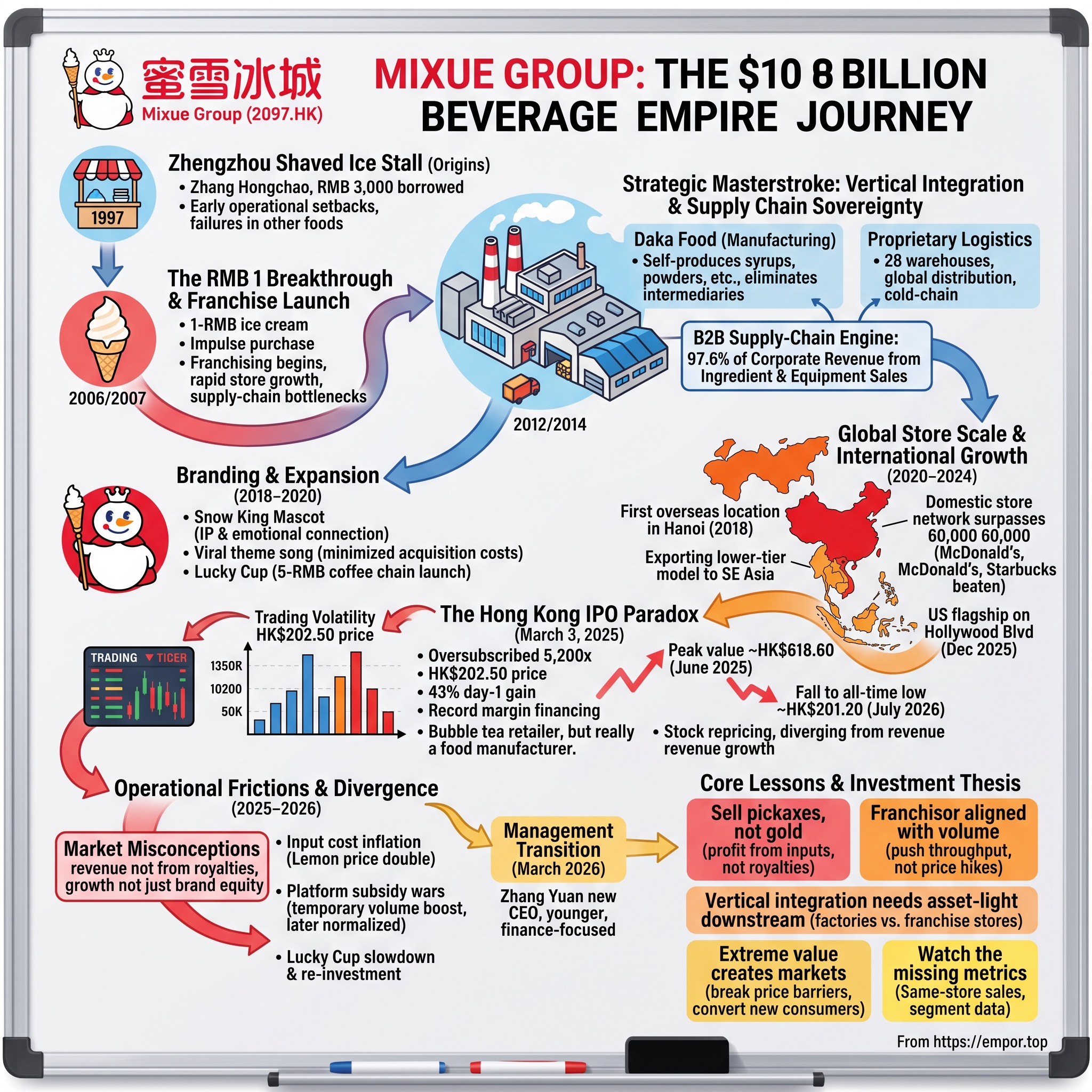
Mixue Group: The $10 Billion Beverage Empire Built on 2-RMB Ice Cream and 60,000 Stores
I. Introduction & Episode Roadmap
On a humid morning in March 2025, trading floor chatter in Hong Kong focused not on a semiconductor designer or a biotechnology firm, but on an ice cream vendor.
Mixue Group (蜜雪冰城) priced its initial public offering at HK$202.50 a share, drawing extraordinary demand from retail investors. The public tranche was oversubscribed more than 5,200 times. Individual investors pledged over HK$1.8 trillion in margin financing to secure an allocation — a record for the market — prompting underwriters to close the order book a day early due to administrative volume.1 When trading commenced on March 3, 2025, the stock closed up 43%, valuing a company that sells soft-serve cones for thirty cents at over US$14 billion.2
That market reaction underscores a central paradox.
Mixue is not, in economic terms, primarily a bubble tea retailer. It is a food manufacturing, agricultural procurement, and cold-chain logistics enterprise operating behind the emblem of a cartoon snowman mascot. In 2025, sales of ingredients, supplies, and equipment to franchisees generated RMB 32.77 billion of the company's RMB 33.56 billion in total revenue. Franchise and service fees — the primary royalty stream for traditional franchise models — contributed RMB 794 million, or 2.4% of total revenue.3 Mixue does not take a royalty percentage on store-level retail sales; it generates revenue when trucks carrying lemon syrup and paper cups depart its warehouses.
Four central threads define this operational model.
The first is counter-positioning at scale. By offering a soft-serve cone for RMB 1 and fresh lemonade for RMB 4, Mixue established a dominant presence in China's lower-tier markets (下沉市场) — county towns, township high streets, and school gates — where premium chains such as Heytea (喜茶) and Nayuki (奈雪的茶) could not enter without compromising their brand positioning and unit economics.
The second is supply-chain sovereignty. In 2012, Mixue became the first company in China's freshly-made drinks sector to establish centralized manufacturing, followed in 2014 by its own logistics network.3 The company self-produces 100% of its core beverage ingredients across five production facilities and distributes them through 28 domestic warehouses.3 This infrastructure provides an operational manufacturing moat rather than a simple consumer preference advantage.
The third is the franchise toll road. Because Mixue earns profit on ingredient sales volume rather than a percentage of store revenue, franchisor and franchisee incentives align around maximizing cup volume. However, this structure also means reported corporate revenue growth can outpace store-level sales performance — a divergence that became critical over the past eighteen months.
The fourth is expansion strategy — applying this operational template to coffee through Lucky Cup (幸运咖), draught beer through FULU Fresh Beer (鲜啤福鹿家), and international locations ranging from Jakarta to Hollywood Boulevard.
Underlying all four threads is a fundamental investment question: Mixue's advantage rests on delivering a branded, freshly-made beverage at a lower price point than any global competitor. That represents a cost advantage, which carries a distinct vulnerability: highly effective while sales volumes compound and input costs remain stable, but sensitive when volume growth moderates or input prices rise. This analysis examines which operational phase the company has entered.
This dynamic explains the stock's subsequent volatility. In the seventeen months following its debut, Mixue shares climbed to HK$618.60 in June 2025 before declining to an all-time low of HK$201.20 on July 10, 2026 — briefly falling below the IPO price — before settling around HK$209.60 in late July 2026.4 That drop erased roughly two-thirds of its peak market valuation. Even as the company maintained 35% top-line revenue growth, its market value declined by more than half.5
This divergence marks a pivotal turn in the company's trajectory. This article examines the structure Mixue built, the operational friction that emerged, and the metrics required to evaluate its long-term position.
 Subscribe on LinkedIn
II. The Shaved Ice Stall in Zhengzhou: Origins & Early Survival (1997–2005)
In the spring of 1997, a 21-year-old student at Henan University of Economics and Law (河南财经政法大学) returned home with an unusually systematic approach for an underfunded undergraduate: he visited shaved-ice shops across the area, buying a bowl at each to taste the products, question operators, and reverse-engineer the recipe.6
His name was Zhang Hongchao (张红超). Lacking family capital, he borrowed RMB 3,000 — approximately US$362 at the time — from his grandmother.6 Rather than leasing a commercial storefront, he spent RMB 800 on a second-hand freezer, constructed a custom shaved-ice machine because commercial equipment was unaffordable, and opened a two-to-three-square-metre semi-open stall in an urban village off Jinshui Road in Zhengzhou (郑州). He named the venture Cold Wave Shaved Ice (寒流刨冰).
What followed was not immediate commercial expansion, but eight years of persistent operational setbacks.
In the late 1990s and early 2000s, rapid urban redevelopment transformed Zhengzhou, leaving informal vendors vulnerable. Municipal clearance of urban villages destroyed Zhang's stall three separate times in a single year.7 Shaved ice was also inherently seasonal in a province with severe winters, causing revenue to drop sharply every October. To maintain cash flow through the winter, Zhang sold mandarin oranges. Over the years, he experimented with popsicles, hot pot, and fried chicken, with little commercial success.
This early period established the foundation of Mixue's operational culture. Zhang functioned not as a designer of premium consumer experiences, but as a machinery tinkerer and cost engineer. Every financial constraint reinforced a single operating principle: build equipment when commercial options are too expensive, formulate ingredients internally to preserve margin, and engineer products to remain profitable at extremely low consumer price points.
Although these early product experiments failed, they provided crucial operational lessons. Selling popsicles illustrated freezer economics and inventory spoilage. Operating hot pot and fried chicken formats demonstrated that labor-intensive models fail to scale without substantial capital. Each pivot narrowed his focus toward a model defined by three distinct criteria: a small physical footprint, minimal skilled labor requirements, and standardized assembly executable in under a minute — the precise operational blueprint of a modern Mixue location.
Regional context in Henan was critical. As one of China's most populous and economically developing provinces at the time, price sensitivity dominated consumer demand. In Zhengzhou's urban villages in 2002, a dessert priced at RMB 5 did not compete against rival sweet shops; it competed against a consumer's decision to forgo discretionary spending entirely.
During this period, the business adopted its enduring brand name: Mixue Bingcheng (蜜雪冰城), translating literally to "Honey Snow Ice City." Unaligned with modern corporate naming trends — avoiding aspirational, English-inflected, or minimalist branding — the name mirrored an accessible neighborhood dessert shop. That unpretentious identity later became a major marketing asset across Chinese digital platforms.
In 2007, Zhang's younger brother Zhang Hongfu (张红甫) joined the enterprise.7 They established a long-standing division of responsibility: Hongchao managed product formulation, equipment design, and technical development, while Hongfu oversaw operations, standardization, and franchise management. Hongfu later documented this period in an online serial of roughly 100,000 words, offering a detailed account of early operational struggles rather than a polished corporate narrative.8
This formative era also shaped the company's approach to structural risk. Having experienced multiple store demolitions, Zhang avoided business models dependent on single locations, landlords, or regional markets. Mixue's eventual architecture — thousands of low-cost, rapidly deployable storefronts operated by franchisees, supplied by corporate-controlled production and logistics assets — reflects an early institutional lesson: physical retail locations are temporary, whereas supply chain infrastructure provides enduring control.
By 2005, the enterprise remained a modest, undercapitalized dessert stall in central China. However, it possessed a fundamental asset: an operating model refined through eight years of radical cost minimization. The following year, the founders applied this low-cost execution framework to a rapidly expanding consumer beverage market.
III. The 1-RMB Ice Cream Breakthrough & Franchise Explosion (2006–2011)
Around 2006, Japanese-style soft-serve ice cream arrived in China's tier-one cities as a minor luxury. Sold in branded cones and widely featured in urban lifestyle media, it typically cost between RMB 10 and RMB 20 — roughly the price of a full lunch in Zhengzhou at the time.
Zhang Hongchao evaluated the product through his established framework of cost engineering, analyzing the raw ingredient and equipment requirements necessary to produce soft serve.
After sourcing milk powder, developing an internal formulation, and purchasing cones in bulk, he calculated that soft serve could be sold profitably for RMB 1 — roughly fourteen US cents, or one-tenth of the prevailing market price.7 Long queues quickly formed outside his Zhengzhou store.
The commercial impact of this pricing strategy extended beyond simple price undercutting, operating through three distinct mechanisms.
First, the RMB 1 cone converted Mixue from a seasonal summer stall into a year-round business. Soft-serve ice cream paired naturally with beverage offerings; establishing soft-serve equipment and customer habits created steady store cash flow even during winter months.
Second, the ultra-low price point transformed the category from a considered treat into an everyday impulse purchase. At RMB 10, soft serve represented a deliberate discretionary expense. At RMB 1, it functioned as an impulse purchase. Rather than competing directly for existing customers at premium ice cream shops in Zhengzhou, Mixue expanded the market, generating new demand among price-sensitive consumers who avoided higher-priced options.
Third, the high-volume queues served as a powerful recruiting tool for prospective franchisees. Observing constant customer traffic, onlookers saw an attractive, repeatable retail opportunity.
This demand laid the foundation for Mixue's franchise model, which emerged out of capital constraints rather than deliberate strategic foresight. The founders adopted franchising because request volume for new locations exceeded their internal capital to open self-operated stores. This origin shaped the company's long-term economics: lacking the capital to build a corporate-owned store network, the brothers created a system focused on supplying ingredients to independent operators.
Mixue launched its franchise system in 2007, prompting rapid network expansion. Franchised locations opened across Henan near university gates, secondary schools, and township high streets — sites traditionally overlooked by corporate retail chains due to lower average spending. For a product priced at RMB 1, total foot traffic mattered far more than individual wallet size.
However, rapid expansion quickly exposed severe supply chain and operational bottlenecks.
Dependence on third-party wholesalers for syrups, powders, and jams led to inconsistent product quality across stores and stockouts during peak seasons. Furthermore, intermediary markups squeezed franchisee margins against the rigid RMB 1 retail price point. The founders realized that third-party distribution intermediaries imposed a firm ceiling on scalable unit economics.
Operational governance presented an equally serious challenge. Early Chinese franchise networks were loosely managed, with franchisees frequently purchasing cheaper, unapproved ingredients from local suppliers. For a brand promising consistent quality across regions, this lack of uniformity posed a critical risk. Zhang Hongfu led the effort to professionalize network governance, introducing store managers, standardized operating procedures, and strict compliance enforcement across previously informal, family-run outlets.7 Establishing operational consistency across thousands of independent store owners proved essential to transforming local outlets into a unified national brand.
Faced with supply chain friction and margin pressures, conventional franchisors typically raise retail prices or extract ongoing royalty fees from store revenues. Mixue pursued neither strategy. Instead, the company chose to integrate vertically and become its franchisees' primary wholesale manufacturer.
IV. The Strategic Masterstroke: Building Daka Food & Supply Chain Sovereignty (2012–2017)
In 2012, with a network of a few thousand regional stores generating modest profits, Mixue made a pivotal capital allocation decision: rather than investing in brand marketing, flagship retail locations, or an expensive tier-one headquarters, the founders directed capital into manufacturing.
This decision made Mixue the first company in China's freshly made drinks industry to establish its own centralized production facilities.3 Operating under the Daka International Food banner (大咖国际食品), this manufacturing arm brought the production of syrups, solid drink powders, jams, milk-based ingredients, and fructose entirely in-house.
Two years later, in 2014, Mixue replicated this strategy in distribution, becoming the first player in the sector to build a proprietary logistics system.3 By 2022, the company operated warehouse facilities across 22 provinces, consolidating raw-material procurement directly from farmers.7
This vertical expansion reshaped the unit economics of low-cost beverages. In a conventional supply chain, a beverage chain purchasing syrup from third-party suppliers absorbs stacked intermediary margins — from the processor, the regional distributor, and the logistics provider — each adding roughly 10% to 20% to input costs. Cumulatively, these layers can inflate the cost of goods by 50% before a beverage is served. While a premium chain selling a RMB 20 drink can absorb those markups, such intermediary margins destroy unit economics on a RMB 4 product.
By controlling both manufacturing and transport, Mixue eliminated intermediary markups and passed a substantial share of the savings to franchisees through below-market ingredient pricing. The company stated in its public filings that direct sourcing at raw-material origins enables it to secure core inputs "at prices below the industry average."3 This structure aligns incentives across the network: franchisees receive cheaper inputs than they could source independently, Mixue earns manufacturing margins, and consumers purchase a RMB 4 lemonade.
A critical nuance lies in how Mixue monetizes this network. The company does not extract hidden royalties through aggressive ingredient markups. Because ingredient costs represent the most visible weekly expense for small store operators, inflated pricing would prompt franchisee defection. The system functions only if franchisees recognize that corporate pricing remains lower than open-market alternatives. Consequently, Mixue's manufacturing margins are bounded not by retail consumer willingness to pay, but by the threshold at which franchisees would seek alternative suppliers — imposing a deliberate structural cap on corporate pricing power.
This supply chain strategy is best illustrated by lemon procurement. Freshly-Squeezed Lemonade remains Mixue's single best-selling product.3 The company sources heavily from Anyue County (安岳) in Sichuan — China's primary lemon-producing region — purchasing nearly half of the county's total annual yield. Mixue contracts directly with local orchards under floor-price agreements, establishing a guaranteed purchase price each September and paying prevailing market rates whenever spot prices exceed that floor.9 This procurement scale creates a formidable competitive barrier: a rival seeking to launch a RMB 4 lemonade must secure raw agricultural supply in a market where Mixue already controls much of the regional output.
That manufacturing footprint expanded into five primary production facilities across Henan, Hainan, Guangxi, Chongqing, and Anhui, providing a comprehensive ingredient catalog spanning syrups, dairy, tea, coffee, fruit, grains, and condiments. This network is supported by 28 domestic warehouses serving a distribution network across 33 provincial-level regions and more than 300 cities.3 Through this infrastructure, the company self-produces 100% of its core ingredients.3
From an investment perspective, vertical integration frequently depresses returns on invested capital by converting asset-light models into capital-intensive industrial operations. For Mixue, however, the strategy succeeded because vertical integration was strictly confined upstream to raw inputs and manufacturing, while store-level real estate remained off the corporate balance sheet. Franchisees execute leases, fund store buildouts, hire staff, and absorb local retail risk. Meanwhile, corporate-owned factories maintain high capacity utilization driven by the massive, predictable volume demands of tens of thousands of franchised locations.
Proprietary logistics served as the second pillar of this operational model. While many franchisors outsource distribution or pass logistics fees onto store operators, Mixue established a self-operated warehouse and delivery network reaching stores across 33 provincial-level regions.3 This infrastructure provides three distinct operational advantages beyond unit cost reduction: - Information Visibility: Real-time weekly order flows give corporate management an accurate read on store-level demand without relying on point-of-sale integrations. - Quality Control: Direct cold-chain distribution preserves product freshness and enforces strict food safety protocols across a dispersed franchise system. - Commercial Retention: Although franchisees are not contractually locked into exclusive procurement for all items, no third-party logistics provider can match Mixue's combination of pricing, reliability, and 24-to-48-hour replenishment cycles, rendering supplier switching commercially impractical.
This dual architecture — industrial scale upstream paired with franchised distribution downstream — forms the operational core of the business. However, it also introduces a key structural requirement: corporate profitability depends on maintaining high factory utilization, which requires continuous store network expansion and steady order throughput.
V. Snow King, 5-RMB Coffee, and the Viral Playbook (2018–2020)
By 2018, Mixue had engineered low operational costs, but it had not yet established brand affection.
Operating thousands of small storefronts selling low-priced beverages across county towns presented a branding challenge that capital alone could not solve: low prices carried a risk of being perceived as cheap or low quality. The strategic task facing management was transforming extreme affordability from a compromise into an engaging consumer asset.
Mixue's response was Snow King (雪王), introduced in 2018 as the company's "lifelong brand ambassador," created to humanize the brand and build an emotional connection with consumers.3 Rather than adopting an aspirational or luxury aesthetic, the character was designed as round, lighthearted, and unpretentious — aligning closely with self-deprecating themes popular in Chinese digital culture.
In 2021, the company launched a promotional theme song, "I Love You, You Love Me, MIXUE Ice Cream & Tea." Its simple, repetitive melody went viral across Douyin and Bilibili, prompting customer-generated videos, in-store singing promotions, and fan translations into dozens of languages. Snow King subsequently starred in two animated series, The Legend of Snow King (2023) and Snow King and the Sands of Mystery (2024). In May 2025, the company released the former in five languages, including English, French, and Portuguese, for global distribution.3 By the end of 2025, the #MIXUE hashtag had accumulated over 65.3 billion views on Douyin.3
This viral marketing strategy directly shaped Mixue's cost structure. Selling and distribution expenses totaled 6.1% of revenue in 2025 — a figure that encompasses operating a national logistics network alongside brand marketing.3 By generating widespread user-created content and organic brand recognition, Mixue minimized traditional customer acquisition costs. For a business model dependent on RMB 6 items, turning brand engagement into an organic content flywheel proved essential, as unit margins leave little room for heavy advertising budgets.
The economic value of Snow King lies in driving traffic rather than commanding pricing power. Mixue's public filings describe Snow King as "the sole iconic IP in China's freshly-made drinks industry."3 While this reflects high consumer recognition, it does not translate into consumer willingness to pay a premium. By reframing low-cost drinks as an accessible, lighthearted purchase, the character drives store traffic and purchase frequency without raising retail prices — reinforcing a business model built on volume.
In parallel, Mixue established a second brand in 2017: Lucky Cup (幸运咖), a freshly made coffee chain.3 The underlying strategy leveraged existing supply chain infrastructure — shared distribution centers, logistics fleets, and franchisee onboarding systems — to enter lower-tier markets where coffee consumption was emerging, but where premium RMB 30 lattes remained impractical. Lucky Cup priced its core beverage lineup between RMB 2 and RMB 11.3
For several years, Lucky Cup expanded at a deliberate pace. Management spent nearly seven years refining store formats and testing unit economics before initiating rapid network expansion. That measured early rollout highlighted the challenge of maintaining store-level profitability at single-digit price points, setting up a format that would see both rapid expansion in 2025 and subsequent operational friction.
Mixue's capital allocation during this expansion phase was notable for its reliance on internal cash flow. The company funded its national manufacturing facilities and logistics network primarily through operating profits. It raised outside capital only in 2020, when Hillhouse Capital and Meituan's Long-Z Capital invested in a pre-IPO financing round; both institutions later served as cornerstone investors in the Hong Kong initial public offering.1
This capital discipline distinguished Mixue from many venture-backed consumer peers during the 2010s. Rival chains such as Heytea and Nayuki pursued capital-intensive, directly operated flagship store models funded by significant equity raises; by 2025, Nayuki faced contracting revenue and net losses.5 By funding factory capacity through cash flow while leaving store capital expenditures to franchisees, Mixue preserved capital efficiency and avoided significant equity dilution, allowing the founding brothers to retain operational control.
VI. Conquest of Southeast Asia & Global Store Network Scale (2020–2024)
In 2018, Mixue opened its first overseas location in Hanoi—a notable departure from prevailing corporate trends. At the time, Chinese consumer beverage brands expanding abroad typically targeted affluent expatriates or pursued premium brand positioning. Mixue took the opposite approach: exporting its lower-tier Chinese retail model, low price points, its Snow King mascot, and a product portfolio tailored for Southeast Asian markets characterized by young demographics, warm climates, dense street retail, and household incomes for which a $1 beverage represented a mass-market product.
The model expanded rapidly across Indonesia, Vietnam, Malaysia, Thailand, the Philippines, Singapore, Australia, Japan, and South Korea. By the end of 2024, Mixue operated 4,895 stores outside mainland China.3
Replicating this operational architecture overseas presented significant structural challenges. In China, Mixue's cost advantage relied on scale agricultural procurement, centralized domestic manufacturing, and a proprietary logistics network. Expanding internationally introduced customs clearance, import tariffs, regional fruit sourcing, local food-safety compliance, and fragmented third-party cold chains. To maintain its low-cost structure, Mixue established local warehouse and delivery networks across eight overseas countries.3
Its international pricing strategy matched its domestic structure. Rather than positioning itself as a premium import, Mixue maintained an average price point of approximately $1 per item across its global network.3 In markets such as Jakarta and Hanoi, this pricing undercut local independent tea shops that lacked procurement scale, while offering standardized storefronts, recognized branding, and consistent ingredient supplies. Against fragmented local competition, the formula proved effective.
However, the model faced friction in markets with high fixed operating costs. While a $1 price point aligns with regions featuring low commercial rents, affordable labor, and dense street retail, it faces tight unit economics in high-cost urban environments where store leases and labor demand significantly higher revenue per square meter.
Concurrently, Mixue's domestic store network continued to expand. Mainland locations reached 41,584 at the end of 2024 and 55,356 by the end of 2025.3 The geographic mix underscores its strategic focus: by the end of 2025, third-tier and lower-tier cities accounted for 32,119 locations, or 58.0% of its mainland network, whereas first-tier cities represented just 2,635 stores, or 4.8%.3 The company's operational foundation remained concentrated in lower-tier regional markets.
As its store count surpassed global chains such as McDonald's and Starbucks to make Mixue the world's largest freshly made beverage operator by total locations, the company pursued a public listing.
The path to capital markets involved several iterations. Mixue first submitted an A-share listing application on the Shenzhen Stock Exchange in September 2022, seeking approximately RMB 6.5 billion, but the application did not proceed.10 The company then pivoted to Hong Kong, filing in January 2024 alongside rival 古茗 Guming.[^11] After that application lapsed, Mixue refiled in January 2025, cleared its listing hearing in February, and listed on the Hong Kong Stock Exchange on March 3, 2025.11
The initial public offering offered a small float relative to corporate scale: 17.06 million shares priced at HK$202.50, raising roughly $444 million and representing approximately 5% of total outstanding shares, with net proceeds following the over-allotment option reaching approximately HK$3,799 million.312 Five cornerstone investors—M&G Investments, HongShan's growth fund, a Boyu Capital unit, a Hillhouse fund, and Meituan's Long-Z Fund—subscribed for approximately $200 million of the offering.1
Following the listing, founders Zhang Hongchao and Zhang Hongfu each retained a 41.27% stake including employee shareholding platforms, holding over 82% of the company combined.1
This limited public float distorted initial trading dynamics. Placing only 5% of total equity into an oversubscribed retail market meant early stock prices reflected structural scarcity rather than long-term cash flow fundamentals. While the stock tripled within three months of its debut, that initial valuation reflected immediate retail demand for a recognized consumer brand. However, the constrained float also created structural vulnerability, setting the stage for sharp price adjustments when pre-IPO lock-up agreements expired fifteen months later.
VII. The B2B Engine: Dissecting Mixue's Financial Architecture & Segment Economics
Strip away the snowman and this is what the income statement looks like.
In 2025, Mixue generated revenue of RMB 33.56 billion, up 35.2% year on year. Gross profit was RMB 10.45 billion, up 29.7%. Profit for the year reached RMB 5.93 billion, up 33.1%, of which RMB 5.89 billion was attributable to owners of the parent, producing basic earnings per share of RMB 15.65.3
The revenue split is the whole thesis in one line. Sales of goods contributed RMB 31.44 billion; sales of equipment — refrigerators, soft-serve machines, sealing machines, dispensers — contributed RMB 1.33 billion; franchise and related services contributed RMB 794 million.3 Manufacturing and distribution is 97.6% of the business. The franchise brand is 2.4%.
Now look at the margins, because they explain both the model and the current controversy.
The goods-and-equipment business earned a gross margin of 29.9% in 2025, down from 31.2% in 2024.3 The franchise services business earned 82.6%, up from 80.4%, benefiting from scale as the store base grew.3 So the tiny segment is enormously profitable and the enormous segment is a normal-looking food manufacturer. Consolidated gross margin lands around 31%.
Below the gross line, the arithmetic becomes flattering. A net margin of roughly 18% on a business whose gross margin is 31% means that operating costs consume only about 13 points of revenue — an extraordinarily lean structure for a company touching 60,000 retail locations. The reason is that Mixue's cost base looks like a mid-sized food manufacturer's while its revenue base looks like a national retailer's, because the retail cost base belongs to somebody else.
That thirty-percent figure is the number to internalise. Mixue is not a high-margin consumer brand; a premium tea chain running its own stores books retail-level gross margins in the 60s. Mixue books factory-level margins in the 30s — but on a revenue base that is vastly larger relative to its own invested capital, with none of the store-level rent and labour, and with almost no inventory risk, because goods are sold to franchisees on delivery rather than sold to consumers on hope. Operating leverage does the rest: selling and distribution costs ran at 6.1% of revenue, administrative expenses at 3.2%, and R&D at just 0.3%.3 A company with 60,000 storefronts employed only 9,102 people at the end of 2025.3 The franchisees employ everyone else.
There is a second, subtler source of returns hiding in the working capital. Mixue's franchisees generally pay in advance: for the majority of goods transactions, customers make advance payments before delivery, and franchise service fees are collected annually up front.3 In 2025, RMB 359.6 million of revenue was recognised from amounts that had been sitting in contract liabilities at the start of the year.3 In plain terms, the franchisees fund Mixue's working capital rather than the other way round. A manufacturer that gets paid before it ships, sells to a captive base, and carries almost no finished-goods risk is operating with structurally negative working capital — which is precisely why a 30%-gross-margin business can throw off cash like a much higher-margin one.
A useful forward indicator lives in the same disclosure. Equipment revenue — soft-serve machines, refrigerators, sealers — jumped 75% to RMB 1.33 billion in 2025.3 Equipment is overwhelmingly sold at the moment a new store is fitted out. So equipment revenue is a reasonably clean proxy for the pace of store openings, while goods revenue reflects the health of the installed base. When those two lines start diverging — equipment holding up while goods per store softens — the company is growing by recruitment rather than by throughput. That is the tell to watch.
The balance sheet is the quiet star. At the end of 2025, cash, time deposits, restricted cash and financial assets at fair value totalled RMB 19.99 billion, up 79.9% year on year; interest-bearing borrowings were RMB 28.2 million — effectively nil; and the gearing ratio was 19.6%.3 This is a business that converts profit to cash quickly, because franchisees generally pay in advance and inventory turns fast.
Which raises an uncomfortable question, and it is the first genuinely awkward one in this story: the board did not recommend any dividend for 2025, and none was paid for 2024 either.3 A company with RMB 20 billion of net cash, minimal capital commitments (RMB 302 million at year-end), no acquisitions of consequence, and no articulated plan for material investment, is retaining 100% of a RMB 5.9 billion annual profit stream.3 Management has not disclosed a capital return framework. For a controlled company where two individuals hold over 82% of the equity, cash retention with no stated purpose is exactly the kind of thing a minority shareholder should be asking about — politely at first.
Franchisee unit economics. This is the load-bearing wall of the whole edifice, and it is also where disclosure is thinnest. From the listing materials, the average Mixue store sold roughly 662 cups per day in the first nine months of 2024, generating average daily store revenue of about RMB 4,184 — roughly RMB 125,000 a month at retail.13 Group-wide terminal retail sales (GMV) grew from RMB 30.7 billion in 2022 to RMB 58.3 billion in 2024.13 The company states that its initial investment and franchise fee sit below the industry average.13
What the company does not disclose, in any period, is same-store sales. There is no like-for-like metric in the annual results announcement. For a business whose revenue mechanically rises whenever store count rises, that omission is significant: a reader cannot separate "more stores" from "better stores" without it. The closest available proxy is the ratio of goods revenue to average store count — and investors will have to build that themselves, because Mixue will not build it for them.
The evidence that unit economics remained attractive through 2025 is the flow of new franchisees: the count rose from 20,976 to 27,450 during the year.3 People do not queue up to buy a franchise whose payback period has broken. But the counter-evidence sits in the same table, and it is the subject of the next section.
VIII. Industry Dynamics, Competitive Benchmarking, and Lower-Tier Dominance
China's freshly made drinks sector operates across three distinct price tiers.
At the top sit premium chains like Heytea (喜茶) and Nayuki (奈雪的茶), which historically priced beverages above RMB 20 with a focus on larger physical locations, fresh fruit ingredients, and lifestyle branding. In the middle tier, between RMB 10 and RMB 20, operators such as Guming (古茗), ChaPanda (茶百道), Auntea Jenny (沪上阿姨), and Chagee (霸王茶姬) compete on store density, tea quality, and brand positioning. At the mass-market tier below RMB 10, Mixue anchors the segment alongside smaller rivals like Tianlala (甜啦啦).
In 2023, industry consultancy CIC ranked Mixue first in China's freshly made drinks market, holding an 11.2% share by gross merchandise value and a 32.7% share by total volume.14 That divergence highlights the company's operational profile: Mixue accounted for nearly one out of every three freshly made beverages sold nationwide, while capturing roughly one out of every nine renminbi spent in the category.
The 2025 financial disclosures illustrated clear industry divergence. Mixue increased revenue by 35% and profit by 33%, while Guming expanded revenue by 47% as its footprint crossed 13,500 locations, and Auntea Jenny grew revenue by 36% past 11,000 stores. By contrast, ChaPanda prioritized profitability over unit expansion, Chagee posted a modest 4% revenue gain as net profit dropped by half, and Nayuki recorded a 12% revenue decline while remaining unprofitable.5
This performance split reflected broader macroeconomic trends. The fastest-growing operators in 2025 maintained extensive lower-tier store networks and vertically integrated supply chains. As Chinese consumers shifted toward value, premium operators struggled to defend margins, losing both volume and profitability. Industrial procurement scale and distribution reach proved far more decisive than brand premium.
Despite Mixue's scale, two external operational pressures created headwinds during 2025.
The first was a delivery platform subsidy war. Early in 2025, JD.com (京东) entered the food delivery market, triggering aggressive promotional spending alongside incumbents Meituan (美团) and Alibaba's (阿里巴巴) Ele.me. Platforms heavily discounted drinks normally selling for RMB 20 down to single digits, with beverages briefly exceeding half of total delivery orders on certain platforms and some channels offering subsidized free drinks.15 The intense competition led Meituan to report a quarterly operating loss of RMB 19.8 billion for the period ending September 2025.16
For Mixue, platform subsidies functioned as a temporary growth catalyst. Delivery discounts drove elevated order volumes across store locations, boosting store sales and driving corporate ingredient shipments. Consequently, Mixue's first-half 2025 revenue rose 39.3% and net profit grew 44.1%.17 On an interim earnings call, management acknowledged the temporary nature of this volume boost, noting that delivery sales growth slowed in July compared to June and emphasizing that long-term success depends on core product and service execution rather than platform promotions.18 Financial news service Caixin subsequently reported that as platform subsidies moderated in the fourth quarter, overall store revenue growth slowed relative to the third quarter and delivery volumes normalized from earlier peaks.19
This dynamic suggests that a portion of the company's 2025 sales acceleration was underwritten by third-party delivery platform capital, making baseline consumer demand harder to isolate.
The second major headwind involved input cost inflation, particularly for lemons. Mixue required roughly 52,000 tonnes of fresh lemons in 2025. By September 2025, national average wholesale lemon prices reached RMB 14.91 per kilogram — nearly doubling from RMB 7.87 a year earlier — while farmgate prices in Anyue rose to between RMB 8 and RMB 10 per kilogram compared to historical norms of RMB 4 to RMB 6.9 Mixue's total lemon procurement expense increased by over 60% in 2025, serving as the primary factor behind the decline in its goods gross margin from 31.2% to 29.9%.20
This volatility illustrates a structural vulnerability of extreme value pricing. With a flagship lemonade priced at RMB 4, doubling agricultural input costs cannot easily be passed along to retail consumers without weakening the brand's core value proposition. Consumer pricing power remains minimal by design, while wholesale price increases to franchisees are constrained by the need to maintain store-level economics and partner retention.
A third emerging pressure stems from substitution by packaged beverages. Freshly made drinks and bottled consumer goods traditionally operated in distinct market segments defined by price and presentation. At an RMB 4 retail price point, however, freshly made beverages compete directly against bottled teas in convenience stores. Major packaged beverage producers, backed by substantial procurement scale of their own, responded by introducing large-format bottled lemon drinks targeted at the same price-sensitive demographic.20 While Mixue relies on made-to-order freshness to differentiate its offerings, maintaining that boundary requires ongoing product quality upgrades and operational investment.
Market Misconceptions and Financial Realities
Three prevalent market assumptions warrant examination against regulatory filings:
- Assumption: Mixue generates earnings primarily through franchise royalties. Financial disclosures show that franchise and related service fees accounted for just 2.4% of total revenue in 2025.3 The business operates fundamentally as a supply chain manufacturer distributing raw materials and equipment to a captive store network, rather than a royalty-dependent franchisor.
- Assumption: Growth is driven primarily by consumer brand equity. Corporate results indicate that operational profitability is closely linked to industrial procurement and agricultural supply chains. In 2025, gross margin movements were driven predominantly by agricultural commodity price fluctuations, such as lemon input costs, rather than brand marketing or retail pricing adjustments.20
- Assumption: Network expansion is approaching immediate domestic saturation. While Mixue added 14,496 gross franchised locations in 2025, store closure rates also increased.3 Network saturation in ultra-large franchise models rarely appears as an abrupt halt in expansion; instead, it manifests gradually through rising store churn and pressure on store-level volumes. Current public disclosures do not provide sufficient store-level sales data to definitively resolve this trend.
Competitive Dynamics in Coffee
In the coffee segment, competitive intensity remains elevated. Market leader Luckin Coffee (瑞幸咖啡) ended 2025 with 31,048 locations after adding 8,708 net new stores, with annual revenue exceeding $4.7 billion, up 38.4%.21 Competitor Cotti Coffee (库迪咖啡) reached over 18,000 locations across 28 markets by January 2026.22 Against these established chains, Mixue's Lucky Cup brand relies on upstream supply chain integration, including direct bean procurement from Brazil and Colombia alongside a 20,000-tonne coffee bean processing reserve facility in Hainan.18 Whether this supply chain foundation can deliver sustainable market share against scale competitors remains a key operational test.
IX. Strategic Frameworks: Porter's 5 Forces & Hamilton Helmer's 7 Powers
Applying strategic management frameworks to Mixue's operational performance reveals where its competitive moat holds firm and where market expectations diverged from business realities.
Scale economies serve as Mixue's primary competitive advantage. Operating five production centers at high capacity utilization across a 60,000-store network generates unit costs for syrups, powders, and packaging that smaller competitors cannot replicate. Corporate disclosures confirm that direct origin-level procurement allows Mixue to secure core raw materials at prices below industry averages.3 However, 2025 demonstrated the limits of this moat: while scale economies mitigate cost pressures, gross margins still contracted under the weight of severe agricultural input inflation, proving that volume advantages absorb commodity shocks only partially.
Process power presents a more nuanced picture. Over a decade of centralized manufacturing and proprietary cold-chain logistics created route density and operational expertise that competitors cannot quickly acquire. A concrete example of process standardization is the rollout of smart drink dispensers, which expanded from over 5,600 stores in mid-2025 to more than 13,000 by year-end, reducing labor requirements and food-safety variance.317 Still, with automated equipment installed in only about a quarter of the domestic network, process optimization remains an ongoing deployment rather than a fully realized defense.
Counter-positioning effectively shielded Mixue's rise against premium incumbents. Chains selling RMB 18 beverages could not introduce a RMB 4 lemonade without cannibalizing their existing revenue and eroding brand equity, forcing higher-tier operators to concede the mass market for over a decade. However, counter-positioning protects only against incumbents operating above a company's price point; it provides no barrier against horizontal peers competing within the same low-cost tier.
Branding power warrants careful distinction. Although the Snow King mascot achieved widespread cultural recognition and consumer engagement, brand power in a strategic sense implies the ability to command a price premium. Mixue's brand does not enable higher retail pricing; rather, it drives transaction volume at established low price points. Snow King functions as a high-efficiency demand-generation tool rather than a source of pricing power.
Network economies are absent at the consumer level, as individual customers derive no direct utility from additional patrons. Instead, Mixue relies on a franchisee-density feedback loop: expanding store counts increases raw material purchasing volume, driving down unit manufacturing costs, preserving franchisee margins, and attracting further network expansion. This mechanism represents a self-reinforcing scale loop rather than a true network effect, meaning it can slow or reverse if store closure rates accelerate.
Analyzing Mixue through Porter's Five Forces highlights additional structural dynamics across the value chain:
Supplier power remains low structurally, yet vulnerable to agricultural cycles. Mixue owns its processing facilities and contracts directly with fruit orchards, eliminating traditional distribution markups. However, when Anyue's lemon crop yields tightened in 2025, Mixue paid prevailing market prices despite its 52,000-tonne procurement scale.9 Vertical integration eliminates middleman margins, but it cannot fully insulate the business from broader commodity shocks.
Buyer power is bifurcated between retail consumers and franchisees. End consumers face zero switching costs and high price sensitivity, a dynamic that historically favored Mixue as the lowest-cost provider. Franchisees represent the more critical buyer group: while contractual and equipment costs create initial switching friction, franchisee leverage increases whenever store payback periods lengthen or unit throughput softens.
Threat of new entrants in the mass-market tier remains low. Differentiating a beverage formula is straightforward, but replicating Mixue's cost structure requires simultaneously constructing production plants, establishing a nationwide cold chain, and securing a store network large enough to absorb factory capacity—a capital-intensive coordination challenge requiring substantial funding and years of execution.
Threat of substitutes is moderate and expanding. At an RMB 4 retail price point, freshly made drinks overlap directly with packaged convenience store beverages, where major beverage manufacturers have introduced large-format bottled lemon drinks aimed specifically at price-sensitive consumers.
Competitive rivalry is high and intensifying across core categories—in tea beverages through lower-tier expansion by Guming and Auntea Jenny, and in coffee through aggressive capital deployment by Luckin and Cotti.
Switching costs are often overstated in franchise business models. Franchisees typically sign three-to-four-year agreements, purchase proprietary Mixue equipment, and must rebrand physical storefronts upon exit.3 While these requirements create operational friction, operators can transition to competing brands at contract expiration. Consequently, franchisee retention relies primarily on economic performance rather than contractual lock-in: if Mixue's ingredient cost advantage narrows, franchisee retention diminishes accordingly.
In summary, Mixue's competitive advantages are genuine but concentrated almost entirely in supply-chain cost efficiency rather than pricing power or brand equity. The divergence between perceived consumer moat and operational cost reality provides a clear framework for understanding the market repricing that followed.
X. Management Credibility, Governance, and Skeptical Investor Stress Test
On March 24, 2026, Mixue published its 2025 annual results while announcing that Zhang Hongfu was stepping down as chief executive.23
The founder-CEO became co-chairman alongside his brother, remaining an executive director to focus on long-term strategy, corporate culture, and innovation. His successor was Zhang Yuan (张渊) — born in 1990, a Tsinghua University postgraduate with prior experience at BofA Securities and Hillhouse, who had joined Mixue in 2023 as executive vice president and chief financial officer.24 Cui Haijing (崔海静) succeeded Zhang as head of finance.23
Advancing from CFO to chief executive of a 60,000-store retail network in three years, at age 35, represents a rapid executive transition. The favorable interpretation holds that a newly public family enterprise required a seasoned capital-markets operator, prompting the founders — who control over 82% of total equity — to delegate operational oversight to a finance specialist. The skeptical interpretation notes that the founder stepped back from daily operations during the same quarter the company reported decelerating store economics and narrowing gross margins, suggesting that installing a former CFO addresses share price pressure rather than operational engineering.
Subsequent corporate execution over the next four to six quarters will determine which narrative holds. Key indicators will include whether the new chief executive establishes explicit performance targets, addresses operational shortfalls with analytical precision, and maintains strategic continuity with prior commitments.
On transparency, the initial track record presents a credible baseline. Management's warning on its interim call that delivery platform subsidies were unsustainable proved accurate within a single quarter.18 The 2025 annual announcement was candid about broader industry conditions, explicitly acknowledging that third-party platform promotions "accelerated the shift of orders to online channels" and "raised consumers' expectations for value for money, setting a higher bar for product competitiveness."3 Furthermore, disclosures detailing store reductions in Indonesia and Vietnam were reported prominently in both interim and annual filings rather than obscured.317
For institutional investors, several core operational areas require ongoing stress testing.
Franchisee Pricing Alignment The bull thesis relies on Mixue providing raw ingredients to franchisees below open-market wholesale prices. While corporate filings emphasize this pricing advantage, independent disclosures quantifying the discount remain unavailable. The best available cross-check is behavioral: franchisee counts expanded 31% in 2025, though that metric reflects network entry rather than long-term franchisee satisfaction.3
Accelerating Store Closures Franchised store closures increased from 1,609 in 2024 to 2,527 in 2025, a 57% jump.3 Relative to opening store counts, the annual closure rate rose from roughly 3.5% to 4.2%.25 In the first half of 2025 alone, closures reached 1,187 locations compared to 799 during the prior-year period.17 While rapid network expansion inevitably generates store churn, a rising closure rate alongside a 58% store concentration in lower-tier cities points toward regional market saturation.
International Network Contraction Overseas store counts fell from 4,895 to 4,467 during 2025 — a net contraction of 428 locations, marking the first annual decline in the international business.3 On the interim earnings call, management characterized this reduction as deliberate store optimization, noting that select relocated units achieved sales growth exceeding 50%.18 While closing underperforming outlets reflects disciplined network management, substituting broad operational contraction with localized performance metrics warrants scrutiny. Furthermore, unit economics vary significantly across markets. Mixue opened its flagship US location on Hollywood Boulevard on December 19, 2025, followed days later by New York sites, offering ice cream at $1.19, lemonade at $1.99, and lattes at $2.99.2627 Operating in high-cost Western metro areas with a $2 price point presents a fundamentally different economic equation than operating in central China. The company also entered Kazakhstan in 2025 and Mexico in February 2026, with preparations underway for expansion into Brazil.28
Structural Food Safety Exposure Across a network of roughly 60,000 stores managed by 27,450 independent franchisees, quality enforcement represents a major operational vulnerability. In March 2025, an investigative report by a Hubei broadcaster identified hygiene violations at a Yichang store, including the use of expired fruit slices. On June 9, 2025, Hong Kong's Centre for Food Safety reported that a frozen dessert sample from a Mixue location in Sha Tin contained 170 coliforms per gram, exceeding the legal threshold of 100, alongside a total bacterial count of 75,000 per gram against a legal ceiling of 50,000.29 By late March 2026, consumer platform Black Cat had logged roughly 11,216 complaints related to Mixue, with over 70% involving food-safety issues.25 While individual incidents do not threaten solvency, cumulative compliance failures constrain long-term brand equity across a franchised network.
Granular Financial Disclosure Mixue's financial reporting provides clear accounting standards, yet disclosures remain limited in critical operational segments. The company provides no same-store sales or like-for-like performance metrics. There is no segment reporting whatsoever; the company states that its chief operating decision-maker evaluates consolidated performance only, omitting reportable segment breakdowns.3 Consequently, investors cannot evaluate the standalone profitability of Lucky Cup or distinguish domestic operating margins from international results across fourteen countries. Outside of a general note stating that most revenue derives from mainland China, there is no geographic revenue breakdown.3 Contract liabilities and franchisee prepayment flows are similarly reported only in aggregate. Expanding segment reporting would offer a direct mechanism for leadership to enhance market credibility.
Earnings Quality and Governance Concentration Accounting practices across the group remain conservative. Revenue recognition rules remain simple: goods are recognized upon delivery, and franchise services are recognized over the contract period.3 There is no capitalization of store development costs, no aggressive franchise fee recognition, negligible debt, and 2025 impairment losses were minimal at RMB 10.5 million on financial assets and RMB 14.1 million on property, plant, and equipment.3
Governance, however, remains heavily concentrated. The founding brothers retain over 82% voting control of a listed company that pays no dividend, holds RMB 20 billion in cash, and completed its first major transaction in late 2025 — acquiring a 51% controlling stake in FULU Fresh Beer for RMB 297 million, adding 1,354 franchised stores.330 While the acquisition aligns with existing supply-chain infrastructure, combining concentrated ownership, substantial idle cash, no formal capital return policy, and initial inorganic expansion requires close investor monitoring.
XI. Playbook: Core Business & Investing Lessons
1. Sell the pickaxes, not the gold. Mixue's most important structural decision was to make its money on inputs rather than on royalties. This produces revenue that is recognized on shipment rather than on retail sale, inventory risk borne by 27,450 franchisees rather than by the parent, and a factory utilization curve that improves with every new store. The catch, which the outline of any franchise-supply model obscures, is that reported growth then reflects network expansion far more than consumer demand. In a system where the manufacturer profits on shipments to stores, the number that matters most to a long-term investor is not revenue — it is whether the stores receiving those shipments are still making money.
1a. Watch the metric the company chooses not to publish. Mixue discloses store counts, openings, closures, franchisee counts, and revenue in granular detail. It does not disclose same-store sales, segment profitability, or geographic revenue. In any business, the absent metric is usually the one that would most complicate the story — not because management is concealing a disaster, but because disclosure creates an obligation to explain. An investor's first analytical act should be to identify which number a company has decided not to give them, and then to construct the closest available proxy.
2. Extreme value expands the market rather than dividing it. The RMB 1 cone did not take share from RMB 10 cones; it created a customer who had never bought an ice cream cone. The same logic carried into RMB 4 lemonade, RMB 6 coffee, and now RMB 6–10 draught beer. This is the most durable idea in the Mixue story and the most transferable: in income-constrained markets, the binding constraint on category size is price, and whoever breaks the price barrier first captures a market that did not previously exist. The corollary is unforgiving — you can only do this if you have already won the cost war, and you can never raise prices to fix a margin problem without surrendering the position.
3. Align the franchisor with volume, not with revenue share. A royalty-based franchisor makes money when the store raises prices. An ingredient-based franchisor makes money when the store sells more cups. Those two incentive structures produce completely different companies over twenty years. Mixue's model pushes it to obsess over throughput, store-level efficiency, and marketing that drives footfall — which is exactly what a RMB 6 business needs.
4. Vertical integration is a weapon only when paired with an asset-light downstream. Owning factories is normally a return-on-capital disaster. It worked here because Mixue integrated upstream into inputs while pushing all retail capital — leases, fit-outs, staff — onto franchisees. Investors evaluating any "vertically integrated" consumer story should ask which end got integrated. Integrating the expensive, cyclical, labor-heavy end usually destroys value; integrating the input end, with guaranteed captive volume, can create it.
5. Cost leadership is a treadmill, not a destination. The 2025 lemon shock demonstrated that a business built on the lowest price in the market has, by construction, the least ability to absorb input inflation. A premium chain facing a doubling in fruit costs raises its RMB 22 drink to RMB 24 and most customers shrug. Mixue cannot raise a RMB 4 lemonade to RMB 6 without abandoning the position that defines it. Cost leaders do not get to have a bad year quietly, and investors should size that asymmetry into any model that assumes stable margins.
6. A playbook is not automatically portable. The most instructive event of the past year was not in tea — it was Lucky Cup applying the identical formula to coffee and discovering it needed to slow down and reinvest in the stores it already had. The Mixue playbook works when the company arrives in a category as the low-cost pioneer facing fragmented, sub-scale incumbents. In coffee, it arrived as a challenger to two well-funded operators who had already industrialized the category. Same supply chain, same franchisee machine, same mascot, very different competitive setup — and a very different result. Before extrapolating any successful operating model into a new category, ask whether the structural conditions that made it work are also present, not merely whether the capabilities are.
XII. Bear vs. Bull Case & Key Metrics to Watch
The bull case.
Mixue is the world's largest freshly made beverage chain by store count, maintaining the lowest input costs in its sector, strong cash conversion, and negligible debt. In 2025, the company expanded earnings by 33% during a period when its primary premium competitors experienced steep profit declines or net losses.35 Its industrial infrastructure — five production plants, 28 domestic distribution centers, localized supply networks across eight international markets, and 100% self-production of core ingredients — required fourteen years to construct and creates a substantial barrier to entry.3
The optimistic outlook rests on three operational pillars. First, the domestic tea network retains expansion potential in lower-tier markets and non-traditional retail formats, such as tourist sites, industrial parks, and highway service areas.18 Second, the group's supply chain can support adjacent beverage concepts with minimal marginal distribution costs; Lucky Cup expanded from roughly 4,600 to 10,000 locations in 2025, while the acquisition of FULU Fresh Beer added an established franchised footprint.313 Third, international markets offer a long-term growth trajectory, with 2025's network contraction representing targeted store optimization in specific regions rather than a fundamental flaw in the concept — leading management in Southeast Asia to project a return to net store growth in 2026.31
The bear case.
Conversely, skeptical investors contend that Mixue's peak growth phase has passed and that its cost advantages face structural limits.
In mainland China, the store network shows signs of physical saturation across 31 provinces and over 300 cities, with 58.0% of outlets concentrated in third-tier and lower-tier markets.3 Accelerating store closures highlight this risk.3 Furthermore, top-line growth in 2025 was temporarily boosted by delivery platform subsidies that have since normalized.19 Crucially, gross margins on goods sales contracted despite expanding revenue, challenging the premise of unchecked operating leverage.3 Overseas store counts contracted for the first time in 2025.3 Additionally, recent expansion into Western metro areas and Latin America exposes the brand to high real estate and labor costs where its domestic supply chain confers far less competitive advantage.
The group's coffee strategy illustrates these operational limits. In July 2026, Lucky Cup management notified franchisees that new store additions for the full year would be capped under 2,000 units — with fewer than 1,000 scheduled for the second half, representing roughly 40% of its 2025 pace. Instead, the chain pivoted to core commercial districts across approximately 20 prefecture-level cities and above. To support store-level economics, Lucky Cup committed roughly RMB 300 million to provide qualifying stores with professional espresso machines valued at RMB 70,000 to RMB 75,000 each, following a RMB 500 million brand and franchisee support package announced in March 2026. This adjustment explicitly prioritized average store revenue over rapid network expansion.31
This strategic pivot demonstrates that replicating Mixue's low-cost beverage model in coffee presents distinct competitive challenges. Unlike the mass-market tea segment where Mixue established early cost leadership, the coffee market features heavily capitalized incumbents like Luckin and Cotti, requiring substantial ongoing capital support to maintain store economics.
Simultaneously, Mixue is executing a network-wide quality upgrade, transitioning core drink recipes from ambient concentrates and powders to cold-chain fresh fruit and dairy, backed by a reported RMB 1.4 billion supply chain investment.32 While necessary to meet evolving consumer expectations, higher ingredient costs squeeze unit margins within an ultra-low retail pricing structure. Citing risks from elevated raw material costs, fading delivery subsidies, and intensifying market competition, UBS downgraded Mixue from Buy to Neutral on January 27, 2026, triggering a single-day share price decline of over 10%.33
In addition to fundamental headwinds, technical supply pressures weighed on equity performance into mid-2026 as one-year pre-IPO shareholder lock-up periods expired, significantly increasing tradable float for a company that originally listed just 5% of its shares.12
Synthesis. The divergence between operational revenue growth and stock market performance reflects a fundamental repricing. Market sentiment initially valued Mixue as a high-margin consumer growth compounder. However, its performance remains bound to manufacturing unit economics, commodity input costs, and high-volume throughput. Mixue derives its advantage not from consumer pricing power, but from industrial cost leadership — an asset class that commands a distinct valuation framework.
The metrics that matter. Three core operational metrics will determine the company's trajectory:
1. Net store additions, separated by brand and geography. Evaluating net additions across mainland Mixue, international markets, Lucky Cup, and FULU Fresh Beer distinguishes sustainable expansion from franchisee turnover. The key indicator is annual store closures; closures rose 57% in 2025, and continued acceleration relative to gross openings would confirm domestic saturation.3
2. Gross margin on sales of goods and equipment. This margin — which declined from 31.2% in 2024 to 29.9% in 2025 — reflects the net impact of agricultural inflation, cold-chain investments, product mix shifts, and franchisee pricing constraints.3 Stabilization would confirm supply-chain scale advantages, whereas continued erosion would indicate that commodity pressures outweigh operational efficiencies.
3. Revenue from sales of goods per average store. In the absence of reported same-store sales figures, calculating goods revenue divided by average store count provides an essential gauge of franchisee throughput. Sustained declines in per-store purchasing would signal store-level cannibalization before it manifests in network closure figures.
Clear operational criteria define the boundaries of both investment theses.
The bull case founders if goods gross margins continue declining in 2026 despite moderating agricultural costs, if domestic net additions turn negative, or if closure rates continue outpacing recruitment. Such trends would indicate that network expansion has reached maturity, transitioning Mixue from a rapid growth story into a mature, cash-generative food manufacturer.
Conversely, the bear case breaks if per-store goods revenue stabilizes in the absence of platform subsidies, if international operations return to net growth through improved unit economics, and if product quality upgrades increase average transaction values without depressing order volume. Achieving these benchmarks would confirm that Mixue can drive growth through store-level productivity rather than relying solely on network expansion.
Mixue's interim results for the first half of 2026 are scheduled for release on August 26, 2026.4 That reporting period will provide the first full financial assessment operating without delivery subsidies, the initial benchmark under new chief executive Zhang Yuan, and critical performance data on international recovery.
References
-
China Bubble Tea & Ice Cream Maker Mixue Group IPO on Hong Kong Exchange — Caproasia, 2025-03-04 ↩↩↩↩
-
Mixue IPO: Bubble tea giant soars on Hong Kong trading debut — CNBC, 2025-03-03 ↩
-
Annual Results Announcement for the Year Ended December 31, 2025 — MIXUE Group / HKEXnews, 2026-03-24 ↩↩↩↩↩↩↩↩↩↩↩↩↩↩↩↩↩↩↩↩↩↩↩↩↩↩↩↩↩↩↩↩↩↩↩↩↩↩↩↩↩↩↩↩↩↩↩↩↩↩↩↩↩↩↩↩↩↩↩↩
-
Chart of the Day: 2025 Earnings Show China's Bigger Bubble Tea Brands in the Lead — Caixin Global, 2026-05-13 ↩↩↩↩
-
Zhang Hongchao: The Entrepreneur Behind Mixue — Asia Observer ↩↩
-
A 21-year-old asked his grandmother for money to open a street-food stall. Now, it's the world's largest fast-food chain — Fortune, 2025-06-02 ↩↩↩↩↩
-
The story of Mixue — a supply chain empire built by Chinese grassroots — Momentum ↩
-
新消费派:柠檬减产价格上涨,年销超10亿杯柠檬水的蜜雪冰城利润承压 — 新华财经 / 新浪财经, 2025-09-25 ↩↩↩
-
China's bubble tea giant Mixue files for Hong Kong IPO — Reuters, 2024-01-02 ↩
-
Mixue Group: Lock-Up Expiry. Stock Slides 18% in a Month — Smartkarma ↩↩
-
Global Offering (Prospectus) — MIXUE Group / HKEXnews, 2025-02-21 ↩↩↩
-
Mixue pours up strong growth in China's overheated bubble tea market — Bamboo Works ↩
-
Coffee at 30 cents escalates into billion-dollar burn for JD.com, Meituan, and Alibaba — CNBC, 2025-07-11 ↩
-
Meituan slides into loss in 'milk tea' subsidy war with instant commerce rival Alibaba — South China Morning Post ↩
-
Interim Results Announcement for the Six Months Ended June 30, 2025 — MIXUE Group / HKEXnews, 2025-08-27 ↩↩↩↩
-
Luckin Coffee Announces Fourth Quarter and Fiscal Year 2025 Financial Results — Luckin Coffee Inc. ↩
-
China's Cotti Coffee Has Been Quietly Growing Throughout the U.S. — Daily Coffee News, 2026-06-08 ↩
-
Mixue Debuts in U.S. with First Store Opening — PR Newswire, 2025-12-20 ↩
-
China's popular Mixue boba shop launches in US — Restaurant Dive ↩
-
蜜雪集团发布2025年业绩公告:营收同比增长35.2%,归母净利润同比增长32.7% — 新浪财经, 2026-03-24 ↩
 LinkedIn
 WhatsApp
 Reddit
 Hacker News
 Email
Email Kindle
 RSS Feed
 Spotify
 Apple Podcasts
 Amazon Music
 Audible
 YouTube