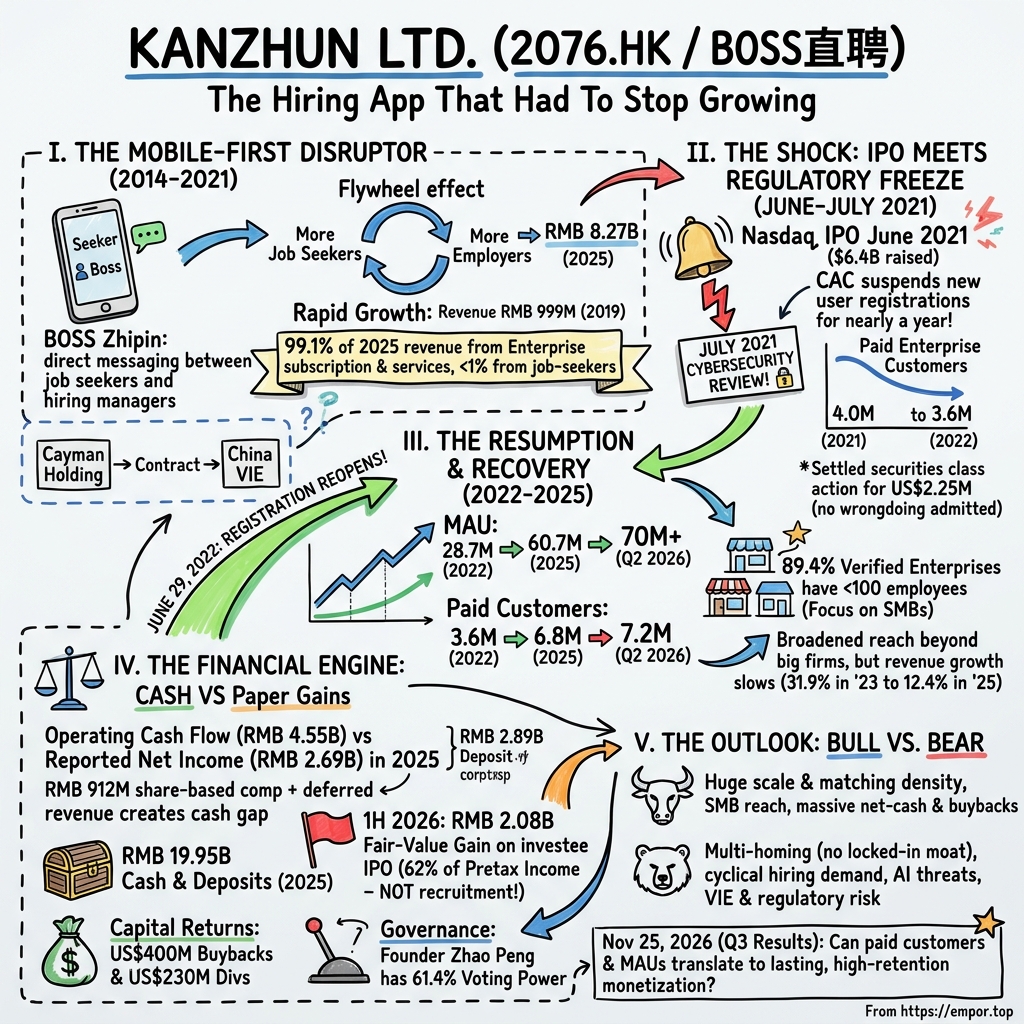
Kanzhun Ltd.: The Hiring App That Had to Stop Growing
I. One Year After Its IPO, the App Went Quiet
Picture a young man in a rented room on the edge of a Chinese factory city. He wants a job that pays better than the one he has. He has no résumé worth printing and no recruiter to call. So he opens an app, scrolls past a few listings, and taps a button that sends a message to the owner of a small logistics firm across town. The owner is standing in a warehouse with a phone in one hand. He reads the message, asks two questions, and invites the young man to come in the next morning. There is no job board in the usual sense here, no human-resources department and no headhunter. There is a chat window between a job seeker and a boss.
That chat window was the whole idea behind BOSS直聘 Boss Zhipin, the app operated by 看准 Kanzhun Ltd. The name says it outright. "Zhipin" means direct hiring, and "Boss" is who you get to talk to. By mid-2021 the idea had made Kanzhun one of the most celebrated Chinese internet listings of the year. Its shares started trading on Nasdaq on June 11, 2021.1 Then, three and a half weeks later, the chat window stopped admitting new people.
On July 5, 2021, China's 网络安全审查办公室 Cybersecurity Review Office, operating under the 国家互联网信息办公室 Cyberspace Administration of China, announced that it was opening a cybersecurity review of Boss Zhipin, along with two truck-hailing platforms, 运满满 Yunmanman and 货车帮 Huochebang.2 The notice was short and its consequence was blunt: during the review, the apps were to stop registering new users.2 Existing users could keep chatting. Nobody new could join.
For most businesses, a pause on new customers is painful. For a marketplace, it strikes at the mechanism itself. Recruitment platforms do not sell inventory. They sell the likelihood that the right person is on the other end of the line, and that likelihood depends on fresh arrivals: the graduate looking for a first job, the factory worker switching cities, the small shop owner hiring for the first time. Cut off the inflow and the network starts to age. The suspension lasted almost a year. Boss Zhipin reopened registration on June 29, 2022.3
Four years later, that interruption looks less like an ending than a dent. In 2025 Kanzhun generated RMB8.27 billion of revenue, roughly eight times what it took in six years earlier, and RMB4.55 billion of cash from operations.1 In the second quarter of 2026 the app reported more than 70 million average monthly active users for the first time.4 By any reasonable standard the product did not break.
The interruption mattered for a different reason. It wrote a lasting clause into the investment case. Kanzhun's marketplace depends on two forms of permission. The first comes from employers, who must keep wanting to hire and keep believing the app is where they will find people. The second comes from the state, which showed in July 2021 that it can stop a hiring platform from growing with a single announcement. Neither permission is guaranteed, and neither shows up on a balance sheet.
There is a third question this story has to keep asking, and it is newer. In the first half of 2026 Kanzhun's reported profit jumped. A large part of that jump came from a fair-value gain on a company it had invested in, which went public in January 2026, not from more employers paying to hire.5 So investors have to ask three things at once. Can the marketplace keep growing? Does its way of matching people give it an edge competitors cannot copy? And how much of today's profit comes from hiring rather than from the treasury?
Before going further, one boundary needs to be drawn, because it shapes everything else. Kanzhun Ltd., the company whose shares trade in Hong Kong under 2076 and in New York as ADSs, is a holding company incorporated in the Cayman Islands.1 It does not directly own the business that runs Boss Zhipin inside mainland China. That business is run through Chinese subsidiaries and a variable interest entity, or VIE, which the listed company controls through a set of contracts rather than through normal share ownership.1 The financial figures in this story are for the consolidated group, and they include the VIE. But an investor in 2076.HK owns shares in a Cayman company whose grip on its most important operations rests on agreements, and Kanzhun's own risk disclosures warn that those agreements may be less effective than direct ownership and that their enforceability under Chinese law carries uncertainty.1
It helps to picture how such a structure works, because the word "VIE" is easy to read past. Chinese rules restrict foreign ownership of certain internet businesses, and the licences an online recruitment platform needs sit in that territory. So the licensed operating company inside China is owned on paper by Chinese individuals, while a foreign-owned subsidiary signs a bundle of contracts with it: exclusive service agreements that route its economic benefits outward, powers of attorney over shareholder votes, options to buy the equity when the law permits, and a pledge of the VIE's shares as collateral.1 The effect is control by contract. Think of a house you cannot legally own, so a trusted friend holds the deed while you hold signed papers giving you the rent, the keys and the right to buy it later. It works as long as the friend, the courts and the government all honour the papers. That is the most structural fact about Kanzhun, and it sits underneath every other one.
So the story begins where the app began: with a man who thought the job board had been built for the wrong screen.
 Subscribe on LinkedIn
II. A Job Board Built for the Phone in Your Hand
Before Boss Zhipin, 赵鹏 Zhao Peng had already spent years inside Chinese online recruitment. He had been chief executive of 智联招聘 Zhaopin, one of the country's two dominant desktop-era job boards, before leaving to start his own company.6 Few people knew the old model better. He also knew its weaknesses better than most, because he had spent years selling the old model. A desktop job board earned its money from the employer's posting fee, not from whether anyone was hired, so the incentive was to sell more postings and more résumé downloads rather than to make the match itself faster. Zhao's later product reads like a direct answer to that incentive problem.
The classic Chinese job board of the 2000s worked a lot like a newspaper classified section that had been moved onto a website. Employers paid to post listings. Job seekers uploaded résumés and fired them at dozens of openings. Somewhere in the middle, a human-resources assistant at the employer sorted through the pile, often days later, and most applicants heard nothing back. The economics rewarded volume. The experience, for everyone involved, felt like shouting into a well.
Zhao's first company was named 看准网 Kanzhun.com, a site where employees could review employers, closer in spirit to Glassdoor than to a job board.1 The name means roughly "see it clearly", and the listed company still carries it. But the bigger bet came in July 2014, when the team launched Boss Zhipin as a mobile app built around one radical simplification: let the job seeker talk directly to the person doing the hiring.1
It is worth slowing down on why that mattered, because it sounds trivial and was not. In a traditional board the unit of interaction is a document, the résumé, sent one way. In Boss Zhipin the unit is a conversation, carried both ways and in real time. A boss can scroll through candidate profiles the app recommends and start a chat. A job seeker can do the same in reverse. Either side can ask a question, decline, or set up an interview within minutes. Behind the chat window sits the part users do not see: recommendation algorithms deciding which profiles and which jobs to show to whom, based on everything both sides have done on the platform.1
Think of the difference between a classified ad and a dating app. The classified ad tells you something exists. The dating app puts two people in a conversation and learns from whether it goes anywhere. Boss Zhipin applied the second logic to work. It also suited the phone, the device that by the mid-2010s had become the only computer most young Chinese workers owned. A factory worker in a dormitory does not have a desktop. A café owner hiring two waiters does not have an HR department. Both have WeChat-trained thumbs.
The growth that followed was not subtle. Revenue grew about eightfold from 2019 to 2025.71 Average monthly active users rose from 28.7 million in 2022, a figure still marked by the registration freeze, to 60.7 million in 2025.[^8]1 On the evidence of scale alone, the product found its market.
Who actually pays
Here is the first thing that surprises people about Boss Zhipin: almost none of its users pay. Job seekers use it free. In 2025, 99.1% of revenue, about RMB8.19 billion, came from online recruitment services sold to enterprise customers.1 The small slice from job seekers, who can buy value-added services that help their profiles stand out, was under 1% of revenue and shrinking from 2024.1 Kanzhun is a business that gives the consumer side away and charges the employers who want to reach those consumers.
Employers pay in two broad ways. They can buy subscription packages, which give them access to job postings and recruiting tools for a set period, or they can buy services separately, often limited by usage, such as a fixed number of extra chats or premium listings.1 Revenue from subscriptions is recognized gradually over the subscription period. Usage-limited services are recognized as they are consumed, or when they expire unused.1 What Kanzhun does not disclose matters as much as what it does. There is no uniform contract length, no minimum commitment, and no figure for how much revenue recurs from the same customers year after year.1 It would be easy to call this "subscription software" and borrow the valuation logic that comes with that label. The filings do not support that comparison. An employer can subscribe for a hiring season and disappear when the hiring stops.
A useful way to see the price point is to divide revenue by paying customers. In 2025, 6.8 million enterprises paid Kanzhun something, which works out to roughly RMB1,200 of enterprise revenue per paying customer for the year.[^9]1 That is about the price of a mid-range smartphone, which says something about who these customers are. They are not multinational HR departments signing seven-figure contracts. They are mostly small businesses paying modest amounts to fill a few roles.
The flywheel and its limits
The case for Boss Zhipin as a great business rests on a familiar marketplace loop. More employers on the app make it more useful to job seekers, because there are more jobs to chat about. More active job seekers make it more valuable to employers, because there are more candidates to reach. Each side's growth is a reason for the other to show up. When that loop works, a marketplace can become very hard to dislodge, because a new competitor has to persuade both sides to move at once.
Kanzhun has the scale such a loop needs. What it does not publish is the evidence that the loop has turned into lock-in. There are no retention rates for paying employers, no renewal figures, and no data on how many employers also recruit on rival apps at the same time.1 A job seeker can have three recruitment apps on the same phone. A restaurant owner can post the same opening on Boss Zhipin and a competitor in ten minutes. Scale proves the product reaches people. It does not, on its own, prove those people would struggle to leave.
That distinction may sound academic in a growing market. It stopped being academic in July 2021, when Kanzhun learned what happens to a marketplace's momentum when new users cannot get in.
III. The IPO Boom Met a Cybersecurity Review
The spring of 2021 was a strange season for Chinese internet listings. Capital was abundant, American investors were still eager for Chinese growth stories, and companies that had waited years for the right window rushed through it. Kanzhun was one of them. Its registration statement filed with the SEC in May 2021 told a crisp story: a mobile-native recruitment platform, growing fast, with an engaged user base and an employer customer count that had multiplied.6
The numbers behind that story were real. Paid enterprise customers had reached 2.2 million in 2020.6 Over the course of 2021 that figure almost doubled, to 4.0 million.[^8] Revenue more than doubled in 2021 too, as China's economy reopened after the first pandemic year and employers rushed to rehire.7 The June Nasdaq listing raised roughly RMB6.4 billion in net proceeds, a war chest larger than the company's revenue that year.3 Tencent, through its investment arm, was among its shareholders.6
It is worth asking how much of that moment was the product and how much was the season. The answer, in hindsight, is both. A recruitment platform naturally grows fastest when hiring rebounds, and 2021 was a rebound year. The IPO prospectus captured Kanzhun at a peak of both the economic cycle and the investor cycle. That does not make the growth fake. It makes it a poor baseline.
Twenty-four days
Then came July 5. The Cyberspace Administration of China's announcement cited national security and the need to prevent data risks, invoking China's national security and cybersecurity laws and its cybersecurity-review measures.2 It placed Boss Zhipin in the same notice as two truck-hailing apps. All three had recently listed in the United States, and that timing was not lost on anyone. Beijing was signalling that companies holding large volumes of Chinese user data, and listing abroad, would be scrutinized on terms the state set.
The order to stop new registrations was the part that bit. Kanzhun said it would cooperate fully with the review and would conduct a comprehensive examination of cybersecurity risks.3 For the following eleven and a half months, the platform operated under that restriction. A recruitment network, more than most, depends on newcomers. Every graduating class, every migrant worker moving cities, every new small business is a potential user. For almost a year, that flow was dammed.
Shareholders who had bought the stock in the IPO sued. A securities class action alleged that the company's offering documents had failed to disclose the regulatory risk adequately. Kanzhun settled for US$2.25 million, the settlement received final approval in April 2023, and it involved no admission or finding of wrongdoing.1 Measured against the company's cash pile, the payment was trivial. Measured as evidence, it recorded that investors who bought into the IPO story had not been told how fragile the growth path could be.
What the freeze revealed
The cleanest test of a network is to cut off its growth and watch what happens. Kanzhun went through that test involuntarily. Paid enterprise customers fell from 4.0 million in 2021 to 3.6 million in 2022.[^8] Revenue growth slowed to 5.9% in 2022, after more than doubling the year before.7 Average monthly active users were 28.7 million in 2022.[^8]
Some of that slowdown was the freeze. Some of it was 2022 itself, a year of rolling lockdowns in Chinese cities that hit small businesses, the core of Kanzhun's customer base, especially hard. The company's filings do not separate the two effects, and an honest reader should not pretend to. What can be said is that the customer count went backwards, which means employers did leave or pause when the platform stopped adding new job seekers and the economy weakened together. The network did not hold every customer through a shock.
But there is a second half to the test. Existing users kept using the app. Revenue still grew in 2022, if slowly, and the company swung to a net profit of RMB107 million that year after its earlier losses.7 The engine was idling, not seized. The word Kanzhun used for what it did during the review, rectification, is worth noting. In Chinese regulatory practice it means the company fixed what the regulator asked it to fix, without a public account of what those items were. Investors learned that the review ended. They did not learn, then or since, precisely what data practices had changed, which means the episode tells them a great deal about the regulator's power and much less about the specific risk that triggered it. Boss Zhipin announced that the cybersecurity review was complete and that new user registration had resumed; the company said it had completed rectification under the regulator's guidance.3
Six months later, Kanzhun completed a second listing. Its shares began trading on the Hong Kong Stock Exchange on December 22, 2022, as a dual primary listing alongside Nasdaq, which gave the company a home market closer to its users and a hedge against the risk of being forced off American exchanges.1 In that listing document Kanzhun put its share of China's online recruitment revenue for the first half of 2022 at 6.1%, a modest-sounding number that later mattered in arguments about dominance.3
So what did 2021 and 2022 teach? Two things that pull in opposite directions. The product clearly survived. Users and employers did not abandon it, and when the gate reopened, they came back in large numbers. But the IPO-era growth rate was never a fair baseline, and the freeze showed how quickly a policy decision can stop user acquisition at a company whose value depends on user acquisition. An investor who drew a straight line from the 2021 prospectus would have been wrong in 2022. An investor who wrote the company off in 2022 would have been wrong in every year since. The question became what kind of growth came back.
IV. Recovery Came Through Smaller Employers and More Users
When registration reopened in the summer of 2022, the app did not need to rebuild its brand. Millions of people already knew it. What it needed was the newcomers it had missed, and they arrived in force. Average monthly active users grew from about 47% in 2023 to about 15% in 2025, slowing each year and reaching 60.7 million.1[^9]
Read that sequence carefully. The first year after the freeze was partly catch-up, a backlog of people who would have joined in 2021 and 2022 joining at once. The second year still grew fast. The third had slowed to the mid-teens. That is the shape of a recovery that turned into ordinary growth, and ordinary growth eventually meets the size of the market. Revenue growth slowed from about 32% in 2023 to about 12% in 2025.1
The small-employer engine
Who were the employers that came back? Kanzhun's own answer is revealing. In its 2025 annual filing, the company said 89.4% of its verified enterprises had fewer than 100 employees.1 This is not a platform for corporate HR departments with applicant-tracking systems and procurement teams. It is a platform for the noodle shop, the regional logistics company, the e-commerce startup and the small factory.
That focus is the product thesis made visible. Large employers already had ways to recruit: campus fairs, agencies, their own career sites, established job boards. Small employers mostly had word of mouth. Boss Zhipin gave a business owner a way to reach thousands of candidates from a phone, without hiring a recruiter. The marketing line fits the evidence: the boss does the hiring, and the app makes that possible.
Kanzhun does sell to large companies too, and says it serves members of the Fortune China 500 as well as millions of smaller firms.1 The company sorts its revenue by account size, and the split is more balanced than the customer count suggests. In 2025, key accounts brought in about RMB2.1 billion, mid-sized accounts about RMB2.7 billion and small accounts about RMB3.5 billion.1 Small businesses are the largest slice, but not most of the money. That matters for two reasons. It means Kanzhun's revenue is not hostage to a handful of giant customers, which helps resilience. It also means growth depends on keeping millions of small, price-sensitive businesses paying, and small businesses are the first to stop hiring when the economy wobbles. Kanzhun does not disclose revenue from any individual customer, its top five or its top ten.1 Given the size mix, concentration is unlikely to be the risk. Cyclicality is.
Recruitment in China runs on a calendar. Hiring weakens in the weeks before 春节 Chinese New Year, as workers go home and employers wait to see who comes back. It surges after the holiday, when the annual job-switching season begins, and again around graduation in the summer. A quarter that includes a late Chinese New Year can look weaker than the business really is, and a quarter that catches the post-holiday surge can look stronger. Anyone comparing Kanzhun's quarters back to back, rather than against the same quarter a year earlier, is likely to misread them.
The 2025 slowdown was not a seasonal artefact, though. It was visible on a full-year basis. Paid enterprise customers still grew, by 11.5% to 6.8 million, and average users rose 14.5%.[^9] But revenue grew 12.4%, below its earlier pace, which means the company was adding customers faster than it was adding revenue per customer. Divide one by the other and revenue per paying employer was roughly flat at around RMB1,200 a year from 2022 to 2025.[^8]1 For three years after the freeze, Kanzhun grew mainly by finding more paying employers, not by charging them more.
That pattern was not an accident; it reflects where the growth was coming from. A new small employer in a third-tier city typically starts on a cheap package, or on free usage, and graduates to paying only when its hiring needs grow. Adding millions of such customers lifts the customer count quickly but holds down the average. Management's stated plan now runs on two tracks: keep pushing user penetration in China's third- to fifth-tier cities, where the platform is still filling in, and seek "reasonable price increases" in first- and second-tier cities, where density is highest.8 That is a coherent strategy for a maturing marketplace. It is also the first time the company has tied its growth story so openly to price, which means the market will be able to see quickly whether the big-city employers accept it.
A record, and a test
By mid-2026 the platform had passed two milestones. For the trailing twelve months to June 30, 2026, it counted 7.2 million paid enterprise customers, up 10.8%.4 In the second quarter of 2026, average monthly active users were about 70.2 million, up 10.4% and above 70 million for the first time.4 Revenue for the quarter rose 14.1% to RMB2.40 billion, faster than the first quarter.4 On the call, management said the share of users who paid had improved for the fourth consecutive quarter and that average revenue per paying user had risen about 7% from a year earlier.8
That 7% figure is the most interesting number of 2026 so far, because it breaks the pattern of the previous three years. If Kanzhun is now raising revenue per customer while still growing its customer base, the recovery is turning into something better than catch-up. If it is a one-quarter effect, the deceleration will reassert itself. Management guided third-quarter revenue to RMB2.41 billion to RMB2.50 billion, growth of roughly 11% to 16%.4 The range itself told the story: the company was confident enough to forecast low-teens growth, but the slope had flattened from the post-freeze years.
So the rebound was real, broad and durable well beyond the immediate reopening. It came from millions of small businesses discovering that they could hire from a phone. The question the next several years must answer is how much more of China's hiring Kanzhun can capture, and whether it can win each employer's budget every time that employer needs to hire.
V. The Marketplace Has to Earn Its Place in Every Hiring Season
Start with a recruiter at a mid-sized company in Hangzhou. She needs three sales representatives by next month. She posts the role on Boss Zhipin. She posts it on 智联招聘 Zhaopin, where her company has had an account for a decade. She asks her own sales staff whether they know anyone, because referred candidates tend to stay longer. If the role is senior, she might call 猎聘 Liepin. And she waits to see which channel produces someone worth interviewing.
Now flip the camera. A 26-year-old salesperson is quietly looking for a new job. He has Boss Zhipin on his phone. He also has 前程无忧 51job, because that is where his last employer found him. He is answering messages from three companies at once. He will take the best offer, wherever it comes from.
That pair of scenes is the competitive reality of recruitment. Nobody signs an exclusive contract with a job app. Every hiring season, the platform has to earn its share of the employer's budget and the candidate's attention again.
Kanzhun's 2025 annual filing names its competition plainly: other online recruitment platforms, including the established job boards, as well as offline channels and employers' own recruiting.1 The players have distinct histories. Zhaopin and 51job built the desktop-era job-board market and still have deep relationships with corporate HR departments. Liepin focuses on mid-to-senior professionals, with a model closer to digital headhunting. Kanzhun's distinctiveness is mobile-native, chat-based interaction with a strong pull among small employers and younger workers. Beyond those platforms lie substitutes that are not apps at all: referrals, labour agencies, campus recruitment, and the factory gate where a sign says "now hiring."
That leaves the 6.1% share of China's online recruitment revenue that Kanzhun cited for the first half of 2022 as its only published market-share figure.3 It was measured in the middle of the registration freeze and the lockdown year, and it is now more than four years old. More recent filings describe Kanzhun as the largest online recruitment platform in China by revenue and by average monthly active users.1 That is a scale claim, not a share figure, and like-for-like current revenue figures for rivals are scarce, because the long-established boards no longer publish the kind of standalone results that would allow a clean comparison. So the most honest statement is this: Kanzhun is probably the largest single online recruitment platform in China today, and online recruitment is still only a part of how Chinese companies hire.
Run the industry through the classic forces and a clearer picture forms. The rivalry is real but not ruinous. Unlike food delivery or ride-hailing, recruitment in China has not turned into a subsidy war, and Kanzhun's adjusted operating margin of about 44% in the second quarter of 2026 says the company is not being forced to buy share at a loss.4 That margin is evidence of a healthy competitive position in a fragmented market.
Buyer power is the more interesting force. On paper, Kanzhun's customers are weak bargainers: millions of small businesses paying around RMB1,200 a year each, none large enough to dictate terms. In practice, their power comes from their ability to walk. A small business can stop paying the moment it stops hiring, and it can post the same job elsewhere at almost no cost. That is collective buyer power expressed through churn rather than negotiation, and it is why revenue per paying customer stayed roughly flat for three years after the freeze.
Supplier power is negligible. Kanzhun's main inputs are engineers, cloud computing and advertising. Its related-party purchases from Tencent affiliates for cloud, payment and other services were about RMB26 million in 2025, a fraction of a percent of revenue.1
The threat of new entrants is moderate. Building a two-sided recruitment network from scratch is hard, because a new app must attract enough job seekers to interest employers and enough employers to interest job seekers. But China's internet giants have the user traffic to try, and short-video and super-app platforms have experimented with job listings. The barrier is the network, not technology or regulation, and networks can be attacked by anyone who already owns attention.
Substitutes are the most underrated force. Most hiring in China does not happen through job apps. Referrals, agencies and direct employer recruiting compete for the same hiring budget, and in a weak economy employers lean on cheaper channels.
Hamilton Helmer's framework asks which of seven sources of durable advantage a business really has. Two are plausible for Kanzhun. The first is network economies, the flywheel described in the company's early years. Its scale makes Boss Zhipin a more useful place to hire than a smaller rival, because the odds of finding a match rise with density.4 The limit is that this advantage is local and segmented. A plumber in Chengdu benefits from plumbers and contractors in Chengdu, not from software engineers in Shenzhen. A competitor can win in a particular city or job category without matching Kanzhun's national scale.
The second is scale economies in data and machine learning. Every chat, reply and interview booked teaches Kanzhun's matching models something. More data should make recommendations better, which should raise the hire rate, which should attract more users. Kanzhun spent about RMB1.65 billion on research and development in 2025, equal to 20% of revenue.1 That is a sizeable spend on matching technology, but spending is an input, not proof of an output.
Switching costs, the third candidate power, are where the evidence runs thin. Kanzhun does not publish employer retention, renewal rates or how often its customers also use competitors.1 Without those numbers, the most cautious reading of the moat is that it is a large and efficient marketplace whose users could leave, rather than one they find costly to leave. The 2021–22 freeze is the strongest historical evidence on either side: paying customers fell when the platform stopped adding users and the economy weakened together.[^8] Those employers came back once registration resumed, which means the brand and product pulled them back. But they left first, which means they were not locked in.
Counter-positioning and cornered resources do not obviously apply. Branding helps at the margin, since Boss Zhipin's heavy advertising, including a 2026 campaign around the FIFA World Cup, keeps it top of mind.4 Process power is possible in matching but not demonstrable from public disclosures.
Is all that scale making the product better, or only the funnel wider? That is the question that separates a great marketplace from a big one. A big funnel brings more people in. A better product turns more of them into hires. Kanzhun reports the funnel well: users, paying customers, revenue. It reports almost nothing about outcomes, such as how many chats lead to interviews, how many interviews lead to hires, or how long a role takes to fill. Investors should therefore watch the two numbers that sit closest to product quality: whether the paying share of users keeps rising, and whether revenue per paying customer keeps growing. Both improved in the second quarter of 2026.8 One good quarter is not a trend. Several would start to answer the question.
The AI fork in the road
Artificial intelligence cuts both ways for Kanzhun, and management's own account of it shows why.
On the Q2 2026 call, 赵鹏 Zhao Peng described a product that increasingly uses AI in matching, chat and interviews. He said AI-conducted interviews were handling more than 10,000 interviews a day.8 He described search that accepts long, conversational queries rather than keyword filters. He talked about the company's own small language model, Nanbeige, and claimed strong results on third-party benchmarks without citing specific scores.8 Most ambitiously, he sketched a future in which Kanzhun is paid for a "closed loop", that is, for a successful hire rather than for access to tools, and argued that the value of a mutual match in Chinese cities is tiny compared with what employers in developed markets pay per hire.8 He made the point with an image: in Chinese cities, he suggested, a mutual match between a boss and a candidate currently earns the platform about as much as a bottle of mineral water, while in developed markets an employer might pay the equivalent of US$25 to US$50 per match.8 It is a vivid way to argue that Kanzhun's prices have headroom. It is also an illustration, not a disclosed metric, and investors should treat it as management's ambition rather than as evidence of what employers will accept.
When Goldman Sachs asked how large that closed-loop AI revenue had become, and what matching-efficiency gains AI had produced, Zhao's answer was qualitative. He said closed-loop revenue grew rapidly from the previous quarter, but gave no figure.8 That is a meaningful gap. It is one thing to say AI is improving matching. It is another to show it in hire rates, in revenue per customer, or in a disclosed revenue line.
The bull reading is clear. If AI lets Kanzhun pre-screen candidates, run first-round interviews and deliver shortlists, the platform moves from selling access to selling outcomes. Outcome-based pricing could let it capture far more of each hire's value than RMB1,200 a year per employer.
The bear reading is just as clear. If AI agents can scour the internet for candidates, write outreach messages and run interviews on behalf of any employer, the value of a dedicated recruitment marketplace could shrink. Employers might pay for the AI tool rather than the platform. Job seekers might let their own AI agents apply everywhere at once, flooding every channel with applications and devaluing the chat window that made Boss Zhipin distinctive. In that world, the scarce resource is no longer access to candidates but the ability to verify them, and it is not yet clear who owns that.
Management's tone on pricing has also shifted. Management's stated pricing ambition is more explicit than the company's earlier messaging, which emphasised user growth.8 It matches the recent rise in revenue per paying user, and it is the right test: if Kanzhun's position is as strong as its scale suggests, it should be able to raise prices in its densest markets without losing customers. If price increases bring churn, the moat is narrower than it looks.
Management described recruitment demand in the second quarter as "broadly stable", and said revenue growth was balanced across account sizes, with small accounts showing healthy momentum.8 When Morgan Stanley asked about the macro outlook for the second half and weak consumption, the transcript of the answer is incomplete. Investors are left with management's stated optimism and a guidance range of 11% to 16%.4
The verdict on the competitive position is therefore narrower than the scale suggests. Kanzhun is very likely the largest and one of the most efficient recruitment marketplaces in China, with a product built for the phone in a way its older rivals were not. The public evidence supports a powerful network more strongly than it supports a locked-in customer base. The forward proof sits in three numbers that management already reports: paid enterprise customers, revenue per paying customer and pricing that holds when it rises. If those three keep moving up together, the moat is real. If customer growth continues while revenue per customer stalls, Kanzhun is a big funnel in a contested market.
All of which raises a different question. If the business makes as much money as it does, what happens to the money?
VI. Cash Is Abundant; the Hard Part Is What Counts as Earnings
Two numbers from 2025 sit side by side in Kanzhun's annual filing. Reported net income was RMB2.69 billion. Cash generated by operations was RMB4.55 billion.1 At first glance, the second number looks like a gift: the business produced about 70% more cash than its accounting profit. Six months later, a third number joined them. In the first half of 2026, a single investee company's stock-market debut produced a RMB2.08 billion fair-value gain for Kanzhun, roughly 62% of its pretax income for the half.5
Neither of those things is a red flag on its own. Together they demand careful reading, because they mean Kanzhun's reported profit and its cash flow each contain material that is not the recruitment business working harder.
Start with the gap between profit and operating cash. Three forces explain most of it. The largest is share-based compensation: in 2025 Kanzhun paid RMB912 million of its staff costs in stock rather than cash.1 Accountants record that as an expense, which reduces profit, but because no cash leaves the building, it gets added back in the cash-flow statement. Depreciation and amortization work the same way. The third force is customer prepayments. Employers often pay for subscriptions up front, so cash arrives before the revenue is recognized. In 2025, the increase in deferred revenue, money collected for services not yet delivered, added RMB151 million to operating cash flow.1
Each of these has a different meaning. The prepayments are a genuine strength of the business model, because customers are funding Kanzhun's working capital. But they are smaller than they were: deferred revenue added RMB733 million to cash in 2023, as the post-freeze recovery brought a wave of new subscriptions, and only RMB151 million in 2025.1 Prepayment cash grows only when billings grow. If customer growth slows, that tailwind fades.
The most recent quarter adds two refinements. Stock compensation is falling: it was about RMB186 million in the second quarter of 2026, down roughly 19% from a year earlier and under 8% of revenue, against about 11% of revenue for 2025 as a whole.48 If that trend holds, the gap between reported and economic profit will narrow, which is a genuine improvement in earnings quality. But operating cash flow fell about 10% in the same quarter, to roughly RMB945 million, which the company attributed to heavier advertising and higher tax payments.4 Sales and marketing spending jumped 38%, mostly on a campaign around the FIFA World Cup, while general and administrative costs fell.48 A recruitment app buying World Cup airtime is a reminder that brand still has to be bought each season, and that some of the margin gains of 2025 came from spending that was deferred rather than abolished.
Share-based compensation is the more important adjustment, and it is a real cost. Every share handed to employees dilutes existing shareholders. A sensible investor treats stock compensation as if it were cash wages, because the company could have sold those shares and paid wages instead. Do that, and 2025's operating cash flow falls from RMB4.55 billion to about RMB3.6 billion. That is still a very strong number on RMB8.27 billion of revenue, and still well above net income. The conclusion holds: Kanzhun's recruitment business is highly cash-generative. It is just less generous than the headline suggests.
There is also a quieter story in the cost base. Kanzhun's purchases of property, equipment and software fell from RMB956 million in 2023 to RMB119 million in 2025, and full-time headcount dropped from 5,688 to 4,884 during 2025.1 Revenue rose through that period. This is a company that had built its infrastructure and was harvesting it. That makes 2025's cash flow look especially strong, and it raises a reasonable question about whether the low capital spending will last as management pushes deeper into AI. Research and development spending rose 3.5% in the second quarter of 2026, a sign that the cost lines are no longer falling.[^11]
Receivables, the other place where accounting profit can disguise weak cash, are a non-issue here. Net accounts receivable were about RMB33 million at the end of 2025, a rounding error against RMB8.27 billion of revenue.1 Employers mostly pay before they use the service. Kanzhun's auditor issued an unmodified opinion on the 2025 accounts, with revenue recognition for enterprise services flagged as the critical audit matter.1
The treasury inside the hiring company
Now for the second issue: the money that Kanzhun does not need to run the business. At the end of 2025, cash, time deposits and short-term investments totalled about RMB19.95 billion.1 That pile, more than two years of revenue, includes RMB9.10 billion of wealth-management products, the bank-sold investment instruments common in China.1 It earned real money. Interest and investment income was RMB706 million in 2025, about 22% of pretax income.1 Put plainly, more than a fifth of Kanzhun's pretax profit in 2025 came from being rich rather than from recruiting.
Then came 2026. In January, a company Kanzhun had invested in completed its own IPO. Kanzhun marks that holding to market, and the stock's move produced a RMB2.08 billion pretax fair-value gain over the first half of 2026, of which about RMB1.47 billion landed in the second quarter.54 That is why second-quarter net income rose 173% to RMB1.94 billion, while adjusted net income, which excludes the investment gain, rose a more ordinary 9.4%.4 Kanzhun itself strips the gain out of its adjusted figures, which is the right instinct.4 The gain is not free money even on paper: in the second quarter alone, Kanzhun booked about RMB367 million of tax related to it, and after tax the net investment gains excluded from adjusted profit were about RMB1.1 billion for the quarter and RMB1.56 billion for the half.4 The tax bill is a reminder that a mark-to-market gain creates real obligations before it creates any real cash. But headline readers who saw net income nearly triple were looking at an investment mark, not a hiring boom. And a mark can reverse. Until Kanzhun sells the stake, the gain is a paper number tied to the share price of another company.
The investment record is not uniformly good, either. In 2025 Kanzhun recorded a RMB120 million impairment of intangible assets after the related business delivered lower profitability than expected.1 It is small against the company's size and does not touch the core recruitment engine. It is a useful reminder that treasury and strategic investments can go wrong as well as right, and that the 2026 gain should not be read as proof of an investing touch.
Kanzhun's capital story does not include a large, defining acquisition. Its growth has been organic, and its main uses of capital have been the platform itself, the treasury and, increasingly, shareholder returns. It has also raised money more than once. Beyond the 2021 IPO, the company completed a follow-on share offer in Hong Kong in July 2025, issuing 34.5 million Class A shares at HK$66 each and raising about HK$2.2 billion net.9 That raise is worth pausing on. A company sitting on nearly RMB20 billion of cash and investments did not obviously need new equity. The prospectus framed the proceeds for technology and AI investment and general purposes.9 A skeptical shareholder would note that buybacks retire shares and follow-ons issue them, and that doing both within a short period mostly shuffles ownership around. The arithmetic makes the point. Tencent's 54.97 million shares were described in January 2026 as about 5.39% of the relevant class, which implies roughly a billion shares outstanding.[^13] On that base, the 2025 offering added a little over 3% to the share count. Management said the 2026 buybacks had already retired around 4.6% of share capital by late August.8 In other words, within roughly a year of selling new shares at HK$66, Kanzhun was buying back more than it had issued. Whether that sequence created value depends on the prices paid on each side, and the company does not disclose an average repurchase price in its quarterly releases.
The return policy has become more explicit. In March 2026 the board raised the repurchase authorization to up to US$400 million and extended it to August 28, 2027.4 Kanzhun also committed to return no less than 50% of each prior year's adjusted net income through dividends and buybacks for each of the next three years, starting in 2026.4 In August 2026 it declared an annual dividend of US$0.255 per ordinary share, about US$230 million in total, paid in October.4 Management said it had completed more than US$300 million of buybacks in 2026 by the time of the second-quarter call, and that total returns for the year of about US$530 million exceeded 100% of the previous year's adjusted net income.8 For comparison, in all of 2025 the company had spent RMB143 million on repurchases and RMB553 million on dividends.1 The pace has stepped up sharply.
That is a meaningful change in behaviour, and it should be judged by execution, not by announcements. So far, execution has matched the words.
Who decides
The final piece of the capital story is who controls it. As of February 2026, 赵鹏 Zhao Peng owned 13.8% of Kanzhun's ordinary shares but controlled 61.4% of the votes, through Class B shares that carry weighted voting rights.1 腾讯 Tencent held 5.9% of the shares, and Capital World Investors 6.3%, with less than 3% of the votes each.1 Kanzhun's board is not majority independent, and the company relies on exemptions available to controlled companies.1
Zhao's long tenure is a strength. He founded the company, has led it since inception and has navigated it through a regulatory freeze and a recovery.1 His pay is not out of line with that record but did jump: his total remuneration rose to RMB41.8 million in 2025, including a RMB34.0 million performance bonus, from RMB7.0 million in 2024.1 The rise came in a year when net income grew by about 70%.1 The leadership bench has also been reshuffled in 2026. Xu Chen stepped back from the rotating president role on September 1 to return to marketing, Tao Zhang took over the rotation for one year, and non-executive director Haiyang Yu resigned in October.[^14][^15] The company's annual general meeting in June passed every resolution, but its announcement gave no tally of dissenting votes.[^16]
None of this is alarming. All of it matters, because when one shareholder controls the votes, minority investors' protection comes from his choices and the board's oversight, not from their ability to change course. A RMB19 billion treasury is a resource. Whether it becomes a return depends on one man's judgement, and so far the evidence of 2026 points towards returning more of it.
That brings the story to the moment of judgement: what kind of company is this?
VII. Analysis & Bear vs. Bull Case
Put two numbers from August 2026 side by side. The first is 70.2 million, the average number of people using Boss Zhipin each month in the second quarter.4 The second is RMB2.08 billion, the half-year gain on a stake in a company that has nothing to do with recruitment.5 One measures activity on the platform. The other measures a share price somewhere else. Both drove Kanzhun's 2026 headlines. Only one of them tells you whether the business is getting better.
The investment debate around Kanzhun comes down to a single question. Is it a compounding marketplace whose scale keeps making it more valuable, or a cyclical, contestable platform whose profits are flattered by stock compensation and investment marks? The evidence supports parts of both answers.
The bull case
The bull case starts with density. A recruitment marketplace gets better as more people use it, because a job seeker is more likely to find the right job and an employer more likely to find the right hire. Kanzhun has the largest such network in China by its own account, with 70 million monthly users and 7.2 million paying employers.4 If AI tools make matching faster and more accurate, the platform with the most data and the most conversations should benefit first.
The second strand is headroom. Most Chinese hiring still happens offline or through referrals, and the platform's strongest customer group, small businesses, is enormous. Management's plan to push user penetration in lower-tier cities while raising prices in big cities is a credible two-track growth path.8 Revenue per paying user rose about 7% in the second quarter, and the paying ratio has risen for four consecutive quarters.8 If both continue, growth could hold up even as user growth slows.
The third strand is the balance sheet. Kanzhun has no borrowings, about RMB18.8 billion of cash and short-term investments as of June 2026, and a recruitment business that generated RMB4.55 billion of operating cash in 2025.41 It is returning at least half of its adjusted profit to shareholders and, in 2026, considerably more.48 It also has a margin profile that improved through the slowdown: adjusted operating margin reached a record of about 44% in the second quarter of 2026.4
The bear case
The bear case starts with the economy. Kanzhun's customers are mostly small businesses that hire when they are confident and stop when they are not. Revenue growth slowed from about 32% in 2023 to about 12% in 2025, and 11% in the first half of 2026.15 Some of that is a larger base. Some of it may be a weaker Chinese job market.
The second strand is the moat's thinness. Employers can and do use several channels. Users can multi-home at no cost. Kanzhun publishes no retention, renewal or multi-homing data, so the switching-cost argument rests on inference.1 Monthly active users measure attention, not hires, and the company does not disclose hire rates.
The third strand is AI. If AI agents can source and screen candidates across the open internet, the value of the marketplace's tools could fall. Kanzhun is investing to be the one that deploys those agents, but management has not quantified the revenue they generate.8
The fourth strand is regulation and structure. The 2021 review proved the state can freeze user growth for a year. The VIE structure means the listed company controls its main operations by contract, not ownership.1 Both are permanent features, not passing risks.
The fifth strand is earnings quality. Share-based compensation of RMB912 million in 2025 is a real cost, about 11% of revenue.1 And 2026's headline profit is dominated by a one-off investment mark.5 An investor who capitalises reported earnings without adjusting for both will overpay for the recruitment business.
A skeptical activist, the kind who writes long letters to boards, would push on four points. First, the treasury: why does a business that needs little capital hold nearly two years of revenue in cash and wealth-management products, earning a single-digit return, when the controlling shareholder could return far more of it? Second, the sequencing: why raise equity in July 2025 and then spend more than the proceeds on buybacks the following year? Third, the investee stake: if management believes the January 2026 listing has made the holding fully valued, will it crystallise the gain, or keep a volatile equity position on a recruitment company's balance sheet? Fourth, accountability: with a board that is not majority independent and a founder holding most of the votes, what mechanism, short of the founder's own preference, would force a change in capital policy? None of these questions implies wrongdoing. Each is the kind of question that dual-class control makes harder for outside shareholders to press.
There are also quieter overlays. Kanzhun reports in renminbi, pays its dividend in US dollars and trades in Hong Kong dollars and US-dollar ADSs, so foreign-exchange moves sit between the operating business and every shareholder's return; the company does not disclose a formal hedging programme.1 No credit-rating agency rationale appears in its filings, which matters little for a company with no borrowings but means there is no independent outside view of its balance sheet beyond the auditor.1
The most important thesis claim is that Kanzhun's network gives it a durable, defensible position. The strongest evidence against it is the 2021–22 episode, when paying customers fell by about a tenth and revenue growth nearly stopped.[^8]7 That evidence involves the same business, the same management and the same customer base, so it deserves weight. But it was caused by an external shock that prevented the network from working normally, it lasted about a year, and the business recovered strongly after it ended. The history does not reject the moat claim. It narrows it. Kanzhun has a network that recovers from a shock, not one that is immune to shocks. The evidence that would confirm a stronger moat is sustained growth in revenue per paying customer alongside stable or rising customer counts. Evidence that would falsify even the narrower version is a price increase followed by customer losses.
The second thesis claim is that management allocates capital well. The record is mixed but improving. The company raised equity in 2021 and 2025, has an RMB120 million impairment on its books from 2025, and holds a gain whose realisation is uncertain.15 Against that, it has committed to and so far delivered large shareholder returns.48 The history neither proves nor disproves discipline yet. The test is whether the return policy holds in a year when profits fall.
Out of everything Kanzhun reports, three numbers carry most of the information. The first is paid enterprise customers: 7.2 million on a trailing basis as of June 2026, up 10.8%, slower than the 11.5% growth of 2025.4[^9] The second is average monthly active users: 70.2 million in the second quarter of 2026, up 10.4%, also slowing.4 The third is revenue per paying customer, which Kanzhun reports as a growth rate on its calls: up about 7% in the second quarter after roughly flat years.8 If customer growth slows while revenue per customer rises, Kanzhun is converting scale into pricing power. If both slow, the market is maturing. Full-year 2026 results will show which story is taking hold, and whether operating performance or investment marks drove the year's profit.
Whatever the share price on the day this is read, the logic of valuing Kanzhun is clear. That price will be divided by an earnings figure. For 2026, that figure will contain a large investment gain that may never be realised in cash. An investor should value the recruitment business on adjusted operating income after stock compensation, then add the treasury separately, at a discount if they doubt how it will be used, and then decide what to pay for a VIE-structured Chinese internet company under a controlling founder. Each of those steps involves judgement. None of them is captured by the headline price-to-earnings ratio.
And beneath all of it sits the boundary drawn at the start. Shareholders of 2076.HK own a Cayman company that controls Boss Zhipin's operating business through contracts. That arrangement has worked for Kanzhun and for many Chinese internet companies for years. It has also never been fully tested in a dispute, and its value depends on Beijing continuing to tolerate it.
What, then, is this story really about?
VIII. Business & Investing Lessons
Go back to July 2021. A platform built on new conversations was told to stop adding new people. Five years later, the same platform hosts more than 70 million people a month, a record. Both facts are true, and the lessons live in the space between them.
The first lesson comes from the freeze and the recovery. For eleven and a half months, Boss Zhipin could not sign up a single new user through its app, and its paying customer base shrank. Then the gate opened, and users and employers flooded back in a way few consumer products could match.31 That recovery is a genuine achievement, and it tells founders something important: a product people actually want can survive almost anything except permanent removal. It also tells investors something the bull case tends to skip. Kanzhun did not prevail against the regulator; it complied, rectified, and waited. A marketplace can restart its growth; it cannot make the regulator disappear.
The second lesson comes from who pays. Kanzhun built its brand on job seekers, who use the app free, and its revenue on employers, who pay because they need to hire.1 The company's most impressive metric is user activity, and its most important one is whether those users turn into hires that employers will pay for. For three years after the freeze, revenue per paying customer barely moved, because activity grew faster than employers' willingness to pay more for it. Now management talks about charging for successful hires, a "closed loop" where the platform earns from outcomes.8 That is the right ambition. It is also an admission that the chat itself was never the product. More conversations are valuable only when they help employers hire.
The third lesson comes from the cash and the votes. Kanzhun holds about RMB19 billion of cash and investments, generates billions more each year, and is controlled by a founder with less than a seventh of the economic ownership and over three-fifths of the votes.41 In 2026 the founder chose to return more than ever: buybacks, a larger dividend, a three-year commitment.48 That choice was his to make, and could be his to reverse. For minority investors in controlled companies everywhere, the lesson is that a balance sheet is a set of options held by someone else. A large cash balance is a resource; the controller's choices decide whether it becomes a return.
The fourth lesson comes from the first half of 2026. Net income nearly tripled in the second quarter, and almost none of the increase came from hiring.4 Kanzhun disclosed the gain clearly and excluded it from its adjusted figures. The trap was for readers, not the company. When the investment portfolio writes the headline, read the line underneath.
The fifth lesson comes from the IPO prospectus. In the spring of 2021, Kanzhun's paying customers had almost doubled in a year, and the story told to new shareholders was one of acceleration.6[^8] Within twelve months those customers were shrinking, and the 2021 peak was surpassed only after registration reopened. Nothing in the business was fraudulent and nothing in the product had failed; the season had changed. For anyone underwriting a marketplace at the moment of its listing, the line to remember is short. A growth rate set in a boom is a souvenir, not a forecast.
IX. Epilogue
On the evening of November 15, 2026, Kanzhun stands between two reports. Its latest results, for the quarter to June 30, showed revenue growth accelerating to about 14%, a record adjusted operating margin and the 70-million-user milestone.4 Its next results, for the third quarter, are scheduled for November 25, 2026.[^17] Management has guided that quarter's revenue to grow between roughly 11% and 16%.4 Where the number lands within that range will say something about the strength of Chinese hiring in the autumn and the effect of the summer's World Cup marketing push. A print near the top, with paid customers still growing about 10% and revenue per paying user still rising, would suggest the second-quarter acceleration was the start of a pricing phase rather than a blip. A print near the bottom, with operating cash flow still falling, would suggest that the World Cup spending bought attention more than hires, and that growth is drifting back towards the low double digits of 2025.
But one quarter will not settle the questions that matter. The first is whether Kanzhun's growth is durable. That will be answered by the full-year 2026 paid enterprise customer count and revenue growth, read alongside average monthly users. If customers keep growing near 10% while revenue per customer keeps rising, the business is compounding in a way it did not between 2022 and 2025. If customer growth fades into single digits and revenue per customer stalls, Kanzhun is a mature platform in a cyclical market.
The second question is whether profit is repeatable. Full-year 2026 net income will be inflated by the investee gain, unless the investee's shares fall and some of it reverses. The figures to compare are revenue, operating income and operating cash flow, with investment income set to one side. If the second-quarter cash-flow decline persists,4 it would suggest the cost of growth is rising.
The third question is about alignment. The dividend has been paid and the buybacks are running, but Kanzhun's three-year commitment to return at least half of adjusted profit will be tested when profit growth slows.4 Investors should also watch for evidence on employer renewal and multi-homing, which Kanzhun does not disclose, and whether prices hold as they rise.
There is one more variable, and it does not appear in any results release. Beijing's approach to platform companies has softened since 2021, and Kanzhun has operated without visible regulatory trouble since the review ended. But the rules that allowed the freeze are still in force. No disclosure can measure the probability that they are used again.
X. Outro
The young man in the rented room still opens the app. So does the boss in the warehouse. The chat window that the state once closed to newcomers is busy again, with many users talking directly to the person who might hire them.4
That is Kanzhun's bargain with growth. Its product works because it removes the layers between a job seeker and a boss. Its value depends on keeping that connection open. The app has proved it can reconnect people. Whether that connection lasts, and who ends up with the cash it creates, is the part of the story still being written.
References
-
Kanzhun Limited 2025 Form 20-F — SEC, 2026-04-29 ↩↩↩↩↩↩↩↩↩↩↩↩↩↩↩↩↩↩↩↩↩↩↩↩↩↩↩↩↩↩↩↩↩↩↩↩↩↩↩↩↩↩↩↩↩↩↩↩↩↩↩↩↩↩↩↩↩↩↩↩↩
-
CAC Announces Cybersecurity Review of BOSS Zhipin — Cyberspace Administration of China, 2021-07-05 ↩↩↩
-
Kanzhun Hong Kong Listing Document — HKEX, 2022-12-16 ↩↩↩↩↩↩↩
-
Kanzhun Limited Announces Second Quarter 2026 Financial Results — SEC, 2026-08-25 ↩↩↩↩↩↩↩↩↩↩↩↩↩↩↩↩↩↩↩↩↩↩↩↩↩↩↩↩↩↩↩↩↩↩↩
-
Kanzhun Limited Interim Results for the Six Months Ended June 30, 2026 — SEC, 2026 ↩↩↩↩↩↩↩
-
Kanzhun Limited Annual Report 2022, Four-Year Financial Summary — SEC, 2023 ↩↩↩↩↩
-
Kanzhun (BZ) Q2 2026 Earnings Call Transcript — The Motley Fool, 2026-09-01 ↩↩↩↩↩↩↩↩↩↩↩↩↩↩↩↩↩↩↩↩↩↩
-
Kanzhun Limited Share Offer Prospectus — HKEX, 2025-06-25 ↩↩
 LinkedIn
 WhatsApp
 Reddit
 Hacker News
 Email
 Kindle
 RSS Feed
 Spotify
 Apple Podcasts
 Amazon Music
 Audible
 YouTube