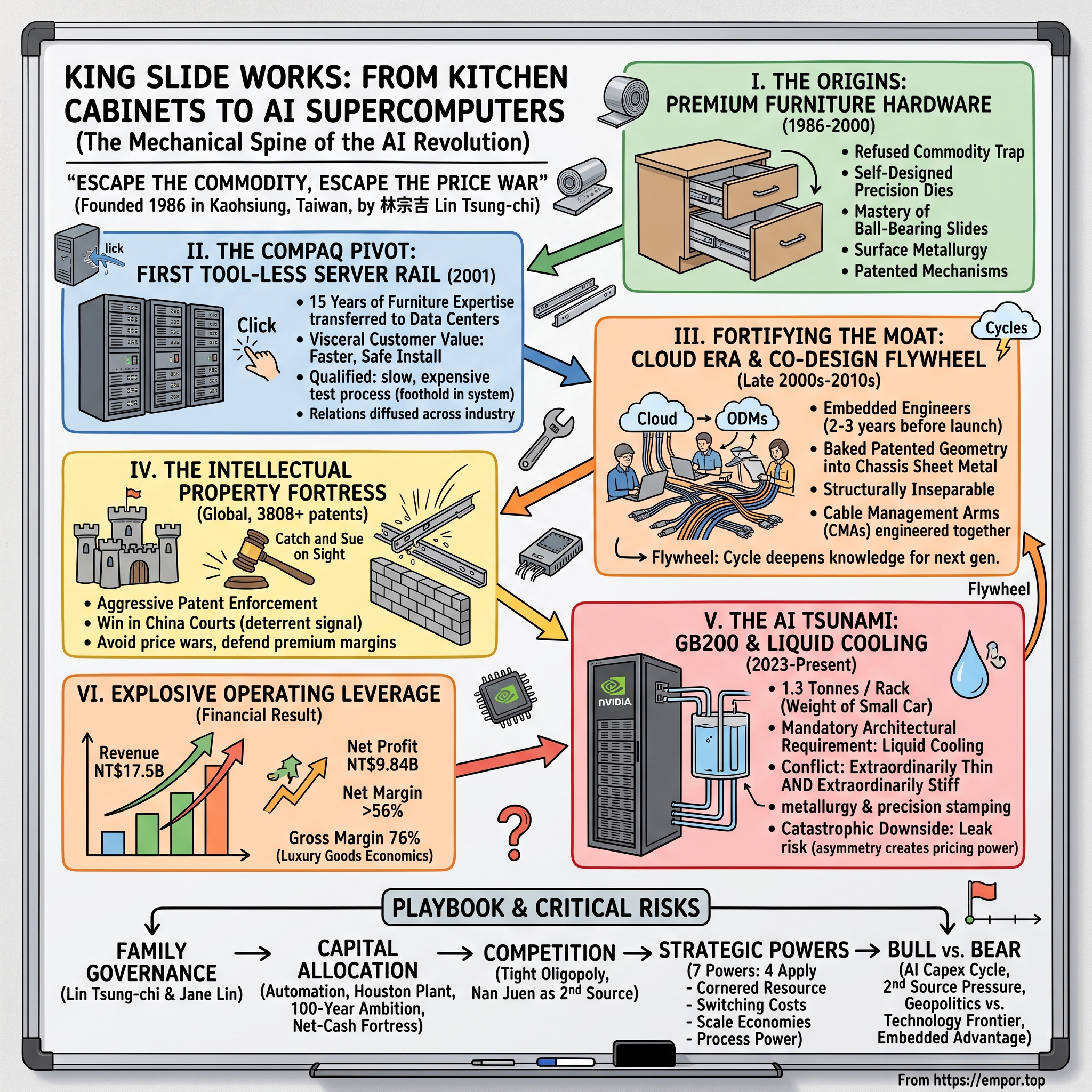
King Slide Works: The Mechanical Spine of the AI Revolution
I. Introduction & Episode Roadmap
Here is a riddle for anyone who thinks they understand where money is made in the artificial-intelligence boom. Name the business that earns a gross margin north of 75 percent and keeps more than half of every dollar of revenue as net profit. Your mind reaches for the obvious suspects: a French luxury house selling handbags at a 90 percent markup, an enterprise-software company shipping code at near-zero marginal cost, or a fabless chip designer renting out the world's most advanced transistors. All plausible. All wrong.
The answer is a metal-stamping company in Kaohsiung, on the southern tip of Taiwan, that spent its first fifteen years making the sliding rails that let a drawer glide smoothly out of a kitchen cabinet. Its name is 川湖科技 King Slide Works Co., Ltd., and it trades on the Taiwan Stock Exchange under the ticker 2059.[^2] In 2025 it turned revenue of roughly NT$17.5 billion into net profit of NT$9.84 billion — a net margin above 56 percent, earned not by writing software but by bending, hardening, and polishing steel.4
That number should stop you. Steel bending is supposed to be a commodity business, the kind of grinding, low-margin trade where Chinese and Taiwanese factories have historically fought each other down to single-digit returns. King Slide earns luxury-goods economics doing it. The riddle of this company is the whole story: how does a family metal shop end up printing software margins on hardware, and how durable is that once you look under the hood?
The short version is a paradigm shift hiding in plain sight. A firm founded in 1986 to make premium drawer slides for wooden cabinets pivoted in 2001 into server racks, and over the following two decades built something close to a global monopoly on one small but unforgiving piece of physical infrastructure: the slide rails and cable-management arms that let a data-center technician pull a running server out of a rack for maintenance and push it back without dropping it.1[^2] In the age of ordinary 1U and 2U servers, that was a decent niche. In the age of Nvidia's liquid-cooled AI supercomputers — GB200, B200, and the coming Rubin generation — where a single rack can weigh well over a tonne and cost millions of dollars, it became something far more valuable: an irreplaceable, high-risk load-bearing component that customers cannot afford to get wrong.
To grasp how strange this is, hold King Slide next to the companies it quietly serves. Nvidia designs the most sophisticated chips on the planet and earns spectacular margins for it; that is comprehensible — it sits at the technological summit. The Taiwanese contract manufacturers that assemble the racks earn thin, single-digit margins for enormous revenue; that too is comprehensible — assembly is competitive and commoditized. King Slide sits at neither extreme. It makes a low-technology-sounding metal part, yet earns margins that exceed Nvidia's on the gross line. The entire puzzle of this company is contained in that misfit between how simple the product sounds and how lucrative it is, and resolving the puzzle requires understanding that the value was never in the steel — it was in forty years of accumulated positioning around the steel.
This is the story of how that happened, and the harder question of whether it lasts. Our roadmap runs in eleven movements. The Carpenter's Vision: humble roots in furniture hardware and a founder who refused the commodity trap. The Compaq Pivot: the 2001 invention of the tool-less server rail. The Co-Design Flywheel: the strategy of embedding engineers inside customers' design loops years before a product ships. The Intellectual Property Fortress: an aggressive, almost pugnacious patent-litigation machine. The AI Tsunami: the physics of liquid-cooled GPU clusters and why weight and thinness suddenly became a moat. And finally the Playbook, the competitive war-game, the strategic frameworks, and the bull-versus-bear stress test that a sober long-term investor has to run before deciding whether 56 percent net margins in a steel business are a fortress or a bubble.
Because that is the real tension here. Everything about King Slide's recent numbers looks too good — and in markets, "too good" is a question, not a conclusion. Let us start where every improbable margin starts: at the beginning, with a man and a drawer.
 Subscribe on LinkedIn
II. The Origins of King Slide: Kitchen Cabinets to Industrial Metals
Kaohsiung in the mid-1980s smelled of hot metal. The port city on Taiwan's southwest coast had grown up around heavy industry — shipbreaking yards, petrochemical complexes, and above all 中國鋼鐵 China Steel Corporation, the state-backed integrated steelmaker whose blast furnaces made the region the beating heart of Taiwan's metallurgical economy. If you wanted to build a business out of shaping metal, there were few better places on earth to be born into the trade. Raw material, skilled tool-and-die men, and a dense web of small subcontractors were all within a short drive.
Into that ecosystem, in 1986, 林宗吉 Lin Tsung-chi founded King Slide Works.1 The product was about as unglamorous as manufacturing gets: drawer slides — the ball-bearing runners bolted to the inside of a cabinet so a drawer can be pulled out smoothly and pushed back without sticking. It was a real market, driven by Taiwan's booming furniture-export industry, but it was also a shark tank. The island in the 1980s was awash in small furniture and hardware makers competing on one axis only: price. Every year the runners got a little cheaper, a little thinner, a little worse, as competitors chased the lowest bid from wholesale buyers who could not tell one slide from another.
Lin made a decision that would echo through the next forty years of the company's DNA: he refused to play that game. This is the origin myth that every King Slide employee can recite, and unlike most corporate origin myths, the later financial statements suggest it is basically true. Rather than compete on being the cheapest, Lin chose to compete on being the best-engineered — investing early and heavily in his own high-precision tooling dies rather than buying cheap generic stamping molds, and obsessing over the tactile qualities that separated a premium ball-bearing slide from a rattling commodity one: the smoothness of the glide, the silence of the close, the resistance to corrosion after years of humidity.
Why did that matter, strategically? Because a drawer slide bought purely on price has no defensible margin — the moment a rival quotes a cent less, the order moves. A drawer slide bought because a high-end European or American cabinet brand trusts that it will feel right and last for a decade is a different product living in a different market, one where the buyer is loyal and relatively price-insensitive. Lin was, without the vocabulary, teaching himself the single lesson that would later let a metal shop earn software margins: escape the commodity, and you escape the price war.
The capital-allocation pattern was set just as early, and it was almost monastic. Instead of taking cash out to scale volume or diversify into adjacent low-margin products, the young company plowed its earnings back into two things — proprietary manufacturing machinery and surface-treatment metallurgy (the plating and hardening processes that determine how a metal part wears and resists rust) — and it began filing design patents on every distinctive mechanism it invented.[^2] For a small family firm in the 1980s, spending scarce cash on patent filings for drawer runners must have looked eccentric, even wasteful. It was, in retrospect, the first brick in a wall that would eventually be over 3,800 patents high.
It is worth dwelling on what a ball-bearing drawer slide actually demands, because the difficulty is easy to underestimate from the outside. A good slide is not one part but a nested assembly of steel members that telescope past one another on rows of hardened ball bearings, each bearing rolling in a raceway pressed into the metal to tolerances of fractions of a millimeter. If the raceway is stamped a hair too shallow, the drawer binds; a hair too deep, and it rattles. The steel has to be hard enough not to deform under load but ductile enough to be formed without cracking, and it has to be treated so that a decade of opening and closing in a humid kitchen does not pit it with rust or wear the bearings loose. Getting all of that right, cheaply and identically across hundreds of thousands of units, is a genuine manufacturing discipline — and it is a discipline that transfers almost perfectly to any application where something heavy has to move smoothly, precisely, and reliably along a track. Lin was building, without knowing it, a general-purpose competence in precision linear motion.
The Kaohsiung setting mattered to how that competence formed. Because the city was thick with metalworking subcontractors and skilled tool-and-die craftsmen — the human capital that grows up around a steel industry — a firm that wanted to design and cut its own dies could find the people and the supporting trades to do it. King Slide's insistence on owning its tooling, rather than outsourcing to whoever bid lowest, meant that its most important intellectual property lived inside the company from the very start: the shapes of the dies, the sequence of the stamping steps, the recipes for the surface treatments. A competitor could buy the same steel and the same presses; what it could not easily buy was the accumulated library of how to make the part well.
None of this made King Slide famous. For its first fifteen years it remained what it was: a well-run, quality-obsessed maker of furniture hardware, invisible outside its trade. But the capabilities it was quietly compounding — self-designed precision dies, mastery of ball-bearing slide mechanics, surface metallurgy, and a reflex to patent everything — turned out to be exactly, almost eerily, the toolkit a very different industry would soon come begging for. That industry was computing, and the call came at the turn of the millennium.
III. The Compaq Pivot: From Drawer Slides to Silicon
Picture a corporate data center around the year 2000. Fluorescent-lit rows of steel racks, each the size of a tall wardrobe, waiting to be filled with servers. Now picture the grim ritual of actually filling one. A server chassis in those days was a heavy steel box, and mounting it meant two or three technicians wrestling it into position, holding its full weight while a colleague fumbled with a screwdriver and a fistful of tiny screws to fasten the mounting brackets — often above shoulder height, often with cables already in the way. The slide rails available then were thick, crude, and prone to jamming when heat made the metal expand. It was slow, it was a two-person job at minimum, and it was a reliable way to drop a machine or crush a finger.
Somewhere inside Compaq — then one of the largest server makers in the world — engineers decided this was a solvable problem. They went looking for a vendor who could deliver a slide rail that was slim, could bear serious weight, and, crucially, could lock a server into a rack without a single screw or tool. It was a demanding spec, and most rail suppliers were exactly the kind of commodity metal shops that could not deliver the precision required.
King Slide could. In 2001 it took the ball-bearing slide technology it had spent fifteen years perfecting for premium kitchen cabinets and re-aimed it at the data center, developing what the company describes as the world's first all-in-one tool-less rail kit for servers.1[^2] The engineering translation was direct and beautiful: the same principles that let a heavy kitchen drawer glide out silently and stop without slamming could let a heavy server glide out of a rack — and the surface metallurgy that kept a slide smooth after a decade of kitchen humidity kept a server rail from seizing under data-center heat. What had been a furniture feature became a mission-critical mechanism.
The payoff for the customer was visceral. Now a single technician could lift a server into place, push, and hear an audible click as the rail locked home — the whole operation reduced from a screwdriver-and-swearing ordeal to a few seconds of one-handed work. Multiply that across the tens of thousands of servers a large data center installs and services, and the labor savings, the reduced damage, and the sheer speed made the tool-less rail an obvious win. Compaq signed King Slide as a key supplier, and the reference customer effect kicked in: winning the validation of one server giant made the others follow. IBM, Dell, and Hewlett-Packard came in behind Compaq, and a Kaohsiung drawer-slide maker quietly became a core supplier to the global server industry.1
The word "validation" is doing quiet but heavy work in that sentence, and it is worth unpacking because it foreshadows the entire later moat. In the server world, a component is not simply bought; it is qualified — subjected to a battery of mechanical, thermal, and reliability tests, then written into an approved-vendor list that engineers are reluctant to reopen. Qualification is slow and expensive, which means that once a supplier is in, inertia works powerfully in its favor. Every technician trained on the click of a King Slide rail, every rack drawing that assumes its dimensions, every service manual that references its lock, is a small deposit in a bank of switching costs. Compaq did not just give King Slide an order in 2001; it gave it a foothold in a system that rewards incumbency. When Compaq was later absorbed into Hewlett-Packard, the relationships and qualifications did not vanish — they diffused across the industry that King Slide was steadily colonizing.
It is worth pausing on why this pivot worked when so many attempts by small manufacturers to climb into higher-value markets fail. King Slide did not diversify into servers by acquiring a server-parts company or hiring away a rival's team. It won by transferring a genuinely hard, genuinely proprietary capability — precision ball-bearing slide engineering — from a market that undervalued it (furniture) into one that desperately needed it (computing). The moat was portable because it lived in tooling and know-how, not in a customer list.
There is also a subtler lesson in the timing. The server rail is a rare kind of product: it is simultaneously invisible and indispensable. Nobody buying a server thinks about the rails; they are a tiny line item, a commodity in the buyer's mental model. Yet the rails are the interface between the expensive machine and the physical world — the thing a human touches every time the server is installed or serviced. A component that is beneath the customer's attention but essential to the customer's operations is the ideal place to build quiet, durable pricing power, because the buyer has neither the incentive to shop it aggressively nor the tolerance for it failing. King Slide had stumbled into exactly that sweet spot, and it would spend the next twenty years fortifying it. But holding a niche in the OEM era, where a few big brands designed everything, was a very different task from holding it in the era that was about to dawn — when the customers designing servers would multiply, fragment, and grow to a scale no OEM had ever reached.
The financial capstone came in 2008, when King Slide listed on the Taiwan Stock Exchange under the ticker 2059, completing its transformation from family metal workshop into a public company.[^2] That timing — going public into the teeth of the global financial crisis, with the stock trading near NT$60 in the panic of late 2008 — is a useful reminder of how far the company would travel. Nearly two decades later the same shares would trade above NT$8,500.3 But the engine that carried it there was not the OEM server business it had just conquered. That business was about to be disrupted by a tectonic shift in who actually buys computers — and King Slide's response to that shift is where the truly durable advantage was forged.
IV. The Cloud Era and the Co-Design Flywheel
For most of computing history, if you wanted a lot of servers you bought them from a brand: Dell, HP, IBM. Those OEMs designed the machines, and suppliers like King Slide sold parts into their designs. Then, over the late 2000s and 2010s, the ground moved. A handful of hyperscale cloud providers — Amazon Web Services, Microsoft Azure, Google Cloud, and Meta — grew so large that buying standard branded servers made no sense. At their scale, every watt of wasted power and every dollar of unnecessary feature multiplied across millions of machines into real money. So they cut out the brand and began designing their own server architectures, then handing the blueprints to Taiwanese Original Design Manufacturers — 廣達 Quanta, 緯穎 Wiwynn, 鴻海 Foxconn, 英業達 Inventec — to build in volume.8
This should have been a threat to King Slide. When the customer changes from a stable roster of OEMs to a shifting ecosystem of cloud giants and their contract manufacturers, an incumbent supplier can easily be designed out. The disruption dissolved the very qualification-and-inertia advantage that Compaq's endorsement had handed King Slide a decade earlier; a company like Meta or Google designing its own server had no reason to inherit HP's approved-vendor list. Many component suppliers who had grown comfortable inside the OEM era were, in fact, quietly squeezed out during this transition, unable to reach the new decision-makers who now sat inside the cloud companies and their ODM partners rather than in Houston or Round Rock. Instead, King Slide turned the disruption into its deepest moat, through a strategy worth understanding carefully because it is the real source of the pricing power that later looks so shocking on the income statement.
The move was this: King Slide stopped behaving like a parts vendor waiting for a spec sheet, and started embedding its own engineers directly inside the design offices of the ODMs and cloud providers — reportedly two to three years before a given server generation was due to launch. The logic is a piece of strategic chess. A slide rail is not a bolt-on accessory; its dimensions, mounting points, and load path are intertwined with the geometry of the server chassis and the rack itself. If King Slide's engineers are in the room while the chassis is still being designed, they can ensure that the physical dimensions of the finished rack are drawn around King Slide's specific rail mechanism. By the time the design is frozen, the company's patented geometry is not an option — it is baked into the sheet metal.
Consider what that does to a would-be competitor. To switch to a rival rail, the customer would have to re-open and re-tool the design of the server housing itself — re-drawing mounting holes, re-validating the load path, re-testing thermal and mechanical tolerances on a machine that might cost millions of dollars per rack. The rail is a tiny fraction of the total cost, but ripping it out means disturbing the whole structure. That is a switching cost measured not in the price of the part but in the risk and delay of redesigning everything around it. King Slide did not build that wall by being cheap; it built it by being early, and by making itself structurally inseparable from the customer's own product.
It helps to be concrete about the second product in that revenue mix, the cable-management arm, or CMA, because it illustrates how King Slide turned an afterthought into a second moat. When a server slides out of a rack, its cables — power, networking, and increasingly liquid-cooling lines — must travel with it without kinking, snagging, or disconnecting. The CMA is the articulated, hinged bracket that carries and folds those cables, choreographing them so a technician can extend a running machine a meter into the aisle and slide it back without ever touching the wiring. On a dense AI rack threaded with hundreds of cables and coolant hoses, a badly designed CMA is not an inconvenience; it is a hazard. Designing the rail and the CMA together, as a matched pair engineered into the specific chassis, is far harder than selling either alone — and it is another reason a customer cannot simply swap in a competitor's rail without unraveling the whole cable architecture around it.
The flywheel is self-reinforcing. Each design cycle King Slide co-engineers deepens its knowledge of the next generation's thermal and mechanical demands, which makes it the natural partner for the generation after that, which gives it earlier access still. Trust, once earned inside a customer's most sensitive design process, compounds. This is why a commodity-sounding product can command non-commodity margins: the customer is not really buying steel, it is buying three years of embedded co-engineering and the assurance that the part will fit and hold.
A neutral observer should test this claim rather than accept it, and the test is the revenue mix combined with the margin trajectory. If King Slide's edge were merely being a competent, low-cost stamper, its margins would look like a stamper's — twenty or thirty points of gross margin, ground down over time by Asian competition. Instead margins climbed as the product grew more demanding, which is the signature of a business that is being paid for engineering scarcity rather than for metal. That is the empirical fingerprint of the co-design moat: value that rises with complexity rather than eroding with commoditization. The furniture business, tellingly, shows the opposite pattern — a low-growth legacy segment where King Slide competes with everyone and earns ordinary returns. The same company, the same factories, two utterly different economics, separated entirely by whether it is designed into the customer's product or merely sold to it.
The clearest evidence of how completely this worked is in the revenue mix. Server slide rails and their companion cable-management arms — the hinged brackets that keep the thick bundle of cables tidy as a server slides in and out — grew to dominate the business, accounting for the overwhelming majority of sales and very nearly all of operating profit; by 2025 rail kits represented on the order of 90 percent or more of total revenue.8 The original furniture and kitchen-cabinet hardware, the business the whole company was founded on, shrank to a small legacy segment serving high-end European and American cabinet brands. The drawer slide did not disappear — it evolved into the server rail, and the server rail ate the company. But holding a design-in position is only half a moat. The other half is stopping anyone from copying the design once it ships. That is where King Slide reveals a personality far more aggressive than its quiet Kaohsiung image suggests.
V. The Intellectual Property Fortress & "Sue on Sight" Strategy
Most companies talk about their patent portfolio the way they talk about insurance — a defensive necessity, filed away and rarely used. King Slide treats its patents the way a medieval city treated its walls: as an active instrument of war, patrolled constantly, and turned on any intruder without hesitation. By its own count the company held 3,808 patents worldwide as of July 1, 2026, spanning Taiwan, China, the United States, Canada, the United Kingdom, Germany, and Japan, and management describes this portfolio, without embarrassment, as its "strongest protective moat."3
What makes the fortress unusual is not its size but the doctrine behind it — a philosophy that Taiwanese business media have nicknamed 抓到就告, roughly "catch them and sue on sight." King Slide runs what amounts to a standing legal-enforcement operation. It buys competitors' rail products on the open market, tears them down, compares the mechanisms against its patent catalog, and if it finds infringement, it litigates — quickly and publicly. This is not litigation as a last resort; it is litigation as a routine, budgeted business process, and the company has been remarkably willing to pursue it across the very jurisdiction where copying is easiest to get away with: mainland China.
The track record gives the doctrine teeth. In 2019 King Slide brought an infringement action against a subsidiary of the Kunshan-based rail maker 聯德控股 Lead Holdings — 昆山聯德 Kunshan Lead — over server slide rails. It won. In 2021 the Jiangsu High People's Court upheld the case, ordering the infringer to pay roughly RMB 3 million in damages and to immediately halt production and sale of the offending products.5 For a Taiwanese firm to win a clean, enforced patent judgment against a mainland competitor in a Chinese court was, at the time, a genuinely striking outcome — and a warning shot to the entire copycat ecosystem.
King Slide did not stop there. On October 30, 2024, it disclosed a fresh wave of infringement suits against three more mainland Chinese firms — 泛亞電子(無錫) the Wuxi arm of the Fan-Ya/Universal group, along with 南京創瑞豐 Nanjing Transray and a related Nanjing entity — after discovering that servers were shipping with rails, branded under a third-party mark, whose structure it judged to fall squarely inside its patent claims.6 The company subsequently prevailed on infringement. And then it did something that tells you a great deal about its posture: having won, it declared itself dissatisfied with the size of the damages award and announced it would appeal to demand more.7 Winning was not enough; King Slide wanted the penalty large enough to be a deterrent to the next imitator watching from the sidelines.
Read that behavior as an investor and the strategy becomes clear. The point of the litigation is not primarily the damages — RMB 3 million is a rounding error against NT$17.5 billion of revenue. The point is signaling. Every published judgment tells the ODMs and cloud providers that if they source a cheaper knock-off rail, they are buying a lawsuit and a supply-chain disruption along with it. That transforms King Slide's patents from a private asset into a public disincentive that polices its customers' behavior for it. Rather than cut prices to fend off cheaper rivals, the company uses the courts to make the cheaper rival radioactive — which is precisely how it defends premium margins without discounting.
There is a governance-flavored point buried in this strategy that is easy to miss. A patent enforcement program only works if the underlying patents are strong and the company is willing to spend real money and management attention litigating in slow, uncertain foreign courts, sometimes for years, with no guarantee of recovery. Many firms file patents and never enforce them, precisely because enforcement is expensive and distracting. King Slide's choice to run enforcement as a permanent function reveals something about how management thinks: it treats the intangible asset — the patent wall — as seriously as the physical one, and it is willing to bear present costs to preserve future pricing power. That is a coherent, long-horizon posture, and it is consistent with the same founder-driven discipline that refused to cut prices four decades earlier.
A skeptic should note the limits here. Patents expire; the earliest, standard-rail designs are aging, and a determined competitor can sometimes engineer around a claim rather than copy it. Litigation also cuts both ways reputationally, and Chinese industrial policy could grow less hospitable to a Taiwanese plaintiff — the very fact that King Slide has, so far, won in Chinese courts is no guarantee it will keep doing so if cross-strait tensions harden. And there is a quieter risk that the largest customers, the ones with the most leverage, eventually decide they would rather fund a challenger's design-around than remain hostage to a single-source supplier's patents. The fortress is real, but it is a wall that must be continually rebuilt as older bricks crumble. For now, though, the combination of design-in switching costs and aggressive patent enforcement gave King Slide something most component makers only dream of — and then, in 2023 and 2024, the AI boom arrived and made that position worth a fortune.
VI. The AI Tsunami: Heavy Iron, Liquid Cooling, and the GB200
To understand why King Slide's margins exploded, you have to feel the physical weight of the AI revolution — literally. A traditional server was a slim box, one or two rack-units tall, weighing perhaps fifteen or twenty kilograms; sliding it out for service was hardly a feat of engineering. An Nvidia GB200 NVL72 rack is a different species of machine entirely. It packs 72 Blackwell GPUs into a single rack-scale system wired together to behave as one giant processor, and fully loaded it weighs on the order of 1.3 tonnes — the mass of a small car, standing upright in a steel frame.2
Now impose two constraints that pull violently against each other. First, the rails that let this monster slide out for maintenance must be extraordinarily thin, because every millimeter inside the rack is fought over by power busbars, thick cable bundles, and — the defining feature of this generation — the manifolds and hoses of a liquid-cooling system. Nvidia's GB200 does not merely benefit from liquid cooling; the chip density is so extreme that liquid cooling is a mandatory architectural requirement, not an option. That means the rack is threaded with coolant plumbing, and space is at an absolute premium. Second, despite being thin, the rails must be stiff enough to bear hundreds of kilograms cantilevered out into the aisle when a technician pulls the system forward, without sagging, flexing, or binding.
Thin and strong are opposites. Resolving them is a metallurgy and precision-stamping problem — exactly the discipline King Slide has been compounding since it was making drawer runners, now pushed to its physical limit. A rail that is a fraction of a millimeter too flexible will let a 1.3-tonne system droop as it extends; a rail that is too bulky steals space the coolant lines need. Getting both right, repeatably, at scale, is the whole game.
An analogy makes the difficulty tangible. Imagine being asked to build a bookshelf bracket as thin as a butter knife that can nonetheless hold a full-grown adult sitting on the end of it, extended a meter from the wall, without bending a hair — and then to make ten thousand of them identical to within the thickness of a human hair, month after month. That is roughly the demand an AI-rack rail must satisfy, except the "adult" is a rack of GPUs worth more than a house and the consequence of a millimeter of sag is not a wobbly shelf but a cracked coolant fitting. The reason this cannot be solved simply by using thicker steel is that thickness is the one thing the rack cannot spare; the reason it cannot be solved with exotic lightweight materials is that they either lack the stiffness or blow the cost. The answer lives in the unglamorous middle — in the precise geometry of the stamped cross-section, the selection and heat-treatment of the steel, and the engineering of the ball-bearing raceways so that the load spreads without binding. It is, in other words, the same problem King Slide solved for a kitchen drawer, scaled up by three orders of magnitude in consequence.
And the cost of getting it wrong is where the moat turns from convenience into necessity. If a slide rail warps, jams, or racks slightly out of true while a technician is pulling out a live, liquid-cooled system, the mechanical stress can be transmitted to the quick-disconnect couplings that join the coolant lines. Crack one of those valves and you get a coolant leak inside a rack packed with GPUs — and conductive fluid meeting live, multi-million-dollar compute hardware can destroy it in seconds. The rail, a component worth a few hundred dollars, sits directly in the failure path of the single most expensive object in the data center. That asymmetry — trivial cost, catastrophic downside — is the psychological core of King Slide's pricing power. No rational data-center operator saves a hundred dollars on an unproven rail to risk a three-million-dollar cabinet.
This is why King Slide's engineering became the default for the AI generation, earning it a place on the short list of validated suppliers for Nvidia's flagship systems and, by the company's and analysts' accounting, something like 70 to 80 percent of the global market for AI server rail kits.2 The financial consequence was a textbook demonstration of operating leverage. Because AI rails command a far higher average selling price than legacy server rails while running through largely the same fixed factory base, the extra revenue fell disproportionately to the bottom line. Gross margin climbed from a historical baseline around 57 percent in 2022 to 61 percent in 2023, to 69 percent in 2024, and to a record 76 percent in 2025 — with net margin expanding past 56 percent.43
It is worth translating the margin arithmetic into plain English, because the number is so extreme it invites disbelief. A 76 percent gross margin means that for every NT$100 of rails King Slide ships, only about NT$24 goes to the cost of the goods themselves — steel, labor, factory overhead — and NT$76 is left over. After the modest research and administrative costs of a focused single-product company, more than half of the original NT$100 survives all the way to net profit. To earn that in hardware is genuinely rare; it is the economics of a patent-protected pharmaceutical or a dominant software franchise, achieved by a company whose principal raw material is coils of steel. The mechanism is not magic. It is the compounding of everything in the preceding sections — the design-in switching costs, the patent wall, the co-engineered CMA, the reputational safety of being the validated choice — collapsing into a single number: the price King Slide can charge without losing the order.
The revenue trajectory tells the same story in a starker way. After a cyclical trough in 2023, when sales dipped to NT$5.76 billion, revenue leapt to NT$10.13 billion in 2024 and then NT$17.5 billion in 2025.4 In the second quarter of 2026 alone the company booked NT$10.83 billion of consolidated sales — up 156 percent year-on-year and nearly double the prior quarter — and June 2026 was a record month at NT$4.44 billion, more than triple the year before.2 First-half 2026 revenue of NT$16.28 billion had, in six months, nearly matched the whole of 2025. Put differently, in the space of three years the company's earnings per share climbed from roughly NT$28 in 2023 to over NT$103 in 2025 — a near-quadrupling that the equity market rewarded by driving the share price above NT$8,500 and making 2059 the second-highest-priced stock in all of Taiwan by mid-2026.43
The obvious analytical caution runs alongside every one of those figures: this is what extreme cyclical upside looks like at the top of a capital-spending wave, and the same operating leverage that magnifies the boom will magnify any bust. The 2023 trough is the tell — a single soft year in the pre-AI server cycle knocked a quarter off revenue, and there is no reason the next downcycle would be gentler now that the business is far more concentrated in one furiously spending end-market. But taken on its own terms, the evidence is unambiguous that King Slide is capturing a dominant, high-value share of the physical build-out of AI infrastructure. The question every investor must then ask is what the people running this windfall do with it — and whether they can be trusted to keep their heads.
VII. Family Governance, Management Credibility & Capital Allocation
There is a familiar arc in Asian family manufacturing dynasties: a disciplined founder builds something real, a windfall arrives, and the second generation spends it on empire — trophy acquisitions, unrelated diversification, glass headquarters, and the slow erosion of the very focus that created the wealth. The most important governance question at King Slide is whether it is following that script or resisting it. So far, the behavior points to resistance, though a windfall this large is precisely when discipline gets tested.
At the center still sits 林宗吉 Lin Tsung-chi, founder and chairman, the drawer-slide obsessive whose refusal to compete on price four decades ago set the entire trajectory in motion. The AI boom made him one of Taiwan's wealthiest individuals; Forbes estimated his fortune at around US$2.9 billion in June 2025, his first appearance on the country's rich list, driven by a stock that had more than doubled.1 His continued large ownership stake is a genuine alignment signal — his personal wealth rises and falls with the same shares outside investors hold. The next generation is woven into management: his daughter 林淑珍 Lin Shu-chen (Jane Lin) serves in the senior executive ranks, alongside son-in-law 王俊強 Wang Chun-chiang, giving the enterprise the tight family control common to Taiwanese industrials.
Family control is a double-edged fact, and a neutral analysis has to hold both edges. On one side, it can enable exactly the long-horizon, quality-over-price patience that a public market obsessed with quarters often punishes — the very patience that let King Slide invest in tooling and patents for decades. On the other, concentrated family power raises the perennial governance questions: minority-shareholder protection, board independence, and whether decisions serve all owners or the family's preferences. King Slide's defense is its track record, and the record is unusually clean of the classic warning signs.
Start with what the company has not done. It has, by its history, avoided M&A almost entirely, preferring to grow organically rather than buy revenue with dilutive, integration-prone acquisitions — the "diworsification" that so often destroys focus. It has resisted the obvious temptation to chase volume by opening low-cost mainland Chinese capacity, choosing instead to stay rooted in Taiwan; management frames the philosophy as "rooted in Taiwan, marketed globally," with an explicit ambition to build a company that lasts a century rather than one that maximizes this cycle.3 And it has consistently refused to buy market share with price. The most revealing anecdote in the company's own telling is of a large U.S. blue-chip customer that demanded a 30 percent price cut; King Slide declined, the customer switched to a cheaper rail, that rail reportedly failed in the field, and the episode became a permanent internal parable about why cutting corners is the real risk.3
The capital it does deploy goes into two disciplined channels. The first is automation — heavily instrumented, near lights-out factories in Kaohsiung, where King Slide has spent two decades building its own production hardware and software in-house, precisely so that precision tolerances do not depend on scarce skilled labor and so that rising wages cannot erode its cost position.3 The second is geographic de-risking: a manufacturing facility in Houston, Texas — a comparatively modest investment reported around US$26 million — designed to serve U.S. hyperscalers on their home soil and to hedge the concentration of production in Taiwan, with mass production expected to begin around September or October 2026.12 Management has also floated a European plant to defend its high-end kitchen-cabinet niche, evaluating sites in Germany, Poland, and the Czech Republic, on the logic that in premium furniture hardware you must "get close to the market" to beat entrenched local brands.3
The balance sheet is the final tell, and it is a conservative one. At the end of 2025 King Slide held roughly NT$24 billion in cash and short-term investments against interest-bearing borrowings of under NT$1 billion — effectively a net-cash fortress, with net cash of around NT$22 billion — while continuing to pay out roughly half of earnings as dividends.4 A company printing 56 percent net margins that carries almost no debt and hoards cash is making a statement about how it views the durability of its own boom: it is not betting the balance sheet on the good times lasting. For a business this cyclical, that caution is a feature.
An activist-minded investor would, in fairness, poke at exactly that cash pile. NT$22 billion of net cash on a balance sheet earning software-like returns is, from one angle, lazy capital — money sitting in low-yielding deposits when it could be returned to owners or reinvested at the company's own extraordinary rate of return. A more aggressive board might lever up modestly, pay a special dividend, or buy back stock. King Slide's answer, implicit in its behavior, is that a company whose revenue can fall a quarter in a bad year and whose factories sit on a geopolitical fault line values optionality and survivability over squeezing the last point of return on equity. Reasonable people can disagree about where the balance should sit, but the choice is coherent and consistently applied — there is no sign of the cash being frittered on vanity projects, related-party deals, or the kind of unrelated diversification that would signal a management losing its discipline. The Houston and mooted European plants are the only large new commitments, and both are defensible on strategic grounds rather than empire-building ones. That consistency between stated philosophy and observed behavior is, in the end, the strongest single piece of evidence on management credibility: over four decades, through a boom that would tempt almost anyone into excess, King Slide has kept doing the same unglamorous things.
But conservatism at the corporate level does not remove competition at the market level, and the more interesting question is who, if anyone, can actually challenge King Slide for the prize.
VIII. Competitor Deep-Dive & Segment Economics
Walk the aisles of a server-rail trade show and you quickly learn that this is not a crowded field. The high-end rail business is a tight oligopoly, and the gap between the leader and everyone else is not a step but a chasm — visible most clearly in the one number a competitor cannot fake: gross margin.
The most credible challenger is 南俊國際 Nan Juen International, listed in Taiwan as Repon (3422). Nan Juen is a real rail manufacturer that has managed to qualify for select U.S. cloud-provider projects and appears alongside King Slide in analyst mappings of Nvidia's server-rail supply chain.8 But its economics tell you exactly where it sits in the pecking order. Where King Slide earns gross margins in the mid-70s, Nan Juen operates in the rough vicinity of 20 to 30 percent — a respectable manufacturing margin, and a fraction of the leader's. That spread is not a matter of King Slide being twice as efficient at bending steel; it is the visible price of King Slide's patent density and design-in position. Lacking the same portfolio of core patents, Nan Juen is pushed toward what is left over: second-source allocations that cloud providers deliberately create for supply security, and standard, non-GPU rack projects where the physical stakes — and therefore the pricing power — are lower.
That role, "the second source," is worth understanding because it is both Nan Juen's opportunity and its ceiling. Large buyers hate single-supplier dependence; a prudent cloud provider wants a qualified backup for even the best component. So there is a structural incentive to keep a second rail vendor alive and to hand it a slice of volume. But a second source qualified largely to keep the first one honest rarely gets the flagship, highest-value nodes, and it typically prices at a discount to win its slice — which is precisely why its margins sit where they do. Nan Juen can grow with the AI wave; what it has not shown is the ability to break King Slide's grip on the most demanding, highest-ASP designs.
The other names in the frame are more spillover than head-on threat. 川益 Fositek is known primarily for hinges and, increasingly, liquid-cooling components, and is positioned to catch adjacent rail opportunities rather than to dislodge King Slide from its core.8 Its presence is a reminder that the AI rack is spawning a whole ecosystem of Taiwanese precision-component winners — hinges, manifolds, cold plates, busbars — each defending a small, specialized niche, and that King Slide's rail franchise is one especially fortified castle in a landscape of such castles rather than a lone monopoly. Western heavy-duty industrial rail makers such as Thomas Regout or General Devices possess genuine mechanical competence but lack the one thing that actually matters in this market: the multi-year, embedded co-design relationships with the specific ODMs and cloud providers building AI racks. You cannot parachute into a design that was frozen with a rival's geometry two years ago.
The economics of the second-source dynamic deserve one more turn, because it is where the bull and bear cases actually collide. From the cloud provider's seat, the ideal outcome is a market with two fully qualified rail vendors of roughly equal capability, bidding against each other on every generation. That would collapse King Slide's margins toward Nan Juen's. From King Slide's seat, the goal is to ensure that by the time any second source is qualified on a given node, the design frontier has already moved to a harder node where only King Slide is ready — so the challenger is perpetually qualified for last year's rack while King Slide owns this year's. Which side wins is not a matter of opinion; it will show up, generation by generation, in whether King Slide's gross margin holds in the mid-70s or drifts down toward the industry mean. That single line on the income statement is the scoreboard for the entire competitive contest, which is why it earns a place among the handful of metrics worth watching.
The net picture is an oligopoly with a clear price-maker. King Slide dictates terms to the ODMs on the critical, high-weight, liquid-cooled nodes because on those nodes it is effectively single-source, and single-source on a component that sits in the catastrophic-failure path is about as strong a negotiating position as exists in hardware. That said, an honest reading keeps the pressure valve in view: the very existence of a viable second source is the mechanism through which buyers will, over time, try to erode that pricing power. The oligopoly is real today; whether it stays a near-monopoly on the best nodes is the central competitive question. To weigh it properly, it helps to run the position through two disciplined lenses.
IX. Strategic Frameworks: 7 Powers & Porter's 5 Forces
Strip away the narrative and the question underneath is simple: is King Slide's advantage the kind that persists, or the kind that competition and time erode? Two frameworks — Hamilton Helmer's 7 Powers and Michael Porter's Five Forces — are useful precisely because they force you to name the mechanism of an advantage rather than admire the outcome.
Hamilton Helmer's 7 Powers. Four of the seven powers apply here with real force. The first is a cornered resource in the form of the patent portfolio — 3,808 patents covering the mechanical tolerances, locking mechanisms, and ultra-thin spatial layouts that AI-server rails demand, defended by an enforcement machine willing to litigate across borders.3 The second, and arguably the deepest, is switching costs: the co-design flywheel bakes King Slide's specific geometry into the physical dies of the server chassis, so that replacing the rail means re-tooling the housing itself — a cost measured in redesign risk and schedule slippage, not in the price of the part. The third is scale economies: two decades of self-built, heavily automated production in Kaohsiung, soon extended to Houston, let King Slide stamp precision rails at a unit cost rivals struggle to match while sustaining the tolerances that cheaper lines cannot hold. The fourth is a form of branding and process power — the security that comes from being a validated supplier for Nvidia's flagship systems, which turns "nobody gets fired for specifying King Slide" into a genuine commercial force when the alternative is risking a multi-million-dollar cabinet to save a trivial sum. What King Slide conspicuously lacks are network economies and counter-positioning in the classic sense; its power is industrial and legal, not viral. But four durable powers stacked on one small component is a formidable structure.
Porter's Five Forces. The threat of new entrants is very low: an entrant would need capital-intensive precision tooling, hard-won metallurgical know-how, multi-year design relationships, and a way through a wall of patents — all at once, for a component that is a small line item nobody is eager to re-qualify. The bargaining power of buyers is the most interesting force, and it cuts both ways. The buyers are among the most powerful companies on earth, and they have every incentive to commoditize their suppliers; that is real pressure. Yet on the specific rails that matter, they are strikingly price-insensitive, because the rail is a microscopic share of an AI rack's cost while sitting at a catastrophic point of physical failure — so buyers prioritize reliability and patent-clearance over shaving pennies. The power exists; it is simply not worth spending on this part, today. Supplier power is low: King Slide's key input is commodity steel, and its margin comes from what it does to the steel, not from the steel itself, so raw-material suppliers have little leverage. The threat of substitutes is very low: a physical server in a physical rack has to be supported and serviced by something physical; there is no software that makes a 1.3-tonne machine slide out of a cabinet. And rivalry is muted at the top and fierce at the bottom — King Slide enjoys near-monopoly economics on the highest nodes while genuine price competition rages in the standard-rail commodity tier it has largely ceded.
The frameworks converge on the same verdict, with the same asterisk. King Slide's position on the premium AI nodes is, right now, about as defensible as a hardware component position gets — multiple reinforcing powers, benign forces on the dimensions that matter. The asterisk is that almost every one of those powers is strongest on the newest designs and weakest on the oldest: patents expire, standard rails get copied, and buyer power is only dormant, not gone. The moat is deep but it is not static; it has to be re-dug with every product generation. Which brings us to the only test that matters for an investor — not whether the business is good today, but what would have to happen for the case to break.
X. Investment Story Spine: Bull vs. Bear Stress Test
Every great business story eventually has to survive a hostile cross-examination. Here is King Slide's, argued from both sides, because a thesis you have not tried to break is not a thesis — it is a hope.
Why King Slide wins from here. The bull case is disarmingly simple: King Slide is the default physical standard for the ongoing build-out of Nvidia's Blackwell and coming Rubin generations, and the technology is moving in exactly the direction that plays to its edge. Every step toward denser, hotter, heavier, more liquid-cooled racks makes the thin-yet-stiff metallurgy problem harder, and King Slide is the firm that has spent forty years compounding the ability to solve it. The co-design flywheel means it is already embedded in the generation after the one shipping today, and the balance sheet is strong enough to fund the Kaohsiung and Houston capacity that demand requires without touching a lender. In this reading, the extraordinary margins are not an anomaly to be competed away but the fair price of being genuinely single-source on the component that no one dares get wrong.
Why King Slide may fail. The bear case is equally coherent, and it comes in three parts. First, AI capex is a cycle, not a law of nature. King Slide's revenue nearly doubled in a single year on the strength of hyperscaler spending; if those buyers hit a stretch of "AI ROI disappointment" and pull back capital expenditure, the same operating leverage that turned rising ASPs into a margin explosion will run brutally in reverse, and a business this concentrated in one end-market will feel it hard. The 2023 revenue trough, when sales fell by a quarter, is a reminder that this company has cyclical downdrafts even in good decades. Second, second-source pressure is structural and permanent. The cloud giants that are King Slide's customers are also its natural adversaries on price; they are actively motivated to qualify and nurture challengers like Nan Juen precisely to drive down the bill of materials, and every generation they succeed in dual-sourcing chips away at the near-monopoly economics. Third, geopolitics sits under everything. The overwhelming majority of King Slide's manufacturing capacity is concentrated in Kaohsiung, on an island that is one of the world's most acute strategic flashpoints; the Houston plant is a hedge, but a modest one against a tail risk that could disrupt ports, shipping, and supply overnight.
Weighing the two, the honest conclusion is not a verdict but a set of conditions. King Slide wins if AI capex stays on its trajectory and its patent-plus-design-in moat keeps the second source confined to lower-value nodes. It struggles if the capex cycle rolls over or if buyers succeed in commoditizing the premium rails faster than King Slide can move the technology frontier out of reach. Both are plausible. Neither is settled.
The subtlest point in the whole debate is that the bull and bear cases are not really about different facts — they agree on the facts — but about different assumptions regarding time. The bull assumes the technology frontier keeps racing ahead, forever staying one hard node in front of the second source, and that AI demand compounds long enough for the moat to keep paying. The bear assumes that all technology cycles eventually plateau, that once the pace of rack innovation slows the challengers catch up, and that a maturing product is a commoditizing product. Both are describing the same company; they simply disagree about whether the treadmill King Slide is running on keeps accelerating or eventually levels out. An investor's real job here is therefore not to admire the margins but to form a view on the durability of the AI build-out and the persistence of the innovation gap — because everything else follows from those two judgments.
The risk radar, ranked by economic mechanism. The sharpest risk is the combination of cyclical demand and operating leverage — the mechanism most likely to hurt earnings, and quickly, in a downturn. Next is customer concentration: a handful of hyperscalers drive the vast majority of AI server builds, so the loss or pullback of even one is material. Third is bypass and patent-expiry risk — competitors designing around live patents, or older standard-rail patents simply lapsing into the public domain. And underneath all of them sits the geopolitical and supply-chain tail, low-probability but high-severity, centered on Kaohsiung.
The three KPIs that actually matter. An investor does not need to track dozens of metrics on this company; three carry most of the signal. The first is gross margin: it is the single cleanest gauge of whether the moat is holding, because the whole thesis rests on King Slide's ability to avoid price competition — a sustained slide from the mid-70s would be the first hard evidence that buyers or second sources are winning the pricing war. The second is hyperscaler capital-expenditure run-rate: as the most direct proxy for the demand volume flowing into AI racks, it is the leading indicator for King Slide's own top line. The third is the ramp and utilization of the Houston, Texas plant through 2026 and 2027: it is the concrete test of both the geopolitical de-risking strategy and the company's ability to qualify U.S.-sourced production for its most important customers. Watch those three and you are watching the thesis itself.
XI. Playbook Lessons & Epilogue
Step back from the numbers and King Slide leaves behind a handful of durable lessons that outlast any single AI cycle — the kind of business wisdom that is easy to state and brutally hard to live.
The first is the power of specialization. You do not have to build the chip to profit enormously from the chip's gold rush. Sometimes the highest-margin business in the entire ecosystem is the humble physical bracket that holds the chip in place — provided you are the only one who can make it hold. King Slide never tried to move up into servers, or GPUs, or systems. It went deeper into a single mechanism until it owned the physics of it, and let the world's most valuable computers come to depend on that depth.
The second is never compete on price. This is the thread that runs from a 1986 drawer slide to a 2026 GB200 rail. Lin Tsung-chi's original refusal to win furniture orders by being the cheapest was not sentimentality; it was the recognition that a business defined by low price has no defense and no future, while a business defined by premium engineering and an unbreachable patent wall can, astonishingly, earn software-like margins while stamping metal. The company would rather lose a customer than a margin — and the customer it lost by refusing a 30 percent cut, only to watch a cheaper rival fail, became the proof that its stubbornness was strategy.
The third is organic discipline. In an era when flush companies reflexively acquire, King Slide compounded capital the hard, quiet way: reinvesting in proprietary automation and in-house engineering, filing patents, hoarding cash, avoiding debt, and declining the empire-building that so often follows a windfall. Its balance sheet at the top of the greatest boom in its history looked almost defensively conservative — which is exactly why it will be standing when the cycle turns.
There is a fourth lesson, more uncomfortable and more useful, hiding in the timing of King Slide's fortune, and it is a lesson about luck as much as skill. Nothing in the company's forty-year plan anticipated that the specific physics of liquid-cooled, trillion-parameter AI training would one day make thin-yet-stiff metallurgy the difference between a working data center and a flooded one. King Slide did not create the AI boom; it was extraordinarily well-positioned to catch it, because the capabilities it had built for entirely different reasons happened to be exactly what the moment demanded. The honest version of the playbook is therefore not "predict the future" but "compound a deep, genuine capability and stay disciplined, so that when a wave you did not foresee arrives, you are the one holding the surfboard." That is a more modest lesson than the triumphant narrative usually told about hidden champions, and a more durable one — because it is repeatable by a company that cannot see the future, which is every company.
None of this makes King Slide a sure thing. It is a deeply cyclical company riding an AI capital-spending wave that will, someday, crest; its fortunes are lashed to a handful of enormous customers who would happily commoditize it; and its factories sit on contested ground. A neutral observer holds those risks in one hand and the genuine, mechanism-backed moat in the other, and resists the temptation to round either up or down. What is not in doubt is the improbability of the thing itself: a family metal shop in Kaohsiung, born making runners for kitchen drawers, that turned precision, patience, and pugnacious patent enforcement into the mechanical spine of the modern cloud. King Slide is the hidden champion of the digital age — the unglamorous steel backbone quietly bearing the enormous, growing weight of artificial intelligence, one 1.3-tonne rack at a time.
References
-
AI Boom Propels Founder Of Server Rail Maker Onto Ranks Of Taiwan's 50 Richest — Forbes, 2025-06-04 ↩↩↩↩↩↩
-
King Slide posts record revenue in second quarter — Taipei Times, 2026-07-07 ↩↩↩↩
-
King Slide Rejects Price War to Claim Taiwan's Second-Highest Stock Crown; U.S. Plant to Begin Mass Production in September — BigGo Finance, 2026 ↩↩↩↩↩↩↩↩↩
-
King Slide Works Co., Ltd. consolidated financial statements — Taiwan Stock Exchange Market Observation Post System, filing ticker 2059 ↩↩↩↩↩
-
川湖告昆山聯德導軌侵權勝訴 (King Slide wins slide-rail infringement suit against Kunshan Lead) — BusinessNext (數位時代) ↩
-
捍衛自家專利,川湖對三陸廠提侵權訴訟 (King Slide files infringement suits against three mainland firms) — MoneyDJ (理財網), 2024-10-30 ↩
-
川湖告陸廠侵權勝訴不滿賠償金額 將依法提起上訴 (King Slide wins but appeals for higher damages) — Economic Daily News (經濟日報), 2024 ↩
-
King Slide and Nan Juen listed in Nvidia server rail supply chain; Fositek in promising position — Digitimes, 2026-02-03 ↩↩↩↩
 LinkedIn
 WhatsApp
 Reddit
 Hacker News
 Email
Email Kindle
 RSS Feed
 Spotify
 Apple Podcasts
 Amazon Music
 Audible
 YouTube