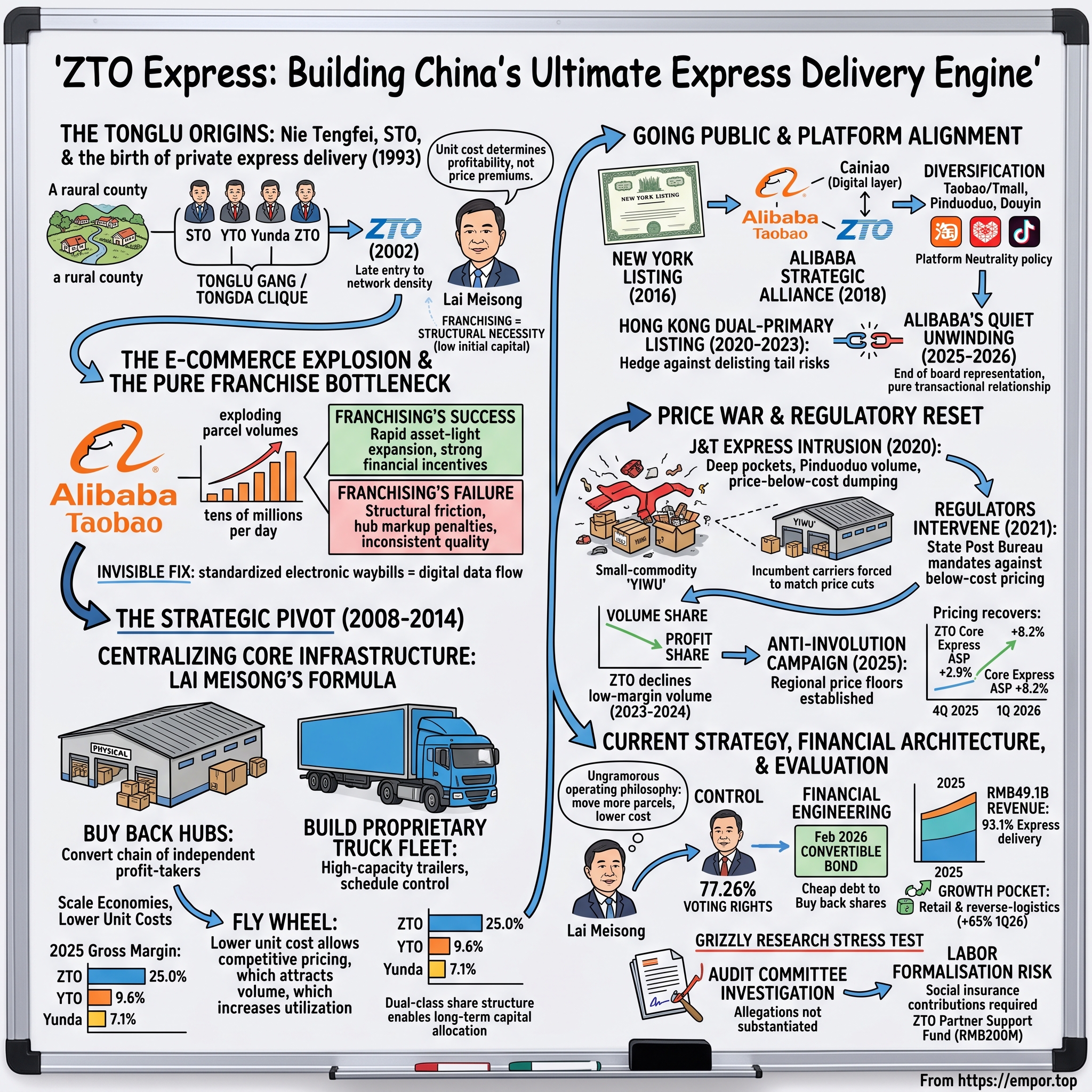
ZTO Express: Building China's Ultimate Express Delivery Engine
I. Introduction & Episode Roadmap
Across China, roughly 1,200 parcels are scanned every second. In 2025, the country's postal and express delivery system moved more than 216 billion pieces, with the express delivery industry handling close to 200 billion parcels—a volume larger than the rest of the world's parcel markets combined.1 It represents the largest physical distribution network in history, constructed over the past two decades largely by entrepreneurs from a single agricultural county in Zhejiang province.
Within that system, one company handles roughly one parcel in five. 中通快递 ZTO Express (Cayman) Inc. delivered 38.5 billion parcels in 2025—up 13.3% year-over-year—generating revenue of RMB49.1 billion and net income of RMB9.2 billion.2 Those parcels moved through 93 sorting hubs, 88 of which the company operates directly; across roughly 3,800 line-haul routes; on more than 10,000 self-owned trucks, including over 9,700 high-capacity 15-to-17-meter trailers; and out through more than 31,000 pickup and delivery outlets run by roughly 6,000 independent network partners.2
That network footprint reflects ZTO's core strategic structure. ZTO owns and operates the capital-intensive middle of the network—hubs and long-haul transportation—while independent franchisees run the labor-intensive pickup and delivery edges. The company earns revenue not directly from retail consumers, but from franchisees paying sorting and transport fees. In effect, ZTO operates as a wholesale sorting-and-trucking utility behind a consumer-facing brand.
The thesis to be tested. The primary investment thesis for ZTO holds that centralizing the capital-intensive middle while franchising the labor-intensive edges created the lowest unit cost structure in Chinese express delivery—a critical asset in a commoditized industry. The empirical support for cost leadership is compelling. In 2025, ZTO reported a gross margin of 25.0%, compared to roughly 9.6% at 圆通速递 YTO Express, 7.1% at 韵达股份 Yunda Express, and comparably thin margins across the rest of the peer set.23 ZTO's net income that year exceeded the combined net profits of YTO, 申通快递 STO Express, and Yunda put together.3 This gap reflects a structural cost advantage rather than a short-term operational divergence.
The second part of the thesis—that cost leadership reliably translates into compounding shareholder value—faced tests in 2024 and 2025. ZTO's market share declined from 22.9% in 2023 to 19.4% in 2024, dipping below 20% for the first time in years, as management deliberately declined to chase low-margin parcels.4 Core express average selling price (ASP) bottomed at RMB1.12 per parcel in the second quarter of 2025, an all-time low.5 Adjusted net income fell 6.3% in 2025 to RMB9.5 billion, even as volume grew.2 Over the same period, YTO expanded volume by 17.2% and increased market share to 15.65%.3 For an investment story predicated on converting cost leadership into profit growth, a year of falling earnings on rising volume warrants close examination.
In the second half of 2025, regulatory dynamics altered market conditions. Beijing's 反内卷 anti-involution campaign—a policy initiative targeting below-cost competition across Chinese industries—extended to express delivery, with regulators introducing regional price floors and pressuring carriers to end sub-cost pricing.64 Pricing began to recover: ZTO's fourth-quarter average selling price rose 2.9% as market share expanded 0.8 percentage points. In the first quarter of 2026, core express ASP rose 8.2% while parcel volume grew 13.2% against industry growth of 5.8%.278 A carrier that sacrificed volume to preserve pricing discipline appeared well positioned as the market adjusted to higher price floors.
Evaluating this thesis from the outside requires navigating specific analytical constraints. Express delivery features no physical product to inspect, no core patent portfolio, and no multi-year enterprise contracts. Operational differentiation resides in fractions of a RMB spread across tens of billions of transactions. Consequently, this analysis relies on ZTO's quarterly unit-cost disclosures and the audited financial results of four direct peers operating at similar scale. Peer comparison serves as the primary tool for evaluating performance.
What this article covers. The narrative begins in 桐庐县 Tonglu County, the rural origin of China's private express delivery industry, tracing the 1998 event that scattered its founding family into four competing carriers. It analyzes the structural failure of pure franchising during the early e-commerce boom and ZTO's strategic pivot between 2008 and 2014 to reacquire sorting hubs and build a proprietary truck fleet—the decision that separated ZTO from its peers. The analysis covers the 2016 New York listing, the strategic partnership with Alibaba and its quiet dissolution in 2026, the price war triggered by J&T Express, the regulatory reset, the Grizzly Research short-seller report, and ZTO's financial architecture. The business is then evaluated through Helmer's 7 Powers and Porter's Five Forces, testing the bull and bear cases against key operational metrics.
The central question is whether ZTO's cost advantage represents a durable economic moat or a temporary operational lead—a distinction that determines whether the company operates as a compounding franchise or as a disciplined operator in a state-regulated commodity market.
 Subscribe on LinkedIn
II. The Tonglu Origins & The Birth of Private Express Delivery
Tonglu County sits about 80 kilometres southwest of Hangzhou, in the hills along the Fuchun River. Historically impoverished, its economy relied on terraced farmland, paper making, and little else. In the early 1990s, its primary export was labor: young men and women taking long-distance buses to Shanghai and Hangzhou looking for work. Over the next three decades, Tonglu improbably transformed into the capital of Chinese express logistics. The founders of STO Express, YTO Express, Yunda Express, and ZTO Express—companies that move well over half of China's parcel volume—all trace back to this single county, originating from the same network of villages, schoolmates, and relatives.
The industry's origin was an act of regulatory arbitrage. In the early 1990s, 中国邮政 China Post held a legal monopoly on letter delivery, but its service was slow. Meanwhile, the Yangtze River Delta was filling with private export manufacturers needing customs declaration documents shuttled overnight between Hangzhou, Ningbo, and Shanghai. A delayed document could hold up an entire shipping container. China Post could not meet that speed. Couriers stepped in illegally, carrying documents in backpacks on long-distance buses.
Nie Tengfei and the founding accident. In 1993, 聂腾飞 Nie Tengfei, a young Tonglu native working in Hangzhou, began taking overnight buses to Shanghai with bags of documents. He charged a fraction of the state system's price for a service several times faster. The business he created became 申通快递 STO Express. As the first major private express company in China, STO operated in a legal gray zone for years; private couriers were not formally recognized until China's revised Postal Law took effect in 2009, sixteen years after Nie started.
Nie died in a car accident in 1998 at age 24. Rather than a single entity inheriting his network, his colleagues, relatives, and in-laws spun off into independent operations, carrying with them the operating model, route knowledge, and Tonglu recruiting pipeline. 韵达股份 Yunda Express was founded in 1999, followed by 圆通速递 YTO Express in 2000. The cluster became known as the 桐庐帮 / 通达系 Tonglu Gang / Tongda Clique: four major carriers with nearly identical operating models, overlapping family ties, and a shared labor pool, competing fiercely against one another.
This shared origin shapes the long-term investment case. Most industries consolidate because incumbents possess proprietary advantages rivals cannot copy. Chinese express delivery began from the opposite condition: every major player started with the same playbook, the same geographic base, and often the same talent pool. With no proprietary technology, brand loyalty, or regulatory protections, competitive advantage had to be built in full view of rivals who understood the business intimately. This environment dictated that long-term differentiation would depend on early capital deployment into physical infrastructure.
Lai Meisong enters. 赖梅松 Lai Meisong was born in Tonglu in 1970. After leaving high school, he spent time at STO before entering the timber trade—a business defined by thin margins, working capital discipline, and heavy transport.9 Managing timber freight instilled a practical understanding that in a commodity service, profitability depends on the unit cost of moving goods rather than price premiums.
Lai founded ZTO on May 8, 2002, in Shanghai, alongside relatives and associates, anchored by a regional network back in Tonglu. Founding ZTO nearly a decade after STO and two to three years after Yunda and YTO created a clear disadvantage. In a business driven by network density, late entry meant operating routes where competitors already enjoyed established volume.
In its initial years, the industry operated without formal service standards, insurance frameworks, or institutional capital. Franchisees were often independent operators with a single van and mobile phone. Parcels were frequently lost, pricing was negotiated locally, and operations depended heavily on personal trust among hometown associates.
While personal trust facilitated rapid low-cost expansion, it created lasting governance challenges. A franchise network bound by hometown ties proved difficult to discipline. When regional partners cut corners, damaged parcels, or underpaid couriers, parent company leverage was limited largely to informal relationships. ZTO's subsequent governance architecture—from standardized transit fees to franchisee incentive structures and support funds—was designed to transition this informal network into a structured corporate utility.
The regulatory environment added further operational friction. Until the 2009 Postal Law provided explicit statutory authorization, private couriers lacked formal legal standing, leaving them without standardized dispute resolution or commercial insurance. The passage of the law eliminated existential regulatory risk while establishing formal state oversight across the industry—a framework that proved critical when regulators later intervened during industry price wars.
So what. For investors, ZTO's origin explains two fundamental characteristics of the business. First, the network partner model was not a theoretical design choice, but a structural necessity born from a lack of initial capital. Every subsequent strategic evolution has required managing this inherited framework. Second, competitive intensity across the industry is structural and deeply rooted. Because these carriers were founded by peers from the same county who have competed for over two decades, assuming voluntary pricing discipline or margin-seeking restraint underestimates historical incentives—explaining why state regulatory intervention ultimately became necessary.
However, late entry provided one distinct structural advantage. ZTO carried fewer legacy obligations: fewer entrenched franchisee arrangements, fewer private hub owners with entrenched claims, and no comfortable position to defend. When the middle of the network required capital-intensive restructuring, ZTO faced fewer institutional impediments to centralizing its network.
The catalyst that transformed the entire industry arrived just as ZTO was establishing its operational footing.
III. The E-Commerce Explosion & The Pure Franchise Bottleneck
In the spring of 2003, the SARS epidemic disrupted traditional retail across China. As offices and shops closed, a large segment of urban consumers turned to online shopping. In May 2003, Alibaba launched 淘宝 Taobao. Over the next several years, the Tongda carriers shifted from regional document couriers into the primary logistics backbone for Chinese e-commerce.
The scale of this expansion was unprecedented. Where a document courier in 1999 handled thousands of items daily, Tongda carriers by the 2010s were processing tens of millions of parcels each day. E-commerce economics dictated industry dynamics: online merchants competing on price treated logistics as a direct expense to be minimized. Consequently, express carriers competed for merchant volume primarily on price per parcel.
Why franchising won. Confronted with explosive volume growth and minimal internal capital, all four Tongda companies adopted the same asset-light expansion strategy: comprehensive franchising. A local entrepreneur in a third-tier city purchased the rights to operate ZTO-branded pickup and delivery services within a defined territory, provided capital for vehicles, storefronts, and couriers, and integrated into the broader network. The parent company collected a transit fee for sorting and moving parcels between regions.
This asset-light model enabled rapid expansion without major corporate capital expenditure. Local franchise operators, working with direct equity stakes, possessed strong financial incentives to expand local coverage and secure merchant accounts. They understood their municipal streets, local merchants, and neighborhood delivery routes. Consequently, network coverage across first- through fourth-tier cities expanded at a pace that directly operated networks—such as the premium service built by 顺丰控股 SF Express—could not match on a comparable cost structure.
For a decade, the fully franchised model delivered strong returns on capital. Over time, however, structural operational and financial limits emerged.
Three failures of pure franchising. The first limitation was structural friction between independent hub operators. In the original model, regional sorting hubs—where parcels across a province were consolidated, sorted, and dispatched—were owned and operated by franchisees. Because each hub functioned as an independent profit center, every parcel crossing a hub boundary incurred a markup paid to a third party with little incentive to optimize end-to-end network efficiency. Hub owners negotiated transfer rates independently and managed parcel flows to maximize regional profits rather than total throughput. In an industry where cost competitiveness depended on fractions of a renminbi per parcel, these compounding intermediary markups created a significant structural cost penalty.
The second limitation was network capacity. The annual 双十一 11.11 Singles' Day shopping festival, introduced by Alibaba in 2009, served as a recurring stress test for franchised operations. Surge volumes routinely overwhelmed local facilities, leaving parcels backed up in sorting centers for days. Independent hub operators had limited incentive to invest ahead of demand for capacity that sat idle during non-peak months, nor did they possess the balance sheets required to finance large-scale facilities.
The third limitation was quality control and service consistency. Without standardized operational guidelines, delivery performance varied depending on the capabilities of the specific origin and destination franchisees. A merchant in Yiwu shipping to Chengdu had no operational assurance regarding transit times or parcel handling. As e-commerce platforms began evaluating merchants on delivery performance, service inconsistency became a commercial liability for carriers and sellers alike.
Underlying these operational issues was a fourth financial constraint. Because franchisees controlled the middle of the network, the parent company's earnings were capped by negotiated transit fees. These rates were subject to ongoing bargaining with independent hub owners who held critical physical assets. The corporate entity functioned primarily as a brand owner and network coordinator between independent regional businesses, capturing a narrow share of value while bearing overall brand risk.
The invisible fix that came from outside. Before express carriers addressed their internal network bottlenecks, e-commerce platforms introduced a pivotal operational standardization. In the industry's early years, parcel tracking relied on multi-part carbon-paper waybills filled out by hand. Sorting required manual reading of handwriting, and tracking updates occurred only when workers manually typed data into systems at designated checkpoints.
The introduction of standardized electronic waybills—machine-printed labels generated at order placement with structured address data and barcodes—converted a manual paper process into a digital data flow. Scanners could read destination labels in milliseconds, automated systems determined optimal routing, and parcel tracking became continuous across transit points.
For carriers, electronic waybills provided essential infrastructure for high-speed automated sorting, enabling systems capable of processing tens of thousands of parcels per hour. However, because the electronic waybill standard was introduced and controlled by e-commerce platforms, the platform layer gained visibility over shipment data, order volumes, merchant behavior, and carrier transit times. ZTO achieved major operational efficiency gains while yielding control over a critical layer of its transaction data architecture to its primary e-commerce customers.
The strategic bind. Management teams across the Tongda carriers recognized these structural bottlenecks. Resolving them required doing what the asset-light model was designed to avoid: committing large amounts of corporate capital to purchase physical assets, at a time when pure franchising still delivered high returns on invested capital.
Reacquiring regional sorting hubs required deploying cash, incurring debt or issuing equity, and absorbing substantial depreciation costs. While centralizing hub ownership promised lower long-term unit costs, it threatened to compress short-term financial returns and increase balance sheet intensity.
Between 2008 and 2014, ZTO founder Lai Meisong initiated the strategic pivot to reacquire regional sorting hubs and centralize trunk-line transit operations.
So what. The tradeoff between network franchising and capital ownership remains central to logistics economics. ZTO's competitive position was not established merely by adopting a franchise model, which was standard across the Tongda group. Rather, it depended on determining precisely where to end franchising—and deploying corporate capital to centralize the middle of the network years before its competitors executed similar transitions.
IV. The Masterstroke Pivot: Centralizing Core Infrastructure
The formulation Lai Meisong arrived at is simple enough to fit on a napkin: franchise the edges, own the core.
The edges—pickup from merchants and delivery to doorsteps—are labor-intensive, hyper-local, and difficult to optimize from headquarters. They benefit from an owner-operator who knows which apartment complex has strict security guards and which merchant ships 4,000 parcels on a Tuesday. Capital adds little at the edges; alignment and incentives add everything.
The core—the sorting hubs where parcels are consolidated and re-sorted, and the line-haul trucks moving them between cities—is the opposite. It is capital-intensive, benefits enormously from scale and standardization, and remains invisible to the end customer. Efficiency in the middle is a pure engineering and utilization problem. Critically, this is where fixed costs reside—and whoever spreads those fixed costs across the highest parcel volume achieves the lowest unit cost.
Buying back the hubs. Beginning in 2008, ZTO systematically repurchased regional sorting hubs from franchisees, converting a chain of independent margin-takers into a single owned backbone. This was a grinding, multi-year campaign of negotiations with dozens of counterparties, many of whom were long-standing partners or relatives. The company had to acquire assets from owners who understood their exact value, doing so without fracturing the commercial relationships that sustained the rest of the network.
A sorting hub functions as a railway marshaling yard for small packages. In an aircraft-hangar-sized facility on a city's periphery, ringed with dozens of truck bays, trailers unload mixed parcels from across a region onto conveyors. Optical scanners read destination labels, and automated cross-belt sorters divert each package into the designated chute for its outbound trailer. A single hub can process tens of thousands of parcels per hour, representing a capital commitment in the hundreds of millions of renminbi. Owning the hub determines who gets capacity, at what price, during peak volume surges like Singles' Day.
The result is reflected in ZTO's operational footprint: of 93 sorting hubs at the end of 2025, ZTO operated 88 directly, with only five still run by network partners.2 By placing the middle of the network on the corporate balance sheet, every cross-province parcel moves through facilities managed by a single entity with one objective—minimizing total system cost—rather than crossing a relay of independent profit centers extracting regional tolls.
Building the fleet. The second leg of the strategy focused on long-haul transportation. While Chinese logistics providers historically relied on spot-market third-party truckers, ZTO built a proprietary fleet of tractors and trailers, prioritizing high-capacity units. Of its more than 10,000 self-owned line-haul vehicles, over 9,700 are 15-to-17-meter high-capacity trailers.2
Because express parcels are light and bulky, line-haul economics are constrained by cubic volume rather than weight. A longer trailer with higher clearance carries significantly more parcels per trip, while the marginal cost—primarily fuel and a single driver—remains nearly flat. Increasing fleet utilization by loading trailers fuller, operating more hours daily, and optimizing return-trip routes drives down line-haul cost per parcel in a way that spot-market chartering cannot replicate.
Direct fleet ownership provides a secondary strategic benefit: schedule control. Carriers relying on third-party transport must adjust to market departure windows. Owning the transport network enables ZTO to set fixed timetables, guarantee consistent transit times, and hold departures open later during peak volume periods. In express delivery, service reliability is largely a function of schedule control.
The third leg was facility automation. ZTO expanded its use of optical character recognition and automated cross-belt sorting equipment to process parcels mechanically. The company operated 781 sets of automated sorting equipment at the end of 2025, up from 596 a year earlier—adding roughly 185 automated lines in a single year, well into its supposed maturity.2
The flywheel and its structural limits. Centralizing hubs and transportation converts variable costs into fixed infrastructure. Dividing fixed costs by expanding volume reduces the unit cost per parcel. Lower unit costs allow ZTO to offer competitive pricing to high-volume e-commerce merchants while preserving margins. Lower prices attract additional volume, which further fills hubs and trailers, driving utilization up and unit costs down.
Operational results demonstrate this mechanism at work. In 2025, ZTO's unit transportation cost fell 12.2% (or five fen per parcel), while unit sorting cost fell 3.7%, or one fen.2 A savings of six fen per parcel translates to roughly RMB 2.3 billion in total cost reduction across 38.5 billion parcels. In the first quarter of 2026, line-haul cost per parcel dropped another tenth to approximately RMB 0.37, which management attributed to volume-tiered incentives and better trailer loading.8
However, scale economies in parcel delivery are asymptotic rather than linear. Adding volume to an underutilized trailer generates substantial unit cost savings, whereas adding volume to an already optimized network yields diminishing marginal gains. Peer carriers—YTO, STO, and Yunda—process between 26 and 31 billion parcels each.3 Competitors have adopted similar playbooks by purchasing hubs, acquiring trucks, and installing automated sorters. While ZTO maintained a 25.0% gross margin in 2025 compared to YTO's sub-10.0%, part of that spread reflects reporting differences between U.S. GAAP and A-share accounting standards, alongside a genuine head start that rivals are working to narrow.
The capital intensity tradeoff. Centralizing core infrastructure required trade-offs in financial optics. An asset-light franchisor reports a small asset base, minimal depreciation, and high return on capital. Buying hubs and trucks expands the balance sheet, increases annual depreciation, absorbs free cash flow through capital expenditures, and depresses return on invested capital during the buildout phase.
Navigating this transition highlights the role of ZTO's governance structure. Founder Lai Meisong's dominant voting control allowed management to absorb multi-year capital deployment cycles and short-term accounting drag without facing public market pressure to alter strategy. While dual-class share structures introduce governance risks for minority shareholders, this control enabled ZTO to execute a long-term capital allocation strategy that quarterly-oriented management teams might have avoided.
So what. The centralization pivot demonstrates management's capacity to execute complex, long-term capital allocation decisions. However, the resulting cost advantage represents an operational lead built on early capital deployment and accumulated routing expertise, rather than an unassailable moat. Maintaining that lead requires continuous reinvestment—explaining why ZTO maintains annual capital expenditures around RMB 6 billion, and why any stabilization in unit-cost convergence relative to peers remains a critical metric for investors.
By 2016, ZTO's physical network architecture was established. The next phase required institutional capital and access to public equity markets to finance further expansion.
V. Going Public & The Alibaba Strategic Alliance
On October 27, 2016, ZTO listed on the New York Stock Exchange. The company priced 72.1 million American depositary shares at $19.50—above its indicated range of $16.50 to $18.50—raising approximately $1.4 billion. It marked the largest U.S. initial public offering of 2016 and the biggest U.S. listing by a Chinese company since Alibaba's debut in 2014.1011
The market's initial reaction was cold. The stock opened at $18.40, below the offer price, and closed its first trading day at $16.57—down roughly 15% from the open and 15% below its issue price.12
That first-day break reflected a structural analytical disagreement rather than routine market volatility. Underwriters had valued ZTO on its rapid growth and operating margins, which resembled a software company more than a conventional carrier. Public investors, however, pressed on three underlying vulnerabilities. First, how could a parcel carrier generate software-like margins? The answer—that ZTO books revenue on a wholesale transit-fee basis while independent franchisees absorb last-mile delivery and labor costs—was disclosed but initially poorly understood. Second, what rights do public shareholders actually hold? ZTO used a variable interest entity (VIE) structure, in which the Cayman-listed holding company owns no direct equity in the onshore operating business, controlling it instead through contractual arrangements such as voting proxies, equity pledges, and call options.13 Third, how dependent was the company's parcel volume on Alibaba?
The governance risks of the VIE structure remain a permanent feature of the investment case. In its 2025 annual report, ZTO disclosed that the consolidated operating entity generated 87.1% of total revenues through contractual agreements that lack formal statutory recognition under Chinese law, warning that any adverse regulatory ruling on the structure would cause a material adverse change to operations.13 Foreign investors hold contractual claims on offshore cash flows rather than direct title to onshore physical assets. While standard across U.S.-listed Chinese technology and logistics companies, this arrangement remains legally untested in a crisis.
The Alibaba alliance. On May 29, 2018, Alibaba Group and 菜鸟网络 Cainiao Network announced a $1.38 billion investment for an approximate 10% equity stake in ZTO.1415 For ZTO, the transaction provided capital, market validation, and a formalized link to the e-commerce platform generating the majority of its parcel traffic. For Alibaba, the stake formed part of a broader strategy to take minority positions across the Tongda group, binding physical carrier networks to Cainiao's central data architecture.
The operational division of labor was deliberate. Cainiao avoided asset-heavy fleet ownership, focusing instead on controlling the digital transaction layer—electronic waybill standards, routing algorithms, address databases, and carrier dispatch choices. ZTO executed physical sorting and transport. This dynamic raised a long-term question for investors: whether ZTO operated as an indispensable strategic partner or a well-compensated utility provider.
ZTO responded by actively diversifying its merchant mix. As 拼多多 Pinduoduo expanded rapidly, ZTO captured significant volume on the platform, later doing the same with 抖音 Douyin e-commerce while maintaining its core Taobao and Tmall volumes. Establishing platform neutrality became an explicit corporate policy: no single e-commerce channel should hold sufficient volume concentration to dictate commercial terms.
The quiet unwinding. The alliance eventually transitioned into a purely transactional relationship. In May 2025, reports surfaced that Alibaba was evaluating a reduction of its ZTO holding as part of a broader divestment from Tongda equity positions, following Cainiao's strategic pivot toward international logistics and technology infrastructure.14 On May 20, 2026, ZTO disclosed that non-executive director Ms. Di Xu had resigned from the board following the formal termination of the 2018 investor rights agreement with Alibaba's subsidiaries.7
Eight years after being celebrated as a transformative strategic partnership, the formal governance link ended with a brief regulatory disclosure.
This separation carries two distinct implications for shareholders. Optimistically, it confirms ZTO's commercial independence: its parcel volume is sufficiently diversified that losing board representation is an administrative detail rather than an operational threat, freeing the company from the perception of being Alibaba's captive carrier. Pessimistically, it marks the end of an era in which e-commerce platforms held direct equity alignment with carriers. In its place is an unhedged spot relationship where platforms route volume to whichever carrier offers the lowest price each quarter. Equity ownership created switching friction; its removal eliminates that buffer.
Myth versus reality: "ZTO is Alibaba's delivery arm." The common market characterization of ZTO as Alibaba's captive courier was never accurate. Alibaba held minority stakes across multiple competing carriers, Cainiao sought to orchestrate logistics rather than manage a single fleet, and ZTO won its platform volume through quarterly price competition among independent merchants. The equity investment secured information visibility and strategic alignment for Alibaba, but it never guaranteed minimum parcel volumes for ZTO or locked capacity for Alibaba.
The primary strategic risk was not that ZTO depended on a single e-commerce buyer, but that overall industry demand remains concentrated among a few powerful e-commerce platforms capable of redirecting parcel flows. Diversifying across Taobao, Tmall, Pinduoduo, and Douyin provides operational defense against any single platform, but it does not resolve the structural asymmetry of five competing carriers serving three dominant buyer groups with an undifferentiated commodity service.
The Hong Kong listings. To hedge capital market access, ZTO completed a secondary listing on the Hong Kong Stock Exchange on September 29, 2020, issuing 45 million shares at HK$218 to raise approximately HK$9.8 billion, or $1.27 billion.[^16] In late 2022, as the U.S. Holding Foreign Companies Accountable Act raised the prospect of forced delistings over audit access, ZTO converted its Hong Kong listing to dual-primary status, effective May 1, 2023.16 Dual-primary status ensured the company could maintain its public listing independently in Hong Kong if U.S. trading were interrupted, while qualifying the stock for mainland investor access through Southbound Stock Connect.
Although the U.S. Public Company Accounting Oversight Board (PCAOB) regained audit inspection access in China in December 2022 and temporarily relieved delisting pressures, ZTO's disclosures note that this status remains subject to annual review.13 Converting to a dual-primary listing served as a timely hedge against regulatory tail risks, mirroring the company's earlier strategy of acquiring sorting hubs ahead of market necessity.
So what. ZTO's capital markets execution demonstrates a consistent pattern of securing funding when market conditions are favorable and insulating the business against structural risks—whether audit disputes, delisting threats, or platform concentration—before they disrupt operations. However, financial engineering and proactive capital management cannot eliminate the core industry dynamic: ZTO sells a commodity service to concentrated e-commerce platforms and high-volume merchants with substantial bargaining leverage. The dissolution of the Alibaba equity link underscores that ZTO's competitive standing rests on unit-cost leadership rather than platform patronage.
That reality sets up the next critical phase: what happens when price competition in a commoditized industry reaches its logical extreme.
VI. The Brutal Price War, J&T Intrusion, & Regulatory Reset
义乌 Yiwu is a city in Zhejiang of roughly two million people that functions as the small-commodities warehouse of the world—shipping buttons, socks, phone cases, Christmas ornaments, and hair clips. It represents the single densest concentration of e-commerce shipping volume on earth, making it the front line of every price war in Chinese express delivery. In 2020 and 2021, Yiwu became the epicenter of severe industry price competition.
The intruder. 极兔速递 J&T Express was founded in Indonesia in 2015, built a large Southeast Asian network, and entered China in March 2020—a market already served by four scaled incumbents alongside SF Express. Industry consensus held that new entry was nearly impossible because a fresh entrant could not replicate nationwide hub-and-spoke infrastructure from scratch against incumbents with two decades of volume density.
J&T bypassed traditional network building by acquiring existing capacity, partnering aggressively, leveraging deep ties to Pinduoduo's merchant base, and pricing aggressively below cost. In Yiwu, subsidized shipping rates dropped to around RMB1 per parcel for both large and small items—a price level at which no carrier, including J&T, generated profits.17 Capitalized by external investors and treating operating losses as customer acquisition costs, J&T exceeded 20 million parcels per day within approximately ten months of entry—a scale that had taken Yunda 19 years, YTO 18 years, and STO 25 years to achieve.17
The strategic rationale behind this expansion reflects a fundamental industry dynamic. In a business defined by high fixed costs and limited service differentiation, unit costs depend on reaching threshold scale. Subsidized parcel volume serves less as a durable customer base than as purchased density, where success depends on whether capital reserves endure until threshold scale is reached.
While J&T secured operational scale, the expansion proved financially costly. J&T recorded average gross losses per parcel of roughly $0.28 in 2020, $0.15 in 2021, and $0.06 in 2022, sustaining per-parcel losses across three consecutive years to secure market position.17
What a price war does to a commodity industry. Incumbent carriers were forced to match price cuts because, in an undifferentiated service market with minimal switching costs, high-volume merchants readily migrate for minor per-parcel savings. Across the entire express sector, average revenue per parcel had already declined from RMB24.57 in 2010 to RMB10.21 by January 2021.17 E-commerce parcel rates fell further, eventually dragging in SF Express despite its historical focus on premium non-e-commerce shipments.18
Under these conditions, the centralized physical infrastructure ZTO built between 2008 and 2014 served primarily as a defensive buffer. Lower unit operating costs enabled ZTO to absorb price reductions that severely compressed peer margins. Cost leadership in a commoditized market functions less as an automatic profit generator than as a solvency reserve that dictates relative endurance during price downturns.
Who actually paid for the price war. Average selling price compression directly affected last-mile delivery operations. In a franchised network, last-mile couriers are paid per parcel delivered by local franchise operators whose own margins are squeezed from above. When merchant rates fall by 30 fen, cost pressure transmits down to front-line couriers, who must increase daily delivery volume to offset lower per-piece compensation. The franchise architecture that minimized corporate capital expenditure also served to pass pricing pressure onto last-mile labor.
This cost transmission mechanism eventually prompted regulatory oversight, representing a key variable in long-term industry unit costs. Any potential formalization or mandatory insurance coverage for last-mile courier labor would alter the industry's underlying cost structure—an operational expense that management and industry models do not fully quantify.
Regulators intervene. By 2021, persistent price competition became a public policy focus. Front-line couriers absorbed the financial impact through declining per-piece delivery pay. On April 6, 2021, the Yiwu Postal Administration issued a formal warning to J&T regarding below-cost dumping, while central and regional authorities mandated that express providers refrain from pricing services below operating cost.17[^20] This regulatory action aligned with the broader 共同富裕 common prosperity policy framework, which sought to curb unsustainable price competition that impacted front-line worker earnings.
The initial regulatory intervention led to a partial stabilization of market pricing. By 2022, rate recovery supported improved profitability across the sector; YTO reported a year-over-year net profit increase of approximately 190% for the first nine months of 2022 on a 27% increase in revenue, as aggressive undercutting moderated.19
Volume share to profit share. ZTO responded by adjusting its commercial strategy, electing to decline low-margin, unprofitable e-commerce volume to focus on per-parcel profitability.
This shift impacted ZTO's relative market share metrics. The company's volume share declined from 22.9% in 2023 to 19.4% in 2024, falling below 20% for the first time in several years.4 In 2025, ZTO expanded parcel volume by 13.3% to 38.5 billion parcels, tracking broader industry growth and leaving its market share around 19%, while YTO expanded volume by 17.2% to reach a 15.65% market share.23
Evaluating this strategy requires weighing market share sacrifices against financial performance. Over a two-year period of volume discipline, ZTO surrendered market share while its adjusted net income declined 6.3% in 2025.2 Concurrently, ZTO's core express ASP reached a record low of RMB1.12 per parcel in the second quarter of 2025.5
Furthermore, volume restraint presents operational implications for the franchise network. Franchise partners maintain fixed operational overhead, including facility leases, vehicle fleets, and staffing. When network parcel growth slows relative to competitors, franchisee retention and unit economics face pressure. This dynamic helps explain why network support payments to franchise partners have become a regular feature of ZTO's financial disclosures.
Anti-involution changes the game. Regulatory policy subsequently altered market dynamics. Through 2025, the government's 反内卷 anti-involution initiative expanded into formal enforcement, with the State Post Bureau establishing the reduction of below-cost pricing as an explicit regulatory priority.6 Regional regulators implemented price floors: Yiwu raised its minimum parcel rate from RMB1.10 to RMB1.20, while select municipal authorities in Guangdong mandated minimum pricing of RMB1.40 or above for light e-commerce packages.4
Industry-wide financial data reflected the policy shift. In 2025, express sector revenue grew 6.4% to RMB1.8 trillion, lagging parcel volume growth and indicating ongoing price deflation.1 That trend reversed in early 2026. State Post Bureau data for the first five months of 2026 showed parcel volume rising 5.2% to 82.87 billion pieces while sector revenue grew 7.2% to RMB635.37 billion, yielding an estimated 1.9% increase in average revenue per parcel to RMB7.67—marking the first period in roughly fifteen years where price growth exceeded volume growth.4
ZTO's operating results reflected these broader pricing trends. In the fourth quarter of 2025, ZTO's core express ASP rose 2.9% while its market share expanded by 0.8 percentage points alongside industry volume growth of roughly 5%.220 In the first quarter of 2026, core express ASP increased 8.2%, revenue grew 22.0%, and parcel volume rose 13.2% against an industry growth rate of 5.8%—expanding ZTO's market share by over one percentage point.78 On the company's earnings call, Founder Lai Meisong characterized the sector as transitioning from scale-driven growth to value-driven development, while CFO Huiping Yan described the shift as a move from chasing lower-priced volume to restoring unit value.820
So what — and what a skeptic says. From an optimistic perspective, ZTO maintained pricing discipline through a period of market compression and subsequently expanded both market share and average selling prices during the market recovery.
Conversely, a cautious perspective notes that ZTO's 2025 and 2026 performance was assisted significantly by state-enforced price floors rather than an expanding proprietary cost advantage. Regulated minimum prices establish a baseline for all market participants, providing margin relief to higher-cost competitors and slowing the rate at which cost leaders consolidate volume. Furthermore, in the first quarter of 2026, ZTO's 22.0% revenue increase translated into a 5.2% gain in adjusted net income, with operating margin declining 2.9 percentage points as higher fuel expenses and partner support payments offset average selling price gains.78 Higher realization rates do not translate directly into expanded net margins when operational costs increase concurrently.
Ultimately, market conditions shaped by regulatory mandates remain subject to future policy adjustments.
VII. Current Strategy, Financial Architecture, & Management Evaluation
Lai Meisong is not a public personality in the way Chinese tech founders often are. He does not give many interviews, does not cultivate a media profile, and on earnings calls speaks through an interpreter in careful, largely unquotable language about service quality and network stability. The most revealing thing about him is not what he says but the shape of his decisions across two decades: buy the hubs before anyone else does; buy the biggest trailers; convert the Hong Kong listing before the delisting threat becomes real; give up market share when the marginal parcel is unprofitable; and hold onto control absolutely.
What emerges from those decisions is a distinctly unglamorous operating philosophy. Lai has never tried to turn ZTO into a technology company, a platform, or a diversified logistics conglomerate — the three temptations that have consumed enormous amounts of capital elsewhere in Chinese logistics. The stated ambition has consistently been narrower and harder: move more parcels than anyone else, at a lower cost than anyone else, with fewer of them going missing. That narrowness is itself a form of capital discipline, and it is the reason the balance sheet contains hubs and trucks rather than a portfolio of acquired adjacencies.
Control. ZTO has a dual-class structure in which Class B shares carry ten votes each. Lai holds 206.1 million Class B ordinary shares, representing about 25.35% of total share capital but roughly 77.26% of voting rights as disclosed in the company's filings.13 He also holds 34.35% of the equity in the consolidated Chinese operating entity itself.13
The practical meaning is unambiguous. Public shareholders in either Hong Kong or New York cannot compel any change at ZTO. There will be no activist campaign, no proxy contest, no board refresh against the founder's wishes. Investors are underwriting Lai Meisong's judgment, not a governance system. Given his record, many are comfortable with that trade. It is still a trade, and it should be priced as one — particularly in combination with the VIE structure, which means the chain from a foreign shareholder to a Chinese sorting hub runs through both a contractual control arrangement and a founder-controlled voting block.
Capital allocation. Here the behavioural record is more testable, and it has genuinely improved. ZTO's stated policy is to return no less than 50% of the prior fiscal year's adjusted net income to shareholders through combined dividends and buybacks.2 The company declared a semi-annual dividend of $0.39 per ADS for the second half of 2025, reflecting a 40% payout ratio, with buybacks making up the balance.220 In March 2026 the board authorised a new $1.5 billion, 24-month repurchase programme running to March 2028; the prior programme had spent $1.4 billion.2 Dividends paid during 2025 totalled $520.4 million.13
The most interesting recent transaction is the February 2026 convertible bond. On 4 February 2026, ZTO priced $1.5 billion of convertible senior notes due 1 March 2031 at a coupon of 0.925%, with an initial conversion price of approximately HK$241.79 — a 35% premium — and allocated up to $1.0 billion of proceeds to fund near-term repurchases of its own shares, executing a concurrent buyback at HK$179.10.21
This deserves plain-English translation because it is a piece of genuine financial engineering. ZTO borrowed $1.5 billion at well under 1% interest, in a form that only converts into equity if the stock rises 35%, and used the money to buy back shares at today's price. Management's framing on the Q1 2026 call was that favourable financing conditions were being used to fund repurchases, with roughly RMB600 million completed at issuance and the remainder targeted over the following year.8 If the stock never reaches the conversion price, ZTO will have retired equity using nearly free debt. If it does convert, the shares are issued 35% above where the buyback was executed. The structure is designed so that repurchases broadly offset conversion dilution.
Is this good capital allocation? On the merits, yes — cheap capital, accretive mechanics, no operational risk taken. The fair criticism is subtler: a company issuing $1.5 billion of debt to buy stock while also spending RMB6 billion a year on capex is making an implicit bet that its shares are undervalued and its balance sheet under-levered. That bet has been fine so far, with RMB10.0 billion in cash and RMB15.6 billion in short-term investments at the end of 2025 providing ample cushion.13 But financial engineering does not create operating advantage, and investors should be careful not to score it as though it does.
Where the money actually comes from. ZTO's 2025 revenue of RMB49.1 billion breaks down as RMB45.7 billion from express delivery services — 93.1% of the total — plus RMB2.4 billion from the sale of accessories such as waybills and packaging (5.0%), RMB808 million from freight forwarding (1.7%), and RMB120 million from other services.2 Operating income was RMB10.5 billion and adjusted EBITDA RMB15.0 billion, on operating cash flow of RMB12.0 billion.2
The proportionality here is the point, and it is worth stating bluntly against the way conglomerate-style logistics stories are often told. 中通快运 ZTO Freight (less-than-truckload), 中通国际 ZTO International (cross-border), and 中通云仓 / 中通冷链 (cloud warehousing and cold chain) are all real businesses that appear in the company's narrative. They are not, currently, material to earnings. The freight forwarding line — the cross-border business — is 1.7% of revenue. LTL, cold chain and warehouse operations are not broken out as reported segments at all, which is itself a disclosure limitation worth noting: an investor cannot independently assess whether these adjacencies earn their cost of capital. In November 2025 ZTO added air cargo capability through Zhejiang Xinglian Air Cargo.13
Treat these as options, not engines. Cross-border in particular faces a materially harsher backdrop than it did two years ago: the United States suspended duty-free de minimis treatment for shipments valued at $800 or less effective 29 August 2025, removing the customs regime on which the direct-from-China small parcel model was built.22 That is a headwind for Chinese cross-border e-commerce volumes generally, and for the logistics providers serving them.
The growth pocket that is working. The genuinely notable operating development is retail and reverse-logistics parcels — returns, individual consumer shipments, non-e-commerce volume. In the fourth quarter of 2025 daily non-retail volume reached 9.8 million parcels, up 38% year on year, with retail parcel volume up roughly 46%.220 By the first quarter of 2026 average daily volume in this category reached 9.7 million units, up 65%, and management stated these parcels carry higher unit profit contribution than traditional e-commerce parcels.8
This matters more than its size suggests. It is the one part of the business where ZTO deals with a fragmented customer base rather than a handful of powerful platforms — which is to say, the one place where it might develop actual pricing power rather than cost-based resilience. If this stream continues compounding at these rates, the mix shift alone changes the margin profile. It is early, and management's claim of higher unit profitability is not independently verifiable from disclosed data, but it is the most interesting thing in the current operating story.
Technology, honestly assessed. On recent calls management has leaned heavily into AI. The specifics: 3D digital twins and computer vision deployed across 25 sorting centres, reducing missorting rates by more than 60%; AI customer service handling over 70% of end-to-end service tickets with escalation rates down five points; large language models applied to business analysis and forecasting.8 Stripped of the AI framing, this is process automation applied to a physical operation — pattern recognition replacing human eyes on a sorting line, and scripted resolution replacing call-centre staff. It is real and it lowers cost. It is not, on the evidence disclosed, a differentiating technology; every scaled peer is doing versions of the same thing, and the equipment vendors are largely shared.
The Grizzly Research stress test. On 2 March 2023, short-seller Grizzly Research published a report on ZTO alleging understatement of revenues and costs, underreported staff numbers, profits hidden in capital expenditure, and unnecessary fundraising — in short, potentially falsified financial statements.[^25] A follow-up report came on 17 March.[^25] The stock fell.
ZTO's response was fast and, more importantly, structured. The company publicly rejected the report as without merit and containing errors and unsupported speculation.[^26] Then the audit committee did the thing that actually matters: it commissioned an independent investigation with an international law firm and forensic accounting experts from a major accounting firm that was not the company's auditor. On 20 April 2023, ZTO announced the investigation was substantially complete and that the audit committee had concluded the allegations in both reports were not substantiated.23
The right way to weigh this is not to declare the matter settled but to note what the episode revealed. The underlying question Grizzly raised — how does a delivery company report margins like these? — has a structural answer that any investor should understand rather than take on faith. ZTO's reported revenue is not the full freight paid by consumers; the network partners collect that, keeping the pickup and last-mile portions, and remit a transit fee to ZTO.13 ZTO's headcount excludes the hundreds of thousands of couriers employed by partners. So ZTO's margins are calculated on a smaller revenue base that excludes the industry's most labour-intensive, lowest-margin activities. The margins are real; they are also margins on a different, narrower business than a naive comparison to FedEx or UPS implies.
That is not fraud. It is, however, a genuine analytical exposure, and it connects directly to the most material medium-term risk in this business. If courier labour is progressively formalised — and China's Supreme People's Court judicial interpretation effective 1 September 2025 invalidating agreements to waive social insurance contributions pushed firmly in that direction24 — costs that currently sit outside ZTO's income statement, inside thousands of independent franchisee businesses, become more expensive. ZTO does not pay them directly. But franchisees under margin pressure must be supported, and ZTO has begun doing exactly that: management disclosed a RMB200 million network support fund on the Q4 2025 call, described as a commitment to partner support distributed across pickup-to-delivery operations.20 Asked directly about social security compliance costs on the Q1 2026 call, Lai acknowledged short-term cost increases while arguing that stable employment reduces turnover and strengthens the network.8
Read that exchange carefully. It is management confirming that a structural cost is coming, without quantifying it. That is a reasonable answer to an unanswerable question — and also exactly the sort of unquantified future cost that off-balance-sheet labour arrangements are designed to obscure.
Myth versus reality: "ZTO captures most of the industry's profits." This claim circulates widely, usually without a date attached, and it needs both a defence and an update. The defence: on 2025 results, ZTO's net income did exceed the combined net profits of YTO, STO and Yunda, on a gross margin roughly two-and-a-half times YTO's and three-and-a-half times Yunda's.23 By any reasonable reading, ZTO remains the profit centre of the listed Tongda group.
The update is where the myth becomes dangerous. That dominance narrowed in 2025 rather than widened. ZTO's own profitability went backwards while YTO's rose and STO's rose sharply; only Yunda deteriorated badly.32 A claim about profit-pool share is a statement about a ratio, and ratios move. Treating "captures most of the profit pool" as a permanent property of the business rather than a measurement taken at a moment is precisely the kind of narrative shortcut that lets an investor miss two consecutive years of relative deterioration. The correct posture is to treat it as a KPI to be re-measured, not a moat to be assumed.
A second look at the balance sheet and the register. Two smaller items deserve a mention because they change the risk picture at the margin. First, leverage. ZTO ran essentially net cash for most of its listed life, and the February 2026 convertible added $1.5 billion of debt against roughly RMB10.0 billion of cash and RMB15.6 billion of short-term investments.1321 The company remains conservatively financed, but it is no longer unlevered, and the notes mature in 2031 — a refinancing date that only becomes interesting if the equity is well below the conversion price by then.
Second, the shareholder register. Alibaba's reported consideration of a stake sale, followed by the termination of the investor rights agreement and the board departure, means a large block of stock sits with a holder that has publicly signalled it is a seller in principle.147 That is not a business risk — it is a supply-of-stock overhang, and a different thing entirely from a deterioration in fundamentals. Investors should keep the two mentally separate when reading price action.
Management credibility, on the record. Assessed on behaviour rather than rhetoric, the scorecard is mixed-to-good. ZTO cut its 2024 volume growth guidance mid-year, from a 15–18% range to 11.6–12.3%, and finished at 12.6% — an overpromise, publicly corrected, then met.25 The narrative across calls has been consistent: the same emphasis on service quality, profit per parcel and network stability appears in 2024, 2025 and 2026 materials, rather than shifting to whatever explains the most recent quarter. Guidance for 2026 of 10–13% volume growth against a State Post Bureau industry estimate of about 8% is a specific, falsifiable commitment to outgrow the market.220 And capital returns have escalated in a formalised, policy-driven way rather than ad hoc.
The persistent gap is disclosure. Segment reporting for adjacent businesses is thin. Franchisee financial health — the single most important leading indicator of network stability — is not disclosed in any systematic form. And the network support fund, subsidies and incentive payments that flow to partners are described qualitatively rather than quantified in a way that lets an outsider model them.
An activist would push on exactly one further point, and it is a fair one: a company generating this much cash, with this concentrated control and this thin segment disclosure, gives outside shareholders no mechanism to test whether the adjacent businesses are consuming capital productively. The counter is that the amounts involved are small relative to the core. Both are true, and the disclosure gap is cheap to close if management chooses to.
So what. This is a founder-controlled company with a strong capital allocation record, an improving shareholder return framework, a demonstrated willingness to accept short-term pain for structural position, and a genuine, unresolved dependence on an off-balance-sheet labour structure that is being progressively formalised by the state. Both halves of that sentence are true simultaneously.
VIII. Industry Structure, Hamilton Helmer's 7 Powers, & Porter's 5 Forces
Strip away the narrative and ask the structural question: does ZTO possess advantages that persist even when competitors know exactly what they are and want to copy them? That is what Hamilton Helmer's framework tests — a Power must both benefit the holder and impose a barrier on the challenger.
Scale Economies — the primary Power, and it is real. ZTO's 38.5 billion parcels absorb the fixed costs of 88 self-operated hubs, 781 automated sorting lines, and more than 10,000 owned line-haul trucks. The barrier is not that a competitor cannot build hubs; it is that a competitor building the same asset base at 60% of the volume runs it at lower utilization and therefore higher cost per parcel, and cannot close the gap by trying harder. The evidence appears in the margin spread — a 25.0% gross margin against roughly 9.6% at YTO and 7.1% at Yunda in 2025 — and in continued unit cost declines of 12.2% in transportation and 3.7% in sorting even at immense scale.23
The honest qualification: this Power is relative and asymptotic, not absolute. YTO at 31.1 billion parcels and STO at 26.1 billion are not sub-scale in any meaningful engineering sense.3 The gap is one of degree and execution, and it is one that a competitor with patience and capital narrows rather than one it is structurally barred from crossing.
Cornered Resource — plausible but unproven. The argument holds that ZTO acquired industrial logistics land near major transit nodes early, at prices and under zoning conditions that cannot be replicated today. Directionally this is almost certainly true — land near Chinese transport hubs has appreciated significantly and zoning has tightened. However, ZTO does not disclose the historical cost basis or current market value of its land holdings in a form that lets an outsider size the advantage. It should be treated as a real but unquantified benefit, not a proven Power.
Process Power — the most underrated. Two decades of accumulated operating knowledge: routing algorithms, trailer loading practices, sorter calibration, peak-season capacity planning, and — crucially — the management of thousands of independent franchisees, which is an operational skill that does not appear on any balance sheet. Process Power is characterized by being slow to build and hard to copy even when observable, and network governance in a franchise system fits that description. The counter-evidence is that peers have been narrowing the operating gap for years, which suggests this operating knowledge diffuses faster than the framework's ideal case.
Network Effects — weaker than the pitch suggests. The claim posits two-sided density: more pickup coverage attracts more merchants, while more delivery volume justifies denser routes. Physically, density economics are real. However, this is not a network effect in the Helmer sense, because users do not derive value from other users' presence — they derive value from cost and speed, both of which are produced by scale, already captured under Scale Economies. Counting density twice inflates the moat. More decisively, all four Tongda carriers maintain national coverage; no carrier wins volume simply because a rival cannot reach a city.
Switching Costs, Branding, Counter-Positioning — largely absent. An e-commerce merchant can move volume between carriers in a week, and routinely does so. There is no meaningful consumer brand preference: shoppers choose the merchant, and the merchant chooses the carrier. Furthermore, ZTO's model is not counter-positioned against anyone — every direct peer runs the same hybrid structure.
Porter's Five Forces.
Threat of new entrants: low, but not zero — and J&T proved it. Building a nationwide hub-and-spoke network from scratch costs billions and takes years. Yet J&T entered in 2020 and reached 20 million daily parcels within ten months by combining acquired capacity, a platform patron in Pinduoduo, and a willingness to lose money on every parcel for three straight years.17 The lesson is that the barrier is not physical infrastructure — it is patient capital paired with a captive volume source. Both exist in China. Any analysis treating entry as impossible ignores recent history.
Bargaining power of buyers: high, and structurally so. This remains the binding constraint on the entire industry. A small number of platforms and large merchants direct vast parcel flows, face near-zero switching costs, and buy an undifferentiated service. The dissolution of Alibaba's equity ties removed what little relationship friction existed. ZTO's defense is not pricing power but cost position — the ability to accept the price the market sets and still earn a margin. That represents a real defense, though it is fundamentally distinct from pricing power.
Rivalry: extreme, currently suppressed by policy. Four structurally similar competitors founded by peers from the same county, plus a well-funded entrant and SF Express competing from above, create severe structural rivalry. The 2020–2021 price war demonstrated what unrestrained competition produces. What changed was not the underlying market structure but regulatory oversight: anti-involution enforcement and regional price floors have suppressed destructive price competition.64 Suppressed competition is not the same as a structural resolution.
Threat of substitutes: very low. Physical goods bought online must physically move. No technology substitutes for parcel delivery; automation and autonomous vehicles alter the cost curve rather than the fundamental need for transport. This represents the most reliable structural force in ZTO's favor.
Supplier power: low to moderate. Truck manufacturers and equipment vendors face a buyer purchasing at extraordinary scale. The genuine supplier-side exposure is fuel — management noted on the Q1 2026 call that anti-involution price recovery largely offset high fuel costs, with certain provinces absorbing increases through fuel surcharges.8 The second factor is labor, which behaves like a supplier whose price is increasingly dictated by regulatory policy rather than local labor markets.
The control group: what SF Express proves. The most informative comparison in Chinese logistics is not between ZTO and its Tongda peers, who operate variations of the same hybrid model, but with SF Express, which chose the opposite architecture: directly operated, salaried couriers, premium service, time-definite delivery, and its own cargo fleet. SF competes on speed and reliability rather than price, serving documents, high-value goods, and enterprise shipments while charging multiples of the standard e-commerce parcel rate.
This comparison demonstrates that both models function effectively, though neither dominates across all segments. SF's approach builds brand equity, pricing power, and service differentiation — the demand-side moat ZTO lacks — at the cost of a heavier operating structure and lower volume in mass e-commerce. ZTO's approach yields volume density and a low unit cost structure at the expense of pricing power. When price competition intensified, SF was drawn into e-commerce parcel pricing despite its premium positioning,18 illustrating that the market segments are not entirely insulated. For investors, "Chinese express delivery" is not a single market with one winner, but distinct segments with different underlying economics, where ZTO has committed entirely to the larger, lower-margin mass market.
The synthesis. ZTO holds one strong Power (scale economies), one probable Power (process), one plausible but unproven advantage (cornered resource), and no meaningful demand-side moat. It operates in an industry with no substitutes, weak supplier power, and one dominant constraint — buyer power — against which cost leadership serves as the primary defense.
This structural combination defines ZTO's investment profile. ZTO is not a compounder protected by high switching costs or pricing power. It operates as the low-cost producer in an essential commodity industry: highly cash generative and structurally advantaged against direct peers, yet permanently exposed to the pricing decisions of large e-commerce platforms and currently supported by a regulatory regime that has restricted below-cost pricing.
IX. The Investment Story Spine: Bull vs. Bear Case & Key KPIs
The bull case: why ZTO wins from here.
The core argument begins with the cost gap, and the cost gap is not a claim—it is arithmetic visible in every peer's audited accounts. In 2025, ZTO generated a 25.0% gross margin compared to roughly 9.6% at YTO and 7.1% at Yunda; ZTO's net income exceeded the combined net profits of YTO, STO, and Yunda put together.23 In a commodity market, the cost leader holds a structural option: it can set prices at levels that remain tolerable for itself while threatening the solvency of higher-cost rivals.
Second, regulatory intervention has shifted industry pricing dynamics. Over the first five months of 2026, sector revenue per parcel rose roughly 1.9% while parcel volume grew 5.2%—marking the first sustained period in modern industry history where price growth outpaced volume expansion.4 ZTO capitalized on this shift in the first quarter of 2026, raising its core express average selling price by 8.2% while expanding volume by 13.2%, compared to 5.8% growth for the broader industry.78 Expanding market share while increasing prices represents the primary operational pillar of the bull case, as volume growth and price realization rarely coincide in a commodity service.
Third, capital returns have transitioned into a structured framework: an established policy returning at least 50% of prior-year adjusted net income through dividends and buybacks, a $1.5 billion share repurchase authorization running through March 2028, and a convertible bond structure that funds repurchases at a sub-1% interest rate.221 Generating RMB12.0 billion in operating cash flow against RMB6.0 billion in capital expenditures allows the company to fully fund internal reinvestment and shareholder distributions simultaneously.220
Fourth, parcel mix is shifting toward higher-margin segments. Retail and reverse-logistics parcels grew 65% year-over-year in the first quarter of 2026, delivering higher stated unit profit contribution from a fragmented customer base that lacks the pricing leverage of major e-commerce platforms—offering a path toward margin expansion independent of regulatory price floors.8
Fifth is cash conversion quality. ZTO converts reported profits into free cash flow with high reliability because it collects wholesale fees directly from network partners rather than extending trade credit to thousands of individual merchants. Furthermore, a substantial portion of annual capital expenditure represents discretionary hub and fleet expansion rather than mandatory maintenance. In an economic downturn, a cash-generative operator with flexible capital commitments can curtail growth capex without impairing core operations.
The bear case: why it may not.
The bear case begins with a key financial divergence: ZTO's adjusted net income fell 6.3% in 2025.2 Despite parcel volume expanding 13.3%, gross margin compressed from 31.0% to 25.0%, causing net earnings to contract during a period of market stabilization.2 The positive operating leverage expected from scale failed to translate into earnings expansion.
Second is market share trajectory. ZTO's volume share declined from 22.9% in 2023 to 19.4% in 2024 and approximately 19% in 2025, even as YTO expanded volume by 17.2% to reach a 15.65% market share.43 While management attributes this decline to intentional volume discipline, a competing interpretation holds that ZTO's cost lead has narrowed, making it harder to defend market share at targeted price levels. Although market share recovered in the first quarter of 2026, a single quarter does not establish a long-term trend.
Third, pricing recovery remains dependent on regulatory policy. State-enforced price floors protect higher-cost competitors from elimination, blunting ZTO's cost advantage as a mechanism for industry consolidation. Moreover, higher average selling prices do not automatically yield expanded net margins: in the first quarter of 2026, a 22.0% revenue increase yielded only a 5.2% rise in adjusted net income, as operating margin fell 2.9 percentage points due to rising fuel costs and partner network support payments.78
Fourth is labor formalization risk. A judicial interpretation effective September 1, 2025, invalidating agreements to waive social insurance contributions points toward rising labor costs across last-mile delivery.24 Although these workers are employed by independent network partners rather than ZTO directly, cost pressures on franchisees eventually require parent-level intervention. ZTO's RMB200 million partner support fund represents an initial step in absorbing these off-balance-sheet labor obligations.20
Fifth are corporate governance and macroeconomic constraints. Foreign investors hold contractual claims through a VIE structure that generated 87.1% of 2025 revenue under arrangements without statutory recognition in China.13 Concentrated founder voting rights prevent activist governance, while regulatory audit risks under the HFCAA remain subject to ongoing review. Externally, cross-border growth faces headwinds from the suspension of U.S. duty-free de minimis treatment,22 while domestic parcel volume growth has slowed, with the State Post Bureau projecting roughly 8% industry expansion in 2026 compared to 21% in 2024.2026
The risk radar, narrowed to what actually bites.
Beyond general market risks, three mechanical exposures directly affect operating performance. First is fuel cost: diesel is a primary expense across a fleet of more than 10,000 trucks, and management acknowledged that fuel inflation diluted first-quarter 2026 price gains, with fuel surcharges implemented in only select provinces.8 Second is Chinese consumer spending, which impacts parcel volume immediately without an order-book buffer.
Third is regulatory policy risk. The recent recovery in average selling prices depends on administrative enforcement against below-cost pricing. Because Chinese industrial policy enforcement historically moves in cycles, any relaxation of price floors could reactivate price competition among carriers seeking to maximize network utilization.
Which case is winning?
As of mid-2026, operational indicators favor the bull case, while structural factors align with the bear case. First-quarter 2026 results demonstrated simultaneous market share expansion and price recovery; however, concurrent operating margin compression indicates that rising unit costs continue to test profitability. Subsequent quarterly disclosures will clarify whether price realization or cost pressure dictates earnings trajectory.
What would settle the argument.
Evaluating this thesis requires specifying the empirical conditions that would validate or invalidate each case. Confirming the bull case requires three concurrent operational developments over upcoming reporting periods: parcel volume growing faster than the industry average, unit transport and sorting costs continuing to decline, and net profit per parcel expanding. Conversely, confirming the bear case requires only a single outcome: net profit per parcel stagnating while volume continues to grow. This analytical asymmetry highlights the key operational metrics required to evaluate ZTO's performance.
The KPIs that matter.
Three primary operational metrics dictate ZTO's financial trajectory:
1. Parcel volume growth relative to industry volume growth. The critical metric is the growth rate differential between ZTO and the broader market. In the first quarter of 2026, ZTO expanded volume by 13.2% compared to 5.8% for the industry—a 7.4 percentage point growth spread—while full-year guidance targets 10% to 13% growth against an industry projection of roughly 8%.7820 This growth differential serves as a direct indicator of whether ZTO's cost structure continues to yield competitive market share gains.
2. Combined transportation and sorting unit cost per parcel. Line-haul transport and sorting costs represent ZTO's primary operational lever. Combined unit costs fell six fen per parcel in 2025 and reduced by an additional four to six fen in the first quarter of 2026.278 Across a volume base exceeding 40 billion parcels, each fen reduction translates to hundreds of millions of renminbi in operating savings. Sustained unit cost reductions remain necessary to preserve ZTO's cost lead over peer carriers.
3. Adjusted net profit per parcel. This metric reconciles volume growth and unit cost efficiency at the bottom line. As demonstrated in 2025, expanding volume and falling unit costs can coincide with contracting net earnings if average selling prices collapse faster than operational efficiencies are realized.
Monitoring these three indicators determines whether ZTO's business model continues to compound value. If volume outpaces industry growth, unit costs continue declining, and profit per parcel expands, ZTO's structural cost advantage remains intact. If profit per parcel stagnates despite volume gains and cost reductions, financial returns are being absorbed elsewhere across the supply chain.
X. Business & Investing Playbook
Own the bottleneck, franchise the edges. The generalizable lesson from ZTO is not that franchising works or that vertical integration works, but that they represent a structural segmentation choice. Work that is local, labor-intensive, and driven by owner-operator incentives should be pushed to partners. Work that is capital-intensive, benefits from scale and standardization, and sits between those partners should be owned centrally—because whoever owns the bottleneck sets the terms for everyone crossing it. ZTO's peers franchised the same edges; the distinction lay in where ZTO drew the line in the middle.
Cost leadership in a commodity is a solvency buffer before it is a profit engine. During the 2020 to 2021 price war, ZTO's cost position did not generate extraordinary returns. Instead, it provided survival with strategic optionality while competitors bled cash and an aggressive entrant lost money on every parcel for three years. That is the core function of low cost in an undifferentiated market: it determines who remains standing to capture returns when pricing eventually normalizes. Investors evaluating commodity businesses should assess cost position primarily as downside resilience rather than immediate upside potential.
Pivot before forced to. ZTO repurchased its sorting hubs and built a proprietary truck fleet while the asset-light model was still yielding high returns on capital and while peers were rewarded for avoiding capital expenditure. That decision compressed near-term financial returns in exchange for a durable structural position. A similar instinct drove the 2022 decision to convert to a dual-primary Hong Kong listing before delisting risks crystallized.16 The pattern is consistent: absorb the cost of insurance and optionality while it remains affordable, well before risk becomes obvious.
Watch what a company gives up, not what it claims. ZTO surrendered more than three percentage points of market share between 2023 and 2024 to preserve unit economics.4 That was a costly, verifiable action, and costly actions carry far more analytical weight than corporate statements. The necessary counter-point is that two years later, expected profit growth had not fully materialized, proving that costly signals demonstrate commitment rather than immediate correctness. Discipline generates value only if the market ultimately rewards it—and for ZTO, that reward depended heavily on state regulatory intervention that could not have been underwritten in advance.
When the referee changes the rules, ask who benefits most. The instinctive assumption is that an administrative price floor helps all market participants, which is precisely why it complicates the outlook for a low-cost leader. State-mandated pricing rescues higher-cost operators on the brink of exit, postponing the market consolidation that cost leadership would otherwise drive. Regulatory intervention that raises industry price floors boosts near-term earnings while clouding long-term competitive structure. Analysts should evaluate these two effects separately rather than combining them into a single bullish conclusion.
Understand the accounting geography before admiring the margins. ZTO's operating margins appear remarkable compared to global parcel carriers, largely because reported revenue excludes the pickup and last-mile fees collected and retained by network partners, while reported headcount excludes the couriers those partners employ.13 The margins are genuine and reflect a structurally efficient business, but comparisons to integrated legacy carriers like FedEx or UPS are misleading. Furthermore, costs currently sitting outside the corporate income statement can shift back onto it as regulatory enforcement evolves. When a company reports margins that seem extraordinary for its sector, the essential question is not just where the moat lies, but what sits inside—and outside—the reporting boundary.
References
-
China's express deliveries top 200 billion parcels in 2025: official data — Global Times, 2026-01 ↩↩
-
ZTO Reports Fourth Quarter 2025 and Full Year 2025 Unaudited Financial Results — PR Newswire, 2026-03-17 ↩↩↩↩↩↩↩↩↩↩↩↩↩↩↩↩↩↩↩↩↩↩↩↩↩↩↩↩
-
2025年五大快递公司财报分析:中通领跑但毛利下滑,圆通降本稳健,申通融合丹鸟业绩大增 — 虎嗅 Huxiu, 2026 ↩↩↩↩↩↩↩↩↩↩↩
-
Is China's express delivery price war over? The answer will lie in profits — Bamboo Works ↩↩↩↩↩↩↩↩↩
-
YTO Express, ZTO Express, STO Express, Yunda Express: The Hidden Rivalry Among China's "Three Tongs and One Da" Express Giants Is Far From Over — 36Kr ↩↩
-
China moves to stop price wars in 'anti-involution' push — Asia Times, 2025-08 ↩↩↩
-
ZTO Reports First Quarter 2026 Unaudited Financial Results — PR Newswire, 2026-05-20 ↩↩↩↩↩↩↩↩↩
-
Earnings call transcript: ZTO Express Q1 2026 shows strong growth but faces margin pressures — Investing.com, 2026-05-20 ↩↩↩↩↩↩↩↩↩↩↩↩↩↩↩↩
-
ZTO Express raises $1.4 billion in largest U.S. IPO of 2016 — Reuters, 2016-10-27 ↩
-
ZTO Announces Pricing of Initial Public Offering — ZTO Investor Relations, 2016-10-26 ↩
-
China's ZTO Express opens at $18.40 a share in biggest US IPO of the year — CNBC, 2016-10-27 ↩
-
ZTO Express (Cayman) Inc. Files Annual Report on Form 20-F for Fiscal Year 2025 — StockTitan / U.S. SEC, 2026 ↩↩↩↩↩↩↩↩↩↩↩↩
-
Alibaba, Cainiao to invest $1.38 billion in ZTO Express for 10% stake — Reuters, 2018-05-29 ↩↩↩
-
Alibaba and Cainiao Make Strategic Investment in ZTO Express — ZTO Investor Relations, 2018-05-29 ↩
-
ZTO Provides Update on Voluntary Conversion to Dual-Primary Listing on the Main Board of The Stock Exchange of Hong Kong Limited — PR Newswire, 2022-12-23 ↩↩
-
Boom or bust? The story of J&T Express in China — KrASIA ↩↩↩↩↩↩
-
A brutal price war is ravaging couriers in China's live-streaming e-commerce hub, where not even SF Express is spared — South China Morning Post ↩↩
-
Chinese Delivery Giant YTO Nearly Triples Net Profit Jan.-Sept. as Price War Ebbs — Yicai Global ↩
-
Earnings call transcript: ZTO Express beats Q4 2025 earnings expectations — Investing.com, 2026-03-17 ↩↩↩↩↩↩↩↩↩↩
-
ZTO Prices Offering of US$1.5 Billion Convertible Senior Notes — PR Newswire, 2026-02-04 ↩↩↩
-
US suspends duty-free de minimis treatment for low-value shipments — EY Global Tax Alert, 2025 ↩↩
-
ZTO Announces Substantial Completion of Independent Investigation — PR Newswire, 2023-04-20 ↩
-
How the Supreme Court's Ruling Sparked a New Wave of China's Social Security Debate — Fred Gao ↩↩
-
ZTO Reports Fourth Quarter 2024 and Full Year 2024 Unaudited Financial Results — ZTO Investor Relations, 2025-03-18 ↩
-
China's express delivery sector posts fast growth in 2024 — The State Council of the People's Republic of China, 2025-01-08 ↩
 LinkedIn
 WhatsApp
 Reddit
 Hacker News
 Email
Email Kindle
 RSS Feed
 Spotify
 Apple Podcasts
 Amazon Music
 Audible
 YouTube