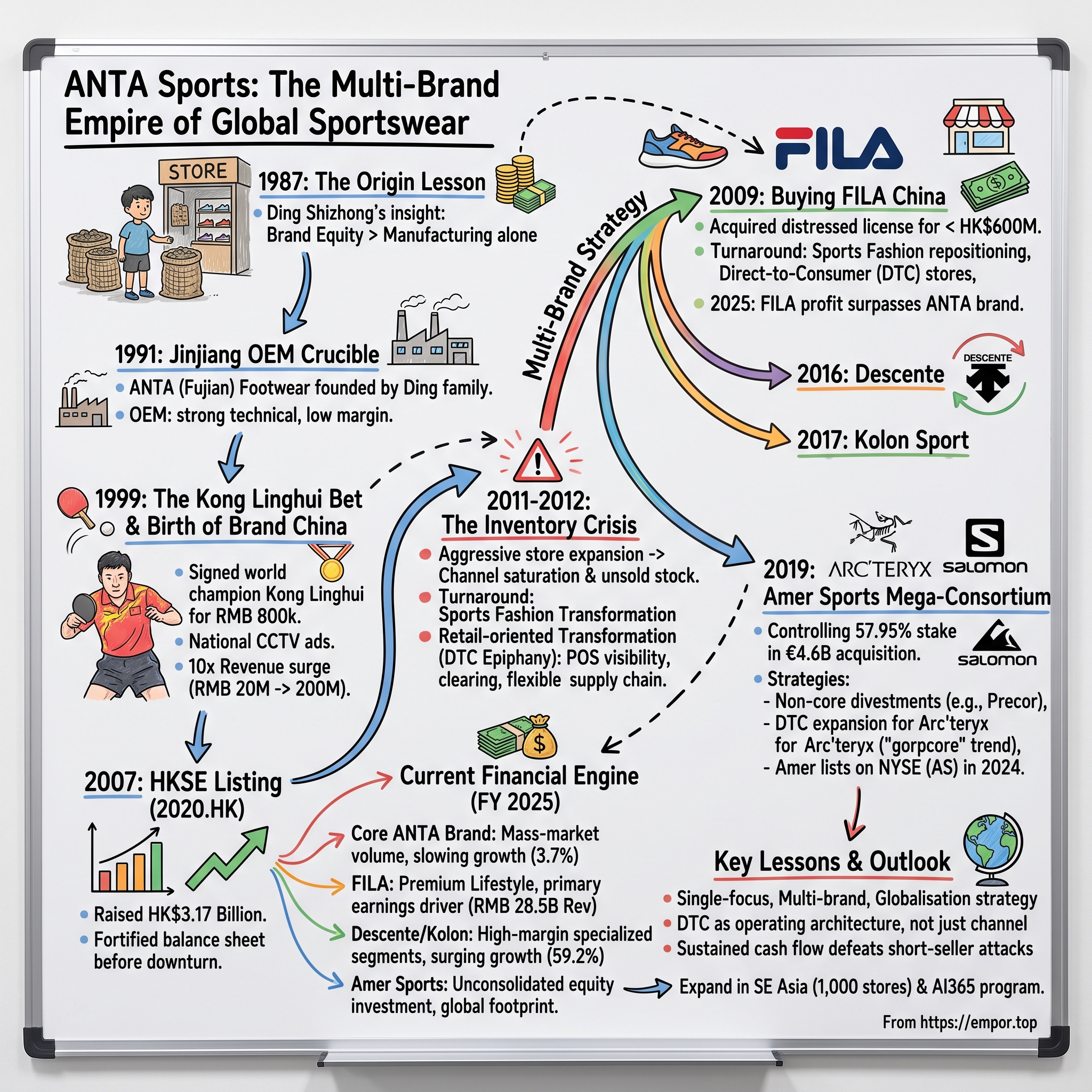
ANTA Sports: The Multi-Brand Empire of Global Sportswear
I. Introduction & Episode Roadmap
In Chinese business circles, an iconic story surrounds a photograph from the late 1980s showing a teenage boy standing outside a Beijing department store, woven plastic sacks filled with sneakers at his feet. The boy had traveled by train for nearly two days from a coastal county in Fujian province where shoe workshops dominated local industry. Having borrowed ten thousand yuan from his father, he brought six hundred pairs of shoes to the capital. What he observed inside the store highlighted a fundamental dynamic of the retail market.
The shoes displayed on store shelves originated from the same county as those in his sacks, often produced in identical workshops by the same workers. Yet footwear bearing an established trademark—such as Qingdao Double Star or Shanghai Torch—sold for roughly 100 yuan per pair, whereas identical unbranded pairs fetched only about 20 yuan.1
That fivefold price difference underscored a central lesson in consumer retail: product manufacturing alone yields only a fraction of the value created by brand equity. The subsequent expansion—including national marketing campaigns, an inventory crisis in 2011, short-seller scrutiny, and a €4.6 billion European acquisition—built upon this core premise.
The young entrepreneur was 丁世忠 Ding Shizhong, the county was 晋江 Jinjiang, and the business his family established, 安踏体育 ANTA Sports Products Limited (2020.HK), reported revenue of RMB 80.22 billion for fiscal year 2025—a 13.3% year-over-year increase that secured an estimated 21.8% share of China's sportswear market, the largest of any domestic or foreign operator.2 Including the separately listed European business under its control, group-level sales exceeded RMB 127 billion.3
ANTA's operational trajectory stands out because it managed a portfolio structure that has challenged many global consumer conglomerates: operating a mass-market volume brand alongside a portfolio of premium and luxury-adjacent labels within a single organisation, without diluting premium brand equity or underfunding core high-volume lines. By comparison, Nike divested brands such as Cole Haan, Umbro, and Hurley to focus primarily on its core brand; Adidas struggled with Reebok for fifteen years before selling the unit; and VF Corporation underwent extensive restructuring in the 2020s.
ANTA framed its approach around a strategy summarized internally as 单聚焦、多品牌、全球化 ("single-focus, multi-brand, globalisation"), generating substantial revenue growth across distinct market segments.4 However, the business faces new operational headwinds. As of early August 2026, ANTA shares traded around HK$77, down from a 52-week high of HK$106.30, representing a market capitalisation of approximately HK$215 billion.5 Growth for the flagship ANTA brand slowed to 3.7% in 2025, marking its weakest annual expansion in a decade outside the pandemic period.2 Furthermore, the brand's CEO resigned on 15 July 2026, leaving a publicly stated RMB 60 billion revenue target unfulfilled.6
These developments raise a key analytical question: whether ANTA's historical performance reflects a systematic, repeatable operating methodology or a series of well-timed strategic moves.
The following analysis examines the stages of this expansion: the original equipment manufacturing base in Jinjiang; the 1999 endorsement campaign that established domestic sports branding; the 2011–2012 inventory crisis that reshaped operating discipline across the Chinese sportswear sector; the acquisition and scaling of FILA; the short-seller reports of 2018–2019; the acquisition of Amer Sports and the expansion of Arc'teryx; and an assessment of current financials, corporate governance, market positioning, and prospective risks.
The story begins in a Fujian farming county centered on shoe manufacturing.
 Subscribe on LinkedIn
II. The Shoemaker of Jinjiang: Origin & The OEM Crucible (1991–1999)
Jinjiang in the early 1990s was an unpromising origin for a future sports powerhouse. A coastal county in southern Fujian, it was historically poor, agricultural, and shaped by emigration, with generations of local families relying on remittances sent home from relatives in Southeast Asia and the Philippines. What Jinjiang possessed was strategic: proximity to Taiwan and Hong Kong, an established culture of family enterprise, and, as Deng Xiaoping's reforms opened coastal markets, an intense appetite for contract manufacturing.
By the mid-1990s, the township of 陈埭 Chendai alone hosted thousands of shoe workshops. Western brands supplied technical specifications, and local families delivered finished sneakers from production lines set directly beneath their living quarters. It was original equipment manufacturing (OEM) in its purest form: strong technical capability, high throughput, and razor-thin profit margins.
The underlying economics of that arrangement shaped ANTA's long-term strategy. In a standard OEM structure, the factory earns a conversion fee covering materials, labor, and a slim markup. The brand owner dictates design, manages customer relationships, and captures the spread between production costs and retail prices. When hundreds of workshops across a single township manufacture identical footwear, buyers easily play suppliers off one another, driving gross margins down toward the cost of capital. Factory orders remained tethered to decisions made in Oregon or Bavaria; a plant owner could achieve exceptional operational efficiency and still lack a viable, independent business.
丁和木 Ding Hemu operated one of those family workshops. In 1991, alongside his sons 丁世家 Ding Shijia and 丁世忠 Ding Shizhong, he formalized the enterprise as ANTA (Fujian) Footwear. Initial capital was variously reported at approximately RMB 60,000, supporting roughly ten workers and incorporating the proceeds from the younger son's four years selling shoes in Beijing.1
What distinguished the Dings from thousands of neighboring workshop operators was not manufacturing technique, but Ding Shizhong's direct experience in retail distribution. In Beijing, he had observed consumer behavior firsthand, studying which footwear sold, at what prices, and why. He realized that the trademark stamped onto a shoe was not decorative trim—it was the primary economic asset.
The name chosen for the enterprise captured both ambition and cautious discipline. 安踏 functions as a contraction of 安心创业,踏实做人—translating roughly to "build a business with a settled mind, conduct yourself on solid ground." This Fujianese ethos was grounded and understated, far removed from the high-profile athletic sponsorships the company would later pursue.
Throughout the 1990s, ANTA operated within the boundaries of a typical domestic supplier. It sold products through China's expanding network of sporting-goods stores and department store concessions, building a regional distributor network while competing primarily on price and availability. Although revenue grew, market density increased rapidly. By the late 1990s, Jinjiang spawned dozens of emerging footwear businesses, including the predecessors of 特步 Xtep, 361度 361 Degrees, 匹克 Peak, and 鸿星尔克 Erke. While these operators adopted corporate logos, few created true brand equity.
That distinction proved fundamental to ANTA's evolution: a logo serves as a visual identifier, whereas a brand builds customer expectations that support prices above commodity levels. In 1998, ANTA possessed a recognized logo and an annual net profit of roughly RMB 4 million—a substantial return for a family business in Chendai, but a small fraction of the capital required to build a national brand.
That gap between local profitability and national visibility framed the company's next move, setting up a high-stakes strategy that would test its financial limits.
III. The Kong Linghui Bet & The Birth of Brand China (1999–2007)
In 1999, ANTA took a major financial risk by signing table tennis world champion 孔令辉 Kong Linghui as its brand ambassador for RMB 800,000.7 For a company then earning single-digit millions in annual net profit, the endorsement fee represented a substantial commitment of working capital tied directly to a single athlete's performance and public profile.
Management initially resisted additional spending on national television advertising that year, arguing that having committed the endorsement fee, broadcast airtime could wait twelve months. Ding Shizhong countered that an endorsement without broad visibility yielded little commercial return, arguing that securing a star athlete required an accompanying broadcast campaign to build brand equity. ANTA subsequently purchased national airtime on China Central Television (CCTV).7
At the 2000 Sydney Olympics, Kong won the men's singles gold medal. The accompanying television campaign—featuring the tagline 我选择,我喜欢 ("I choose, I like")—gained widespread national resonance. Chinese consumers who previously had no familiarity with the Jinjiang manufacturer increasingly associated ANTA with top-tier athletic achievement.
The commercial impact was immediate and substantial. ANTA's annual sales surged from roughly RMB 20 million to more than RMB 200 million.7 This tenfold revenue expansion was driven not by physical factory expansion or product innovation, but by establishing brand recognition and consumer equity.
The broader strategic effect reshaped the regional market. ANTA demonstrated that pairing prominent athletic endorsements with national television advertising could build brand equity and pricing power in China's emerging consumer economy. Competitors across Jinjiang quickly adopted the playbook. Within eighteen months, dozens of local footwear manufacturers signed athlete endorsements and purchased advertising space on CCTV's sports channel, leading industry observers to nickname the channel 晋江频道 (the "Jinjiang Channel").7
This transition highlighted two critical strategic dynamics. First, while celebrity endorsements were an established global practice, ANTA recognized their specific leverage within China's fragmented retail environment. In a market where consumers lacked established brand loyalty, the marginal return on building national brand awareness far exceeded the return on adding manufacturing capacity—a pivotal capital allocation decision. Second, as competitors replicated the strategy, national advertising alone ceased to offer a distinct competitive advantage. However, ANTA leveraged its early momentum to build out an extensive distribution network and accumulate capital reserves before advertising costs escalated across the sector.
That distribution network served as the second pillar of ANTA's expansion. Throughout the 2000s, the company established a wholesale system across China's lower-tier cities, county seats, and prefectural capitals. In these markets, global leaders like Nike and Adidas had minimal distribution, and sneakers priced around RMB 200 held aspirational appeal for middle-income consumers. The business model was deliberately asset-light: ANTA sold products directly to regional distributors, who then supplied sub-distributors and retail store operators. This structure allowed ANTA to earn wholesale margins without incurring direct retail lease liabilities or carrying store-level inventory risk, resulting in strong capital efficiency. However, it also left management with minimal direct visibility into sell-through rates and actual consumer demand—a vulnerability that would later trigger industry-wide strain.
On 10 July 2007, ANTA listed on the Hong Kong Stock Exchange, issuing 600 million shares at HK$5.28 per share and raising approximately HK$3.17 billion.8 Reflecting robust investor demand for Chinese consumer equities ahead of the 2008 Beijing Olympics, the initial public offering's retail tranche was oversubscribed by a reported 183 times.8
In hindsight, the timing proved exceptionally strategic. The capital raise provided ANTA with substantial cash reserves near the peak of the market cycle, approximately one year before the 2008 global financial crisis and four years prior to an industry-wide inventory downturn in Chinese sportswear. Securing liquidity during this market window gave ANTA a fortified balance sheet, positioning the company as one of the few domestic operators capable of strategic acquisitions and structural reforms during the subsequent sector consolidation.
IV. The 2011 Inventory Crisis & The DTC Epiphany (2008–2015)
The Beijing Olympics were intended to mark the beginning of a sustained athletic retail boom. Instead, they marked an operational peak.
In the run-up to August 2008, Chinese sportswear executives operated under a shared premise: a nation of 1.3 billion people, heavy government investment in sports infrastructure, a rapidly expanding middle class, and a televised global showcase of national pride. The commercial strategy seemed obvious: expand retail store networks as aggressively as possible.
They executed that playbook at scale. Between 2008 and 2011, Li-Ning, ANTA, Peak, and 361 Degrees collectively opened more than 9,000 stores across mainland China—an average of roughly eight new retail locations every day for three years.9
The structural mechanism by which this expansion turned into an industry-wide downturn became a defining operational lesson for ANTA.
Under a wholesale model, a sportswear brand recognizes revenue upon shipping products to independent regional distributors—a metric known as sell-in. Actual consumer purchases at retail represent sell-through. In a stable market, sell-in and sell-through closely track each other. During an aggressive store expansion, however, the two metrics decouple. Because every new store requires initial opening stock, wholesale sell-in surges even if consumer sell-through remains flat. Corporate revenues and reported profits accelerate rapidly while unsold inventory accumulates inside distribution channels. Because independent distributors owned the inventory and brand owners lacked point-of-sale tracking, corporate executives had virtually no real-time visibility into end-consumer demand.
By 2011, wholesale distribution channels were saturated. Distributors held large volumes of unsold stock and lacked the liquidity to place new orders, causing factory reorders to collapse. Discounting became ubiquitous across retail outlets—and as products sold at persistent 50% markdowns, the brand equity accumulated over the preceding decade degraded rapidly.
李宁 Li-Ning, then the market leader and premier domestic sports brand, compounded its exposure through an ill-timed strategic repositioning that remains a classic cautionary case in Chinese consumer strategy. Li-Ning attempted to move upmarket—introducing a new logo, slogan, and higher price points targeted at younger, wealthier urban consumers—while simultaneously attempting to retain its traditional mass-market base. The brand achieved neither: it lacked the consumer prestige to command Nike-adjacent pricing and alienated its existing customer base. In December 2012, Li-Ning warned of a substantial full-year loss, driven largely by a channel revitalization program to buy back distributor inventory estimated to cost between RMB 1.4 billion and RMB 1.8 billion.10 Li-Ning ultimately reported a net loss of approximately RMB 1.98 billion for 2012. By contrast, ANTA remained profitable that year, generating net income of roughly RMB 1.36 billion.9
This performance divergence shaped ANTA's long-term operating character. Faced with the sector downturn, ANTA avoided brand repositioning and focused instead on fundamental operational restructuring. Management labeled the initiative the 零售导向转型 ("retail-oriented transformation"), executing three core operational shifts:
Digitizing channel visibility. ANTA deployed point-of-sale (POS) systems across its distributor network, granting corporate headquarters real-time visibility into daily retail sell-through rather than relying on quarterly wholesale sell-in. In 2012, across thousands of independently operated stores in lower-tier cities, this represented a major technical and organizational hurdle, as distributors recognized that data transparency shifted operational control back to the brand.
Clearing channel inventory. Rather than delaying write-downs, ANTA bought back excess inventory directly from distributors and systematically closed underperforming retail locations, prioritizing channel health over aggregate store counts.
Restructuring supply chain dynamics. Moving away from the industry standard of single, large wholesale orders placed nine months before a season, ANTA instituted a flexible replenishment model driven by live sell-through data—replacing speculative long-lead orders with frequent, smaller production runs.
By executing these reforms, ANTA converted an industry-wide demand shock into a structural data advantage. Real-time visibility into store-level sales enabled the company to optimize production, lower markdown rates, and improve working capital efficiency compared to peers operating on trailing forecasts.
Simultaneously, the restructuring altered the balance of power between ANTA and its retail partners. Prior to 2011, regional distributors operated as autonomous middleman enterprises, setting localized pricing and managing independent inventory. Post-restructuring, distributors functioned as integrated nodes within ANTA's centralized operating system. Establishing direct oversight of retail mechanics and channel data provided the operational foundation required for ANTA's subsequent multi-brand strategy.
This operational shift culminated in August 2020, when ANTA announced a formal transition of its core brand to a direct-to-consumer (DTC) model. The plan encompassed approximately 3,500 retail stores across eleven provinces and major municipalities, including Shanghai, Guangdong, Zhejiang, Chengdu, Chongqing, Wuhan, Xi'an, and Nanjing, with roughly 60% taken over and operated directly by ANTA and the remainder managed by franchisees under tightened operating standards.11
In ANTA's framework, direct-to-consumer went far beyond expanding e-commerce channels. It represented a structural commitment to bring inventory, store leases, retail staff, and markdown risk directly onto the corporate balance sheet. In exchange, ANTA captured full retail margins and gained complete control over brand presentation and pricing strategy. While this model increased capital intensity and operating leverage, it depended on superior store-level execution.
By the time ANTA initiated this DTC transition for its flagship brand in 2020, it had already spent a decade refining the model on an acquired label—one it had purchased at a distressed valuation.
V. The Masterstroke: Buying FILA China & The Multi-Brand Playbook (2009–2018)
By 2009, FILA's operations in mainland China were underperforming and unprofitable.
The Italian sportswear house had licensed its Greater China rights to Full Prospect, a joint venture majority-owned by 百丽国际 Belle International—a Shenzhen-based women's footwear retailer that struggled to adapt a European athletic brand to the domestic retail market. In August 2009, Belle announced it would sell its 85% stake in Full Prospect, along with its retail operations in Hong Kong and Macau, to ANTA for a total consideration capped at HK$600 million.12
Relative to ANTA's financial scale, the transaction was modest: the purchase price represented less than one-fifth of the capital raised in ANTA's 2007 initial public offering. At the time, market observers viewed the acquisition with skepticism, questioning whether a domestic mass-market footwear manufacturer possessed the capability to turn around an underperforming foreign label.
ANTA's leadership identified an operational mismatch rather than an inherently flawed brand. Distributing a heritage European athletic brand through traditional mass-market footwear channels diluted brand equity and constrained margins, leaving the underlying value of the trademark unexploited.
The subsequent turnaround unfolded over roughly five years, anchored by three strategic decisions:
Reposition the category, not the brand. ANTA shifted FILA away from direct competition in technical athletic performance—where it faced pressure from global leaders like Nike above and ANTA's core brand below—toward sports fashion and premium lifestyle apparel. By positioning FILA at the intersection of sportswear and fashion, ANTA entered a less crowded market segment where purchasing decisions depended on aesthetics and heritage rather than technical specifications, supporting higher gross margins.
Own every store. ANTA eliminated independent wholesale distributors for FILA, transitioning the label entirely to a directly operated retail model. Stores were established in mid-to-high-end shopping malls across tier-one and tier-two cities. By managing retail locations directly, ANTA captured full retail markups instead of wholesale margins. This direct structure drove FILA's reported gross margins significantly above those of traditional wholesale-reliant peers, an accounting contrast that would later draw intense short-seller scrutiny.
Segment the brand into sub-portfolios. ANTA introduced targeted sub-labels—such as FILA KIDS, FILA FUSION for younger streetwear consumers, and FILA GOLF—to reach distinct demographic segments without fragmenting the master brand's core identity. This enabled market expansion within a consistent aesthetic framework.
The financial returns proved highly substantial. A business that had generated combined net losses of approximately RMB 54 million in 2007 and 2008 generated RMB 28.47 billion in revenue for fiscal year 2025 at a 66.4% gross margin.42 Operating profits from a single fiscal year eventually exceeded the original HK$600 million purchase price multiple times over.
This growth was reinforced by favourable macro trends. The global rise of athleisure apparel beginning around 2014 provided a strong industry tailwind. Simultaneously, an expansion of modern shopping malls across China created a steady supply of prime retail space suited for premium lifestyle positioning. ANTA capitalized on these market shifts through disciplined operational execution.
Beyond immediate financial results, the acquisition established a repeatable operating framework. Rather than treating FILA's turnaround as an isolated success, ANTA institutionalized the multi-brand strategy, acquiring Greater China rights for specialized foreign labels with unexploited regional potential: establishing a joint venture for Japanese ski and performance brand 迪桑特 Descente in 2016, and acquiring Korean premium outdoor brand 可隆体育 Kolon Sport in 2017.
This approach formed ANTA's core multi-brand playbook: secure Greater China rights for foreign labels with established technical credibility but minimal local scale; bypass wholesale distribution in favour of directly operated stores in tier-one shopping centers; segment product lines effectively; and leverage foreign brand equity to capture premium market tiers inaccessible to a domestic mass-market brand.
By 2018, this strategy generated profit margins significantly higher than global industry averages—an operational performance that soon attracted intense skepticism from short-selling investment firms.
VI. Fighting Off the Short Sellers: The Muddy Waters Battle (2018–2019)
On 8 July 2019, ANTA Sports requested a trading halt on the Hong Kong Stock Exchange after its shares fell 7.3% during morning trading.13
The immediate catalyst was the first installment of a five-part research series from Carson Block's Muddy Waters Research, titled "Turds in the Punchbowl."[^14] GMT Research had previously raised accounting questions in 2018, and Blue Orca Capital had published a critique earlier in 2019 alleging that ANTA misstated operational data.13 Muddy Waters, however, mounted a more sustained campaign, releasing successive reports over a two-week period.
The central allegation focused on profitability metrics. ANTA reported operating margins in the mid-20% range, whereas established global leaders such as Nike and Adidas reported operating margins roughly half that level. The short sellers questioned how a domestic sportswear manufacturer could generate margins double those of the industry's largest global operators.
Muddy Waters alleged that ANTA secretly controlled its distributor network. The report claimed ANTA covertly owned at least 27 nominally independent first-tier distributors, accounting for an estimated 70% to 80% of core ANTA brand sales.13[^14] Under this mechanism, ANTA would book wholesale revenue while keeping retail operating costs off its balance sheet, thereby artificially inflating operating margins and rendering its financial statements unreliable. A subsequent installment alleged that management had transferred an international retail business to a proxy buyer at a substantial discount in 2008, shortly after the initial public offering.13
ANTA responded promptly. The board issued statements during the same week denying the allegations as inaccurate and misleading, followed by detailed disclosures addressing the specific claims.13[^15]
The failure of the short thesis to gain lasting traction stemmed from structural business differences rather than corporate denials.
The margin comparison central to the short report overlooked fundamental operational distinctions. Global peers like Nike and Adidas relied heavily on wholesale models across much of their global footprint, selling to third-party retailers who captured the retail markup. In contrast, ANTA's premium segments—most notably FILA—operated through direct-to-consumer models, capturing the full spread between production costs and final retail prices. Comparing operating margins without adjusting for where retail margin sits in the value chain conflated distinct business models. Furthermore, ANTA benefited from a localized supply chain in the Jinjiang manufacturing cluster, where component sourcing, labor, and logistics costs remained well below the cost structures of Western brands contracting third-party production across multiple countries.
While related-party transparency within domestic distribution networks remained a recurring industry concern, long-term cash flow metrics provided empirical verification.
If a company inflates margins through off-balance-sheet entities, reported profits typically fail to materialize as cash. ANTA consistently generated operating cash flow, maintained a dividend policy targeting roughly 50% of net profit, and built a substantial net cash position. In fiscal year 2025, the group generated RMB 16.11 billion in free cash flow and closed the year with net cash of RMB 31.72 billion.2 Consistent cash generation and dividend payouts over a multi-year period provided concrete evidence of reported earnings.
Management's operational response during the episode also reassured capital markets. Rather than pursuing litigation or extended trading suspensions, ANTA halted trading briefly, published detailed line-item rebuttals through the stock exchange, and resumed standard operations. Company founders and controlling shareholders purchased shares in the open market, while management maintained its dividend policy and progressively increased disclosure granularity regarding segment reporting and store networks in subsequent reporting periods.
The episode demonstrated that sustained cash distribution and operational transparency serve as effective defenses against market skepticism. However, it also underscored structural complexities inherent in multi-entity distribution models, where segment margin calculations depend on precise internal cost allocations. These organizational complexities expanded further in late 2018 and 2019, as ANTA pursued the largest cross-border acquisition in the history of the global sporting goods industry.
VII. The Amer Sports Mega-Consortium: Buying Arc'teryx & Going Global (2019–2024)
In 2018, Amer Sports represented a geographically dispersed European sporting goods group assembled over several decades. Headquartered in Helsinki, the company held an extensive brand portfolio—including 始祖鸟 Arc'teryx, the North Vancouver technical outerwear brand; 萨洛蒙 Salomon, the French trail-running and winter sports specialist; 威尔胜 Wilson, the American racquet and ball sports manufacturer; Peak Performance; and Atomic—yet it operated at a net loss reportedly exceeding $200 million annually.4 Its holdings also included a commercial fitness equipment manufacturer, a cycling wheel maker, and a sports watch business, resulting in a capital-intensive and unfocused corporate structure.
On 7 December 2018, a consortium announced a voluntary recommended public cash tender offer of €40.00 per share for all outstanding shares of Amer Sports, valuing its equity at approximately €4.6 billion.14 The acquiring entity brought together distinct capital partners: ANTA held a controlling 57.95% stake, Chinese private equity firm FountainVest acquired 21.40%, and Anamered Investments—the investment vehicle of Lululemon founder Chip Wilson—took 20.65%, alongside minority participation from Tencent.4 The transaction structure combined roughly €2.663 billion in equity with approximately €3 billion in debt financing.4 By 28 March 2019, 98.1% of Amer Sports shares had been tendered.
Initial market reaction was cautious. Analysts questioned whether ANTA was paying a demanding valuation for an unprofitable European group financed through heavy debt leverage, particularly given that ANTA's executive team had built its operating experience primarily within Chinese domestic retail.
Rather than attempting an immediate multi-brand integration across all divisions, the consortium executed a sequential strategy focused on portfolio streamlining, direct-to-consumer expansion, and balance-sheet refinancing.
Streamlining non-core assets. The consortium systematically divested non-core equipment units to reduce debt and focus resources on apparel and footwear. Commercial fitness equipment maker Precor was sold to Peloton in a $420 million transaction announced in December 2020 and completed in April 2021; board executive director James Zheng noted that the go-forward strategy prioritized "Softgoods, Direct to Consumer, and building a significantly enhanced presence in China."15 Cycling components brand Mavic was divested, and sports watch maker Suunto was sold to a Chinese wearables firm in early 2022.16 These sales removed hardware-manufacturing overhead and allowed management to focus capital on higher-margin softgoods.
Applying the DTC playbook to Arc'teryx. Arc'teryx had previously operated as a technical niche label distributed primarily through specialist outdoor wholesalers. ANTA transitioned the brand toward directly operated flagship stores in tier-one urban shopping districts, particularly across China, while capitalizing on the commercial overlap between technical outerwear and urban fashion. This repositioning coincided with the global rise of gorpcore—the trend of wearing high-performance outdoor gear in metropolitan environments. Supported by technical credibility and strong visual branding, Arc'teryx shell jackets priced around RMB 8,000 became prominent status items in major Chinese consumer markets.
Refinancing debt through public markets. On 1 February 2024, Amer Sports, Inc. listed on the New York Stock Exchange under the ticker AS, issuing 105 million shares at $13.00 to raise approximately $1.37 billion in gross proceeds. A follow-on equity offering in December 2024 raised an additional $1.08 billion dedicated to debt repayment.4 ANTA remained the largest shareholder with approximately 43% of outstanding shares, accounting for the holding as an associate rather than consolidating its financial statements.17
Subsequent financial performance reflected the impact of these operational changes. For fiscal year 2025, Amer Sports reported total revenue of $6.566 billion, a 27% increase year-over-year. Growth was led by Technical Apparel—anchored by Arc'teryx—which expanded 30% to $2.856 billion. The Outdoor Performance division, led by Salomon, rose 31% to $2.404 billion as Salomon surpassed $2 billion in annual brand sales for the first time. Ball & Racquet Sports grew 13% to $1.307 billion. Expansion was fastest in Greater China, where revenue climbed 43.4% to $1.86 billion. Direct-to-consumer sales increased 41.5% to $3.209 billion, supported by a 39% expansion in directly operated stores to 703 locations. Operating efficiency improved concurrently: adjusted gross margin rose 230 basis points to 58.0%, adjusted operating margin increased 170 basis points to 12.8%, and net income reached $427.4 million, leaving net debt at $291 million, or 0.3 times leverage.18
During the fourth-quarter earnings call in February 2026, chief executive James Zheng characterized the period as "a great finish to a breakout year," while chief financial officer Andrew Page noted that "our financial foundation has never been stronger."19 Addressing analyst questions regarding accelerated marketing and inventory investments behind Salomon, management stated that these expenditures targeted verified growth momentum and anticipated normal operating leverage to resume in the second half of 2026.19 Guidance for full-year 2026 projected reported revenue growth of 16% to 18%, with adjusted earnings per share expected between $1.10 and $1.15.18
This restructuring altered Amer Sports' financial profile. From a loss-making entity acquired at a €4.6 billion equity valuation in 2018, Amer Sports expanded into a publicly traded company with a market capitalization exceeding $20 billion by mid-2026, making ANTA's equity stake a material component of its own corporate valuation.
Strategically, the acquisition transformed ANTA's operating model, evolving the group from a domestic manufacturer managing licensed overseas brands into an international enterprise with direct global store networks and substantial overseas revenue.
VIII. Current Financial Engine: Segment Breakdown & Economic Drivers
Behind ANTA's growth story sits a four-tier corporate structure, with each brand segment occupying a distinct price tier in the Chinese consumer market and operating under different margin dynamics.
The group's three-year top-line trajectory illustrates both scale expansion and recent moderation: revenue expanded from RMB 62.36 billion in 2023 to RMB 70.83 billion in 2024, reaching RMB 80.22 billion in 2025.202 That performance added roughly RMB 18 billion in annual sales over two years—a mid-teens compound growth rate that reflects steady expansion on an enlarged base.
For fiscal year 2025, consolidated group revenue rose 13.3% to RMB 80.219 billion. Operating profit increased 15.0% to RMB 19.091 billion, expanding operating margin by 0.4 percentage points to 23.8%, while gross margin edged down 0.2 percentage points to 62.0%.2 Profit attributable to equity shareholders was RMB 13.588 billion. On a headline basis, attributable profit declined 12.9% against 2024, but the prior-year figure was inflated by a large, non-recurring accounting gain recognized during the public listing and share placement of Amer Sports. Restated in the annual report on a comparable basis, 2024 net profit was RMB 11.927 billion, representing a 13.9% year-over-year increase for 2025.293 Earnings per share stood at RMB 4.89, compared with RMB 5.55 reported for 2024.29 Free cash flow expanded 21.5% to RMB 16.11 billion—a metric less affected by non-operating accounting adjustments.21
The four brand layers display distinct operational roles:
ANTA core brand — the mass-market volume engine. The flagship brand generated revenue of RMB 34.754 billion (up 3.7%) and operating profit of RMB 7.211 billion (up 2.5%).2 Offering performance footwear and apparel in the RMB 200–600 price range, the brand operated 7,203 monobrand stores across China and overseas at year-end 2025—a net addition of 68 doors from 7,135 a year earlier.29 Group-wide across all portfolio labels, store count stood at approximately 13,000.29 Direct-to-consumer conversion for the core brand is largely complete.
The 3.7% revenue growth rate represents a notable deceleration from 10.6% in 2024 and years of double-digit expansion. Gross margin for the core brand contracted, while operating margin slipped from 21.0% to 20.7%.296 Decelerating revenue alongside margin pressure typically signals that merchandise is requiring greater promotional support to clear.
Digital sales reflected similar friction. Online revenue reached RMB 12.86 billion in 2025, growing 7.3%—below group-level expansion and well off its historical pace.29 Management attributed the digital deceleration to a deliberate strategy to curb steep promotional discounting, though margin trends have yet to confirm a full recovery in full-price digital sell-through.
FILA — the primary earnings driver. FILA produced revenue of RMB 28.469 billion (up 6.9%) and operating profit of RMB 7.418 billion (up 10.1%).2 A key operational milestone occurred in 2025: FILA's operating profit surpassed that of the core ANTA brand for the first time.3 An asset acquired in 2009 for a consideration capped at HK$600 million now generates more operating earnings than the parent brand that acquired it.
FILA's growth rate—roughly half the group average—reflects a maturing retail footprint. The store network, including kids and youth sub-labels, closed 2025 at 2,652 doors compared with 2,784 a year earlier, representing a net closure of 132 locations.29 With store expansion complete, future revenue growth depends primarily on same-store productivity and category extension. That FILA expanded operating profit faster than top-line revenue in 2025 points to disciplined store-level execution and expense management.
All other brands — the high-margin expansion engine. Combined revenue for smaller specialized brands surged 59.2% to RMB 16.996 billion, while operating profit rose 55.3% to RMB 4.74 billion.2 This segment includes Descente, Kolon Sport, and newly acquired Jack Wolfskin. Descente's annual retail sales surpassed RMB 10 billion for the first time in 2025, establishing it as the group's third RMB 10 billion brand, while Kolon's turnover exceeded RMB 6 billion (up nearly 70%), supported by per-store productivity exceeding RMB 2 million.323
This segment generates the strongest unit economics in the portfolio. Specialized technical categories—such as skiing, golf, and premium outdoor gear—are distributed to high-income urban consumers through a lean network of high-productivity, directly operated stores. Segment revenue has expanded nearly sevenfold since 2020 with only modest net store additions.3 High store productivity rather than footprint expansion drives growth, though the total addressable market for premium niche sportswear remains structurally smaller than mass market categories.
In June 2025, ANTA completed the acquisition of German outdoor brand Jack Wolfskin from Topgolf Callaway Brands for $290 million in cash, effective 31 May 2025.2425 The transaction followed ANTA's established pattern of acquiring European heritage outdoor labels with underutilized global reach. However, integrating the brand introduced initial operational friction, contributing to higher group inventory turnover days.26
Amer Sports — the unconsolidated equity investment. Because ANTA holds an approximate 43% equity stake and accounts for Amer Sports as an associate, Amer's top-line revenue is not consolidated into ANTA's reported sales; only ANTA's share of Amer's net profit appears on the income statement. Including Amer, total sales across all brands within the broader ANTA ecosystem reached approximately RMB 127.8 billion in 2025.3
This accounting structure means reported consolidated figures understate the total economic footprint of the group's brand holdings. With Amer's standalone market capitalization exceeding $20 billion by mid-2026 and ANTA's equity value around HK$215 billion (roughly $27–28 billion), ANTA's equity stake in Amer represents approximately one-third of parent market value.517 Evaluating ANTA on a simple consolidated price-to-earnings ratio understates the asset base, making a sum-of-the-parts approach necessary.
Working capital metrics showed area-specific pressure. Group average inventory turnover expanded to 137 days in 2025, compared with 123 days in both 2023 and 2024—nearing the 138 days recorded during the 2022 market disruptions.29 Part of the increase was mechanical, stemming from the acquisition of Jack Wolfskin, which required a cash outlay of RMB 2.17 billion and brought existing stock onto the balance sheet.29
Capital distribution remained consistent with stated targets. ANTA declared an interim dividend of HK$1.37 and a final dividend of HK$1.08 per share for 2025, totaling HK$2.45 compared with HK$2.36 in 2024. This represented a cash outlay of RMB 6.199 billion, or 50.1% of adjusted profit attributable to shareholders—aligning with the board's 50% payout policy.29 In addition, the group executed RMB 1.952 billion in share repurchases while maintaining a net cash position of RMB 31.7 billion.29
Myth versus reality
Three common market assertions regarding ANTA's positioning require clarification:
"ANTA has overtaken Nike in China." While ANTA Group's aggregate China revenue surpassed Nike's domestic sales—securing a market-leading estimated 21.8% market share—that comparison evaluates a multi-brand group against a single brand.2 Measured on a brand-to-brand basis, Nike's Greater China business remained substantially larger than the core ANTA brand as of the most recent reporting period.26 ANTA's multi-brand ecosystem leads the market, but its flagship brand alone does not.
"FILA was primarily a lucky acquisition." Favorable market timing and the rise of athleisure supported the brand's trajectory, but value creation was driven by operational changes. The previous brand owner held identical licensing rights but ran the operation at a loss. ANTA's turnaround resulted from eliminating wholesale distribution, bringing retail operations in-house, and repositioning FILA into premium lifestyle fashion—enabling the brand to maintain a 66% gross margin over a sustained period.
"The 2025 net profit decline indicates structural weakness." The year-over-year drop in headline net profit resulted from a high comparison base in 2024, which included a non-recurring accounting gain from the Amer Sports listing. On a comparable operational basis, net profit and free cash flow both grew.32 The primary operational challenge in the 2025 results lies in the core brand's 3.7% growth rate, narrowing gross margins, and elevated inventory turnover days.
ANTA's broader financial framework remains well-capitalized, but operational slowing at its primary volume engine highlights key strategic questions heading into the second half of 2026.
IX. Management, Governance, & Capital Allocation Discipline
On 19 January 2023, ANTA announced the largest reorganization of its senior management in sixteen years. Ding Shizhong, then 52, stepped down as chief executive while remaining chairman with responsibility for internal audit, oversight, and mergers and acquisitions. 赖世贤 Lai Shixian, 48, and 吴永华 Wu Yonghua became joint chief executives, effective 1 February. Lai assumed oversight of the core ANTA brand, non-FILA labels, group procurement, human resources, legal, and investor relations. Wu took charge of the FILA brand and retail channels, having previously managed the Professional Sports Group. 毕明伟 Bi Mingwei succeeded Lai as chief financial officer, while 丁世家 Ding Shijia, 58, retained production management. Meanwhile, 郑捷 Zheng Jie—known internationally as James Zheng—stepped down as group president to become chief executive of Amer Sports.27
This corporate restructuring can be interpreted in two contrasting ways, both supported by the underlying record.
The favorable view highlights a founder-controlled Chinese enterprise voluntarily splitting the chairman and chief executive roles, delegating operational authority to professional executives with extensive international experience—such as Zheng, who held senior roles at Procter & Gamble and Adidas prior to leading the FILA turnaround—and cultivating a broader management bench. In a market where founder-dominated governance is standard and succession often creates instability, this shift represented a meaningful governance milestone.
The critical view emphasizes that the resulting structure remains complex, reporting lines have shifted repeatedly, and the founder retains the chairmanship alongside control over capital allocation. As of 31 December 2025, family-trust structures held through HSBC Trustee held economic interests in approximately 53.21% of issued shares, while Anta International Group Holdings and its wholly owned subsidiaries directly controlled 52.83%—an ownership chain spanning four separate family trusts associated with Ding Shizhong, Ding Shijia, Wu Yonghua, and the family of Lai Shixian.29 Regardless of formal organizational charts, ultimate decision-making authority remains centralized within the founding group.
On 15 July 2026, 许阳 Xu Yang, chief executive of the core ANTA brand, resigned for stated personal reasons, with joint chief executive Lai Shixian assuming his responsibilities on an acting basis.6
This departure carried significant strategic implications, serving as a critical test of management execution. Over the preceding three years, Xu had implemented a strategy aimed at refining brand segmentation—decomposing the flagship brand into specialized sub-units targeted by demographic and distribution channel. The initiative introduced specialized store formats, including ANTA SNEAKER VERSE for high-end sneaker buyers and Super ANTA for value-focused consumers. Central to this strategy was an ambitious, publicly stated target: reaching RMB 60 billion in ANTA brand revenue by 2026 and surpassing Nike as China's top single brand.6
The operational results fell substantially short of those goals. The core brand closed 2025 with RMB 34.75 billion in revenue. The specialized retail formats generated lower-than-projected sales productivity, inventory levels rose, and channel friction developed as company-operated locations competed directly with existing franchise partners. Furthermore, high-profile athletic sponsorships—including a basketball partnership with Kyrie Irving—failed to generate the anticipated sales momentum.6
Evaluating this sequence points to three key conclusions regarding corporate governance.
First, the revenue targets were unrealistically aggressive. Achieving RMB 60 billion by 2026 from the 2023 baseline required compound annual growth rates that the flagship brand had not demonstrated in years, particularly within a softening macroeconomic climate. Setting an unachievable public target exposed corporate forecasting to scrutiny when execution lagged.
Second, executive accountability was enforced promptly. The departure of the brand chief demonstrated that management was unwilling to preserve leadership during prolonged underperformance.
Third, the governance response remains incomplete. Reassigning direct oversight of the flagship brand to a group co-chief executive already managing extensive operational portfolios functions as a temporary measure. Until a permanent brand leader is appointed with a realistic operating strategy, the group's largest revenue line remains under interim leadership.
This episode reflects a broader divergence between group-level discipline and brand-level communication. At the group level, ANTA's strategic narrative has remained remarkably stable. The 单聚焦、多品牌 ("single-focus, multi-brand") framework has anchored corporate communications from the mid-2010s through the 2025 annual results, with chairman Ding Shizhong consistently prioritizing operational efficiency and product quality over uncalibrated scale.23 Long-term narrative consistency indicates structural focus, avoiding the strategic pivots that often signal operational instability.
Conversely, discipline has proved less consistent at the individual brand level, where leadership teams have occasionally issued aspirational growth targets. The RMB 60 billion revenue goal exemplified a tendency within domestic consumer firms to deploy ambitious round-number targets as internal operational motivators rather than formal financial guidance. Consequently, brand-level projections serve primarily as indicators of strategic ambition, whereas group-level commitments—such as dividend payouts, inventory controls, and net cash maintenance—have demonstrated far higher execution consistency.
ANTA's capital allocation record remains significantly stronger. The group's stated acquisition framework—targeting underperforming brands with strong equity that can be scaled through ANTA's domestic distribution matrix and global supply chain—has been consistently executed across FILA, Descente, Kolon Sport, and Amer Sports. Each asset was acquired at distressed or reasonable valuations rather than through competitive bidding wars. Furthermore, dividend payouts have been maintained across market cycles, the balance sheet retains a net cash position, and Amer Sports reduced its debt leverage primarily through public equity offerings rather than operational cash drain.
Skeptical investors, however, point to several persistent governance and operational risks. The corporate portfolio has grown increasingly complex, encompassing more than a dozen brands across two publicly listed entities and multiple joint ventures. The acquisition of Jack Wolfskin adds a fourth outdoor brand to a portfolio that already includes Arc'teryx, Salomon, and Kolon Sport—an overlap that could signal either comprehensive market coverage or portfolio redundancy. Additionally, segment-level operating margins depend on internal cost allocation methodologies that external investors cannot independently audit, while majority voting control by the founding family limits minority shareholder influence. These factors contribute to a visible valuation discount: in early August 2026, ANTA shares traded at approximately 14 times trailing earnings, markedly below historical multiples for global sportswear peers with comparable growth and margin profiles.5
This valuation gap frames the central question facing investors: whether the current trading discount reflects a market mispricing or structural limits in ANTA's long-term competitive moat.
X. The 7 Powers & Porter's 5 Forces Analysis
A rigorous assessment of ANTA's strategic position requires evaluating where the enterprise holds durable competitive advantages and where its business model remains vulnerable.
Hamilton Helmer's 7 Powers
Scale economies — strong and durable. ANTA is the largest buyer of athletic footwear components in China. The company sources soles, uppers, textiles, and adhesives from the Fujian manufacturing cluster at volumes unmatched by domestic peers, spreading logistics, information systems, retail technology, and research and development—which reached RMB 2.2 billion in 2025—across a broad portfolio.23 The impact of this scale is evident in the group's margin profile: maintaining a consolidated gross margin near 62% while operating a mass-market volume brand requires a fundamental cost advantage.2
Counter-positioning — strong, forming the core thesis. Global incumbents such as Nike and Adidas cannot replicate ANTA's low-tier pricing in county-level Chinese markets—such as sneakers priced at RMB 200—without undermining the premium equity supporting their global price structures. Conversely, Li-Ning's attempt to stretch its mass-market brand upmarket illustrated the difficulty of single-brand repositioning. ANTA avoids this structural dilemma by segmenting its business into distinct brands with dedicated retail stores, distinct merchandising, and targeted customer bases. This multi-brand architecture enables a mass-market brand operating at a 20.7% operating margin to coexist with a premium portfolio delivering operating margins above 27% on a single consolidated balance sheet.
Process power — real, but subject to erosion. The retail management system developed following the 2012 inventory crisis—combining real-time sell-through tracking, flexible replenishment, and disciplined markdown controls—represents ANTA's primary operational capability. However, process advantages naturally diminish as industry peers digitize their supply chains over time. Rising inventory turnover days and contracting gross margins at the core ANTA brand in 2025 reflect potential operational friction in sustaining this execution edge.
Cornered resource — strong where established, but bounded. ANTA holds perpetual exclusive Greater China rights for FILA, majority control of the Descente China joint venture, and a controlling equity stake in Amer Sports' global intellectual property. These contractual rights provide exclusive regional commercial control over established global brands. However, this advantage remains contractual rather than organic: it secures previously acquired assets without guaranteeing the cost or availability of future brand acquisitions.
Brand power — strong across premium labels, contested at the core. Arc'teryx commands substantial brand equity, with consumers paying a significant premium over technical utility. FILA and Descente maintain similar pricing power within their respective categories. By contrast, while the core ANTA brand possesses widespread consumer awareness, its pricing power in the mass segment remains limited—as demonstrated in 2025 by promotional discounting, margin compression, and inventory accumulation.
Switching costs and network economies — essentially absent. Athletic footwear and apparel feature minimal switching costs and no meaningful network effects. Consumers re-evaluate brand choices with each purchase, placing a structural limit on the long-term defensibility of any single brand.
Porter's 5 Forces
Rivalry — intense and escalating. ANTA competes against global leaders Nike and Adidas, which retain strong brand equity; against Lululemon in premium athleisure; and against domestic peers such as Li-Ning and Xtep across mass channels. On a single-brand basis, Nike's Greater China business generated approximately $6.59 billion in 2024 compared with roughly $3.9 billion for the flagship ANTA brand, underscoring that ANTA's market leadership rests on group portfolio sales rather than single-brand dominance.26 Furthermore, while Nike's regional profit declines highlight market share opportunities for domestic operators, they also reflect broader softening in underlying consumer demand.26
Buyer power — moderate and rising in lower price tiers. Mass-market consumers exhibit low brand loyalty and extensive price sensitivity supported by e-commerce comparison shopping. Conversely, customer retention remains higher in technical outdoor categories—such as Arc'teryx and Descente—where purchasing decisions are tied to specialized performance requirements and brand identity.
Supplier power — low. ANTA operates above a fragmented domestic contract manufacturing base while maintaining internal production capacity, insulating the group from supplier concentration risks.
Threat of new entrants — low to moderate. Securing prime shopping mall leases, elite sports sponsorships, and direct retail infrastructure creates high capital barriers for national entrants. However, e-commerce platforms and social channels have lowered barriers for niche brands, enabling digitally native labels to achieve rapid initial distribution via livestream commerce.
Threat of substitutes — low. Long-term trends toward casual attire and expanding sports participation continue to favor athletic apparel over formal wear, keeping substitution threats minimal.
In composite, ANTA's competitive advantages are concentrated in structural counter-positioning and scale-driven cost efficiencies. At the same time, its process power and core brand equity face operational pressure. This balance between structural portfolio strengths and brand-level execution challenges defines the central debate surrounding the group's long-term valuation.
XI. The Investment Spine: Bull vs. Bear Case & Key KPIs
Why this wins from here
Multi-brand execution at scale. The bullish thesis rests primarily on demonstrated outcomes across acquired labels rather than corporate aspirations. FILA, acquired in a distressed state for up to HK$600 million, now generates higher operating profit than the flagship brand. Descente reached RMB 10 billion in annual retail sales, Kolon Sport expanded nearly 70% in 2025, and Amer Sports transitioned from annual net losses exceeding $200 million prior to its acquisition to $427 million in net income with a 0.3 times leverage ratio.418 This operational track record spans four distinct sub-portfolios, multiple price tiers, and different geographic origins, suggesting a systematic operating methodology rather than isolated fortune.
Growth migration across portfolio tiers. Slower top-line expansion at the core ANTA brand (3.7%) and FILA (6.9%) is offset by momentum in higher-margin segments. Revenue from specialized labels grew 59.2% in 2025 to represent approximately one-fifth of group sales at the portfolio's highest operating margins, while Amer Sports expanded revenue by 27% overall and 43.4% in Greater China.218 This shift aligns consolidated earnings with faster-growing, premium-priced product categories.
Expanding international reach. Overseas expansion offers a mechanism to reduce long-term reliance on mainland Chinese consumer demand. The group reported approximately 70% growth in international revenue for 2025 and announced plans to establish 1,000 core-brand stores across Southeast Asia by 2028.223 Paired with the global footprint of Amer Sports' Salomon and Arc'teryx labels, these initiatives establish an expanding geographic presence outside domestic retail channels.
Balance sheet strength and cash generation. Robust cash flow generation supports both capital flexibility and shareholder returns. In 2025, the group generated RMB 16.11 billion in free cash flow, maintained a net cash position of RMB 31.72 billion, and distributed 50.1% of adjusted attributable profit through dividends alongside RMB 1.95 billion in share repurchases.229 Consistent cash conversion provides a buffer against operational volatility while supporting steady capital returns.
What could break the case
Concentration in Chinese discretionary spending. Despite international expansion, the vast majority of consolidated revenue remains dependent on domestic retail foot traffic across Chinese commercial centers. A prolonged slowdown in consumer spending risks dampening mall traffic, accelerating promotional discounting, and disproportionately affecting high-ticket outdoor items. The contraction in gross margin at the core ANTA brand in 2025, alongside a 0.7 percentage point drop in group-level gross margin to 63.4% during the first half of 2025 driven by e-commerce discounting, reflects these broader macroeconomic headwinds.2628
Potential structural limits at the flagship brand. The core ANTA brand's modest 3.7% growth in 2025 may reflect broader market saturation rather than temporary managerial missteps. If the domestic mass-market athletic segment has reached maturity, incremental market share gains become increasingly costly. A net addition of only 68 core-brand stores in 2025, alongside planned closures of roughly 160 locations across the ANTA and FILA networks in 2026, indicates that physical store expansion has largely plateaued.22
Decelerating growth at FILA. With FILA generating roughly 35% of consolidated revenue, its mid-single-digit growth rate (6.9% in 2025) mathematically restricts overall group top-line expansion. Although disciplined expense management expanded FILA's operating margins in 2025, efficiency gains cannot indefinitely substitute for volume growth. Should FILA's sales flatten, maintaining group-level growth targets would require smaller specialized labels to sustain annual growth rates near 50%, representing an ambitious operating assumption.
Growing portfolio complexity and integration risks. Integrating additional brands risks diluting operational focus and stretching management resources. The $290 million acquisition of German outdoor label Jack Wolfskin introduced a fourth outdoor-oriented brand within the group portfolio, accompanied by initial integration friction and elevated inventory turnover days.26 While acquiring growth assets can mask core deceleration, the relatively low transaction cost relative to the group's RMB 31.7 billion net cash position limits overall balance-sheet risk.
Geopolitical and cross-border brand scrutiny. Beyond standard trade tariffs and supply chain considerations, international expansion introduces brand-level political risks. Premium labels like Arc'teryx and Salomon generate substantial sales in Western Europe and North America, where Chinese corporate ownership of established Western heritage brands can face political or consumer headwinds. While Amer Sports' independent New York stock listing and international executive structure mitigate these risks, cross-border operations introduce governance sensitivities absent in purely domestic enterprises.
Persistent governance discount. Majority equity control by founding family trusts, intricate distribution relationships, segment margin calculations reliant on internal cost allocations, and prior short-seller scrutiny contribute to an ongoing valuation discount relative to global peers. As a result, market multiples may continue to reflect structural governance factors alongside operational metrics.
The three metrics that actually matter
The long-term trajectory of the business can be evaluated through three key operational metrics:
1. Combined revenue growth and gross margin at the core ANTA brand. Revenue growth accompanied by gross margin expansion would signal that recent flagship deceleration was executional and has been resolved. Conversely, revenue growth achieved through lower gross margins would indicate promotional discounting, while contracting margins alongside sluggish top-line growth would support the structural maturity thesis.
2. Group average inventory turnover days. Inventory metrics serve as a key leading indicator of channel health. An increase in turnover days typically signals unsold inventory, which historically leads to promotional markdowns, gross margin compression, and brand equity dilution over subsequent quarters. Group inventory turnover expanded from 123 days in 2023 and 2024 to 137 days in 2025. Whether inventory metrics normalize toward historical levels as Jack Wolfskin is fully integrated will test whether the operational discipline established after the 2011 downturn remains effective.
3. Amer Sports' Greater China growth and direct-to-consumer store productivity. Amer Sports represents a core driver of incremental value and a major test of applying ANTA's operating model to international acquired labels. A sharp deceleration in Greater China revenue, or direct-to-consumer sales growth lagging store footprint expansion—suggesting store cannibalization rather than market expansion—would indicate that demand for flagship labels like Arc'teryx reflects temporary category momentum rather than durable brand equity.
XII. Playbook & Strategic Lessons
Stripping away company-specific details leaves four core transferable principles, each supported by historical execution and contrasted by industry peer counterexamples.
Do not stretch a single brand across price tiers; build a portfolio. Li-Ning provided the cautionary precedent for this principle during its ill-timed upmarket move. A brand's position in the consumer mind operates within a narrow band; attempts to force a mass-market brand upmarket frequently alienate existing customers before securing higher-tier buyers. ANTA's alternative required higher upfront capital—purchasing established labels and operating distinct retail networks increases overhead—yet it enabled the group to serve a consumer purchasing an RMB 200 sneaker alongside one buying an RMB 8,000 technical jacket without diluting brand equity in either segment. The validity of this structure lies not in corporate statements, but in the fact that mass-market and premium labels have maintained materially distinct margin profiles within the same group for over a decade.
Direct-to-consumer is an operating architecture, not merely a sales channel. Treating direct-to-consumer distribution simply as e-commerce expansion misses the operational core of ANTA's model: real-time sell-through visibility, taking inventory and lease liabilities onto the corporate balance sheet, flexible supply-chain replenishment cycles, and direct control over retail pricing and presentation. While capital-intensive and organizationally complex, these capabilities distinguish a brand that discounts reactively to clear channels from one that manages full-price sell-through deliberately. The 2011 inventory crisis served as the tuition payment for this capability, making ANTA one of the few domestic operators to institutionalize structural reforms rather than merely survive the sector downturn.
Western brand equity combined with Chinese retail execution creates a commercial arbitrage, but only for underexploited assets. The value unlocked across FILA China, Descente, Kolon Sport, and Arc'teryx rested not on superior product design from ANTA, but on authentic brand credibility that incumbent owners failed to scale in China's retail market. ANTA contributed execution velocity: rapid store rollout in prime shopping centers, e-commerce integration, localized merchandising, and capital deployment that overseas parent entities hesitated to commit. However, this arbitrage depends on acquiring underperforming or distressed assets at reasonable valuations. It cannot be replicated through competitive auction pricing, meaning the long-term viability of ANTA's acquisition strategy relies on identifying motivated sellers—a supply that remains inherently constrained.
Against a short-seller attack, sustained cash flow provides the ultimate defense. The Muddy Waters episode illustrates how an enterprise can navigate intense market scrutiny. Public denials, regardless of detail, rarely resolve accounting doubts. What ultimately countered the short thesis was seven subsequent years of consistent free cash flow, reliable dividend payouts, and a growing net cash position. While segment margin allocations and distribution structures remain subject to analytical debate, realized cash generation and liquid reserves provide empirical evidence that press releases cannot match.
A fifth, implicit lesson highlights the accompanying trade-off: the multi-brand architecture that resolves brand-stretching risks creates structural complexity. Each additional brand introduces managerial overhead, integration friction, and segment metrics that external investors must evaluate with limited visibility. While ANTA navigated these demands effectively across its primary labels, managing more than a dozen brands across two listed entities tests organizational capacity—a constraint highlighted by the mid-2026 leadership vacancy at the flagship brand.
XIII. Epilogue & Future Outlook
Thirty-five years separate the ten-person workshop in Chendai from an enterprise that—including the entities it controls in Helsinki and New York—generates approximately RMB 128 billion in annual sportswear sales and employs more than 69,000 people.323
That expansion reflects a sequence of strategic decisions: pivoting from contract manufacturing to building a proprietary brand; committing an entire year's net profit to a single athlete endorsement; restructuring channel mechanics rather than repositioning the brand during an industry-wide inventory crisis; acquiring a distressed European license; navigating intense short-seller scrutiny; and executing the largest cross-border transaction in the history of the sporting-goods sector.
Yet ANTA stands at its most challenging operational juncture since 2012. Revenue growth for the flagship brand has decelerated to low single digits, leadership remains under interim management, and the core brand carries the lingering residue of an unfulfilled public sales target. Meanwhile, FILA has reached maturity. Reflecting these headwinds, the market has marked ANTA shares down roughly a quarter from their 52-week high, applying a valuation multiple that indicates persistent market skepticism regarding its long-term growth trajectory.5
Conversely, specialized portfolio segments continue to demonstrate rapid expansion. Descente and Kolon Sport are growing at exceptional rates, while Arc'teryx has developed strong global pricing power. Supported by a balance sheet holding substantial net cash and robust free cash flow, management has committed to two tangible milestones: establishing 1,000 core-brand stores across Southeast Asia by 2028, and deploying an internal artificial intelligence program branded AI365, which targets over 50% internal adoption within three years and a management-projected RMB 5 billion in value creation.3 Both metrics provide clear benchmarks for future execution.
Ding Shizhong has long described the company's ultimate ambition as building "an ANTA of China, and a world-class ANTA." The domestic objective has been realized: ANTA has operated as China's largest sportswear group for several years, capturing an estimated 21.8% share in a market where global incumbents once held dominant positions.2 The second objective—evolving into a truly global consumer group rather than a domestic enterprise holding overseas labels—remains an open question. Its resolution will be determined not in Jinjiang, but in Southeast Asian shopping centers, North American mountain towns, and European cities evaluating high-end technical outerwear.
Thirty-five years ago, a teenage entrepreneur recognized that a recognized trademark carried five times the economic value of an unbranded shoe. ANTA's history represents an ongoing test of how far that core insight can be extended across categories, price tiers, and global markets. The company's next phase will be evaluated on the same fundamentals that governed its past: retail sell-through, inventory turnover days, and cash generation.
References
-
丁世忠 (Ding Shizhong) — MBA智库百科 / 界面新闻 background on the 1987 Beijing trip and 1991 founding of ANTA ↩↩
-
ANTA Sports' 2025 Revenue Grows 13.3% to Over RMB80.2 Billion, Reinforcing Industry Leadership in China with Record Market Share — ANTA Sports Investor Relations, 2026-03-25 ↩↩↩↩↩↩↩↩↩↩↩↩↩↩↩
-
Anta Sports 2025 Revenue Breaks 80 Billion Yuan for First Time, Multi-Brand Portfolio Offsets Slowdown in Core Brand Growth — BigGo Finance, 2026-03 ↩↩↩↩↩↩↩↩↩↩
-
ANTA Sports Strategy Case Study: Amer Sports, FILA and Global M&A — Sporting Goods Intelligence Europe ↩↩↩↩↩↩↩
-
ANTA Sports Products (HKG:2020) share price, market capitalisation and valuation data — StockAnalysis, 2026-08-03 ↩↩↩↩
-
Anta Sports CEO Steps Down at Flagship Brand: Xu Yang's Three-Year Overhaul Hits a Wall, Co-CEO Lai Shixian Takes Over — BigGo Finance, 2026-07-15 ↩↩↩↩↩
-
安踏体育曾以80万的低价请孔令辉代言 (ANTA signed Kong Linghui for RMB 800,000) — 新浪财经 Sina Finance, 2009-12-25 ↩↩↩↩
-
Ding Shizhong biography and ANTA's July 2007 Hong Kong Stock Exchange listing — Baidu Baike ↩↩
-
Analysis of Transformation from a Financial Perspective — Taking ANTA and Li-Ning as Examples ↩↩
-
Li Ning warns of loss over plan to buy inventory — China Daily, 2012-12-18 ↩
-
The ANTA Brand: Switched to DTC and Kept Increasing Investment in Product R&D — Luxe.CO ↩
-
Anta buys Belle's Fila mainland, HK, Macao franchises — China Daily (Hong Kong Edition), 2009-08-14 ↩
-
Sportswear Giant Anta Denies Short-Seller's Fraud Allegations — Caixin Global, 2019-07-09 ↩↩↩↩↩
-
Mascot Bidco Oy announces a voluntary recommended public cash tender offer for all the shares in Amer Sports Corporation — Amer Sports, 2018-12-07 ↩
-
Amer Sports divests Precor — Peloton to be new owner of the fitness brand — Amer Sports, 2020-12-21 ↩
-
Amer sells Suunto to Chinese tech company — Bicycle Retailer and Industry News, 2022-01-11 ↩
-
Amer Sports, Inc.'s largest shareholders are public companies with 48% ownership — Yahoo Finance / Simply Wall St, 2025-01-29 ↩↩
-
Amer Sports Reports Fourth Quarter and Fiscal Year 2025 Financial Results and Provides 2026 Outlook — Amer Sports Investor Relations, 2026-02-24 ↩↩↩↩
-
Amer Sports (AS) Q4 2025 Earnings Call Transcript — The Motley Fool, 2026-02-24 ↩↩
-
ANTA Sports Annual Report 2023 Disclosure — HKEXnews, 2024-04-18 ↩
-
Anta Sports Revenue Grows 13% to €10.28bn, Expands Market Share to 21.8% — Sporting Goods Intelligence Europe, 2026-03 ↩
-
Anta Sports: Record 2025 revenue tempered by decline in profit — FashionNetwork, 2026-03 ↩↩
-
ANTA Sports 2025 revenue surpasses 80 billion yuan, extending China market leadership — Xinhua, 2026-03-25 ↩↩↩↩
-
Morgan Lewis Advises ANTA Sports on $290 Million Acquisition of Jack Wolfskin from Topgolf Callaway — Morgan Lewis, 2025-06 ↩
-
Topgolf Callaway Brands Completes Sale of Jack Wolfskin to ANTA Sports — PR Newswire, 2025-06-02 ↩
-
Anta holds China lead over Nike, but global ambitions leave investors wary — KrASIA, 2025 ↩↩↩↩↩↩
-
Anta CEO Steps Down in Sportswear Giant's Biggest C-Suite Shake-Up in 16 Years — Yicai Global, 2023-01-19 ↩
-
ANTA Sports Products Limited Interim Results 2025 — ANTA Sports Investor Relations, 2025-08-27 ↩
-
ANTA Sports Products Limited Annual Report 2025 — ANTA Sports Products Limited / SGX filing, 2026 ↩↩↩↩↩↩↩↩↩↩↩↩↩
 LinkedIn
 WhatsApp
 Reddit
 Hacker News
 Email
Email Kindle
 RSS Feed
 Spotify
 Apple Podcasts
 Amazon Music
 Audible
 YouTube