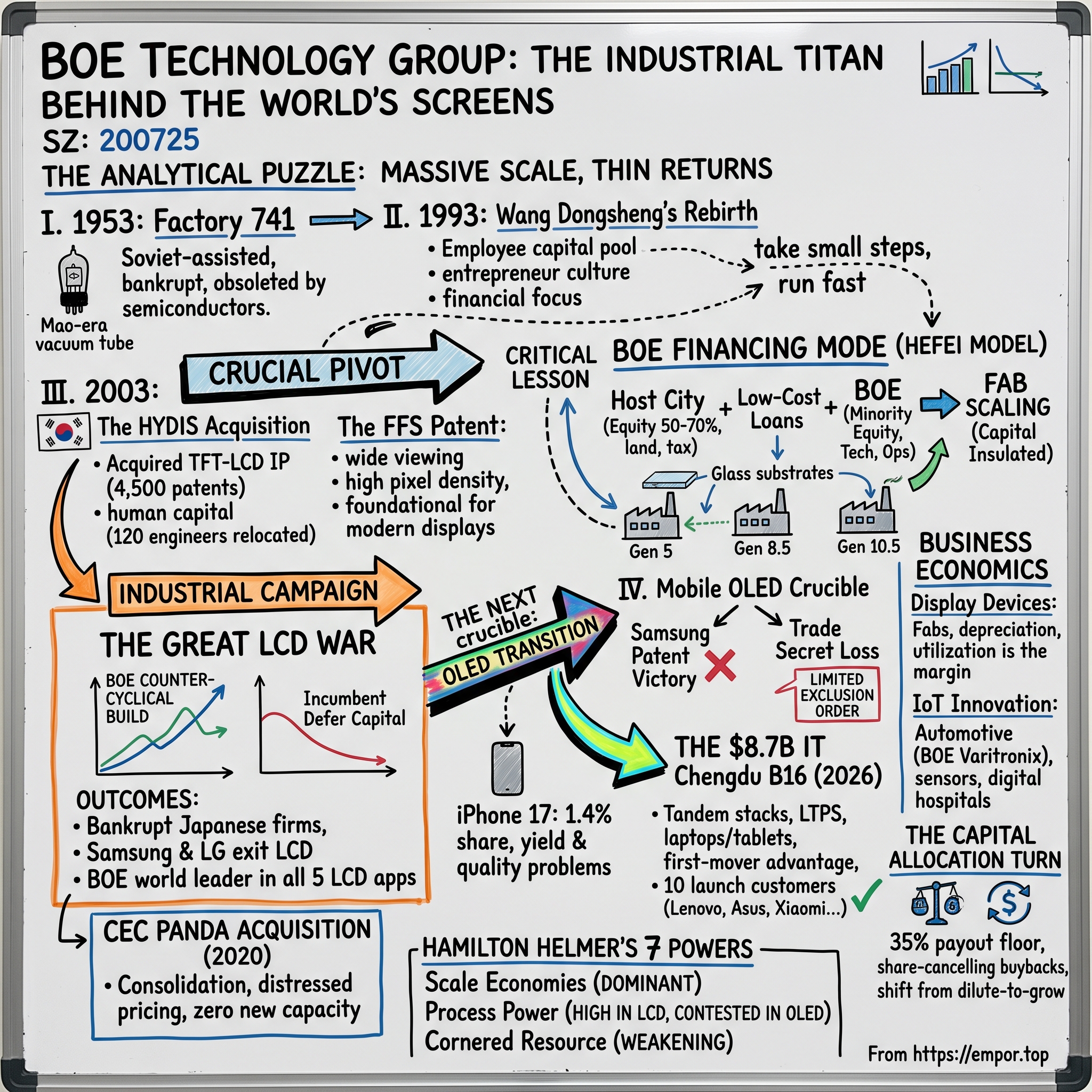
BOE Technology Group: The Industrial Titan Behind the World's Screens
I. Introduction & Episode Roadmap (8 min)
Somewhere in the room right now, there is roughly a one-in-four chance that a rectangle of glass — a phone screen, a laptop lid, a television, or the instrument cluster in a car — was assembled from a panel made by a company most Western consumers have never heard of. It carries no logo on the finished product. It runs no Super Bowl advertising. Its name appears in teardown reports and supply-chain filings, but never on the box.
That company is 京东方 BOE Technology Group Company Limited, listed on the 深圳证券交易所 Shenzhen Stock Exchange under two tickers: A-shares as 000725 and Hong Kong-dollar-denominated B-shares as 200725.
For the 2025 financial year, BOE reported total operating revenue of RMB 204.59 billion, up 3.13% year on year, and net profit attributable to shareholders of RMB 5.857 billion, up 10.03%.1 Those two figures, side by side, outline the analytical puzzle this company presents. Revenue of RMB 204.59 billion places BOE among the largest manufacturing enterprises in China. Net profit of RMB 5.857 billion on that top line represents a net margin of roughly 2.9%. A company that dominates its global market converts less than three fen of every revenue yuan into profit for shareholders.
That gap — massive scale alongside thin returns — is the core story.
The central question. How did a bankrupt Mao-era vacuum tube factory in Beijing, loss-making for seven consecutive years by the early 1990s, become the largest display manufacturer in the world? How did it bankrupt Japanese incumbents, force 삼성디스플레이 Samsung Display and 엘지디스플레이 LG Display out of the liquid-crystal display business they pioneered at scale, and crack Apple's iPhone panel supply chain? And — the primary question for investors — did any of that industrial expansion translate into durable shareholder returns, or has BOE functioned as a mechanism for converting state capital into consumer surplus for global buyers?
The themes. Four themes structure the analysis.
First is the extreme capital intensity of flat-panel display manufacturing, an industry where a single fabrication plant costs more than a nuclear reactor and depreciates on a schedule that can guarantee years of accounting losses before generating consistent net profit. Second is what Chinese industry terms the 京东方模式 "BOE Mode" — a financing structure in which municipal governments, rather than private capital markets, underwrote factory construction. Third is the rapid obsolescence of generational technology upgrades, where a plant that was state-of-the-art in 2010 can become an operational drag by 2020. Fourth is the strategic pivot BOE claims to be executing: transitioning from volume expansion at all costs to harvesting cash flow, paying dividends, and repurchasing shares.
Myth versus reality. Three market assumptions about BOE circulate widely, and each requires qualification.
Myth one: BOE won solely because of government subsidies. Subsidies were substantial — the company disclosed roughly US$536 million of government grants in 2023 alone.26 However, government subsidies were available across the domestic Chinese display sector, and many smaller competitors were eventually absorbed or liquidated. What set BOE apart was a distinct municipal co-investment architecture, not simple cash grants.
Myth two: BOE is Apple's primary display supplier. BOE has supplied displays intermittently for lower-tier or legacy product programs. In recent product cycles, it has occupied a secondary position due to operational yield challenges and intellectual property disputes.
Myth three: the hard technological transition is finished. The most demanding technology shift in the company's history — moving from liquid crystal displays, where BOE established dominance, to active-matrix organic light-emitting diodes (AMOLED), where it trails South Korean competitors in premium yield — remains active.
BOE secured dominance in legacy LCD technology, but it faces an ongoing challenge in premium OLED panels.
The roadmap. The story begins in 1953 at a Soviet-assisted electron tube plant designated 741厂 Factory 741. It traces the 1993 employee restructuring that created the modern enterprise, the 2003 acquisition of a distressed South Korean display business that provided foundational intellectual property, and the municipal financing framework that converted inland Chinese cities into display hubs. It examines the Generation 10.5 capital deployments that altered Korean and Taiwanese market share, the 2020 consolidation of state-owned peers, and the flexible OLED expansion into smartphone supply chains.
The narrative starts inside the mid-century planned economy.
 Subscribe on LinkedIn
II. Historical Foundations: 741 Factory & Wang Dongsheng's 1993 Rebirth (12 min)
In 1992, a 35-year-old accountant took over a Beijing factory that employed thousands of workers and had not turned a profit since 1985. The sprawling complex was Soviet-designed. Its core product — vacuum electron tubes — had been rendered obsolete by solid-state semiconductors two decades earlier, a reality well understood inside the plant but outside anyone's authority to alter. Payroll was barely met, and state planners were weighing whether to write off the entire operation.
The facility was 北京电子管厂 Beijing Electron Tube Factory, known across the Chinese industrial bureaucracy simply as Factory 741. Founded in 1953 as a cornerstone project of China's First Five-Year Plan with Soviet technical assistance, it had once been the country's preeminent electron tube producer — a key industrial asset when vacuum tubes powered radios, radar, and military communications. When solid-state electronics displaced tubes, Factory 741 was left stranded as a relic of an earlier technological era.
The accountant was 王东升 Wang Dongsheng. Stripped of the founding myth that later grew around him in Chinese business literature, his initial playbook was straightforwardly mechanical: rather than await a state bailout, he organized a restructuring in which employees pooled personal savings to capitalize a new enterprise alongside converted state assets. In April 1993, 北京东方电子集团股份有限公司 Beijing Oriental Electronics Group Co., Ltd. was formally established.
Two structural features of that 1993 rebirth explain much of BOE's subsequent strategy.
First, employees injected their own capital. Early 1990s reforms of Chinese state-owned enterprises produced numerous corporate reconstitutions, but very few where workers personally co-funded the turnaround. This fostered an unusual hybrid culture: a state-backed enterprise with an entrepreneurial sense of internal ownership. Wang's guiding slogan, repeatedly cited in corporate communications over the following three decades, was "小步快跑,永不停步" — "take small steps, run fast, and never stop." While phrased as folksy encouragement, in practice it functioned as an imperative for relentless, non-stop capital deployment.
Second, Wang was a finance professional rather than an engineer. Having spent years watching a technically capable plant collapse under balance-sheet strain, he viewed business competition through a financial lens. Where engineering-led executives often assume technological superiority dictates market outcomes, financial leaders prioritize capital access. BOE's subsequent history reflected management's conviction that competitive scale was fundamentally a financing challenge, treating technology acquisition primarily as a transaction to be funded rather than an in-house laboratory exercise.
Getting to the capital markets. The company listed foreign-currency B-shares on the Shenzhen Stock Exchange in 1997, raising approximately US$60 million, before adding a domestic A-share listing in 2001. This dual structure remains in place, with the underlying operating company represented across two share classes, two tickers, and two currencies. The listings established a pattern that defined BOE's relationship with public equity markets for the next two decades: treating public exchanges primarily as recurring funding taps for heavy capital expenditures rather than mechanisms for delivering equity returns.
The fork in the road. By 2000, BOE faced a fundamental strategic decision: which display technology would anchor its future growth? Three paths presented themselves. Cathode ray tubes were the legacy standard — a mature technology where BOE possessed existing supply-chain integration, but one facing clear obsolescence. Plasma display panels were the high-profile choice for large television screens, backed by major Japanese electronics firms. Thin-film transistor liquid-crystal displays — TFT-LCD — were capital-intensive, technically complex, and controlled entirely by Japanese and South Korean manufacturers.
Wang chose TFT-LCD. His thesis rested on the insight that TFT-LCD manufacturing shared the underlying physics of semiconductor processing: depositing thin films on a substrate, patterning them via photolithography, and etching the layers. The primary difference was the substrate material — large sheets of glass instead of small silicon wafers. Under this logic, TFT-LCD would follow semiconductor-like cost curves, where manufacturing yields and unit economics improve predictably with cumulative production volume, ultimately rewarding the player that amassed the largest production capacity fastest.
The technological judgment proved correct, but capturing that curve required immense capital. By 2001, BOE had committed to a technology platform where it possessed no proprietary intellectual property, no commercial fabrication lines, and no veteran display engineering teams. Developing those capabilities organically would take a decade — far longer than the market window would allow. Entry required acquiring external technology and production assets directly.
Conveniently for BOE, three thousand kilometers to the east, a distressed South Korean conglomerate was preparing to sell.
III. The HYDIS Watershed: Mastering TFT-LCD IP & Technology Transfer (2003) (12 min)
By 2002, the wreckage of the Asian financial crisis was still being cleared across South Korea's corporate landscape. 현대전자 Hyundai Electronics — restructured into Hynix Semiconductor — was drowning in debt and divesting operations outside its core memory chip business. Among the assets on the block was HYDIS, its TFT-LCD division: three operating fabrication plants, a workforce of experienced panel engineers, and a patent portfolio built over a decade of competing with 삼성 Samsung and LG.
On September 26, 2002, Hynix announced it had signed a memorandum of understanding with BOE regarding the sale of the HYDIS unit.2 The transaction closed in January 2003. BOE paid US$380 million in cash and assumed roughly US$40 million in additional liabilities, acquiring Generation 2.5, Generation 3, and Generation 3.5 production lines along with the associated tangible assets, buildings, and intellectual property.2
Industry reaction ranged from skepticism to outright derision. A Chinese company with no display panel experience was buying obsolete-generation fabs from a distressed seller in a notoriously cyclical industry, using heavy debt financing. In 2003, Samsung and LG were already operating Generation 5 production lines. By comparison, Generation 2.5 and 3 facilities were industrial antiques. On the surface, BOE had acquired a museum.
What BOE actually bought. The hardware, however, was secondary. The real value lay in roughly 4,500 patents and the practical engineering knowledge required to commercialize them.
The crown jewel was Fringe Field Switching, or FFS. Understanding its significance requires examining basic display physics. A liquid-crystal display relies on an electric field to twist tiny, rod-shaped liquid crystal molecules, which act as light shutters controlling illumination from the backlight. In early designs, the electric field ran vertically through the liquid crystal layer, causing molecules to tilt rather than rotate in-plane. Because a tilted molecule alters light transmission depending on the viewing angle, laptop displays in the 1990s washed out or inverted colors when viewed off-center. FFS resolved this by generating a horizontal electric field between co-planar electrodes, forcing molecules to rotate parallel to the screen surface. The architecture delivered wide viewing angles, high light transmittance, and strong performance when paired with high pixel densities and integrated touch sensors.
Virtually every modern high-resolution smartphone display and premium laptop panel relies on a variant of in-plane switching. BOE secured a foundational patent position in the technology for US$380 million at a time when few competitors were willing to bid.
The second critical asset was human capital. BOE relocated approximately 120 South Korean engineers to Beijing to establish its first domestic facility — a Generation 5 fabrication plant designated B1 in the Beijing Yizhuang development zone. This was not technology transfer through simple paper licensing. It was the physical transfer of tacit operational expertise: accumulated engineering instincts regarding etching drift, diagnostic methods for suppressing visual defects, and photoresist performance under ambient humidity. That unwritten knowledge represented the primary barrier to entry in panel manufacturing.
The crucible. Having secured the technology and intellectual property, BOE immediately encountered the display industry's defining hazard: extreme cyclical volatility.
The global LCD market crashed in 2005 as panel prices collapsed. With its single Generation 5 fab still navigating its production yield ramp while carrying heavy debt, BOE posted substantial losses. In South Korea, the remaining HYDIS operations deteriorated further and entered court receivership in 2006. The filing triggered labor strikes, political scrutiny, and allegations that BOE had extracted proprietary technology before abandoning the Korean operations — claims that echoed in trade disputes for years to come.
The setback led BOE management to a strategic conclusion that defined its approach for the next decade and a half: the fundamental error in 2005 was not over-investment, but under-investment. Operating a single fabrication plant at a single generation created fatal operational fragility. Display panel manufacturing requires continuous generational escalation; larger glass substrates yield a step-function reduction in unit costs. A company dependent on a single Generation 5 facility would become structurally uncompetitive within four years regardless of operational efficiency. The only viable defense was continuous expansion into larger substrate generations and greater production capacity across industry downturns.
While strategically coherent, that imperative was financially unfeasible under BOE's existing balance sheet. By 2006, the company lacked the capital to fund another fab, commercial banks refused to lend to the distressed sector, and equity markets were unwilling to absorb massive dilution.
Faced with capital exhaustion, BOE sought an alternative financing model.
IV. The "BOE Financing Mode": Local State Equity, Debt Leverage, & Fab Scaling (16 min)
To understand how BOE broke through its capital constraints, consider two structural realities of display manufacturing.
A modern high-generation display fab costs between US$3 billion and US$6 billion to construct. Once operational, it is depreciated over roughly five to seven years, imposing a heavy quarterly non-cash charge on the income statement well before the facility turns a net profit. The financial consequence is arithmetic: an enterprise building fabrication plants in continuous succession will report muted or negative net income, regardless of operational efficiency. Every additional production line defers bottom-line profitability by half a decade.
For a public company accountable to equity markets, continuous capital deployment on this scale is nearly impossible to finance through conventional equity, as public shareholders rarely tolerate a decade of depressed net margins.
BOE did not rely primarily on public equity markets. Instead, it sought partners with entirely different financial and strategic priorities.
The insight. In the late 2000s, Chinese municipal governments competed aggressively to build high-technology industrial clusters. A display fab functions as an anchor development, attracting glass substrate suppliers, polarizer manufacturers, driver-IC packagers, module assemblers, and device brands. A single facility can generate thousands of jobs, expand the local tax base, and reshape a regional economy. Municipal leaders evaluating such projects do not require a market-rate return on equity; their economic returns accrue through land value appreciation, employment growth, and broader industrial spillover effects rather than direct corporate dividends.
BOE built its capital expansion strategy on this structural alignment.
The structure. For each new fabrication line, BOE established a dedicated joint-venture project company. The host municipal government's state-owned investment platform contributed the majority of the equity — typically 50% to 70% — alongside subsidized land, tax concessions, and access to low-cost syndicated loans from policy and commercial banks. BOE provided a minority equity stake, frequently raised through targeted private share placements, while supplying technology licenses, patents, operational management, and commercial governance.
Under this model, BOE secured operating control of multi-billion-dollar manufacturing assets while committing a fraction of the equity and insulating its balance sheet from debt guarantees. The municipality absorbed the initial depreciation burden during early loss-making ramp phases. Once a facility matured and generated steady operational cash flow, BOE routinely repurchased the local government's equity stake using internal cash or newly issued shares, consolidating fully amortized, large-scale production assets at favorable valuations.
Hefei. The primary demonstration occurred in 合肥 Hefei, an inland provincial capital in Anhui Province that was not previously a high-technology hub. In 2008, when BOE sought capital for its Generation 6 line, and subsequently its Generation 8.5 facility, Hefei's municipal government committed approximately RMB 6 billion in equity — representing a substantial share of the city's annual fiscal budget at the time.3 Local authorities prioritized the investment over municipal infrastructure projects, accepting considerable fiscal exposure.
The investment succeeded. Over subsequent production cycles, Hefei's state capital platform committed a cumulative RMB 47.8 billion across multiple BOE fabrication lines, eventually realizing RMB 24.4 billion through partial equity exits and booking over RMB 23.1 billion in investment gains.3 Hefei established a major industrial display hub while generating positive investment returns. This co-investment model, termed the 合肥模式 "Hefei Model", became a blueprint for municipal industrial policy across China, later replicated in semiconductors, electric vehicles, and solar manufacturing.
BOE subsequently deployed this financing template in 成都 Chengdu, 重庆 Chongqing, 武汉 Wuhan, 绵阳 Mianyang, and 福州 Fuzhou.
What this means analytically. Beyond clever financial engineering, the "BOE Mode" highlights a fundamental analytical reality: during its primary expansion phase, BOE's cost of capital was determined by municipal industrial strategy rather than public equity markets. This provided a formidable competitive advantage during capital-intensive scaling, but it also explains the company's historically subdued return on equity. Abundant municipal capital enabled rapid capacity expansion without requiring strict market-rate hurdle rates for individual projects.
From a critical investor perspective, BOE functioned during this era less as a disciplined allocator of market equity than as an execution vehicle for municipal industrial development. Whether this industrial base can generate attractive risk-adjusted returns on equity as state co-investment recedes remains a primary question for public shareholders.
Throughout the 2010s, however, market attention focused on scale, as BOE used this capital structure to systematically capture global market share.
V. The Great LCD War: Crushing Global Rivals & Achieving Market Dominance (14 min)
In 2010, the global display industry resembled a layered hierarchy.
At the top sat Japanese manufacturers—Sharp, Panasonic, and NEC—holding foundational patents and technological prestige. In the middle stood the South Korean leaders: Samsung Display and LG Display, operating advanced fabrication lines, supplying premium device segments, and reinvesting heavily. Below them, Taiwanese volume producers, including 群创光電 Innolux and 友達光電 AUO, competed for market share in lower-margin monitor and television panels.
At the bottom of this hierarchy was BOE: a Chinese challenger with a small number of operational lines, persistent financial losses, and a habit of announcing major capital expansions during industry downturns.
That counter-cyclical investment strategy became BOE's primary competitive mechanism.
Counter-cyclical building. The display industry follows a pronounced cycle: rising panel prices spur capacity announcements; new factories come online simultaneously two years later, causing oversupply and price collapses; manufacturers cancel capital projects; supply tightens, and prices recover. For conventional public companies, the standard response to a downturn is to conserve cash and defer capital expenditure. Japanese, South Korean, and Taiwanese boards routinely followed this playbook under pressure from public shareholders demanding capital discipline.
BOE, backed by municipal partners indifferent to short-term panel cycles, took the opposite approach. By breaking ground during market troughs, BOE ensured its new production capacity arrived as demand recovered, steadily lowering its unit costs per square meter of processed glass while competitors held expenditure flat.
The Generation 10.5 leapfrog. The decisive strategic move occurred in 2015, when BOE initiated construction of the world's first Generation 10.5 fabrication facility in Hefei, designated B9, followed by a second Generation 10.5 line in Wuhan, designated B17.
Substrate size dictates fundamental unit economics in panel manufacturing. A display plant processes large glass substrates through hundreds of sequential deposition, photolithography, and etching steps. Because processing costs per sheet remain relatively fixed regardless of panel yield, overall profitability depends almost entirely on cutting efficiency—the proportion of the substrate converted into saleable product.
A Generation 8.5 substrate measures approximately 2,200 millimeters by 2,500 millimeters. When cut for 65-inch television panels, it yields only three units, leaving a large portion of the glass as unused scrap. In contrast, a Generation 10.5 substrate measures 2,940 millimeters by 3,370 millimeters—a size optimized to fit eight 65-inch or six 75-inch panels with cutting efficiencies exceeding 95%.
This efficiency difference created a structural cost advantage rather than an incremental one. BOE could manufacture large-format television panels at unit costs below the cash operating costs of Korean and Taiwanese Generation 8.5 facilities. When an entrant produces finished goods below an incumbent's cash operating cost, the incumbent's legacy facility becomes economically unviable to operate.
The exodus. A major structural shift across the display market followed.
Panel prices dropped below the cash costs of legacy production lines and remained depressed. Sharp and Panasonic reduced display operations. Taiwanese producers pivoted toward specialized and automotive applications. Meanwhile, the South Korean manufacturers that had led the industry retreated from liquid-crystal manufacturing. Samsung Display ceased LCD production entirely by 2022, while LG Display scaled down its domestic operations in Paju and sold its Guangzhou fabrication plant. Neither enterprise failed operationally; both determined that competing against state-supported capital expansion in commodity LCDs offered an unviable return on invested capital.
By 2019, BOE claimed the top global position by shipment volume across all five primary LCD applications: smartphones, tablets, laptops, monitors, and televisions. The company reported holding those leading volume shares again in its 2025 financial results, alongside the top spot in automotive display panels.1
The uncomfortable footnote. Yet complete market dominance in liquid-crystal displays arrived just as LCD panels matured into a low-margin commodity. BOE conquered an industry whose overall profit pool had been diminished by the very capital expansion that enabled its rise. South Korean competitors did not simply lose market share; they strategically exited LCD manufacturing to reallocate capital toward advanced active-matrix organic light-emitting diode (AMOLED) technology.
This strategic outcome highlights the core analytical question facing investors: did BOE's massive LCD expansion establish a high-return commercial franchise, or merely secure volume leadership in a low-margin commodity market? The answer depends on whether BOE can convert its scale into pricing discipline and leverage its cash flow to fund the next technology transition. In 2020, BOE moved to consolidate industry capacity.
VI. The CEC Panda Acquisition (2020): Capital Allocation & Industry Consolidation (12 min)
By 2020, the Chinese display industry faced a structural challenge strikingly similar to the one it had previously imposed on foreign competitors.
Having pushed international rivals out of liquid-crystal display manufacturing, domestic producers were increasingly competing against one another. Several of these entrants were state-owned enterprises operating with the same indifference to financial returns that had enabled the sector's initial expansion. Among the distressed producers was 中电熊猫 CEC Panda, the display arm of state-owned conglomerate 中国电子信息产业集团 China Electronics Corporation. Operating advanced fabrication plants in Nanjing and Chengdu, CEC Panda was recording persistent losses across both locations.
CEC Panda's state parent sought an exit, leaving the market to determine who would absorb the assets and on what terms.
The transaction. On September 23, 2020, BOE announced agreements to acquire an 80.831% stake in Nanjing CEC Panda Flat Panel Display Technology, which operated a Generation 8.5 line, and a 51% stake in Chengdu CEC Panda Display Technology, operating a Generation 8.6 line. The combined transaction value was RMB 12.117 billion, or approximately US$1.78 billion.4
Two structural features distinguished this transaction from BOE's previous expansion phases.
First, BOE acquired existing capacity rather than constructing new facilities. Every prior expansion had added net new supply to global markets, depressing panel prices and industry profitability. This transaction brought more than 100,000 substrates per month of manufacturing capacity under BOE's operational control while adding zero new capacity to the global market. The industry supply curve remained unchanged while ownership consolidated.
Second, the transaction reflected distressed asset pricing. Acquiring sub-scale panel assets from a motivated state vendor at a discount to both book value and replacement cost represented a fundamental shift in capital allocation compared to greenfield fab construction. Rebuilding equivalent capacity would have required substantially higher capital outlays and years of construction time. Industry research firm TrendForce estimated at the time that the acquisition would raise BOE's share of global large-size display panel capacity to roughly 28% in 2021.5
The structural consequence. Alongside 华星光电 TCL CSOT's contemporaneous purchase of Samsung's LCD operations in Suzhou, the CEC Panda transaction reshaped the industry's competitive landscape. Large-panel LCD manufacturing shifted from a fragmented global market with a dozen major participants into a concentrated structure, with two Chinese industrial groups controlling over half of world capacity, complemented by a second tier led by HKC.
This structural concentration altered operational incentives across display cycles. In a fragmented market, the rational strategy for an individual producer during a downturn was to run fabrication lines at full capacity to preserve volume, as unilateral output cuts would not influence market prices. In a concentrated market, output discipline directly affects supply-demand dynamics—and leading producers possess sufficient market share for production curtailments to prove effective.
Evidence of this behavioral shift is visible in how the industry manages market downturns. Rather than flooding the market during soft demand periods, major Chinese producers have repeatedly curtailed production to support pricing. In February 2026, coordinated production cuts of five to ten days each by BOE, TCL CSOT, and HKC tightened LCD television panel supply and supported higher prices.6 By May 2026, monitor panel prices climbed again as Chinese majors maintained tight supply controls while remaining Taiwanese and South Korean lines closed.7 Utilization rates across leading Chinese producers have been actively managed within an 80% to 90% band rather than run at maximum capacity.7
How an investor should read this. Output discipline that relies on tacit coordination among a small group of market leaders reflects an advantageous market structure rather than an enduring competitive moat. Market structures remain vulnerable to disruption: any participant choosing to chase volume over price, or any new capacity deployed for strategic rather than economic reasons, can unseat the prevailing equilibrium. Furthermore, managing output to defend pricing in a highly concentrated market increases regulatory scrutiny and buyer pushback from major electronics brands.
For BOE, however, this consolidated structure alters its financial dynamics. It converts the mature liquid-crystal display business from an ongoing cash drain into a predictable source of funding—a transition that became essential as the next technological battle in advanced displays intensified.
VII. The Mobile OLED Crucible: Apple Supply Chain Entry & The $8.7B IT OLED Bet (18 min)
Around 2017, executives inside BOE were looking at a chart that must have felt uncomfortably familiar. In organic light-emitting diode displays for smartphones — the technology replacing LCD in every premium phone — Samsung Display held over 90% of the market. One company. One country. Exactly the position the Koreans and Japanese had occupied in LCD in 2003.
BOE had beaten that setup once. It decided to do it again.
Why OLED is harder. It is worth being precise about the difference, because the assumption that BOE could simply repeat the LCD playbook has been the single most reliable source of error in analyzing this company.
An LCD is a light valve. A backlight shines constantly; liquid crystals and color filters decide how much of it reaches your eye at each sub-pixel. Nothing on the panel itself emits light. An OLED has no backlight at all — each sub-pixel is its own tiny lamp, an organic compound that glows when current passes through it. That is why OLED gives perfect blacks (the pixel is simply off), why it can be made on flexible plastic instead of rigid glass, and why it can be thin enough to fold.
It is also why it is brutally difficult to manufacture. The organic emitter materials must be deposited by evaporating them in a vacuum through a Fine Metal Mask — a stencil of foil perforated with millions of microscopic apertures that must stay aligned to within a few microns across a large substrate while being heated. The organics degrade on contact with oxygen or water vapor, so every panel needs a near-perfect encapsulation barrier. And the flexible variants require the finished stack to be detached from its rigid carrier glass by laser without cracking anything.
None of this scales the way LCD scaled. Bigger substrates do not automatically make it cheaper, because mask sag and alignment error get worse with size. The advantage goes to whoever has spent the most years grinding through yield problems — what Helmer would call Process Power, and what cannot be bought.
The campaign. BOE built Generation 6 flexible AMOLED lines at Chengdu (B7), Mianyang (B11), and Chongqing (B12). All three ran at heavy operating losses for years while yields climbed. By the 2025 annual report, all three had been fully transferred to fixed assets and were carrying full depreciation.8
Cracking Apple — and then losing the position. BOE entered Apple's supply chain through the least glamorous door available: replacement and refurbishment panels, in 2020. It progressed to new-build iPhone panels over subsequent generations, generally on standard rather than Pro models, and generally as a third source behind the two Korean suppliers.[^9]
Then it went backwards, and the reason is the most important single fact in the current investment case.
In October 2022, Samsung Display initiated proceedings against BOE at the United States International Trade Commission. The dispute ran on two tracks — patents and trade secrets — and they went differently. On the patent track, BOE prevailed: in March 2025 the ITC found in BOE's favor on the asserted patents.9 On the trade secrets track, it did not. In July 2025 an ITC ruling found that BOE and seven affiliated entities had violated Section 337 by misappropriating Samsung Display's trade secrets, and recommended a limited exclusion order barring imports of OLED panels and modules made using those trade secrets for a period of fourteen years and eight months.10 The ITC's findings described Samsung Display as having implemented exceptional security measures that BOE nonetheless circumvented.11
The two companies settled on November 19, 2025. BOE agreed to pay royalties to Samsung Display for its OLED intellectual property, and both parties withdrew their litigation in the United States and China.11 The terms were not disclosed.
The commercial damage, however, had already landed. For the iPhone 17 series, against total Apple orders of approximately 89 million OLED panels, Samsung Display shipped roughly 57 million units and LG Display roughly 30 million. BOE shipped approximately 1.3 million — about 1.4% of the program.12 The reasons cited were a combination of yield and quality problems on BOE's high-end line and the restriction of BOE panels to units sold within China as a consequence of the trade case.12 For Apple's 2026 premium models, BOE was reportedly excluded altogether, with the two Korean suppliers taking essentially the entire allocation.13
BOE has not been eliminated from Apple — it was signed as a supplier for the budget iPhone 17e, though by early 2026 Samsung Display had reportedly secured the largest share of even that program.14 Reports in May 2026 indicated BOE was targeting 35 million iPhone display shipments for the year.15 Whether that target is achievable given the 2025 outcome is exactly the sort of claim an investor should treat as a hypothesis rather than a fact.
The company's own accounting of the shortfall. BOE shipped approximately 150 million AMOLED displays in 2025, growth of about 8% over 2024 and below its own plan. Chairman Chen Yanshun attributed the miss to three causes: patent disputes in the AMOLED sector, limited coverage of Chinese national handset subsidies (which mostly applied to budget phones), and internal lean-management shortcomings requiring improvement.16 Two of those three are external. The candid one is the third.
The RMB 63 billion answer. BOE's response to being squeezed in mobile OLED was to attempt to leapfrog the category entirely.
In November 2023, the company announced an investment of RMB 63 billion — approximately US$8.7 billion at the time — in China's first Generation 8.6 flexible AMOLED line, designated B16, in Chengdu.17[^19] The strategic logic targets the next transition: laptops, tablets, and monitors moving from LCD to OLED, a category where panel sizes make Generation 6 lines uneconomic and where Samsung Display was building its own Generation 8.6 A6 line on a parallel timeline.
BOE accelerated. It lit the line ahead of schedule, pulling the mass-production target forward by roughly five months.18 On June 17, 2026, it held a mass-production ceremony in Chengdu — beating Samsung Display to volume production at this generation.19 The line runs a 2290mm by 2620mm substrate at a designed capacity of 32,000 substrates per month, using fine metal mask processes with LTPO backplanes supporting variable refresh from 1Hz to 240Hz, and tandem OLED stacks that cut power consumption 20% to 30% and extend panel lifetime by three to four times versus conventional single-stack architectures.19
The tandem point is worth translating. A conventional OLED pixel has one light-emitting layer. A tandem stacks two, so each layer runs at lower drive current for the same brightness — and since organic material degradation scales sharply with current, halving the load extends life dramatically. That is what makes OLED viable for a laptop that displays a static taskbar for eight hours a day, five days a week, for five years. It is the enabling technology for the entire IT OLED transition.
The first product off the line was a 14-inch 2.8K panel for Lenovo notebooks. Attendees at the opening included Lenovo, Asus, MSI, Oppo, Vivo, Honor, ZTE, Transsion, Xiaomi, and Nothing.19 BOE has indicated a target of roughly 10 million OLED panels from B16 in 2026, ramping substantially in 2027.
Note who was not on that customer list.
VIII. Segment Economics & Business Architecture: Display Devices vs. IoT Optionality (12 min)
Strip away the corporate strategy decks, and BOE is fundamentally two businesses of vastly unequal scale.
The engine. The core Display Devices segment generated revenue of approximately RMB 166.4 billion in 2025, up 0.86% year on year — accounting for roughly 81% of the group total.1 This segment houses the LCD fabs, flexible OLED lines, and microdisplay operations, generating the overwhelming majority of group gross profit.
The economics of this segment reduce to three core variables, making the analytical task straightforward regardless of corporate narrative.
The first is capacity utilization. Display fabs carry almost entirely fixed costs, meaning the marginal cost of producing an additional panel is negligible. Below roughly 80% utilization, fixed-cost absorption breaks down and operating margins collapse. Above that threshold, incremental volume flows directly to profit at a high rate. This explains why the industry's coordinated production discipline matters so much: utilization effectively is the margin.
The second is blended average selling price, which is determined by global supply-demand dynamics and product mix — specifically, how much production shifts toward high-value automotive, medical, and premium IT panels versus commodity television glass.
The third is depreciation, which forms the cornerstone of the current bull thesis. BOE's annual depreciation charge reached approximately RMB 37 billion and, according to commentary accompanying its 2025 results, peaked in 2025.8 Because depreciation is a non-cash expense, it depresses reported net income without consuming cash. As mature fabs complete their depreciation schedules, those non-cash charges fall away and — all else equal — flow directly into reported earnings. Company commentary around its 2025 results highlighted this shift as a potential driver of substantial future earnings elasticity.8
While this mechanism is financially sound, it relies on a condition that optimistic projections often overlook: it only works if BOE stops building. Depreciation charges roll off only if they are not replaced by new capital outlays. Yet committing RMB 63 billion to a new display facility introduces a large new depreciation burden just as legacy assets finish amortizing.
The optionality. The remaining revenue — grouped under IoT Innovation and adjacent businesses — totaled roughly RMB 38 billion in 2025, up 15.14% year on year.1 This category encompasses several distinct ventures.
Automotive displays operate largely through 京东方精电 BOE Varitronix, listed separately in Hong Kong under ticker 0710.HK. This represents the most commercially established non-core unit: BOE led the global automotive display market in 2024 with 40.9 million units shipped, securing a 17.6% market share and 16% volume growth.20 Automotive displays offer structural advantages, including long design-in cycles, high switching costs, and expanding screen area per vehicle. However, the segment remains exposed to intense price competition, which has placed visible pressure on the listed subsidiary's margins.
Electronic shelf labels operate primarily through BOE's relationship with French technology firm VusionGroup, formerly SES-imagotag, in which BOE holds a significant equity stake while acting as both a major supplier and customer. This multi-faceted arrangement drew short-seller scrutiny in June 2023, when Gotham City Research published a report alleging accounting irregularities and circular transactions, valuing VusionGroup shares between €15 and €30 against a market price of €166.80.21 VusionGroup rejected the claims, presenting auditor confirmations from Deloitte and KPMG that transactions with BOE totaling €53.1 million had been neutralized and excluded from its 2022 reported revenue of €620.9 million.22 While this episode does not establish misconduct by BOE, it highlights why related-party arrangements where an entity serves simultaneously as major shareholder, supplier, and customer require thorough reading rather than skimming.
The remaining early-stage businesses require realistic sizing. Sensors — encompassing medical X-ray detectors, biometric sensors, and smart architectural glass — recorded 52.0% revenue growth in 2025, marking the fastest segment growth in the group, though off a base small enough that the percentage rate outpaces its financial impact.1 MLED, covering mini-LED backlighting and direct-view displays, expanded 9.81%.1 Meanwhile, smart medical engineering — comprising BOE's digital hospital operations in Beijing, Chengdu, Hefei, and Suzhou — grew 3.40%.1
Evaluated together, these adjacent operations represent strategic options rather than immediate earnings drivers. Their combined contribution to group profit remains negligible today, meaning investors should treat them as a portfolio of long-term experiments funded by the core display business.
Which brings the question back to the executives deciding how much of the display business's cash flow to commit to them.
IX. Current Leadership & Strategic Execution: Chen Yanshun's "Screen of Things" (12 min)
In May 2019, Wang Dongsheng stepped down after twenty-six years. He had taken a bankrupt tube factory and built it into the largest display manufacturer in the world. He had also presided over an era in which shareholders in the listed vehicle earned very little.
His successor, 陈炎顺 Chen Yanshun, was elected chairman that year — a long-serving insider rather than an outside change agent, signaling clearly that the board sought continuity of execution rather than a break with the past.23
The current governance structure reflects a deliberate, staged succession. In January 2025, BOE completed its eleventh board election. Chen, then 60, retained the chairmanship while 冯强 Feng Qiang took over as chief executive — a generational handover of operational control while the strategic architect stayed in place.24 Above all of this sits the state: Beijing State-owned Capital Operation and Management Company was the largest shareholder with 10.79% as of the first quarter of 2025, with additional state influence flowing through Beijing Electronics Holding and other affiliated vehicles.25 No single holder controls BOE outright, but the register's center of gravity is unambiguously public-sector.
The strategy. Chen's signature framework is 屏之物联 "Screen of Things", expressed as 1+4+N+生态. The "1" represents the display device foundation. The "4" represents the growth engines: IoT innovation, MLED, sensors, and smart medical engineering. The "N" signifies the set of application scenarios — retail, automotive, industrial, healthcare, and smart city applications — into which screens are embedded. The "生态" represents the partner ecosystem surrounding it.
The strategic intent is straightforward: reposition BOE from a commodity panel supplier, whose value is dictated by a brutal industry cycle, into a systems provider whose screens carry software, sensing, and integrated services. Every hardware manufacturer facing commoditization eventually articulates a version of this vision.
In practice, as of 2026, the core display foundation still performs essentially all the heavy lifting. The four growth engines combined represent a modest share of revenue and an even smaller share of group profit. That does not invalidate the strategy, but it leaves it unproven. The relevant test is not whether management articulates the vision consistently, but whether those growth engines begin contributing meaningfully to group gross profit. They have not yet done so.
More recently, management has introduced an "AI+" framing — deploying artificial intelligence to improve manufacturing efficiency and yield.8 Applied to fab operations, this is a credible, pragmatic use case focusing on defect detection, process parameter optimization, and predictive maintenance. Applied as broader corporate positioning, it warrants the same analytical skepticism as any corporate AI narrative.
The capital allocation turn. The most substantive shift under current leadership lies not in strategic vocabulary, but in cash returned to shareholders.
For 2025, BOE proposed a cash dividend of RMB 0.56 per 10 shares, totaling approximately RMB 2.074 billion, representing 35.4% of net profit attributable to shareholders — marking the twelfth consecutive year of cash dividends, with cumulative distributions approaching RMB 24 billion.1 The company adopted a three-year shareholder return policy committing to distribute a minimum of 35% of annual net profit.8 Alongside this, BOE announced buyback programs authorizing RMB 500 million to RMB 1 billion of A-shares at prices up to RMB 6.00, and HK$500 million to HK$1 billion of B-shares at prices up to HK$4.81, with all repurchased shares designated for cancellation to reduce registered capital.8
Cancellation is a crucial distinction. A buyback that retires shares represents a genuine return of capital, whereas one allocated to employee equity schemes functions as executive compensation. BOE chose the former.
How to weigh this. Establishing a 35% payout floor alongside share-cancelling buybacks represents a notable behavioral shift for a company that spent two decades diluting shareholders to fund factory construction. It provides the strongest available evidence that management's stated pivot toward capital discipline is operational rather than rhetorical.
At the same time, the scale remains modest. A dividend distribution of RMB 2.07 billion against RMB 204.59 billion in revenue is modest at the group level, and buyback authorizations measured in hundreds of millions of yuan remain small relative to a company that recently committed RMB 63 billion to a single fabrication line. The capital allocation ratio — balancing capital returned to shareholders against capital deployed into physical plants — has improved at the margin, but it has not fundamentally inverted.
That structural tension remains the primary question for any investor assessing BOE's long-term capital discipline.
X. Playbook: Business, Strategy, & Investing Lessons (12 min)
Set the narrative aside and examine the competitive position through two standard frameworks. The exercise is especially useful for BOE because it separates advantages that are structurally durable from those that were rented.
Hamilton Helmer's 7 Powers.
Scale Economies — dominant, and the core of the case. This is BOE's genuine power. Operating the world's largest fleet of high-generation LCD fabs alongside a Generation 8.6 OLED line spreads fixed costs across a volume base no competitor can match. It confers purchasing leverage over glass substrate suppliers like Corning and 日本電気硝子 Nippon Electric Glass, over polarizer and driver-IC vendors, and over equipment makers. In an industry where the cost floor is set by the largest and most modern asset base, BOE sets the floor. This power is real, measurable, and structurally durable.
Process Power — high in LCD, contested in OLED. Panel yield is accumulated operational knowledge. In LCD, BOE has two decades of experience and serves as the reference producer. In flexible OLED, the evidence is more equivocal: the yield and quality problems that contributed to BOE's near-exclusion from the iPhone 17 program are precisely a process-power deficit relative to Samsung Display.12 BOE's Generation 8.6 first-mover position is a bet that it can build process power in IT OLED before Samsung Display arrives with its own line. That bet remains active, not won.
Cornered Resource — historically decisive, now diminishing. Privileged access to municipal state capital, land, subsidized debt, and tax incentives gave BOE an artificially low cost of capital throughout its scaling phase. In 2023 alone, the company disclosed government subsidies of roughly US$536 million.26 But this power is structurally weakening: BOE is now a mature, profitable-on-paper enterprise rather than an infant industry, and municipal fiscal capacity across China is materially tighter than it was in 2010. Investors should model this advantage as decaying rather than permanent.
Switching Costs — moderate, and asymmetric. Design-in cycles for automotive and premium IT displays run twelve to twenty-four months and create real stickiness, particularly in automotive where qualification is onerous. In smartphones, the iPhone 17 outcome demonstrated how quickly a design-in position evaporates when yield or legal problems appear. Switching costs protect BOE in automotive panels, but they failed to protect it in smartphones.
Branding, Network Economies, Counter-Positioning — essentially absent. BOE sells an invisible component to concentrated buyers. There is no brand premium and no network effect.
Porter's Five Forces.
Threat of new entrants — very low. Multi-billion-dollar minimum efficient scale, dense patent thickets, and structurally low industry returns deter rational new entrants. This represents the most secure of the five forces.
Supplier power — high, and the industry's genuine chokepoint. The upstream supply chain is far more concentrated than the panel makers themselves. Canon Tokki holds a near-monopoly on the vacuum evaporation systems required for OLED mass production. Applied Materials and a handful of others dominate deposition equipment. Glass substrates originate from a small group of specialists, while OLED emitter materials come from a short list of Japanese, South Korean, German, and American chemical firms. BOE's scale provides purchasing leverage over commodity inputs but yields minimal leverage over critical specialized tools.
Buyer power — moderate to high. Apple, Samsung, Xiaomi, Lenovo, Dell, and automotive OEMs are concentrated, sophisticated buyers that dual-source by policy. Apple in particular has demonstrated the ability to reallocate panel volume between suppliers on short notice.
Threat of substitutes — low to moderate. Micro-LED remains far too expensive for mainstream form factors and shows no near-term path to cost parity. Laser projection remains a niche. Over the coming decade, LCD and OLED remain the only economically viable options for mass-market screens. The meaningful substitution occurs within BOE's portfolio — OLED cannibalizing LCD — a transition BOE is spending heavily to navigate on both sides.
Rivalry — the swing factor. In LCD, rivalry has been deliberately moderated through industry consolidation and coordinated utilization management. In OLED, rivalry is ferocious: Samsung Display and LG Display compete from above, while 维信诺 Visionox, 天马 Tianma, and TCL CSOT compete from the domestic Chinese capacity expansion.
The lesson. BOE's history demonstrates that in a capital-intensive commodity industry, the winner is whichever enterprise can access the lowest-cost capital for the longest duration — not necessarily the one with the superior technology. That is a crucial strategic insight. It is also a warning, because a business built on that foundation generates immense industrial output while historically yielding modest returns for shareholders.
Which is precisely where the skeptics enter the analysis.
XI. Activist & Skeptical Investor Stress Test: Subsidies, CapEx Treadmills, & ROIC (12 min)
Consider a short-seller constructing the bear case against BOE. The argument is straightforward, and the central challenge for bulls is that most of its supporting evidence relies on undisputed facts.
Exhibit one: two decades of value destruction. Between the mid-2000s and 2020, BOE's return on equity averaged in the low single digits, frequently trailing any plausible weighted average cost of capital. The company expanded top-line revenue by orders of magnitude while earning less than its cost of capital on deployed equity. In financial terms, that is not value-creating growth; it is capital destruction under the guise of industrial expansion.
Recent financial performance offers little immediate relief. In the first quarter of 2026, BOE reported a weighted average return on equity of 1.26%, up five basis points year on year.27 Even an optimistic annualization leaves returns far below a standard market cost of equity.
Exhibit two: recurring equity dilution. For most of its history, the primary function of BOE's listed vehicles was raising factory construction capital. Repeated A-share private placements funded minority equity contributions into municipal project companies, diluting public shareholders with each issuance. That capital built massive manufacturing capacity, but the resulting value accrued primarily to Chinese industrial policy, downstream electronics brands, and global consumers buying low-cost large-screen televisions — leaving public equity holders with residual returns.
Exhibit three: quality of underlying earnings. The composition of BOE's bottom line warrants careful scrutiny. For 2025, net profit attributable to shareholders reached RMB 5.857 billion, but net profit excluding non-recurring items stood at RMB 4.23 billion.1 The gap of roughly RMB 1.6 billion — representing over a quarter of headline earnings — stemmed from non-operating sources, where government grants and subsidies have historically predominated. Compared to disclosed government grants of approximately US$536 million in 2023, state support remains material relative to net earnings.26
Skeptics argue that for much of BOE's history, state backing represented the margin between profitability and net losses. While government grants are transparently disclosed and the non-recurring gap has narrowed as core operations improved, disciplined analysis anchors on net profit excluding non-recurring items, treating state support as a policy variable rather than a permanent operating annuity.
Exhibit four: continuous capital expenditure requirements. This represents the central structural objection. Management maintains that as mature fabrication plants fully depreciate, the roughly RMB 37 billion annual depreciation charge will roll off, driving significant earnings expansion.8 The counter-argument is straightforward: the new RMB 63 billion Chengdu line will begin its own depreciation cycle just as legacy assets finish amortizing. In an industry governed by ongoing technological upgrades — moving from mobile OLED to Generation 8.6 IT OLED, and eventually to micro-LED — assertions that depreciation will roll off have repeatedly been offset by new capital outlays.
Exhibit five: portfolio complexity and capital allocation. BOE's adjacent operations include digital hospitals, smart architectural glass, biometric sensors, and electronic shelf labels managed through a French listed affiliate. While each initiative has a strategic rationale, collectively they raise capital allocation questions for a core business that demands intense funding, particularly given the historical short-seller scrutiny surrounding related-party transactions in its retail display ecosystem.21
The management response. BOE's counter-argument rests on three key pillars, presenting a stronger defense than in past cycles.
First, industry consolidation has altered market dynamics. The post-2020 LCD oligopoly has shifted pricing behavior, with major domestic producers demonstrating active capacity management through coordinated production adjustments in 2026.67
Second, the accounting benefits of asset amortization are genuine, even if their net timing is debated. All three Generation 6 flexible AMOLED facilities are now fully capitalized and carrying their peak depreciation loads, establishing a timeline for those charges to subside.8
Third, corporate capital allocation shows tangible signs of change. Establishing a 35% dividend payout floor, maintaining a twelve-year dividend history, and executing share-cancelling buybacks provide concrete metrics for assessing management's commitment to shareholder returns.18 These actions establish a verifiable track record for evaluating future capital allocation.
Ultimately, the investment thesis hinges on a single condition: whether BOE's capital allocation over the coming decade departs fundamentally from its historical pattern. While full-year 2025 and first-quarter 2026 results indicate progress, they do not yet offer definitive proof. Evaluating the enterprise requires monitoring where capital is actually committed rather than relying on strategic positioning.
Moreover, external variables beyond management's control may determine the outcome well before the internal transition is complete.
XII. Material Risk Radar & Geopolitical Vulnerabilities (10 min)
There is a room in every advanced display fab that visitors are rarely shown. It houses the vacuum evaporation equipment — the precision tools that vaporize organic compounds and condense them onto glass through metal stencils perforated with millions of microscopic holes. Only a handful of companies worldwide can build these tools at production quality, and none of them is Chinese.
That room illustrates the structural shape of BOE's operational exposure. Over three decades, the enterprise built scale to insulate itself from market rivals, but scale alone has not eliminated technological dependence.
The primary vulnerabilities facing the enterprise are specific, mechanical, and concentrated in upstream equipment and legal frameworks.
Geopolitical and supply-chain restriction. BOE's primary vulnerability lies at the head of its supply chain. While the enterprise can construct advanced fabrication facilities, it remains reliant on foreign suppliers for the underlying tooling. Vacuum evaporation systems essential for mass OLED production come overwhelmingly from Canon Tokki in Japan. Advanced deposition and inspection tools originate from American and Japanese vendors. Specialized photoresists, emitter materials, and encapsulation chemistries are sourced from a narrow group of Japanese, South Korean, German, and U.S. suppliers, while display driver integrated circuits rely on foundries subject to export-control regimes.
To date, Western semiconductor export controls have concentrated on logic chips and memory. Extending those restrictions to advanced display equipment remains a tail risk rather than a base case, but the mechanism of disruption is direct: export restrictions would halt BOE's ability to execute generational technology upgrades, freezing its cost structure relative to international peers. A single regulatory shift at the equipment level represents the most immediate structural risk to the long-term investment case.
Intellectual property and market access. While the November 2025 settlement with Samsung Display removed the immediate threat of a U.S. import exclusion, it required BOE to pay ongoing royalties on Samsung Display's OLED intellectual property.11 Those payments impose a permanent, if undisclosed, cost drag on BOE's OLED margins while highlighting its reliance on a rival's patent portfolio. The strategic contrast with legacy operations is clear: BOE's LCD dominance was built on the patent portfolio it acquired from HYDIS in 2003, whereas its OLED business lacks an equivalent proprietary foundation. As the 2025 trade proceedings demonstrated, Western legal venues retain the ability to gate BOE's access to premium Western customers.10
IT OLED overcapacity. BOE's first-mover position in Generation 8.6 flexible AMOLED manufacturing carries the risk of triggering industry overcapacity. BOE's RMB 63 billion commitment to its Chengdu facility coincides with Samsung Display's parallel construction of its own Generation 8.6 line. Yet the addressable market for laptop, tablet, and monitor OLED panels is substantially smaller in unit volume than the smartphone market. If both major producers ramp capacity ahead of market adoption, the resulting oversupply could drive a sharp margin compression across 2027 and 2028—precisely in the product category BOE relies upon to power its next phase of earnings growth.
Demand cyclicality and consumer saturation. Structural lengthening of device replacement cycles across smartphones, personal computers, and televisions limits top-line growth. Management commentary for 2026 anticipated minimal expansion in global flexible AMOLED smartphone shipments—projecting a modest increase from roughly 668 million units to 675 million—alongside pricing pressure in the first half and stabilization expected in the second.16 Chairman Chen Yanshun also cited rising memory prices as a constraint on handset demand.16 Because fixed depreciation and operating costs make display fabs highly sensitive to factory utilization, even modest demand softness inflicts disproportionate damage on operating margins.
Customer concentration and qualification risk. The iPhone 17 outcome serves as a primary case study.12 Component allocations at leading original equipment manufacturers are re-evaluated for every product generation based on production yields, quality metrics, unit pricing, and legal risk. As recent supply-chain shifts demonstrated, a panel vendor can see its share of a flagship product line drop from a major position to 1.4% within a single cycle. Serving highly concentrated commercial buyers creates ongoing volume volatility rather than predictable recurring revenue.
Input cost and energy exposure. Advanced display fabrication plants operate among the most energy-intensive industrial processes in manufacturing, requiring continuous power for cleanrooms, vacuum deposition chambers, and cooling systems. Because powering down and restarting a line carries prohibitive operational costs, facilities must maintain operation through market downturns. This operational reality leaves BOE structurally exposed to Chinese industrial power tariffs and the long-term compliance costs associated with national dual-carbon goals. It also restricts management's ability to reduce cash operating expenses when demand softens, reinforcing capacity utilization as the dominant driver of profitability. On the bill of materials, BOE remains vulnerable to glass substrate pricing set by a highly concentrated group of specialized producers, as well as driver integrated circuit supply constraints in contract foundries.
Financing cost. BOE carries significant debt incurred to capitalize its manufacturing facilities. First-quarter 2026 financial disclosures showed borrowing costs increasing substantially year on year even as operating results improved.27 For an enterprise whose historical expansion relied on access to low-cost capital, rising interest expenses represent a direct drag on net profitability.
Policy risk in both directions. In April 2026, reports indicated that Chinese industrial planners were drafting a sector consolidation policy that would assign BOE primary responsibility for small- and medium-sized OLED panels while designating TCL CSOT for large-format LCDs, with smaller producers facing mergers or exit.28 While such a policy framework would benefit BOE by increasing market concentration and defining clear product domain boundaries, it serves as a reminder of the role state planning plays in shaping corporate strategy. The administrative mechanisms that enabled BOE's industrial expansion retain the authority to reshape its operational scope.
XIII. Bull vs. Bear Case & Key KPIs to Watch (12 min)
Two coherent, internally consistent investment cases can be constructed for BOE using the exact same underlying facts.
The bull case.
The bullish thesis begins with market structure: BOE has already secured the hardest part of the equation. It operates the world's lowest-cost large-panel manufacturing base in an industry with prohibitively high barriers to entry. The legacy LCD market has consolidated into a manageable oligopoly that has demonstrated operational pricing discipline through coordinated output management.67 Rather than chasing market share at any cost, this mature asset base functions as an industrial annuity being harvested for cash.
Next is the depreciation roll-off mechanism. Annual non-cash depreciation charges reached approximately RMB 37 billion, peaking in 2025, while operating cash flow continues to run far ahead of reported net profit.8 As those non-cash charges subside while top-line revenue holds steady, reported net income should expand mechanically—delivering substantial earnings elasticity against a baseline net profit of under RMB 6 billion.
Then comes the Generation 8.6 optionality. BOE reached volume production on its new Chengdu line ahead of Samsung Display, securing more than ten launch customers and shipping its initial panels into Lenovo notebooks.19 If the laptop and tablet market transitions to IT OLED on schedule, BOE will hold the world's only operational high-generation line for several quarters, recreating the first-mover advantage that Generation 10.5 delivered in LCD.
Finally, capital allocation has visibly shifted. Management established a 35% dividend payout floor, extended its dividend track record to twelve consecutive years, and structured share buybacks specifically for cancellation.18
The bear case.
The bearish counter-argument examines that same industrial annuity and questions its ultimate value for public equity holders. In the first quarter of 2026, revenue increased 0.80% while net profit grew 5.78%.27 Those low-single-digit growth rates yield a return on equity below standard capital costs. If two decades of expansion and hundreds of billions of yuan in capital deployment result in returns that barely rival a public utility, the underlying economics of display manufacturing may remain structurally weak.
Furthermore, the depreciation roll-off argument assumes capital discipline, yet BOE has never stopped reinvesting. The RMB 63 billion commitment in Chengdu demonstrates that capital outlays remain massive.
The company's OLED position also trails market leaders in profitability. BOE shipped 150 million AMOLED panels in 2025, falling short of its internal target.16 In premium smartphones, it supplied roughly 1.3 million iPhone 17 panels compared to Samsung Display's 57 million.12 Supply-chain reports indicate BOE was excluded entirely from Apple's 2026 premium lineup.13 Additionally, the settlement of trade disputes leaves BOE paying ongoing royalties to its primary rival for OLED intellectual property.11 Consequently, BOE remains a volume supplier in lower-margin mobile OLED rather than a core supplier to premium profit pools.
The IT OLED strategy carries similar risk: BOE may build capacity first, only to see Korean rivals capture premium yield while total market demand develops slower than expected.
At the same time, Western supply-chain diversification persists, placing ongoing pressure on global electronics brands to source key components outside China.
Three KPIs — and only three.
One: AMOLED gross margin and yield, specifically for the Generation 8.6 line. This is the single most critical operational metric for the business. Whether the RMB 63 billion investment yields an acceptable return, whether BOE re-enters premium flagship device programs, and whether OLED stops depending on LCD cash flows all depend on achieving competitive yields and positive gross margins on flexible and IT AMOLED panels. Investors should track B16 yield updates each quarter and monitor when management signals breakeven on the line.
Two: net operating cash flow relative to total capital expenditure. This ratio serves as the ultimate test of capital discipline. If operating cash flow consistently exceeds capital expenditure, BOE has genuinely transitioned into a cash-harvesting enterprise capable of supporting its dividend and buyback commitments. If capital outlays continue to absorb cash generation, the core financial dynamic remains unchanged regardless of strategic framing.
Three: blended LCD capacity utilization and average selling prices. This metric monitors the health of the LCD oligopoly. Maintaining capacity utilization in the 80% to 90% range alongside stable or rising average selling prices confirms that output discipline remains intact.7 Conversely, a spike in utilization paired with falling panel prices would indicate a breakdown in market coordination, signaling a return to the destructive price competition that depressed industry returns for twenty years.
Everything else is secondary context.
XIV. Epilogue (6 min)
One version of the BOE story is straightforwardly triumphant.
A vacuum tube factory built with Soviet assistance in 1953, insolvent by the early 1990s, was reconstituted by an accountant and a workforce that co-invested its own savings. It placed a multi-decade bet on a technology it had no initial capability to manufacture, acquired that technology from a distressed South Korean vendor, and developed a municipal financing model that funded an expansion public equity markets would not underwrite. In doing so, it established the world's largest display manufacturing base, pushed Japanese and South Korean competitors out of commodity liquid-crystal displays, and lowered panel costs enough to make digital screens ubiquitous.
That expansion represents one of the most consequential industrial campaigns of recent decades.
Yet the broader takeaway concerns the financing model as much as the enterprise itself. BOE serves as a case study in what patient state capital can accomplish in a capital-intensive industry—and what that strategy costs. Municipal partners like Hefei realized substantial financial gains on their equity investments.3 Downstream electronics brands and consumers gained access to displays at once-unimaginable prices, while China's domestic technology sector secured an integrated manufacturing foundation. Meanwhile, public equity investors who held BOE's Shenzhen-listed shares throughout the buildout ended up owning an industrial titan that, even in a strong year, converts less than three percent of its revenue into net profit.
Those outcomes are not contradictory; they reflect the same economic expansion viewed through different financial lenses.
The core uncertainty now facing investors is whether management can shift priorities. Under Chen Yanshun and Feng Qiang, BOE has signaled a greater focus on public equity holders, establishing a dividend payout floor, conducting share-cancelling buybacks, and framing strategy around harvesting cash flow rather than expanding volume.18 Whether this represents a durable transition toward capital discipline or merely a pause before the next capital-intensive buildout remains an open question. The RMB 63 billion commitment to the Chengdu IT OLED facility suggests ongoing heavy reinvestment, even as the formal return policy points toward cash distribution.
Display panels will continue to be produced at massive scale. The primary question for investors deploying capital today is whether those manufacturing assets will deliver sustainable shareholder returns.
References
-
重回2000亿!"屏王"京东方2025年报释放周期突围新信号 — 新浪财经, 2026-04-01 ↩↩↩↩↩↩↩↩↩↩↩↩
-
hynix Signed MOU to Sell HYDIS — SK hynix Newsroom, 2002-09-26 ↩↩
-
BOE to acquire majority stakes in CEC-Panda LCD fabs — DIGITIMES, 2020-09-25 ↩
-
BOE to Control 28% of Global Large-Sized Display Panel Capacity in 2021 via CEC Panda Acquisition — TrendForce, 2020-09-24 ↩
-
Chinese panel cuts push LCD TV prices higher in February — DIGITIMES, 2026-02-02 ↩↩↩
-
LCD monitor panel prices climb again: BOE, TCL CSOT tighten supply amid Taiwan, South Korea cuts — DIGITIMES, 2026-05-06 ↩↩↩↩↩
-
京东方科技集团股份有限公司 2025 年年度报告 — 巨潮资讯网 CNINFO, 2026-04-01 ↩↩↩↩↩↩↩↩↩↩↩↩
-
BOE Technology Scores Complete ITC Victory Against Samsung Display — Orrick, 2025-03 ↩
-
The US ITC to ban the import of BOE's AMOLED panels into the US for almost 15 years — OLED-Info, 2025 ↩↩
-
Samsung Display and BOE ended their long OLED IP battle, as BOE agrees to pay royalties for Samsung's patents — OLED-Info, 2025-11-19 ↩↩↩↩
-
UBI: Samsung and LG Display shipped almost 99% of Apple's iPhone 17 AMOLED panels — OLED-Info, 2025-10-29 ↩↩↩↩↩
-
For its new 2026 products, Apple to rely exclusively on AMOLEDs from Samsung and LG as BOE fails to enter its supply chain — OLED-Info, 2026 ↩↩
-
Apple signs up BOE to supply the majority of its LTPS AMOLED panels for the budget 2026 iPhone 17e — OLED-Info, 2026 ↩
-
Apple and BOE reportedly deepen OLED partnership as BOE targets 35 million iPhone display shipments in 2026 — TechNode, 2026-05-07 ↩
-
BOE shipped 150 million OLED panels in 2025, the company provides details on its OLED roadmap, demand for IT panels, and OLED profitability — OLED-Info, 2026-04-06 ↩↩↩↩
-
Chinese display maker BOE plans $8.7 billion OLED plant in Chengdu — Reuters, 2023-11-29 ↩
-
BOE lights up its 8.6-Gen AMOLED line in Chengdu ahead of schedule — OLED-Info ↩
-
BOE Begins Mass Production at Chengdu Gen 8.6 OLED Line — The Elec, 2026-06 ↩↩↩↩
-
Omdia: Global Automotive Display Panel Shipments Reach 232 Million Units in 2024, Fueled by China's Market Influence — Omdia, 2025-03-18 ↩
-
SES-imagotag: Short-seller Gotham City Research Targets the Company — MarketScreener, 2023-06 ↩↩
-
BOE begins succession plan with new CEO appointment — DIGITIMES, 2025-01-20 ↩
-
BOE Technology Group Company Limited: Shareholders, Board Members, Managers and Company Profile — MarketScreener ↩
-
China: Government subsidies for listed company Boe Technology Group Co., Ltd. in year 2023 — Global Trade Alert ↩↩↩
-
China plans display sector consolidation; panel prices seen stabilizing, equipment orders at risk — DIGITIMES, 2026-04-01 ↩
 LinkedIn
 WhatsApp
 Reddit
 Hacker News
 Email
Email Kindle
 RSS Feed
 Spotify
 Apple Podcasts
 Amazon Music
 Audible
 YouTube