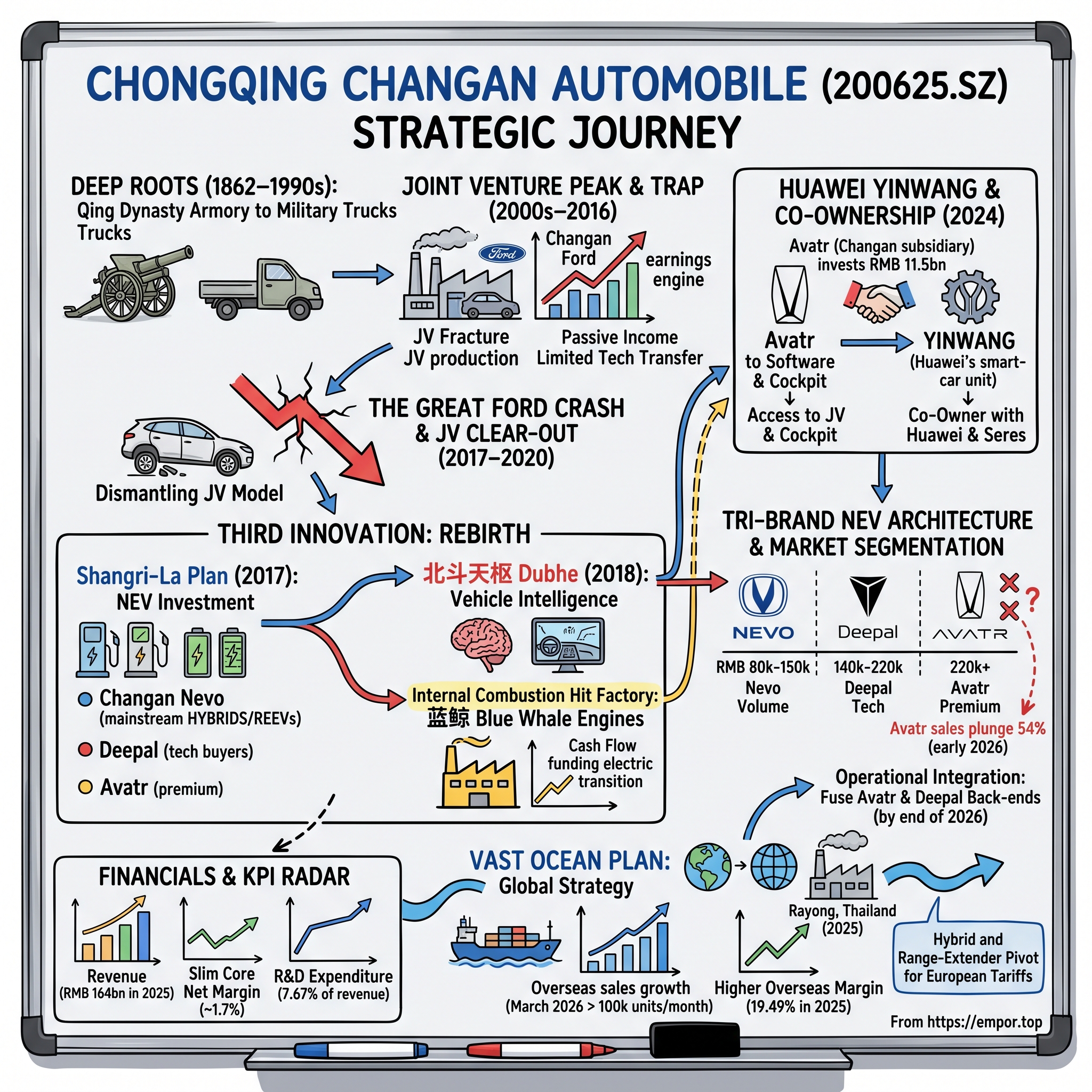
Chongqing Changan Automobile: From Qing Dynasty Armory to Huawei Smart-Car Co-Owner
I. Introduction & Episode Roadmap
On July 15, 2026, 重庆长安汽车股份有限公司 Chongqing Changan Automobile issued a profit warning on the Shenzhen Stock Exchange. First-half net profit was projected to land between RMB 740 million and RMB 970 million, marking a year-on-year drop of 57.66% to 67.70%. Excluding non-recurring items, underlying net profit shrank further to between RMB 230 million and RMB 330 million, down as much as 84%. Management attributed the decline to foreign-exchange losses and rising raw-material costs, promising stricter currency risk controls and cost reductions.15
That profit warning arrived less than twelve months after a major state-directed restructuring. On July 29, 2025, China's State-owned Assets Supervision and Administration Commission inaugurated 中国长安汽车集团 China Changan Automobile Group as a standalone central state-owned enterprise — the country's third centrally administered automaker, alongside 中国一汽 FAW and 东风 Dongfeng. Capitalized at RMB 20 billion, the new group oversaw 117 subsidiaries, roughly 110,000 employees, and RMB 308.7 billion in assets.3 Chairman 朱华荣 Zhu Huarong outlined a target to build a "globally competitive, world-class automaker with independent core technologies," aiming by 2030 for annual sales exceeding five million vehicles — including three million new-energy vehicles and one-third sold overseas — on revenue of RMB 600 billion.3
Holding those two developments side by side illustrates Changan's central investment dilemma: the company is simultaneously one of China's most strategically ambitious and least profitable major automakers. In 2025, Changan sold 2.913 million vehicles — its highest volume in nine years and its sixth consecutive year of growth — generating approximately RMB 164 billion in revenue, while reported net profit attributable to shareholders fell 44.34% to RMB 4.075 billion.1 That drop, however, primarily reflected the absence of prior one-off gains; core underlying net profit actually rose 8.03% to RMB 2.795 billion.2 Even so, an enterprise turning over roughly $23 billion converted less than 2% of that revenue into core profit.
The company's long-term trajectory explains how it arrived at this juncture. Changan traces its lineage to a Qing dynasty ordnance bureau established in 1862, marking over 160 years of continuity through three major industrial transformations.4 During the 2000s and early 2010s, the group functioned as a joint-venture earnings engine, propelled by its 长安福特 Changan Ford partnership to a peak volume of 957,500 units in 2016.6 When those joint ventures subsequently stumbled, Changan unwound or surrendered three foreign partnerships within five years, pivoting toward proprietary, domestically engineered platforms.
The centerpiece of this domestic repositioning was its alliance with Huawei. Through its premium electric vehicle subsidiary 阿维塔 Avatr, Changan invested RMB 11.5 billion for a 10% stake in 引望 Yinwang — the Shenzhen entity housing 华为 Huawei's Intelligent Automotive Solution unit — implying a RMB 115 billion valuation for a business launched just seven months prior.910 The final transaction tranche cleared in October 2025.9 As a result, Changan became a co-owner, alongside 赛力斯 Seres, of the software and sensing technology that is increasingly becoming an industry standard across China.
Supporting this strategy is a three-tier new-energy brand architecture: 长安启源 Changan Nevo (Qiyuan) for mainstream hybrids and range-extenders, 深蓝 Deepal for technology-focused buyers, and Avatr at the premium tier, co-engineered with Huawei and 宁德时代 CATL. Collectively, these three brands delivered approximately 1.11 million new-energy vehicles in 2025, a 51.1% increase that generated RMB 80.276 billion in revenue.1
Yet Changan's valuation continues to reflect market skepticism because these strategic milestones have not translated into consistent earnings. Avatr posted a net loss of RMB 3.49 billion in 2025 and saw sales drop 54% year-on-year across the first five months of 2026.1112 Deepal narrowed its losses but remained unprofitable.2 Operating cash flow dropped 62% in 2025.1 Moreover, the multi-brand architecture built over the past five years is already undergoing consolidation, with Avatr and Deepal directed to integrate their back-end operations.13
This report examines how a Qing dynasty armory became a key stakeholder in Huawei's smart-car ecosystem — and whether its strategic pivots can eventually yield sustainable profitability.
 Subscribe on LinkedIn
II. Deep Roots: From Qing Dynasty Armory to Military Truck Builder (1862–1990s)
Every company has a founding myth. Changan's features artillery.
In 1862, amid the upheaval of the Taiping Rebellion, Qing dynasty statesman 李鸿章 Li Hongzhang established an ordnance bureau in Shanghai to manufacture Western-style artillery. That institution—the 上海洋炮局 Shanghai Bureau of Ordnance—is the direct ancestor Changan claims today, establishing a documented lineage of more than 160 years and what management frames as three successive entrepreneurial transformations.428
For investors, the significance lies less in its antiquity than in the strategic blueprint it established. The 洋务运动 Self-Strengthening Movement that birthed the bureau operated on a clear mandate: acquire foreign technology, master its domestic production, and eliminate external dependence. That strategy—purchasing external capability to internalize it—has reemerged throughout Changan's history, extending to its 2024 transaction with Huawei.
The company's second formative period occurred during the Second Sino-Japanese War, when the Nationalist government moved China's industrial base inland to the mountainous sanctuary of Chongqing. As the wartime capital and primary armaments hub, Chongqing shaped the operational culture of the enterprises operating there. They developed deep capabilities in heavy metallurgy, machining, and precision engineering, alongside an institutional orientation toward state requirements. Changan's headquarters in Chongqing remains a direct legacy of that wartime retreat.
After 1978, Deng Xiaoping's 军转民 (military-to-civilian conversion) policy compelled defense enterprises across China to enter consumer markets. Changan pivoted to commercial transport. In 1984, the company partnered with スズキ Suzuki to produce its first line of mini-vehicles.4 Micro-vans and mini-trucks offered a practical entry point into vehicle assembly: they required modest tooling investment and served an under-addressed market of small-town entrepreneurs, logistics operators, and local fleets.
The strategy yielded rapid commercial success. By 1999, the company launched the Changan Star micro-van, eventually capturing nearly 40% of China's mini-vehicle market at its peak.4 For fifteen years, Changan dominated the market for the compact, functional vans that powered commerce across China's second- and third-tier cities.
The partnership with Suzuki, formalised into a joint venture during the 1990s, provided critical technical discipline. At the time, Suzuki was a global leader in designing low-cost, fuel-efficient small cars. Models like the Alto and Lingyang anchored early Chinese private car ownership. Manufacturing to Japanese quality standards on domestic assembly lines gave Changan foundational manufacturing capabilities.
However, the partnership also highlighted the risks of narrow specialization. As Chinese household incomes grew, consumer preferences shifted rapidly toward larger vehicles. Between 2003 and 2017, the market share for mini and small cars dropped from 35% to less than 7%, while sport utility vehicles expanded from 6% to 43% of total sales.5 Suzuki, whose portfolio remained tied to compact models, saw its China sales fall by more than half, from 266,000 units in 2014 to roughly 119,000 in 2017.5 Suzuki's experience offered Changan a clear lesson in the danger of failing to adapt to shifting market demand.
Three core inheritances from this era continue to shape Changan today. First, internal heavy-manufacturing capacity—spanning stamping, casting, and machining—enables Changan to design and build engines, transmissions, and range-extenders in-house. Second, an engineering-driven corporate culture prioritizes technical development. Third, close integration with central authorities and the Chongqing municipal government provides access to capital, land, and regulatory support—while imposing state-directed volume targets, employment mandates, and policy objectives that purely commercial competitors do not carry.
This state relationship positioned Changan advantageously for the next era of Chinese automotive development. As global automakers expanded into China, they required precisely what Changan possessed: a licensed, state-backed manufacturing partner with deep domestic infrastructure.
III. The Golden Age & Hidden Trap of Joint Ventures (2000s–2016)
For roughly fifteen years, the Chinese automotive joint venture stood as one of the world's most lucrative business models—masking long-term structural risks for domestic automakers.
The model operated under straightforward rules. Foreign ownership of a Chinese automaker was capped at 50%, requiring global original equipment manufacturers seeking entry into the Chinese market to form 50-50 joint ventures with domestic partners, localize production, and divide profits. The foreign partner contributed vehicle platforms, engines, brand equity, and manufacturing discipline. The domestic partner provided regulatory licensing, land access, labor management, and government relations. The structure generated substantial earnings for both sides.
长安福特 Changan Ford was formed in 2001, becoming a centerpiece of this era.4 Through the 2010s, it rode popular models—including the Focus, Mondeo, Kuga, and Edge—to mass-market scale, peaking at a record 957,500 units in 2016.6 长安马自达 Changan Mazda followed in 2012, alongside a 2011 venture with PSA to build the DS brand.7
The accounting mechanics of these partnerships explain Changan's subsequent strategic vulnerabilities. Under Chinese accounting standards, 50-50 joint ventures are not consolidated, meaning their top-line revenues do not appear in the parent company's results. Instead, the parent records its share of net profit as investment income—a high-margin, low-capital stream decoupled from its own manufacturing operations. At its peak, joint-venture earnings dominated Changan's net profit while contributing nothing to its consolidated revenue.
This accounting treatment distorted corporate incentives. Reported profitability appeared robust, and return on invested capital was artificially elevated because production assets sat on the joint venture's balance sheet rather than Changan's. Proprietary brand vehicles, sold at thin margins in a competitive domestic market, risked being treated as secondary to collecting dividend checks from foreign partners.
This dependency trap constrained both sides of the agreements. For foreign automakers, China functioned as a high-margin cash generator that funded global shareholder returns, creating an incentive to under-invest in China-specific product development. Foreign partners hesitated to redesign interiors for local tastes, localize infotainment software, or accelerate powertrain refresh cycles while existing models sold near record volumes at attractive margins. For domestic partners, joint ventures absorbed top engineering talent, prime manufacturing sites, and executive focus in service of foreign brands.
Beyond capital allocation, the arrangement limited technology transfer. Because the joint venture owned the platform architecture, tooling, and intellectual property, domestic partners accumulated minimal transferable design capabilities. While Changan personnel gained valuable operational knowledge running plants to Ford's quality standards, they did not learn to design vehicle platforms independently. Decades of joint ventures across China yielded world-class assembly discipline but little proprietary vehicle architecture, forcing Changan's post-2018 restructuring to start closer to first principles than its JV-era scale implied.
Despite these systemic disincentives, Changan's leadership sought to build internal engineering capacity. During this period, 朱华荣 Zhu Huarong—a Chongqing native born in March 1965 who earned a degree in vehicle engineering from the Beijing Institute of Technology and joined Changan's predecessor as a technician in 1986—advanced through the company's R&D institute, technical department, and chief engineer's office, becoming vice president and then president in 2014.21 His background centered on engineering development rather than joint-venture dividend management.
Under this engineering focus, Changan established an international R&D network spanning Chongqing, Shanghai, Beijing, Turin, Yokohama, Birmingham, and Detroit—sourcing exterior design from Italy, powertrain calibration from Japan, chassis dynamics from the UK, and advanced concepts from the US. The company also accelerated internal vehicle development: the BenBen, its first self-developed passenger car, debuted in September 2006, followed by the Eado sedan and CS35 crossover.4 By 2015 and 2016, Changan had emerged as China's top-selling domestic brand.4
These investments established Changan's domestic manufacturing footprint, but its proprietary brand remained a volume-driven rather than profit-generating business. Selling entry-level vehicles in the RMB 60,000 to RMB 100,000 price range against dozens of domestic competitors yielded minimal margins. Net earnings remained overwhelmingly reliant on the Ford partnership.
As a result, Changan's broader corporate structure rested on an unexamined assumption: that Changan Ford would maintain annual sales near one million units indefinitely.
IV. The Great Ford Crash & The "Third Innovation" Rebirth (2017–2020)
The collapse was not gradual. It was a cliff.
From 957,500 units in 2016, Changan Ford's sales fell for five consecutive years, dropping below 200,000 by 2019.6 That represented a loss of roughly three-quarters of the volume from a business unit that had served as the single largest source of the parent company's earnings in just thirty-six months.
The causes were unglamorous and entirely foreseeable. Ford's China lineup aged simultaneously. The Focus and Mondeo—the twin pillars of the franchise—went years without meaningful redesigns. Quality issues accumulated and were handled poorly. Furthermore, the product mix was misaligned with market shifts: while Chinese buyers demanded SUVs with large screens and connected software, the joint venture continued shipping sedans designed to European specifications.
The financial consequences for the parent company were immediate and severe. Changan's net profit plunged 90.46% in 2018 to RMB 681 million. An enterprise that had earned billions on paper discovered that when foreign joint-venture dividends vanished, its underlying operations offered little support.
What followed was the most consequential period in Changan's modern history, defined not by defending the joint-venture model, but by dismantling it.
The great JV clear-out. In September 2018, Suzuki agreed to transfer its 50% stake in 长安铃木 Changan Suzuki to Changan for a nominal one yuan—roughly fifteen U.S. cents—marking its complete exit from China, though Changan continued producing Suzuki-badged vehicles under license.5 In January 2020, Changan and PSA jointly agreed to sell 长安PSA Changan PSA to 宝能 Baoneng, with Changan's half fetching RMB 1.63 billion. The venture had accumulated RMB 4.9 billion in losses through September 2019, as DS-brand deliveries plummeted from around 23,000 vehicles in 2014 to roughly 2,040 in the first eleven months of 2019.7 The stated goal was to "solve the problem of the company's survival for good."7
These two distinct transactions delivered a single message: the era of collecting passive dividend income from foreign brands had ended, and Changan preferred taking a nominal valuation over carrying a distressed asset.
The Third Entrepreneurship. In 2017, Changan declared its 第三次创业 Third Entrepreneurship—framing it as the third major transformation in its history—and launched a series of ambitious strategic initiatives.4 The first, the 香格里拉计划 Shangri-La Plan announced on October 19, 2017, targeted RMB 100 billion in investment across new-energy vehicles, proprietary energy platforms, battery technology, and charging infrastructure, with 21 pure-electric and 12 plug-in hybrid models planned.8
The plan included a specific operational target: by 2025, Changan pledged to cease selling traditional internal combustion vehicles entirely.8
In 2025, Changan sold 2.913 million vehicles, of which approximately 1.11 million were new-energy models.1 Nearly 1.8 million vehicles were conventional fuel cars. The Shangri-La target was missed by a factor of three, and management has not issued a public reconciliation of the gap. The shortfall illustrates a broader pattern in Changan's execution: while its strategic direction has proven correct, its quantified targets have functioned more as aspirational benchmarks than strict commitments.
The second major initiative, 北斗天枢 Dubhe, followed in 2018 and focused on vehicle intelligence—encompassing smart cockpits, assisted driving, and connected services.29 It reflected a recognition by executive leadership that software was becoming the core axis of automotive competition, and foreign partners would not transfer proprietary software capability.
The internal combustion hit factory. Meanwhile, conventional gasoline vehicles sustained the company's financial transition. Changan developed its proprietary 蓝鲸 Blue Whale turbocharged engine family—marketed internationally as BlueCore—and launched a series of commercially successful domestic models, including the CS75 PLUS SUV and the UNI series. Rather than serving purely as technology showcases, these models generated steady cash flow and profit margins in segments where domestic consumers no longer prioritized foreign badges.
The strategic reality was straightforward: sales of internal combustion vehicles funded the transition to electric mobility, providing the primary financing mechanism behind Changan's restructuring.
The joint venture with Ford never fully recovered. Changan Ford sold 247,000 units in 2024 and 99,400 units in 2025—a 60% decline that pushed annual volume below the 100,000-unit threshold widely viewed in China as essential for operational viability. In June 2025, Changan stopped disclosing Changan Ford's sales figures separately in its monthly reports.6 The restructuring continued into 2026: in June 2026, Changan listed its 40% stake in Changan Ford New Energy for sale at a base price of roughly RMB 154 million, following a year in which the venture's flagship Mustang Mach-E logged just 35 sales in 2025.25
Selling 35 units in a full calendar year served as a clear endpoint for a business unit that had once generated the majority of Changan's corporate net profit.
With foreign joint-venture revenue winding down, Changan shifted toward developing proprietary brands capable of competing independently. That effort centered on three distinct brand platforms.
V. The Tri-Brand NEV Architecture & Market Segmentation
Picture the problem facing a Chinese mass-market automaker around 2020. Your badge is known — and known as cheap. You have spent two decades convincing families that a Changan is a sensible RMB 90,000 SUV. Now you need to sell some of them a RMB 350,000 electric luxury car with laser radar on the roof.
Every incumbent automaker in history has confronted this. Toyota answered with Lexus. Volkswagen answered with Audi. The wrong answer is to stick the mass-market badge on the premium product and hope the specification does the talking.
Changan's answer was to build three separate brands, each with its own visual identity, price band, dealer experience and target psychographic.
长安启源 Changan Nevo (Qiyuan) occupies the mainstream family segment, roughly RMB 80,000 to 150,000, and leans heavily on plug-in hybrids and range-extenders rather than pure battery vehicles. This is the volume engine and the most direct assault on 比亚迪 BYD's Song and Qin families. In 2025 Nevo sold more than 410,000 units, up 42.6%.1 In the first half of 2026 it delivered 173,822 vehicles, with the compact Q05 SUV alone accounting for more than 76,000 of those — a model that went from marginal to segment top-five in about a year.2027
深蓝 Deepal sits above it, roughly RMB 140,000 to 220,000, aimed at younger, technology-oriented buyers, built on a multi-powertrain platform that supports both pure electric and range-extended versions of the same body. In 2025 Deepal sold about 325,000 units, up 44.4%, generating revenue of RMB 50.245 billion and narrowing its net loss to RMB 899 million from RMB 1.57 billion.12 In the first half of 2026 it delivered 164,200 units, up 14.6%, with overseas sales of 35,800 units — up 141%.27
阿维塔 Avatr is the premium play, roughly RMB 220,000 and up, and the most interesting of the three because it was never really a Changan product. It was founded in July 2018 as a joint venture with 蔚来 NIO, later restructured around Changan, Huawei and CATL. As of the most recent prospectus, Changan holds 41.57% and CATL 9.38%; NIO fully exited in 2025.11 Avatr vehicles run on the CHN platform — Changan providing vehicle integration and manufacturing, Huawei the intelligent driving and cockpit stack, CATL the cells and pack architecture.
A word on range extenders, because they matter more than they sound. A range-extended electric vehicle, or REEV, is an electric car with a small petrol generator on board. The wheels are always driven by electric motors; the engine never touches the driveshaft. It exists only to burn fuel and recharge the battery when it runs low. That means you can fit a battery perhaps a third to a half the size of a comparable pure electric car, because you no longer need the pack to cover the once-a-year long trip. Since the battery is the single most expensive component in an EV, the bill of materials drops materially — and the customer's range anxiety disappears entirely.
For a company competing in a price war, this is close to the ideal architecture: electric driving experience, dramatically lower battery cost, no charging infrastructure dependency. It also travels well internationally, where charging networks are thin. Changan has leaned into it across all three brands, and its most senior product executives are explicit that hybrids and range-extenders are the bridge, not a detour. At a semi-annual media briefing on July 16, 2026, 谭本宏 Tan Benhong put it flatly: "HEV is the core track for Changan's fuel vehicle transition, bar none," and projected industry-wide hybrid volumes of 1.8 to 2.0 million units for the year.14
Now the uncomfortable part. The tri-brand architecture is elegant on a strategy slide and expensive in practice. Three brands mean three marketing budgets, three dealer networks, three sets of product planners and three overhead structures — for a group whose entire core net profit in 2025 was RMB 2.795 billion.2
And the premium brand broke. Avatr delivered 11,703 vehicles in the first quarter of 2026, down 41.6% from 20,041 a year earlier.13 Over January to May 2026 sales fell 54% year-on-year to roughly 20,000 units.11 In the first half of 2026 the brand delivered 27,600 vehicles — more than 30,000 fewer than the same period a year before. A luxury brand losing half its volume in a market growing overall is not suffering from a price war. It is suffering from a product-market problem.
Changan's response, announced by Zhu Huarong in April 2026, was to fuse Avatr and Deepal operations by the end of the year under an "independent front-end, collaborative mid-to-back-end" model: separate brands and showrooms, shared R&D, shared supply chain, shared manufacturing, with projected cost savings of 20–30%.13 Deepal would take the RMB 150,000–300,000 band targeting a million units a year; Avatr the RMB 250,000–700,000 band targeting 500,000.13
Read one way, this is admirable pragmatism — fixing a cost structure the moment the volume assumption breaks. Read another way, it is a partial retreat from the very thesis that justified building separate brands in the first place, executed only about three years after Avatr and Deepal reached market. Both readings are defensible. What is not defensible is treating the original tri-brand logic as proven; the market has now tested it, and the premium tier failed the test.
There is a second warning sign in the mix. Group average selling price fell to about RMB 53,400 in 2025, down RMB 3,300 from the prior year.12 Selling more new-energy vehicles at lower average prices is a volume achievement, not necessarily a value one. And management has begun saying so: Changan is actively contracting the LUMIN — a micro-EV that contributed roughly 200,000 sales in 2025 — and has installed an internal rule that if a product is not profitable, hitting its volume target still wipes out the project team's investment stakes.14
That is a meaningful change in incentive design, and it is the single most encouraging governance signal in this story. It also implies that until recently, volume was being bought.
Which brings us to the transaction that will define how this company is remembered.
VI. Capital Deployment Masterstroke: Buying Into Huawei's Yinwang
In November 2023, Changan and Huawei signed a memorandum of cooperation. Two months later, on January 16, 2024, Huawei registered a new subsidiary in Shenzhen — 深圳引望智能技术有限公司 Yinwang Intelligent Technology, capitalized at RMB 1 billion — into which it carved its Intelligent Automotive Solution business.10 On August 20, 2024, Changan's premium EV subsidiary, Avatr, signed an equity transfer agreement to acquire a 10% stake in Yinwang for RMB 11.5 billion.10
Understanding the strategic import of the investment requires examining the debate that had gripped the Chinese automotive industry for three years.
The "soul versus body" problem. In 2021, the chairman of SAIC Motor publicly rejected letting Huawei supply its full autonomous driving software stack, warning that doing so would reduce the automaker to a hardware "body" while Huawei retained the intelligent "soul" — along with customer relationships, driving data, and software margins. While strategically coherent, that independent stance proved financially prohibitive for most automakers. Developing a competitive full-stack autonomous driving system requires thousands of software engineers, massive fleet data processing, and billions of yuan in annual R&D with no assurance of parity against tech leaders.
Changan chose a middle path: rather than rejecting Huawei or relying solely on a vendor relationship, it acquired an equity stake in Huawei's automotive platform.
The transaction mechanics. Avatr paid the RMB 11.5 billion in three tranches: RMB 2.3 billion in October 2024, RMB 5.75 billion in February 2025, and the final RMB 3.45 billion on October 9, 2025.910 Seres 赛力斯 signed a mirror-image agreement five days after Changan, acquiring an identical 10% stake on the same terms, with both Avatr and Seres securing board seats.10 Following the completion of both investments, Huawei retained an 80% majority stake in Yinwang, with Avatr and Seres each holding 10%.
At RMB 11.5 billion for 10%, the transaction implied an enterprise valuation for Yinwang of RMB 115 billion (approximately $16 billion). Valuing a newly structured entity at that level presented a stark contrast in industry benchmarks. By comparison, Intel acquired Mobileye for $15.3 billion in 2017, when Mobileye was already the dominant global supplier of vision-based driver-assistance systems with established revenue and a decade of commercial design wins. At signing, Yinwang was a seven-month-old legal entity housing a carved-out business unit with a shorter public track record, no independent audited financial history, and a single dominant parent company.
Conversely, Yinwang holds a commanding position in China's urban and highway assisted-driving market, seamless integration with Huawei's HarmonyOS cockpit ecosystem, and an expanding client base that includes Seres, Chery 奇瑞, BAIC 北汽, and JAC 江淮 alongside Changan. Huawei's automotive solutions business achieved profitability in 2024 as sales of vehicles equipped with its Advanced Driving System (ADS) expanded.
The clearest empirical benchmark comes from Avatr's own financial disclosures. In its first full year holding the stake, Avatr recorded RMB 182 million in profit from its investment in Yinwang.12 Extrapolating those implied returns shows underlying earnings running well below a level that would conventionally justify a RMB 115 billion valuation. On standard valuation multiples, Changan paid a steep premium. Proponents view this as an investment in a high-growth technology platform whose earnings will scale with broader automotive adoption. Skeptics argue that Changan paid a strategic access premium to a dominant supplier that established the valuation, retained 80% control, and remains a core vendor.
Strategic deliverables. From an operational standpoint, the transaction yielded three distinct assets for Changan, in descending order of certainty: priority access to Huawei's software and cockpit architecture, with plans to co-develop 17 models by 2030 and launch five upgraded models in 2026;9 board representation providing insight into the technical roadmap of an essential supplier; and a proportional share of future platform earnings as third-party adoption expands — a theoretical benefit that remains unproven over the long term.
The dual-track strategy. The most revealing aspect of Changan's software strategy emerged shortly after the Yinwang investment. Despite acquiring a stake in Huawei's platform, Changan simultaneously accelerated its own proprietary software development. At the 2026 Chongqing Auto Show, the automaker unveiled an in-house assisted-driving stack — branded as Tianshu Pilot and SDA Pilot — offered in three performance tiers, with LiDAR included as standard equipment on the entry version. Built on an internal R&D program dating back to 2009, the system incorporated over 400,000 simulation scenarios and drew on more than 2,000 engineers who logged five million kilometers of road testing across 185 distinct real-world scenarios over the previous five years.19 The system is scheduled to launch on the Nevo Q06 in the second half of 2026.1920
When asked why Changan was funding parallel autonomous driving efforts, executive Tan Benhong offered a remarkably candid explanation: "If we don't do this, we might really end up as just a shell manufacturer."14
That assessment highlights the limits of Changan's alliance with Huawei. Purchasing a minority stake secured technology access and lead times, but it did not grant architectural sovereignty. As a result, Changan is maintaining two capital-intensive intelligent-driving initiatives at once — an in-house software division and a 10% holding in an external vendor — even as its core corporate net margin remains below 2%.
The tripartite alliance between Changan, Huawei, and CATL offers genuine operational advantages: Changan provides high-volume vehicle integration and manufacturing, CATL supplies battery cell architecture and holds equity in Avatr, and Huawei contributes the intelligent cockpit and autonomous driving stack. Yet an alliance functions as a defensive moat only if its terms remain favorable and internal alternatives are unviable. Changan's parallel investment in its own software stack indicates that executive leadership remains cautious about relying entirely on a partner platform.
If domestic strategy remains contested, Changan's international expansion has provided the cleanest growth trajectory in its portfolio.
VII. Global Strategy: The "Vast Ocean Plan"
In May 2025, Changan began mass production at its first overseas new-energy vehicle factory on an industrial estate in Rayong province, Thailand—eighteen months after breaking ground in November 2023. The facility builds the Deepal S05 alongside range-extended models for right-hand-drive markets across Southeast Asia and Oceania, serving what Chairman Zhu Huarong described as a planned "global benchmark."17
The 海纳百川 Vast Ocean Plan—taking its name from a Chinese idiom meaning "the sea accepts a hundred rivers"—represents Changan's clearest operational success and its most critical economic growth engine.
The performance figures highlight this shift. Overseas sales reached 637,000 vehicles in 2025, an 18.9% increase that accounted for roughly 22% of total group volume.116 In March 2026, monthly exports topped 100,000 units for the first time, reaching 104,100.1 According to the company's profit warning, overseas deliveries reached 454,700 units in the first half of 2026—up 51.87% year-on-year during a period when total vehicle volume declined.15
That divergence underscores a key structural change: while domestic volume contracts, rapid export growth is shifting the sales mix toward the company's most profitable business segment.
International markets offer significantly stronger pricing power than China's hyper-competitive domestic arena. Changan's overseas gross margin reached 19.49% in 2025, comfortably ahead of the group's overall 15.54% margin.1 For example, a Deepal S07 retails in Europe for around €45,000.18 Selling domestically engineered vehicle platforms into overseas markets against legacy European incumbents with higher cost bases yields healthier margins.
The build-out. When Changan presented its updated Vast Ocean Plan 2.0 at Auto China on April 24, 2026, it outlined a broad international footprint: 22 overseas manufacturing bases with a combined annual capacity of 350,000 units, operations across 118 countries through 1,124 sales outlets, 21 new market entries in 2025, and a lineup of 41 international models—25 combustion and 16 new-energy.16 Additional completely-knocked-down assembly projects are planned in countries such as Kazakhstan and Egypt.17 Management targets 1.5 million annual overseas sales by 2030, with a stretch goal of 1.8 million.16
The composition of that international lineup is revealing: more than half the models on offer remain traditional internal combustion vehicles. The automaker that pledged under its Shangri-La Plan to cease selling internal combustion vehicles by 2025 continues to export them by the hundreds of thousands. While commercially pragmatic—given the limited charging infrastructure across many developing economies—this contrast highlights the need to view Changan's public strategic targets as directional aspirations rather than strict operational deadlines.
Tariffs and the hybrid workaround. Europe represents the most challenging regulatory environment for Changan's global expansion. In late 2024, the European Commission imposed definitive anti-subsidy duties on Chinese-built battery electric vehicles on top of the standard 10% import duty, leaving Changan with an additional 20% tariff on pure-electric models such as the Deepal S07 and S05.
Changan responded through strategic product arbitrage. Because the EU tariffs specifically target pure battery electric vehicles, plug-in hybrids and range-extenders remain exempt. Changan is consequently introducing hybrid variants of its European lineup—a pivot mirrored across the industry, as Chinese hybrid imports into the EU surged 155% in 2025 compared with 12% growth for tariffed battery electrics.18
To support this push, Changan established national sales organizations in Germany, the United Kingdom, Portugal, and Norway, expanded into Italy and Spain in January 2026, and planned entry into France while relying on independent importers in Greece and Serbia. Its long-term roadmap targets €2 billion in European investment by 2030, eight models across Deepal, Nevo, and Avatr, and 1,000 sales and service locations.18 Additionally, Changan is evaluating a European assembly plant—with Spain frequently cited as a prospective candidate—which would bypass EU tariffs altogether.
Risk and reality. International expansion leverages Changan's core cost position—forged in China's domestic market—into higher-margin revenue. However, it also increases exposure to factors beyond management's control, including tariff regimes, trade policy, and currency volatility. Notably, Changan's first-half 2026 profit warning cited foreign-exchange losses as a key driver of its net profit decline.15 Generating a growing share of profits abroad without adequate currency hedging converts an operational advantage into a financial risk. Management acknowledged the issue and pledged to implement stricter foreign-exchange risk controls,15 though the execution of those measures remains to be demonstrated.
This pattern raises a broader question: how closely do management's public commitments align with operational realities?
VIII. Current Management, Incentives & Governance
A photograph from July 2026 shows Zhu Huarong meeting Thailand's prime minister to deepen Changan's "In Thailand, For Thailand" commitment — an image that illustrates the role of a Chinese central state-owned enterprise chairman: part engineer, part diplomat, and part instrument of national industrial policy.
Having spent four decades at Changan after joining as a technician in 1986 and rising to president in 2014, 朱华荣 Zhu Huarong today chairs both the listed company and its new central-SOE parent.213 As a National People's Congress deputy, he publicly called in February 2026 for fairer competition and an ecosystem upgrade in the Chinese auto industry — a recurring theme in his public remarks, supported by Changan's relative restraint in domestic price wars.
His leadership style is distinctly technical and candid regarding operational headwinds. He has spoken repeatedly against destructive domestic price discounting and personally announced the Avatr–Deepal operational integration at a post-conference briefing rather than obscuring it in a corporate filing, emphasizing that brand positioning and customer entitlements would remain unchanged.13 The decision reflected a willingness to restructure underperforming units promptly rather than absorb prolonged losses.
王俊 Wang Jun has served as president since October 15, 2020, following an internal career across marketing, product management, technology research, and the commercial vehicle division.22 His background reinforces a broader corporate pattern: Changan's senior leadership consists primarily of product and engineering veterans rather than financial strategists or party bureaucrats.
Management has continued to refresh its executive ranks. On June 16, 2026, the board appointed 陈卓 Chen Zhuo and 狄志瑞 Di Zhirui as vice presidents. Chen, a 40-year-old Chongqing native who joined in 2006, previously served as company spokesperson and head of brand PR before holding senior roles at Avatr, including president. Di, 45, advanced through product planning and brand management, most recently serving as chief executive of Qiyuan Products.23 Promoting Avatr's former president to group leadership despite the brand's volume contraction suggests the board attributed Avatr's performance to broader market headwinds rather than management execution — an interpretation that remains unverified.
Separately, Zhu stepped down as chairman of Avatr in September 2025, transferring the chairmanship to vice president 王辉 Wang Hui, an executive with extensive international experience.26 Ahead of a prospective Hong Kong initial public offering, replacing the group chairman with an export-focused operator represents a standard governance alignment.
The ownership restructuring. In February 2025, Changan and Dongfeng disclosed preliminary merger discussions aimed at carving out the automotive operations of parent China South Industries Group (CSGC) to create a single central state-owned enterprise with annual sales exceeding five million vehicles. Four months later, on June 10, 2025, the talks were terminated when the State-owned Assets Supervision and Administration Commission (SASAC) opted instead to establish CSGC's automotive assets as an independent central state enterprise.24 Following the announcement, Changan's equity rose 3.34%, while Dongfeng's Hong Kong-listed shares declined 14.45%, reflecting market perceptions of relative operational strength.24
The formal establishment of China Changan Automobile Group on July 29, 2025, provided direct SASAC oversight, separated the automotive business from defense manufacturing, and expanded balance-sheet flexibility alongside increased policy alignment.318
A review of management's operational commitments reveals a mixed record of execution:
- The Shangri-La electrification pledge: The 2017 target to phase out traditional internal combustion sales by 2025 was missed by a wide margin, with combustion models still accounting for over 60% of total volume in 2025, and management has not provided a formal reconciliation.81
- Joint-venture restructuring: Executive leadership systematically unwound underperforming foreign partnerships, exiting Suzuki and PSA and listing its stake in the Changan Ford new-energy venture.5725
- The Yinwang transaction: The strategic investment was completed on schedule across three tranches over a twelve-month period.9
- Timeliness of disclosure: Management has generally disclosed negative developments promptly, as seen in the July 2026 profit warning detailing specific drivers of net profit contraction.15
- Consistency of reporting: Disclosure quality remains variable. For the first half of 2026, the listed entity reported sales of 1.1189 million vehicles, whereas group-level communications cited 1.1956 million deliveries alongside differing export figures.1527 While potentially attributable to differing consolidation scopes, the discrepancy creates unnecessary analytical friction.
- Joint-venture transparency: Stopping separate monthly volume disclosures for Changan Ford in June 2025 reduced reporting visibility during a period of steep operational decline.6
Capital allocation and diversification risk. R&D expenditure rose 23.79% in 2025 to RMB 12.58 billion, representing 7.67% of total revenue — a reinvestment rate noticeably higher than the 5% industry average for mid-tier global automakers.12 For 2026, planned capital allocation totals RMB 14.47 billion, comprising RMB 4.47 billion in fixed assets and RMB 10 billion in equity investments.1
The RMB 10 billion equity allocation warrants careful examination. Changan's technology roadmap envisions solid-state battery testing in 2026 with mass production in 2027, alongside humanoid robotics production by 2028 and electric vertical takeoff vehicles by 2030.1 While solid-state battery architecture aligns directly with automotive manufacturing, robotics and flying vehicles extend beyond traditional vehicle operations. Funding two parallel autonomous driving programs, three distinct brand architectures, twenty-two overseas manufacturing facilities, and a €2 billion European expansion while generating under RMB 3 billion in core annual profit creates a capital demand profile that internal cash generation cannot cover independently. This capital intensity relies heavily on state-backed financing capacity — a structural feature reinforced by the company's central state-owned enterprise status.
This balance highlights the core governance tradeoff for public investors. Changan benefits from patient state capital unavailable to private competitors. In return, it absorbs policy mandates — including volume targets, employment stability, and national industrial initiatives — that may not maximize short-term profitability. Consequently, minority shareholders hold equity in an enterprise whose overarching mandate extends beyond pure capital return.
Evaluating the financial results of that mandate provides the final measure of Changan's operational trajectory.
IX. Financial Breakdown, Unit Economics & KPI Radar
In 2025, Changan sold 2.913 million vehicles and generated approximately RMB 164 billion in revenue, up 2.67% year-on-year.2 While total sales volume expanded 8.5%, revenue grew at less than a third of that pace — illustrating the top-line impact of China's domestic price war. Average selling price dropped by roughly RMB 3,300 to approximately RMB 53,400 per vehicle.12 The company moved higher volume while capturing less revenue per unit.
Despite lower realizations, gross margin widened to 15.54% from 14.94% in 2024, peaking at 16.8% in the fourth quarter.1 Because average selling prices fell, the margin expansion indicates unit costs declined faster than vehicle prices — driven by procurement scale, cross-brand platform sharing, and an increasing mix of range-extended models featuring smaller, less expensive battery packs. This cost control represented the strongest operational outcome in the 2025 financial performance.
Reported net profit attributable to shareholders dropped 44.34% to RMB 4.075 billion, compared to RMB 7.321 billion the prior year. The contraction was driven by a sharp drop in non-recurring items: non-operating gains fell from RMB 4.73 billion to RMB 1.28 billion, as government subsidies decreased from RMB 1.627 billion to RMB 559 million and gains on fixed-asset disposals shrank from RMB 2.466 billion to RMB 103 million.12 Stripping out these non-recurring items, underlying core net profit grew 8.03% to RMB 2.795 billion.2
While core operations showed underlying improvement, earning RMB 2.795 billion in core profit on RMB 164 billion in revenue yields a slim core net margin of approximately 1.7%. Operating at that margin leaves the company vulnerable to foreign-exchange fluctuations or raw-material price increases — a vulnerability exposed in the first half of 2026.15
Operating cash flow contraction. Operating cash flow fell 62.15% in 2025 to RMB 1.836 billion.1 For an automaker planning RMB 14.47 billion in 2026 capital investments, generating under RMB 2 billion in operational cash creates a substantial funding gap. Closing that gap requires reliance on balance-sheet liquidity, external subsidiary fundraising, or state-backed financing.
Key accounting considerations. Three specific accounting areas merit close evaluation:
First, R&D capitalization. Of Changan's RMB 12.58 billion in total 2025 R&D spending, RMB 7.158 billion was expensed directly on the income statement.1 The remaining RMB 5.422 billion — an amount exceeding reported full-year net profit — was capitalized as intangible development assets for future amortization. While standard practice in automotive accounting for commercially viable programs, capitalizing development costs for 43 planned new models and dual driver-assistance software platforms represents a significant balance-sheet assumption. Any future impairment or lower capitalization rate would directly reduce reported net income.
Second, the carrying value of the Yinwang holding. Avatr carries the RMB 11.5 billion investment on its balance sheet based on an implied enterprise valuation established through bilateral negotiation. Because Yinwang operates as a carved-out subsidiary without separate audited public financial statements, investors are assessing this asset without market-observable pricing.
Third, joint-venture accounting. As Changan Ford's sales volume diminished and its new-energy venture was listed for sale at a base price of roughly RMB 154 million, residual carrying values and disposal accounting became critical.25 While management has historically recognized restructuring losses promptly rather than deferring them, ongoing joint-venture wind-downs will continue to introduce non-operating volatility into reported earnings.
Subsidiary and segment performance. Revenue from new-energy vehicles reached RMB 80.276 billion in 2025, an increase of 36.3% that accounted for roughly half of total group turnover.1 Deepal generated RMB 50.245 billion in revenue while narrowing its net loss to RMB 899 million.12 Premium subsidiary Avatr generated RMB 25.63 billion on deliveries of 123,000 vehicles, improving its gross margin from 6.3% to 9.4%, but posted a net loss of RMB 3.49 billion.1112 That result brought Avatr's cumulative losses since 2022 above RMB 13.2 billion, with cost of sales consuming 90.6% of its 2025 revenue.12
Avatr capital raising. Avatr submitted its initial Hong Kong IPO application in November 2025, allowed the filing to lapse on May 27, 2026, and refiled on June 30, 2026, targeting up to $1 billion in capital.1112 The prospectus disclosed RMB 6.25 billion in cash as of April 30, 2026, alongside guidance that full-year net losses would likely persist.12 Refiling during a period when five-month sales fell 54% underscores Avatr's reliance on external capital injection. Changan has reaffirmed support for the unit, framing the back-end integration of Avatr and Deepal as a key measure to curb operating overhead.1113
First-half 2026 financial contraction. In the first half of 2026, group revenue declined by RMB 14.551 billion year-on-year to RMB 113.949 billion, as vehicle deliveries dropped by 236,400 units to 1.1189 million.15 Management attributed the severe drop in net profit primarily to foreign-exchange losses and elevated raw-material costs.15 However, because overseas sales grew 51.87% over the same period, the volume contraction was concentrated in the domestic market.15 Management outlined corrective measures focused on currency risk management, structural cost reductions, technology optimization, and operational efficiency.
Operational policy shift. Following these first-half headwinds, Changan altered its volume strategy. Production of the low-margin LUMIN micro-EV — which contributed approximately 200,000 sales in 2025 — is being systematically reduced.14 Management also enforced an internal directive requiring project teams to forfeit financial investment stakes if a vehicle model fails to reach profitability, regardless of whether it meets volume targets.14 For full-year 2026, Changan set an overall sales target of 3.3 million vehicles, including 1.4 million new-energy vehicles, supported by plans to launch 43 new models over three years and achieve a 40% new-energy penetration rate.114 Reaching 3.3 million total deliveries following a 1.12 million unit first half would require an unprecedented second-half volume expansion.
Core performance indicators. Evaluating Changan's strategic transition depends primarily on three core financial metrics:
1. Overseas volume and margin trajectory. Export expansion represents Changan's primary margin driver. Progress requires monitoring monthly export units against the 1.5 million vehicle target for 2030 alongside overseas gross margin, which narrowed by 6.7 percentage points to 19.49% in 2025 despite rising sales.1 Whether export volume growth can stabilize gross margins determines whether international expansion generates sustainable value or merely expands unit distribution.
2. Consolidated gross margin versus average selling price. In 2025, gross margin expanded while average selling price declined, reflecting unit cost reductions that outpaced price discounting. Sustaining profitability requires cost reductions to continuously offset ongoing domestic price pressure.
3. Subsidiary losses and path to profitability. Capital allocation remains concentrated in Deepal and Avatr. While Deepal narrowed its net loss on higher volume in 2025, Avatr's losses widened as sales contracted. The planned operational integration of the two brands by the end of 2026 targets 20% to 30% in cost savings.13 The core measure of success is whether combined operating losses diminish and Avatr restores unit volume growth.
X. Strategic Frameworks: Hamilton Helmer's 7 Powers & Porter's 5 Forces
Strategic frameworks are most valuable when they force a rigorous distinction between temporary operational edges and durable competitive moats. Applied to Changan, they yield a shorter list of structural advantages than corporate presentations suggest.
Hamilton Helmer's 7 Powers
Cornered Resource — partially present, weakly protected. A 10% stake in Yinwang and equity ties with CATL provide Changan with direct access to two vital components of the Chinese automotive technology stack. However, a cornered resource requires preferential access on terms that competitors cannot replicate. Seres acquired an identical 10% stake in Yinwang on identical terms five days later.10 Other domestic peers, including Chery, BAIC, and JAC, purchase Huawei's technology without taking equity, while CATL supplies battery cells across the entire market. Changan's investment secured board seats and a share of platform profits—valuable assets, but not exclusive ones. That Changan continues to fund its own driver-assistance technology demonstrates that management itself does not view this alliance as a fully protected corner.1914
Counter-Positioning — real, and largely spent. Changan's primary counter-positioning move was embracing an external full-stack software provider while foreign automakers and joint ventures hesitated over software sovereignty. That approach yielded a distinct operational lead from roughly 2021 to 2024. Today, that edge has largely dissolved as the ecosystem of Huawei-partnered automakers expanded, shifting the competitive question from whether to partner to who executes best. Counter-positioning inherently erodes once competitors adopt the same model.
Process Power — the most credible of the four. Changan's ability to produce internal combustion engines, plug-in hybrids, range-extenders, and pure electric vehicles on shared architectures allows it to pivot production rapidly as consumer demand shifts. In a market where policy, subsidies, and fuel costs can alter segment demand rapidly within a single year, manufacturing flexibility offers material economic protection. That capability relies on two decades of accumulated powertrain engineering that pure electric startups lack. This operational discipline helped gross margin expand in 2025 despite falling vehicle prices.1 Nevertheless, hybrid-flexible manufacturing has since become standard practice among major domestic incumbents, including BYD, 吉利 Geely, and Chery.
Scale Economies — present but insufficient. Delivering 2.913 million vehicles annually grants Changan substantial procurement and tooling leverage.1 However, scale confers structural power only when it yields a cost advantage that competitors cannot replicate. BYD operates at significantly higher volume while maintaining deeper vertical integration across battery cells and semiconductors. Changan's scale ensures operational viability, but it does not dictate market pricing.
Absent powers. Switching costs for Chinese car buyers remain minimal, and network effects are absent. Brand power—defined as the ability to command a price premium for comparable physical specifications—was the strategic goal behind Avatr. However, the brand's 54% sales drop in early 2026 indicates that pricing power has not materialized.11
Porter's Five Forces
Rivalry: extreme and structural. Over a hundred automotive brands compete in a Chinese passenger vehicle market growing at low single-digit rates, backed by state-supported manufacturing capacity that resists rapid exit. This environment reflects what domestic commentators term 内卷 (neijuan, or involution)—a state of hyper-competition that erodes industry-wide profitability. Chairman Zhu Huarong's repeated public calls for disciplined, fair competition highlight the toll this price competition inflicts on industry margins.
Buyer power: high. While individual car buyers hold no individual bargaining power, consumers collectively exercise immense leverage because numerous manufacturers offer closely comparable vehicles. Minimal switching costs combined with abundant substitutes drive persistent price deflation, as reflected in Changan's RMB 3,300 drop in average selling price in 2025.1
Supplier power: moderate to high, concentrated in core technologies. While raw steel and body stampings remain commodities, battery chemistry and automotive computing silicon are highly concentrated. CATL's market position in battery cells and Huawei's dominance in intelligent vehicle software grant those suppliers significant bargaining power. Changan's equity investments in CATL via Avatr and in Huawei via Yinwang represent defensive capital deployments to secure critical inputs, underscoring where industry leverage truly resides.
Threat of substitutes: low to moderate. Dense urban public transit and high-speed rail networks suppress vehicle ownership in China's tier-one metropolises. However, Changan's primary customer base sits in lower-tier domestic cities and emerging international markets, where the functional alternative to a passenger vehicle is public transit or two-wheeled transport.
Threat of new entrants: low and declining. The market window that enabled the emergence of early electric vehicle startups has closed. Capital for uncapitalized newcomers has contracted, regulatory requirements have expanded, and the baseline scale needed to compete on unit cost has risen dramatically. While this barrier protects established incumbents, it offers limited relief because early entrants that survived have already established formidable market positions.
Net read. Changan's most defensible advantage rests on its flexible, multi-powertrain manufacturing architecture and an internationally competitive cost structure. Its strategic ties with Huawei and CATL offer access to leading software and battery technology, but those platforms are shared across competing automakers. What Changan lacks—and what vertically integrated rivals like BYD possess—is a proprietary cost advantage in core electric battery hardware.
XI. Bull vs. Bear Case & Activist Stress Test
Myth vs Reality
Before analyzing the core investment arguments, it is worth evaluating four common market narratives—two bullish and two bearish—that present an incomplete or misleading picture of the company.
Myth: "Changan owns a piece of Huawei's autonomous driving business, so it has locked in a technology moat." Reality: Changan holds a 10% stake in Yinwang on identical terms to those secured by Seres, while Huawei retains an 80% majority stake and operational control.10 First-year investment returns were modest, with Avatr recording RMB 182 million in profit.12 The stake secures information, alignment, and a board seat rather than software exclusivity, as demonstrated by Changan's parallel in-house assisted-driving development program.19
Myth: "Changan's profit collapsed in 2025, so the business is deteriorating." Reality: The reported 44% decline in net profit reflected the absence of prior-year subsidies and asset-disposal gains. Stripping out those non-recurring items, underlying core profit rose 8% alongside gross margin expansion.12 The primary financial vulnerability in the 2025 accounts lies in a 62% drop in operating cash flow, which received minimal market attention.1
Myth: "As a state-owned enterprise, Changan is protected from the price war." Reality: State ownership provides balance-sheet capital and patient sponsorship rather than pricing power. Average selling price fell by roughly RMB 3,300 in 2025, and first-half 2026 revenue dropped by RMB 14.55 billion.115 State-owned enterprise status enhances long-term resilience, but it does not protect commercial margins during aggressive industry discounting.
Myth: "Chinese automakers are being shut out of Europe by tariffs." Reality: EU anti-subsidy duties specifically target pure battery electric vehicles. Chinese hybrid imports into the European Union expanded 155% in 2025 compared to 12% growth for tariffed battery electrics, leading Changan to pivot its European launch toward plug-in hybrids.18 Current tariffs do not block exports so much as redirect powertrain selection. The primary risk remains regulatory scope expansion rather than underlying consumer demand.
The Bull Case
Export growth is driving margin expansion. Overseas deliveries rose 51.87% in the first half of 2026 despite domestic volume contraction, generating a gross margin roughly four percentage points above the group average.151 Expanding market share in regions where Changan's domestic cost base provides a competitive edge offers the clearest path to expanding its slim 1.7% core net margin. With 22 overseas manufacturing bases and operations across 118 countries, the company's international infrastructure is already established.16
Unit cost reductions are outpacing price declines. Gross margin expanded to 15.54% in 2025—reaching 16.8% in the fourth quarter—even as average selling prices fell.1 This demonstrates that procurement scale, cross-brand platform sharing, and range-extended EV architectures are driving tangible cost efficiencies.
The Huawei partnership provides structural alignment. Despite the high valuation paid for Yinwang, Changan secured board representation, priority software roadmap access, and a plan to co-develop 17 models through 2030.910 While non-equity peers operate purely as customers, Changan holds an equity stake in a core industry technology supplier.
Governance incentives are shifting toward profitability. Management's decision to scale back the low-margin LUMIN micro-EV, enforce internal financial penalties on unprofitable model teams, and integrate back-end operations between Avatr and Deepal indicates a disciplined shift away from unprofitable volume expansion.1413
Central state ownership provides capital security. Designation as a central state-owned enterprise gives Changan balance-sheet support and financing access that private competitors operating at losses cannot match.3
The Bear Case
Core net margins remain vulnerable to external shocks. Generating RMB 2.795 billion in underlying profit on RMB 164 billion in revenue yields a core net margin of 1.7%, leaving minimal cushion for cost inflation.2 First-half 2026 results demonstrated this exposure, as foreign-exchange losses and raw-material costs reduced underlying net profit by up to 84%.15
Operating cash flow cannot cover planned capital expenditure. Full-year 2025 operating cash flow fell to RMB 1.836 billion, creating a substantial funding gap against planned 2026 capital investments of RMB 14.47 billion that must be covered through external financing.1
The premium brand trajectory remains troubled. Avatr posted a RMB 3.49 billion net loss in 2025, bringing cumulative losses past RMB 13.2 billion, while deliveries fell 54% in the first five months of 2026 ahead of a refiled Hong Kong IPO.1112 Despite access to Huawei's software stack and CATL's battery technology, Changan has yet to establish a profitable premium franchise.
Parallel software investments duplicate capital expenditure. Funding an internal assisted-driving development program alongside a RMB 11.5 billion investment in Huawei's Yinwang platform creates parallel R&D expenses that weigh heavily on the company's thin operating margins.1914
Global expansion faces persistent trade policy risks. European anti-subsidy tariffs already apply to Changan's pure battery electric vehicles, leaving its hybrid export strategy vulnerable to potential regulatory adjustments, while North American markets remain restricted.18
Resource allocation is extending into non-core domains. Directing capital toward humanoid robotics planned for 2028 and electric flying vehicles targeted for 2030 expands strategic scope before core automotive operations generate self-sustaining cash flow.1
The Activist Stress Test
Evaluating Changan through the lens of an institutional investor highlights several critical governance and operational questions for the board:
-
Yinwang valuation and governance: Avatr recorded RMB 182 million in profit from its RMB 11.5 billion Yinwang investment in year one.12 What long-term return rate does the board underwrite, and how will carrying values be evaluated if third-party adoption slows? Furthermore, how were conflicts managed during negotiations with a counterparty that serves simultaneously as supplier, technology partner, and equity seller?
-
Duplicated software development: If the proprietary Tianshu Pilot system achieves commercial competitiveness, what long-term role does the Yinwang stake serve? Conversely, if external software architecture is essential, what justifies funding a parallel internal software division?
-
Brand architecture consolidation: After establishing separate brand identities to prevent positioning dilution, management announced the back-end integration of Avatr and Deepal within three years of launch.13 Does this integration represent a necessary correction to high overhead, or a retreat that risks diluting premium brand positioning? Additionally, will the projected 20% to 30% cost savings be publicly reported against audited baselines?
-
Reporting consistency and disclosure transparency: What accounts for the material discrepancies between group-level communications and listed-entity filings for first-half 2026 vehicle deliveries?1527 Furthermore, what was the rationale for discontinuing separate monthly sales disclosures for Changan Ford during a period of accelerating volume decline?6
-
Accountability for public strategic targets: The 2017 Shangri-La Plan targeted the complete phaseout of internal combustion sales by 2025, yet conventional fuel vehicles accounted for nearly 1.8 million units sold that year.81 Similarly, achieving the full-year 2026 target of 3.3 million vehicles requires a dramatic acceleration following first-half sales of 1.12 million units.1415 What governance oversight mechanisms exist to hold executive leadership accountable when public targets are missed?
-
Non-core capital allocation: What approval framework and hurdle rates apply to capital allocated toward humanoid robotics and electric vertical takeoff vehicles while core operations remain cash-flow negative?1
-
Minority shareholder alignment: Given SASAC's role as controlling sponsor and the inclusion of national industrial mandates, how does the board balance policy directives with returns for public minority shareholders—particularly holders of B-shares who absorb operational risks without governance leverage?
While none of these challenges inherently invalidates Changan's strategic direction, clear public answers remain essential for investors evaluating the company's long-term risk-return profile.
XII. Playbook & Key Takeaways
Lesson 1: Joint-venture cash flow is a loan against the future, not durable income. Dividends from Changan Ford delivered substantial cash that masked structural weaknesses in Changan's underlying operations. When the joint venture's product cycle turned, those earnings did not decline gradually; they vanished, taking 90% of the parent company's annual profit with them. The broader lesson: when a major portion of reported earnings arrives as investment income from operations an automaker does not control and cannot redesign, management should treat those funds as a finite annuity earmarked for developing proprietary capabilities. Changan funded an international R&D network and an in-house powertrain family during the peak joint-venture years, but it did not move quickly enough to prevent 2018 from becoming an existential crisis rather than a routine cyclical downturn.
Lesson 2: Brand architecture is a hypothesis that must be validated by unit economics. Segmenting brands to avoid placing a luxury electric vehicle under a mass-market badge is logically coherent. However, multiple brands create duplicate overhead structures, and a premium tier justifies its costs only if buyers accept premium pricing. Avatr's steep volume drop and its subsequent operational integration with Deepal indicate that Changan scaled its multi-brand architecture before establishing stable market demand.1311 The key lesson centers on execution sequence: establish genuine pricing power before committing to fixed organizational separation, and remain prepared to consolidate operations promptly if market adoption falls short.
Lesson 3: Acquiring equity in a key supplier is a strategic hedge, not software sovereignty. Acquiring a 10% stake in Huawei's Yinwang platform offered Changan a practical route to access advanced driver-assistance technology without committing endless capital to solo development. A minority holding provides board representation, technical alignment, and roadmap visibility. However, it does not confer exclusivity, architectural control, or independence from a dominant technology provider. This reality explains why Changan continues to fund an internal driver-assistance division while executive leadership acknowledges the risk of becoming "just a shell manufacturer."14 The lesson on platform dependency is clear: taking an equity stake in an essential vendor improves governance terms and operational insight, but it does not alter who controls the underlying software roadmap or customer relationship.
The core takeaway. Changan possesses clear strategic assets: flexible multi-powertrain manufacturing, an expanding export footprint, strong technology partnerships, access to state capital, and a management team willing to restructure underperforming operations. At the same time, the enterprise converts roughly $23 billion in revenue into less than $400 million in core profit, generates operating cash flow well below its capital expenditure requirements, and frequently misses its public operational targets. Both realities exist concurrently. For investors, the central question is whether this strategic restructuring will ultimately yield sustainable profitability—a trajectory that will be tracked, quarter by quarter, through export volumes, the relationship between gross margins and average selling prices, and the operational turnaround of Deepal and Avatr.
References
-
Changan Automobile 2025 Financial Report: Record Sales and Profit Structure Adjustment — Gasgoo, 2026 ↩↩↩↩↩↩↩↩↩↩↩↩↩↩↩↩↩↩↩↩↩↩↩↩↩↩↩↩↩↩↩↩↩↩↩
-
Changan Automobile 2025 Revenue Rises 2.67%, Underlying Net Profit Grows 8.03% — Gasgoo, 2026 ↩↩↩↩↩↩↩↩↩↩↩↩↩
-
Changan Rolls Out Global Expansion Plan Following SOE Upgrade in Chongqing — iChongqing, 2025-07-31 ↩↩↩↩↩
-
Wheels of Change: the Story of Changan Automobile (Part 1) — Gasgoo ↩↩↩↩↩↩↩↩
-
Suzuki departs from final China venture — China Daily, 2018-09-06 ↩↩↩↩
-
Another Joint Venture "Disappears" from Financial Reports — Gasgoo, 2026 ↩↩↩↩↩↩
-
New direction for DS as partners agree to sell stakes to Baoneng — China Daily, 2020-01-06 ↩↩↩↩
-
Changan's $15 Billion Electric Revolution ("Shangri-La") Plan — CleanTechnica, 2017-10-27 ↩↩↩↩
-
AVATR completes 11.5-billion-yuan equity investment in Huawei's Yinwang auto tech unit — Gasgoo, 2025-10 ↩↩↩↩↩↩
-
Avatr and Seres Chiefs Join Huawei-backed Yinwang Board With Each Holding 10% Stake — iChongqing, 2025-04-02 ↩↩↩↩↩↩↩↩
-
Changan-Backed Avatr Revives Hong Kong IPO Bid Amid Sales Slump — Caixin Global, 2026-07-03 ↩↩↩↩↩↩↩↩↩
-
Avatr refiles for Hong Kong listing after prospectus lapses — CnEVPost, 2026-07-01 ↩↩↩↩↩↩↩↩↩
-
Changan to fuse Avatr and Deepal operations as Avatr Q1 sales plunge 41.6% — CarNewsChina, 2026-04-21 ↩↩↩↩↩↩↩↩↩↩
-
Volume and Profit Priority: Changan Exits Price-for-Volume Elimination Race — Gasgoo, 2026-07 ↩↩↩↩↩↩↩↩↩↩↩
-
Changan Automobile Warns First-Half Net Profit to Plunge Nearly 70% on FX Losses, Raw Material Costs — BigGo Finance, 2026-07-15 ↩↩↩↩↩↩↩↩↩↩↩↩↩↩↩
-
Changan Group Unveils Updated "Vast Ocean Plan 2.0" and Highlights Next-Generation BlueCore Hybrid at Auto China 2026 — Thailand Business News, 2026-04 ↩↩↩↩
-
ChangAn Unveils Vast Ocean Plan Global Expansion Milestones Following Official Launch of First International NEV Factory in Rayong, Thailand — PR Newswire, 2025-05-20 ↩↩
-
Changan prepares model offensive for Europe — electrive, 2026-01-19 ↩↩↩↩↩↩
-
2026 Chongqing Auto Show: Changan Automobile Unveils "Tianshu Pilot" Driver-Assistance System — Gasgoo, 2026 ↩↩↩↩↩
-
Changan Nevo Unveils H2 Lineup, Targets 400,000 Sales in 2026 — Gasgoo, 2026-07 ↩↩
-
Resume of Zhu Huarong, Chairman of Changan Automobile — BitAuto ↩↩
-
Changan Auto Reshuffles Leadership, Appoints Chen Zhuo and Di Zhirui as Vice Presidents — Gasgoo, 2026-06 ↩
-
Changan–Dongfeng Merger Halted, Vision for 5M-Unit Auto Giant Derailed — Bridging News / iChongqing, 2025-06-10 ↩↩
-
Overseas Giants Stumble in New Energy Sector: Only 35 Vehicles Sold in a Year, Changan Divests 40% Stake at Discounted Price — 36Kr, 2026-06 ↩↩↩
-
Changan Chairman Zhu Huarong Steps Down as Chairman of Avatr — DSF, 2025-09 ↩
-
Changan Auto Reports Robust H1 2026 Delivery Growth with Strong Overseas and New-energy Momentum — China Report, 2026-07 ↩↩↩↩
-
Chongqing Changan Automobile Company Limited disclosures (000625.SZ / 200625.SZ) — CNINFO disclosure platform ↩
 LinkedIn
 WhatsApp
 Reddit
 Hacker News
 Email
Email Kindle
 RSS Feed
 Spotify
 Apple Podcasts
 Amazon Music
 Audible
 YouTube