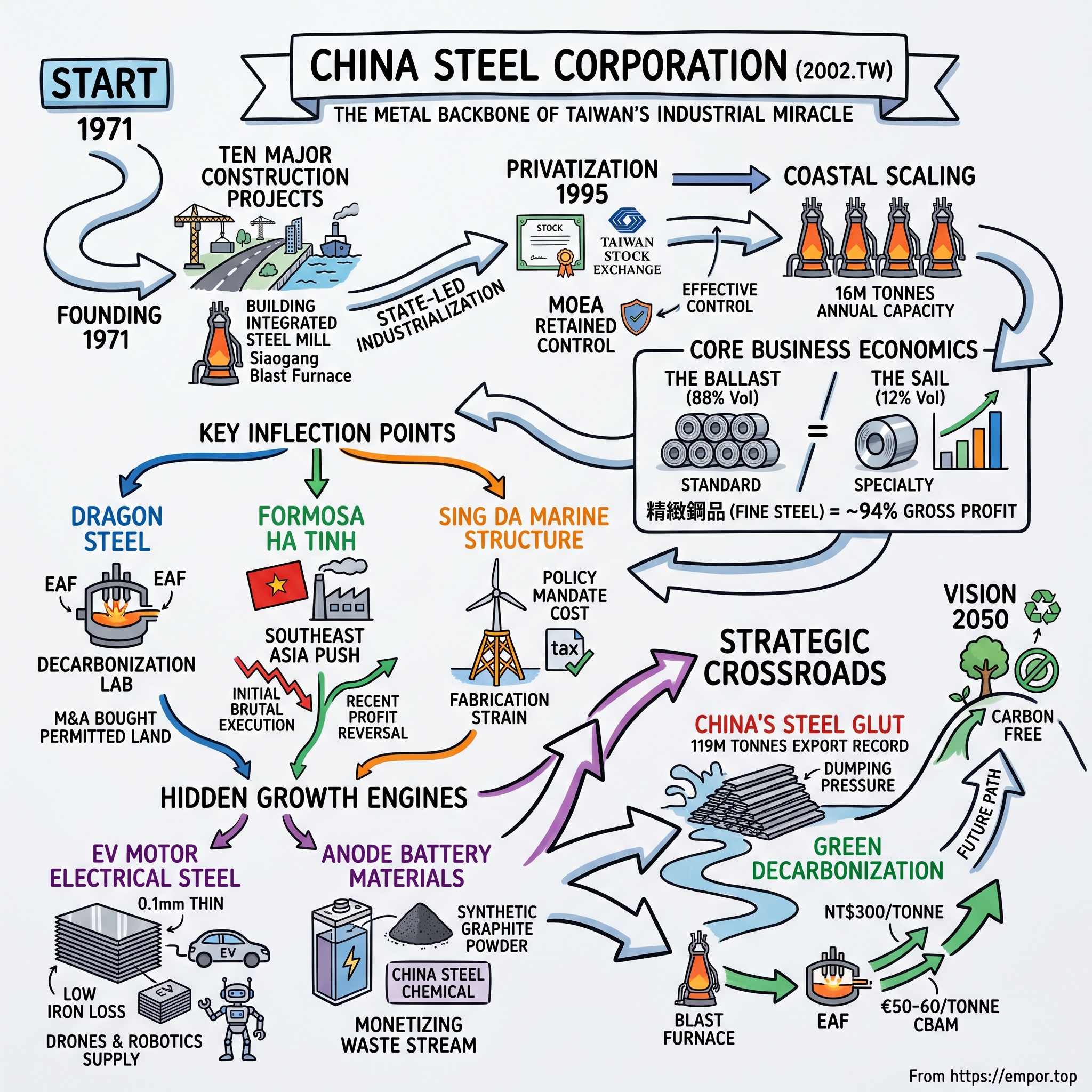
China Steel Corporation: The Metal Backbone of Taiwan's Industrial Miracle
I. Introduction & Episode Roadmap
On a humid afternoon in May 2026, in a hall inside a steelworks on the southern tip of Taiwan, the chairman of the island's largest industrial company stood in front of several thousand shareholders — many of them retirees who had held the stock for decades — and had to say something no China Steel chairman had ever said before.
The company had lost money for a full year.
Not a bad quarter. Not a soft half. A full-year loss: negative NT$0.29 of earnings per share for 2025, on revenue of about NT$317 billion.1 Chairman 黃建智 Hwang Chien-chih called it the most difficult year since the company was privatized in 1995.2 For a firm that had paid a dividend through the Asian financial crisis, through the dot-com bust, through 2008, and through the COVID collapse — and whose shares are held by something on the order of a million Taiwanese retail accounts as a bond substitute — the loss was less a financial event than a cultural one.
And here is the strange part. Two months before that shareholder meeting, in April 2026, the very same company posted its best monthly crude-steel output in twenty-seven months, roughly 976,000 tonnes, and swung back to a pre-tax profit of NT$485 million.23 By May the pre-tax number had nearly tripled again to NT$1.35 billion.3 The patient that had flatlined in 2025 was, by mid-2026, sitting up and asking for lunch.
That whiplash is the story. 中國鋼鐵 China Steel Corporation (2002.TW) is a company whose reported earnings say almost nothing about the quality of the business in any given year, and almost everything about the price of hot-rolled coil in Asia relative to the price of Australian coking coal and Brazilian iron ore. Understanding CSC means separating two things that are constantly confused: the cyclical machine, which is loud and volatile and dominates the headlines, and the structural machine underneath it, which is quiet, slow, and where the entire investment question actually lives.
Here is the shape of the enterprise as it stands in mid-2026. The group runs close to 16 million tonnes of annual crude steel capacity — roughly 9.9 million tonnes from four blast furnaces at the Siaogang works in 高雄 Kaohsiung, and about 6 million tonnes from subsidiary 中龍鋼鐵 Dragon Steel in 台中 Taichung, which operates two blast furnaces plus electric arc furnace equipment.4 It holds more than half of Taiwan's domestic market across its product families, with shares running from the twenties in some categories up to roughly 79 percent in coated flat products.4 It supplies the steel that becomes the structural frame of semiconductor fabs, the hulls of Taiwanese ships, the fasteners that Taiwan exports to the world, and — most interestingly — the ultra-thin electrical steel that becomes the stator cores of electric vehicle traction motors.
And it does all this while the 中華民國 Ministry of Economic Affairs owns 20 percent of the shares and appoints the chairman.56
That is the core paradox, and it is not a rhetorical flourish. CSC is simultaneously a listed company answerable to minority shareholders and an instrument of Taiwanese industrial policy answerable to a ministry. When those two masters agree, CSC is a formidable machine. When they disagree — on steel pricing during inflation, on offshore wind localization, on how fast to decarbonize — the shareholder is usually the one who pays.
The road ahead: the founding under 蔣經國 Chiang Ching-kuo and the 十大建設 Ten Major Construction Projects; the 1995 privatization and the building of the Siaogang moat; three capital-allocation decisions that reveal how this management team actually thinks — Dragon Steel, 台塑河靜鋼鐵 Formosa Ha Tinh Steel in Vietnam, and 興達海洋基礎 Sing Da Marine Structure in offshore wind; the segment economics and where the money is really made; the electrical steel and battery-materials businesses that management is betting the next decade on; the governance dynamics and management's credibility record; the collision course with Chinese overcapacity, carbon fees, and the EU's border tax; and finally an honest bull-versus-bear stress test of a company that has never been harder to value.
Start where it started: with a government that had almost no friends left in the world, and decided to build a steel mill.
 Subscribe on LinkedIn
II. Founding & State-Led Industrialization: The Ten Major Construction Projects
Picture Taiwan in 1971. In October of that year the Republic of China lost its seat at the United Nations. Within a few years the diplomatic dominoes would fall — Japan, then eventually the United States. The island had a population of roughly fifteen million, an economy built on textiles, plastics, and light assembly, and a defense posture premised on the possibility that nobody would come. Then in 1973 the oil shock hit, and the cost of every imported input Taiwan depended on doubled.
A government in that position makes a particular kind of calculation. It stops optimizing for return on capital and starts optimizing for not being strangled.
The answer was the 十大建設 Ten Major Construction Projects, championed by Premier Chiang Ching-kuo: highways, a new international airport, electrified rail, nuclear power, shipyards, ports, petrochemicals — and, at the center of the heavy-industry cluster, an integrated steel mill. Taiwan at the time imported essentially all of its flat steel. Every shipyard, every machinery maker, every construction firm was hostage to Japanese and Korean mills for both price and delivery. Steel was not a business opportunity; it was a chokepoint.
China Steel Corporation was founded in 1971 by the Taiwanese government to close it.7 The site office at Kaohsiung was established in 1972, construction of the steelworks began in 1974, and in 1975 the head office itself was relocated from Taipei to Kaohsiung — a small administrative fact that says something real about the seriousness of the project.7 Executives were expected to live next to the furnaces, not commute to them from the capital.
The site selection deserves more attention than it usually gets, because it is the single most durable decision in the company's history. Siaogang District sits on the edge of Kaohsiung harbor, one of the deepest natural ports in East Asia. Integrated steelmaking is, at bottom, a bulk logistics business wearing a metallurgy costume: for every tonne of steel that comes out, roughly 1.5 tonnes of iron ore and half a tonne or so of coal must come in, by sea, from Australia and Brazil. If you have to truck or rail those inputs inland from a port, you have added a cost that never goes away, compounding every day for fifty years. CSC was built so that Capesize vessels could discharge ore directly onto a conveyor that runs to the sinter plant, and so that finished coil could be loaded onto export vessels from berths the company controls.
Phase I was completed in 1977 with an annual capacity of 1.5 million tonnes.7 By the standards of 日本製鐵 Nippon Steel or 浦項鋼鐵 POSCO at the time, that was modest. By the standards of an island that had never made a tonne of integrated flat steel, it was a national event.
And from the first day, the tension that still defines the company was visible. CSC existed to make steel cheap for Taiwanese manufacturers — that was the policy purpose. But it was also structured as a corporation expected to earn a return. Those two mandates are only compatible when steel is scarce and margins are wide. When steel is abundant and margins are thin, the state's interest ("hold prices down for downstream industry") and the shareholder's interest ("hold prices up to protect the spread") point in opposite directions.
For roughly two decades that tension stayed latent, because Taiwan's industrial economy was compounding at a rate that absorbed everything CSC could produce. Domestic shipbuilding, machine tools, bicycles, fasteners, and construction all scaled at once, and CSC scaled with them. The company began investing outward as well — taking a position in China Steel Structure in 1978, the beginning of what would become a sprawling group.7
Then, in the 1990s, Taiwan's government decided it wanted its capital back — and the second act began.
III. Privatization & Coastal Scaling: The Siaogang Blast Furnace Moat
On April 12, 1995, China Steel was privatized.7 The mechanism was the one used across Taiwan's state-enterprise sector in that era: the government sold down its holding below 50 percent and the shares listed on the 臺灣證券交易所 Taiwan Stock Exchange, where CSC became — and remains — one of the most widely held securities on the island.
But read the fine print, because the fine print is the company. The Ministry of Economic Affairs did not exit. Three decades later, as of March 31, 2026, MOEA still owned 20 percent of the issued shares.5 In a company with an otherwise atomized retail register and no other holder of comparable size, 20 percent is not a passive stake — it is effective control of board composition. The chairman of China Steel is, functionally, a ministry appointee. When Hwang Chien-chih was elected chairman at the first meeting of the newly constituted board on June 19, 2025, the company's own disclosure identified him as the juristic-person representative of the Ministry of Economic Affairs.6
So "privatization" here meant something specific: CSC got market discipline on its cost of capital, a currency for acquisitions, transparency obligations, and a retail shareholder base that expects dividends — while the state retained the steering wheel. It is a hybrid, and hybrids have hybrid problems. We will come back to them.
What the newly listed company did with its freedom was build. Through the late 1990s and 2000s, Siaogang was expanded phase by phase into a four-blast-furnace integrated works, and by 2006 the group's liquid steel capacity was approaching 10 million tonnes a year.7 Today CSC's four furnaces at the site account for roughly 9.9 million tonnes of that near-16-million-tonne group capacity.4
It is worth slowing down on why a coastal integrated mill of this scale is genuinely hard to replicate, because "scale economies" gets used as a lazy synonym for "big."
An integrated steelworks is not one factory; it is a heat-and-gas ecosystem. Coal is baked into coke in coke ovens. Iron ore fines are agglomerated into sinter in sinter plants. Coke and sinter go into the blast furnace to make molten iron. Molten iron goes to the basic oxygen furnace to become steel. Every one of those steps throws off gas — coke oven gas, blast furnace gas, converter gas — and in a well-designed plant, none of it is wasted. It is captured and burned in on-site power plants to generate the electricity that runs the rolling mills. Slag, the stony byproduct of the furnace, is sold into cement. Waste heat is recovered. The plant is, in effect, a refinery that happens to produce metal.
This is why a mill like Siaogang has a cost structure that a standalone rolling operation cannot touch, and why the capital cost of replicating one is prohibitive. It is also why blast furnaces cannot be casually switched off: a furnace runs continuously for something like fifteen to twenty years between relines, and taking one down and restarting it costs a fortune. That inflexibility is the moat and the trap at the same time — a point that will matter enormously when we get to decarbonization.
CSC's capital spending in 2026 shows the machine still being fed. In February the board approved NT$7.757 billion to revamp the No. 4 blast furnace, targeted for completion by August 31, 2029; in May it approved a further NT$1.987 billion to revamp the No. 3 and No. 4 sinter plants, with work commencing June 1, 2026.6 These are not growth projects. They are the price of keeping a forty-year-old industrial organism alive, and they recur forever.
Around the mill, CSC built the other half of its moat: the customer ecosystem. Taiwanese steel demand is unusual. It is not dominated by automotive assembly the way Japan's or Korea's is; it is dominated by a long tail of small and mid-sized exporters — fastener makers in Kaohsiung and Tainan, hand-tool manufacturers in Taichung, wire and cable producers, shipbuilders, structural fabricators. CSC's own 2025 domestic sales breakdown shows the pattern clearly: single-stand re-rollers at about 20 percent of domestic volume, direct end users at roughly 16 percent, screw and nut manufacturers around 15 percent, cut-to-length processors about 14 percent, then structural steel, tube, vehicle, shipbuilding, and hand-tool customers.4
That fragmentation is a subtle competitive advantage. A giant like 寶山鋼鐵 Baoshan Iron & Steel can undercut CSC on a container of commodity coil. It cannot easily replicate forty years of relationships with three hundred small Taiwanese fastener plants that need specific chemistries, tight delivery windows, and a technical service engineer who answers the phone. This is why CSC has held domestic share above half even as Chinese import pressure has intensified — and why the domestic ratio matters. In the first three quarters of 2025, CSC's parent-level sales of 5.56 million tonnes split roughly 60 percent domestic and 40 percent export; adding Dragon Steel, group sales of 7.42 million tonnes split about 58 percent domestic.4
Domestic tonnes are the good tonnes. They carry relationship pricing, lower logistics cost, and less exposure to whatever tariff wall goes up next. Export tonnes — 39.7 percent of which went to Southeast Asia in that period, 19.4 percent to Japan, 16.3 percent to Europe, 6.0 percent to mainland China — are the marginal, price-taking tonnes.4 A large part of what has happened to CSC's earnings over the past three years is simply that the marginal tonne got much worse.
Having built the mill and the ecosystem, management then had to decide what to do with the cash. That record is where a business gets judged.
IV. M&A, Capital Deployment, & Key Inflection Points
There is a certain kind of capital-allocation decision that looks obvious in the boardroom and only reveals itself a decade later. China Steel has made three big ones since privatization. One looks good. One looks expensive but defensible. One is a case study in what happens when a government-influenced company invests to satisfy a policy rather than a hurdle rate.
Inflection Point 1: Dragon Steel — the acquisition that bought a decade
In 2004, CSC took a position in a company called Kuei-Yi Industrial, which it renamed Dragon Steel Corporation; by 2008 Dragon Steel had been acquired outright.7 The plant sits on reclaimed coastal land in Taichung, on Taiwan's central west coast.
Read superficially, this was a mid-sized domestic acquisition. Read properly, it was CSC buying something that had become impossible to buy in Taiwan: permitted heavy industrial land on deep water.
By the mid-2000s, Taiwan's environmental permitting environment for new blast furnace capacity had effectively closed. The island is densely populated, air quality in the central and southern corridors is politically radioactive, and the prospect of a greenfield integrated steelworks winning approval had become remote. Dragon Steel came with a site, an existing permit envelope, and room to grow. CSC used that room to add blast furnace capacity — Dragon Steel now contributes roughly 6 million tonnes of the group's near-16-million-tonne capacity, from two blast furnaces plus electric arc furnace equipment.4
Did CSC overpay? The honest answer is that transaction multiples are the wrong lens. What CSC bought was optionality that could not be manufactured at any price by 2010: a second integrated site, geographically diversified from Kaohsiung, serving central and northern Taiwan with lower inland freight, and — critically — carrying an EAF capability that has since become the group's decarbonization laboratory. Dragon Steel reached roughly 60 percent scrap-based production in 2024.7 More recently, CSC and Dragon Steel jointly developed a process feeding hot metal directly into an EAF-fed caster, which produced a product certified at 90 percent recycled content under UL 2809.4
That is the tell. Dragon Steel is not just tonnes; it is the only place inside the group where CSC can practice the low-carbon process it will eventually need at Kaohsiung. Judged as a strategic option rather than as an EBITDA multiple, it looks like the best capital decision the company has made.
Inflection Point 2: Formosa Ha Tinh — the Vietnam lesson
The second decision moved money offshore. CSC's Southeast Asian push began earlier — a joint venture with Japanese partners in Vietnam was set up in 2009 — but the defining commitment came with the 台塑河靜鋼鐵 Formosa Ha Tinh Steel project, the multi-billion-dollar integrated works in northern Vietnam led by Formosa Plastics Group, in which CSC raised its stake in 2015.7
The logic was sound and remains sound. Vietnam was, and is, one of the fastest-growing steel markets on earth. ASEAN tariff structures reward production inside the bloc. And Taiwan's own domestic demand had matured — CSC could either accept a shrinking pie or buy a seat at a growing one.
The execution was brutal. In 2016, the Ha Tinh plant became the center of a major marine pollution incident on Vietnam's central coast, with mass fish deaths and a national political crisis. Then the regional steel cycle turned, Chinese exports surged, and prices across Southeast Asia collapsed. For years the investment was a drag rather than a contributor.
The interesting recent development is that this has quietly reversed. In the first quarter of 2026, CSC's share of profit of associates was NT$265.9 million, against NT$57.5 million in the same quarter of 2025 — a line item that materially cushioned an otherwise ugly quarter.5 Equity-method income from a Vietnamese asset is now doing real work in the consolidated numbers.
The lesson for investors is uncomfortable but useful: a strategically correct investment can be wrong for eight years and right in the ninth, and there is no way to tell in advance whether you are in year three or year nine. What you can assess is whether management was honest about it while it was going badly — and here CSC's disclosure has been reasonably plain, carrying the associate line visibly rather than burying it.
Inflection Point 3: Sing Da Marine Structure — the cost of a policy mandate
The third decision is the one that should make shareholders uneasy, and it is the clearest window into the governance question.
In the late 2010s Taiwan committed to building an offshore wind industry in the Taiwan Strait — one of the best wind resources in the world — and attached to it an aggressive local-content mandate. Developers wanting Taiwanese grid contracts had to buy Taiwanese-made components: blades, towers, cables, and the enormous steel jacket foundations that anchor turbines to the seabed.
Somebody had to build a jacket factory. Taiwan had no such capability. CSC founded 興達海洋基礎 Sing Da Marine Structure and, in December 2019, completed a fabrication facility for subsea foundations for offshore wind turbines.8
Consider what was actually being asked. A jacket foundation is a welded steel lattice the height of a twenty-story building, fabricated to offshore-certification tolerances, in a country with no offshore fabrication workforce, on a schedule set by developers with liquidated-damages clauses. Steelmaking and heavy offshore fabrication are not the same business. They share a raw material and nothing else — different labor skills, different quality regimes, different project-accounting risk profile. CSC entered it because Taiwan's energy policy required a Taiwanese champion to enter it, and CSC is the company the state calls.
The outcome has been the predictable one for a first-of-a-kind fabrication venture: steep learning curves, throughput bottlenecks, and financial strain. CSC has never presented Sing Da as a returns success.
CSC also went further up the value chain, taking 51 percent of the 中能 Zhong Neng offshore wind farm off Changhua County alongside Copenhagen Infrastructure Partners at 49 percent, with total project investment of roughly NT$55 billion and expected generation of about 1.1 billion kilowatt-hours a year.4 Here too, reality has been humbling. In its November 2025 investor conference, CSC disclosed that Zhong Neng's 2025 generation fell short of target because summer wind speeds were below the historical average and turbine availability after grid connection was worse than expected — and said the shortfall was one of the reasons group operations swung from profit to loss during the year.4
Read that again, because it is a striking sentence for a steel company: a wind farm's turbine reliability was a stated contributor to the earnings swing at Taiwan's largest steelmaker.
The honest framing is this. CSC's green-energy portfolio — 101 megawatts of installed solar generating about 1.1 billion kilowatt-hours cumulatively and NT$3.53 billion of electricity sales revenue through October 2025, plus an 11 megawatt-hour battery storage system — is not economically trivial, and it does hedge a genuine regulatory exposure, since Taiwan requires large electricity consumers to procure renewables.4 But management's own projection has green-energy revenue at roughly NT$590 million in 2025 rising to about NT$700 million by 2033.4 Against a group that turns over more than NT$300 billion, that is a rounding error carrying multi-billion-dollar capital and reputational risk.
Which is exactly what a skeptical investor should say out loud: a substantial share of CSC's discretionary capital over the past decade went into businesses chosen partly by Taipei rather than entirely by the hurdle rate. Some of it was rational hedging. Some of it was the tax a national champion pays for being a national champion. Distinguishing the two requires looking at where the money is actually made — so let us open the machine.
V. Inside the Machine: Segment Breakdown & Core Economics
If you want to understand China Steel's economics, forget the org chart for a moment and hold one number in your head.
In the first nine months of 2025, CSC sold 607,000 tonnes of what it calls 精緻鋼品 — "fine steel products," its term for high-margin specialty grades. That was 11.6 percent of sales volume and 17.8 percent of revenue.
It was 93.6 percent of gross profit.4
Read that ratio slowly, because it reframes everything. Roughly one tonne in nine generates essentially all of the gross margin. The other eight tonnes — the hot-rolled coil, the plate, the bar and wire that make up the bulk of the tonnage and the headlines — collectively contributed close to nothing at the gross line in a bad year.
This is not a bug in CSC's business. It is the defining characteristic of an integrated steelmaker in a world of structural overcapacity. The commodity book is not there to make money; it is there to keep the blast furnaces at full utilization so that the fixed cost per tonne stays low enough that the specialty book can be profitable. The commodity tonnes are the ballast. The specialty tonnes are the sail.
The steel segment: where the spread lives
The steel business — CSC's Kaohsiung parent, Dragon Steel, 中鴻鋼鐵 Chung Hung Steel, the Vietnamese and Malaysian and Indian operations, and the trading arms — is the overwhelming majority of consolidated revenue and effectively all of the value creation.45
Its economics reduce to one equation: the selling price of finished steel minus the delivered cost of a raw material basket dominated by iron ore and metallurgical coal. CSC's product mix at the parent level in the first three quarters of 2025 ran roughly 32 percent hot-rolled, 18 percent bar and wire, 17 percent coated products, 16 percent cold-rolled, 12 percent plate, and 6 percent semi-finished.4
Here is what makes the equation treacherous. CSC buys ore and coal on the seaborne market, where three suppliers — Rio Tinto, BHP, and Vale — dominate iron ore and Australia dominates premium coking coal. It sells into an Asian market where the price is set at the margin by Chinese exports. So CSC buys in a concentrated oligopoly and sells into a fragmented glut. That is close to the worst structural position a manufacturer can occupy, and it is why the company's returns swing so violently.
The magnitude of the swing is genuinely hard to believe until you see it in sequence. In 2021, riding the post-COVID restocking boom, CSC earned NT$62.1 billion of net income on NT$468.3 billion of revenue — earnings per share of NT$4.02. In 2022, EPS fell to NT$1.15. In 2023, NT$0.11. In 2024, NT$0.13. In 2025, negative NT$0.29.1
Peak-to-trough, earnings fell by well over 100 percent of the peak in four years, on a revenue decline of only about a third. That is operating leverage in its rawest form: with roughly NT$32 billion of annual depreciation against a fixed asset base of more than NT$400 billion, small changes in the spread per tonne become enormous changes in profit.1
And notice something that gets lost in the loss headline. Even in 2025, with a NT$4.35 billion net loss, CSC generated NT$44.7 billion of cash from operations — helped by NT$17.4 billion released from inventory — spent NT$32.2 billion on capital expenditure, and still produced roughly NT$12.6 billion of free cash flow.1 The accounting loss and the cash reality are two different animals. A capital-intensive steelmaker with heavy depreciation can lose money on the income statement for years while remaining cash-generative, which is precisely why the company could still fund a dividend.
Engineering & construction: the fab-building sideline
The second cluster is engineering and fabrication: 中國鋼鐵結構 China Steel Structure (2013.TW), China Steel Machinery, China Ecotek, and Sing Da Marine.4 Several of these are separately listed on the Taiwan Stock Exchange, which is worth noting — CSC is not one company but a listed holding structure with listed children, including China Steel Structure, China Steel Chemical, CHC Resources, China Ecotek, and Chung Hung Steel.5
The most interesting thread here connects steel to semiconductors. Taiwan's fab construction boom requires enormous quantities of heavy structural steel — a modern wafer fab is a vibration-isolated, seismically braced steel structure carrying cleanrooms and utilities, not a conventional building. China Steel Structure's order book has been supported by that expansion, and CSC's own materials note that high-performance structural steel — used in tall buildings, long-span bridges such as the Danjiang Bridge, and ship hulls — was the largest specialty product by both volume and gross profit contribution in the first nine months of 2025.4
There is a genuine irony worth savoring: the most reliable growth driver in a 1970s blast furnace company turns out to be the physical scaffolding of Taiwan's semiconductor industry. The steel doesn't go into the chip. It holds up the room the chip is made in.
Industrial materials, trading, and energy
The third cluster covers 中鋼碳素化學 China Steel Chemical (1723.TW), CHC Resources, China Steel Aluminium, magnetics, plus shipping, trading, security, and development arms.4 We will come back to the chemical business shortly, because it is more strategically interesting than its size suggests.
The structural conclusion for an investor is this: CSC's consolidated revenue is dominated by a commodity business whose margin is set by forces entirely outside management control, while its gross profit is dominated by a small specialty book that management can influence. Every strategic statement the company has made since 2024 follows from that asymmetry. Whether the strategy works is a different question — and it hinges on two businesses most people have never heard of.
VI. The Hidden Growth Engines: EV Motor Electrical Steel & Anode Battery Materials
Take a sheet of A4 paper between your fingers. That is roughly a tenth of a millimeter thick.
Now imagine rolling steel to that thickness — steel with precisely controlled silicon content, a crystal structure engineered so magnetic domains flip with minimum energy loss, and an insulating coating applied so that thousands of these sheets can be stacked into a motor core without shorting to each other. Imagine doing it continuously, at width, at commercial yield.
That is what China Steel says it is now doing, and it is the single most important thing happening inside the company.
Why electrical steel is hard, in plain language
An electric motor works by using electromagnets to spin a rotor. The magnetic field has to reverse direction many times per second. Every time it reverses, some energy is lost as heat inside the steel itself — "iron loss." In a fan motor nobody cares. In an EV traction motor spinning at extreme speed, iron loss is the difference between range and no range, and between a motor that runs warm and one that needs an expensive cooling system.
Two things reduce iron loss: adding silicon to the steel (which raises electrical resistance and impedes the wasteful eddy currents), and making the laminations thinner. Thinner sheets break the eddy current loops into smaller circuits. CSC's own general manager 陳守道 Chen Shou-tao has put the rule of thumb bluntly: halving the thickness cuts iron loss by roughly 25 percent.9
But thin, high-silicon steel is miserable to manufacture. Silicon makes steel brittle; brittle steel cracks in rolling mills. Thin gauges reduce throughput and increase defect sensitivity. You are asking a heavy industrial process to hit near-electronics tolerances. This is why the supplier list is short.
CSC's position, and the honest version of it
CSC has upgraded thin-gauge electrical steel annual capacity by 200,000 tonnes and can supply at ultra-wide 1,360 millimeter width, which matters because wider strip means fewer laminations wasted at the edges when motor cores are stamped out.4 It has developed self-adhesive coated electrical steel — sheets that bond to each other when stacked, giving better core dimensional precision, higher stamping speed, and lower production cost for the motor maker. Orders for that product were expected to exceed 5,000 tonnes in 2025 with two- to three-fold annual growth, and a second generation with better coating heat resistance and bond strength is in development.4
At the May 2026 shareholder meeting, CSC disclosed it had developed 0.1 millimeter electrical steel with self-adhesive coating, and stated that only five manufacturers worldwide make ultra-thin electrical steel at all, with CSC one of just two possessing the combined ultra-thin rolling and coating technology.9 The target applications are not primarily passenger cars: they are drones and robots, where motors spin faster and weight matters more. CSC has said it is developing eight motor designs to support domestic drone makers and expects to begin volume supply of electrical steel into the drone and robotics chains from 2027.4
Now the discipline. Is the moat real, and what would falsify it?
Three pieces of evidence support it. First, the margin data: electrical steel is among the highest gross-margin contributors within the specialty book, ranking near the top of gross profit contribution in 2024 alongside high-performance structural steel and precision forging steel.4 Second, the qualification barrier: automotive and aerospace motor programs require multi-year material qualification, which creates genuine switching costs once designed in — and CSC has explicitly cited long new-customer validation timelines as a reason its own volumes lagged.4 Third, the demand backdrop: CSC projects global electrical steel demand rising from 1.23 million tonnes in 2024 to 2.73 million tonnes by 2030, with each electric vehicle consuming roughly 85 to 110 kilograms.4
And now the evidence against, which management itself disclosed rather than hid. In the first three quarters of 2025, electrical steel orders fell year-on-year, because major automaker customers sold fewer vehicles and new-customer qualification takes too long to fill the gap. CSC's guidance for 2026 electrical steel bookings was flat with 2025 — explicitly attributed to the United States ending EV purchase subsidies and to low-priced Chinese EVs squeezing European and American automakers' volumes.4
That is the falsification test, and it is a live one. A moat that produces flat volumes for two consecutive years during the supposed steepest part of the EV adoption curve is a moat under strain. The technology claim may be entirely true while the commercial claim underperforms, because CSC does not control which automakers win. The pivot toward drones and robotics is a rational response — those are higher-value, less price-elastic, and strategically favored in Taiwan — but 2027 is the stated volume year, which means this thesis will not be provable from the financials for some time.
The stealth carbon play: China Steel Chemical
Here is a piece of vertical integration that almost nobody outside Taiwan tracks.
CSC's coke ovens exist to turn coal into coke for the blast furnaces. In the process they throw off coal tar and coal tar pitch — historically low-value byproducts. 中鋼碳素化學 China Steel Chemical Corporation (1723.TW) exists to take those streams and refine them upward: coal tar distillation, light oil, carbon materials, and — the interesting part — anode-material precursors and anode materials for lithium-ion batteries, activated carbon, and mesophase carbon products including green mesophase powder, carbonized mesophase powder, and mesophase graphite powder.10
Mesophase pitch is a genuinely valuable intermediate. In the right processing window, coal tar pitch forms an ordered liquid-crystal phase that can be converted into highly structured synthetic graphite — the material that makes up the negative electrode of a lithium-ion cell. Global anode supply is overwhelmingly Chinese. Any credible non-Chinese source of anode precursor is strategically interesting to battery makers navigating trade restrictions and customer diversification requirements.
The honest assessment: this is optionality, not a current earnings driver. China Steel Chemical is a small listed subsidiary whose trailing revenue runs in the low hundreds of millions of US dollars, and its anode business is a slice of that.10 What makes it worth watching is the structural elegance — CSC is monetizing a waste stream from a process it must run anyway, which means the marginal cost basis is unusually favorable, and it does not require CSC to win in steel to work.
Both of these growth engines share a characteristic that should shape expectations: they are real, they are technically credible, and they are years away from moving a NT$300 billion revenue line. Which brings us to the people who have to manage that gap — and to the question of whether they have earned the benefit of the doubt.
VII. Current Management & Governance: MOEA Oversight, Leadership Transition, & Capital Allocation
In September 2024, China Steel changed both its chairman and its president on the same day. Hwang Chien-chih became chairperson and Chen Shou-tao became president, succeeding 王錫欽 Wang Shyi-chin, who had held both roles.6
The backgrounds matter. Hwang came up through the corporate function — he had served as executive vice president, spokesperson, corporate governance officer, and chief information security officer at CSC before taking the chair, and he was subsequently re-elected chairman on June 19, 2025 as the representative of the Ministry of Economic Affairs.6 Chen came from the production side, as vice president of the production division. It is a pairing of a governance-and-communications executive with an operations executive, at a moment when the company needed both a story and a cost program.
It is also, unavoidably, a state appointment. The chairman of China Steel sits at the intersection of a listed company's board and Taiwan's Department of State-owned Enterprise Affairs. No amount of corporate-governance boilerplate changes that reality, and investors should not pretend otherwise.
The governance dilemma, concretely
The abstract version — "state interests versus minority shareholders" — is easy to nod along to. The concrete version is sharper.
CSC sets domestic steel prices on a periodic basis for Taiwanese downstream customers. In inflationary periods, there is political pressure to restrain those increases so that Taiwanese manufacturers are not squeezed. In deflationary periods, there is commercial pressure to cut. A purely commercial steelmaker optimizes the spread. A national champion optimizes something fuzzier that includes downstream industrial health. CSC's own strategy documents state the philosophy explicitly: the competition is no longer between individual firms but between industrial ecosystems, and "when downstream does well and customers do well, China Steel does better."4
That is a coherent industrial-policy philosophy. It is not a shareholder-value maximization philosophy, and it is honest of the company to say so plainly. An investor buying CSC is buying a business that will, at the margin, subsidize its customer base — and receives in return a protected domestic position, regulatory support on trade remedies, and an implicit sovereign backstop.
The offshore wind and jacket-fabrication investments discussed earlier are the same trade in capital form. So is the drone and robotics push, which aligns neatly with Taiwan's national defense-industrial priorities: CSC describes it as building a domestically produced, mass-producible, trustworthy end-to-end defense supply chain.4
The credibility record: what management actually did
Assessing management by behavior rather than rhetoric produces a genuinely mixed scorecard.
On target-setting, the disclosure is unusually specific. Most steel companies talk about "high-value products" in the abstract. CSC published a year-by-year path: fine steel products at 11.8 percent of finished sales volume in 2025, then 12.8 percent in 2026, 14.6 percent in 2027, 16.4 percent in 2028, 18.2 percent in 2029, and 20.0 percent in 2030 — with corresponding tonnages rising from 874,000 to 1.565 million tonnes.4 Committing to a public annual ladder is a choice; it makes management falsifiable. Actual first-nine-months 2025 performance came in at 11.6 percent against the 11.8 percent full-year target — a marginal miss, disclosed without spin.4 At the 2026 shareholder meeting the chairman restated the 12.8 percent target for the year.9
On cost discipline, the actions are real but modest. CSC has shut down, mothballed, or retired six production lines — including a wire rod plant commissioned in 1977, a vacuum oxygen decarburization furnace from 1994, an electrical steel coating line, and a continuous annealing line — and is reviewing 26 ironmaking, steelmaking, and rolling lines for consolidation. The quantified benefit: roughly NT$506 million a year of headcount cost and NT$537 million a year of process cost.4 Management branded the program "less is more."
Just over NT$1 billion of annual savings against a company that lost NT$4.35 billion in 2025 is helpful but not decisive. The framing is right — a mature steelmaker in a structurally oversupplied market should shrink toward its best assets — but the pace is cautious, which is what you would expect from a company where large-scale headcount reduction carries political consequences.
On guidance discipline, management has been notably unwilling to over-promise. On the November 25, 2025 investor call, management characterized 2026 conditions in baseball terms as "one good, three bad," said the priority was to earn more profit on the same or lower volume, and declined to forecast meaningful volume growth despite a recovering demand outlook.11 Asked about CBAM, they said European sales volumes would inevitably decline.11 Asked about Chinese capacity cuts, they described the reduction as gradual rather than dramatic.11
Those are not the answers of a management team selling a story. In an industry where executives routinely promise that the cycle turns next quarter, consistent under-claiming is a modest but genuine credibility asset — and it has been consistent, since the same call also disclosed the electrical steel volume shortfall and the wind farm underperformance rather than burying them.
On capital allocation, the record is where a skeptic should press hardest. CSC spent NT$42.8 billion on capital expenditure in 2024 — a year in which it earned NT$1.98 billion of net income and generated negative free cash flow of roughly NT$0.5 billion.1 It then spent NT$32.2 billion in 2025, a loss year.1 Capital spending at that scale through the trough of a cycle, funded partly by debt, is a defensible choice if the assets are essential (blast furnace and sinter relines genuinely are) and an aggressive one if they are discretionary.
The balance sheet shows the consequence. At the end of 2025, total debt stood at roughly NT$271.1 billion against net debt of about NT$250.8 billion, with total liabilities of NT$343.9 billion versus total equity of NT$329.9 billion.1 The credit market noticed: Taiwan Ratings assigned a long-term twAA- rating with a negative outlook on April 24, 2025, while Fitch's national long-term rating stood at AA(twn) with a stable outlook as of April 14, 2025.4 A negative outlook from the domestic agency during a loss year is exactly the second-layer signal an investor should weigh — investment grade, but with the trajectory flagged.
On dividends, the pattern reveals the shareholder base. Look at the payout ratios across the cycle: 102 percent in 2015, 88 percent in 2019, an extraordinary 600 percent in 2020, 77 percent in the boom year of 2021, 318 percent in 2023, and 254 percent in 2024.4 CSC pays out far more than it earns in weak years, because its retail and income-fund holders treat it as a yield instrument and the political cost of a zero is high.
For 2025 — the loss year — the board proposed NT$1.4 per preferred share and NT$0.15 per common share on February 26, 2026.6 Paying a common dividend out of a loss, while carrying NT$251 billion of net debt and a negative rating outlook, is a defensible gesture to a retail base but not an obviously disciplined capital decision. It is precisely the sort of thing an activist would put in the first slide.
That activist would have a broader list, too: a sprawling group with multiple separately listed subsidiaries and limited consolidated segment transparency; non-core assets in shipping, security services, and property development; policy-driven ventures with unclear returns; and a controlling shareholder whose objective function is not stated in the annual report. None of these are secrets. All of them are structural, and none will be fixed by an outside investor, because 20 percent of the register belongs to the government.
Governance sets the boundaries of what management can do. What it must do next is dictated by two forces neither management nor the ministry controls.
VIII. Strategic Crossroads: China's Steel Glut, Green Decarbonization, & CBAM
In 2025, China exported a record 119 million tonnes of steel.2
Sit with that figure. It is more than seven times China Steel's entire group crude steel capacity, exported in a single year by a single country, into a region where CSC sells about 40 percent of its output. It is roughly equal to the combined annual steel consumption of most mid-sized economies. And it happened not because Chinese mills were winning, but because Chinese property construction collapsed and roughly a billion tonnes of domestic capacity had to find somewhere to go.
This is the central fact of the global steel industry in the 2020s, and it explains CSC's income statement more completely than any strategic narrative.
The dumping problem and Taiwan's response
Taiwan has fought back with trade remedies. In September 2025, Taiwan's Customs Administration finalized anti-dumping duties on designated hot-rolled flat steel products from China, ranging from 16.10 percent for three named Chinese producers to 20.15 percent for other manufacturers and exporters, following provisional duties imposed from June.12
Trade remedies of that magnitude genuinely help — they raise the landed cost of the marginal import and protect CSC's domestic share, which is the profitable share. But they are partial. They cover specific product categories, they can be circumvented through third-country processing, and they invite retaliation. They also do nothing for CSC's export book, which competes against the same Chinese material in Southeast Asia without protection.
Meanwhile, the trade environment worsened from the other direction. In 2025, the United States raised its Section 232 steel tariff to 50 percent and introduced reciprocal tariffs, which CSC identified as a direct cause of the order decline that pushed the company into loss from the second quarter onward — a double squeeze in which Taiwanese downstream exporters, hit by tariff walls in their own end markets, stopped ordering steel.4
There is, at last, a genuine turn. In the first four months of 2026, Chinese crude steel production fell 4.1 percent year-on-year and Chinese steel exports fell 9.7 percent, as Beijing enforced production cuts and tightened export controls.13 Combined with supply disruption from Middle East conflict, that pushed international steel prices up sharply in the second quarter of 2026 — though CSC has been careful to describe the market as having entered a high but range-bound consolidation with mixed sentiment, rather than declaring a new bull market.313
That restraint is warranted. Chinese supply discipline has been announced and abandoned several times over the past decade. The question no analyst can answer is whether this round is structural — driven by the 反內捲 anti-involution campaign and genuine consolidation among the top ten producers — or another temporary curtailment. Management's own view on the November 2025 call was gradualist: consolidation among the largest Chinese steelmakers could improve market discipline, but the process would be slow.11
The carbon problem, which is arithmetic
Blast furnace steelmaking works by using carbon to strip oxygen from iron ore. The carbon comes from coal. The oxygen leaves as carbon dioxide. That is not an inefficiency to be engineered away; it is the chemistry of the process. Which is why decarbonizing an integrated steelmaker is not like decarbonizing a factory — it means replacing the reaction itself.
CSC's own numbers frame the scale. Using 2018 as its baseline year, the company emitted 22.1 million tonnes of CO2 equivalent. Between 2018 and the third quarter of 2025 it completed 1,370 emission-reduction projects, cutting 1.534 million tonnes — a 6.94 percent reduction.4 The published path targets a 7 percent cut by 2025, 25 percent by 2030, and carbon neutrality by 2050.4
Seven percent in seven years, to reach twenty-five percent in five more, then one hundred percent in twenty. The curve required is not linear; it is a cliff.
Two regulatory mechanisms now put a price on that gap.
Taiwan's carbon fee took effect from January 2025 at a standard rate of NT$300 per tonne, with preferential rates of NT$50 or NT$100 available to companies submitting approved voluntary reduction plans. The first collection cycle closed on May 31, 2026 and raised NT$4.97 billion from 240 companies operating 461 factories, of which 29 steel plants paid NT$400 million.14
CSC's own disclosure on this is one of the sharpest numbers in the entire story. Its voluntary reduction plan passed the Ministry of Environment's preliminary substantive review on November 14, 2025. With the plan approved — qualifying it for both the high-carbon-leakage emissions adjustment coefficient and the preferential rate — CSC estimated its carbon fee at approximately NT$200 million. Without the plan, at the general rate, the bill would have been around NT$6 billion.4
A thirty-fold difference, contingent on regulatory approval. CSC has been accruing the fee monthly since January 2025.4 That is an enormous conditional liability sitting behind a policy decision, and it is precisely the kind of item that deserves attention: the economics of Taiwanese steelmaking currently depend on a discount that the government grants and could narrow.
The EU's Carbon Border Adjustment Mechanism entered its definitive period on January 1, 2026, requiring authorized importers to buy certificates covering embedded emissions in steel, cement, fertilizer and other covered goods, with verified emissions data.15 CSC estimates the market consensus CBAM cost at €50 to €60 per tonne of steel.4
Against a hot-rolled coil price typically in the several-hundred-dollar range, a €50-60 per tonne carbon charge is not a nuisance — it is a margin. CSC has flagged that the benchmark values, verification rules, and whether Taiwan's domestic carbon fee will be creditable against CBAM obligations all remain unclear, and that the EU pushed the first certificate purchase date from January 1, 2026 to February 1, 2027.4 The company's current export quotations do not include CBAM cost, with prices adjusted to market conditions — meaning the ultimate incidence of the charge between CSC and its European buyers is still being negotiated commercially, deal by deal, with buyers largely demanding delivered-duty-paid terms that put the cost on the supplier.4 Europe was 16.3 percent of CSC's export volume in the first three quarters of 2025.4
The 2050 plan, and why the EAF was paused
CSC's technology roadmap has three phases. Near term to 2030: increase scrap ratio, add low-carbon iron sources, inject hydrogen-rich gas into blast furnaces, and pursue "steel-chemical coupling" — capturing carbon monoxide and CO2 from furnace gases and converting them into chemicals like acetic acid, methanol, and EVA. Medium term: electrification and carbon-free fuels. Long term: full hydrogen-based direct reduced iron paired with electric arc furnaces, plus carbon capture and storage.4
The progress on the four near-term levers is real and specific. HBI addition testing was completed in 2023, with each tonne of hot briquetted iron cutting 1.5 tonnes of CO2e and reducing the fuel rate by up to 12.4 percent. Hydrogen-rich gas injection began single-tuyere testing on the No. 1 blast furnace in February 2024, reaching injection rates of 750 normal cubic meters per hour of natural gas and coke oven gas. The steel-chemical coupling pilot plant, completed in September 2022, has cut carbon capture energy consumption by 18 percent, with a further NT$40 million of equipment upgrades planned for 2026. And CSC has certified steel products at 12, 20, 30, 60, and 90 percent recycled content.4
Total identified reduction potential across those four levers: 6.582 million tonnes of CO2e — of which steel-chemical coupling accounts for 2.9 million and increased scrap use 2.24 million.4
That is roughly 30 percent of the 2018 baseline, achievable with technologies CSC can see. The remaining 70 percent requires green hydrogen at industrial scale, abundant cheap renewable power, and carbon storage — on an island with limited land, contested energy politics, and no domestic green hydrogen industry. CSC states the challenge plainly in its own materials: immature technology, absent green hydrogen resources, and required equipment reconstruction constitute three simultaneous challenges of technology, resources, and capital.4
Which brings us to the decision that most clearly illustrates the gap between plan and reality. CSC had signaled an intention to replace its No. 1 blast furnace at Kaohsiung with a large electric arc furnace, targeted for around 2030. That conversion has not proceeded on the original timetable, and the company's published near-term roadmap and 2026 board approvals now center on revamping existing blast furnace and sinter capacity rather than replacing it.46 The economics explain why: Taiwan has limited domestic scrap generation for a country its size, imported scrap prices are volatile, and an EAF running on expensive grid power in a country with constrained electricity supply has an uncertain cost position against a fully depreciated blast furnace.
For investors, this is the most important thing to hold on to about steel decarbonization generally: the transition is capital destruction before it is capital creation. Every tonne of green steel capacity built in a market that already has too much steel adds to the glut, and the first movers pay the learning cost. CSC's caution may be commercially rational. It may also mean the company arrives at 2035 with a carbon-intensive asset base facing a much higher carbon price. Both can be true.
IX. Playbook: Business, Structural, & Investing Lessons
Step back from the numbers, and China Steel offers four lessons that generalize well beyond steel.
Lesson 1: The quasi-state enterprise is a trade, not a flaw
The standard Western analytical instinct is to treat state ownership as a defect — evidence of soft budget constraints and political interference. CSC shows why that is too simple.
What state sponsorship bought was extraordinary: a site nobody could permit today, capital in the 1970s when no private Taiwanese firm could have raised it, trade protection when imports surged, regulatory cooperation on carbon pricing, and a cost of debt that reflects an implicit sovereign relationship. What it costs is equally real: capital deployed to serve policy, pricing restrained during inflation, and a chairman whose primary accountability runs to a ministry.
The mistake is not owning a quasi-state enterprise. The mistake is modeling one as if it were a purely commercial firm, and being surprised when a wind farm turns up in the earnings bridge. The correct approach is to underwrite the policy relationship as a real, quantifiable term in the investment case — and to demand a valuation that compensates for it.
Lesson 2: Escaping the commodity trap requires patience most investors don't have
The 93.6-percent-of-gross-profit-from-11.6-percent-of-volume statistic is the most important disclosure CSC makes. It tells you the specialty strategy is the entire business case.
But it also tells you something less comfortable. Moving that ratio from roughly 12 percent to 20 percent — CSC's stated 2030 goal — requires adding about 700,000 tonnes of qualified specialty volume over five years, across customers who take two to three years to qualify a new material supplier. There is no shortcut. There is no quarter in which this becomes visible as a step change. And the near-term evidence is mixed: the fine steel ratio was slightly behind target in 2025, and electrical steel volumes went backward.4
The generalizable lesson: specialty transitions in heavy industry are measured in product qualification cycles, not fiscal quarters, and the market almost always misprices them in both directions — too optimistic when management announces the strategy, too pessimistic when the first two years disappoint.
Lesson 3: Mandated non-core capex is a tax, and it should be modeled as one
Sing Da Marine Structure and the Zhong Neng wind farm are the clearest examples in the story of capital deployed for reasons that would not survive an ordinary hurdle-rate review. Heavy offshore fabrication and offshore wind development are adjacent to steelmaking only in the sense that both involve large metal objects.
The pattern repeats across state-linked champions globally: the national champion gets the mandate because it is the only entity with the balance sheet, and the shareholders absorb the learning curve. The analytical response is not outrage; it is arithmetic. Estimate the run-rate drag, treat it as a permanent charge against group returns, and ask whether the offsetting benefits — trade protection, regulatory forbearance, financing access — exceed it. For CSC in the 2020s, that ledger is genuinely close to balanced, which is more than can be said for many peers.
Lesson 4: In bulk industry, geography is the most durable moat there is
Technology moats erode. Brand moats erode. A deepwater berth attached to a fully permitted integrated steelworks on an island that will never permit another one does not erode.
Every tonne CSC moves benefits from the fact that ore arrives by ship at a berth the company controls, and finished coil leaves the same way. Competitors serving Taiwan must land steel at a commercial port, pay handling, and truck it inland. That differential is small per tonne and enormous per year, and it is the reason CSC has held domestic share above half through an import wave that has crushed steelmakers elsewhere.
The investing generalization: in industries where the product is heavy and cheap relative to its bulk, logistics geometry beats almost everything else. Look for the berth, the pipeline, the rail spur, the quarry adjacent to the plant. Those are the assets that still matter in thirty years.
Which sets up the final question: given all of this, what actually has to be true for the investment to work, and what would break it?
X. Analysis, Valuation, & Bear vs. Bull Stress Test
Myth versus reality
Three consensus narratives about China Steel deserve testing.
Myth: "CSC is a safe dividend stock." Reality: CSC is a highly cyclical, heavily indebted commodity producer that has funded dividends out of capital in loss years. Payout ratios of 254 percent in 2024 and 318 percent in 2023 are not dividend safety; they are dividend maintenance from a shrinking cushion.4 The dividend has been maintained through political and cultural commitment as much as through earnings power, and the 2025 common dividend of NT$0.15 was declared against an annual loss.6
Myth: "The EV electrical steel business will transform the company." Reality: it is the highest-quality part of the business and the most credible source of durable margin, but it has not yet delivered volume growth, and management guided 2026 orders flat with 2025.4 The transformation thesis is a 2027-and-beyond proposition contingent on drones, robotics, and new customer qualifications landing.
Myth: "Chinese overcapacity is easing, so the cycle has turned." Reality: Chinese output fell 4.1 percent and exports 9.7 percent in early 2026, which is real and helpful — but off a 2025 base that set an all-time export record of 119 million tonnes.213 A single-digit percentage cut from a record is improvement, not resolution. CSC's own language — a high but range-bound market with mixed sentiment — is the more accurate description.13
The 7 Powers view
Running Hamilton Helmer's framework honestly produces a company with two solid powers, one moderate power, and several absent ones.
Cornered Resource — strong. The Siaogang site with dedicated deepwater bulk berths is the clearest example in the story. It cannot be replicated in Taiwan under any realistic permitting scenario. Dragon Steel's permitted coastal site is a second instance.
Process Power — moderate and narrowing to one product. In commodity flat steel, CSC has no meaningful process advantage over Nippon Steel, POSCO, or Baosteel; if anything it is subscale against them. In ultra-thin electrical steel, the claim is stronger and more specific: rolling brittle high-silicon steel to 0.1 millimeter with self-adhesive coating, at width, is a genuine accumulation of tacit process knowledge, and CSC's own claim of being one of two firms globally with both capabilities is a testable statement about a very short list.9
Scale Economies — real domestically, absent globally. Near 16 million tonnes of group capacity makes CSC dominant on an island of 23 million people and lets it amortize fixed cost across the only integrated system Taiwan has. Against Baosteel at multiples of that scale, or Nippon Steel and POSCO, it confers nothing. CSC is a large company in a small market, not a large company in a large market.
Switching Costs — narrow but real. Present in qualified specialty grades, where automotive and motor customers face multi-year requalification. Effectively absent in commodity coil.
Branding, Network Economies, Counter-Positioning — absent. No mechanism exists for any of them in this business.
The honest synthesis: CSC's durable advantages are geographic and domestic. Its emerging advantage is metallurgical and narrow. It has no global structural power, which is why global steel prices set its earnings.
The 5 Forces view
Supplier power: high, and unlikely to fall. Seaborne iron ore is effectively a three-firm market and premium coking coal is concentrated in Australia. CSC's own data shows its input basket swinging materially within a single year, with iron ore, coking coal, and the blended hot metal raw material cost all moving in double-digit percentage ranges relative to end-2024.4 CSC takes those prices.
Buyer power: bifurcated. In commodity coil sold to traders and re-rollers, buyers hold the whip — the product is fungible and the alternative is a Chinese import quotation. In qualified specialty grades, buyer power drops sharply because requalification is expensive. This bifurcation is the 93.6 percent gross profit statistic in a different form.
Threat of substitutes: low in structure, moderate in vehicles. Nothing replaces structural steel in bridges, ships, and high-rise frames at anything close to the cost. In automotive, aluminum and composites take share at the margin — though notably, the electrification trend that threatens steel in body panels creates demand for electrical steel in motors. CSC is on both sides of that trade.
Threat of new entrants: as close to zero as industrial analysis gets. A new Taiwanese integrated steelworks would require tens of billions of US dollars, a coastal site, and environmental approval that will not be granted. Even the incumbent's own EAF conversion has proven economically difficult to justify.
Competitive rivalry: severe and structural. This is the force that dominates all others. Roughly a billion tonnes of Chinese capacity facing a property market in prolonged contraction guarantees export pressure across Asia. Regional peers — Baosteel, Nippon Steel, POSCO — all operate at greater scale, and Taiwan's domestic EAF producers such as 豐興鋼鐵 Feng Hsin Steel compete in longs with a lower fixed-cost model. CSC's answer is protection at home and specialization abroad, and it is the only answer available.
The three KPIs that matter
Most steel metrics are noise. Three are signal.
1. The fine steel product ratio — specialty volume as a percentage of finished sales. This is management's own published ladder: 12.8 percent targeted for 2026, stepping to 20.0 percent by 2030.4 It is the single cleanest test of whether the strategy is working, because CSC has committed to it publicly and reports it quarterly. If the ratio stalls near 12 percent for two years, the mix-shift thesis is failing regardless of what happens to steel prices. Watch the ratio, not the rhetoric.
2. The spread between finished steel prices and the raw material basket. This determines whether the other 88 percent of tonnes make or lose money, and therefore determines reported earnings. CSC publishes its input cost index movements and monthly sales volumes, and the relationship between realized selling price and the ore-plus-coal basket is the fastest read on the near-term earnings direction. It is also the metric that tells you whether a profit recovery is a genuine mix improvement or simply the cycle doing what the cycle does.
3. Carbon intensity per tonne of crude steel, measured against the 2030 target. CSC has committed to a 25 percent reduction from the 2018 baseline of 22.1 million tonnes by 2030, having achieved 6.94 percent through the third quarter of 2025.4 This is not an ESG checkbox — it is a direct financial variable. It determines the Taiwanese carbon fee (NT$200 million with an approved plan versus roughly NT$6 billion without), it determines CBAM exposure on European sales at an estimated €50-60 per tonne, and it determines whether CSC can sell into customers with supply-chain emissions targets.41415 Emissions intensity has become a pricing input.
The bull case
The bull case requires four things, and they are not implausible.
First, Chinese supply discipline holds and deepens — the early-2026 production and export declines mark a policy shift rather than a pause, and consolidation among China's largest producers imposes lasting order on Asian pricing.13 Second, the specialty ladder is climbed on schedule, with drone and robotics electrical steel volumes arriving from 2027 as management has indicated, moving the fine steel ratio toward 20 percent and lifting group gross margin structurally rather than cyclically.4 Third, trade protection holds at home, preserving the 50-plus percent domestic share that carries the relationship pricing.12 Fourth, the operating leverage works in reverse: because so much of CSC's cost base is fixed, a modest improvement in spread per tonne produces a disproportionate improvement in profit — which is exactly what the swing from a NT$967 million pre-tax loss in the first quarter of 2026 to a NT$1.35 billion pre-tax profit in May demonstrates.53
Add to this the balance sheet reality: even in the worst year in the company's history as a public firm, CSC generated NT$44.7 billion of operating cash flow and remained free-cash-flow positive.1 This is not a business with existential risk. It is a business with earnings risk.
The bear case
The bear case is simpler and requires only that the status quo persist.
China's property downturn continues, the anti-involution production discipline erodes as it has before, and exports resume their climb — grinding Asian spreads down for years. Carbon costs arrive faster than technology: the Taiwanese fee discount narrows, CBAM benchmarks land unfavorably, Taiwan's domestic carbon fee is not credited against CBAM obligations, and CSC's European volumes decline as management has already conceded they will.11 Green hydrogen fails to materialize at industrial scale and cost in Taiwan, leaving CSC's 2050 plan without its central mechanism and its asset base exposed. Meanwhile, policy-driven capital allocation continues to consume returns, and the dividend — maintained through loss years for political reasons — constrains deleveraging while net debt sits near NT$251 billion against a negative domestic credit outlook.14
And the specific bear risk that gets least attention: the specialty pivot could be right and still not matter enough. Even at the 2030 target of 20 percent of volume, four out of five tonnes remain commodity tonnes exposed to Chinese pricing. Mix shift improves the quality of earnings; it does not remove the cyclicality.
What the evidence actually supports
Strip out the narrative and the picture is reasonably clear. China Steel possesses a genuinely durable domestic franchise built on irreplaceable geography and forty years of customer relationships, a small but technically credible specialty business with real switching costs and a plausible non-China supply-chain angle in both electrical steel and battery anode precursors, a management team that has been more honest than most about misses, and a balance sheet that is stretched but not fragile.
It also carries a cost structure hostage to a supplier oligopoly, a revenue line hostage to Chinese export policy, a controlling shareholder whose objectives are not purely financial, a decarbonization obligation whose critical technology does not yet exist at scale, and a dividend practice that has repeatedly outrun earnings.
The investment question is not whether CSC survives — it will; Taiwan will not permit otherwise. The question is whether the specialty mix shift compounds fast enough to structurally re-rate the earnings power before carbon costs and Chinese supply compress it further. That is a race between two slow-moving forces, and the honest answer today is that it is genuinely undetermined. The fine steel ratio and the carbon intensity number are the scoreboard. Watch them both.
XI. Epilogue & Outro
There is a photograph, familiar to anyone who has spent time in Kaohsiung, of the Siaogang works at night — the blast furnaces lit, the harbor black, ore carriers at the berths. It has been essentially the same image for four decades. That continuity is the point and the problem.
China Steel was built in the 1970s to solve a specific national problem: an island with no friends and no steel. It solved it completely. Along the way it became something its founders never designed — a supplier of ultra-thin magnetic steel to motors that did not exist when the first furnace was lit, a fabricator of the structures that house the world's most advanced semiconductor plants, a refiner of coal tar into battery materials, and, improbably, an offshore wind developer.
The company that emerges from that history in 2026 is not the one described in either the bull or the bear pitch. It is a mature, capital-intensive, politically embedded industrial franchise trying to execute a slow, unglamorous mix shift — from tonnes to grades, from volume to value — while the ground shifts under it in two directions at once: Chinese supply on one side, carbon pricing on the other.
The multi-decade question is genuinely open. Can a blast furnace company on a small island, with limited scrap, limited land, constrained power, and no domestic green hydrogen industry, rebuild the chemistry of its own core process by 2050 — while remaining the metal backbone the rest of Taiwanese industry depends on?
Management has published the ladder. The next several years will show whether it can be climbed.
References
-
China Steel Corporation Financial Reports Archive — China Steel Corporation ↩↩↩↩↩↩↩↩↩
-
CSC posts major surge in month-on-month profit — Taipei Times, 2026-06-23 ↩↩↩↩
-
China Steel Group Joint Investor Conference Presentation, November 25, 2025 — China Steel Corporation, 2025-11-25 ↩↩↩↩↩↩↩↩↩↩↩↩↩↩↩↩↩↩↩↩↩↩↩↩↩↩↩↩↩↩↩↩↩↩↩↩↩↩↩↩↩↩↩↩↩↩↩↩↩↩↩↩↩↩↩
-
China Steel Corporation and Subsidiaries — Consolidated Financial Statements, First Quarter 2026 — China Steel Corporation, 2026-05-08 ↩↩↩↩↩↩
-
History of the China Steel Corporation — CSC Business Timeline, Steel on the Net ↩↩↩↩↩↩↩↩↩
-
CSC-invested jacket foundation plant for offshore wind power completed — Focus Taiwan, 2019-12-27 ↩
-
中鋼 0.1mm 電磁鋼片切入無人機!董座黃建智喊精緻鋼品挑戰 12.8% — TechNews 科技新報, 2026-05-22 ↩↩↩↩
-
Taiwan Customs confirms anti-dumping duties on Chinese beer, steel — Taipei Times, 2025-09-25 ↩↩
-
CSC: China production cuts and geopolitical tensions tighten global steel supply — SteelOrbis, 2026-06-30 ↩↩↩↩↩
-
Taiwan collects nearly NT$5 billion in first carbon fee cycle: MOENV — Focus Taiwan, 2026-06-03 ↩↩
-
Start of the definitive period of the CBAM in the EU — European Commission, Access2Markets ↩↩
 LinkedIn
 WhatsApp
 Reddit
 Hacker News
 Email
Email Kindle
 RSS Feed
 Spotify
 Apple Podcasts
 Amazon Music
 Audible
 YouTube